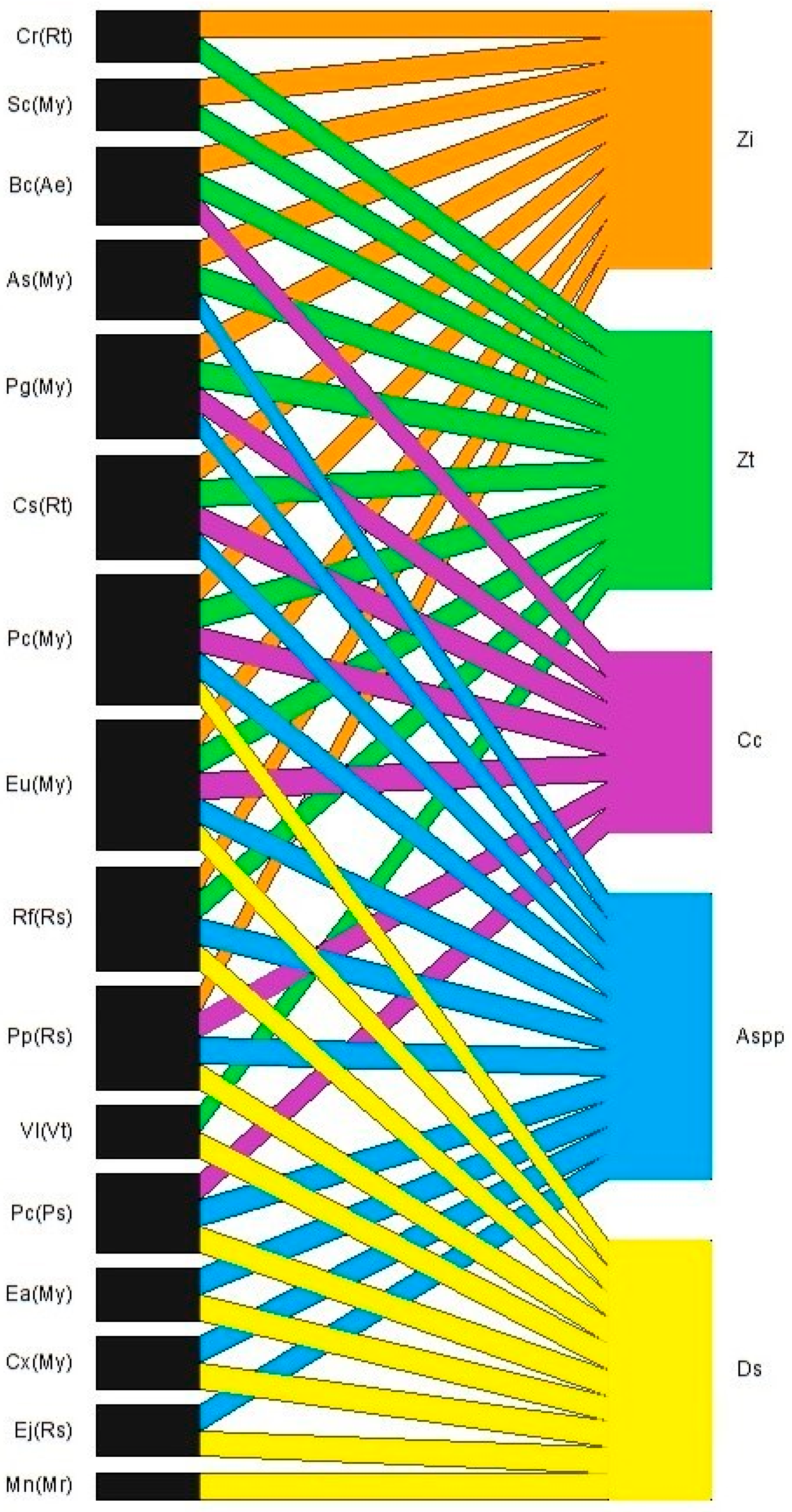
Interactions of the Invasive Fruit Flies Drosophila suzukii, Zaprionus indianus, Zaprionus tuberculatus and Ceratitis capitata with Their Hosts in the Brazilian Pampa Biome

 , , ,
, , ,  and
and 
Simple Summary
Abstract
1. Introduction
2. Materials and Methods
2.1. Fruit Sampling
2.2. Fruit Packaging and Insect Emergence
2.3. Insect and Plant Identification
2.4. Data Analysis
3. Results
4. Discussion
5. Conclusions
Author Contributions
Funding
Data Availability Statement
Acknowledgments
Conflicts of Interest
References
- Wollmann, J.; Schlesener, D.C.H.; Mendes, S.R.; Krüger, A.P.; Martins, L.N.; Bernardi, D.; Garcia, M.S.; Garcia, F.R.M. Infestation index of Drosophila suzukii (Diptera: Drosophilidae) in small fruit in southern Brazil. Arq. Inst. Biol. 2020, 87, e0432018. [Google Scholar] [CrossRef]
- Brasil. Ministério do Meio Ambiente. Available online: https://www.gov.br/mma/pt-br/assuntos/biodiversidade-e-biomas (accessed on 28 October 2024).
- Ribeiro, S.; Moreira, L.F.B.; Overbeck, G.E.; Maltchik, L. Protected Areas of the Pampa biome presented land use incompatible with conservation purposes. J. Land Use Sci. 2021, 16, 260–272. [Google Scholar] [CrossRef]
- Hilman, R.; Abot, A.R.; Garcia, F.R.M. Prioritization of absent quarantine pests in Brazil through the Analytical Hierarchy Process. Braz. J. Biol. 2023, 83, e274333. [Google Scholar] [CrossRef]
- Brack, P.; Köhler, M.; Corrêa, C.A.; Ardissone, R.E.; Sobral, M.E.G.; Kinupp, V.F. Native fruits of Rio Grande do Sul, Brazil: Richness and potential as food. Rodriguésia 2021, 71, e03102018. [Google Scholar] [CrossRef]
- Balmès, V.; Mouttet, R. The drosophilid risk on imports. EPPO Bull. 2019, 49, 122–126. [Google Scholar] [CrossRef]
- Garcia, F.R.M. Introduction to Drosophila sukuzii Management. In Drosophila suzukii Management, 1st ed.; Garcia, F.R.M., Ed.; Springer International Publishing: New York, NY, USA, 2020; pp. 1–9. [Google Scholar] [CrossRef]
- Deprá, M.; Poppe, J.L.; Schmitz, H.J.; De Toni, D.C.; Valente, V.L. The first records of the invasive pest Drosophila suzukii in the South American continent. J. Pest Sci. 2014, 87, 379–383. [Google Scholar] [CrossRef]
- Vilela, C.R. Is Zaprionus indianus Gupta, 1970 (Diptera, Drosophilidae) currently colonizing the Neotropical region? Drosoph. Inf. Serv. 1999, 82, 37–39. [Google Scholar]
- Viana, J.P.C.; Viana, M.C.; Cavalcanti, F.A.G.S.; Mateus, R.P.; Bitner-Mathé, B.C.; Garcia, F.R.M.; Jobim, K.; Madi-Ravazzi, L.; Rohde, C.; Martins, M.B.; et al. Assessing the potential spread of Zaprionus tuberculatus (Diptera: Drosophilidae) in the Americas: Insights for proactive management and agricultural protection. J. Econ. Entomol. 2025, 118, 195–202. [Google Scholar] [CrossRef]
- CABI. Ceratitis capitata; CABI: Wallingford, UK, 2024. Available online: https://www.cabidigitallibrary.org/doi/full/10.1079/cabicompendium.12367 (accessed on 28 October 2024).
- Garcia, F.R.M.; Lasa, R.; Funes, C.F.; Buzzetti, K. Drosophila suzukii management in Latin America: Current status and perspectives. J. Econ. Entomol. 2022, 115, 1008–1023. [Google Scholar] [CrossRef] [PubMed]
- Lasa, R.; Tadeo, E. Invasive drosophilid pests Drosophila suzukii and Zaprionus indianus (Diptera: Drosophilidae) in Veracruz, Mexico. Fla. Entomol. 2015, 98, 987–988. [Google Scholar] [CrossRef]
- Kamel, M.B.H.; Cheik, Z.B.; Zouari, S.; Balmès, V. First report of Z. tuberculatus (Diptera: Drosophilidae) in Tunisia. EPPO Bull. 2020, 50, 307–310. [Google Scholar] [CrossRef]
- Yassin, A.; David, J.R. Revision of the Afrotropical species of Zaprionus (Diptera, Drosophilidae), with descriptions of two new species and notes on internal reproductive structures and immature stages. Zookeys 2010, 51, 33–72. [Google Scholar] [CrossRef]
- Eppo. Mini Datasheet on Zaprionus tuberculatus (Diptera: Drosophilidae); Eppo: Luxembourg, 2023. Available online: https://gd.eppo.int/download/doc/1437_minids_ZAPRTU.pdf (accessed on 7 February 2024).
- Enkerlin, E.; Garcia, L.; Lopez, F. Mexico, Central and South America. In Their Biology, Natural Enemies and Control; Robinson, A.S., Hooper, G., Eds.; World Crop Pests 3 (A): Amsterdam, The Netherlands, 1989; pp. 83–90. [Google Scholar]
- Cavalcanti, F.A.G.S.; Ribeiro, L.B.; Martins, G.; Tonelli, G.S.S.S.; Báo, S.N.; Yassin, A.; Tidon, R. Geographic Expansion of an Invasive Fly: First Record of Zaprionus tuberculatus (Diptera: Drosophilidae) in the Americas. Ann. Entomol. Soc. Am. 2022, 115, 267–274. [Google Scholar] [CrossRef]
- Garcia, F.R.M.; Adaime, R.; de Jesus, C.R.; Raga, A.; Araujo, E.L.; de Miranda, S.H.G.; Filho, M.d.S. Fruit Fly Management in Brazil: Current Status and Perspectives. In Management of Fruit Flies in the Americas; Garcia, F.R.M., Ed.; Springer: Cham, Switzerland, 2024; pp. 235–288. [Google Scholar] [CrossRef]
- Vasconcelos, A.S.; Azevedo, T.S.; Santos, R.S. Primeiro registro de Zaprionus indianus Gupta (Diptera: Drosophilidae) no estado do Acre, Brasil. EntomoBrasilis 2017, 10, 60–63. [Google Scholar] [CrossRef]
- Garcia, F.R.M.; Oliveira, E.E. Potential Ecological Interactions and Challenges for the Management of Spotted-Wing Drosophila in Recently Invaded Regions. Neotrop. Entomol. 2024, 53, 186–188. [Google Scholar] [CrossRef] [PubMed]
- Yuzuki, K.; Tidon, R. Identification key for drosophilid species (Diptera, Drosophilidae) exotic to the Neotropical Region and occurring in Brazil. Rev. Bras. Entomol. 2020, 64, e2019100. [Google Scholar] [CrossRef]
- White, I.M.; Elson-Harris, M.M. Fruit Flies of Economic Significance: Their Identification and Bionomics; CAB International: Wallingford, UK, 1992; p. 600. [Google Scholar]
- Lorenzi, H. Árvores Brasileiras: Manual de Identificação e Cultivo de Plantas Arbóreas Nativas do Brasil, 5th ed.; Instituto Plantarum: Nova Odessa, Brazil, 2016; Volume 1, pp. 384p. [Google Scholar]
- Vieira, J.G.A.; Wollmann, J.; Schlesener, D.C.H.; Mendes, S.R.; Garcia, F.R.M. Níveis de infestação de Zaprionus indianus (Diptera: Drosophilidae) em diferentes frutos hospedeiros. Rev. Ciênc. Agrovet. 2019, 18, 268–273. [Google Scholar] [CrossRef]
- Dormann, C.F.; Gruber, B.; Fründ, J. Introducing the bipartite package: Analyzing ecological networks. R News 2008, 8, 8–11. [Google Scholar]
- Buck, N.; Fountain, M.T.; Potts, S.G.; Bishop, J.; Garratt, M.P.D. The effects of non-crop habitat on spotted wing Drosophila (Drosophila suzukii) abundance in fruit systems: A meta-analysis. Agric. Forest. Entomol. 2023, 25, 66–76. [Google Scholar] [CrossRef]
- Gentili, R.; Quaglini, L.A.; Galasso, G.; Montagnani, C.; Caronni, S.; Cardarelli, E.; Citterio, S. Urban refugia sheltering biodiversity across world cities. Urban Ecosyst. 2024, 27, 219–230. [Google Scholar] [CrossRef]
- Santos, J.P.; Menezes-Netto, A.C.; Ansiliero, A.A.; Werner, S.S.; Lins Junior, J.C. Infestação de moscas-das-frutas e sua relação com os compostos fenólicos de frutos de mirtáceas nativas. Agropecu. Catarin. 2022, 35, 43–48. [Google Scholar] [CrossRef]
- Simberloff, D.; Martin, J.; Genovesi, P.; Maris, V.; Wardle, D.A.; Aronson, J.; Courchamp, F.; Galil, B.; García-Berthou, E.; Pascal, M.; et al. Impacts of biological invasions: What is what and the way forward. Trends Ecol. Evol. 2013, 28, 58–66. [Google Scholar] [CrossRef]
- Mcquate, G.T.; Liquido, N.J. Host plants of invasive tephritid fruit fly species of economic importance. Int. J. Plant. Biol. 2017, 5, 1072. [Google Scholar]
- Bolda, M.P.; Goodhue, R.E.; Zalom, F.G. Spotted wing drosophila: Potential economic impact of a newly established pest. Giannini Found. Agric. Econ. 2010, 13, 5–8. [Google Scholar]
- Lee, J.C.; Bruck, D.J.; Dreves, A.J.; Ioriatti, C.; Vogt, H.; Baufeld, P. In focus: Spotted wing Drosophila, Drosophila suzukii, across perspectives. Pest Manag. Sci. 2011, 67, 1349–1351. [Google Scholar] [CrossRef]
- Andreazza, F.; Bernardi, D.; Baronio, C.A.; Pasinato, J.; Nava, D.E.; Botton, M. Toxicities and effects of insecticidal toxic baits to control Drosophila suzukii and Zaprionus indianus (Diptera: Drosophilidae). Pest Manag. Sci. 2017, 73, 146–152. [Google Scholar] [CrossRef] [PubMed]
- Shaw, B.; Brain, P.; Wijen, H.; Fountain, M.T. Reducing Drosophila suzukii emergence through inter-species competition. Pest Manag. Sci. 2018, 74, 1466–1471. [Google Scholar] [CrossRef]
- da Silva, C.S.B.; Park, K.R.; Blood, R.A.; Walton, V.M. Intraspecific Competition Affects the Pupation Behavior of Spotted-Wing Drosophila (Drosophila suzukii). Sci. Rep. 2019, 9, 7775. [Google Scholar] [CrossRef] [PubMed]
- Shrader, M.E.; Burrack, H.J.; Pfeiffer, D.G. Effects of Interspecific Larval Competition on Developmental Parameters in Nutrient Sources Between Drosophila suzukii (Diptera: Drosophilidae) and Zaprionus indianus. J. Econ. Entomol. 2020, 113, 230–238. [Google Scholar] [CrossRef]
- Keesey, I.W.; Koerte, S.; Retzke, T.; Haverkamp, A.; Hansson, B.S.; Knaden, M. Adult Frass Provides a Pheromone Signature for Drosophila Feeding and Aggregation. J. Chem. Ecol. 2016, 42, 739–747. [Google Scholar] [CrossRef] [PubMed]
- Kienzle, R.; Rohlfs, M. Mind the Wound!—Fruit Injury Ranks Higher than, and Interacts with, Heterospecific Cues for Drosophila suzukii Oviposition. Insects 2021, 12, 424. [Google Scholar] [CrossRef]
- Dweck, H.K.M.; Ebrahim, S.A.M.; Thoma, M.; Mohamed, A.A.M.; Keesey, I.W.; Trona, F.; Lavista-llanos, S.; Svatos, A.; Sachse, S.; Knaden, M.; et al. Pheromones mediating copulation and attraction in Drosophila. Proc. Natl. Acad. Sci. USA 2015, 112, E2835. [Google Scholar] [CrossRef]
- Tait, G.; Park, K.; Nieri, R.; Crava, M.C.; Mermer, S.; Clappa, E.; Boyer, G.; Dalton, D.T.; Carlin, S.; Brewer, L.; et al. Reproductive Site Selection: Evidence of an Oviposition Cue in a Highly Adaptive Dipteran, Drosophila suzukii (Diptera: Drosophilidae). Environ. Entomol. 2020, 49, 355–363. [Google Scholar] [CrossRef] [PubMed]
- Reyes-Ramírez, A.; Belgaidi, Z.; Gilbert, P.; Pommier, T.; Siberchicot, A.; Mount, L.; Desouhant, E. Larval density in the invasive Drosophila suzukii: Immediate and delayed effects on life-history traits. Ecol. Evol. 2023, 13, e10433. [Google Scholar] [CrossRef] [PubMed]
- Buonocore-Biancheri, M.J.; Wang, X.; Núñez-Campero, S.R.; Suárez, L.; Schliserman, P.; Ponssa, M.D.; Kirschbaum, D.S.; Garcia, F.R.M.; Ovruski, S.M. The population dynamics and parasitism rates of Ceratitis capitata, Anastrepha fraterculus, and Drosophila suzukii in non-crop hosts: Implications for the management of pest fruit flies. Insects 2024, 15, 61. [Google Scholar] [CrossRef]
- Zucchi, R.A.; Moraes, R.C.B. Fruit Flies in Brazil—Hosts and Parasitoids of the Mediterranean Fruit Fly. 2024. Available online: http://www.lea.esalq.usp.br/ceratitis/ (accessed on 7 February 2024).
- Renkema, J.M.; Miller, M.; Fraser, H.; Légaré, J.-P.H.; Hallett, R.H. First records of Zaprionus indianus Gupta (Diptera: Drosophilidae) from commercial fruit fields in Ontario and Quebec, Canadá. J. Entomol. Soc. Ont. 2013, 144, 125–130. [Google Scholar] [CrossRef]
- Patlar, B.; Koc, B.; Yilmaz, M.; Ozsoy, E.D. First records of Zaprionus tuberculatus (Diptera: Drosophilidae) from the Mediterranean Region, Turkey. Drosoph. Inf. Serv. 2012, 95, 94–96. [Google Scholar]
- Kuyulu, A.; Yücel, S.; Genç, H. Molecular identification of invasive drosophilid Zaprionus tuberculatus Malloch (Diptera: Drosophilidae) in Çanakkale, Turkey. Turk. J. Zool. 2019, 43, 531–535. [Google Scholar] [CrossRef]
- Bernardi, D.; Andreazza, F.; Botton, M.; Baronio, C.A.; Nava, D.E. Susceptibility and Interactions of Drosophila suzukii and Zaprionus indianus (Diptera: Drosophilidae) in Damaging Strawberry. Neotrop. Entomol. 2017, 46, 1–7. [Google Scholar] [CrossRef]
- ABRAFRUTAS. Associação Brasileira dos Produtores Exportadores de Frutas e Derivados. Available online: https://abrafrutas.org/dados-estatisticos (accessed on 19 January 2024).
- Santos, J.P.; Fiedler, M.; Menezes-Netto, A.C.; Boff, M.I.C.; Garcia, F.R.M. Primeiro registro de Zaprionus tuberculatus (Diptera: Drosophilidae) no estado de Santa Catarina, Brasil. Agropecu. Catarin. 2023, 36, 22–25. [Google Scholar] [CrossRef]
- Fernandes, D.R.R.; Araújo, E.L. Ocorrência de Zaprionus indianus Gupta (Diptera: Drosophilidae) em frutos de juazeiro Ziziphus joazeiro Mart. (Rhamnaceae) no estado do Rio Grande do Norte. Rev. Bras. Frutic. 2011, 33, 1356–1358. [Google Scholar] [CrossRef]
- Pasini, M.P.B.; Lúcio, D.C. Ocorrência da mosca-do-figo no Rio Grande do Sul e sua emergência em diferentes frutas. Rev. Cienc. Agrar. 2014, 57, 318–321. [Google Scholar] [CrossRef]
- Schliserman, P.; Aluja, M.; Rull, J.; Ovruski, S.M. Habitat degradation and introduction of exotic plants favor persistence of invasive species and population growth of native polyphagous fruit fly pests in a Northwestern Argentinean mosaic. Biol. Invasions 2014, 16, 2599–2613. [Google Scholar] [CrossRef]
- Jobim, K.; Kaster, P.L.; da Rosa, B.R.; Tidon, R.; Garcia, F.R.M. Expansion of the area of occurrence of Zaprionus tuberculatus (Diptera: Drosophilidae) in the Americas and registration of new host plants. Braz. J. Biol. 2023, 83, e273916. [Google Scholar] [CrossRef] [PubMed]
- Moreira, M.M.; Dias, L.d.P.B.; Sena, L.C.d.P.; Neto, J.L.; de Medeiros, H.F.; Yotoko, K. First Record of Zaprionus tuberculatus Malloch, 1932 (Diptera: Drosophilidae) in Minas Gerais, Brazil. Rev. Bras. Entomol. 2023, 67, e20230031. [Google Scholar] [CrossRef]
- Faria, G.S.; Bitner-Mathé, B.C. Occurrence of Zaprionus tuberculatus on the Southeastern Brazil coastal plain, in Rio de Janeiro. Dros. Inf. Serv. 2023, 106, e273916. [Google Scholar]
- Hernández-Ortíz, V.; Barradas-Juanz, N.; Díaz-Castelazo, C. A Review of the Natural Host Plants of the Anastrepha fraterculus Complex in the Americas. In Area-Wide Management of Fruit Fly Pests; Perez-Staples, D., Diaz-Fleischer, F., Montoya, P., Vera, M., Eds.; CRC Press: Boca Raton, FL, USA, 2019; pp. 90–112. [Google Scholar]
- Norrbom, A.L. Host Plant Database for Anastrepha and Toxotrypana (Diptera: Tephritidae: Toxotrypanini). In Diptera Data Dis-semination Disk [CD-ROM] 2; North American Dipterist’s Society: Washington, DC, USA, 2004. [Google Scholar]
- Mack, R.N.; Simberloff, D.; Mark, L.W.; Evans, H.; Clout, M.; Bazzaz, F.A. Biotic invasions: Causes, epidemiology, global consequences, and control. Ecol. Appl. 2000, 10, 689–710. [Google Scholar] [CrossRef]
- Gress, B.E.; Zalom, F.G. Identification and risk assessment of spinosad resistance in a California population of Drosophila suzukii. Pest. Manag. Sci. 2019, 75, 1270–1276. [Google Scholar] [CrossRef]


| Host Plants | Abbreviation | Origin | Common Name | Coordinates * |
|---|---|---|---|---|
| Arecaceae | ||||
| Butia capitata | Bc(Ae) | N | Jelly palm | Area 1 |
| Moraceae | ||||
| Morus nigra | Mn(Mr) | E | Black mulberry | Areas 2, 3, 4, and 5 |
| Myrtaceae | ||||
| Psidium cattleianum | Pc(My) | N | Strawberry guava | Areas 6, 7, 8, and 9 |
| Eugenia aggregata | Ea(My) | N | Cherry | Area 10 |
| Psidium guajava | Pg(My) | N | Guava | Area 11 |
| Acca sellowiana | As(My) | N | Feijoa | Area 10 |
| Campomanesia xanthocarpa | Cx(My) | N | Guabiroba | Areas 9 and 10 |
| Syzygium cumini | Sc(My) | E | Jamelão | Areas 12 and 13 |
| Eugenia uniflora | Eu(My) | N | Surinam cherry | Areas 1, 10, 7, 14, 15, and 16 |
| Passifloraceae | ||||
| Passiflora caerulea | Pc(Ps) | N | Blue passion flower | Areas 5 and 18 |
| Rosaceae | ||||
| Eriobotrya japonica | Ej(Rs) | E | Loquat | Areas 8, 9 and 19 |
| Prunus pérsica var. nucipersica, | Pp(Rs) | E | Nectarine | Area 16 |
| Rubus fruticosus | Rf(Rs) | E | Blackberry | Area 19 |
| Rutaceae | ||||
| Citrus reticulata | Cr(Rt) | E | Tangerine | Area 8 |
| Citrus sinensis | Cs(Rt) | E | Sweet orange | Area 5 |
| Vitaceae | ||||
| Vitis labrusca cv Isabel | Vl(Vt) | E | Fox grape | Area 9 |
| PFI (%). | M/n | M/PF | ||||||||||||||
|---|---|---|---|---|---|---|---|---|---|---|---|---|---|---|---|---|
| Origin | Host | Ds | Zi | Zt | Aspp | CC | Ds | Zi | Zt | Aspp | CC | Ds | Zi | Zt | Aspp | CC |
| Ground | Bc(Ae) | 0.0 | 82.7 | 52.9 | 0.0 | 0.9 | 0.0 | 15.1 | 5.4 | 0.0 | 1.0 | 0.0 | 1323.5 | 469.8 | 0.0 | 103.7 |
| Mn(Mr) | 9.3 | 0.0 | 0.0 | 0.0 | 0.0 | 1.2 | 0.0 | 0.0 | 0.0 | 0.0 | 777.1 | 0.0 | 0.0 | 0.0 | 0.0 | |
| As(My) | 0.0 | 17.1 | 7.3 | 80.5 | 0.0 | 0.0 | 3.3 | 4.3 | 1.7 | 0.0 | 0.0 | 153.8 | 184.4 | 72.4 | 0.0 | |
| Cx(My) | 5.4 | 0.0 | 0.0 | 8.1 | 0.0 | 1.3 | 0.0 | 0.0 | 1.5 | 0.0 | 574.7 | 0.0 | 0.0 | 761.5 | 0.0 | |
| Ea(My) | 63.8 | 0.0 | 0.0 | 28.0 | 0.0 | 1.5 | 0.0 | 0.0 | 1.4 | 0.0 | 249.6 | 0.0 | 0.0 | 105.6 | 0.0 | |
| Eu(My) | 26.9 | 17.8 | 9.2 | 15.7 | 0.2 | 1.7 | 7.1 | 4.9 | 1.1 | 1.0 | 773.2 | 3192.1 | 2392.7 | 550.7 | 303.7 | |
| Pc(My) | 1.6 | 34.1 | 6.3 | 35.0 | 6.3 | 1.4 | 4.7 | 2.1 | 1.2 | 1.8 | 251.8 | 1139.7 | 434.4 | 352.4 | 421.7 | |
| Pg(My) | 0.0 | 59.2 | 42.9 | 100.0 | 4.1 | 0.0 | 14.6 | 2.7 | 3.2 | 1.0 | 0.0 | 353.4 | 66.0 | 79.8 | 27.8 | |
| Sc(My) | 0.0 | 61.3 | 9.3 | 0.0 | 0.0 | 0.0 | 4.8 | 1.3 | 0.0 | 0.0 | 0.0 | 1001.8 | 265.0 | 0.0 | 0.0 | |
| Pc(Ps) | 8.0 | 0.0 | 0.0 | 92.0 | 0.0 | 1.5 | 0.0 | 0.0 | 1.3 | 0.0 | 244.4 | 0.0 | 0.0 | 216.9 | 0.0 | |
| Pp(Rs) | 1.4 | 11.3 | 0.0 | 4.2 | 8.5 | 1.0 | 2.5 | 0.0 | 1.0 | 1.5 | 58.4 | 849.1 | 0.0 | 70.9 | 692.6 | |
| Cr(Rt) | 0.0 | 57.1 | 71.4 | 0.0 | 0.0 | 0.0 | 8.3 | 13.4 | 0.0 | 0.0 | 0.0 | 176.5 | 244.6 | 0.0 | 0.0 | |
| Cs(Rt) | 0.0 | 54.8 | 48.7 | 0.5 | 15.7 | 0.0 | 13.8 | 18.4 | 1.0 | 6.1 | 0.0 | 158.7 | 217.9 | 10.6 | 62.1 | |
| Plant | Ea(My) | 86.5 | 0.0 | 0.0 | 59.5 | 0.0 | 6.2 | 0.0 | 0.0 | 1.2 | 0.0 | 1739.1 | 0.0 | 0.0 | 520.7 | 0.0 |
| Eu(My) | 80.0 | 28.0 | 36.0 | 28.0 | 0.0 | 1.8 | 2.9 | 3.9 | 1.0 | 0.0 | 930.7 | 1866.5 | 2595.2 | 433.8 | 0.0 | |
| Pc(My) | 0.0 | 31.1 | 0.0 | 19.7 | 3.3 | 0.0 | 7.5 | 0.0 | 1.3 | 2.0 | 0.0 | 1320.4 | 0.0 | 198.1 | 413.0 | |
| Pc(Ps) | 0.0 | 0.0 | 0.0 | 66.1 | 0.8 | 0.0 | 0.0 | 0.0 | 3.1 | 1.0 | 0.0 | 0.0 | 0.0 | 343.5 | 159.6 | |
| Ej(Rs) | 2.0 | 0.0 | 0.0 | 16.0 | 0.0 | 1.0 | 0.0 | 0.0 | 1.3 | 0.0 | 80.9 | 0.0 | 0.0 | 74.1 | 0.0 | |
| Rf(Rs) | 61.5 | 18.2 | 7.4 | 37.2 | 0.0 | 5.1 | 1.8 | 1.6 | 1.2 | 0.0 | 619.3 | 498.7 | 452.0 | 404.7 | 0.0 | |
| Cs(Rt) | 0.0 | 10.0 | 0.0 | 0.0 | 16.7 | 0.0 | 16.3 | 0.0 | 0.0 | 9.0 | 0.0 | 173.3 | 0.0 | 0.0 | 100.7 | |
| Vl(Vt) | 3.4 | 0.0 | 6.9 | 0.0 | 0.0 | 2.5 | 0.0 | 1.2 | 0.0 | 0.0 | 940.5 | 0.0 | 429.3 | 0.0 | 0.0 | |
Disclaimer/Publisher’s Note: The statements, opinions and data contained in all publications are solely those of the individual author(s) and contributor(s) and not of MDPI and/or the editor(s). MDPI and/or the editor(s) disclaim responsibility for any injury to people or property resulting from any ideas, methods, instructions or products referred to in the content. |
© 2025 by the authors. Licensee MDPI, Basel, Switzerland. This article is an open access article distributed under the terms and conditions of the Creative Commons Attribution (CC BY) license (https://creativecommons.org/licenses/by/4.0/).
Share and Cite
Jobim, K.; da Rosa, B.R.; Kaster, P.d.L.; Ovruski, S.M.; Garcia, F.R.M. Interactions of the Invasive Fruit Flies Drosophila suzukii, Zaprionus indianus, Zaprionus tuberculatus and Ceratitis capitata with Their Hosts in the Brazilian Pampa Biome. Insects 2025, 16, 1285. https://doi.org/10.3390/insects16121285
Jobim K, da Rosa BR, Kaster PdL, Ovruski SM, Garcia FRM. Interactions of the Invasive Fruit Flies Drosophila suzukii, Zaprionus indianus, Zaprionus tuberculatus and Ceratitis capitata with Their Hosts in the Brazilian Pampa Biome. Insects. 2025; 16(12):1285. https://doi.org/10.3390/insects16121285
Chicago/Turabian StyleJobim, Karina, Bárbara Rafaela da Rosa, Pedro da Luz Kaster, Sergio Marcelo Ovruski, and Flávio Roberto Mello Garcia. 2025. "Interactions of the Invasive Fruit Flies Drosophila suzukii, Zaprionus indianus, Zaprionus tuberculatus and Ceratitis capitata with Their Hosts in the Brazilian Pampa Biome" Insects 16, no. 12: 1285. https://doi.org/10.3390/insects16121285
APA StyleJobim, K., da Rosa, B. R., Kaster, P. d. L., Ovruski, S. M., & Garcia, F. R. M. (2025). Interactions of the Invasive Fruit Flies Drosophila suzukii, Zaprionus indianus, Zaprionus tuberculatus and Ceratitis capitata with Their Hosts in the Brazilian Pampa Biome. Insects, 16(12), 1285. https://doi.org/10.3390/insects16121285