
Genetic Differentiation of Bisexual and Parthenogenetic Populations of Plant Louse Cacopsylla ledi (Hemiptera, Psylloidea)

 , , , , and
Simple Summary
Abstract
1. Introduction
2. Materials and Methods
2.1. Taxon Sampling
2.2. Cytological Studies
2.3. DNA Extraction
2.4. mtDNA PCR and Sequencing
2.5. Detection of Wolbachia Endosymbionts
3. Results
3.1. Haplotype Diversity
3.2. Sex Ratio in Populations
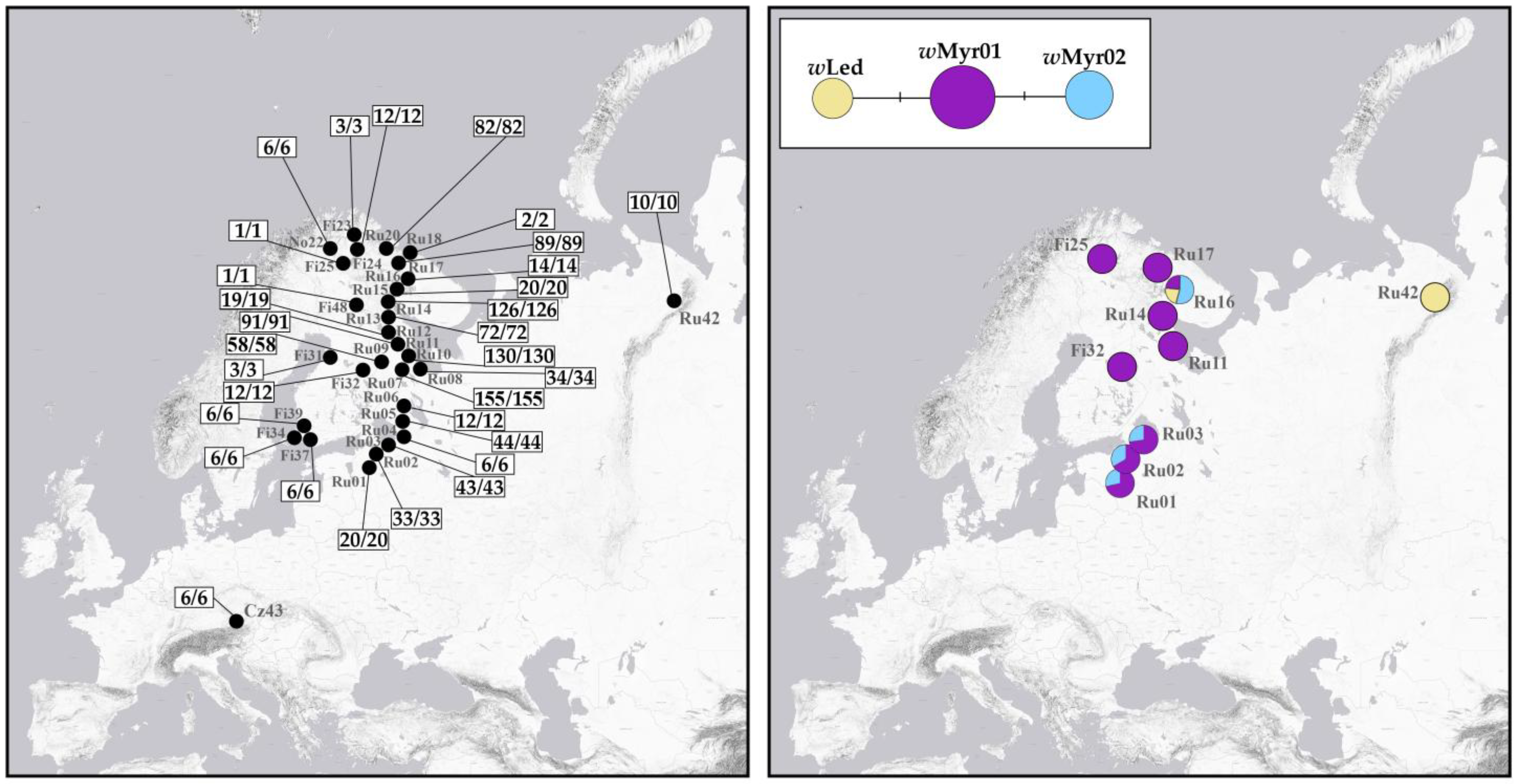
3.3. Wolbachia Infection
3.4. Cytological Analysis of Ploidy Level and Its Relationship with COI Haplotypes
4. Discussion
4.1. Phylogeographic Patterns Depending on the Mode of Reproduction
4.2. Wolbachia Infection
5. Conclusions
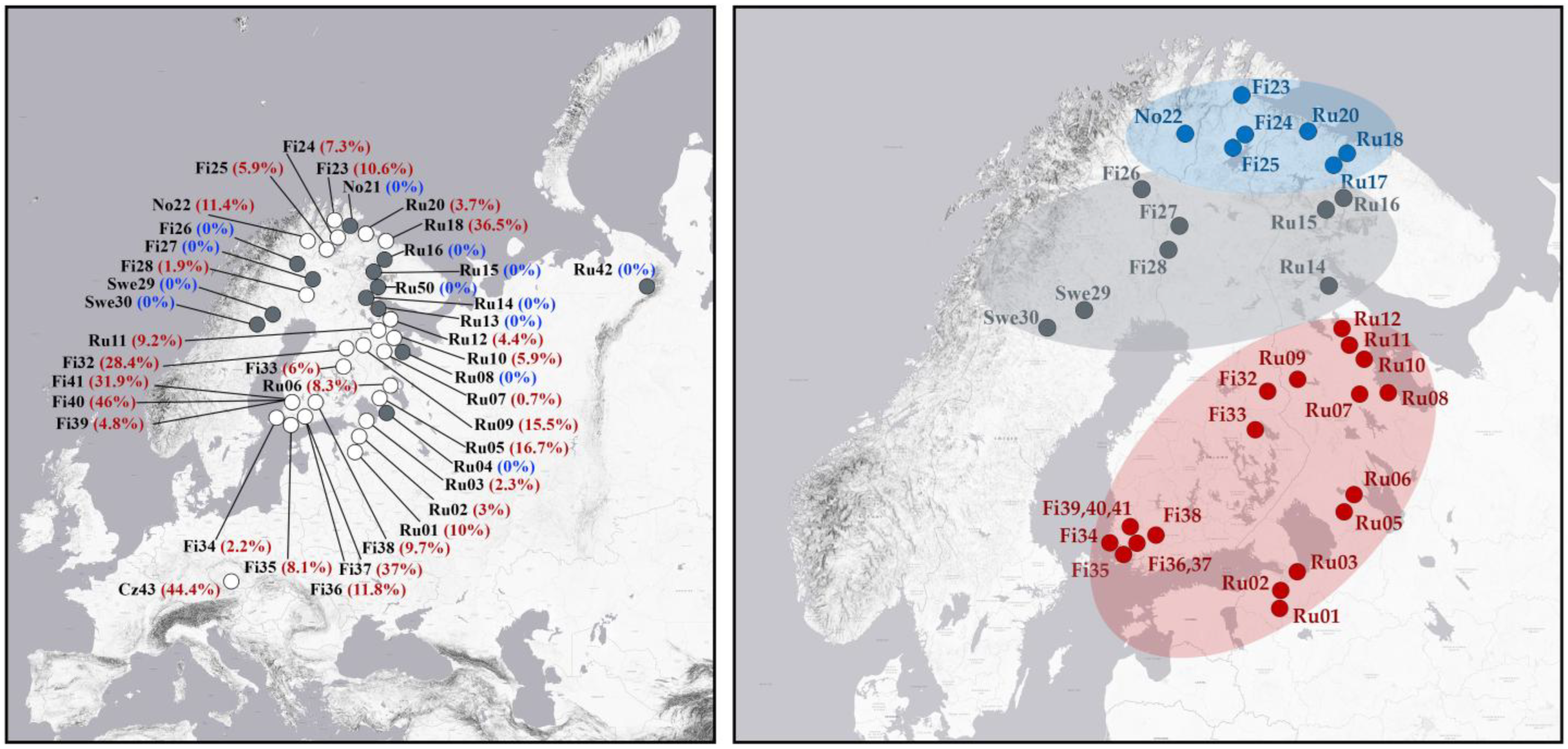
- The plant louse C. ledi exhibits two different reproductive strategies throughout its distribution range: parthenogenetic and bisexual. Parthenogens are geographically widespread and have been found in all studied populations, with the exception of an isolated Central European population in the Southern Bohemia. Bisexuals occupy two geographically separated zones and appear to have emerged at least twice in the evolutionary history of C. ledi. Bisexuals found in central Europe and southern Fennoscandia are of ancestral origin, while those inhabiting northern Fennoscandia have emerged recently as a reversion from a parthenogenetic lineage.
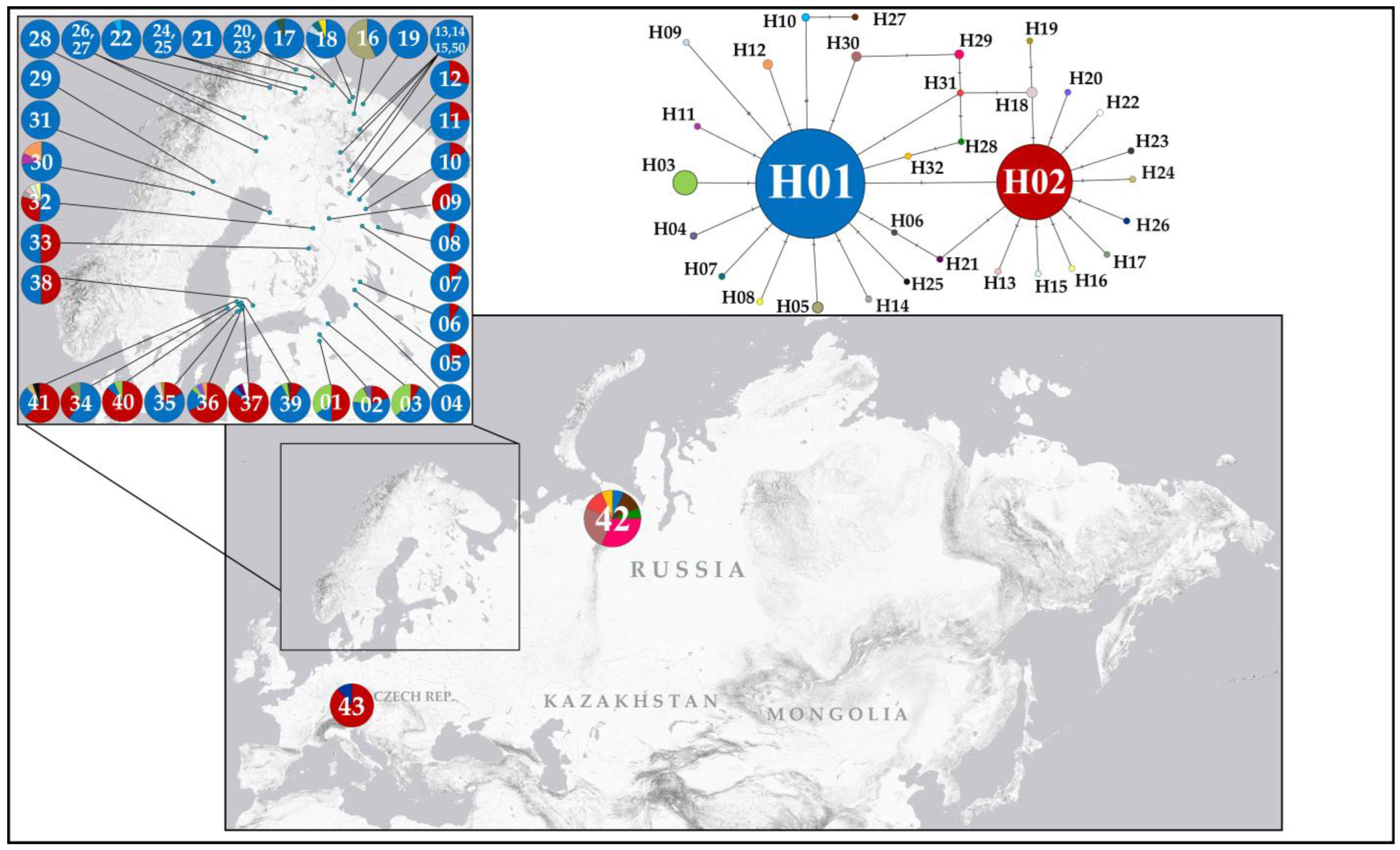
- Haplotype analysis of DNA barcodes revealed a star-like structure with two dominant, geographically widespread major haplotypes and a number of satellite, mainly private haplotypes. This structure indicates a relatively rapid species expansion of C. ledi, most likely associated with post-glacial recolonization processes.
- The ancestral bisexual lineage is characterised by specific COI haplotypes that were not found in parthenogens, and it can be easily distinguished using DNA barcoding alone.
- Haplotype diversity, reproductive strategies, and shifts in modes of reproduction in C. ledi are not associated with Wolbachia infection. They are likely influenced by other factors, most probably environmental or biogeographical, which warrants further study. Nonetheless, the presence of Wolbachia infection in all analysed C. ledi specimens suggests that the endosymbiont plays an important role in the biology and evolution of the species, potentially contributing to the observed biogeographic patterns. No other Cacopsylla species previously screened for Wolbachia had such a total infection.
Supplementary Materials
Author Contributions
Funding
Data Availability Statement
Acknowledgments
Conflicts of Interest
References
- Psyl’list—The World Psylloidea Database. 2021. Available online: https://data.nhm.ac.uk/dataset/psyl-list/resource/8746ceec-4846-4899-b607-9ba603002033 (accessed on 20 July 2024).
- Drohojowska, J.; Kalandyk-Kołodziejczyk, M.; Simon, E. Thorax morphology of selected species of the genus Cacopsylla (Hemiptera, Psylloidea). ZooKeys 2013, 319, 27–35. [Google Scholar] [CrossRef][Green Version]
- Hodkinson, I.D. Present-day distribution patterns of the Holarctic Psylloidea (Homoptera: Insecta) with particular reference to the origin of the Nearctic fauna. J. Biogeogr. 1980, 7, 127–146. [Google Scholar] [CrossRef]
- Hollis, D. Australian Psylloidea: Jumping Plantlice and Lerp Insects; Australian Biological Resources Study: Canberra, Australia, 2004; 216p, ISBN 9780642568366. [Google Scholar]
- Nokkala, S.; Maryańska-Nadachowska, A.; Kuznetsova, V.G. First evidence of polyploidy in Psylloidea (Homoptera, Sternorrhyncha): A parthenogenetic population of Cacopsylla myrtilli (W. Wagner, 1947) from northeast Finland is apomictic and triploid. Genetica 2008, 133, 201–205. [Google Scholar] [CrossRef]
- Nokkala, C.; Kuznetsova, V.G.; Nokkala, S. Meiosis in rare males in parthenogenetic Cacopsylla myrtilli (Wagner, 1947) (Hemiptera, Psyllidae) populations from northern Europe. Comp. Cytogenet. 2013, 7, 241–251. [Google Scholar] [CrossRef] [PubMed][Green Version]
- Nokkala, C.; Kuznetsova, V.G.; Nokkala, S. Rare diploid females coexist with rare males: A novel finding in triploid parthenogenetic populations in the psyllid Cacopsylla myrtilli (W.Wagner, 1947) (Hemiptera, Psylloidea) in northern Europe. Genetica 2015, 143, 589–595. [Google Scholar] [CrossRef]
- Nokkala, S.; Kuznetsova, V.G.; Nokkala, C. Characteristics of parthenogenesis in Cacopsylla ledi (Flor, 1861) (Hemiptera, Sternorryncha, Psylloidea): Cytological and molecular approaches. Comp. Cytogenet. 2017, 11, 807–817. [Google Scholar] [CrossRef][Green Version]
- Nokkala, S.; Kuznetsova, V.G.; Pietarinen, P.; Nokkala, C. Evolutionary potential of parthenogenesis—Bisexual lineages within triploid apomictic thelytoky in Cacopsylla ledi (Flor, 1861) (Hemiptera, Psylloidea) in Fennoscandia. Insects 2022, 13, 1140. [Google Scholar] [CrossRef]
- Normark, B.B. The evolution of alternative genetic systems in insects. Annu. Rev. Entomol. 2003, 48, 397–423. [Google Scholar] [CrossRef] [PubMed]
- Simon, J.-C.; Delmotte, F.; Rispe, C.; Crease, T. Phylogenetic relationships between parthenogens and their sexual relatives: The possible routes to parthenogenesis in animals. Biol. J. Linn. Soc. 2003, 79, 151–163. [Google Scholar] [CrossRef]
- Maccari, M.; Gómez, A.; Hontoria, F.; Amat, F. Functional rare males in diploid parthenogenetic Artemia. J. Evol. Biol. 2013, 26, 1934–1948. [Google Scholar] [CrossRef]
- Vershinina, A.O.; Kuznetsova, V.G. Parthenogenesis in Hexapoda: Entognatha and non-holometabolous insects. J. Zool. Syst. Evol. Res. 2016, 54, 257–268. [Google Scholar] [CrossRef]
- Nokkala, C.; Kuznetsova, V.G.; Rinne, V.; Nokkala, S. Description of two new species of the genus Cacopsylla Ossiannilsson, 1970 (Hemiptera, Psylloidea) from northern Fennoscandia recognized by morphology, cytogenetic characters and COI barcode sequence. Comp. Cytogenet. 2019, 13, 367–382. [Google Scholar] [CrossRef]
- Labina, E.S.; Nokkala, S.; Maryańska-Nadachowska, A.; Kuznetsova, V.G. The distribution and population sex ratio of Cacopsylla myrtilli (W. Wagner, 1947) (Hemiptera: Psylloidea). Folia Biol. 2009, 57, 157–163. [Google Scholar] [CrossRef]
- Nokkala, C.; Kuznetsova, V.G.; Shapoval, N.A.; Nokkala, S. Phylogeography and Wolbachia infections reveal postglacial recolonization routes of the parthenogenetic plant louse Cacopsylla myrtilli (W. Wagner 1947), (Hemiptera, Psylloidea). J. Zool. Syst. Evol. Res. 2022, 2022, 5458633. [Google Scholar] [CrossRef]
- Shapoval, N.A.; Nokkala, S.; Nokkala, C.; Kuftina, G.N.; Kuznetsova, V.G. The incidence of Wolbachia bacterial endosymbiont in bisexual and parthenogenetic populations of the psyllid genus Cacopsylla (Hemiptera, Psylloidea). Insects 2021, 12, 853. [Google Scholar] [CrossRef] [PubMed]
- Ossiannilsson, F. The Psylloidea (Homoptera) of Fennoscandia and Denmark; Fauna Entomologica Scandinavica; Brill Publishers: Leiden, The Netherlands, 1992; Volume 26, pp. 1–347. [Google Scholar]
- Zeh, D.; Zeh, J.; Bonilla, M. Wolbachia, sex ratio bias and apparent male killing in the harlequin beetle riding pseudoscorpion. Heredity 2005, 95, 41–49. [Google Scholar] [CrossRef]
- Huigens, M.E.; de Almeida, R.P.; Boons, P.A.; Luck, R.F.; Stouthamer, R. Natural interspecific and intraspecific horizontal transfer of parthenogenesis-inducing Wolbachia in Trichogramma wasps. Proc. R. Soc. B Biol. Sci. 2004, 271, 509–515. [Google Scholar] [CrossRef]
- Ali, H.; Muhammad, A.; Bala, N.S.; Wang, G.; Chen, Z.; Peng, Z.; Hou, Y. Genomic evaluations of Wolbachia and mtDNA in the population of coconut hispine beetle, Brontispa longissima (Coleoptera: Chrysomelidae). Mol. Phylogenet. Evol. 2018, 127, 1000–1009. [Google Scholar] [CrossRef]
- Jiang, W.; Zhu, J.; Wu, Y.; Li, L.; Li, Y.; Ge, C.; Wang, Y.; Endersby, N.M.; Hoffmann, A.A.; Yu, W. Influence of Wolbachia infection on mitochondrial DNA variation in the genus Polytremis (Lepidoptera: Hesperiidae). Mol. Phylogenet. Evol. 2018, 129, 158–170. [Google Scholar] [CrossRef]
- Whitworth, T.L.; Dawson, R.D.; Magalon, H.; Baudry, E. DNA barcoding cannot reliably identify species of the blowfly genus Protocalliphora (Diptera: Calliphoridae). Proc. R. Soc. B Biol. Sci. 2007, 274, 1731–1739. [Google Scholar] [CrossRef] [PubMed]
- Charlat, S.; Duplouy, A.; Hornett, E.A.; Dyson, E.A.; Davies, N.; Roderick, G.K.; Wedell, N.; Hurst, G.D.D. The joint evolutionary histories of Wolbachia and mitochondria in Hypolimnas bolina. BMC Evol. Biol. 2009, 9, 64. [Google Scholar] [CrossRef]
- Narita, S.; Nomura, M.; Kato, Y.; Fukatsu, T. Genetic structure of sibling butterfly species affected by Wolbachia infection sweep: Evolutionary and biogeographical implications. Mol. Ecol. 2006, 15, 1095–1108. [Google Scholar] [CrossRef]
- Ballard, J.W.O. Comparative genomics of mitochondrial DNA in Drosophila simulans. J. Mol. Evol. 2000, 51, 64–75. [Google Scholar] [CrossRef] [PubMed]
- Ballard, J.W.O. When one is not enough: Introgression of mitochondrial DNA in Drosophila. Mol. Biol. Evol. 2000, 17, 1126–1130. [Google Scholar] [CrossRef] [PubMed]
- Jiggins, F.M. Male-killing Wolbachia and mitochondrial DNA: Selective sweeps, hybrid introgression and parasite population dynamics. Genetics 2003, 164, 5–12. [Google Scholar] [CrossRef]
- Rousset, F.; Solignac, M. Evolution of single and double Wolbachia symbioses during speciation in the Drosophila simulans complex. Proc. Natl. Acad. Sci. USA 1995, 92, 6389–6393. [Google Scholar] [CrossRef]
- Murray, M.G.; Thompson, W.F. Rapid isolation of high molecular weight plant DNA. Nucleic Acids Res. 1980, 8, 4321–4325. [Google Scholar] [CrossRef] [PubMed]
- Lukhtanov, V.A.; Shapoval, N.A. Detection of cryptic species in sympatry using population analysis of unlinked genetic markers: A study of the Agrodiaetus kendevani species complex (Lepidoptera: Lycaenidae). Dokl. Biol. Sci. 2008, 423, 432–436. [Google Scholar] [CrossRef]
- Lukhtanov, V.A.; Shapoval, N.A.; Dantchenko, A.V. Agrodiaetus shahkuhensis sp. n. (Lepidoptera, Lycaenidae), a cryptic species from Iran discovered by using molecular and chromosomal markers. Comp. Cytogenet. 2008, 2, 99–114. [Google Scholar]
- Shapoval, N.A.; Kir’yanov, A.V.; Krupitsky, A.V.; Yakovlev, R.V.; Romanovich, A.E.; Zhang, J.; Cong, Q.; Grishin, N.V.; Kovalenko, M.G.; Shapoval, G.N. Phylogeography of two enigmatic sulphur butterflies, Colias mongola Alphéraky, 1897 and Colias tamerlana Staudinger, 1897 (Lepidoptera, Pieridae), with relations to Wolbachia Infection. Insects 2023, 14, 943. [Google Scholar] [CrossRef]
- Kuznetsova, V.G.; Labina, E.S.; Shapoval, N.A.; Maryańska-Nadachowska, A.; Lukhtanov, V.A. Cacopsylla fraudatrix sp.n. (Hemiptera: Psylloidea) recognised from testis structure and mitochondrial gene COI. Zootaxa 2012, 3547, 55–63. [Google Scholar] [CrossRef]
- Clement, M.; Posada, D.; Crandall, K.A. TCS: A computer program to estimate gene genealogies. Mol. Ecol. 2000, 9, 1657–1659. [Google Scholar] [CrossRef]
- Leigh, J.W.; Bryant, D. PopART: Full-feature software for haplotype network construction. Methods Ecol. Evol. 2015, 6, 1110–1116. [Google Scholar] [CrossRef]
- Kumar, S.; Stecher, G.; Tamura, K. MEGA7: Molecular evolutionary genetics analysis version 7.0 for bigger datasets. Mol. Biol. Evol. 2016, 33, 1870–1874. [Google Scholar] [CrossRef]
- Rozas, J.; Ferrer-Mata, A.; Sánchez-DelBarrio, J.C.; Guirao-Rico, S.; Librado, P.; Ramos-Onsins, S.E.; Sánchez-Gracia, A. DnaSP 6: DNA sequence polymorphism analysis of large data sets. Mol. Biol. Evol. 2017, 34, 3299–3302. [Google Scholar] [CrossRef]
- Werren, J.H.; Windsor, D.M. Wolbachia infection frequency in insects: Evidence of a global equilibrium? Proc. R. Soc. B Biol. Sci. 2000, 267, 1277–1285. [Google Scholar] [CrossRef]
- Zhou, W.; Rousset, F.; O’Neil, S. Phylogeny and PCR-based classification of Wolbachia strains using wsp gene sequences. Proc. Biol. Sci. 1998, 265, 509–515. [Google Scholar] [CrossRef] [PubMed]
- Jeyaprakash, A.; Hoy, M.A. Long PCR improves Wolbachia DNA amplification: Wsp sequences found in 76% of sixty-three arthropod species. Insect Mol. Biol. 2000, 9, 393–405. [Google Scholar] [CrossRef] [PubMed]
- Lukhtanov, V.A.; Shapoval, N.A.; Anokhin, B.A.; Saifitdinova, A.F.; Kuznetsova, V.G. Homoploid hybrid speciation and genome evolution via chromosome sorting. Proc. R. Soc. B Biol. Sci. 2015, 282, 20150157. [Google Scholar] [CrossRef]
- Shapoval, N.A.; Lukhtanov, V.A. Intragenomic variations of multicopy ITS2 marker in Agrodiaetus blue butterflies (Lepidoptera, Lycaenidae). Comp. Cytogenet. 2015, 9, 483–497. [Google Scholar] [CrossRef]
- Çoraman, E.; Dundarova, H.; Dietz, C.; Mayer, F. Patterns of mtDNA introgression suggest population replacement in Palaearctic whiskered bat species. R. Soc. Open Sci. 2000, 7, 191805. [Google Scholar] [CrossRef]
- Dincă, V.; Dapporto, L.; Somervuo, P.; Vodă, R.; Cuvelier, S.; Gascoigne-Pees, M.; Huemer, P.; Mutanen, M.; Hebert, P.D.N.; Vila, R. High resolution DNA barcode library for European butterflies reveals continental patterns of mitochondrial genetic diversity. Commun. Biol. 2021, 4, 315. [Google Scholar] [CrossRef]
- Singh, V.K.; Joshi, P.C.; Joshi, B.D. Molecular data suggest population expansion and high level of gene flow in the Plain Tiger (Danaus chrysippus; Nymphalidae: Danainae). Mitochondrial DNA Part B 2018, 3, 707–712. [Google Scholar] [CrossRef] [PubMed]
- Norton, R.A.; Kethley, J.B.; Johnston, D.E.; O’Connor, B.M. Phylogenetic perspectives on genetic systems and reproductive modes of mites. In Evolution and Diversity of Sex Ratio in Haplodiploid Insects and Mites; Wrench, D., Ebbert, M., Eds.; Chapman & Hall: New York, NY, USA, 1993; pp. 8–99. ISBN 9780412022210. [Google Scholar]
- White, M.J.D. Animal Cytology and Evolution, 3rd ed.; Cambridge University Press: Cambridge, UK, 1973; 468p, ISBN 9780521292276. [Google Scholar]
- Hörandl, E. The complex causality of geographical parthenogenesis. New Phytol. 2006, 171, 525–538. [Google Scholar] [CrossRef]
- Kearney, M. Hybridization, glaciation and geographical parthenogenesis. Trends Ecol. Evol. 2005, 20, 495–502. [Google Scholar] [CrossRef] [PubMed]
- Lundmark, M. Polyploidization, hybridization and geographical parthenogenesis. Trends Ecol. Evol. 2006, 21, 9. [Google Scholar] [CrossRef] [PubMed]
- Fukui, T.; Kawamoto, M.; Shoji, K.; Kiuchi, T.; Sugano, S.; Shimada, T.; Suzuki, Y.; Katsuma, S. The endosymbiotic bacterium Wolbachia selectively kills male hosts by targeting the masculinizing gene. PLoS Pathog. 2015, 11, e1005048. [Google Scholar] [CrossRef]
- Jiggins, F.M.; Hurst, G.D.D.; Dolman, C.E.; Majerus, M.E.N. High-prevalence male-killing Wolbachia in the butterfly Acraea encedana. J. Evol. Biol. 2000, 13, 495–501. [Google Scholar] [CrossRef]
- Stouthamer, R.; Breeuwer, J.A.J.; Hurst, G.D.D. Wolbachia pipientis: Microbial manipulator of arthropod reproduction. Annu. Rev. Microbiol. 1999, 53, 71–102. [Google Scholar] [CrossRef]
- Bailly-Bechet, M.; Martins-Simões, P.; Szöllősi, G.J.; Mialdea, G.; Sagot, M.-F.; Charlat, S. How long does Wolbachia remain on board? Mol. Biol. Evol. 2017, 34, 1183–1193. [Google Scholar] [CrossRef]
- Werren, J.H. Wolbachia and speciation. In Endless Forms: Species and Speciation; Howard, D., Berlocher, S., Eds.; Oxford University Press: New York, NY, USA, 1998; pp. 245–260. ISBN 9780195109016. [Google Scholar]
- Ritter, S.; Michalski, S.G.; Settele, J.; Wiemers, M.; Fric, Z.F.; Sielezniew, M.; Šašić, M.; Rozier, Y.; Durka, W. Wolbachia infections mimic cryptic speciation in two parasitic butterfly species, Phengaris teleius and P. nausithous (Lepidoptera: Lycaenidae). PLoS ONE 2013, 8, e78107. [Google Scholar] [CrossRef]
- Telschow, A.; Gadau, J.; Werren, J.H.; Kobayashi, Y. Genetic incompatibilities between mitochondria and nuclear genes: Effect on gene flow and speciation. Front. Genet. 2019, 10, 62. [Google Scholar] [CrossRef]
- Ma, Z.; Gao, J.; Wang, G.; Zhao, M.; Xing, D.; Zhao, T.; Zhang, H. Effects of Wolbachia on mitochondrial DNA variation in Aedes albopictus (Diptera: Culicidae). Acta Trop. 2025, 263, 107561. [Google Scholar] [CrossRef] [PubMed]
- Shoemaker, D.D.; Dyer, K.A.; Ahrens, M.; McAbee, K.; Jaenike, J. Decreased diversity but increased substitution rate in host mtDNA as a consequence of Wolbachia endosymbiont infection. Genetics 2004, 168, 2049–2058. [Google Scholar] [CrossRef] [PubMed]
- Sucháčková Bartoňová, A.; Konvička, M.; Marešová, J.; Wiemers, M.; Ignatev, N.; Wahlberg, N.; Schmitt, T.; Fric, Z.F. Wolbachia affects mitochondrial population structure in two systems of closely related Palaearctic blue butterflies. Sci. Rep. 2021, 11, 3019. [Google Scholar] [CrossRef] [PubMed]



| N | H | S | π | h | Tajima’s D | Fu and Li’s D* | Fu and Li’s F | Fu’s Fs | Max. P-Dist. |
|---|---|---|---|---|---|---|---|---|---|
| 925 | 32 | 29 | 0.00092 | 0.521 | −2.12636 | −7.42374 p < 0.02 | −6.17885 p < 0.02 | −44.034 | 0.92% (±0.35%) |
| Haplotype | n | Sn | Sampling Site |
|---|---|---|---|
| H01 | 601 | 43 | Ru01–Ru020, Ru42, Ru50, No21, No22, Swe29, Swe30, Fi23–Fi41 |
| H02 | 255 | 22 | Ru01–Ru03, Ru05–Ru12, Fi32–Fi41, Cz43 |
| H03 | 24 | 6 | Ru01–Ru03, Fi036, Fi039, Fi040 |
| H04 | 1 | 1 | Ru02 |
| H05 | 4 | 1 | Ru16 |
| H06 | 1 | 1 | Ru17 |
| H07 | 1 | 1 | Ru18 |
| H08 | 1 | 1 | Ru18 |
| H09 | 1 | 1 | Ru18 |
| H10 | 2 | 1 | No22 |
| H11 | 1 | 1 | Swe30 |
| H12 | 3 | 2 | Swe30, Fi36 |
| H13 | 1 | 1 | Fi32 |
| H14 | 1 | 1 | Fi32 |
| H15 | 1 | 1 | Fi32 |
| H16 | 1 | 1 | Fi32 |
| H17 | 1 | 1 | Fi34 |
| H18 | 2 | 1 | Fi35 |
| H19 | 1 | 1 | Fi35 |
| H20 | 1 | 1 | Fi36 |
| H21 | 1 | 1 | Fi37 |
| H22 | 1 | 1 | Fi37 |
| H23 | 1 | 1 | Fi39 |
| H24 | 1 | 1 | Fi41 |
| H25 | 1 | 1 | Fi41 |
| H26 | 1 | 1 | Cz43 |
| H27 | 2 | 1 | Ru42 |
| H28 | 1 | 1 | Ru42 |
| H29 | 5 | 1 | Ru42 |
| H30 | 4 | 1 | Ru42 |
| H31 | 2 | 1 | Ru42 |
| H32 | 1 | 1 | Ru42 |
| H | Sn | Sampling Site |
|---|---|---|
| 7 | 1 | Ru42 |
| 6 | 1 | Fi32 |
| 5 | 1 | Fi36 |
| 4 | 6 | Fi35, Fi37, Fi39, Fi41, Ru02, Ru018 |
| 3 | 5 | Fi30, Fi34, Fi40, Ru01, Ru03, |
| 2 | 14 | Ru05–Ru12, Ru16, Ru17, No22, Fi33, Fi38, Cz43 |
| 1 | 16 | Ru04, Ru13–Ru15, Ru19, Ru20, Ru50, Fi23, No21, Fi24-Fi29, Fi31 |
| Population | Male Frequency | Females 3n/2n | COI Haplotypes | Reference |
|---|---|---|---|---|
| Ru18 | 36.46% | 0/30 | -/H01 (27), H07 (1), H08 (1), H09 (1) | Present study |
| Fi37 | 37.02% | 1/42 | H01 (1)/H02 (40), H21 (1), H22 (1) | [9] |
| Fi41 | 13.90% | 15/24 | H01 (14), H25 (1)/H02 (24) | [9] |
| Fi25 | 5.88% | 36/5 | H01 (36)/H01 (5) | [9] |
| Fi35 | 8.06% | 64/7 | H01 (26)/H02 (5), H19 (1) | [8] |
Disclaimer/Publisher’s Note: The statements, opinions and data contained in all publications are solely those of the individual author(s) and contributor(s) and not of MDPI and/or the editor(s). MDPI and/or the editor(s) disclaim responsibility for any injury to people or property resulting from any ideas, methods, instructions or products referred to in the content. |
© 2025 by the authors. Licensee MDPI, Basel, Switzerland. This article is an open access article distributed under the terms and conditions of the Creative Commons Attribution (CC BY) license (https://creativecommons.org/licenses/by/4.0/).
Share and Cite
Shapoval, N.A.; Nokkala, S.; Nokkala, C.; Shapoval, G.N.; Labina, E.S.; Romanovich, A.E.; Kuznetsova, V.G. Genetic Differentiation of Bisexual and Parthenogenetic Populations of Plant Louse Cacopsylla ledi (Hemiptera, Psylloidea). Insects 2025, 16, 1268. https://doi.org/10.3390/insects16121268
Shapoval NA, Nokkala S, Nokkala C, Shapoval GN, Labina ES, Romanovich AE, Kuznetsova VG. Genetic Differentiation of Bisexual and Parthenogenetic Populations of Plant Louse Cacopsylla ledi (Hemiptera, Psylloidea). Insects. 2025; 16(12):1268. https://doi.org/10.3390/insects16121268
Chicago/Turabian StyleShapoval, Nazar A., Seppo Nokkala, Christina Nokkala, Galina N. Shapoval, Eugenia S. Labina, Anna E. Romanovich, and Valentina G. Kuznetsova. 2025. "Genetic Differentiation of Bisexual and Parthenogenetic Populations of Plant Louse Cacopsylla ledi (Hemiptera, Psylloidea)" Insects 16, no. 12: 1268. https://doi.org/10.3390/insects16121268
APA StyleShapoval, N. A., Nokkala, S., Nokkala, C., Shapoval, G. N., Labina, E. S., Romanovich, A. E., & Kuznetsova, V. G. (2025). Genetic Differentiation of Bisexual and Parthenogenetic Populations of Plant Louse Cacopsylla ledi (Hemiptera, Psylloidea). Insects, 16(12), 1268. https://doi.org/10.3390/insects16121268