Tetraniliprole Triggers Transgenerational Hormesis in an Invasive Insect Herbivore: Molecular and Biological Insights

 ,
,  ,
,  ,
, 
 ,
, 
Simple Summary
Abstract
1. Introduction
2. Materials and Methods
2.1. Insect
2.2. Toxicity Bioassays
2.3. Sublethal Effects of Tetraniliprole on Life-History Traits of the F0 Generation
2.4. Transgenerational Effects of Tetraniliprole on Biological Parameters of Subsequent Generations (F1 and F2)
2.5. Tetraniliprole-Induced Transgenerational Effects on Developmental and Resistance Genes
2.6. Data and Life Table Analysis
2.7. Population Projection
3. Results
3.1. Toxicity of Tetraniliprole to Tuta absoluta Larvae
3.2. The Sublethal Effects of Tetraniliprole on the Development of the Parental Generation (F0)
3.3. The Sublethal Effects of Tetraniliprole on the Development of the Subsequent Generations (F1 and F2)
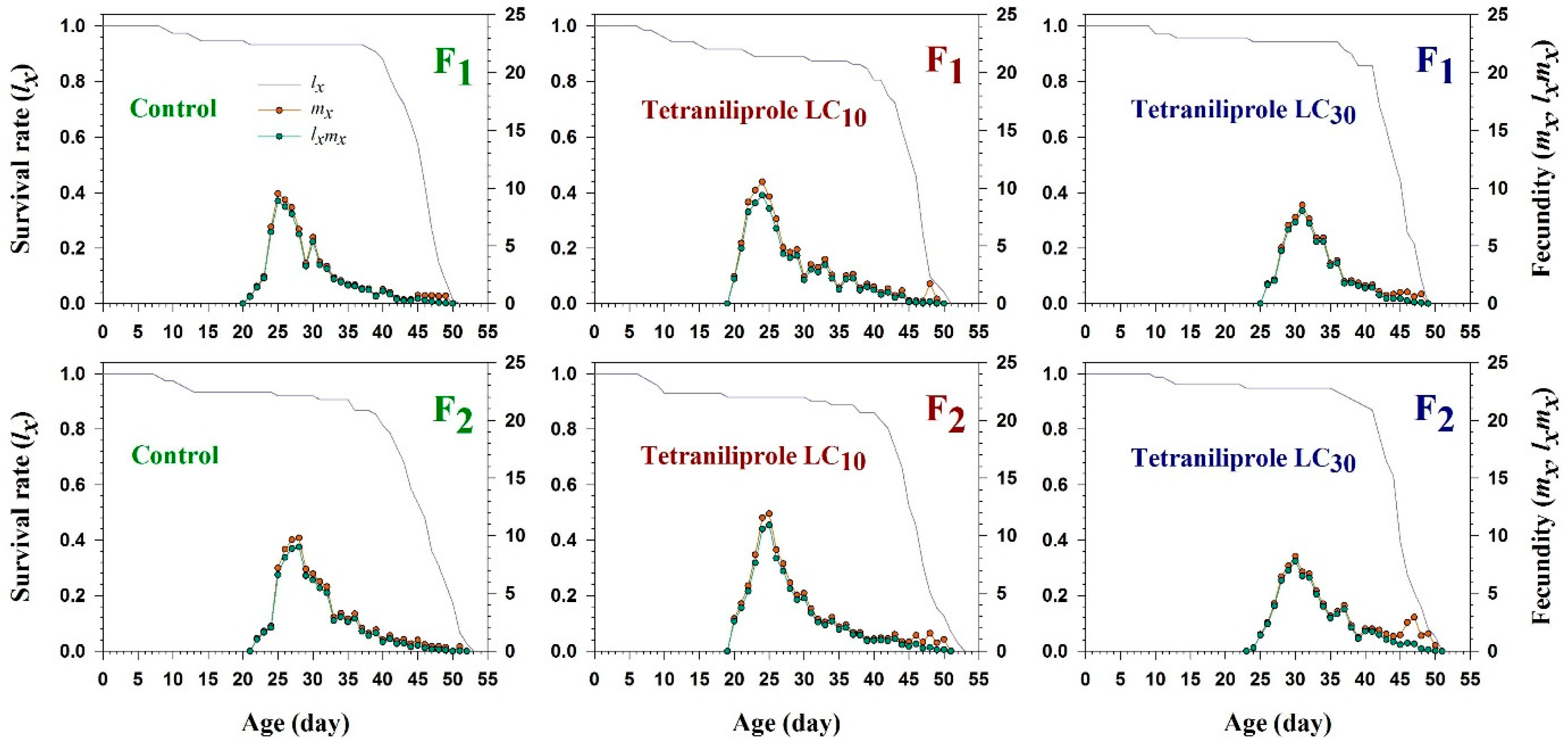
3.4. The Transgenerational Sublethal Effects of Tetraniliprole on the Progeny Generations (F1 and F2) of Tuta absoluta
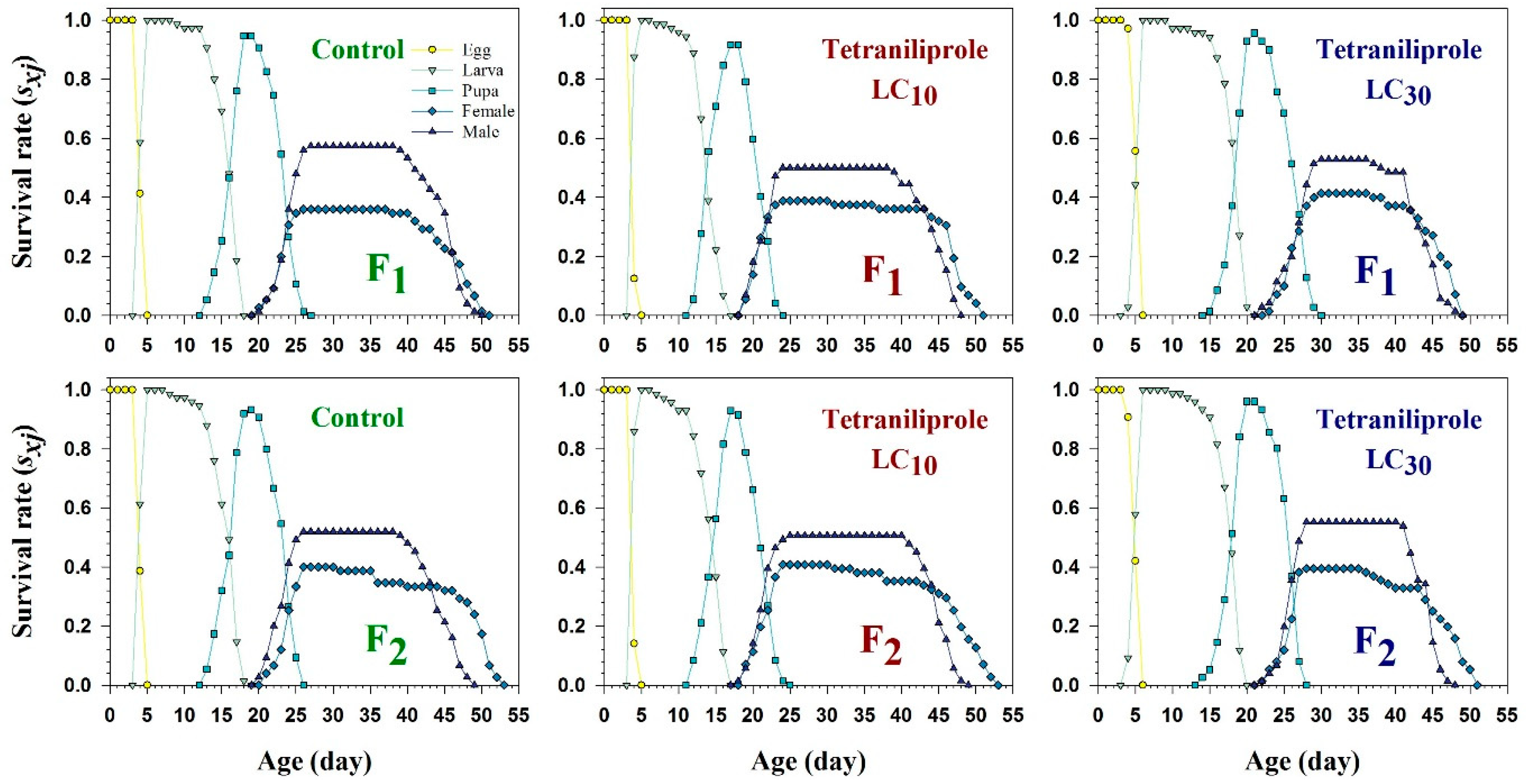
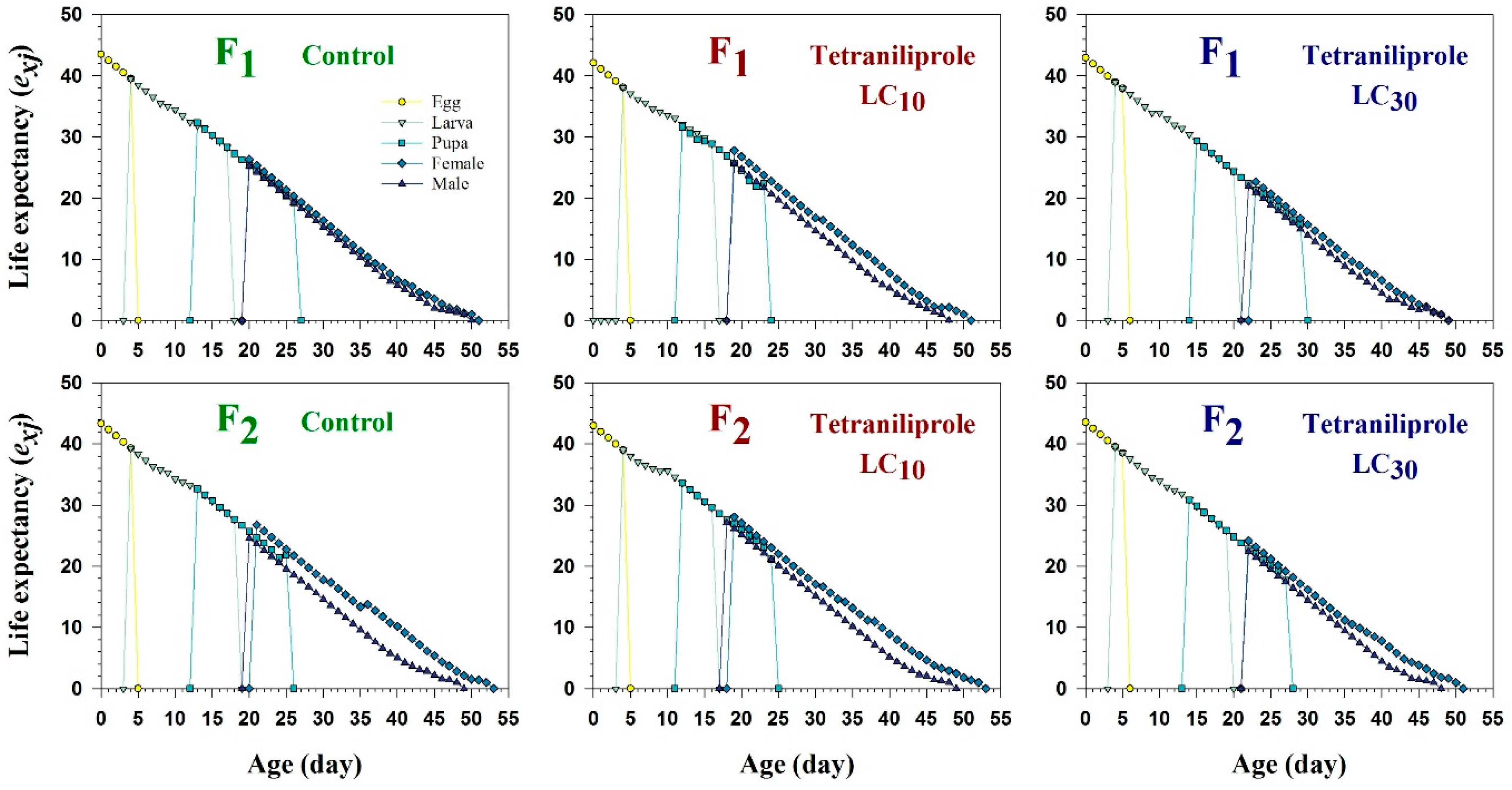
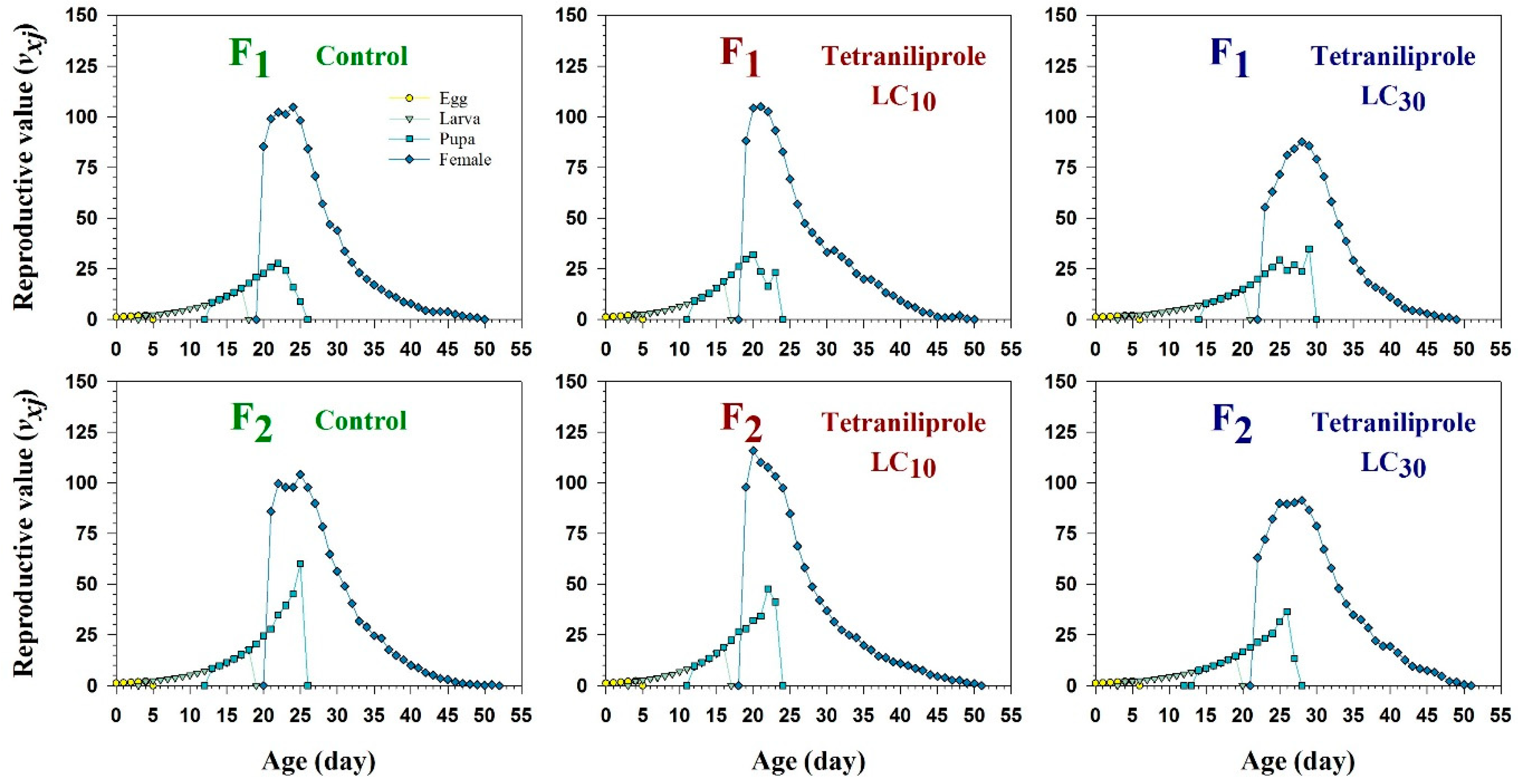
3.5. Age-Stage Specific Survival Rate, Fecundity, and Life Expectancy of Tetraniliprole Exposed Tuta absoluta
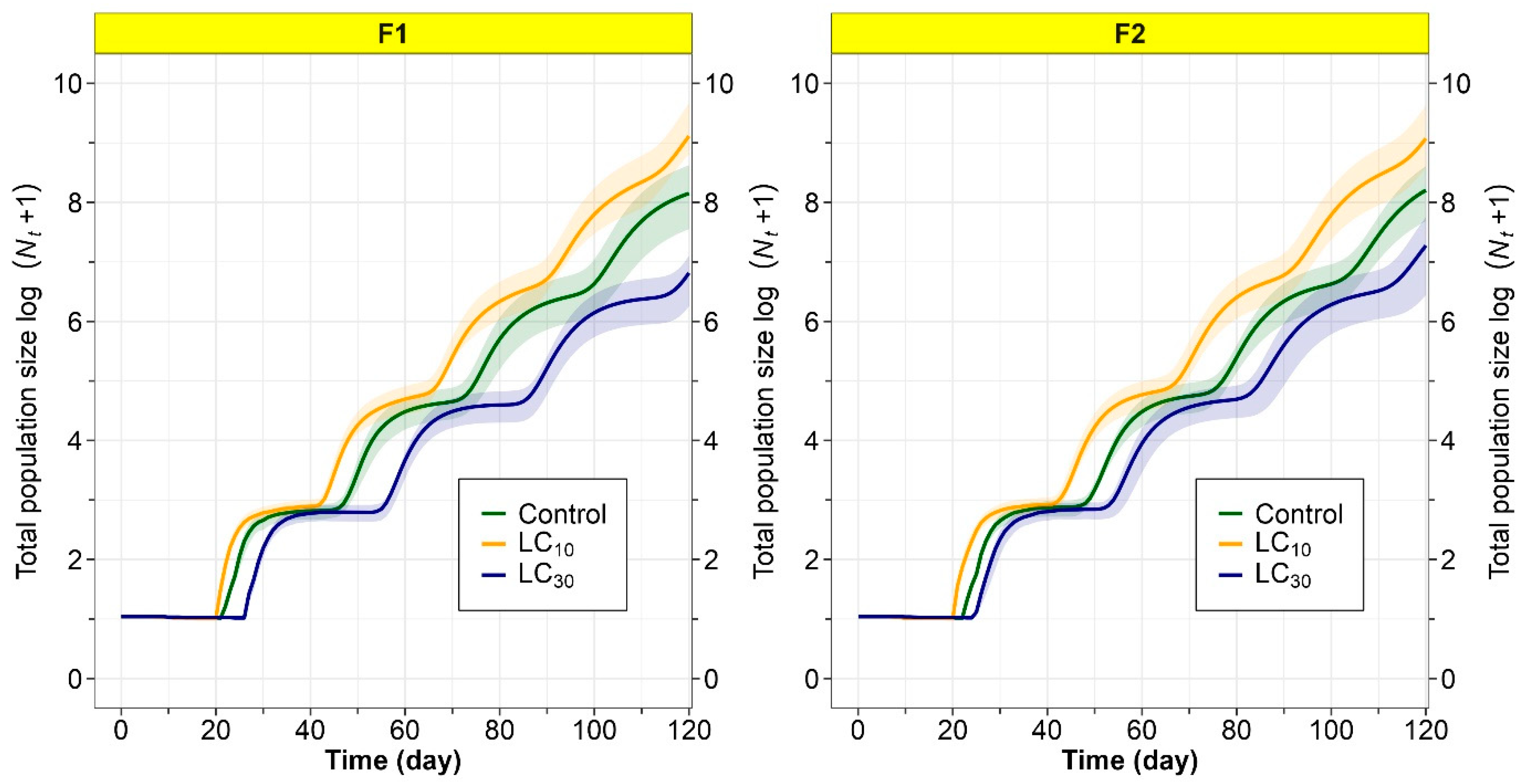
3.6. Population Projection
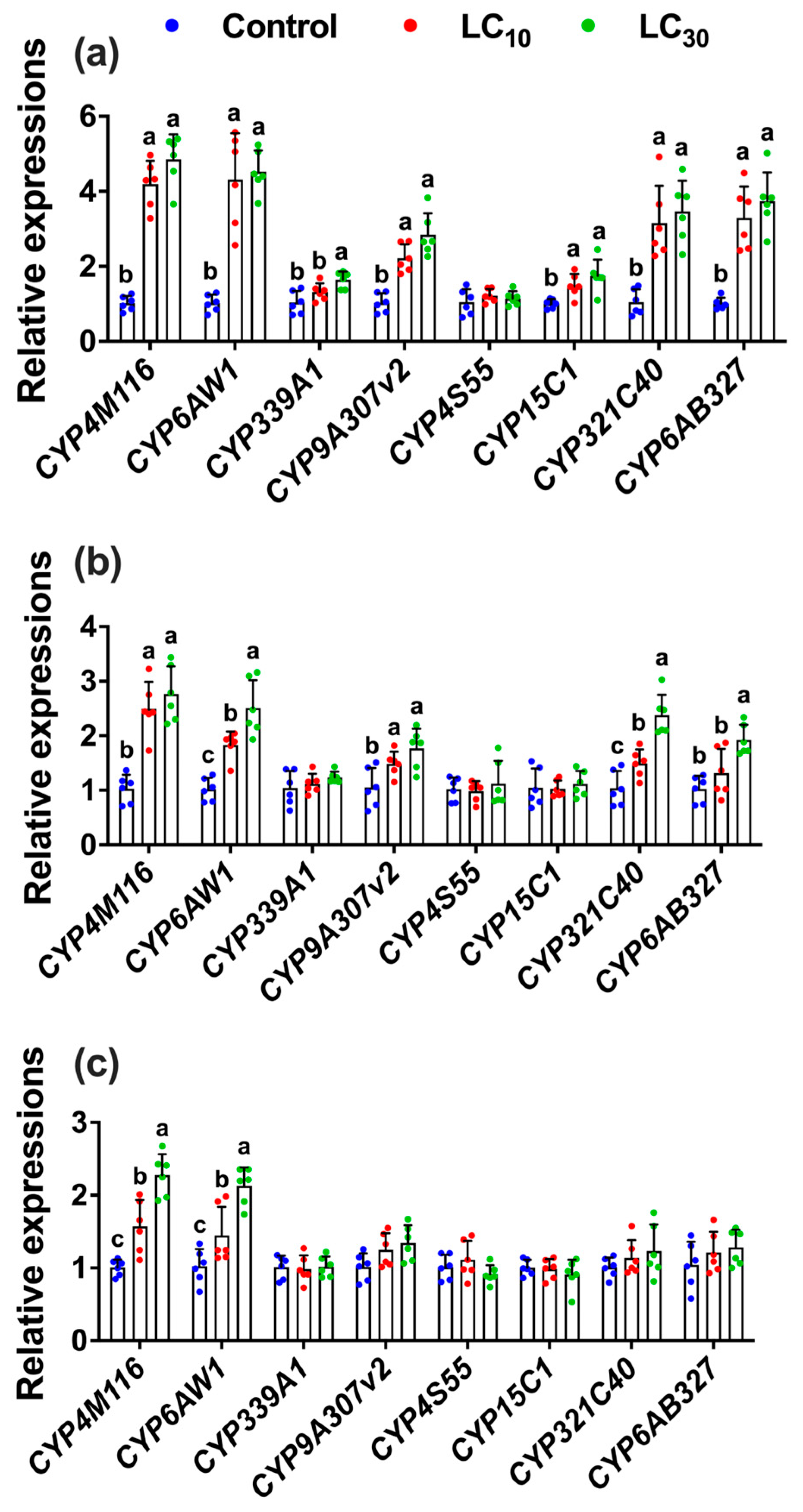
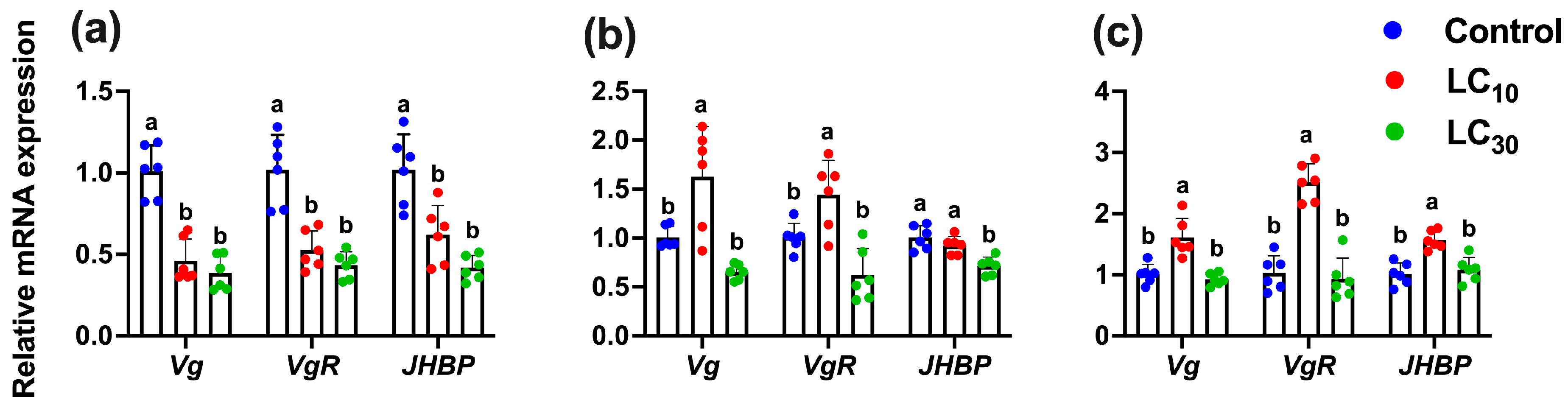
3.7. Transgenerational Effects of Tetraniliprole on Developmental and Resistance Genes
4. Discussion
5. Conclusions
Author Contributions
Funding
Data Availability Statement
Conflicts of Interest
Correction Statement
References
- Wang, M.-H.; Ismoilov, K.; Liu, W.-X.; Bai, M.; Bai, X.-S.; Chen, B.; Chen, H.-L.; Chen, H.-S.; Dong, Y.-C.; Fang, K.; et al. Tuta absoluta management in China: Progress and prospects. Entomol. Gen. 2024, 44, 269–278. [Google Scholar] [CrossRef]
- Desneux, N.; Wajnberg, E.; Wyckhuys, K.A.; Burgio, G.; Arpaia, S.; Narváez-Vasquez, C.A.; González-Cabrera, J.; Catalán, R.D.; Tabone, E.; Frandon, J. Biological invasion of European tomato crops by Tuta absoluta: Ecology, geographic expansion and prospects for biological control. J. Pest Sci. 2010, 83, 197–215. [Google Scholar] [CrossRef]
- Biondi, A.; Guedes, R.N.C.; Wan, F.H.; Desneux, N. Ecology, worldwide spread, and management of the invasive South American tomato pinworm, Tuta absoluta: Past, present, and future. Annu. Rev. Entomol. 2018, 63, 239–258. [Google Scholar] [CrossRef]
- Campos, M.R.; Biondi, A.; Adiga, A.; Guedes, R.N.; Desneux, N. From the Western Palaearctic region to beyond: Tuta absoluta 10 years after invading Europe. J. Pest Sci. 2017, 90, 787–796. [Google Scholar] [CrossRef]
- Han, P.; Zhang, Y. Research toward enhancing integrated management of Tuta absoluta, an ongoing invasive threat in Afro-Eurasia. Entomol. Gen. 2024, 44, 263–267. [Google Scholar] [CrossRef]
- Campos, M.R.; Béarez, P.; Amiens-Desneux, E.; Ponti, L.; Gutierrez, A.P.; Biondi, A.; Adiga, A.; Desneux, N. Thermal biology of Tuta absoluta: Demographic parameters and facultative diapause. J. Pest Sci. 2021, 94, 829–842. [Google Scholar] [CrossRef]
- Ponti, L.; Gutierrez, A.P.; de Campos, M.R.; Desneux, N.; Biondi, A.; Neteler, M. Biological invasion risk assessment of Tuta absoluta: Mechanistic versus correlative methods. Biol. Invasions 2021, 23, 3809–3829. [Google Scholar] [CrossRef]
- Desneux, N.; Luna, M.G.; Guillemaud, T.; Urbaneja, A. The invasive South American tomato pinworm, Tuta absoluta, continues to spread in Afro-Eurasia and beyond: The new threat to tomato world production. J. Pest Sci. 2011, 84, 403–408. [Google Scholar] [CrossRef]
- Liu, X.-X.; Yang, M.; Arnó, J.; Kriticos, D.J.; Desneux, N.; Zalucki, M.P.; Lu, Z. Protected agriculture matters: Year-round persistence of Tuta absoluta in China where it should not. Entomol. Gen. 2024, 44, 279–287. [Google Scholar] [CrossRef]
- Sun, Z.-X.; Ma, R.-X.; Hu, J.; Chen, Y.-P.; Peng, C.; Li, D.-G.; Zhang, J.-T.; Shen, M.-L.; Gui, F.-R. Repellent and insecticidal effects of Rosmarinus officinalis and its volatiles on Tuta absoluta. Entomol. Gen. 2024, 44, 297–306. [Google Scholar] [CrossRef]
- Ullah, F.; Guru-Pirasanna-Pandi, G.; Murtaza, G.; Sarangi, S.; Gul, H.; Li, X.; Chavarín-Gómez, L.E.; Ramírez-Romero, R.; Guedes, R.N.C.; Desneux, N. Evolving strategies in agroecosystem pest control: Transitioning from chemical to green management. J. Pest Sci. 2025. [Google Scholar] [CrossRef]
- Sparks, T.C.; Crossthwaite, A.J.; Nauen, R.; Banba, S.; Cordova, D.; Earley, F.; Ebbinghaus-Kintscher, U.; Fujioka, S.; Hirao, A.; Karmon, D.; et al. Insecticides, biologics and nematicides: Updates to IRAC’s mode of action classification-a tool for resistance management. Pestic. Biochem. Physiol. 2020, 167, 104587. [Google Scholar] [CrossRef]
- Zhang, Z.; Gao, B.; Qu, C.; Gong, J.; Li, W.; Luo, C.; Wang, R. Resistance monitoring for six insecticides in vegetable field-collected populations of Spodoptera litura from China. Horticulturae 2022, 8, 255. [Google Scholar] [CrossRef]
- Lee, Y.; Jung, J.W.; Kang, D.H.; Kim, H.K.; Kim, G.H. Evaluation of the insecticidal toxicity of various pesticides for Atractomorpha lata (Orthoptera: Pyrgomorphidae) control. Entomol. Res. 2023, 53, 209–218. [Google Scholar] [CrossRef]
- Wakil, W.; Kavallieratos, N.G.; Naeem, A.; Gidari, D.L.S.; Boukouvala, M.C.; El-Shafie, H.A. Efficacy of the anthranilic diamide tetraniliprole against four coleopteran pests of stored grains. Crop Prot. 2025, 194, 107200. [Google Scholar] [CrossRef]
- Desneux, N.; Fauvergue, X.; Dechaume-Moncharmont, F.X.; Kerhoas, L.; Ballanger, Y.; Kaiser, L. Diaeretiella rapae limits Myzus persicae populations after applications of deltamethrin in oilseed rape. J. Econ. Entomol. 2005, 98, 9–17. [Google Scholar] [PubMed]
- Desneux, N.; Decourtye, A.; Delpuech, J.M. The sublethal effects of pesticides on beneficial arthropods. Annu. Rev. Entomol. 2007, 52, 81–106. [Google Scholar] [CrossRef]
- Guedes, R.N.C.; Berenbaum, M.R.; Biondi, A.; Desneux, N. The side effects of pesticides on non-target arthropods. Annu. Rev. Entomol. 2026. [Google Scholar] [CrossRef]
- Ullah, F.; Güncan, A.; Gul, H.; Hafeez, M.; Zhou, S.; Wang, Y.; Zhang, Z.; Huang, J.; Ghramh, H.A.; Guo, W.; et al. Spinosad-induced intergenerational sublethal effects on Tuta absoluta: Biological traits and related genes expressions. Entomol. Gen. 2024, 44, 395–404. [Google Scholar] [CrossRef]
- Ullah, F.; Güncan, A.; Abbas, A.; Gul, H.; Guedes, R.N.C.; Zhang, Z.; Huang, J.; Khan, K.A.; Ghramh, H.A.; Chavarín-Gómez, L.E.; et al. Sublethal effects of neonicotinoids on insect pests. Entomol. Gen. 2024, 44, 1145–1160. [Google Scholar] [CrossRef]
- Wang, K.; He, Y.; Zhang, Y.; Dong, R.; Hu, S.; Yang, Z.; Guo, Z.; Zhang, Y.; Xie, W.; Wang, S. Sublethal effects of thiamethoxam on Encarsia formosa: Intergenerational impacts and insights from transcriptomic analysis. Entomol. Gen. 2025, 45, 275–284. [Google Scholar] [CrossRef]
- Guedes, R.; Smagghe, G.; Stark, J.; Desneux, N. Pesticide-induced stress in arthropod pests for optimized integrated pest management programs. Annu. Rev. Entomol. 2016, 61, 43–62. [Google Scholar] [CrossRef]
- Cutler, G.C.; Amichot, M.; Benelli, G.; Guedes, R.N.C.; Qu, Y.; Rix, R.R.; Ullah, F.; Desneux, N. Hormesis and insects: Effects and interactions in agroecosystems. Sci. Total Environ. 2022, 825, 153899. [Google Scholar] [CrossRef]
- Zhou, C.; Yang, X.B.; Yang, H.; Long, G.Y.; Jin, D.C. Effects of sublethal concentrations of insecticides on the fecundity of Sogatella furcifera (Hemiptera: Delphacidae) via the regulation of vitellogenin and its receptor. J. Insect Sci. 2020, 20, 14. [Google Scholar] [CrossRef]
- Wang, L.; Zhu, J.; Wang, Q.; Ji, X.; Wang, W.; Huang, W.; Rui, C.; Cui, L. Hormesis effects of sulfoxaflor on Aphis gossypii feeding, growth, reproduction behaviour and the related mechanisms. Sci. Total Environ. 2023, 872, 162240. [Google Scholar] [CrossRef]
- Chi, H.; Güncan, A.; Kavousi, A.; Gharakhani, G.; Atlihan, R.; Özgökçe, M.S.; Shirazi, J.; Amir-Maafi, M.; Maroufpoor, M.; Taghizadeh, R. TWOSEX-MSChart: The key tool for life table research and education. Entomol. Gen. 2022, 42, 845–849. [Google Scholar] [CrossRef]
- Chi, H.; Kavousi, A.; Gharekhani, G.; Atlihan, R.; Salih-Özgökçe, M.; Güncan, A.; Gökçe, A.; Smith, C.L.; Benelli, G.; Guedes, R.N.C.; et al. Advances in theory, data analysis, and application of the age-stage, two-sex life table for demographic research, biological control, and pest management. Entomol. Gen. 2023, 43, 705–732. [Google Scholar] [CrossRef]
- Birch, L. The intrinsic rate of natural increase of an insect population. J. Anim. Ecol. 1948, 17, 15–26. [Google Scholar] [CrossRef]
- Chi, H. Life-table analysis incorporating both sexes and variable development rates among individuals. Environ. Entomol. 1988, 17, 26–34. [Google Scholar] [CrossRef]
- Ullah, F.; Guru-Pirasanna-Pandi, G.; Gul, H.; Panda, R.M.; Murtaza, G.; Zhang, Z.J.; Huang, J.; Li, X.; Desneux, N.; Lu, Y. Nanocarrier-mediated RNAi of CYP9E2 and CYB5R enhance susceptibility of invasive tomato pest, Tuta absoluta to cyantraniliprole. Front. Plant Sci. 2025, 16, 1573634. [Google Scholar] [CrossRef]
- Livak, K.J.; Schmittgen, T.D. Analysis of Relative Gene Expression Data Using Real-Time Quantitative PCR and the 2−ΔΔCT Method. Methods 2001, 25, 402–408. [Google Scholar] [CrossRef]
- Chi, H. TWOSEX-MSChart: A Computer Program for the Age–Stage, Two-Sex Life Table Analysis. Zenodo. 2024. Available online: https://doi.org/10.5281/zenodo.7484085 (accessed on 1 April 2024).
- Huang, Y.B.; Chi, H. Age-stage, two-sex life tables of Bactrocera cucurbitae (Coquillett)(Diptera: Tephritidae) with a discussion on the problem of applying female age-specific life tables to insect populations. Insect Sci. 2012, 19, 263–273. [Google Scholar] [CrossRef]
- Akca, I.; Ayvaz, T.; Yazici, E.; Smith, C.L.; Chi, H. Demography and population projection of Aphis fabae (Hemiptera: Aphididae): With additional comments on life table research criteria. J. Econ. Entomol. 2015, 108, 1466–1478. [Google Scholar] [CrossRef] [PubMed]
- Polat Akköprü, E.; Atlıhan, R.; Okut, H.; Chi, H. Demographic assessment of plant cultivar resistance to insect pests: A case study of the dusky-veined walnut aphid (Hemiptera: Callaphididae) on five walnut cultivars. J. Econ. Entomol. 2015, 108, 378–387. [Google Scholar] [CrossRef] [PubMed]
- Chi, H. TIMING-MSChart: A Computer Program for the Population Projection Based on Age–Stage, Two-Sex Life Table. Zenodo. 2024. Available online: https://doi.org/10.5281/zenodo.7482191 (accessed on 1 April 2024).
- Chi, H. Timing of control based on the stage structure of pest populations: A simulation approach. J. Econ. Entomol. 1990, 83, 1143–1150. [Google Scholar] [CrossRef]
- Huang, H.W.; Chi, H.; Smith, C.L. Linking demography and consumption of Henosepilachna vigintioctopunctata (Coleoptera: Coccinellidae) fed on Solanum photeinocarpum (Solanales: Solanaceae): With a new method to project the uncertainty of population growth and consumption. J. Econ. Entomol. 2017, 111, 1–9. [Google Scholar] [CrossRef]
- Lahm, G.P.; Selby, T.P.; Freudenberger, J.H.; Stevenson, T.M.; Myers, B.J.; Seburyamo, G.; Smith, B.K.; Flexner, L.; Clark, C.E.; Cordova, D. Insecticidal anthranilic diamides: A new class of potent ryanodine receptor activators. Bioorganic Med. Chem. Lett. 2005, 15, 4898–4906. [Google Scholar] [CrossRef]
- Cordova, D.; Benner, E.A.; Sacher, M.D.; Rauh, J.J.; Sopa, J.S.; Lahm, G.P.; Selby, T.P.; Stevenson, T.M.; Flexner, L.; Gutteridge, S.; et al. Anthranilic diamides: A new class of insecticides with a novel mode of action, ryanodine receptor activation. Pestic. Biochem. Physiol. 2006, 84, 196–214. [Google Scholar] [CrossRef]
- França, S.M.; Breda, M.O.; Barbosa, D.R.; Araujo, A.M.; Guedes, C.A.; Shields, V.D.C. The sublethal effects of insecticides in insects. Biol. Control Pest Vector Insects 2017, 10, 66461. [Google Scholar] [CrossRef]
- Lv, W.; Yan, Y.; Ma, Y.; Jiang, X.; Deng, K.; Xie, D.; Cheng, Y.; Liu, N.; Zhang, L. Effects of chlorantraniliprole on reproductive and migration-related traits of Spodoptera frugiperda. Entomol. Gen. 2025, 45, 265–274. [Google Scholar] [CrossRef]
- Cutler, G.C. Insects, insecticides and hormesis: Evidence and considerations for study. Dose-Response 2013, 11, 154–177. [Google Scholar] [CrossRef]
- Guedes, R.N.C.; Cutler, G.C. Insecticide-induced hormesis and arthropod pest management. Pest Manag. Sci. 2013, 70, 690–697. [Google Scholar] [CrossRef] [PubMed]
- Babu, S.R.; Dudwal, R. Field efficacy of tetraniliprole 200 SC, a new diamide insecticide molecule against common cutworm, Spodoptera litura in soybean. Indian J. Plant Prot. 2020, 45. [Google Scholar]
- Stark, J.D.; Banks, J.E. Population-level effects of pesticides and other toxicants on arthropods. Annu. Rev. Entomol. 2003, 48, 505–519. [Google Scholar] [CrossRef] [PubMed]
- Cloyd, R.A.; Bethke, J.A. Impact of neonicotinoid insecticides on natural enemies in greenhouse and interiorscape environments. Pest Manag. Sci. 2011, 67, 3–9. [Google Scholar] [CrossRef] [PubMed]
- Yao, Q.; Xu, S.; Dong, Y.; Que, Y.; Quan, L.; Chen, B. Characterization of vitellogenin and vitellogenin receptor of Conopomorpha sinensis Bradley and their responses to sublethal concentrations of insecticide. Front. Physiol. 2018, 9, 1250. [Google Scholar] [CrossRef]
- Huang, L.; Lu, M.; Han, G.; Du, Y.; Wang, J. Sublethal effects of chlorantraniliprole on development, reproduction and vitellogenin gene (CsVg) expression in the rice stem borer, Chilo suppressalis. Pest Manag. Sci. 2016, 72, 2280–2286. [Google Scholar] [CrossRef]
- Kaplanoglu, E.; Chapman, P.; Scott, I.M.; Donly, C. Overexpression of a cytochrome P450 and a UDP-glycosyltransferase is associated with imidacloprid resistance in the Colorado potato beetle, Leptinotarsa decemlineata. Sci. Rep. 2017, 7, 1762. [Google Scholar] [CrossRef]
- Stavrakaki, M.; Ilias, A.; Ioannidis, P.; Vontas, J.; Roditakis, E. Investigating mechanisms associated with emamectin benzoate resistance in the tomato borer Tuta absoluta. J. Pest Sci. 2022, 95, 1163–1177. [Google Scholar] [CrossRef]




| Primer Name | Forward Sequence | Reverse Sequence |
|---|---|---|
| JHBP | CCCATTAACCATGCCACAGG | TGAAGCTTTTCCTGGTGTGTC |
| Vg | TGGTACGTGGTTATGCAGGA | TACTTCGACACTGGGGGTTC |
| VgR | ATCTTTGTCCGGACCACACT | CGTCTGCACAATCTGTCTCG |
| CYP4M116 | GACGCCAACTTTCCACTTCAAC | GCCCATCGCTGTTTCGCATA |
| CYP6AW1 | GCCTTGAAACATCAGCCACAAC | GTCAATCCGTCGTGCTTACTCA |
| CYP339A1 | TCTCGCTTCACCTCGTCCTG | CGAACGGCAGAACCATAGACTC |
| CYP9A307v2 | AAAGGTTCGTGGGCAGATTCG | TCGTTCAGGAAGTCTCGGTGAT |
| CYP4S55 | GGTTCCACGAGAGCATCTATTCA | CGAGAGCACCACCTCAACATC |
| CYP15C1 | GCAGCAGGAGATAGATGAAGTCA | CACGGAGGATATGCGAAGAGTT |
| CYP321C40 | GGAATGAGATACGCACGACTACA | CACCGCTTGCTTGCTGTACT |
| CYP6AB327 | AAGGTGCTCTAGTGGGAGAATCT | AATCCTGCGGCGAAGAATACAA |
| EF1α | GAAGCCTGGTATGGTTGTCGT | GGGTGGGTTGTTCTTTGTG |
| RPL28 | TCAGACGTGCTGAACACACA | GCCAGTCTTGGACAACCATT |
| Treatments | Slope ± SE a | LC10 mg/L (95% CL) b | LC30 mg/L (95% CL) b | LC50 mg/L (95% CL) b | χ2 (df) c | p-Value |
|---|---|---|---|---|---|---|
| Tetraniliprole | 2.369 ± 0.216 | 0.008 (0.006–0.011) | 0.018 (0.014–0.021) | 0.029 (0.025–0.034) | 7.035 (19) | 0.994 |
| Parameters | Control | Tetraniliprole LC10 | Tetraniliprole LC30 | |||
|---|---|---|---|---|---|---|
| n | Mean ± SE | n | Mean ± SE | n | Mean ± SE | |
| Larva (days) | 74 | 11.72 ± 0.14 c | 69 | 13.72 ± 0.12 b | 69 | 14.83 ± 0.18 a |
| Pupa (days) | 72 | 7.21 ± 0.08 c | 68 | 8.12 ± 0.08 b | 69 | 8.74 ± 0.07 a |
| Female longevity (days) | 31 | 23.06 ± 0.54 a | 30 | 16.47 ± 0.88 b | 27 | 13.89 ± 0.63 c |
| Male longevity (days) | 41 | 21.12 ± 0.35 a | 38 | 16.21 ± 0.36 b | 42 | 13.64 ± 0.23 c |
| Fecundity (eggs/female) | 31 | 192.87 ± 6.54 a | 30 | 125.23 ± 5.11 b | 27 | 71.15 ± 3.52 c |
| Oviposition days (days) | 31 | 13.00 ± 0.38 a | 30 | 8.73 ± 0.50 b | 27 | 5.96 ± 0.44 c |
| Adult preoviposition period (days) | 31 | 1.19 ± 0.07 b | 30 | 2.17 ± 0.08 a | 27 | 2.37 ± 0.09 a |
| Durations (Days) | Generations | Control | Tetraniliprole LC10 | Tetraniliprole LC30 | |||
|---|---|---|---|---|---|---|---|
| n | Mean ± SE | n | Mean ± SE | n | Mean ± SE | ||
| Egg | F1 | 75 | 4.41 ± 0.06 bA | 72 | 4.13 ± 0.04 cA | 70 | 5.53 ± 0.07 aA |
| F2 | 75 | 4.39 ± 0.06 bA | 71 | 4.14 ± 0.04 cA | 76 | 5.33 ± 0.07 aB | |
| Larva | F1 | 71 | 11.80 ± 0.16 bA | 68 | 10.24 ± 0.16 cA | 67 | 13.12 ± 0.14 aA |
| F2 | 70 | 11.76 ± 0.17 bA | 66 | 10.65 ± 0.19 cA | 73 | 12.71 ± 0.14 aB | |
| Pupa | F1 | 70 | 7.43 ± 0.10 bA | 64 | 6.84 ± 0.10 cA | 66 | 7.88 ± 0.15 aA |
| F2 | 69 | 7.42 ± 0.10 bA | 65 | 6.63 ± 0.09 cA | 72 | 7.82 ± 0.06 aA | |
| Total Preadult | F1 | 70 | 23.64 ± 0.19 bA | 64 | 21.23 ± 0.18 cA | 66 | 26.52 ± 0.23 aA |
| F2 | 69 | 23.49 ± 0.19 bA | 65 | 21.48 ± 0.20 cA | 72 | 25.86 ± 0.17 aB | |
| Female longevity | F1 | 27 | 23.19 ± 0.53 bA | 28 | 25.79 ± 0.68 aA | 29 | 19.24 ± 0.61 cA |
| F2 | 30 | 23.80 ± 0.95 aA | 29 | 25.52 ± 0.89 aA | 30 | 20.37 ± 0.77 bA | |
| Male longevity | F1 | 43 | 21.30 ± 0.31 bA | 36 | 23.28 ± 0.36 aA | 37 | 17.35 ± 0.26 cB |
| F2 | 39 | 21.46 ± 0.30 bA | 36 | 23.72 ± 0.20 aA | 42 | 18.52 ± 0.22 cA | |
| Total female longevity | F1 | 27 | 46.33 ± 0.65 aA | 28 | 46.79 ± 0.77 aA | 29 | 45.69 ± 0.60 aA |
| F2 | 30 | 47.77 ± 1.06 aA | 29 | 47.07 ± 1.03 aA | 30 | 46.17 ± 0.78 aA | |
| Total male longevity | F1 | 43 | 45.26 ± 0.41 aA | 36 | 44.69 ± 0.42 abA | 37 | 43.92 ± 0.43 bA |
| F2 | 39 | 44.59 ± 0.42 aA | 36 | 45.14 ± 0.33 aA | 42 | 44.43 ± 0.26 aA | |
| Parameters | Generations | Control | Tetraniliprole LC10 | Tetraniliprole LC30 |
|---|---|---|---|---|
| Mean ± SE | Mean ± SE | Mean ± SE | ||
| Net reproductive rate (R0) (offspring/individual) | F1 | 70.29 ± 10.94 aA | 86.24 ± 13.20 aA | 64.41 ± 9.34 aA |
| F2 | 80.68 ± 11.93 aA | 94.38 ± 13.67 aA | 72.00 ± 10.53 aA | |
| Intrinsic rate of increase (r) (day−1) | F1 | 0.1492 ± 0.0061 bA | 0.1674 ± 0.0064 aA | 0.1272 ± 0.0047 cA |
| F2 | 0.1476 ± 0.0055 bA | 0.1684 ± 0.0061 aA | 0.1320 ± 0.0049 cA | |
| Finite rate of increase (λ) (day−1) | F1 | 1.1609 ± 0.0070 bA | 1.1822 ± 0.0076 aA | 1.1356 ± 0.0054 cA |
| F2 | 1.1591 ± 0.0063 bA | 1.1835 ± 0.0072 aA | 1.1412 ± 0.0056 cA | |
| Mean generation time (T) (days) | F1 | 28.50 ± 0.32 bB | 26.63 ± 0.33 cA | 32.76 ± 0.31 aA |
| F2 | 29.74 ± 0.33 bA | 27.00 ± 0.39 cA | 32.39 ± 0.35 aA | |
| Fecundity (F) (eggs/female) | F1 | 195.26 ± 3.99 bA | 221.75 ± 8.83 aA | 155.48 ± 4.41 cB |
| F2 | 201.70 ± 8.56 bA | 231.07 ± 6.12 aA | 182.40 ± 6.53 bA | |
| Ovipositon days (Od) (days) | F1 | 12.96 ± 0.33 aA | 12.93 ± 0.53 aB | 10.10 ± 0.45 bB |
| F2 | 12.17 ± 0.52 bA | 14.83 ± 0.56 aA | 13.00 ± 0.61 bA | |
| Adult preoviposition period (APOP) (days) | F1 | 1.26 ± 0.09 bA | 1.18 ± 0.07 bA | 2.24 ± 0.08 aA |
| F2 | 1.27 ± 0.08 bA | 1.21 ± 0.08 bA | 2.00 ± 0.09 aA | |
| Total preoviposition period (TPOP) (days) | F1 | 24.41 ± 0.27 bB | 22.18 ± 0.28 cA | 28.69 ± 0.31 aA |
| F2 | 25.23 ± 0.27 bA | 22.76 ± 0.33 cA | 27.80 ± 0.29 aB |
Disclaimer/Publisher’s Note: The statements, opinions and data contained in all publications are solely those of the individual author(s) and contributor(s) and not of MDPI and/or the editor(s). MDPI and/or the editor(s) disclaim responsibility for any injury to people or property resulting from any ideas, methods, instructions or products referred to in the content. |
© 2025 by the authors. Licensee MDPI, Basel, Switzerland. This article is an open access article distributed under the terms and conditions of the Creative Commons Attribution (CC BY) license (https://creativecommons.org/licenses/by/4.0/).
Share and Cite
Ullah, F.; Ullah, Z.; Güncan, A.; Govindharaj, G.-P.-P.; Gul, H.; Pradhan, P.P.; Murtaza, G.; Li, X.; Desneux, N.; Lu, Y. Tetraniliprole Triggers Transgenerational Hormesis in an Invasive Insect Herbivore: Molecular and Biological Insights. Insects 2025, 16, 1073. https://doi.org/10.3390/insects16101073
Ullah F, Ullah Z, Güncan A, Govindharaj G-P-P, Gul H, Pradhan PP, Murtaza G, Li X, Desneux N, Lu Y. Tetraniliprole Triggers Transgenerational Hormesis in an Invasive Insect Herbivore: Molecular and Biological Insights. Insects. 2025; 16(10):1073. https://doi.org/10.3390/insects16101073
Chicago/Turabian StyleUllah, Farman, Zeeshan Ullah, Ali Güncan, Guru-Pirasanna-Pandi Govindharaj, Hina Gul, Prabhu Prasanna Pradhan, Ghulam Murtaza, Xiaowei Li, Nicolas Desneux, and Yaobin Lu. 2025. "Tetraniliprole Triggers Transgenerational Hormesis in an Invasive Insect Herbivore: Molecular and Biological Insights" Insects 16, no. 10: 1073. https://doi.org/10.3390/insects16101073
APA StyleUllah, F., Ullah, Z., Güncan, A., Govindharaj, G.-P.-P., Gul, H., Pradhan, P. P., Murtaza, G., Li, X., Desneux, N., & Lu, Y. (2025). Tetraniliprole Triggers Transgenerational Hormesis in an Invasive Insect Herbivore: Molecular and Biological Insights. Insects, 16(10), 1073. https://doi.org/10.3390/insects16101073