A Computer Vision-Based Approach for Tick Identification Using Deep Learning Models


Department of Microbiology, University of Massachusetts, Amherst, MA 01003, USA
*
Author to whom correspondence should be addressed.
Insects 2022, 13(2), 116; https://doi.org/10.3390/insects13020116
Submission received: 6 December 2021
/
Revised: 18 January 2022
/
Accepted: 19 January 2022
/
Published: 22 January 2022
Simple Summary
Ticks are ectoparasites of humans, livestock, and wild animals and, as such, they are a nuisance, as well as vectors for disease transmission. Since the risk of tick-borne disease varies with the tick species, tick identification is vitally important in assessing threats. Standard taxonomic approaches are time-consuming and require skilled microscopy. Computer vision may provide a tenable solution to this problem. The emerging field of computer vision has many practical applications already, such as medical image analyses, facial recognition, and object detection. This tool may also help with the identification of ticks. To train a computer vision model, a substantial number of images are required. In the present study, tick images were obtained from a tick passive surveillance program that receives ticks from public individuals, partnering agencies, or veterinary clinics. We developed a computer vision method to identify common tick species and our results indicate that this tool could provide accurate, affordable, and real-time solutions for discriminating tick species. It provides an alternative to the present tick identification strategies.
Abstract
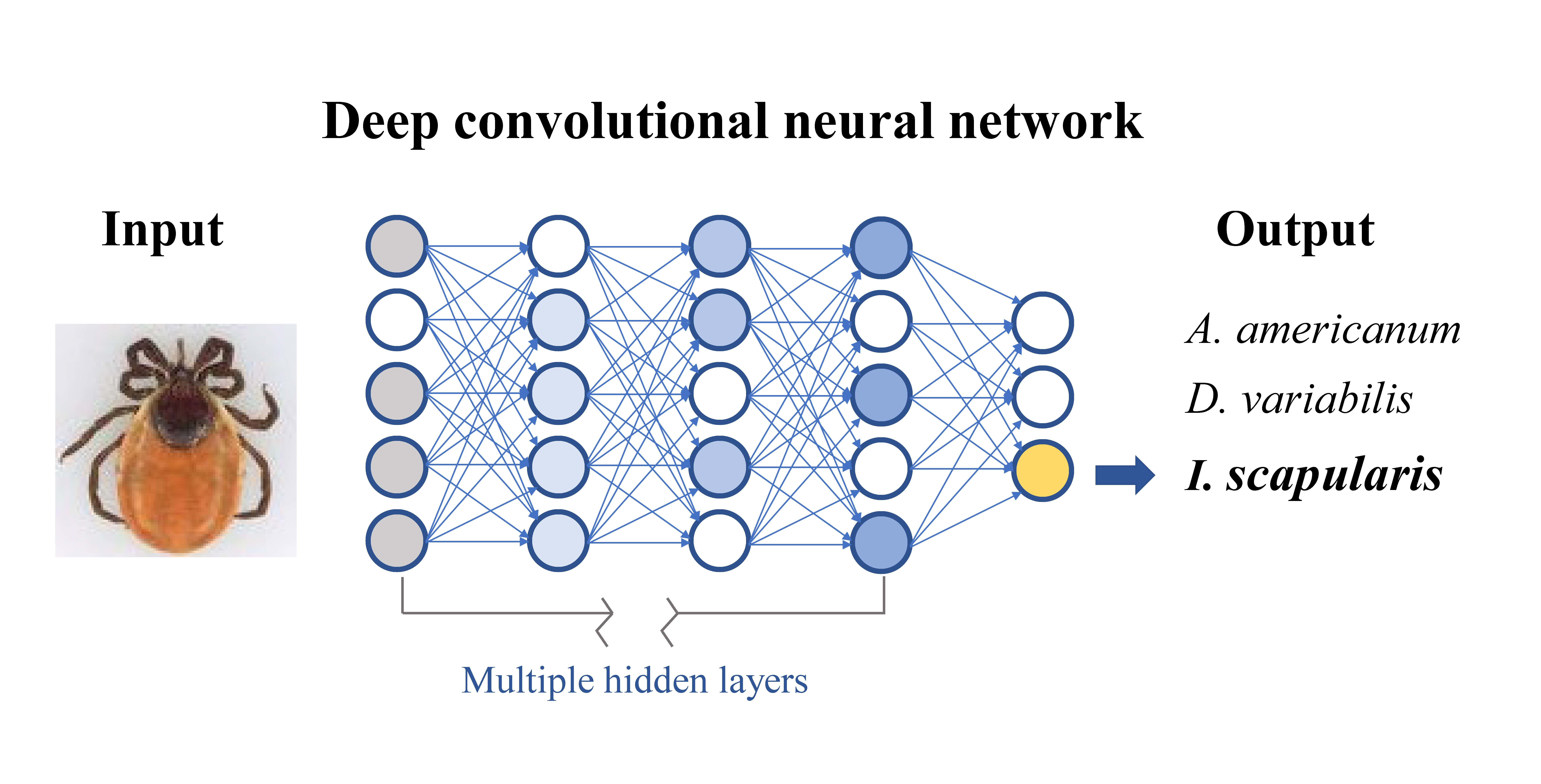
A wide range of pathogens, such as bacteria, viruses, and parasites can be transmitted by ticks and can cause diseases, such as Lyme disease, anaplasmosis, or Rocky Mountain spotted fever. Landscape and climate changes are driving the geographic range expansion of important tick species. The morphological identification of ticks is critical for the assessment of disease risk; however, this process is time-consuming, costly, and requires qualified taxonomic specialists. To address this issue, we constructed a tick identification tool that can differentiate the most encountered human-biting ticks, Amblyomma americanum, Dermacentor variabilis, and Ixodes scapularis, by implementing artificial intelligence methods with deep learning algorithms. Many convolutional neural network (CNN) models (such as VGG, ResNet, or Inception) have been used for image recognition purposes but it is still a very limited application in the use of tick identification. Here, we describe the modified CNN-based models which were trained using a large-scale molecularly verified dataset to identify tick species. The best CNN model achieved a 99.5% accuracy on the test set. These results demonstrate that a computer vision system is a potential alternative tool to help in prescreening ticks for identification, an earlier diagnosis of disease risk, and, as such, could be a valuable resource for health professionals.
Keywords:
medical entomology; ticks; computer vision