


Females of Halyomorpha halys (Hemiptera: Pentatomidae) Experience a Facultative Reproductive Diapause in Northern Greece
by
 , ,
, ,
Eleni I. Koutsogeorgiou
1,2 ,
,
Nikos A. Kouloussis
1 ,
,
Dimitrios S. Koveos
1 and 
Stefanos S. Andreadis
2,*
1
Laboratory of Applied Zoology and Parasitology, School of Agriculture, Aristotle University of Thessaloniki, 54124 Thessaloniki, Greece
2
Institute of Plant Breeding and Genetic Resources, Hellenic Agricultural Organization “DEMETER”, 57001 Thermi, Greece
*
Author to whom correspondence should be addressed.
Insects 2022, 13(10), 866; https://doi.org/10.3390/insects13100866
Submission received: 23 August 2022
/
Revised: 21 September 2022
/
Accepted: 23 September 2022
/
Published: 23 September 2022
(This article belongs to the Collection Hemiptera: Ecology, Physiology, and Economic Importance)
Simple Summary
In this study we investigated the oviposition rates and fecundity of females of Halyomorpha halys, by collecting adults soon after they entered their overwintering sites and allowing them to overwinter for 2, 3, 4 and 5 months in natural conditions of Northern Greece. We studied the occurrence of a facultative reproductive diapause in females of this insect in N. Greece by measuring the preoviposition period. According to our results, females of H. halys need an additional time period to exit diapause after they emerge from overwintering sites to mature sexually and start laying eggs. This finding is especially important to assess the possible damage of H. halys to early maturing crops for any forecasting models and thus management strategies.
Abstract
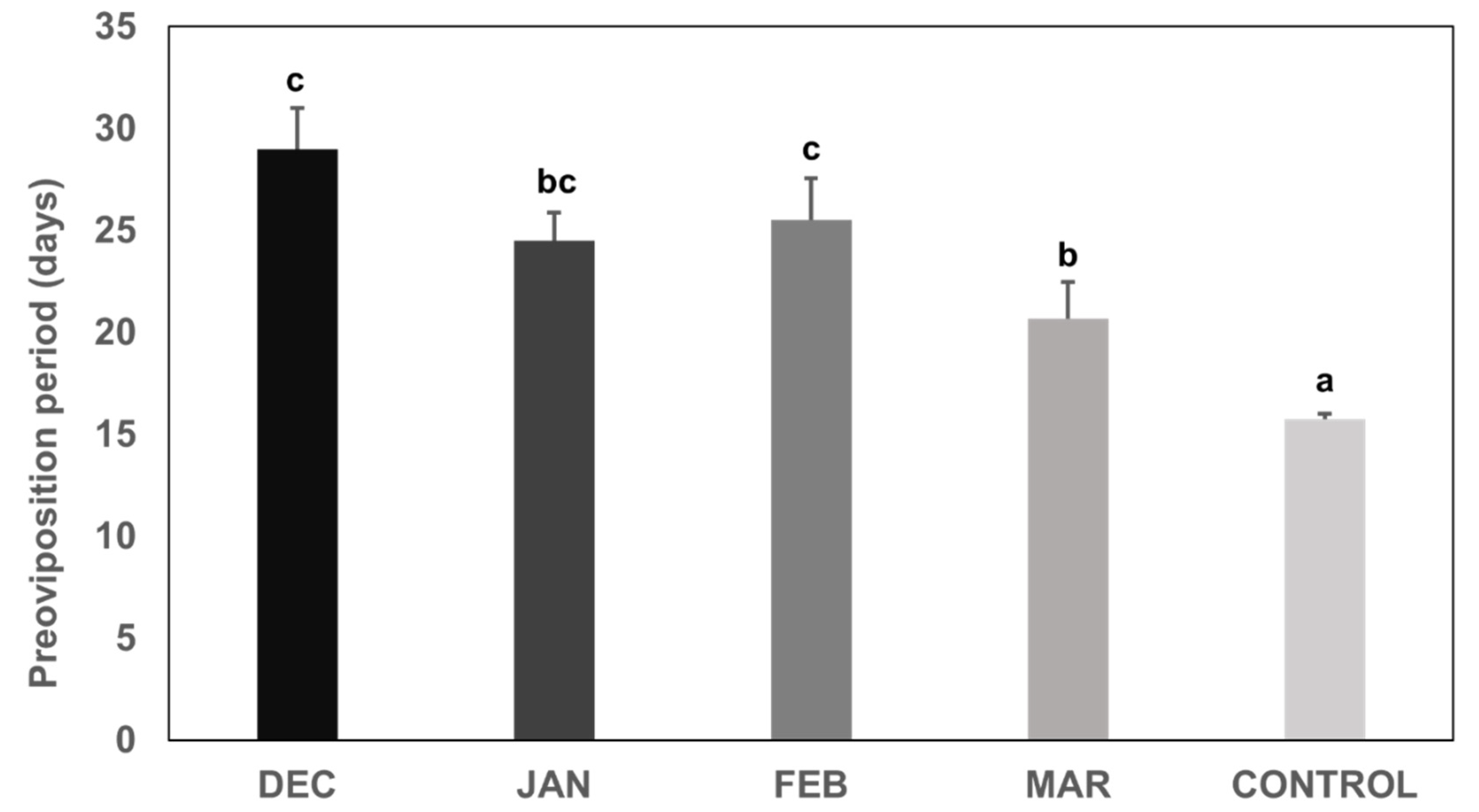
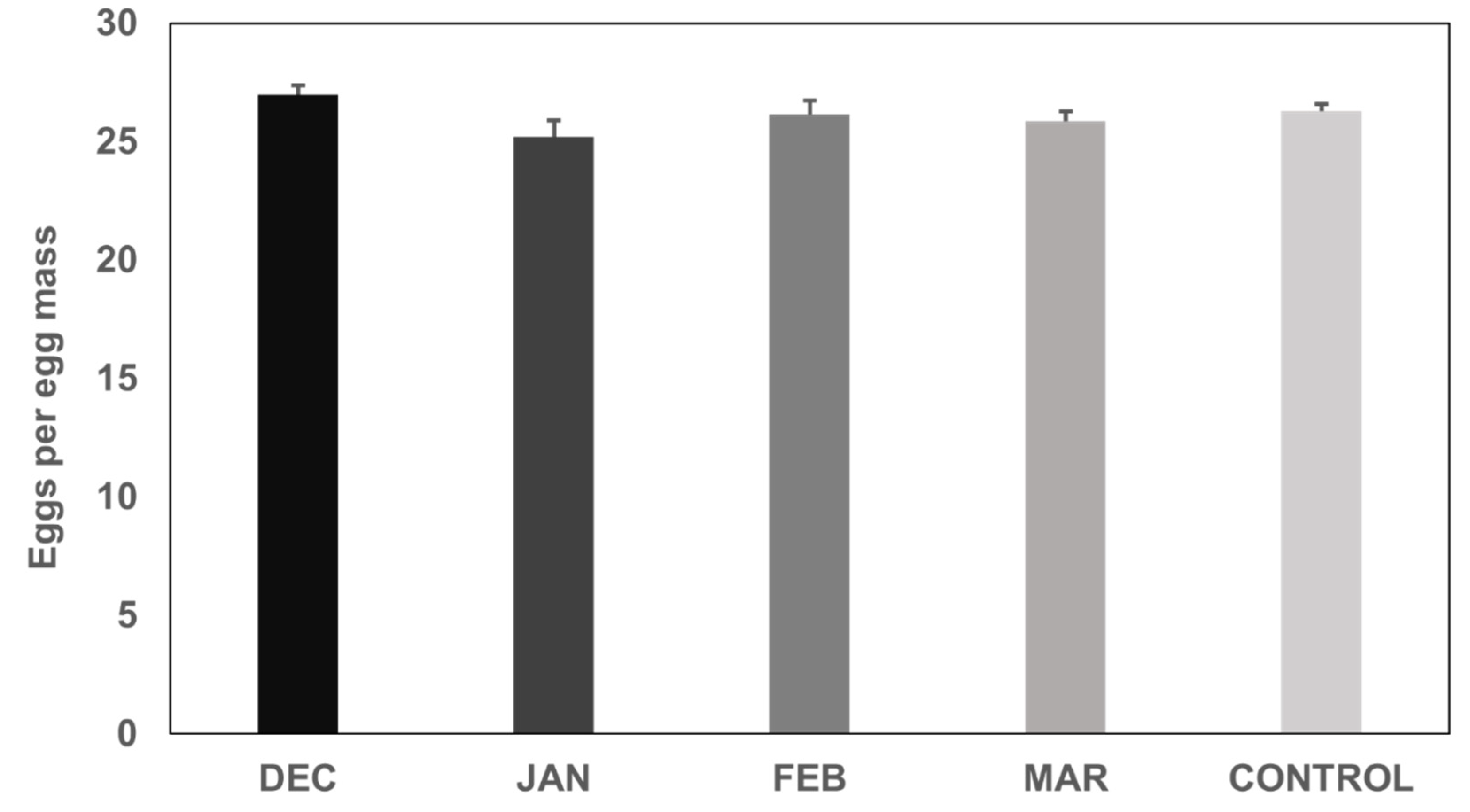
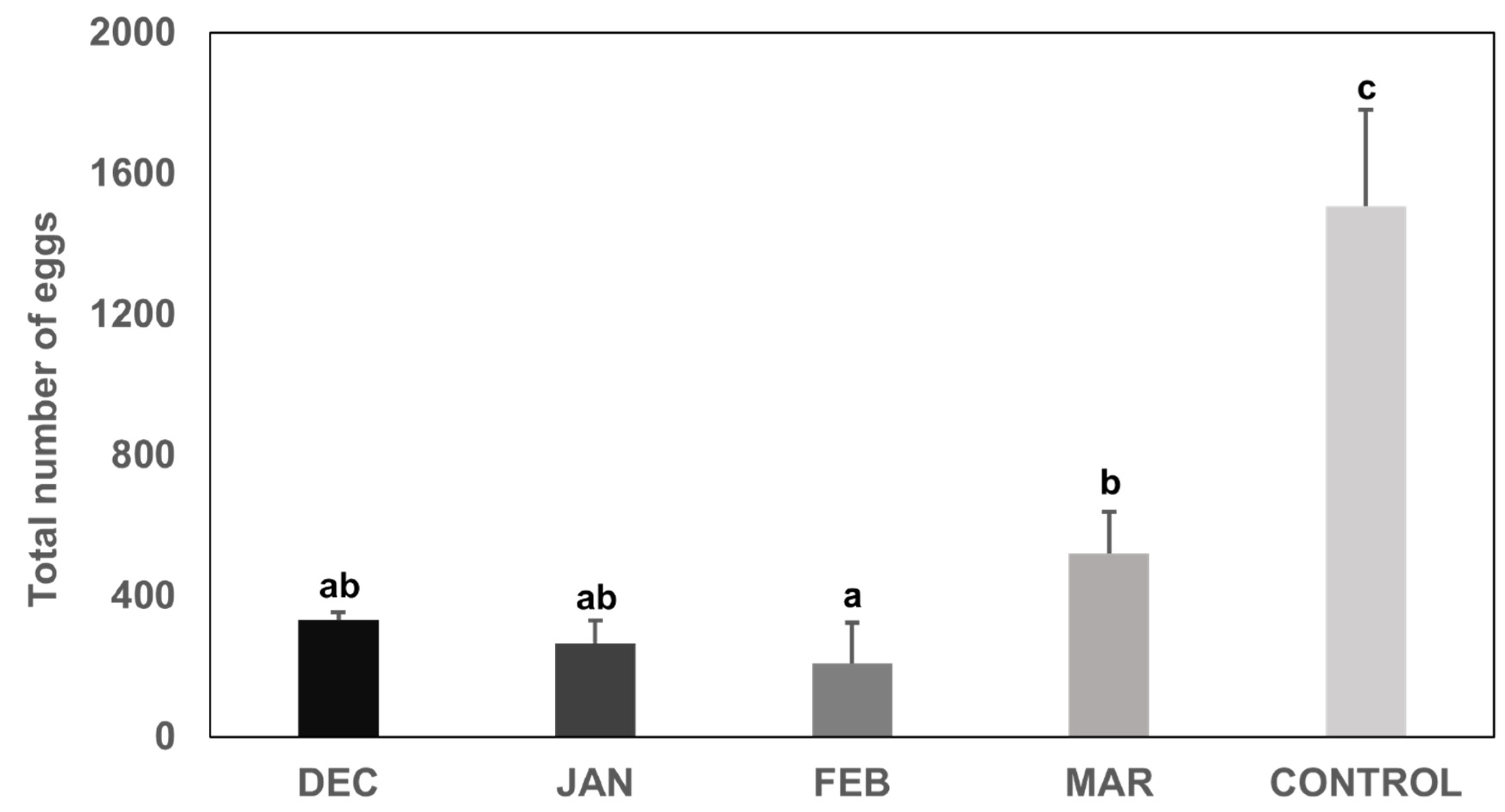
Halyomorpha halys (Stål) (Hemiptera: Pentatomidae) is a native pest of East Asia that overwinters as an adult in natural and human-made structures. Adult emergence from overwintering sites starts in spring, whereas females produce offspring in early summer on host plants, where most feeding occurs. In this study, we investigated the reproductive physiology of overwintering females of H. halys in Northern Greece, by determining the duration of the preoviposition period and fecundity of individuals that were left to overwinter in natural conditions and were subsequently transferred to chambers with standard conditions monthly, from December 2020 to March 2021. According to our results, overwintering H. halys females do not initiate egg laying once they emerge from overwintering sites, but rather need some additional time to exit diapause and mature reproductively. The mean preoviposition period of overwintering females that were transferred from their overwintering sites to the chambers in December 2020 was 29.0 days, which was significantly longer by 8.3 days than that of females that overwintered until March 2021, and by 13.2 days than the control (26 °C, 60% RH and a 16:8 h light: dark photoperiod). No significant difference among the average number of eggs per egg mass laid by overwintering individuals brought in the chambers in different time intervals and the laboratory colony was observed. However, females that were left to overwinter until March laid a significantly higher number of eggs in total, compared to the ones whose overwintering was disrupted in February. Based on our findings, overwintering females of H. halys experience a facultative reproductive diapause in Northern Greece. Our study was the first to determine the occurrence of diapause of H. halys in N. Greece and our findings could be very valuable for assessing the damage of this pest to early-season crops and designing successful management practices.