Host Plant Species Mediates Impact of Neonicotinoid Exposure to Monarch Butterflies


1
Odum School of Ecology, University of Georgia, Athens, GA 30602, USA
2
Department of Entomology, University of Minnesota, St. Paul, MN 55108, USA
*
Author to whom correspondence should be addressed.
Insects 2021, 12(11), 999; https://doi.org/10.3390/insects12110999
Submission received: 12 August 2021
/
Revised: 27 October 2021
/
Accepted: 2 November 2021
/
Published: 6 November 2021
(This article belongs to the Section Insect Ecology, Diversity and Conservation)
Simple Summary
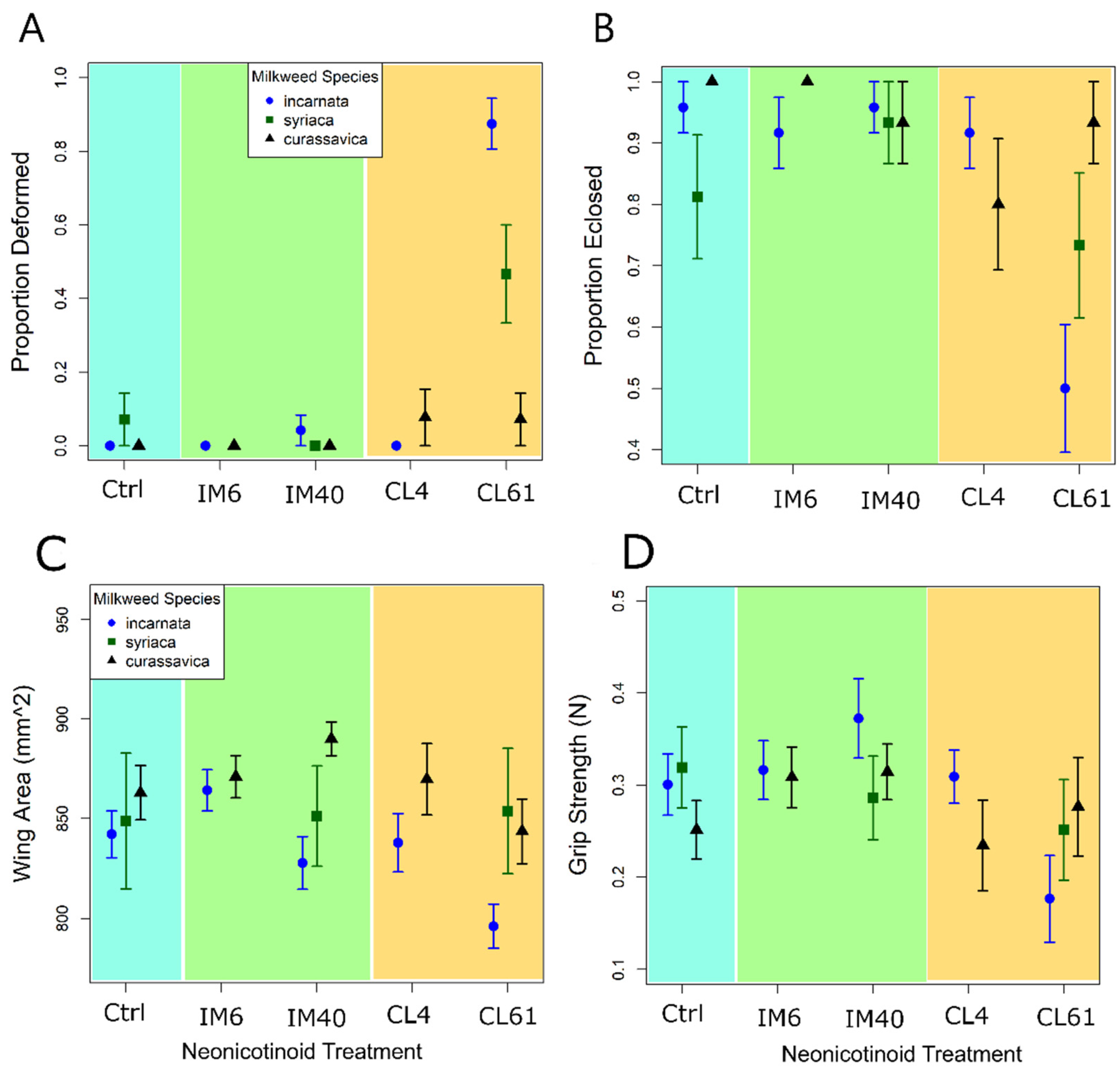
Neonicotinoids are the most widely used insecticides in North America and many studies document the negative effects of neonicotinoids on bees. Monarch butterflies are famous for their long-distance migrations, and for their ability to sequester toxins from their milkweed host plants. The neonicotinoids imidacloprid and clothianidin were suggested to correlate with declines in North American monarchs. We examined how monarch development, survival, and flight were affected by exposure to neonicotinoids, and how these effects depend on milkweed host plant species that differ in their cardenolide toxins. Monarch survival and flight were unaffected by low and intermediate neonicotinoid doses. At the highest dose, neonicotinoids negatively affected monarch pupation and survival, for caterpillars that fed on the least toxic milkweed. Monarchs fed milkweed of intermediate toxicity experienced moderate negative effects of high insecticide doses. Monarchs fed the most toxic milkweed species had no negative consequences associated with neonicotinoid treatment. Our work shows that monarchs tolerate low neonicotinoid doses, but experience detrimental effects at higher doses, depending on milkweed species. To our knowledge, this is the first study to show that host plant species potentially reduce the residue of neonicotinoid insecticides on the leaf surface, and this phenomenon warrants further investigation.
Abstract
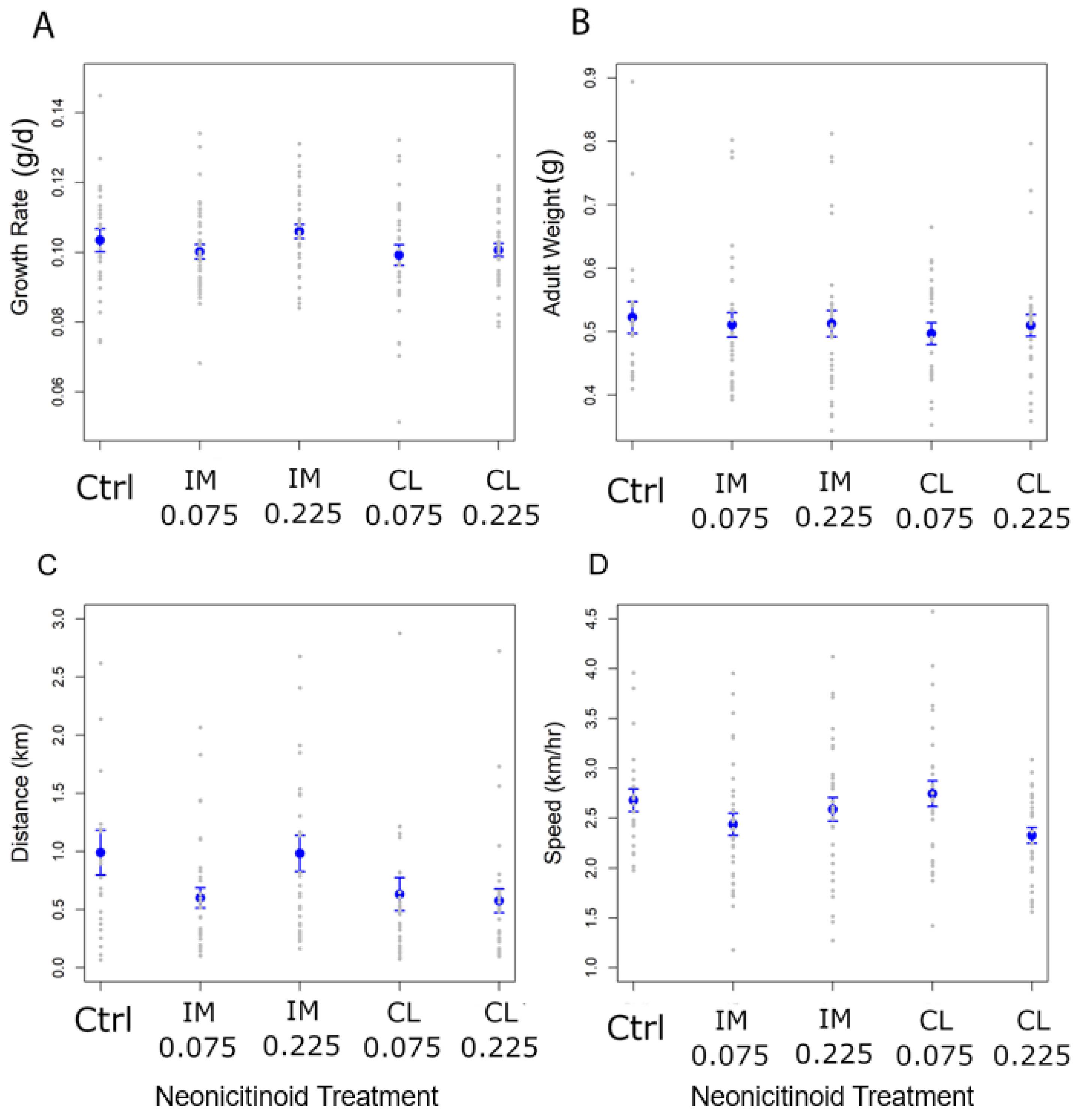
Neonicotinoids are the most widely used insecticides in North America. Numerous studies document the negative effects of neonicotinoids on bees, and it remains crucial to demonstrate if neonicotinoids affect other non-target insects, such as butterflies. Here we examine how two neonicotinoids (imidacloprid and clothianidin) affect the development, survival, and flight of monarch butterflies, and how these chemicals interact with the monarch’s milkweed host plant. We first fed caterpillars field-relevant low doses (0.075 and 0.225 ng/g) of neonicotinoids applied to milkweed leaves (Asclepias incarnata), and found no significant reductions in larval development rate, pre-adult survival, or adult flight performance. We next fed larvae higher neonicotinoid doses (4–70 ng/g) and reared them on milkweed species known to produce low, moderate, or high levels of secondary toxins (cardenolides). Monarchs exposed to the highest dose of clothianidin (51–70 ng/g) experienced pupal deformity, low survival to eclosion, smaller body size, and weaker adult grip strength. This effect was most evident for monarchs reared on the lowest cardenolide milkweed (A. incarnata), whereas monarchs reared on the high-cardenolide A. curassavica showed no significant reductions in any variable measured. Our results indicate that monarchs are tolerant to low doses of neonicotinoid, and that negative impacts of neonicotinoids depend on host plant type. Plant toxins may confer protective effects or leaf physical properties may affect chemical retention. Although neonicotinoid residues are ubiquitous on milkweeds in agricultural and ornamental settings, commonly encountered doses below 50 ng/g are unlikely to cause substantial declines in monarch survival or migratory performance.
Keywords:
clothianidin; imidacloprid; Danaus plexippus; sub-lethal effects; toxicity; Asclepias; milkweed; flight