1. Introduction
Reducing friction and wear is a key objective in modern tribology and is essential for increasing the reliability and durability of machines and mechanisms. The use of lubricants reduces direct contact between rubbing surfaces, lowers energy losses, and reduces the rate of surface layer destruction. Therefore, considerable attention is being paid to developing new lubricant compositions, including those modified with nanoparticles. Recent reviews show that metallic and oxide nanomaterials can significantly alter the antifriction and antiwear properties of oils. However, the final effect is determined not only by the chemical nature of the particles but also by their size, shape, concentration, dispersion stability, and friction conditions [
1,
2,
3,
4,
5].
Oil suspensions containing CuO nanoparticles are of particular interest. Early work has shown that even at relatively low concentrations, such additives can significantly alter not only the friction coefficient and wear, but also the physicochemical properties of the lubricant itself. Thus, Ettefaghi et al. [
6] studied SAE 20W50 motor oil with CuO nanoparticles and showed that the additive changes viscosity, increases the flash point, and, within a certain concentration range, improves low-temperature properties; based on a set of parameters, a concentration of about 0.2 wt.% was identified as the best result among the tested concentrations. In one of the most cited works, Hernández Battez et al. [
7] compared CuO, ZnO and ZrO
2 for synthetic polyalphaolefin base oil (PAO 6) in the mixed lubrication mode and showed that all the studied oxide particles are capable of improving antiwear behavior, but the severity of the effect is determined by the nature of the oxide (phase state, crystalline structure, etc.) and its concentration; in this case, the improvement was associated with the deposition of particles in the wear zone and the formation of a protective layer. In a subsequent study by the same authors [
8], it was shown that a CuO nanolubricant for NiCrBSi coatings reduces the friction coefficient and promotes more stable sliding, and that the particles themselves are actively involved in processes occurring on the contact surface. Jatti and Singh [
9], studying CuO in lubricating oil on a pin-on-disk tribometer under various loads and speeds, came to the conclusion that CuO nanoparticles effectively improve the lubricating ability of the oil, reducing friction and wear due to the entry of particles into the contact zone and a partial transition from purely sliding interaction to a more complex mixed mechanism involving solid nanoparticles.
This direction was further developed in works on more complex and practically significant lubricating compositions. Peña-Parás et al. [
10] showed that in finished lubricants (fully formulated oils), the addition of CuO provides a more pronounced improvement in tribological characteristics than Al
2O
3, and this positive effect was accompanied by a decrease in roughness and was interpreted within the framework of mechanisms of filling microroughness and surface restoration. Alves et al. [
11] used CuO nanoparticles, 5 nm in size, modified with oleic acid, and showed that at low concentrations in synthetic PAO oil, a reduction in friction and wear is achieved; the authors linked the effect with the formation of a protective surface layer and tribosintering of particles in the contact zone. In mineral oil, Abdel-Rehim et al. [
12] demonstrated a reduction in the friction coefficient of 14.59–42.92% compared to the base oil, and SEM/EDS and AFM analysis allowed the authors to discuss the combined action of several mechanisms, from the formation of a protective film to the modification of the wear surface morphology.
More recent work has shifted the emphasis from the positive effect of CuO itself to issues of dispersion stability, particle surface chemistry, and compatibility with a particular base oil. Hisham et al. [
13] investigated a hybrid cellulose nanocrystal–CuO system for piston ring–cylinder liner contact and showed that increased colloidal stability was accompanied by improved tribological performance, emphasizing the importance of stabilizing the nanoparticles in the oil. Szabó, Marsicki, and Hargitai [
14] found that for Group III base oil with 8 wt.% Komad 323 dispersant, surface-modified CuO particles performed most effectively at a concentration of about 0.4 wt.%, providing approximately 4% friction reduction, 27% wear scar diameter reduction, and 48% wear volume reduction. In this case, CuO and the additive package acted together, forming an antiwear, low-friction boundary layer. In the work of Szabó and Pápai [
15], it was shown that 0.5 wt.% CuO in thermally aged Group III base oil not only retains the antifriction effect, but also partially suppresses the negative manifestations of oil aging: static friction decreased by 34–37%, wear scar diameter by approximately 35%, and wear volume, at best, decreased to 77% relative to the original sample. Sikdar and Menezes [
16] demonstrated that CuO functionalization significantly increases the efficiency of the additive in waste-plastic-derived oil, and that the key factor is not only particle concentration but also the state of their surface. Elsoudy et al. [
17] showed that by selecting the ligand shell and stabilizing the dispersion, it is possible to significantly enhance the tribological effect of CuO nanolubricants; Thus, it was directly confirmed that colloidal stability and interfacial chemistry are not secondary, but determining parameters in the design of nanolubricants. Finally, Szabó and Hasan [
18] found for an automotive base oil that 0.3 wt.% CuO alone provides a reduction in dynamic friction by approximately 19% and a decrease in disk wear volume by 47%, while the introduction of a binary mixture of CuO/ZnO in a ratio of 2:1 gives a synergistic effect—up to 27% for friction and 54% for wear.
It is significant that some studies compare CuO not only with base oil, but also with traditional antiwear and EP additive packages. Thus, Mello et al. [
19] showed that in synthetic oil, CuO nanoparticles can act as an effective friction reducer due to copper deposition and the mending effect mechanism, whereas in mineral oil under the same conditions, a different scenario is possible—the behavior of particles as a “third body” with a pronounced dependence of the result on concentration and dispersion. Tóth, Hargitai and Szabó [
20] for Group III base oil with overbased calcium sulfonate showed that surface-modified oxide nanoparticles, including CuO, work most effectively in the range of about 0.4 wt.% and can reduce friction by up to 15%, and wear volume—up to 77%; The authors interpreted this as the result of the combined formation of a protective boundary layer by oxide particles and calcium-containing components of the additive package.
Previous studies indicate that CuO-containing additives can reduce friction and wear in several base oils and tribosystems [
7,
8,
9,
10,
11,
12]. More recent work shows that the magnitude and even the direction of the response depend strongly on dispersion stability, surface functionalization, base-oil chemistry, and the presence of conventional additives [
13,
14,
15,
16,
17,
18]. Comparisons with formulated lubricants further demonstrate that particles may form beneficial boundary layers in one system but behave as a concentration-sensitive third body in another [
19,
20]. Despite this literature, direct comparisons of copper-containing powders produced by the same synthesis route but differing in Cu/Cu
2O/CuO composition remain limited. Such comparisons are especially useful when the powders are tested in the same additive-free base oil under identical loading and test duration.
The present study directly compares two copper-containing powders produced by the same high-throughput electron-beam method under different current–time regimes and tested under the same tribological conditions. Phase composition is an important distinguishing characteristic, but the powders also differ in synthesis conditions, mean particle size, and morphology; accordingly, the experiment does not isolate phase ratio as the only independent variable. The industrial ELV-6 route remains attractive because it can produce copper-containing nanopowders at rates of up to several hundred grams per hour, substantially exceeding many laboratory-scale synthesis methods. A broader series of powders with independently controlled phase composition, size, morphology, surface state, and dispersion stability will be required before general phase-design rules for lubricant additives can be established.
The aim of this work was to compare the effects of two copper-containing composite nanopowders with different Cu/Cu2O/CuO compositions on the wear of Steel 40 specimens lubricated with additive-free I-20A mineral oil. N1 and N2 were synthesized and characterized, six separate suspensions containing 0.01, 0.1, or 1 wt.% powder were prepared, and three independent block-on-ring tests were conducted for each lubricant condition. Mass loss was evaluated statistically, and SEM/EDS was used for a local comparative examination of the untested surface and wear scars obtained with 1 wt.% N1 and 1 wt.% N2.
2. Materials and Methods
2.1. Synthesis and Characterization of Copper-Containing Nanopowders
The copper nanoparticles were fabricated from grade M1 copper (purity ≥ 99.9 wt.% conforming to GOST 859-2014 [
21]), which is chemically equivalent to UNS C11000.
Copper nanopowder was produced at the Unique Scientific Facility ELV-6 (UNU ELV-6), which was developed and is located at the Institute of Nuclear Physics of the Siberian Branch of the Russian Academy of Sciences. The nanopowder production facility is based on the industrial ELV-6 linear electron accelerator, which releases a focused relativistic beam into the atmosphere with an energy of 1.4 MeV and a power of up to 100 kW [
22]. This level of energy allows operation at atmospheric pressure of the surrounding gas environment because scattering losses in the gas are small. The power density of the electron beam can reach 5 MW/cm
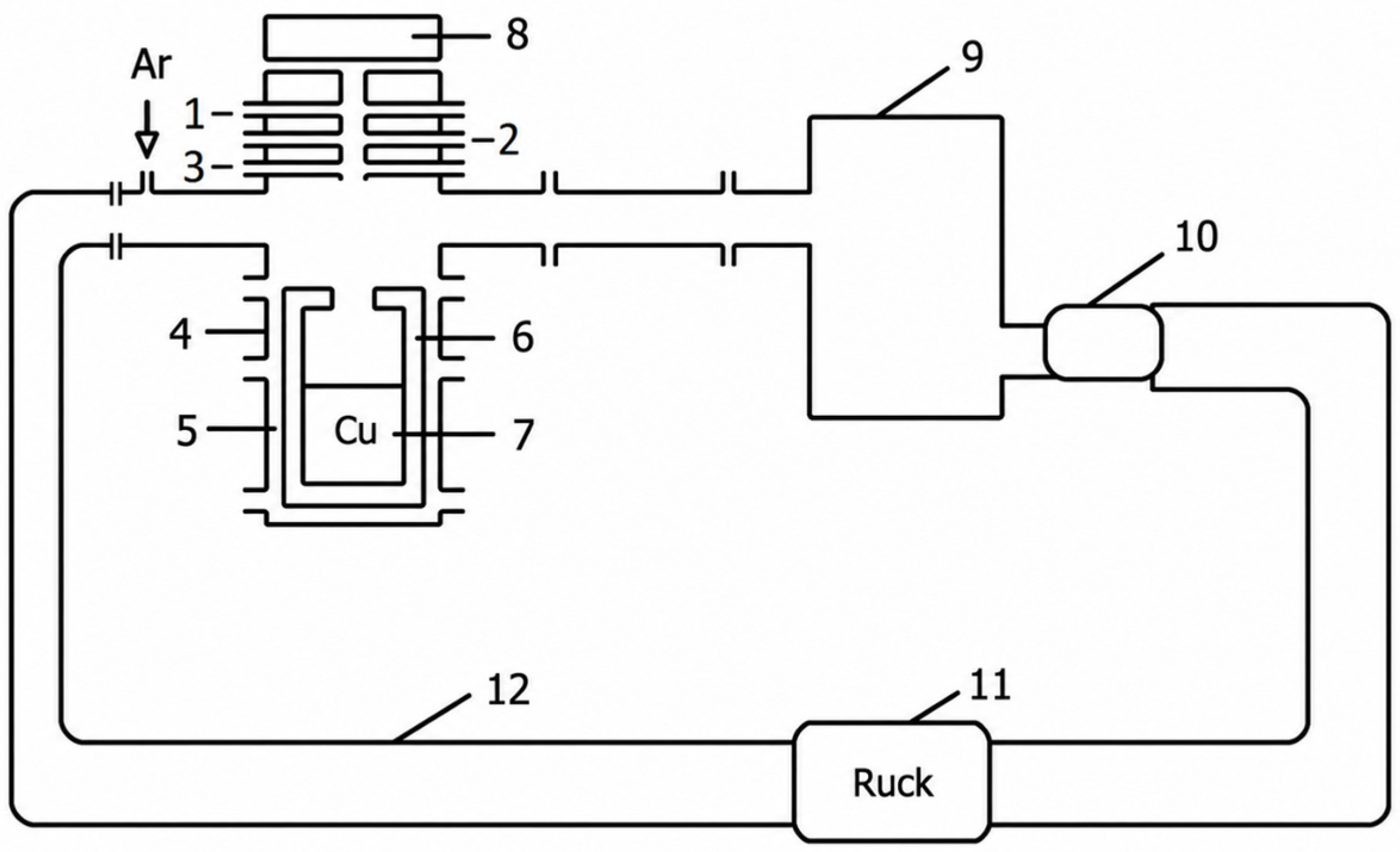
2. The general installation diagram is presented in
Figure 1. The gas path had a closed-loop configuration and was filled with argon at a pressure close to atmospheric. This design enabled repeated use of the carrier gas, reduced argon consumption, and limited oxygen ingress into the synthesis zone. Argon circulation in the closed gas path was provided by a Ruck EL 250 D2 01 fan (Ruck Ventilatoren GmbH, Boxberg, Germany). However, the formation of oxide phases could not be completely suppressed; oxide phases were still detected in the resulting nanopowders.
The beam from the accelerator (8) is injected into the partitioned water-cooled sublimator (4). In the area where the electron beam exits the evaporation chamber, process channels 1–3 are designed to provide protective gas purging of the output unit. Inert or protective gas can be supplied through the corresponding inlets, creating a local gas-dynamic barrier in the beam passage zone. The purpose of this purging is to prevent the backflow of metal vapor, molten droplets, and aerosol particles to the output device diaphragm and thence to the accelerator’s vacuum system. The M1 industrial copper target (7) was placed in a cylindrical graphite crucible (5) with an external diameter of 140 mm. The crucible height was 110 mm, the wall thickness was 22 mm, and the bottom was 30 mm thick [
23]. The crucible was placed in a water-cooled stainless steel sublimator (4). The surface of the material was exposed to a focused continuous-wave electron beam with an electron energy of 1.4 MeV, a current of 15–20 mA (corresponding to a nominal beam power of 21–28 kW), and a treatment duration of 15–25 min.
Part of the energy flux is reflected from the surface, and the rest is absorbed in the thin surface layer of the target by about 0.5 mm, causing it to heat, followed by melting and evaporation. The diameter of the beam on the upper surface of the molten material is about 30 mm.
Less than 10 min after the start of exposure to the electron beam, the copper sample completely melted, and in the exposure zone, the copper evaporated intensively. The resulting vapors condensed in the argon flow and, after passing through a coarse-fraction separator designed for the inertial deposition of microdroplets, large agglomerates, and mechanical particles, entered the filter box as an aerosol flow, where they were collected as nanopowder samples [
24]. The approach to obtaining copper nanopowders and their modeling was discussed in detail previously [
25].
The size, shape, and surface morphology of the nanoparticles were characterized by electron microscopy using a LIBRA120 transmission electron microscope (TEM) (ZEISS, Oberkochen, Germany). An X-ray diffraction (XRD) method (Difray 401, Scientific Instruments JSC, Saint Petersburg, Russia) was used to study the phase composition. Nanoparticle size analysis was performed on a Nano Particle Size Analyzer SALD-7500nano (Shimadzu, Kyoto, Japan).
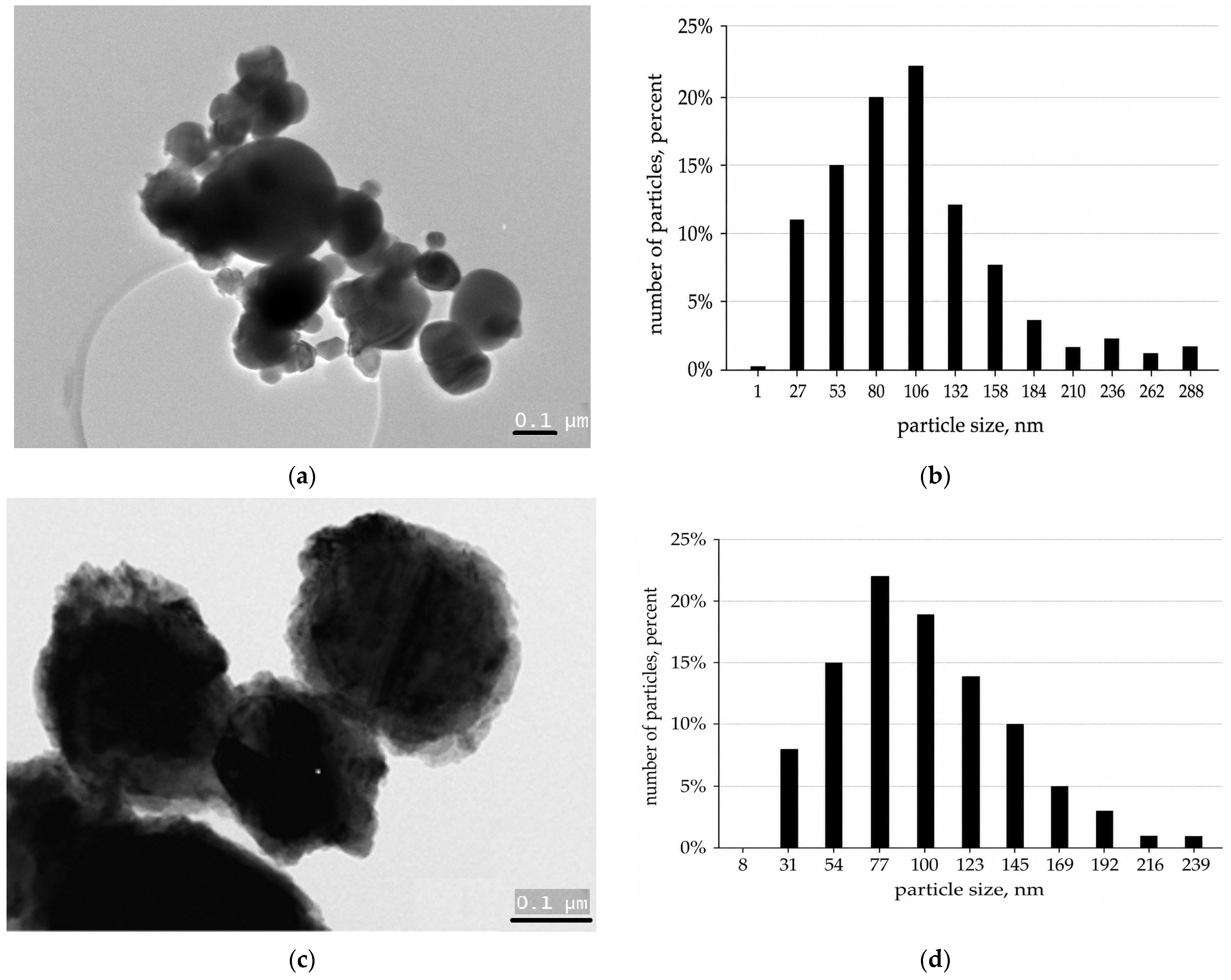
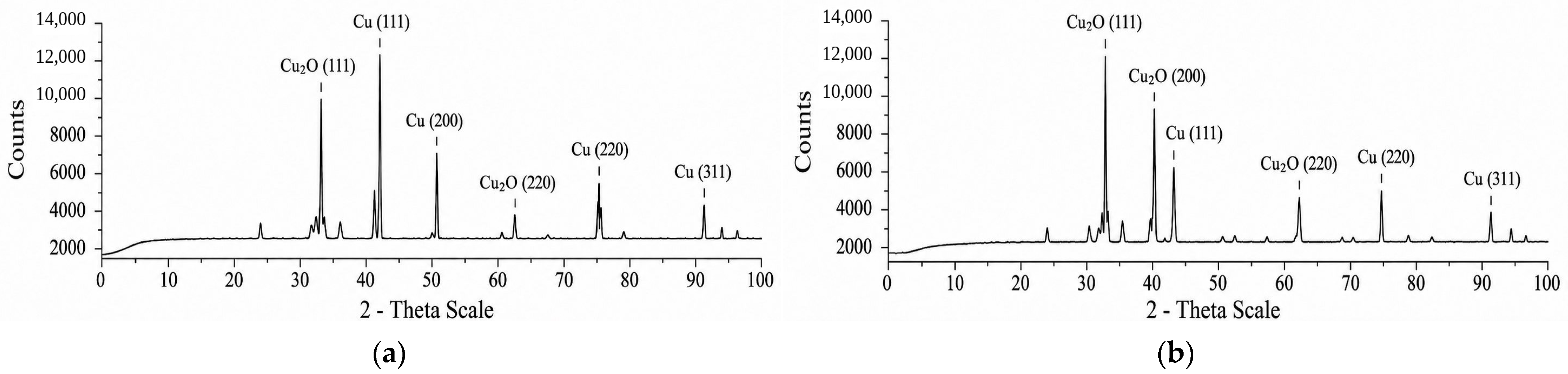
Figure 2 and
Figure 3 and
Table 1 summarize the characteristics of N1 and N2. TEM showed a more pronounced faceted shape and a relatively dense surface for N1, whereas N2 had less-defined particle boundaries and a looser morphology. XRD analysis showed that N1 contained 91 wt.% Cu, 2 wt.% Cu
2O, and 7 wt.% CuO, whereas N2 contained 38 wt.% Cu, 48 wt.% Cu
2O, and 14 wt.% CuO. The number-based particle-size distributions are shown in
Figure 2, and the mean particle sizes reported in
Table 1 were 140 nm for N1 and 187 nm for N2. Thus, the powders differed not only in phase composition but also in mean particle size and morphology; these concomitant differences were considered when interpreting the tribological results.
Powder N1 was synthesized using a continuous 1.4 MeV electron beam at 20 mA for 15 min. The corresponding nominal beam power was 28 kW, and the nominal integrated beam energy (beam power × treatment time) was 25.2 MJ.
Powder N2 was synthesized at the same electron energy using a beam current of 15 mA for 25 min. The corresponding nominal beam power was 21 kW, and the nominal integrated beam energy was 31.5 MJ.
The difference in phase composition is consistent with the previously reported dependence of copper-nanopowder oxidation on electron-beam power [
24,
25]. Longer processing at lower current promoted oxidation and resulted in the production of oxide-containing powder N2, while higher current at shorter processing duration increased the proportion of copper metal in N1. Thus, the increased content of oxides in N2 is associated primarily with an increase in the duration of exposure and contact with residual oxygen at a lower instantaneous flow of copper vapor.
2.2. Preparation of Lubricating Compositions and Wear-Test Scheme
I-20A mineral oil, without additives, was used as the base medium (in accordance with GOST 20799-88), thereby eliminating the influence of commercial additive packages on the experimental results [
26]. I-20A is a general-purpose mineral industrial oil produced through the selective refining of petroleum. It is classified as a distillate oil (or a blend of distillate and residual components). I-20A is a “pure” mineral oil without chemical additives, making it a versatile, cost-effective lubricant for industrial equipment. According to GOST 20799-88, the typical physical and chemical properties are: kinematic viscosity at 40 °C is 25–35 mm
2/s (cSt); flash point (open cup) is at least 200 °C; pour point is −15 °C; density at 20 °C is a maximum of 890 kg/m
3; acid number is a maximum of 0.03 mg KOH/g. It contains no water or mechanical impurities.
The I-20A oil is widely used in various industrial fields for its reliability and availability. It functions as the main working fluid for machine tool drives, automated production lines, and hydraulic presses. It is suitable for lightly to moderately loaded gears, rolling and sliding guides, and other mechanical friction components. Additionally, it is frequently used as a quenching medium to cool steel parts during hardening processes. It also serves as a base oil in the formulation of more complex lubricants that contain anti-corrosion or anti-wear additives.
Using I-20A oil as the base medium, six separate lubricant formulations were prepared: N1 at 0.01, 0.1, and 1 wt.% and N2 at the same three concentrations. No formulation contained a mixture of N1 and N2. Each suspension was ultrasonicated for 10 min at room temperature using a standalone 1.3 L ultrasonic bath (Model N26676, Launch Tech Co., Ltd., Shenzhen, China) operating continuously at 100 W and 40 kHz. Each suspension was redispersed immediately before every independent wear test.
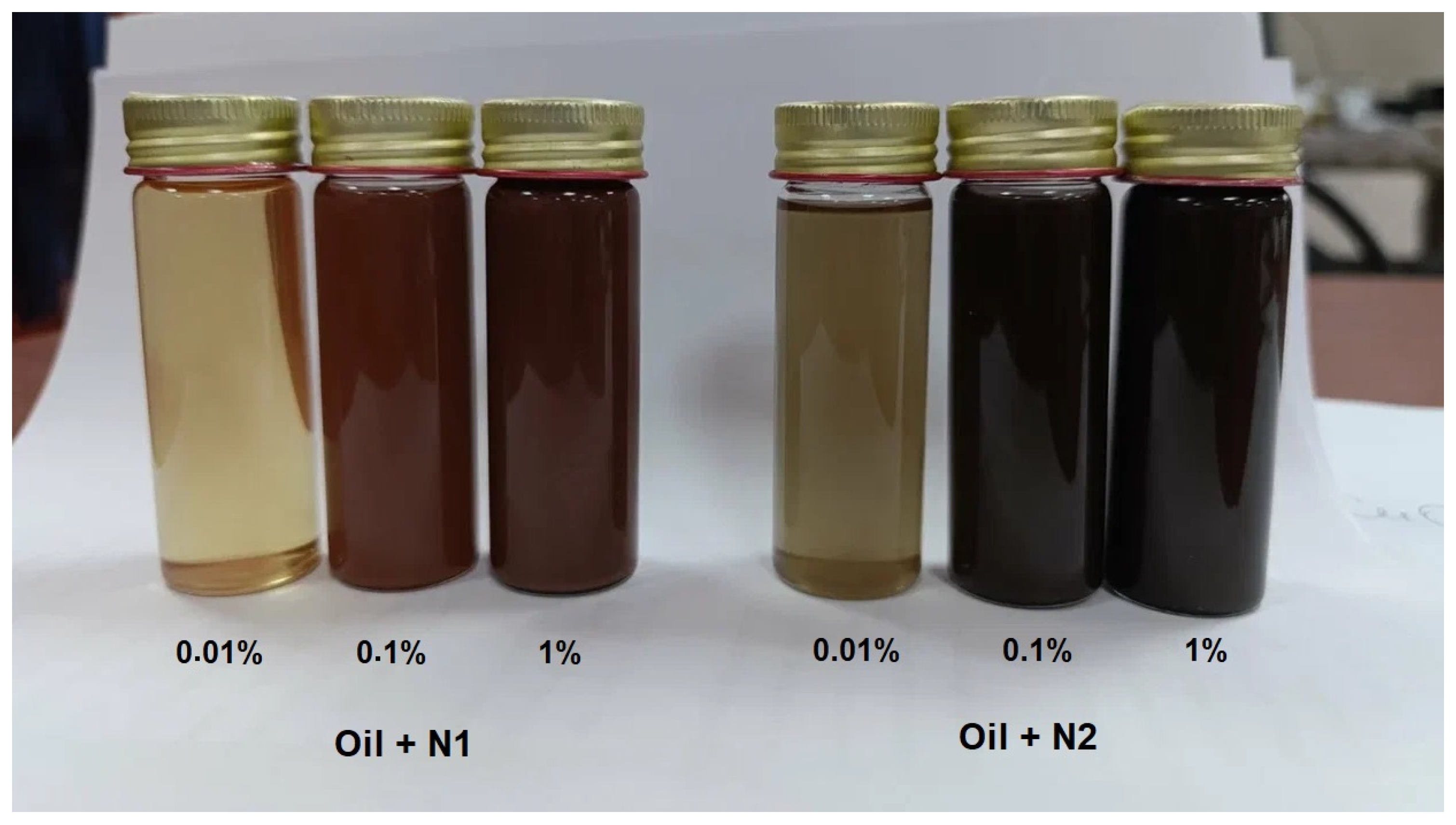
Figure 4 shows all six formulations after dispersion, with the N1-containing samples on the left and the N2-containing samples on the right. At the same nominal concentration, the N1 suspensions were red-brown, whereas the N2 suspensions were gray to black and darkened more strongly with increasing concentration. This visual contrast is qualitatively consistent with the different Cu/Cu
2O/CuO compositions and the resulting optical absorption and scattering of the suspensions, but color was not used as an independent method of phase identification. No visible sedimentation or macroscopic phase separation was observed during the first 2 h after ultrasonication. This stability assessment was qualitative; zeta potential, quantitative sedimentation kinetics, and time-dependent particle-size distributions were not measured.
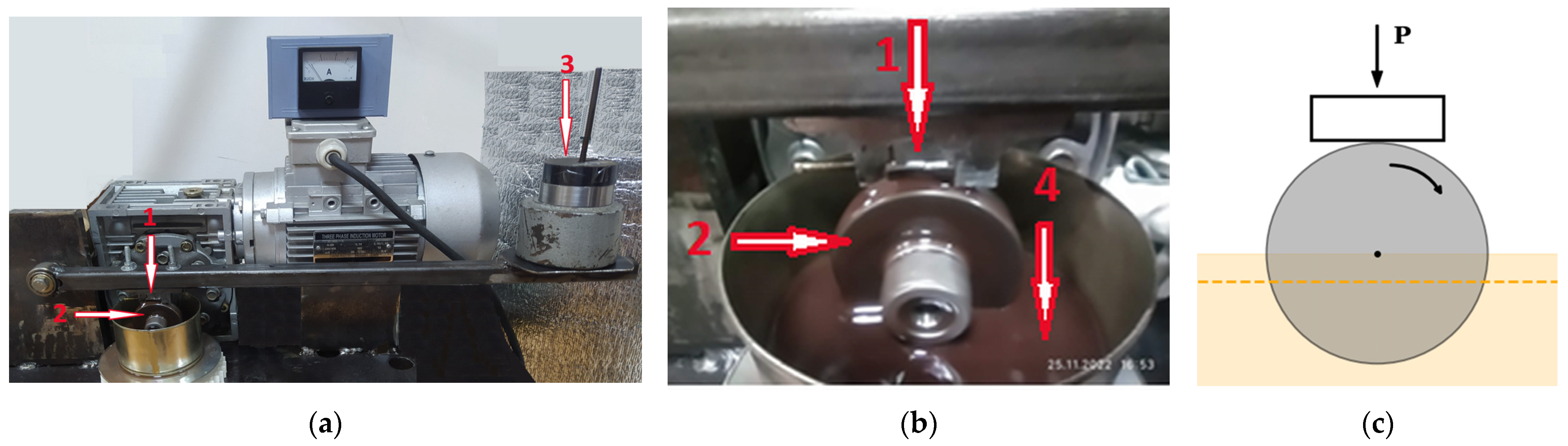
Wear tests were conducted on a friction machine custom-built in the workshops of Buryat State University named after D. Banzarov (Ulan-Ude, Russia; no commercial manufacturer or model designation) using a block-on-ring configuration. Flat Steel 40 specimens (approximately 13 × 10 × 5 mm; approximately equivalent to AISI 1040) were fixed above a rotating Steel 40 counterbody (
Figure 5). The friction pair was immersed in the lubricant, a constant 4.75 kg load (46.6 N) was applied, and each test lasted 60 min. Seven lubricant conditions were evaluated: pure I-20A oil and I-20A containing 0.01, 0.1, or 1 wt.% N1 or N2. Each condition was tested in three independent experiments using a separate steel specimen and an independently redispersed lubricant aliquot (
n = 3). After testing and prior to weighing, the specimens were immersed in a container filled with petroleum ether (“Galosha” solvent). The worn surfaces were cleaned in the solvent using a polymer-bristle brush. Brushing was performed first parallel to the wear tracks and then perpendicular to them. The specimens were subsequently wiped dry with a lint-free cloth, rinsed with acetone, and finally wiped dry again using a clean lint-free cloth. The specimens were then weighed on a GH-120 analytical balance (A&D Company Ltd., Tokyo, Japan) with a readability of 0.0001 g. Mass loss was calculated as the difference between the pre-test and post-test specimen masses. The friction machine did not include a calibrated tangential-force measurement channel; consequently, the coefficient of friction was not measured. The nominal chemical composition of Steel 40 specified by GOST 1050–2013 is summarized in
Table 2 [
27].
Surface characterization was performed using a JCM-6000 NeoScope II scanning electron microscope (JEOL Ltd., Tokyo, Japan) equipped with an EDS system. Selected regions of the untested Steel 40 surface and the wear scars produced after 60 min in I-20A oil containing 1 wt.% N1 or 1 wt.% N2 were examined. SEM images were acquired at an accelerating voltage of 15 kV, a working distance of 3–6 mm, and in secondary-electron imaging (SEI) mode. EDS spectra were collected from selected rectangular local regions using the EX-23010BU/EX-37001 EDS system (JEOL Ltd.), with an acquisition time of 10 min, and were processed using JEOL JED-Series software (JEOL Analysis Station, version 3.8.0.59.). The EDS results were interpreted as local elemental measurements; the method does not determine whether detected copper is present as Cu, Cu2O, or CuO. The selected regions provide a descriptive local comparison and are not areal averages or statistically representative surface maps. Equivalent SEM/EDS datasets were not available for pure oil or the lower powder concentrations, so the surface data were not used to establish a general wear mechanism for all lubricant conditions.
2.3. Approximate Evaluation of the Lubrication Regime
For a qualitative interpretation of the friction conditions, a Stribeck-type parameter was estimated as S0 = ηv/p, where η is the dynamic viscosity of the oil, v is the characteristic sliding velocity, and p is the nominal contact pressure. For I-20A oil at 40 °C, η was taken as approximately 0.031 Pa·s. With a load of 4.75 kg (F = 46.6 N), an approximate sliding velocity of 1 m/s, and a nominal contact area of 5 × 5 mm (S = 2.5 × 10⁻⁵ m2), the nominal contact pressure is pnom ≈ 1.9 MPa.
The corresponding value of ηv/p is approximately 1.6 × 10⁻⁸ m. This estimate is not a dimensionless Stribeck number because it uses nominal pressure and an approximate sliding velocity. It is therefore used only as qualitative context suggesting that local asperity contact and near-surface processes may have been important. Because the coefficient of friction, lubricant-film thickness, and electrical contact resistance were not measured, the lubrication regime was not experimentally validated. The estimate does not by itself demonstrate particle transfer, tribofilm formation, or any specific wear-reduction mechanism.
2.4. Replication and Statistical Analysis
Mass-loss results are reported as the arithmetic mean ± sample standard deviation (SD) of three independent experiments for each of the seven lubricant conditions (n = 3; 21 individual mass-loss measurements in total). The reported means, sample SDs, Welch’s t-test p-values, and Holm-adjusted p-values were calculated directly from these 21 individual measurements. The relative standard deviation was calculated as RSD = 100 × SD/mean. The distribution of residuals from the seven-group dataset was approximately Gaussian. Because equality of variances was not assumed, each nanopowder formulation was compared with pure I-20A oil using a two-sided Welch t-test. Holm adjustment was applied to the six planned comparisons to control the family-wise error rate. Holm-adjusted p < 0.05 was considered statistically significant.
3. Results
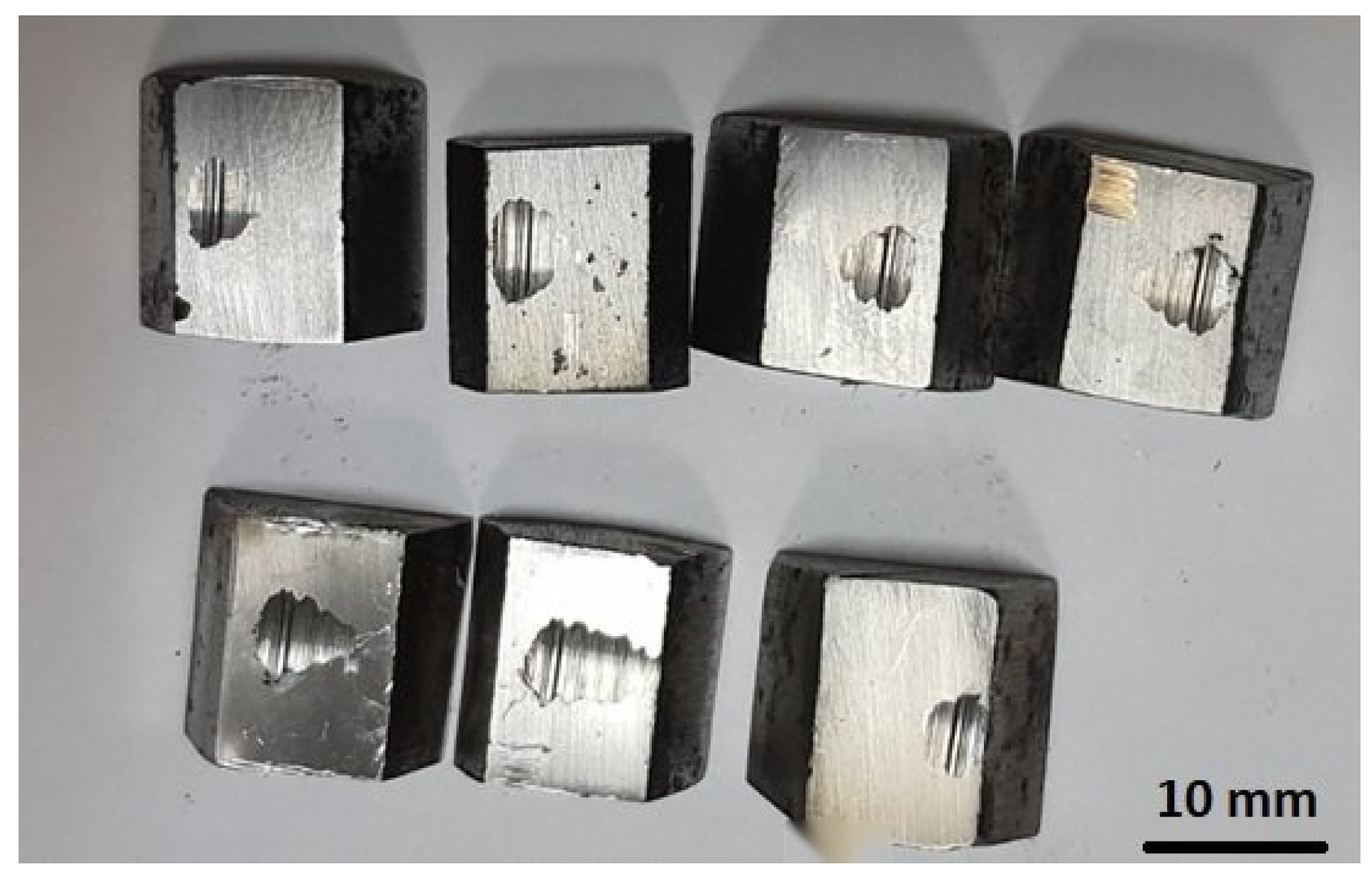
Macroscopic views of the Steel 40 specimens after wear testing are shown in
Figure 6. Visible wear tracks were present in the nominal contact area under every lubricant condition. The specimens differed in initial mass, but the contact geometry, normal load, test duration, lubricant volume, and specimen material were kept the same.
Figure 6 is a macroscopic documentation of the tested specimens and is not used to infer differences in microscopic wear mechanisms.
The replicated mass-loss results are summarized in
Table 3. Pure I-20A oil produced a mean mass loss of 0.00510 ± 0.00026 g. The lowest value was obtained with 1 wt.% N2 (0.00290 ± 0.00015 g), corresponding to a 43.1% decrease relative to pure oil; this difference remained statistically significant after Holm adjustment (adjusted
p = 0.0045). The mean values for 0.01 and 0.1 wt.% N2 were 0.00500 ± 0.00015 and 0.00490 ± 0.00020 g, respectively, and did not differ significantly from pure oil. For N1, 0.01 and 1 wt.% produced statistically significant increases in mass loss, whereas the 0.1 wt.% formulation did not differ significantly from pure oil.
Accordingly, a statistically supported antiwear improvement relative to pure oil was observed only for the formulation containing 1 wt.% N2. The large increase measured for 1 wt.% N1 is a reproducible experimental observation. Agglomeration, impaired lubricant supply to the contact, and abrasive action of agglomerates or wear debris as a third body are considered possible explanations, but none of these mechanisms was directly measured in the present work.
Values are mean ± sample SD of three independent tests per condition. All means, sample SDs, Welch’s t-test p-values, and Holm-adjusted p-values were calculated directly from the 21 individual mass-loss measurements (three measurements for each of seven conditions). RSD = 100 × SD/mean. Holm-adjusted p-values were obtained from two-sided Welch comparisons with pure I-20A oil. Adjusted p < 0.05 was considered statistically significant.
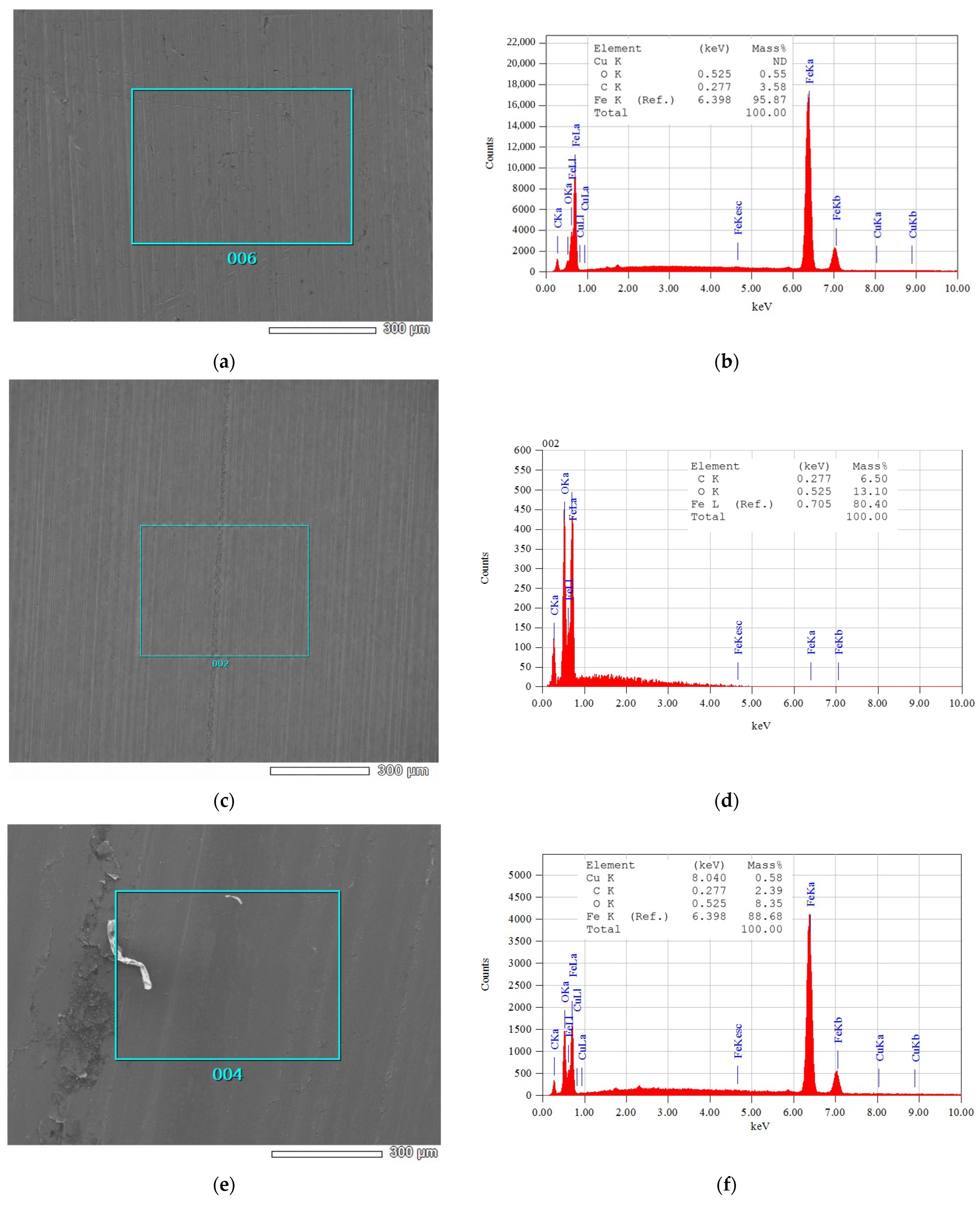
Figure 7 presents SEM images and corresponding local EDS spectra for selected regions of the untested Steel 40 surface and the wear scars obtained after 60 min in I-20A oil containing 1 wt.% N1 or 1 wt.% N2. The selected untested region had a relatively uniform relief with shallow machining marks, and Cu was below the EDS detection limit. After testing with 1 wt.% N1, the selected region exhibited deeper and more pronounced longitudinal grooves, consistent with stronger local plowing or microcutting and plastic deformation; Cu was also below the detection limit in this region. After testing with 1 wt.% N2, the selected region was smoother and more homogeneous, with less-pronounced deep grooves, and EDS detected 0.58 wt.% Cu.
These observations provide local comparative evidence for the two 1 wt.% formulations: Cu-containing material was retained in the analyzed N2 region, whereas Cu was not detected in the selected N1 region. However, absence of a Cu signal at one N1 location does not establish its absence across the entire wear scar, and the local N2 signal does not identify whether copper was present as Cu, Cu2O, CuO, or a mixture. The SEM/EDS data therefore do not demonstrate formation of a continuous protective tribofilm or establish that the higher oxide fraction caused the lower mass loss.
The combination of lower mass loss, smoother local morphology, and a Cu signal after the N2 test is consistent with particle transfer and retention, localized compaction or filling of surface irregularities, adsorption, or tribochemical transformation, as discussed in the literature [
7,
8,
9,
10,
11,
12,
20]. The deeper grooves after the N1 test are consistent with possible abrasive third-body action [
19]. At highly stressed asperity contacts, plastic deformation and freshly exposed steel may also facilitate oxygen transfer from CuO to Fe; the simplified reaction CuO + Fe → Cu + FeO is therefore chemically plausible. None of these processes was directly identified in the present work. Verification would require broader SEM/EDS mapping and profilometry together with a chemical-state-sensitive method such as XPS, Raman spectroscopy, or grazing-incidence XRD.
4. Discussion
The replicated results demonstrate a formulation- and concentration-dependent response rather than a general beneficial effect of copper-containing nanopowders. Only 1 wt.% N2 produced a statistically significant reduction in mass loss relative to pure I-20A oil. The two lower N2 concentrations were statistically indistinguishable from pure oil, whereas 0.01 and 1 wt.% N1 significantly increased mass loss. Concentration-dependent responses have been reported for CuO-containing base oils [
7,
8,
9,
10,
11,
12], while recent studies emphasize the roles of dispersion stability and surface chemistry [
13,
14,
15,
16,
17,
18] and formulated-oil interactions [
19,
20]. The present comparison does not establish phase composition as the sole cause of the response.
The association between the lowest mass loss and the oxide-richer N2 powder is scientifically relevant but must be interpreted cautiously. N1 and N2 differed simultaneously in synthesis regime (20 mA for 15 min versus 15 mA for 25 min), Cu/Cu
2O/CuO proportions, mean particle size (140 versus 187 nm), and morphology, and their detailed dispersion behavior was not quantified. The local SEM/EDS comparison in
Figure 7 shows different wear-surface features for the two 1 wt.% formulations, but it does not isolate which powder characteristic caused the difference in mass loss.
The combined gravimetric and local surface data support a coherent interpretation for the superior performance of N2. At 1 wt.% N2, mass loss decreased by 43.1%, while the selected wear-scar region was smoother and contained 0.58 wt.% Cu. These observations show that Cu-containing material reached the contact and was locally retained during sliding. In an asperity-dominated contact, such retained particles can plausibly be compacted into surface depressions, share part of the local load, reduce direct steel–steel interaction, and contribute to a Cu-containing boundary layer; analogous filling, deposition, and boundary-layer mechanisms have been reported for CuO-containing lubricants [
7,
8,
9,
10,
11,
12,
20]. The higher oxide fraction of N2 may favor such surface interaction, and oxygen transfer from CuO to freshly exposed Fe (e.g., CuO + Fe → Cu + FeO) is chemically plausible at highly stressed asperities. Tribo-oxidation of copper and its oxides is known to depend strongly on sliding conditions and temperature [
28,
29], which supports the general plausibility of interfacial oxide transformations but does not prove this specific reaction in the present tribosystem. However, because N2 also differs from N1 in particle size, morphology, and synthesis regime, and because EDS does not determine Cu oxidation state, the present results do not establish the oxide fraction or any tribochemical reaction as the sole cause of the lower wear.
The N1 results are consistent with a different particle–surface interaction pathway. At 1 wt.% N1, mass loss increased by 478.4% relative to pure oil, and the selected wear-scar region exhibited deeper longitudinal grooves, a morphology consistent with enhanced plowing or microcutting. A plausible explanation is abrasive third-body action involving individual particles, particle clusters, and/or wear debris, possibly combined with impaired lubricant replenishment at high solid loading [
19]. Agglomeration is therefore treated only as one possible contributor rather than as an experimentally established cause. Importantly, the N1 response was non-monotonic: 0.01 wt.% significantly increased wear, 0.1 wt.% did not differ significantly from pure oil, and 1 wt.% produced a severe wear increase. This behavior indicates that concentration alone does not control the response and that particle delivery to the contact, dispersion state, retention or expulsion from the interface, and third-body dynamics likely compete during sliding.
It is important to distinguish evidence for antiwear performance from evidence for a specific wear mechanism. The replicated mass-loss measurements provide a direct integrated measure of material removal and statistically establish the beneficial response of 1 wt.% N2 and the detrimental response of 1 wt.% N1 under the present test conditions. The localized SEM/EDS observations provide complementary morphological and elemental evidence, but they do not quantify friction, wear volume, wear-track depth, or roughness and do not establish the chemical state or continuity of a tribofilm. Accordingly, the mechanistic interpretation above is presented as a physically consistent explanation of the combined results rather than as direct proof of the operative mechanism. Friction-force measurements, profilometry, quantitative roughness/wear-volume analysis, broader SEM/EDS mapping, and chemical-state-sensitive characterization would be required to test these pathways directly.
The qualitative Stribeck-type estimate in
Section 2.3 is consistent with conditions in which local asperity contact and particle-mediated boundary processes may influence wear. The literature reports that CuO-containing lubricants can reduce the coefficient of friction under boundary or mixed lubrication [
7,
8]. Nevertheless, the present apparatus did not measure friction force, so no conclusion is drawn regarding the antifriction performance of N1 or N2, and the estimated lubrication regime should not be treated as experimentally validated.
Among the tested concentrations, 1 wt.% N2 produced the lowest mean mass loss. This result does not establish a true optimum because concentrations above 1 wt.% were not examined. In addition, the present statistical evaluation is based on three independent tests per condition. Future work should include a broader concentration range, additional replicates, simultaneous friction–force measurement, quantitative dispersion-stability analysis, profilometry, and comparative surface characterization for all lubricant conditions.
5. Conclusions
Two copper-containing composite nanopowders produced by the same electron-beam evaporation route under different current–time regimes were compared as additives to additive-free I-20A mineral oil. N1 was synthesized at 20 mA for 15 min (nominal beam power 28 kW; integrated beam energy 25.2 MJ) and was predominantly metallic (91 wt.% Cu). N2 was synthesized at 15 mA for 25 min (21 kW; 31.5 MJ) and contained a larger oxide fraction (48 wt.% Cu2O and 14 wt.% CuO). The powders also differed in mean particle size and morphology.
Three independent wear tests were performed for every lubricant condition, yielding 21 individual mass-loss measurements in total. Relative to pure I-20A oil, a statistically significant reduction in mean mass loss was observed only for 1 wt.% N2: from 0.00510 ± 0.00026 to 0.00290 ± 0.00015 g, corresponding to a 43.1% decrease (Holm-adjusted p = 0.0045). The 0.01 and 0.1 wt.% N2 formulations did not differ significantly from pure oil. N1 at 0.01 and 1 wt.% significantly increased mass loss, while the difference at 0.1 wt.% was not significant.
Local SEM/EDS comparison showed deeper longitudinal grooves and no detectable Cu in the selected wear-scar region after testing with 1 wt.% N1, whereas the selected region after testing with 1 wt.% N2 was smoother and contained 0.58 wt.% Cu. Together with the mass-loss data, these observations demonstrate that the two powders interacted differently with the worn surface and that Cu-containing material was locally retained after the N2 test. However, the analysis does not establish the absence of Cu across the entire N1 scar, determine the copper oxidation state, or demonstrate a continuous tribofilm; therefore, the specific wear-reduction and wear-acceleration mechanisms remain unresolved.
Thus, the replicated gravimetric data establish the antiwear benefit of 1 wt.% N2 under the tested conditions, whereas the SEM/EDS observations provide only local mechanistic support. The present results therefore distinguish a statistically demonstrated antiwear effect from the specific particle–surface processes responsible for it.
Because N1 and N2 differed simultaneously in synthesis regime, phase composition, particle size, and morphology, the present experiment does not identify the Cu/Cu2O/CuO ratio as the sole controlling factor. The results instead show that the combined powder formulation and concentration govern the response under the tested conditions and identify 1 wt.% N2 as the most promising formulation among those examined. Future experiments should use powders with independently controlled phase composition and particle characteristics, include friction-coefficient measurements, and provide comparative profilometry, SEM/EDS mapping, and chemical-state analysis of wear tracks for pure oil, N1, and N2. The high-throughput electron-beam route remains a potentially scalable platform for producing such controlled powder series.




 ,
,