1. Introduction
Self-lubricating materials have attracted increasing attention for applications in mechanical systems operating under severe or lubricant-starved conditions, where conventional liquid lubrication becomes ineffective or impractical. Components such as bearings, bushings, sliding guides, and tribological interfaces subjected to high loads, elevated temperatures, or intermittent lubrication require materials that can simultaneously withstand mechanical stresses and continuously supply lubrication at the contact surface [
1,
2,
3]. The self-lubricating composites (SLCs) combine a structural matrix, commonly made of bronze, steel, or polymers, with a solid lubricating phase [
4], such as MoS
2, hBN, PTFE, low-melting-point metals, and graphite, among others [
5,
6]. The self-lubrication mechanism relies on material wear, which continuously exposes fresh lubricant particles, thereby maintaining a stable lubricating layer throughout the service life of the component [
7]. In this context, self-lubricating metal matrix composites (SLMMCs) produced by powder metallurgy (PM) have emerged as promising candidates for combining structural integrity with the controlled incorporation of solid lubricant phases [
7].
Powder metallurgy is the most used technique for manufacturing SLMMCs [
8], as it allows the production of parts with complex shapes, high dimensional accuracy, and a porous structure that can act as a lubricant reservoir [
9,
10]. Within this category, self-lubricating iron-matrix (Fe) composites produced by PM are particularly attractive, owing to the abundance of raw materials, high strength, good impact absorption capacity, and favorable tribological properties [
11]. Improving the tribological behavior of these materials is crucial, as wear failure significantly affects their service life. Porous self-lubricating iron components are widely used in demanding applications, including bushings for aircraft engines, bearings, sliding guide plates, pistons, and connecting rods [
8,
12,
13].
Three-dimensional crystalline graphite (Gr) is one of the oldest and most widely studied solid lubricants [
5,
14]. Its lubricating effect is often attributed to the easy sliding of its basal planes, described by the “deck of cards” model, although humidity or adsorbed gases are required to passivate dangling bonds [
15]. In metallic matrices, the addition of graphite has been shown to reduce friction and wear [
14,
16]. However, low friction coefficients often require lubricant contents in the range of 15–40 vol.%, which may compromise matrix continuity and, hence, mechanical strength [
6,
8]. An alternative solution is the in situ generation of two-dimensional turbostratic graphite from precursors such as silicon carbide (SiC) during sintering, resulting in graphite reservoirs with low friction coefficients (below 0.10) and good mechanical properties [
17]. In addition, reducing the sintering temperature of Fe-based PM components is technologically relevant because it decreases energy consumption, processing costs, and furnace wear, while also limiting excessive carbon diffusion into the iron matrix. Processing below the α → γ transformation temperature of iron may help preserve carbon-rich lubricant phases and avoid significant carbon dissolution, thereby maintaining self-lubricating behavior in graphite-containing composites. Consequently, low-temperature sintering approaches can be an attractive, more sustainable alternative for producing self-lubricating PM materials with reduced manufacturing costs and simplified thermal cycles [
18,
19,
20].
In the field of carbon nanomaterials, graphene and its derivatives, such as graphene oxide (GO) and reduced graphene oxide (rGO), have attracted attention due to their single-layer structure, high thermal conductivity, and excellent mechanical strength [
21,
22]. Graphene and GO have been studied as reinforcements in several metal matrices, including copper (Cu) and aluminum (Al) alloys [
23,
24,
25]. However, a persistent challenge with nanofillers such as GO and RGO is their tendency to agglomerate, which can impair microstructural uniformity and increase porosity [
26,
27].
Although numerous studies have examined the tribological performance of graphite-containing iron-matrix composites and the effects of graphene-based nanomaterials in metallic matrices such as Cu and Al, there is still limited understanding regarding the comparative performance of graphite (Gr), graphene oxide (GO), and hybrid Gr/GO systems processed under identical powder metallurgy conditions. In particular, the influence of low-temperature sintering, here defined as sintering below the α → γ transformation temperature of iron (912 °C) and substantially lower than conventional Fe-based PM sintering temperatures (>1100 °C), on the densification, hardness, and tribological response of Fe-based self-lubricating composites remains insufficiently explored. This temperature is specifically selected to minimize or limit chemical reactions between the carbon fillers and the iron matrix, thereby allowing a direct evaluation of their independent tribological performance. Processing at lower sintering temperatures may be an attractive strategy to reduce manufacturing costs and energy consumption, while limiting excessive carbon dissolution into the iron matrix and preserving the solid lubricant phases responsible for tribolayer formation. Understanding the tribological synergies and differences between conventional three-dimensional graphite and two-dimensional graphene oxide, used individually or in combination in Fe-based PM composites, is essential for optimizing the design of next-generation self-lubricating materials. In this context, the present work investigates iron-matrix self-lubricating composites reinforced with graphite, graphene oxide, and a hybrid graphite/GO formulation, produced by powder metallurgy and low-temperature sintering at 880 °C. The main objective is to evaluate how these additions affect densification, porosity, hardness, and dry-sliding friction and wear, relative to unreinforced iron.
2. Materials and Methods
Four Fe-based materials were investigated: pure iron (Fe) and three self-lubricating composites reinforced with graphite and/or graphene oxide, namely Fe10%Gr, Fe10%GO, and Fe5%Gr5%GO. The compositions were defined as volumetric fractions (vol.%), with Fe as the balance matrix across all reinforced conditions. A total lubricant content of 10 vol.% was selected because it is within the typical range reported for self-lubricating powder metallurgy composites [
7]. Commercial iron (Fe, particle size ≈ 4 µm, purity ≥ 99.9 wt.%) and graphite (Gr, particle size < 20 µm, purity ≥ 95 wt.%) powders were supplied by Sigma-Aldrich (St. Louis, MO, USA), while graphene oxide (GO, particle size 0.8–1.2 µm, carbon content ~60 wt.%, purity ≥ 98 wt.%) was obtained from Changsha Easchem Co., Ltd. (Changsha, China).
The powders were weighed using an analytical balance and homogenized in a planetary ball mill (PQN04, Across International, Livingston, NJ, USA) using chrome steel balls under dry conditions. A ball-to-powder mass ratio of 3:1 was employed, with a rotational speed of 150 rpm in bidirectional mode. The mixing process consisted of three cycles of 15 min of milling, followed by 15 min pauses, to minimize excessive heating and promote homogeneous powder blending.
After homogenization, the powders were uniaxially compacted in a hardened D6 tool steel die with a cylindrical cavity using a hydraulic press at a nominal pressure of 500 MPa. Cylindrical specimens with a diameter of 10 mm and a height of 10 mm were manufactured for density measurements, microstructural characterization, and hardness testing. For tribological testing, cylindrical disks with a diameter of 24.5 mm and a height of 5 mm were produced for pin-on-disk experiments. Zinc stearate was applied to the die walls and punches to reduce friction during compaction and facilitate specimen ejection.
The green compacts were sintered in a tube furnace (Carbolite Gero, Neuhausen, Germany) under a flowing argon atmosphere (100% Ar, 20 L/h). The thermal cycle consisted of heating from room temperature to 880 °C at 5 °C/min, followed by a 60 min hold at the maximum temperature, and subsequent furnace cooling to room temperature under the same protective atmosphere. The sintering temperature of 880 °C was selected to remain below the α → γ transformation temperature of iron (912 °C), thereby minimizing carbon dissolution into the Fe matrix and preserving the carbon-rich lubricant phases responsible for tribolayer formation during sliding. After sintering, specimen dimensions and mass were assessed to determine sintered density and dimensional changes using three independent replicates for each condition.
For metallographic characterization, specimens were sectioned to an approximate thickness of 3 mm using a precision cutting machine (VC-50, LECO Corporation, St. Joseph, MI, USA). The samples were mounted in thermosetting resin, ground using progressively finer SiC abrasive papers, and polished with diamond suspensions (1–3 µm) and alumina until a mirror-like surface finish was achieved. Chemical etching was performed with 2% Nital solution to reveal the microstructure. Microstructural characterization was performed by optical microscopy (OPTIKA, Ponteranica, Italy).
Vickers hardness measurements were performed using a ZwickRoell ZHU8187.5 LKV hardness tester (ZwickRoell GmbH, Ulm, Germany) under a load of 5 kgf and a dwell time of 11 s for the sintered samples, with a minimum of eight random indentations performed per sample. Compression tests were performed at room temperature using a universal testing machine (BT1-FB100TN, ZwickRoell GmbH, Ulm, Germany), following the ASTM E9 standard for compression testing of metallic materials. A preload of 2 MPa and a crosshead speed of 0.127 mm/min were used throughout the tests. The compressive yield strength was determined using the 0.2% offset method from the stress–strain curves obtained during testing.
Dry-sliding tests were carried out using a pin-on-disk tribometer (Wear and Friction Tech, São Carlos, Brazil) against an AISI 52100 steel ball with an 8 mm diameter as the counterbody. The tests were performed under a normal load of 7 N, a rotational speed of 16 rpm, a wear track diameter of 18 mm, and a total sliding time of 30 min under ambient conditions. The tribological tests were conducted in ambient air (23 °C and relative humidity between 40% and 50%), and the coefficient of friction (COF) was continuously recorded during sliding. All dry-sliding tests were executed with six independent replicates under identical conditions.
After testing, the wear tracks were characterized by scanning electron microscopy coupled with energy-dispersive spectroscopy (SEM–EDS) using a Hitachi SU3500 microscope (Hitachi, Tokyo, Japan) to evaluate wear mechanisms and tribolayer formation. In addition, Vickers microhardness measurements were performed directly inside the wear tracks using a LECO LM300AT microhardness tester (LECO Corporation, St. Joseph, MI, USA) under a load of 10 gf (HV0.01) and a dwell time of 11 s.
The wear profiles were obtained using a contact profilometer (MarSurf, Mahr GmbH, Göttingen, Germany) equipped with a diamond stylus. Ten transverse profiles were measured for each wear track. The cross-sectional wear areas were determined using MountainsMap v7.1 software and multiplied by the track perimeter to calculate the removed volume. The specific wear rate was then determined by normalizing the worn volume by the applied load and sliding distance. Counterbody wear was evaluated based on the wear scars formed on AISI 52100 steel balls after testing. Images of the wear scars were acquired with an optical microscope, and the scar diameters were measured with image analysis software. Based on the measured scar geometry, the wear volume of the spheres was estimated [
28].
3. Results and Discussion
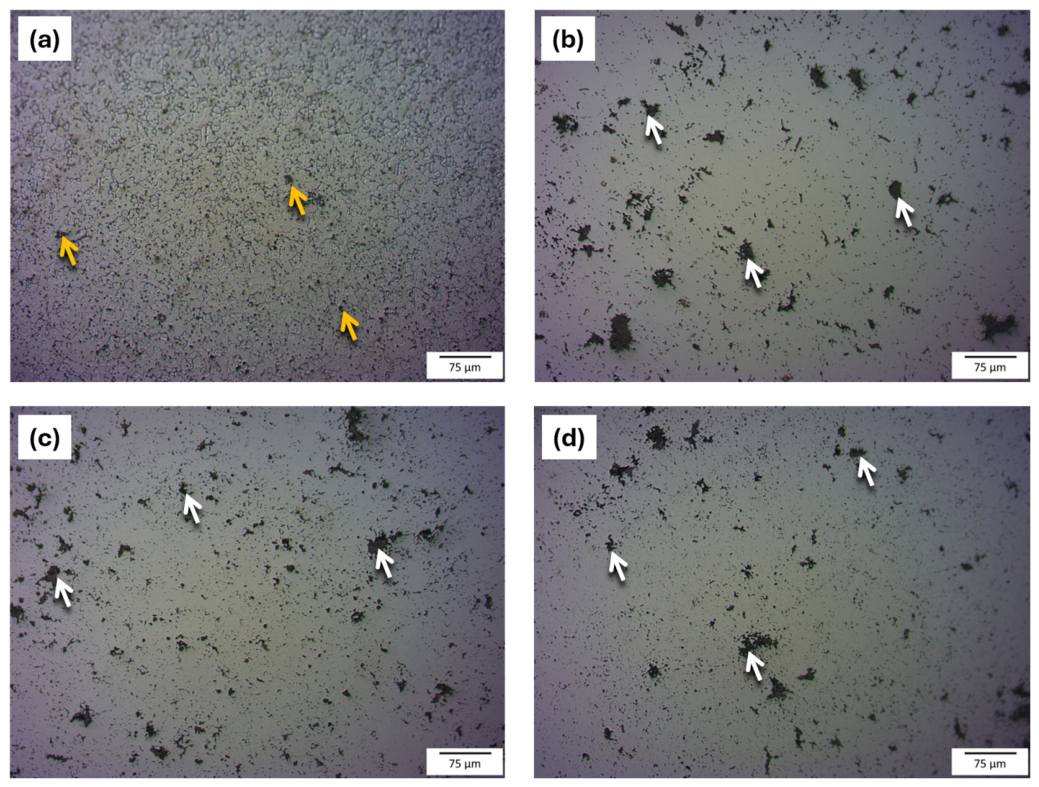
The optical micrographs of the four conditions studied after sintering are shown in
Figure 1. Pure iron exhibits a predominantly ferritic matrix with dispersed pores (yellow arrows), which is typical of sintered materials with residual porosity. No relevant secondary phases are observed, in line with the low overall carbon content. In Fe10%Gr, Fe10%GO, and Fe5%Gr5%GO, the ferritic matrix is retained, but with a visible presence of dark regions consisting of free carbon distributed throughout the microstructure (white arrows), acting as solid lubricant reservoirs. The morphology and contrast of these phases suggest that graphite and GO remain largely undissolved at the sintering temperature used, acting as a particulate second phase. This lubricant distribution is relevant to tribological behavior, as it controls the availability of self-lubricating material at the surface during sliding.
Table 1 summarizes the density and porosity results obtained after compaction and sintering. Unreinforced Fe exhibited one of the highest densifications and one of the lowest residual porosity values, indicating that diffusion and neck growth between Fe particles occurred more effectively in the absence of solid lubricant phases. In contrast, all self-lubricating composites showed lower sintered densities and higher residual porosity, demonstrating that the incorporation of graphite and/or graphene oxide restricts interparticle bonding and pore elimination during low-temperature sintering. Among the reinforced compositions, Fe10%GO presented a porosity level comparable to that of pure Fe, suggesting that the finer GO particles (0.8–1.2 µm) may partially occupy the interstitial spaces between the larger Fe particles, improving particle packing during compaction. In contrast, Fe10%Gr and the hybrid Fe5%Gr5%GO condition exhibited the highest porosity values. This behavior is consistent with the microstructural observations, in which the lubricant-containing compositions exhibited a greater fraction of interconnected pores and heterogeneous carbon-rich regions distributed throughout the Fe matrix.
The reduced densification observed in the reinforced materials is expected, since undissolved carbonaceous phases generally act as diffusion barriers between metallic particles, thereby reducing the effective contact area between metallic particles during sintering [
19]. Furthermore, the relatively low sintering temperature employed in this work, selected to preserve the lubricant phases and minimize carbon dissolution into the Fe matrix, also limits diffusion-driven pore closure. Although excessive porosity may reduce mechanical strength and wear resistance, retained pores can also enhance tribological behavior by acting as reservoirs for lubricant accumulation and facilitating tribolayer renewal during sliding. Consequently, the results indicate a clear trade-off between densification and self-lubricating capability in Fe-based composites sintered at low temperatures.
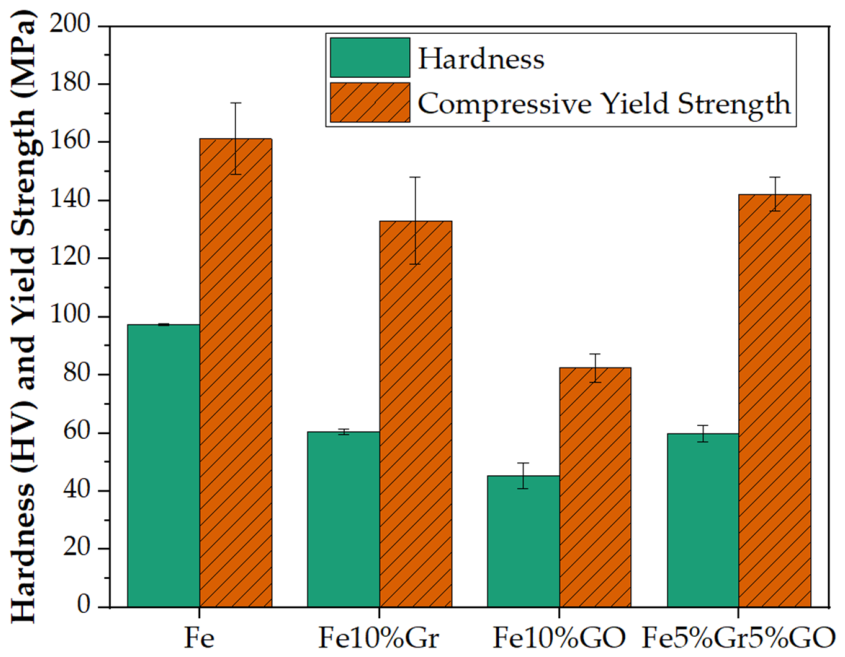
The Vickers hardness and compressive yield strength results are presented in
Figure 2. Pure Fe exhibited the highest hardness, close to 97 HV, together with the highest compressive yield strength, approximately 160 MPa. This behavior is consistent with its higher density and lower porosity, which promote improved neck formation and greater continuity of the metallic matrix. Consequently, the Fe condition exhibited greater resistance to both localized plastic deformation under indentation and compressive loading.
In contrast, all self-lubricating composites exhibited lower hardness and yield strength due to the incorporation of soft carbonaceous phases and the higher residual porosity generated from low-temperature sintering. Among the reinforced conditions, Fe10%GO exhibited the lowest mechanical properties and porosity among the self-lubricating materials. Despite its comparatively good densification, Fe10%GO exhibited the lowest compressive yield strength, suggesting that the high fraction of dispersed GO weakens the continuity of the metallic network under compressive loading and facilitates earlier yielding. Furthermore, the finer GO particles are distributed over a larger fraction of the Fe particle surfaces than graphite, which may further contribute to the reduction in yield strength despite the improved densification.
Fe10%Gr exhibited hardness values close to 60 HV together with an intermediate compressive yield strength. Although graphite particles reduce matrix continuity and increase residual porosity, the mechanical degradation was less severe than that observed for the GO-rich composition. This result suggests that graphite affects the Fe matrix differently under compressive loading, possibly due to its larger particle size and lower interfacial interaction with the metallic phase. Interestingly, the hybrid Fe5%Gr5%GO composition exhibited hardness and yield strength values close to those of Fe10%Gr despite presenting relatively high porosity. This result suggests that the combined incorporation of graphite and GO mitigates the detrimental mechanical effect observed for the GO-only condition.
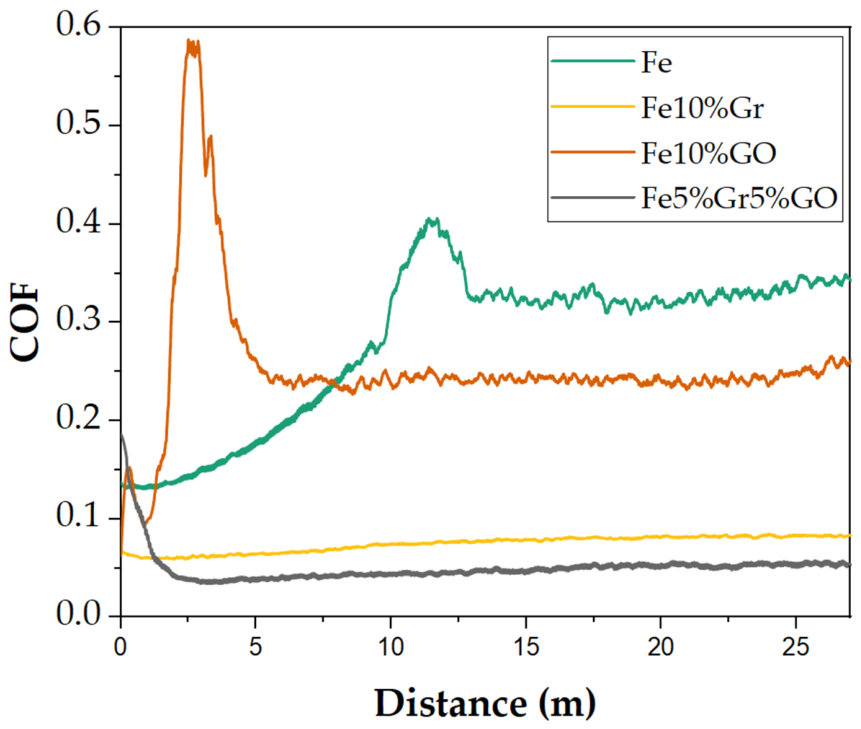
The evolution of the coefficient of friction (COF) with sliding distance for all compositions is shown in
Figure 3, clearly revealing distinct running-in behaviors and steady-state regimes depending on the reinforcement type. Pure Fe shows a gradual increase in COF from ~0.12 to ~0.33–0.35, with a noticeable peak around 10–12 m before stabilizing. This behavior is suggestive of progressive surface damage and oxide-rich tribolayer formation, a phenomenon typically associated with dry sliding conditions where the absence of solid lubrication increases asperity interaction and adhesion [
17]. In contrast, the Fe10%Gr sample exhibits a markedly low and stable COF (~0.06–0.08) throughout the entire test, with virtually no pronounced running-in stage. This indicates the rapid establishment of a lubricating graphite film that is continuously sheared and replenished, preventing direct metal–metal contact and suppressing friction fluctuations.
The Fe10%GO condition exhibits a markedly different response, with a sharp COF peak (~0.55) at the early stage (≈2–3 m), followed by a rapid decrease and stabilization to ~0.23–0.25. This pronounced transient suggests an unstable initial tribolayer, likely due to disruption or insufficient coverage of GO sheets under shear. Although friction decreases after this peak, the steady-state COF remains significantly higher than that of graphite-containing samples, indicating that GO alone provides limited long-term lubrication under these conditions.
Interestingly, the hybrid Fe5%Gr5%GO sample shows the lowest and most stable COF (~0.03–0.05), with a short running-in period and minimal fluctuations over the entire sliding distance. The absence of large friction spikes and the consistently low values suggest a synergistic interaction between graphite and GO.
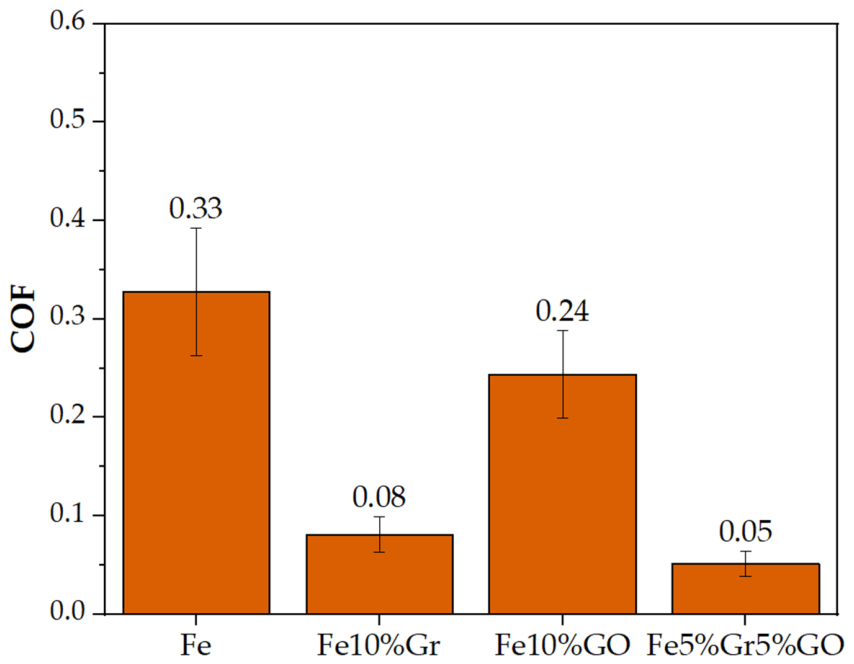
Figure 4 presents the average COF values in the steady-state regime, calculated after approximately 13.5 m of sliding. The trends are consistent with those observed in
Figure 3. Pure Fe shows the highest COF (~0.33), while Fe10%Gr significantly reduces friction to ~0.08, confirming the strong lubricating effect of graphite. Fe10%GO exhibits a more moderate reduction (~0.24), indicating limited effectiveness of GO alone under steady-state conditions. The hybrid Fe5%Gr5%GO achieves the lowest COF (~0.05), indicating a synergistic interaction between graphite and GO that stabilizes a low-friction tribolayer.
As shown in
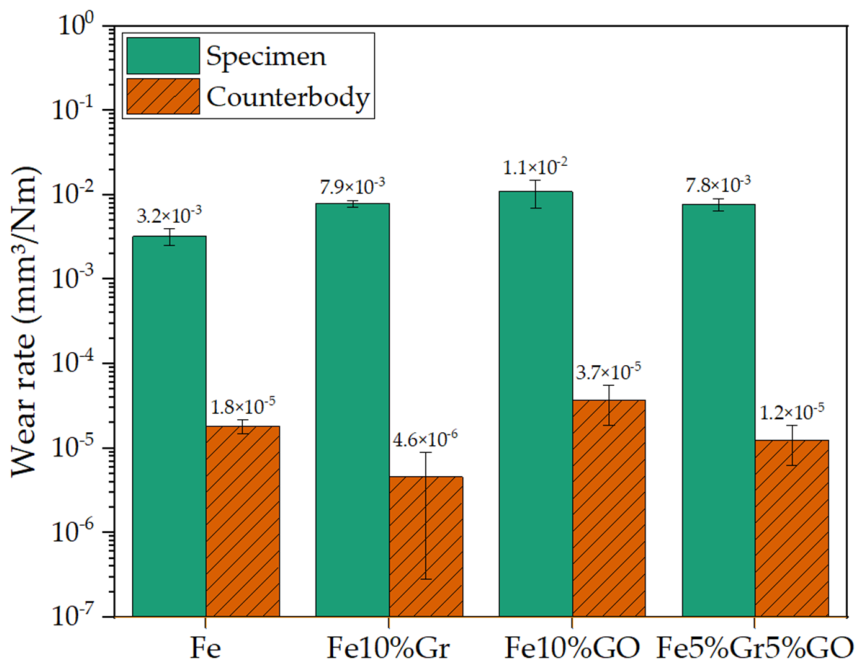
Figure 5, the wear rates of the specimens and counterbodies reveal a clear trade-off between friction reduction and wear resistance, consistent with the densification and mechanical property results. Pure Fe exhibits the lowest wear rate (~3.2 × 10
−3 mm
3/Nm), despite showing the highest COF. This behavior is directly associated with its higher density, lower porosity (~17.5%), and superior hardness (~97 HV), which enhance resistance to plastic deformation and material removal under sliding conditions. In contrast, all self-lubricating composites exhibit higher wear rates, reflecting the adverse effects of reduced densification and mechanical strength. To assess the contribution of plastic deformation and work hardening to the plowing component of the COF,
Table 2 presents microhardness values (HV
0.01) measured within the wear tracks.
Among the reinforced materials, Fe10%GO exhibits the highest wear rate (~1.1 × 10
−2 mm
3/Nm), consistent with its unstable friction behavior and lowest mechanical strength. Despite its relatively high densification among the composites, its reduced load-bearing capacity suggests that GO weakens the continuity of the metallic matrix, thereby promoting accelerated wear. As shown in
Table 2, the sample with 10% GO does not undergo considerable work hardening during the tribological tests, so the reduction in the friction coefficient when compared to pure Fe can be related to GO acting as a stress concentrator, facilitating plastic deformation and material removal, which is consistent with its lower wear-track microhardness and higher wear rate. Fe10%Gr and Fe5%Gr5%GO show intermediate wear rates (~7.8 × 10
−3 mm
3/Nm), indicating that graphite effectively reduces friction but does not fully compensate for the loss of mechanical integrity associated with increased porosity. In these materials, pores may act as stress concentrators, promoting crack initiation and debris formation, although they may also contribute to lubricant retention.
For the counterbody, wear rates are two to three orders of magnitude lower, reflecting its higher hardness. The lowest counterbody wear is observed for Fe10%Gr, consistent with its stable, low COF, which minimizes abrasive and adhesive interactions. The hybrid Fe5%Gr5%GO also reduces counterbody wear compared to pure Fe, supporting the formation of a more stable carbon-rich tribolayer. In contrast, Fe10%GO exhibits the highest counterbody wear, consistent with the higher wear rates and increased debris generation observed for the GO-containing condition.
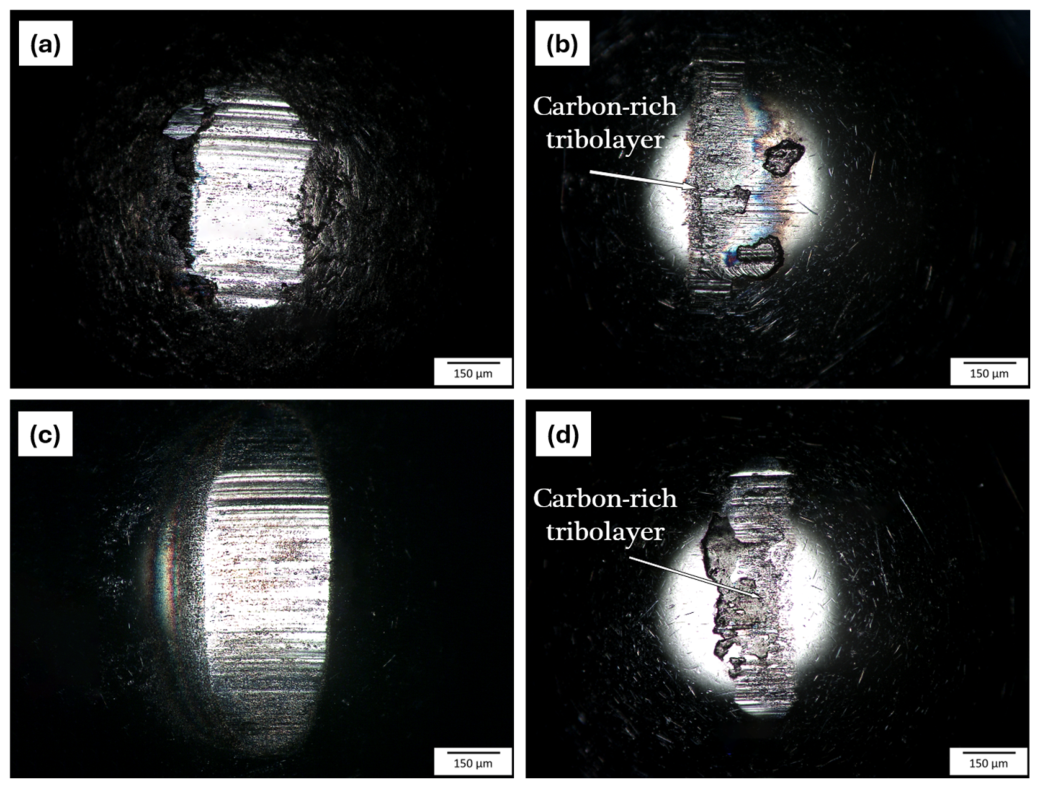
The morphology of the wear scars on the specimens reflects the effectiveness of tribolayer formation and its direct correlation with the previously discussed wear rates. Conditions without an effective tribolayer, such as Fe (
Figure 6a) and Fe10%GO (
Figure 6c), exhibit larger scars with pronounced grooves along the sliding direction, indicative of abrasive wear. These features are consistent with the higher counterbody wear rates observed for both conditions.
In contrast, the incorporation of graphite promotes the formation of a carbon-rich tribolayer, as observed in Fe10%Gr (
Figure 6b) and Fe5%Gr5%GO (
Figure 6d). The lowest wear rates observed in
Figure 5 are directly associated with the formation and stability of a carbon-rich tribolayer on the counterbody surface. Conversely, Fe and Fe10%GO, which show more pronounced abrasive features, exhibit higher wear. These observations reinforce the role of graphite in enabling the formation of an effective and protective tribolayer, while GO alone provides only moderate friction reduction under the tested conditions, acting as a stress concentrator and reducing energy dissipation associated with plastic deformation.
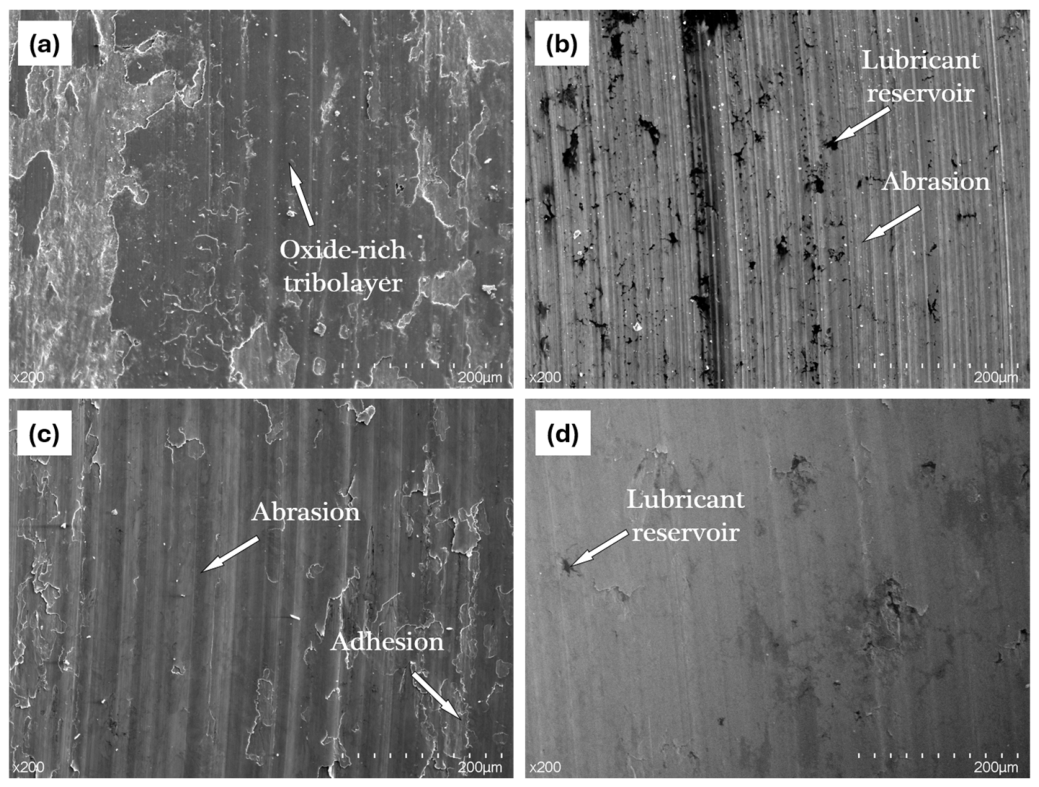
The morphology of the wear scars on the counterbodies reflects the effectiveness of tribolayer transfer and is consistent with the counterbody wear rates.
Figure 7a shows a heterogeneous surface covered by discontinuous oxide-rich tribolayers. In the absence of solid lubricant phases, direct metal-to-metal contact becomes more significant, promoting oxidation, debris formation, and localized material removal. Although oxide films partially cover the surface, they do not provide stable lubrication during sliding, consistent with the relatively high COF observed under this condition.
More pronounced abrasion grooves are observed in Fe10%Gr (
Figure 7b) and Fe10%GO (
Figure 7c), where parallel grooves along the sliding direction dominate the wear tracks. In Fe10%Gr (
Figure 7b), open lubricant reservoirs are clearly visible on the worn surface. These reservoirs are particularly important because they serve as local storage sites for graphite particles and wear debris, enabling the continuous extrusion of lubricant toward the contact interface during sliding. This mechanism helps maintain a lubricated regime throughout the test and explains the significant reduction in COF observed under this condition [
29]. Nevertheless, the persistence of deep abrasive grooves indicates that abrasion remained active, resulting in increased material removal despite improved lubrication.
In Fe10%GO (
Figure 7c), abrasion is even more pronounced and is accompanied by localized adhesive wear, indicating instability of the tribolayer during sliding. Although GO contributes to friction reduction, the resulting tribolayer appears less continuous and stable than under graphite-containing conditions due to severe adhesive wear, which is enhanced by localized stress concentrations associated with GO. As a result, protective surface coverage becomes insufficient, leading to high wear rates and localized material detachment. In contrast, Fe5%Gr5%GO (
Figure 7d) exhibits a smoother and more homogeneous wear track, with fewer severe grooves and visible lubricant reservoirs distributed across the surface. The simultaneous presence of graphite and GO appears to promote the formation of a more stable and continuous tribolayer. This effect is particularly relevant in porous self-lubricating PM materials, since maintaining open lubricant reservoirs on the worn surface helps sustain the lubricated regime over time and reduces direct asperity interaction during sliding. Consequently, the hybrid composition exhibits a more balanced tribological behavior, combining low friction with moderate wear resistance. Therefore, the smoother and more homogeneous surface morphology observed in
Figure 7d, combined with the higher wear track microhardness of the Fe5%Gr5%GO sample, indicates a synergistic mechanism where graphite ensures continuous lubrication, while GO appears to promote adhesion to the surface, thereby contributing to a more compact and resilient tribolayer.
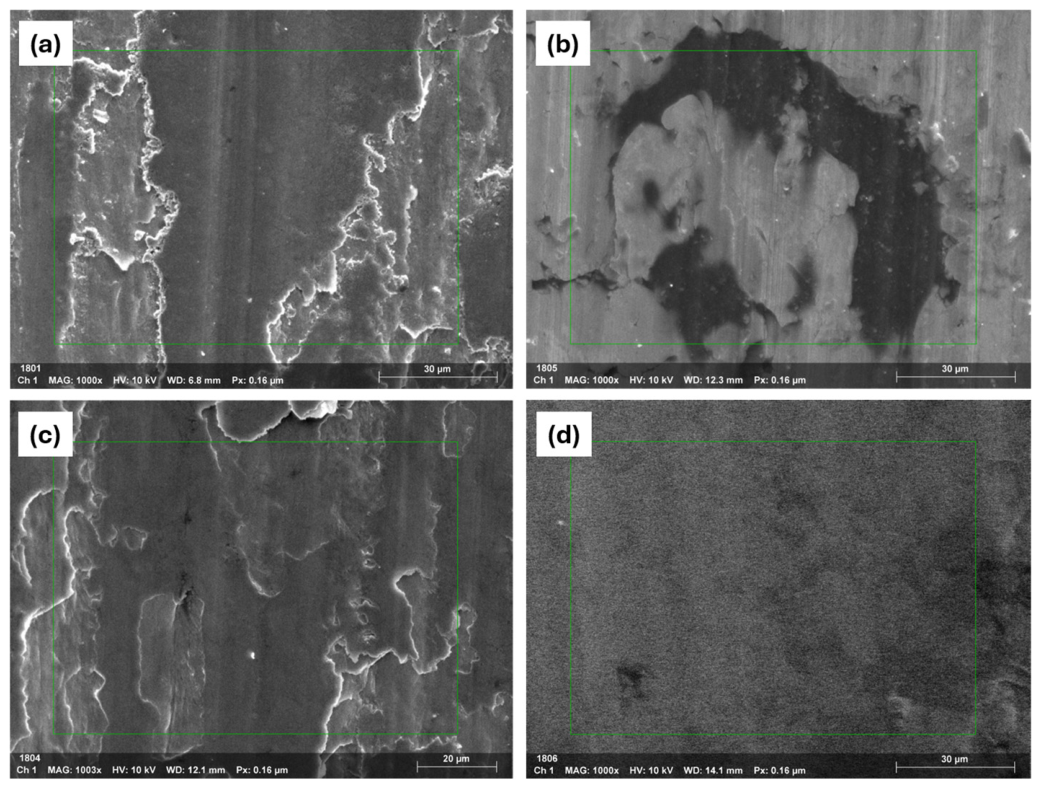
As shown in
Figure 8 and quantified in
Table 3, the chemical composition of the worn surfaces reveals that the tribological response is primarily governed by the balance between oxide formation and carbon-rich tribolayer development. Surfaces dominated by Fe and O, with low carbon content (
Figure 8a,c), are associated with oxide-rich tribolayers that provide limited protection during sliding. These tend to be unstable under shear, promoting abrasion and leading to high friction and wear, consistent with previously observed trends. For the unreinforced Fe, the high oxygen content detected by EDS, coupled with its heterogeneous morphology, is consistent with the progressive surface damage and oxide-rich tribolayer formation suggested during the friction analysis. In contrast, higher carbon contents (
Figure 8b,d) are directly linked to the formation of carbon-rich tribolayers, which act as solid lubricating films and significantly reduce interfacial shear. The effectiveness of these tribolayers depends not only on the carbon content but also on its distribution and stability, leading to a more balanced tribological response. In addition, physicochemical interactions between the Fe surface and the carbonaceous tribolayers may also contribute to friction reduction by decreasing interfacial adhesion during sliding [
30].
The results obtained in this work indicate that the combined incorporation of graphite and graphene oxide into Fe-based self-lubricating composites may generate synergistic effects on the tribological and mechanical behavior of the materials processed by low-temperature powder metallurgy. In particular, the hybrid Fe5%Gr5%GO composition exhibited a more balanced combination of friction reduction, wear resistance, and mechanical integrity compared with the individual lubricant additions.



 ,
,