
Coupled Model of Point-Contact Thermo-Elastohydrodynamic Lubrication and Dynamics with Double-Impact Mechanism for High-Precision Quantitative Diagnosis of Rolling Bearings

 ,
, 
Abstract
1. Introduction
2. Point-Contact Thermo-Elastohydrodynamic Lubrication Theory and Bearing Characteristic Modeling
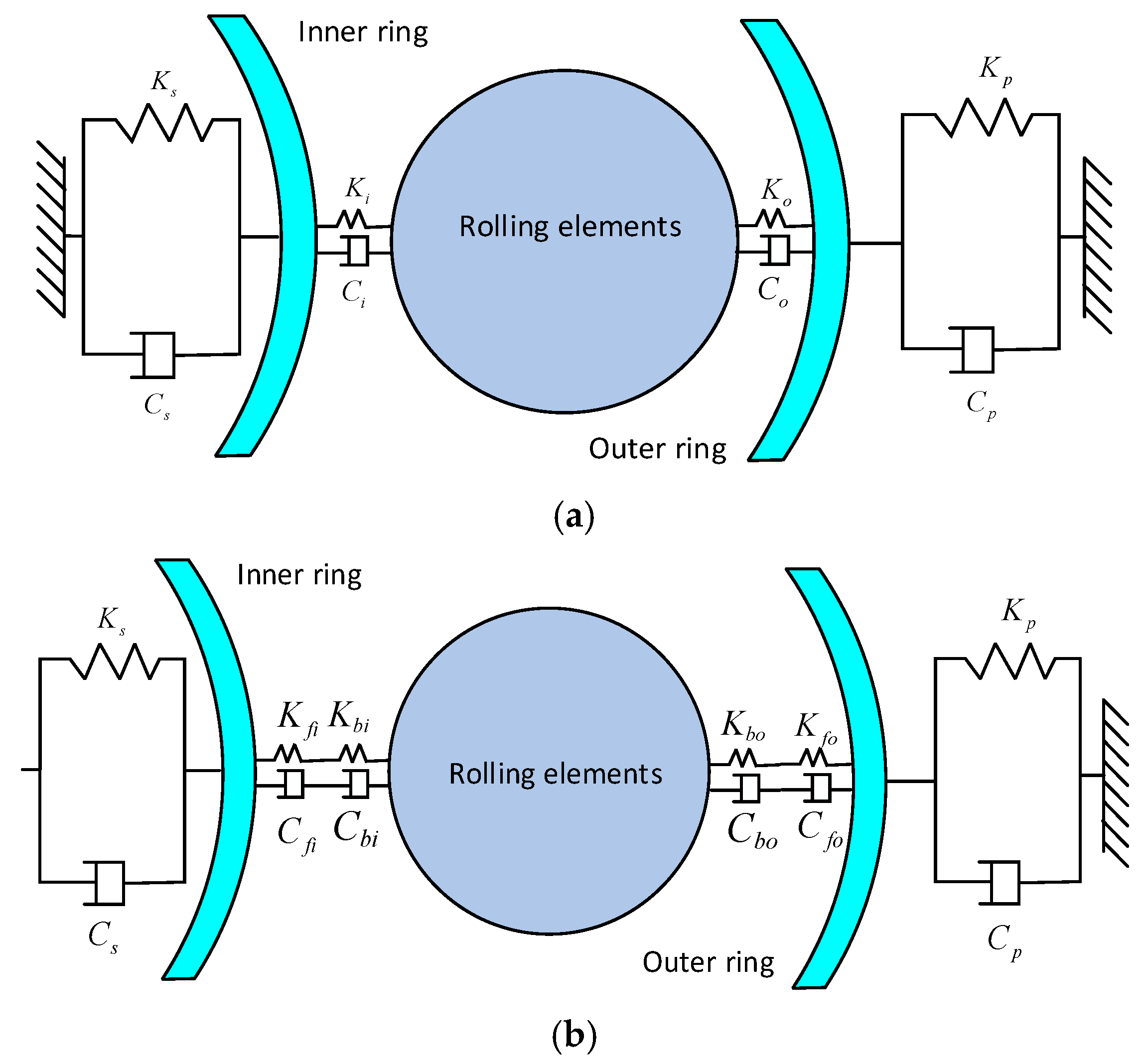
2.1. Limitations of Traditional Bearing Stiffness and Damping Models
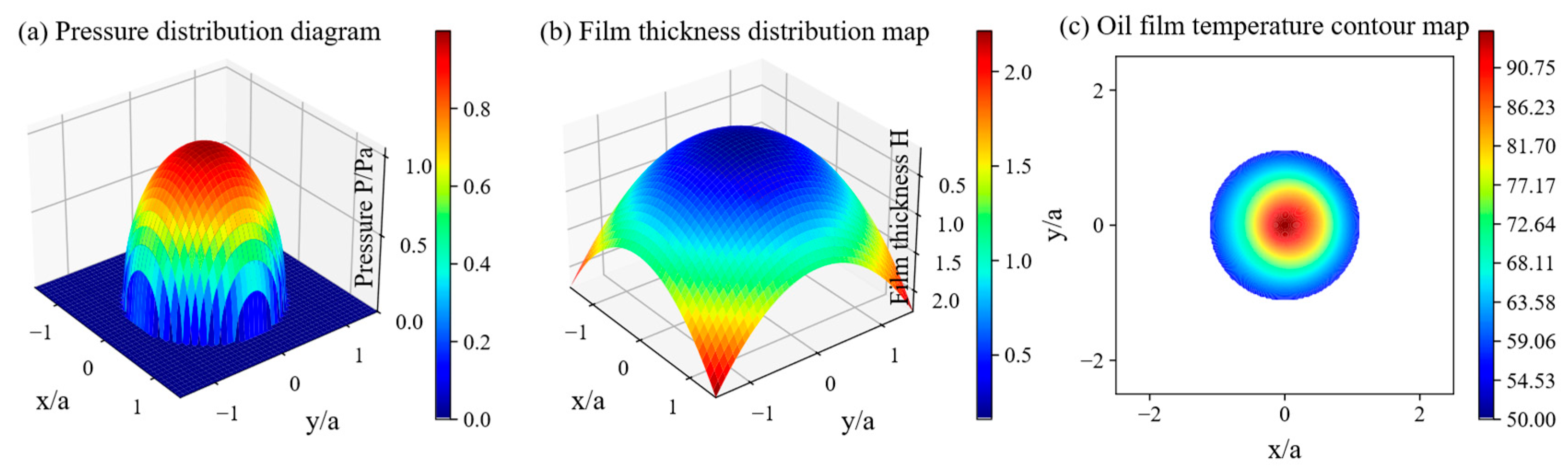
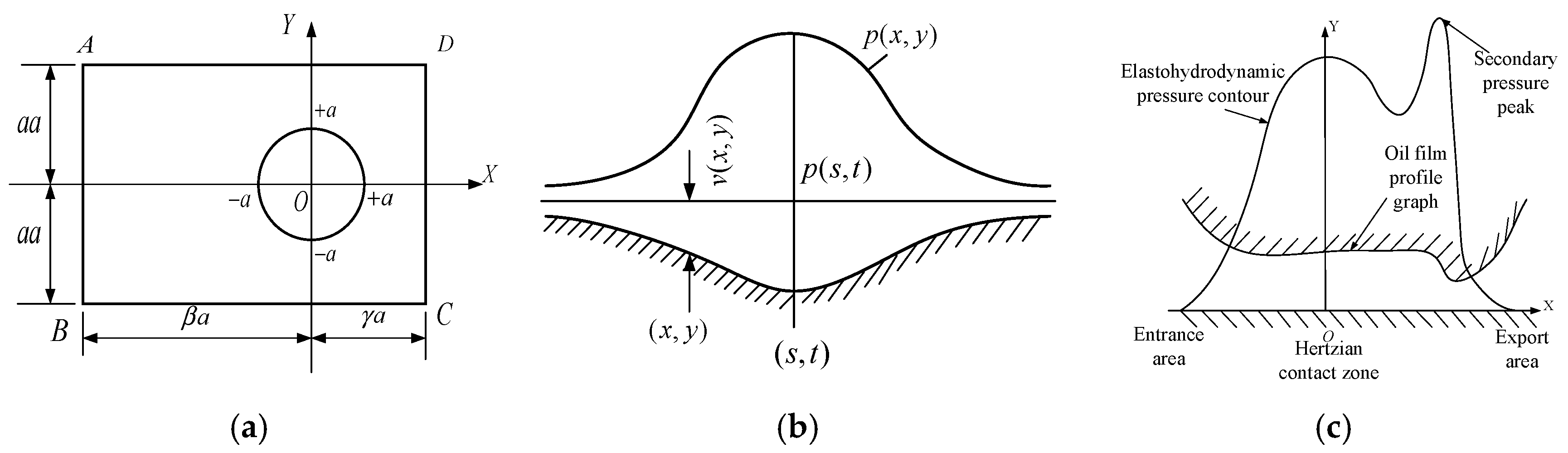
2.2. Numerical Simulation Modeling of Point-Contact Thermo-Elastohydrodynamic Lubrication
2.2.1. Numerical Simulation Model Construction
- (1)
- Reynolds equation
- (2)
- Viscosity variation equation (dependent on pressure and temperature):
- (3)
- The lubricant density is described using the Dowson–Higginson density–pressure relation with a temperature correction [29]:where is the initial density of the lubricant.
- (4)
- Point-contact elastic deformation equation
- (5)
- The oil-film temperature field is obtained from the thermal EHL energy equation [31]:where represents the thermal conductivity of the lubricant, and denotes the specific heat capacity of the lubricant.
- (6)
- The heat transfer at the rolling element–lubricant and raceway–lubricant interfaces is described using thermal boundary conditions derived from moving heat-source theory [32]:where , , denote the density, specific heat capacity and heat transfer coefficient of the contact pair; subscripts 1 and 2 refer to the rolling element and raceway, respectively.
2.2.2. Analysis of Numerical Simulation Results
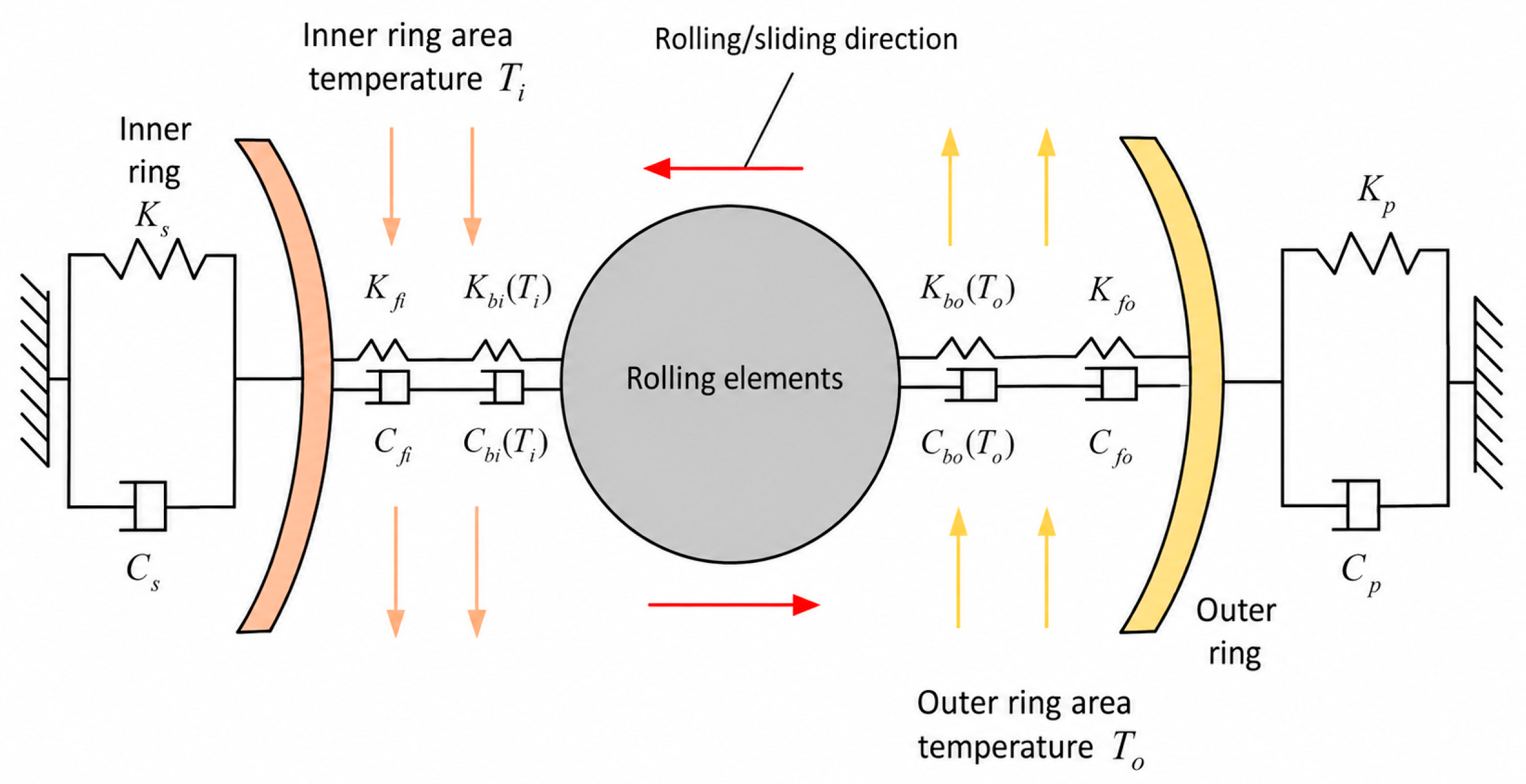
2.3. Improved Rolling-Bearing Stiffness and Damping Model Considering Thermo-Elastohydrodynamic Lubrication
2.3.1. Improved Bearing Stiffness and Damping Models
2.3.2. Rolling-Bearing Stiffness Calculation
2.3.3. Calculation of Rolling Bearing Damping
3. Modeling and Quantitative Diagnostic Study of Rolling-Bearing Dynamics Under TEHL
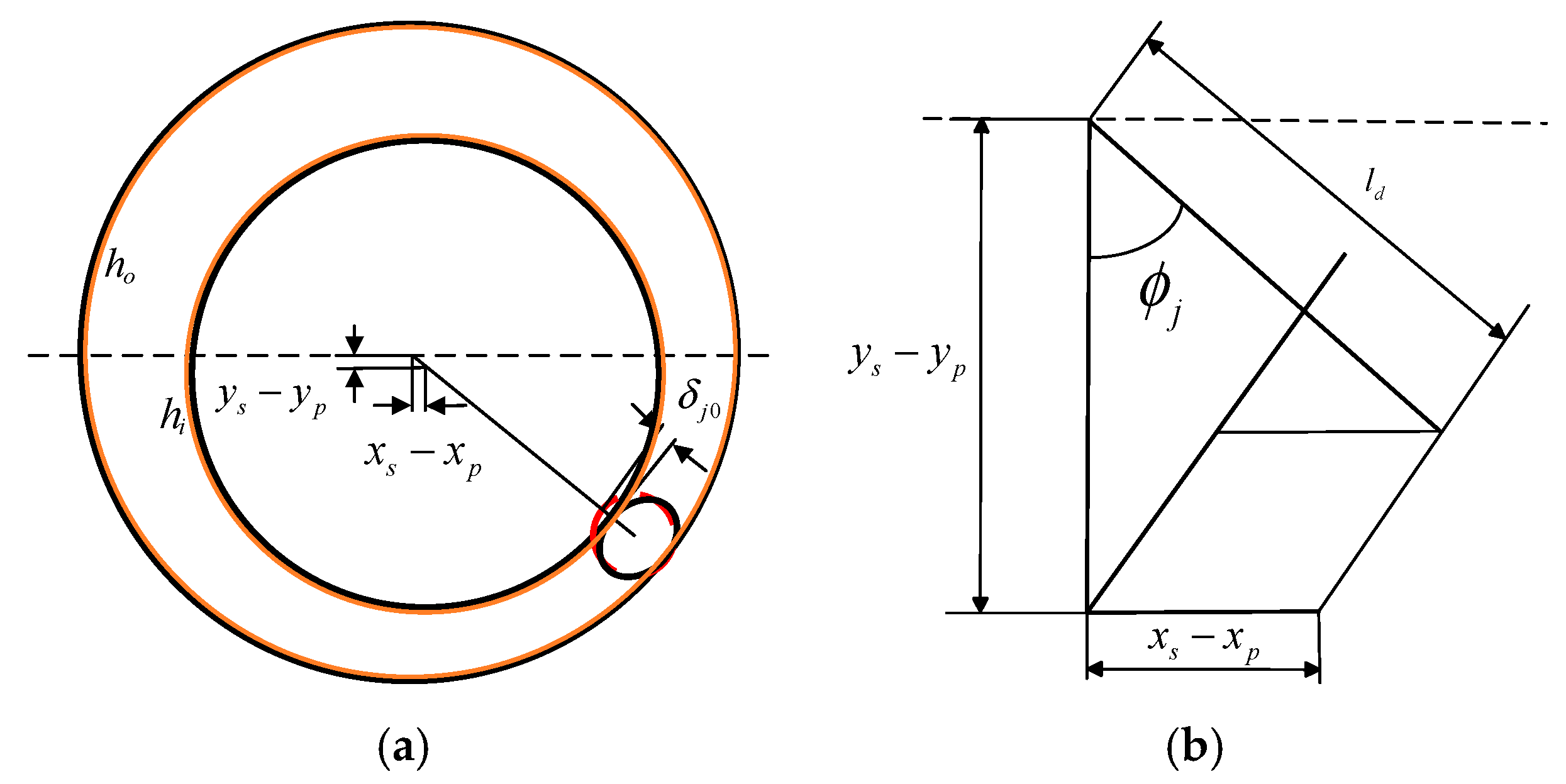
3.1. Excitation Model for Additional Displacement of Rolling Element–Raceway Contact Under TEHL
3.2. Calculation of Rolling Element–Raceway Contact Force Under TEHL
3.3. Equation Construction of Rolling-Bearing Dynamics Under TEHL
3.4. Simulation and Mechanism Analysis of Rolling-Bearing Impact Characteristics Under TEHL
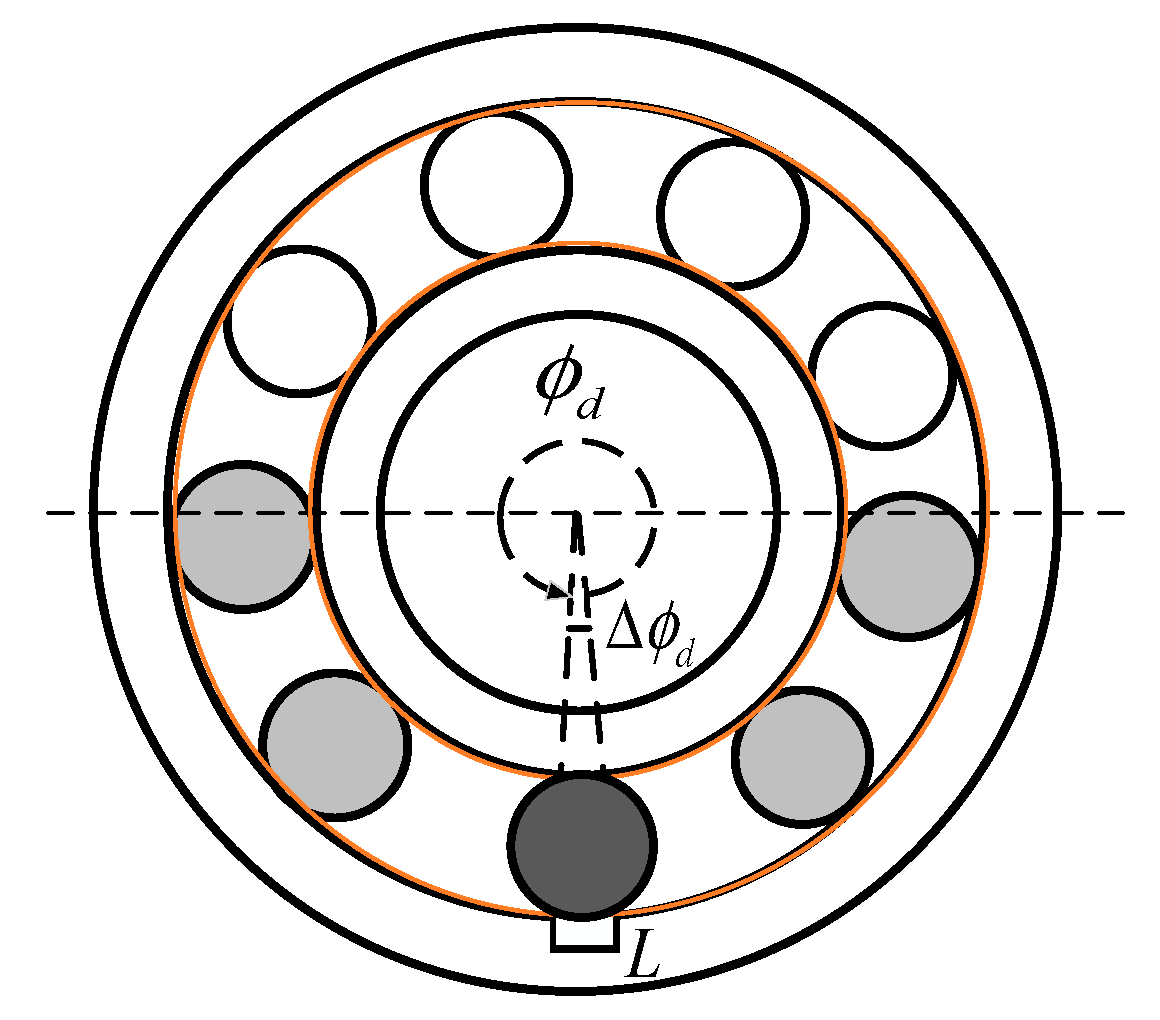
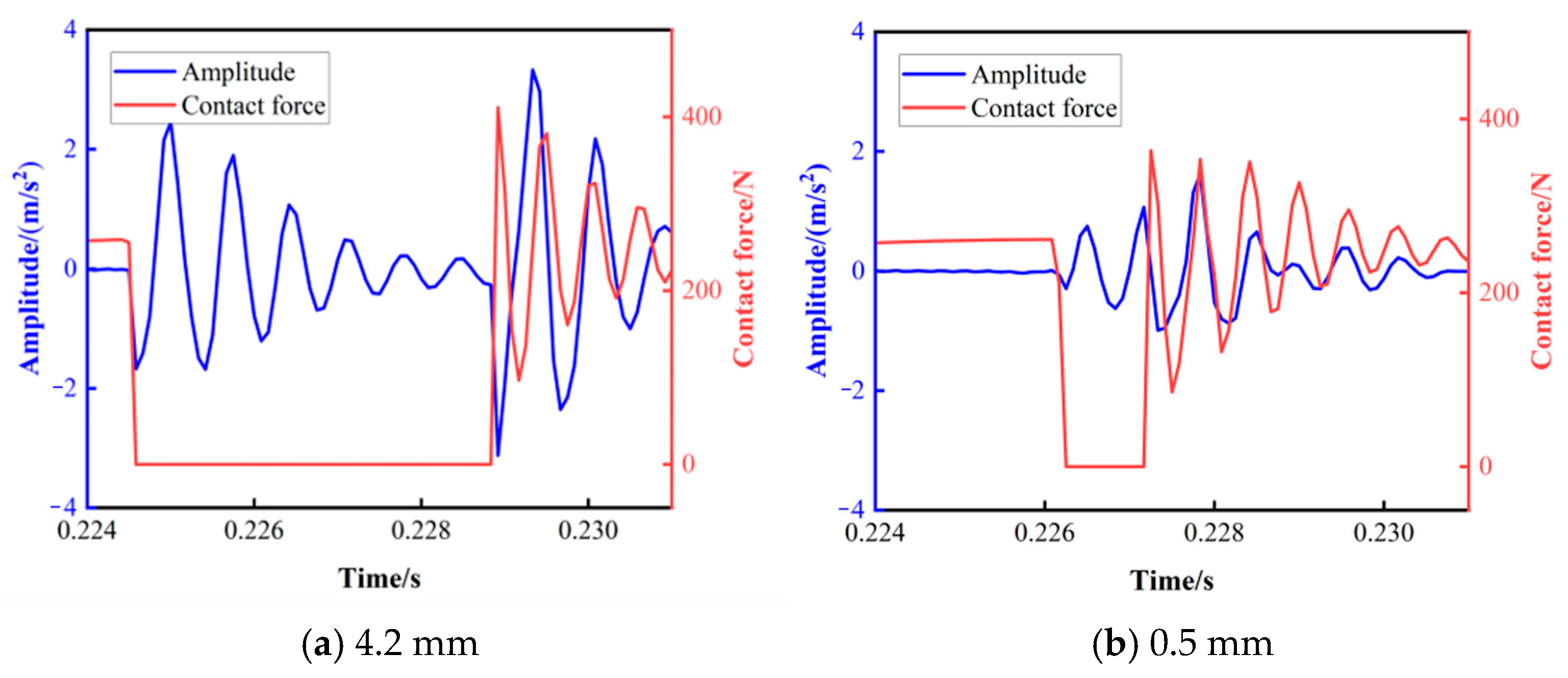
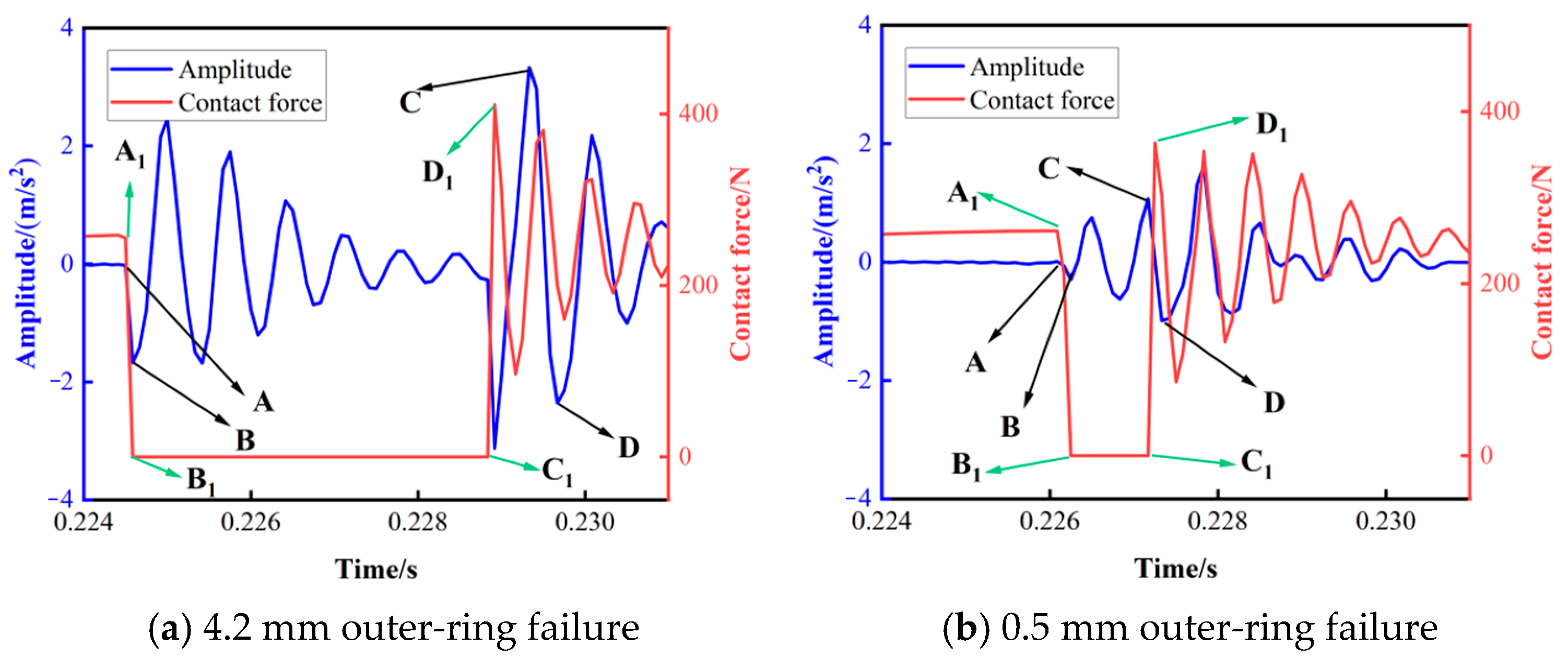
3.4.1. Vibration Response and Contact Force Analysis for Two Defect Sizes
3.4.2. Comparison and Mechanism Exploration of Impact Phenomena Associated with Large-Size and Small-Size Failures
3.5. Quantitative Diagnosis of Localized Defects Based on the TEHL Model
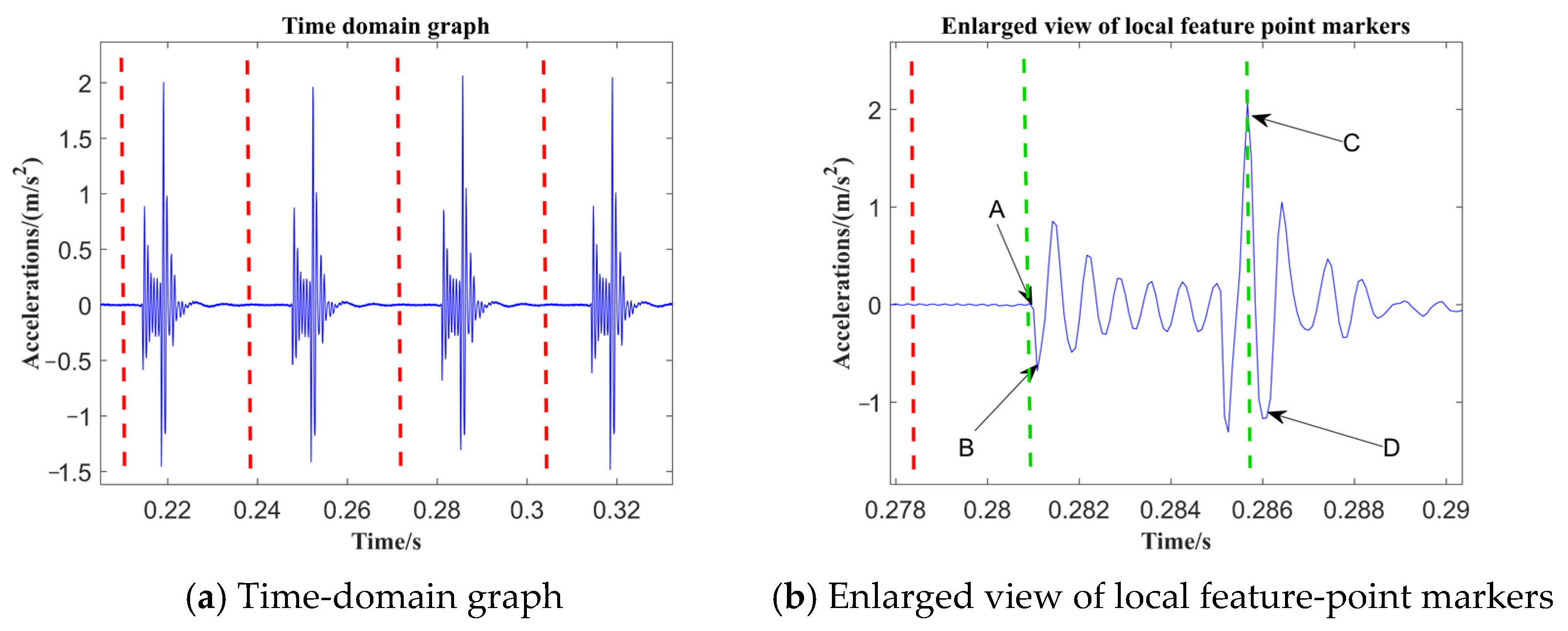
3.5.1. Dynamic Model Validation and Characteristic Point Analysis at Different Rotational Speeds
3.5.2. Comparative Analysis of Spall-Size Estimation Accuracy Using Different Dynamic Formulations
4. Experimental Validation
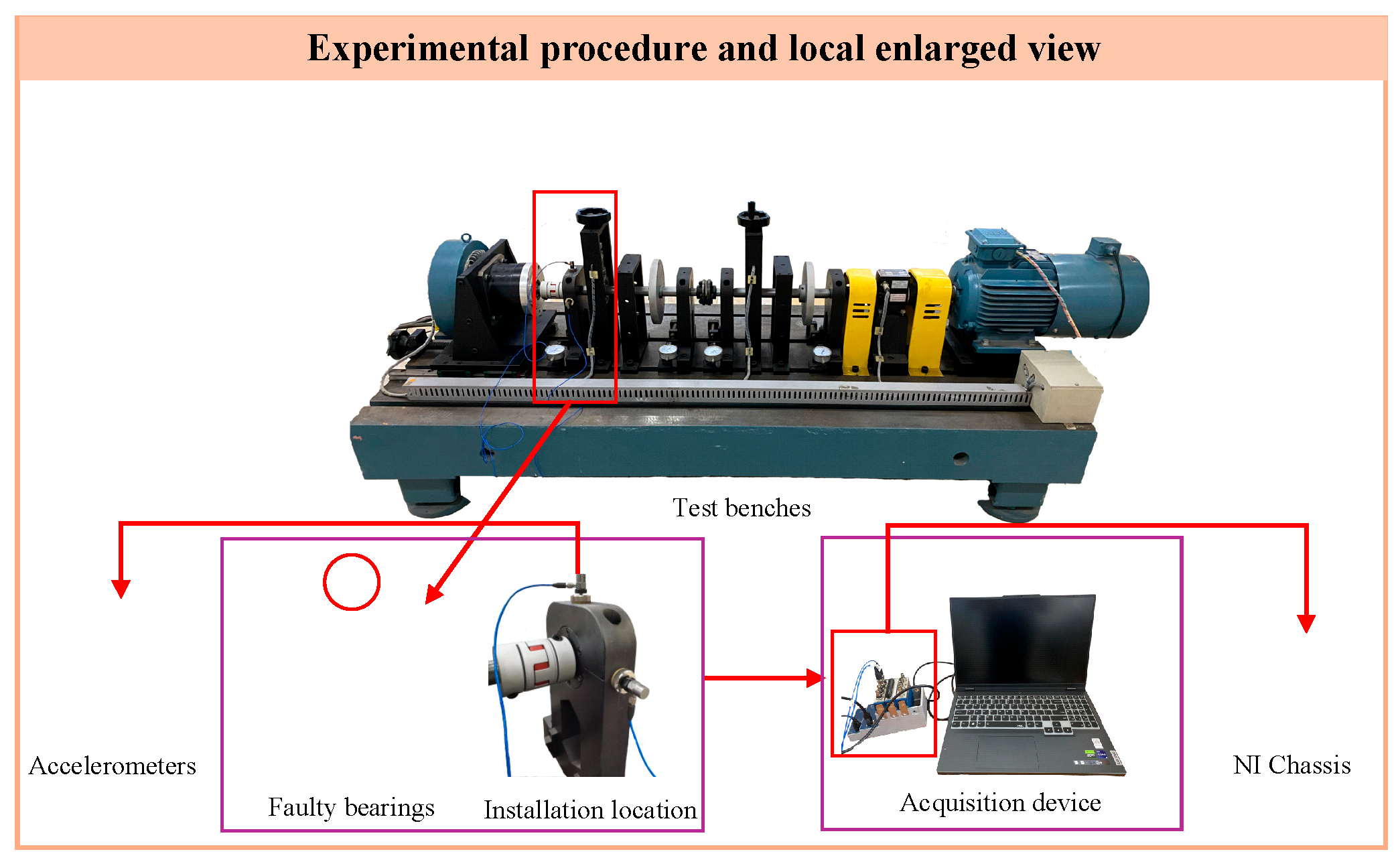
4.1. Experimental Equipment and Bearing Failure Parts
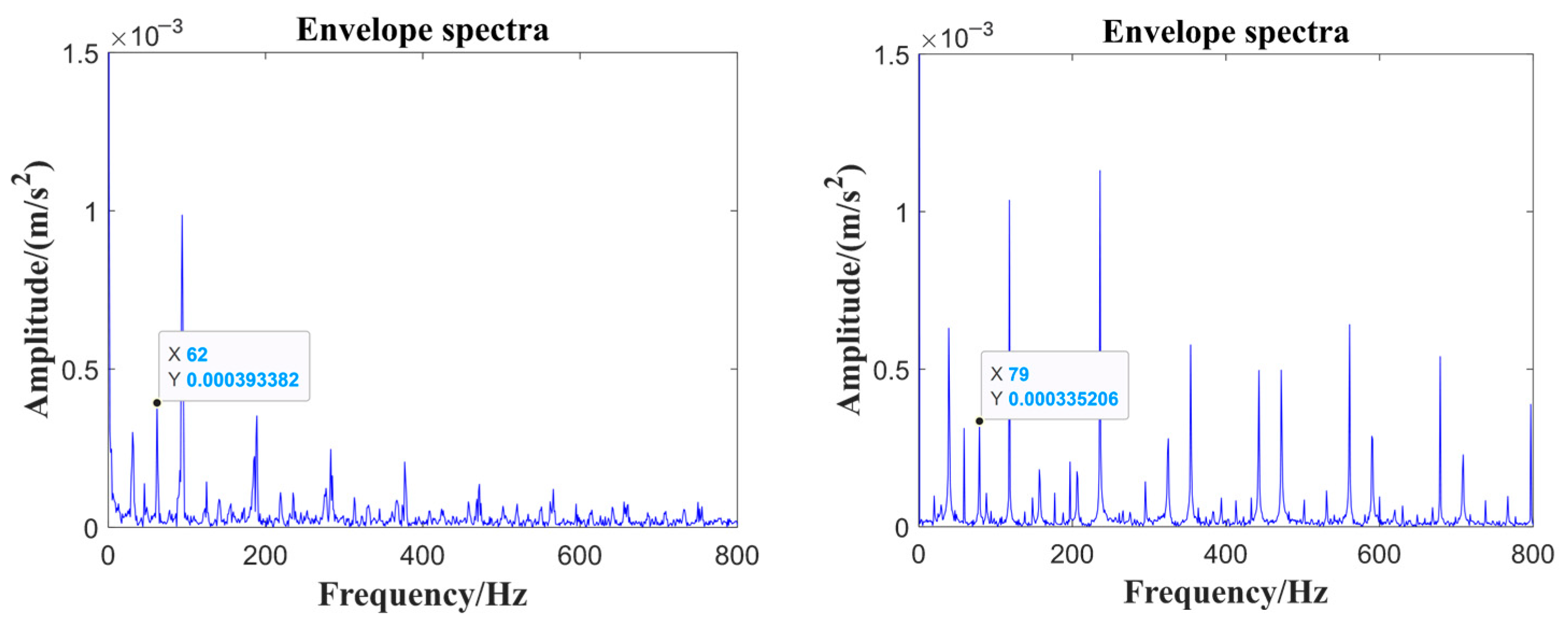
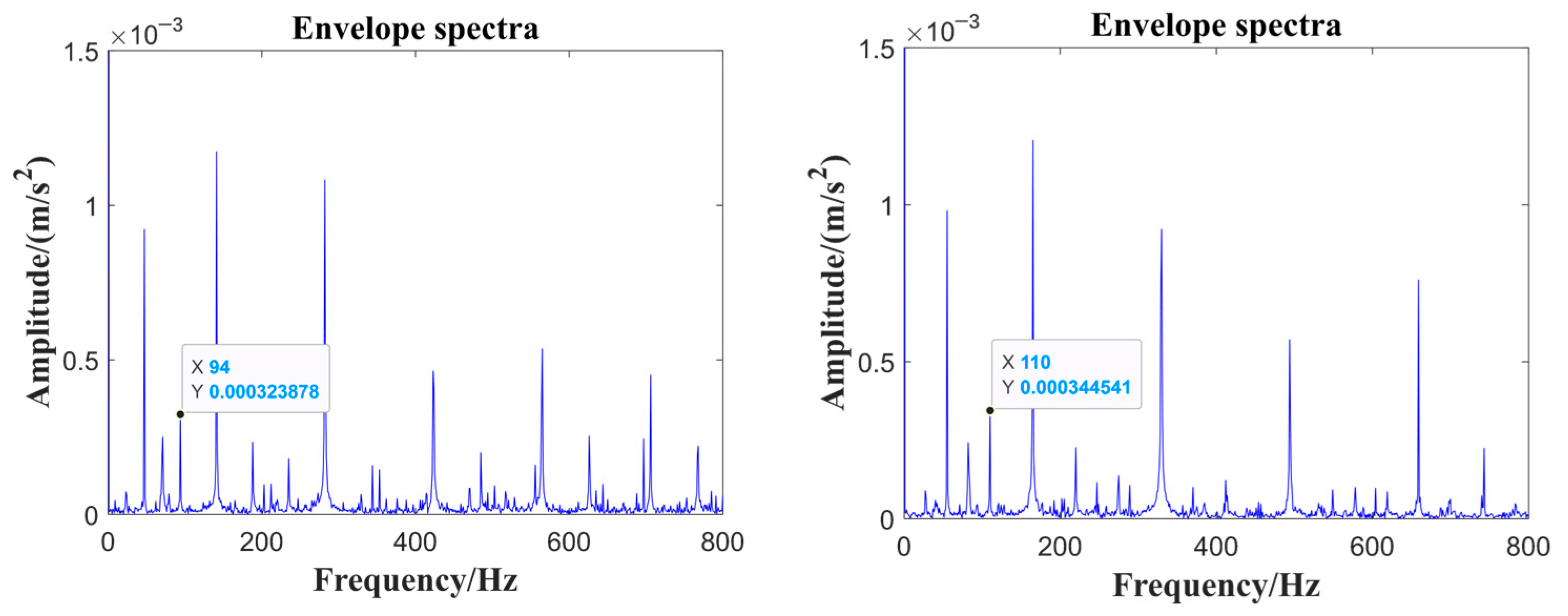
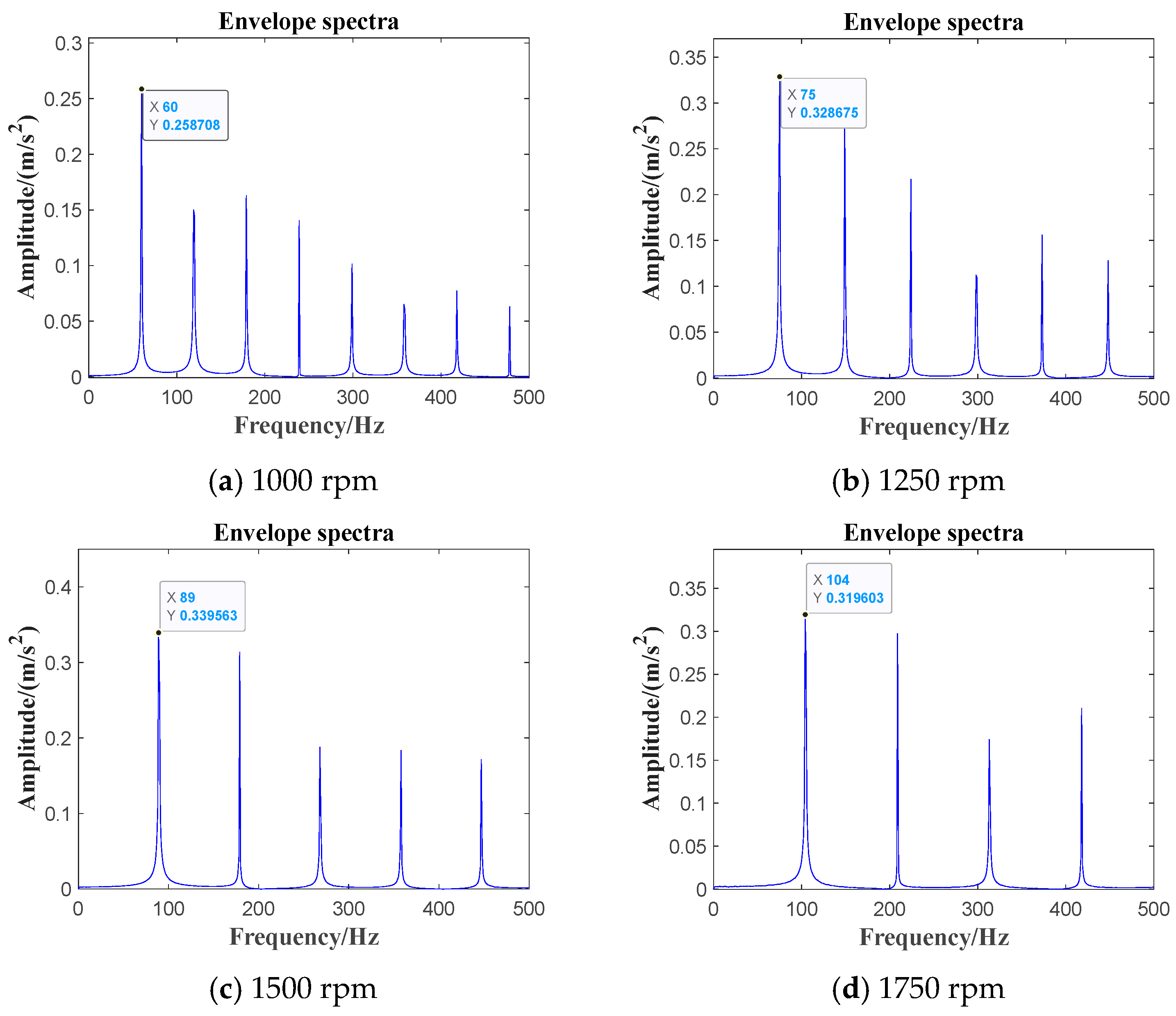
4.2. Comparative Analysis of Experimental and Modeled Fault Characteristic Frequencies for an Outer-Ring Defect of 0.6 mm
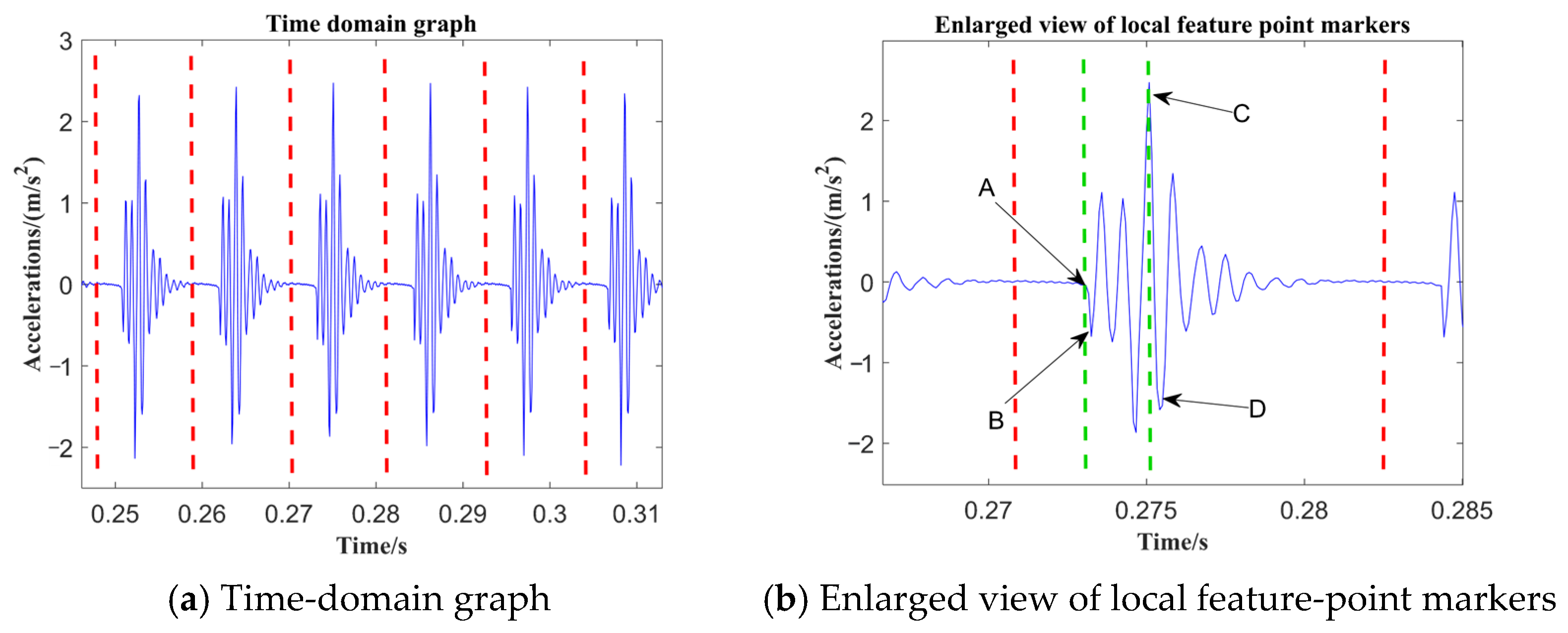
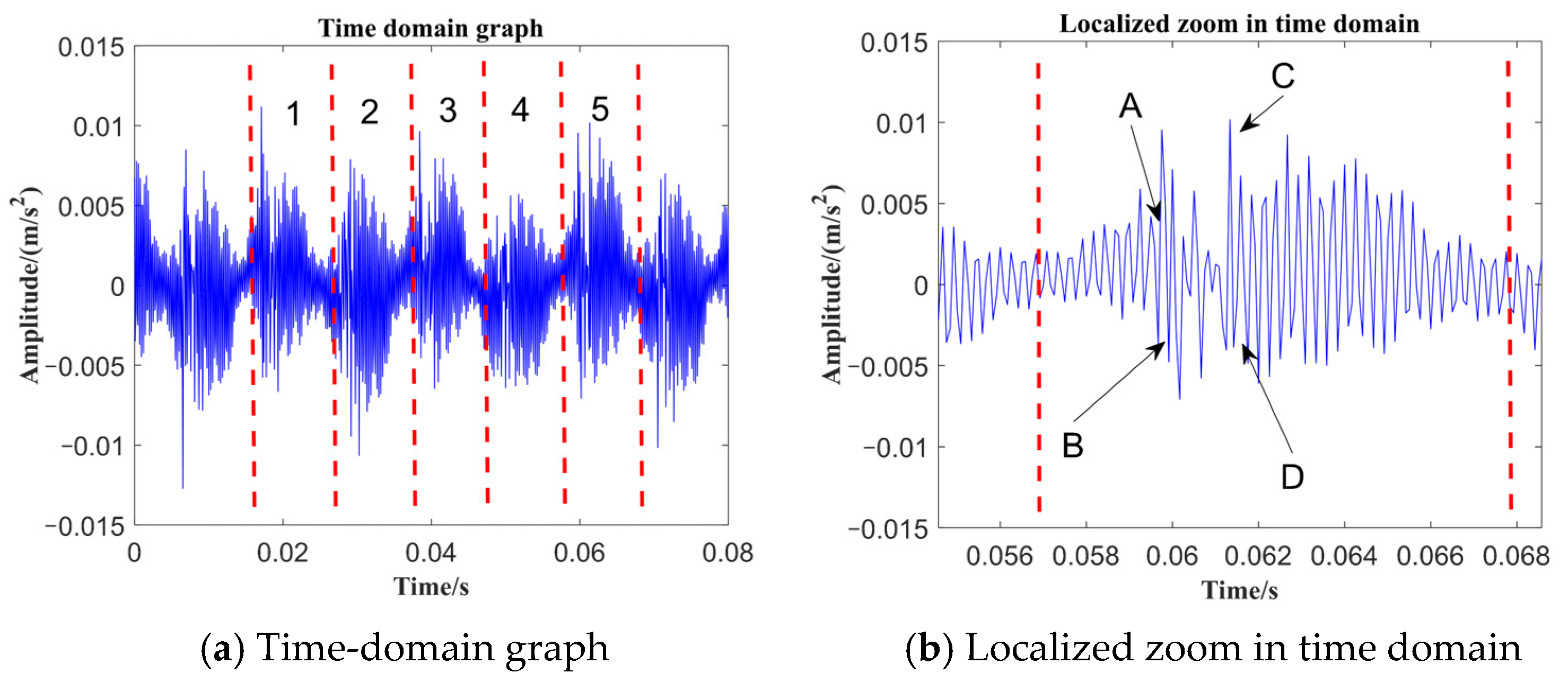
4.3. Quantitative Comparative Analysis of Experimental and Modeled Double Impacts with Outer-Ring Defect of 0.6 mm
5. Conclusions
- A novel equivalent stiffness–damping representation is formulated to characterize the point-contact TEHL interface. Unlike conventional idealized Hertzian assumptions, this approach explicitly parameterizes the temperature-dependent oil-film pressure, film thickness, and inner–outer raceway thermal asymmetry, providing a rigorous tribological boundary for localized-defect modeling.
- The physical mechanism of the lubricated double-impact response is elucidated by integrating the TEHL-derived representation into a classical 5-DOF framework. The model reveals that the oil film essentially acts as an additional dynamic clearance and damping buffer. This mechanism alters the spatial trajectory of rolling elements traversing the spall and induces phase delays in impact force peaks, thereby affecting the double-impact time interval.
- The proposed method significantly improves the accuracy of spall-size quantification under thermally coupled conditions. Comparative analyses and experimental validation demonstrate that the TEHL-parameterized formulation restricts the frequency estimation error to within 5.45% and achieves a spall-size prediction error of 10.83% in experiments. Furthermore, it explicitly outperforms conventional 5-DOF, 4-DOF, and 2-DOF dry-contact models across all defect sizes (with theoretical errors reduced to below 6.00%), validating its reliability for high-precision fault diagnosis.
Author Contributions
Funding
Data Availability Statement
Conflicts of Interest
References
- Zhang, C.; Liu, T.; Wang, Y.; He, H.; Zhang, C. Mechanism Study of Symmetric Mechanism-Rolling Bearing Dynamic System Considering the Influence of Temperature Factor. Symmetry 2023, 15, 2166. [Google Scholar] [CrossRef]
- Rahnejat, H.; Gohar, R. The Vibrations of Radial Ball Bearings. Proc. Inst. Mech. Eng. Part C J. Mech. Eng. Sci. 1985, 199, 181–193. [Google Scholar] [CrossRef]
- Wijnant, Y.H.; Wensing, J.A.; van Nijen, G.C. The Influence of Lubrication on the Dynamic Behaviour of Ball Bearings. J. Sound Vib. 1999, 222, 579–596. [Google Scholar] [CrossRef]
- Sarangi, M.; Majumdar, B.C.; Sekhar, A.S. On the Dynamics of Elastohydrodynamic Mixed Lubricated Ball Bearings. Part I: Formulation of Stiffness and Damping Coefficients. Proc. Inst. Mech. Eng. Part J J. Eng. Tribol. 2005, 219, 411–421. [Google Scholar] [CrossRef]
- Mohammadpour, M.; Johns-Rahnejat, P.M.; Rahnejat, H. Roller Bearing Dynamics under Transient Thermal-Mixed Non-Newtonian Elastohydrodynamic Regime of Lubrication. Proc. Inst. Mech. Eng. Part K J. Multi-Body Dyn. 2015, 229, 407–423. [Google Scholar] [CrossRef]
- Zhang, Y.Y.; Wang, X.L.; Yan, X.L. Dynamic Behaviors of the Elastohydrodynamic Lubricated Contact for Rolling Bearings. J. Tribol. 2013, 135, 021501. [Google Scholar] [CrossRef]
- Luo, M.; Guo, Y.; André, H.; Wu, X.; Na, J. Dynamic Modeling and Quantitative Diagnosis for Dual-Impulse Behavior of Rolling Element Bearing with a Spall on Inner Race. Mech. Syst. Signal Process. 2021, 158, 107711. [Google Scholar] [CrossRef]
- Gomez, J.L.; Bourdon, A.; André, H.; Rémond, D. Modelling Deep Groove Ball Bearing Localized Defects Inducing Instantaneous Angular Speed Variations. Tribol. Int. 2016, 98, 270–281. [Google Scholar] [CrossRef]
- Jiang, Y.; Huang, W.; Luo, J.; Wang, W. An Improved Dynamic Model of Defective Bearings Considering the Three-Dimensional Geometric Relationship between the Rolling Element and Defect Area. Mech. Syst. Signal Process. 2019, 129, 694–716. [Google Scholar] [CrossRef]
- Yan, P.; Yan, C.; Wang, K.; Wang, F.; Wu, L. 5-DOF Dynamic Modeling of Rolling Bearing with Local Defect Considering Comprehensive Stiffness under Isothermal Elastohydrodynamic Lubrication. Shock Vib. 2020, 2020, 9310278. [Google Scholar] [CrossRef]
- Tian, J.; Zhang, C.; Liang, H.; Guo, D. Simulation of the Load Reduction Process of High-Speed Angular Contact Ball Bearing with Coupling Model of Dynamics and Thermo-Elastohydrodynamic Lubrication. Tribol. Int. 2022, 165, 107292. [Google Scholar] [CrossRef]
- Wang, Y.; Yan, C.; Lu, Z.; Liu, Y.; Wu, L. Effect of Thermal Elastohydrodynamic Lubrication on Vibration Characteristics of Ball Bearing with Local Defect. Proc. Inst. Mech. Eng. Part K J. Multi-Body Dyn. 2022, 236, 488–500. [Google Scholar] [CrossRef]
- Tian, Y.; Yan, C.; Liu, Y.; Kang, J.; Lu, Z.; Wu, L. Dynamic Modelling of Deep Groove Ball Bearings with Different Local Defects Considering Skidding and Thermal Elastohydrodynamic Lubrication. Proc. Inst. Mech. Eng. Part K J. Multi-Body Dyn. 2023, 237, 511–533. [Google Scholar] [CrossRef]
- Huo, Z.; Chen, J.; Hao, L.; Gao, J. Study on the Effect of Starved Lubrication on the Dynamic Characteristics of Locally Failed Roller Bearings. Tribol. Trans. 2024, 67, 952–961. [Google Scholar] [CrossRef]
- Bai, X.; Zou, R.; Shi, H.; Zheng, H. Influence of Lubrication State Transition on Dynamic Characteristics of Deep Groove Ball Bearing with Localized Defect in Thermal Environment. Int. J. Non-Linear Mech. 2024, 167, 104879. [Google Scholar] [CrossRef]
- Huo, Z.; Chen, J.; Hao, L.; Gao, J. Dynamic Investigation of Deep Groove Ball Bearings with Localised Failure of Outer Ring Considering the Effect of Starved Lubrication. Lubr. Sci. 2025, 37, 315–327. [Google Scholar] [CrossRef]
- Peng, C.; Wei, J.; Liu, K.; Cao, H. Dynamic Characteristics of Angular Contact Ball Bearings with Mild Defect on Outer Raceway. Eng. Fail. Anal. 2025, 178, 109721. [Google Scholar] [CrossRef]
- Epps, I.K. An Investigation into Vibrations Excited by Discrete Faults in Rolling Element Bearings. Ph.D. Thesis, University of Canterbury, Christchurch, New Zealand, 1991. Available online: https://ir.canterbury.ac.nz/handle/10092/6025 (accessed on 24 June 2026).
- Randall, R.B.; Sawalhi, N. Signal Processing Tools for Tracking the Size of a Spall in a Rolling Element Bearing. In IUTAM Symposium on Emerging Trends in Rotor Dynamics; IUTAM Bookseries; Gupta, K., Ed.; Springer: Dordrecht, The Netherlands, 2011; Volume 25, pp. 429–440. [Google Scholar] [CrossRef]
- Sawalhi, N.; Randall, R.B. Vibration Response of Spalled Rolling Element Bearings: Observations, Simulations and Signal Processing Techniques to Track the Spall Size. Mech. Syst. Signal Process. 2011, 25, 846–870. [Google Scholar] [CrossRef]
- Ming, A.B.; Zhang, W.; Qin, Z.Y.; Chu, F.L. Dual-Impulse Response Model for the Acoustic Emission Produced by a Spall and the Size Evaluation in Rolling Element Bearings. IEEE Trans. Ind. Electron. 2015, 62, 6606–6615. [Google Scholar] [CrossRef]
- Singh, M.; Kumar, R. Thrust Bearing Groove Race Defect Measurement by Wavelet Decomposition of Pre-Processed Vibration Signal. Measurement 2013, 46, 3508–3515. [Google Scholar] [CrossRef]
- Jena, D.P.; Panigrahi, S.N. Precise Measurement of Defect Width in Tapered Roller Bearing Using Vibration Signal. Measurement 2014, 55, 39–50. [Google Scholar] [CrossRef]
- He, S.; Zhu, L.; Li, H.; Hu, C.; Bao, J. Cross-Condition Quantitative Diagnosis Method for Bearing Faults Based on IDRSN-ECDAN. Meas. Sci. Technol. 2024, 35, 025129. [Google Scholar] [CrossRef]
- Wu, R.; Wang, X.; Ni, Z.; Zeng, C. Dual-Impulse Behavior Analysis and Quantitative Diagnosis of the Raceway Fault of Rolling Bearing. Mech. Syst. Signal Process. 2022, 169, 108734. [Google Scholar] [CrossRef]
- Luo, M.; Guo, Y.; Su, Z.; André, H.; Tang, Z.; Zhou, C.; Li, C. Defect Quantification Evaluation of a Rolling Element Bearing Based on Physical Modelling and Instantaneous Vibration Energy Investigation. J. Sound Vib. 2025, 600, 118875. [Google Scholar] [CrossRef]
- Roelands, C.J.A.; Winer, W.O.; Wright, W.A. Correlational Aspects of the Viscosity–Temperature–Pressure Relationship of Lubricating Oils. J. Lubr. Technol. 1971, 93, 209–210. [Google Scholar] [CrossRef]
- Houpert, L. New Results of Traction Force Calculations in Elastohydrodynamic Contacts. J. Tribol. 1985, 107, 241–245. [Google Scholar] [CrossRef]
- Dowson, D.; Higginson, G.R. Elastohydrodynamic Lubrication; Pergamon Press: Oxford, UK, 1966. [Google Scholar]
- Johnson, K.L. Contact Mechanics; Cambridge University Press: Cambridge, UK, 1985. [Google Scholar] [CrossRef]
- Cheng, H.S. A Refined Solution to the Thermal-Elastohydrodynamic Lubrication of Rolling and Sliding Cylinders. ASLE Trans. 1965, 8, 397–410. [Google Scholar] [CrossRef]
- Jaeger, J.C. Moving Sources of Heat and the Temperature at Sliding Contacts. J. Proc. R. Soc. N. S. W. 1943, 76, 203–224. [Google Scholar] [CrossRef]
- Hertz, H. Ueber die Berührung fester elastischer Körper. J. Reine Angew. Math. 1882, 92, 156–171. [Google Scholar] [CrossRef]
- Harris, T.A.; Kotzalas, M.N. Essential Concepts of Bearing Technology, 5th ed.; CRC Press: Boca Raton, FL, USA, 2006. [Google Scholar] [CrossRef]
- Genta, G. On a Persistent Misunderstanding of the Role of Hysteretic Damping in Rotor Dynamics. J. Vib. Acoust. 2004, 126, 459–461. [Google Scholar] [CrossRef]
- Hamrock, B.J.; Dowson, D. Elastohydrodynamic Lubrication of Elliptical Contacts for Materials of Low Elastic Modulus I—Fully Flooded Conjunction. J. Lubr. Technol. 1978, 100, 236–245. [Google Scholar] [CrossRef]
- Aini, R.; Rahnejat, H.; Gohar, R. A Five Degrees of Freedom Analysis of Vibrations in Precision Spindles. Int. J. Mach. Tools Manuf. 1990, 30, 1–8. [Google Scholar] [CrossRef]





| Parameter Name | Value |
|---|---|
| Number of rolling elements Diameter of rolling element | 9 7.938 |
| Pitch circle diameter | 38.5 |
| Inner raceway diameter | 30.562 |
| Outer raceway diameter (mm) | 46.438 |
| Radial internal clearance | 3 |
| Contact angle | 0 |
| Parameter Name and Unit | Value |
|---|---|
| Thermal Conductivity | 0.0966 |
| Viscosity–Pressure Coefficient | 1.85 × 10⁻⁸ |
| Viscosity–Temperature Coefficient | 0.0315 |
| Specific Heat Capacity | 2000 |
| Ambient Temperature | 298.15 |
| Initial Viscosity | 0.055 |
| Initial Density | 890 |
| Parameter Name | Value and Unit | Parameter Name | Value and Unit |
|---|---|---|---|
| Inner race and shaft mass Outer race and shaft stiffness | 1.2638 kg 4.241 × 10⁴ N/m | Unit resonator mass Unit resonator stiffness | 1 kg 8.8826 × 10⁹ N/m |
| Inner race and shaft damping | 2376.8 N s/m | Unit resonator damping | 9424.8 N s/m |
| Outer race and base mass | 12.638 kg | Outer race and base stiffness | 15.1056 × 10⁶ N/m |
| Outer race and base damping | 2210.7 N s/m | Contact stiffness | 1.8918 × 10¹⁰ N/m |
| Reference Spall Size (mm) | TEHL-Parameterized 5-DOF Formulation (mm) | Conventional 5-DOF Model (mm) | Conventional 4-DOF Model (mm) | Conventional 2-DOF Model (mm) |
|---|---|---|---|---|
| 0.2 | 0.212 | 0.235 | 0.251 | 0.188 |
| 0.6 | 0.632 | 0.648 | 0.671 | 0.495 |
| 1.2 | 1.242 | 1.291 | 1.398 | 0.925 |
| 2.0 | 2.041 | 2.096 | 2.235 | 1.734 |
| 3.0 | 3.040 | 3.093 | 3.204 | 2.758 |
| 4.2 | 4.225 | 4.296 | 4.382 | 3.951 |
| Outer-Ring Failure Characteristic Frequency and Error | Rotation Speed (r/min) | |||
|---|---|---|---|---|
| 1000 | 1250 | 1500 | 1750 | |
| Theoretical value (Hz) | 59.54 | 74.42 | 89.30 | 104.19 |
| Simulation value (Hz) | 60 | 75 | 89 | 104 |
| Experimental value (Hz) | 62 | 79 | 94 | 110 |
| Simulation and theoretical errors (%) | 0.77 | 0.78 | 0.34 | 0.18 |
| Simulation and experimental errors (%) | 3.23 | 5.06 | 5.32 | 5.45 |
| Parameter Name | Numerical Values and Units |
|---|---|
| Reference outer-ring spall size Estimated spall size by the TEHL-based method | 0.6 mm 0.665 mm |
| Absolute error | 0.065 mm |
| Relative error | 10.83% |
Disclaimer/Publisher’s Note: The statements, opinions and data contained in all publications are solely those of the individual author(s) and contributor(s) and not of MDPI and/or the editor(s). MDPI and/or the editor(s) disclaim responsibility for any injury to people or property resulting from any ideas, methods, instructions or products referred to in the content. |
© 2026 by the authors. Licensee MDPI, Basel, Switzerland. This article is an open access article distributed under the terms and conditions of the Creative Commons Attribution (CC BY) license.
Share and Cite
Jin, W.; Liu, C.; Liu, T.; Huang, J.; Zhang, C.; Jin, F.; Zhang, F.; Zhang, C. Coupled Model of Point-Contact Thermo-Elastohydrodynamic Lubrication and Dynamics with Double-Impact Mechanism for High-Precision Quantitative Diagnosis of Rolling Bearings. Lubricants 2026, 14, 261. https://doi.org/10.3390/lubricants14070261
Jin W, Liu C, Liu T, Huang J, Zhang C, Jin F, Zhang F, Zhang C. Coupled Model of Point-Contact Thermo-Elastohydrodynamic Lubrication and Dynamics with Double-Impact Mechanism for High-Precision Quantitative Diagnosis of Rolling Bearings. Lubricants. 2026; 14(7):261. https://doi.org/10.3390/lubricants14070261
Chicago/Turabian StyleJin, Wei, Chao Liu, Tongtong Liu, Jinfeng Huang, Chengshi Zhang, Feng Jin, Feibin Zhang, and Chao Zhang. 2026. "Coupled Model of Point-Contact Thermo-Elastohydrodynamic Lubrication and Dynamics with Double-Impact Mechanism for High-Precision Quantitative Diagnosis of Rolling Bearings" Lubricants 14, no. 7: 261. https://doi.org/10.3390/lubricants14070261
APA StyleJin, W., Liu, C., Liu, T., Huang, J., Zhang, C., Jin, F., Zhang, F., & Zhang, C. (2026). Coupled Model of Point-Contact Thermo-Elastohydrodynamic Lubrication and Dynamics with Double-Impact Mechanism for High-Precision Quantitative Diagnosis of Rolling Bearings. Lubricants, 14(7), 261. https://doi.org/10.3390/lubricants14070261