Review

Laser Surface Texturing for Tribological Applications: Mechanisms, Surface Engineering Strategies, and Application-Oriented Design

1
School of Mechanical and Automotive Engineering, Ningbo University of Technology, Ningbo 315336, China
2
Department of Stomatology, Ningbo Beilun District People’s Hospital, Ningbo 315826, China
3
Ningbo Institute of Technology, Beihang University, Ningbo 315832, China
*
Author to whom correspondence should be addressed.
Lubricants 2026, 14(6), 239; https://doi.org/10.3390/lubricants14060239 (registering DOI)
Submission received: 11 May 2026 / Revised: 1 June 2026 / Accepted: 11 June 2026 / Published: 14 June 2026
(This article belongs to the Special Issue Laser Surface Treatments for Tribological Applications)

Abstract

Friction and wear are major factors affecting the efficiency and reliability of mechanical systems, leading to increasing interest in laser surface texturing (LST) for tribological surface engineering. This review summarizes the development of LST from conventional surface modification to multifunctional interface design and discusses the underlying process–structure–performance relationships. Different lubrication-dependent mechanisms, including micro-hydrodynamic pressure generation, wear debris entrapment, contact stress regulation, metallurgical strengthening, and wettability control, are analyzed under hydrodynamic, boundary, and dry sliding conditions. Representative processing technologies, including nanosecond, ultrafast, direct laser interference patterning (DLIP), and liquid-assisted laser processing, are compared in terms of fabrication precision, thermal effects, scalability, and tribological performance. Recent advances in hybrid surface engineering strategies integrating textures with coatings, solid lubricants, and surface hardening treatments are also reviewed. Representative applications involving bearings, cutting tools, biomedical implants, advanced ceramics, and additively manufactured materials are discussed to summarize application-oriented texture design principles. Current limitations related to thermal damage, manufacturing efficiency, coating stability, and long-term reliability are critically evaluated. Future developments are expected to focus on multifunctional surface integration, large-area manufacturing, and AI-assisted optimization for application-specific tribological interface design.

1. Introduction

1.1. Background and Significance of Tribological Surface Engineering

In modern mechanical systems, friction- and wear-related losses account for a considerable portion of global energy consumption. Previous tribology studies have estimated that nearly 20–30% of worldwide energy usage is associated with tribological processes [1,2,3]. Conventional surface engineering has long relied on an empirical assumption that smoother surfaces generally provide better tribological performance [4,5]. However, this approach is often insufficient under severe operating conditions. Under heavy loads or starved lubrication, smooth surfaces and uniform coatings are prone to lubricant film failure, leading to increased direct contact and accelerated wear [6,7].
To address these limitations, laser surface texturing (LST) has been widely investigated as a non-contact method for tribological surface design [5,8]. Compared with chemical etching and mechanical embossing, LST offers better control over surface morphology and enables the fabrication of micro- and nano-scale textures on different material systems [9]. Typical structures include dimples, grooves, and periodic arrays with controllable dimensions and distributions. This processing capability has shifted surface design from empirical roughness optimization toward more controlled topographical engineering.
Current studies increasingly focus on multi-scale and hierarchical surface structures rather than isolated single-scale textures. Representative examples include the combination of micro-textures with laser-induced periodic surface structures (LIPSS) [10,11]. Such hierarchical surfaces can modify interfacial contact conditions by promoting hydrodynamic pressure generation and reducing the accumulation of abrasive debris [12,13]. Their tribological performance can be further improved when combined with functional coatings. The combined strategy helps reduce lubricant starvation and coating failure, leading to lower friction and improved wear durability under demanding service conditions [14,15].

1.2. Evolution of Surface Engineering Strategies for Tribological Enhancement

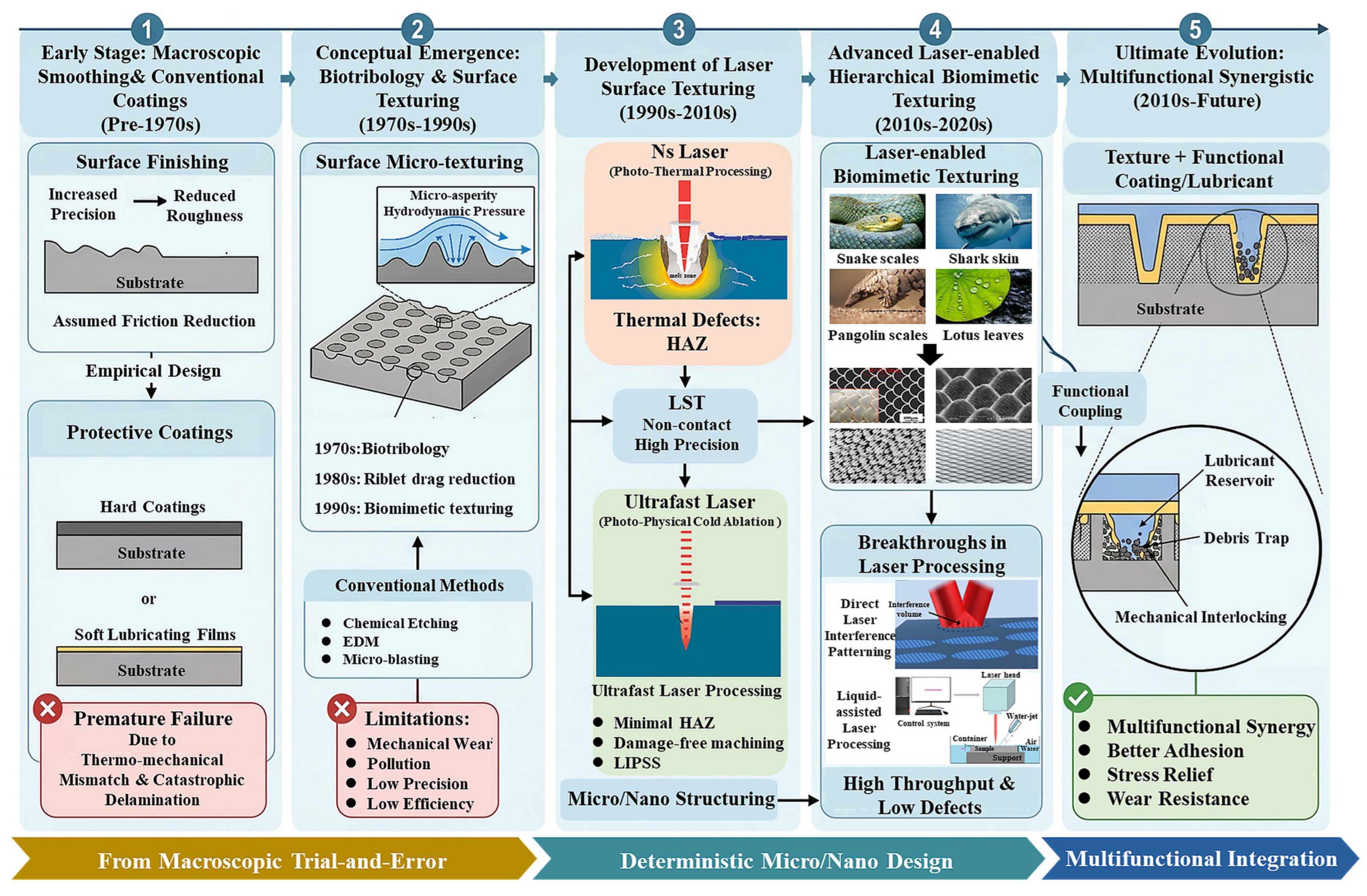
The demand for improved tribological performance has driven the development of surface engineering from conventional roughness control to deterministic micro-/nano-scale interface design and, more recently, multifunctional hybrid surface systems. Based on recent research progress, this development can generally be divided into five stages, as shown in Figure 1.
Early tribological surface treatments mainly focused on surface finishing and protective coatings, aiming to reduce friction and wear through lower roughness and improved surface hardness. During the 1970s and 1980s, the development of biotribology and biomimetic design introduced the concept that surface geometry could influence lubrication behavior and contact stress distribution. With advances in laser processing technologies, surface texturing gradually evolved into deterministic laser surface texturing (LST), which provides higher fabrication precision, better control of texture geometry, and lower thermal damage than conventional methods. Recent studies have further extended tribological surface engineering toward hierarchical biomimetic structures and multifunctional hybrid interfaces that combine textures, coatings, lubricants, and surface functionalization methods. These integrated strategies are mainly used to improve friction reduction, wear resistance, and long-term interfacial stability.
The evolution of tribological surface engineering can generally be divided into five stages, reflecting the gradual transition from empirical surface modification to mechanism-based and multifunctional interface design.
In the early stage, tribological improvement mainly relied on macroscopic surface finishing and conventional protective coatings. The common assumption was that lower surface roughness would directly improve tribological performance [12]. Friction and wear were therefore evaluated mainly through macroscopic parameters such as roughness, hardness, and wear rate. Surface finishing processes were widely used to reduce asperities and improve machining precision, although this approach eventually encountered both physical and economic limitations [16]. To further reduce friction and wear, protective coatings including TiN (titanium nitride), DLC (diamond-like carbon), and PTFE (polytetrafluoroethylene) were introduced [13,17]. These coatings improved surface hardness or reduced interfacial shear strength, but their performance was often limited by thermo-mechanical mismatch and poor interfacial adhesion, particularly under severe operating conditions [18].
The second stage marked the development of deterministic surface texturing concepts. Experimental studies showed that texture geometry, including dimple diameter, spacing, density, and aspect ratio, strongly influences hydrodynamic pressure generation and debris trapping behavior. Hamilton et al. proposed the micro-asperity hydrodynamic lubrication theory, demonstrating that microscopic surface features can generate additional hydrodynamic pressure [19]. Etsion et al. later confirmed that micro-dimples can effectively reduce friction and wear in mechanical systems [20]. During this period, several conventional fabrication methods were explored, including chemical etching, micro-abrasive blasting, electrical discharge machining (EDM), ion beam etching, and embossing [21]. However, these methods were generally limited by low processing efficiency, environmental concerns, tool wear, and the formation of heat-affected zones (HAZ) and residual stresses.
A major advance occurred with the emergence of laser surface texturing (LST), which enabled deterministic micro-/nano-scale surface engineering through non-contact processing [22]. Compared with conventional methods such as chemical etching and EDM, laser-based techniques provided higher fabrication precision, broader material compatibility, and better control of texture geometry, including feature size, spacing, density, and aspect ratio. Early nanosecond laser surface texturing (ns-LST) mainly relied on photothermal ablation. Although it offered relatively high material removal efficiency, it also introduced recast layers, deeper HAZ, and thermally induced microcracks [23]. The development of ultrafast laser systems gradually shifted surface processing toward non-equilibrium “cold ablation,” where ultrashort pulse durations suppress thermal diffusion and reduce HAZ formation [24,25]. This transition improved surface integrity, dimensional accuracy, lubrication stability, and tribological reliability under complex operating conditions. The development of picosecond laser surface texturing (ps-LST) and femtosecond laser surface texturing (fs-LST) further enabled the fabrication of hierarchical micro-/nano-structures and laser-induced periodic surface structures (LIPSS), extending the capability of precision tribological interface design.
Surface engineering later developed toward biomimetic and high-throughput processing strategies. Inspired by natural surfaces such as shark skin, snake scales, and lotus leaves, researchers designed hierarchical textures with cross-scale features to improve directional friction control, lubrication stability, and debris accommodation [26,27]. At this stage, tribological surface engineering expanded from simple friction reduction toward multifunctional interfacial regulation, including wettability control and lubrication management. To improve processing efficiency, direct laser interference patterning (DLIP) was introduced for rapid fabrication of large-area periodic structures [28,29,30]. Liquid-assisted laser processing was also developed to suppress thermal effects and remove ablation debris through cavitation-assisted mechanisms, thereby improving texture quality and surface morphology [31].
The most recent stage is characterized by the integration of laser-textured surfaces with functional coatings and solid lubricants [14]. In these hybrid systems, surface textures serve as lubricant reservoirs, debris traps, and mechanical interlocking sites that improve coating adhesion [32,33]. The coupling between texture geometry and functional materials helps redistribute contact stress and reduce coating delamination under high-load conditions, leading to improved friction and wear performance [34]. Current studies increasingly focus on cross-scale interactions among texture morphology, coatings, lubricants, and interfacial chemistry, with performance improvements reflected in enhanced wear resistance, coating durability, and lubrication stability under complex service environments.
To illustrate the development of tribological surface engineering more clearly, Table 1 summarizes the representative strategies, functional characteristics, tribological performance, scalability, and limitations associated with different developmental stages.
As summarized in Table 1, the development of surface engineering strategies shows a gradual transition from passive surface modification to deterministic and multifunctional interfacial regulation aimed at improving tribological adaptability.

1.3. Objectives, Scope, and Novelty of the Review

Although many studies and review articles have investigated LST for tribological applications, most existing reviews mainly focus on specific processing methods, texture geometries, or individual performance improvements. Relatively few studies systematically connect lubrication regimes, interfacial mechanisms, processing strategies, and application-oriented surface design. Current limitations, industrial scalability, and multifunctional hybrid surface engineering are also less comprehensively discussed.
This review provides a mechanism-oriented analysis of LST for tribological applications based on process–structure–performance relationships. Particular attention is given to lubrication-dependent mechanisms under hydrodynamic lubrication, boundary lubrication, and dry sliding conditions. The corresponding effects of debris entrapment, stress redistribution, metallurgical strengthening, and wettability regulation are also discussed. Representative LST technologies, including nanosecond processing, ultrafast laser processing, direct laser interference patterning (DLIP), and liquid-assisted laser processing, are compared in terms of fabrication precision, thermal effects, processing efficiency, scalability, and industrial applicability.
In addition to summarizing existing studies, this review discusses application-oriented surface design principles and hybrid engineering strategies that combine textures with coatings, solid lubricants, and surface hardening methods. Current challenges and future research directions are also reviewed, including large-scale manufacturing, long-term reliability, multifunctional integration, and AI-assisted surface design for tribological applications.

2. Methodology of Literature Review

The literature reviewed in this work was systematically collected from major scientific databases, including Web of Science, Scopus, and ScienceDirect. Google Scholar was used as a supplementary search tool to improve literature coverage and identify potentially relevant publications. All records retrieved through Google Scholar were further verified, and only peer-reviewed journal articles indexed in recognized scientific databases (e.g., Web of Science Core Collection or Scopus) were retained for final inclusion. The search focused on publications related to laser surface texturing for tribological applications. The literature search was conducted using combinations of the following keywords: “laser surface texturing”, “laser texturing”, “surface micro-texture”, “tribology”, “friction reduction”, “wear resistance”, “hydrodynamic lubrication”, “biomimetic surface”, “ultrafast laser processing”, and “surface functionalization”.
This review primarily covers studies published between 2010 and 2025. To provide historical background and technological evolution, several seminal studies published before 2010 were also included, particularly those concerning hydrodynamic lubrication theory, laser-material interaction mechanisms, and early surface texturing concepts.
The inclusion criteria adopted in this review were (i) peer-reviewed journal articles, (ii) studies related to tribological applications of laser surface texturing, (iii) experimental, numerical, or theoretical investigations, (iv) studies involving metallic, ceramic, or coated engineering surfaces, and (v) articles published in English. The exclusion criteria included (i) conference abstracts, (ii) duplicated publications, (iii) non-English articles, (iv) studies unrelated to tribological performance, and (v) studies lacking sufficient experimental or analytical details.
The literature screening and selection process was performed with reference to the PRISMA framework to improve the transparency and systematicity of the review process. After removing duplicate and irrelevant studies, the final selected publications were analyzed according to laser processing parameters, texture geometry, lubrication regimes, tribological mechanisms, and engineering applications.

3. Conventional Surface Engineering Strategies: Limitations and Comparative Analysis

The intensifying rigor of modern tribological environments has necessitated a fundamental shift in surface engineering, moving away from macroscopic trial-and-error toward a more deterministic micro- and nano-scale design paradigm. While academia and industry have long relied on a diverse toolkit, ranging from mechanical machining to thin-film deposition, these traditional interventions increasingly falter when subjected to the crucibles of heavy loading or starved lubrication [35]. Indeed, the efficacy of such methods is frequently capped by systemic bottlenecks; they often lack the dimensional precision and interfacial integrity required to survive multi-field coupling, ultimately raising concerns regarding both their performance limits and environmental sustainability.
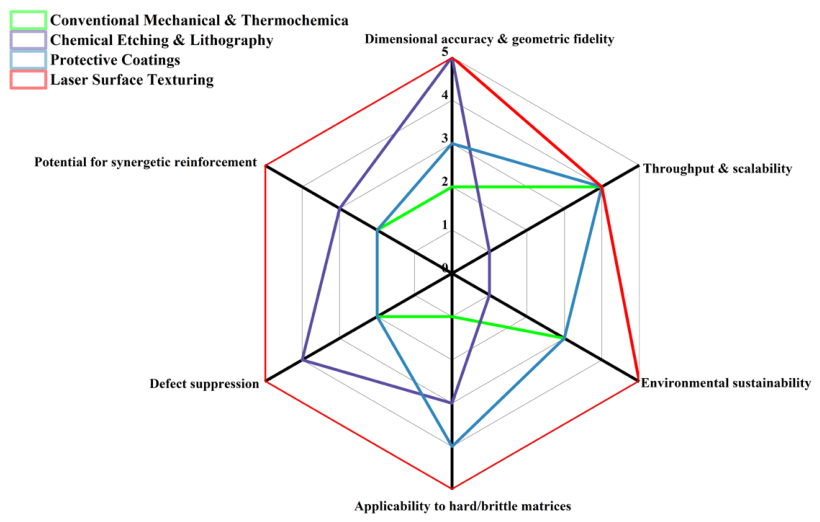
A critical assessment of these strategies, as mapped in Figure 2, reveals a landscape defined by unavoidable trade-offs between precision, scalability, and material applicability. While mechanical and thermochemical approaches remain industrial workhorses due to their high scalability, they are notoriously hampered by poor defect control and a lack of geometric fidelity. Conversely, while chemical etching and lithography offer the necessary precision for complex features, they remain economically and environmentally taxing. Even protective coatings, which ostensibly bolster surface hardness, frequently suffer from a persistent fragility in interfacial adhesion, a limitation that underscores the urgent need for more synergistic, multifunctional design strategies that can transcend these traditional boundaries.
The comparison summarized in Table 2 illustrates the trade-offs among fabrication precision, processing efficiency, thermal effects, and scalability for current surface engineering technologies. Conventional mechanical and thermochemical methods generally provide mature processing capability and high throughput, but their application is often limited by tool wear, HAZ formation, and insufficient precision for brittle or high-performance materials. Chemical etching and lithography can achieve high structural precision with minimal surface damage; however, their low throughput and limited scalability restrict large-scale industrial application. Protective coatings are widely used to improve surface hardness and friction behavior, although their long-term performance is frequently affected by coating delamination and interfacial instability.
Compared with these methods, LST offers better controllability for deterministic interface engineering. Nanosecond laser processing is suitable for efficient large-area fabrication, but photothermal ablation can introduce recast layers and thermal damage. Ultrafast laser processing, which is based on non-equilibrium ablation, substantially reduces thermal diffusion and HAZ formation. This allows the fabrication of high-fidelity micro-/nano-structures with improved surface integrity, although the processing cost is generally higher and the throughput remains lower.
As summarized in Table 2, surface engineering technologies have gradually evolved from conventional roughness reduction and passive surface protection toward deterministic and multifunctional interface engineering. Conventional methods generally provide mature processing capability and high throughput, but they are often limited by poor structural controllability, thermal damage, or interfacial instability. In comparison, LST, particularly ultrafast laser processing, offers higher geometric precision, lower HAZ formation, and greater flexibility in tailoring tribological interfaces. These advantages make LST suitable for advanced tribological surface engineering aimed at improving friction reduction, wear resistance, and interfacial durability.

3.1. Mechanical and Thermochemical Texturing: Contact-Induced Limitations

The accessibility of traditional texturing methods, such as micro-milling and abrasive blasting, often belies a suite of inherent structural compromises. Because these techniques are predicated on direct solid–solid contact, the imposition of macroscopic cutting forces inevitably compromises the substrate—particularly in ultra-hard or brittle materials—by inducing subsurface micro-cracks and residual tensile stresses [36]. Even in the case of Electrical Discharge Machining (EDM), which bypasses mechanical contact, the shift toward pulsed thermal melting merely exchanges one set of limitations for another [21]. The resulting recast layers and deep HAZ are not merely superficial defects; they act as critical sites for crack initiation under cyclic loading, essentially pre-programming the component for premature fatigue failure and long-term instability [37].

3.2. Chemical Etching and Lithography: Precision vs. Scalability Trade-Offs

While chemical etching and mask lithography stand as the gold standard for achieving high-resolution, damage-free topographies, their utility is frequently undercut by the sheer complexity of their execution. The paradox of these methods lies in their precision; the very multi-step sequence required to ensure sub-micron accuracy—spanning photoresist application to final development—creates an inherent bottleneck that renders them ill-suited for the high-throughput demands of large-scale industrial manufacturing [35]. Beyond these logistical constraints, the environmental dimension of wet etching poses a significant challenge. The dependence on corrosive, hazardous reagents introduces a layer of operational volatility that complicates three-dimensional control and, perhaps more critically, stands in direct opposition to the contemporary mandate for sustainable “green” manufacturing [38]. Ultimately, these combined hurdles restrict such high-precision techniques to niche applications, preventing their broader integration into mainstream industrial practice.

3.3. Protective Coatings: Interfacial Failure and Durability Constraints

The application of protective coatings—spanning PVD/CVD hard films like TiN and DLC to soft, self-lubricating layers such as MoS2—remains a cornerstone of contemporary tribological strategy. By design, these interventions serve to bolster surface hardness or minimize interfacial shear strength, offering a seemingly robust solution for mitigating initial friction and wear.
The efficacy of these coatings is frequently ephemeral, primarily compromised by the structural fragility of the coating-substrate interface [39]. Under the relentless strain of cyclic loading and thermo-mechanical flux, the inherent dissonance between the mechanical and thermal properties of the film and its substrate facilitates the rapid initiation of interfacial micro-cracks [2]. When delamination inevitably occurs, the failure is twofold: the surface is not only stripped of its protection, but the resulting debris transforms into aggressive third-body abrasives. This shift from protective layer to destructive fragment triggers a severe ploughing mechanism that accelerates component degradation far beyond its original wear rate.

3.4. Laser Surface Texturing: Toward Deterministic Interface Design

To address the limitations of conventional surface engineering methods, LST has been increasingly used for tribological interface modification. As a non-contact optical processing technique, LST avoids tool wear, is applicable to a wide range of materials, and enables controllable fabrication of micro-/nano-scale surface structures with high geometric precision [40]. The process also does not require masks or chemical reagents, which makes it compatible with environmentally sustainable manufacturing.
The performance of LST is determined by the laser–material interaction process, where pulsed laser energy is locally deposited onto the material surface to produce controlled ablation and deterministic surface textures. Among the processing parameters, laser pulse duration strongly influences energy deposition behavior, thermal diffusion, and ablation mechanisms, thereby affecting texture morphology, subsurface integrity, and tribological performance [41,42]. Nanosecond (ns) pulsed lasers, typically operating within pulse durations of 10−9–10−8 s, mainly rely on thermally dominated material removal. Because of the relatively long pulse duration, heat diffusion occurs during laser irradiation, which often causes localized melting, re-solidification, oxidation, recast layer formation, and the generation of HAZ [43,44]. Excessive thermal accumulation may also lead to burr formation, tensile residual stress, microcracks, and surface degradation, which can reduce fatigue life and wear resistance. The thermal diffusion length during laser processing can be expressed as:
L = α τ ,
where L is the thermal diffusion length, α is the thermal diffusivity, and τ is the laser pulse duration. This relationship indicates that shorter pulse durations significantly restrict thermal diffusion and reduce the size of the HAZ.
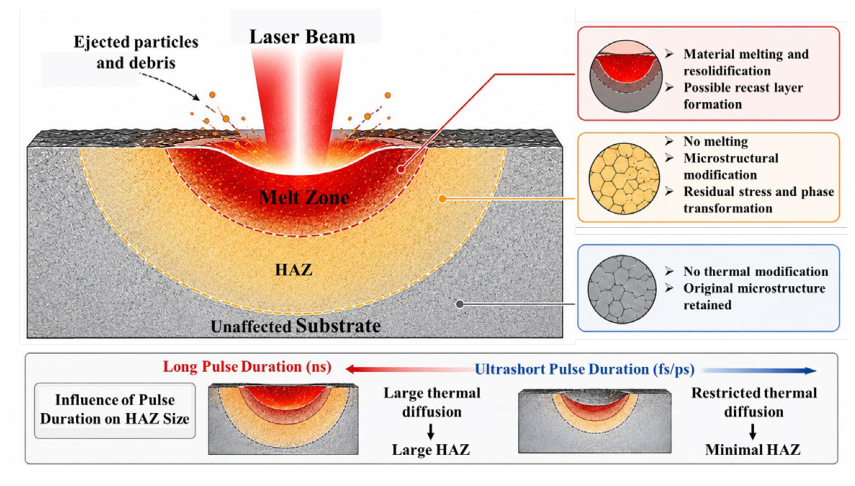
Figure 3 schematically illustrates the formation of the melt zone, heat-affected zone HAZ, and unaffected substrate during laser surface texturing. The melt zone corresponds to the region where the material undergoes melting and subsequent resolidification, whereas the HAZ represents the surrounding area that experiences sufficient thermal exposure to induce microstructural and mechanical property changes without complete melting. Outside the HAZ, the substrate remains largely unaffected by the thermal cycle.
Compared with nanosecond lasers, picosecond (ps, 10−12 s) lasers significantly reduce thermal diffusion because of the shorter laser–material interaction time. As a result, melting and recast layer formation are suppressed, leading to improved dimensional accuracy and surface integrity. Femtosecond (fs, 10−15 s) lasers further reduce thermal effects through ultrafast non-equilibrium laser–material interactions. Since the pulse duration is shorter than the characteristic electron–phonon coupling time in most materials, energy transfer to the lattice is greatly limited. Material removal therefore mainly occurs through nonthermal ablation mechanisms, including Coulomb explosion and phase explosion [45,46].
As a result, fs-LST can fabricate shallow micro-textures with minimal burr formation, negligible HAZ, limited oxidation, and high surface quality. Ultrafast laser processing may also introduce beneficial compressive residual stresses in some materials, as reported for hardened AISI 440C bearing steel [47]. The transition from nanosecond to ultrafast laser processing therefore reflects a shift from thermally dominated material removal to more controlled and nonthermal surface engineering. In addition to improving geometric precision, ultrafast processing enhances subsurface integrity and provides better control of tribological interface characteristics.
The differences among nanosecond, picosecond, and femtosecond laser processing in terms of laser–material interaction, thermal effects, HAZ formation, and surface integrity are summarized in Table 3. As shown in Table 3, shorter pulse durations effectively reduce thermal diffusion and suppress HAZ formation, leading to improved surface integrity and texture precision. Nanosecond laser processing generally offers higher efficiency and lower processing cost, whereas ultrafast laser systems are more suitable for fabricating high-quality micro-/nano-structures with limited thermal damage. These characteristics make picosecond and femtosecond laser processing attractive for advanced tribological surface engineering applications.
Laser-generated micro-/nano-textures also introduce controllable interfacial features that can function as lubricant reservoirs, debris traps, and mechanical interlocking sites. When combined with functional coatings, solid lubricants, or metallurgical modification methods such as laser nitriding, these textures can further improve interfacial adhesion, stress distribution, and lubrication stability through synergistic effects [33,48].

4. Mechanistic Framework of Laser-Textured Tribological Interfaces

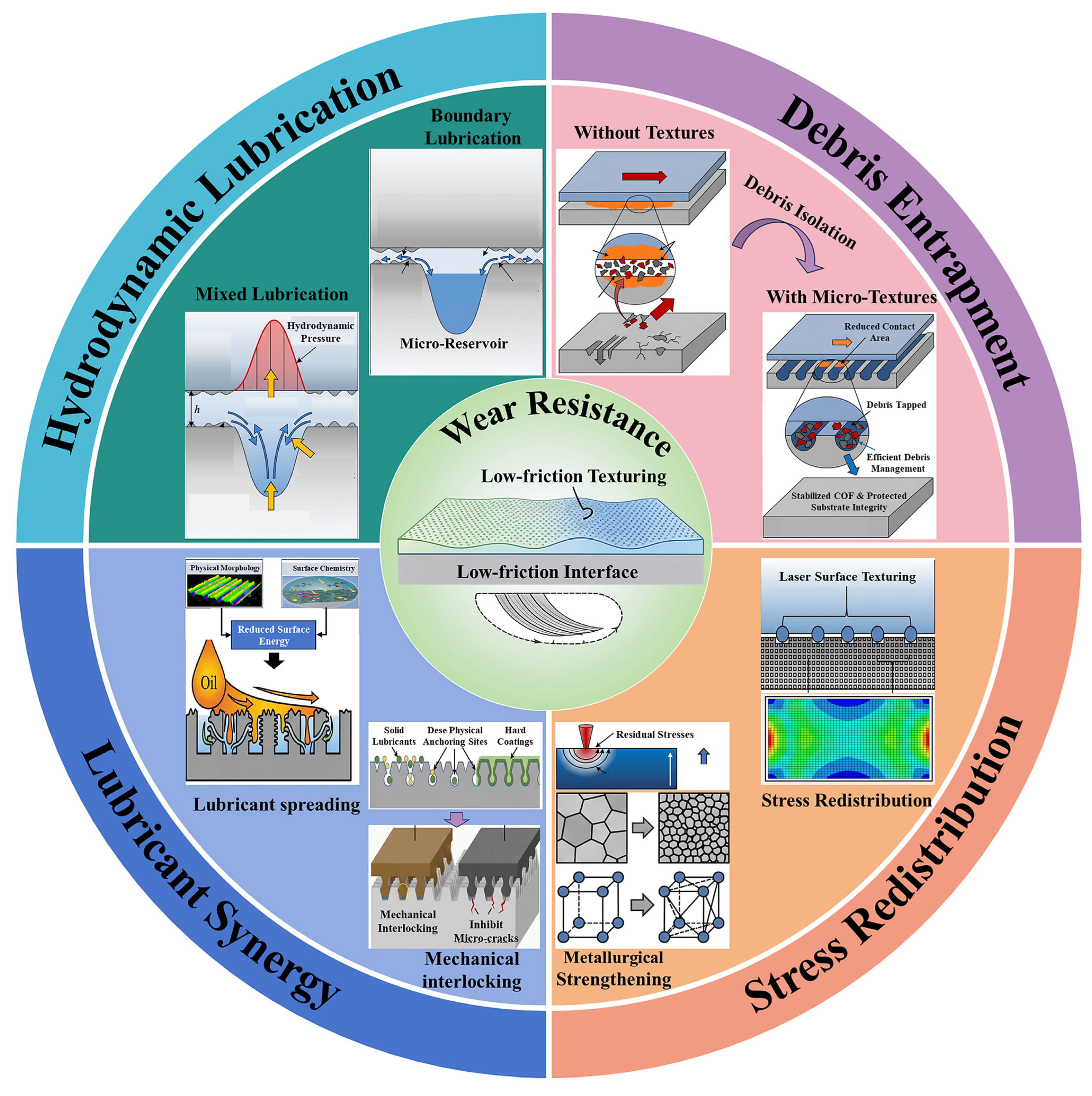
LST has gradually developed from a surface modification method into a mechanism-based approach for tribological interface engineering through deterministic micro-/nano-scale surface design. As illustrated in Figure 4, the tribological improvement induced by LST does not originate from a single mechanism but from the combined interaction of multiple interfacial effects operating at different scales.
These effects can generally be divided into four interrelated mechanisms: micro-hydrodynamic pressure generation and secondary lubrication at the continuum scale; contact regulation and third-body debris entrapment at the interface scale; laser-induced metallurgical strengthening and stress redistribution at the material scale; and wettability modulation together with interactions involving solid lubricants or coatings. The coupling of these mechanisms enables coordinated regulation of lubrication behavior, contact conditions, and material response under different operating conditions.
Overall, LST provides a multi-scale and multi-physics approach in which texture geometry, material modification, and interfacial regulation are closely interconnected. Through this coupling effect, friction and wear behavior can be adjusted under different lubrication regimes and loading conditions, providing a basis for the design of advanced tribological surfaces. The following sections discuss these mechanisms in detail.
The tribological performance of laser surface textures strongly depend on the lubrication regime and contact conditions. To clarify the dominant mechanisms responsible for friction reduction and wear resistance, the following sections discuss the roles of LST under hydrodynamic lubrication, boundary lubrication, and dry sliding conditions separately.

4.1. Hydrodynamic Lubrication Mechanisms

Under hydrodynamic lubrication conditions, the tribological behavior of laser-textured surfaces is mainly governed by micro-hydrodynamic pressure generation within engineered surface features. According to the Reynolds equation, variations in lubricant film thickness caused by the converging geometry of micro-dimples or micro-grooves produce asymmetric positive pressure distributions [49,50]. This micro-hydrodynamic effect increases dynamic pressure lift, promotes lubricant film formation, and helps separate contacting asperities [35]. As a result, the generated hydrodynamic pressure improves load-carrying capacity and reduces direct solid-to-solid contact.
The hydrodynamic behavior of textured surfaces is strongly affected by geometric parameters such as texture density, aspect ratio, depth-to-diameter ratio, and texture spacing. These factors influence lubricant replenishment, pressure generation, cavitation behavior, and fluid-film stability under different operating conditions.
In general, insufficient texture depth or low texture density may weaken hydrodynamic pressure generation, whereas excessively large textures can interrupt lubricant film continuity and reduce the effective load-bearing area. Periodically distributed textures can also promote lubricant circulation and stabilize fluid-film formation during sliding. Under full-film and mixed lubrication conditions, these hydrodynamic effects contribute to friction reduction, lower surface damage, and improved tribological stability. A more detailed discussion of texture geometry and parameter-dependent tribological behavior is provided in Section 4.

4.2. Boundary Lubrication Mechanisms

Under boundary lubrication conditions, the lubricant film is not thick enough to completely separate contacting asperities, and the tribological behavior becomes highly dependent on local surface characteristics. In this regime, laser-induced micro-textures can act as localized lubricant reservoirs that store and gradually release lubricant during sliding [47,51]. Through capillary effects and mechanical squeezing, these micro-cavities continuously supply lubricant to the contact interface, helping maintain tribo-film stability and delay lubricant starvation [7,23,47].
Textured surfaces can also improve boundary lubrication stability by reducing local stress concentration and suppressing direct metal-to-metal adhesion. In addition, surface textures facilitate the retention of lubricant additives and tribochemical reaction products, which further improves anti-wear performance under severe lubrication conditions. As a result, LST can delay the transition from boundary lubrication to dry sliding, leading to lower friction fluctuations and improved surface durability.

4.3. Dry Sliding and Third-Body Debris Entrapment Mechanisms

Under dry sliding conditions, the tribological behavior of laser-textured surfaces is mainly controlled by contact mechanics and wear debris evolution. In the absence of a continuous lubricant film, direct asperity contact dominates the friction and wear process, making the real contact area and debris accumulation key factors affecting tribological performance [25,52]. Laser-induced micro-textures can reduce the real contact area by interrupting continuous surface contact, thereby suppressing adhesive interactions and lowering friction. More importantly, textured cavities can act as localized traps for wear debris and oxidized particles generated during sliding [53]. By isolating abrasive particles from the main contact interface, these micro-reservoirs help suppress severe three-body abrasion and reduce deep ploughing damage.
The entrapment of wear debris can also stabilize the sliding interface by preventing excessive particle accumulation and reducing local stress concentration. As a result, LST can delay the transition from mild wear to severe abrasive wear, leading to improved friction stability, reduced surface damage, and longer service life under dry sliding conditions [12,25].
However, the beneficial effect of debris entrapment strongly depends on texture geometry and operating conditions. Under high normal loads or prolonged sliding, excessive debris may accumulate inside the textured features, resulting in clogging or compaction within the cavities. Once the textures become saturated, their debris storage capability decreases, and the textured regions may instead act as abrasive contact sites, accelerating wear and friction instability. Excessively high texture density or overly deep textures can also reduce the effective load-bearing area and introduce local stress concentration, which may aggravate wear under severe contact conditions. Therefore, the positive effect of debris entrapment is condition-dependent and requires optimized texture parameters and operating conditions to maintain stable tribological performance.

4.4. Laser-Induced Metallurgical Strengthening and Stress Redistribution

Beyond geometric modification, LST can also induce significant subsurface microstructural changes through rapid localized heating and subsequent self-quenching. These non-equilibrium thermal cycles may promote grain refinement, phase transformation, and localized hardening, thereby altering the mechanical properties of the near-surface region [15,23,54]. Under suitable processing conditions, rapid thermal gradients can facilitate the formation of refined martensitic structures and increase dislocation density, leading to higher surface hardness and improved resistance to plastic deformation. Laser processing may also introduce compressive residual stresses or redistribute local stress around textured regions, which can suppress crack initiation and propagation during cyclic loading [2,9]. The combined effect of metallurgical strengthening and stress redistribution improves the load-bearing capacity and fatigue resistance of textured surfaces. As a result, laser-induced subsurface modification can enhance both wear resistance and structural durability under severe tribological conditions [55].
However, excessive thermal input or microstructural modification may also produce adverse effects under inappropriate processing conditions. Steep residual stress gradients generated during rapid heating and cooling can promote crack initiation and localized fatigue damage, particularly in brittle or high-hardness materials. Excessive hardening or the formation of non-equilibrium microstructures may reduce material toughness and increase susceptibility to brittle fracture under cyclic or impact loading. Thermally induced phase heterogeneity, recast layers, and localized tensile residual stresses associated with unsuitable laser parameters can also reduce interfacial integrity and long-term tribological stability. These issues are especially relevant in nanosecond laser processing, where stronger thermal diffusion often leads to more pronounced HAZ formation. Therefore, optimization of laser processing parameters and careful balancing between strengthening effects and subsurface integrity are essential for achieving stable and durable tribological performance.

4.5. Interfacial Wettability Control and Solid Lubricant Synergy

The tribological behavior of laser-textured surfaces is also closely related to interfacial wettability and lubricant–surface interactions. Laser-induced micro-/nano-scale structures can alter surface roughness and surface energy, enabling adjustable wetting behavior ranging from superhydrophobicity to superoleophilicity [6,25]. These wettability changes influence lubricant spreading, retention, and replenishment at the sliding interface.
Hierarchical micro-/nano-textures can increase lubricant storage capacity and improve lubricant film stability by promoting capillary-driven spreading and reducing lubricant loss during sliding. Surface textures also facilitate the retention of lubricant additives and tribochemical reaction products, which helps maintain stable boundary lubrication films under severe operating conditions. In addition, laser-generated textures can act as mechanical interlocking sites for solid lubricants and functional coatings, including MoS2 and DLC films [2,15,32].
This interfacial anchoring effect improves coating adhesion and reduces premature delamination under cyclic loading. As a result, the combined effects of surface texturing, wettability regulation, and solid lubricant or coating systems can reduce friction, improve wear resistance, and enhance interfacial durability under complex tribological conditions.

5. Effect of Texture Geometry and Parameters on Tribological Performance

The surface characteristics of laser-textured components are directly determined by processing parameters rather than being intrinsic material properties. These parameters control the laser–material interaction process and thereby influence texture geometry, surface morphology, and subsurface modification, all of which strongly affect tribological performance [25,47]. Parameters such as texture shape, density, spacing, and aspect ratio are important for achieving functions including lubricant retention, wear debris entrapment, and hydrodynamic pressure enhancement.
The control of these geometric features depends on laser processing variables including pulse energy, repetition rate, and scanning speed, which determine the final texture size, depth, and edge morphology. As a result, the relationship between processing parameters and texture geometry is closely linked to tribological behavior. This dependence highlights the need for systematic texture design and parameter optimization for different tribological applications, providing a basis for further discussion of laser–material interactions and laser-induced microstructural evolution.

5.1. Shape Optimization (Dimples, Grooves, Crosshatch, Bionic)

The geometric shape of surface textures is an important design parameter because it directly affects lubricant flow, contact behavior, and wear debris evolution. Among different texture geometries, circular dimples are the most widely studied due to their isotropic characteristics and relatively simple fabrication process. In precision bearing applications, femtosecond laser-fabricated circular dimples on AISI 440C steel improved tribological performance under starved lubrication conditions without producing a noticeable HAZ [47]. Similar results have been reported for ZA-27/TiC composites [53] and 7075 aluminum alloy [56], where circular textures showed lower friction and wear than square or triangular textures. This behavior is generally attributed to more stable lubricant retention and effective wear debris entrapment.
Linear grooves provide another common texture geometry and can be aligned parallel, perpendicular, or inclined relative to the sliding direction, allowing anisotropic control of tribological behavior. Studies on stainless steel showed that grooves oriented perpendicular to the sliding direction often provide better tribological performance because they facilitate lubricant transport and debris removal more effectively [57]. More complex geometries, such as micro-crosshatch patterns, combine the advantages of multiple groove orientations. Femtosecond laser-fabricated crosshatch textures on gray cast iron reduced friction by up to 90% under dry sliding conditions, mainly because the interconnected grooves trapped wear debris efficiently and exposed graphite flakes that acted as solid lubricants [52].
Biomimetic textures inspired by natural structures, including scales, leaves, and shark skin, represent a further development in texture shape design. Examples such as scaly textures for starved lubrication [13] and vein-like patterns on bearing raceways [1] have been developed to improve secondary lubrication effects and hydrodynamic pressure generation. Overall, the optimal texture shape depends on the material system, lubrication regime, and operating conditions. Texture geometry therefore needs to be considered together with parameters such as density, spacing, and aspect ratio to achieve stable tribological performance.

5.2. Density, Spacing, and Aspect Ratio

Texture density, spacing, and aspect ratio are key geometric parameters that strongly influence the tribological performance of laser-textured surfaces by affecting lubricant behavior, contact conditions, and wear debris entrapment. Texture density, usually defined as the area fraction occupied by textures, determines the lubricant storage capacity and contact pressure distribution. An appropriate texture density should provide sufficient micro-reservoirs for lubricant retention under starved lubrication conditions without excessively reducing the effective load-bearing area. For example, studies on gray cast iron and titanium alloys identified optimal texture densities of approximately 60% [52] and 10% [58], respectively, which produced lower friction coefficients and wear rates by balancing lubricant storage and surface integrity.
Texture spacing, defined as the center-to-center distance between adjacent textures, affects the interaction among surface features and the development of hydrodynamic pressure. Research on hypereutectic Al–Si cylinder liners showed that a spacing of 1 mm provided better tribological performance than larger spacings of 1.5 mm or 2 mm [59]. Larger spacing reduced lubricant replenishment efficiency between neighboring textures and weakened hydrodynamic effects.
The aspect ratio, commonly defined as the ratio of texture depth to characteristic width, influences lubricant and debris storage capacity as well as stress concentration around texture edges. A relatively low aspect ratio, such as 0.06 for micro-crosshatch textures on gray cast iron, can promote smoother lubricant flow and reduce local edge stress concentration, contributing to lower friction [52]. In contrast, unsuitable aspect ratios may reduce debris trapping efficiency or increase the likelihood of local damage and premature failure.
The effects of density, spacing, and aspect ratio are strongly interrelated and depend on the material system and operating conditions. As a result, systematic optimization methods, including response surface methodology, are often required to determine suitable texture parameters for specific tribological applications [5,26]. Proper optimization of these geometric factors is essential for achieving stable hydrodynamic effects, effective debris management, and improved tribological performance.

5.3. Depth and Edge Profile Control

Texture depth and edge morphology are important geometric parameters because they directly affect lubricant retention, hydrodynamic pressure generation, and wear debris management. In precision components such as bearings, shallow and burr-free micro-textures are preferred to avoid stress concentration sites that may accelerate fatigue failure [47]. Texture geometry is mainly controlled through laser processing parameters, including pulse energy, repetition rate, and pulse number.
Studies on nanosecond laser texturing of TB6 alloy showed that increasing the number of laser scanning cycles increased dimple depth. Under optimized conditions, the coefficient of friction decreased by up to 66% under dry sliding due to reduced real contact area and improved lubricant retention [23]. In picosecond laser processing of WC-Ni coatings, texture depth was found to be more sensitive to scanning speed and laser power than texture diameter, indicating that accurate parameter control is necessary for regulating texture dimensions [10].
The edge profile around textured features is also important. Sharp edges or pronounced bulges surrounding laser-induced craters can generate local stress concentration, increase abrasive wear, and reduce the effective load-bearing capacity of the surface [60]. In comparison, smoother and well-defined edges, which are more easily achieved using ultrafast laser systems such as femtosecond lasers, promote more stable lubricant retention and more uniform stress distribution [61,62]. Appropriate control of texture depth and edge morphology can also improve debris entrapment efficiency, helping shift wear behavior from severe adhesive or abrasive wear toward milder wear mechanisms [63,64]. Therefore, controlling these geometric characteristics through laser parameter optimization is essential for achieving predictable friction and wear performance.

5.4. Influence of Texture Arrangement on Tribological Performance

In addition to individual texture geometry, the spatial arrangement of surface textures is another important factor affecting tribological performance. The distribution pattern of micro-features influences hydrodynamic pressure generation, lubricant replenishment, and the transport and entrapment of wear debris. For example, micro-crosshatch patterns fabricated on gray cast iron reduced the coefficient of friction by up to 90% under dry sliding conditions, with the tribological performance strongly dependent on pattern density [52].
Comparative studies on AISI O1 steel showed that staggered texture arrangements provided better tribological behavior than inline patterns because staggered distributions promoted more effective hydrodynamic pressure generation within the lubricant film [16]. Research on SS316L also indicated that homothetic dimple patterns generally performed better than hybrid dimple-channel structures under dry sliding conditions, since the latter could disturb lubricant film stability and increase ploughing wear [65].
Texture arrangement can also influence friction anisotropy. Saw-tooth surface topographies fabricated on copper produced directional friction behavior, where the friction coefficient varied with the sliding direction relative to the texture orientation [66]. In addition, the arrangement of textures affects wear debris transport and lubricant flow. Studies on Babbitt alloy showed that square texture arrays generated more stable micro-hydrodynamic pressure distributions and lower friction coefficients than linear radiating patterns under mixed and starved lubrication conditions [67].
These studies indicate that texture arrangement is an important design parameter for optimizing load-bearing capacity, friction reduction, and wear control. Appropriate spatial distribution of textures therefore provides an additional strategy for improving the performance of advanced tribological surfaces.

6. State-of-the-Art Laser Surface Engineering Strategies for Tribological Applications

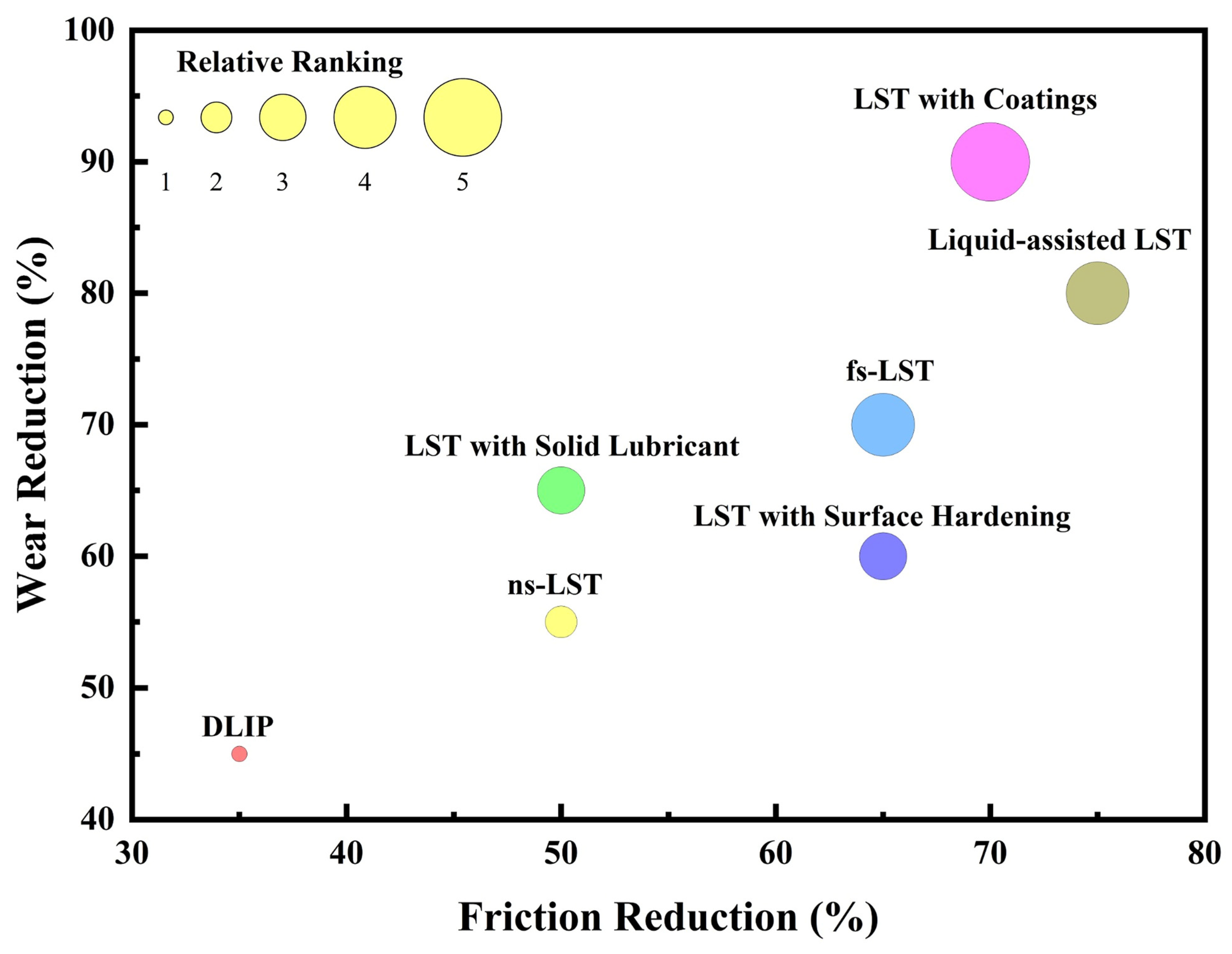
Grounded in the mechanistic principles established in the preceding discussion, laser surface treatment has transcended its role as a simple modification tool to become a sophisticated suite of strategies for precision interface tailoring. As mapped in Figure 1, the field has undergone a decisive shift: it has moved away from isolated, single-scale features toward a paradigm of multi-functional engineering. In this advanced stage, geometric design, material modification, and interfacial regulation are no longer treated as independent variables but are instead managed as an inseparable triad.
At present, the landscape of laser-enabled tribological enhancement is defined by several distinct methodologies, ranging from conventional ns-LST and DLIP to the more refined ultrafast regimes (fs/ps-LST) and liquid-assisted techniques. This also includes the burgeoning field of hybrid strategies that incorporate functional coatings, solid lubricants, or surface hardening. Each of these routes represents a specific calibration between processing efficiency, structural fidelity, and ultimate service performance.
The performance hierarchy synthesized in Figure 5 clarifies the current state of the art: while ns-LST and DLIP provide respectable improvements, the transition to ultrafast LST marks a significant leap in precision and effectiveness. However, the most profound gains are arguably found in hybrid and liquid-assisted strategies. By orchestrating a multi-mechanism response—integrating stress redistribution with enhanced debris management and lubrication stability—these advanced routes achieve a level of performance that standalone texturing simply cannot replicate.
Such progress underscores a fundamental pivot in the discipline: the focus is no longer on optimizing a single structure but on the sophisticated orchestration of multi-functional and multi-field interactions. This shift from isolated interventions toward holistic interface engineering provides the necessary context for the detailed technical examination of these strategies that follows.

6.1. Laser Surface Texturing: Process–Structure–Performance Relationship

The utility of LST in tailoring tribological performance is fundamentally predicated on its capacity to transform deterministic micro- and nano-scale structuring into a reliable, high-fidelity engineering tool [5,25,68]. Far from being a uniform process, LST’s efficacy is governed by the underlying physics of the laser–material interaction, which is primarily dictated by pulse duration. While nanosecond and microsecond systems are characterized by more pronounced thermal effects and the concomitant microstructural and chemical shifts that follow—the transition toward ultrafast (femtosecond and picosecond) regimes enables a non-equilibrium “cold” ablation pathway [69,70,71,72]. This distinction is pivotal; it allows for the realization of complex geometries, such as dimples and periodic arrays, without the collateral thermal damage that historically compromised surface integrity. When this temporal control is combined with the inherent flexibility of parameters like pulse energy and repetition rate, a robust process–structure relationship emerges [73,74]. This synergy provides the necessary foundation for the rational design of topographies, the specific strategies and performance outcomes of which are examined in the following sections.

6.1.1. Nanosecond/Microsecond Laser Texturing: Thermally Driven Structuring

As a mainstay of industrial surface modification, short- and medium-pulse laser texturing, operating within the nanosecond (ns) to microsecond (µs) regimes—offers a pragmatically balanced pathway for tribological enhancement. Unlike the non-equilibrium mechanisms of ultrafast systems, the laser–material interaction here is fundamentally governed by thermo-physical phenomena, where the interplay of melting, vaporization, and re-solidification, dictates the final topography. While these thermal effects are more pronounced, they are by no means unmanageable; through the rigorous optimization of parameters such as power density and scanning velocity, it remains possible to engineer functional micro-textures with a high degree of geometric reproducibility [44].
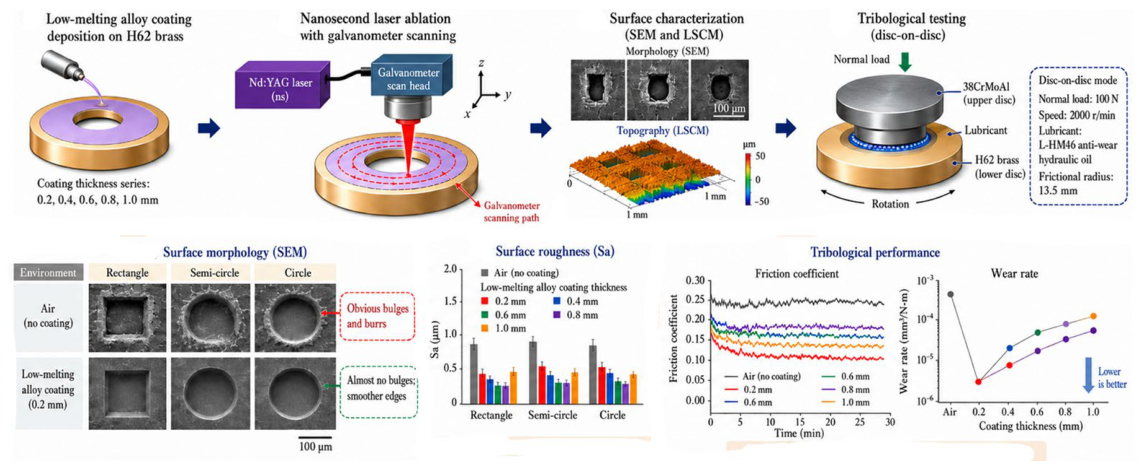
Figure 6 summarizes representative studies demonstrating the effectiveness of LST under different tribological conditions. Chen et al. developed a coating-assisted nanosecond laser processing method to fabricate high-quality textures on H62 brass. The approach significantly reduced recast layer formation, with bulge height decreasing from approximately 9.9 μm to 0.5 μm, while achieving a low friction coefficient of about 0.08 under lubricated sliding conditions together with improved wear resistance [75].
Nanosecond laser-textured dimples on TB6 titanium alloy also reduced the coefficient of friction by up to 66% under dry sliding and 61% under starved lubrication against steel counter faces [23]. The improvement was mainly attributed to reduced real contact area and enhanced lubricant retention. Similar behavior has been observed for AISI O1 steel, where textured surfaces exhibited lower friction and wear than smooth surfaces under reciprocating sliding conditions [16]. However, the tribological performance remained strongly dependent on texture geometry, lubrication conditions, and operating parameters.
The persistent challenge, however, lies in navigating the inherent tension between structural fidelity and collateral thermal damage. Because excessive heat input can catalyze undesirable oxidation, recast layers, and micro-cracking, the “process window” for ns/µs texturing is often narrower than it initially appears. Consequently, the task for the engineer is to find the precise equilibrium where the benefits of the engineered topography are not undermined by a compromised surface integrity. When this balance is achieved, short- and medium-pulse texturing remains a formidable and scalable route for tribological improvement, particularly in industrial contexts where the metrics of processing efficiency and cost-per-part are paramount.
It should be noted that the tribological improvements reported for ns/µs laser texturing are strongly dependent on testing conditions, including contact load, sliding speed, lubrication regime, and counter face material.

6.1.2. Ultrafast Laser Texturing: Non-Equilibrium Precision Engineering

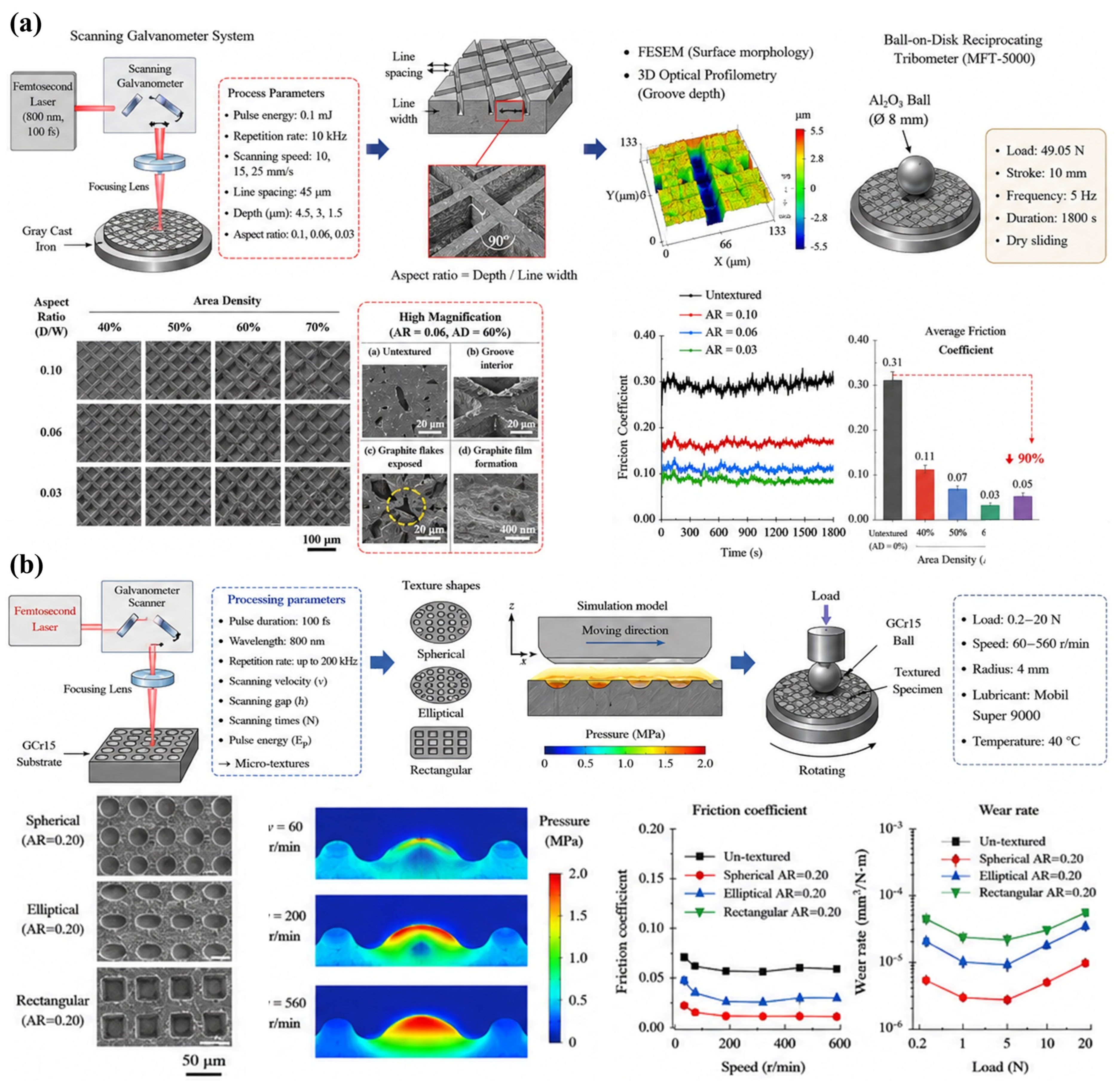
The transition into femtosecond and picosecond regimes marks a fundamental departure from the thermal constraints of earlier methods, ushering in a paradigm of non-equilibrium precision. By delivering energy on a timescale shorter than the material’s thermal relaxation period, ultrafast lasers bypass conventional heat diffusion, effectively realizing a “cold” ablation regime that yields high-fidelity features with a near-total absence of HAZ [5,9,12]. This precision is functionally imperative for components where surface integrity is non-negotiable. The efficacy of this approach is vividly illustrated in the work of Basha et al., where micro-crosshatch textures on gray cast iron achieved a striking 90% reduction in friction—a feat facilitated by the strategic exposure of graphite phases and superior debris sequestration [52]. Similarly, the spherical micro-textures fabricated by Yang et al. on GCr15 bearing steel leverage this geometric accuracy to bolster hydrodynamic lift, resulting in a substantial 75% improvement in load-carrying capacity [76].
These characteristics are particularly beneficial for applications requiring high surface integrity. As shown in Figure 7a, Basha et al. fabricated micro-crosshatch textures on gray cast iron using fs-LST with a texture density of approximately 60% and an aspect ratio of about 0.06 [52]. Under dry sliding against steel counter faces, the textured surface achieved more than 90% friction reduction and about 77.4% wear reduction compared with untreated smooth surfaces. The improvement was mainly attributed to efficient wear debris trapping and the exposure of graphite phases that acted as solid lubricants.
Yang et al. also produced spherical micro-textures on GCr15 bearing steel with a depth-to-width ratio of approximately 0.2, resulting in up to 75% friction reduction and improved load-carrying capacity under lubricated sliding conditions (Figure 7b) [76]. The enhanced performance was mainly associated with improved micro-hydrodynamic lubrication.
The tribological performance of ultrafast LST is strongly affected by processing parameters such as pulse energy, repetition rate, and scanning speed, which determine texture density, depth, and spacing [77]. Ultrafast laser systems can also fabricate hierarchical and biomimetic structures, enabling combined improvements in friction reduction, wear resistance, and wettability regulation [78,79]. In addition, direct laser writing (DLW) with ultrafast lasers allows sub-micrometer structures to be fabricated directly on functional coatings such as DLC films, reducing coating damage and mitigating adhesion problems associated with pre-textured substrates [61].
Overall, ultrafast laser texturing provides a flexible approach for tribological surface modification where high precision and limited thermal damage are required. However, the resulting tribological improvement remains strongly dependent on testing conditions, including lubrication regime, contact load, sliding speed, and counter face material.

6.1.3. Direct Laser Interference Patterning: High-Throughput Periodic Structuring

While ultrafast laser DLW offers undeniable precision, its reliance on a point-by-point scanning strategy inherently restricts its throughput, rendering it less practical for industrial-scale, large-area applications. DLIP emerges as a robust solution to this bottleneck by harnessing the interference of multiple coherent beams to project periodic energy distributions directly onto the material [66]. This shift from serial scanning to parallel processing is significant: it facilitates the instantaneous synthesis of sub-micron periodic architectures—ranging from simple line arrays to complex crosshatches—across expansive areas within a single or a few pulses [80]. In essence, DLIP transforms the fabrication process from a labor-intensive “drawing” task into a high-speed “stamping” of light.
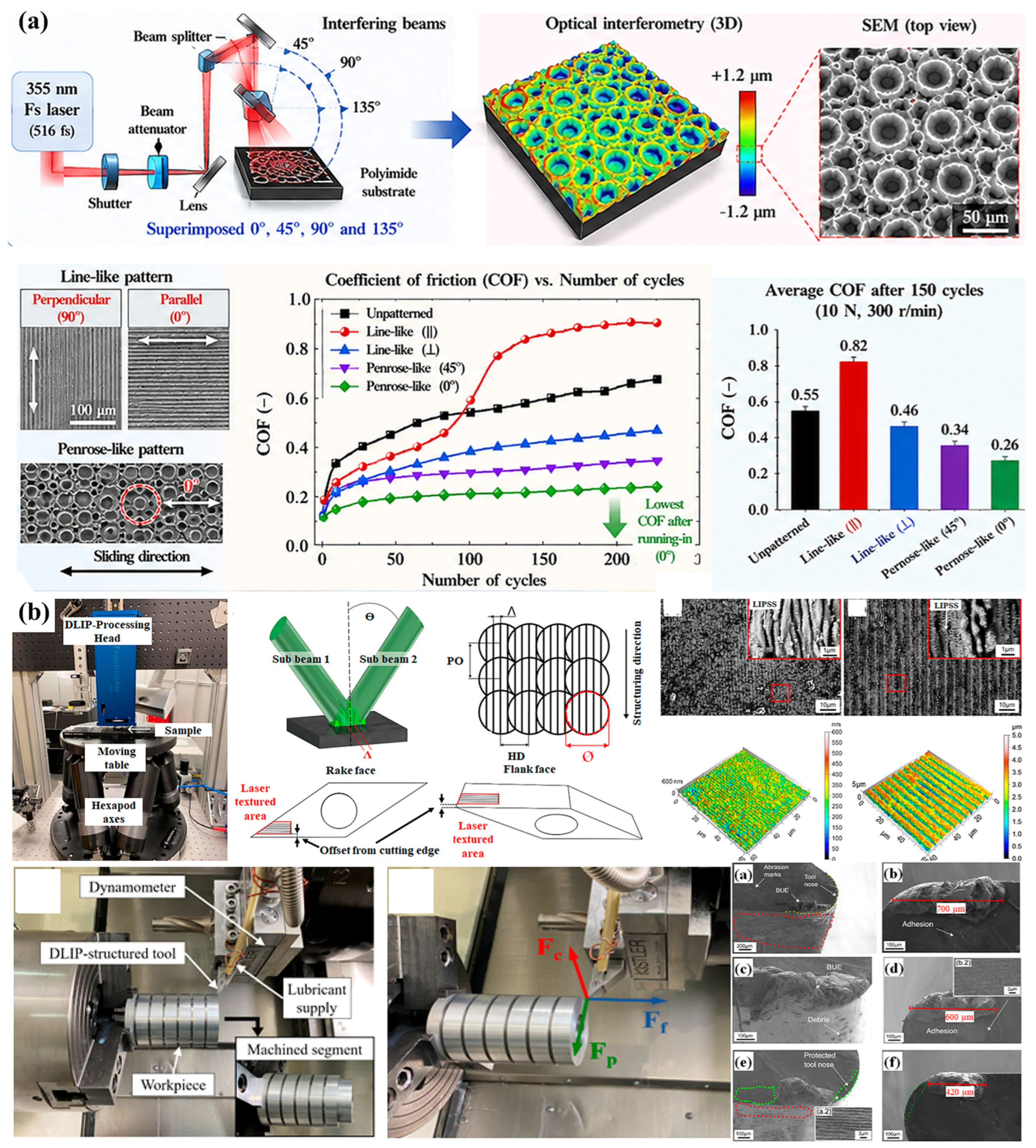
The capacity for generating such deterministic and uniform patterns is particularly salient for tribological engineering, where surface performance is a direct consequence of structural consistency. A compelling demonstration of this is found in the work of Gachot et al., who utilized DLIP to engineer Penrose-like quasi-periodic structures on polyimide, as shown in Figure 8a [81]. Their findings highlight a critical insight: by suppressing interfacial adhesion through these tailored geometries, they achieved a notably low coefficient of friction (~0.3–0.35) after the running-in phase—outperforming conventional periodic textures. This principle of geometric optimization extends to heavy-duty industrial contexts as well. For instance, Baumann et al. applied DLIP to WC cutting tools, reporting that the resulting micro/nano-textures reduced cutting forces and friction by up to 13.5% and 28%, respectively, during Al6061 machining (Figure 8b) [82]. These cases underscore that DLIP is not merely a faster tool, but a more effective one for enhancing mechanical interfaces.
Compared with DLW, DLIP offers superior processing efficiency and scalability while maintaining high structural uniformity and periodicity [83]. However, its design flexibility is relatively limited to periodic or quasi-periodic structures, whereas DLW enables more complex and customized geometries. Despite its significant advantages in high-throughput fabrication and large-area periodic structuring, DLIP still faces several practical limitations for industrial tribological applications [84]. The technique is inherently optimized for generating highly regular periodic patterns, whereas the fabrication of complex, non-periodic, or application-specific texture geometries remains challenging compared with direct laser writing approaches. In addition, the optical interference setup requires precise beam alignment and environmental stability, making the process sensitive to vibration, surface curvature, and positioning errors during large-area manufacturing [85].
Another important limitation arises from the trade-off between processing throughput and structural flexibility [86]. Although DLIP enables rapid fabrication over large areas, increasing processing speed may compromise pattern fidelity and uniformity, particularly for hierarchical or multi-scale textures. Furthermore, implementing DLIP on complex three-dimensional components or curved engineering surfaces remains difficult because maintaining stable interference conditions across non-planar geometries is technically challenging [87].
Generally, DLIP provides a high-throughput route for engineering tribological surfaces, where controlled periodic structures can effectively modulate hydrodynamic pressure, friction anisotropy, and interfacial contact behavior.

6.1.4. Liquid-Assisted Laser Processing: Cavitation-Driven Surface Refinement

Moving beyond the inherent constraints of ambient processing, liquid-assisted laser texturing has emerged as a critical intervention for mitigating the thermal defects that typically plague dry ablation. In conventional “in-air” environments, the precision of the laser is often compromised by debris redeposition and plasma shielding—secondary effects that inevitably degrade the final texture quality. By performing the texturing under a liquid medium, such as water or chemically active aqueous solutions (e.g., sodium hydroxide (NaOH), sodium nitrate (NaNO3), potassium chloride (KCl), and alcohol–water mixtures), the surrounding fluid acts as a high-capacity heat sink that promotes rapid cooling and suppresses excessive thermal damage. This facilitates a rapid quenching of the irradiated zone, which, as established in the literature, is essential for neutralizing the HAZ, recast layers, and thermal cracking that otherwise undermine structural integrity [58].
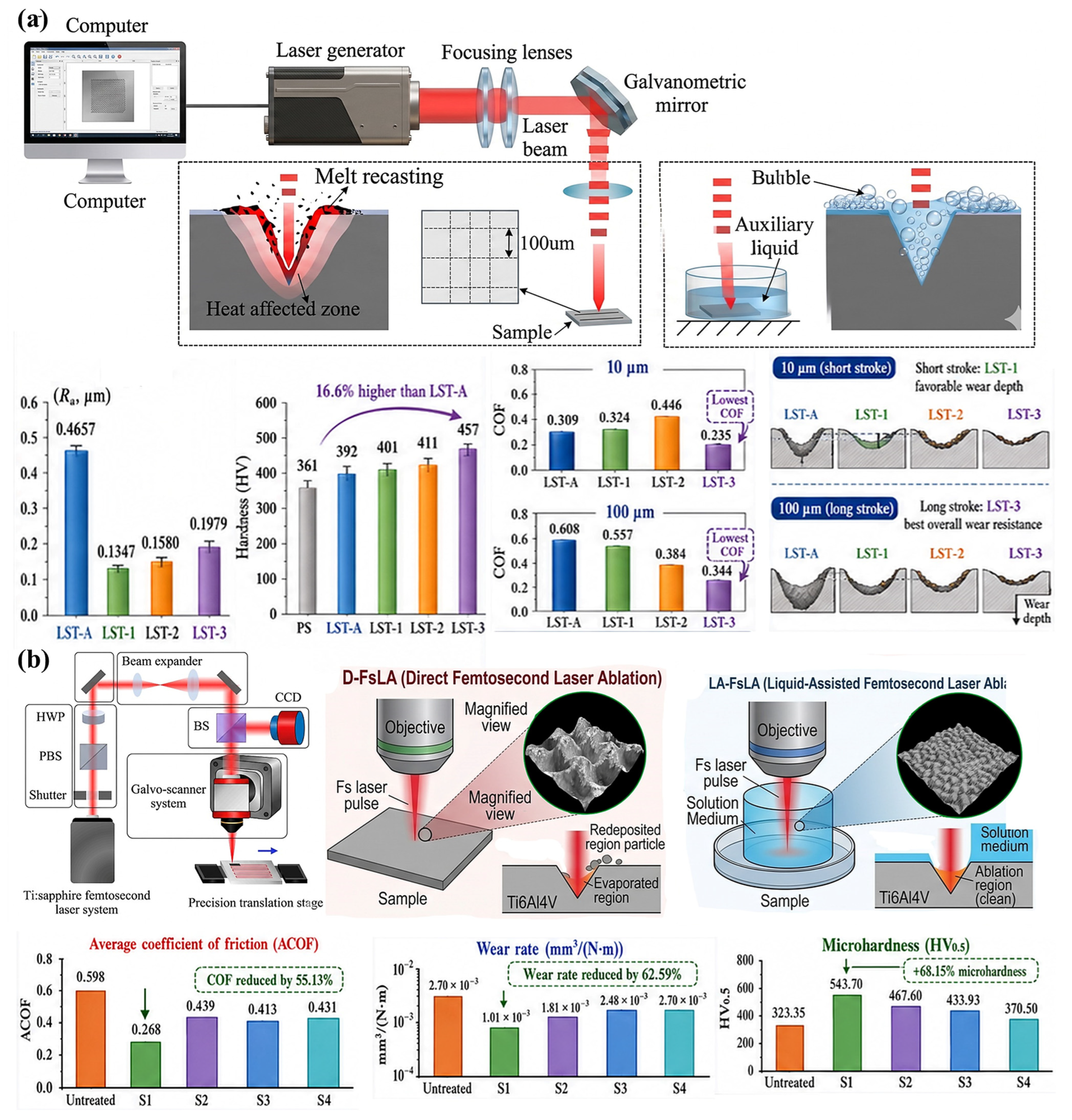
However, the real transformative potential of liquid environments lies not just in thermal management, but in the potent cavitation dynamics triggered at the liquid-solid interface. The rapid expansion and subsequent collapse of laser-induced bubbles generate high-speed micro-jets and localized shock waves—kinetic forces that actively drive material removal and the ejection of molten debris [88]. The result is a fundamentally cleaner surface characterized by a smoother crater morphology and a marked reduction in oxidation. These morphological refinements translate directly into superior mechanical performance. This is perhaps most clearly demonstrated in the solution-assisted processing of Ti6Al4V, where researchers observed a significant jump in surface hardness (from ~361 HV to ~457 HV) and wear resistance, as shown in Figure 9a [89]. Notably, the use of NaNO3 media provided a synergistic control over both the microstructure and surface chemistry, a nuance that simple air-based processing cannot replicate. Similarly, Wu et al. illustrated that by effectively suppressing recast layers through this liquid-assisted approach, friction and wear could be reduced by 55.13% and 62.59%, respectively (Figure 9b) [90].
Furthermore, the improved surface integrity and wettability obtained under liquid-assisted conditions can also promote lubricant spreading and retention. At the same time, the generated micro-textures serve as lubricant reservoirs and wear debris traps, contributing to improved tribological behavior.
Despite these advantages, several challenges still restrict the large-scale industrial application of liquid-assisted laser processing. The process is highly sensitive to liquid-related parameters such as liquid layer thickness, flow stability, and cavitation bubble behavior, all of which can strongly affect energy deposition and texture reproducibility. The liquid medium may also introduce optical attenuation, refraction, and scattering, making accurate laser focusing and process stabilization more difficult during large-area fabrication.
Compared with conventional dry laser texturing, liquid-assisted processing generally requires more complex auxiliary systems for liquid circulation, contamination control, and environmental stabilization, which increases operational complexity and processing cost. In addition, maintaining stable liquid-assisted conditions during high-speed or large-area processing remains challenging, which can limit industrial scalability for continuous manufacturing.
In general, liquid-assisted laser processing provides an effective approach for fabricating high-quality surface textures with reduced thermal damage and improved tribological performance, particularly for demanding operating conditions.

6.2. Hybrid Surface Engineering: Synergistic Integration Strategies

The maturation of LST has seen its transition from a standalone intervention to a sophisticated platform for multi-modal surface engineering. By coupling deterministic topography with functional materials, these hybrid strategies effectively bridge the performance gaps of individual treatments, specifically the poor adhesion of hard coatings and the limited load-bearing capacity of soft lubricants [61]. This integration typically unfolds along three distinct trajectories: the synergy of LST with hard coatings (e.g., DLC, TiN) to enhance interfacial tenacity through mechanical interlocking [17]; the utilization of textures as micro-reservoirs for solid lubricants (e.g., MoS2, PTFE) to facilitate sustained, self-replenishing lubrication [91]; and the fusion of LST with subsurface hardening to reinforce the material’s structural integrity while preserving its functional geometry [92]. Ultimately, this multi-functional coupling enables a coordinated regulation of contact mechanics and material properties, providing a robust framework for the advanced tribological strategies discussed in the following sections.

6.2.1. LST-Coating Systems: Adhesion Enhancement and Multi-Functional Coupling

The convergence of LST and advanced thin-film coatings is not merely an additive process but a strategic necessity to bridge the inherent compromises of each technique. While hard coatings like DLC, TiN, and AlCrN offer exceptional hardness and chemical stability, their practical utility is frequently undermined by poor interfacial adhesion and a lack of lubricant retention under extreme pressure [39]. Conversely, LST provides the requisite topographic architecture for debris management and fluid storage, yet it fails to improve the underlying material’s resistance to deformation or oxidation [9,35]. By integrating these two approaches, one can achieve a synergistic coupling where the geometric functionality of the texture and the intrinsic properties of the material are effectively unified.
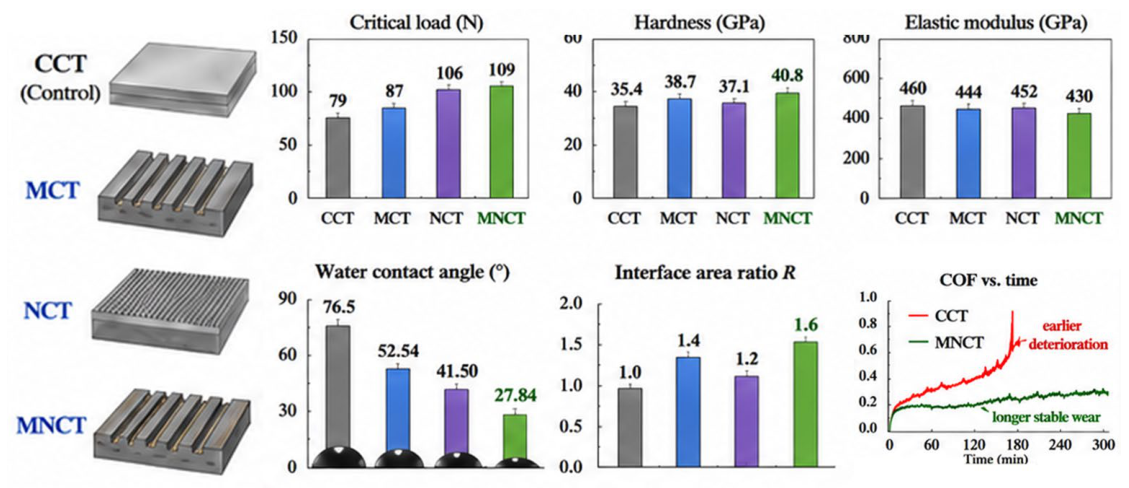
At the heart of this synergy lies the dramatic reinforcement of interfacial tenacity. By introducing a defined topography prior to deposition, the effective contact area is expanded, creating a robust mechanical interlocking mechanism that stabilizes the coating-substrate interface. This principle is clearly evidenced by the work of Zhang et al., demonstrated that micro-/nano-scale texturing of cemented carbide prior to TiAlN deposition raised the critical load from 79 N to approximately 109 N, a shift driven by improved wettability and interfacial compatibility (Figure 10) [93]. Similar gains have been observed in complex hybrid systems involving DLIP and plasma nitriding, which effectively minimize friction even under significant contact pressures [94]. Alternatively, the advent of ultrafast laser processing has opened a secondary route: post-deposition texturing. This allows for the high-precision patterning of sub-micrometer features directly within the coating layer itself, bypassing the risk of delamination often associated with sharp pre-textured features [61].
Ultimately, these combined strategies translate into a significant dividend in tribological performance. Whether through the robust load-bearing capacity of laser-textured carbon-coated steel or the resilience of superhydrophobic AlCrN coatings on titanium alloys, the LST-coating integration offers a versatile solution for dry and starved lubrication environments [95]. In this context, the surface is no longer viewed as a simple boundary, but as a multi-functional system where adhesion, lubrication, and contact mechanics are intrinsically coupled. Such a framework provides a high-performance design strategy capable of meeting the rigorous demands of modern mechanical applications.

6.2.2. LST-Solid Lubricant Systems: Self-Replenishing Lubrication Interfaces

While hard coatings address the requirement for interfacial strength, the integration of solid lubricant infiltration into laser-induced textures targets the persistent challenge of maintaining performance under boundary or starved lubrication conditions. In this configuration, the micro-textures are not merely static voids; they function as active reservoirs that facilitate the controlled, gradual release of lubricant to form a self-replenishing film at the sliding interface. The real efficacy of this approach hinges on a delicate balance: the texture must be deep enough to ensure long-term retention, yet optimized to supply a consistent lubricating layer under mechanical load. This dynamic is well-illustrated by the two-step LIPIT process, which anchors MoS2 particles into deep micro-dimples to enhance seizure resistance [96], and similarly by the infiltration of graphite into laser-textured aluminum composites to maintain tribological stability [97].
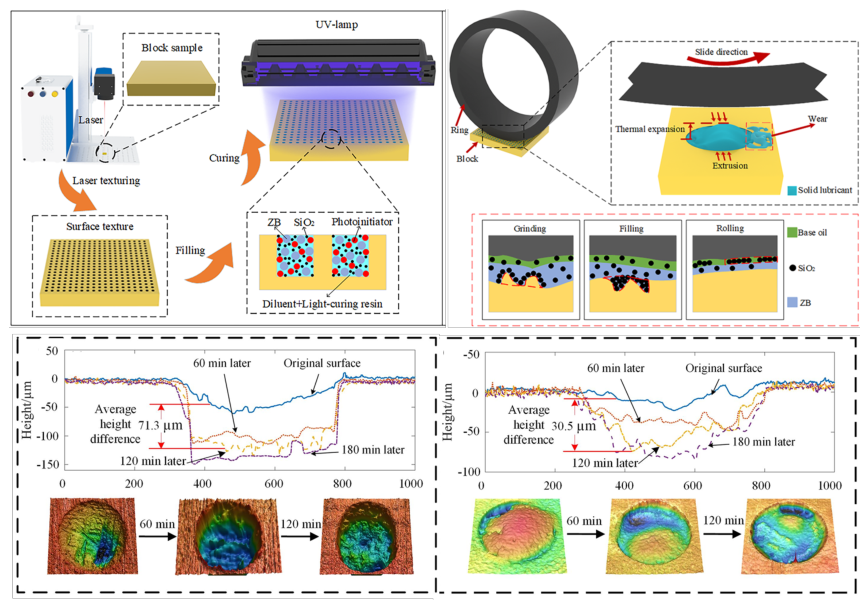
The success of these systems, however, is not a product of the lubricant chemistry alone, but rather a result of its synergy with the underlying topographic geometry. For instance, the use of biomimetic laser textures on Ti alloys, when coupled with PTFE, can trigger a continuous supply mechanism that reduces the friction coefficient by upwards of 70%. Beyond simple replenishment, more complex composite lubricants, such as the ZnO–B2O3 and SiO2 systems, as shown in Figure 11, contribute to the formation of protective boundary films that act as micro-bearings during operation [98]. This interplay, often characterized as a “mechanical self-locking” and “secondary lubrication” effect, effectively extends the service life of components operating in mixed lubrication regimes [99]. Ultimately, by coupling the storage capacity of LST with the functional release of solid lubricants, researchers have moved toward a self-adaptive lubrication framework where durability is intrinsically linked to the surface’s architectural design.

6.2.3. LST-Surface Hardening Systems: Strengthening–Function Integration

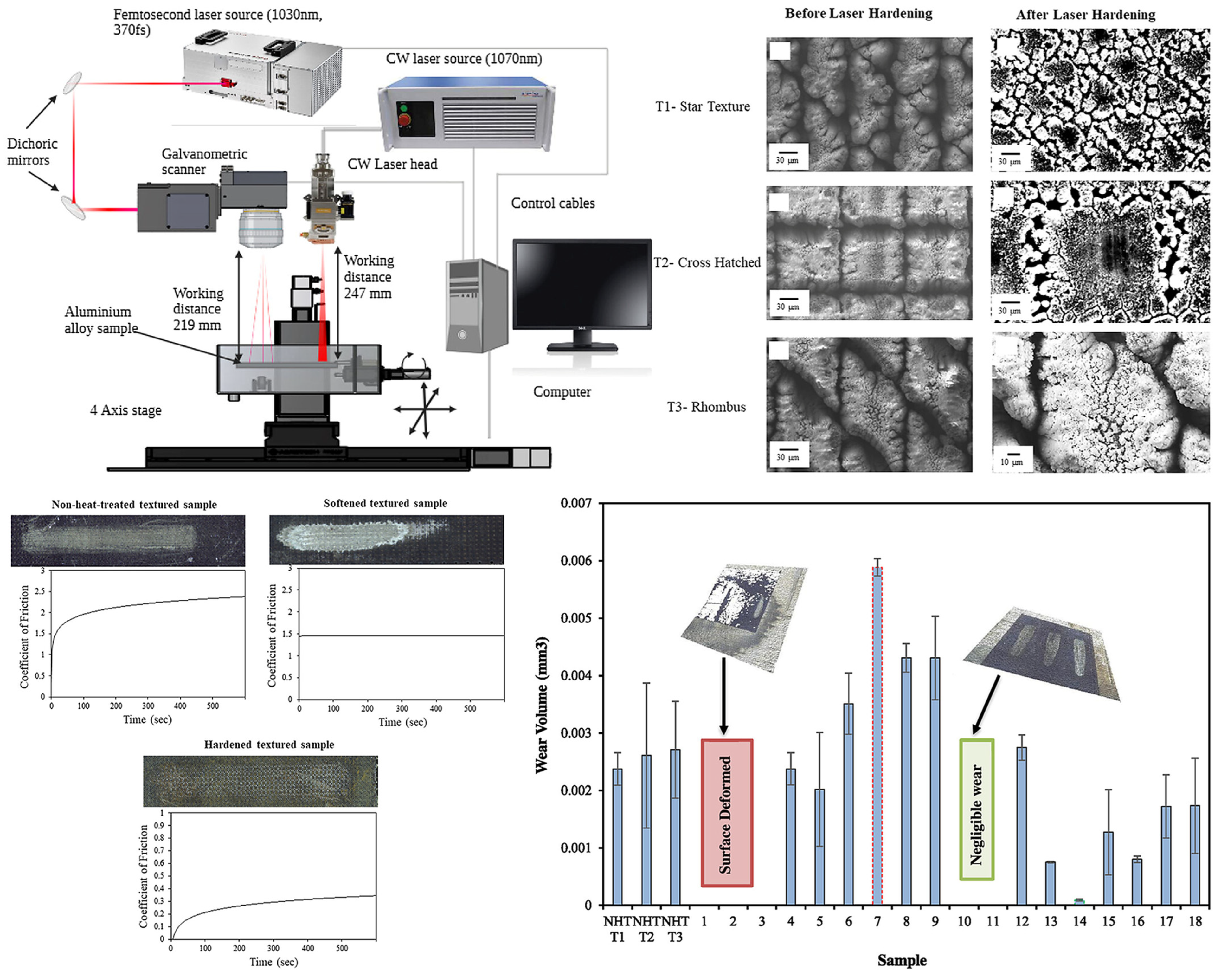
While the advantages of LST for lubrication and debris management are well-established, the introduction of topographic features often presents a structural trade-off, potentially compromising the material’s load-bearing capacity or introducing localized stress concentrations. Integrating LST with surface hardening techniques—such as laser quenching, presents a compelling solution to this dilemma by reinforcing the substrate’s mechanical durability alongside its functional geometry [100]. In this hybrid framework, the hardened subsurface layer, characterized by martensitic transformations and grain refinement, acts as a resilient foundation that resists plastic deformation and ploughing under high contact stresses. Crucially, this allows the textured features to perform their roles as lubricant reservoirs and debris traps without the risk of structural collapse. This synergy is particularly evident in the treatment of Al7075, as presented in Figure 12, where ultrafast laser texturing followed by laser heat treatment yielded a 17.8% increase in microhardness and a substantial reduction in both friction and wear volume compared to surfaces that were textured alone [101]. Similar benefits are found in picosecond laser processing of stainless steel, where localized quenching effects induce the formation of nanostructures and martensitic phases that further fortify the tribological interface [102]. Notably, the processing sequence is a vital consideration; performing hardening post-texturing can effectively remediate the thermal damage or softening that often accompanies longer-pulse ablation. Ultimately, this coupling of functional topography with subsurface strengthening establishes a hierarchical system capable of withstanding the rigorous demands of high-load and severe contact conditions [6,103].
To further illustrate the applicability of different hybrid LST strategies under various tribological conditions, Table 4 summarizes representative application scenarios, main advantages, and current limitations of different hybrid surface engineering approaches.
Overall, the selection of hybrid LST strategies should depend on the lubrication regime, loading conditions, and required surface functions. Hybrid systems combining textures with coatings or surface hardening treatments are generally more suitable for high-load and severe wear conditions, whereas lubricant-assisted and biomimetic hierarchical structures are more effective for lubrication stabilization and multifunctional surface regulation. These developments reflect the gradual transition of LST from single-function surface modification toward integrated and application-oriented tribological interface engineering.

7. Engineering and Biomedical Applications of Laser Surface Texturing

LST has matured into a cornerstone of contemporary surface engineering, offering a robust mechanism for optimizing performance in high-stress environments. In industrial systems, particularly bearings, forming tools, and sealing interfaces, the strategic deployment of LST does more than mitigate friction; it fundamentally recalibrates the tribological interface to ensure sustained lubrication and structural resilience against wear.
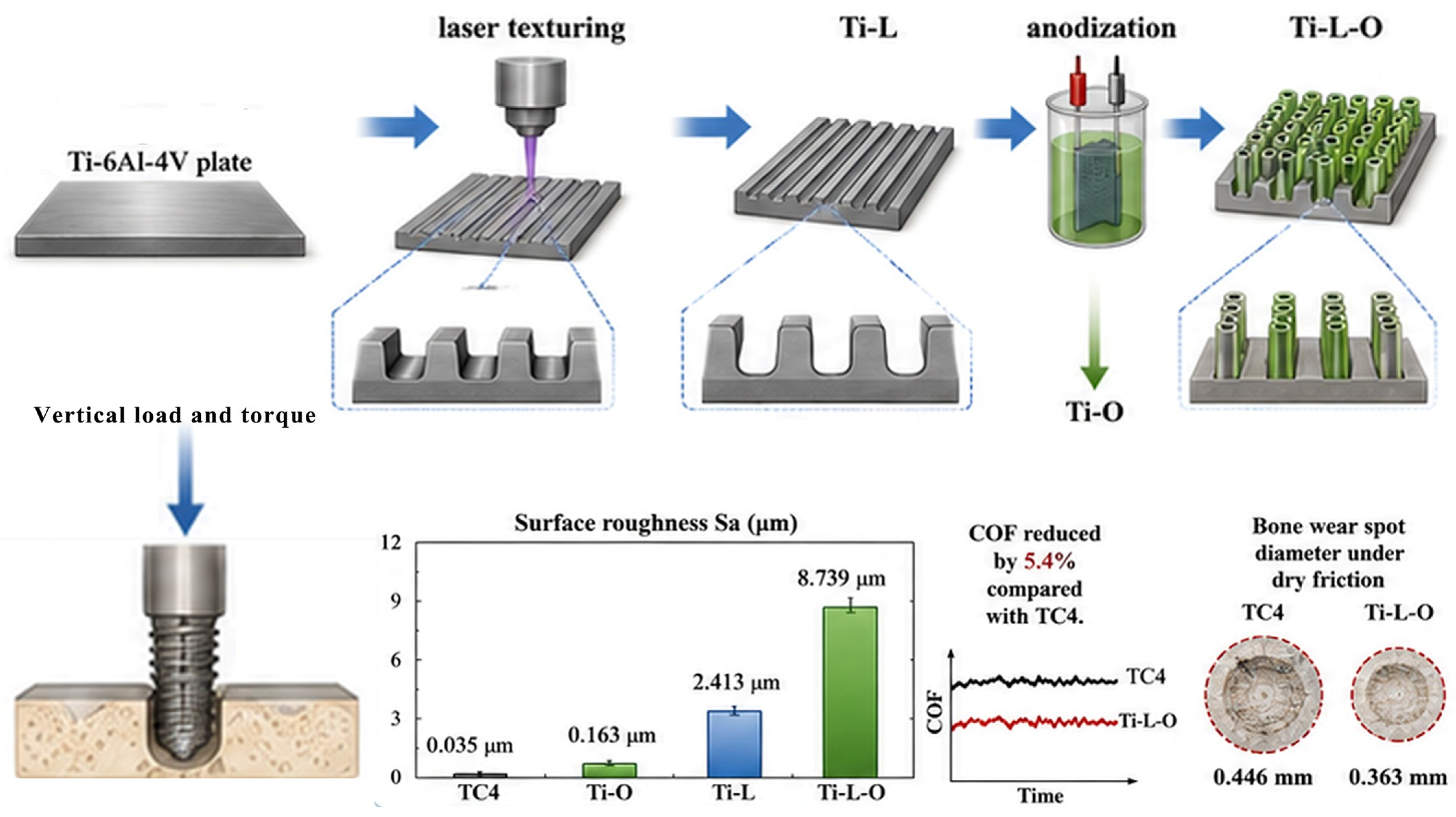
This utility becomes even more pronounced in the biomedical domain, where LST confronts the persistent paradox of alloys like Ti6Al4V: exceptional biocompatibility coupled with notoriously poor tribological durability [69,73]. By introducing precise surface topographies and facilitating synergistic treatments such as anodic oxidation or nitriding, LST effectively stabilizes the material’s wear response and enhances long-term reliability [77]. These advancements underscore the inherent versatility of LST, establishing a critical foundation for the nuanced application scenarios analyzed in the following sections.

7.1. Bearings and Seals: Enhancing Lubrication Stability and Reliability

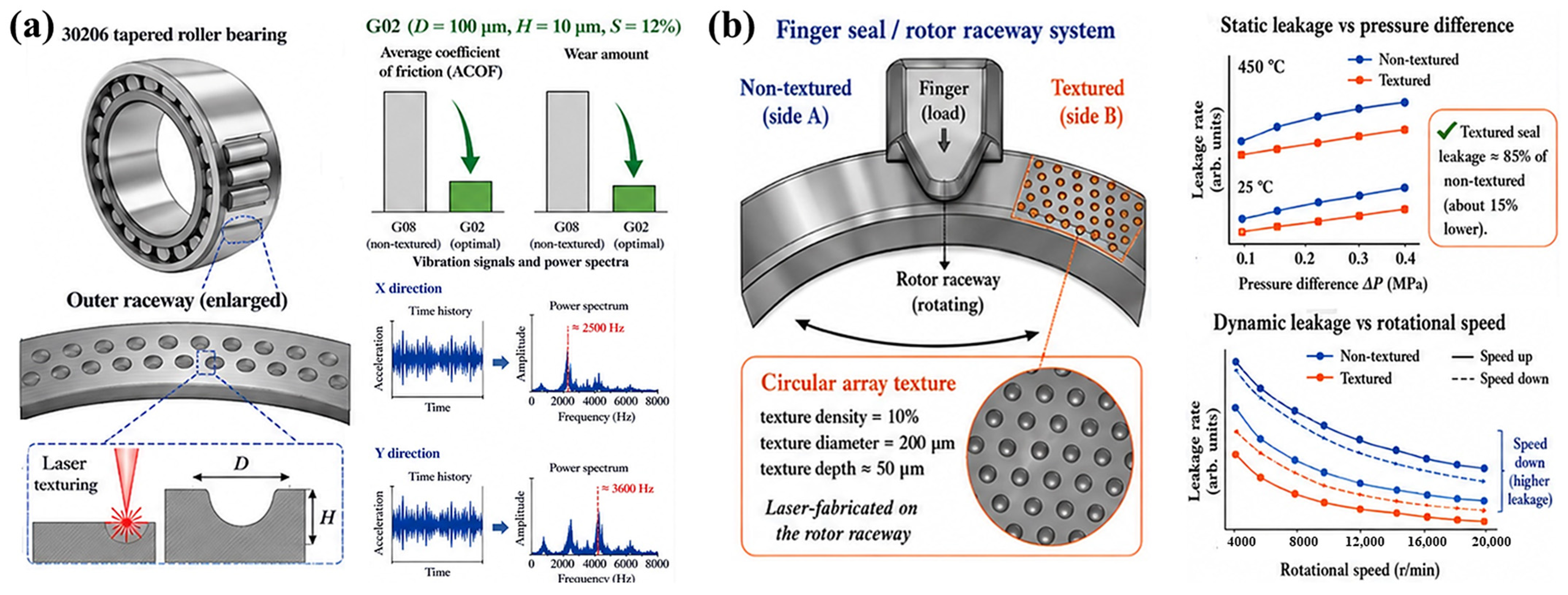
The deployment of LST has evolved into a critical methodology for reinforcing the tribological integrity and operational lifespan of high-load mechanical systems [9,47]. This is perhaps best exemplified by the systematic optimization of tapered roller bearings. As shown in Figure 13a, calibrating pit geometry to specific thresholds (D = 100 μm, S = 12%) achieves more than a simple reduction in contact area, yielding a dramatic 66.6% decrease in friction alongside suppressed vibration [104]. Such advancements are not limited to rotating assemblies but extend to sealing interfaces, where the introduction of 200 μm circular textures has been shown to reduce leakage by 15% under rigorous thermal and pressure gradients, as demonstrated in Figure 13b [105]. Furthermore, the utility of LST in engine components like cylinder liners highlights its capacity to maintain lubrication stability via micro-hydrodynamic effects, even under boundary lubrication conditions [106]. Collectively, these applications demonstrate that LST is not merely an additive process but a foundational strategy for mechanical reliability, one that paves the way for the specialized tooling discussions that follow.

7.2. Cutting Tools: Tribological Optimization for Machining Performance

The application of LST to cutting tools represents a sophisticated shift in managing the volatile tribological conditions inherent to the tool–workpiece interface. Rather than treating the tool surface as a passive component, the integration of discrete surface features allows for the active reconfiguration of the contact zone. By minimizing the real contact area and providing dedicated reservoirs for lubricant retention and debris entrapment, LST provides a dual-functionality that is essential for curbing the onset of adhesive and abrasive wear [107].
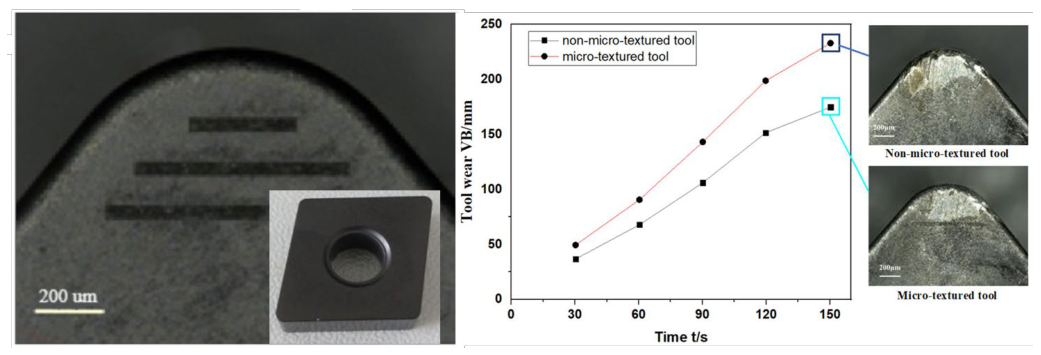
Empirical evidence underscores the sensitivity of these outcomes to specific laser-processing parameters. The efficacy of nanosecond-laser texturing on cemented carbide tools hinges on the precise calibration of texture depth and width; when optimized, this approach yields a notable 14.5% reduction in tool wear alongside a 30% improvement in workpiece finish [74]. This precision is further refined through fs-LST on coated inserts, as depicted in Figure 14, laser processing parameters, including laser energy, scanning speed, and scanning times, were optimized to fabricate high-quality micro-grooves on TiAlN-coated tools, resulting in enhanced coating–substrate bonding and a 25% reduction in tool wear [40]. However, geometry is not the sole determinant of success; while circular pit patterns often demonstrate superior performance [108], the chronological sequence of processing is equally vital. Crucially, pre-texturing prior to coating deposition appears to foster superior interfacial adhesion through mechanical interlocking, offering a more stable tribological framework than post-coating modifications [39]. Collectively, these findings suggest that LST is far more than a supplementary treatment; it is a scalable design strategy for engineering the next generation of high-durability machining tools.

7.3. Advanced Material Systems: Metal Matrix Composites, Ceramics, and Additive Manufacturing

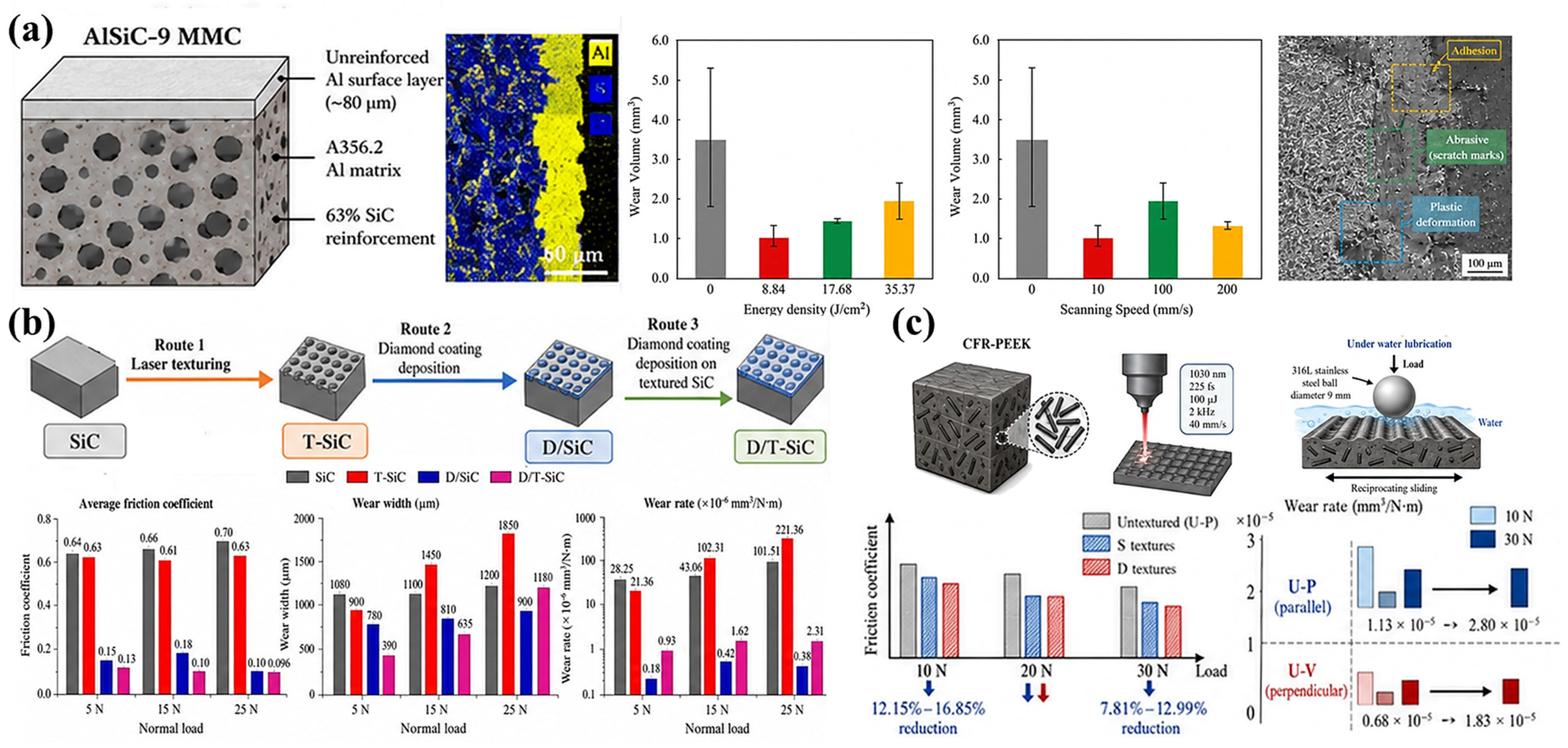
The versatility of LST is perhaps most rigorously tested—and ultimately validated—within the context of advanced material systems, including Metal Matrix Composites (MMCs), ceramics, and additively manufactured (AM) components. These materials, while high-performing, frequently suffer from inherent surface defects, microstructural heterogeneity, and severe wear susceptibility that traditional finishing methods fail to address [109]. Consequently, LST is increasingly viewed not merely as an elective enhancement, but as a critical corrective measure to stabilize these complex surfaces.
In MMCs such as Al-SiC and ZA-27/TiC systems, the strategic deployment of laser-textured dimples and grooves achieves more than simple lubrication; these features function as essential traps for hard reinforcement particles, effectively neutralizing the debris that would otherwise drive adhesive and abrasive wear, as presented in Figure 15a [63]. A similar logic of structural mitigation is evident in ceramic systems like SiC and Si3N4. Figure 15b shows that LST often integrated with hard coatings such as diamond suppresses three-body abrasion while optimizing hydrodynamic load support, a synergy that depends heavily on the precise calibration of texture geometry [64]. This intervention is equally vital for AM components, where LST provides a targeted means of compensating for the surface roughness and microstructural anisotropy inherent to selective laser melting. As illustrated in fiber-reinforced systems like CF/PEEK, the efficacy of the texture is inextricably linked to its orientation relative to the fiber direction, which serves as the governing factor for debris management and lubrication stability, as can be seen in Figure 15c [110].
Ultimately, these developments underscore that while LST is a remarkably flexible tool, its success remains highly application-specific. To fully realize the tribological benefits in these advanced systems, the texture design must be meticulously tailored to the material’s underlying microstructure and reinforcement characteristics, a nuance that transitions from general surface modification to precise interface engineering.

7.4. Biomedical Implants: Bio-Tribological Enhancement and Longevity

While titanium (Ti6Al4V) and cobalt–chromium (Co–Cr) alloys remain the workhorses of load-bearing orthopedic implants, their clinical longevity is frequently compromised by a persistent tribological paradox: superior biocompatibility shadowed by high friction and a notorious susceptibility to adhesive wear [73,84]. These mechanical deficiencies often trigger a cascade of adverse biological responses, most notably debris-induced osteolysis and chronic inflammation. LST intervenes in this dynamic by reconfiguring the interfacial environment at the micro-scale. Rather than relying on the bulk properties of the alloy alone, LST introduces discrete topographical features that serve as reservoirs for synovial or simulated body fluids, ensuring the maintenance of a stable lubrication film even under the demanding boundary conditions characteristic of human joint motion [111]. Simultaneously, these textures act as effective traps for wear debris, neutralizing the threat of three-body abrasion while reducing the real contact area to minimize frictional resistance.
The efficacy of this topographical intervention is underscored by recent empirical evidence, where the focus has shifted toward more sophisticated, hierarchical designs. As illustrated in Figure 16, the transition to laser-induced micro/nano structures allows for a unique functional duality, achieving low dynamic friction for ease of movement alongside high static friction to ensure initial implant stability [112]. Perhaps more significant is the trend toward hybridizing LST with complementary surface treatments to transcend the limits of singular modifications. The integration of LST with anodic oxidation, for instance, produces a reinforced TiO2 layer that offers wear resistance far exceeding that of untreated or solely textured surfaces [73]. Similarly, pairing textured architectures with solid lubricant coatings, such as CrN-MoS2-Ag, exploits mechanical interlocking to ensure a sustained lubricant supply, yielding wear reductions of over 74% [99]. Ultimately, these hybrid strategies represent a critical pathway for engineering a new generation of implants capable of meeting the rigorous demands of long-term clinical service.
Figure 16. Laser-induced microgrooves combined with anodization create hierarchical micro/nano structures on titanium alloy screw implant. The figure was adapted from Ref. [112].
Lubricants 14 00239 g016

7.5. General Design Principles for Application-Oriented LST

Although the optimal texture design strongly depends on the target application and operating conditions, several generalizable principles can be identified from current studies. Under hydrodynamic and mixed lubrication conditions, relatively shallow and periodically distributed textures are generally preferred to promote lubricant film stability and hydrodynamic pressure generation while minimizing flow disruption. In contrast, dry sliding applications benefit more from textures with enhanced debris entrapment capability and solid-lubrication effects to reduce abrasive wear and direct asperity contact. For high-load engineering components such as bearings and cutting tools, hybrid strategies combining textures with protective coatings or surface hardening treatments are typically more effective because they improve load-bearing capacity, coating adhesion, and interfacial durability. In biomedical applications, texture geometry must additionally consider biocompatibility, wettability, and cellular response, requiring careful balance between tribological performance and biological functionality.
Furthermore, ultrafast laser processing is generally more suitable for applications requiring high surface integrity and minimal thermal damage, whereas nanosecond/microsecond processing remains advantageous for large-area and cost-sensitive industrial manufacturing. Overall, effective LST design should simultaneously consider lubrication regime, contact mechanics, material properties, environmental conditions, and manufacturing scalability to achieve application-specific tribological optimization.
To summarize, LST has demonstrated broad applicability across engineering systems, biomedical implants, and advanced material platforms by regulating lubrication behavior, contact mechanics, and wear mechanisms through tailored micro-/nano-scale surface structures. Current studies indicate that effective LST design should be application-oriented rather than based on universal texture configurations. Hydrodynamic lubrication systems generally favor shallow periodic textures for lubricant film stabilization, whereas dry sliding conditions benefit more from debris-entrapment and solid-lubrication effects. Hybrid strategies combining textures with coatings or surface hardening are more suitable for high-load applications, while biomedical systems additionally require optimization of wettability, biocompatibility, and surface integrity. Nevertheless, challenges remain in design standardization, multi-scale mechanism understanding, manufacturing scalability, and long-term reliability. Addressing these issues will be essential for the broader implementation of LST in next-generation tribological systems.

8. Challenges and Future Perspectives in Laser Surface Texturing

While the trajectory of LST has been marked by significant technical progress, its migration toward large-scale industrial implementation is currently hindered by a series of critical bottlenecks. Chief among these is the persistent challenge of thermal damage, which continues to compromise surface integrity and interfacial coating adhesion, a problem that is only intensified by the logistical difficulties of maintaining precision across large-scale or geometrically complex surfaces. Resolving these issues has necessitated a strategic shift toward advanced laser technologies and high-precision control mechanisms specifically designed to minimize deleterious thermal effects [113]. Simultaneously, the field is moving away from the limitations of empirical trial-and-error in favor of a more rigorous, data-driven methodology. By synthesizing artificial intelligence (AI) with multi-physics modeling, researchers are now positioned to replace heuristic approaches with a predictive framework that holistically integrates texture geometry, material response, and service environments [114,115]. The following subsections delineate these technical hurdles and the emerging strategies poised to redefine the limits of LST in next-generation tribological applications.

8.1. Fundamental Bottlenecks: Thermal Effects, Adhesion, and Scalability

Notwithstanding the empirical successes previously discussed, the industrial trajectory of LST remains stalled by several recalcitrant technical bottlenecks. Primary among these is the persistent challenge of thermal degradation; in nanosecond and longer-pulse regimes, excessive heat flux triggers a cascade of detrimental phase transformations and residual tensile stresses that fundamentally undermine the dimensional accuracy of the processed surface [59,74]. This compromise in integrity further complicates the quest for reliable coating adhesion. In conventional workflows, the sharp geometric gradients characteristic of pre-textured substrates often acts as nucleation sites for stress concentration, leading to premature interfacial delamination under rigorous tribological loading [2,17]. Perhaps the most formidable barrier, however, is the inherent tension between precision and scalability. While ultrafast systems mitigate thermal damage, their integration into high-volume production remains constrained by prohibitive operational costs and restricted throughput [5]. Ultimately, the current reliance on case-specific trial-and-error underscores a critical lack of process standardization, necessitating a more unified approach to thermal management and interfacial engineering to bridge the gap between laboratory feasibility and industrial reality.

8.2. Emerging Technologies: Ultrafast Processing and Intelligent Monitoring

The resolution of the thermal bottlenecks described in the preceding section lies in a decisive shift toward a thermal processing regimes and adaptive system intelligence. Central to this transition is the deployment of ultrafast laser sources—specifically femtosecond and picosecond systems, which bypass the inherent limitations of melt-driven ablation by utilizing high-intensity, non-thermal mechanisms [61]. By effectively eliminating the HAZ at its source, these technologies enable the fabrication of burr-free architectures even on highly sensitive functional coatings such as DLC. This quest for precision is further augmented by the emergence of alternative processing environments; liquid-assisted texturing and laser-induced cavitation micro-texturing offer a sophisticated means of suppressing oxidation while simultaneously tailoring surface wettability [116]. Beyond the laser source itself, the integration of real-time, closed-loop monitoring is becoming an essential prerequisite for industrial reliability. By capturing in situ signatures, such as melt pool dynamics and plasma emission, these systems provide the adaptive control necessary to maintain geometric fidelity and reproducibility at scale.
Ultimately, the convergence of non-thermal precision and systemic intelligence establishes the technical infrastructure required for high-fidelity surface fabrication. This transition does not merely solve existing manufacturing constraints but also facilitates the broader shift toward the data-driven and AI-assisted design frameworks explored in the subsequent sections.

8.3. Intelligent Design: AI-Driven Optimization and Multi-Functional Surfaces

LST is gradually moving from empirical trial-and-error development toward more mechanism-oriented and data-assisted design approaches using AI and machine learning (ML). By combining experimental datasets with multi-physics simulations, AI-based models can analyze complex parameter relationships involving laser conditions, texture geometry, material properties, and operating environments, enabling more efficient prediction and optimization of tribological performance [117]. Recent studies have shown that machine-learning-assisted optimization can improve the selection of texture density, depth, spacing, and laser processing parameters under different lubrication conditions, thereby reducing experimental workload and improving design efficiency.
However, AI-driven research on LST is still at an early stage and faces several limitations. Current challenges include the lack of standardized datasets, limited physical interpretability of data-driven models, and insufficient generalization across different materials and operating conditions. Further integration of experimental tribology, multi-physics simulation, and intelligent optimization methods is therefore needed to achieve reliable and application-oriented AI-assisted surface design.
At the same time, LST is increasingly being developed toward multifunctional surface engineering beyond conventional friction and wear control. By integrating surface textures with coatings, solid lubricants, nanoparticles, and other functional materials, additional properties such as wettability control, corrosion resistance, and adaptive lubrication behavior can be introduced [118,119].
In biomedical and fluidic systems, these multifunctional interfaces may simultaneously regulate tribological behavior, biological interactions, and fluid transport. Overall, the combination of AI-assisted optimization and multifunctional surface integration is expected to support the development of more adaptive and application-oriented tribological interfaces for future engineering applications.

9. Conclusions

In summary, this review discussed the development, mechanisms, processing technologies, and application-oriented design principles of laser surface texturing (LST) for tribological applications. Existing studies indicate that LST provides an effective and controllable method for regulating friction and wear behavior through engineered micro-/nano-scale surface structures. With continued advances in laser processing, surface engineering, and tribological interface design, LST has been increasingly applied to improve lubrication stability, wear resistance, and interfacial durability under different operating conditions. The main conclusions are summarized as follows:
(1)
LST provides an effective and controllable method for regulating friction and wear through engineered micro-/nano-scale surface structures. The tribological performance of textured surfaces strongly depends on the lubrication regime and contact conditions. Mechanisms including hydrodynamic lubrication enhancement, wear debris entrapment, contact stress redistribution, and laser-induced metallurgical strengthening collectively contribute to friction reduction and improved wear resistance. These effects form the basis of the process–structure–performance relationship in LST-designed tribological interfaces.
(2)
Advances in laser processing technologies, from nanosecond to ultrafast laser systems, have considerably expanded the capability of LST for precision surface engineering. Nanosecond laser processing offers advantages in processing efficiency and large-area scalability, whereas ultrafast laser processing enables high-fidelity micro-/nano-structuring with limited thermal damage. High-throughput methods such as direct laser interference patterning (DLIP) and liquid-assisted laser processing further improve processing flexibility, surface quality, and functional controllability. In addition, the combination of LST with coatings, solid lubricants, and surface hardening treatments highlights the growing importance of hybrid and multifunctional surface engineering strategies.
(3)
LST has shown broad application potential in engineering components, cutting tools, biomedical implants, advanced ceramics, metal matrix composites, and additively manufactured materials. Existing studies indicate that texture design should be application-specific rather than based on universal texture configurations. Under hydrodynamic lubrication conditions, shallow periodic textures are generally beneficial for maintaining lubricant film stability, whereas dry sliding conditions require more effective wear debris entrapment and solid-lubrication effects. For high-load applications, hybrid approaches combining textures with coatings or surface hardening treatments are usually more effective for improving load-bearing capacity and interfacial durability.
(4)
Despite substantial progress, several challenges remain, including thermal damage control, coating adhesion stability, large-area manufacturing efficiency, long-term reliability, and the absence of standardized design frameworks. Future research is expected to focus on the integration of ultrafast laser processing, in situ monitoring, multi-physics modeling, and AI-assisted optimization to support the development of application-oriented multifunctional tribological surfaces with improved adaptability, scalability, and engineering reliability.

Author Contributions

Conceptualization, J.Z. and L.L.; methodology, J.Z.; formal analysis, J.Z.; writing—original draft preparation, J.Z.; writing—review and editing, T.Y. and L.L.; visualization, J.Z.; supervision, L.L.; funding acquisition, L.L. All authors have read and agreed to the published version of the manuscript.

Funding

This research was funded by the Ningbo Yongjiang Young talent sub-project Programme (2022A-147-G); the Natural Science Foundation of Ningbo (2024J098), International Sci-tech Cooperation Projects under the “Innovation Yongjiang 2035” Key R&D Programme (2024H014); the Ningbo “Innovation Yongjiang 2035” Key R&D Pro-gramme (2025Z075); the Ningbo University of Technology Research Cultivation Program (2022TS16); and the Ningbo University of Technology Research Startup Fund (2022KQ16).

Data Availability Statement

Data is contained within the article.

Conflicts of Interest

The authors declare no conflicts of interest.

Abbreviations

The following abbreviations are used in this manuscript:
LSTLaser Surface Texturing
ns-LSTNanosecond Laser Surface Texturing
fs-LSTFemtosecond Laser Surface Texturing
ps-LSTPicosecond Laser Surface Texturing
DLIPDirect Laser Interference Patterning
DLWDirect Laser Writing
LIPSSLaser-Induced Periodic Surface Structures
HAZHeat-Affected Zone
DLCDiamond-Like Carbon
PTFEPolytetrafluoroethylene
EDMElectrical Discharge Machining
PVDPhysical Vapor Deposition
CVDChemical Vapor Deposition
MMC(s)Metal Matrix Composites
AMAdditive Manufacturing
CF/PEEKCarbon Fiber Reinforced Polyether Ether Ketone
AIArtificial Intelligence
MLMachine Learning

References

  1. Long, R.; Shang, Q.; Jin, Z.; Zhang, Y.; Ju, Z.; Li, M. Tribological Behavior of Laser Textured Rolling Element Bearings under Starved Lubrication. Ind. Lubr. Tribol. 2022, 74, 453–462. [Google Scholar] [CrossRef]
  2. Xu, Y.; Chen, Y.; Zhou, D.; Zhang, L.; Su, B. Fabrication of TiN Coatings Deposited on Laser Shock Micro-Textured Substrates for Improving the Interface Adhesion Properties of Coatings. Materials 2024, 17, 3302. [Google Scholar] [CrossRef]
  3. Holmberg, K.; Erdemir, A. Influence of Tribology on Global Energy Consumption, Costs and Emissions. Friction 2017, 5, 263–284. [Google Scholar] [CrossRef]
  4. Li, W.-X.; Liu, Y.; Duan, H.-T.; Wang, Y.-H.; Zhan, S.-P.; Zhang, W.-L.; Yang, T.; Li, G.-Z.; Dan, J. Effect of Laser Texturing Bulges on Tribological Properties of 316L Stainless Steel. Surf. Topogr. Metrol. Prop. 2023, 11, 015004. [Google Scholar] [CrossRef]
  5. Zhu, X.; Yang, X.; Liu, D.; Zhao, L.; Guo, Z.; Hu, S. Research Progress in Processing, Design and Application of Surface Microtexturing for Friction Reduction and Lubrication. Int. J. Precis. Eng. Manuf. 2026, 27, 1275–1299. [Google Scholar] [CrossRef]
  6. Calvo-García, E.; Abreu, C.S.; Barro, Ó.; Arias-González, F.; Riveiro, A.; Comesaña, R.; Román, M.; Pérez-Betanzos, S.; Lusquiños, F.; Gomes, J.R.; et al. Effects of Laser Microtexturing on the Surface Properties and Tribological Behaviour of Hot Forging Tool Steels. Surf. Coat. Technol. 2026, 523, 133222. [Google Scholar] [CrossRef]
  7. Sedlaček, M.; Gregorčič, P.; Podgornik, B. Use of the Roughness Parameters Ssk and Sku to Control Friction—A Method for Designing Surface Texturing. Tribol. Trans. 2017, 60, 260–266. [Google Scholar] [CrossRef]
  8. Wahab, J.A.; Ghazali, M.J.; Yusoff, W.M.W.; Sajuri, Z. Enhancing Material Performance through Laser Surface Texturing: A Review. Trans. IMF 2016, 94, 193–198. [Google Scholar] [CrossRef]
  9. Mao, B.; Siddaiah, A.; Liao, Y.; Menezes, P.L. Laser Surface Texturing and Related Techniques for Enhancing Tribological Performance of Engineering Materials: A Review. J. Manuf. Process. 2020, 53, 153–173. [Google Scholar] [CrossRef]
  10. Lin, G.; Yu, G.; Cai, Z.; Gu, L.; Dong, Z.; Zhang, P.; Wang, Q.; Wang, J.; Yan, X.; Lu, B. Effect of Process Parameters on the Dimension and Morphology of Laser Cladded WC-Ni Composite Coatings Prepared by Picosecond Laser Surface Texturing. Opt. Laser Technol. 2026, 198, 114874. [Google Scholar] [CrossRef]
  11. Zhang, D.; Zhang, L.; Ji, J.; Wang, L.; Zhang, J.; An, Z.; Shen, Y. Superhydrophobic Properties of Femtosecond Laser-Textured Low-Carbon Stainless Steel Surfaces: Wettability Behavior Characterization and Durability Analysis. Steel Res. Int. 2026, 97, 234–251. [Google Scholar] [CrossRef]
  12. Sun, X.; Jiang, J.; Guo, F.; Li, X.; Wang, D. Recent Advances in Laser Surface Texturing for Improving Tribological Properties of Materials (2020–2025). Int. J. Adv. Manuf. Technol. 2025, 141, 3557–3598. [Google Scholar] [CrossRef]
  13. Liu, Y.; Zhang, H.; Dai, S.; Dong, G. Designing a Bioinspired Scaly Textured Surface for Improving the Tribological Behaviors of Starved Lubrication. Tribol. Int. 2022, 173, 107594. [Google Scholar] [CrossRef]
  14. Yan, X.; Yan, H.; Zhang, P.; Lu, Q.; Shi, H. Fabrication and Tribological Properties of Bionic Surface Texture Self-Lubricating 60NiTi Alloy via Selective Laser Melting and Infiltration. Tribol. Int. 2025, 202, 110364. [Google Scholar] [CrossRef]
  15. Zhang, Y.; Fu, H.; Wang, X.; Liang, H.; Puoza, J.C.; Ji, J.; Hua, X.; Xu, X.; Fu, Y. Additional Tribological Effect of Laser Surface Texturing and Diamond-like Carbon Coating for Medium Carbon Steel at near Room Temperature. Coatings 2020, 10, 929. [Google Scholar] [CrossRef]
  16. Guo, K.W. Effect of Sliding Speed on Tribological Characteristics of Different Surface Textures on AISI O1 Steel Irradiated by Nd:YAG Pulsed Laser. Ironmak. Steelmak. 2009, 36, 63–74. [Google Scholar] [CrossRef]
  17. Chen, P.; Xiang, X.; Shao, T.; La, Y.; Li, J. Effect of Triangular Texture on the Tribological Performance of Die Steel with TiN Coatings under Lubricated Sliding Condition. Appl. Surf. Sci. 2016, 389, 361–368. [Google Scholar] [CrossRef]
  18. Wu, G.; Yin, Y.; Zhang, S.; Wang, Y.; Xiang, Y.; Li, L.; Yao, J. Effect of Laser Texturing on the Antiwear Properties of Micro-Arc Oxidation Coating Formed on Ti-6Al-4V. Surf. Coat. Technol. 2023, 453, 129114. [Google Scholar] [CrossRef]
  19. Hamilton, D.B.; Walowit, J.A.; Allen, C.M. A Theory of Lubrication by Microirregularities. J. Basic Eng. 1966, 88, 177–185. [Google Scholar] [CrossRef]
  20. Etsion, I. Improving Tribological Performance of Mechanical Components by Laser Surface Texturing. Tribol. Lett. 2004, 17, 733–737. [Google Scholar] [CrossRef]
  21. Karmiris-Obratański, P.; Papazoglou, E.L.; Leszczyńska-Madej, B.; Karkalos, N.E.; Markopoulos, A.P. An Optimalization Study on the Surface Texture and Machining Parameters of 60CrMoV18-5 Steel by EDM. Materials 2022, 15, 3559. [Google Scholar] [CrossRef]
  22. Rosenkranz, A.; Jaeger, S.; Gachot, C.; Vogel, S.; Mücklich, F. Wear Behavior of Laser-Patterned Piston Rings in Squeeze Film Dampers. Adv. Eng. Mater. 2015, 17, 1208–1214. [Google Scholar] [CrossRef]
  23. Guo, J.; Hu, T.; Li, Q.; Liu, Y. Nanosecond Laser-Induced Dimple Texturing of TB6 Alloy Surfaces: Tribological Behavior under Dry and Starved-Oil Lubrication. Tribol. Int. 2024, 197, 109842. [Google Scholar] [CrossRef]
  24. Samyn, P.; Everaerts, J.; Chandroth, A.M.; Cosemans, P.; Malek, O. A Feasibility Study on Femtosecond Laser Texturing of Sprayed Nanocellulose Coatings. Carbohydr. Polym. 2024, 340, 122307. [Google Scholar] [CrossRef]
  25. Li, S.; Zhang, K.; Liu, W.; Jiang, X.; Wang, H.; Wang, J.; Chen, S. Hydrophobicity and Tribological Property of Femtosecond Laser Induced Periodic Surface Structures on 7075 Aluminum Alloy. Int. J. Precis. Eng. Manuf. 2026, 27, 1365–1385. [Google Scholar] [CrossRef]
  26. Qin, S.; Peng, Z.; Shi, X.; Xue, Y.; Zhang, K.; Huang, Q. Optimization of Textured Parameters to Improve the Tribological Behavior of TC4-Based Bionic Coating Using RSM. Tribol. Trans. 2022, 65, 441–456. [Google Scholar] [CrossRef]
  27. Xiao, G.; Liu, Z.; Lin, O.; He, Y.; Liu, S.; Huang, J. A Novel Approach for the Fabrication of Sharkskin Structured Bionic Surfaces with Hydrophobic Wettability: Laser Processing and Ordered Abrasive Belt Grinding. J. Bionic Eng. 2023, 20, 1687–1700. [Google Scholar] [CrossRef]
  28. Matijosius, T.; Staisiunas, L.; Selskiene, A.; Pakstas, V.; Bikulcius, G.; Onufrijevs, P.; Montero, C.C.; Rageliene, L.; Smailys, A.; Rukuiza, R.; et al. Tribological Studies of Laser-Textured Titanium Alloys in Biological Environment. Wear 2026, 594, 206672. [Google Scholar] [CrossRef]
  29. Sun, J.; Jing, X.; Zheng, S.; Shi, B.; Zhang, D.; Li, H. Fabrication of Composite Wettability Surface and Slippery Surface via Liquid-Assisted Laser Ablation. Surf. Interfaces 2025, 68, 106724. [Google Scholar] [CrossRef]
  30. Zhou, R.; Shi, W.; Cao, Y.; Yang, Y.; Li, K. Friction and Wear Study for the New Method of Laser-Induced Cavitation Micro-Texturing on 7050 Aluminum Alloy. Mater. Des. 2025, 252, 113796. [Google Scholar] [CrossRef]
  31. Lv, X.; Xu, Z.; Liu, Y.; Wang, X.; Xie, S.; Xu, L.; Tan, H. Study on Liquid-Phase-Assisted Laser Surface Microtexturing and the Surface Properties of 304 Stainless Steel. J. Mater. Eng. Perform. 2025, 34, 531–543. [Google Scholar] [CrossRef]
  32. Sha, L.; Lin, N.; Li, X.; Wang, W.; Shi, Q.; Liu, Z.; Yu, Y.; Zeng, Q.; Li, D.; Wu, Y. Synergistic Enhancement in Wear Resistance of AISI 321 Austenitic Stainless Steel by Laser Surface Texturing and Double Glow Plasma Surface Alloying Using a Ni–Ti Target with an Atomic Ratio of 1:2. J. Mater. Sci. 2026, 61, 6903–6950. [Google Scholar] [CrossRef]
  33. Ye, Z.; Yan, T.; Shi, J.; Yang, R.; Zhang, Y.; Shi, X.; Chen, Z.; Rong, H.; Bai, B.; Liu, K.; et al. Construction of Wear-Resistant and Anti-Corrosion Composite Coatings on Uranium Surface by Laser Surface Nitriding and Texture Coupled with Solid Lubrication. J. Nucl. Mater. 2025, 607, 155696. [Google Scholar] [CrossRef]
  34. Guo, Z.; Deng, F.; Zhang, L.; Hao, C.; Zhao, X.; Xiang, D. Fabrication and Tribological Properties of Textured Diamond Coatings on WC-Co Cemented Carbide Surfaces. Ceram. Int. 2021, 47, 5423–5431. [Google Scholar] [CrossRef]
  35. Ibatan, T.; Uddin, M.S.; Chowdhury, M.A.K. Recent Development on Surface Texturing in Enhancing Tribological Performance of Bearing Sliders. Surf. Coat. Technol. 2015, 272, 102–120. [Google Scholar] [CrossRef]
  36. Li, X.; Yue, W.; Huang, F.; Kang, J.; Zhu, L.; Tian, B. Tribological Behaviour of Textured Titanium under Abrasive Wear. Surf. Eng. 2019, 35, 378–386. [Google Scholar] [CrossRef]
  37. Lu, Y.; Deng, J.; Wang, R.; Wu, J.; Meng, Y. Tribological Performance of Micro Textured Surface Machined by Nd:YAG Laser with Different Incident Angle. Opt. Laser Technol. 2022, 148, 107768. [Google Scholar] [CrossRef]
  38. Li, W.; Duan, Y.; Geng, N.; Liu, Y.; Yang, W.; Yan, X.; Guo, J. Fabrication of Hydrophobic Texture on 4241 High-Speed Steel Tool through Femtosecond Laser Micromachining for Enhancing Tribological Performance under Water Lubrication. Surf. Topogr. Metrol. Prop. 2025, 13, 035012. [Google Scholar] [CrossRef]
  39. Seid Ahmed, Y.; Yilbas, B.S. Influence of Laser Texturing Sequence on Interfacial Adhesion and Tribological Behavior of TiAlN-Coated Cemented Carbide Cutting Tool. Mater. Today Commun. 2026, 51, 114694. [Google Scholar] [CrossRef]
  40. Wu, X.; Zhan, J.; Mei, S. Optimization of Micro-Texturing Process Parameters of TiAlN Coated Cutting Tools by Femtosecond Laser. Materials 2022, 15, 6519. [Google Scholar] [CrossRef] [PubMed]
  41. Hou, Y.; Ji, Z.; Zhang, H. Crystal Plasticity Modeling for Grain Size and Texture Effects on Laser Shock Clinching of Ultra-Thin Foils. J. Mater. Res. Technol. 2025, 35, 3293–3303. [Google Scholar] [CrossRef]
  42. Wang, C.; Cai, J.; Cheng, G.; Wang, J.; Tang, D. Numerical Investigations of Tribological Characteristics of Biomimetic-Textured Surfaces. Sustainability 2023, 15, 13054. [Google Scholar] [CrossRef]
  43. Ding, Y.; Li, Q.; Jia, R.; Chen, L.; Liu, B. Surface Texturing on Polycrystalline Diamond Compact Cutter by Nanosecond Laser Processing. Adv. Eng. Mater. 2025, 27, 2402204. [Google Scholar] [CrossRef]
  44. Lu, L.; Zhang, Z.; Guan, Y.; Zheng, H. Comparison of the Effect of Typical Patterns on Friction and Wear Properties of Chromium Alloy Prepared by Laser Surface Texturing. Opt. Laser Technol. 2018, 106, 272–279. [Google Scholar] [CrossRef]
  45. Phillips, K.C.; Gandhi, H.H.; Mazur, E.; Sundaram, S.K. Ultrafast Laser Processing of Materials: A Review. Adv. Opt. Photonics 2015, 7, 684–712. [Google Scholar] [CrossRef]
  46. Erdoǧan, M.; Öktem, B.; Kalaycıoǧlu, H.; Yavaş, S.; Mukhopadhyay, P.K.; Eken, K.; Özgören, K.; Aykaç, Y.; Tazebay, U.H.; Ilday, F.Ö. Texturing of Titanium (Ti6Al4V) Medical Implant Surfaces with MHz-Repetition-Rate Femtosecond and Picosecond Yb-Doped Fiber Lasers. Opt. Express 2011, 19, 10986. [Google Scholar] [CrossRef]
  47. Anand, P.; Biswas, J.; Singh, S.S.; Samuel, G.L.; Ramkumar, P.; Edachery, V. Femto-Second Laser Ablated Surface-Textures in AISI 440C Martensitic Stainless Steel for Precision Bearings: Hardness, Residual Stress, Lubricant Wettability, Friction and Wear Assessment. Opt. Laser Technol. 2025, 183, 112359. [Google Scholar] [CrossRef]
  48. Wang, C.; Huang, H.; Wu, H.; Hong, J.; Zhang, L.; Yan, J. Ultra-Low Wear of Titanium Alloy Surface under Lubricated Conditions Achieved by Laser Texturing and Simultaneous Nitriding. Surf. Coat. Technol. 2023, 474, 130083. [Google Scholar] [CrossRef]
  49. Ge, S.; Ren, W.; Sun, T.; Lu, X.; Zhang, Z.; Xu, K.; Liu, Y.; Wang, J.; Zhu, H. Morphological Characterization and Friction Reduction Performance of Ni–Co Coatings on Copper Substrates Prepared by Electrodeposition and Ultrafast Laser Surface Texturing. Tribol. Int. 2026, 219, 111833. [Google Scholar] [CrossRef]
  50. Li, W.; Liu, W.; Liu, H.; Tan, J.; Liu, Y.; Zhu, X.; Geng, Y.; Li, T.; Chen, Q.; Lei, B.; et al. Study on the Process Design, Microstructural Evolution and Tribological Characteristics of Femtosecond Laser-Induced Micro-Textures/Grooves on Nickel-Based Ceramic Composite Coatings. Tribol. Int. 2026, 220, 111968. [Google Scholar] [CrossRef]
  51. Paknejad, M.; Bösinger, R.; Azarhoushang, B.; Kailer, A.; Konrath, G.; Killinger, A.; Blum, M.; Pfindel, T.; Zahrani, E.G. Sustainable Tribological Solutions: Laser-Textured Cr3C2/Cr2O3-Coated Shaft Sleeves. Wear 2026, 588, 206525. [Google Scholar] [CrossRef]
  52. Basha, D.N.; Samuel, G.L.; Bathe, R. Femtosecond Laser Surface Textured Micro-Crosshatch Patterns for Tribological Enhancement of Gray Cast Iron. Int. J. Precis. Eng. Manuf.-Green Technol. 2026, 13, 77–87. [Google Scholar] [CrossRef]
  53. Bashir, M.; Sheikh, K.A.; Saleem, S.S.; Khan, M.M.; Bhat, M.N.; Wani, M.F. A Study on the Effect of Laser Surface Texturing on the Dry Sliding Behavior of ZA-27/TiC Composites. Appl. Phys. A 2026, 132, 211–231. [Google Scholar] [CrossRef]
  54. Jia, X.; Zhang, Y.; Dong, X.; Wang, Z. Enhanced Lipophilicity and Wear Resistance of 20CrMnTi Induced by Laser Surface Texturing. Opt. Laser Technol. 2024, 170, 110329. [Google Scholar] [CrossRef]
  55. Rezayat, M.; Moradi, M.; Mateo, A. Nanosecond Multi-Passes Laser Surface Texturing on AISI 301LN TRIP Steel. Int. J. Adv. Manuf. Technol. 2024, 132, 4753–4764. [Google Scholar] [CrossRef]
  56. Li, Q.; Wu, X.; Zhang, K.; Liu, W. Influence of Femtosecond Laser Textured Shapes on the Friction Characteristics of 7075 Aluminum Alloy. Mater. Lett. 2024, 373, 137098. [Google Scholar] [CrossRef]
  57. Wang, Z.; Li, Y.-B.; Bai, F.; Wang, C.-W.; Zhao, Q.-Z. Angle-Dependent Lubricated Tribological Properties of Stainless Steel by Femtosecond Laser Surface Texturing. Opt. Laser Technol. 2016, 81, 60–66. [Google Scholar] [CrossRef]
  58. Niu, Y.; Pang, X.; Song, C.; Shangguan, B.; Zhang, Y.; Wang, S. Tailoring Tribological Properties of Ti-Zr Alloys via Process Design of Laser Surface Texturing and Thermal Oxidation. Surf. Interfaces 2023, 37, 102743. [Google Scholar] [CrossRef]
  59. Baby, A.K.; Rajendrakumar, P.K.; Lawrence K, D. Comparative Study on the Tribological Performance and Wear Behaviour of Hypereutectic Al–Si Cylinder Liner Surfaces Textured Using Micro-Drilling and Mechanical Indentation-Based Approaches. Wear 2024, 540–541, 205240. [Google Scholar] [CrossRef]
  60. Li, J.; Wang, X. Numerical Simulation of the Influence of the Bulges around Laser Surface Textures on the Tribological Performance. Tribol. Trans. 2013, 56, 1011–1018. [Google Scholar] [CrossRef]
  61. Čermák, A.; Simonović, K.; Bondarev, A.; Kožmín, P.; Syrovátka, Š.; Polcar, T.; Syrovátka, J. Femtosecond Laser Texturing of DLC-Based Coatings by DLW Method with Sub-Micrometer Precision. Int. J. Adv. Manuf. Technol. 2022, 121, 8479–8494. [Google Scholar] [CrossRef]
  62. Zhang, J.; Yang, D.; Rosenkranz, A.; Zhang, J.; Zhao, L.; Song, C.; Yan, Y.; Sun, T. Laser Surface Texturing of Stainless Steel—Effect of Pulse Duration on Texture’s Morphology and Frictional Response. Adv. Eng. Mater. 2019, 21, 1801016. [Google Scholar] [CrossRef]
  63. Del Sol, I.; Batista, M.; Mayuet, P.; Bañon, F.; Vazquez-Martinez, J.M. Improvement of the Tribological Behavior of High Reinforcement Concentration Al–SiC (63%) Metal Matrix Composite through Laser Surface Texturing. J. Mater. Res. Technol. 2024, 28, 2338–2346. [Google Scholar] [CrossRef]
  64. Hu, E.; Zhi, J.; Wu, Y.; Yu, S. Fabrication and Tribological Properties of the Laser Textured SiC Cylinders with Diamond Coating. Appl. Phys. A 2023, 129, 257. [Google Scholar] [CrossRef]
  65. Rajurkar, A.; Waikar, R.; Mugle, G.; Deore, N.; Tandel, N.; Mhaske, V.; Nanekar, A.; Mane, T. Investigation on Laser Parameter Optimization for Homothetic and Hybrid Micro-Texturing on SS316L for Tribological Study. Int. J. Interact. Des. Manuf. (IJIDeM) 2026, 20, 2671–2691. [Google Scholar] [CrossRef]
  66. Suarez, S.; Alderete, B.; Bonner, F.; Schütz, S.; Mücklich, F. Geometry-Driven Asymmetric Tribological Response in Laser-Patterned Cu Surfaces. Tribol. Lett. 2026, 74, 39–49. [Google Scholar] [CrossRef]
  67. Zhang, H.; Zhang, D.Y.; Hua, M.; Dong, G.N.; Chin, K.S. A Study on the Tribological Behavior of Surface Texturing on Babbitt Alloy under Mixed or Starved Lubrication. Tribol. Lett. 2014, 56, 305–315. [Google Scholar] [CrossRef]
  68. Sharma, N.; Kango, S.; Tayal, A.; Sharma, R.K.; Sunil. Investigations on the Influence of Surface Texturing on a Couple Stress Fluid–Based Journal Bearing by Using JFO Boundary Conditions. Tribol. Trans. 2016, 59, 579–584. [Google Scholar] [CrossRef]
  69. Kümmel, D.; Linsler, D.; Schneider, R.; Schneider, J. Surface Engineering of a Titanium Alloy for Tribological Applications by Nanosecond-Pulsed Laser. Tribol. Int. 2020, 150, 106376. [Google Scholar] [CrossRef]
  70. Moles, L.; Llavori, I.; Aginagalde, A.; Echegaray, G.; Bruneel, D.; Boto, F.; Zabala, A. On the Use of Machine Learning for Predicting Femtosecond Laser Grooves in Tribological Applications. Tribol. Int. 2024, 200, 110067. [Google Scholar] [CrossRef]
  71. Tripathi, K.; Gyawali, G.; Amanov, A.; Lee, S.W. Synergy Effect of Ultrasonic Nanocrystalline Surface Modification and Laser Surface Texturing on Friction and Wear Behavior of Graphite Cast Iron. Tribol. Trans. 2017, 60, 226–237. [Google Scholar] [CrossRef]
  72. Maroof, M.; Sujithra, R.; Tewari, R.P. An Optimization Study on the Effect of Laser Textured Micro-Pattern on Tribological Behavior of Thin Superelastic NiTi Sheet. Colloids Surf. A 2025, 722, 137307. [Google Scholar] [CrossRef]
  73. Bayrak, Ö. Effects of Additively Manufactured Surface Texturing and Anodic Oxidation on Tribological Performance of Biomedical Ti6Al4V Alloy. J. Mech. Behav. Biomed. Mater. 2026, 177, 107375. [Google Scholar] [CrossRef]
  74. Zhou, L.; Zou, P.; Yang, Z.; Ren, B. Influence of Laser Texturing Parameters on the Surface Characteristics and Cutting Performance of Cemented Carbide Tools. Opt. Laser Technol. 2025, 188, 112933. [Google Scholar] [CrossRef]
  75. Chen, L.; Zhu, Y.; Huang, H.; Zhou, D.; Peng, K.; Wang, Y. Process-Surface Topography-Tribological Performance of Surface Micro-Textures by Nanosecond Laser Ablation with Low-Melting Alloy Coatings. Tribol. Int. 2026, 214, 111167. [Google Scholar] [CrossRef]
  76. Yang, L.; Ding, Y.; Cheng, B.; He, J.; Wang, G.; Wang, Y. Investigations on Femtosecond Laser Modified Micro-Textured Surface with Anti-Friction Property on Bearing Steel GCr15. Appl. Surf. Sci. 2018, 434, 831–842. [Google Scholar] [CrossRef]
  77. Woźniak, A.; Bialas, O.; Adamiak, M.; Hadzima, B.; Szewczenko, J. The Influence of Laser Texturing on the Tribological Behavior of Titanium Alloy Ti6Al4V in Medical Applications. Arch. Civ. Mech. Eng. 2024, 24, 146. [Google Scholar] [CrossRef]
  78. Li, L.; Li, Z.; Xing, Z.; Guo, W.; Huang, Y.; Wang, H. Effect of Femtosecond Laser Bionic Texture on Anti-Wear Properties of Medical Ti-6Al-4 V. Tribol. Int. 2023, 190, 109062. [Google Scholar] [CrossRef]
  79. Zhang, X.; He, T.; Wen, D.; Li, T.; Chen, X.; Li, C.; Ding, Y.; Tang, X.; Yang, Z. Improving Zirconia Ceramics Grinding Surface Integrity through Innovative Laser Bionic Surface Texturing. Ceram. Int. 2024, 50, 32081–32097. [Google Scholar] [CrossRef]
  80. MacLucas, T.; Grützmacher, P.G.; Leonhard-Trautmann, P.; Suarez, S.; Gachot, C.; Mücklich, F. Combining Carbon Nanoparticle Coatings and Laser Surface Texturing for Enhanced Lubricity under High Loads. Tribol. Lett. 2024, 72, 38. [Google Scholar] [CrossRef]
  81. Gachot, C.; Rosenkranz, A.; Buchheit, R.; Souza, N.; Mücklich, F. Tailored Frictional Properties by Penrose Inspired Surfaces Produced by Direct Laser Interference Patterning. Appl. Surf. Sci. 2016, 367, 174–180. [Google Scholar] [CrossRef]
  82. Baumann, R.; Bouraoui, Y.; Teicher, U.; Selbmann, E.; Ihlenfeldt, S.; Lasagni, A.F. Tailored Laser Structuring of Tungsten Carbide Cutting Tools for Improving Their Tribological Performance in Turning Aluminum Alloy Al6061 T6. Materials 2023, 16, 1205. [Google Scholar] [CrossRef]
  83. Lasagni, A.F.; Gachot, C.; Trinh, K.E.; Hans, M.; Rosenkranz, A.; Roch, T.; Eckhardt, S.; Kunze, T.; Bieda, M.; Günther, D.; et al. Direct Laser Interference Patterning, 20 Years of Development: From the Basics to Industrial Applications. In Laser-Based Micro-and Nanoprocessing XI; SPIE: Bellingham, WA, USA, 2017; Volume 10092, p. 1009211. [Google Scholar]
  84. Bieda, M.; Schmädicke, C.; Roch, T.; Lasagni, A. Ultra-Low Friction on 100Cr6-Steel Surfaces after Direct Laser Interference Patterning. Adv. Eng. Mater. 2015, 17, 102–108. [Google Scholar] [CrossRef]
  85. Rosenkranz, A.; Pangraz, J.C.; Gachot, C.; Mücklich, F. Load-Dependent Run-in and Wear Behaviour of Line-like Surface Patterns Produced by Direct Laser Interference Patterning. Wear 2016, 368–369, 350–357. [Google Scholar] [CrossRef]
  86. Rosenkranz, A.; Stratmann, A.; Gachot, C.; Burghardt, G.; Jacobs, G.; Mücklich, F. Improved Wear Behavior of Cylindrical Roller Thrust Bearings by Three-Beam Laser Interference. Adv. Eng. Mater. 2016, 18, 854–862. [Google Scholar] [CrossRef]
  87. Butler-Smith, P.; Burtt, N.; See, T. The Friction of Surface Textured Cylinder Liner Segments Modified by Direct Laser Writing and Direct Laser Interference Patterning Processes. J. Manuf. Process. 2024, 117, 366–374. [Google Scholar] [CrossRef]
  88. Hu, J.; Xu, H. Friction and Wear Behavior Analysis of the Stainless Steel Surface Fabricated by Laser Texturing Underwater. Tribol. Int. 2016, 102, 371–377. [Google Scholar] [CrossRef]
  89. Song, S.; Meng, Y.; Lv, J.; Wang, S.; Pan, Y.; Fu, X.; Pan, Y. Tailoring Tribological Properties of Ti-6Al-4V Alloy via Solution-Assisted Femtosecond Laser Texturing. Opt. Laser Technol. 2026, 196, 114649. [Google Scholar] [CrossRef]
  90. Wu, S.; Wang, Y.; Jiang, X.; Hu, S.; Yao, C.; Dong, B.; Ma, C.; Lu, L.; Chen, J. Bioinspired Femtosecond Laser Surface Texturing for Enhancing Tribological Properties of Ti6Al4V Titanium Alloy. Tribol. Int. 2026, 213, 110987. [Google Scholar] [CrossRef]
  91. Ma, L.; Fu, S.; Li, J.; Lu, Y.; Li, X.; Qi, J.; Chen, J. Combining Laser Biomimetic Surface Microtextured and PTFE Solid Lubricant for Improved Friction Property of Ti6Al4V. Sci. Rep. 2025, 15, 10457. [Google Scholar] [CrossRef]
  92. Wang, C.; Hong, J.; Cui, M.; Huang, H.; Zhang, L.; Yan, J. The Effects of Simultaneous Laser Nitriding and Texturing on Surface Hardness and Tribological Properties of Ti6Al4V. Surf. Coat. Technol. 2022, 437, 128358. [Google Scholar] [CrossRef]
  93. Zhang, K.; Deng, J.; Guo, X.; Sun, L.; Lei, S. Study on the Adhesion and Tribological Behavior of PVD TiAlN Coatings with a Multi-Scale Textured Substrate Surface. Int. J. Refract. Met. Hard Mater. 2018, 72, 292–305. [Google Scholar] [CrossRef]
  94. Kuisat, F.; Abraham, T.; Schmidt, T.; Weber, M.; Demmler, M.; Bräuer, G.; Fabián Lasagni, A. Surface Modification of Forming Tools for Aluminum Sheet Metal Forming. J. Laser Micro/Nanoeng. 2020, 15, 49–55. [Google Scholar] [CrossRef]
  95. Guo, J.; Li, C.; Du, Q.; Liu, Y. Fabrication of Superhydrophobic AlCrN Coatings and Their Tribological Properties under Dry and Starved Lubrication Conditions. Vacuum 2025, 238, 114276. [Google Scholar] [CrossRef]
  96. Kajihara, M.; Suzuki, H.; Amamiya, T.; Yonezu, A. Laser-Induced Particle Impact Testing for Improvement of Tribological Performance: Micro-Dimpled Textures with Solid Lubricant Bonding. J. Mater. Res. Technol. 2026, 41, 4896–4908. [Google Scholar] [CrossRef]
  97. Pathak, A.; Zindal, A.; Chauhan, S.; Singh, V.K. SiC and MoS2-Reinforced Al–1 Wt.% Mg Hybrid Metal Matrix Composites: Effect of Laser Surface Texturing and Graphite Infiltration on Mechanical and Tribological Performance. Silicon 2026, 18, 2129–2144. [Google Scholar] [CrossRef]
  98. Wu, M.; Wen, D.; Zuo, X.; Zhou, Y. Improving Tribological Properties of Sliding Bearing with Lubrication Structures by Laser Texturing and Ultraviolet-Curing Method. J. Tribol. 2026, 148, 014202. [Google Scholar] [CrossRef]
  99. Narayana, T.; Saleem, S.S. Enhancing Fretting Wear Behavior of Ti64 Alloy: The Impact of Surface Textures and CrN-MoS2-Ag Composite Coating. Tribol. Int. 2024, 193, 109346. [Google Scholar] [CrossRef]
  100. Tang, W.; Zhou, Y.; Zhu, H.; Yang, H. The Effect of Surface Texturing on Reducing the Friction and Wear of Steel under Lubricated Sliding Contact. Appl. Surf. Sci. 2013, 273, 199–204. [Google Scholar] [CrossRef]
  101. Cholkar, A.; Chatterjee, S.; Kumar, S.; Sedaček, M.; Podgornik, B.; Kinahan, D.; Brabazon, D. Combining Ultrafast Laser Texturing and Laser Hardening to Enhance Surface Durability by Improving Hardness and Wear Performance. Adv. Eng. Mater. 2024, 26, 2401183. [Google Scholar] [CrossRef]
  102. Wang, Z.; Wang, C.-W.; Wang, M.; Zhao, Q.-Z. Manipulation of Tribological Properties of Stainless Steel by Picosecond Laser Texturing and Quenching. Tribol. Int. 2016, 99, 14–22. [Google Scholar] [CrossRef]
  103. Peng, Y.; Wang, Y.; Li, L.; Bi, X.; Zhou, Y.; Li, P. Dependence of Tribological Behavior on Substrate Microstructure in Laser Surface Textured TA15 Titanium Alloy. Appl. Phys. A 2026, 132, 307–326. [Google Scholar] [CrossRef]
  104. Wang, Y.; Liu, T.; Luo, D.; Du, Z.; Yao, L.; Zhang, Y. Study on the Tribological and Tribo-Vibration Characteristics of Laser Textured Tapered Roller Bearings under Full Oil Lubrication. Ind. Lubr. Tribol. 2025, 77, 281–290. [Google Scholar] [CrossRef]
  105. Chen, L.; Zhang, Y.; Chen, G.; Chou, Y.; Umaru, S. Bench-Scale Testing Study on the Influence of Surface Texturing on Leakage Performance and Tribological Properties of Finger Seals. Phys. Scr. 2026, 101, 045009. [Google Scholar] [CrossRef]
  106. Xue, J.; Cai, Y.; Aslam, J.; Liang, X.; Li, X.; Tang, Y.; Liu, Z. Laser Surface Texture for Enhancement of Tribological Performance of AISI 5115 Steel Engine Valve Train Components. Opt. Laser Technol. 2025, 192, 113456. [Google Scholar] [CrossRef]
  107. Roushan, A. Chetan Influence of Laser Parameters on the Machining Performance of Textured Cutting Tools. Opt. Laser Technol. 2023, 165, 109569. [Google Scholar] [CrossRef]
  108. He, C.; Yang, S.; Zheng, M. Analysis of Synergistic Friction Reduction Effect on Micro-Textured Cemented Carbide Surface by Laser Processing. Opt. Laser Technol. 2022, 155, 108343. [Google Scholar] [CrossRef]
  109. Wang, H.-J.; Huang, J.-D.; Wang, B.; Zhang, Y.; Wang, J. Study on the Tribological Behavior of Laser Surface Texturing on Silicon Nitride Ceramic under Water Lubrication. Lubricants 2025, 13, 21. [Google Scholar] [CrossRef]
  110. Cui, Z.; Keremu, A.; Dong, L.; Jiang, H.; Aihemaiti, P.; Aiyiti, W.; Shuai, C. Effect of Fiber Orientation on the Tribological Performance of 3D-Printed Carbon Fiber-Reinforced Polyetheretherketone with Laser Surface Texturing. Tribol. Int. 2026, 220, 111914. [Google Scholar] [CrossRef]
  111. Conradi, M.; Podgornik, B.; Kocijan, A.; Remškar, M.; Klobčar, D. Water versus Oil Lubrication of Laser-Textured Ti6Al4V Alloy upon Addition of MoS2 Nanotubes for Green Tribology. Materials 2022, 15, 2974. [Google Scholar] [CrossRef]
  112. Zhang, Y.; Du, X.; Wang, C.; Zhang, G. Tribological Properties of Titanium Alloy with Micro-Nano Multiscale Texturing against Bone under Simulated Implant Contact Conditions. Tribol. Int. 2024, 194, 109586. [Google Scholar] [CrossRef]
  113. Xing, H.; Wang, S.; Zheng, W.; Bao, X.; Wang, X.; Zhao, Q. Gold Film Suppresses Ablation Damage of CVD Polycrystalline Diamond by Sub-Nanosecond Pulsed Laser Processing: Experimental and Theoretical Investigation. Diam. Relat. Mater. 2025, 153, 112100. [Google Scholar] [CrossRef]
  114. Zhang, W.; Liu, J.; Xing, Y.; Ao, X.; Yang, R.; Yang, C.; Tan, J. Effects of Pore Defects on Stress Concentration of Laser Melting Deposition-Manufactured AlSi10Mg via Crystal Plasticity Finite Element Method. Materials 2025, 18, 2285. [Google Scholar] [CrossRef] [PubMed]
  115. Song, X.; Hou, Z.; Gan, Z.; Hu, Y.; Zheng, H.; Wu, Y.; Liu, M. Biomimetic Lubricant-Grafted Surfaces on Laser-Textured Microwell Arrays with Multifunctionality. Friction 2024, 12, 2707–2725. [Google Scholar] [CrossRef]
  116. Liu, J.; Feng, Y.; Zheng, M.; Chen, S.; Wang, P.; Zhao, M.; Huang, Z.; Li, M. Ultra-Thin Rapeseed Oil-Assisted Femtosecond Laser Etching on Quartz Glass Microgrooves. iScience 2025, 28, 111921. [Google Scholar] [CrossRef]
  117. Joshi, B.; Tripathi, K.; Gyawali, G.; Lee, S.W. The Effect of Laser Surface Texturing on the Tribological Performance of Different Sialon Ceramic Phases. Prog. Nat. Sci. Mater. Int. 2016, 26, 415–421. [Google Scholar] [CrossRef]
  118. Chang, C.-L.; Hsu, M.-T.; Lin, H.-K.; Chuang, K.; Huang, J. Effects of Metal Film Coatings on Surface Properties of Laser-Textured Stainless Steel. Surf. Coat. Technol. 2023, 461, 129446. [Google Scholar] [CrossRef]
  119. Liu, Y.; Wang, G.; Jia, F.; Jiang, X.; Jiang, N.; Wang, C.; Lin, Z. Improvements in Wettability and Tribological Behavior of Zirconia Artificial Teeth Using Surface Micro-Textures. Materials 2025, 18, 3117. [Google Scholar] [CrossRef] [PubMed]
Figure 1. Mechanism-driven evolution of tribological surface engineering strategies from conventional roughness reduction and coating technologies toward deterministic laser-enabled micro/nano-texturing and multifunctional hybrid interfaces. The developmental stages are characterized by progressively improved structural controllability, processing precision, thermal damage suppression, and tribological performance. The figure was developed by the authors based on the reviewed literature.
Lubricants 14 00239 g001
Figure 2. Radar chart comparing conventional mechanical/thermochemical methods, chemical etching and lithography, protective coatings, and LST across key tribological and manufacturing metrics. The figure was developed by the authors based on the reviewed literature.
Lubricants 14 00239 g002
Figure 3. Schematic illustration of HAZ formation during laser surface texturing and the influence of laser pulse duration on thermal diffusion and HAZ size.
Lubricants 14 00239 g003
Figure 4. Mechanism-based schematic framework illustrating the principal mechanisms responsible for friction reduction and wear resistance in LST, including hydrodynamic lubrication enhancement, debris entrapment, lubricant synergistic effects, and contact stress redistribution under different lubrication and contact conditions. The figure was schematically designed and developed by the authors based on the reviewed literature.
Lubricants 14 00239 g004
Figure 5. Quantitative comparison of tribological performance for various LST strategies and their hybrid approaches.Different colors are used to distinguish different laser surface texturing (LST) strategies: red for DLIP, yellow for ns-LST, green for LST with solid lubricant, blue for fs-LST, purple/indigo for LST with surface hardening, magenta for LST with coatings, and olive for liquid-assisted LST. The bubble size indicates the relative ranking.
Lubricants 14 00239 g005
Figure 6. Integrated characterization of low-melting alloy-assisted nanosecond laser texturing: from processing configuration and texture design to microstructural evolution and tribological wear behavior. The figure was adapted from Ref. [75].
Lubricants 14 00239 g006
Figure 7. Ultrafast laser texturing: (a) Schematic illustration and experimental setup of fs-LST circular texture arrays and its rotational sliding conditions; (b) Morphologies and cross-sectional profiles of micro-textures formed under different scanning strategies, demonstrating precise structural control enabled by femtosecond laser processing. The figure was summarized and redrawn based on Refs. [52,76].
Lubricants 14 00239 g007
Figure 8. DLIP for surface texturing: (left a) Fabrication of Penrose-like quasi-periodic surface structures by DLIP and their tribological performance; (left b) Experimental workflow and tribological performance of DLIP-textured tungsten carbide cutting tools [81,82]. (left a) was adapted from Ref. [81], (left b) was modified and adapted from Ref. [82], licensed under CC BY 4.0.
Lubricants 14 00239 g008
Figure 9. Liquid-Assisted Laser surface texturing: (a) Schematic illustration of liquid -assisted laser processing and its influence on material removal behavior and surface modification mechanisms; (b) Multi-physics comparison of femtosecond laser processing in air and liquid environments: from plasma-induced redeposition to bubble-mediated ablation and surface optimization. The figure was summarized and redrawn based on Refs. [89,90].
Lubricants 14 00239 g009
Figure 10. Effects of multi-scale laser-textured substrates on the structure, mechanical properties, and tribological behavior of PVD TiAlN coatings. The figure was adapted from Ref. [93].
Lubricants 14 00239 g010
Figure 11. Schematic illustration of the fabrication process, lubrication mechanism, and evolution behavior of laser-textured lubrication structures filled via a UV-curing method. Adapted from Wu et al. [98], Journal of Tribology, Copyright © ASME. Reproduced/Adapted with permission conveyed through Copyright Clearance Center.
Lubricants 14 00239 g011
Figure 12. Multimodal ultrafast laser texturing and laser hardening of Al 7075 and their effects on surface morphology and tribological performance. Figure modified and adapted from Ref. [101], licensed under CC BY 4.0.
Lubricants 14 00239 g012
Figure 13. Laser texturing circular texture for enhancing the tribological performance: (a) Tapered roller bearing and its wear loss and average friction of coefficient under full oil lubrications; (b) Finger seal test piece and its leakage rate under room temperature. The figure was summarized and redrawn based on Refs. [104,105].
Lubricants 14 00239 g013
Figure 14. Laser texturing micro-groove textures for enhancing the enhancing TiAlN-coated tool and its wear value of different tools varies with time. Figure modified and adapted from Ref. [10], licensed under CC BY 4.0.
Lubricants 14 00239 g014
Figure 15. Laser surface texturing for enhancing the performance of complex systems: (a) ns-LST tailors the surface morphology of high-volume fraction Al–SiC composites; (b) LST combined with diamond coating on SiC; (c) femtosecond laser-textured fiber-preserving surfaces. The figure was summarized and redrawn based on Refs. [63,64,110].
Lubricants 14 00239 g015
Table 1. Evolution of surface engineering strategies for tribological enhancement and their corresponding functional characteristics.
StageRepresentative StrategyMain CharacteristicsFriction/Wear PerformanceScalabilityKey Limitations
Conventional Surface FinishingPolishing, grindingReduced roughnessModerate friction reductionHighLimited functional control
Coating-Based EngineeringDLC, nitriding, PVD coatingsSurface protectionImproved wear resistanceModerateDelamination and adhesion issues
Micro/Nano-TexturingMechanical texturing, lithographyDeterministic structuresEnhanced lubrication and debris trappingLimitedComplex fabrication
Laser Surface Texturingns/ps/fs-LSTHigh precision and controllabilitySignificant friction and wear reductionHighThermal damage (ns-LST)
Hybrid and Multifunctional InterfacesLST + coatings/lubricantsMulti-functional couplingSuperior tribological stabilityEmergingProcess complexity
Table 2. Summarizes representative comparisons between conventional and laser-based surface engineering technologies for tribological applications.
TechnologyTypical PrecisionThroughputRelative CostHAZMain Characteristics
Mechanical texturing~50–500 μmHighLowNoneHighly scalable but limited in structural precision
EDM~20–100 μmModerateModerateSignificantSuitable for conductive materials but prone to thermal defects
Chemical etching/lithography<1–10 μmLowHighNoneHigh precision and damage-free processing, but limited scalability
Protective coatingsNano/micron scaleModerate-HighModerateNoneEnhanced hardness and friction reduction, but prone to delamination
ns-LST~10–50 μmHighModerateModerate-HighEfficient and scalable, but prone to thermal damage
fs/ps-LST<1–10 μmModerate–LowHighMinimalHigh-fidelity micro/nano-structuring with minimal thermal damage
Table 3. Comparison of pulse-duration-dependent LST mechanisms and their influence on HAZ formation and surface integrity.
Laser TypePulse DurationDominant MechanismHAZSurface IntegrityTypical Features
ns10−9 sThermal meltingLargeModerateRecast layer
ps10−12 sReduced thermal diffusionSmallHighFine textures
fs10−15 sNonthermal ablationMinimalExcellentBurr-free textures
Table 4. Comparative framework of hybrid LST strategies for tribological applications.
Hybrid StrategyTypical Application ScenarioKey AdvantageMain Limitation
Texture + Solid LubricantDry or starved lubricationReduced friction and debris accumulationLubricant depletion
Texture + CoatingHigh-load/severe wear conditionsImproved adhesion and wear resistanceDelamination risk
Texture + Liquid LubricationHydrodynamic/mixed lubricationEnhanced film stability and lubricant retentionLubricant sensitivity
Biomimetic Hierarchical StructuresMultifunctional surface regulationSynergistic control of friction and wettabilityComplex fabrication
Surface Hardening + TextureHigh hardness and durability requirementsImproved load-bearing capacityResidual stress and thermal effects
Disclaimer/Publisher’s Note: The statements, opinions and data contained in all publications are solely those of the individual author(s) and contributor(s) and not of MDPI and/or the editor(s). MDPI and/or the editor(s) disclaim responsibility for any injury to people or property resulting from any ideas, methods, instructions or products referred to in the content.