Review

Research Progress on Bionic Functional Surfaces for Friction Reduction, Wear Resistance, and Anti-Adhesion in Agricultural Machinery

School of Agricultural Engineering, Jiangsu University, Zhenjiang 212013, China
*
Author to whom correspondence should be addressed.
Lubricants 2026, 14(6), 238; https://doi.org/10.3390/lubricants14060238
Submission received: 10 May 2026 / Revised: 29 May 2026 / Accepted: 9 June 2026 / Published: 12 June 2026

Abstract

This review explicitly focuses on agricultural attachments and executing components that interact directly with soil and crops, rather than the tractor vehicle itself. Operating within complex and variable farmland media environments, the key components of agricultural machinery have long been constrained by bottlenecks such as high-energy draught resistance, severe solid–liquid interfacial adhesion, and intense abrasive wear. Bionic functional surfaces, based on the coupling of micro-geometric morphology and surface-interface physical chemistry, provide a scientific approach to overcoming traditional tribological limitations by reconstructing the contact mechanics and fluid dynamics boundaries at the interface. This paper presents a comprehensive review of the latest research progress regarding bionic functional surfaces in the fields of friction reduction, wear resistance, and anti-adhesion in agricultural machinery. The article systematically categorises typical biological prototypes, such as soil-burrowing animals, aquatic organisms, and plant leaves, alongside their multidimensional feature extraction methods. It provides an in-depth analysis of core interaction mechanisms, ranging from static air cushion effects and dynamic wetting evolution to active electro-osmotic soil detachment, interfacial stress redistribution, and microscopic wear debris capture. Furthermore, it evaluates the efficacy of cross-scale coupled numerical simulation technologies in resolving interfacial interactions. At the engineering application level, this review extensively discusses the field performance of bionic structures in typical operational scenarios, including draught reduction in tillage and land preparation, blockage prevention in seed-metering channels, and low-damage harvesting in agricultural machinery. Finally, countermeasures are proposed to address the fatigue degradation of bionic surfaces under alternating field loads and the barriers to the large-scale fabrication of large-sized components. The paper further highlights the development trend towards the deep integration of bionic tribology with digital twins and intelligent wear-state perception technologies, aiming to provide systematic underlying theoretical and technical references for the research and development of the next generation of intelligent agricultural equipment characterised by low energy consumption and a prolonged service life.

1. Introduction

Against the backdrop of global food security and the rapid development of technologically advanced precision agriculture, the operational efficiency and intelligence level of agricultural machinery have become key indicators for measuring agricultural modernisation [1,2,3,4,5,6,7]. However, when operating within complex farmland mechanical environments and multiphase media (soil, crops, and stubble), the key components of agricultural machinery have long been constrained by bottlenecks such as high-energy draught resistance, severe interfacial adhesion, and intense abrasive wear [8]. In their research on soil adhesion mechanisms, Ren et al. [9] pointed out that the adhesion between soil and solid surfaces is a comprehensive process involving water liquid bridge forces, van der Waals forces, and electrostatic attraction. Indeed, within complex and variable farmland media, the liquid bridge force at the interface often plays a dominant role. Particularly in cohesive soils with a high moisture content, continuous liquid-phase bridging can lead to an exponential increase in the resistance of traditional metal surfaces, even triggering severe operational blockage phenomena [10].
Wear is equally a core factor restricting the reliability of agricultural machinery. Interfacial failure is particularly prominent during high-speed operations or when processing crops containing high-hardness biomass particles [11,12,13,14]. Utilising multi-scale modelling, Zhang et al. [15] investigated the wear behaviour of Q235 steel during its interaction with rice particles, confirming that abrasive wear is the fundamental cause of early component failure. From the perspective of microscopic tribological mechanisms, the micro-cutting and polishing effects generated at the contact interface by high-hardness silica particles contained within crops result in severe impact and material loss on the material surface. Although traditional material strengthening strategies, such as carburising and quenching, can enhance surface hardness, they often struggle to accommodate the multifunctional synergistic requirements of friction reduction, wear resistance, and anti-adhesion. Consequently, there is an urgent need to seek disruptive breakthrough pathways from the perspective of interfacial tribology.
As an interdisciplinary technology, bionic surface engineering provides a scientific approach based on the wisdom of biological evolution to resolve the aforementioned bottlenecks [16,17,18,19,20,21]. Over long-term evolution, soil-burrowing animals, plant leaves, and marine organisms have evolved unique geometric morphologies, micro/nano-structures, and wetting regulation mechanisms [22,23,24,25]. Inspired by the claw toe curve of the Mexican ground squirrel, Garibaldi-Marquez et al. [26] applied it to the design of a subsoiler, achieving a 22.25% reduction in draught resistance. Mechanistic studies indicate that simulating the non-linear geometric edges of biological movement actuators can effectively optimise the stress flow distribution at the contact interface, thereby improving the sliding trajectory of materials. In addition to static geometric bionics, active intervention technologies simulating the electrical characteristics of biological epidermises have also demonstrated immense potential. For instance, utilising the electro-osmotic effect to induce the formation of a micro-scale water film at the interface can achieve an extremely high proportion of soil detachment and anti-adhesion effects [27].
To ensure the service reliability of bionic structures under severe farmland environments, the research and development of multifunctional composite surfaces have become a current research hotspot. Wan et al. [28] proposed a synergistic scheme combining laser texturing and functional coatings, protecting micro/nano-scale superhydrophobic structures by replicating the macroscopic protective texture of an armadillo shell. The superiority of this design logic lies in the fact that the macroscopic texture, acting as a physical barrier, can absorb the majority of the mechanical wear energy, thereby providing long-acting armour protection for the fragile functional micro-structures. Furthermore, with the intervention of data science, the research and development of bionic surfaces is evolving from pure morphological replication towards intelligent design. Utilising machine learning algorithms such as artificial neural networks (ANNs), it is now possible to achieve high-precision predictions of the operational resistance of components following bionic treatment [29].
This paper aims to comprehensively review the latest research progress regarding bionic functional surfaces in the field of agricultural machinery. To avoid a simple enumeration of the literature, this review is structured around a unified logical framework: “Biological Prototype Inspiration → Interfacial Mechanism Revelation → Multi-scale Simulation Verification → Targeted Agricultural Machinery Application”. Guided by this logic, the paper systematically establishes the precise correspondence between specific biomimetic structures and targeted agricultural machinery functions. Starting from surface wetting dynamics, contact mechanics distribution laws, and multi-physics (DEM-MBD-CFD) simulation mechanisms, this review will deeply analyse the application status of bionic structures in key processes such as tillage and land preparation, seeding and fertilisation, and crop harvesting. Finally, it presents perspectives on the fatigue degradation of bionic surfaces under alternating farmland loads, the low-cost large-scale manufacturing of large-sized components, and the cross-integration of bionic technology with intelligent wear perception. This aims to provide systematic theoretical guidance for the research and development of the next generation of high-performance, long-life intelligent agricultural equipment.

2. Biological Prototypes and Surface Feature Extraction

Over billions of years of evolutionary history, to adapt to extreme survival environments, biological body surfaces have evolved various micro-geometric structures, material compositions, and secretion characteristics with special functions. The extraction of these features in this review is not a random collection of biology literature, but a targeted search driven strictly by the operational bottlenecks of agricultural machinery. In the field of agricultural engineering, extracting the key features of these biological prototypes and transforming them into engineering language is the logical starting point for realising the friction reduction, wear resistance, and anti-adhesion design of agricultural machinery components. Feature extraction involves not only non-contact scanning and curve fitting of the macroscopic geometric profiles of biological body surfaces but also delves into the multidimensional characterisation of nano-scale topological structures and biochemical properties. Research indicates that from the non-smooth morphology of soil animals to the superhydrophobic effect of plant leaves, and further to the fluid drag reduction mechanisms of marine organisms, all reflect a high degree of unity between morphology and function. Through in-depth analysis of these typical biological prototypes, researchers can identify the core parameters determining performance, such as the spacing of protrusions, the depth-to-width ratio of grooves, and the composite proportion of micro/nano-structures, thereby providing precise mathematical models and design criteria for replicating bionic functional surfaces using laser processing, 3D printing, and coating technologies.

2.1. Typical Biological Prototypes for Drag Reduction and Anti-Adhesion

When agricultural machinery engages in soil-touching operations and the transportation of high-moisture materials, severe adhesion resistance is highly susceptible to occurring at the interface due to liquid bridge forces and microscopic mechanical interlocking [30]. Identifying biological prototypes capable of breaking interfacial continuity and reducing the effective contact area is key to overcoming this bottleneck. Currently, relevant feature extraction has surpassed early macroscopic profile mapping, focusing primarily on the morphology–secretion coupling of soil-burrowing animals, the flow field regulation of aquatic animals, and the superhydrophobic wetting networks of plant leaves.
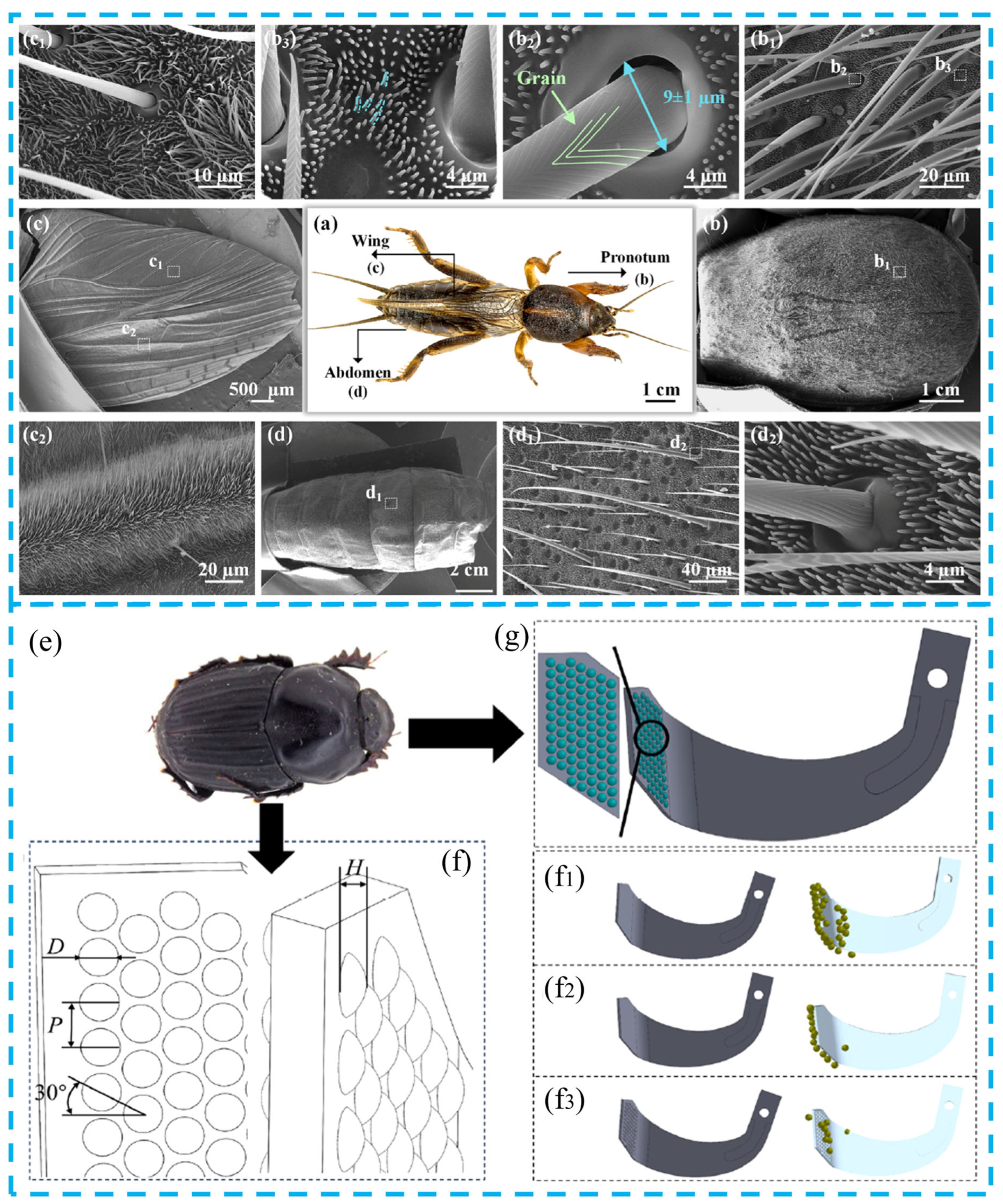
In response to highly cohesive soil environments, burrowing organisms have demonstrated anti-adhesion strategies of significant engineering value [31]. Li et al. [32] verified the coupling effect of earthworm epidermal folds and dorsal pore distribution in lubrication and drag reduction; Zhang et al. [33] further revealed the thixotropy of biological mucins. In fact, within extremely cohesive and heavy media, dynamic rheological regulation and solid-state microscopic topological structures often function synergistically. As shown in Figure 1a–d, through observations of the Oriental mole cricket, researchers discovered that its pronotum, wings, and abdominal surfaces are distributed with a large number of fine micro/nano-hierarchical structures. By replicating the micro/nano-hierarchical networks on the body surfaces of such insects, micro air bags can be effectively captured and an extremely high contact angle can be maintained, thereby forming an air film at the mud interface to block physical adhesion [34].
At present, this anti-adhesion strategy relying on hard non-smooth armour, such as protrusion or pit arrays, has been successfully transplanted onto rotary tillage blades and drill bits [35]. As illustrated in Figure 1e–g, the non-smooth convex hull microscopic features of the dung beetle’s head are extracted and introduced as design parameters into the bionic optimisation of rotary tillage blades. Such bionic implements, based on the reconstruction of biological prototypes, have generally achieved a reduction in adhesion mass of over 80% in actual operations [36]. Furthermore, the macroscopic geometric profiles of executing organs, such as claw toe curves or serrated edges, equally contain mechanical advantages for cutting and flow guidance, which can holistically reduce operational energy consumption from the perspective of macroscopic stress distribution [37,38].
When dealing with fluid media within agricultural machinery flow channels or high-speed movement conditions, the surface configurations of aquatic and flying organisms provide classic prototypes for flow field regulation. Vortex control within the boundary layer is the physical foundation for achieving fluid drag reduction. Micron-scale longitudinal grooves or three-dimensional rib-like structures can effectively suppress turbulent secondary vortices, and an asymmetrical arrangement is often more efficient than a simple parallel structure in guiding the flow field direction and reducing frictional resistance [39,40]. Based on this theory, Zheng et al. [41] confirmed that the transverse sine wave micro-grooves of dolphin skin can reduce fluid resistance by 29.3% by increasing the thickness of the viscous sublayer. Muthuramalingam et al. [42] also discovered that the overlapping geometric arrangement of fish scales can significantly delay the transition from laminar to turbulent flow. For complex amphibious mud environments, such as the direct seeding of rice, the ridge-like scale features on the body surface of the loach have been extracted and verified, preliminarily demonstrating their potential for chassis drag reduction on sliding plate components [43].
Aiming at the anti-blockage requirements of precision components such as seeding and pesticide application in agricultural machinery, the self-cleaning and wetting characteristics of plant surfaces further provide design bases at the microscopic level. The multi-scale hierarchical network of the lotus leaf replicated by Wang et al. [44] proved its superhydrophobic stability under extreme corrosive or high-humidity environments. Bixler et al. [45] analysed in detail the anisotropic features of micron-scale grooves and nano-scale waxy protrusions on rice leaves. Mechanistic research shows that this multi-scale, directional hierarchical structure can effectively guide the directional rolling of droplets, thereby endowing the flow channel interface with passive self-cleaning capabilities. Plant morphology not only excels in the conveyance of fluids or micro-particles but also possesses universality in the anti-adhesion of solid-phase media; by introducing specific leaf sheath textures combined with low free radical modification, an adhesion reduction effect of up to 50% can be achieved even in heavy clay [46].
In summary, the application of typical biological prototypes for drag reduction and anti-adhesion has gradually abandoned isolated morphological imitation, shifting towards the deep exploration of the multi-scale coupling mechanism of “macroscopic profile-micro/nano-topology-interfacial rheology”. This transition from phenomenological description to the dismantling of physical essence has constructed a solid theoretical boundary for the subsequent precise design of complex agricultural machinery components.

2.2. Typical Biological Prototypes for Wear Resistance and Anti-Cutting

During the field operations of agricultural machinery, key components must not only contend with adhesion resistance but also withstand high-intensity cutting and erosion caused by hard particles, sand, and crop fibres. Wear-resistant organisms in nature, such as desert scorpions, pangolins, and shellfish, have demonstrated exceptional damage-resistance performance. This protective capability typically does not originate from a single high-hardness material but instead relies on the deep coupling of micro-geometric morphology, multi-scale hierarchical structures, and physical hardness gradients. By constructing bionic topological features, the transmission paths of impact loads can be effectively altered, thereby achieving the dispersion and dissipation of interfacial energy.
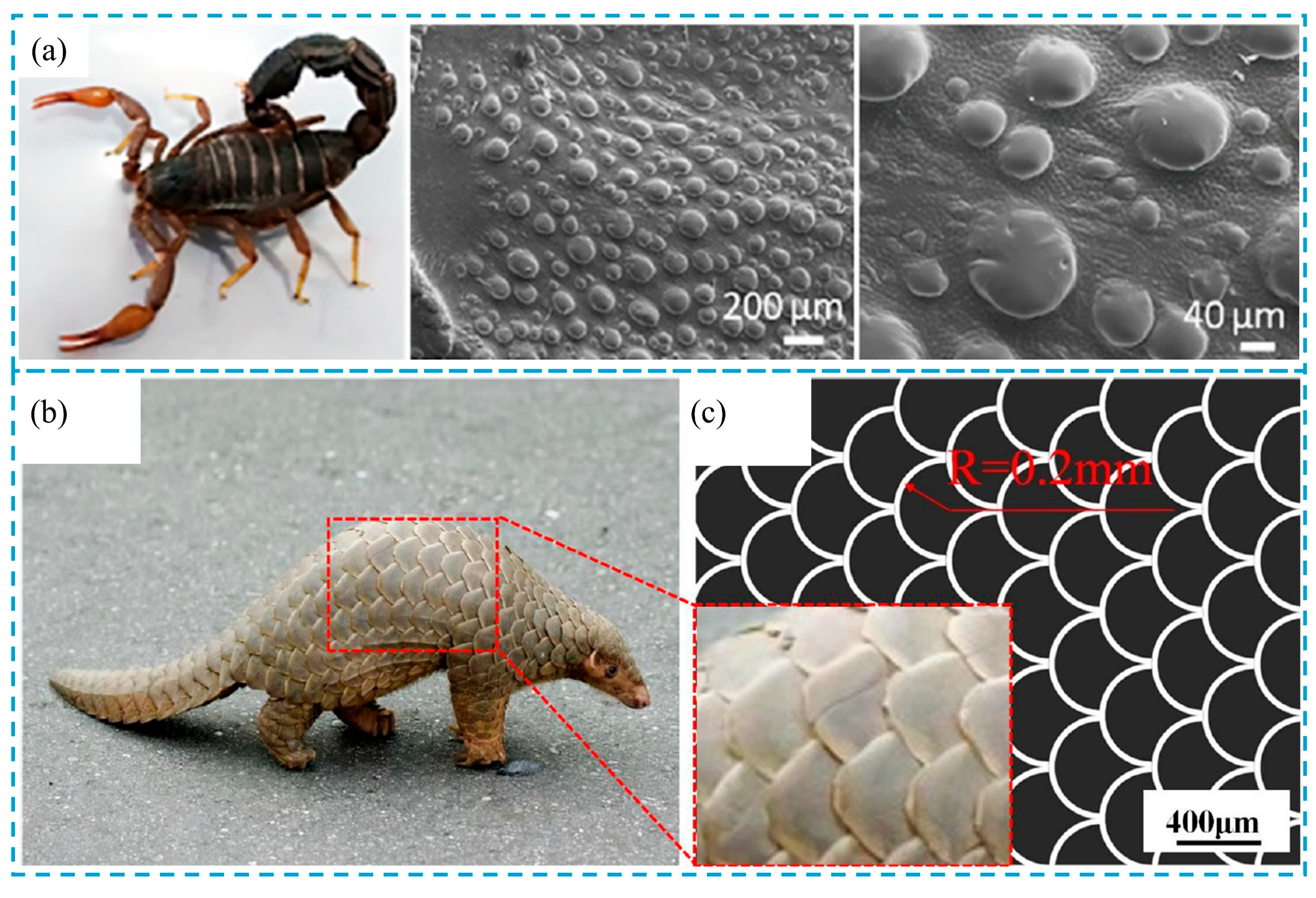
In response to severe erosion environments involving solid particles, the non-smooth features on the body surface of desert scorpions provide a typical aerodynamic protective mechanism. Han et al. [47,48] extracted the protrusion and groove structures from the scorpion’s back, proving that these can significantly enhance erosion resistance under sand and wind impacts. In fact, the core physical mechanism of such micro-textured surfaces lies in altering the relative incident angle of impact particles. Through the induction of the geometric interface, the normal impact kinetic energy of the particles is converted into tangential components, thereby substantially alleviating deep damage to the substrate material. Based on this energy dissipation principle, as illustrated in Figure 2a, researchers extracted the microscopic protrusion features from the desert scorpion’s back and utilised 3D printing technology to replicate and prepare a protrusion-smooth coupled ceramic material; this not only reproduced the morphology of biological armour but also effectively unloaded vertical impact stress at the hard–soft interface [49].
When addressing abrasive wear within soil environments, as shown in Figure 2b,c, the overlapping arrangement and chemical composition features of pangolin scales possess high engineering instructional value. Cui et al. [51] and Sun et al. [52] respectively employed bionic laser surface treatment and laser cladding processes to prepare micro-structures and hard units, such as TiC, similar to biological scales on metal substrates. Research indicates that the wear limit of a material often depends on the microscopic mechanical response of the interface. A non-smooth interface composed of a soft matrix and hard phases can form a discontinuous cutting interruption effect. The hard phase is responsible for resisting continuous scratches from abrasive particles, while the soft matrix absorbs mechanical impact energy through elastic deformation. This strategy of synergistic enhancement between morphology and coatings has been verified to reduce the friction coefficient of snapping rolls by a significant 38.09% [50].
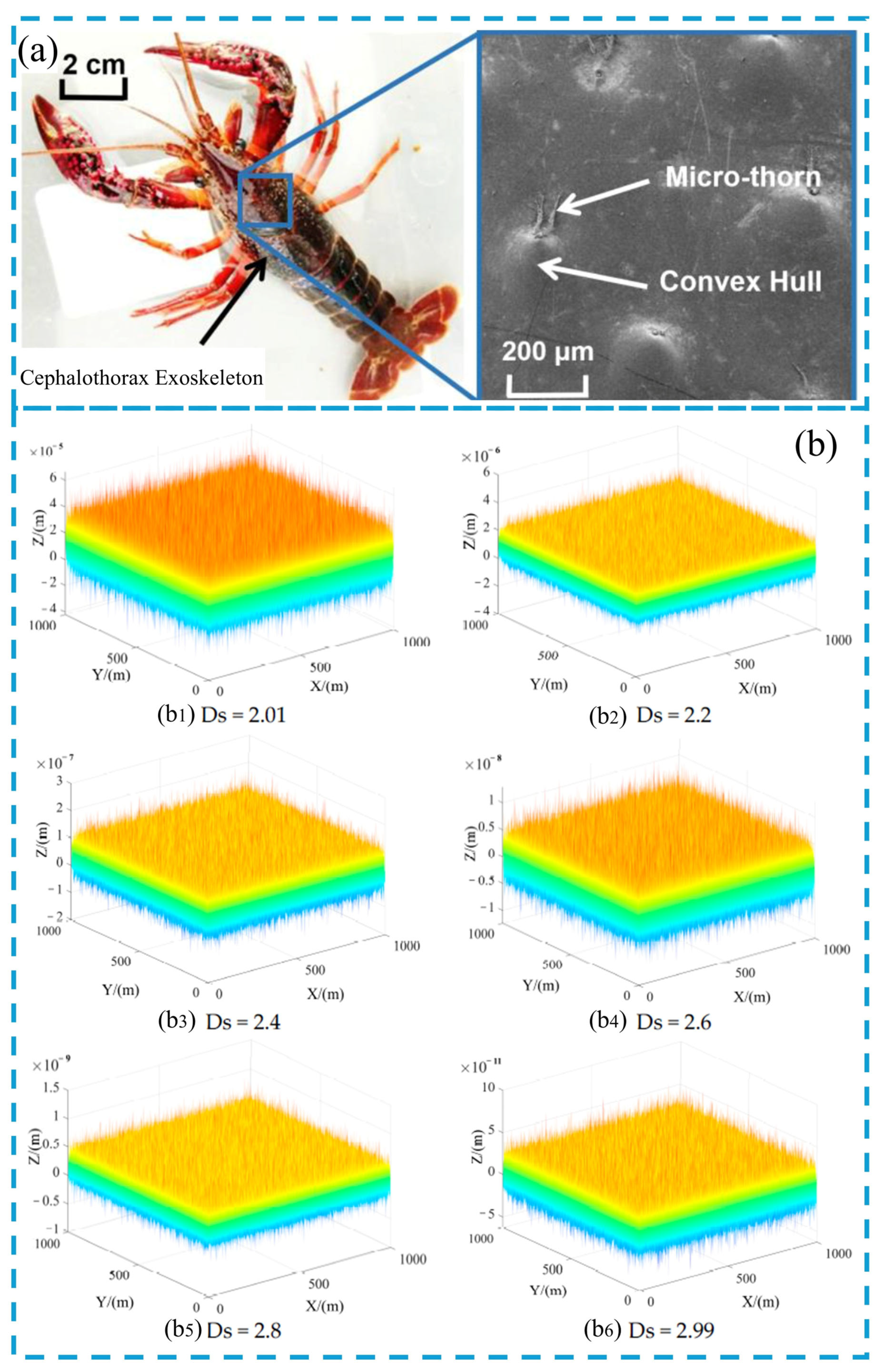
Beyond macroscopic armour, the interfacial tribological characteristics of shells and microscopic aquatic organisms also reveal pathways for the optimisation of contact mechanics. Zhao et al. [53,54] constructed aluminium–nickel soft–hard alternating phases and micro-convex strip structures based on the anti-wear mechanism of shells. Mechanistic analysis indicates that micro-convex strips with specific spacing can form effective chip removal spaces, preventing the malignant accumulation of third-body wear debris at the interface, thereby reducing the wear rate by over 77.6%. Furthermore, the dynamic intervention of microscopic topological morphology on the movement state of particles is of paramount importance. For instance, by introducing a micro-thorn and convex hull coupled structure similar to a crayfish shell, the “sliding friction” of soil particles at the interface can be forcibly induced into “rolling friction” with lower energy dissipation; this fundamentally mitigates the ploughing and cutting damage caused by hard particles to the surface [55].
In summary, research on wear-resistant bionic prototypes has surpassed the stage of simple macroscopic morphological imitation. The current focus is shifting towards the exploration of the deep coupling mechanisms among “morphology, material, and environment”. From altering particle incident angles to inducing rolling friction, and further to stress dispersion systems with alternating soft and hard phases, the systematic elucidation of these underlying mechanical mechanisms has laid a solid scientific foundation for the development of agricultural machinery executing components adapted to complex and variable soil environments.

2.3. Extraction of Bionic Microscopic Features and Feasibility of Engineering Preparation

After clarifying the anti-wear and drag reduction mechanisms of biological prototypes, how to precisely extract their microscopic features and achieve efficient engineering preparation is the core barrier to the field application of bionic technology. Current feature extraction technologies have abandoned traditional two-dimensional approximations, comprehensively shifting towards three-dimensional high-fidelity reconstruction integrating high-resolution scanning and computer graphics algorithms. Simultaneously, the precision and material adaptability of manufacturing processes directly determine the final service quality of bionic interfaces.
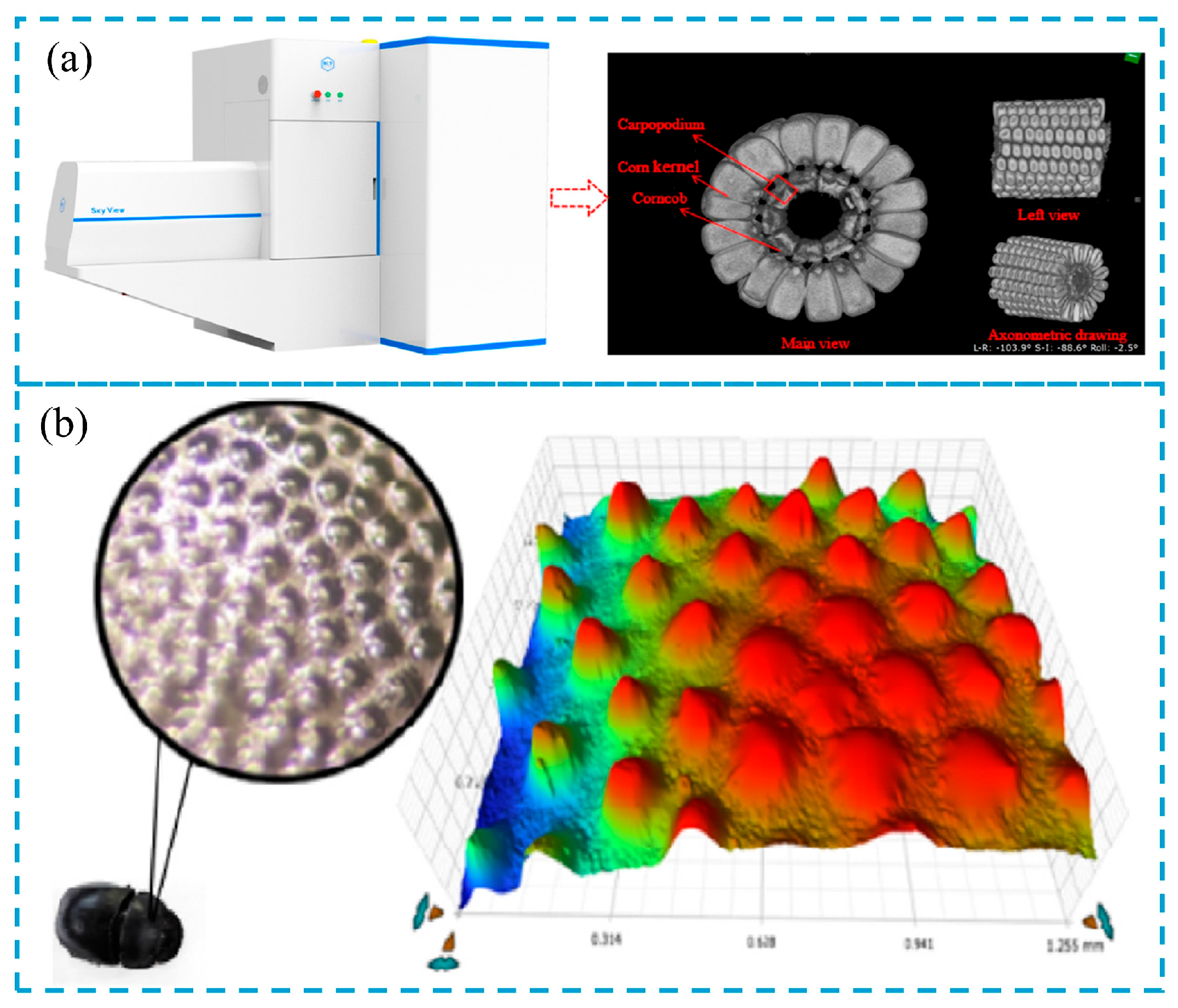
The first step in transforming biological features into engineering language is the digital reconstruction of complex, irregular biological morphologies. Yu et al. [56] and Li et al. [57] utilised white light interferometry and computed tomography (CT) scanning technology, respectively, to precisely capture the microscopic structures of the dung beetle’s head and the internal topological parameters of the corn carpopodium. Specifically, as shown in Figure 3a, the non-destructive extraction and physical modelling of the complex three-dimensional topological structure within high-moisture corn carpopodia were achieved via CT scanning technology, providing realistic geometric boundaries for subsequent mechanical simulations; meanwhile, as illustrated in Figure 3b, a white light interferometer was employed to precisely map and extract the non-smooth convex hull microscopic profiles and morphological features on the head surface of the dung beetle. Because biological body surfaces often possess a high degree of anisotropy and non-linear connection characteristics, direct replication presents significant difficulties. By introducing digital image processing and polynomial fitting algorithms, these discrete biological coordinates can be transformed into continuous mathematical equations or computer-aided design (CAD) spatial surfaces [26]. This logical closed loop from physical characterisation to digital modelling provides an indispensable data source for subsequent industrial-grade numerical control machining and multi-body dynamics simulations.
In the preparation phase of micro/nano-scale bionic structures, high-energy beam processing and additive manufacturing technologies have demonstrated extremely high dimensional control capabilities [58]. Li et al. [59] systematically discussed the advantages of ultrafast lasers, such as femtosecond lasers, in the processing of metallic bionic textures. From the perspective of thermodynamic mechanisms, ultrafast lasers can achieve the cold ablation of materials through extremely short pulse energy, thereby effectively avoiding heat-affected zones and micro-crack defects caused by long-pulse processing. Concurrently, 3D printing technology endows materials with the capability for multiphase compounding within three-dimensional space [49,60]. Through precise control over layer superimposition and compositional gradients, it is not only possible to replicate bionic configurations with complex internal cavities with high fidelity, such as shark skin placoid scales, but also to achieve directional reduction in fluid dynamic resistance peaks [61].
Aiming at the low-cost, large-scale manufacturing of large-sized agricultural machinery components, biological replication and multi-process compounding technologies provide high-potential industrialisation pathways. Zhang et al. [62] and Chen et al. [63] successively developed high-precision synthetic replication and ultraviolet (UV) curing-based proportional scaling replication methods. In macroscopic engineering applications, differences between field fluid Reynolds numbers and laboratory conditions often necessitate that bionic structures possess precise scaling capabilities. Micro-moulding processes based on material shrinkage characteristics not only resolve the size-matching difficulties of large-scale proportional scaling but also maintain extremely high replication fidelity via polymer films [64]. Furthermore, for complex field sand and dust wear conditions, a synergistic preparation strategy nesting macroscopic laser textures with micro/nano-scale superhydrophobic coatings has been proven to exponentially enhance the mechanical durability of functional interfaces through the “armour protection effect” [28].
The evolution of manufacturing processes is continuously approaching an industrial-grade optimal solution that balances precision, efficiency, and cost. By introducing multi-scale coupled preparation technologies such as heat-assisted ablation, nano-spraying, and vacuum casting, the thermodynamic and kinetic obstacles to replicating fine textures over large areas are being progressively overcome [65,66]. More importantly, parameter equations optimised in combination with discrete element method (DEM) simulations can now directly drive industrial-grade numerical control machine tools to accomplish the economical processing of large-sized bionic components [67,68]. The maturity of these preparation systems indicates that bionic functional surfaces already possess the technical feasibility to transition smoothly from microscopic laboratory samples to large-scale, heavy-duty equipment such as agricultural machinery.

3. Mechanisms of Bionic Functional Surfaces

Building upon the specific biological prototypes extracted in Section 2, this section aims to establish a clear correspondence between those structural features and their underlying physical mechanisms, revealing how specific morphologies dictate functional outcomes. The core physical essence of the exceptional friction reduction, wear resistance, and anti-adhesion performance exhibited by bionic functional surfaces in agricultural machinery lies in breaking the interfacial energy distribution and mechanical transmission paths of traditional smooth surfaces. This operational mechanism is not a single-dimensional physical effect, but rather the result of the synergistic interaction among micro-topological morphology, surface energy distribution, dynamic fluid behaviour, and multiphase media coupling. Macroscopically, non-smooth features transform the large-area continuous contact between components and external media into discrete point or line contacts; microscopically, they trigger the complex evolution of wetting dynamics, the directional migration of wear debris, and energy dissipation based on contact mechanics. An in-depth analysis of these mechanisms is the theoretical foundation for achieving the cross-scale precise design of agricultural machinery components under varying operational conditions.

3.1. Surface Wetting Dynamics and Anti-Adhesion Mechanisms

When agricultural machinery operates in water-rich soils, the adhesion phenomenon primarily originates from continuous liquid bridge forces formed at the solid–liquid interface [69,70,71]. The theoretical frameworks of Ren et al. [9] and Jia [72] point out that the effective contact area and surface energy of the interface jointly determine the magnitude of the work of adhesion. In fact, by constructing micro/nano-sized non-smooth structures on solid surfaces, the continuous spreading of water molecules can be effectively blocked from both physical and chemical dimensions. When the ratio of the amplitude to the period of these micro-textures reaches a specific threshold, microscopic gaps are spontaneously induced at the interface, which in turn capture air to form an “air cushion”. This air cushion effect enables the contact interface to remain in a stable Cassie–Baxter wetting mode; for instance, the hierarchical structure on the body surface of the Oriental mole cricket can utilise this to maintain a static contact angle exceeding 150°, thereby macroscopically reducing the adhesion force by 86.5% [34].
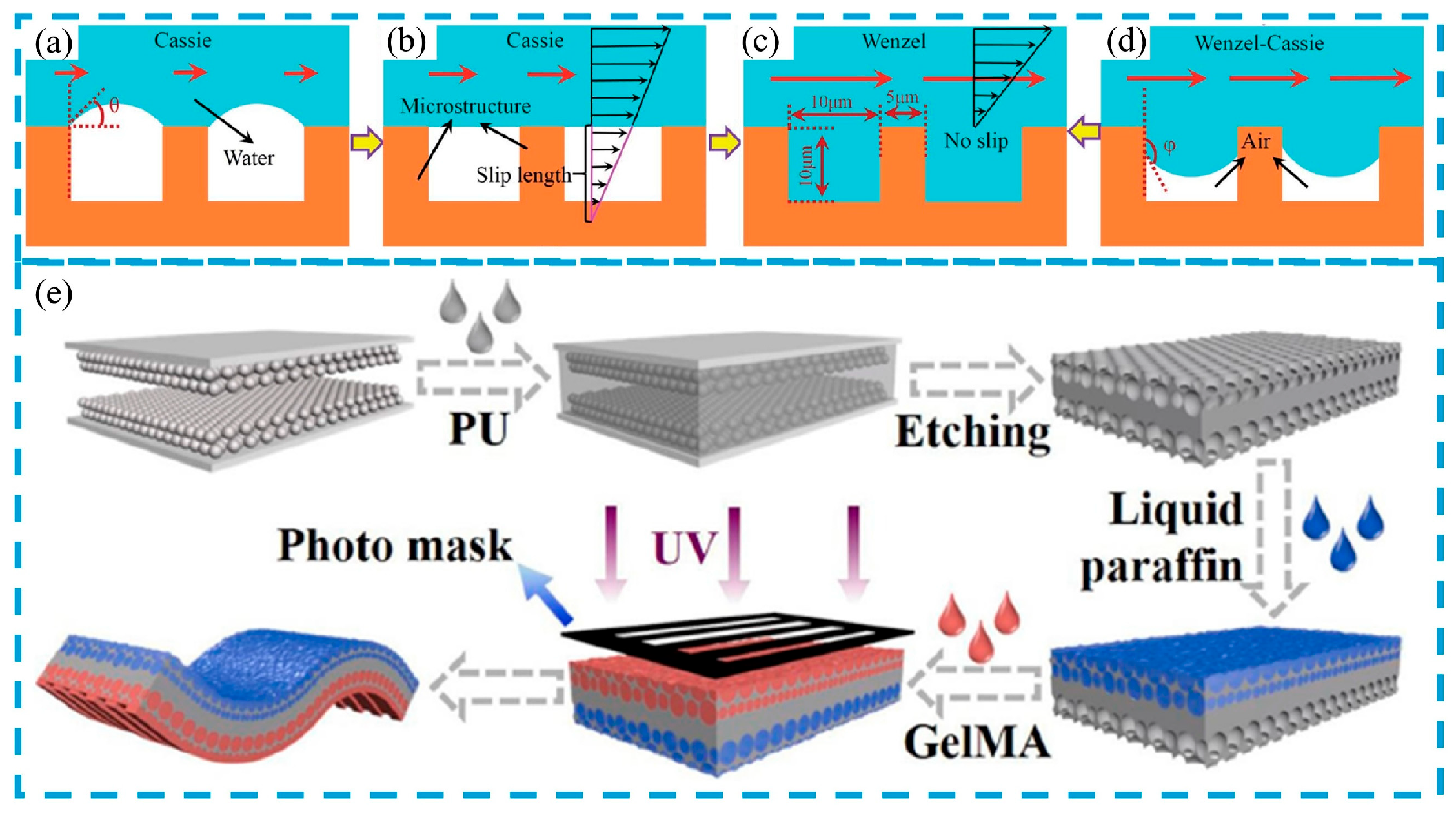
However, a static high contact angle is insufficient to cope with the complex, high-speed operational conditions of agricultural machinery, and interfacial dynamic pressure often leads to a malignant transformation of the wetting state. Wang et al. [73] confirmed that the contact state of the solid–liquid interface and the characteristics of the fluid boundary layer evolve significantly with the relative velocity of the flow field. At low speeds, the fluid, influenced by surface tension, is suspended above the micro-structures to maintain the Cassie state (Figure 4a), and the air cushion captured at the interface can effectively induce a fluid slip length, significantly reducing boundary layer shear stress (Figure 4b). When the relative velocity of the flow field increases, the droplet dynamic pressure overcomes the surface tension of the gas–liquid interface and permeates into the grooves, undergoing a locally filled Wenzel–Cassie transition state (Figure 4c), and ultimately completely filling the texture grooves to enter the Wenzel state (Figure 4d). At this stage, the interfacial boundary layer exhibits a no-slip characteristic, causing the anti-adhesion and drag reduction mechanisms to completely fail from the Cassie state and decline into the Wenzel state.
To resist this dynamic pressure permeation, introducing multi-scale hierarchical structures is a key physical pathway for maintaining the stability of the air film. Dual-scale micro-air cushions constructed through multi-scale preparation methods, such as chemical vapour deposition, can substantially reduce the true liquid–solid contact area [44]. Tribological tests further demonstrate that the nested network of micron-scale papillae and nano-scale branches can convert up to 99% of liquid–solid contact into gas–liquid friction, providing reliable “gas lubrication” support for the dynamic anti-adhesion of flow channel components [74].
Figure 4. Extraction of microscopic features from the lotus leaf surface and their applications in flow field drag reduction and tissue repair: (a) Cassie wetting state; (b) boundary layer flow velocity distribution characteristics under the Cassie state; (c) Wenzel–Cassie transition state; (d) fully wetted Wenzel state [73]; (e) schematic diagram of the bionic multifunctional composite patch structure possessing anisotropic wetting and adhesion characteristics [75].
Lubricants 14 00238 g004
Aiming at extremely cohesive and heavy media, the passive water-repellent strategy relying on geometric morphology is gradually evolving towards active intervention and liquid film lubrication. The bionic electro-osmosis system optimised by Massah et al. [27] demonstrates that by applying a specific direct current electric field, the electro-osmotic flow can actively precipitate a uniform micron-scale lubricating water film at the solid–liquid interface, thereby reducing the adhesion amount of extreme clay by 90%. This physical mechanism of substituting a solid friction interface with a fluid is equally reflected in slippery liquid-infused porous surfaces (SLIPSs). By constructing a dual-layer porous scaffold via etching technology on a polyurethane (PU) inverse opal template, and infusing liquid paraffin on one side to form an anti-adhesion slippery surface, while infusing GelMA hydrogel on the other side combined with ultraviolet (UV) curing and photo mask technology, a composite thin film possessing both structural heterogeneity and functional anisotropy can be successfully prepared (Figure 4e). Such anisotropic smooth liquid films constructed after locking lubricating fluids within porous scaffolds not only repel highly viscous soft tissues but also possess thermodynamic self-healing capabilities after interfacial damage [75]. Additionally, the inherent rheological properties of biological mucus itself are also crucial; its thixotropic characteristic of “shear-thinning” implies that apparent viscosity drops precipitously with increasing shear rates, providing a natural theoretical template for the dynamic lubrication design of high-speed moving components [33].
At the level of fluid dynamic intervention, the symmetry and geometric parameters of micro-structures directly determine the flow stability of the boundary layer and the migration paths of droplets. Based on light-induced polymers, Gao et al. [76] achieved the controllable transformation of a superhydrophobic surface from isotropic (lotus leaf-like) to anisotropic (rice leaf-like). From a kinetic perspective, breaking the symmetry of surface micro-structures can induce a gradient distribution of surface energy, thereby precisely guiding droplets to roll off and detach along a specific direction. Simultaneously, the slip length induced by micro-textures has also been proven to significantly reduce the velocity gradient near the wall in laminar flow, lowering macroscopic shear resistance [77]. In more complex turbulent boundary layers, dynamic micro-textures such as low-amplitude sine waves can effectively suppress early disturbances in the fluid boundary layer, significantly delaying the transition phenomenon and further weakening wall shear stress [78].
As mechanistic research deepens, the environmental durability and multiphase flow precise separation capability of bionic interfaces have become new evaluation dimensions. Carbon-based multi-scale structures prepared based on biological morphological templates can still maintain an ultra-high contact angle of 162° after undergoing fluorination modification and exposure to natural environments for several months; this verifies the long-term service stability of bionic structures from a physicochemical level [79]. Concurrently, the anti-adhesion mechanism is upgrading from a singular “water-repellent anti-blockage” to “selective passage”. The asymmetric wetting membrane with Janus characteristics developed by Wang et al. [80] achieves spontaneous screening and precise detachment of oil–water multiphase flows at the interface through the difference in surface energy between its front and back sides. Overall, the exploration of surface wetting dynamic mechanisms has thoroughly broken through static superhydrophobicity theory, forming a systematic physical framework encompassing air film steady-state, rheological control, and directional regulation of surface energy.

3.2. Distribution Laws of Contact Mechanics and Evolution Mechanisms of Wear Debris

During the operational processes of agricultural machinery, the contact mechanical behaviour between soil-engaging components and multiphase media directly determines energy transmission efficiency and the structural integrity of materials. When bearing high loads, traditional smooth surfaces are highly susceptible to generating severe stress concentration, leading to local plastic deformation and the initiation of fatigue cracks. By introducing microscopic geometric discontinuities, the stress distribution laws at the interface can be fundamentally altered, and a crucial regulatory role can be played in the third-body particles (wear debris) generated by wear. Zhang et al. [81] confirmed that bionic array micro-pits combined with laser shock peening and diamond-like carbon (DLC) coatings can utilise residual compressive stresses up to 660 MPa to generate a work-hardening effect, thereby suppressing crack propagation.
The mechanical response characteristics of the interface often depend on the redistribution of the stress field by topological structures. Under high-temperature operational conditions such as dry cutting, the annular protrusions surrounding bionic micro-textures can significantly block heat conduction paths, preventing the vicious cycle of adhesive wear by reducing diffusion wear caused by cutting heat [82]. Aiming at the abrasive wear universally present in agricultural machinery operations, the core advantage of non-smooth surfaces lies in altering the movement state of abrasive particles. Zhang et al. [55], drawing inspiration from the characteristics of crayfish shells, constructed a geometrically coupled surface composed of micro-thorns and convex hulls (Figure 5a), revealing its intervention mechanism on particle movement. In fact, this induced rolling mechanism can utilise the geometric hindrance effect of micro-units to forcibly convert sliding friction, which causes severe cutting damage, into rolling friction with lower energy dissipation, thereby drastically reducing the surface wear mass from 194.1 mg to 11.5 mg.
The evolution laws of wear debris at the friction interface are another core factor determining service life. Micro-textured surfaces possess a unique “trap” effect, capable of effectively capturing and storing wear debris at the interface. Dai et al. [83] utilised mask sandblasting to construct micro-textures, successfully shifting the wear mechanism from severe ploughing to a mode where micro-pit spalling and residual ploughing coexist. From a mechanistic perspective, allowing oxidative wear debris to escape the friction interface or enter micro-pores can significantly reduce the incidence of three-body wear; furthermore, under specific conditions, debris captured within micro-pits can even exert a physical isolation effect, protecting the friction pair from direct contact [84]. Moreover, for ferromagnetic materials, utilising demagnetisation treatment to enhance the debris-capturing capability of micro-pits can effectively prevent the “bridging” phenomenon of debris at the edges of the pits, thereby maintaining the stability of the friction coefficient [85].
A significant correlation exists between the geometric parameters of bionic structures and load adaptability. Rosenkranz et al. [86] demonstrated that when the direction of periodic textures forms a specific angle with the sliding direction, the debris storage function reaches an optimum, allowing the system to maintain an extremely low dynamic friction coefficient during long-term cycling. The stability of this mechanical state is largely attributed to the load-sharing effect of bionic structures on normal loads. Research by Ma et al. [87] also discovered that bionic surfaces exhibit specific adaptability under different load ranges. By simulating the hardness characteristics of pangolin scales and constructing hard units on a soft matrix, a coupled wear mechanism of “soft absorption and hard blocking” can be achieved; that is, the hard units block abrasive cutting, whilst the soft matrix absorbs impact energy through elastic deformation [52].
Under fluid lubrication states, the contribution of geometric morphology to interfacial dynamic pressure is another pathway for optimising contact characteristics. Cui et al. [88], by coupling elliptical and shell-shaped grooves, confirmed that composite bionic textures can enhance the hydrodynamic load-carrying capacity of the oil film by 53.79%. Mechanistic comparisons reveal that micro-pits of different shapes, such as rectangular and hexagonal pits, exhibit differences in debris collection efficiency under dry sliding friction, which directly impacts the residence time of third-body particles at the interface [89]. For complex flexible contact interfaces, hierarchical structures demonstrate a stronger universality in friction reduction, capable of effectively regulating the friction feedback when interacting with biomass materials, such as human fingerprints or crop epidermises [90].
To achieve precise monitoring of the wear evolution process, intelligent recognition technology has begun to integrate deeply with tribological mechanisms. Zhang et al. [15] utilised a DEM-FEA cross-scale model to visually characterise the interactive behaviour of rice particles on the surfaces of soil-engaging components (Figure 5b). Their analysis showed that the micro-cutting and local stress concentration generated at the contact interface by high-hardness particles contained within the crop are the fundamental causes of material loss. Based on this, by introducing the fractal dimension as a sensitive indicator of the degree of wear, the damage level of the rice–steel friction pair can be further quantitatively evaluated. Currently, utilising deep learning models, such as DenseNet121, to automatically identify typical wear debris in ferrography images has achieved a recognition accuracy exceeding 90.15% [91]. This classification method based on the grey-level co-occurrence matrix and feedforward neural networks endows agricultural machinery components not only with passive wear-resistant performance but also with the capability for real-time health status diagnosis based on the morphological evolution of wear debris [92].

3.3. Multi-Scale Numerical Simulation of Interfacial Interactions

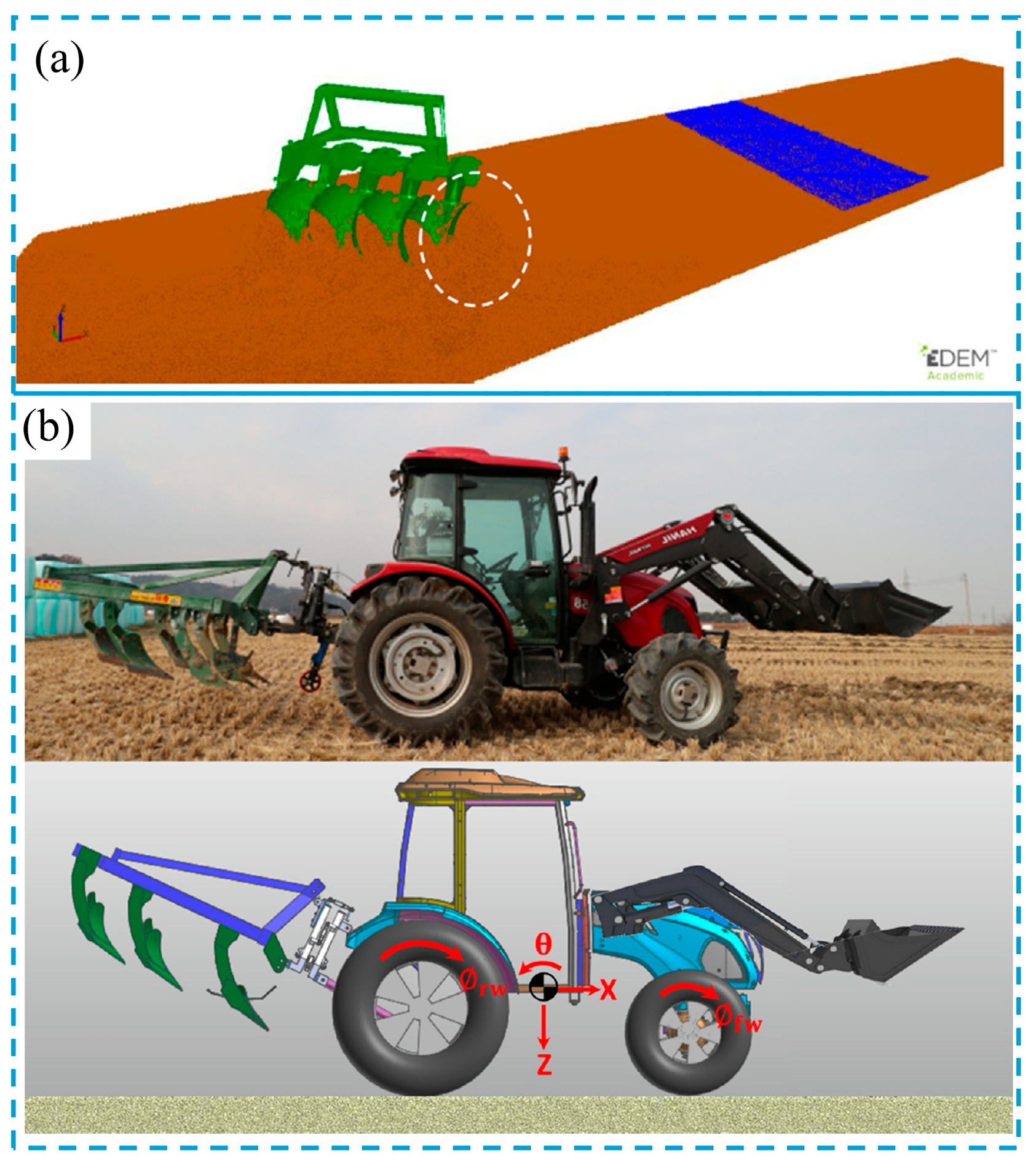
With the development of computational science, multi-scale numerical simulation has become the core bridge connecting the microscopic mechanisms of bionic surfaces with the macroscopic operational performance of agricultural machinery. Under complex farmland operational conditions, soil-engaging components face the combined effects of discrete particles, the dynamic responses of the entire machine, and fluid media. The current mainstream simulation paradigm is cross-scale coupling technology integrating DEM, MBD, CFD, and FEM. Ucgul et al. [93] successfully predicted the rotational speed of a disc plough under different operational parameters by constructing a DEM-MBD coupled model of the interaction between the disc plough and soil particles (Figure 6a), with an error of only 6.9%. This method, which involves the precise calibration of contact parameters, such as the JKR model, and the introduction of non-spherical particle modelling, can reproduce the drag reduction and soil detachment behaviour of bionic surfaces in realistic field environments with high fidelity.
The introduction of digital twin technology has significantly improved the prediction accuracy of draught resistance for agricultural machinery [94,95,96]. The full-scale “soil-tool-tractor” coupled dynamics model (Figure 6b) established by Kim et al. [97] achieved high-precision prediction of real-time draught resistance during tractor operations, with an accuracy up to 90.8%, considering the deep non-uniform distribution of soil properties. From the perspective of mechanical decomposition, dividing the operational components into multiple stress-bearing zones for analysis assists in revealing the resistance evolution laws of the cutting edge and the bottom surface at varying soil penetration depths [94]. Aiming at the widely distributed high-moisture paddy fields in southern China, the CFD-DEM coupled multiphase flow model can achieve refined modelling of the dynamic characteristics of cohesive soils; by calibrating key surface energy parameters through rotational simulation, prediction errors can be stably controlled within 15% [95].
Figure 6. Cross-scale coupled numerical simulation models of the interaction between agricultural machinery components and soil media: (a) DEM-MBD coupled simulation model of the interaction between a disc plough and soil particles [93]; (b) multi-body dynamics configuration and force analysis model of the full-scale tractor-mouldboard plough operational system [96].
Lubricants 14 00238 g006
The balance between computational efficiency and model complexity is a key challenge for simulation technology moving towards engineering application [97]. El-Emam et al. [98] demonstrated that a two-way coupled model can capture the feedback effect of solid particles on the fluid more accurately than a one-way model, thereby precisely identifying high-wear regions. Addressing the demand for large-scale particle computation, GPU-accelerated solvers developed utilising CUDA technology can now handle fluid–solid coupling calculations for up to 25 million particles, providing the possibility of simulating the threshing and conveying processes of large combine harvesters [99]. Furthermore, considering the anisotropy of real farmland media, particle sphericity has a significant impact on interfacial friction and blockage behaviour; ignoring morphological features will lead to severe simulation deviations [100].
The introduction of non-spherical particle modelling and failure criteria further enhances the scientific validity of simulation results. Xu et al. [101] proposed an LBM-DEM coupling method based on the super-ellipsoid model, which can efficiently characterise non-spherical bionic particles with smooth surfaces, such as seeds. At the material failure level, the DEM-FEM coupled model is frequently employed to simulate crack initiation in ceramic tools during loading processes, which is of great value for evaluating the fatigue life of bionic wear-resistant coatings under alternating loads [102]. High-fidelity digital reconstruction is the logical starting point for simulation. The biological shark skin model established by Zhang et al. [103] via scanning technology, combined with direct numerical simulation to capture the turbulent structures within micron-scale grooves, verified the consistency between the simulation model and physical experiments.
Innovations in numerical algorithms directly drive the enhancement of simulation efficiency for complex multiphase flows in agricultural machinery. Yuan et al. [104] discovered that micro-textures with triangular cross-sections can significantly alter the turbulent kinetic energy distribution near the wall, thereby achieving a drag reduction rate of 14.29%. When addressing the challenge of multi-point frictional contact, introducing the non-smooth contact dynamics (NSCD) algorithm and adopting the bi-potential concept can greatly enhance the computational stability of large-scale operational biomimetics [105]. Additionally, evaluation indicators based on the second law of thermodynamics, such as entropy generation analysis, provide new criteria for designing ultra-low power consumption flow channels, quantifying energy losses that are difficult to explain from a kinetic perspective [106].
Aiming at high-speed gas–solid two-phase flow conditions, composite textures demonstrate significant superiority in suppressing boundary layer separation. Utilising large eddy simulation, Hijazi et al. [107] discovered that the drag reduction effect of bionic textures arranged at specific yaw angles is 9.2 times that of a single structure. The integration of these algorithms and theories has driven a paradigm shift in agricultural machinery design from “empirical field testing” to “precise cloud-based design”. Ultimately, by coupling the JKR and Bonding models, it is even possible to achieve the digital replication of the mechanical interlocking effect of crop root–soil complexes, thereby comprehensively deepening the understanding of the drag reduction mechanisms of bionic surfaces within complex biological media [108].

4. Typical Applications in Agricultural Machinery

Throughout the full life-cycle operations of agricultural machinery, the interfacial interactions between executing components and multiphase media (such as soil, seeds, fertilisers, and agricultural products) directly determine the operational efficiency of the entire machine. Under complex and variable farmland conditions, traditional rigid smooth components have long faced physical bottlenecks such as high energy consumption, susceptibility to adhesion and blockage, and the frequent occurrence of mechanical wear. By integrating the biological prototypes (Section 2) and their tribological mechanisms (Section 3), this section strictly maps these bionic theoretical achievements to specific agricultural machinery functions to solve the aforementioned bottlenecks. The introduction of bionic functional surfaces essentially involves the targeted physical reconstruction of the interfacial tribological behaviour of agricultural machinery components by reproducing the microscopic geometry and mechanical characteristics of natural biological surfaces. In fact, requirements for interfacial properties vary significantly across different operational scenarios, necessitating different corresponding bionic strategies. In the tillage and land preparation process, the core logic is to utilise non-smooth features to disrupt soil–liquid bridges, thereby reducing the draught resistance caused by highly cohesive media; in the seeding and fertilisation stage, anti-blocking and smooth designs rely on microscopic channels to precisely guide the dynamic state of particle swarms, while in the harvesting stage, the interface is required to possess not only high wear resistance against the cutting of hard stalks but also a compliant mechanism to achieve low-damage interaction with high-value fruits and vegetables. This scene-based application, rooted in operational characteristics, is driving agricultural machinery to evolve from traditional passive damage resistance towards active interfacial regulation.

4.1. Tillage and Land Preparation Machinery: Drag Reduction and Soil Detachment Applications for Soil-Engaging Components

In the tillage and land preparation processes, overcoming the draught resistance generated by soil shearing and friction by soil-engaging components (such as subsoilers and ploughshares) accounts for the primary energy consumption of agricultural machinery [109,110]. Regarding the stress optimisation of soil-penetrating cutting edges, the macroscopic geometric profiles of biological digging organs provide naturally excellent configurations. Garibaldi-Marquez et al. [26] introduced the internal and external contour curves of the Mexican ground squirrel’s claw toes into a subsoiler design, successfully reducing the average draught resistance by 22.25%; Tong et al. [111] utilised a DEM model to confirm that a curved shank combined with a chisel-shaped tip possesses the lowest specific resistance during deep tillage.
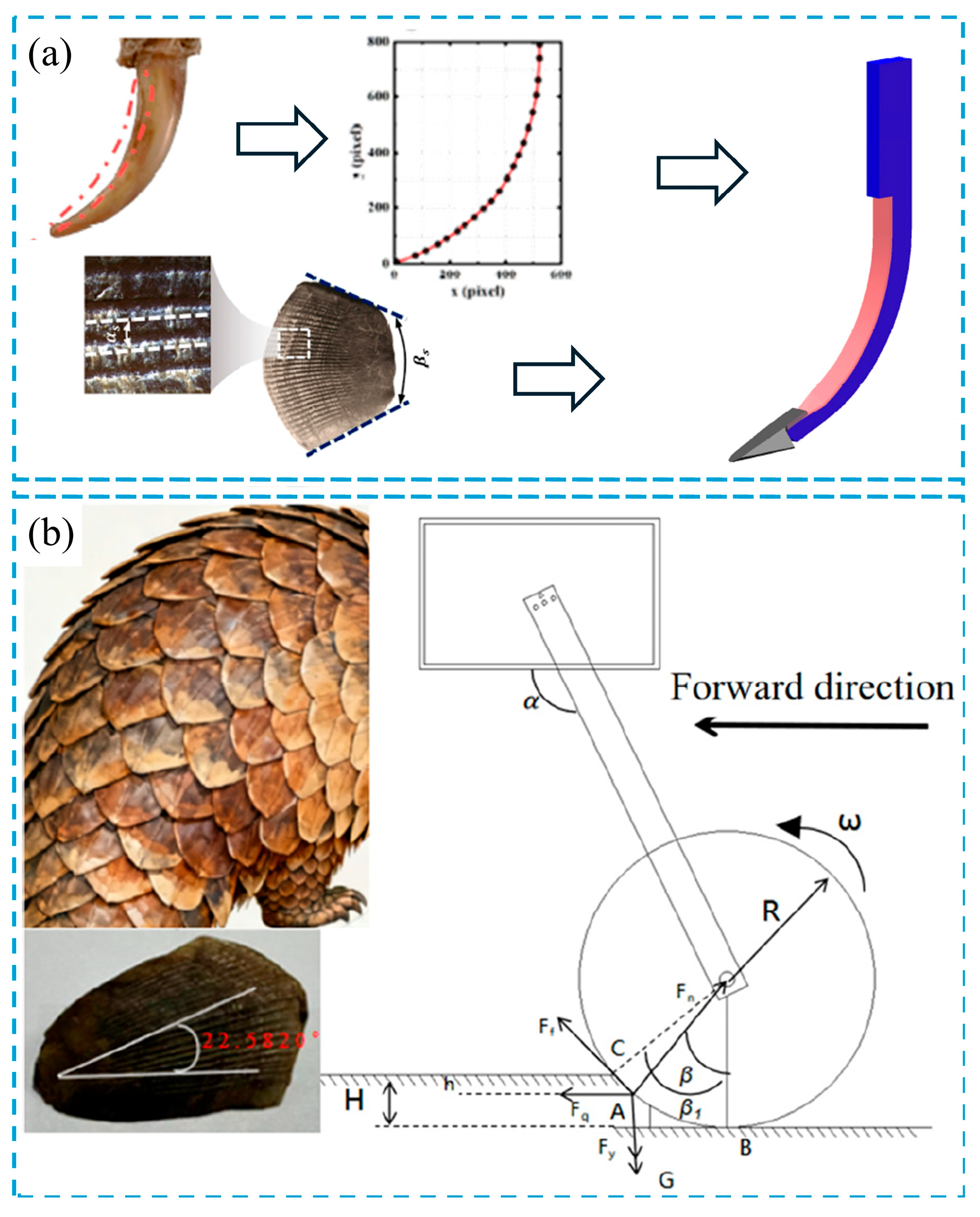
From the perspective of soil mechanics, the advantage of bionic cutting edges lies in their non-linear geometric profiles, which can smoothly alter the stress flow distribution in the soil forward-sliding zone. By reducing local stress concentration and the soil-breaking resistance in front of the cutting edge, the penetrating component can complete the shearing and peeling of compacted soil layers with less energy. Such macroscopic geometric bionics have been further extended into composite structures; for instance, a composite subsoiler designed by combining the digging profile of a badger claw with the overlapping characteristics of pangolin scales (Figure 7a) has been shown to significantly reduce the draught resistance and soil disturbance coefficient at various operational speeds through the synergistic effect of multiple bionic configurations [112].
Addressing the severe surface adhesion problems caused by wet and sticky soil, non-smooth micro-structures have demonstrated superior physical efficiency in soil detachment. Rotary tillage blades designed by Wang et al. [35], which simulate the protrusion arrays on a dung beetle’s head, achieved an 82.93% reduction in soil adhesion in loess environments; Zheng et al. [113] extracted the geometric topological structure of the imbricated scales on a pangolin’s body surface to construct a bionic pressing roller with non-smooth arrays (Figure 7b), which effectively disrupted the continuous water film at the soil–metal interface through scale arrangement, significantly reducing the amount of hanging soil in heavy clay by 47.2%. From the level of interfacial mechanics, the mechanism by which non-smooth surfaces disrupt the continuous water film primarily relies on spatial heterogeneity at the micro/nano-scale. When highly cohesive soil slides over bionic textures (such as protrusions, stripes, or discontinuous placoid scales resembling shark skin), microscopic pores and air cushions are easily induced at the interface; this not only severs the direct contact between soil particles and the metal substrate, but also substantially weakens the dominant role of liquid bridge forces [114,115,116]. This strategy of intervening in interfacial continuity via morphology exhibits robust self-cleaning and drag reduction effects in digging implements used in extreme saline–alkali land or high-moisture conditions [113].
Figure 7. Typical bionic soil-engaging component designs for tillage and land preparation machinery: (a) design principle of the composite subsoiler combining the digging profile of a badger claw with the overlapping characteristics of pangolin scales [112]; (b) three-dimensional model of the bionic pressing roller constructed drawing inspiration from the imbricated scale characteristics of pangolins [117].
Lubricants 14 00238 g007
In addition to passive anti-adhesion dependent on geometric configurations, active electro-osmotic flow regulation and low-surface-energy material modification have further broadened the technical boundaries of tillage drag reduction. A bionic electro-osmosis system developed by Yang et al. [118], inspired by the bio-electric coupling mechanism of earthworms, reduced the soil adhesion force of shovels by 52.84% under 12 V alternating current; Massah et al. [27] demonstrated that applying a short-term electric field at specific voltages can achieve a soil detachment rate of up to 90%. The essence of electro-osmotic drag reduction is the use of an external electric field to drive the directional migration of free water within soil capillaries toward the cathode (the surface of the soil-engaging component), thereby forcibly precipitating a continuous natural lubricating water film at the solid–soil interface.
Concurrently, bionic coatings and protrusion arrays based on polymer materials such as UHMW-PE utilise the inherently extremely low surface free energy of the material to directly reduce the van der Waals forces and adhesive friction work between interfaces, maintaining steady drag reduction benefits in both dry and wet soil bin conditions [119,120]. Furthermore, environmentally friendly “matter-repellent” surfaces constructed via chemical grafting have also been theoretically calculated to be capable of reducing the work of soil–steel adhesion by a full order of magnitude [121]. For heavy-duty reciprocating components and the precise prediction of complex interfacial interactions, multi-physics-based simulation evaluation and structural optimisation have become standard. In heavy-duty hydraulic and pumping systems of agricultural machinery, cylindrical micro-pit arrays simulating earthworm body surface features have been proven to effectively guide the flow of lubricating oil, reducing the friction of the piston-cylinder liner by over 10% through the micro-fluid dynamic pressure effect [122].
In the digital research and development of macroscopic soil-touching operations, Ucgul et al. [93] and Li et al. [123] utilised DEM-MBD strong coupling and a DEM model considering cohesive forces, respectively, to achieve high-fidelity replication of the dynamic responses of disc ploughs and bionic digging shovels in cohesive soil. The core value of these advanced simulation frameworks lies in their ability to precisely decouple the normal and tangential forces on bionic structures during the dynamic cutting process. By revealing the non-linear response laws between soil moisture content, operational speed, and bionic parameters, this digital quantitative evaluation provides a reliable technical foundation for the low-consumption and long-term service of large-scale tillage components.

4.2. Seed-Metering and Fertilisation Machinery: Anti-Blocking and Smooth Applications for Flow Channel Components

In sowing and fertilisation operations, the smoothness and anti-blocking capability of seed-metering devices, fertiliser applicators, and conveying flow channels are core indicators for achieving technologically advanced precision agriculture [124,125,126,127,128,129]. With the development of high-speed precision sowing technology, irregular seeds are highly susceptible to filling blockages and non-uniform conveying. Yan et al. [130], addressing the challenge of varying shapes of Cyperus esculentus L. seeds, designed V-shaped and arc-shaped bionic pick-up spoons, successfully reducing the missed-seeding rate by 9%; Shi et al. [131] utilised a biological barb mechanism to introduce auxiliary structures into a hole planter, controlling the empty hole rate to within 2.0%. Essentially, the geometric topological optimisation of mechanical executing organs alters the macroscopic kinematic trajectories of granular materials. By simulating biological grasping or anchoring structures, mechanical components can forcibly guide irregular particles into stable transport channels, thereby suppressing the random jumping of particle swarms and avoiding bridging and void effects within the seed hopper [132].
Addressing extreme farmland conditions such as high stickiness and high moisture, the anti-adhesion performance of sowing and fertilisation components directly determines the continuity of operations. Yu et al. [56], by simulating the protrusion micro-structures of a dung beetle’s head, reduced the soil adhesion of seeding implements by 34.62% under conditions with a moisture content of 22.72%. Wang et al. [38] drew inspiration from the forelegs of a mantis to design vertical rotating serrated blades for a residue-cleaning device, reducing the rotary tillage torque by 12.3%. From the perspective of interfacial cutting mechanisms, non-smooth features act as local stress concentrators in cohesive soil and crop residues. These geometric discontinuities can effectively disrupt the cohesive bridging networks between high-moisture media and cut through crop fibres with lower energy consumption, thereby ensuring that the subsequent seed-metering channels are free from physical interference caused by residue accumulation.
The dynamic behaviour of particle swarms within flow channels is the theoretical foundation for anti-blocking design. Shahzad et al. [133] utilised DEM and JKR adhesion theory to study the aggregation and clogging phenomena of particles in micro-scale channels; Qiu et al. [134] discovered through CFD-DEM coupling that irregularly shaped particles significantly increase the probability of macroscopic blockage. Cross-disciplinary research in fluid mechanics and particle dynamics indicates that granular behaviour within closed channels is extremely sensitive to boundary layer friction. Introducing bionic texture models such as super-ellipsoids at the fluid–solid interface [101] can target and induce specific rolling or sliding modes in particle swarms. This interfacial intervention mechanism weakens the normal extrusion and tangential self-locking forces between particles, resolving internal friction hysteresis during material flow at its source.
To maintain a smooth interface within the internal walls of flow channels over the long term, the precision replication of microscopic structures combined with self-cleaning materials is crucial. Pu et al. [135] replicated shark skin micro-grooves through an elastic stamping process, effectively reducing fluid resistance; Tang et al. [136] utilised the melt fracture phenomenon to generate hydrophobic textures on films at an extremely low cost. Furthermore, Bixler et al. [45] and Ibrahim et al. [137] confirmed that hierarchical structures resembling rice leaves or shark scales possess the ability to inhibit microbial adhesion and resist fouling. Mechanistic analysis indicates that the synergistic effect of low surface energy and anisotropic topological structures endows flow channels with a passive self-cleaning function. The “droplet rolling” effect can spontaneously carry away dust and residues when conveying pesticides or liquid fertilisers. This long-term anti-fouling characteristic provides physical security for the high-frequency service of precision sowing and transplanting devices in complex farmland environments [119,138,139,140].

4.3. Harvesting Machinery: Applications of Wear Resistance and Low-Damage Interaction for Operational Components

Harvesting machinery represents the high-energy-consuming terminal end of agricultural production; its operational components are subjected to high-intensity shearing and the erosion of hard materials over long periods, making them highly susceptible to mechanical wear and thermal fatigue. Zhang et al. [50] combined the bionic pangolin scale texture with a TiN coating and applied it to corn snapping rolls, reducing the friction coefficient by 38.09%. Yan et al. [141] and Ye et al. [142] replicated fan-shaped scales and shell textures on the surfaces of gears and traction wheels, respectively, and filled the interstices with MoS2 solid lubricant, resulting in a sharp reduction in wear depth of over 80%. The mechanism of surface engineering lies in the fact that composite micro/nano-structures thoroughly reconstruct the response mode of the friction pair. Hard boundaries or thin films are responsible for resisting the micro-cutting of external abrasives [143], while bionic micro-pits transform into miniature storage reservoirs, continuously pumping solid lubricants into the contact zone under the extrusion of alternating loads, thereby converting malignant adhesive wear into controllable, mild abrasive wear.
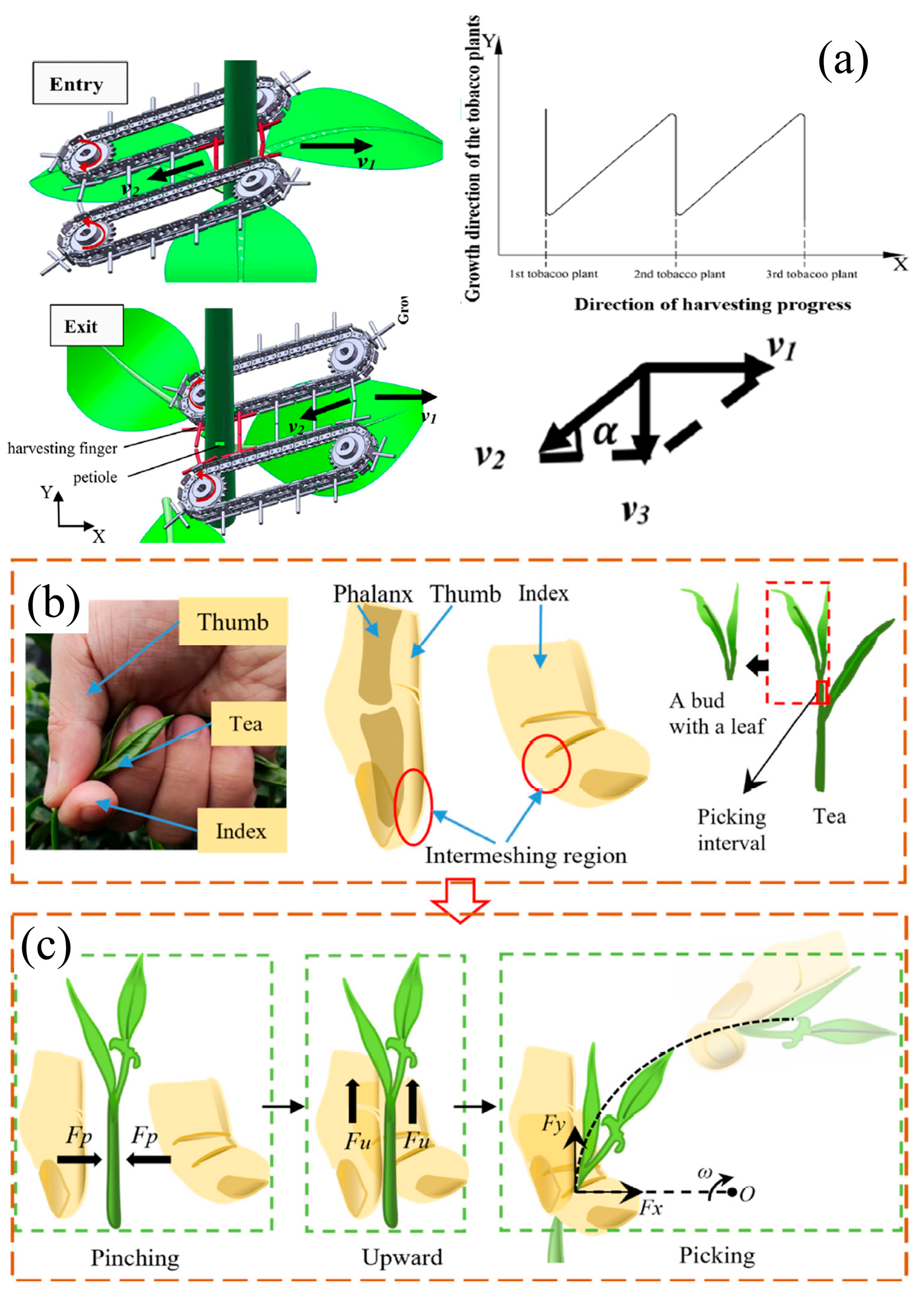
When processing high-value-added crops such as fresh fruits and vegetables, constructing bionic flexible contact interfaces has become a core strategy for reducing mechanical damage from a tribological and surface engineering perspective [144,145,146,147,148]. Rather than purely focusing on macroscopic robotic kinematics, recent research emphasises the interfacial friction and stress-buffering properties of these bionic surfaces. For instance, drawing reference from the soft tissue characteristics and epidermal friction of the human hand, Yu et al. [144] developed a flexible tobacco-leaf harvesting manipulator (Figure 8a); by replicating the flexible enveloping interface; this effectively avoids severe sliding friction and resolved the difficulties of tearing and breakage during the mechanical collection of tobacco leaves. Luo et al. [149] deeply analysed the biomechanical mechanisms of manual finger-pinching in tea harvesting, and by comparing the interfacial contact stress characteristics of the manual harvesting model (Figure 8b) and the bionic mechanical harvesting model (Figure 8c), they revealed the physical essence of low-damage interaction at the contact interface.
Furthermore, Luo et al. [150] established a fresh corn harvesting device with a non-dislocation baffle relying on bionic compliant surfaces, successfully reducing the ear damage rate to 0.32%. Additionally, Chen et al. [151] developed a soybean reel using low-modulus bionic coating materials to prevent pod shattering. The physical essence of low-damage interaction lies in impedance matching and reduction in the contact modulus at the solid–biological interface. Unlike traditional rigid surfaces that cause localised puncture or severe abrasive wear, compliant bionic functional surfaces significantly increase the effective contact area through their own micro/macro-scale elastic deformation, absorbing and dissipating high-frequency impact kinetic energy at the moment of collision; this ensures that the peak frictional and compressive stress transmitted to the crop epidermis always remains below its biomechanical yield strength limit [152,153], which fundamentally extends the concept of “wear resistance” to the protection of the fragile harvested objects themselves.
Figure 8. Typical bionic flexible executing mechanism designs for harvesting machinery: (a) three-dimensional model of the bionic flexible tobacco-leaf harvesting manipulator [144]; (b) biomechanical model of manual finger-pinching in tea harvesting; (c) schematic diagram of the mechanical interaction in bionic mechanical tea harvesting [145].
Lubricants 14 00238 g008
The multi-scale damage mechanisms of fruits and vegetables, alongside intelligent monitoring, provide critical evaluation metrics for the protective efficacy of bionic functional surfaces [146,147,148,154]. Zhou et al. [149] and Ashtiani et al. [155] utilised the finite element method to reveal the micro-evolutionary laws of concealed damage in fruits and vegetables under mechanical contact. Wu et al. [156] and Nadimi et al. [157] developed large visual models based on Transformers and convolutional neural networks, achieving precise online recognition of broken kernels and mechanical damage, which serves as a highly sensitive tool for quantifying the interfacial friction damage. In fact, mechanical damage is not purely macroscopic fragmentation but originates from the yielding and fracture of microscopic cell walls. Connecting real-time morphological monitoring networks with the execution feedback of bionic contact interfaces enables the mechanical system to dynamically perceive interfacial friction resistance changes and evaluate the real-time wear state of the interaction, ensuring that frictional and normal physical interaction loads are strictly restricted within the safe load-bearing envelope of the crop.
Facing complex vibrations and biomass corrosion in harvesting environments, the system-level protective role of multifunctional bionic coatings and morphologies is becoming increasingly prominent in mitigating surface degradation. Early alternate soft–hard phases constructed on aluminium surfaces via laser alloying [53,158], along with bionic superhydrophobic coatings synthesised using edible materials or PPS/PTFE [159,160], have provided solutions for interfacial isolation and anti-adhesion of viscous plant sap. Nath et al. [161] further discovered that bionic placoid scale structures can alter the vibration response of a flat plate without destroying its mode shape. Dynamic mechanistic analysis indicates that not only do hierarchical coatings physically isolate the biochemical corrosion of the metal matrix caused by crop sap (acidic or viscous), but also that specific topological arrangements can regulate the interfacial micro-vibration characteristics, thereby actively reducing the contact fatigue wear caused by high-frequency harvesting impacts. This comprehensive physicochemical protection, which accommodates both environmental tolerance [162] and surface lubrication [163], greatly extends the service life cycle of harvesting machinery under extreme heavy-duty conditions.

5. Conclusions and Future Perspectives

5.1. Conclusions

Research on bionic functional surfaces in the fields of friction reduction, wear resistance, and anti-adhesion in agricultural machinery has evolved from early morphological imitation into a systematic science encompassing multiphase media coupling and interfacial energy regulation. In terms of biological feature extraction and passive physical drag reduction, Garibaldi-Marquez et al. [26] successfully reduced draught resistance by 22.25% by utilising the claw toe curve of the ground squirrel; Zhang et al. [55] reduced wear mass by over 90% by replicating a micro-thorn-and-convex hull coupled structure. From the underlying logic of interfacial mechanics, the core value of bionic non-smooth features lies in severing the continuous stress network of traditional smooth surfaces. Through the optimisation of stress flow distribution via macroscopic geometric configurations, and the induction of friction mode transitions using micro/nano-topological structures (such as the transition from sliding friction to rolling friction), mechanical components are able to accomplish the physical cutting and separation of soil or hard stalks with extremely low energy dissipation.
Regarding mechanistic deepening and full-scenario applications, active electro-osmotic intervention and multi-physics simulation have constructed new technological boundaries. Ren et al. [164] and Massah et al. [27] achieved an adhesion reduction of up to 90% in their research on electro-osmotic soil detachment; Ucgul et al. [93] and Yu et al. [56] achieved high-precision digital predictions for disc ploughs and seed-metering flow channels using DEM-MBD models and discrete element parameter optimisation, respectively; Luo et al. [150] reduced the damage rate to 0.32% with a bionic picking device designed for fresh corn. Essentially, this is due to the deep integration of dynamic intervention and digital design. Active electric fields or dynamic micro-textures can forcibly alter the surface free energy of the solid–liquid interface, whilst strongly coupled simulations based on the discrete element method and fluid dynamics provide high-fidelity “digital twin” models for analysing the boundary layer friction laws of complex agricultural media (such as high-moisture soil, irregular seeds, and tender fruits and vegetables), thereby achieving refined impedance matching across varying operational scenarios.

5.2. Future Perspectives

Although bionic functional surfaces have demonstrated definitive feasibility in enhancing the service performance of agricultural machinery, transitioning from laboratory theories to engineering applications under extreme field conditions remains challenging. To bridge this gap in a structured manner, we outline our prospective vision across three critical dimensions where future research must seek disruptive breakthroughs: dynamic durability, large-scale continuous manufacturing, and digital-twin-driven intelligent perception.
Regarding the durability bottleneck under complex alternating farmland loads, we strongly believe that the ultimate solution relies on shifting from static “passive resistance” to dynamic “active adaptation.” While current research highlights intelligent self-healing microcapsule coatings (possessing near-infrared or pH responsiveness) [165,166] or macroscopic bionic textures protecting micro/nano-coatings [28], field environments are interwoven with intense mechanical impacts and continuous abrasive cutting. From our perspective, future bionic interfaces must construct a cross-scale chemo-mechanical network of “macroscopic energy-absorbing buffering, microscopic tear resistance, and molecular-level self-healing.” This will enable the functional surface to maintain thermodynamic and kinetic steady states during long-term heavy-duty operations.
In terms of advancing towards the low-cost, large-scale manufacturing of large-sized agricultural machinery components, our outlook projects that future process iterations must inevitably abandon batch-processing limitations. Currently, rolling imprint and hot-pressing replication processes have achieved high precision for micro-structures [167,168]. However, laboratory-grade high-energy beam or etching processes present immense energy dissipation and cost barriers when processing agricultural implements measuring several square metres. We posit that the industry must evolve towards high-deposition-rate techniques, continuous topological roll-to-roll forming, and in situ self-assembly. Only by radically reducing the thermodynamic potential barrier during the construction of hierarchical morphologies can the physical functionalisation of large-scale operational components be achieved economically [169].
Finally, we view the deep intersection of bionic interfaces and intelligent perception technologies as the catalyst that will thoroughly reshape the research paradigm of agricultural machinery tribology. Specifically, we anticipate that the next major scientific leap will be driven by high-fidelity “Digital Twins” powered by cross-scale DEM-MBD (Discrete Element Method and Multi-Body Dynamics) coupled simulations. Predictive models [170] and triboelectric nanogenerators [171] have laid the groundwork for wear perception. However, future breakthroughs will depend on digitally replicating the complex biomechanical interactions between the bionic surface and agricultural multiphase media prior to physical manufacturing. By utilising advanced DEM-MBD coupling to simulate flexible collision dynamics and cell-wall biomechanical yield limits, researchers can achieve precise interfacial impedance matching. Ultimately, by utilising the physical interface as a sensory antenna to capture real-time electrical signals of resistance, the executing mechanism will spontaneously adjust lubrication and cutting parameters, achieving an intelligent closed-loop transition to “state self-perception and damage self-decision-making.”

Author Contributions

Conceptualization, H.Z. and Z.T.; methodology, H.Z. and T.J.; software, J.Z. and D.L.; validation, H.Z., T.J. and J.Z.; formal analysis, H.Z. and D.L.; investigation, H.Z. and T.Ji.; resources, Z.T.; data curation, J.Z. and D.L.; writing—original draft preparation, H.Z.; writing—review and editing, H.Z., T.J. and Z.T.; visualization, J.Z. and D.L.; supervision, Z.T.; project administration, Z.T.; funding acquisition, Z.T. All authors have read and agreed to the published version of the manuscript.

Funding

This investigation is supported by the Postgraduate Research & Practice Innovation Program of Jiangsu Province (KYCX25_4246), Ministry of Education (MAET202326), Major Science and Technology Projects of Xinjiang Production and Construction Corps (Grant No. 2025AA01402-2) and The Modern Agricultural Machinery Equipment and Technology Promotion Project of Jiangsu Province (Grant No. NJ2025-16).

Data Availability Statement

No new data were created or analysed in this study.

Conflicts of Interest

The authors declare no conflicts of interest.

References

  1. Wang, B.; Du, X.X.; Wang, Y.N.; Mao, H.P. Multi-machine collaboration realization conditions and precise and efficient production mode of intelligent agricultural machinery. Int. J. Agric. Biol. Eng. 2024, 17, 27–36. [Google Scholar] [CrossRef]
  2. Zhu, X.Y.; Chikangaise, P.; Shi, W.D.; Chen, W.H.; Yuan, S.Q. Review of intelligent sprinkler irrigation technologies for remote autonomous system. Int. J. Agric. Biol. Eng. 2018, 11, 23–30. [Google Scholar] [CrossRef]
  3. Wu, P.L.; Lei, X.H.; Zeng, J.; Qi, Y.N.; Yuan, Q.C.; Huang, W.X.; Ma, Z.B.; Shen, Q.Y.; Lyu, X.L. Research progress in mechanized and intelligentized pollination technologies for fruit and vegetable crops. Int. J. Agric. Biol. Eng. 2024, 17, 11–21. [Google Scholar] [CrossRef]
  4. Wu, M.M.; Liu, S.Y.; Li, Z.Y.; Ou, M.X.; Dai, S.Q.; Dong, X.; Wang, X.W.; Jiang, L.; Jia, W.D. A Review of Intelligent Orchard Sprayer Technologies: Perception, Control, and System Integration. Horticulturae 2025, 11, 668. [Google Scholar] [CrossRef]
  5. Chen, Z.J.; Yin, J.J.; Farhan, S.M.; Liu, L.; Zhang, D.; Zhou, M.L.; Cheng, J.H. A comprehensive review of obstacle avoidance for autonomous agricultural machinery in multi-ope rational environment. Artif. Intell. Agric. 2026, 16, 139–163. [Google Scholar] [CrossRef]
  6. Yuan, Y.; Chen, L.; Wu, H.R.; Li, L. Advanced agricultural disease image recognition technologies: A review. Inf. Process. Agric. 2022, 9, 48–59. [Google Scholar] [CrossRef]
  7. Zhong, W.; Yang, W.T.; Wang, Y.F.; Dong, X.; Wang, X.W.; Jia, W.D.; Ou, M.X. Intelligent pesticide application system for intercropping: Development, challenges, and solutions based on monoculture machinery. Cogent Food Agric. 2025, 11, 2597615. [Google Scholar] [CrossRef]
  8. Guo, Y.F.; Sun, Z.Y.; Guo, S.; Fu, J.L. Research on a Novel Heat Treatment Process for Boron Steel Used for Soil-Engaging Components of Tillage Machinery. Agriculture 2024, 14, 1555. [Google Scholar] [CrossRef]
  9. Ren, L.Q.; Tong, J.; Li, J.Q.; Chen, B.C. Soil adhesion and biomimetics of soil-engaging components: A review. J. Agric. Eng. Res. 2001, 79, 239–263. [Google Scholar] [CrossRef]
  10. Aday, S.H.; Ramadhan, M.N. Comparison between the draft force requirements and the disturbed area of a single tine, parallel double tines and partially swerved double tines subsoilers. Soil Tillage Res. 2019, 191, 238–244. [Google Scholar] [CrossRef]
  11. Guan, C.S.; Fu, J.J.; Cui, Z.C.; Wang, S.L.; Gao, Q.S.; Yang, Y.T. Evaluation of the tribological and anti-adhesive properties of different materials coated rotary tillage blades. Soil Tillage Res. 2021, 209, 104933. [Google Scholar] [CrossRef]
  12. Guan, C.S.; Fu, J.J.; Xu, L.; Jiang, X.Z.; Wang, S.L.; Cui, Z.C. Study on the reduction of soil adhesion and tillage force of bionic cutter teeth in secondary soil crushing. Biosyst. Eng. 2022, 213, 133–147. [Google Scholar] [CrossRef]
  13. Gao, Y.Y.; Yang, Y.F.; Fu, S.; Feng, K.Y.; Han, X.; Hu, Y.Y.; Zhu, Q.Z.; Wei, X.H. Analysis of Vibration Characteristics of Tractor-Rotary Cultivator Combination Based on Time Domain and Frequency Domain. Agriculture 2024, 14, 1139. [Google Scholar] [CrossRef]
  14. Yin, J.J.; Gao, Y.S.; Guo, R.P.; Lv, S.Y.; Zhou, M.L.; Yu, D. Wear Calculation Method of Tripping Mechanism of Knotter Based on Rigid-Flexible Coupling Dynamic Model. Agriculture 2025, 15, 2229. [Google Scholar] [CrossRef]
  15. Zhang, H.L.; Tang, Z.; Gu, X.Y.; Zhang, B. Understanding the Lubrication and Wear Behavior of Agricultural Components Under Rice Interaction: A Multi-Scale Modeling Study. Lubricants 2025, 13, 388. [Google Scholar] [CrossRef]
  16. Zhang, F.; Chen, T.H.; Teng, S.; Wang, J.J.; Xu, R.L.; Guo, Z.J. Model construction for field operation machinery selection and configuration in wheat-maize double cropping system. Int. J. Agric. Biol. Eng. 2021, 14, 82–89. [Google Scholar] [CrossRef]
  17. Lu, B.; Han, F.K.; Aheto, J.H.; Rashed, M.M.A.; Pan, Z.G. Artificial bionic taste sensors coupled with chemometrics for rapid detection of beef adulteration. Food Sci. Nutr. 2021, 9, 5220–5228. [Google Scholar] [CrossRef]
  18. Xu, L.Z.; Ma, Z.; Li, Y.M. Test and Analyses of the Reciprocal Friction Properties between the Rapeseeds Threshing Mixture and Non-smooth Bionic Surface. Ama-Agric. Mech. Asia Afr. Lat. Am. 2016, 47, 17–23. [Google Scholar]
  19. Zhu, S.J.; Wang, B.; Pan, S.Q.; Ye, Y.T.; Wang, E.G.; Mao, H.P. Task Allocation of Multi-Machine Collaborative Operation for Agricultural Machinery Based on the Improved Fireworks Algorithm. Agronomy 2024, 14, 710. [Google Scholar] [CrossRef]
  20. Hu, J.P.; Xu, L.Z.; Yu, Y.; Lu, J.; Han, D.L.; Chai, X.Y.; Wu, Q.H.; Zhu, L.J. Design and Experiment of Bionic Straw-Cutting Blades Based on Locusta migratoria manilensis. Agriculture 2023, 13, 2231. [Google Scholar] [CrossRef]
  21. Tian, K.P.; Zhang, B.; Ji, A.M.; Huang, J.C.; Liu, H.L.; Shen, C. Design and experiment of the bionic disc cutter for kenaf harvesters. Int. J. Agric. Biol. Eng. 2023, 16, 116–123. [Google Scholar] [CrossRef]
  22. Zhang, F.; Teng, S.; Wang, Y.F.; Guo, Z.J.; Wang, J.J.; Xu, R.L. Design of bionic goat quadruped robot mechanism and walking gait planning. Int. J. Agric. Biol. Eng. 2020, 13, 32–39. [Google Scholar] [CrossRef]
  23. Ma, Z.; Wu, Z.P.; Li, Y.F.; Song, Z.Q.; Yu, J.; Li, Y.M.; Xu, L.Z. Study of the grain particle-conveying performance of a bionic non-smooth-structure screw conveyor. Biosyst. Eng. 2024, 238, 94–104. [Google Scholar] [CrossRef]
  24. Han, D.L.; Zhang, H.; Li, G.Y.; Wang, G.L.; Wang, X.Z.; Chen, Y.C.; Chen, X.G.; Wen, X.Y.; Yang, Q.Z.; Zhao, R.Q. Development of a Bionic Picking Device for High Harvest and Low Loss Rate Pod Pepper Harvesting and Related Working Parameter Optimization Details. Agriculture 2024, 14, 859. [Google Scholar] [CrossRef]
  25. Zhu, X.F.; Xu, Y.; Han, C.J.; You, J.; Zhang, X.J.; Mao, H.P.; Ma, X. Design and Experiment of In-Situ Bionic Harvesting Device for Edible Sunflower. Agriculture 2024, 14, 1169. [Google Scholar] [CrossRef]
  26. Garibaldi-Márquez, F.; Martínez-Reyes, E.; Morales-Morales, C.; Ramos-Cantú, L.; Castro-Bello, M.; González-Lorence, A. Subsoiler Tool with Bio-Inspired Attack Edge for Reducing Draft Force during Soil Tillage. AgriEngineering 2024, 6, 2678–2693. [Google Scholar] [CrossRef]
  27. Massah, J.; Fard, M.R.; Aghel, H. An optimized bionic electro-osmotic soil-engaging implement for soil adhesion reduction. J. Terramechanics 2021, 95, 1–6. [Google Scholar] [CrossRef]
  28. Wan, Y.; Sun, M.X.; Peng, H.Y.; Ma, L.; Liao, M.; Huang, H.J. A robust superhydrophobic coating fabricated by combination of laser texturing and electrostatic spraying for anti-soil adhesion. Appl. Surf. Sci. 2025, 703, 163355. [Google Scholar] [CrossRef]
  29. Abbaspour-Gilandeh, Y.; Fazeli, M.; Roshanianfard, A.; Hernández-Hernández, M.; Gallardo-Bernal, I.; Hernández-Hernández, J.L. Prediction of Draft Force of a Chisel Cultivator Using Artificial Neural Networks and Its Comparison with Regression Model. Agronomy 2020, 10, 451. [Google Scholar] [CrossRef]
  30. Hu, Y.G.; Asante, E.A.; Lu, Y.Z.; Mahmood, A.; Buttar, N.A.; Yuan, S.Q. A review of air disturbance technology for plant frost protection. Int. J. Agric. Biol. Eng. 2018, 11, 21–28. [Google Scholar] [CrossRef]
  31. Pilco-Romero, G.; Chisaguano-Tonato, A.M.; Herrera-Fontana, M.E.; Chimbo-Gándarac, L.F.; Sharifi-Rad, M.; Giampieri, F.; Battinof, M.; Vernaza, M.G.; Alvarez-Suárez, J.M. House cricket (Acheta domesticus): A review based on its nutritional composition, quality, and potential uses in the food industry. Trends Food Sci. Technol. 2023, 142, 104226. [Google Scholar] [CrossRef]
  32. Li, J.Q.; Kou, B.X.; Liu, G.M.; Fan, W.F.; Liu, L.L. Resistance reduction by bionic coupling of the earthworm lubrication function. Sci. China-Technol. Sci. 2010, 53, 2989–2995. [Google Scholar] [CrossRef]
  33. Zhang, D.G.; Chen, Y.X.; Ma, Y.H.; Guo, L.; Sun, J.Y.; Tong, J. Earthworm epidermal mucus: Rheological behavior reveals drag-reducing characteristics in soil. Soil Tillage Res. 2016, 158, 57–66. [Google Scholar] [CrossRef]
  34. Lu, J.B.; Ning, X.W.; Chen, Y.Y.; Li, Z.H.; Xie, H.; Wu, T.; Qu, J.P. Oriental mole cricket inspired micro/nanostructured surfaces for anti-adhesion and friction reduction. Tribol. Int. 2026, 219, 111862. [Google Scholar] [CrossRef]
  35. Wang, Z.; Zhang, Y.; Xu, H.J.; Du, H.; Yang, Z.Q.; Yang, J.Q.; Mao, Z.Q.; Wang, H.Z. Mechanism and Optimization of Adhesion and Resistance Reduction by Bionic Microtextured Rotary Tillage Blades in Soil-Straw Environment. Agriculture 2026, 16, 437. [Google Scholar] [CrossRef]
  36. Yang, X.F.; Xia, R.; Zhou, H.W.; Guo, L.; Zhang, L.J. Bionic surface design of cemented carbide drill bit. Sci. China-Technol. Sci. 2016, 59, 175–182. [Google Scholar] [CrossRef]
  37. Tan, H.C.; Shen, C.C.; Ma, J.L.; Wu, C.L.; Xu, L.M.; Ma, S. The reduction of energy consumption and soil disturbance mechanisms in trenching using biomimetic blades. Comput. Electron. Agric. 2025, 230, 109887. [Google Scholar] [CrossRef]
  38. Wang, W.W.; Song, J.L.; Zhou, G.A.; Pan, B.T.; Wang, Q.Q.; Chen, L.Q. Simulations and Experiments of the Seedbed Straw and Soil Disturbance as Affected by the Strip-Tillage of Rowcleaner (Dem). Inmateh-Agric. Eng. 2022, 66, 49–61. [Google Scholar] [CrossRef]
  39. Luo, Y.H.; Yuan, L.; Li, J.H.; Wang, J.S. Boundary layer drag reduction research hypotheses derived from bio-inspired surface and recent advanced applications. Micron 2015, 79, 59–73. [Google Scholar] [CrossRef]
  40. Chen, H.W.; Rao, F.G.; Shang, X.P.; Zhang, D.Y.; Hagiwara, I. Flow over bio-inspired 3D herringbone wall riblets. Exp. Fluids 2014, 55, 7. [Google Scholar] [CrossRef]
  41. Zheng, T.F.; Liu, J.B.; Qin, L.G.; Lu, S.; Mawignon, F.J.; Ma, Z.Y.; Hao, L.X.; Wu, Y.H.; An, D.; Dong, G.N. Effect of dolphin-inspired transverse wave microgrooves on drag reduction in turbulence. Phys. Fluids 2024, 36, 13. [Google Scholar] [CrossRef]
  42. Muthuramalingam, M.; Puckert, D.K.; Rist, U.; Bruecker, C. Transition delay using biomimetic fish scale arrays. Sci. Rep. 2020, 10, 14534. [Google Scholar] [CrossRef]
  43. Wang, H.C.; Ding, K.Q.; Zhang, G.Z.; Jiang, Z.; Salem, A.E.; Gao, Y. Research on drag reduction performance of sliding plate of rice direct seeding machine based on non-smooth structure of loach surface. J. Terramechanics 2023, 110, 79–85. [Google Scholar] [CrossRef]
  44. Wang, P.W.; Zhao, T.Y.; Bian, R.X.; Wang, G.Y.; Liu, H. Robust Superhydrophobic Carbon Nanotube Film with Lotus Leaf Mimetic Multiscale Hierarchical Structures. ACS Nano 2017, 11, 12385–12391. [Google Scholar] [CrossRef]
  45. Bixler, G.D.; Theiss, A.; Bhushan, B.; Lee, S.C. Anti-fouling properties of microstructured surfaces bio-inspired by rice leaves and butterfly wings. J. Colloid Interface Sci. 2014, 419, 114–133. [Google Scholar] [CrossRef]
  46. Li, J.W.; Tong, J.; Hu, B.; Ma, Y.H. Biomimetic functional surface of reducing soil adhesion on 65Mn steel. Adv. Mech. Eng. 2019, 11, 1687814019889801. [Google Scholar] [CrossRef]
  47. Han, Z.W.; Zhang, J.Q.; Ge, C.; Wen, L.; Ren, L.Q. Erosion Resistance of Bionic Functional Surfaces Inspired from Desert Scorpions. Langmuir 2012, 28, 2914–2921. [Google Scholar] [CrossRef]
  48. Han, Z.W.; Zhu, B.; Yang, M.K.; Niu, S.C.; Song, H.L.; Zhang, J.Q. The effect of the micro-structures on the scorpion surface for improving the anti-erosion performance. Surf. Coat. Technol. 2017, 313, 143–150. [Google Scholar] [CrossRef]
  49. Wang, Z.Z.; Wang, W.C.; Duan, X.H.; Bai, X.; Jiao, Z.B.; Wu, C.L.; Zhao, J.; Zhang, Z.H. Three-Dimensional Printing Biomimetic Ceramic Composites Inspired by the Desert Scorpion with Excellent Erosion Wear Resistance. Biomimetics 2026, 11, 248. [Google Scholar] [CrossRef] [PubMed]
  50. Zhang, W.W.; Zhang, M.Y.; Dong, X.L.; Huang, Y.Z.; Cao, S.K. Utilization of TiN and the Texture of Bionic Pangolin Scales to Improve the Wear Resistance of Cast Steel 20Mn Metal. Biomimetics 2025, 10, 42. [Google Scholar] [CrossRef] [PubMed]
  51. Cui, B.; Chen, K.; Yang, Y.; Lv, Y.; Zheng, H.M. The effect of biomimetic laser surface treatment on the wear performance of high manganese steel. Mater. Chem. Phys. 2024, 321, 129498. [Google Scholar] [CrossRef]
  52. Sun, N.; Shan, H.Y.; Zhou, H.; Chen, D.R.; Li, X.Y.; Xia, W.; Ren, L.Q. Friction and wear behaviors of compacted graphite iron with different biomimetic units fabricated by laser cladding. Appl. Surf. Sci. 2012, 258, 7699–7706. [Google Scholar] [CrossRef]
  53. Zhao, G.; Yuan, Y.; Wang, H.; Li, X.; Zhang, P.; Zhou, T.; Lin, H.; Jin, X.; Deng, Y. Study on wear properties of 7075 aluminum alloy by laser alloying imitating shell surface structure with different unit spacing. Mater. Chem. Phys. 2023, 297, 127327. [Google Scholar] [CrossRef]
  54. Zhao, Y.; Liao, G.R.; Li, X.; Gao, K.; Zhang, C.S.; Lv, X.S.; Ai, H.X.; Xie, X.B. Study on Wear Resistance of Nickel Cladding Layer with Imitation Shell Convex Strip Structure on the Surface of 7075 Aluminum Alloy Drill Pipe. Coatings 2023, 13, 1317. [Google Scholar] [CrossRef]
  55. Zhang, Q.Z.; Zuo, G.B.A.; Lai, Q.H.; Tong, J.; Zhang, Z.H. EDEM Investigation and Experimental Evaluation of Abrasive Wear Resistance Performance of Bionic Micro-Thorn and Convex Hull Geometrically Coupled Structured Surface. Appl. Sci. 2021, 11, 6655. [Google Scholar] [CrossRef]
  56. Yu, L.H.; Feng, C.; Chen, L.P.; Chen, Y.; Zheng, L.; Wu, Q.Z. DEM and soil bin study of a bionic planter under yellow clay. Comput. Part. Mech. 2026, 15, 1–14. [Google Scholar] [CrossRef]
  57. Li, X.P.; Li, Y.A.; Bin, P.; Sun, R.Z.; Xu, S.D.; Wang, J.Y.; Hou, J.R. Simulation Analysis of Fracture Process of High Moisture Content Corn Kernel Carpopodium. Appl. Sci. 2025, 15, 2215. [Google Scholar] [CrossRef]
  58. Lu, Y.Z.; Xu, W.X.; Leng, J.Y.; Liu, X.Y.; Xu, H.Y.; Ding, H.N.; Zhou, J.F.; Cui, L.F. Review and Research Prospects on Additive Manufacturing Technology for Agricultural Manufacturing. Agriculture 2024, 14, 1207. [Google Scholar] [CrossRef]
  59. Li, L.X.; Huang, Y.F.; Xing, Z.G.; Li, Z.X.; Wang, H.D. Research Progress of Ultrafast Laser Fabrication of Biomimetic Textures. China Surf. Eng. 2023, 36, 1–21. [Google Scholar] [CrossRef]
  60. Guo, Z.; Li, Z.H.; Cen, S.Y.; Liang, N.N.; Shi, J.Y.; Huang, X.W.; Zou, X.B. Preparation of Pangasius hypophthalmus protein-stabilized pickering emulsions and 3D printing application. J. Food Eng. 2023, 341, 111333. [Google Scholar] [CrossRef]
  61. Yang, K.; Yu, X.P.; Cui, X.X.; Chen, D.K.; Shen, T.; Liu, Z.X.; Zhang, B.W.; Chen, H.W.; Fang, R.C.; Dong, Z.C.; et al. Surface Modification of 3D Biomimetic Shark Denticle Structures for Drag Reduction. Adv. Mater. 2025, 37, 2417337. [Google Scholar] [CrossRef]
  62. Zhang, D.Y.; Li, Y.Y.; Han, X.; Li, X.A.; Chen, H.W. High-precision bio-replication of synthetic drag reduction shark skin. Chin. Sci. Bull. 2011, 56, 938–944. [Google Scholar] [CrossRef]
  63. Chen, H.W.; Che, D.; Zhang, X.; Yue, Y.; Zhang, D.Y. Large-proportional shrunken bio-replication of shark skin based on UV-curing shrinkage. J. Micromech. Microeng. 2015, 25, 017002. [Google Scholar] [CrossRef]
  64. Kim, T.W. Assessment of Hydro/Oleophobicity for Shark Skin Replica with Riblets. J. Nanosci. Nanotechnol. 2014, 14, 7562–7568. [Google Scholar] [CrossRef]
  65. Zhang, W.; Su, Y.; Liu, F.H.; Yang, H.; Wang, J.B. Study of Interactions between 3,4-Dihydroxyphenylalanine and Surfaces with Nano-, Micro- and Hierarchical Structures Using Colloidal Probe Technology. Acta Phys.-Chim. Sin. 2017, 33, 1644–1654. [Google Scholar] [CrossRef]
  66. Qin, L.G.; Hafezi, M.; Yang, H.; Dong, G.N.; Zhang, Y.L. Constructing a Dual-Function Surface by Microcasting and Nanospraying for Efficient Drag Reduction and Potential Antifouling Capabilities. Micromachines 2019, 10, 490. [Google Scholar] [CrossRef]
  67. Yuan, H.; Liang, S.F.; Wang, J.; Lu, Y.K. Numerical Simulation and Analysis of Vibrating Rice Filling Based on EDEM Software. Agriculture 2022, 12, 2013. [Google Scholar] [CrossRef]
  68. El-Emam, M.A.; Zhou, L.; Omara, A.I. Predicting the performance of aero-type cyclone separators with different spiral inlets under macroscopic bio-granular flow using CFD-DEM modelling. Biosyst. Eng. 2023, 233, 125–150. [Google Scholar] [CrossRef]
  69. Ahmad, F.; Qiu, B.J.; Ding, Q.S.; Ding, W.M.; Khan, Z.M.; Shoaib, M.; Chandio, F.A.; Rehim, A.; Khaliq, A. Discrete element method simulation of disc type furrow openers in paddy soil. Int. J. Agric. Biol. Eng. 2020, 13, 103–110. [Google Scholar] [CrossRef]
  70. Fu, W.G.; Zhang, J.Q.; Wang, D.; Li, P.P.; Yin, Q.L. Effects of soil moisture on Phragmites australis (Cav.) allelochemicals in soil and on growth of Phalaris arundinacea L. in Chinese Wetland. Allelopath. J. 2020, 51, 67–77. [Google Scholar] [CrossRef]
  71. Tang, L.D.; Shaikh, I.A.; Tunio, A.; Junejo, A.R.; Hao, L.; Dahri, J.; Mangrio, M.A.; Soothar, R.K.; Khan, Z.A. Effect of Raised Flat Bed and Ridge Planting on Wheat Crop Growth and Yield under Varying Soil Moisture Depletions. Agronomy 2024, 14, 1404. [Google Scholar] [CrossRef]
  72. Jia, X.A. Unsmooth cuticles of soil animals and theoretical analysis of their hydrophobicity and anti-soil-adhesion mechanism. J. Colloid Interface Sci. 2006, 295, 490–494. [Google Scholar] [CrossRef]
  73. Wang, H.; Luo, G.H.; Chen, L.; Song, Y.Q.; Liu, C.H.; Wu, L.Y. Preparation of a bionic lotus leaf microstructured surface and its drag reduction performance. Rsc Adv. 2022, 12, 16723–16731. [Google Scholar] [CrossRef]
  74. Lu, Y. Superior lubrication properties of biomimetic surfaces with hierarchical structure. Tribol. Int. 2018, 119, 131–142. [Google Scholar] [CrossRef]
  75. Zou, M.H.; Zhao, X.; Zhang, X.X.; Zhao, Y.J.; Zhang, C.W.; Shi, K.Q. Bio-inspired multiple composite film with anisotropic surface wettability and adhesion for tissue repair. Chem. Eng. J. 2020, 398, 125563. [Google Scholar] [CrossRef]
  76. Gao, F.; Yao, Y.; Wang, W.; Wang, X.F.; Li, L.; Zhuang, Q.X.; Lin, S.L. Light-Driven Transformation of Bio-Inspired Superhydrophobic Structure via Reconfigurable PAzoMA Microarrays: From Lotus Leaf to Rice Leaf. Macromolecules 2018, 51, 2742–2749. [Google Scholar] [CrossRef]
  77. Jung, Y.C.; Bhushan, B. Biomimetic structures for fluid drag reduction in laminar and turbulent flows. J. Phys.-Condes. Matter 2010, 22, 035104. [Google Scholar] [CrossRef] [PubMed]
  78. Bhatia, D.; Li, G.; Lin, Y.; Sun, J.; Barrington, P.; Li, H.; Wang, J. Transition Delay and Drag Reduction using Biomimetically Inspired Surface Waves. J. Appl. Fluid Mech. 2020, 13, 1207–1222. [Google Scholar] [CrossRef]
  79. Wang, T.C.; Chang, L.J.; Hatton, B.; Kong, J.; Chen, G.; Jia, Y.; Xiong, D.S.; Wong, C.P. Preparation and hydrophobicity of biomorphic ZnO/carbon based on a lotus-leaf template. Mater. Sci. Eng. C-Mater. Biol. Appl. 2014, 43, 310–316. [Google Scholar] [CrossRef]
  80. Wang, Z.C.; Yang, J.L.; Song, S.Y.; Liu, X.Q.; Li, S.H. A bio-inspired method to fabricate the substrate-independent Janus membranes with outstanding floatability for precise oil/water separation. Bull. Mat. Sci. 2021, 44, 153. [Google Scholar] [CrossRef]
  81. Zhang, Z.H.; Cao, Z.W.; Wei, D.S.; Ge, P.T.; Zhou, W.L.; Chen, G.Q.; Zu, Y.F.; Fu, X.S. Effects of Laser Shock Surface Dimple Texturing on Fretting Wear Behavior of Diamond-Like Carbon Coatings. Chin. J. Lasers 2025, 52, 11. [Google Scholar] [CrossRef]
  82. Wan, Q.; Zhong, W.Z.; Hu, X.Y.; Yang, S.C. Inhibitory Effect of Laser Surface Texturing in Dry Cutting of Titanium Alloy on Cemented Carbide Tool Wear. Int. J. Precis. Eng. Manuf. 2024, 25, 539–553. [Google Scholar] [CrossRef]
  83. Dai, Y.; Liu, D.; Bao, H.; Zhao, J.; Zhao, R.; Zhu, H.; Huang, C.; Zhang, Y.; Zhang, W. Friction-reducing and wear-resistant micro-textures on cast iron via shape-controlled maskless abrasive air jet machining. J. Braz. Soc. Mech. Sci. Eng. 2025, 47, 404. [Google Scholar] [CrossRef]
  84. Varenberg, M.; Halperin, G.; Etsion, I. Different aspects of the role of wear debris in fretting wear. Wear 2002, 252, 902–910. [Google Scholar] [CrossRef]
  85. Yu, A.B.; Niu, W.Y.; Hong, X.; He, Y.; Wu, M.C.; Chen, Q.J.; Ding, M.L. Influence of tribo-magnetization on wear debris trapping processes of textured dimples. Tribol. Int. 2018, 121, 84–93. [Google Scholar] [CrossRef]
  86. Rosenkranz, A.; Reinert, L.; Gachot, C.; Mücklich, F. Alignment and wear debris effects between laser-patterned steel surfaces under dry sliding conditions. Wear 2014, 318, 49–61. [Google Scholar] [CrossRef]
  87. Ma, Y.; Wang, H.; Xiao, Y.; Fan, X.; Tong, J.; Guo, L.; Tian, L. Friction and wear behaviour of steel with bionic non-smooth surfaces during sliding. Mater. Sci. Technol. 2016, 32, 257–265. [Google Scholar] [CrossRef]
  88. Cui, Y.Z.; Yan, B.Y.; Zheng, M.L.; Mu, H.J.; Liu, C.X.; Wang, D.Y.; Li, X.M.; Li, Q.W.; Jiang, H.; Wang, F.J.; et al. Optimization of Micro-Texture Parameters for Machine Tool Guide Rail Combination Based on Response Surface Methodology and Research on Its Anti-Friction and Lubrication Performance. Lubricants 2025, 13, 243. [Google Scholar] [CrossRef]
  89. Cui, Y.Z.; Zheng, M.L.; Zhang, W.; Wang, B.; Zhang, L. Study of dry sliding friction and wear behavior of bionic surface of hardened steel. Mater. Express 2019, 9, 535–544. [Google Scholar] [CrossRef]
  90. Nakano, S.; Ibrahim, M.D.; Mahmod, D.S.A.; Ochiai, M.; Iwamori, S. Tribological Evaluation of Biomimetic Shark Skin with Poly-DL-Lactic Acid (PDLLA) Nanosheets with Human Fingerprint Sliding Behavior. Lubricants 2025, 13, 432. [Google Scholar] [CrossRef]
  91. Jia, F.G.; Wei, H.J. FWDNet: A Novel Recognition Network for Ferrography Wear Debris Image Analysis. Wirel. Commun. Mob. Comput. 2022, 11, 6511235. [Google Scholar] [CrossRef]
  92. Zhang, F.; Chen, Z.J.; Wang, Y.F.; Bao, R.F.; Chen, X.G.; Fu, S.L.; Tian, M.M.; Zhang, Y.K. Research on Flexible End-Effectors with Humanoid Grasp Function for Small Spherical Fruit Picking. Agriculture 2023, 13, 123. [Google Scholar] [CrossRef]
  93. Ucgul, M. Simulating Soil–Disc Plough Interaction Using Discrete Element Method–Multi-Body Dynamic Coupling. Agriculture 2023, 13, 305. [Google Scholar] [CrossRef]
  94. Cao, H.T.; Xie, H.R.; Pan, D.; Qi, Y.C.; Richter, L.; Shen, Y.; Zou, M. An Analytical Modeling Framework for Martian Soil-Sampling Scoop Interaction with Numerical Validation. Aerospace 2026, 13, 237. [Google Scholar] [CrossRef]
  95. Tang, Z.Y.; Gong, H.; Wu, S.L.; Zeng, Z.W.; Wang, Z.Q.; Zhou, Y.H.; Fu, D.B.; Liu, C.; Cai, Y.H.; Qi, L. Modelling of paddy soil using the CFD-DEM coupling method. Soil Tillage Res. 2023, 226, 105591. [Google Scholar] [CrossRef]
  96. Kim, Y.-S.; Lee, S.-D.; Baek, S.-M.; Baek, S.-Y.; Jeon, H.-H.; Lee, J.-H.; Siddique, M.A.A.; Kim, Y.-J.; Kim, W.-S.; Sim, T.; et al. Development of DEM-MBD coupling model for draft force prediction of agricultural tractor with plowing depth. Comput. Electron. Agric. 2022, 202, 107405. [Google Scholar] [CrossRef]
  97. Zhang, R.X.; Zhu, H.T.; Chang, Q.L.; Mao, Q.R. A Comprehensive Review of Digital Twins Technology in Agriculture. Agriculture 2025, 15, 903. [Google Scholar] [CrossRef]
  98. El-Emam, M.A.; Yasser, E.; Shi, W.D.; Zhou, L. Characterization of particle-liquid two-phase flow for predicting wear evolution in a slurry centrifugal pump using CFD-DEM/CGDEM simulations. Powder Technol. 2026, 470, 122040. [Google Scholar] [CrossRef]
  99. Jajcevic, D.; Siegmann, E.; Radeke, C.; Khinast, J.G. Large-scale CFD–DEM simulations of fluidized granular systems. Chem. Eng. Sci. 2013, 98, 298–310. [Google Scholar] [CrossRef]
  100. Akhshik, S.; Behzad, M.; Rajabi, M. CFD-DEM simulation of the hole cleaning process in a deviated well drilling: The effects of particle shape. Particuology 2016, 25, 72–82. [Google Scholar] [CrossRef]
  101. Xu, C.; Li, X.; Liu, Z.H.; Zhou, D.; Wang, Z.X.; Chen, L.K.; Yang, J.; Zhou, L.Y.; Zhao, Y.Z. A resolved LBM-DEM coupling method for fluid-solid interaction of non-spherical particles based on the super-ellipsoid model. Particuology 2025, 103, 252–266. [Google Scholar] [CrossRef]
  102. Xiao, X.; Geng, M.; Peng, R.; Gao, J.; Zhao, L. Mitigating ceramic tool wear in GH4169 machining through pre-stressed cutting: Insights from DEM-FEM coupling. Eng. Fail. Anal. 2025, 182, 110166. [Google Scholar] [CrossRef]
  103. Zhang, D.Y.; Luo, Y.H.; Li, X.; Chen, H.W. Numerical Simulation and Experimental Study of Drag-Reducing Surface of a Real Shark Skin. J. Hydrodyn. 2011, 23, 204–211. [Google Scholar] [CrossRef]
  104. Yuan, Z.Y.; Ji, M.C.; Li, J.Y.; Zhang, Y.Q.; Song, X.Z.; Wang, Z.X.; Li, J.F.; Man, J. Optimization of drag-reduction microstructure parameters and study of the drag reduction mechanism in a rotating flow field. Phys. Fluids 2025, 37, 12. [Google Scholar] [CrossRef]
  105. Sanni, I.; Bellenger, E.; Fortin, J.; Coorevits, P. A reliable algorithm to solve 3D frictional multi-contact problems: Application to granular media. J. Comput. Appl. Math. 2010, 234, 1161–1171. [Google Scholar] [CrossRef][Green Version]
  106. Yu, H.Y.; Zhang, H.C.; Guo, Y.Y.; Tan, H.P.; Li, Y.; Xie, G.N. Thermodynamic analysis of shark skin texture surfaces for microchannel flow. Contin. Mech. Thermodyn. 2016, 28, 1361–1371. [Google Scholar] [CrossRef]
  107. Hijazi, S.; Tolouei, E. Bio-inspired Surface Texture Fluid Drag Reduction using Large Eddy Simulation. J. Appl. Fluid Mech. 2023, 16, 1175–1192. [Google Scholar] [CrossRef]
  108. Zhang, W.T.; Li, Z.; Cao, Q.Z.; Li, W.; Jiang, P. Calibration of Discrete Element Method Parameters for Cabbage Stubble-Soil Interface Using In Situ Pullout Force. Agriculture 2026, 16, 205. [Google Scholar] [CrossRef]
  109. Liu, J.; Xia, C.; Jiang, D.; Sun, Y. Development and Testing of the Power Transmission System of a Crawler Electric Tractor for Greenhouses. Appl. Eng. Agric. 2020, 36, 797–805. [Google Scholar] [CrossRef]
  110. Gao, J.; Qi, H. Soil Throwing Experiments for Reverse Rotary Tillage at Various Depths, Travel Speeds, and Rotational Speeds. Trans. Asabe 2017, 60, 1113–1121. [Google Scholar] [CrossRef]
  111. Tong, J.; Jiang, X.H.; Wang, Y.M.; Ma, Y.H.; Li, J.W.; Sun, J.Y. Tillage force and disturbance characteristics of different geometric-shaped subsoilers via DEM. Adv. Manuf. 2020, 8, 392–404. [Google Scholar] [CrossRef]
  112. Xu, Z.H.; Qi, H.Y.; Wang, L.D.; Wang, S.; Liu, X.T.; Ma, Y.H. DEM Study and Field Experiments on Coupling Bionic Subsoilers. Biomimetics 2025, 10, 306. [Google Scholar] [CrossRef] [PubMed]
  113. Li, J.G.; Qi, H.Y.; Ma, Y.H.; Gao, P.; Wu, B.G. Investigating Soil Adhesion and Antiadhesion Performance of Nonsmooth Subsoiler Surfaces. J. Eng. 2024, 14, 7019756. [Google Scholar] [CrossRef]
  114. Niu, J.P.; Luo, T.Y.; Xie, J.Q.; Cai, H.X.; Zhou, Z.K.; Chen, J.; Zhang, S. Simulation and experimental study on drag reduction and anti-adhesion of subsoiler with bionic surface. Int. J. Agric. Biol. Eng. 2022, 15, 57–64. [Google Scholar] [CrossRef]
  115. Sun, N.; Shan, H.Y.; Zhou, H.; Chen, D.R.; Ren, L.Q. Adhesion resistance surfaces against clay resulting from biomimetic adaptation. Surf. Coat. Technol. 2012, 206, 3559–3565. [Google Scholar] [CrossRef]
  116. Shan, H.; Zhou, H.; Sun, N.; Ren, L.; Chen, L.; Li, X. Study on adhesion resistance behavior of sample with striated non-smooth surface by laser processing technique. J. Mater. Process. Technol. 2008, 199, 221–229. [Google Scholar] [CrossRef]
  117. Zheng, X.; Hao, J.X.; Xie, H.Y.; Xu, W.B. Design and Analysis of a Bionic Pressing Roller Based on the Structural Characteristics of Pangolin Scales. Biomimetics 2026, 11, 50. [Google Scholar] [CrossRef]
  118. Yang, L.; Zhang, Z.H.; Yan, B.P.; Yuan, S.; Zhang, F. Design and evaluation of bio-inspired electro-osmosis system for reducing soil adhesion on agricultural equipment. Soil Tillage Res. 2025, 251, 106521. [Google Scholar] [CrossRef]
  119. Bai, H.B.; Li, X.Y.; Zeng, F.D.; Su, Q.; Cui, J.; Wang, J.Y.; Zhang, Y.Z. Calibration and Experiments of the Simulation Bonding Parameters for Plug Seedling Substrate Block. Inmateh-Agric. Eng. 2023, 69, 617–625. [Google Scholar] [CrossRef]
  120. Mao, H.P.; Kumi, F.; Li, Q.L.; Han, L.H. Combining X-ray computed tomography with relevant techniques for analyzing soil-root dynamics-an overview. Acta Agric. Scand. Sect. B-Soil Plant Sci. 2016, 66, 1–19. [Google Scholar] [CrossRef]
  121. Li, X.; Wang, R.Z.; Cai, Y.K.; Xu, B.Y.; Shi, Z.; Li, J.Q. Biomimetic eco-friendly matter-repellent surfaces with superior soil adhesion resistance. Surf. Interfaces 2025, 56, 105630. [Google Scholar] [CrossRef]
  122. Gao, T.Y.; Zhang, H.; Xu, J.; Ma, B.S.; Cong, Q. Effects of cylindrical pit array on tribological property of Piston Cylinder sleeve friction pair in a BW-250 slime pump. Tribol. Int. 2020, 151, 106505. [Google Scholar] [CrossRef]
  123. Li, J.W.; Jiang, X.H.; Ma, Y.H.; Tong, J.; Hu, B. Bionic Design of a Potato Digging Shovel with Drag Reduction Based on the Discrete Element Method (DEM) in Clay Soil. Appl. Sci. 2020, 10, 7096. [Google Scholar] [CrossRef]
  124. Li, P.; Li, H.; Li, J.S.; Huang, X.Q.; Liu, Y.; Jiang, Y. Effect of Aeration on Blockage Regularity and Microbial Diversity of Blockage Substance in Drip Irrigation Emitter. Agriculture 2022, 12, 1941. [Google Scholar] [CrossRef]
  125. Zhang, Z.Y.; Chen, C.; Li, H.; Xia, H.M. Design and Evaluation of a Control System for the Fertigation Device. J. Asabe 2022, 65, 1293–1302. [Google Scholar] [CrossRef]
  126. Gao, Y.Y.; Feng, K.Y.; Yang, S.; Han, X.; Wei, X.H.; Zhu, Q.Z.; Chen, L.P. Design and Experiment of an Unmanned Variable-Rate Fertilization Control System with Self-Calibration of Fertilizer Discharging Shaft Speed. Agronomy 2024, 14, 2336. [Google Scholar] [CrossRef]
  127. Wang, L.X.; Gao, J.M.; Qureshi, W.A. Evolution and Application of Precision Fertilizer: A Review. Agronomy 2025, 15, 1939. [Google Scholar] [CrossRef]
  128. Tang, P.; Li, H.; Issaka, Z.; Chen, C. Effect of manifold layout and fertilizer solution concentration on fertilization and flushing times and uniformity of drip irrigation systems. Agric. Water Manag. 2018, 200, 71–79. [Google Scholar] [CrossRef]
  129. Zhu, Y.L.; Ma, Z.; Wu, Z.P.; Zhang, Z.L.; Li, Y.M.; Wang, L.; Pan, Y. Monitoring and blockage diagnosis in axial flow threshing and separation device under variable feed conditions. Biosyst. Eng. 2025, 258, 104262. [Google Scholar] [CrossRef]
  130. Yan, J.G.; Liu, Z.Y.; Wang, L.J.; Zhao, X.Y.; Liu, F. Design and Experiment of a Seed-Metering Device Based on the Physical Properties of Cyperus esculentus L. Seeds Appl. Sci. 2026, 16, 1008. [Google Scholar] [CrossRef]
  131. Shi, L.R.; Zhao, W.Y.; Hua, C.T.; Rao, G.; Guo, J.H.; Wang, Z. Study on the Intercropping Mechanism and Seeding Improvement of the Cavity Planter with Vertical Insertion Using DEM-MBD Coupling Method. Agriculture 2022, 12, 1567. [Google Scholar] [CrossRef]
  132. Zhang, B.; Pan, D.; Liu, Q.C.; Shen, W.M.; Liu, G.Y. Simulation and Experiment of the Interaction Process Between Seeding and Soil-Engaging for Transverse Sugarcane Planter. Agriculture 2026, 16, 853. [Google Scholar] [CrossRef]
  133. Shahzad, K.; Van Aeken, W.; Mottaghi, M.; Kamyab, V.K.; Kuhn, S. Aggregation and clogging phenomena of rigid microparticles in microfluidics, Microfluid. Nanofluid 2018, 22, 104. [Google Scholar] [CrossRef]
  134. Qiu, Z.; Xiao, Q.; Yuan, H.; Han, X.; Li, C. Particle shape and clogging in fluid-driven flow: A coupled CFD-DEM study. Powder Technol. 2024, 437, 119566. [Google Scholar] [CrossRef]
  135. Pu, X.; Li, G.J.; Huang, H.L. Preparation, anti-biofouling and drag-reduction properties of a biomimetic shark skin surface. Biol. Open 2016, 5, 389–396. [Google Scholar] [CrossRef] [PubMed]
  136. Tang, B.; Yue, Y.Y.; Gai, Z.P.; Huang, Y.; Liu, Y.; Gao, X.L.; Sun, J.Y.; Wu, D.M. Utilization of Melt Fracture Phenomenon for the Preparation of Shark Skin Structured Hydrophobic Film. Polymers 2021, 13, 4299. [Google Scholar] [CrossRef]
  137. Ibrahim, M.D.; Philip, S.; Lam, S.S.; Sunami, Y.J.T.O. Evaluation of an Antifouling Surface Inspired by Malaysian Sharks Negaprion Brevirostris and Carcharhinus Leucas Riblets. Tribol. Online 2021, 16, 70–80. [Google Scholar] [CrossRef]
  138. Wang, Y.; Cai, J.Z.; Lin, H.; Ouyang, Q.; Liu, Z.H. Deep learning-assisted self-cleaning cellulose colorimetric sensor array for monitoring black tea withering dynamics. Food Chem. 2025, 487, 144727. [Google Scholar] [CrossRef] [PubMed]
  139. Zheng, Y.X.; Yin, L.M.; Jayan, H.; Jiang, S.Q.; El-Seedi, H.R.; Zou, X.B.; Guo, Z.M. In situ self-cleaning PAN/Cu2O@Ag/Au@Ag flexible SERS sensor coupled with chemometrics for quantitative detection of thiram residues on apples. Food Chem. 2025, 473, 143032. [Google Scholar] [CrossRef]
  140. Jiang, L.; Wei, W.Y.; Liu, S.S.; Haruna, S.A.; Zareef, M.; Ahmad, W.; Hassan, M.M.; Li, H.H.; Chen, Q.S. A tailorable and recyclable TiO2 NFSF/Ti@Ag NPs SERS substrate fabricated by a facile method and its applications in prohibited fish drugs detection. J. Food Meas. Charact. 2022, 16, 2890–2898. [Google Scholar] [CrossRef]
  141. Yan, T.B.; Wu, C.H.; Shi, X.L.; Chen, K.P.; Chen, W.H. Combining Oil-Solid Dual Lubrication System with Bionic Scaly Texture to Improve the Tribological Performance of AISI 4140 Steel. J. Mater. Eng. Perform. 2026, 35, 12607–12622. [Google Scholar] [CrossRef]
  142. Ye, H.Y.; Chen, Y.X.; Zhong, W.; Jiang, Y.Y. Study on the Optimization of Tribological Properties of Ductile Iron by Micro-Texture and Solid Lubrication Coatings. Lubr. Sci. 2026, 1–14. [Google Scholar] [CrossRef]
  143. Yan, G.Y.; Sun, Y.B.; Wang, H.; Wu, Y.H.; Li, B.W.; Li, S.H. Preparation and Mechanical Properties of Diamond Films on Textured WC-Co Substrate. Adv. Eng. Mater. 2025, 27, 2402962. [Google Scholar] [CrossRef]
  144. Yu, J.; Chu, J.K.; Zhang, M.Q.; Ran, Y.L.; Dong, X.; Gao, H.T.; Ma, Z.; Xu, L.Z.; Liu, Y.B.; Wang, S.; et al. Design and testing of a bionic flexible low-damage tobacco-leaf harvesting mechanism. Rev. Bras. Eng. Agric. Ambient. 2025, 29, 9. [Google Scholar] [CrossRef]
  145. Luo, K.; Wu, Z.M.; Cao, C.M.; Qin, K.; Zhang, X.C.; An, M.H. Biomechanical Characterization of Bionic Mechanical Harvesting of Tea Buds. Agriculture 2022, 12, 1361. [Google Scholar] [CrossRef]
  146. Zhang, H.L.; Sun, H.Y.; Tang, Z.; Wang, G.Q. Integrated agronomy of pea (Pisum sativum L.): A review on cultivation, harvesting, and storage for sustainable agriculture. Front. Plant Sci. 2025, 16, 1670445. [Google Scholar] [CrossRef] [PubMed]
  147. Zhang, H.L.; Tang, Z.; Sun, H.Y.; Wang, G.Q. Enhancing the food application value of pea (Pisum sativum L.): A systematic review on genetic improvement, processing, and biotransformation. Aip Adv. 2025, 15, 25. [Google Scholar] [CrossRef]
  148. Zhang, H.L.; Tang, Z.; Tian, L.Q.; Jing, T.T.; Zhang, B. An Analytical and Numerical Study of Wear Distribution on the Combine Harvester Header Platform: Model Development, Comparison, and Experimental Validation. Lubricants 2025, 13, 482. [Google Scholar] [CrossRef]
  149. Zhou, L.H.; Kang, N.B.; Qu, Q.J.; Zhang, H.B.; Zhang, J.; Hu, K.K. Advances in Multi-Scale Biomechanics of Fruits and Vegetables: A Review. J. Food Process Eng. 2024, 47, e14778. [Google Scholar] [CrossRef]
  150. Luo, H.Z.; Nie, J.S.; Zhang, L.H. Design and Test of Dislocation Baffle Roller Bionic Picking Device for Fresh Corn. Agriculture 2023, 13, 991. [Google Scholar] [CrossRef]
  151. Chen, Y.X.; Wang, S.G.; Li, B.; Liu, Y.; Tang, Z.; He, X.Y.; Jing, J.P.; Zhou, W.W. Influence Mechanism and Optimal Design of Flexible Spring-Tooth Reel Mechanism for Soybean Pod-Shattering Reduction. Agriculture 2025, 15, 1378. [Google Scholar] [CrossRef]
  152. Ji, W.; Qian, Z.J.; Xu, B.; Tang, W.; Li, J.L.; Zhao, D.A. Grasping damage analysis of apple by end-effector in harvesting robot. J. Food Process Eng. 2017, 40, e12589. [Google Scholar] [CrossRef]
  153. Chen, K.W.; Li, T.; Yan, T.J.; Xie, F.; Feng, Q.C.; Zhu, Q.Z.; Zhao, C.J. A Soft Gripper Design for Apple Harvesting with Force Feedback and Fruit Slip Detection. Agriculture 2022, 12, 1802. [Google Scholar] [CrossRef]
  154. Zhang, H.L.; Tian, L.Q.; Tang, Z.; Fang, M.; Zhang, B. Friction-Reduction Mechanism and Performance Optimization of Biomimetic Non-Smooth Surfaces Inspired by Dung Beetle Microstructures. Lubricants 2025, 13, 490. [Google Scholar] [CrossRef]
  155. Ashtiani, S.H.M.; Sadrnia, H.; Mohammadinezhad, H.; Aghkhani, M.H.; Khojastehpour, M.; Abbaspour-Fard, M.H. FEM-based simulation of the mechanical behavior of grapefruit under compressive loading. Sci. Hortic. 2019, 245, 39–46. [Google Scholar] [CrossRef]
  156. Wu, Y.H.; Fan, C.L.; Dong, M.; Liu, Y.; Qiao, M.M.; Yang, Y.T. An online prediction method for maize kernel breakage rate based on transformer models. Measurement 2026, 275, 121369. [Google Scholar] [CrossRef]
  157. Nadimi, M.; Divyanth, L.G.; Paliwal, J. Automated Detection of Mechanical Damage in Flaxseeds Using Radiographic Imaging and Machine Learning. Food Bioprocess Technol. 2023, 16, 526–536. [Google Scholar] [CrossRef]
  158. Zhao, G.P.; Yuan, Y.H.; Zhang, P.; Zhou, T.; Wang, H.W.; Li, X.F.; Zhou, H. Effect of hardness gradient of laser bionic coupling unit on wear resistance of 6082 aluminum alloy. Opt. Laser Technol. 2022, 153, 108172. [Google Scholar] [CrossRef]
  159. Li, Y.; Bi, J.R.; Wang, S.Q.; Zhang, T.; Xu, X.M.; Wang, H.T.; Cheng, S.S.; Zhu, B.W.; Tan, M.Q. Bio-inspired Edible Superhydrophobic Interface for Reducing Residual Liquid Food. J. Agric. Food Chem. 2018, 66, 2143–2150. [Google Scholar] [CrossRef]
  160. Sun, N.; Qin, S.; Wu, J.T.; Cong, C.B.; Qiao, Y.C.; Zhou, Q. Bio-Inspired Superhydrophobic Polyphenylene Sulfide/Polytetrafluoroethylene Coatings with High Performance. J. Nanosci. Nanotechnol. 2012, 12, 7222–7225. [Google Scholar] [CrossRef]
  161. Atri, N.; Aninda, P.; Prabhakar, A.; Ritwik, G.; Nilanjan, M.J.M.B.D.O.S. Machines, Shark skin biomimetic surface modification for plates: Influence on free vibration response. Mech. Based Des. Struct. Mach. 2024, 52, 1874–1897. [Google Scholar]
  162. Lufu, R.; Ambaw, A.; Opara, U.L. Water loss of fresh fruit: Influencing pre-harvest, harvest and postharvest factors. Sci. Hortic. 2020, 272, 109519. [Google Scholar] [CrossRef]
  163. Hao, L.X.; Fan, B. Slippery liquid-like surfaces as a promising solution for sustainable drag reduction. Nanoscale 2025, 17, 6448–6459. [Google Scholar] [CrossRef] [PubMed]
  164. Ren, L.Q.; Cong, Q.; Tong, J.; Chen, B.C. Reducing adhesion of soil against loading shovel using bionic electro-osmosis method. J. Terramechanics 2001, 38, 211–219. [Google Scholar] [CrossRef]
  165. Shen, T.T.; Zou, X.B.; Shi, J.Y.; Li, Z.H.; Huang, X.W.; Xu, Y.W.; Chen, W. Determination Geographical Origin and Flavonoids Content of Goji Berry Using Near-Infrared Spectroscopy and Chemometrics. Food Anal. Methods 2016, 9, 68–79. [Google Scholar] [CrossRef]
  166. Yue, P.P.; Zhang, M.; Zhao, T.; Liu, P.; Peng, F.; Yang, L.Q. Eco-friendly epoxidized Eucommia ulmoides gum based composite coating with enhanced super-hydrophobicity and corrosion resistance properties. Ind. Crops Prod. 2024, 214, 118523. [Google Scholar] [CrossRef]
  167. Guo, C.F.; Tian, Q.Q.; Wang, H.R.; Sun, J.X.; Du, L.Q.; Wang, M.J.; Zhao, D.Y. Roller embossing process for the replication of shark-skin-inspired micro-riblets. Micro Nano Lett. 2017, 12, 439–444. [Google Scholar] [CrossRef]
  168. Han, X.; Zhang, D.Y.; Li, X.; Li, Y.Y. Bio-replicated forming of the biomimetic drag-reducing surfaces in large area based on shark skin. Chin. Sci. Bull. 2008, 53, 1587–1592. [Google Scholar] [CrossRef]
  169. Li, Y.N.; Zhang, P.L. An online de-noising method for oil ultrasonic wear debris signal: Fuzzy morphology component analysis. Ind. Lubr. Tribol. 2018, 70, 1012–1019. [Google Scholar] [CrossRef]
  170. Liao, J.; Hewitt, A.J.; Wang, P.; Luo, X.W.; Zang, Y.; Zhou, Z.Y.; Lan, Y.B.; O’Donnell, C. Development of droplet characteristics prediction models for air induction nozzles based on wind tunnel tests. Int. J. Agric. Biol. Eng. 2019, 12, 1–6. [Google Scholar] [CrossRef]
  171. Liu, M.J.; Zhang, X.; Xin, Y.; Guo, D.X.; Hu, G.K.; Ma, Y.F.; Yu, B.; Huang, T.; Ji, C.C.; Zhu, M.F.; et al. Earthworm-Inspired Ultra-Durable Sliding Triboelectric Nanogenerator with Bionic Self-Replenishing Lubricating Property for Wind Energy Harvesting and Self-Powered Intelligent Sports Monitoring. Adv. Sci. 2024, 11, 13. [Google Scholar] [CrossRef]
Figure 1. Typical biological prototypes for drag reduction and anti-adhesion and their bionic application designs: (a) Optical image of the Oriental mole cricket; SEM of the (b) pronotum, (c) wing, and (d) abdomen. Specifically: (b1b3) detailed morphology of the pronotum showing dense microhairs with basal rings (b1), sawtooth-like patterns on the setae forming directed microchannels (b2), and the dense distribution of basal rings (b3); (c1,c2) detailed morphology of the wing showing long bristles concentrated along the anterior margin (c1) and dense conical microhairs clustered along the wing veins (c2); (d1,d2) detailed morphology of the abdomen showing slightly curved bristles oriented toward the tail (d1) and a textured surface with oval microhairs at the base (d2) [34]; (e) specimen image of the dung beetle; (f) schematic diagram of the bionic convex hull micro-structure, the (f1f3) are ordinary rotary tillage blade, parameter optimization rotary tillage blade, and bionic optimization rotary tillage blade; (g) schematic diagram of the structure and soil-detaching principle of the bionic rotary tillage blade [35].
Lubricants 14 00238 g001
Figure 2. Typical wear-resistant biological prototype features and the design of their bionic surface micro-textures: (a) macroscopic overall morphology of the desert scorpion and scanning electron microscopy (SEM) images of the microscopic protrusion morphology on its dorsal surface [49]; (b) structural feature diagram of the overlapping arrangement of pangolin body surface scales; (c) geometric feature diagram of the bionic micro-texture extracted and designed based on pangolin scales [50].
Lubricants 14 00238 g002
Figure 3. High-precision characterisation and extraction of microscopic features of typical biological tissues and body surfaces: (a) internal three-dimensional topological structure model of a high-moisture corn carpopodium extracted based on CT scanning technology [57]; (b) precise morphology and characteristic parameters of the non-smooth microscopic structure on the head surface of a dung beetle obtained based on a white light interferometer [56].
Lubricants 14 00238 g003
Figure 5. Regulatory mechanisms of bionic surfaces on the movement state of abrasive particles and the micro-damage evolution process of metal surfaces caused by crop particles: (a) induction model for the movement of soil particles by the bionic micro-thorn and convex hull geometrically coupled surface [55]; (b) micro-cutting and interfacial stress distribution characteristics under the interaction between rice particles and steel plates [15].
Lubricants 14 00238 g005
Disclaimer/Publisher’s Note: The statements, opinions and data contained in all publications are solely those of the individual author(s) and contributor(s) and not of MDPI and/or the editor(s). MDPI and/or the editor(s) disclaim responsibility for any injury to people or property resulting from any ideas, methods, instructions or products referred to in the content.