1. Introduction
Cavitation is a fascinating natural and technical phenomenon that occurs only in fluids under specific conditions. At the same time, it is a destructive process, demonstrating that fluids, under certain circumstances, can produce forces more damaging than those of solid materials. In the context of machine design, cavitation represents a major cause of failure in machine components.
All liquids possess a limited capacity to sustain tensile stresses. When the local pressure drops sufficiently, this limitation results in cavitation, characterised by a reduction in density and the nucleation and growth of vapour- or gas-filled cavities (bubbles) within the fluid. Since cavitation is a fundamental property of all fluids, it is widely encountered in various practical applications. It is most especially observed in high-speed vessels and ships, as well as in a range of bladed mechanisms, including hydro turbines, pumps, and propellers. Engineering experience has also shown that cavitation can occur in the operation of certain general-purpose machine elements, such as gears, plain bearings, rolling bearings, seals, and others. For this reason, extensive research is being conducted on the physical and hydrodynamic nature of cavitation phenomena, as well as on the various effects of cavitation, which often cause material damage and, in many cases, lead to the loss of operational ability of hydraulic systems and machine elements.
The literature considered in this review was selected through a structured search of major scientific databases, including Scopus, Web of Science, and Google Scholar, as well as by screening publications in relevant peer-reviewed journals in the fields of tribology, fluid mechanics, and machine elements. The selection was guided by key terms related to cavitation, cavitation erosion, degradation of machine elements, and standardization in line with the main topics addressed in this study. Given the multidisciplinary and long-standing nature of cavitation research, both seminal foundational works and recent publications were included to ensure a comprehensive and balanced representation of the field. Particular emphasis was placed on recent studies in order to capture current developments and emerging research trends.
The phenomenon of cavitation has been observed since ancient times. Isaac Newton was the first to record the appearance of Newton’s rings in water between a convex lens and a flat glass surface, describing them in his Opticks in 1704. By pressing the upper glass at different points along its edges, he observed how the rings rapidly shifted from one position to another, while a small white spot followed their center and immediately disappeared upon water penetration at that location. In 1754, Euler, in his work on turbines, indirectly predicted a phenomenon that later puzzled many engineers throughout the nineteenth century, the loss of the desired water flow by steamship propellers under certain operating conditions, which resulted in engines running at higher rotational speeds. In 1873, Reynolds conducted experiments on a 30-inch ship model and observed that the propeller’s ability to maintain the required inflow of water decreased when air was present behind the blades [
1,
2]. In a later study, Reynolds developed the well-known Reynolds equation for hydrodynamic lubrication, assuming a continuous fluid film. Subsequent work by Sommerfel in 1904, extended this solution, revealing regions of predicted sub-atmospheric pressure in the divergent part of the lubricating film. These findings later highlighted the importance of considering film rupture and cavitation phenomena in tribological contacts [
3].
Further observations of cavitation effects on ship propellers were reported by Parson in 1893, who subsequently constructed the first experimental hydrodynamic tunnel. Together with Barnaby, he described the formation of bubbles around propeller blades when the pressure in their vicinity dropped below a critical level. The term cavitation first appeared in the literature in 1895, introduced by Barnaby and Thornycroft at the suggestion of Froude. A systematic theoretical study of bubble dynamics was later carried out by Rayleigh in 1917. Subsequent investigations by Lamb in 1923, Cole in 1948, and Blake and Plesset in 1949, among others, further contributed to the understanding of cavitation processes [
1,
2,
4,
5,
6].
Systematic experimental studies of cavitation erosion began in the 1930s, particularly in the fields of hydropower and naval engineering, leading to the development of specialized testing methods and cavitation tunnels. After the mid-twentieth century, research activity increased significantly as hydraulic systems became more powerful and widespread. Since the 1970s, advances in experimental techniques, high-speed visualization, and numerical modeling have resulted in a rapid growth of studies devoted to cavitation mechanisms and cavitation erosion of engineering materials and components.
In recent decades, the rapid development of computational fluid dynamics (CFD), advanced surface characterization methods, and new engineering materials has further accelerated research in this field. As a result, cavitation and cavitation erosion are now recognized as important degradation mechanisms not only in hydraulic equipment but also in a wide range of machine elements and tribological systems, motivating continued investigation into their mechanisms, prediction, and mitigation.
There is a certain number of review papers that address cavitation, cavitation-induced damage, and the mechanical systems in which these phenomena occur. Several review papers have addressed cavitation primarily from the perspective of material behavior and degradation mechanisms. Early work provided a comprehensive analysis of cavitation erosion, examining microstructural aspects of plastic deformation, experimental evaluation methods, correlations between erosion resistance and mechanical properties, as well as predictive models and mitigation strategies [
7]. More recent studies have focused on material degradation and protection against cavitation erosion, emphasizing surface modification techniques and the influence of hardness, ductility, and fatigue strength on erosion resistance [
8]. In a broader tribological context, other reviews have discussed cavitation erosion of propulsion materials and the complex interactions between mechanical and electrochemical processes [
9].
Research has also focused on the modeling of cavitation as a hydrodynamic phenomenon, as well as the prediction of cavitation-induced erosion on machine components. Some studies focus on CFD approaches for simulating cavitating flows, linking the models to practical applications in hydraulic machinery and other engineering systems, while also considering the impact of cavitation on material erosion and component performance [
10,
11,
12]. Other reviews specifically examine numerical methods for predicting cavitation erosion, including fluid–structure interaction, micro-jet, and energy-balance models, highlighting their relevance for evaluating wear and fatigue in pumps, valves, and other fluid-handling equipment [
13,
14]. Additionally, research on specific hydraulic technologies, such as gerotor and gear pumps, emphasizes the use of modeling and simulations to forecast cavitation occurrence, optimize geometry, and minimize erosive wear [
15].
Earlier review papers considered cavitation primarily as a hydrodynamic phenomenon. However, over time, increasing attention within the scientific and engineering communities has been directed toward the material degradation and damage of finished mechanical components caused by cavitation. Subsequent reviews have therefore focused on cavitation-induced material degradation in the form of erosive wear, most often in the context of hydraulic machinery and its components [
16]. In particular, cavitation erosion has been extensively reported in pumps [
17,
18,
19], valves [
19], propellers [
17,
20], turbines and turbine runners [
17,
20,
21], impellers [
20,
22], as well as bearings and seals [
22], highlighting its practical significance in fluid-handling systems.
The main objective of this review is to systematically analyze cavitation in machine elements by synthesizing existing knowledge from experimental investigations, numerical simulations, and standardized testing approaches. The study aims to identify key existing limitations and limitations in current methodologies, particularly the lack of a unified framework that directly links cavitation erosion mechanisms with the load-carrying capacity, reliability, and durability of machine elements. Based on this analysis, the paper further outlines directions for future research toward the development of more integrated and predictive approaches for assessing cavitation-induced damage in engineering systems.
The originality of this review lies in its comprehensive scope, which integrates historical development, fundamental concepts, standards, material behavior, and modern computational approaches within a single structured overview of cavitation in machine elements. Unlike most existing review papers that focus on isolated aspects of cavitation erosion, this study provides a unified synthesis and critical assessment of the state of the art, highlighting key research gaps and future research directions.
2. Impacts of Cavitation
Cavitation in fluid systems has both short-term and long-term negative effects, impacting machine performance and broader environmental and economic sustainability. In the short term, cavitation causes surface damage (e.g., increased roughness, reduced strength, and durability), leading to the loss of operational ability of machine elements and fluid systems. This results in downtime, frequent repairs, and increased resource consumption. Over time, wear particles generated by cavitation contaminate the fluid, degrade other system components (through clogging, settling, and secondary wear), and disrupt industrial processes. On a larger scale, fluid contamination can affect drinking water quality, disrupt aquatic ecosystems, and endanger human health, ultimately threatening ecological balance and economic sustainability.
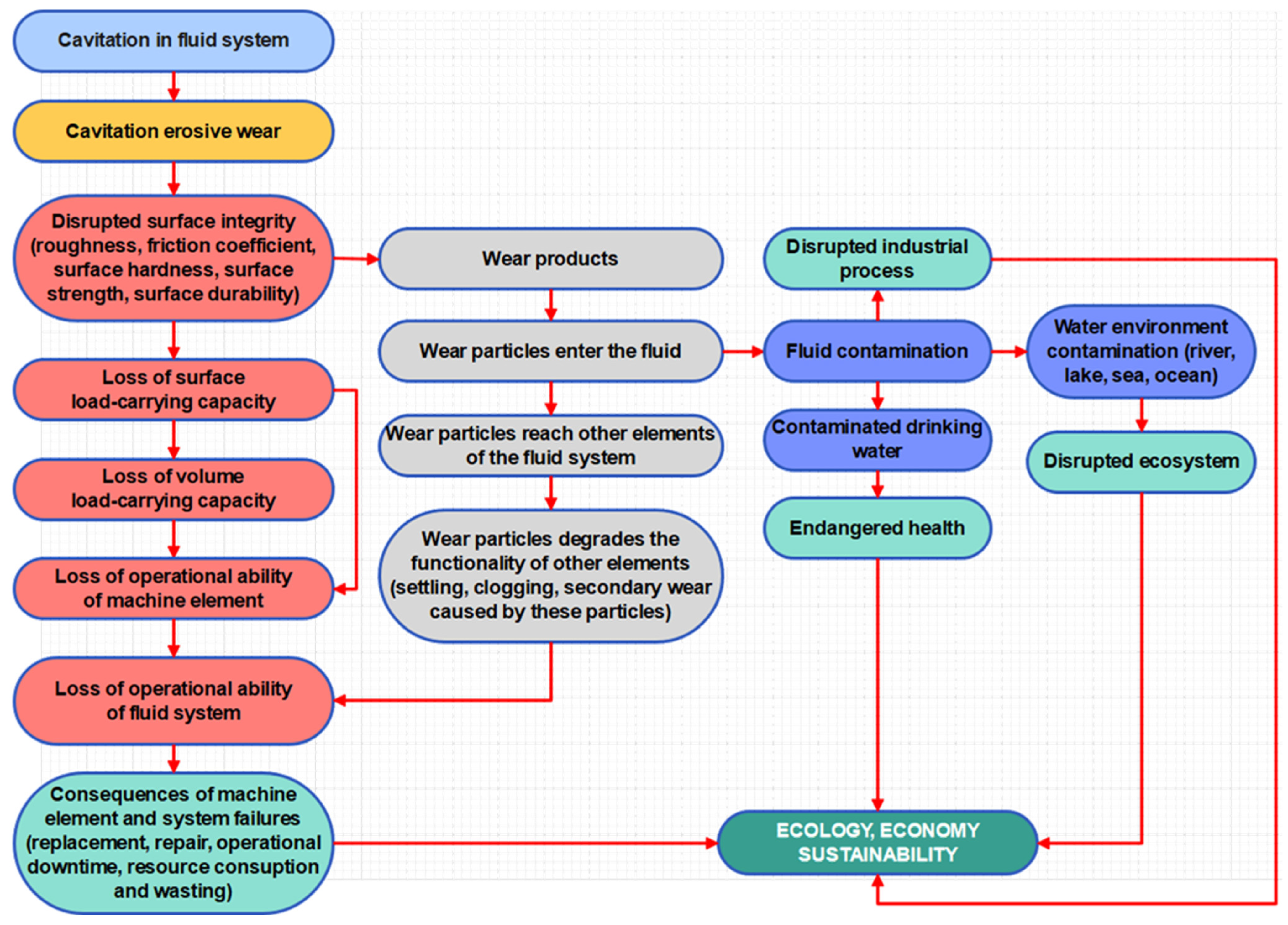
As shown in
Figure 1, the diagram schematically presents the cascading progression of cavitation-erosive wear within fluid systems.
The scheme in
Figure 1 visualizes the cause–effect chain originating from localized surface degradation of machine elements and evolving toward functional deterioration, reduced load-carrying capacity, and system instability. The graphical representation highlights how initial material damage propagates through the system, ultimately influencing operational reliability and overall process performance. Additionally, fluid contamination can impact drinking water quality, disrupt ecosystems in aquatic environments, and endanger human health. Ultimately, these consequences affect ecology, economy, and sustainability, highlighting the importance of addressing cavitation-related issues in fluid systems.
The study of cavitation-induced degradation of machine elements is of critical importance due to its significant impact on the reliability, efficiency, and service life of both fluid-handling systems and other mechanical components of machine system as a whole. Cavitation erosion can lead to progressive surface damage, reduced load-carrying capacity, and failure of pumps, turbines, propellers, industrial valves, pipelines, and machine elements such as gears, plain bearings, and seals. It may also occur in rolling bearings under certain operating and lubrication conditions, where cavitation-induced damage can develop even though these components are not part of hydraulic systems. Moreover, the material debris generated during cavitation accelerates wear in other system components and contaminates the working fluid, which may compromise system performance and safety. Beyond technical and economic consequences, cavitation can also pose environmental and health risks, for instance, through the contamination of water systems and the disruption of aquatic ecosystems.
Understanding the mechanisms and factors influencing cavitation-induced material damage is therefore essential for improving design, selecting appropriate materials, developing protective coatings, and implementing effective predictive maintenance strategies, ultimately enhancing both system reliability and sustainability.
Cavitation, although commonly associated with material degradation, may also exhibit beneficial effects when properly controlled and directed. Some studies have demonstrated its potential in surface modification and nanofabrication, including cavitation-bubble-induced surface peening at the nano/micro scale and post-process finishing techniques such as Ultrasonic Cavitation Abrasive Finishing (UCAF), achieving significant surface roughness reduction and controlled material removal [
23,
24,
25]. In addition, cavitation peening, a mechanical surface treatment similar to shot peening, utilizes collapse of cavitation bubble to introduce compressive residual stresses, enhancing fatigue resistance and reaching difficult-to-access regions [
26,
27]. The study [
28] reviews peening-based surface treatments, with particular focus on cavitation peening and its distinction from conventional shot peening. It examines how shock waves from collapsing bubbles impact the surface layer of metallic components, affecting fatigue, corrosion, and wear resistance, while emphasizing the need for improved understanding of anti-wear and corrosion performance. The paper [
29] explains that a deeper insight into bubble collapse mechanisms enables better control of surface effects, helping to minimize unintended damage, optimize surface preparation, and enhance the process stability of cavitation peening mechanically induced surface modification technique. The study [
30] investigates the application of cavitating jets for processes such as cleaning, drilling, and cavitation peening. It analyzes the unsteady characteristics of vortex cavitation, identifies key governing parameters (including injection pressure, cavitation number, and flow field sound velocity), and discusses approaches for assessing jet aggressiveness. Particular attention is given to evaluating cavitation erosion and wear through measurements of material weight loss and peening intensity.
However, the beneficial exploitation of cavitation is beyond the scope of this work, which focuses exclusively on its damaging mechanisms and adverse effects on machine elements. From the perspective of functionality, load-carrying capacity, service life, and operational reliability of machine elements, cavitation represents a critical degradation factor that must be systematically addressed in engineering analysis and design. The present work provides a comprehensive review for engineers and researchers in tribology and fluid systems, aiming to summarize the mechanisms, materials, standards, and predictive approaches related to cavitation-induced damage in machine elements.
3. Terms and Definitions
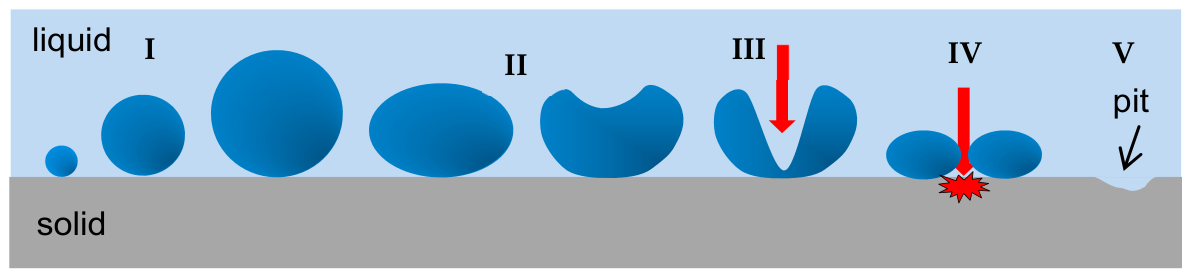
Cavitation can be defined as a non-stationary process involving the formation of vapor or vapor-gas bubbles in a flowing fluid and their subsequent implosion (condensation) near or directly on a solid surface (
Figure 2). This phenomenon occurs when the local pressure in the fluid drops below the critical pressure of cavitation nuclei (primarily bubbles of non-condensable gas), which then grow into larger bubbles due to intense evaporation [
1,
31]. In hydraulic systems, the recovery of pressure causes these bubbles to collapse, generating extremely high local pressure peaks that can reach several thousand bars. If this collapse occurs near a machine component surface, the surrounding liquid is forced into the void, producing a high-velocity microjet. The impact of the microjet can damage the surface, forming characteristic pits or furrows and often removing material, leading to progressive cavitation-induced erosive wear (
Figure 2).
To provide a clear framework for the discussion presented in this review, it is necessary to briefly define the key terms and phenomena addressed in the following sections.
Cavitation is the phenomenon involving the formation and subsequent collapse of vapor bubbles within a fluid when the local pressure falls below the vapor pressure, potentially causing damage to surfaces in contact with the fluid.
Erosive wear is the progressive loss of material from a solid surface due to repeated impacts of solid particles, liquid droplets, or high-velocity gas flow, resulting in surface deformation and material removal.
Cavitation erosion, cavitation wear or cavitation erosive wear is the progressive loss of material from a solid surface caused by the repeated formation and collapse of vapor bubbles in a fluid, generating shock waves and micro-jets that produce localized high-pressure impacts and erode the surface.
Essentially, cavitation wear and cavitation erosion are almost synonymous in the literature; however, “erosion” more often emphasizes the material removal mechanism due to fluid-dynamic effects, whereas “wear” is used more broadly within tribological terminology. Given the conceptual similarities and partial overlap between these phenomena, a clear distinction between the terms is necessary for precise scientific discussion. However, in engineering practice, cavitation-induced material damage, i.e., cavitation wear or cavitation erosion, is frequently referred to simply as cavitation, which can sometimes lead to terminological ambiguity.
4. Types of Cavitation
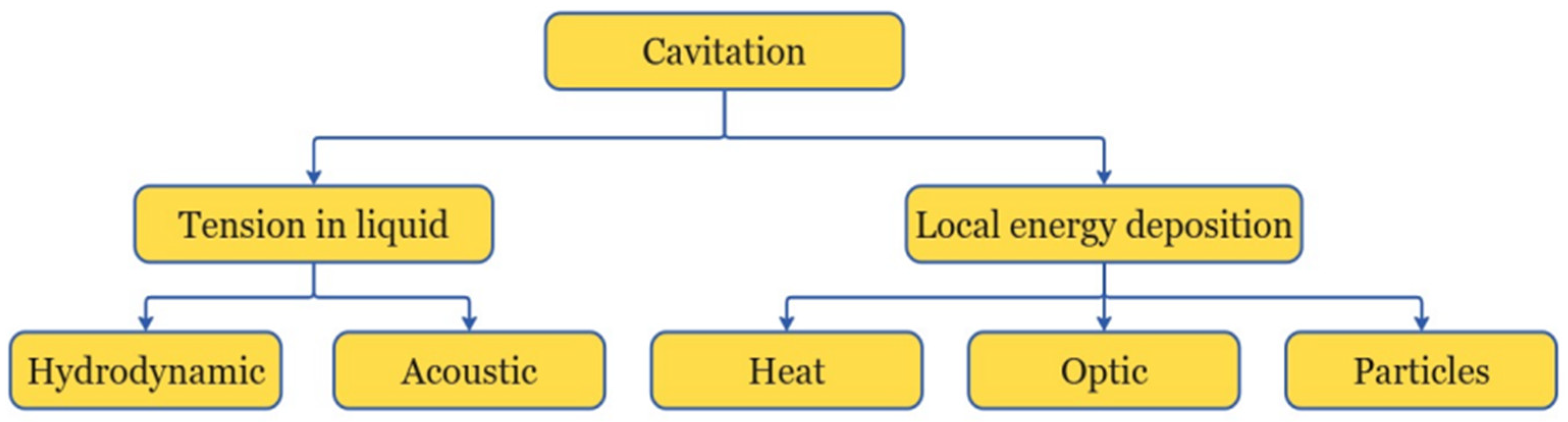
The most general criterion for classifying cavitation is based on the underlying causes that can induce this phenomenon. According to the nature of these causes [
32], types of cavitation occur through two mechanisms: tension in the liquid (hydrodynamic and acoustic cavitation) and local energy deposition (optical and particle cavitation). Fluid stresses occur in flowing fluids, known as hydrodynamic cavitation (HC) and in fluids exposed to high-frequency sound waves, referred to as acoustic (ultrasonic) cavitation (UC). Hydrodynamic cavitation occurs in flowing liquids when a geometric change leads to an increase in velocity and a corresponding pressure drop below the vapour pressure, in accordance with Bernoulli’s equation [
33,
34]. Acoustic cavitation refers to the formation and collapse of cavities induced by ultrasound [
6,
35]. Local energy deposition can be caused by thermal energy, light, or elementary particles [
2,
36]. A schematic representation of this classification is shown in
Figure 3.
Hydrodynamic cavitation occurs in a fluid flow in regions where the local pressure drops below the saturation pressure of the fluid. Under these conditions, vapor bubbles form within the fluid, which act as the nuclei of cavitation. In this context, cavitation nuclei can be classified as either homogeneous or heterogeneous. The distinction between these nuclei is typically explained using a molecular approach that involves Gibbs free energy. Homogeneous nuclei are rare in practice and correspond to the pure vaporization of the fluid without the presence of any gases. In such cases, the fluid can sometimes withstand negative pressures due to the strong intermolecular forces, and the formation of bubbles requires extremely high tensile stresses, reaching up to 60 MPa. Heterogeneous nuclei, on the other hand, arise in flows where particles or gas bubbles are present, typically as gas pockets adjacent to solid surfaces. In these situations, bubbles form more easily and are generally vapor-gas in nature [
37,
38].
The pressure variations responsible for cavitation are caused by local changes in the fluid velocity. These variations are directly dependent on the system geometry and operating conditions. Two types of devices can induce hydrodynamic cavitation: those with moving components and those with stationary components. In devices with moving parts (e.g., propellers), cavitation is directly influenced by the geometry and kinematics of the moving elements, whereas in devices with stationary components, only the geometrical changes affect the occurrence of cavitation from the perspective of the device [
39,
40]. From the fluid’s perspective, the inlet pressure is most commonly used as the primary parameter [
41].
Hydrodynamic cavitation can be further categorized into three types: travelling, fixed, and vortex cavitation. Travelling cavitation occurs when the bubble moves with the fluid flow and collapses in a higher-pressure region. In fixed cavitation, the bubbles remain localized at a specific position, regardless of unsteady flow conditions. Vortex cavitation, often referred to as tip cavitation, typically occurs at the tip of a propeller. It forms in regions of vortices, where the fluid experiences high shear stresses. The morphology of bubbles formed during hydrodynamic cavitation can vary: isolated bubbles (bubble cavitation), a vapor layer along a solid surface (sheet cavitation), clouds of bubbles, often generated by the detachment of a vapor layer and bubbles within vortices. There is also supercavitation, which in some respects resembles sheet cavitation, with the distinction that the entire body is enveloped by and effectively moves within a single vapor cavity. It may occur naturally or be artificially induced, and it is most commonly associated with marine vehicles. Due to the pressure drop resulting from increased fluid velocity, hydrodynamic cavitation is generally associated with turbulent flow regimes [
42]. The earlier cavitation research in rotary machines has primarily focused on hydrodynamic cavitation. The increasing use of ultrasound in industrial processes in the late 1920s, mainly for cleaning, homogenisation, plastic welding, etc., led to the discovery of the physical impact (erosion) of ultrasonic waves on solid surfaces, referred to as acoustic cavitation [
32,
43].
Acoustic cavitation, unlike hydrodynamic cavitation, is most commonly induced under laboratory conditions. It can also occur in machine systems when components experience vibrations. A wide range of frequencies can induce this type of cavitation. The propagation of ultrasonic waves causes pressure fluctuations within the liquid, leading to the formation of vapor bubbles. Depending on the frequency, acoustic cavitation can be classified as stationary or transient. Stationary cavitation involves the steady formation of bubbles under low-frequency ultrasonic conditions, whereas transient cavitation occurs at high frequencies and entails the formation and subsequent collapse (implosion) of bubbles [
6,
44,
45].
Two additional types of cavitation can be distinguished according to their source: optical cavitation (caused by optical breakdown when a laser is focused into a liquid) [
46,
47] and particle cavitation (resulting from the electrical discharge of elementary particles).
Optical cavitation is most commonly induced using short-pulse lasers in low-absorbing liquids. Under these conditions, the focused laser beams lead to plasma formation. A more recent approach employs low-power continuous laser radiation, known as thermocavitation. In this case, the liquid is highly absorbing, so it absorbs the thermal energy, resulting in a temperature rise, superheating, and bubble formation [
46,
48,
49].
Particle-induced cavitation occurs when elementary particles (e.g., protons) pass through a liquid, causing bubble formation as a result of localized energy deposition by these particles [
2,
36].
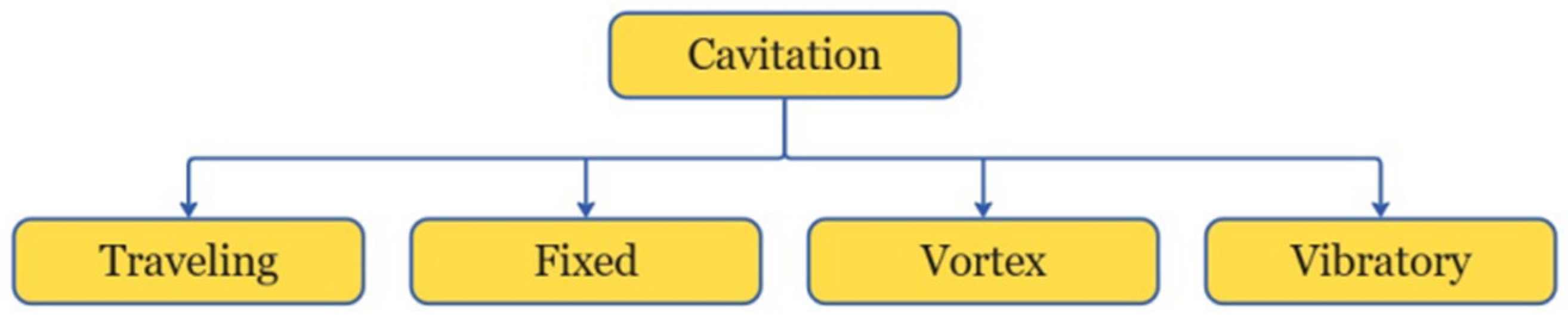
In addition to classifications based on the physical mechanisms responsible for cavitation initiation, several authors have proposed classifications according to the flow conditions and the observed behavior of cavitation bubbles. One such approach was presented by Swales [
3], who distinguished four general types of cavitation that are predominantly vaporous in nature. These forms of cavitation are typically transient phenomena in which the cavitation bubble grows and collapses depending on the surrounding pressure field and the ability of the liquid to withstand tensile stresses. According to this classification, four forms of cavitation can be distinguished: traveling cavitation, fixed cavitation, vortex cavitation, and vibratory cavitation (
Figure 4).
Except for vortex cavitation, where vortices may persist for a relatively longer time, the remaining forms are generally unstable and short-lived, particularly vibratory cavitation [
3]. The stability and composition of the cavities depend strongly on the properties of the fluid and the operating conditions. As noted by Swales and by Dowson et al. [
3], cavitation bubbles may contain vapor, gas, or a mixture of both. In lubricating oils containing dissolved air, numerous nucleation sites may exist, and when the local pressure falls below the saturation level, gas can diffuse out of the fluid and form relatively stable cavities. Consequently, depending on the specific process conditions, cavitation may be either vaporous, gaseous, or a combination of the two.
In engineering and mechanical systems, hydrodynamic cavitation is the most frequently encountered form due to the nature of fluid flow in such environments. However, in cases involving high-frequency vibrations of system components, acoustic cavitation may also occur. In some situations, these phenomena can act simultaneously, with vibrations (ultrasonic waves) producing pressure fluctuations that promote bubble formation and lead to combined Hydrodynamic-Acoustic Cavitation HAC [
50].
It should also be emphasized that not all forms of cavitation result in material damage. For degradation to occur, bubble implosion (condensation) must take place, generating shock waves and microjets that are primarily responsible for surface deterioration. In this context, certain types of cavitation do not exhibit a damaging effect. For example, in supercavitation, if the vapor cavity surrounding the body remains stable, no material damage occurs. Similarly, in stable acoustic cavitation, where bubble collapse does not take place, destructive effects are absent.
Both hydrodynamic and acoustic cavitation have been widely investigated because of their significant impact on engineering systems, where they can cause erosion of machine elements as well as noise, vibrations, and overall system malfunction [
12]. An experimental comparative analysis of these two types of cavitation on stainless steel showed that acoustic cavitation produces smaller pits that appear more rapidly, whereas hydrodynamic cavitation results in larger pits that develop more slowly [
51]. For the same exposure time, the percentage of the sample surface affected by pitting was lower in the case of acoustic cavitation. However, subsequent Scanning Electron Microscopy (SEM) analysis of localised areas subjected to cavitation erosion revealed that acoustic cavitation causes material damage at a higher rate.
The phenomenon of cavitation as a hydrodynamic process has been thoroughly explained in the chapter on cavitation in the
Encyclopedia of Tribology [
3]. This source provides a comprehensive overview of the fundamental mechanisms responsible for cavitation, including the conditions under which cavities are formed in liquids, the nucleation and growth of bubbles, as well as their subsequent collapse. Particular attention is devoted to the dynamics of bubble implosion and the associated physical effects, such as the generation of pressure shock waves and high-velocity microjets that may interact with nearby solid surfaces and contribute to material damage. The chapter also discusses the role of fluid properties, pressure distribution, and flow conditions in governing cavitation development and stability. Although these physical aspects are essential for understanding the phenomenon itself, a detailed treatment of cavitation hydrodynamics is beyond the scope of the present paper, which focuses primarily on cavitation erosion of engineering materials and machine components.
5. International Standards Related to Cavitation Phenomena
In mechanical engineering, standardization forms the basis for consistent design, manufacturing, and performance evaluation of machine elements operating under complex mechanical and tribological conditions. Standards define harmonized terminology, testing procedures, material characterization methods, and acceptance criteria that enable reproducibility of experimental results and comparability between different studies and industrial solutions. By establishing unified technical frameworks, standards facilitate communication between researchers, designers, manufacturers, and industry, while directly supporting quality assurance and informed engineering decision-making.
Standards may be developed and adopted at both international and national levels, depending on the scope of their application and the regulatory framework of individual countries. International standards aim to ensure global harmonization of technical requirements, while national standards may adapt or further specify these requirements according to local industrial practices and regulations. In the present review, particular attention is given to standards issued by relevant international standardization bodies, primarily the ISO (International Organization for Standardization) and ASTM International (originally founded as the American Society for Testing and Materials), as these organizations play a leading role in the development of technical standards in mechanical engineering and materials testing. The keyword used for identifying relevant standards was “cavitation.” The search results indicate that, despite the significant practical importance of this phenomenon in mechanical and tribological systems, the number of dedicated standards addressing cavitation remains comparatively small.
5.1. ISO
A search of the ISO database using the keyword “cavitation” yielded a total of nine standards, including one technical report. Of these, only a subset is directly relevant to mechanical engineering and tribology, as several address applications outside the field, such as water treatment or fine bubble technologies. This indicates that, despite the practical importance of cavitation phenomena in machine elements, the number of dedicated international standards specifically targeting this area is relatively limited. The focus of our interest was on standards/technical reports related to
thermoplastic valves [
52],
rotodynamic pumps [
53], and
plain bearings [
54], since these refer to mechanical engineering systems or their components. Standards addressing cavitation in the context of noise evaluation and hull pressure measurement, specifically for ships and marine technology, were not considered.
The standard concerning
thermoplastic valves [
52] defines the procedure for conducting an endurance test intended to verify the durability of manually operated plastic valves under long-term service conditions involving repeated opening and closing cycles. It does not address valve performance under severe operating conditions, such as exposure to chemically aggressive fluids or environments, nor does it cover the effects of high flow velocities or cavitation phenomena. Although cavitation is listed among the key terms of this standard, its effects are explicitly excluded from consideration in the assessment of thermoplastic valves.
Standard [
53] on
rotodynamic pumps and hydraulic performance acceptance testing using model pumps specifies procedures for assessing the hydraulic performance of small-scale centrifugal, mixed-flow, or axial pumps, including cavitation characteristics. It is primarily intended for acceptance testing, where a geometrically similar model is used to verify the expected performance of a full-scale pump designed for actual operation (i.e., the prototype pump). Nevertheless, it does not exclude inspections or additional testing conducted directly on the prototype. Testing on the full-scale pump is generally preferred; however, model testing may be justified when the required flow rate or power exceeds the capabilities of the available test facility, when parts of the pump are integrated into concrete structures and cannot be practically reproduced, when specified by the purchaser, or when prototype testing is otherwise impractical. The procedures described apply to steady-state operating conditions representative of those of the prototype pump. Clauses 8 and 9 of the Standard [
53] address cavitation-related testing and performance assessment. Clause 8 defines two types of tests: the cavitation test and the net positive suction head (NPSH) test. The cavitation test is intended to determine whether the total head of a model pump is affected by cavitation when operating under conditions corresponding to those of the prototype pump. The test aims to verify the presence and magnitude of head reduction caused by cavitation under operating conditions representative of the prototype. Clause 9 further addresses cavitation performance criteria. The cavitation guarantee condition is considered fulfilled if the measured decrease in total head does not exceed 3% of the value obtained during the performance test.
Standard [
54] establishes a framework for identifying, describing, and categorizing in-service damage in hydrodynamically lubricated metallic
plain bearings that results from cavitation erosion, and it outlines potential preventive and corrective measures. Its purpose is to facilitate the recognition and interpretation of the distinct damage patterns that may develop during operation. The scope is limited to damage types that exhibit clearly identifiable features and can be reliably linked to specific causes. Representative forms of deterioration are supported by photographic evidence and schematic illustrations. The standard begins with the clarification of relevant terminology and progresses to a detailed explanation of the cavitation erosion phenomenon. It first examines the underlying mechanisms responsible for material damage, explaining how vapor bubble formation and collapse within the lubricant film lead to progressive surface deterioration. The document then proposes a structured classification of cavitation erosion and outlines general strategies for mitigating its occurrence. A substantial part of the standard is devoted to a detailed description of distinct cavitation erosion modes observed in service. For each type, the characteristic surface morphology is described, the most probable causes are analyzed, and appropriate preventive or corrective measures are discussed. The presentation emphasizes the correlation between operating conditions, bearing design, lubrication regime, and the resulting damage patterns. To support reliable identification, the standard provides illustrative figures and representative examples that help distinguish between different erosion mechanisms. In addition to the principal erosion categories, the document also considers less common manifestations, including damage associated with high-frequency vibrations, elastic deformation effects, abnormal combustion influences, and surface rippling phenomena. The standard serves as a diagnostic and interpretative guide for recognizing cavitation-related damage and linking it to its most likely operational causes. More detailed discussion on the types of cavitation effects and the resulting damage in plain bearings, according to [
54], will be provided later in the section dedicated to machine elements.
5.2. ASTM
Standard ASTM G134-17 describes a cavitation erosion test in which cavitation is generated by a submerged liquid jet issuing from a nozzle and impinging on a specimen surface. The method enables the controlled variation of flow velocity and chamber pressure, allowing for the independent adjustment of cavitation conditions and the investigation of their influence on material erosion resistance. It is primarily intended for comparative assessment of materials exposed to cavitation in hydraulic machinery and fluid systems. However, this standard is not the focus of the present review. The paper concentrates on the methodology and result interpretation associated with the vibratory cavitation erosion test defined in ASTM G32 [
55], which represents the most widely used and standardized laboratory procedure in cavitation erosion research. In contrast, the cavitating jet approach described in ASTM G134 involves substantially different flow conditions, erosion mechanisms, and experimental parameters, making direct comparison with vibratory test results difficult. For this reason, a detailed discussion of ASTM G134 is beyond the scope of this review.
The only ASTM standard specifically addressing cavitation concerns the detailed procedures for testing cavitation erosion using a vibratory apparatus [
55]. Given that this is the sole standard dedicated to evaluating cavitation resistance and has been widely applied worldwide for several decades, it warrants special attention and a more detailed discussion. ASTM standard G32 [
55] defines a test method for producing and evaluating cavitation damage on specimens subjected to high-frequency vibrations while immersed in a liquid. The vibration induces the formation and collapse of cavities in the fluid, resulting in material erosion. Although the cavitation mechanism differs from that in flowing systems or hydraulic machinery, the resulting material damage is considered fundamentally similar. The method offers a controlled, small-scale approach for comparing erosion resistance among materials, investigating damage progression, and assessing the effects of test variables. Standard conditions are specified for specimen size, vibratory amplitude and frequency, as well as the test liquid and its container, with guidance on apparatus setup, procedures, and reference materials for validation.
An overview of the key terms and definitions based on the content of the standard is presented in
Table 1.
Cavitation generally occurs due to a local drop in hydrostatic pressure within a liquid, which may result from the motion of the liquid itself (flow cavitation) or from the movement of an adjacent solid surface (vibratory cavitation). This phenomenon is distinct from boiling, which occurs when the temperature of a liquid increases. The term “cavitation” refers to the phenomenon itself and should not be used to describe the material damage it may cause. When cavitation causes material loss from a solid surface, the effect is specifically referred to as cavitation damage, cavitation erosion or cavitation wear. Material erosion occurs when bubbles or cavities collapse directly on or very close to the surface.
The main physical quantities related to cavitation, along with their explanations and relevant comments, are presented in
Table 2. The cumulative erosion rate is also known as the average erosion rate. In cavitation and liquid impingement erosion, the erosion rate-time pattern can include some or all of the following stages: incubation, acceleration, maximum rate, deceleration, terminal, and occasionally catastrophic. The term “period” is used for quantitative measurements of duration, while “stage” is preferred for qualitative descriptions. The incubation period is generally considered to reflect the build-up of plastic deformation and internal stresses beneath the surface, occurring before substantial material loss begins. Its exact duration cannot be precisely measured. Related terms include erosion threshold time (ETT) and nominal incubation period.
The appearance of a maximum erosion rate (ER) is common in many cavitation and liquid impact tests. It may occur as a brief instantaneous peak or as a steady-state maximum that persists for a period of time. The mean depth of erosion (MDE) is also referred to as the mean depth of penetration (MDP), although the latter term is less commonly used. When determining the normalized erosion resistance (Ne), both the test and reference materials must be evaluated under comparable conditions, ensuring that erosion rates are measured for corresponding segments of the erosion rate–time curve, such as the maximum or terminal erosion rate.
The exact mechanisms behind cavitation erosion and liquid impingement erosion are still not fully understood and can vary depending on the specifics, scale, and intensity of interactions between the liquid and solid surfaces. As a result, “erosion resistance” likely reflects a combination of multiple material properties rather than a single characteristic, and it has not yet been reliably linked to independently measurable material parameters. Consequently, results obtained from different testing methods or under varying field conditions may not be fully consistent. Small differences between materials should be interpreted cautiously, as their relative performance rankings could change under different test conditions.
Following the early observation that cavitation erosion could develop on the surface of a vibrating piston, this phenomenon began to be widely applied in both fundamental research and comparative material evaluation. In the mid-1950s, the American Society of Mechanical Engineers recommended a standard testing approach, reflecting the technical capabilities available at that time. Significant improvements in experimental equipment and procedures were achieved in the years that followed. In response to these developments, ASTM Committee G02 organized an interlaboratory study in the late 1960s. The specifications and recommendations included in the first official version of the test method were largely based on the outcomes of that study. The vibratory method was selected for standardization because it was already extensively used, relatively straightforward and cost-effective to implement, and allowed good control over the key testing parameters.
In addition to the vibratory technique, other approaches for cavitation testing have been employed, such as cavitation tunnels (where cavitation is generated by fluid flow through a venturi or around an obstruction), rotating cavitating discs, and, more recently, cavitating jet methods.
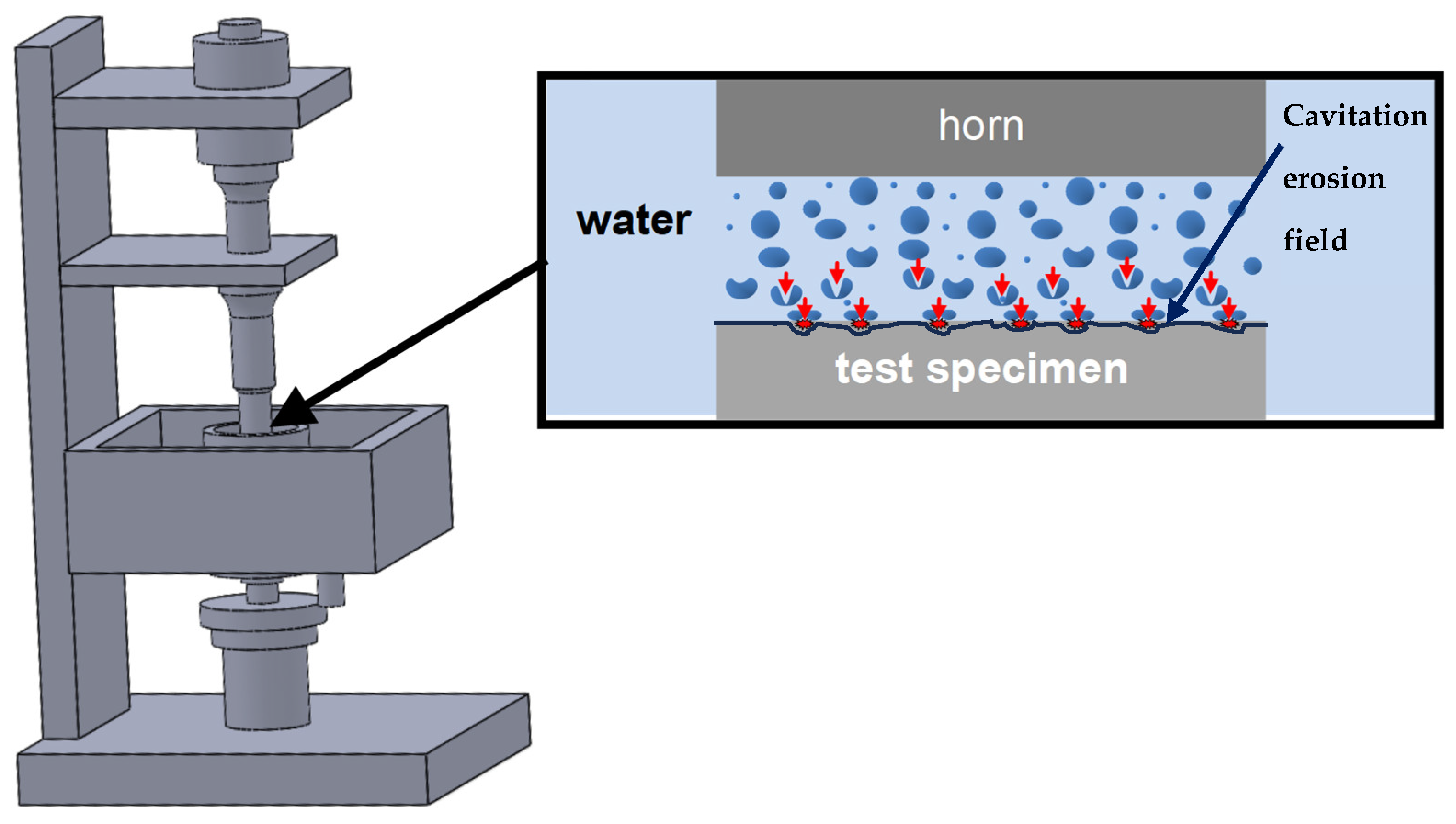
The test method prescribed in the standard [
55] utilizes a commercially available 20 ± 0.5 kHz ultrasonic transducer fitted with a properly designed horn, to which the specimen is attached at its tip. The specimen is immersed in a test liquid, typically distilled water, maintained at a controlled temperature, and subjected to vibration at a specified amplitude and frequency, both of which must be carefully controlled and monitored. The specimen mass is measured before testing and at regular intervals during the test to determine mass loss as a function of time. The resulting cumulative erosion–time curve allows comparison of material performance under different testing conditions. The vibratory equipment employed in this test generates axial oscillations of a specimen immersed to a defined depth in the test liquid. Vibrations are produced by either a magnetostrictive or piezoelectric transducer, operated through an electronic oscillator and power amplifier. The system must provide adequate power to maintain a constant vibration amplitude both in air and during immersion, typically within an acoustic output range of approximately 250–1000 W. Commercially available ultrasonic systems designed for applications such as welding or emulsification are commonly used for this purpose. The model of the device used in this study is shown in
Figure 5.
The specimen is described in detail in the standard, including its geometry, dimensions, specified tolerances, and permissible deviations in form and position. Additionally, the calibration procedure, as well as the testing conditions and methodology, are thoroughly defined.
The basic parameters for testing cavitation resistance, as outlined in the ASTM G32 standard, are presented in
Table 3.
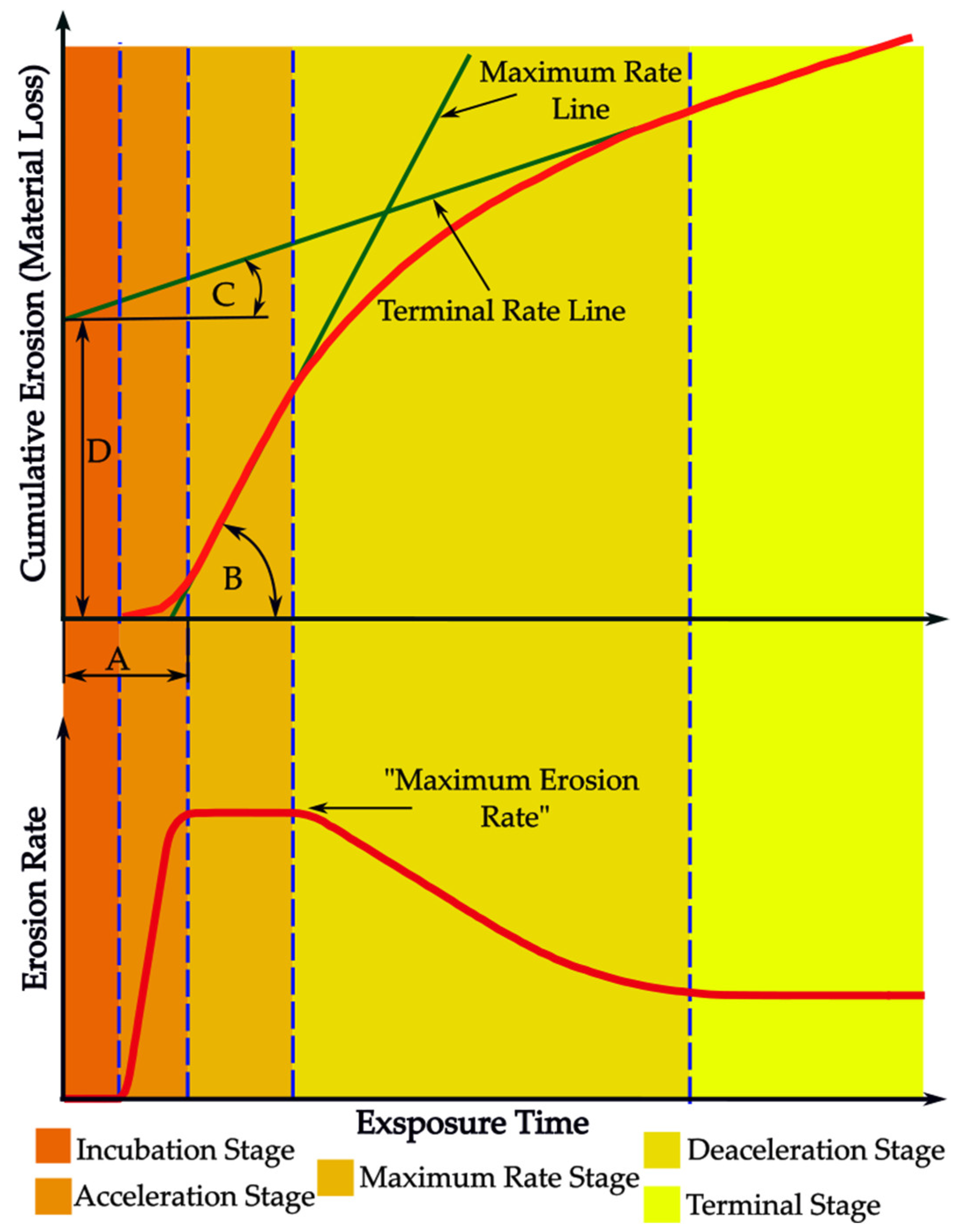
Interpretation of cavitation erosion results is complicated by the fact that material loss does not occur at a constant rate but progresses through several distinct stages, as illustrated in
Figure 6. Consequently, a single value cannot reliably represent test outcomes, nor can long-term behavior be accurately predicted from short-term exposures.
The main result of the test is the cumulative erosion–time curve. Although measurements are initially obtained as mass loss versus time, they should be converted to MDE versus time to enable meaningful comparison between materials of different densities. Due to the characteristic shape of the curve, direct comparison of MDE values at equal exposure times is not appropriate. Instead, materials should be compared based on the time required to reach specified erosion depths. For a more complete evaluation, several parameters are defined (
Figure 6). The maximum ER corresponds to the slope of the steepest linear portion of the cumulative erosion–time curve and represents the most commonly reported single indicator of erosion performance. The nominal incubation time is determined from the intercept of this line with the time axis. Additional optional parameters include the ETT (time to reach 1 μm MDE) and the terminal ER observed at prolonged exposure. If the terminal rate is reported, the corresponding intersection with the maximum-rate line or its intercept on the MDE axis should also be specified.
In
Figure 6, A represents the nominal incubation time, which, as can be seen from the diagram, cannot be equated with the actual incubation period; instead, it is used to define the maximum erosion rate line. B denotes the slope of the tangent corresponding to the maximum erosion rate line. C and D are related to the terminal stage. Since the cumulative mass loss curve is linearized during the terminal period, C defines the slope of this linearized segment, while D represents its intercept on the y-axis.
According to the standard [
55], mass loss is measured using an analytical balance with an accuracy of 0.01 mg. Since the MDE (MDP) is calculated directly from the measured mass loss, taking into account the eroded surface area (most commonly the horn tip or the specimen surface) or by converting the fraction of the eroded area relative to the total specimen surface together with the material density the resulting data points in the MDE diagram represent the measured mass-loss values shifted by a constant factor. In this sense, the interpretation of mass loss and MDE, as well as their mathematical approximation by analytical functions, does not differ.
For the mathematical interpretation of experimental results, linear regression based on the least-squares method is most commonly applied [
56,
57], since it provides the minimum squared error. However, if the ER or the MDER is calculated as the first derivative of mass loss or MDE with respect to time, the result is a constant value, which is not consistent with the diagram presented in the standard (
Figure 6). Another limitation of this approximation is that it does not satisfy the trivial condition at the origin, i.e., that no mass loss exists at the initial moment. To satisfy the zero-mass-loss condition at the beginning of the test (
t = 0), the authors in [
58] proposed the use of an exponential function for approximating the experimental data:
In Equation (1), the coefficient A1 is set to a value of 1, while the remaining coefficients are determined numerically. However, this approach generally results in a larger mean squared error, and in many cases the fitting procedure yields the coefficient c equal to zero, effectively reducing the approximation to the least-squares linear regression. When this function is used for the approximation of MDE, the coefficients a and b must be divided by the eroded surface area and the material density. The resulting value of ETT differs significantly between these two approximations, most likely due to deviations between the functions in the vicinity of the origin. This observation suggests that the least-squares method provides the most accurate mathematical interpretation of the experimental data. In the case of the exponential function, the first derivative is also an exponential function; however, its shape does not correspond to the erosion rate curve presented in the standard for ER. This indicates that the obtained approximation functions cannot be used to derive, through mathematical differentiation, a curve that reproduces the ER profile defined in the standard. For the interpretation of ER, it is therefore more appropriate to divide the measured mass loss or MDE within specific time intervals by the duration of those intervals and to plot the resulting points. A spline function can then be applied to these data points, which enables a partial agreement with the erosion rate curve described in the standard.
A standardized procedure for testing material resistance to cavitation erosion is essential because it ensures the comparability and reproducibility of experimental results obtained by different laboratories. The existence of a widely accepted standard, therefore, represents an important foundation for both scientific research and engineering practice. However, experience accumulated through experimental studies and practical applications has revealed a number of limitations of the currently used testing procedures. In recent years, an increasing number of studies have critically examined the existing standard, pointing out ambiguities, methodological constraints, and the need for improvements. These works emphasize that the standard should be refined, expanded, and better aligned with contemporary materials, coatings, and testing technologies.
Several studies have questioned the comparability and representativeness of the standard testing procedure. It has been shown that experimental parameters not strictly controlled by the standard, such as the distance between the ultrasonic horn and the specimen, can significantly influence the cavitation erosion rate, raising concerns about the comparability of results obtained using different variants of the method [
59]. Similar conclusions were reached in studies comparing the standard vibratory method with alternative approaches such as cavitating jets, where differences in cavitation intensity and flow conditions led to different rankings of material erosion resistance [
60]. More generally, the physical mechanisms governing cavitation erosion depend strongly on the method used to generate cavitation (acoustic, hydrodynamic, or other sources), which makes direct comparison of results obtained with different experimental setups questionable [
61].
Another group of studies has focused on the limitations of the standard method in reproducing realistic cavitation conditions. Investigations comparing the ultrasonic vibratory technique with other laboratory approaches have suggested that cavitating jet methods can produce cavitation structures and flow fields that more closely resemble real hydrodynamic conditions [
62]. In addition, the cavitation generated by ultrasonic excitation has been criticized for differing significantly from cavitation occurring in full-scale hydraulic systems [
63,
64]. Also, these works have addressed the applicability of the standard to modern materials and coatings. It has been pointed out that the conventional procedure was originally developed primarily for metallic materials and may be unsuitable for testing softer materials such as polymers or coatings, where unreliable or inconsistent results can occur [
63,
64]. Consequently, modified procedures have been proposed to enable testing of non-metallic materials, composites, and protective coatings, although such modifications may lead to differences in measured erosion rates and interpretation of results [
65].
Further research has examined limitations related to test conditions and cavitation intensity. The standard test procedure relies on a single cavitation intensity level, which may be insufficient for highly cavitation-resistant materials and can result in excessively long testing times or inconclusive results [
62]. In addition, the standard is typically limited to normal environmental conditions and water as the working medium. For this reason, new experimental methods and specialized equipment have been proposed to enable testing at elevated temperatures, pressures, and in aggressive liquids [
66].
Some studies have focused on the evaluation and interpretation of cavitation erosion test results. Conventional analysis based on parameters derived from the cumulative erosion-time curve, such as nominal incubation time or maximum erosion rate, has been criticized because these parameters represent localized or highly variable values. Alternative evaluation approaches based on non-cumulative mass loss data have therefore been proposed to provide a more detailed characterization of the erosion process [
67].
These studies highlight the growing recognition that, although the existing standard provides a valuable reference framework, its methodology requires further refinement to improve realism, broaden applicability to modern materials and operating conditions, and enhance the reliability and comparability of cavitation erosion testing results.
6. Materials
As previously described, cavitation occurs when vapor bubbles form in a liquid and subsequently collapse, generating powerful hydraulic impacts with pressures that can reach several GPa. Cavitation resistance represents the ability of a material to withstand the destructive effects of this cavitation erosion process. The mechanism of cavitation damage involves several stages. The initial stage is the incubation period, during which fatigue accumulates in the material without visible surface damage. This is followed by a stage of active erosion, characterized by the formation of pits and craters on the material surface. The final stage is marked by intensive material loss resulting from progressive cavitation erosion.
For ferrous alloys, particularly steels, the cavitation resistance of a material depends on a variety of factors that can be broadly categorized into structural and chemical characteristics. Key structural factors include the type of crystal lattice, grain size, and the presence of inclusions or defects. The chemical composition of steel plays a significant role in enhancing cavitation resistance. Chromium alloying markedly improves resistance by forming a protective oxide layer, with a chromium content of 12–18% ensuring a stable passive film that can self-repair if damaged [
68]. Nickel addition stabilizes the austenitic structure, which better absorbs the energy of impact loads compared to ferritic or martensitic structures. Molybdenum further increases corrosion resistance in aggressive environments. Structural features also contribute to cavitation performance. Metastable austenitic steels exhibit improved resistance due to stress-induced phase transformations. The formation of deformation-induced martensite helps dissipate the energy of cavitation impacts and extends the incubation period before surface damage occurs.
Different classes of materials exhibit significantly different cavitation resistance. Carbon steels, such as C45, have the lowest resistance and are taken as a reference with a coefficient of 1.0. Austenitic stainless steels, such as X5CrNi18-10, show 8–12 times higher resistance compared to carbon steels. Addition of molybdenum in grades like X5CrNiMo17-12-2 increases resistance further, up to 15–20 times the reference. Titanium alloys, such as Ti 6Al 4V, demonstrate outstanding cavitation resistance, exceeding carbon steel by 25–30 times, thanks to the formation of a stable TiO
2 oxide layer and titanium’s inherent corrosion resistance. Bronzes, particularly aluminum bronzes like CuAl10Fe3, have moderate resistance, 4–6 times higher than the reference, with advantages of good machinability and relatively low cost [
68].
There are several approaches to improving cavitation resistance, applicable both during the material production stage and in the processing of finished components. These methods can be broadly categorized as metallurgical, thermal, and surface treatments. Optimizing the chemical composition of steel is a primary means of enhancing cavitation resistance. Increasing chromium content to 18–20% and nickel to 10–12% promotes the formation of a stable austenitic structure with high resistance to cavitation [
68]. Thermal treatments, such as quenching from high tempering temperatures, provide an optimal balance of strength and ductility. Surface hardening using induction techniques creates a hard outer layer while retaining a tough, ductile core. Surface improvement methods, including the deposition of cavitation-resistant alloys based on cobalt or stainless steels, are effective for protecting components. A deposited layer of 3–5 mm thickness ensures long-lasting protection of the base material [
68].
6.1. Steels
Recent research on cavitation erosion of steels has addressed both the influence of material properties and testing conditions on erosion resistance. Several studies focused on comparing different steel types, including carbon, alloy, and stainless steels, under ultrasonic and abrasive cavitation tests. For instance, 1045 carbon steel, 304 stainless steel, and 4340 alloy steel were tested, demonstrating that 304 stainless steel showed the highest erosion resistance, while the wear mechanisms varied depending on the presence of abrasive particles [
57].
Martensitic, austenitic, and ferritic stainless steels have been widely studied for their relative resistance. Early reviews highlighted that martensitic steels generally provide the highest cavitation resistance, austenitic steels show intermediate performance, and ferritic steels exhibit the lowest resistance [
7,
8,
69,
70]. Detailed investigations of Cr–Mn–N austenitic and uplex stainless steels revealed that high work-hardening ability and low ferrite content significantly enhance cavitation resistance compared to martensitic 0Cr13Ni5Mo steel [
71].
Heat treatment and microstructural optimization were identified as key factors influencing erosion resistance. S30400 and other alloys demonstrated a strong correlation between hardness, tensile strength, and cavitation erosion resistance, while retained austenite improved resistance in tool steels produced by powder metallurgy [
72,
73]. Studies on grain size effects confirmed that finer grains increase resistance, particularly in high-nitrogen austenitic stainless steels [
74].
Comparative testing methods also play an important role in evaluating steel performance. Cavitation erosion resistance was assessed using vibratory ultrasonic rigs, cavitating jet methods, and rotating disc apparatus, showing that the observed erosion rates and mechanisms can differ depending on the test configuration and intensity [
75,
76,
77]. Some works highlighted that carbon and alloy steels exhibit different erosion behaviors in distilled versus tap water, due to oxidation effects altering the surface structure [
78,
79].
Specialized steels and coatings have been developed to enhance cavitation resistance. Studies on welded coatings and cladded layers, including NiTi, High-Cobalt stainless steels, and AWS E309 alloys, confirmed that protective layers improve resistance substantially compared to base stainless steels such as 304L and CA6NM [
80,
81]. High-chromium cast steels also showed improved performance with optimized carbide morphology and controlled austenite content [
82]. High-Velocity Oxygen Fuel (HVOF)-applied metal–ceramic coatings further demonstrated enhanced protection, correlating hardness with erosion resistance [
70].
Comparative analyses across multiple steels under uniform testing conditions confirmed that cavitation erosion often follows a multi-stage process, with initial pitting, subsequent plastic deformation, and eventual mass loss, and that mechanical properties, such as hardness, ductility, and fracture strain, are strong predictors of performance [
79,
83,
84,
85]. Vibratory and cavitating jet methods were compared, highlighting that test method choice influences both the quantitative and qualitative assessment of erosion [
77].
Cavitation erosion resistance of steels is governed by a complex interplay of factors, including steel type, microstructure, mechanical properties, surface treatments, and operating conditions. Quantitative measures such as mass loss per unit time or mean depth penetration rate (MDPR) provide a reliable basis for comparing materials and evaluating their performance under cavitation. These numerical cavitation rates are essential for understanding material behavior in hydraulic machinery and other applications where cavitation is a critical concern.
Several studies have systematically analyzed cavitation erosion data for stainless steels, highlighting the importance of mechanical properties and hardness in determining resistance. For example, conversion of vibratory test results to standardized average erosion rates showed that the erosion resistance of ferritic, austenitic, duplex, and martensitic stainless steels correlates strongly with specimen hardness after testing, allowing prediction of relative performance using material factors [
86]. Similarly, temperature and pressure were found to significantly affect the cavitation damage of materials like Stellite 6B, L-605, and AISI 316 stainless steel in sodium, with higher pressures increasing average volume loss rates in a predictable manner [
87]. Comparative studies on Cr–Mn–N stainless steels versus 0Cr13Ni5Mo martensitic steel further demonstrated that high work-hardening ability and low ferrite content enhance cavitation resistance, as reflected in mass loss rates over test duration [
71].
The relationship between mechanical properties and cavitation erosion was also explored in carbon and medium-carbon steels. Strong correlations were found between material removal rates and cyclic deformation parameters, emphasizing fatigue as a governing mechanism [
88,
89]. Heat treatments and low-temperature plasma nitriding were shown to modify microstructure and reduce initial erosion rates, with AISI 410N martensitic steel exhibiting an initial cavitation rate of 1.2 mg/h, later decreasing to 0.36 mg/h due to the exposure of an expanded martensite layer [
90]. Quantitative approaches based on particle detachment during erosion further confirmed that hardness and fatigue crack growth rates can predict cavitation material removal [
91].
Comparative reviews reinforced these findings by showing that martensitic stainless steels generally possess the highest erosion resistance among stainless steels, followed by austenitic types, with ferritic steels performing poorly [
7,
69]. The influence of structural and mechanical properties, such as hardness, tensile strength, and Young’s modulus, on erosion behavior was consistently observed, and methods for increasing resistance through heat treatment, thermochemical processes, and coatings were proposed [
8,
72].
Database analyses of carbon steels and nonferrous metals highlighted the proportionality of erosion resistance to the 2.4th power of Vickers hardness, allowing prediction of maximum instantaneous erosion rates and comparison among materials such as cast iron, aluminum, copper, and titanium alloys [
89,
92].
Surface engineering and alloy modification were also identified as effective strategies for enhancing cavitation resistance. Duplex and super duplex stainless steels, as well as plasma-nitrided or High-Cobalt coatings, significantly reduced cavitation wear rates, in some cases by more than two orders of magnitude, demonstrating the critical role of surface microstructure and composition in controlling erosion [
81,
93,
94].
Grain refinement in austenitic stainless steels and high-nitrogen alloys improved cavitation resistance, while factors such as stacking fault energy, martensitic transformation, and incubation period influenced the erosion rate during testing [
74].
All studies confirmed that cavitation damage occurs through distinct stages: incubation, accumulation, attenuation, and steady state and that erosion rates depend on both the material properties and the testing parameters, such as oscillation amplitude and frequency [
57,
95]. Direct comparisons between carbon steels and alloy steels, as well as between normalized, spheroidized, and martensitic microstructures, underscored the superior performance of martensitic phases in resisting cavitation-induced mass loss [
96,
97].
Recently published studies have investigated the cavitation resistance and surface degradation behavior of engineering steels exposed to aggressive operating conditions. One study analyzed the corrosion and cavitation erosion behavior of low-alloy steel 42CrMo4 used in marine applications [
98]. The authors performed corrosion and cavitation tests combined with Optical Microscopy (OM), SEM, Energy-Dispersive Spectroscopy (EDS), and image analysis, concluding that degradation mechanisms evolved with exposure time and that corrosion caused more severe surface degradation than cavitation erosion. The study also identified pit formation and subsequent pit growth and coalescence as dominant cavitation damage mechanisms.
Another study investigated the cavitation erosion resistance of Duplex stainless steel protected by hardfaced metallic alloy coatings [
99]. Cavitation tests and surface characterization showed that deposited austenitic manganese alloy coatings significantly improved cavitation resistance, achieving approximately 8.5–10.5 times higher erosion resistance compared to the base material. The improved behavior was primarily attributed to the increased surface hardness of the coated layers.
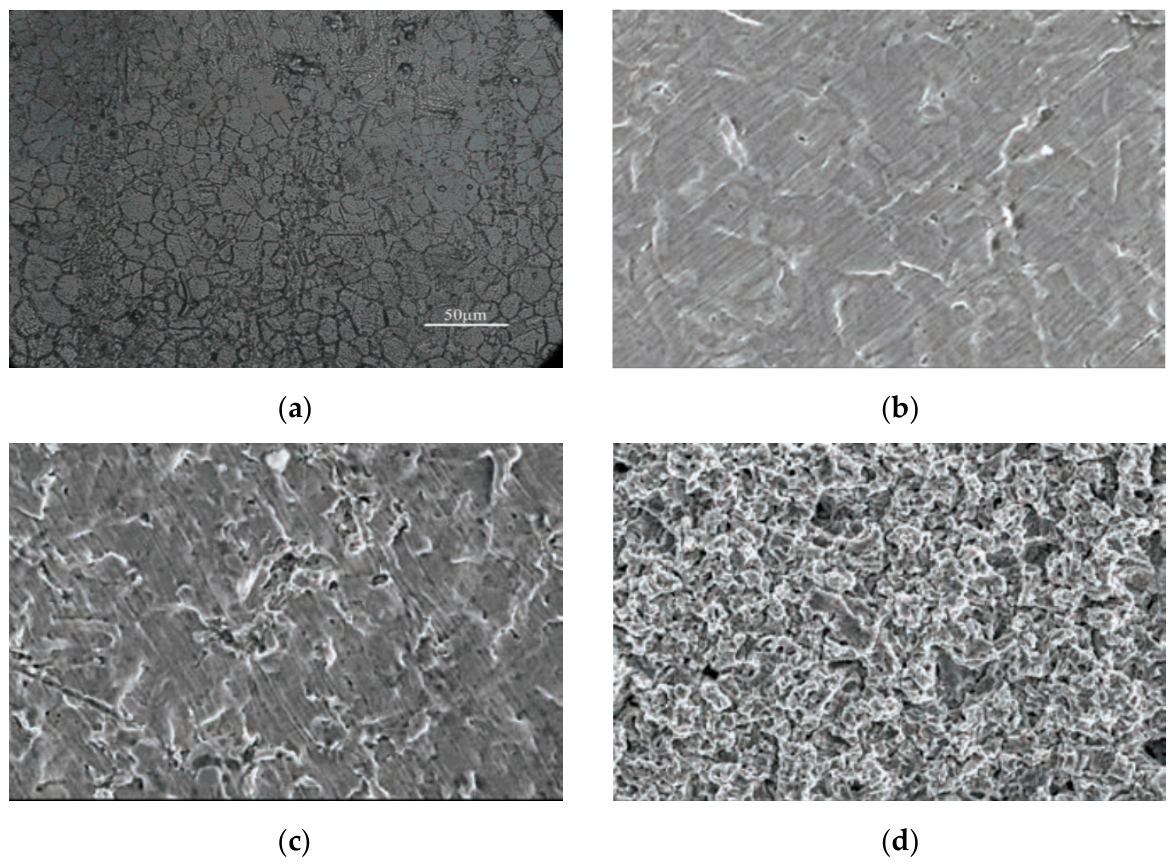
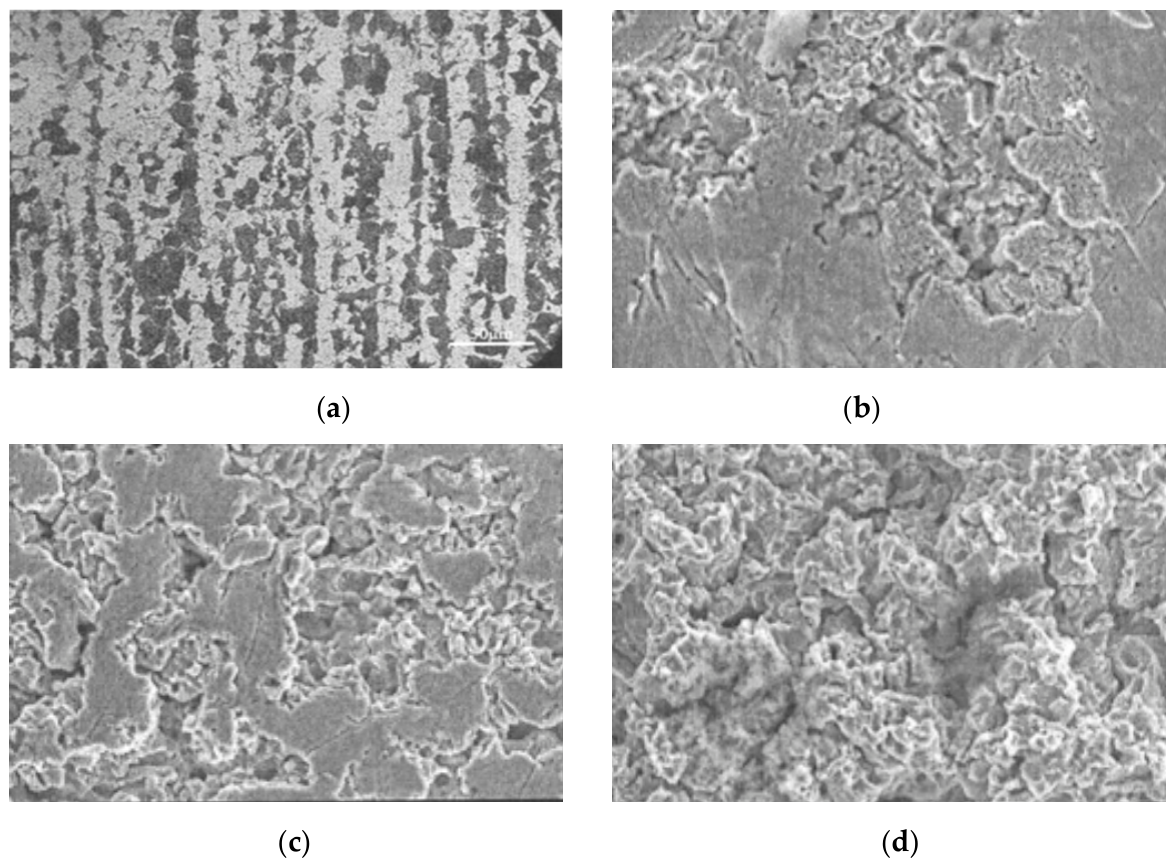
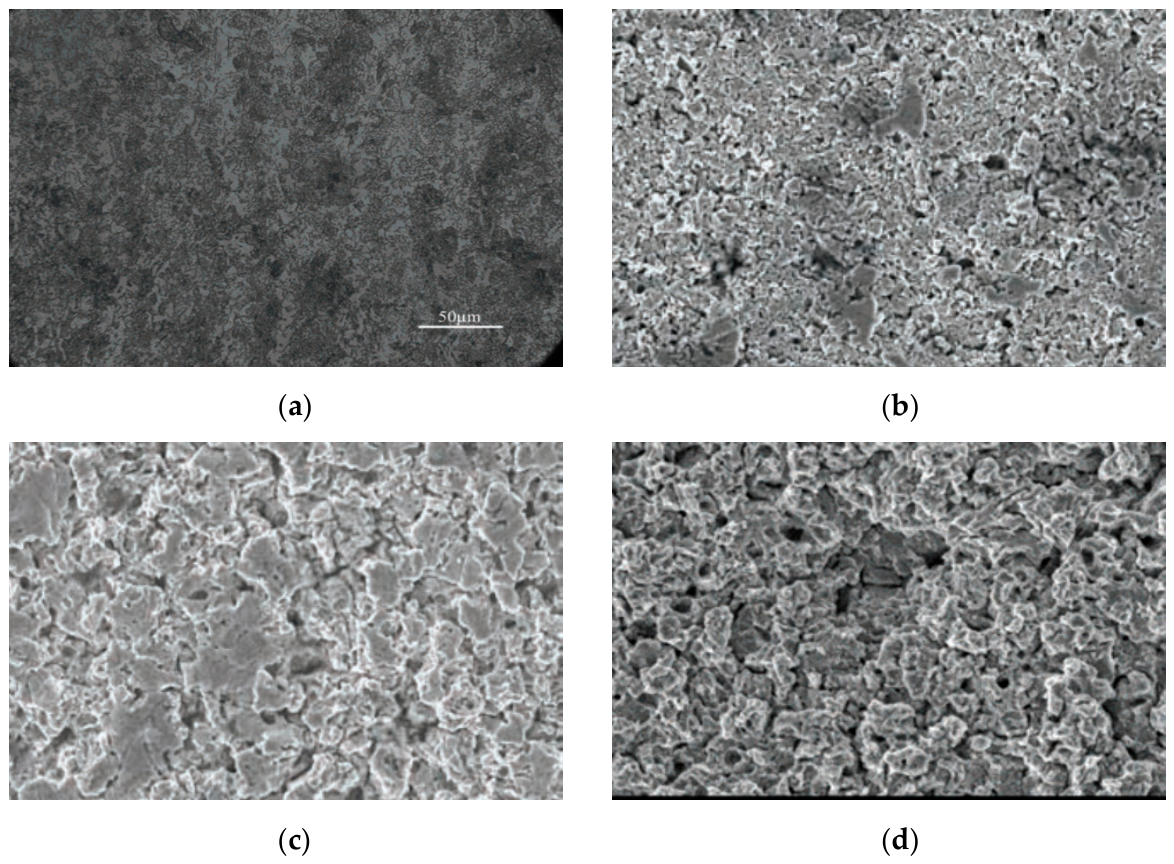
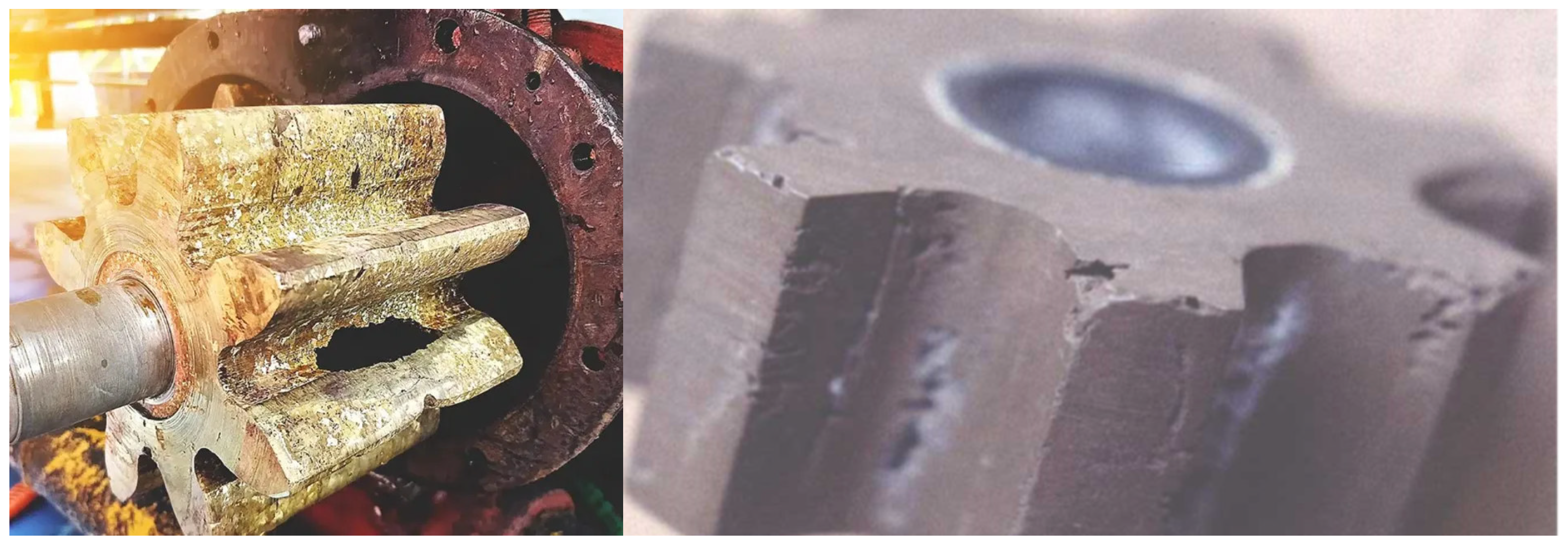
Illustrative examples of cavitation-damaged surfaces for different steel categories, based on the authors’ own experimental results, are presented in
Figure 7,
Figure 8 and
Figure 9, providing a qualitative comparison of the response of medium-carbon, low-alloy, and high-alloy steels to cavitation exposure.
The results presented in
Figure 7,
Figure 8 and
Figure 9 demonstrate the progressive development of cavitation-induced surface degradation in medium-carbon, low-alloy, and high-alloy steels based on the authors’ experimental investigations. SEM observations indicate a characteristic evolution of damage with increasing exposure time, starting from plastic deformation of the near-surface layer, followed by pit formation, crack initiation and propagation, and eventual material removal. These stages are consistent with the measured cavitation erosion rates, which were found to be 0.064 mg/min for medium-carbon steel, 0.050 mg/min for low-alloy steel, and 0.022 mg/min for high-alloy steel. The observed differences in erosion resistance can be related to material composition and mechanical properties. In particular, alloyed steels exhibit improved cavitation resistance due to their higher hardness, enhanced strength, and more favorable balance between strength and ductility, as well as a more stable response of the surface layer under repeated cavitation loading. In contrast, medium-carbon steel shows more pronounced surface degradation, consistent with its lower resistance to cyclic plastic deformation in the surface region. Overall, the presented results indicate that cavitation resistance is strongly governed by microstructural characteristics and mechanical properties, with alloyed steels demonstrating superior performance compared to medium-carbon steel.
6.2. Plain Bearing Alloys
The cavitation resistance of plain bearing materials is primarily influenced by mechanical strength, microstructural stability, corrosion resistance, and the presence of hard reinforcing phases or protective surface layers. Materials used in plain bearings must possess a combination of adequate strength, toughness, and resistance to surface degradation to maintain their integrity under cavitating conditions. Several studies highlight the importance of alloy composition and mechanical properties in determining cavitation erosion resistance. Reviews of engineering materials indicate that cavitation resistance is strongly related to the mechanical strength and microstructural stability of the material in non-corrosive environments [
100]. Advanced alloy systems, such as complex concentrated alloys, have therefore been investigated as potential candidates for applications exposed to cavitation. Alloying additions, including titanium, have been reported to improve both corrosion resistance and cavitation erosion resistance, while certain complex concentrated alloys show wear resistance superior to conventional bearing steels [
100].
Copper-based alloys are also widely investigated because of their use in marine and tribological components. Research on nickel–aluminum bronze, which is commonly used in propulsion and bearing systems, shows that this alloy provides good resistance to cavitation erosion and sliding wear in saline environments. Its performance is mainly attributed to the favorable combination of mechanical strength and corrosion resistance, which helps preserve surface stability during cavitation loading [
9].
Traditional white metal (Babbitt) bearing alloys have also been studied with respect to cavitation resistance. Comparative analyses indicate that tin-based white metals generally exhibit higher resistance to cavitation erosion than lead-based counterparts. This behavior is associated with the stronger matrix and better ability of tin-based alloys to withstand repeated impact loads generated by collapsing cavities [
101].
In addition to bulk materials, research has increasingly focused on surface engineering approaches to improve cavitation resistance. For example, iron-based amorphous or nanocrystalline coatings produced by high-velocity oxy-fuel spraying have demonstrated significantly improved cavitation erosion resistance, in some cases up to 7.5 times higher than that of the substrate after extended testing [
102]. Similarly, nickel-based overlay coatings containing hard reinforcing phases such as tungsten carbide particles have shown enhanced resistance to cavitation due to their high hardness and improved resistance to localized plastic deformation [
103].
6.3. 3D Printed Metal
Additive manufacturing (AM) has gained attention in cavitation erosion research due to the increasing use of 3D-printed metallic components in hydraulic, marine, and energy systems. AM materials exhibit unique microstructures, including refined cellular structures, anisotropic grains, and process-induced porosity, which can either enhance or reduce cavitation resistance depending on defect size, surface roughness, and post-processing [
104,
105,
106,
107,
108,
109,
110,
111,
112,
113]. Studies on 316L stainless steel fabricated by Selective Laser Melting (SLM) show that cavitation resistance depends strongly on process parameters and microstructure, with large pores accelerating damage and dense cellular or columnar grains improving incubation periods and erosion behavior [
105,
106,
110,
111]. AM AlSi10Mg alloys may surpass cast materials in resistance due to ultrafine microstructure, though heat treatment can reduce performance by coarsening grains and enlarging pores [
104]. Directed energy deposition of nickel-aluminum bronze similarly reduced mass loss by ~75% compared to cast material, thanks to finer and more homogeneous microstructures [
107]. Additively manufactured coatings and surface treatments also improve resistance: Hastelloy C276 coatings enhanced hardness and erosion resistance on stainless steel substrates [
108], 17-4PH stainless steel with rectangular pocket micro-textures increased resistance 7–8 times over flat AM surfaces [
112], and Ni-based superalloys like Inconel 625 and 718 showed improved performance after machining or polishing [
113]. Ti–6Al–4V produced by electron beam melting exhibited lower resistance than bulk alloys, but peening treatments effectively reduced erosion rates [
109].
Recent studies on additively manufactured maraging steels further highlight the role of manufacturing route and resulting microstructure. Laser-powder bed fused 1.2709 maraging steel exhibited a lower resistance to the initiation of cavitation erosion compared with forged counterparts, although the overall erosion rates of both materials were reported to be comparable once the steady-state stage was reached [
114]. Similarly, investigations of MS1 maraging steel fabricated by direct metal laser sintering (DMLS) evaluated cavitation behavior using the ASTM G32 ultrasonic vibration method and showed that erosion development and damage localization are strongly related to the as-built microstructure and surface condition, as confirmed by SEM and EDS analyses during different stages of the cavitation process [
56].
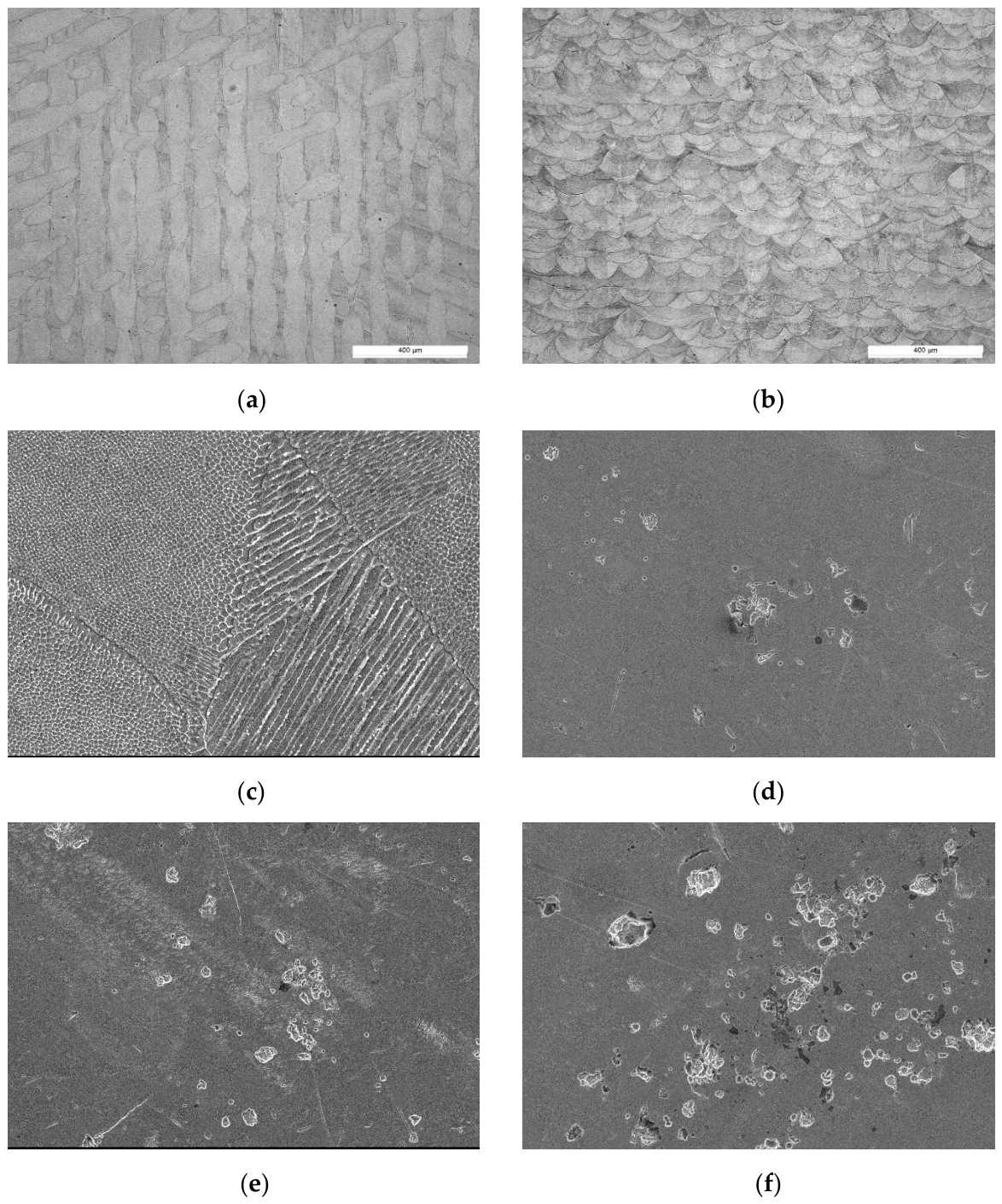
Illustrative examples of the microstructural characteristics and cavitation-induced surface evolution of additively manufactured maraging steel MS1 produced by the Direct Metal Laser Sintering (DMLS) process with a vertical build direction are presented in
Figure 10, based on the authors’ experimental results.
Figure 10 provides a qualitative overview of the material prior to cavitation exposure, including optical observations of the as-built microstructure. SEM images illustrate the progressive development of surface damage after cavitation erosion for different exposure times, highlighting the evolution of wear features with increasing duration of loading. In the cross-section parallel to the layers and perpendicular to the build direction (
Figure 10a), structures resembling columns in multiple planes under a certain angle can be observed, with the angle depending on the manufacturing technology. The cross-section parallel to the build direction (
Figure 10b) shows a banded structure. In
Figure 10c, two types of segments forming the layer structure can be observed—cellular and columnar segments. These two types of segment morphology originate from the grain growth direction, which is governed by the temperature gradient. The segments are separated by boundaries formed during rapid cooling. Samples with this structure were exposed to ultrasonic cavitation for 240 min according to the ASTM G32 standard.
Figure 10d–f show the development of cavitation erosion damage over time. After 60 min of cavitation exposure (
Figure 10d), mostly isolated small damages with a heterogeneous distribution can be observed. Several larger isolated damages are also present. After 120 min of cavitation erosion exposure (
Figure 10e), grouping of smaller damages is visible in the central part of the image, together with several larger, mostly isolated damages. After 240 min (
Figure 10f), the damages become more densely grouped and larger in size. Initial cracks responsible for damage formation may originate from pores or inclusions formed during manufacturing, which can be caused by chamber gas entrapment or by separation of segments along their boundaries during the production process. The locations where damage grouping occurs may correspond to zones with different microscale roughness, scratches formed during polishing, or regions with a higher concentration of inclusions and pores. The cavitation rate was 0.00617 mg/min.
6.4. Comparative Overview of Basic Engineering Materials
Since cavitation erosion can affect a wide range of metallic systems, numerous alloys and specially designed materials have been investigated in the literature. However, in practical engineering applications, the majority of components exposed to cavitating conditions are manufactured from a relatively limited group of widely used engineering materials, including steels, copper alloys, aluminium alloys, and cast irons. A comparative overview of the cavitation resistance of the most frequently used engineering materials is presented in
Table 4, while the general influence of selected alloying elements on cavitation resistance is summarized in
Table 5 [
68].
Environmentally friendly cavitation-resistant materials play an increasingly important role in improving the sustainability of fluid machinery systems. In addition to enhancing resistance to cavitation-induced erosion, such materials contribute to reducing the overall environmental impact through extended service life, lower maintenance requirements, and decreased material and energy consumption. Common solutions include corrosion-resistant and high-strength alloys, surface-engineered steels, and environmentally benign protective coatings such as advanced hard coatings and carbon-based films (e.g., DLC coatings), which have been widely reported to improve cavitation erosion resistance through surface hardening and reduced material removal rates [
8,
28,
115,
116]. These materials are designed to improve surface hardness, reduce roughness evolution, and limit material loss under cavitation loading conditions, as also confirmed in recent studies on surface modification and coating technologies. As illustrated in
Figure 1, improved material resistance directly influences the severity of wear particle generation and subsequent fluid contamination. By reducing particle release into the system, environmentally friendly materials help mitigate secondary effects such as clogging, degradation of other components, and contamination of surrounding environments, including water ecosystems. In this way, material selection becomes a key factor not only in component durability, but also in ecological protection and sustainable operation of machine systems.
Numerous studies available in the literature and online highlight the cavitation behavior of a wide range of materials, including polymers, composites, ceramics, and specialized alloys, emphasizing how microstructure, surface finish, and environmental conditions influence erosion rates and mechanisms. While these investigations provide valuable insights into cavitation processes, the present work does not cover such highly specialized materials. Instead, our focus is on metallic materials that are most commonly used in engineering applications and machine components.
7. Machine Elements
Knowledge of the cavitation resistance of materials is critically important in the design of hydraulic equipment. Cavitation-related damage is encountered in several key engineering fields, including hydropower, shipbuilding, the chemical industry, and water supply systems. In hydropower applications, the components most exposed to cavitation erosion are turbine runners, guide vanes, and draft tubes, where the use of stainless steels or specialized hardfacing layers can significantly extend the service life of the equipment. Similarly, centrifugal pumps often operate under conditions prone to intense cavitation, particularly when the suction pressure is insufficient; in such cases, impellers manufactured from bronze or stainless steel are commonly used to ensure reliable and long-term operation. In the field of shipbuilding, propellers are especially vulnerable to cavitation erosion at high rotational speeds, and the application of specialized bronzes and composite materials has proven to be an effective solution for improving durability and performance.
In addition to hydraulic machinery, cavitation and cavitation erosion can also occur in many widely used machine elements that operate in lubricated contacts or in fluid-flow environments. Although these components are not traditionally associated with cavitation to the same extent as hydraulic turbines or pumps, numerous studies have shown that local pressure fluctuations, rapid fluid acceleration, and the formation and collapse of vapor bubbles may occur in lubricating films or flowing media, leading to material damage and performance degradation. Such phenomena have been reported in gear transmissions, plain bearings, rolling bearings and seals where complex fluid–structure interactions, transient pressure drops, and dynamic loading conditions create favorable conditions for cavitation inception. The repeated collapse of cavitation bubbles near solid surfaces may cause surface pitting, erosion, and progressive material removal, ultimately affecting the durability, efficiency, and reliability of these machine elements. Because gears and plain bearings are fundamental components of numerous mechanical systems, understanding the mechanisms and manifestations of cavitation in these elements is of considerable practical importance.
A proper characterization of cavitation-induced damage in machine elements requires the application of advanced imaging and surface analysis techniques, which are essential for understanding both the morphology and evolution of material degradation. Commonly used methods include SEM for detailed examination of surface damage features such as pits, cracks, and material removal patterns, as well as optical and 3D profilometry for quantifying surface roughness changes, wear volume loss, and overall surface topography evolution. In addition, atomic force microscopy (AFM) can be employed for high-resolution analysis of local surface modifications at the micro- and nano-scale. Complementary experimental evaluations typically include microhardness measurements for assessing local changes in material mechanical properties, surface roughness measurements (Ra, Rz) for quantifying degradation severity, and mass loss measurements for evaluating the overall extent of cavitation-induced erosion. These parameters provide a quantitative basis for comparing material performance under cavitation loading conditions. These techniques provide important insight into the initiation and progression of cavitation erosion and enable a more reliable correlation between observed damage patterns and underlying physical mechanisms. Consequently, they represent a crucial component in experimental cavitation studies and contribute to a more comprehensive understanding of material response under cavitation loading conditions.
7.1. Gears
Gears represent essential components in many mechanical and fluid power systems and are widely applied across various engineering fields. Their performance significantly impacts the overall operation of machinery, affecting factors such as reliability, efficiency, and operational stability. Due to their critical role, gear elements are the subject of extensive theoretical and experimental research aimed at understanding their behavior under different loading and operating conditions [
117,
118]. Because of their sensitivity to operating conditions, gears are also prone to various forms of damage, including cavitation erosion. Such degradation can lead to costly repairs, significant downtime, and may also affect other components within the mechanical system. Consequently, understanding the mechanisms of gear damage and improving their resistance remain important topics in engineering research.
A systematic classification of gear damage is given in the standard [
119] and the accompanying technical report [
120]. These documents provide detailed descriptions of failure modes, along with additional explanations and the theoretical background underlying the standard. The standard [
119] classifies the most common gear failure modes into six general groups: tribological (non-fatigue) damage, fatigue damage, non-fatigue fractures, plastic deformations, manufacturing issues, and other surface damages (
Figure 11).
In the standard classification, cavitation damage is categorized under “Others”, together with overheating, electric discharge, erosion, and corrosion. However, the fact that cavitation appears last in the classification does not imply that it is of lesser importance. Although this type of damage may not be dominant and typically occurs only under specific operating conditions, it remains highly significant. It cannot be neglected, particularly because it may arise in specialized and highly critical mechanical systems. The severity of gear damage caused by cavitation is illustrated in
Figure 12 [
121,
122]. According to the standard definition and description, cavitation occurs when vapor-filled bubbles form in a liquid due to a local pressure drop caused by relative motion between a solid surface and the fluid, such as in the lubricant film between mating gear teeth. When these bubbles move into higher-pressure regions, they collapse, generating localized forces that can remove surface material and induce plastic deformation, work hardening, and ductile fracture of surface asperities. Microscopically, the resulting craters are deep, rough, and clean, often exhibiting a honeycomb-like structure, while macroscopically, the surface may appear similar to being sandblasted [
119,
120].
One of the very first relevant works in this field we found is the paper by Hunt et al. [
123]. This work represents one of the earliest experimental and theoretical attempts to investigate cavitation in gear contacts. In this study, the authors demonstrated that cavitation may occur between meshing gear teeth in an oil-lubricated gearbox transmitting torque. Using high-speed time-resolved photography, the formation and evolution of cavitation bubbles in the lubricant film between the teeth were directly observed. The experiments showed that the character of bubble formation strongly depends on rotational speed. At lower rotational speeds (below approximately 500 rpm), cavitation bubbles were not detected. At moderate speeds (around 1000 rpm) a small bubble approximately 0.1 mm in diameter was observed near the pitch point, travelling along the tooth profile with the moving contact point while remaining nearly constant in size (
Figure 13a). At higher rotational speeds (above about 3500 rpm), the cavitation process became significantly more violent, with larger and more irregular bubbles forming and collapsing more rapidly (
Figure 13b).
The experimental observations were supported by theoretical analysis based on the Navier–Stokes equations and earlier studies on bubble dynamics, indicating that the stresses generated during bubble collapse may exceed the yield strength of the material and thus lead to surface damage.
Cavitation in gears can occur both in hydraulic systems, such as gear pumps, and in conventional mechanical power transmission systems. The key difference lies in the role of the fluid. In gear pumps, the working fluid (water or oil) has defined inlet and outlet velocities and pressures, and the meshing gears act to increase the pressure at the outlet. In contrast, in mechanical power transmissions, the fluid primarily serves to lubricate and cool the meshing gears. In such cases, the gears are typically partially immersed in the fluid or the lubricant is directly injected into the contact zone.
In Ref. [
124], the authors performed a two-dimensional CFD simulation in ANSYS Fluent to investigate the influence of inlet and outlet pressures on gear pump performance, employing the Zwart cavitation model. The comparison with experimental results revealed certain discrepancies, which were primarily attributed to the simplifications inherent in the 2D approach. It is generally recognized that cavitation in gear pumps most often originates from a pronounced pressure increase in the region where the fluid becomes trapped between meshing teeth (the so-called oil-trapped zone). As the fluid leaves this region, significant pressure fluctuations occur toward the outlet, which play a dominant role in cavitation inception [
125].
From a theoretical standpoint, a contact ratio equal to one would eliminate trapped fluid regions. Accordingly, a reduction in contact ratio leads to a decrease in the volume of such zones. However, this must be considered together with its effect on pump efficiency. Furthermore, the development of cavitation is strongly influenced by elastic deformation of the tooth flanks under load, as well as by surface roughness factors that are often neglected in many numerical models, despite their impact on the pressure distribution within the contact region [
126]. In addition, the design of the pump housing has been shown to significantly affect cavitation behavior [
127].
For gear pumps with cycloidal tooth profiles, it has been shown that the number of teeth has a significant influence on cavitation behavior. When the number of teeth is varied (e.g., from 6 to 9), an increase in tooth count at a constant outer diameter leads to a reduction in cavitation intensity. However, an increase in the number of teeth also results in higher rotational speeds, which can intensify the cavitation process [
128]. Similar to involute tooth profiles, cavitation bubbles tend to form near the outlet of the meshing zone and subsequently accumulate along the surface as their volume increases.
Vibro-acoustic methods have also been developed for detecting and analyzing cavitation in gear systems. Experimental investigations on gear pumps using oil as the working fluid have shown that an increase in oil temperature intensifies cavitation. In addition, a series of numerical simulations performed in COMSOL examined the influence of vibrations and temperature on cavitation development in both spur and helical gears. The results indicate that bubble formation typically occurs at the outlet of the meshing zone, near the tip or root of the active tooth flank. With increasing circumferential velocity, the proportion of the vapor phase increases.
Since the influence of vibrations was specifically considered, it was observed that they are most pronounced in the contact zone, where they induce pressure fluctuations that promote bubble formation. This mechanism can be associated with acoustic (ultrasonic) cavitation. In the case of helical gears, the absence of trapped fluid regions contributes to a reduced tendency for cavitation. However, due to the variation in temperature along the contact line, cavitation is most intense in regions of highest temperature, typically near the point of the contact line. An increase in load leads to a reduction in vibration amplitude but also to a rise in temperature. Therefore, from the standpoint of vibration-induced cavitation, higher loads tend to reduce pressure fluctuations. Since angular velocity directly affects circumferential speed, an increase in rotational speed increases the fraction of vapor or vapor–gas phase, up to a certain critical speed, beyond which the rate of cavitation development decreases [
129,
130,
131,
132].
The simulation of cavitation phenomena can be carried out using a variety of CFD tools, including ANSYS Fluent, COMSOL, STAR-CCM+, FLOW-3D, and OpenFOAM. Most of these are commercial, closed-source software packages, whereas OpenFOAM represents an open-source alternative. However, its application in simulations of gear meshing remains relatively limited, primarily due to the complexity associated with mesh generation, particularly for moving and deforming domains, which is still an area of ongoing development. For this reason, commercial CFD tools currently retain a dominant role in such analyses [
133].
To overcome the challenges related to the generation of complex and moving meshes, mesh-free approaches have also been introduced. Among them, the Smoothed Particle Hydrodynamics (SPH) method has gained increasing attention in fluid dynamics simulations, offering an alternative framework that avoids conventional mesh-related limitations [
134].
7.2. Plain Bearings
The phenomenon of cavitation in hydrodynamic plain journal bearings has been extensively investigated since the late 20th century due to its critical influence on bearing performance and durability. Early studies highlighted the increasing significance of cavitation erosion as engine designs evolved toward higher rotational speeds and faster pressure rise rates, leading to localized material loss and reduced reliability [
135]. Experimental approaches using flat surfaces adjacent to rotating shafts demonstrated that the locations of cavitation bubble formation and erosion do not always coincide, revealing the complex fluid–structure interactions (FSI) within bearing films [
136]. High-speed photographic studies further identified both vapor and gas cavitation under dynamic loading, showing that cavitation can influence bearing stability and power loss [
137]. These investigations laid the groundwork for understanding the initiation and development of cavitation-induced wear in journal bearings.
Material selection has a substantial impact on cavitation erosion resistance in bearings. Comparative studies on various bearing alloys, including tin-based, lead-based, Cu-Pb alloys, and leaded bronze, revealed that erosion resistance does not necessarily correlate with conventional wear resistance, with some materials exhibiting significantly higher susceptibility to cavitation-induced damage [
138]. Theoretical and experimental work on vapor cavitation in heavily loaded bearings elucidated the damage mechanisms, emphasizing bubble collapse and fatigue-driven material removal [
139]. Subsequent studies on aluminum, cast lead-bronze, and sintered lead-bronze materials reinforced these findings, demonstrating that even minor compositional or structural differences can markedly affect erosion rates [
140]. These insights have guided the selection and treatment of bearing materials to enhance cavitation resistance under operational conditions.
The transition from oil-lubricated to water-lubricated bearings (WLBs) has introduced new challenges due to the low viscosity of water and the occurrence of cavitation, turbulent flow, and thermo-elastohydrodynamic effects. Investigations using numerical simulations have shown how surface roughness, thermal effects, and elastic deformation influence the dynamic characteristics of WLBs, including load-carrying capacity, friction, stiffness, and damping [
141,
142,
143]. Reviews of WLBs emphasize the role of cavitation, misalignment, and turbulence in performance degradation, suggesting optimized geometrical designs and numerical models based on Elastohydrodynamic Lubrication (EHL), to improve tribological behavior in marine and hydropower applications [
143,
144]. In high-performance engines, cavitation erosion in connecting rod and crankshaft bearings presents significant reliability concerns. Recent multiscale cavitation erosion models integrated with mixed-elastohydrodynamic lubrication frameworks allow quantitative prediction of material removal and damage evolution under operational conditions, accounting for factors such as engine speed, bearing clearance, and lubricant formulation [
145].
Advances in computational methods have enabled detailed predictions of cavitation behavior and bearing performance. Early elastohydrodynamic simulations quantified cavitation damage and wear in connecting rod big end bearings under dynamic loading, showing how bubble implosion generates localized high-pressure pulses that contribute to surface erosion [
146,
147]. Three-dimensional CFD simulations have since been employed to capture complex flow structures near feedholes and grooves, where traditional two-dimensional Reynolds equation models fail, providing accurate predictions of vapor formation and erosion-prone regions [
148,
149]. Multi-phase and FSI approaches further allow visualization of cavitation, recirculation, and elastohydrodynamic effects within journal bearings, offering comprehensive insight into internal flow phenomena [
141,
150]. Experimental validation of vibration characteristics has also been used as an indirect method to monitor vapor cavitation, revealing specific spectral patterns associated with cavitation in loaded bearings [
151]. Reviews of CFD and FSI methods summarize the impact of cavitation and temperature on bearing performance, highlighting the importance of coupled simulations for high-fidelity design analysis [
152,
153]. Numerical simulations using CFD, implemented in OpenFOAM with bubble dynamic models, as presented in [
154], allow analysis of cavitating flow and prediction of damage, accounting for parameters like bubble nuclei and bearing geometry. Although the literature provides substantial insight into cavitation mechanisms and erosion in journal bearings, studies are often fragmented and lack consistent integration between experimental observations and computational models. Material comparisons and testing methodologies vary widely, limiting the generalization of results and design guidelines. WLBs and other specialized configurations remain underexplored, with most research relying on simulations rather than validated operational data. Key factors such as wear evolution, thermal effects, misalignment, and multi-physics interactions are still inadequately addressed, leaving issues in predicting long-term performance and cavitation-induced damage. While the foundational understanding of bubble dynamics and surface erosion is strong, the field of plain bearing cavitation damage requires more unified, multi-scale, and experimentally validated approaches to reliably inform bearing design and service life assessment.
The ISO standard providing a general overview of damage in metallic plain bearings [
139] was first published in 2008. The currently valid second edition dates from 2019, with no significant differences compared to the first edition. The responsible ISO Technical Committee is currently preparing a new edition, which is expected to be published in the near future. In [
155], cavitation is treated as one of several mechanisms that may contribute to bearing damage, often acting simultaneously with other processes, which complicates the identification of the primary cause (
Figure 14).
The standard emphasizes that reliable damage analysis requires not only observation of visible features on the bearing surfaces but also a thorough understanding of operating conditions and maintenance history, since similar surface appearances may result from different mechanisms.
While standard [
139] provides the fundamental description, classification, and visual identification of cavitation-related damage, a more detailed analysis of its causes is given in an additional standard [
54], where cavitation is treated in greater depth. The fact that standard [
139] identifies ten distinct forms of damage in plain bearings during operation, while only one dedicated standard has so far been published addressing a single specific damage mechanism—cavitation erosion—highlights the significance of this phenomenon in mechanical systems.
The standard “
Plain bearings—Appearance and characterization of damage to metallic hydrodynamic bearings—Part 2: Cavitation erosion and its countermeasures” [
54] shares the same publication history as [
155], with editions released in 2008 and 2019. A new edition is expected to be published in the near future. According to Ref. [
54], cavitation erosion in hydrodynamically lubricated metallic plain bearings is a damage mechanism that may occur in service under complex operating conditions.
Bearing damage, including cavitation-related damage, is often the result of multiple interacting factors related to design, manufacturing, assembly, operation, and maintenance, which can make the identification of a single root cause difficult. The classification is based primarily on the observable features of damage on the bearing surfaces, supported by consideration of operating conditions, with the aim of enabling a reliable understanding of characteristic cavitation erosion forms and their countermeasures.
Cavitation erosion in plain bearings typically develops in localized regions, most often in lightly loaded or unloaded areas of the bearing. The affected surfaces initially undergo changes in appearance due to roughening, followed by the formation of small pits and surface cracks that may propagate and lead to material removal. Depending on operating conditions and the presence of entrained particles, the damaged areas may exhibit either a rough or, in some cases, a smoother and more polished appearance.
The progression and severity of cavitation erosion are influenced by a combination of operating parameters, including load conditions, journal motion, bearing geometry and clearance, lubrication conditions, and oil properties, as well as material characteristics such as hardness, toughness, and fatigue resistance. Based on the classification defined in [
54], cavitation erosion in plain bearings is categorized into five types according to the underlying flow-related mechanisms, originally developed from studies on internal combustion engine bearings and applicable to similar flow conditions in other machines. Types 1 to 4 include flow, impact, suction, and discharge cavitation, while type 5 comprises miscellaneous forms that are not easily attributed to a single mechanism. An overview of this classification is presented in
Figure 15.
Within this classification, flow and impact cavitation refer to the mechanisms of cavi-tation inception, whereas suction and discharge cavitation are often used to describe both the underlying mechanisms and the corresponding inlet and outlet regions of the bearing.
Flow cavitation erosion (
Figure 16) is characterized by localized material removal on the bearing surface, typically affecting the overlay or alloy layer, and in severe cases, penetrating deeper into the bearing material. It commonly occurs in regions associated with flow discontinuities, such as the edges of oil holes, groove ends, and joint face reliefs. It is caused by high-velocity flow over geometric discontinuities, leading to local pressure drops and cavitation, which subsequently results in surface erosion.
This type of cavitation follows directly from the Reynolds equation. Under the load acting on a journal bearing, a converging region is formed—an area of a thin lubricant film between the shaft and the bearing resulting from the applied radial load—and a diverging region, characterized by an increased clearance between the shaft and the bearing. As the lubricant passes through the converging zone, there is a sharp increase in pressure and temperature. Upon entering the diverging zone, the pressure in the fluid may drop below the saturation pressure, leading to the formation of cavitation bubbles.
Impact cavitation erosion (
Figure 17) is typically observed as localized damage with characteristic kidney-, ring-, or half-moon-shaped patterns [
54]. It occurs in regions downstream of partial circumferential oil grooves, oil drillings, or bleed slots, often at specific circumferential positions depending on operating conditions. The mechanism is associated with abrupt interruption of oil flow and inertia-driven flow within oil passages, which leads to local pressure drops and cavitation downstream of the discontinuity [
54].
Suction cavitation erosion (
Figure 18) occurs in dynamically loaded bearings and is typically observed on the upper halves of main bearings and near the circumferential centerlines of the bearing lands. The damage often appears in elongated, lancet-like forms in milder cases, while more severe cases exhibit broader and more irregular patterns. It is associated with rapid separation of the journal from the bearing surface under dynamic loading, which creates localized pressure reductions and leads to cavitation and subsequent surface erosion.
Discharge cavitation erosion (
Figure 19) is observed in dynamically loaded bearings equipped with circumferential oil grooves. It typically initiates at the edges of the groove and may appear as elongated spear-like damage in milder cases, or develop into V-shaped patterns progressing against the direction of journal rotation in more severe cases [
54]. This type of erosion is associated with rapid approach of the journal toward the bearing surface, which forces oil into the circumferential groove where it continues to flow due to inertia, creating local pressure reductions and cavitation.
Miscellaneous cavitation erosion includes several specific forms that cannot be clearly classified within the previous four mechanisms. These include cavitation induced by high-frequency vibration (vibration cavitation), erosion associated with elastic deformation of the bearing structure or abnormal combustion, and early-stage surface effects such as rippling or roughening [
54]. Although some of these forms may share similarities with suction cavitation, they occur under distinct conditions and are therefore treated separately as non-typical or mixed-mode cavitation phenomena.
For each type of cavitation erosion, the standards [
54,
155] provides corresponding illustrative examples, including photographs of damaged bearings, to support the identification and understanding of the characteristic damage appearances.
Figure 20 presents examples of cavitation erosion damage on plain bearings available from publicly accessible online sources [
156].
7.3. Others
Cavitation and cavitation erosion in rolling bearings are less frequently present than in hydrodynamic bearings or hydraulic components, yet they may develop under specific operating and lubrication conditions. These phenomena are primarily associated with transient pressure variations within the lubricant film, the presence of dissolved or entrained gases, and dynamic loading regimes. Cavitation occurs when the local pressure in the lubricant drops below its vapor pressure, leading to the formation of vapor bubbles. In rolling bearings, this is typically related to EHL conditions, particularly in the inlet and outlet regions of the rolling contact, where pressure gradients are most pronounced. The occurrence of cavitation is influenced by several factors, including rapid pressure fluctuations caused by combined rolling and sliding motion, elevated rolling speeds that intensify pressure gradients, and starved lubrication conditions in which insufficient lubricant supply promotes local pressure drops. Additional contributing factors include air entrainment or inadequate deaeration of the lubricant, as well as transient or dynamic loading conditions. Cavitation is most commonly observed in the outlet zone of the EHL contact, where pressure rapidly decreases following the peak Hertzian pressure. Although the intensity of cavitation erosion in rolling bearings is generally lower than in hydraulic systems, its effects can contribute to surface fatigue initiation, micro-pitting, and gradual material removal, often in combination with rolling contact fatigue and lubrication-related damage mechanisms.
Cavitation and cavitation erosion in seals are less commonly reported, yet they may significantly affect sealing performance, particularly in high-speed and high-pressure applications. These phenomena are primarily related to local pressure fluctuations, flow instabilities, and the behavior of the working fluid within the sealing interface. Cavitation can take place in different seal types, including mechanical face seals, lip seals, and labyrinth seals, depending on their operating principles and flow conditions.
In mechanical face seals, hydrodynamic effects generate pressure distributions across the sealing gap, and rapid pressure drops in diverging regions or at the outlet may promote cavitation. In lip seals, micro-hydrodynamic effects associated with surface roughness and shaft rotation can create localized low-pressure zones. In labyrinth seals, high-velocity flow through narrow clearances often leads to flow separation, vortex formation, and local pressure reductions, all of which favor cavitation. The likelihood of cavitation further increases under transient operating conditions, such as start-up or shutdown, as well as in the presence of pressure pulsations, dissolved gases, or inadequate fluid deaeration. Cavitation near sealing surfaces can lead to surface degradation, pitting, and material removal, as well as the deterioration of elastomeric elements in contact seals. In mechanical seals, such damage may compromise the integrity of precision contact surfaces, resulting in increased leakage and reduced service life.
7.4. Machine Design Aspect
From a machine design perspective, mitigation of cavitation and cavitation erosion relies on a coordinated approach that integrates geometry, operating conditions, lubrication, and material selection. Regardless of the specific machine element, the fundamental objective is to avoid local pressure drops below the vapor pressure of the working fluid, while simultaneously reducing the intensity of bubble collapse and its interaction with solid surfaces. In general, design measures should aim at ensuring smooth and continuous fluid flow, without abrupt changes in geometry that may induce local pressure gradients. Sharp edges, sudden expansions, and discontinuities should be avoided, as they promote flow separation and cavitation inception. Adequate control of operating conditions is equally important; excessive speeds, dynamic loading, and pressure fluctuations increase the likelihood of cavitation and should be minimized where possible. The lubrication system plays a central role. Sufficient lubricant supply must be ensured to prevent starvation, while lubricant properties, such as viscosity, vapor pressure, and air release capability, should be selected to maintain a stable fluid film and suppress bubble formation. At the same time, contamination control is essential, since particles and impurities may act as nucleation sites. Material and surface engineering also contribute to improving resistance against cavitation erosion. This includes the use of materials with high fatigue strength and toughness, as well as surface finishing and coatings that reduce surface defects and increase durability under repeated micro-impacts.
For gears, cavitation is primarily associated with rapid pressure variations in the lubricant film within the meshing zone. Therefore, attention should be paid to maintaining a stable lubrication regime and avoiding starvation, particularly at high speeds. Gear geometry and micro-modifications should ensure smooth meshing and gradual pressure transitions, while lubricant selection must support adequate film formation and air release. In plain bearings, where hydrodynamic lubrication governs performance, control of the oil flow is critical. The flow should be as continuous and smooth as possible, with properly designed oil grooves, holes, and passages. Increasing the oil supply pressure and reducing excessive clearances help maintain pressure above the cavitation threshold. Material selection is also important, favoring alloys with higher resistance to erosion and good mechanical properties, while maintaining clean, homogeneous, and defect-free surfaces. For rolling bearings, cavitation is typically linked to transient conditions in elastohydrodynamic contacts. The main countermeasures include ensuring sufficient lubricant supply, preventing air entrainment, and maintaining appropriate viscosity. From a design standpoint, proper internal clearances and alignment are necessary to avoid localized pressure drops, while stable operating conditions help reduce pressure fluctuations and associated cavitation effects. In the case of seals, cavitation is strongly influenced by local flow behavior and pressure distribution within narrow gaps. Design optimization should therefore focus on minimizing sharp pressure gradients and avoiding flow separation, particularly in high-speed or high-pressure applications. In addition, maintaining stable operating conditions and using fluids with suitable properties are essential, while surface engineering and material selection help improve resistance to cavitation-induced damage.
All operating parameters of machine systems depend on input and output conditions, particularly in power transmission systems where bearings and gears represent critical components. In conventional designs, it is not possible to dynamically modify the fundamental operating parameters of the system during operation without affecting its functionality and reliability. For this reason, direct control of cavitation through real-time changes in operating conditions is limited. However, within modern approaches to intelligent machine elements, there is increasing interest in adaptive and data-driven strategies for mitigating tribological and flow-induced damage mechanisms, including cavitation. Although direct real-time control of cavitation is generally constrained in conventional systems, indirect approaches may offer viable alternatives. These include optimization of component geometry, surface treatments, and lubrication conditions, as well as the application of artificial intelligence-based models for damage prediction and prevention. The integration of sensors in contact zones remains technically challenging; however, indirect monitoring methods such as vibration and acoustic signal analysis are already widely applied in power transmission systems. Although these methods do not enable isolated monitoring of cavitation, they can contribute to its detection when combined with numerical models and predictive algorithms.
8. Numerical Modeling, Simulation, ML and ANN Approaches
In contemporary research and engineering, CFD is widely applied to analyze cavitation and cavitation-induced erosion in machine elements. Various commercial and open-source CFD packages are available, each offering different levels of support for multiphase flows, turbulence modeling, and cavitation phenomena. Among commercial software, ANSYS Fluent is frequently used due to its advanced cavitation models, such as the “full cavitation model” which accounts for phase change and bubble dynamics by simplifying the Rayleigh–Plesset equation’s rate expressions for vapor and liquid mass transfer; this model has been implemented in Fluent’s multiphase framework to enable practical engineering simulations of cavitating flows [
157]. STAR-CCM+ provides similar capabilities, enabling multiphase and turbulent flow simulations, parametric studies, and visualization of complex geometries, with cavitation modeling approaches based on bubble growth and collapse rates, including full Rayleigh–Plesset and Schnerr–Sauer type models [
158]. COMSOL Multiphysics also allows cavitation modeling when CFD modules are coupled with structural analysis, enabling fluid–structure interaction studies relevant for erosion prediction.
For academic research or projects with limited resources, open-source CFD tools are especially relevant. OpenFOAM provides built-in solvers for cavitating, multiphase flows. For example, the solver cavitatingFoam employs the homogeneous equilibrium model (HEM) to represent the compressibility and phase fraction of a liquid–vapor mixture, with the possibility to select turbulence models such as Reynolds-Averaged Navier–Stokes (RANS) or Large Eddy Simulation (LES) [
159]. Another solver, cavitatingDyMFoam, incorporates dynamic mesh motion for rotating machinery applications [
160]. Literature reports further extensions and implementations of cavitation models in OpenFOAM, including density-based equilibrium approaches that capture shock waves generated by bubble collapse, which are relevant for erosion assessment [
161]. Other open tools exist for educational or research purposes. SU2 supports multiphase and cavitation simulations, often applied in aerodynamic optimization studies, while CFD Python, PyFR, and Basilisk provide frameworks for numerical experimentation, though they are less commonly applied to industrial cavitation problems without additional development. Some software solutions offer free or academic versions, such as an Ansys Academic/Student License and the cloud-based SimScale platform, which provides multiphase and basic cavitation simulations using full cavitation models [
162].
The capability of each software to model cavitation-induced erosion varies. Commercial packages often include dedicated modules or allow extensions through user functions or scripting, whereas open-source solutions generally require user-implemented erosion criteria linked to local flow conditions and collapse events. CFD solvers for cavitation are typically based on the interplay between liquid pressure, vapor pressure, and turbulence, deriving mass transfer source terms from simplified rate expressions based on Rayleigh-Plesset-type formulations, volume of fluid (VOF), or homogeneous equilibrium approaches.
Table 6 summarizes the main software packages discussed, their cavitation and erosion modeling capabilities, and key notes regarding solver features.
The software packages presented in
Table 6 demonstrate the current capabilities for modeling and simulating cavitation and cavitation-induced erosion in machine elements. Nevertheless, challenges remain, particularly regarding the accurate prediction of erosion rates and material damage. Open-source solvers often require user-implemented erosion models, while even commercial tools may be limited in capturing microscale bubble collapse effects and their interaction with material surfaces. Future research should aim to develop integrated multiphysics approaches, improved turbulence–cavitation interaction models, and standardized methods for quantifying erosion, which would enhance the reliability and predictive power of numerical simulations in the context of cavitation wear.
Recent advances in cavitation modelling have demonstrated that the phenomenon can be effectively described only through coupled multiphysics approaches, which integrate fluid dynamics, thermodynamic effects, and material response. In particular, computational fluid dynamics (CFD) methods based on multiphase flow formulations (e.g., Euler–Euler or mixture models) are widely used to capture cavitation inception and development, while incorporating phase-change mechanisms governed by local pressure and vapor pressure conditions. Representative studies have shown that such models can be further enhanced by coupling bubble dynamics with energy or pressure-based formulations to improve prediction accuracy of cavitation structures and collapse intensity [
164,
165]. In addition, thermal effects and heat transfer have been identified as important factors influencing cavitation behavior, particularly in high-intensity or high-speed flows, where local temperature variations can alter vapor pressure and modify cavity dynamics [
164,
166]. From the materials perspective, cavitation erosion modelling has evolved toward energy-based and pressure-wave-based approaches that aim to predict material damage caused by microjet impacts and shockwave loading during bubble collapse events [
167]. Despite these significant developments, a fully predictive and unified modelling framework that simultaneously captures fluid flow, heat transfer, and erosion mechanisms in complex machine element geometries is still not available. This remains an active research area, particularly in the context of linking cavitation dynamics with real material degradation in engineering components.
In recent years, machine learning (ML) and artificial neural networks (ANNs) have increasingly been applied in cavitation research to improve prediction accuracy, detect cavitation conditions, and model complex physical processes that are difficult to describe analytically. These approaches allow researchers to process large datasets obtained from experiments or numerical simulations and to identify nonlinear relationships between variables influencing cavitation behavior. Recent review papers emphasize the growing role of data-driven methods in cavitation research. Reviews of cavitation erosion prediction methods highlight the limitations of traditional approaches such as FSI models, micro-jet models, and energy-balance methods, while suggesting that machine learning techniques can improve parameter optimization and predictive robustness in erosion modeling [
13].
Several studies focus on predicting cavitation erosion and material damage using artificial intelligence techniques. An artificial neural network model based on a back-propagation algorithm was used to predict cavitation damage in stainless steels such as 316L and 420 by considering parameters including cavitation exposure time, surface roughness, and residual stress as input variables. The model was optimized by adjusting the number of input nodes, hidden layer neurons, and activation functions, demonstrating the potential of ANN approaches to accurately estimate the mean depth of erosion caused by cavitation [
168]. Neural modeling has been applied to the cavitation erosion behavior of 34CrNiMo6 steel, where experimental results obtained using the ultrasonic vibratory method were analyzed using Matlab’s Neural Network Toolbox. The developed ANN model incorporated variables such as exposure time, roughness, worn surface fraction, and mass loss, while image analysis was also explored as an additional input signal to describe erosion progression [
169]. Machine learning has also been used to model mass loss of copper-based alloys subjected to cavitation. A comparative study evaluated several artificial intelligence techniques, including Support Vector Regression (SVR), Generalized Regression Neural Network (GRNN), Gene Expression Programming (GEP), and Radial Basis Function (RBF) networks. Among these approaches, the GRNN model provided the most accurate prediction of mass loss, followed by SVR, demonstrating that data-driven models can successfully describe corrosion–erosion processes occurring in cavitation environments [
170].
Another important research direction involves the use of machine learning for detecting cavitation or predicting its onset in engineering systems. Support Vector Machine (SVM) algorithms have been applied for diagnosing flow blockages and predicting the onset of cavitation in centrifugal pumps using vibration signals. By classifying different operating conditions, the model can identify pre-cavitation states, enabling early fault detection and preventive maintenance [
171]. SVM-based classification has been used for cavitation detection in butterfly valves. Statistical features extracted from vibration or acoustic signals were used to train SVM models capable of distinguishing normal operating conditions from cavitating flow. The study also compared SVM performance with a self-organizing feature map neural network, highlighting the effectiveness of machine learning approaches for condition monitoring in fluid systems [
172].
9. Discussion
This review indicates that cavitation and cavitation-induced erosion in machine elements represent a well-recognized phenomenon with a long-standing research tradition. From a historical perspective, the phenomenon has been observed and described for more than two centuries, while its theoretical foundations, particularly in terms of hydrodynamics and bubble dynamics, are well established. The physical mechanisms governing cavitation, including bubble nucleation, growth, and collapse, have been extensively studied, primarily within the field of fluid mechanics, providing a solid theoretical basis for further research and engineering applications. At the same time, the analysis of available literature reveals a clear imbalance between the level of understanding of cavitation as a hydrodynamic phenomenon and its investigation as a degradation mechanism in machine elements. While the fundamental physics is well understood, its direct translation into engineering design criteria and predictive tools for machine elements is limited.
Standardized testing procedure, based on vibratory cavitation (ASTM G32) is widely available and supported by commercially developed equipment commonly used in tribological and industrial laboratories. In addition:
A wide range of engineering materials, including newly developed alloys and surface-treated materials, can be systematically tested;
Comparative analysis between materials is well established;
The influence of microstructure, chemical composition, and mechanical properties on cavitation resistance is extensively documented.
In this sense, material characterization and experimental evaluation of cavitation resistance do not represent a limiting factor in current research. However, despite the existence of standardized methodologies, a number of important limitations have been identified:
Methodological limitations of standard tests sensitivity of results to test parameters not strictly defined (e.g., horn–specimen distance);
Limited representativeness of real operating conditions, particularly in relation to hydrodynamic cavitation;
Limitations in data interpretation, strong dependence of results on the selected evaluation parameters (e.g., maximum erosion rate, incubation time), lack of a universal parameter that reliably characterizes cavitation resistance, as well as inconsistencies in mathematical interpretation of erosion curves.
These observations indicate that, although standard methods provide a necessary reference framework, they do not fully ensure the reliability, universality, and comparability of results; however, the existence of a standardized approach is still essential, as it allows global comparison of cavitation erosion data.
A particularly important limitation identified in this review is the insufficient number of standards addressing cavitation in mechanical systems. Existing standards are mainly focused on hydraulic machinery (e.g., pumps) and, to a limited extent, on specific components such as plain bearings. In contrast, for many widely used machine elements (e.g., gears, rolling bearings, seals), there are no dedicated standards addressing cavitation behavior and cavitation-induced damage. This significantly limits the possibility of systematic analysis, comparison of results, and the development of unified design guidelines.
The experimental investigation of cavitation in machine elements is still limited by the absence of universally standardized test rigs. This limitation arises from the strongly application-specific nature of cavitation phenomena, which differ significantly between components such as bearings, gears, seals… In these systems, cavitation is not an isolated hydrodynamic phenomenon but is closely coupled with tribological effects, elastohydrodynamic lubrication regimes, and transient contact mechanics. In addition, cavitation behavior is highly sensitive to operating conditions and surface properties, including load variations, sliding or rolling speed, lubricant characteristics, and local surface topography. As a result, it is difficult to define a single experimental configuration that would be representative across different machine elements. Consequently, current experimental approaches remain component-specific and are designed to reproduce selected aspects of cavitation behavior rather than providing a unified standardized testing framework. Progress in this field would first require the development of standardized testing methodologies for cavitation in machine elements. However, such an effort would demand extensive coordinated work involving competent technical committees, as well as a deep and comprehensive reliance on results from existing and future scientific research in this area.
From the perspective of theoretical and numerical research, the analysis shows that studies dealing with the mathematical and geometrical modeling of cavitation in machine elements are relatively limited. The most available models focus on fluid flow and cavitation inception, with less attention given to surface damage mechanisms and the evolution of cavitation erosion. In particular, there is a noticeable lack of research addressing micro-scale modeling of cavitation erosion processes, including:
Material response to repeated micro-jet impacts,
Initiation and propagation of surface damage;
Multi-scale approaches, which would connect system-level parameters (geometry, operating conditions), fluid behavior (cavitation dynamics), material response (erosion mechanisms), and resulting performance degradation (load capacity, durability, service life, reliability).
Another important limitation concerns experimental infrastructure. Unlike material testing, where standardized devices are widely available, there are no universal standardized test rigs specifically designed for cavitation investigation in machine elements such as gear transmissions, plain bearings, rolling bearings, and seals. Instead, most studies rely on custom-developed laboratory setups and application-specific experimental configurations. This further contributes to the fragmentation of research results. The greatest challenge faced by researchers working on the mathematical modeling of cavitation and cavitation erosion in specific machine elements is the requirement for experimental validation of their results, which is complex and costly to organize. Therefore, in recent times, the development of information technologies has led to the increasing use of numerical simulations.
With respect to numerical simulations, although the application of CFD methods has significantly advanced the analysis of cavitating flows, current approaches still exhibit important limitations. most models can successfully predict cavitation occurrence and flow structure. However, the link between cavitation and material degradation (wear intensity) remains insufficiently developed. As a result, researchers often rely on simplified assumptions or develop custom models and codes based on specific geometries and conditions. Consequently, comprehensive predictive models that can simultaneously describe cavitation dynamics and resulting erosion are still lacking. In this context FSI analysis is increasingly being applied in the study of fluid systems and machine elements operating with liquid media, particularly in lubricated contacts such as gears and plain bearings. These approaches enable a more realistic representation of the interaction between the fluid flow and deformable solid boundaries, which is essential for capturing local pressure fluctuations and conditions leading to cavitation inception. However, their application to cavitation erosion problems remains limited, mainly due to high computational demands and the complexity of coupling fluid dynamics, structural response, and material degradation mechanisms.
Modern data-driven approaches, such as machine learning and neural networks, are only marginally represented in this field. Their application remains limited due to insufficient experimental datasets, a lack of standardized input parameters, and the complexity of the multi-physics interactions involved in cavitation processes. However, they show potential for predicting cavitation occurrence and estimating erosion rates.
Future research directions should include the development of sustainable and intelligent machine systems with enhanced capabilities for adaptive design, predictive modeling, and indirect monitoring of cavitation-related phenomena.
10. Conclusions
This review has shown that cavitation and cavitation-induced erosion in machine elements are well-recognized phenomena with a solid theoretical background and extensive experimental support. While the fundamental mechanisms of cavitation are well understood, their application to the analysis, prediction, and design of machine elements remains limited. The analysis further indicates that, although standardized testing methods and material characterization techniques are well developed, important limitations remain in terms of result interpretation, representativeness of real operating conditions, and the lack of dedicated standards for many machine elements. In addition, the absence of universal experimental setups and the reliance on custom-developed test rigs contribute to the fragmentation of research results and hinder their broader applicability. From the modeling perspective, current approaches are still largely focused on cavitation inception and flow behavior, while the mechanisms of material degradation and their quantitative prediction are insufficiently addressed. The lack of micro-scale models, as well as integrated multi-scale and multi-physics approaches, represents a key limitation for the development of reliable predictive tools. Furthermore, numerical simulations, although increasingly used, are still constrained by model simplifications and the need for complex and costly experimental validation.
Based on the conducted analysis, future research in the field of cavitation in machine elements should be directed toward:
Development of new and improved testing standards tailored to specific machine elements;
Establishment of unified methodologies for data analysis and interpretation;
Advancement of multi-scale models linking cavitation phenomena with material degradation and machine elements geometry;
Establishing a direct link between cavitation phenomena, erosion mechanisms, and the design and operational characteristics of machine elements, including geometry, load capacity, functional performance, service life, and reliability;
Development of standardized experimental rigs for machine elements;
Closer integration of numerical simulations with experimental validation;
Increased application of data-driven approaches for prediction and optimization.
Addressing these challenges is essential for improving the understanding of cavitation-induced damage and for enabling more reliable design, assessment, and operation of machine elements exposed to cavitating conditions.