Article

Analysis of Friction-Induced Vibration Behavior of Train Brake Systems Considering the Effect of Environmental Temperature

1
College of Mechanical and Electrical Engineering, Wenzhou University, Wenzhou 325399, China
2
Tribology Research Institute, School of Mechanical Engineering, Southwest Jiaotong University, Chengdu 610031, China
3
State Key Laboratory of Rail Transit Vehicle System, Southwest Jiaotong University, Chengdu 610031, China
*
Author to whom correspondence should be addressed.
Lubricants 2026, 14(6), 236; https://doi.org/10.3390/lubricants14060236
Submission received: 30 April 2026 / Revised: 2 June 2026 / Accepted: 5 June 2026 / Published: 11 June 2026

Abstract

Train brake systems are characterized by strong friction and open-system features during the service process. Low environmental temperatures significantly affect the contact interface and the attrition characteristics of the braking frictional couple, thus intensifying friction-induced vibration and threatening operational safety. To elucidate the impact of environmental temperature on the frictional vibration characteristics of train brake systems, braking deceleration tests under different environmental temperatures were first conducted to obtain the evolution of vibration, noise, and friction coefficient with environmental temperature and brake disc rotational speed. Then, the Stribeck friction parameters under different environmental temperatures were identified using a genetic algorithm. On this basis, a brake system dynamic model was developed, incorporating disc–pad friction, wheel–rail adhesion, and the relative torsion between the brake disc and the wheelset, enabling accurate examination of the vibrational behaviour arising from friction under different environmental temperatures. And the dynamic relationship among environmental temperature, interface friction parameters, and vibration characteristics of the brake system during braking deceleration was elucidated. The findings indicate that as the environmental temperature decreases, the dynamic friction coefficient increases during the relatively high-speed braking phase, intensifying high-frequency unstable vibrations of the braking assembly. During the relatively low-speed braking phase, the friction coefficient exhibits an obvious negative-slope relationship with vehicle speed that means the friction coefficient increases as the speed decreases, and this negative slope effect is enhanced under low-temperature conditions. Consequently, it triggers intense stick–slip motion at the disc–pad interface and even severe vibrations of various components in the brake system, leading to a sudden increase in vibration intensity in the relatively low-speed range.

1. Introduction

The high-speed train constitutes an essential component of China’s modern transportation system, and its operational safety and reliability have always been a key focus of research and engineering practice [1,2]. In recent years, as the “Eight Vertical and Eight Horizontal” high-speed railway network continues to extend into the western high-altitude and cold mountainous regions, the complex and variable environmental temperatures have imposed higher demands on train service performance. The braking system, as the actuator for train deceleration and stopping, exhibits strong frictional and open-system characteristics during service. The complex and variable environmental temperatures in the western high-altitude and cold mountainous areas can significantly alter the friction contact and wear behaviour at the braking interface, thereby intensifying friction-induced vibration and noise. This not only affects ride comfort but may also lead to abnormal structural damage to the braking system, endangering operational safety [3,4,5,6]. Therefore, investigation into the effect of environmental temperature on the friction characteristics and vibration behaviour of the brake system is of great significance for ensuring train braking safety.
At present, researchers have extensively explored the relationship between environmental temperature and braking friction [7,8,9], as well as vibration behaviour [10,11,12]. Yavuz et al. [13] performed dynamic characteristic tests on a high-speed train operating in cold conditions and observed that the system’s vibration amplitude was significantly larger than that under normal-temperature conditions. Lyu et al. [14] carried out pin-on-disc tribological tests and revealed that both the coefficient of friction together with the wear loss rate of the disc–pad interface increased slightly under low-temperature conditions compared with those at environmental temperature. Ma et al. [15] analyzed the frictional response of a train’s braking system under cold conditions and demonstrated that reduced temperatures aggravate interfacial vibration and wear, thereby deteriorating braking performance. Yu et al. [16] studied the wear behaviour together with the vibroacoustic signatures of the braking interface at low temperatures, revealing that environmental temperature alters the morphology and distribution of contact plateaus, which consequently modulates the magnitude of vibratory response and sound produced by friction. Zhang et al. [17] studied the effect of a perforated friction block on the tribological behaviour of a high-speed train braking interface under different environmental temperatures and found that low temperatures increase material hardness and brittleness, resulting in more severe abrasive wear and enhanced vibration and noise responses. Pelcastre et al. [18] conducted tribological tests on composite brake block materials at normal temperature and at −15 °C and found that the composite materials maintained a higher friction coefficient under low-temperature conditions. While the above-mentioned studies have experimentally explored the relationships between environmental temperature, braking friction, vibration and noise behaviour, they have not established the intrinsic link among environmental temperature, interfacial friction, and vibration response. Consequently, it remains difficult to accurately understand the influence of environmental temperature variations on braking friction-induced vibration and the underlying mechanism.
Environmental temperature influences the dynamic behaviour of the braking system primarily through its effect on the frictional signatures of the braking frictional pair [19,20,21,22,23]. Accurately obtaining the friction parameters under different environmental temperatures is therefore the key to revealing the influence mechanism of environmental temperature on braking friction-induced vibration. Wu et al. [24] inferred the parametric values of the Stribeck friction model during low-speed stick–slip braking using a curve-fitting approach implemented in MATLAB. Lee et al. [25] presented a quick recursive-least-squares-based technique for determining system parameters, which simplified the identification procedure while improving computational efficiency. Liang et al. [26] devised a nonlinear method for estimating friction parameters via the integration of separable least squares and kinematic orthogonality, approximating the friction characteristics along a specific path in a least-squares sense, thereby reducing computational cost compared to conventional methods. Liu et al. [27] integrated the least-squares method with a PSO-based method for the identification of Stribeck-model parameters, achieving good agreement between the identified results and experimental measurements. Huang et al. [28] divided the friction parameters into sliding and adhesion parts and used a Gaussian swarm optimization algorithm to estimate the coefficients of the generalized Maxwell slip model, effectively characterizing the system friction behaviour. These research outcomes provide important methodological and theoretical guidance for friction parameter identification. However, existing studies rarely address the identification of braking interface friction parameters under different environmental temperatures, the relationship between environmental temperature and braking interface friction parameters has not been established, and a dearth of investigations exists on characterizing the friction-induced oscillation of the braking assembly across different temperature settings.
In this study, braking deceleration tests were conducted under different environmental temperatures using a self-developed multi-condition and multi-mode test rig for braking studies aiming to analyze the evolution of braking interface vibration, noise, and disc–pad friction coefficient with environmental temperature. Subsequently, an adaptive identification method for Stribeck friction parameters based on a genetic algorithm was proposed to accurately capture the relationship involving the frictional coefficient, brake disc angular velocity, and environmental temperature. On this basis, a dynamic model of the brake system was developed, taking into account pad–disc interfacial friction and wheel–rail adhesion, together with the disc–wheelset torsional coupling. The identified friction parameters under different environmental temperatures were introduced into the model, and numerical simulations were performed to explore the influence of environmental temperature on braking friction-induced vibration at relatively high and relatively low speeds, thereby elucidating the relationship among environmental temperature, interface friction coefficient, and braking friction-induced vibration during braking deceleration. The research findings can provide guidance for understanding and accurately analyzing the evolution of friction-excited structural vibration and sound during low-temperature stopping operations of rail vehicles.

2. Experimental Preparation

2.1. Experimental Setup

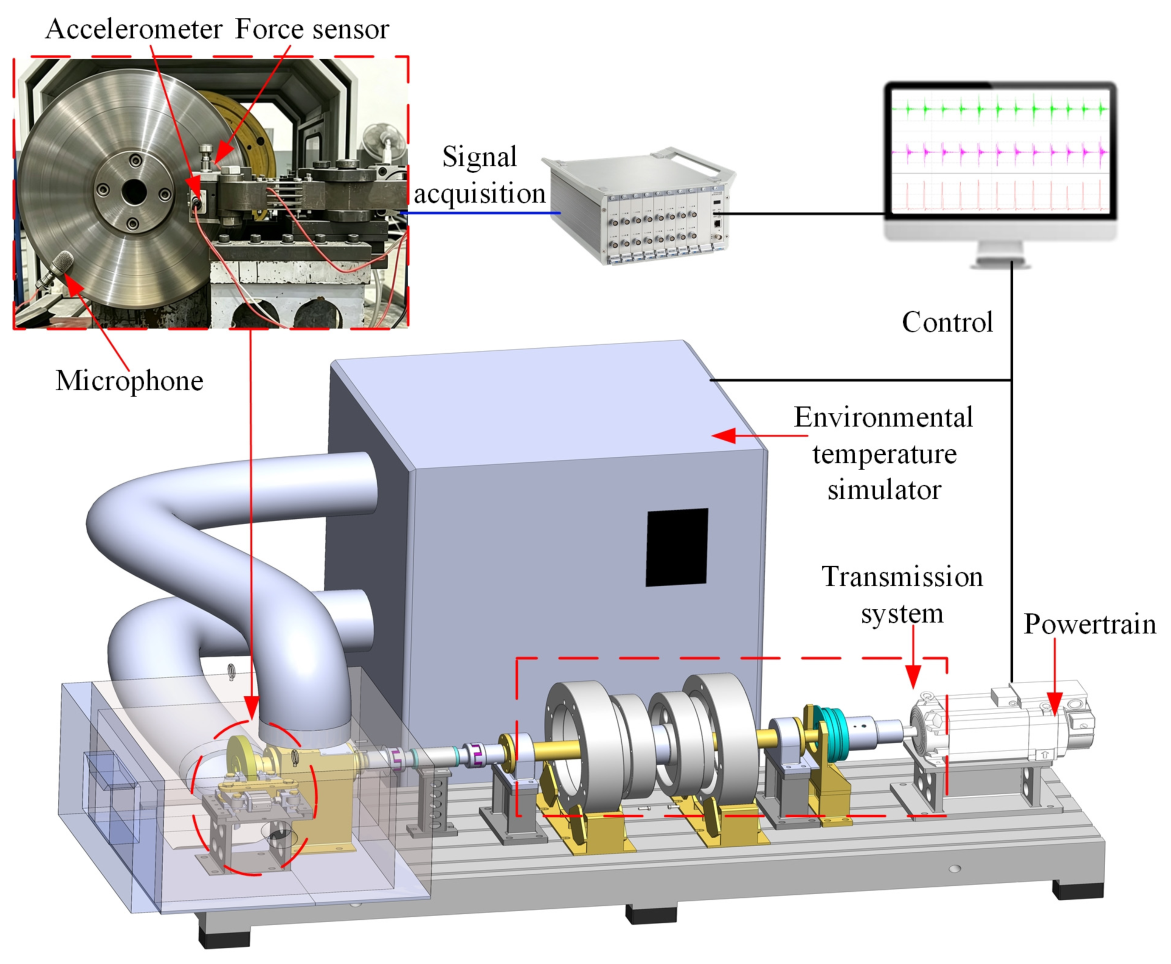
To examine the modulation of environmental temperature on the friction characteristics and vibration-noise behaviour of the braking system, braking friction experiments were performed using a laboratory-developed, temperature-controllable train braking behaviour apparatus, as illustrated in Figure 1. The experimental setup mainly comprises an environmental temperature regulation module, a braking unit, a power system, one transmission system, and one data collection and analysis system. The environmental temperature control unit is capable of regulating the environmental temperature within a range of −40 °C to 20 °C. The braking unit can reproduce multiple braking modes, including dragging, service braking, and emergency braking. During the experiments, vibration and noise signals were measured using a triaxial accelerometer (measurement range: ±10 g; sensitivity: 50 mV/(m·s−2)) and a microphone (dynamic range: 20–77 dB; sensitivity: 57.3 mV/Pa), respectively. In addition, a force sensor (measurement range: 3 kN; sensitivity: 1.5 mV/V) was employed to measure the normal load during the braking friction process. These signal acquisition instruments were all provided by Donghua Testing Technology Co., Ltd. (Jingjiang, China). To accurately capture high-frequency vibration and noise signals, the data acquisition rate was configured at 20 kHz. The signals from all sensors were processed through the signal capture and interpretation unit.

2.2. Experimental Sample and Progress

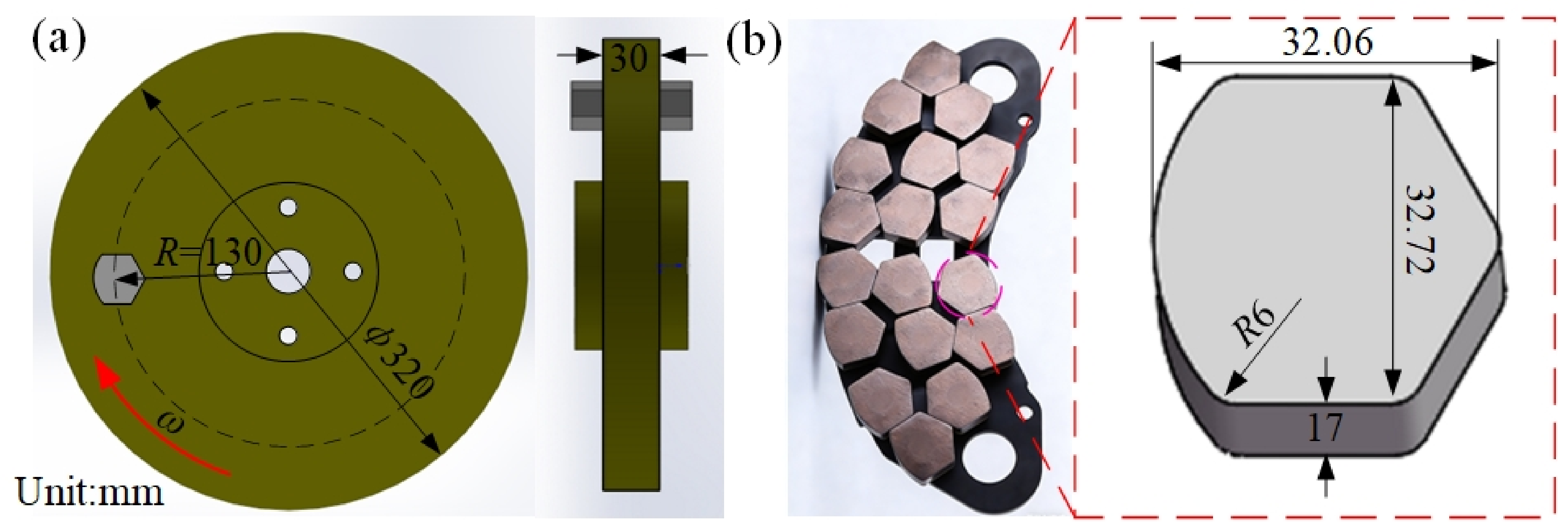
Figure 2 presents the geometric size specifications and mating geometry and pad specimens. Forged steel constitutes the tested brake disc, which measures 320 mm in diameter and 30 mm in thickness. The brake pad specimen is established upon the pentagonal structure of high-speed train brake pads, with a cross-sectional area of 793 mm2 and a height of 17 mm. The effective disc–pad friction radius is set to 130 mm.
Considering that the monthly average minimum temperature in winter in the high-altitude cold regions of Western China is approximately −20 °C, while 20 °C represents the widely applicable environmental operating conditions for braking systems, this study selects these two typical environmental temperatures for comparative experiments. During train braking, wear-free electric braking is prioritized. Mechanical friction braking is usually activated when the speed drops below 60 km/h and the electric braking becomes insufficient. Therefore, an initial braking speed of 70 km/h is selected to cover the range of mechanical friction braking. Prior to each test, the environmental temperature control unit was used to adjust the test rig to the target temperature. Subsequently, we controlled the brake disc to start rotating so that the vehicle speed reached 70 km/h, and a 500 N normal contact force was exerted while disengaging the clutch to simulate the braking and stopping process. For each temperature condition, 20 braking tests were conducted. In each run, the temperature of the brake disc was brought down to the preset environmental temperature prior to conducting the subsequent experiment.

3. Experimental Results and Analysis

Based on the vibration, noise, and friction coefficient signals acquired from braking friction experiments, analyses were conducted on the braking noise intensity, time–frequency characteristics of vibration, and friction coefficient–velocity relationship under different environmental temperatures. The study aims to reveal the effects of environmental temperature on braking vibration behaviour and friction characteristics, and to provide data support for the extraction of brake interface friction parameters and numerical simulation analyses.

3.1. Friction Vibrational and Noise Properties

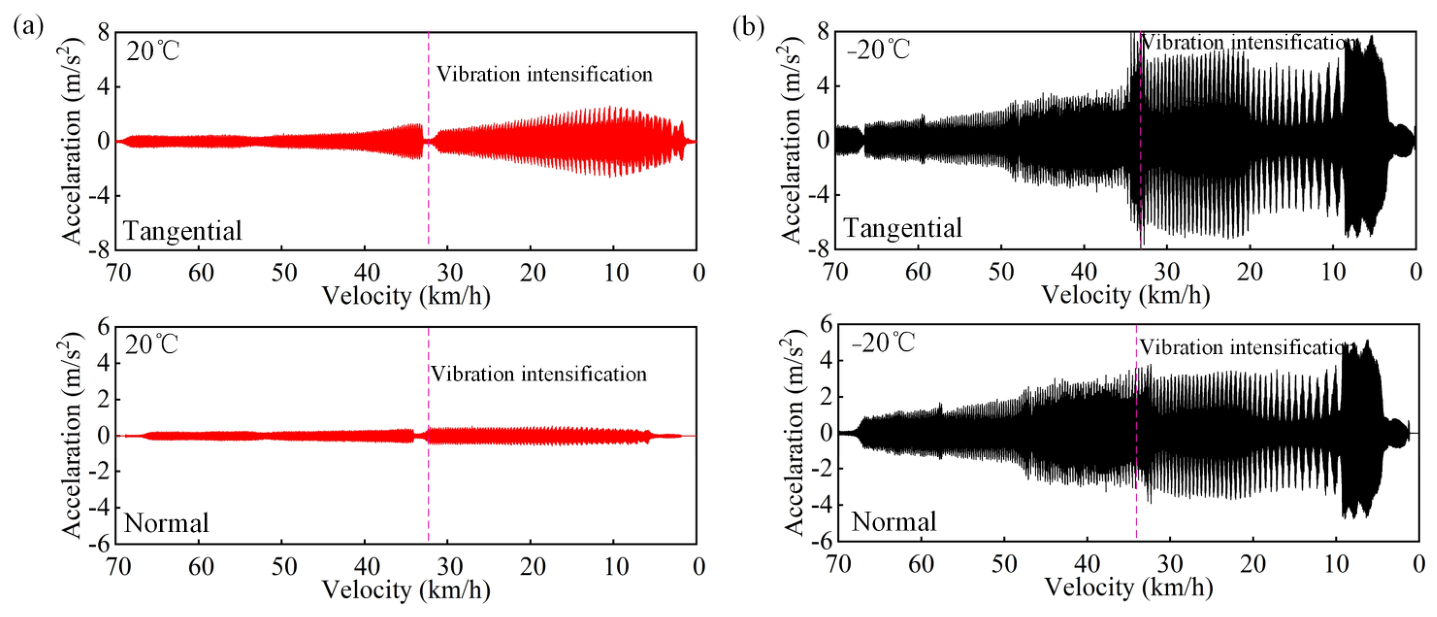
To elucidate the braking vibration behaviour under different environmental temperatures, RMS amplitudes of the tangential and normal acceleration signals of the brake pad were analyzed with respect to environmental temperature and speed, as illustrated in Figure 3. At the onset of brake application, the vibration amplitudes under different temperatures remained relatively stable without significant fluctuations. Once the vehicle speed decreased to approximately 30 km/h, an abrupt rise in vibration amplitude was observed, with the enhancement being more pronounced under the low-temperature condition of −20 °C. These results indicate that the braking friction vibration exhibits a stage-dependent variation with decreasing speed and that low temperatures amplify the vibration intensity.
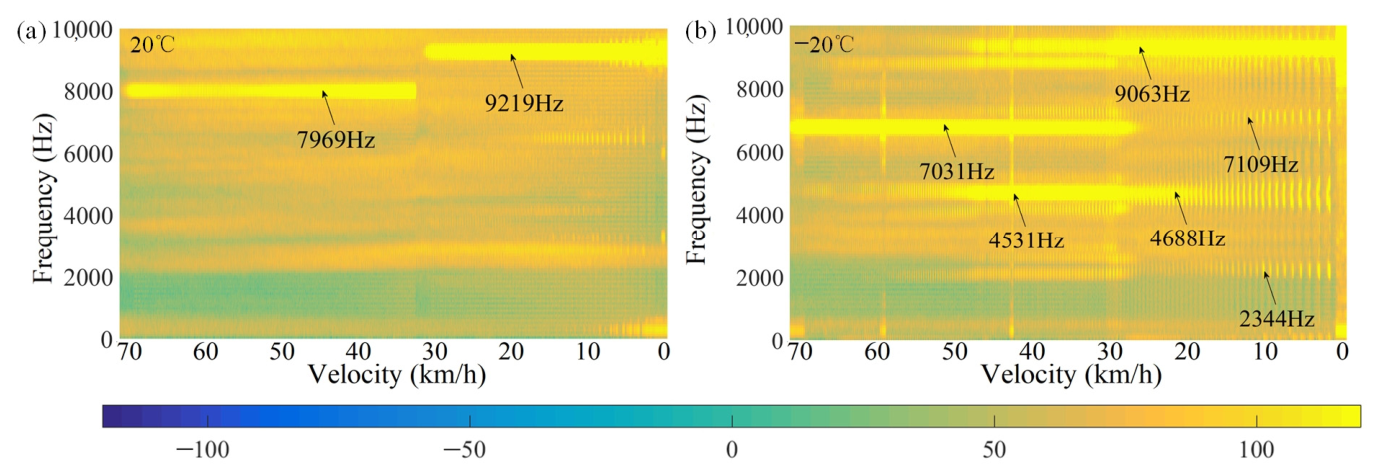
To investigate the frequency-domain characteristics of vibration under different environmental temperatures, time–frequency analysis was conducted on the tangential acceleration during the service braking process. As shown in Figure 4, significant changes in the vibration spectra occurred upon the vehicle speed dropping to approximately 30 km/h. During the relatively high-speed stage above 30 km/h, all test conditions exhibited high-frequency friction-induced vibrations. Under the 20 °C condition, the vibration energy was concentrated at a single dominant frequency, whereas at −20 °C, additional frequency components appeared. As the vehicle speed dropped below 30 km/h, the vibration spectrum became more complex, consisting of intermittently distributed low- and high-frequency components. These results indicate that both environmental temperature and speed variations make a considerable contribution to the dynamic behaviour and spectral signatures at different stages of deceleration braking.
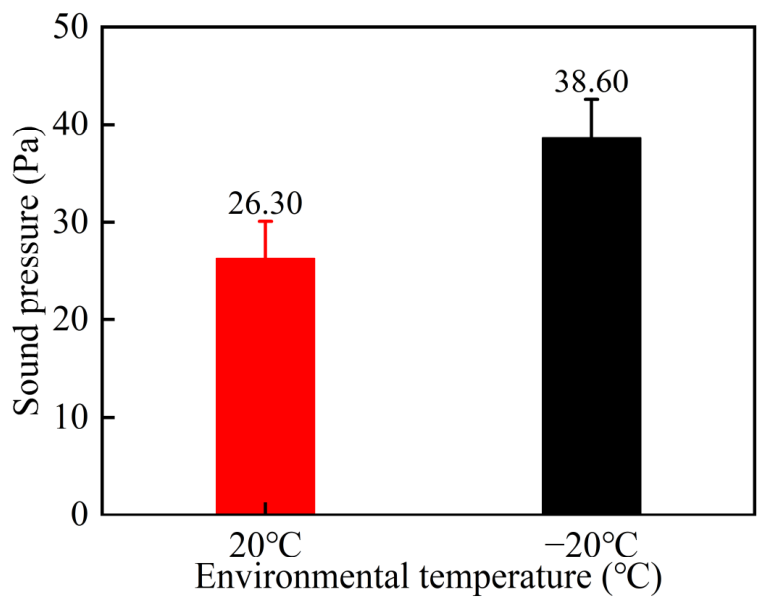
Further analysis was conducted on the braking noise. Figure 5 presents the sound pressure RMS quantities signals acquired during the entire braking process under varying environmental temperatures, along with the error analysis from 20 repeated tests. It can be observed that the sound pressure intensity generated at the brake interface increases under low-temperature conditions, accompanied by a slight increase in the error bar length. This indicates that a decrease in environmental temperature not only enhances the braking noise intensity but also amplifies the fluctuation magnitude of the noise signals.

3.2. Friction Parameter Analysis and Identification

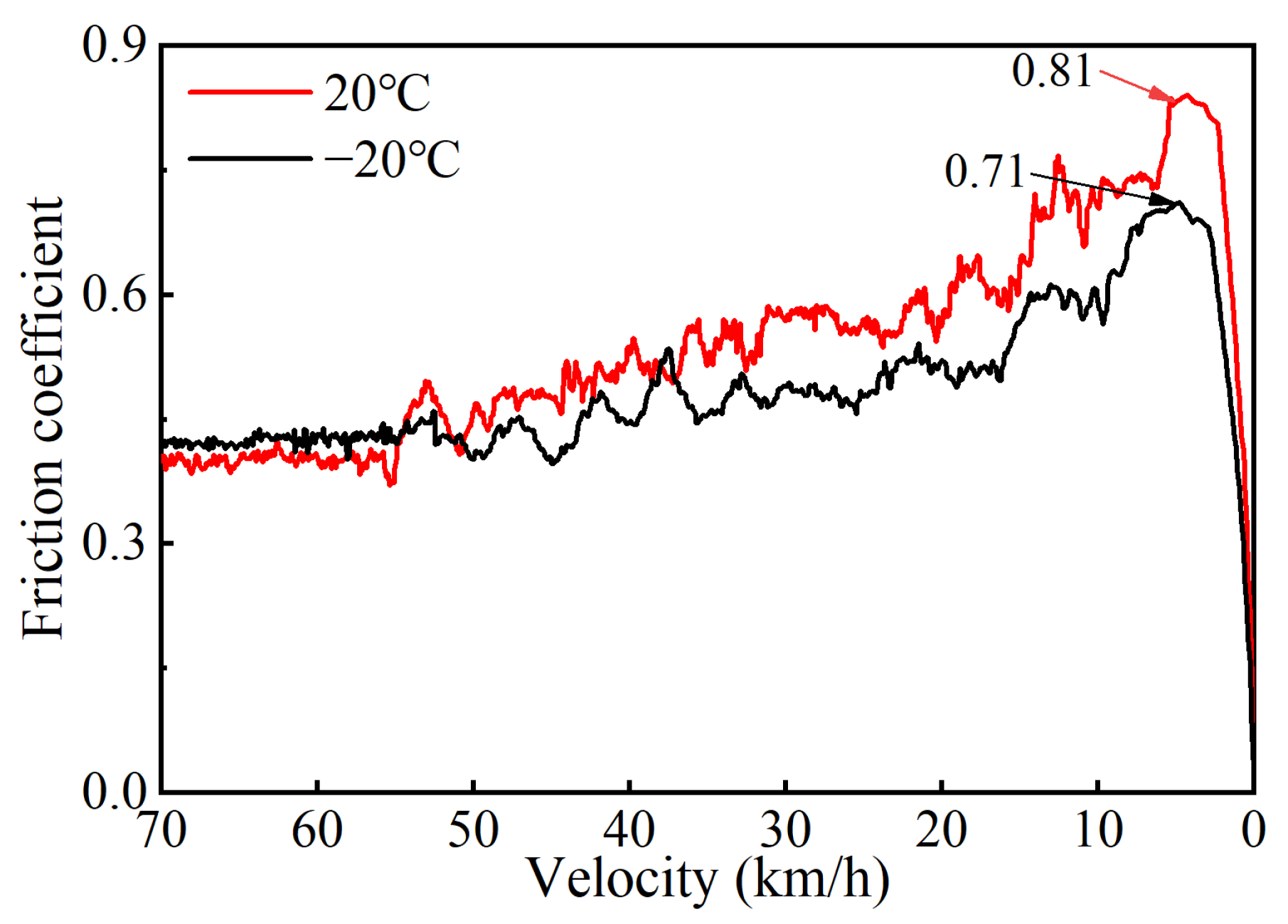
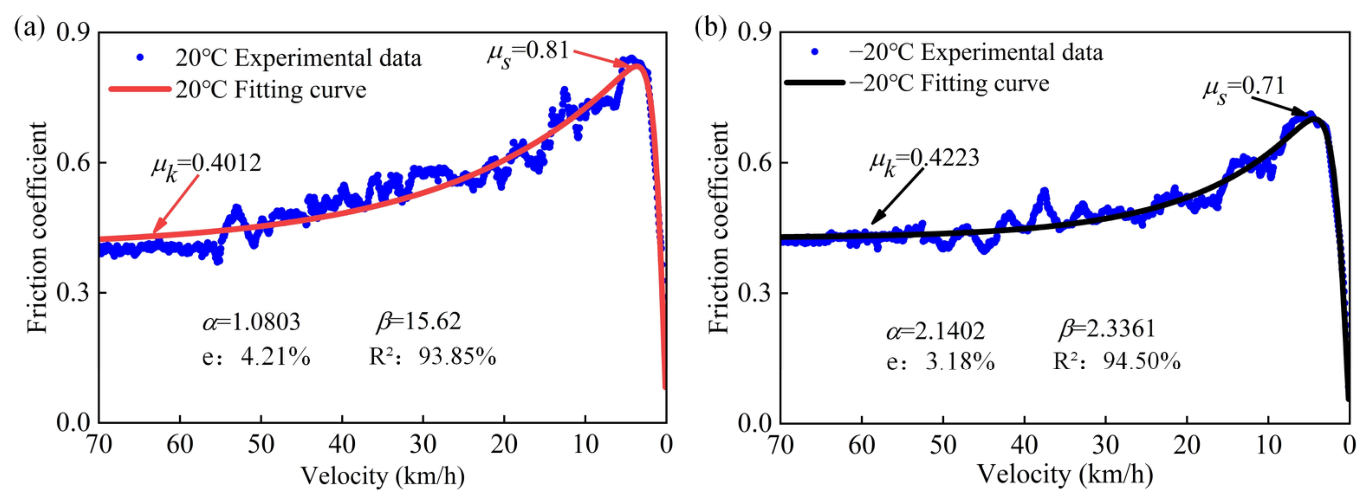
The interfacial friction coefficient correlates strongly with the vibration response. Figure 6 shows the dynamic temporal behaviour of the frictional coefficient during the deceleration braking process under varying environmental temperatures. Employing the torque T obtained via a torque-sensing device, together with the friction radius R and the braking force F, the friction coefficient μ is obtained through the following equation: μ = T 2 R F . Overall, the trend of friction coefficient variation with speed is similar under both temperature conditions. As the speed decreases, the friction coefficient initially rises gradually; when the speed drops to approximately 30 km/h, the friction coefficient increases sharply. This variation is consistent with the negative-slope relationship between friction coefficient and relative velocity and generally aligns with the trend of vibration amplitude versus speed. In addition, the maximum friction coefficients (static friction) during braking under the two temperature conditions are 0.81 and 0.71, respectively, indicating that low environmental temperature reduces the braking friction coefficient.
During deceleration braking, the friction–speed dependence agrees with the Stribeck effect, exhibiting the typical negative-slope characteristic regarding the relative velocity. Therefore, the Stribeck friction model was selected to characterize the variation in the friction coefficient, with its mathematical expression given as follows [29]:
μ ( v r ) = ( μ k + μ s μ k e α v r ) tanh ( β v r )
where μ denotes the friction coefficient, α stands for the exponential decay factor, β is the velocity smoothing factor, μ k is the kinetic frictional coefficient, μ s is the static friction coefficient, and v r indicates the disc–pad relative velocity.
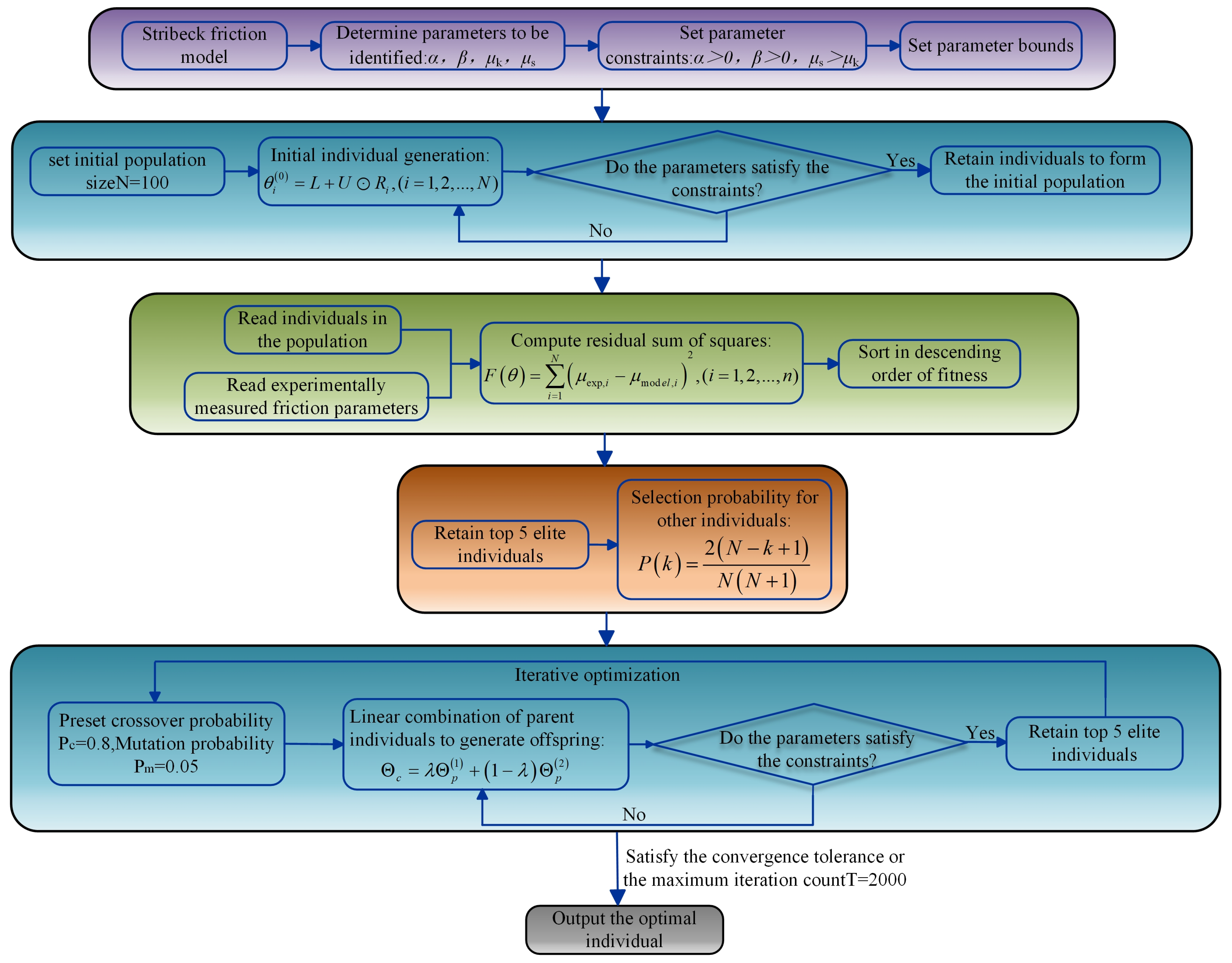
To quantitatively describe how depends on the relative velocity between disc and pad, a genetic algorithm was adopted for automatic parameter identification of the Stribeck friction model given in Equation (1). This algorithm offers strong global optimization capability, does not depend on initial values, and exhibits high robustness, making it effective for accurately obtaining friction curves under different environmental temperatures [30]. The parameter identification procedure of the genetic algorithm-based Stribeck friction description is depicted in Figure 7.
In the initialization stage of the genetic algorithm, the population size was set to N = 100, each individual representing a candidate set of Stribeck friction model parameters to be identified; the parameters to be identified is x = μ k , μ s , α , β T . The initial individuals were randomly generated according to
θ i 0 = L + U R i , ( i = 1 , 2 , , N )
where θ i 0 denotes the i -th initial individual; L is the vector of lower bounds for the parameters; U is the interval length defined by the upper and lower bounds; R i is a random vector, and represents the Hadamard product. For the Stribeck friction model, the lower bounds L = 0.3 , 0.5 , 0.1 , 0.1 T and parameter ranges were predefined as U = 0.2 , 1.5 , 9.9 , 29.9 T .
Based on the least squares criterion, the fitting error was quantified as the sum of squared residuals between the model predictions and the measured friction parameters:
F θ = i = 1 N μ exp , i μ mod e l , i 2 , ( i = 1 , 2 , , n )
where F θ is the sum of squared residuals, and μ exp , i and μ mod e l , i are the measured and predicted friction coefficients for the i-th data point, while n denotes the total number of data points.
Individuals were ranked according to their fitness, defined as the reciprocal of the fitting residuals. The top five individuals were preserved as elites for the next generation. For the remaining individuals, a ranking-based roulette wheel selection was employed, with the selection probability P ( k ) determined by the individual’s rank k in the population:
P k = 2 N k + 1 N N + 1
The crossover rate was fixed at P c = 0.8 , while the mutation probability was set to P m = 0.05 . Arithmetic crossover and boundary mutation are performed on the selected parent individuals. In arithmetic crossover, the crossover weight λ is assigned according to the fitness of the parents, and the offspring individual Θ c is generated by a linear combination of two parents:
Θ c = λ Θ p 1 + 1 λ Θ p 2
An elitist update mechanism was applied in each generation, retaining the top five elites while generating the remaining individuals through crossover and mutation. The iteration continued until the maximum number of generations T = 2000 or the convergence criterion was met. To preserve the global search capability and prevent premature convergence, the algorithm ensured that after mutation the static friction coefficient remained greater than the kinetic friction coefficient ( μ s > μ k ), and the decay factor α and velocity smoothing factor β were co-evolved to obtain an optimal set of interface friction parameters.
Based on the genetic algorithm, Stribeck friction parameters were identified under different environmental temperatures. Figure 8 presents the comparison between the Stribeck model fit and the measured friction coefficients. To corroborate the parametric accuracy of the identified Stribeck friction model, the relative error e between the experimentally measured friction coefficients and the corresponding fitted values under distinct environmental temperatures is presented. The findings reveal that, for both temperature conditions, the relative error remains consistently below 5%, while the coefficient of determination R2 exceeds 90%. Indicating that the fitted curves closely match the experimental data, the genetic algorithm is capable of precisely capturing the quantitative dependence of the friction coefficient, rotational speed, and environmental temperature. Table 1 further summarizes the identified friction parameters at different environmental temperatures. Comparative analysis shows that decreasing environmental temperature reduces the static friction coefficient μ s while increasing the kinetic friction coefficient μ k and decay factor α . The decay factor α characterizes the decreasing trend of friction coefficient with increasing relative velocity, and its increase indicates that the negative slope effect is more pronounced under low-temperature conditions.

4. Friction Vibration Analysis of the Braking System

4.1. Dynamic Model of the Braking System Including the Role of Environmental Temperature

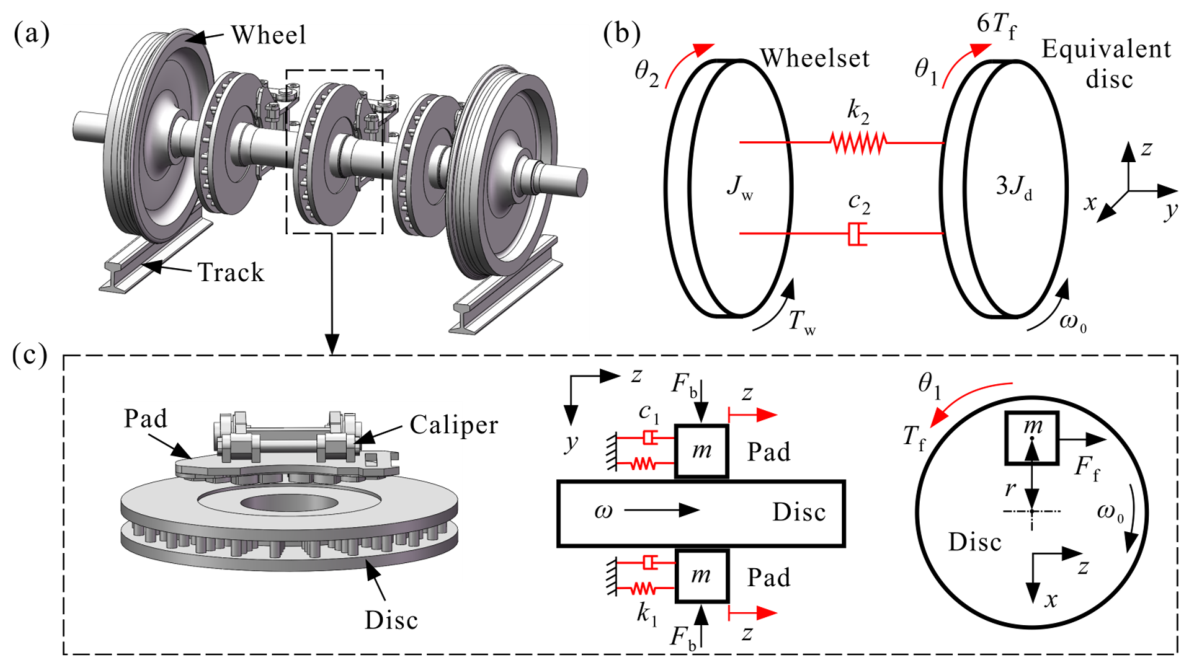
The braking system of a high-speed train primarily consists of the foundation braking device and the wheelset, where the disc–pad friction characteristics and wheel–rail adhesion behaviour play dominant roles in the braking system’s dynamic behaviour. To this end, based on the coefficients of the Stribeck friction model obtained under different environmental temperatures using a genetic algorithm, combined with tribological and dynamic theories, a nonlinear dynamical representation of the braking system was developed by including wheel–rail adhesion and the torsional coupling present at the disc–wheelset junction, and the temperature-dependent variation in the friction coefficient according to tribological and vehicle dynamics theories. The corresponding model is illustrated in Figure 9. In this model, the pad–calliper pair on the disc’s opposite sides are equivalent to a concentrated mass m ; k 1 and c 1 represent the equivalent stiffness and damping coefficient of the concentrated mass, respectively; k 2 and c 2 are defined as the torsional rigidity and energy dissipation present at the disc–wheelset junction, respectively; F b is the thrust applied to the brake pad, referred to as the braking force in this paper; F f stands for the tangential contact force at the disc–pad junction; T f denotes the frictional torque exerted on the brake disc; whereas T w denotes the fluctuating component of the wheel–rail adhesion torque induced through tangential contact forces due to creep, defined herein serving as the time-varying adhesion torque; z is the pad’s tangential displacement; θ 1 and θ 2 correspond to the fluctuating the twist deformations experienced by the brake disc and the wheelset, respectively; ω and ω 0 are the transient rotational velocity and the average angular velocity of the brake disc, respectively; J d and J w are the respective mass moments of inertia for the brake disc and the wheelset (listed sequentially).
Ignoring the torsional coupling among the brake discs, the set of three discs can be represented as a single equivalent disc whose resultant moment of inertia equals 3 J d . By invoking d’Alembert’s principle, the governing motion equations for the braking system accounting for wheel–rail adhesion characteristics can be formulated as follows:
m z ¨ + c 1 z ˙ + k 1 z = F f 3 J d θ ¨ 1 + c 2 ( θ ˙ 1 θ ˙ 2 ) + k 2 ( θ 1 θ 2 ) = 6 T f J w θ ¨ 2 + c 2 ( θ ˙ 2 θ ˙ 1 ) + k 2 ( θ 2 θ 1 ) = T w
The span between the pad’s geometric centre and the disc’s axis of rotation defines the friction radius r ; the relative speed between disc and pad, denoted v r , is given by
v r = ω r z ˙ = ( ω 0 + θ ˙ ) r z ˙
Assuming the braking force applied to the brake pad is F b , the friction force developed at the disc–pad junction can be written as
F f = F b μ ( v r ) = F b μ k + ( μ s μ k ) e α | v r | tanh ( β v r )
Correspondingly, the friction torque T f exerted on the brake disc by the single-sided brake pad can be written as
T f = F f r = F b r μ k + ( μ s μ k ) e α | v r | tanh ( β v r )
When the high-speed train is in motion, the vertical contact force and the tangential creep force cause slight elastic distortion within the wheel–rail contact patch, leading to wheel–rail slip displacement [31]. This effect is referred to as wheel–rail creep or adhesion, and the corresponding adhesion torque plays a direct role in modulating the train’s traction and braking response. In the presence of creep, the slip velocity (i.e., the relative velocity of the wheel with respect to the rail) can be written as Δ V = V ω w R , and the slip ratio is set forth as follows [32]:
s = Δ V V = V ω w R V = 1 ( ω 0 + θ ˙ 2 ) ( R 0 + R 1 ) V 0 + V x
where V and V 0 stand for, in order, the instantaneous and average forward velocities of the train; ω w and ω 0 are the instantaneous and average angular velocities of the wheel, respectively; R is the wheel radius; and R 0 is the nominal rolling radius.
Neglecting fluctuations of longitudinal velocity V x and wheel radius R 1 , let V x = 0 and R 1 = 0 ; the slip ratio can be expressed as
s = 1 ( ω 0 + θ ˙ 2 ) R 0 / V 0
When θ ˙ 2       =     0 , the average wheelset slip ratio is defined as
s 0 = 1 ω 0 R 0 / V 0
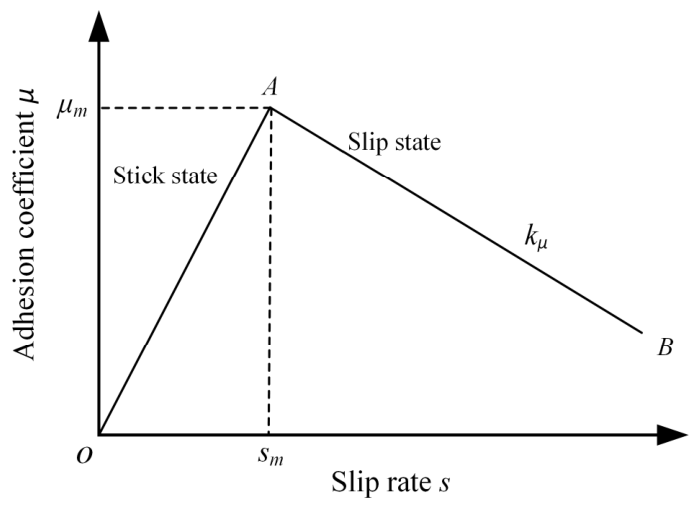
Linear stability is examined through linearization of the equations of motion around the equilibrium location in this section. Bifurcation diagrams under different operating conditions are computed to reveal the system’s stability in the nonlinear regime. To this end, a wheel–rail adhesion model that is more amenable to linearization and can effectively reduce computational time is adopted [33,34], as shown in Figure 10.
For small slip ratio values, the adhesion value follows an increasing pattern as the slip ratio increases (referred to as the adhesion regime), as shown by segment OA in Figure 10. Beyond a critical slip ratio, the coefficient decreases with increasing slip ratio (sliding phase, segment AB). Thus, the wheel–rail adhesion coefficient is formulated using a piecewise definition [35]:
μ = μ m s / s m                                                 0 s s m μ m + k μ ( s s m )                   s m < s 1
where s m represents the critical slip ratio; μ m represents the peak adhesion value at the optimum slip ratio; and k μ represents the negative slope in the sliding phase.
The axle load of the train is W . Vertical vehicle vibrations are omitted in this model; hence, the total wheel–rail normal contact force acting on the two sides of the wheelset is considered to be equivalent to the axle load. Therefore, the momentary adhesive torque T g acting on the wheelset can be expressed as follows:
T g = μ W R 0
Substituting Equation (14) into Equation (13) yields the piecewise expression regarding the transient wheel–rail adhesive torque as
T g = μ m s W R 0 / s m                                                                       0 s s m μ m W R 0 + k μ W R 0 ( s s m )                         s m < s 1
The instantaneous adhesion torque T g comprises the static wheel–rail adhesion torque T g 0 and the dynamic adhesion torque T w . Substituting the average slip ratio from Equation (12) into Equation (15), the static adhesion torque can be expressed as follows:
T g 0 = μ m s 0 W R 0 / s m                                                                       0 s 0 s m   μ m W R 0 + k μ W R 0 ( s 0 s m )                         s m < s 0 1
Furthermore, according to Equations (10)–(16), the adhesion-induced dynamic torque T w can be derived. As s 0 s m , the system’s transient adhesion torque in the adhesion regime takes the following form:
T w = θ ˙ 2 μ m W R 0 2 V 0 s m ω m ω 0 θ ˙ 2 V 0 R 0 ω 0 μ m + k μ ( 1 s m ) μ m s m W R 0 + μ m s m ω 0 k μ ( ω 0 + θ ˙ 2 ) W R 0 2 V 0 ω 0 θ ˙ 2 < ω m ω 0
where ω m = ( 1 s m ) V 0 / R 0 .
Similarly, when s 0 > s m , the transient adhesion torque for the system in the sliding stage can be written as
T w = μ m + k μ ( 1 s m ) μ m s m W R 0 + μ m s m ( ω 0 + θ ˙ 2 ) k μ ω 0 W R 0 2 V 0 ω m ω 0 θ ˙ 2 V 0 R 0 ω 0 θ ˙ 2 k μ W R 0 2 V 0 ω 0 θ ˙ 2 < ω m ω 0
The parameter settings in the braking system’s dynamic model can be found in reference [36]. In previous studies, the validity of the constructed dynamic model was validated against field measurement data; for details, please refer to Section 5 of reference [37].

4.2. Analysis of Braking Friction Vibration Under Different Environmental Temperatures

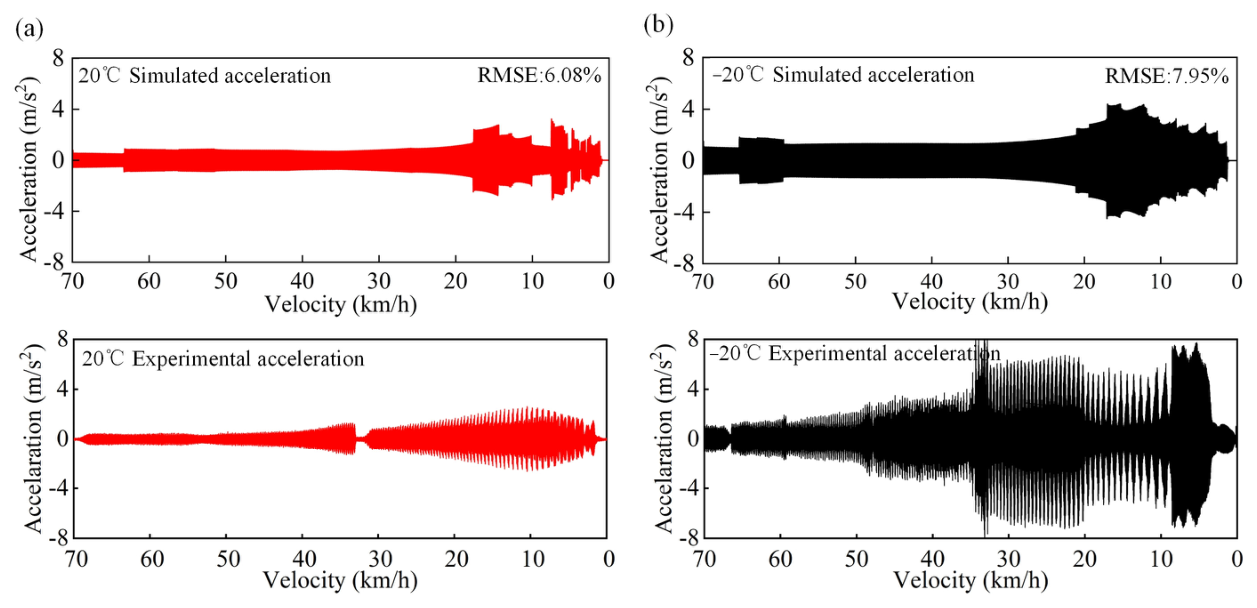
According to the presented braking system dynamic model, the braking deceleration process under different environmental temperatures was first simulated. Figure 11 presents simulation–experiment comparison results of the tangential vibration acceleration of the brake pad under different environmental temperatures. To evaluate the mismatch between the simulated signals and the experimental measurements, the root-mean-square error (RMSE) was adopted. For the two temperature levels of 20 °C and −20 °C, the RMSEs between simulation and experiment are 6.08% and 7.95%, respectively, demonstrating that the fitted data possess favourable credibility. It is observed that the tangential vibration acceleration of the brake pad is more severe under low-temperature conditions, which is consistent with the experimental results. Furthermore, at relatively low speeds, the simulated signals under both temperature conditions exhibit a sudden increase in amplitude, and the same phenomenon was detected in the experiments. These results indicate that the proposed model can accurately reproduce the vibration characteristics during braking and can be further used to probe the influence of different environmental temperatures on the friction-induced vibration at the disc–pad interface during braking deceleration.
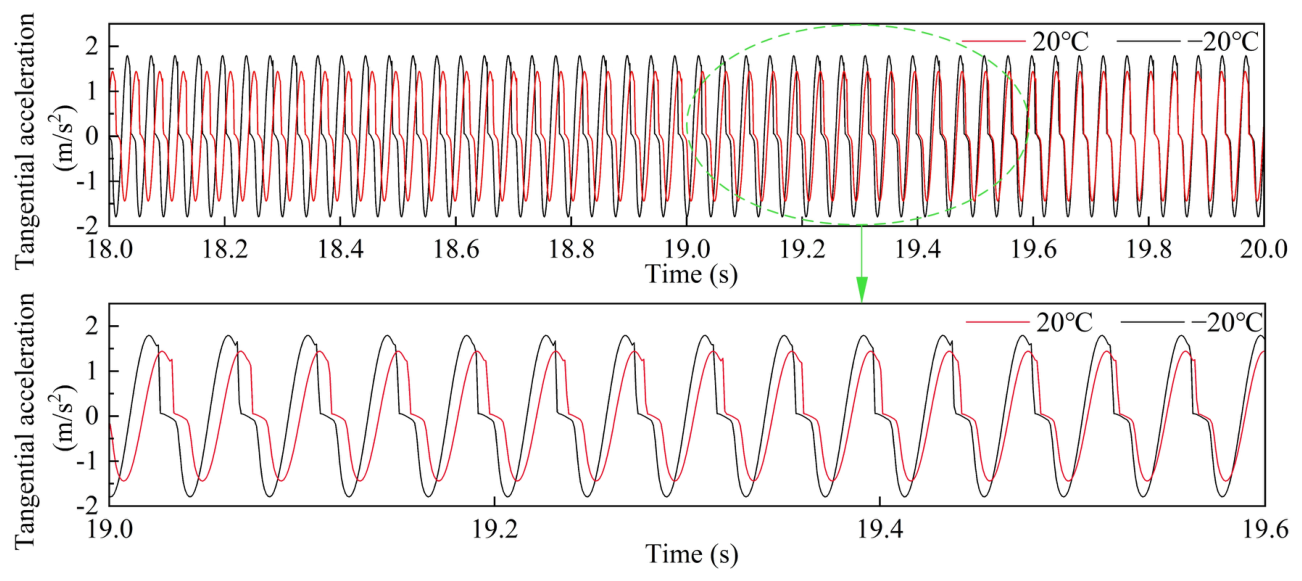
To intuitively reflect the bearing of environmental temperatures regarding the oscillatory behaviour of the braking system, two typical operating conditions, that is, comparatively high speed (30 km/h) and relatively low speed (8 km/h), were selected for comparative analysis of the dynamic responses of the braking components. Figure 12 presents the time-domain signals of the tangential vibration of the brake pad during braking at 30 km/h. The findings reveal that the brake pad’s vibration intensity increases at low-temperature conditions. Combined with the friction coefficient, it is evident that a decrease in environmental temperature leads to an increase in the dynamic friction coefficient μ k during the high-speed braking phase, thereby enhancing the tangential friction at the interface and intensifying the friction-induced vibration at the braking interface.
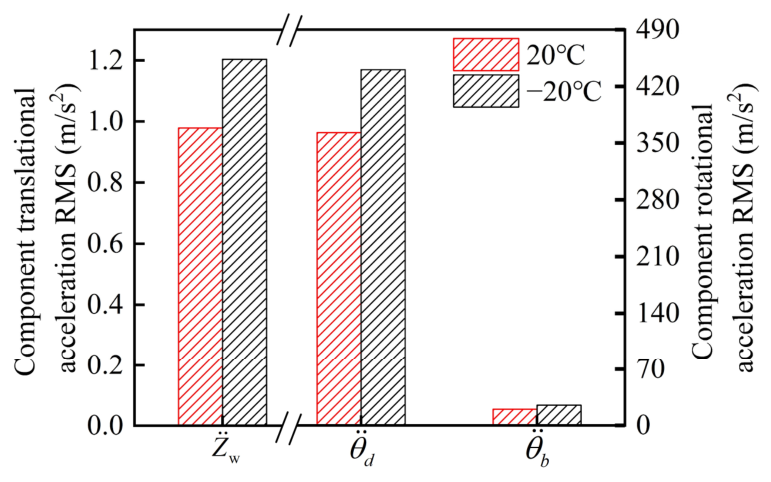
Figure 13 displays the RMS magnitudes of the vibrational acceleration for multiple subassemblies of the brake system across distinct environmental temperatures at a speed of 30 km/h. At low environmental temperatures, the acceleration intensities of the pad’s tangential vibratory motion ( Z ¨ w i ), the torsional vibration of the wheelset ( θ ¨ d i ), and the torsional vibration of the brake disc ( θ ¨ b ) are all greater, indicating that a decrease in environmental temperature affects the friction characteristics at the braking interface, excites more severe friction-induced vibration within the disc–pad system, and leads to increased vibration intensity and degraded stability of the braking system.
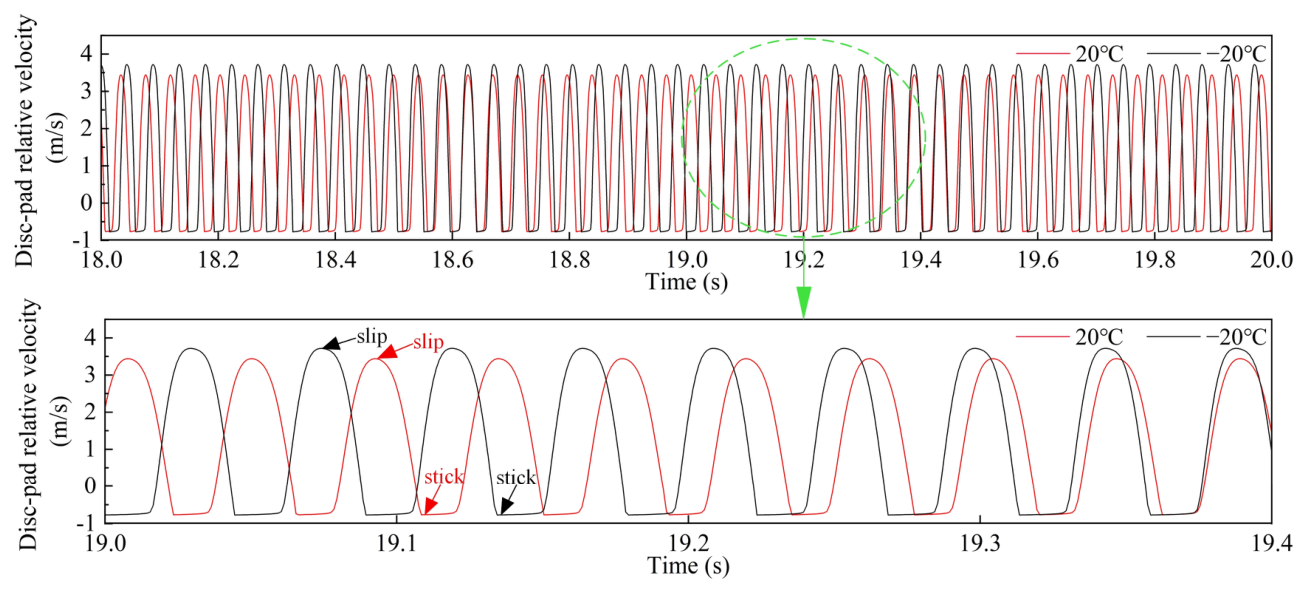
Further analysis focused on the vibrational characteristics of braking system subassemblies at a low speed of 8 km/h. As shown in Figure 14, the brake pad undergoes stick–slip oscillation at both environmental temperatures; however, the sliding-phase velocity amplitude is substantially larger at −20 °C than at 20 °C. Thus, low temperatures intensify disc–pad stick–slip vibration in the low-speed regime.
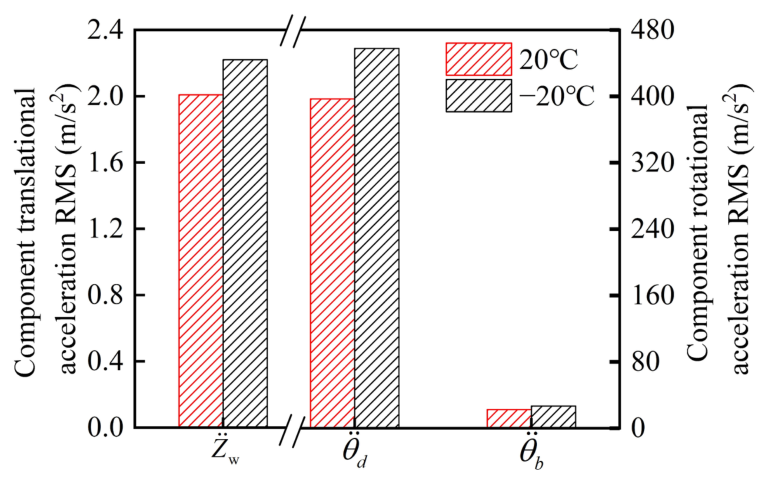
Figure 15 shows the RMS acceleration levels of key brake system components at low speeds under different environmental temperatures. Under low-temperature conditions, the tangential acceleration of the brake pad ( Z ¨ w i ), the torsional vibration of the wheelset ( θ ¨ d i ), and that of the brake disc ( θ ¨ b ) are all greater. This confirms that lower environmental temperatures aggravate stick–slip vibration in both the disc–pad interface and other system components during low-speed braking.

5. Conclusions

Based on braking deceleration tests under different environmental temperatures and a genetic algorithm, the Stribeck friction parameters at the braking interface were identified. Combined with a dynamic brake system model, numerical simulations were carried out to examine the relationships among environmental temperature, interface friction, and system vibrational response, and to clarify the effect of temperature on friction-induced vibration during braking deceleration. The principal conclusions are summarized below:
(1)
Compared with the normal-temperature condition of 20 °C, the braking friction-induced vibration and noise under the low-temperature condition of −20 °C exhibit higher intensity and larger fluctuation amplitude, accompanied by more complex frequency components. In addition, the vibration characteristics exhibit staged variations during braking deceleration. In the relatively high-speed braking phase (above 30 km/h), the oscillation magnitude is relatively small and stable, but the dominant vibration frequency is high. As the vehicle speed drops below approximately 30 km/h, the vibration intensity increases suddenly, and the frequency spectrum consists of intermittently distributed low and high frequencies.
(2)
During braking deceleration, a Stribeck effect exists between the friction coefficient and vehicle speed, that means a reduction in speed promotes a growth in the friction coefficient. The Stribeck friction parameters were adaptively identified using a genetic algorithm. It is found that under low-temperature conditions, the transient friction coefficient at the brake contact surface and the decay factor (which quantifies the severity of the negative inclination) both rise, while the static friction coefficient decreases correspondingly.
(3)
Simulations indicate that environmental temperature variations modify the disc–pad friction coefficient, thereby influencing brake system vibration. A temperature drop raises the dynamic friction coefficient during higher-speed braking, increasing tangential friction and component vibration. At lower speeds, the attenuation factor rises as temperature falls, implying a stronger negative slope between frictional force and relative speed. This excites severe stick–slip motion at the interface and markedly amplifies system vibration.

Author Contributions

Conceptualization, Z.W.; Methodology, J.M.; Software, X.W.; Validation, Q.W. and Z.W.; Formal analysis, X.W. and W.L.; Investigation, X.W. and W.L.; Data curation, X.W. and W.L.; Writing—original draft, X.W.; Writing—review & editing, Q.W. and Z.W.; Visualization, W.L. and J.M.; Supervision, Q.W.; Project administration, J.M.; Funding acquisition, X.W., Q.W., Z.W. and J.M. All authors have read and agreed to the published version of the manuscript.

Funding

This research was funded by the National Natural Science Foundation of China (52305209, 52505220 and U22A20181), the Sichuan Science and Technology Program (2026NSFSC1268), and Wenzhou Basic Public Welfare Science and Technology Project (G2023047).

Data Availability Statement

Data will be made available on request.

Conflicts of Interest

The authors declare that they have no known competing financial interests or personal relationships that could have appeared to influence the work reported in this paper.

References

  1. Wang, B.; Li, S.; Wang, W.; Zhang, X.; Liu, G.; Wang, H. A review on research of system dynamics and multi-source fault diagnosis of key components in high-speed train. Chin. J. Mech. Eng. 2025, 38, 100066. [Google Scholar] [CrossRef]
  2. Xie, S.; Tan, H.; Yang, C.; Yan, H. A review of fault diagnosis methods for key systems of the high-speed train. Appl. Sci. 2023, 13, 4790. [Google Scholar] [CrossRef]
  3. Shen, M.X.; Li, S.X.; Yu, M.; Huangfu, L.Z.; Rong, B.; Xiong, G.Y. Response behavior of wheel-rail interface adhesion and damage after wheels encountering warm and humid airflow during trains through tunnels in frigid regions. China Mech. Eng. 2022, 33, 1504. [Google Scholar] [CrossRef]
  4. Hoffmann, N.; von Wagner, U. A note on safety-relevant vibrations induced by brake squeal. J. Sound Vib. 2010, 329, 3867–3872. [Google Scholar] [CrossRef]
  5. Krumm, A.; Ostermeyer, G.-P.; Schiefer, F.; Montua, S. Model based investigations of the NVH behaviour of bogie brakes. In EuroBrake; Paper No. EB2022-RLB-001; International Federation of Automotive Engineering Societies: London, UK, 2022; Available online: https://www.fisita.org/library/eb2022-rlb-001 (accessed on 17 May 2022).
  6. Barot, A.; Wang, W. Objectively quantify creep groan and dynamic grunt performance of different brake friction materials. In SAE Technical Paper; No. 2024-01-3035; SAE International: Warrendale, PA, USA, 2024. [Google Scholar] [CrossRef]
  7. Luo, R.; Teng, W.X.; Wu, X.W.; Zeng, J. Dynamics simulation of a high-speed railway car operating in low-temperature environments with stochastic parameters. Veh. Syst. Dyn. 2020, 58, 1914–1934. [Google Scholar] [CrossRef]
  8. Ou, Y.; Yang, D.; Pu, X.; Zhang, M.; Zhong, W.; Ma, L. Research on friction and wear properties of new energy micro logistics vans brake materials under different ambient temperature and humidity conditions. Wear 2024, 556–557, 205511. [Google Scholar] [CrossRef]
  9. Ahn, S.; Sohn, C.; Choi, S.; Nam, C. Study on reduction of squeal noise of disc brake system considering braking temperature of urban railway vehicle. J. Mech. Sci. Technol. 2023, 37, 2253–2262. [Google Scholar] [CrossRef]
  10. Zhang, M.X.; Shi, H.B.; Ding, S.Y.; Ma, L. Influence of braking speed on the wear property and simulation analysis of high-speed railway braking materials at low temperature. Ind. Lubr. Tribol. 2023, 75, 387–397. [Google Scholar] [CrossRef]
  11. Kim, S.; Lee, S.; Kim, S.; Nam, J. Influence of brake pad temperature variation on the squeal noise characteristics of disc‘s in-plane vibration mode. Sensors 2025, 25, 4080. [Google Scholar] [CrossRef] [PubMed]
  12. Li, D.; Mi, R.; Chen, L.; Dai, J. A review of tribological behavior of brake pads for high-speed train. Proc. Inst. Mech. Eng. Part J J. Eng. Tribol. 2025; accepted. [CrossRef]
  13. Yavuz, A.; Şen, O.T.; Kırmacı, M.E.; Gündoğdu, T. Effect of temperature variations on brake squeal characteristics in disc brake systems. Eng. Proc. 2026, 121, 11. [Google Scholar] [CrossRef]
  14. Lyu, Y.; Bergseth, E.; Wahlström, J.; Olofsson, U. A pin-on-disc study on the tribology of cast iron, sinter and composite railway brake blocks at low temperatures. Wear 2019, 424–425, 48–52. [Google Scholar] [CrossRef]
  15. Ma, L.; Ding, S.Y.; Zhang, C.; Huang, Y.Z.; Zhang, X. Study on the wear performance of high-speed railway brake materials at low temperatures under continuous braking conditions. Wear 2023, 512, 204556. [Google Scholar] [CrossRef]
  16. Yu, Z.; Feng, S.; Zhang, Q.; Tang, B.; Mo, J.; Zhu, S.; Jin, W. The effects of friction block shape on friction-induced wear, vibration, and noise of train brake interface at low temperature. Tribol. Lett. 2024, 72, 97. [Google Scholar] [CrossRef]
  17. Zhang, Q.X.; Yu, Z.; Wu, M.; Wang, X.C.; Mo, J.L. Effect of perforated friction block design on the tribological behavior of high-speed train brake interfaces under different ambient temperatures. Eng. Fail. Anal. 2026. advance online publication. [Google Scholar] [CrossRef]
  18. Pelcastre, L.; Weniger, L.-M.; Hardell, J. On the low temperature tribological behaviour of brake block materials for railway applications under dry and icy conditions. Wear 2023, 523, 204764. [Google Scholar] [CrossRef]
  19. Ishii-Dodson, N.; Thuesen, J.; Eggleston, D. Analysis of the Temperature Dependence of Different Modes of Brake Squeal Noise. In EuroBrake; Paper No.EB2012-TM-15; International Federation of Automotive Engineering Societies: London, UK, 2012. [Google Scholar]
  20. Nishioka, M.; Hara, Y.; Nomoto, M.; Ono, M. Brake Squeals After Standing at Low Temperatures. In SAE Technical Paper; SAE International: Warrendale, PA, USA, 2006; Volume 01-3190. [Google Scholar] [CrossRef]
  21. Genuit, K.; Blaschke, P.; Gierlich, H.W. The Role of Climatic Conditions on Disc Brake Noise. In SAE Technical Paper; SAE International: Warrendale, PA, USA, 2006; Volume 01-3209. [Google Scholar] [CrossRef]
  22. Lee, W.K.; Shin, M.K.; Kim, S.H.; Jang, H.; Cho, M.H. The influence of humidity on the sliding friction of brake friction material. Wear 2013, 302, 1397–1403. [Google Scholar] [CrossRef]
  23. Zhang, P.; Zhang, L.; Wei, D.; Wu, P.; Cao, J.; Shijia, C.; Qu, X. A high-performance copper-based brake pad for high-speed railway trains and its surface substance evolution and wear mechanism at high temperature. Wear 2020, 444–445, 203182. [Google Scholar] [CrossRef]
  24. Wu, D.; Li, S.; Wang, W.; Wang, W.; Jiang, P.; Wang, B.; Wei, D. Bifurcation and chaotic behaviors of vehicle brake system under low speed braking condition. J. Vib. Eng. Technol. 2021, 9, 2107–2120. [Google Scholar] [CrossRef]
  25. Lee, C.Y.; Hwang, S.H.; Nam, E.; Min, B.K. Identification of mass and sliding friction parameters of machine tool feed drive using recursive least squares method. Int. J. Adv. Manuf. Technol. 2020, 109, 2831–2844. [Google Scholar] [CrossRef]
  26. Liang, M.; Zhou, D. A nonlinear friction identification method combining separable least squares approach and kinematic orthogonal property. Int. J. Precis. Eng. Manuf. 2022, 23, 139–152. [Google Scholar] [CrossRef]
  27. Liu, Y.; Dong, Y.; Wang, W.; Song, J. Friction model identification and compensation strategy for photoelectric tracking system. Infrared Laser Eng. 2023, 52, 20230151. [Google Scholar] [CrossRef]
  28. Huang, D.; Yang, J.; Xu, G.; Zhou, H.; Chen, J. Effective parameter identification of the GMS friction model for feed systems in CNC machines. Control Eng. Pract. 2024, 152, 106061. [Google Scholar] [CrossRef]
  29. Kiss, A.K.; Beregi, S.; Takács, D. Phase portraits and bifurcations induced by static and dynamic friction models. Nonlinear Dyn. 2025, 113, 15863–15899. [Google Scholar] [CrossRef]
  30. Ma, X.; Liu, Y.; Yang, X. Research on nonlinear optimization problem solving and model performance improvement based on adaptive genetic algorithm. In 4th International Conference on Artificial Intelligence and Autonomous Robot Systems (AIARS 2025); The Institution of Engineering and Technology: Hertfordshire, UK, 2025. [Google Scholar] [CrossRef]
  31. Jing, L.; Zhou, X.F.; Wang, K.Y. An elastic-plastic theoretical analysis model of wheel-rail rolling contact behaviour. Acta Mech. Sin. 2023, 39, 422465. [Google Scholar] [CrossRef]
  32. Malvezzi, M.; Pugi, L.; Papini, S. Identification of a wheel-rail adhesion coefficient from experimental data during braking tests. Proc. Inst. Mech. Eng. Part F J. Rail Rapid Transit 2012, 227, 128–139. [Google Scholar] [CrossRef]
  33. Chen, Z.G.; Zhai, W.M.; Wang, K.Y. Locomotive dynamic performance under traction/braking conditions considering effect of gear transmissions. Veh. Syst. Dyn. 2018, 56, 1097–1117. [Google Scholar] [CrossRef]
  34. Zhao, H.; Liu, J.; Zhai, W. Simulation and analysis for self-excited torsional vibration of locomotive drive system. In 2nd International Conference on Transportation Engineering; American Society of Civil Engineers: Reston, VA, USA, 2009. [Google Scholar] [CrossRef]
  35. Wagner, U.V. Nonlinear dynamic behaviour of a railway wheelset. Veh. Syst. Dyn. 2009, 47, 627–640. [Google Scholar] [CrossRef]
  36. Wang, Q.; Wang, Z.W.; Mo, J.L.; Zhang, L. Nonlinear behaviors of the disc brake system under the effect of wheel-rail adhesion. Tribol. Int. 2022, 165, 107263. [Google Scholar] [CrossRef]
  37. Wang, Q.; Wang, Z.W.; Mo, J.L.; Zhang, L.; Du, L.Q.; Gou, Q.B. Coupled dynamic behaviours of the brake system considering wheel-rail interactions. Int. J. Rail Transp. 2022, 10, 749–771. [Google Scholar] [CrossRef]
Figure 1. Experimental setup schematic.
Lubricants 14 00236 g001
Figure 2. Structure of the test sample: (a) brake disc specimen; (b) brake pad specimen.
Lubricants 14 00236 g002
Figure 3. Tangential and normal accelerations at different environmental temperatures: (a) 20 °C and (b) −20 °C.
Lubricants 14 00236 g003
Figure 4. Time–frequency tangential acceleration signals at different environmental temperatures: (a) 20 °C, (b) −20 °C.
Lubricants 14 00236 g004
Figure 5. Sound pressure (RMS) signal at different environmental temperatures.
Lubricants 14 00236 g005
Figure 6. Variation in friction coefficient with brake disc speed under different environmental temperatures.
Lubricants 14 00236 g006
Figure 7. Parameter identification process of the Stribeck friction parameterization derived from genetic algorithm.
Lubricants 14 00236 g007
Figure 8. Comparison of friction coefficient measurements and identified results under different environmental temperatures: (a) 20 °C and (b) −20 °C.
Lubricants 14 00236 g008
Figure 9. Dynamic braking model accounting for wheel–rail adhesion characteristics: (a) brake system structure; (b) wheel–disc relative torsion; (c) disc–pad friction.
Lubricants 14 00236 g009
Figure 10. Wheel–rail adhesion characteristic curve.
Lubricants 14 00236 g010
Figure 11. Simulated and experimental tangential acceleration of the brake pad: (a) 20 °C, (b) −20 °C.
Lubricants 14 00236 g011
Figure 12. Time-domain tangential vibration of the brake pad at 30 km/h under different environmental temperatures.
Lubricants 14 00236 g012
Figure 13. Relationship between environmental temperature and RMS values of vibration for braking system components at 30 km/h.
Lubricants 14 00236 g013
Figure 14. Temporal waveforms of the brake pad’s tangential oscillation across various environmental temperatures at 8 km/h.
Lubricants 14 00236 g014
Figure 15. Relationship between environmental temperature and RMS values of vibration for braking system components at 8 km/h.
Lubricants 14 00236 g015
Table 1. Stribeck friction parameters identified based on genetic algorithm.
T/°C20−20
μ s 0.89650.8367
μ k 0.40120.4223
α 1.08032.1402
β 15.622.3361
e4.21%3.18%
R293.85%94.50%
Disclaimer/Publisher’s Note: The statements, opinions and data contained in all publications are solely those of the individual author(s) and contributor(s) and not of MDPI and/or the editor(s). MDPI and/or the editor(s) disclaim responsibility for any injury to people or property resulting from any ideas, methods, instructions or products referred to in the content.