Article

Influence of TiO2 Additive on the Tribological Performance of Bonded MoS2 Solid Lubricants


1
Department of Chemical and Materials Engineering, Concordia University, Montreal, QC H3G 1M8, Canada
2
Everlube Products, Curtiss-Wright Corporation, 100 Cooper Circle, Peachtree City, GA 30269, USA
*
Authors to whom correspondence should be addressed.
Lubricants 2026, 14(5), 186; https://doi.org/10.3390/lubricants14050186
Submission received: 29 March 2026 / Revised: 23 April 2026 / Accepted: 24 April 2026 / Published: 28 April 2026

Abstract

To elucidate the role of environmentally friendly oxide additives in a molybdenum disulfide (MoS2)-based solid lubricant, this study investigates the tribological behavior of a MoS2–TiO2 coating deposited via a spray-bonding process and compares it with a commercial Sb2O3-containing formulation (Everlube 620C). Interfacial characteristics and wear-related mechanisms were systematically analyzed using scanning electron microscopy (SEM), focused ion beam (FIB), Raman spectroscopy, and X-ray diffraction (XRD). The MoS2–TiO2 coating exhibited a higher steady-state coefficient of friction (0.35–0.45) and wear compared to the baseline. Its wear behavior was governed by fracture-induced three-body abrasion, driven by the hard and brittle nature of TiO2, which promotes stress concentration at particle–matrix interfaces, crack initiation, particle pull-out, and debris generation. These processes suppress the formation of a desirable MoS2-rich tribo/transfer film, leading to deformation-dominated friction. Overall, the findings indicate that the intrinsic mechanical properties and interfacial behavior of TiO2 limit its effectiveness as an additive in MoS2-based coatings, highlighting the importance of additive selection and compatibility in achieving optimal tribological performance. Notably, this study was performed at an additive volume fraction equivalent to that of Sb2O3 in Everlube 620C, serving as a foundation and indicating that further optimization of TiO2 particle size and concentration is required to achieve comparable performance.

1. Introduction

All moving mechanical parts inevitably experience friction and wear, which can lead to energy loss, surface damage, and reduced service life. To mitigate these effects, tribological materials are engineered to minimize interfacial shear and mechanical degradation under contact. In addition to possessing limited solubility and weak adhesive bonding between contacting pairs—which prevent excessive material transfer or cold welding—their mechanical and physical properties (e.g., strength, hardness, and thermal expansion) play a crucial role in performance. However, achieving an ideal balance between these properties while maintaining low friction and wear is often impractical. As a result, applying a thin interfacial layer (e.g., liquid lubricant)—capable of accommodating shear deformation and reducing direct asperity contact—has become a practical strategy to enhance surface durability and lubrication efficiency [1]. Modern aerospace and space systems are the most common examples, likely functioning under harsh environments that far exceed the operational limits of conventional liquid lubricants [1,2]. At cryogenic temperatures, oils and greases often solidify or lose fluidity, leading to inadequate film formation and increased friction. Under high-temperature conditions, they suffer from thermal degradation and oxidation, causing viscosity breakdown and eventual failure. In ultra-high vacuum, volatile components rapidly evaporate, leaving surfaces unprotected, while reactive atmospheres can trigger chemical decomposition and corrosion at the sliding interface. Together, these effects produce unstable frictional behavior and accelerate component wear and failure. To ensure reliable operation in such demanding conditions, solid lubricants have become vital, offering consistent low-friction and anti-wear performance across a wide range of extreme environments [3].
Solid lubricants are generally classified into two broad categories: organic (e.g., polymers) and inorganic solid lubricants, which include lamellar materials, soft metals, metal fluorides, and metal oxides [4]. Among solid lubricants, graphite, molybdenum disulfide (MoS2), and polytetrafluoroethylene (PTFE) are the most frequently used in tribological applications [5]. PTFE and graphite are relatively soft and generally exhibit limited mechanical properties, whereas MoS2 demonstrates superior load-carrying capacity and low friction. The latter arises from its lamellar crystal structure, in which weak van der Waals forces between adjacent layers and strong bonding within each layer enable smooth sliding of the layers over each other [6]. Furthermore, two-dimensional (2D) materials such as MoS2 exhibit better lubricating performance than their bulk counterparts. Their large specific surface area promotes strong adhesion to contacting surfaces and supports the development of a protective tribo layer that limits direct surface-to-surface contact. In addition, 2D materials can accommodate surface asperities by filling wear grooves, thereby further reducing friction and wear [7,8,9].
Although MoS2 shows excellent performance under vacuum conditions, its tribological behavior degrades markedly in oxygen-rich and humid environments [10]. At temperatures below 100 °C, this deterioration is primarily associated with the physical adsorption of water vapor species on the coating surface, which interferes with interlayer shear by promoting hydrogen bonding between lamellae and softening the film, ultimately increasing ploughing-related deformation. At temperatures above 100 °C, thermally driven oxidation becomes the dominant degradation mechanism, where the formation of MoO3 can introduce abrasive particles that further impair tribological performance [11].
To preserve the favorable lubricating behavior of MoS2 under the conditions described above, it is common practice to incorporate additives or dopants, including both soft and hard phases, into the MoS2 matrix [10]. The resulting improvement is largely attributed to the preferential interaction of these additives with O2 and H2O, which limits their direct interaction with MoS2 [12]. Moreover, increasing the crystallinity of the coating can enhance humidity resistance by reducing the density of highly reactive edge sites [13,14,15]. However, poorly crystalline (i.e., randomly or perpendicularly oriented) or amorphous MoS2 coatings can achieve low friction rapidly in the early stages of sliding, as friction-induced stresses promote the reorientation of (002) basal planes parallel to the sliding direction or induce crystallization during sliding in initially amorphous films [1,2].
Historically, lead-based compounds and antimony trioxide (Sb2O3) have been commonly employed as additives in MoS2-based solid lubricants to extend service lifetime [16,17,18]. However, their use has led to significant environmental and health risks owing to their inherent toxicity. Under the European Union’s Registration, Evaluation, Authorisation and Restriction of Chemicals (REACH) regulation, lead compounds (e.g., lead phosphite) are subject to stricter regulatory control and are classified as substances of very high concern (SVHC), whereas Sb2O3 is classified as a suspected carcinogen (Carc. 2) and is comparatively less restricted. These concerns have motivated the development of environmentally benign solid lubricant systems capable of delivering comparable performance without compromising safety or sustainability.
Recent studies have identified titanium dioxide (TiO2) as a potential eco-friendly oxide additive for MoS2-based coatings. Due to its high chemical and thermal stability and moderate hardness (Mohs hardness 6–7), TiO2 is widely employed as a reinforcing phase in composite coatings [19,20,21].
Borgaonkar et al. [19,22,23,24,25] systematically investigated MoS2–TiO2 composite coatings bonded with an inorganic sodium silicate binder to improve the wear resistance and adhesion of pure MoS2. The results showed that incorporating TiO2 nanoparticles enhances coating hardness, bonding strength, and tribological performance. An optimal composition—typically around 15 wt.% TiO2 with nanoscale particle size (~60 nm or lower)—provided the best performance, achieving up to ~31% reduction in friction coefficient and ~39% reduction in wear rate compared to pure MoS2 coatings. However, further increasing TiO2 content led to particle agglomeration, increased brittleness, and reduced adhesion, ultimately deteriorating the coating performance.
A recent study by Gao et al. [26] demonstrated that incorporating TiO2 into MXene/MoS2 nanocomposites can enhance tribological performance through a synergistic effect. The MXene/TiO2/MoS2 system exhibited significantly lower friction compared to MoS2-based and MXene/MoS2 systems, with an optimal concentration of the MXene/TiO2/MoS2 additive (~3 wt.%) in base oil, achieving a friction coefficient as low as ~0.09. This improvement was attributed to the formation of a stable lubricating film and the synergistic interaction of layered structures, which facilitates interfacial sliding.
Another study showed that in MoS2-based coatings with a sodium silicate binder, the tribological behavior strongly depends on the relative concentration of TiO2 and ZrO2 additives. Increasing TiO2 content (up to ~15 wt.%) generally reduces friction due to its relatively softer nature and its synergetic interaction with MoS2; however, higher contents can lead to improper mixing and weak interfacial bonding, resulting in increased friction and wear. In contrast, increasing ZrO2 content enhances wear resistance due to its ceramic nature but tends to increase friction and coating brittleness, particularly at higher concentrations (~15 wt.%). These findings suggest that tribological performance is highly sensitive to additive concentration, with both TiO2 and ZrO2 being effective only within a limited compositional window, beyond which friction and wear may deteriorate [27].
From a mechanistic perspective, the inherently high hardness and strong cation–anion bonding of TiO2, reflected by a relatively large interaction parameter of 0.081 Å−3, can hinder the formation of low-shear tribofilms and may even promote abrasive behavior under sliding contact conditions [28]. According to the polarizability-based model proposed by Prakash and Celis [28], oxides with lower interaction parameters exhibit weaker cation–anion bonding, facilitating interfacial shearing and consequently reducing friction. In this framework, highly basic (ionic) oxides such as BaO and Bi2O3, with interaction parameters of 0.003 Å−3 and 0.008 Å−3, respectively, have been reported to achieve friction coefficients comparable to or lower than those of PbO-containing systems [28,29]. In contrast, TiO2, despite being classified as a basic oxide, possesses a substantially higher interaction parameter and greater mechanical rigidity, which limits its lubricating effectiveness. As a result, TiO2 may increase friction by introducing hard particles into the tribological contacts, as evidenced by reported friction coefficients of 0.35–0.55 at T/Tm = 0.37–0.5 [28,30,31].
It has been reported that over 95% of commonly used solid lubricants are resin-bonded, owing to their low cost and ease of application [18]. Such coatings are typically applied by spraying, brushing, or dipping. However, because these processes can lead to thickness variations across the substrate, they are generally unsuitable for applications requiring tight clearances. Among these techniques, dipping results in the poorest thickness uniformity, whereas spraying offers the most uniform coating thickness [16].
In contrast to existing MoS2–TiO2 studies primarily based on inorganic binders [19,22,23,24,25,27], the behavior of TiO2 as an additive in organic resin-bonded MoS2 systems remains insufficiently understood. In this work, a comprehensive investigation is conducted on MoS2 solid lubricant incorporating the TiO2 additive to elucidate how the addition of this oxide influences tribological performance. The results were subsequently compared with those of the commercial Sb2O3-containing Everlube 620C (baseline formulation). The coating was fabricated using a spray-bonding process, and its behavior was examined under ambient air using ball-on-flat reciprocating tests, providing quantitative insight into friction behavior and wear mechanism. To further elucidate the mechanisms governing the tribological response, detailed characterization was carried out using Confocal microscopy, scanning electron microscopy (SEM), and focused ion beam (FIB) sectioning to examine microstructural evolution and subsurface structure, while Raman spectroscopy and X-ray diffraction (XRD) were employed to identify surface chemistry. Integrating these tribological and microstructural findings provides new insight into the role of TiO2 as an environmentally benign additive, clarifying its influence on the interfacial phenomenon of MoS2 coatings developed for space/aerospace and other extreme-environment applications.

2. Materials and Methods

A specimen of AISI 304 stainless steel (25.4 mm× 25.4 mm× 5 mm) was selected as the substrate material due to its widespread use in turbine engine components. Prior to coating deposition, the substrate was mechanically prepared through sequential grinding with silicon carbide abrasive papers (grit sizes 320, 500, and 800). Final surface finishing was achieved through polishing with water-based diamond suspensions of decreasing particle sizes (9 µm, 3 µm, and 1 µm) using an automated grinding–polishing system (Tegramin, Struers, Ballerup, Denmark). To eliminate residual contaminants, the polished sample was vapor degreased and subsequently grit blasted to obtain a surface roughness (Sa) in the desired range of 0.5–0.9 µm. This roughness range was selected based on the manufacturer’s recommended application procedure for solid film lubricants [32]. It is also widely recognized that an optimal surface roughness is essential for maximizing mechanical interlocking between the coating and substrate, thereby enhancing adhesion. Typical optimum values are reported in the range of ~0.5–2.0 µm, with peak performance often observed near 0.5 µm [16,33]. Beyond this range, increased stress concentration at asperity peaks and the likelihood of abrasive wear may adversely affect coating performance [16]. A passivation treatment was then carried out in accordance with MIL-S 5002D [34] or AMS-QQ-P35 [35] specifications to improve corrosion resistance, and in certain cases, with optional ferric chloride etching applied to further enhance interfacial bonding.
Everlube 620C was used as the baseline formulation, consisting of 14.2 wt.% MoS2 and 9.5 wt.% Sb2O3 dispersed within a phenolic binder matrix (19.8 wt.%). To enable a direct comparison, the MoS2–TiO2 coating was developed using the same additive volume fraction (i.e., TiO2) as the reference formulation. The lubricant mixture, composed of 14.2wt.% MoS2, 7.5 wt.% TiO2, 19.8 wt.% phenolic binder, and solvent-borne carrier, was homogenized thoroughly and deposited onto the prepared substrate via a spray-bonding technique, developed by Everlube Products (Peachtree City, GA, USA).
TiO2 was selected as an alternative to Sb2O3 due to its more favorable environmental and health profile. It is chemically stable and widely used in coatings as a white pigment and opacifier. In addition, as an oxide additive similar in nature to Sb2O3, TiO2 was considered a relevant candidate for evaluation in MoS2-based lubricant formulations.
The binder matrix plays a critical role in the tribological performance of bonded solid lubricant coatings by ensuring adhesion to the substrate, maintaining mechanical integrity, and governing the wear behavior of the system. In particular, the binder controls the retention and gradual release of solid lubricant particles during sliding, thereby influencing both friction and wear. While increasing the binder content can enhance wear resistance, corrosion protection, and coating durability, it may also lead to higher friction due to increased load-bearing by the binder phase. Therefore, an optimal balance is required to ensure sufficient wear life while enabling continuous replenishment of the lubricating phase at the sliding interface [16].
Compared to inorganic binders, organic binders generally operate at lower temperatures and loads but exhibit lower brittleness, improved wear tolerance, and reduced sensitivity to moisture and oxidation, thereby providing more stable and longer-lasting tribological performance. Among organic binders, phenolic and epoxy resins are most commonly used. Phenolic resins, in particular, offer superior adhesion to metallic substrates, higher hardness, and better thermal stability compared to epoxy systems [16]. In addition, high–molecular-weight phenolic resins have been extensively used as organic binder systems for dry film lubricants since the 1950s, demonstrating well-established performance across a wide range of industrial applications.
The solvent system typically comprises ketones, alcohols, and aromatic compounds, selected based on compatibility with the specific phenolic resin to facilitate proper dissolution and ensure a homogeneous dispersion of the coating constituents. The deposition process was performed using an air-atomized spray gun equipped with a fluid nozzle diameter of 1.02–1.78 mm, operated at an air pressure of 20–35 psi. The spray viscosity was controlled within the typical range of 15–18 s using a #2 Zahn cup, ensuring suitable atomization, droplet formation, and uniform coating deposition.
The process targeted a coating thickness of 5–13 µm, which lies within the range typically reported for dry-film lubricant systems and is consistent with applicable military specifications (e.g., SAE AS1701) [36]. Film thickness was determined by the manufacturer using an eddy-current method following ASTM D7091 [37], yielding values of 9 ± 3 μm. This thickness range confirms uniform coating continuity and sufficient adhesion prior to tribological evaluation. After deposition, the coating was allowed to air dry before undergoing thermal curing in a preheated oven at 150 ± 15 °C for 1 h, followed by cooling to ambient temperature to ensure proper binder crosslinking and coating integrity.
Reciprocating sliding experiments were carried out in a ball-on-flat configuration using a TRB3 tribometer (Anton Paar TriTec SA, Corcelles-Cormondrèche, Switzerland) to characterize the interfacial behavior of the developed solid lubricant coating. To ensure repeatability, the friction test was performed in duplicate. The coefficient of friction (COF) was calculated as the mean value of the repeated tests and plotted as a function of sliding cycles, with error bars reported at intervals of 200 cycles.
The tribological tests were conducted under ambient conditions (~25 °C and 20–25% relative humidity) with a normal load of 1 N, sliding velocity of 3.14 cm/s (or frequency of 1 Hz), a stroke length of 10 mm, and a total of 5000 reciprocating cycles. An alumina counterbody with a diameter of 6.35 mm (McMaster-Carr, Elmhurst, IL, USA) was used in all tests due to its high hardness and chemical inertness. These operating conditions were selected based on the limitations of the tribometer and similar previous studies reported in the literature [38,39,40,41]. They are also representative of the low-speed sliding environments in which bonded solid lubricant coatings are typically employed [16]. The applied normal load of 1 N resulted in an estimated Hertzian contact pressure of approximately 0.7 GPa, which corresponds to the upper load limit tolerated by solid lubricant coatings under low sliding velocity conditions [33]. This contact regime enables the examination of surface-governed mechanisms while reducing the likelihood of substrate plastic deformation and preventing premature coating failure.
Following the sliding tests, wear track topography was characterized using a confocal laser scanning microscope (LEXT OLS4100, Olympus Corporation, Tokyo, Japan). Wear profiles were obtained by averaging 30 individual cross-sectional measurements collected from the left, central, and right regions of each wear scar. The wear volume was determined relative to the unworn reference surface, and the wear rate was subsequently calculated using K = V/WS, where K represents the specific wear rate (mm3/Nm), V is the wear volume (mm3), W is the applied normal load (N), and S is the total sliding distance (m). The average wear depth was calculated by identifying the maximum depth in each wear profile relative to the unworn surface and averaging the measurements.
To further investigate the interfacial interactions and wear-related mechanisms, the unworn surface, wear scar, and corresponding counterball were characterized using scanning electron microscopy (SU3500, Hitachi High-Technologies Corporation, Tokyo, Japan) equipped with an energy-dispersive X-ray spectroscopy (EDS) system (Oxford Instruments, Abingdon, UK). For a more detailed examination of interfacial and subsurface features, both unworn and worn regions of the coating were analyzed by means of focused ion beam–scanning electron microscopy (FIB–SEM) using an Ethos NX5000 instrument (Hitachi High-Tech Corporation, Tokyo, Japan) with a gallium ion source. Before FIB milling, a platinum protective layer of approximately 20 nm thick was deposited on the specimen to reduce imaging artifacts caused by the incident ion beam. A cross-sectional trench with dimensions of 40 × 40 × 45 µm was prepared in the unworn region, while a trench measuring 40 × 40 × 30 µm was milled within the wear track perpendicular to the sliding direction.
Raman spectroscopy was subsequently performed on both unworn and worn surfaces using an inVia Reflex Raman microscope (Renishaw plc, Wotton-under-Edge, UK) equipped with a 785 nm excitation laser and a 50× objective lens, enabling the identification of molecular vibrational modes and tribochemical interactions induced during sliding. Phase identification and crystallographic analysis of unworn and worn surfaces were further conducted by means of X-ray diffraction (XRD) using a D8 Advance diffractometer (Bruker Corporation, Billerica, MA, USA) equipped with Cu Kα radiation (λ = 1.54 Å) over a 2θ range of 10–80°.

3. Results

3.1. Friction and Wear

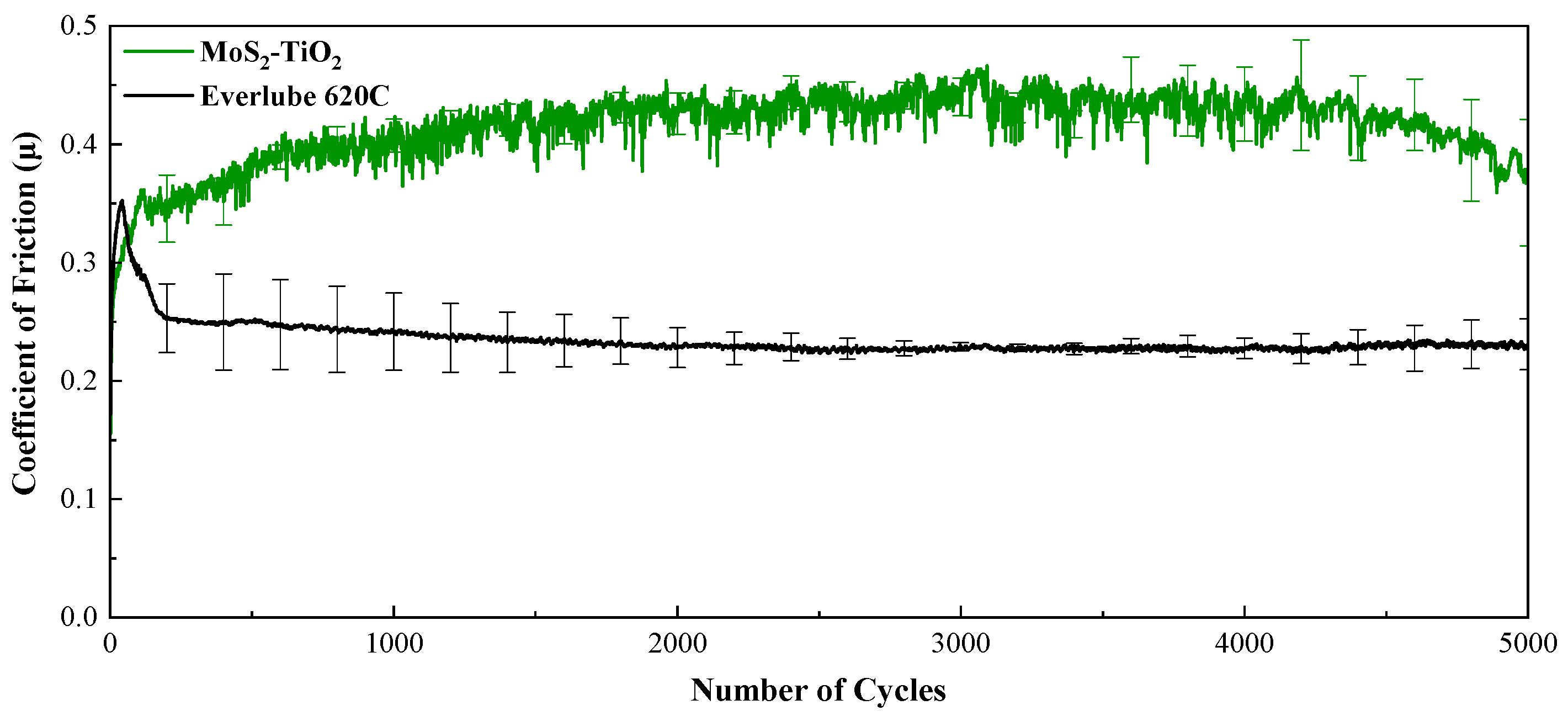
Figure 1 depicts the friction properties of MoS2-TiO2 solid lubricant after a reciprocating ball-on-flat tribology test, compared with the previously published Everlube 620C baseline [38]. The composite MoS2-TiO2 coating displayed a short break-in phase of approximately 100 cycles, following which the average friction coefficient erratically varied between 0.35 and 0.45. In contrast, the Everlube 620C coating maintained a lower and more stable average friction coefficient of approximately 0.24.
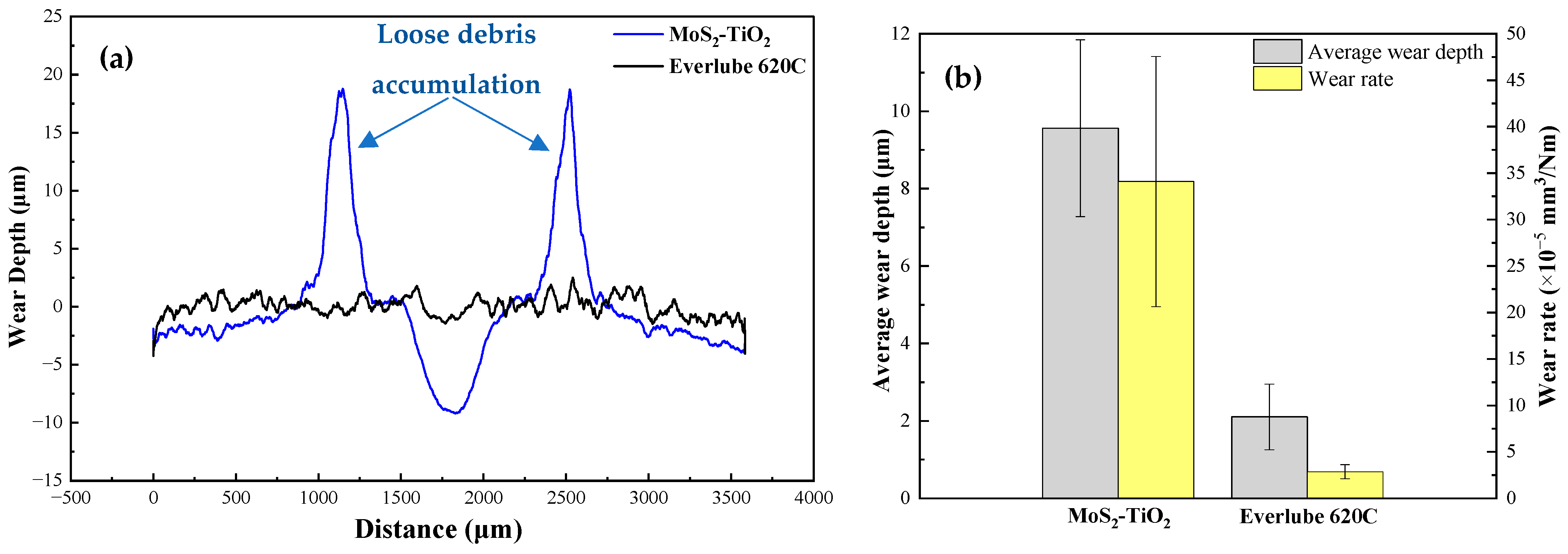
Figure 2a illustrates the average wear profile of the MoS2-TiO2 solid lubricant after sliding tests, showing the significant pile-up of removed material (i.e., loose debris) along the wear scar. In contrast, the Everlube 620C coating exhibited a comparatively shallow and less severe wear profile. Figure 2b presents the measured average wear depth and wear rate, respectively. According to this figure, the MoS2-TiO2 coating exhibited an average wear depth of approximately 9.5 ± 2.2 µm and a wear rate of 34.1 ± 13.5 × 10⁻⁵ mm3/N·m, which are approximately five and twelve times higher, respectively, than those measured for Everlube 620C.
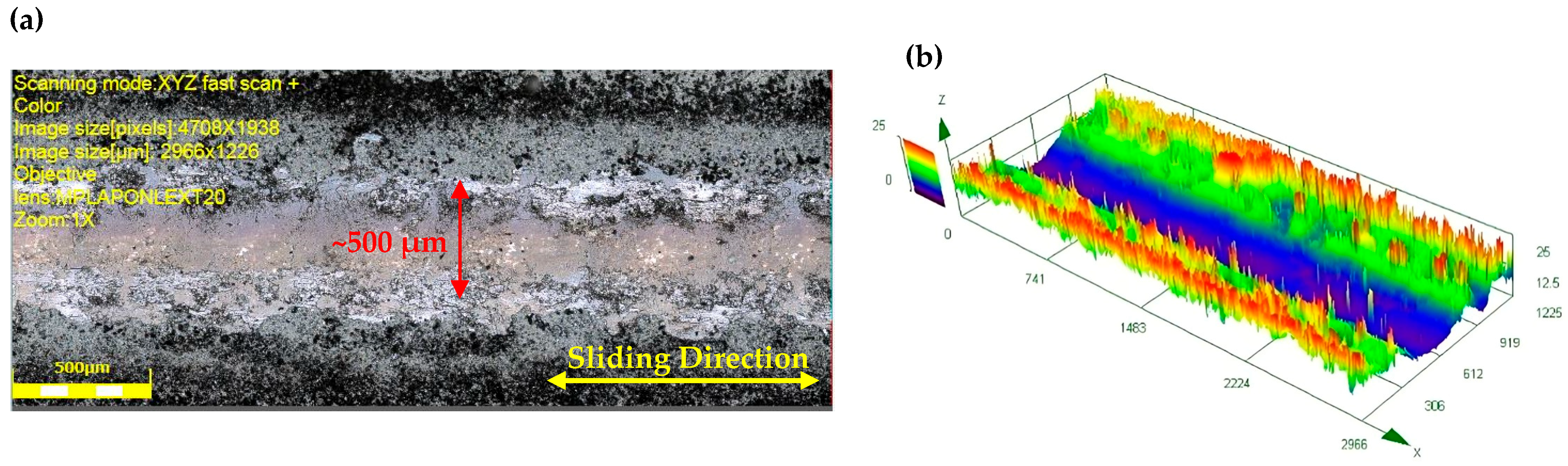
As shown in Figure 3, 2D and 3D confocal images of the wear scar further support the abovementioned findings. The MoS2-TiO2 solid lubricant displayed a wide wear track of approximately 500 µm, with notable buildup of loose debris along the wear track (Figure 3a). The 3D confocal image (Figure 3b) further confirms the pronounced depth of the wear track.

3.2. Ex Situ Characteristics

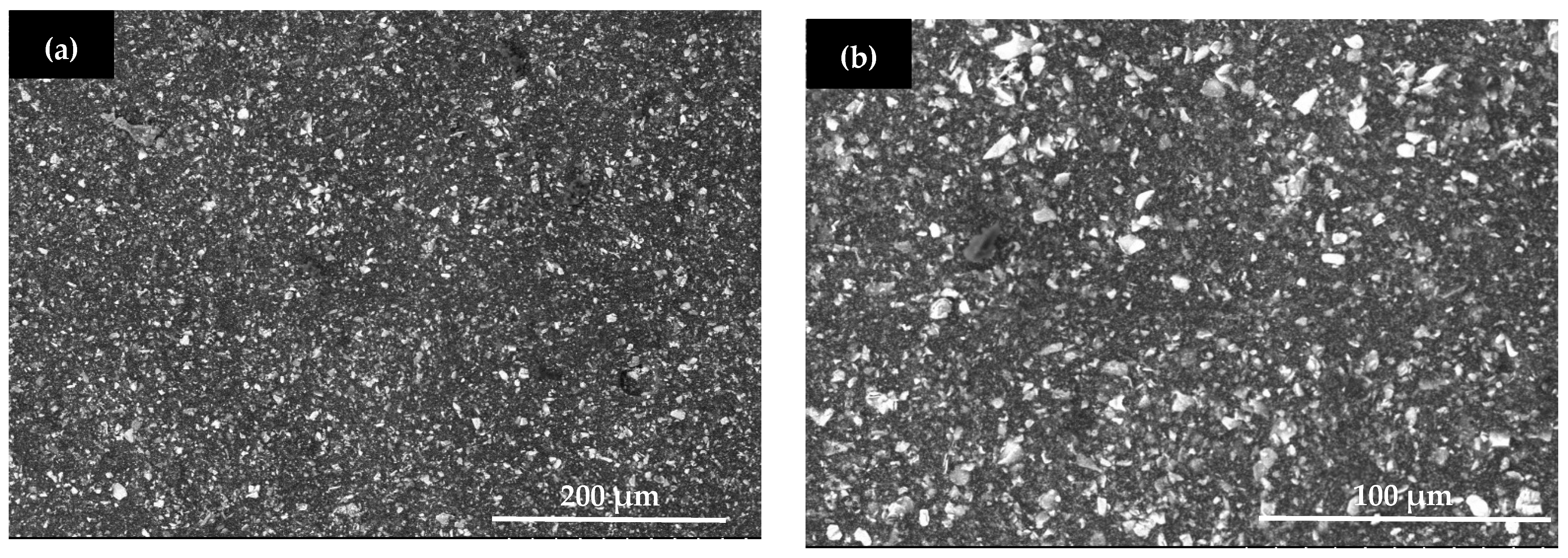
Figure 4a,b shows the unworn surface of the MoS2–TiO2 coating, where MoS2 (bright contrast) and TiO2 (gray contrast) particles are uniformly distributed within the dark phenolic binder matrix.
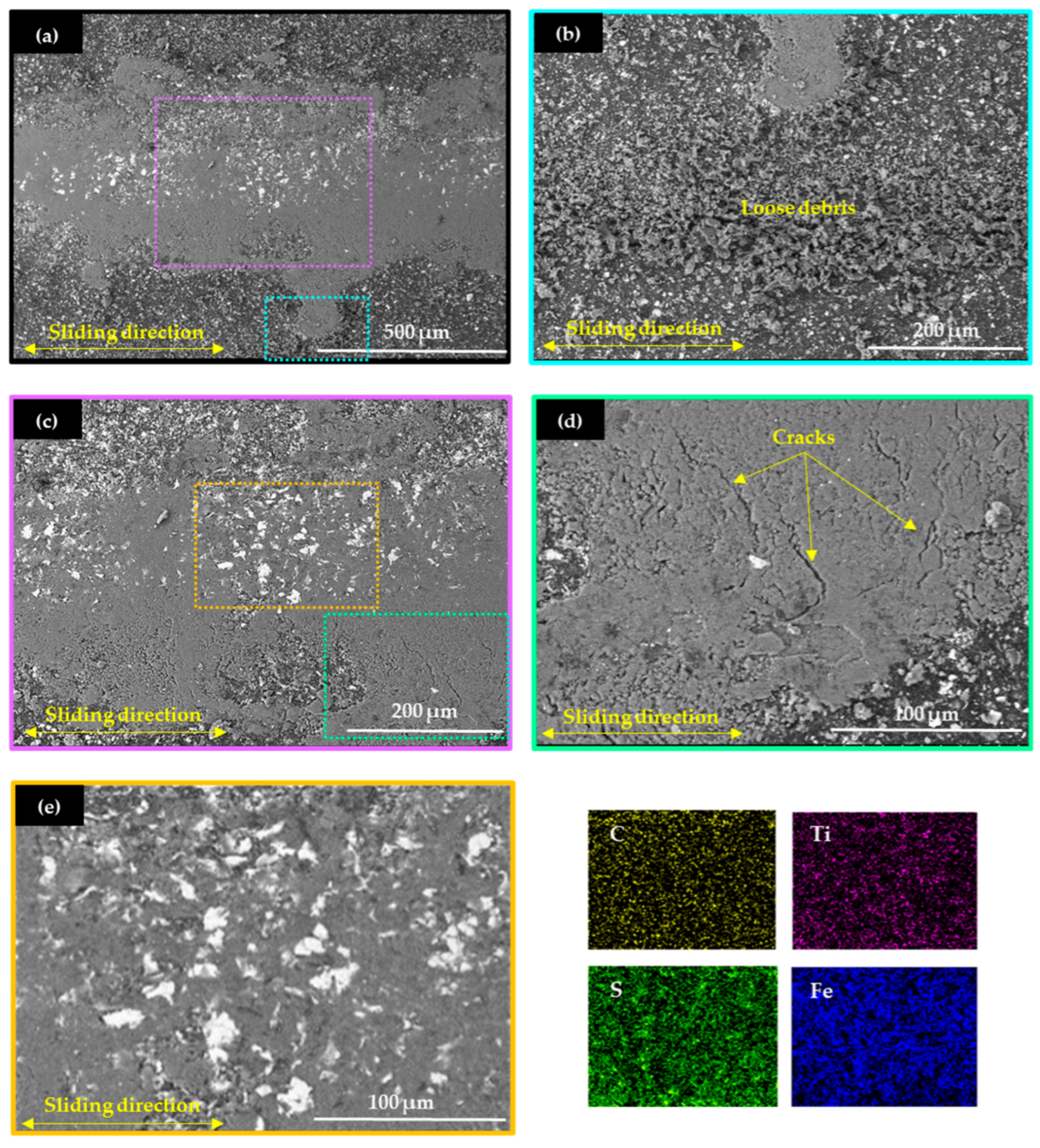
Figure 5 displays SEM images of the worn surface of the MoS2-TiO2 coating following the sliding test. According to Figure 5a, the MoS2-TiO2 coating revealed the tribofilm formation on the flat surface. The loose debris accumulation along the wear track and the magnified view of the tribofilm are shown in Figure 5b and Figure 5c, respectively. Table 1 summarizes the EDS analysis of the loose debris, revealing the presence of key elements originating from the coating constituents as well as the substrate, thereby confirming material removal and tribofilm disruption during sliding. In addition, numerous cracks can be observed oriented nearly perpendicular to the sliding direction (Figure 5d). EDS mapping of the worn surface (Figure 5e) showed that while sulfur, carbon, and titanium—indicatives of MoS2, binder, and additive, respectively—were detected on the wear track, a significant amount of iron, associated with the exposed 304SS substrate, was also evident.
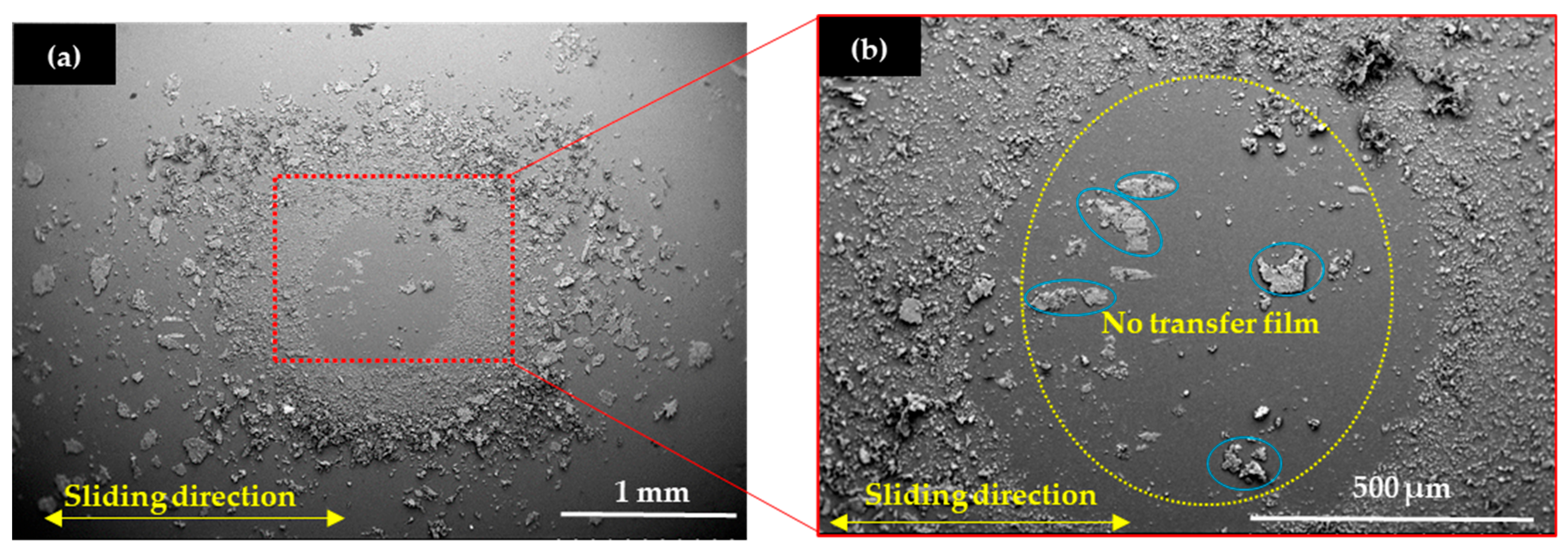
Figure 6 exhibits SEM images of the alumina counterface after the sliding test against the MoS2-TiO2 solid lubricant. As can be seen in Figure 6a, a considerable amount of debris, varying in size, is distinctly distributed around the contact area, with smaller particles present near the contact zone and larger particles further away. According to the magnified view of the alumina ball (Figure 6b), no visible transfer film was detected in the central area of the counter ball. Although some material accumulation was observed in the central region of the counterface associated with the MoS2–TiO2 coating, this should not be interpreted as the formation of a well-developed or continuous transfer film. Based on the backscattered SEM images and morphology, the observed material (indicated by blue circles) appears to be loosely attached debris, likely displaced from other areas of the wear track rather than generated in situ as a stable transfer film.
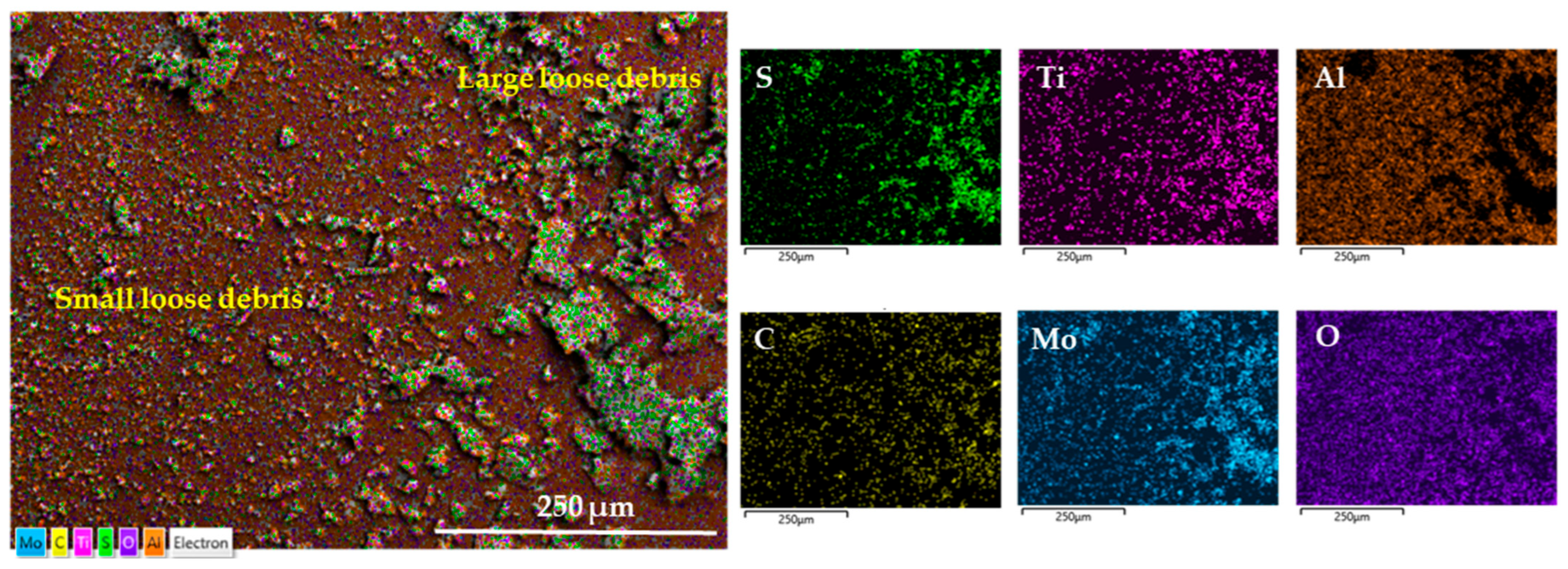
Figure 7 presents the EDS mapping of the alumina counterball following sliding against the MoS2–TiO2 coating. The results reveal that the loosely attached debris on the counterface contains sulfur and molybdenum (indicative of MoS2), carbon (indicative of the binder), as well as titanium, confirming the presence of transferred material originating from both the solid lubricant matrix and the TiO2 additive.
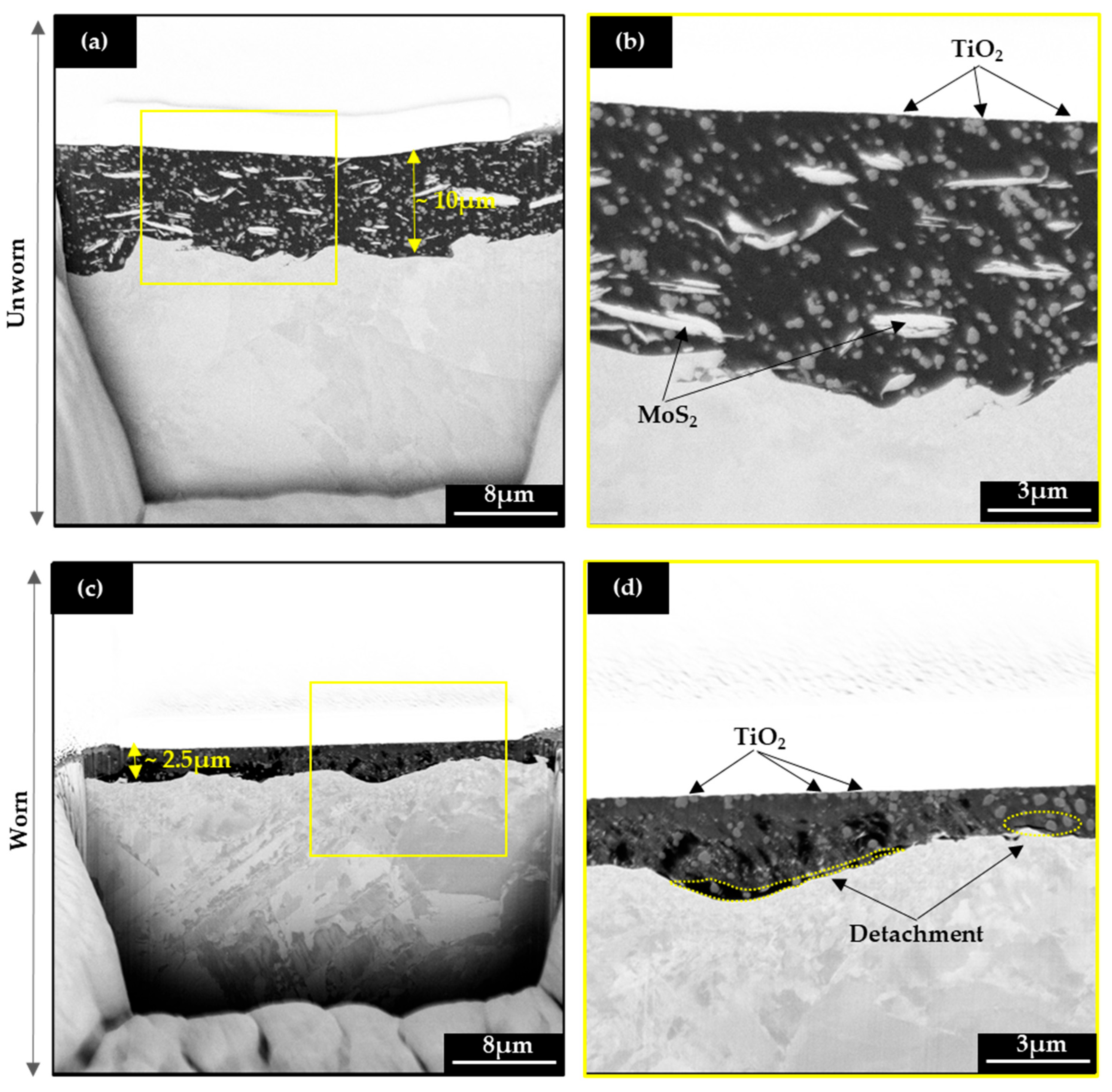
Figure 8 shows cross-sectional FIB images of the unworn and worn surfaces of theMoS2-TiO2 coating. As observed in the unworn surface (Figure 8a,b), TiO2 particles with a near-spherical morphology (gray contrast) and an average size of ~300 nm are embedded within the matrix, composed of MoS2 lamellae (bright contrast) and the binder phase (dark region). After the sliding test, the coating thickness drastically decreased from approximately 10 µm (as-deposited) to around 2.5 µm (Figure 8c), which correlates well with the high wear reported in Figure 2. The magnified cross-sectional image of the worn surface (Figure 8d) reveals extensive fragmentation and depletion of the MoS2 lubricant phase, accompanied by accumulation of TiO2 particles at the top surface. In addition, localized coating delamination from the substrate, indicative of partial detachment, is observed.
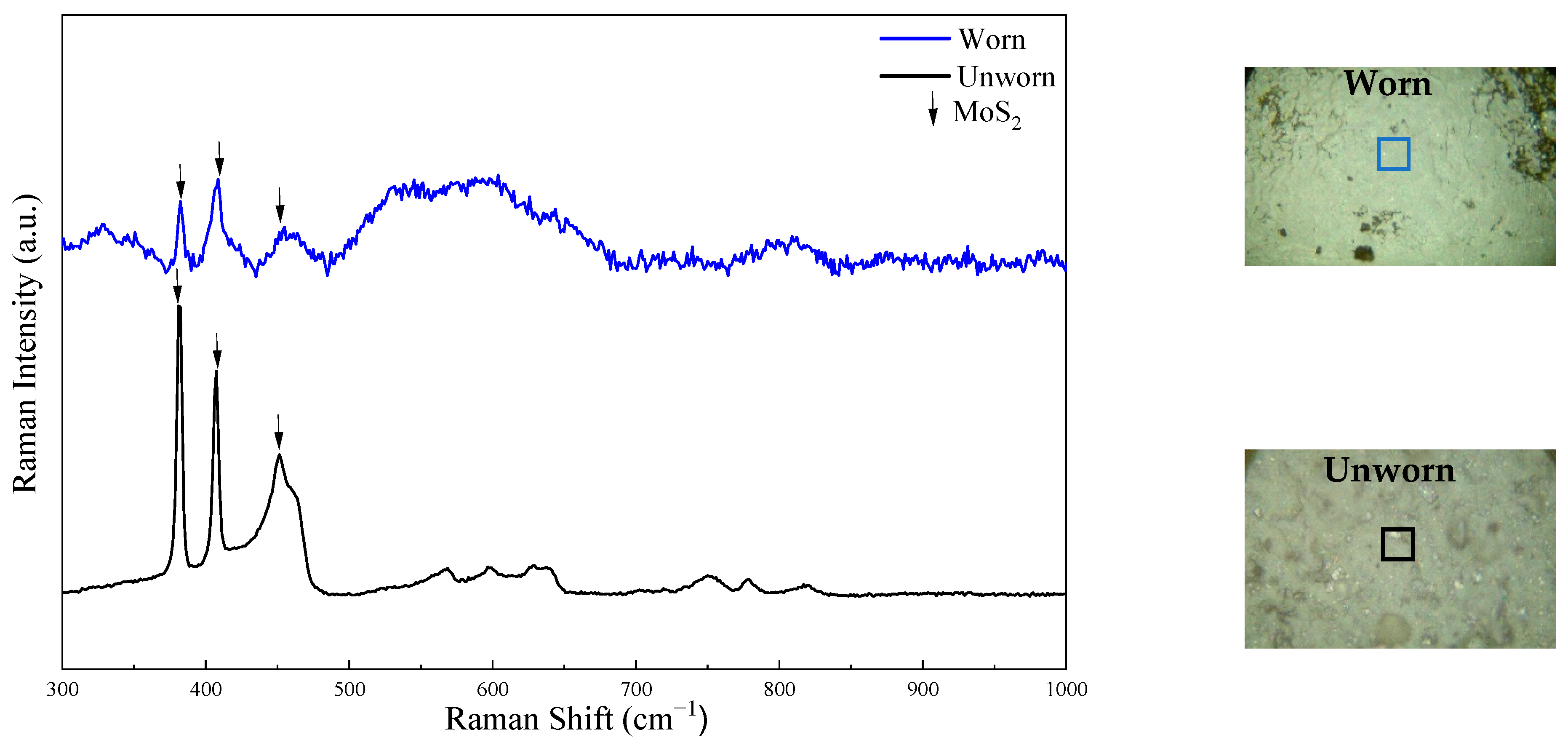
Figure 9 illustrates the Raman spectra acquired from the unworn surface and wear scar of the MoS2-TiO2 coating. The unworn surface displays the characteristic Raman features of MoS2, with prominent peaks at 383 and 408 cm−1, related to its first-order vibrational modes [42]. Additional peaks observed at 450, 596, and 778 cm−1 are attributed to second-order MoS2 modes, while bands near 567, 757, and 817 cm−1 arise from overtone processes involving the first- and second-order modes of MoS2 [43]. Notably, no distinct Raman peaks associated with TiO2 are detected, which can be attributed to the low signal intensity arising from the limited presence of this oxide within the probed area. In contrast, the worn surface exhibits a pronounced reduction in the intensity of the primary MoS2 peaks at 383 and 408 cm−1 relative to the unworn condition, indicating partial depletion of the MoS2 lubricant phase from the surface during sliding. This observation is consistent with the FIB cross-sectional images of the worn surface (Figure 8d), which reveal significant depletion of MoS2 from the coating.
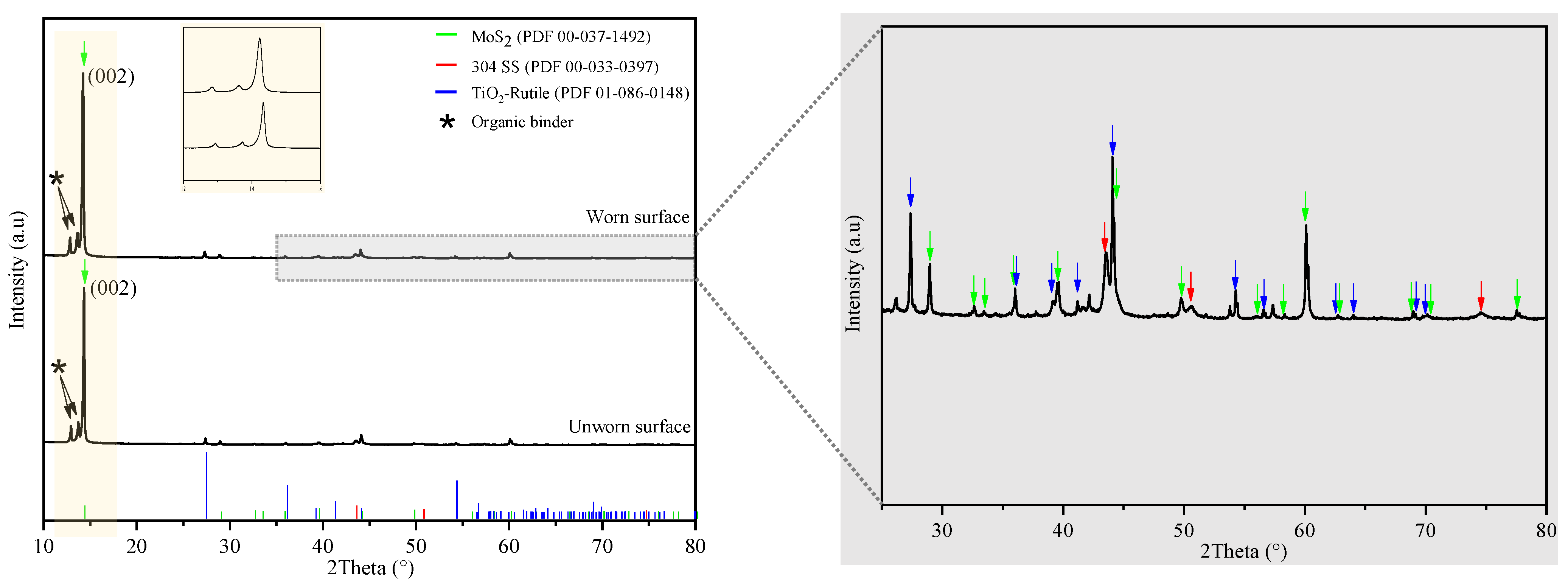
Figure 10 shows the XRD patterns attained from the unworn and worn surfaces of the coating investigated in this work. In both conditions, diffraction peaks associated with MoS2 are evident, confirming its presence as the primary lubricating phase. MoS2 is identified as having a hexagonal crystal structure (2H), in agreement with the 2H-MoS2 reference pattern (PDF number 00-037-1492), which represents the most stable and commonly occurring polymorph [44]. Diffraction peaks corresponding to the 304 stainless steel substrates are also detected on the worn surface, indicating partial penetration of the X-ray beam through the coating. Furthermore, two low-angle peaks located at approximately 12.92° and 13.73°, observed in both worn and unworn surfaces, are likely associated with the organic constituents of the coating, namely the phenolic binder. In addition, peaks associated with TiO2 (PDF number 00-001-1292) are also detected on both worn and unworn surfaces, indicating the presence of the rutile phase, which has a tetragonal crystal structure and is widely used in various industries [19].

4. Discussion

4.1. Friction and Wear Properties

The friction performance of the MoS2–TiO2 coating is likely governed by the deformation component of friction, arising from asperity interactions and ploughing. During the initial sliding cycles (approximately the first 100 cycles, as shown in Figure 1), a run-in period is observed, which is associated with repeated asperity collisions and the progressive accommodation of surface roughness. In this stage, the tangential force required to deform and flatten the microscopic asperities increases, leading to a rise in the COF to a maximum value of approximately 0.36 [45]. After the run-in period, the system reaches a steady-state regime in which the COF fluctuates between 0.35 and 0.45, primarily due to continuous ploughing and repeated deformation of the coating surface.
From a mechanistic perspective, the friction coefficient is defined as μ = F/N, where F is the total friction force and N is the applied normal load. The friction force can be expressed as the sum of an adhesive component (Fa) and a deformation component (Fd), such that F = Fa + Fd [46]. Thus, in the present MoS2–TiO2 system, the significant contribution to friction arises from the deformation component, as evidenced by the fracture-assisted material removal observed on the worn surface. This behavior is manifested by the accumulation of loose debris along the wear track edges (Figure 5b), the presence of cracks within the worn surface (Figure 5d), and the transfer of fragmented material onto the contact region of the alumina counterface (Figure 6). The contribution of adhesive friction is comparatively limited due to the presence of MoS2, which reduces interfacial shear strength; however, it is not entirely eliminated under the applied contact conditions.
In addition, the poor friction behavior of the MoS2-TiO2 coating can be further explained by the high interaction parameter of TiO2, reported to be 0.081 Å−3 [21]. This parameter has been correlated with a friction coefficient ranging from 0.35 to 0.55 at a temperature ratio (T/Tm) between 0.37 and 0.5 [28,47]. The elevated interaction parameter indicates stronger cation–anion bonding in TiO2, which increases resistance to shear at the contact interface. Such strong bonding promotes higher interfacial strength and restricts easy shear, thereby intensifying deformation-dominated friction and reducing lubrication efficiency. Compared with values reported in the literature [38], the MoS2–TiO2 system exhibits inferior friction performance relative to MoS2–Bi2O3 and Everlube 620C (MoS2–Sb2O3) coatings, which showed average steady-state friction coefficients of approximately 0.28 and 0.24, respectively, under the same tribosystem and experimental conditions. This difference can be attributed to the nature of the oxide additives: Bi2O3 and Sb2O3 are highly ionic oxides with low interaction parameters of 0.008 and 0.011, respectively, indicating weaker bonding and reduced resistance to shear. As a result, these oxides facilitate easier interfacial sliding and more effective lubrication, leading to lower friction compared to the TiO2-containing coating.
In terms of wear performance, the MoS2–TiO2 coating exhibited abrasive damage governed by a fracture-controlled mechanism, as evidenced by extensive crack formation observed on the SEM images of the worn surface (Figure 5d), indicating that material removal is primarily driven by crack initiation and propagation. In addition, abrasion occurred under a three-body condition, in which wear debris—likely originating from particle pull-out (e.g., TiO2), coating fragmentation, and detachment of surface features (e.g., asperities)—can act as mobile third-body abrasives entrapped within the contact interface between the coating and the counterface. This wear mode can be characterized by the presence of a significant amount of loose and non-adhered debris accumulated along the wear track edges (Figure 5b), which is not embedded within the worn surface, indicating that these particles are free to slide within the contact interface and be displaced laterally during sliding.
The EDS elemental mapping of the wear track (Figure 5e) further supports the poor wear resistance of the MoS2–TiO2 coating, revealing the presence of iron (Fe) from the substrate alongside coating constituents (C, S, and Ti). Although localized Fe enrichment indicates partial exposure of the stainless-steel substrate, the corresponding friction curve (Figure 1) does not exhibit a sudden increase in the friction coefficient typically associated with complete coating failure. This behavior can be attributed to the progressive and non-uniform nature of the coating degradation process, in which some regions of the wear track experienced failure down to the substrate, while other regions likely retained sufficient MoS2 to maintain partial lubrication. This localized wear behavior led to a more erratic but not sharply increasing friction trend, as observed in Figure 1. Moreover, XRD patterns acquired from the unworn and worn surfaces of the coating (Figure 10) also confirm the detection of the SS304 substrate after sliding, indicating the substrate exposure.
Likewise, SEM images of the counterball (Figure 6a) exhibited a large number of loosely attached debris particles distributed across the contact region, further supporting severe abrasive wear associated with the presence of hard and brittle TiO2 particles within the coating. Moreover, no continuous transfer film was observed on the counterface sliding against the MoS2-TiO2 coating (Figure 6b). The absence of a transfer film is likely related to the brittle nature of TiO2, which disrupts film continuity and promotes coating fragmentation and debris generation rather than the formation of a stable MoS2-based transfer layer. The lack of a well-adhered transfer film on the counterface (Figure 6b) indicates that the generated debris is not stabilized at the interface but remains mobile within the contact zone, providing further evidence for the three-body abrasive mechanism. In general, the formation of a transfer layer during sliding is known to limit direct asperity contact and decrease interfacial shear strength, ultimately leading to reduced friction and wear. Accordingly, the lack of an effective transfer film in the present system contributes to the elevated friction and wear observed, consistent with previous studies emphasizing the critical role of transfer film formation in tribological performance [40,48]. EDS analyses of the loose debris collected from the wear track and counterball (Table 1 and Figure 7) also confirmed that wear debris contains constituents from the coating (MoS2, TiO2, and binder) as well as substrate material, further supporting active material removal.
Collectively, the presence of loose and non-embedded debris within both the wear track and the counterface, together with the absence of a stable transfer film, indicates that these particles are free to roll and/or slide within the interface, which is characteristic of three-body abrasion.
FIB cross-sectional imaging (Figure 8) confirms a substantial reduction in thickness, from approximately 10 µm to 2.5 µm, indicating severe wear, which was consistent with the high wear depth and wear rate reported in Figure 2. The worn cross sections also show significant depletion of the lubricating MoS2 phase and localized coating delamination (Figure 8c,d). The loss of MoS2 is further corroborated by the Raman spectra (Figure 9), exhibiting a noticeable decrease in MoS2 intensity on the worn surface compared to the unworn surface, likely resulting from accelerated material removal caused by the accumulation of abrasive TiO2 particles on the surface layer. In addition, the observed partial delamination of the coating from the substrate suggests that the shear stresses generated during sliding exceeded the interfacial shear strength of the coating–substrate interface [49]. This disruption can be attributed to the poor mechanical compatibility between the hard and brittle TiO2 particles and the matrix, which promotes localized stress concentrations at the particle–matrix interface and leads to brittle fracture and interfacial degradation.
Overall, excessive hardness of the oxide beyond the optimal level, combined with its brittle nature, can enhance the brittleness of the coating. This increases the likelihood of brittle fracture during sliding and deterioration of coating effectiveness, leading to the generation of substantial debris particles [50]. From a classical standpoint, wear behavior is often described by Archard’s relationship, where the wear volume is inversely proportional to hardness (V ∝ 1/H), suggesting that harder materials should exhibit lower wear. However, this assumption is mainly applicable to adhesive or two-body abrasive wear [51]. In the present system, wear is dominated by fracture and three-body abrasion, where detached debris particles act as a third body within the contact interface. These debris particles actively participate in the sliding process, intensifying abrasion and accelerating material removal. As a result, the wear response is controlled less by the bulk hardness of the coating and more by the mechanical characteristics (e.g., hardness and brittleness) and stability of the debris generated during sliding. Consequently, the hard and brittle TiO2 particles, acting as third-body abrasives within the contact interface, can promote material removal and accelerate wear. At the microscale, ductile materials tend to fracture as a result of plastic deformation, whereas failure in brittle materials is predominantly governed by crack initiation and subsequent propagation, as described by fracture mechanics. Since brittle fracture often results in more severe wear, it is important for solid film lubricants to be able to accommodate plastic deformation to maintain their integrity under stress [52]. Similar behavior has been reported in previous studies examining the effect of TiO2 content on the wear performance of bonded MoS2-based coatings with inorganic binders (i.e., sodium silicate). In this study [24], systematic variation of TiO2 concentration revealed that increasing the TiO2 content beyond 15 wt.% resulted in a pronounced deterioration in wear performance. This behavior was attributed to inadequate dispersion and interfacial bonding, increased coating brittleness, and a reduced ability to accommodate shear deformation during sliding.
When compared with other oxide additives reported in the literature [38], such as Bi2O3 and Sb2O3 in MoS2-based solid lubricants, the MoS2–TiO2 system investigated in the present work exhibits significantly inferior wear performance. Specifically, the wear depth of the MoS2–TiO2 coating is approximately 5 and 2.5 times higher, while the wear rate is about 12 and 6.5 times higher than those of Everlube 620C (MoS2–Sb2O3) and MoS2–Bi2O3 systems, respectively, under comparable tribological conditions. This disparity can be primarily attributed to the hard and brittle nature of TiO2 particles, which promotes severe abrasive wear through particle fragmentation, pull-out, and three-body abrasion. In contrast, Sb2O3 has been reported to exhibit better mechanical and tribological compatibility with the MoS2 matrix, facilitating basal-plane orientation of MoS2 parallel to the sliding direction and thereby increasing shear accommodation and wear resistance. It should be noted, however, that although the MoS2–Bi2O3 and MoS2–Sb2O3 coatings were evaluated under similar test conditions, the oxide particle sizes in those systems were generally larger than the TiO2 particles used in the present study. Previous investigations have shown that reducing the TiO2 particle size from approximately 300 nm to about 63 nm can improve the tribological performance of MoS2–TiO2 composites [25]. This improvement can be attributed to more uniform particle dispersion, improved load sharing, and reduced stress concentrations at the particle–matrix interface. Similarly, it has been reported that the incorporation of finer ZrO2 particles in ZrO2-filled PEEK composites promotes the formation of a continuous and stable transfer film on the counterface, thereby enhancing wear resistance and reducing material loss during sliding [53]. Nevertheless, despite the smaller TiO2 particle size (~300 nm) employed in this work compared to Bi2O3 and Sb2O3, the tribological performance remains inferior. This observation indicates that the poor tribological performance of the MoS2–TiO2 system is not primarily governed by particle size effects, but is more fundamentally linked to the intrinsic material characteristics of TiO2, including its high hardness, brittleness, and strong ionic bonding, which hinder effective shear and promote fracture-dominated wear.
Finally, it is important to acknowledge that neither the TiO2 particle size nor its concentration was systematically optimized in the present study. As such, this work should be regarded as a foundational investigation into the tribological behavior of MoS2–TiO2 coatings based on the reference formulation (i.e., Everlube 620C), in which the additive was introduced at a constant volume concentration for direct comparison. Nevertheless, it is well established that both TiO2 particle size and concentration play a critical role in tribological performance: optimal nanoscale particle sizes and intermediate concentrations can enhance coating integrity, whereas excessive content or larger particles tend to promote agglomeration, poor dispersion, and increased brittleness, ultimately leading to higher friction and wear. Future studies focusing on systematic optimization of TiO2 content, particle size, and dispersion—potentially in combination with surface modification strategies—may provide viable pathways to mitigate brittleness and improve the overall friction and wear performance of this coating system.

4.2. Wear Mechanism

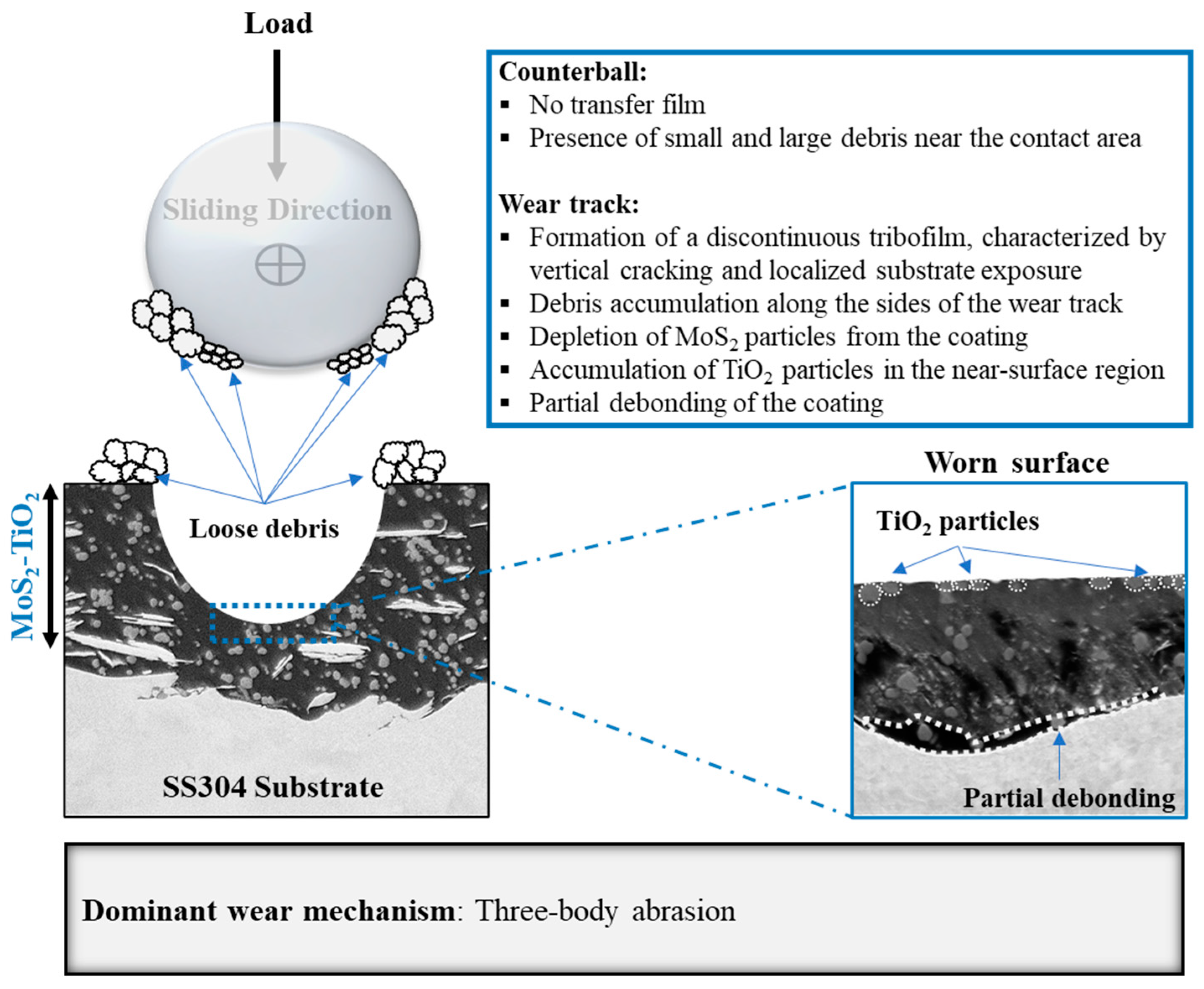
According to the tribological tests and obtained results, a schematic illustration of the wear mechanism of the MoS2-TiO2 coating is presented in Figure 11. During sliding, the applied load compresses the coating; however, the TiO2 particles, due to their inherent high hardness and brittleness, do not shear easily or effectively contribute to load sharing. Instead, these particles behave as abrasive particles, leading to disruption of the matrix, pushing themselves out toward the surface under cyclic loading, thereby intensifying abrasive wear. Therefore, the poor interfacial bonding and limited structural integrity between TiO2 and MoS2 can also result in stress localization and fragmentation of MoS2 particles within the coating. This process facilitates particle pull-out and the generation of loose debris across the wear scar and on the alumina counterface, leading to progressive depletion of the lubricating solid phase (MoS2) from the coating. In addition, the accumulation of shear stress at the coating–substrate interface may exceed the interfacial shear strength, resulting in partial debonding and local delamination of the coating.

5. Conclusions

This study aimed to evaluate the effect of TiO2 as an environmentally friendly oxide additive on the tribological performance of resin-bonded MoS2 solid lubricant coatings, in comparison with the commercial Sb2O3-containing Everlube 620C (i.e., reference formulation). The MoS2–TiO2 coating revealed higher friction (0.35–0.45) and significantly greater wear than the baseline system. This inferior performance is attributed to the hard and brittle nature of TiO2, which promotes stress concentration at particle–matrix interfaces, leading to crack initiation, particle pull-out, and extensive debris generation. These effects disrupt the formation of a stable MoS2-rich tribo/transfer film and promote three-body abrasion, resulting in accelerated material removal and partial coating delamination. In contrast, the Everlube 620C coating benefits from the more favorable mechanical compatibility of Sb2O3 with the matrix, enabling more stable lubrication and improved wear resistance. Notably, this comparison was conducted at an equivalent additive volume fraction, providing a consistent basis for evaluation. Therefore, further investigation into the optimization of TiO2 particle size and concentration is required to improve its tribological performance and assess its potential as a viable environmentally friendly replacement.

Author Contributions

Methodology, investigation, formal analysis, visualization, and writing—original draft, P.F.; Methodology and investigation, C.H.; Methodology, investigation, and writing—review and editing, C.J.B.; Supervision, funding acquisition, methodology, and writing—review and editing, R.W.; Supervision, funding acquisition, methodology, and writing—review and editing, P.S. All authors have read and agreed to the published version of the manuscript.

Funding

This research received no external funding.

Data Availability Statement

The data presented in this study are available upon request from the corresponding author.

Acknowledgments

The authors thank Concordia University for access to their characterization and tribology laboratories. They also acknowledge Everlube Products for providing the coated samples. Support from the Facility for Electron Microscopy Research (FEMR) at McGill University for FIB analysis, as well as from Université du Québec à Montréal for Raman spectroscopy and XRD, is also appreciated.

Conflicts of Interest

Authors Cara Hensley and Charles J. Beall were employed by the company Curtiss-Wright Corporation. The remaining authors declare that the research was conducted in the absence of any commercial or financial relationships that could be construed as a potential conflict of interest.

References

  1. Scharf, T.W.; Prasad, S.V. Solid lubricants: A review. J. Mater. Sci. 2013, 48, 511–531. [Google Scholar] [CrossRef]
  2. Vazirisereshk, M.R.; Martini, A.; Strubbe, D.A.; Baykara, M.Z. Solid Lubrication with MoS2: A Review. Lubricants 2019, 7, 57. [Google Scholar] [CrossRef]
  3. Singer, I.L. Solid Lubrication Processes. In Fundamentals of Friction: Macroscopic and Microscopic Processes; Singer, I.L., Pollock, H.M., Eds.; Springer: Dordrecht, The Netherlands, 1992; pp. 237–261. [Google Scholar]
  4. Sarkar, M.; Mandal, N. Solid lubricant materials for high temperature application: A review. Mater. Today Proc. 2022, 66, 3762–3768. [Google Scholar] [CrossRef]
  5. Erdemir, A. Modern Tribology Handbook. 2: Materials, Coatings, and Industrial Applications; CRC Press: Boca Raton, FL, USA, 2001. [Google Scholar]
  6. Yin, J.; Yan, H.; Cai, M.; Song, S.; Fan, X.; Zhu, M. Bonded flake MoS2 solid lubricant coating: An effective protection against fretting wear. J. Ind. Eng. Chem. 2023, 117, 450–460. [Google Scholar] [CrossRef]
  7. Wang, Y.; Du, Y.; Deng, J.; Wang, Z. Friction reduction of water based lubricant with highly dispersed functional MoS2 nanosheets. Colloids Surf. A Physicochem. Eng. Asp. 2019, 562, 321–328. [Google Scholar] [CrossRef]
  8. Rajendhran, N.; Palanisamy, S.; Periyasamy, P.; Venkatachalam, R. Enhancing of the tribological characteristics of the lubricant oils using Ni-promoted nanosheets as nano-additives. Tribol. Int. 2018, 118, 314–328. [Google Scholar] [CrossRef]
  9. Li, S.; Duan, C.; Li, X.; Shao, M.; Qu, C.; Zhang, D.; Wang, Q.; Wang, T.; Zhang, X. The effect of different layered materials on the tribological properties of PTFE composites. Friction 2020, 8, 542–552. [Google Scholar] [CrossRef]
  10. Chen, Z.; He, X.; Xiao, C.; Kim, S.H. Effect of Humidity on Friction and Wear—A Critical Review. Lubricants 2018, 6, 74. [Google Scholar] [CrossRef]
  11. Mukhtar, S.H.; Gulzar, A.; Saleem, S.; Wani, M.F.; Sehgal, R.; Yakovenko, A.A.; Goryacheva, I.G.; Sharma, M.D. Advances in development of solid lubricating MoS2 coatings for space applications: A review of modeling and experimental approaches. Tribol. Int. 2024, 192, 109194. [Google Scholar] [CrossRef]
  12. Li, Q.; Zheng, S.; Pu, J.; Wang, W.; Li, L.; Wang, L. Revealing the failure mechanism and designing protection approach for MoS2 in humid environment by first-principles investigation. Appl. Surf. Sci. 2019, 487, 1121–1130. [Google Scholar] [CrossRef]
  13. Vierneusel, B.; Schneider, T.; Tremmel, S.; Wartzack, S.; Gradt, T. Humidity resistant MoS2 coatings deposited by unbalanced magnetron sputtering. Surf. Coat. Technol. 2013, 235, 97–107. [Google Scholar] [CrossRef]
  14. Domínguez-Meister, S.; Conte, M.; Igartua, A.; Rojas, T.C.; Sánchez-López, J.C. Self-Lubricity of WSex Nanocomposite Coatings. ACS Appl. Mater. Interfaces 2015, 7, 7979–7986. [Google Scholar] [CrossRef]
  15. Curry, J.F.; Argibay, N.; Babuska, T.; Nation, B.; Martini, A.; Strandwitz, N.C.; Dugger, M.T.; Krick, B.A. Highly Oriented MoS2 Coatings: Tribology and Environmental Stability. Tribol. Lett. 2016, 64, 11. [Google Scholar] [CrossRef]
  16. Lince, J.R. Effective Application of Solid Lubricants in Spacecraft Mechanisms. Lubricants 2020, 8, 74. [Google Scholar] [CrossRef]
  17. Molybdenum disulphide lubrication, Chapter 7 Properties of molybdenum disulphide films. In Tribology Series; Elsevier: Amsterdam, The Netherlands, 1999; Volume 35, pp. 79–106.
  18. Molybdenum disulphide lubrication, Chapter 11 Bonded films. In Tribology Series; Elsevier: Amsterdam, The Netherlands, 1999; Volume 35, pp. 179–206.
  19. Borgaonkar, A.V.; Syed, I.; Sonawane, S.H. Fabrication and characterization of composite MoS2-TiO2 coating material. Proc. Inst. Mech. Eng. Part C J. Mech. Eng. Sci. 2022, 236, 1838–1849. [Google Scholar] [CrossRef]
  20. Properties of Titanium Oxide. Available online: https://www.techniques-ingenieur.fr/en/resources/article/ti589/titanium-dioxide-n4813/v1/properties-of-titanium-oxide-2 (accessed on 8 May 2025).
  21. Properties: Titanium Dioxide-Titania (TiO2). Available online: https://www.azom.com/properties.aspx?ArticleID=1179 (accessed on 2 May 2025).
  22. Borgaonkar, A.; Syed, I. Eco-friendly sustainable machining with MoS2-based solid lubricant. Proc. Inst. Mech. Eng. Part J J. Eng. Tribol. 2023, 237, 1783–1795. [Google Scholar] [CrossRef]
  23. Borgaonkar, A.V.; Ismail, S. Tribological behavior prediction of composite MoS2-TiO2 coating using Taguchi coupled artificial neural network approach. Proc. Inst. Mech. Eng. Part C J. Mech. Eng. Sci. 2022, 236, 6835–6850. [Google Scholar] [CrossRef]
  24. Borgaonkar, A.; Syed, I. Friction and wear behaviour of composite MoS2–TiO2 coating material in dry sliding contact. J. Braz. Soc. Mech. Sci. Eng. 2021, 43, 51. [Google Scholar] [CrossRef]
  25. Borgaonkar, A.V.; Syed, I.; Sonawane, S.H. Effects of Lubrication on Tribological Properties of Composite MoS2-TiO2 Coating Material. In Tribological Applications of Composite Materials; Hameed Sultan, M.T., Mohd Jamir, M.R., Abdul Majid, M.S., Azmi, A.I., Saba, N., Eds.; Springer: Singapore, 2021; pp. 267–281. [Google Scholar]
  26. Gao, X.Y.; Lu, P.; Xu, Z.M.; Tang, G.G. Synthesis and tribological properties of MXene/TiO2/MoS2 nanocomposite. Chalcogenide Lett. 2022, 19, 513–527. [Google Scholar] [CrossRef]
  27. Borgaonkar, A.; Syed, I. Tribological Investigation of Composite MoS2-TiO2-ZrO2 Coating Material by Response Surface Methodology Approach. J. Tribol. 2022, 144, 031401. [Google Scholar] [CrossRef]
  28. Prakash, B.; Celis, J.P. The Lubricity of Oxides Revised Based on a Polarisability Approach. Tribol. Lett. 2007, 27, 105–112. [Google Scholar] [CrossRef]
  29. Rodil, S.E.; Depablos-Rivera, O.; Sánchez-López, J.C. Tribological Response of δ-Bi2O3 Coatings Deposited by RF Magnetron Sputtering. Lubricants 2023, 11, 207. [Google Scholar] [CrossRef]
  30. Birleanu, C.; Pustan, M.; Cioaza, M.; Molea, A.; Popa, F.; Contiu, G. Effect of TiO2 nanoparticles on the tribological properties of lubricating oil: An experimental investigation. Sci. Rep. 2022, 12, 5201. [Google Scholar] [CrossRef]
  31. Ilie, F.; Ipate, G.; Manaila, F.C. Tribological Properties Study of Solid Lubrication with TiO2 Powder Particles. Materials 2022, 15, 7145. [Google Scholar] [CrossRef]
  32. 3000-A–Solid Film Lubricants & Engineered Coatings. Available online: https://everlubeproducts.com/prod/docs/processbulletins/3000APB.pdf (accessed on 15 August 2025).
  33. Lansdown, A.R. Molybdenum Disulphide Lubrication; Elsevier: Amsterdam, The Netherlands, 1999; Volume 35. [Google Scholar]
  34. MIL-S-5002D; Surface Treatments and Inorganic Coatings for Metal Surfaces of Weapons Systems. U.S. Department of Defense: Washington, DC, USA, 1990.
  35. AMS-QQ-P-35; Passivation Treatments for Corrosion-Resistant Steel. SAE International: Warrendale, PA, USA, 2014.
  36. AS1701F; E-25 General Standards for Aerospace and Propulsion Systems Lubricant, Solid Film. SAE International: Warrendale, PA, USA, 2017. [CrossRef]
  37. ASTM D7091; Standard Practice for Nondestructive Measurement of Dry Film Thickness of Nonmagnetic Coatings Applied to Ferrous Metals and Nonmagnetic, Nonconductive Coatings Applied to Non-Ferrous Metals. ASTM: Conshohocken, PA, USA, 2021. [CrossRef]
  38. Fallah, P.; Hensley, C.; Beall, C.J.; Stoyanov, P.; Wuthrich, R. Toward greener alternative: Comparative tribological study of Sb2O3 and Bi2O3 additives in bonded MoS2-based solid lubricants for aerospace applications. Wear 2026, 588, 206526. [Google Scholar] [CrossRef]
  39. Fallah, P.; Hensley, C.; Beall, C.J.; Stoyanov, P.; Wuthrich, R. Effect of additive concentration and temperature on the tribological performance of eco-friendly bonded MoS2-PEEK solid lubricants for aerospace applications. Results Surf. Interfaces 2025, 21, 100681. [Google Scholar] [CrossRef]
  40. Fallah, P.; Hensley, C.; Beall, C.J.; Islasencalada, A.; Chromik, R.; Wuthrich, R.; Stoyanov, P. Environmentally friendly MoS2-hBN solid lubricants: A Comprehensive Tribological Evaluation. J. Tribol. 2024, 147, 041403. [Google Scholar] [CrossRef]
  41. Fallah, P.; Hensley, C.; Beall, C.J.; Encalada, A.I.; Chromik, R.R.; Wuthrich, R.; Stoyanov, P. Tribological Evaluation of Sustainable Spray-Bonded MoS2/hBN Solid Lubricant at Low Temperature. Tribol. Lett. 2025, 73, 111. [Google Scholar] [CrossRef]
  42. Windom, B.C.; Sawyer, W.G.; Hahn, D.W. A Raman Spectroscopic Study of MoS2 and MoO3: Applications to Tribological Systems. Tribol. Lett. 2011, 42, 301–310. [Google Scholar] [CrossRef]
  43. Chen, J.M.; Wang, C.S. Second order Raman spectrum of MoS2. Solid State Commun. 1974, 14, 857–860. [Google Scholar] [CrossRef]
  44. The International Centre for Diffraction Data|Materials Identification with the Powder Diffraction File (PDF), Newtown Square, PA, USA. Available online: https://www.icdd.com/ (accessed on 20 December 2025).
  45. Bressan, J.D.; Williams, J.A. Mathematical slip-line field solutions for ploughing a hard particle over a softer material. Wear 2009, 267, 1865–1872. [Google Scholar] [CrossRef]
  46. Holmberg, K.; Matthews, A. Coatings Tribology: Properties, Mechanisms, Techniques and Applications in Surface Engineering; Elsevier: Amsterdam, The Netherlands, 2009. [Google Scholar]
  47. Dimitrov, V.; Komatsu, T. Classification of Simple Oxides: A Polarizability Approach. J. Solid State Chem. 2002, 163, 100–112. [Google Scholar] [CrossRef]
  48. Tonge, P.; Roy, A.; Patel, P.; Beall, C.J.; Stoyanov, P. Tribological Evaluation of Lead-Free MoS2-Based Solid Film Lubricants as Environmentally Friendly Replacements for Aerospace Applications. Lubricants 2022, 10, 7. [Google Scholar] [CrossRef]
  49. Komvopoulos, K.; Saka, N.; Suh, N.P. The Significance of Oxide Layers in Boundary Lubrication. J. Tribol. 1986, 108, 502–513. [Google Scholar] [CrossRef]
  50. Schütze, M. Mechanical properties of oxide scales. Oxid. Met. 1995, 44, 29–61. [Google Scholar] [CrossRef]
  51. Archard, J.F. Contact and Rubbing of Flat Surfaces. J. Appl. Phys. 1953, 24, 981–988. [Google Scholar] [CrossRef]
  52. Manu, B.R.; Gupta, A.; Jayatissa, A.H. Tribological Properties of 2D Materials and Composites—A Review of Recent Advances. Materials 2021, 14, 1630. [Google Scholar] [CrossRef]
  53. Wang, Q.; Xue, Q.; Liu, H.; Shen, W.; Xu, J. The effect of particle size of nanometer ZrO2 on the tribological behaviour of PEEK. Wear 1996, 198, 216–219. [Google Scholar] [CrossRef]
Figure 1. Comparative friction behavior of MoS2-TiO2 and Everlube 620C solid lubricants after the sliding test. The Everlube 620C data were reproduced from [38].
Lubricants 14 00186 g001
Figure 2. (a) Wear profiles of MoS2-TiO2 and Everlube 620C solid lubricants following sliding tests, and (b) average wear depths and wear rates derived from the wear profiles. The Everlube 620C data were reproduced from [38].
Lubricants 14 00186 g002
Figure 3. Confocal images of the wear track of the MoS2-TiO2 coating after ball-on-flat tribological testing: (a) 2D and (b) 3D views.
Lubricants 14 00186 g003
Figure 4. SEM images of the unworn surface of the MoS2-TiO2 coating at (a) lower and (b) higher magnification.
Lubricants 14 00186 g004
Figure 5. SEM images of the wear track of the MoS2–TiO2 coating: (a) tribofilm formation, (b) magnified view of loose debris along the wear scar, (c) higher-magnification view of the tribofilm, (d) perpendicular crack formation on the worn surface, and (e) magnified view of image (c) with corresponding EDS elemental mapping. The colored dashed frames (purple, blue, orange, and green) indicate regions of interest selected for higher-magnification analysis.
Lubricants 14 00186 g005
Figure 6. SEM images of the counterballs at (a) low and (b) high magnifications for MoS2-TiO2. The blue circles indicate loosely attached debris displaced from other regions.
Lubricants 14 00186 g006
Figure 7. EDS elemental mapping of the counterball corresponding to the MoS2-TiO2 coating.
Lubricants 14 00186 g007
Figure 8. FIB images obtained from (a,b) unworn and (c,d) worn surfaces of the MoS2-TiO2 coating.
Lubricants 14 00186 g008
Figure 9. Raman spectra obtained from the unworn and worn MoS2–TiO2 coating, accompanied by optical images showing the regions selected for analysis.
Lubricants 14 00186 g009
Figure 10. XRD patterns of the unworn and worn surfaces for the MoS2-TiO2 coating.
Lubricants 14 00186 g010
Figure 11. Illustration of the wear mechanism for MoS2 solid lubricant coating containing TiO2.
Lubricants 14 00186 g011
Table 1. EDS analysis of loose debris collected along the wear track shown in Figure 5b.
COSTiFe
Weight percentage (%)55.43 ± 4.2419.49 ± 1.7113.51 ± 2.19.53 ± 2.041.81 ± 0.6
Disclaimer/Publisher’s Note: The statements, opinions and data contained in all publications are solely those of the individual author(s) and contributor(s) and not of MDPI and/or the editor(s). MDPI and/or the editor(s) disclaim responsibility for any injury to people or property resulting from any ideas, methods, instructions or products referred to in the content.