Article

Integrated Theoretical Modeling and MASTA-Based Parametric Simulation for Contact Mechanics, Wear Behavior, of Critical Bearings in RV Reducers

1
School of Future Science and Engineering, Suzhou University, Suzhou 215006, China
2
School of Mechanical and Electrical Engineering, Suzhou University, Suzhou 215137, China
*
Author to whom correspondence should be addressed.
Lubricants 2026, 14(4), 141; https://doi.org/10.3390/lubricants14040141
Submission received: 5 February 2026 / Revised: 23 March 2026 / Accepted: 25 March 2026 / Published: 27 March 2026

Abstract

RV reducers are vital components in industrial robots and precision equipment, where the fatigue life of the crank arm and support bearings critically influences the overall system longevity. This study presents a comprehensive performance evaluation, with a specific focus on contact mechanics and wear analysis of these critical bearings. A theoretical mathematical model for force analysis is established based on static mechanics, which is further extended to incorporate wear depth prediction based on contact pressure and sliding velocity. To validate this model and investigate bearing behavior in detail, a high-fidelity parametric simulation model is developed using MASTA software. The simulation results, encompassing contact stress, shear stress, and wear patterns, demonstrate good correlation with the predictions from the theoretical mathematical model, effectively verifying its accuracy for performance and life assessment. The systematic analysis confirms that both the investigated tapered roller and needle roller bearings meet the design requirements. This integrated approach of theoretical modeling, which includes wear analysis, and software simulation provides a reliable methodology for assessing bearing performance and fatigue life, offering significant value for the design optimization and reliability enhancement of RV reducers.

1. Introduction

Industrial robots have become indispensable pillars in modern intelligent manufacturing, driving advancements in precision machining, automated assembly, and flexible production with their unparalleled accuracy, efficiency, and adaptability [1]. Among the core components determining robotic performance, precision reducers stand out as the “power transmission heart,” directly governing motion accuracy, response speed, and load-bearing capacity. Among various reducer types, Rotary Vector (RV) reducers have emerged as the preferred choice for high-performance industrial robots, thanks to their distinctive advantages: a wide transmission ratio range, exceptional transmission accuracy, high load-carrying capacity, compact structural design, and excellent rigidity [2]. These characteristics make RV reducers ideal for critical joints of industrial robots, such as the waist, base, and upper arm that operate under heavy-load and high-precision requirements, including applications in welding, material handling, automotive assembly, and aerospace component machining.
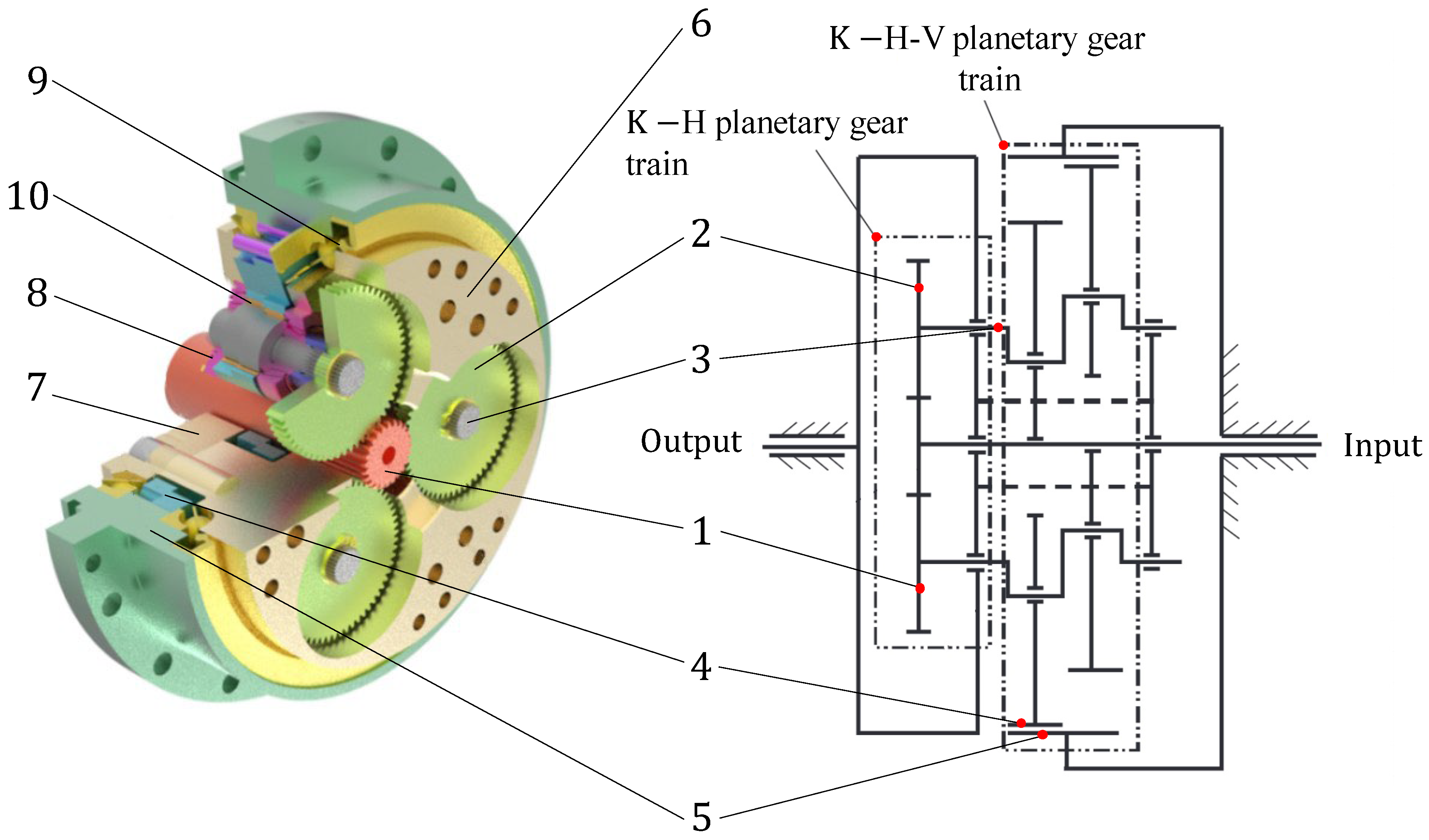
Structurally, RV reducers adopt a planocentric transmission configuration based on the cycloidal pin-wheel mechanism, integrating a two-stage transmission system to achieve high-precision power output, as shown in Figure 1. The first stage employs an involute gear mechanism, consisting of a sun gear (1), planet gears (2), and planetary carriers (6, 7), which realizes preliminary speed reduction and torque distribution. The second stage relies on a cycloidal pinwheel mechanism, where crankshafts (3) drive cycloidal discs (4) to engage with fixed pin gears (5) in a multi-tooth meshing manner, completing the final speed reduction and torque output. Key supporting components include tapered roller bearings (8), angular contact ball bearings (9), and needle roller bearings (10), among which the crank arm bearings and crank support bearings play pivotal roles in torque transmission, structural positioning, and load distribution. Their operational reliability directly influences the overall stiffness, transmission efficiency, and service life of the reducer.
The mechanical behavior inside RV reducers is inherently complex due to the coupled effects of multi-stage transmission, multi-tooth meshing, and dynamic load interactions. During operation, the cycloidal discs undergo compound motion (rotation and revolution) driven by the crankshafts, leading to time-varying contact forces between the cycloidal teeth and pin gears. These forces are transmitted to the crank arm bearings and support bearings, resulting in complex loading conditions such as alternating radial loads, axial loads, and moment loads. Additionally, factors including manufacturing errors, assembly clearances, elastic deformation of components, and frictional interactions further exacerbate the complexity of the internal force field. As critical force-bearing components, crank arm bearings and crank support bearings are subjected to continuous cyclic loads and shear stresses, making them prone to wear, fatigue, and even premature failure. Consequently, the fatigue life and reliability of these bearings directly determine the service life of the entire RV reducer, highlighting the urgency of in-depth research on their contact mechanics, load characteristics, and wear behavior.
Over the past few decades, scholars worldwide have conducted extensive research on RV reducers, focusing on transmission accuracy, dynamic performance, and structural optimization. Hidaka et al. [3,4] were pioneering in investigating the stiffness and transmission error of RV reducers, proposing an error equivalence modeling method and a transmission error model considering manufacturing and assembly errors, which laid a theoretical foundation for system accuracy analysis. Blanche and Yang [5,6] adopted a geometric approach to analyze errors and backlash in single-stage cycloidal drives; however, this method is difficult to extend to multi-stage RV transmission systems due to the increased complexity of force distribution and motion coupling. Rosso et al. [7] and Kim et al. [8] explored the effects of bearing stiffness and damping on the dynamic performance of RV reducers through theoretical analysis and finite element simulation. Kim further established a torsional rigidity model by simplifying cycloidal gear contact as spring elements and validating it experimentally, revealing that cycloidal profile modifications, pin radius errors, and pin distribution circle errors significantly affect meshing stiffness and bearing loads. Despite these contributions, dedicated force analysis models for crank arm bearings and crank support bearings remain scarce, with most studies focusing on overall system performance rather than the detailed mechanical behavior of individual bearing components.
With the advancement of multibody dynamics and virtual prototyping technology, dynamic simulation has become a powerful tool for RV reducer research. Zhang et al. [9] constructed a virtual prototype of an RV reducer using ADAMS 2015 software based on multibody dynamics theory, investigating the influence of backlash and component deformation on transmission error and developing a flexible-rigid coupled dynamic model. Building on this work, Jin et al. [10] and Zhang et al. [11] integrated elastic deformation, manufacturing errors, and load conditions into virtual prototypes established via CREO 11, ANSYS R1, and ADAMS 2018, validating simulation accuracy through experimental comparisons and providing insights into dynamic transmission error. Recent research has focused on enhancing the comprehensiveness of dynamic modeling: Li et al. [12] proposed a generalized dynamic model for bearing-cycloid-pinwheel transmission mechanisms (BCPTMs), analyzing the effects of geometric parameters and crank arm bearings on dynamic contact responses; Tao et al. [13] quantified the degradation of transmission accuracy caused by cycloidal gear wear, establishing a numerical-simulation hybrid method to predict transmission error as a function of wear volume; Zhang et al. [14] employed isogeometric analysis (IGA) for multi-tooth contact modeling of cycloid pinwheel drives, achieving higher precision and efficiency than traditional finite element methods; Qi et al. [15] developed a numerical method integrating clearance, deformation, and friction for cycloidal drive optimization; Li et al. [16] emphasized the impact of tooth profile modifications and system errors on RV reducer performance; and Ahn et al. [17] studied the effects of tolerance and friction between cycloidal discs and pin rollers on efficiency, highlighting the need for precise tolerance control.
In terms of structural optimization, significant progress has also been made. Pang et al. [18] analyzed bearing forces and load distribution in RV reducers, demonstrating that optimizing structural parameters can reduce bearing loads and improve efficiency and longevity. Gao et al. [19] applied genetic algorithms to optimize crankshaft bearing design, significantly enhancing fatigue life and stiffness. Xu et al. [20] and Cui et al. [21] investigated the effects of material inclusions and defects on bearing fatigue life and stress distribution, emphasizing the importance of integrating material factors into reliability modeling. However, existing optimization studies often lack a direct link between bearing contact mechanics, wear behavior, and overall system performance, with limited attention to the synergistic effects of contact stress, sliding velocity, and wear on bearing life.
Despite the extensive body of research on RV reducers, critical gaps remain in the systematic analysis of crank arm bearings and crank support bearings. Current studies either focus on overall system dynamics without detailed bearing-level analysis or address bearing performance in isolation without integrating it into the complex transmission context of RV reducers. There is a pressing need for a comprehensive approach that combines theoretical modeling and numerical simulation to investigate the contact mechanics, load characteristics, and wear behavior of these critical bearings, thereby providing a reliable basis for life assessment and design optimization.
To address this gap, the present study aims to develop a integrated framework for the performance evaluation of critical bearings in RV reducers. Specifically, (1) separate force analysis models for crank arm bearings and crank support bearings are established based on static mechanics, incorporating wear depth prediction by coupling contact pressure and sliding velocity; (2) a high-fidelity parametric simulation model is developed using MASTA 14 software to validate the theoretical model and analyze bearing contact stress, shear stress, and wear patterns; (3) the consistency between theoretical predictions and simulation results is verified, confirming the accuracy of the proposed method. This study focuses on tapered roller bearings and needle roller bearings, systematically evaluating their performance to ensure compliance with design requirements. The integrated approach of theoretical modeling and software simulation provides a reliable methodology for assessing bearing performance and fatigue life, offering significant value for the design optimization, reliability enhancement, and service life extension of RV reducers in industrial robot applications.

2. Theoretical Modeling of Critical Bearings in RV Reducers

2.1. Force Analysis of the RV Reducer System

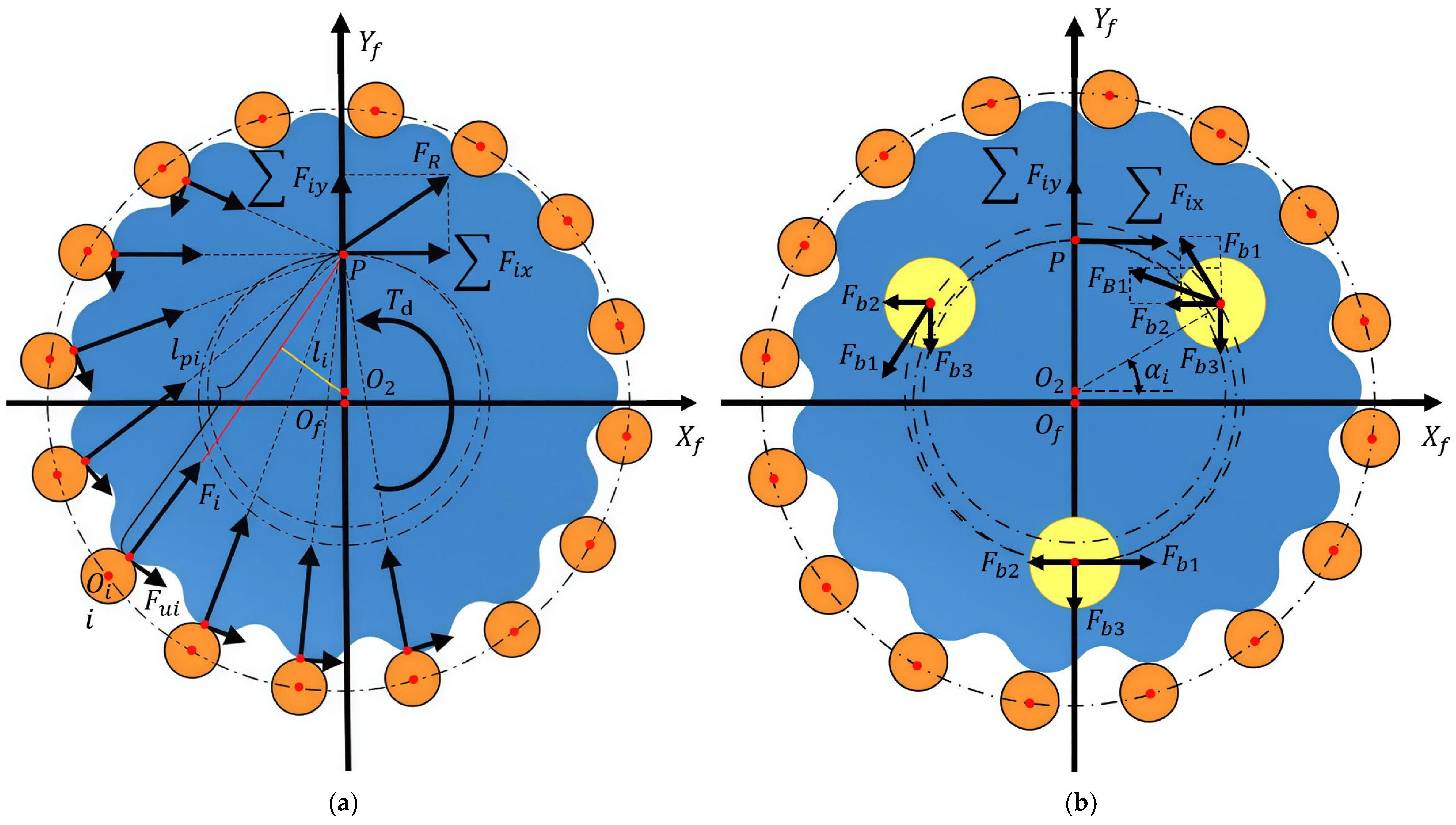
As shown in Figure 2a, the force transfer between the cycloidal disc and the pin gear is illustrated. During meshing, each contact force F i at the engagement points aligns with the node P on the cycloidal disc. At the interface, the frictional force F u i acts tangentially to F i , generating a clockwise torque on the cycloidal disc.
At each point of engagement, the normal force F i is resolved along with the associated frictional force F u i , where the components are directed along the X f axis and the Y f axis, respectively. These resolved components are then combined to obtain the resultant force F R . The magnitude of the interaction force F i is obtained using load tooth contact analysis (LTCA), while the related frictional force F u i is evaluated using the kinetic friction model based on Coulomb’s law.
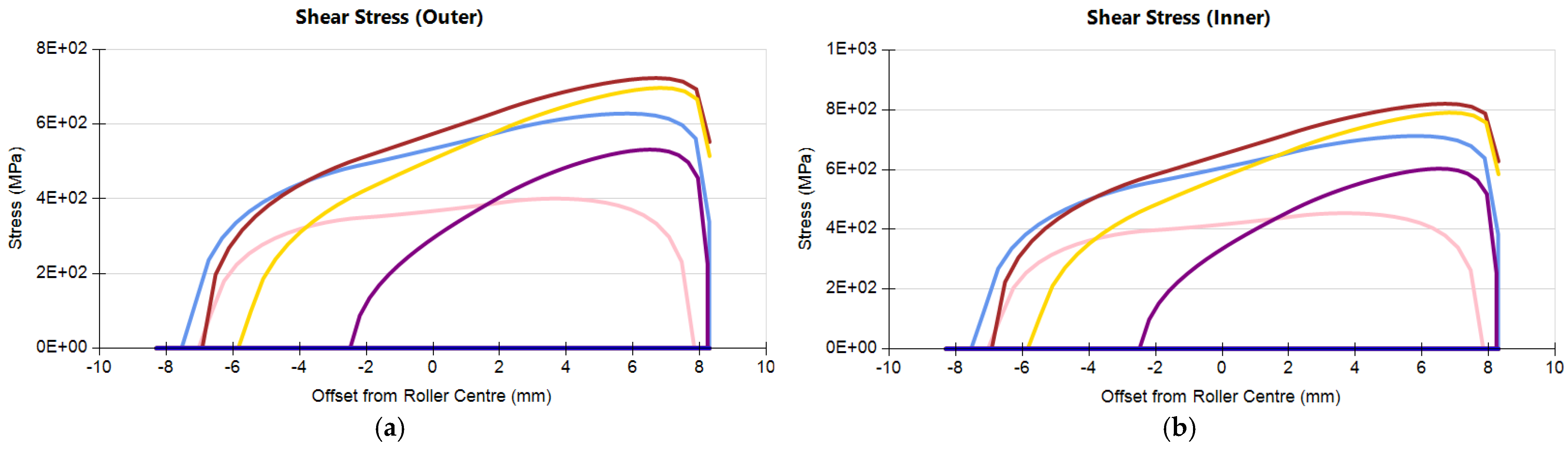
F i x = F i l i e z 2 + F u i 1 l i e z 2 2 F i y = F i 1 l i e z 2 2 + F u i l i e z 2
In Equation (1), l i denotes the lever arm measured from the cycloidal disc center O 2 to the direction in which force F i acts, e denotes the eccentricity of the cycloidal disc, and z 2 indicates the total count of teeth on the cycloidal disc.
As shown in Figure 2b, the force analysis of the crankshaft on the cycloidal wheel is presented. An RV reducer contains n crankshafts ( n 2 ), and the cycloidal wheel achieves static equilibrium under the combined action of the pin gear contact forces and the crankshaft bearings. Given the high stiffness of the cycloidal wheel, elastic deformation caused by external loads is minor compared to the overall load distribution. Consequently, the relative positions of the crankshaft holes on the cycloidal wheel before and after loading are assumed unchanged. Assuming no manufacturing errors, the elastic deformation of the crankshaft bearings on the cycloidal wheel remains identical.
In Figure 2b, a force analysis of the crankshaft is provided. An RV reducer contains n crankshafts ( n 2 ), and the cycloidal wheel remains in static equilibrium under the combined effect of the pin gear contact forces and supports of the crankshaft bearings. Owing to the high stiffness of the cycloidal wheel, deformation due to external loads is minor compared to the overall load. As a result, the relative locations of the crankshaft holes in the cycloidal wheel before and after loading are assumed unchanged. Under the assumption of perfect manufacture, the elastic deformation of the crankshaft bearings is assumed to be largely consistent along the path of the resultant force applied by the pin gears to the cycloidal wheel.
When the cycloidal wheel experiences an external torque, the elastic deformation of each crankshaft bearing in the tangential direction of the crankshaft holes remains the same. For simplicity, the force applied by the crankshaft bearings on the crankshaft holes of the cycloidal wheel can be decomposed into three components: F b 2 , counteracting the force F i x of the pin teeth along the X f axis; F b 3 , counteracting the force F i y of the pin teeth along the Y f axis; and F b 1 , opposing the external torque from the pin teeth interaction with the cycloidal wheel. The equations governing the static balance of the cycloidal wheel under the action of crankshaft bearings are as follows:
F b 1 = e z 2 r b g F i x F b 2 = 1 n F i x F b 3 = 1 n F i y
In Equation (2), r b g denotes the radius of the circle on which the crankshaft holes are positioned on the cycloidal wheel, n indicates the total count of crankshafts mounted to the cycloidal wheel, z 2 specifies the total count of teeth, and e denotes the eccentricity of the cycloidal wheel.
Therefore, we deduce that the magnitudes of F b 1 , F b 2 , and F b 3 remain constant, while their phase angles change with the rotational position of the crankshaft support. Consequently, the resultant force from the crankshaft bearings behaves as a time-varying fluctuating load. In Figure 2b, the resultant force exerted by the cycloidal wheel on the crankshaft bearings is denoted as F B 1 . For simplicity, this force F B 1 can be decomposed into two components F B 1 X and F B 1 Y , expressed as:
F B 1 X = F b 2 + F b 1 sin α 1 F B 1 Y = F b 3 F b 1 cos α 1 α 1 = ϕ o u t
In Equation (3), α 1 denotes the angle between the vector that joins the center of the cycloidal wheel and the center of the first crankshaft hole and the X f axis, and ϕ i n denotes the rotational angle input.
Similarly, for the i ( i   n ) crankshaft bearing, the force components F B i X along the X f axis and F B i Y along the Y f axis, can be expressed as:
F B i X = F b 2 + F b 1 sin α i = 1 n F i x + e z 2 r b g F i x sin α i F B i Y = F b 3 F b 1 cos α i = 1 n F i y e z 2 r b g F i x cos α i α i = 2 π i 1 n + ϕ o u t
In Equation (4), α i denotes the angle between the vector that joins the center of the cycloidal wheel and the center of the i -th crankshaft hole and the X f axis.
Therefore, the resultant force of the i -th ( i n ) crankshaft bearing can be expressed as:
F B i = F B i X 2 + F B i Y 2
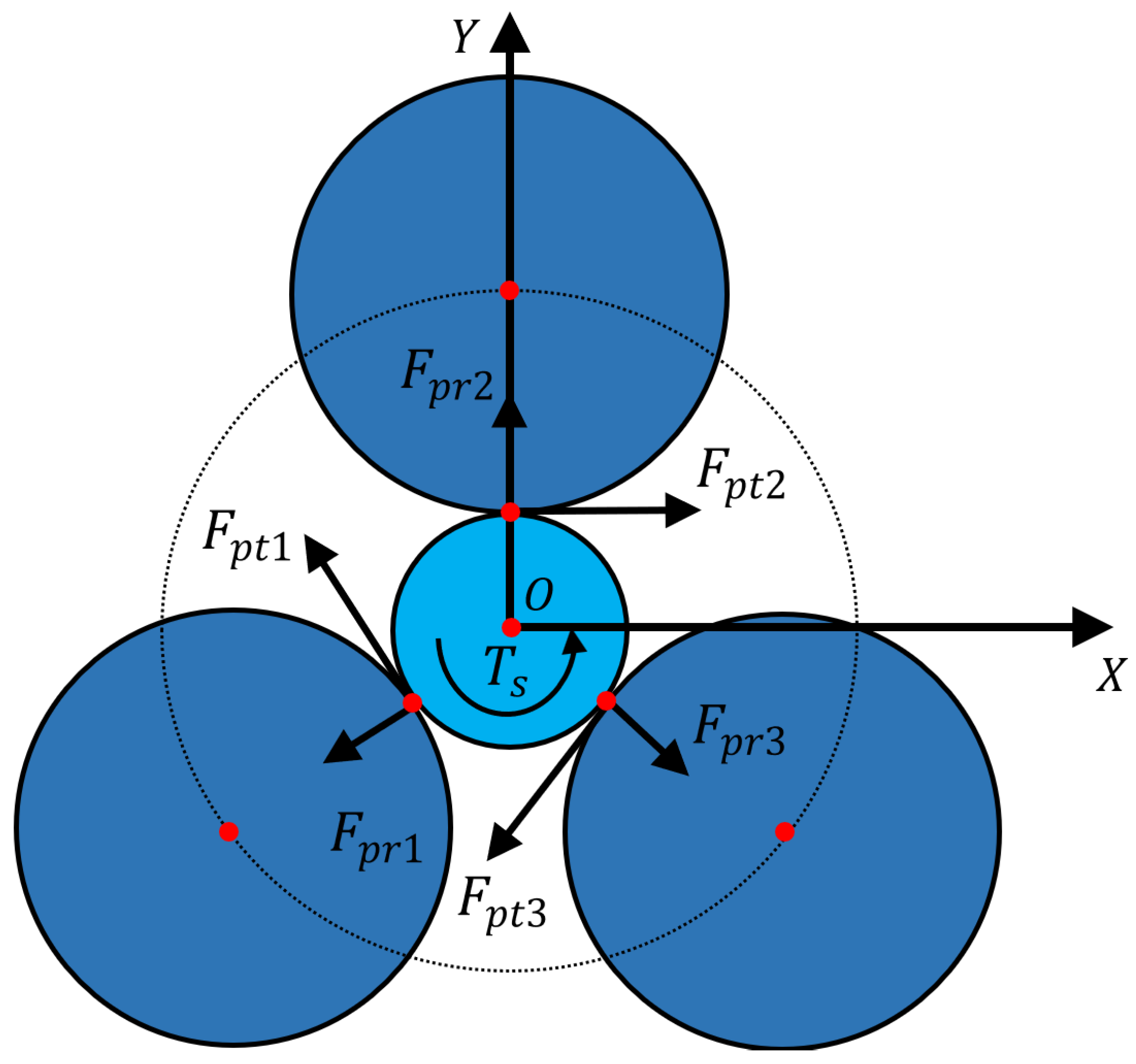
According to the literature, involute planetary gears are uniformly distributed along the circumferential direction of the sun gear and are geometrically symmetric in symmetry with the center of the sun gear. As a result, the forces exerted on the involute planetary gears can be considered approximately equal. After meshing with the sun gear, the elastic deformations along the line of action are assumed to be equal. As shown in Figure 3, the radial force applied to the involute planetary gear along the distribution circle is denoted as F p r k , which can be expressed as:
F p r k = F p t k tan α k
In Equation (6), F p t k denotes the tangential force applied to the planetary gear along the distribution circle, which can be obtained through force analysis in the subsequent subsection. α k is the pressure angle of the involute gear set, and T s denotes the actual input torque applied to the sun gear, which can be expressed as:
T s = N F p t k r s
In Equation (7), N denotes the number of planetary gears, and r s denotes the pitch circle radius of the sun gear.
Furthermore, the transmission efficiency of the entire RV transmission mechanism can be expressed as:
η = T s t T s = 2 z s T d z p z c T s
In Equation (8), T s t denotes the theoretical input torque, z p denotes the total count of teeth on the planetary gear, z s denotes the total count of teeth on the sun gear, z c denotes the total count of teeth on the cycloidal gear, and T d denotes the external torque applied to a single cycloidal gear.
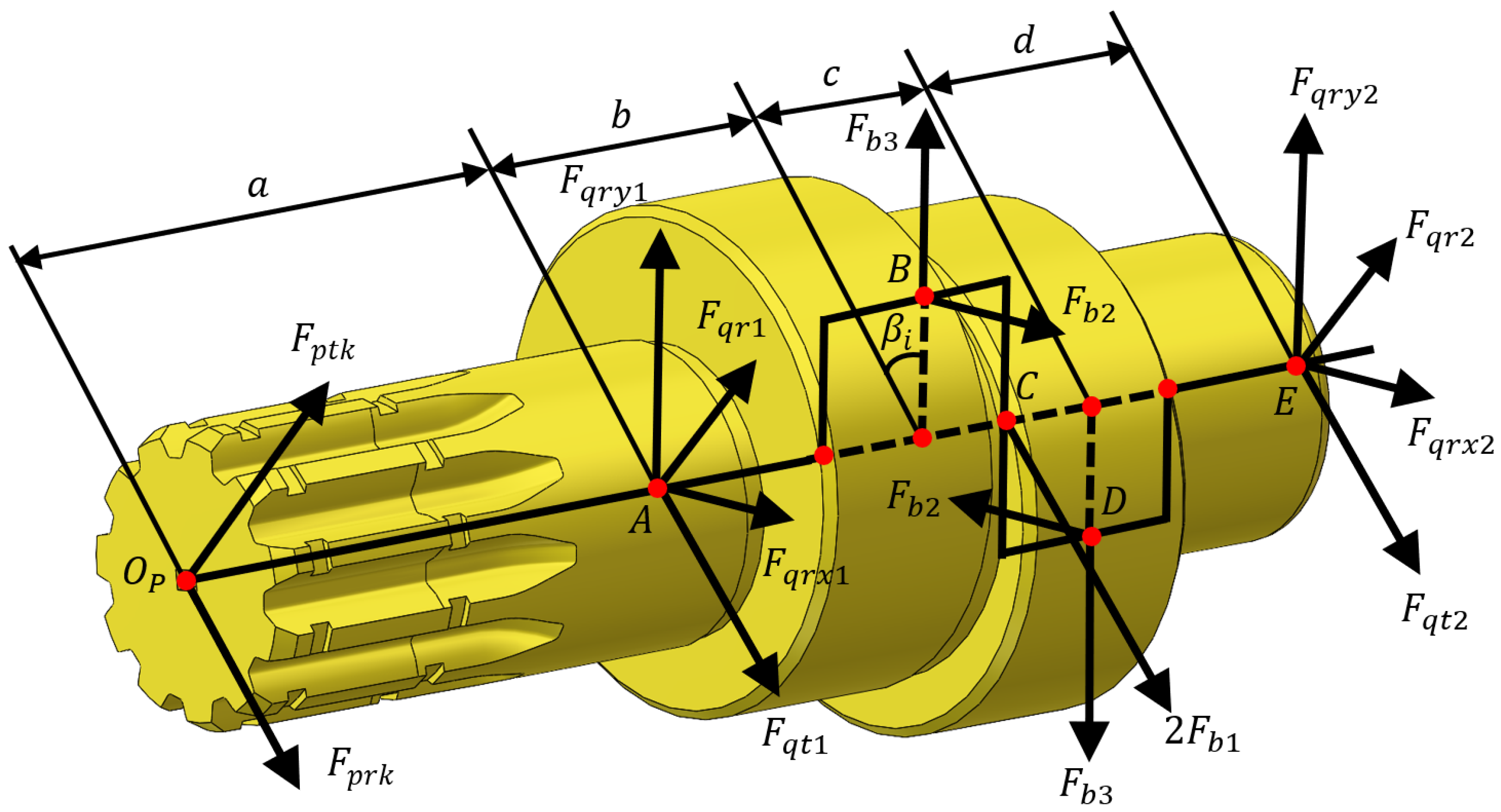
In Figure 4, the force analysis diagram for any crankshaft on the cycloidal gear is illustrated. At point O p , where the planetary gear engages with the crankshaft, two primary forces are acting: the radial force F p r k , exerted by the sun gear, and the tangential force F p t k . At points A and E, where the front and rear planet carriers engage with the crankshaft, the main forces include the radial components F q r 1 and F q r 2 , as well as the tangential components F q t 1 and F q t 2 . For simplification, the radial components F q r 1 and F q r 2 are resolved into components along the eccentric direction of the cycloidal gear ( F q r y 1 , F q r y 2 ) and perpendicular to this direction ( F q r x 1 , F q r x 2 ). At points B and D, three forces are involved: a tangential force F b 1 in the direction from the geometric center of the cycloidal gear and the crankshaft center, a force F b 2 perpendicular to the eccentric direction, and a force F b 3 along the eccentric direction. To further simplify, based on static equilibrium, the two forces F b 1 exerted on the crankshaft are shifted to the midpoint C of the upper and lower eccentric segments, with their magnitudes and directions unchanged. The distances a , b , c , and d represent the distances from the planetary gear center to the front planet carrier center, from the front planet carrier center to the first cycloidal gear center, from the first to the second cycloidal gear center, and from the second cycloidal gear center to the rear planet carrier center, respectively.
Based on the moment equilibrium equation of the crankshaft in the end plane, F p t k can be expressed as:
F p t k = 2 F b 2 e r p
In Equation (9), r p denotes the pitch circle radius of the involute sun gear.
For points A and E, in the directions of F b 1 and F p t k (i.e., the tangential direction of cycloidal gear rotation), the moment equilibrium equations result in F q t 1 and F q t 2 :
F q t 1 = a + b + c + d b + c + d F p t k 2 d + c b + c + d F b 1 F q t 2 = a b + c + d F p t k 2 b + c b + c + d F b 1
For points A and E, in the direction of F b 2 , the moment equilibrium equations result in F q r x 1 and F q r x 2 :
F q j x 1 = c b + c + d F b 2 F q j x 2 = c b + c + d F b 2
where β i = π 2 π i 1 n + ϕ o u t is the angle subtended by F b 1 and F b 3 on the i crankshaft.
For points A and E, in the direction of F b 3 , the moment equilibrium equations yield F q r y 1   a n d F q r y 2 :
F q j y 1 = c b + c + d F b 3 F q j y 2 = c b + c + d F b 3
Similarly, for points A and E, in the direction of F p r k , the moment equilibrium equations result in F q j p r 1 and F q j p r 2 :
F q j p r 1 = a + b + c + d b + c + d F p r k F q j p r 2 = a b + c + d F p r k
Therefore, the radial resultant forces applied to the crank support bearings at points A and E are expressed as:
F R 1 = F q r 1 + F q j x 1 cos β i + F q j y 1 sin β i F R 2 = F q r 2 + F q j x 2 cos β i + F q j y 2 sin β i
The tangential resultant forces applied to the crank support bearings at points A and E are expressed as:
F T 1 = F q t 1 + F q j x 1 sin β i F q j y 1 cos β i F T 2 = F q t 2 + F q j x 2 sin β i F q j y 2 cos β i
Thus, the resultant external forces applied to the crank support bearings at points A and E are expressed as:
F H 1 = F R 1 2 + F T 1 2 F H 2 = F R 2 2 + F T 2 2

2.1.1. Geometrical Structure Analysis of Roller Bearings

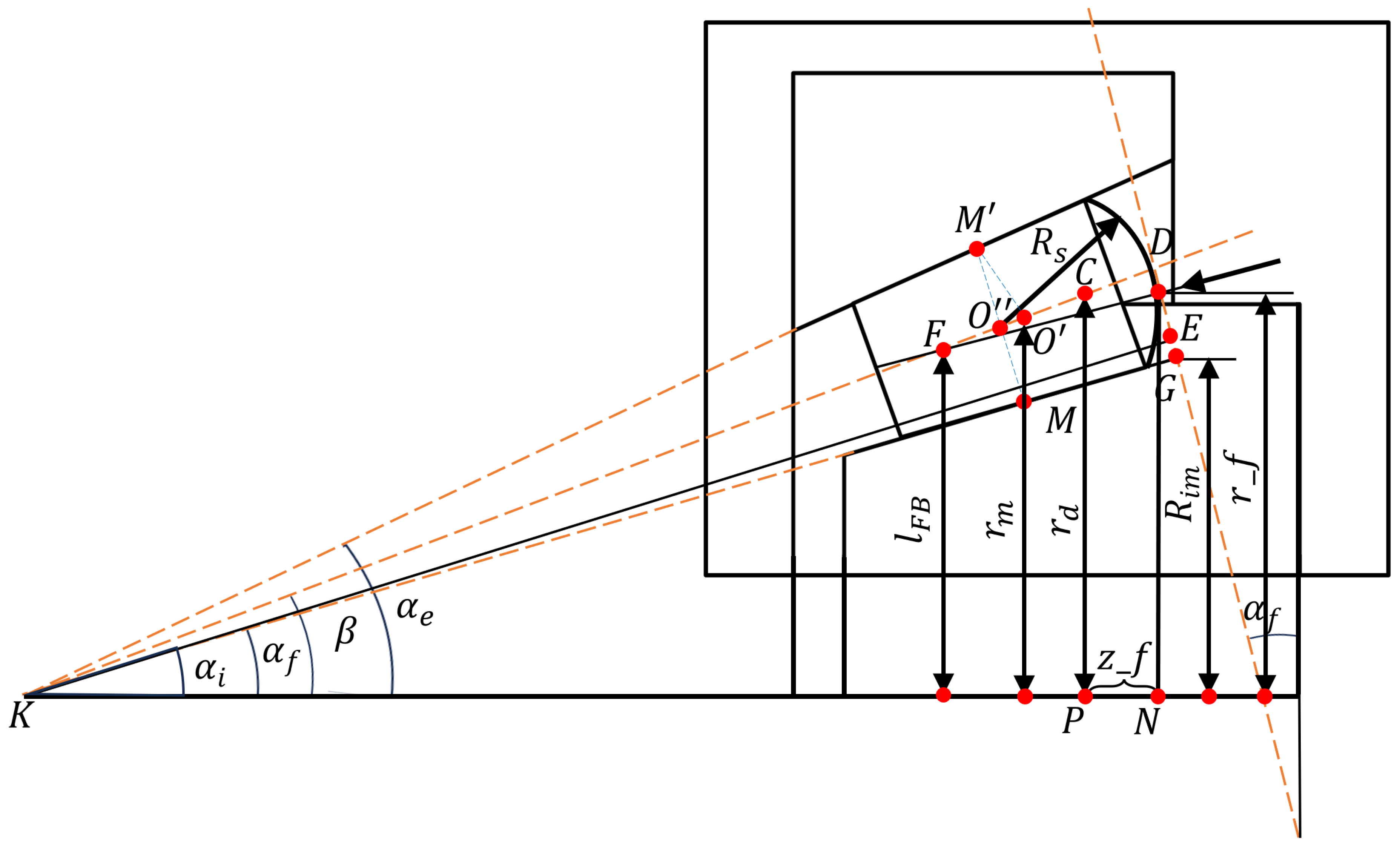
In Figure 5, the geometric configuration of the roller bearing is illustrated. Point D is where the spherical end face contacts the conical rib of the inner ring, while point K marks the intersection between the raceway generatrix and the bearing axis. By constructing the line KE perpendicular to DG through point K, with the assumption that KE equals Rp and Rs denotes the radius of the roller’s spherical end face, the following relations can be derived from the geometric principles:
R p = ( R i m tan α f + R i m cot α i ) cos α f β = ( α i + α e ) / 2 μ o = β α f D G = D E + E G = R p tan ( α f α i ) + ( R p R s ) tan μ o
In Equation (17), R im indicates the outer radius of the inner raceway, α f is the angle formed by the conical rib of the inner raceway and the vertical axis, α i is the inner contact angle, α e is the outer contact angle, and μ o is the angle formed by the normal vector at point D and the axis of the roller.
The radius of the circle passing through point D is given by:
r _ f = R i m + D G cos α f
The rolling element of the roller bearing consists of a truncated cone and a spherical base surface. Given the diameters at both ends of the roller and its cone angle, the axial height of the roller can be expressed as:
h _ r o l l e r = ( L r 2 ( ( D 1 D 2 ) / 2 ) 2 ) 0.5
In Equation (19), D 1 and D 2 denote the diameters at both ends of the rolling element.
The pitch circle radius of the bearing is given by:
r m   = ( d i + d o ) / 4
In Equation (20), d i and d o denote the diameters at both ends of the bearing.
At the contact point between the roller’s large end and the inner ring rib, the normal intersects the roller axis at point F. Based on the geometric relationship, the length l F B is derived as:
l F B = r m ( ( ( R s 2 ( D 1 2 ) 2 ) 0.5 h _ r o l l e r 2 ) sin ( α i + α e 2 ) )
The centroid of the rolling element is denoted as C . The horizontal separation from C to point D can be expressed as:
z _ f = R s cos ( α i + α e 2 μ o ) + l F B / tan ( α i + α e 2 ) r i tan α i
In Equation (22), r i denotes the radius of the inner ring of the bearing.

2.1.2. Static Mechanics-Based Force Analysis of Roller Bearings

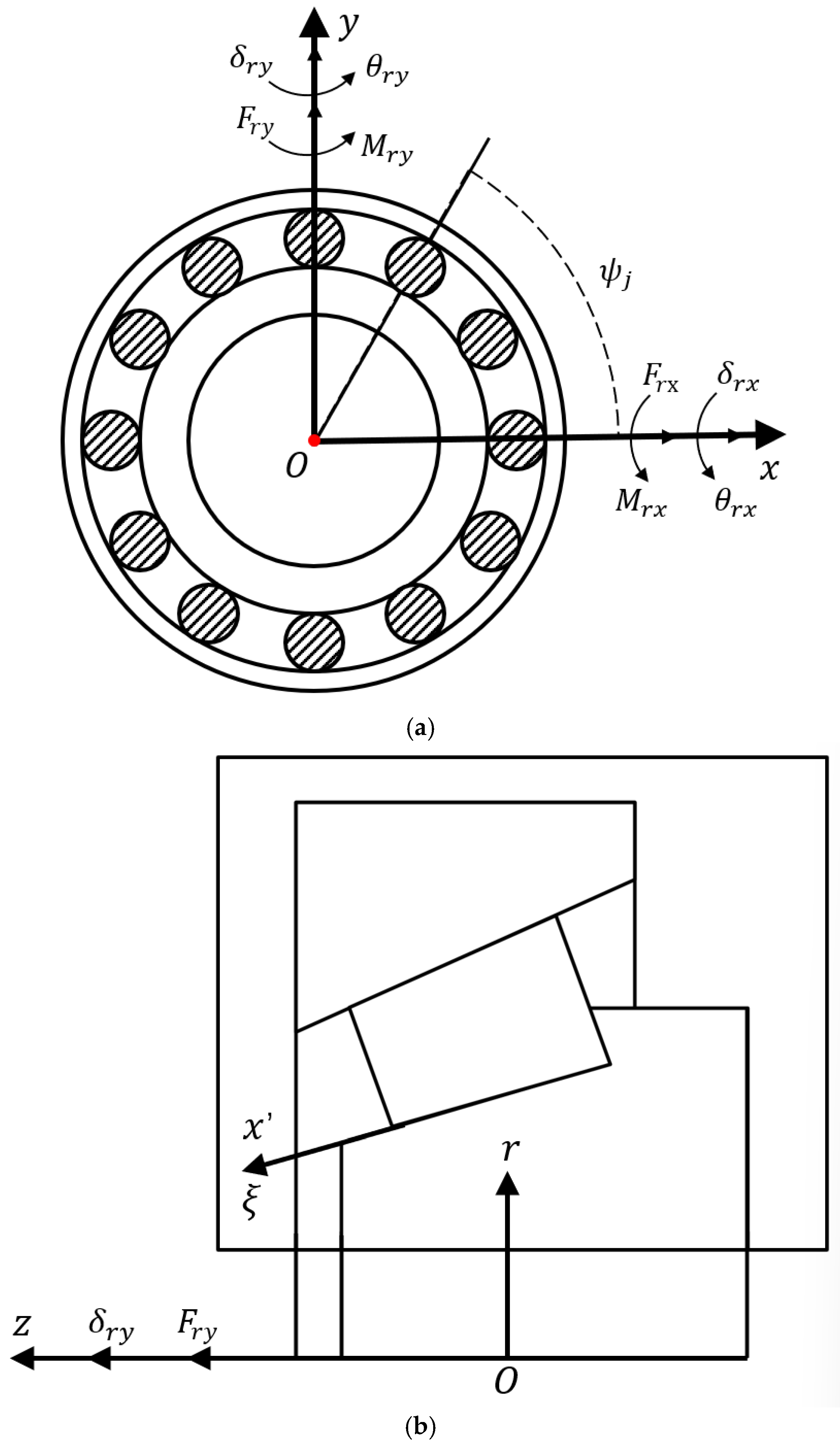
When roller bearings operate under load, external forces induce elastic deformations between the roller and the raceways. In most studies, it is assumed that the outer ring is stationary, while the inner ring undergoes translational and rotational motions described by δ r x δ r y δ r z θ r x θ r y under the applied forces F r x F r y F r z M r x M r y , as depicted in Figure 6.
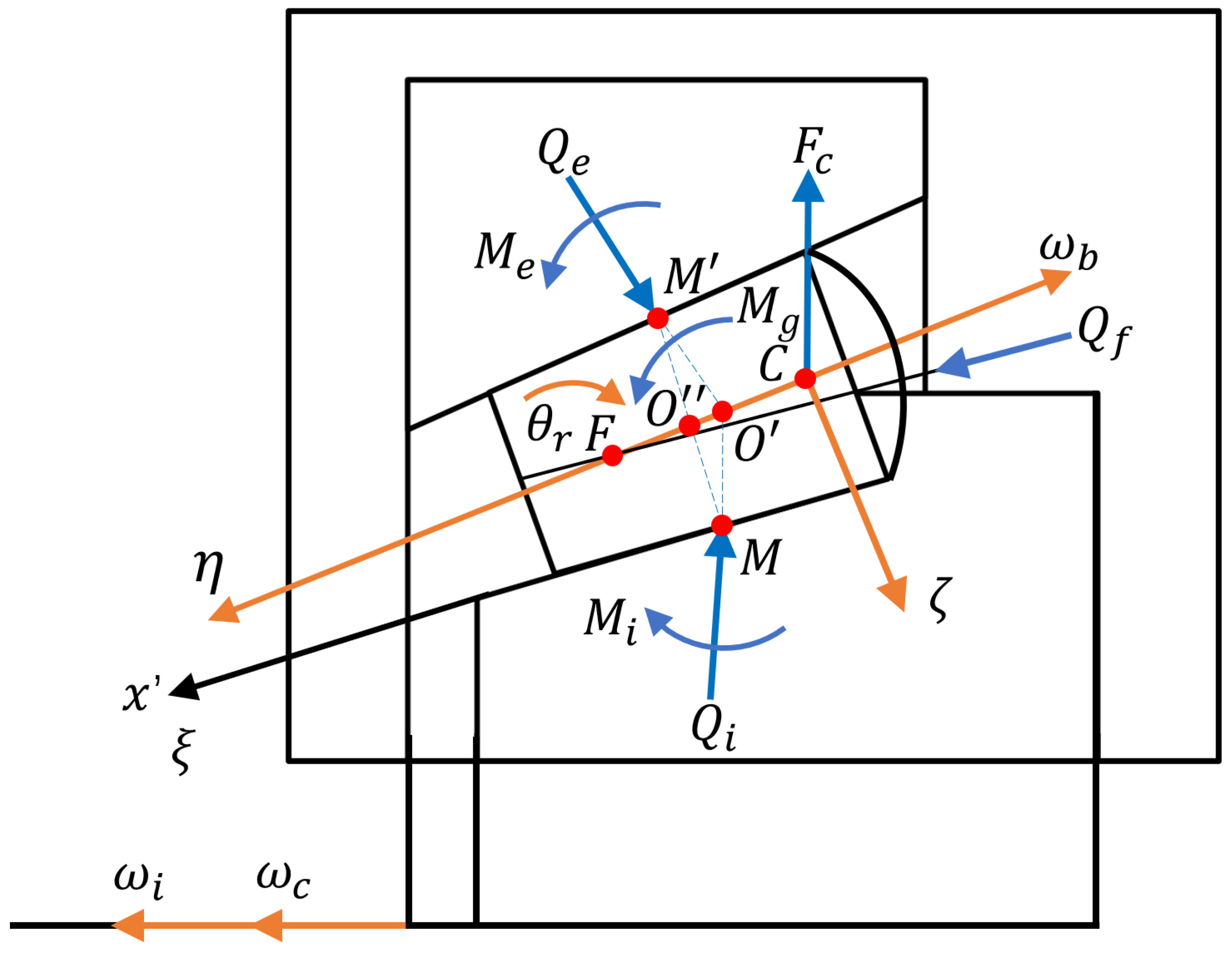
The schematic representation of the force and displacement of the internal rolling component is shown in Figure 7. To analyze this, a local coordinate system ( x , ξ ) is established across the interaction path between the roller and the inner raceway, where the origin M is positioned at the midpoint along the generatrix line of the roller. The relationship between ξ and x is given by the equation ξ = x L r , where L r denotes the roller’s generatrix length. The range of coordinates is x 0.5 L r , 0.5 L r , and ξ 0.5,0.5 . For simplicity, the unevenly distributed load along the roller generatrix is approximated by equivalent contact forces Q i and Q e , as well as equivalent moments M i and M e at midpoint O , which together produce the same effect.
The force exerted at the interface of the roller and the inner ring rib is represented as Q f . The centrifugal force resulting from the orbital movement of the rolling component is represented as F c . Due to the self-rotation of the rolling component around its centroid, with the angular velocity vector rotating about the axis of bearing, an inertial moment M g is introduced. Under the combined effects of contact forces and inertial loads, the roller experiences translational motions η ζ of its centroid and a rotational displacement θ r .
For the j -th roller, the deformation due to compression along the direction normal to roller’s generatrix at the contact point with the inner raceway is composed of two components. The first component is the deformation that occurs at the midpoint M of the generatrix, while the second component arises from the relative motion of the inner raceway. The displacement of the midpoint of the inner raceway can be expressed as:
V V ψ j = δ r x cos α 0 cos ψ j + δ r y cos α 0 sin ψ j + δ r z sin α 0 z + β r x r j sin α 0 sin ψ j β r y r j sin α 0 cos ψ j r l cos α 0
In Equation (23), ψ j denotes the angular displacement of the j -th rolling component inside the bearing. The rotational movements of the inner ring along the x -axis and y -axis are indicated by β r x and β r y . The parameters r j , r l , and z correspond to the pitch radius, radial gap, and roller modification factor, respectively. The modification factor z can be expressed as:
z = f 1 ln [ 1 f 2 ( 2 x / L r ) 2 ] 1 ( | x | 0.5 L r )
In Equation (24), L r denotes the roller’s generatrix length, while f 1 and f 2 are parameters for logarithmic modification, where f 1 is measured in micrometers (μm) and f 2 is a dimensionless quantity.
The displacement at point M along the direction normal to the generatrix is:
V roller ψ j = ζ × cos ( ( α e α i ) / 2 ) η × sin ( ( α e α i ) / 2 ) + θ r × C M × sin γ
In Equation (25), θ r denotes the roller’s deflection angle.
Therefore, the initial component of the deformation, which denotes the indentation resulting from the inner race interacting with the roller at point M, can be expressed as:
V ψ j = V V ψ j V roller ψ j
The second component of the deformation arises from the rotation of the race interacting with the roller and can be expressed as:
Δ V ψ j , ξ = z β b x sin ψ j + β b y cos ψ j θ r = ξ L r β b x sin ψ j + β b y cos ψ j θ r = ξ L r ω ψ j
Therefore, integrating the previous derivations, the indentation deformation at any location along the interface between the inner race and the roller, in the direction normal to the generatrix, can be expressed as:
δ i j ξ = V ψ j + Δ V ψ j , ξ = V ψ j + ξ L r ω ψ j , δ i j ξ > 0 , 0 , δ i j ξ 0 , 0.5 ξ 0.5
For the indentation deformation occurring between the roller and the outer race, the same approach is applied. Since the outer ring remains stationary, there is no displacement or angular variation in the outer race. The displacement of the roller’s generatrix midpoint relative to the outer race directly corresponds to the indentation deformation at that point, which can be expressed as:
V _ o u t ψ j = V roller ψ j
Correspondingly, the indentation deformation resulting from the angular motion of the outer race interacting with the roller can be expressed as:
Δ V _ o u t ψ j , ξ = z θ = ξ L r θ
Therefore, considering the above, the indentation deformation at any location along the interface between the outer race and the roller, in the direction normal to the generatrix, can be expressed as:
δ e j ξ = V _ o u t ψ j + Δ V _ o u t ψ j , ξ = V r o l l e r ψ j + ξ L r θ , δ e j ξ > 0 0 , δ e j ξ 0 , 0.5 ξ 0.5
Due to the rib’s tapering geometry and the spherical structure of the roller’s end, their interaction results in point contact. The indentation deformation between the two components can be expressed as:
δ f = ( δ x cos ( φ j ) + δ y sin ( φ j ) ) cos ( π / 2 + μ 0 ( α i + α e ) / 2 ) + ( θ x r _ f sin ( φ j ) θ y r _ f cos ( φ j ) + δ z cos ( ( α i + α e ) / 2 ) μ 0 )
After determining the indentation deformations between the roller and the inner and outer raceways, the contact forces can be computed using Hertzian contact theory. The force exerted between the roller and the inner and outer raceways, which involves line contact, can be expressed as:
Q i j / e j = K n ξ 1 ξ 2 V ψ j + ξ L r ω ψ j n d ξ
Additionally, the force exerted between the roller and the large rib of the inner ring, which involves point contact, can be expressed as:
Q f = K f δ f n
In Equation (34), n = 1.5 for point contact and n = 10 9 for line contact.
During operation, the roller generates a centrifugal force due to its revolution around the bearing axis, expressed as:
F c = m ω c 2 r m
In Equation (35), m denotes the roller mass, and ω c denotes the rotational angular velocity of the cage.
To account for the uneven force distribution between the roller and the raceways, the concept of eccentricity (load eccentricity) e i j e j is introduced to denote the equivalent point of action of the contact force along the x -axis.
To account for the non-uniform distribution of contact forces between the rollers and the inner and outer raceways, the concept of eccentricity (load eccentricity) e i j e j is introduced. This ratio denotes the relative position of the equivalent force application point along the x -axis, reflecting the fact that the resultant contact force line does not pass through the roller center line. By using e i j e j , the effective location of the roller-raceway contact force can be accurately represented in the model.
e i j e j = L r ξ 1 ξ 2 ξ V φ j + ξ L r ω φ j n d ξ ξ 1 ξ 2 V φ j + ξ L r ω φ j n d ξ
For the j -th roller, the force and moment equilibrium equations can be expressed as:
( Q i j + Q e j ) sin ( ( α e α i ) / 2 ) F c sin ( ( α e + α i ) / 2 ) + Q f cos μ o = 0 ( Q e j Q i j ) cos ( ( α e α i ) / 2 ) F c cos ( ( α e + α i ) / 2 ) Q f sin μ o = 0 F c C O ` cos ( ( α e + α i ) / 2 ) + Q f F O ` sin μ o + Q i j e i j Q e j e e j M g = 0
On the inner race, the forces exerted by all the rollers are balanced by the external forces, and the static equilibrium can be expressed as:
F x = j = 1 n ( Q i j cos α i Q f sin ( ( α i + α e ) / 2 μ o ) ) cos ψ j F y = j = 1 n ( Q i j cos α i Q f sin ( ( α i + α e ) / 2 μ o ) ) sin ψ j F z = j = 1 n Q i j sin α i + Q f cos ( ( α i + α e ) / 2 μ o ) M x = j = 1 n ( Q i j ( r i sin α i e i j ) Q f sin ( ( α i + α e ) / 2 μ o ) z _ f + Q f cos ( ( α i + α e ) / 2 μ o ) r _ f ) sin ψ j M y = j = 1 n ( Q i j ( r i sin α i e i j ) + Q f sin ( ( α i + α e ) / 2 μ o ) z _ f Q f cos ( ( α i + α e ) / 2 μ o ) r _ f ) cos ψ j

2.2. Establishment of Theoretical Model of Critical Bearings

Table 1 presents the main parameters of the tapered roller bearing model 33006, including its dimensions, rated static load capacity, and lubrication speeds.
Table 2 presents the main parameters of the needle roller bearing K35 × 55 × 21, including its dimensions, rated static load capacity, and lubrication speeds.
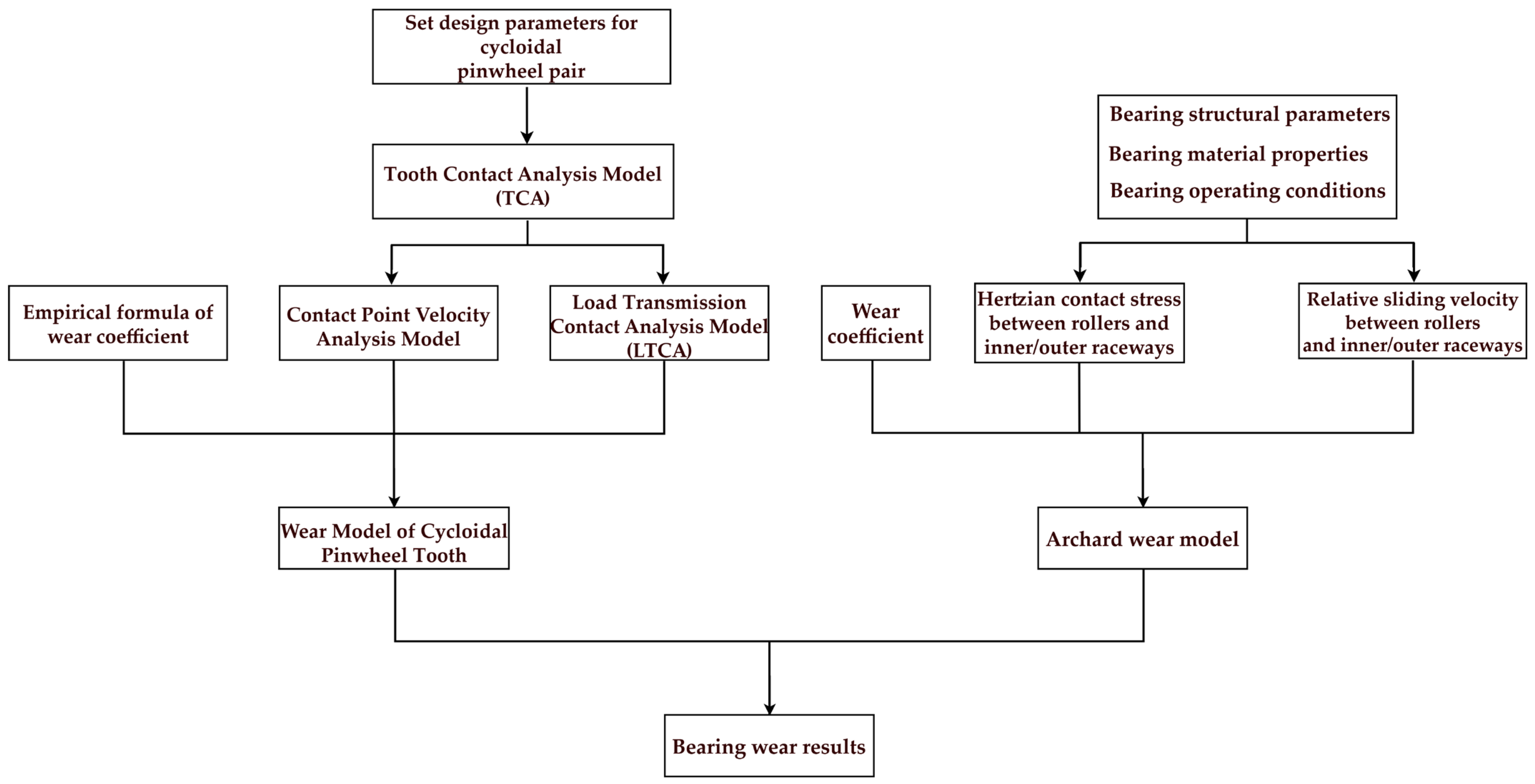
Figure 8 shows the computational procedure for cycloidal pinwheel tooth wear using MATLAB R2024b. Design parameters are applied to the Tooth Contact Analysis Model (TCA). Three parallel analyses—empirical wear coefficient, contact point velocity, and load transmission (LTCCA)—are performed. The results are combined in the Wear Model of Cycloidal Pinwheel Tooth to calculate the final wear results.

2.3. Theoretical Analysis of Critical Bearings

2.3.1. Contact Pressure and Sliding Velocity

For tapered roller bearings, sliding wear is the dominant wear mechanism. Accordingly, the Archard wear model is employed to relate the local wear volume d V in the contact region to the local contact load d Q and the relative sliding distance d L :
d V = k d Q d L
where k is the wear coefficient, defined as k = K H . Here, K represents the dimensionless wear coefficient. In the present study, the tapered roller bearing is assumed to operate under boundary lubrication conditions, for which K = 1.77 × 10 8 . The material hardness of the bearing H is typically taken as three times the yield strength of the material. For bearing steel, H = 5001   MPa , resulting in a wear coefficient k = 3.54 × 10 12   MPa 1 [22].
By dividing both sides of the above equation by the local contact area d S , the local wear depth d h can be expressed in terms of contact stress and sliding distance:
d h = k p d L
where d h = d V d S denotes the local wear depth and p = d Q d S is the contact stress.
Furthermore, by dividing both sides by time d t , the wear depth at any point within the contact region per unit time can be obtained:
h = k p v
where h = d h d t represents the wear rate and v = d L d t is the relative sliding velocity at the contact point.
Based on Hertzian contact theory, the normal load acting on the q t h rectangular element within the region where engagement occurs between the roller and its mating surface can be expressed as:
Q i q / e q =   K n δ i q / e q n   Δ l / L r
In Equation (42), K n denotes the stiffness in the normal direction, defined as K n = 7.86 × 10 4 L r 8 9 ; δ i q e q n indicates the elastic displacement at the midpoint of the q t h rectangular element; and Δ l refers to the segment length measured along the roller generatrix, with Δ l = L r N . For each rectangular segment, the half-width in contact is obtained as:
a i q / e q = D q δ i q / e q cos α e α i / 2
In Equation (43), D q denotes the roller diameter at the q t h rectangular element, calculated as:
D q = 0.5 ξ D 1 + 0.5 + ξ D 2
The maximum pressure at the centroid of the q t h rectangular element is:
p max , q = 2 Q i q / e q π Δ l a i q / e q
The pressure at any position y within the rectangular element is:
p q x i / e , y i / e = p max , q 1 y a q 2
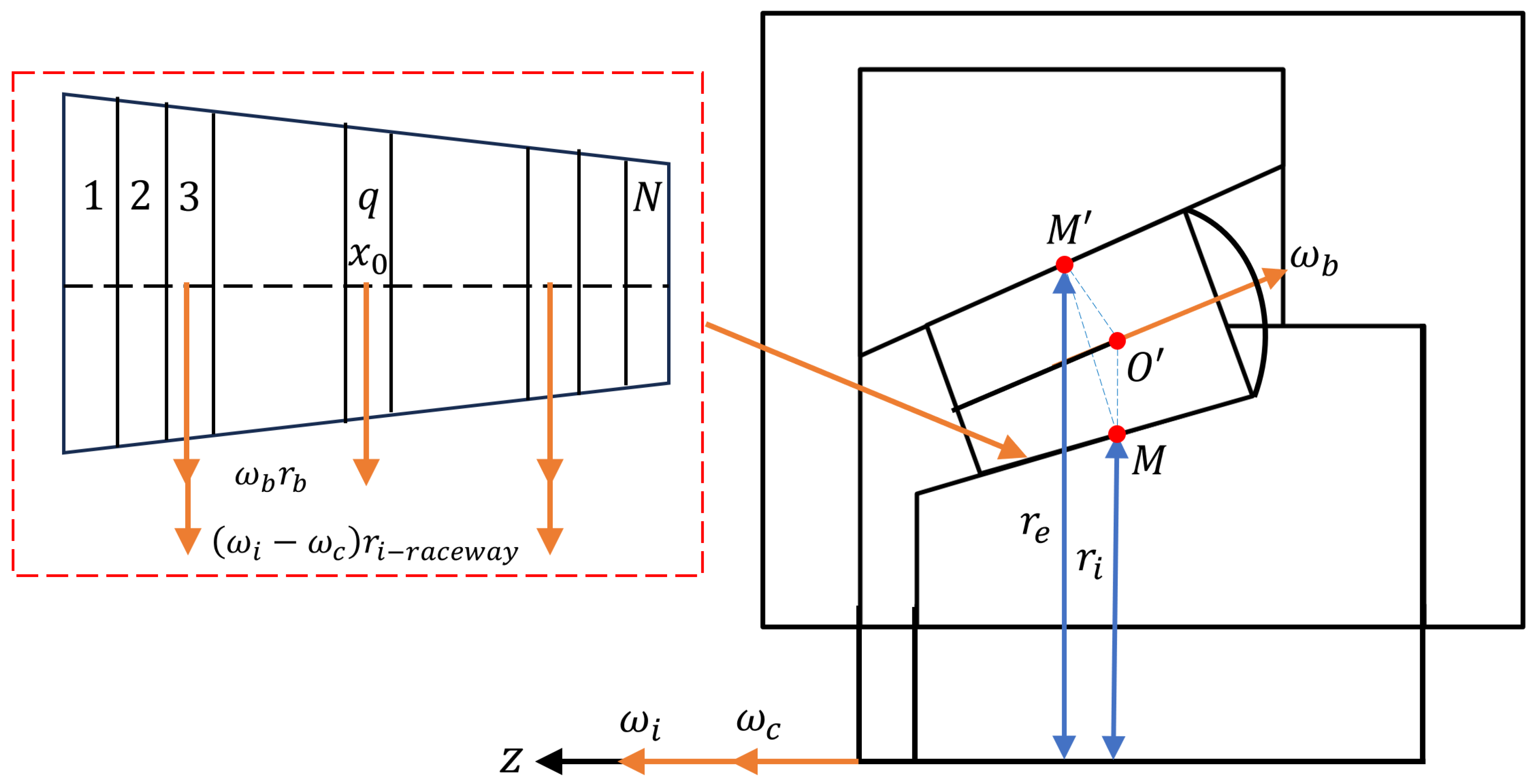
In Figure 9, the bearing cage is chosen as the coordinate frame of interest. The inner ring revolves about the bearing axis at a relative angular speed of ω i ω c , where ω i denotes The angular velocity of the inner ring, and ω c denotes the orbital motion rate of the rollers (i.e., the cage rotation speed). Each roller also rotates about its own axis at a spin rate of ω b .
Due to roller crowning, the roller radius decreases, causing a mismatch in tangential speeds at points other than the pure rolling location between the roller’s surface and the contacting raceways, which results in sliding.
After the roller is divided into N elements, each element has a different roller radius. The roller radius for the q t h element after crowning is expressed as:
r b = ξ ( D 2 D 1 ) + ( D 1 + D 2 ) 2 z ` 2
As shown in Figure 9, the distances from the centers M and M on the inner and outer raceways down to the bearing axis are:
r i = r m D 1 + D 2 4 + r l cos α i cos β α i cos β r e = r m + D 1 + D 2 4 + r l cos α e cos β α e cos β
In Equation (48), r l denotes the radial clearance separating the roller from its mating raceway.
At the coordinate position ξ along the inner and outer raceways, the distances from the bearing axis are:
r i r a c e w a y = r i L r ξ sin α i r e r a c e w a y = r e L r ξ sin α e
In the current analysis, the midpoint of the roller generatrix and its contact point with the raceway are assumed to be the pure rolling point. Based on this assumption, the orbital and spin angular velocities of the roller are expressed as:
ω c = ω i r i / 2 r m ω b = 4 ( ω i ω c ) r i / ( D 1 + D 2 )
Based on the above angular velocities and geometric relationships, the differential sliding velocities at any point within the roller–raceway contact region are:
v i = ω i ω c r i r a c e w a y ω b r b v e = ω c r e r a c e w a y ω b r b
By combining Equations (41), (46) and (51) and integrating over the area of the rectangular element, the wear volume per unit time for the q t h rectangular element within the contact region between the roller and the inner or outer raceway can be obtained.
V ¯ q = A q h ¯ q d x d y = A q k p q x i / e , y i / e v q x i / e , y i / e d x i / e d y i / e
When the inner race rotates with the spindle while the outer race remains fixed, the contact forces between the rollers and the outer raceway vary as a function of angular position. Consequently, the amount of material loss on the outer raceway varies with the angular location of each roller. If the total service time of the bearing is T and the number of rollers is Z , the wear depth of the q t h rectangular segment at the angular position corresponding to the j t h roller on the outer raceways can be expressed as:
h e q = Z V ¯ j q T S e q = Z k p q x e , y e v q x e , y e d x e d y e S e q T
In Equation (53), S e q denotes the circumferential surface associated with the q t h rectangular segment on the outer raceways.
The loading regimes differ for the inner and outer raceways. Every location on the inner raceway maintains engagement with all rollers, so material loss along the inner raceway is considered largely consistent and does not depend on the angular position of the rollers. The depth of wear for the q t h rectangular segment on the inner raceway is determined as
h i q = j = 1 Z V ¯ j q T S i q = j = 1 Z k p q x i , y i v q x i , y i d x i d y i S i q T
In Equation (54), S i q denotes the circumferential surface associated with the q t h rectangular segment on the inner raceway.

2.3.2. Analysis Results of Tapered Roller Bearings

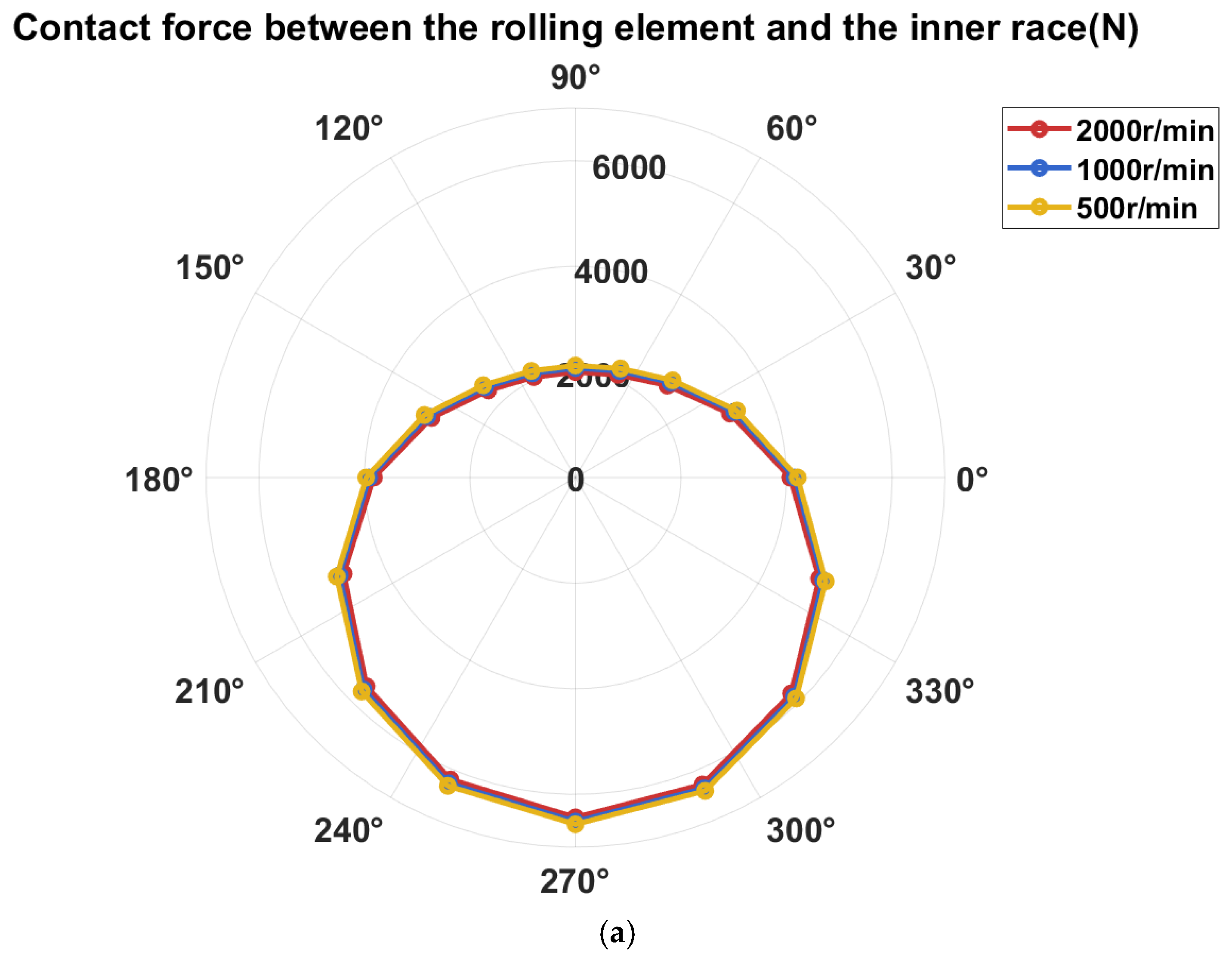
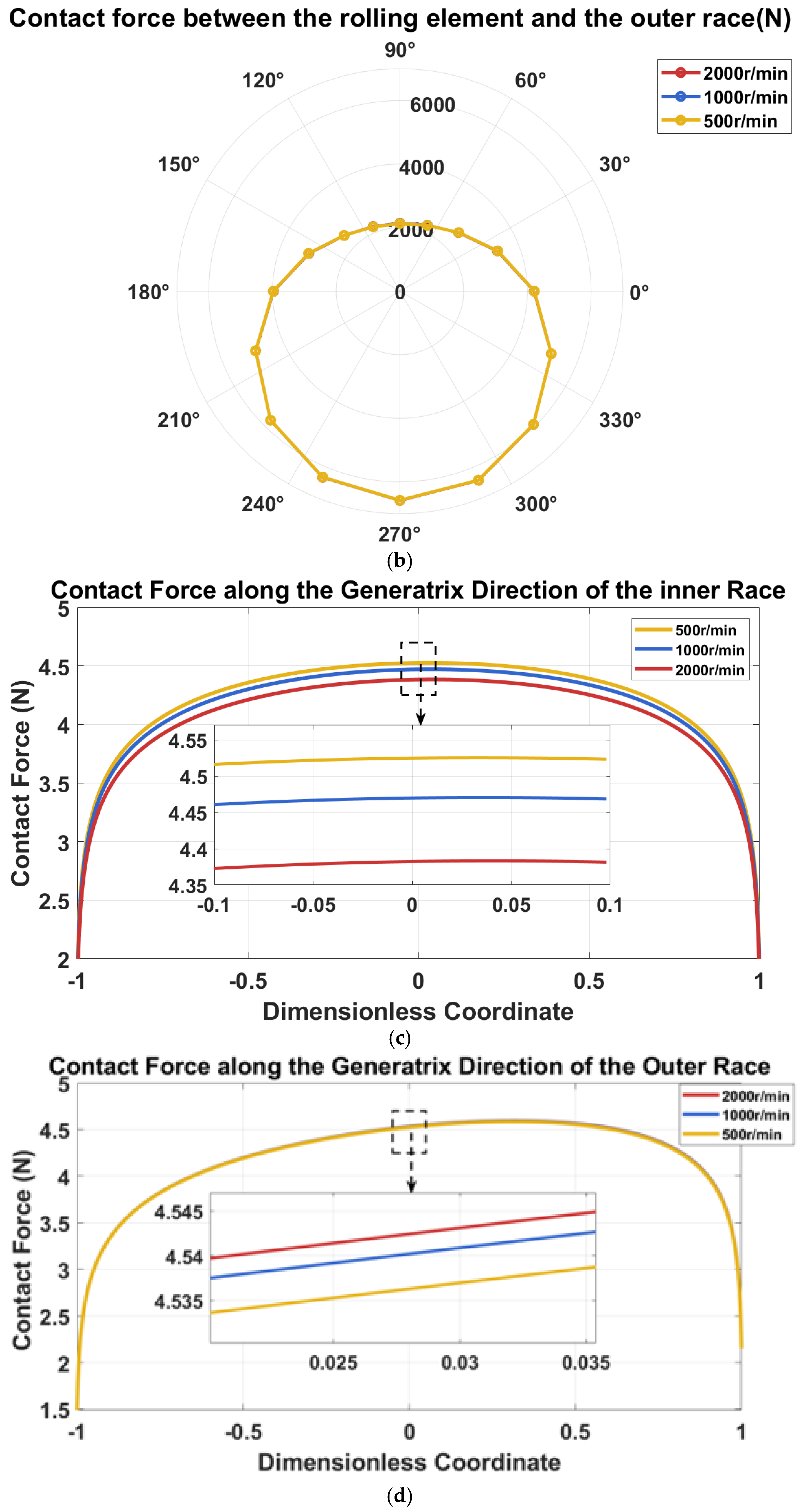
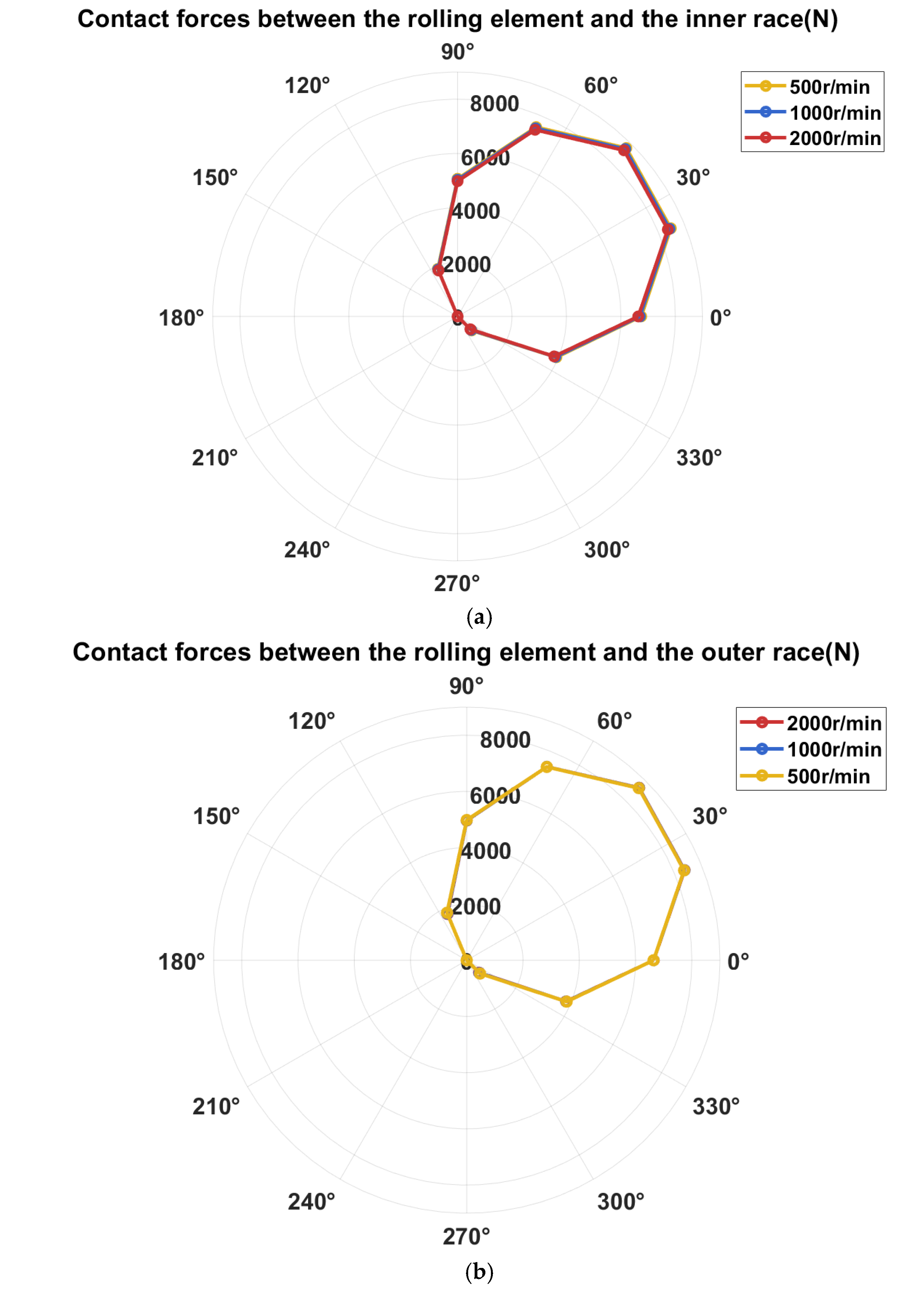
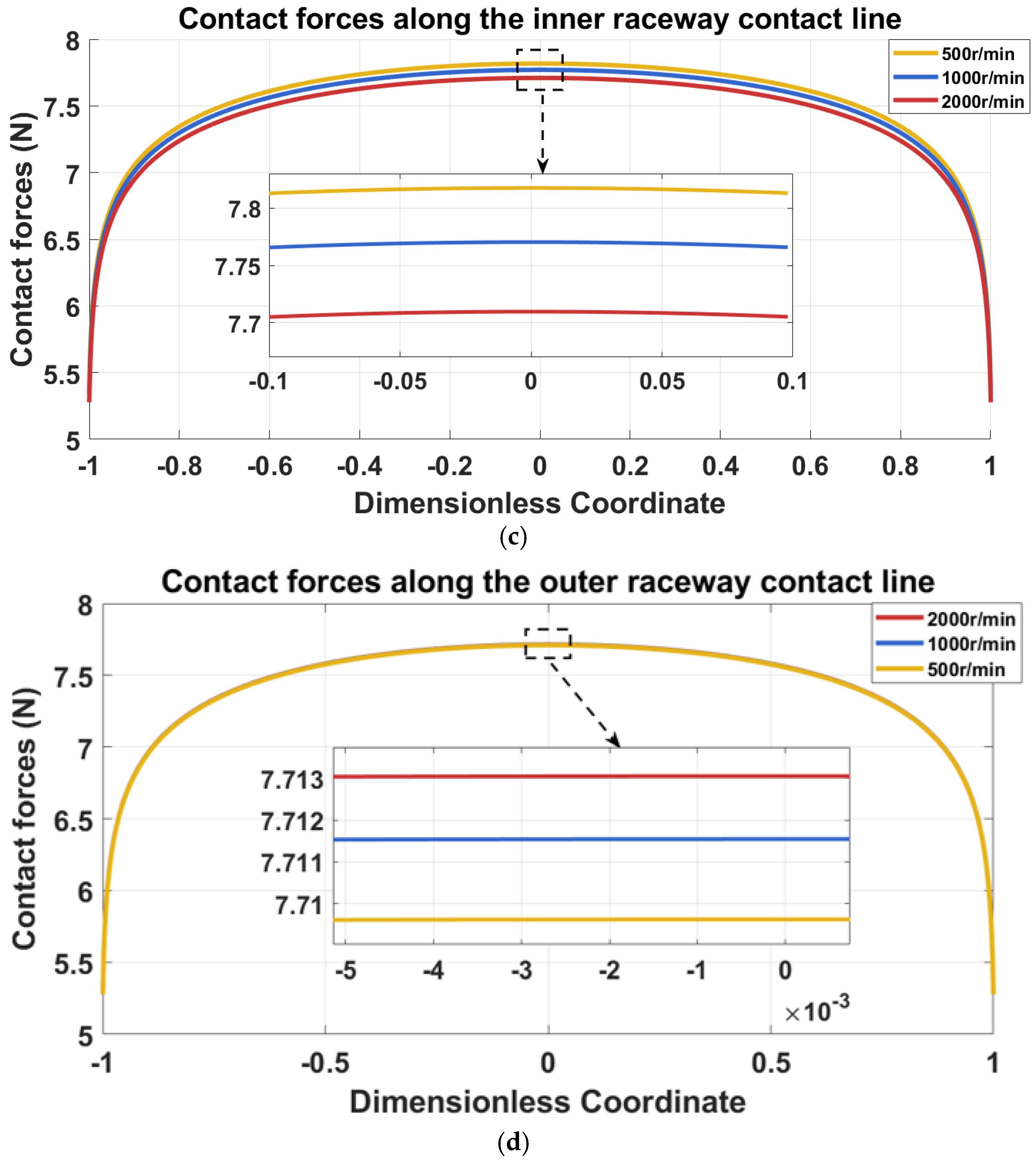
Figure 10a,b presents the distribution of contact forces at different rotational speeds. Within the examined operational range, rotational speed exerts only a marginal influence on the forces transmitted through the rolling elements and raceways. This behavior arises because the bearing load distribution is predominantly governed by structural stiffness: under the applied operational loads, the rollers primarily transmit forces in accordance with the geometry and elastic properties of the bearing components, rather than the rotational velocity. Although, in principle, centrifugal effects may slightly decrease the contact forces on the inner raceway while increasing those on the outer raceway at elevated speeds, the magnitude of these effects is limited within the considered speed range, resulting in only a minimal alteration of the overall contact force profiles.
In the circumferential direction, the force distribution is uneven, with nearly half of the roller carrying most of the load. At 500 r/min, the maximum force on the inner raceway is approximately 6563 N, while the minimum is around 2120 N. For the outer raceway, the maximum is about 6578 N, and the minimum is about 2127 N.
Figure 10c,d show the contact force variation along the raceway lines at 500 r/min, 1000 r/min, and 2000 r/min. It is observed that the force increases initially and then decreases. For the inner raceway, the maximum force occurs at 500 r/min, followed by 1000 r/min, and the minimum at 2000 r/min. For the outer raceway, the maximum occurs at 2000 r/min, followed by 1000 r/min, with the minimum at 500 r/min.
Near the right-hand shaft end, the contact forces acting on the rolling elements were estimated using Hertzian contact theory. For a GCr15 steel roller (elastic modulus E = 219   GPa , Poisson’s ratio ν = 0.3 ) interacting with the raceway, the contact force F can be approximated as F = 4 3 E * R * δ 3 / 2 , where E * = E / ( 1 ν 2 ) is the effective elastic modulus, R * is the equivalent contact radius 3   mm , and δ is the local compression. For a micrometer-scale compression δ = 1 5   μ m , the resulting contact forces are approximately 0.018–0.206 N. These forces are much smaller than the 4–5 N forces experienced by rollers in the central region of the bearing, primarily due to the bearing geometry and elastic compliance of the metallic components. Therefore, the contribution of these shaft-end forces to the overall load distribution is minimal.
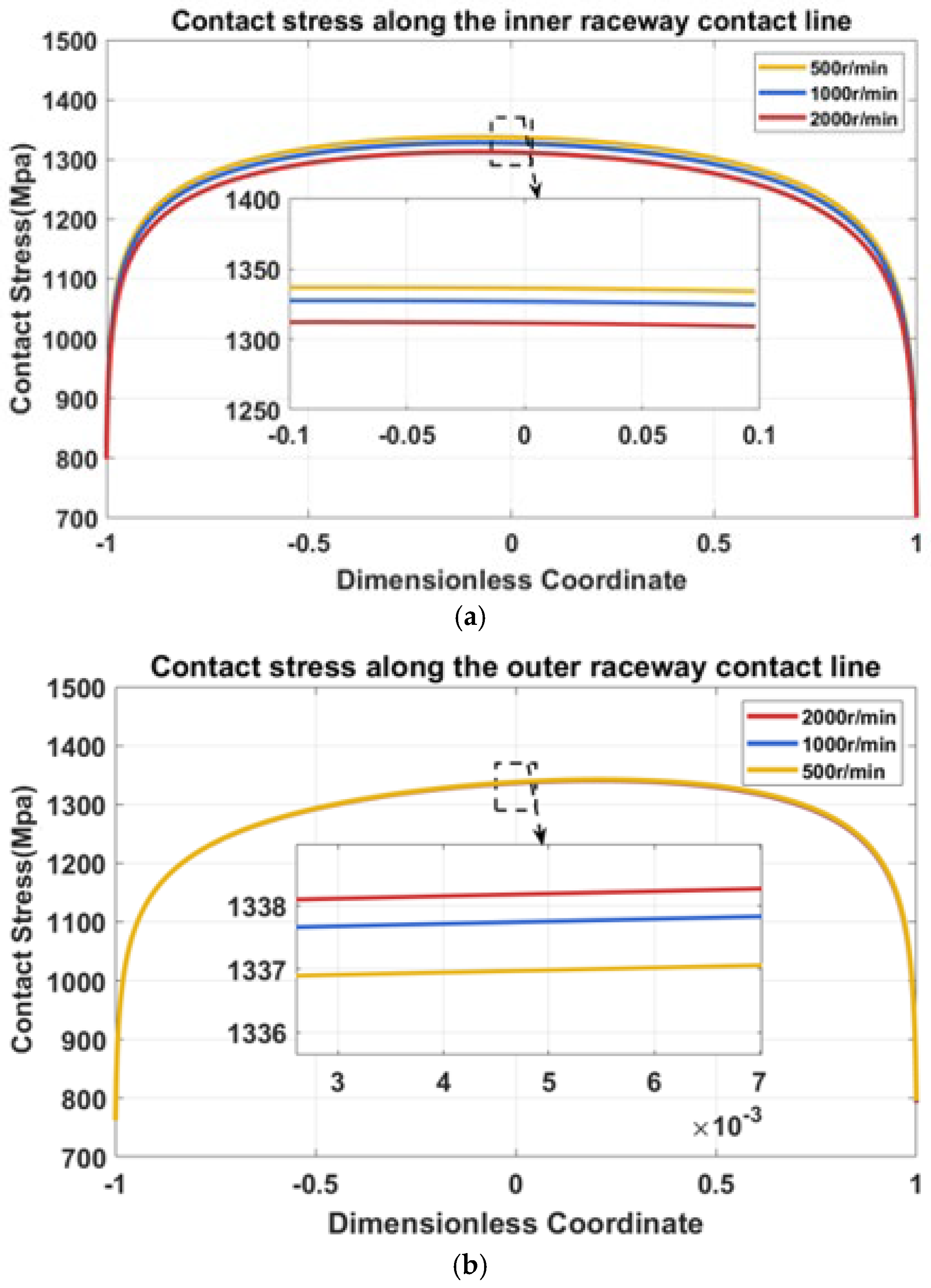
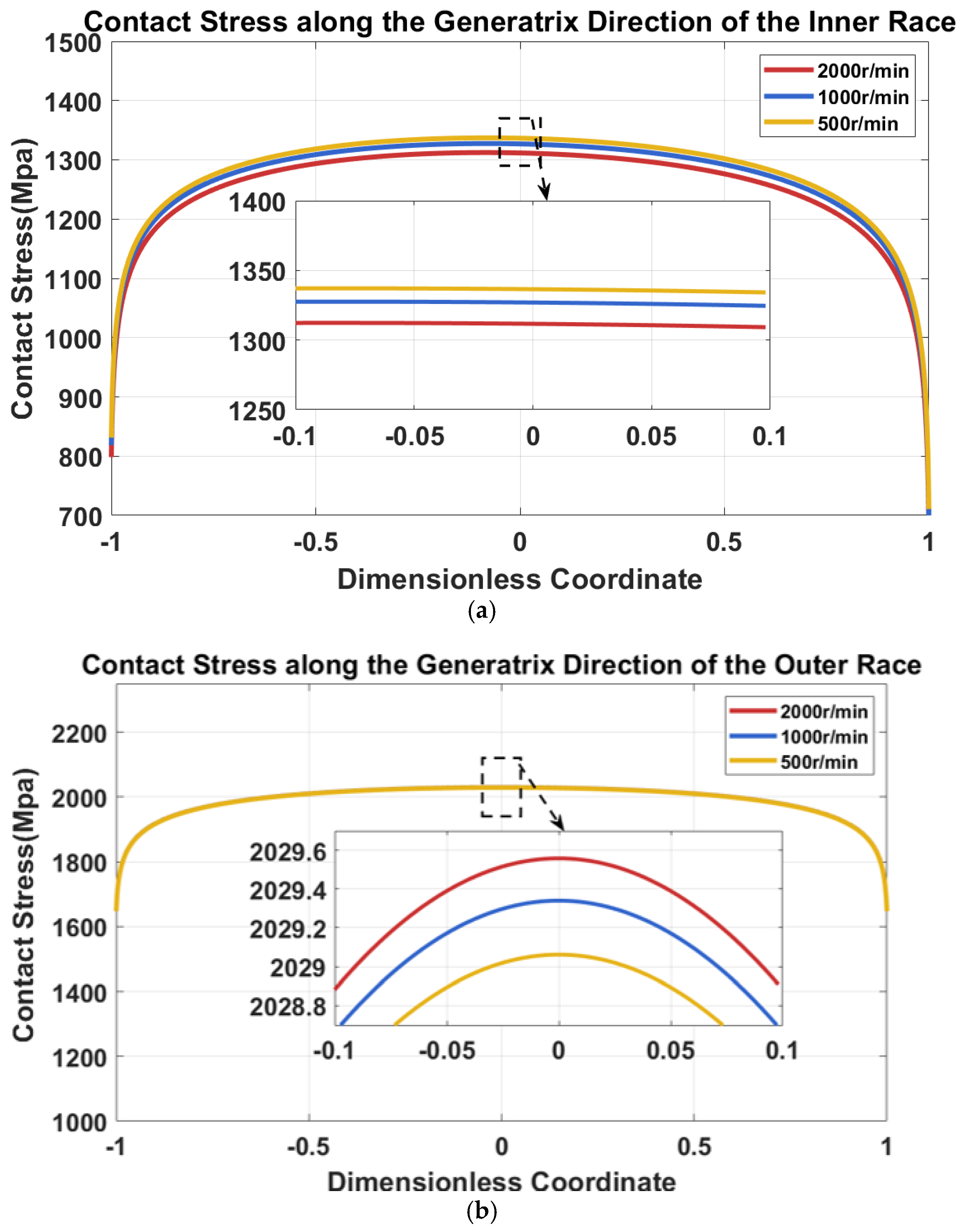
Similarly to the force distribution on the rolling elements and raceways, Figure 11 shows the variations in contact stress along the raceway contact lines at different rotational speeds. At 500 r/min, 1000 r/min, and 2000 r/min, the maximum contact stresses on the inner raceway are approximately 1336 MPa, 1326 MPa, and 1311 MPa, respectively. The corresponding maximum stresses on the outer raceway are approximately 1337.1 MPa, 1336.7 MPa, and 1336 MPa, respectively.
In summary, the contact stresses on the inner and outer raceways are within the allowable limits for bearing steel, confirming that the bearing meets the design specifications.
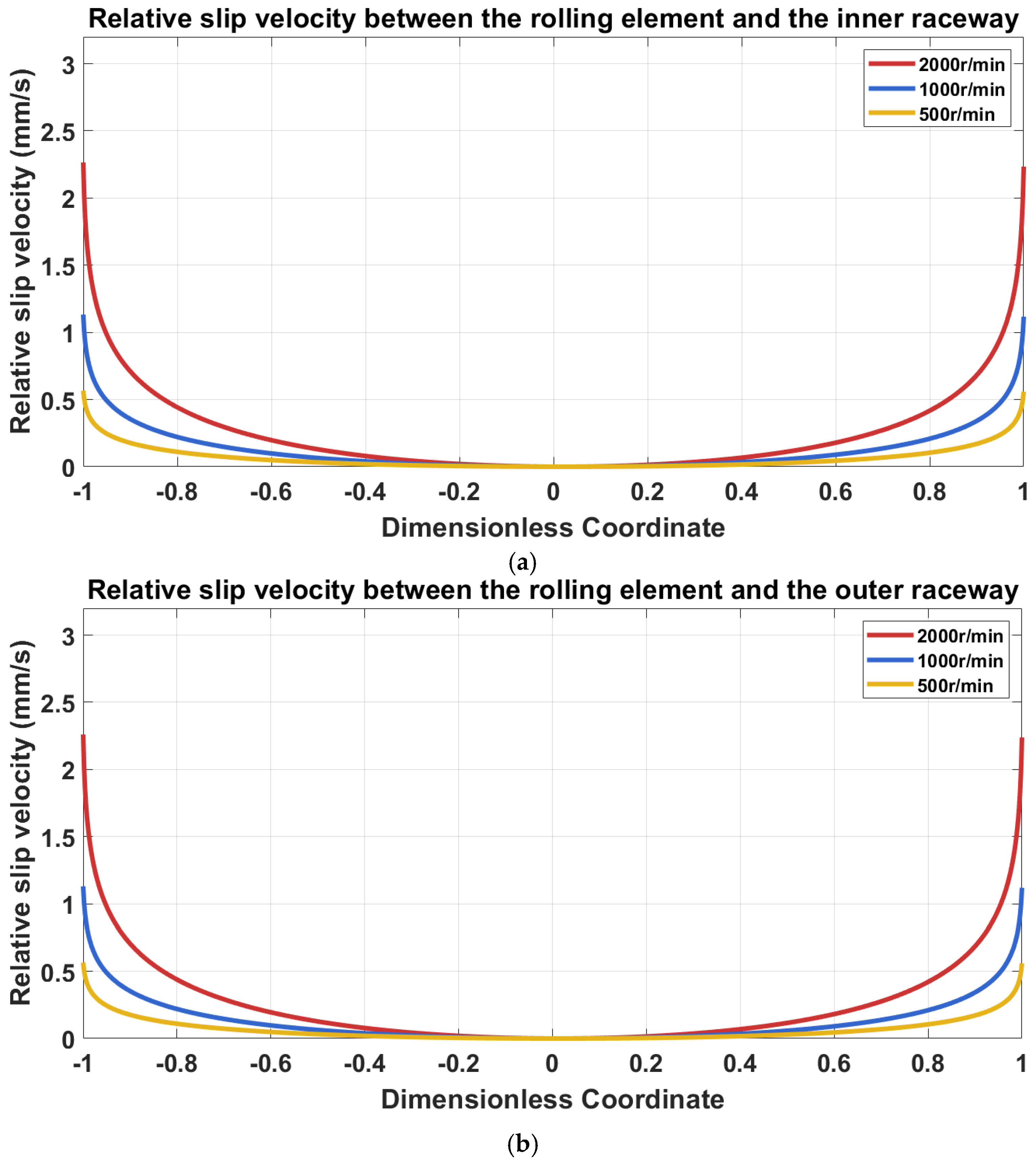
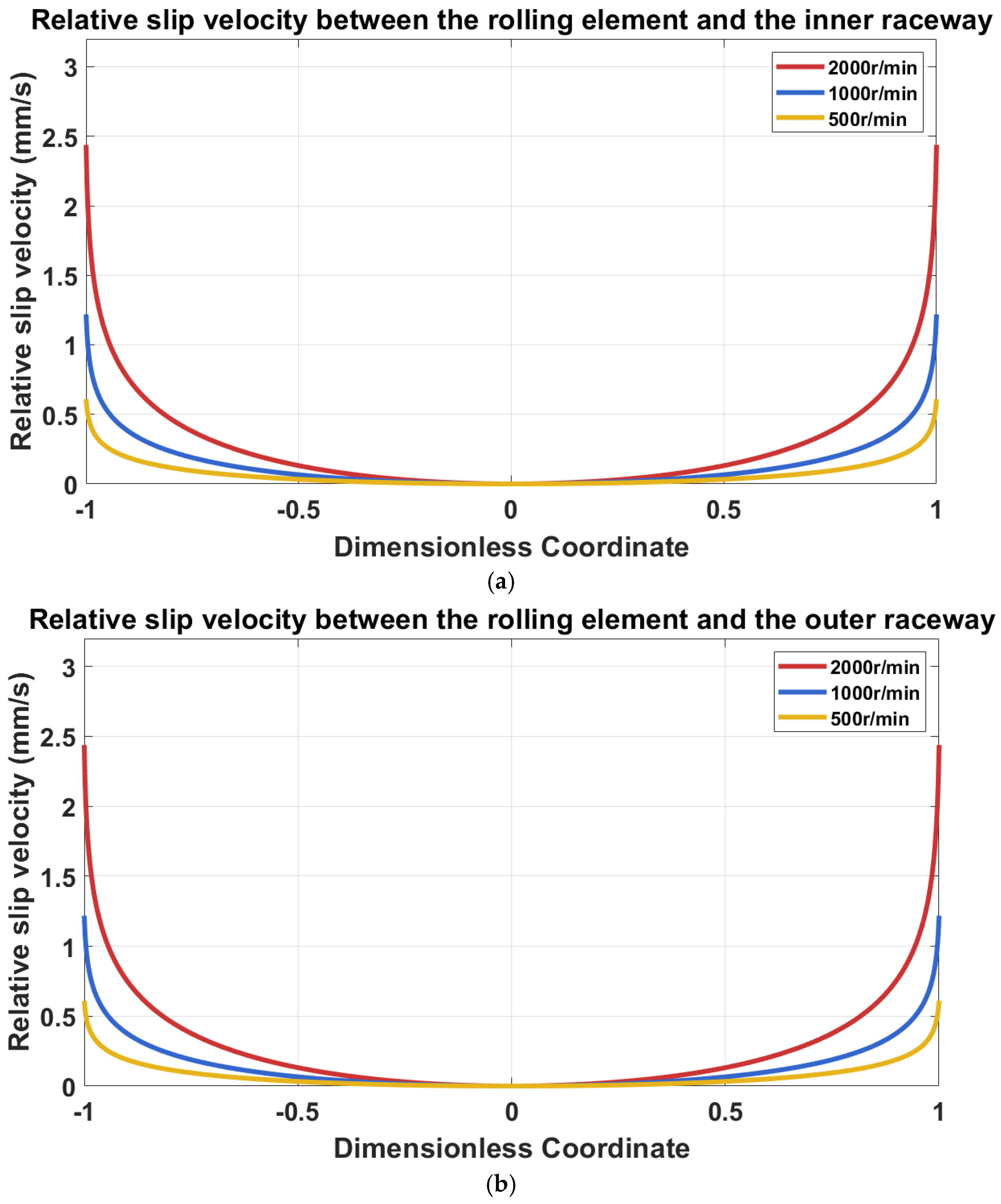
Figure 12 shows the distribution of relative sliding velocity along the contact lines between the rollers and the raceways in the tapered roller bearing. The elastic deformation in the contact region is very small compared to the geometric dimensions of the rollers and raceways, and thus the contact behavior is primarily governed by the geometry and stiffness of the bearing components. The sliding velocity is primarily determined by the geometric parameters of the rollers and raceways, such as the roller half-cone angle, raceway curvature, and contact line length, and remains constant under different load conditions.
The distribution is symmetric about the midpoint of the roller generatrix, with sliding velocity increasing from the center toward the ends. At the center, the velocity is zero, indicating pure rolling, while at the ends, higher sliding velocities occur due to velocity mismatch between the raceway and roller.
As rotational speed increases, the relative sliding velocity rises significantly. The maximum velocity reaches 0.565 mm/s at 500 r/min and increases to 2.261 mm/s at 2000 r/min. This indicates that sliding effects become more pronounced at higher speeds, potentially leading to lubrication breakdown and increased frictional heat, which can impair bearing performance and lifespan.
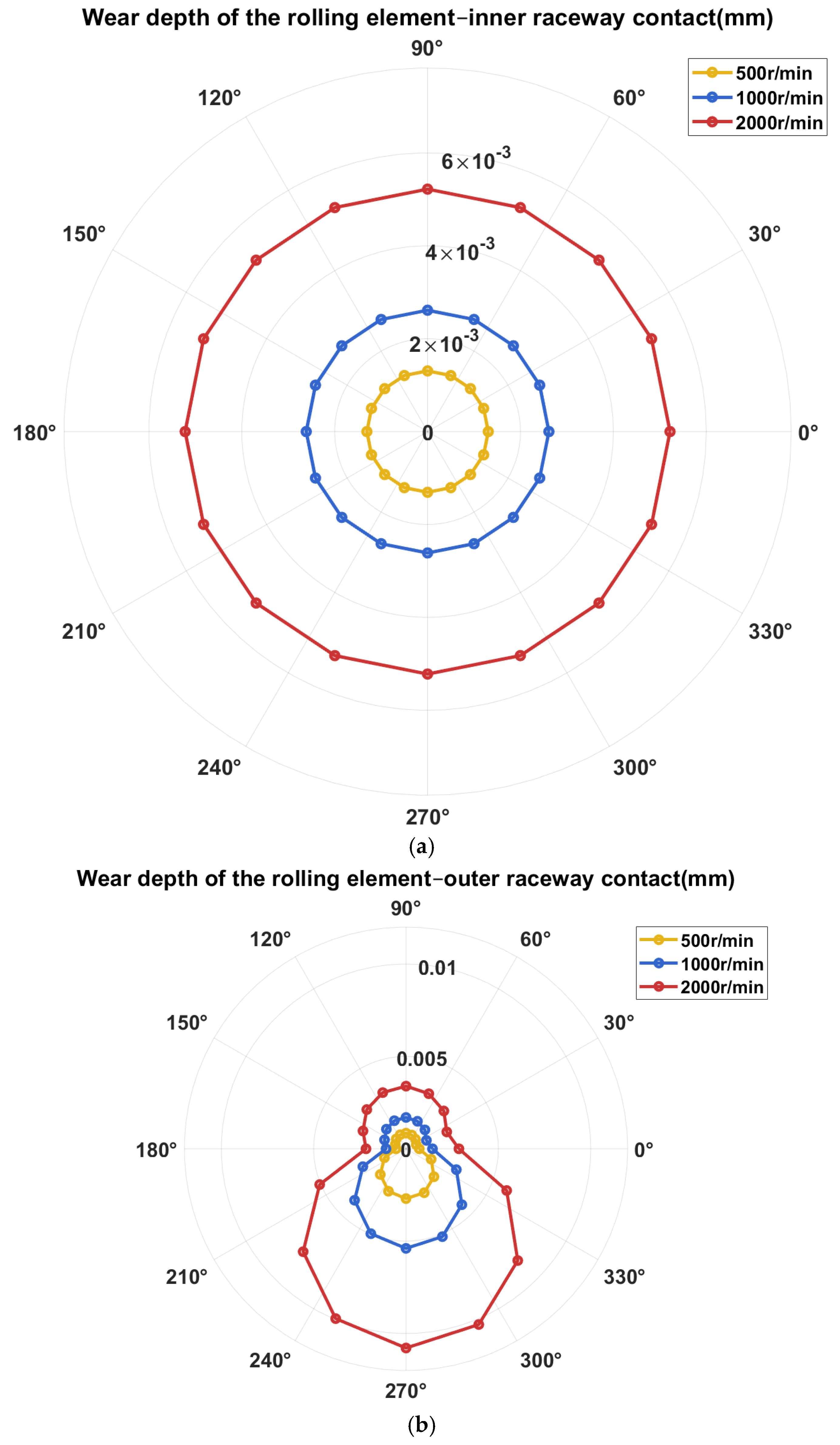
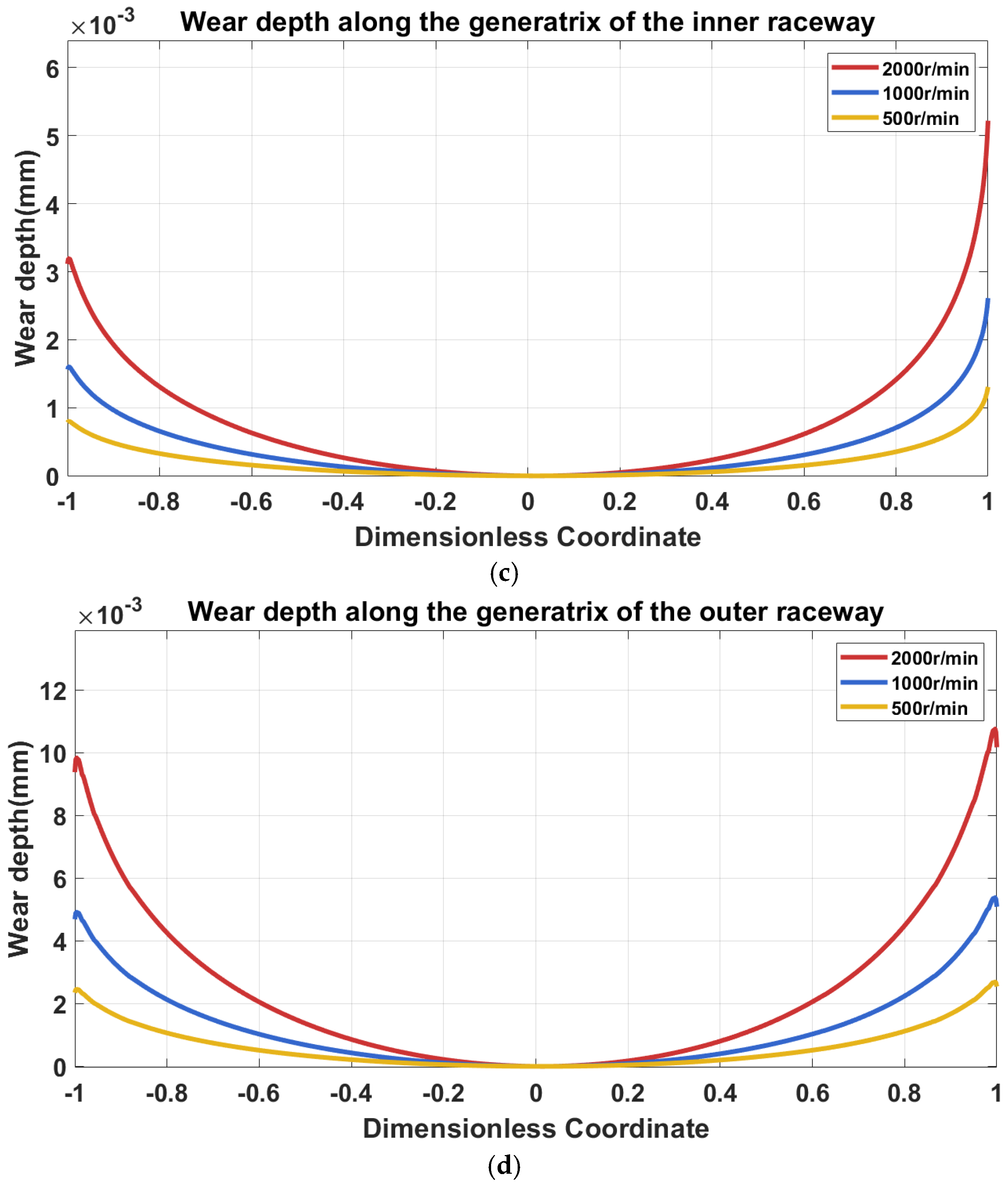
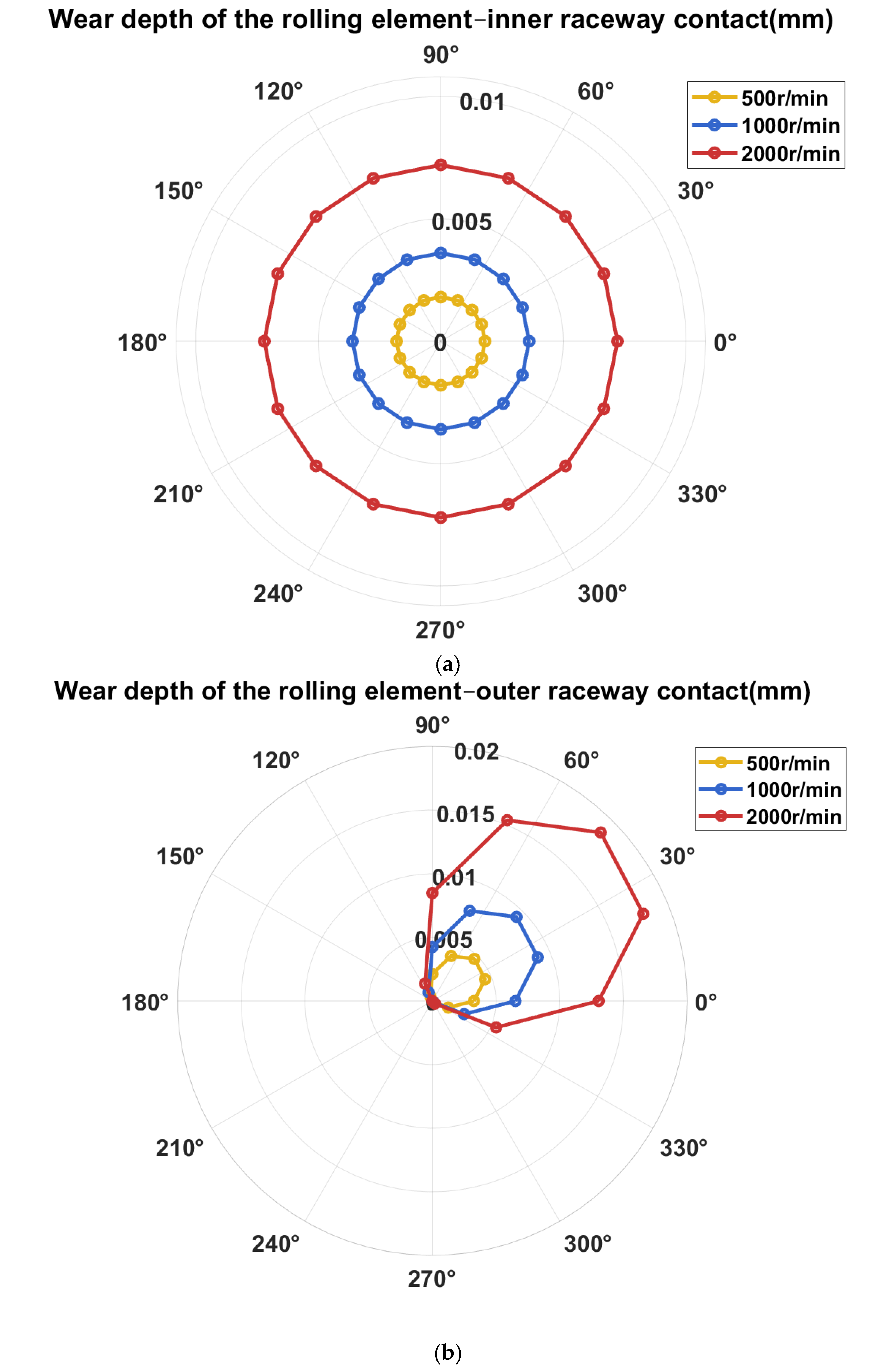
Under different rotational speeds (500, 1000, and 2000 r/min) and a service time of 8000 h, the distributions of contact force, stress, and relative sliding velocity between the rolling elements and raceways vary, leading to differences in wear depth. Figure 13a,b show the maximum wear depth distributions at different speeds and angular positions. Due to the inner raceway’s rotation and the outer raceway’s stationary position, their wear characteristics differ. The inner raceway exhibits relatively consistent wear, while the outer raceway’s wear fluctuates based on contact pressure and load. This circumferentially non-uniform wear on the outer raceway arises because each point along the outer race engages with only a subset of rollers at any given instant, causing the local wear depth to depend on the instantaneous contact pressure and roller load. Elastic deformations of the rollers and geometric variations further contribute to localized differences in contact stress, producing the observed fluctuation in wear depth around the circumference.
With increasing rotational speed, wear depth increases for both raceways: from 1.306 μm to 5.219 μm for the inner raceway, and from 0.542–2.695 μm to 2.166–10.782 μm for the outer raceway. Higher speeds enhance friction and accelerate material removal. Moreover, the outer raceway exhibits circumferentially non-uniform wear due to variations in local contact pressure and load along the roller positions, whereas the inner raceway experiences relatively uniform wear.
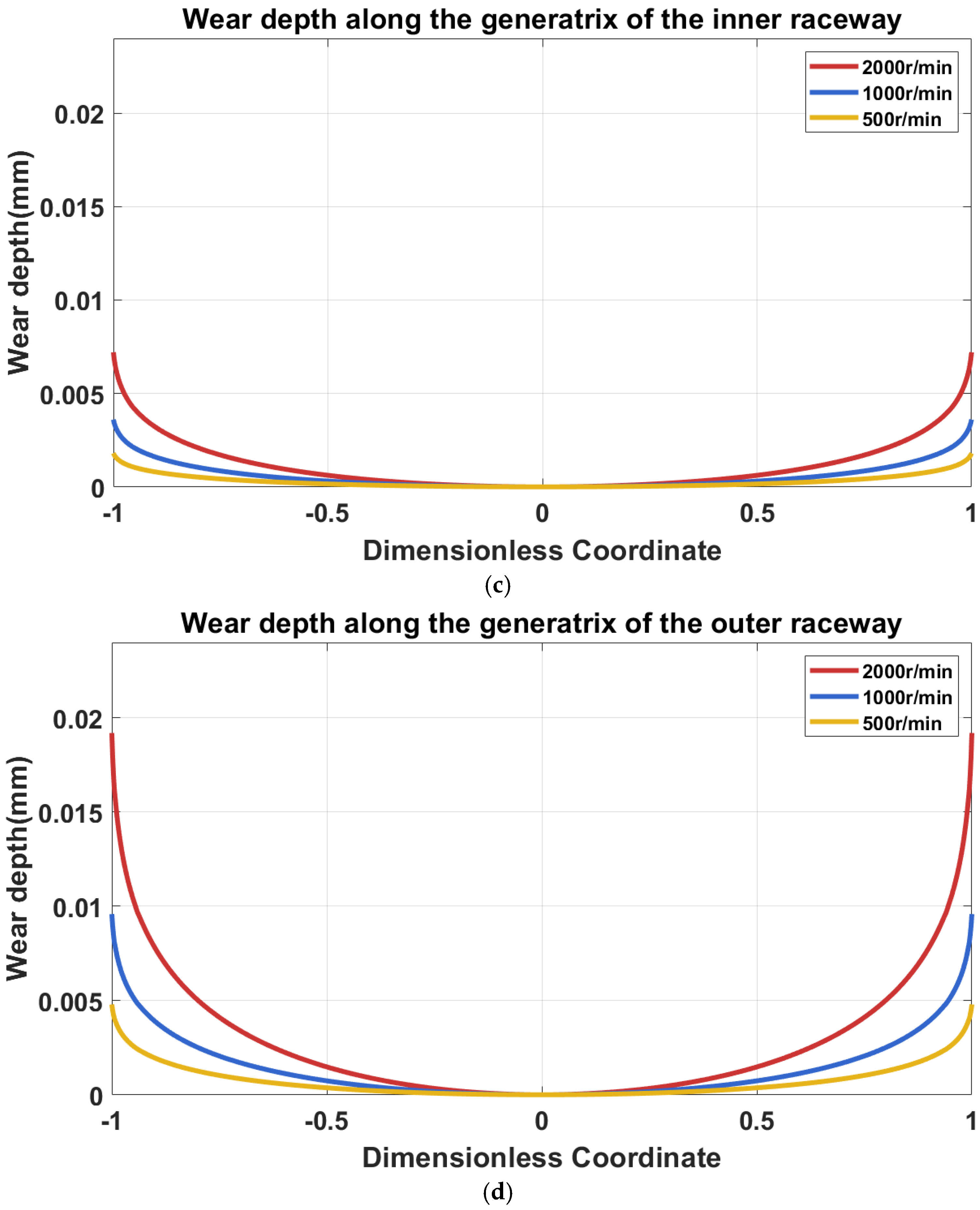
Figure 13c,d reveal that wear is more pronounced at the ends of the generatrix due to higher sliding velocities, leading to a “severe wear at the ends and slight wear at the center” pattern. Higher speeds amplify both overall wear and wear unevenness along the generatrix, accelerating material removal and potentially degrading bearing performance.

2.3.3. Analysis Results of Needle Roller Bearings

The wear model developed in this study demonstrates strong applicability and can be easily extended to needle roller bearings. By appropriately adjusting the geometric parameters based on their specific structural characteristics, the wear behavior of needle roller bearings can be accurately predicted.
Figure 14a,b shows the distributions of the contact forces between the needle rollers and the inner and outer races at rotational speeds of 500 r/min, 1000 r/min, and 2000 r/min. Due to the non-uniform load distribution along the circumferential direction, only a portion of the needle rollers bears the majority of the load. At 500 r/min, the maximum contact forces on the inner and outer races are approximately 8766 N and 8648 N, respectively, while the minimum values are both zero.
Figure 14c,d illustrate the variations in contact force along the contact line direction. At all three speeds, the contact force increases initially and then decreases, reaching a maximum near the middle of the contact line and approaching zero near both ends. For the inner race, the peak force decreases with increasing speed, while the outer race shows the opposite trend, with higher contact forces occurring at higher rotational speeds.
Figure 15 illustrates the variations in contact stress along the raceway lines at different speeds. As speed increases, the contact stress at the center of the inner race decreases slightly from 2045 MPa to 2027 MPa, while the stress at the center of the outer race increases slightly from 2029.1 MPa to 2029.6 MPa, indicating a marginal rise in local load between the rollers and the outer race under high-speed conditions.
Overall, the contact stresses on both the inner and outer raceways remain below the allowable stress of bearing steel, meeting the design criteria.
Figure 16 shows the relative sliding velocity distribution along the contact line between the rollers and the races in the tapered roller bearing. The sliding velocity is primarily influenced by the geometrical parameters of the rollers and races, such as the roller semi-cone angle, raceway curvature, and contact line length.
The velocity distribution is symmetric about the roller generatrix midpoint, increasing from the center toward both ends. At the center, the velocity is zero, indicating pure rolling, while higher sliding occurs at the ends due to the mismatch between the roller and race velocities.
As speed increases, the sliding velocity rises significantly, from 0.611 mm/s at 500 r/min to 2.438 mm/s at 2000 r/min. This suggests that higher speeds increase sliding effects, potentially leading to lubrication breakdown and higher frictional heating, affecting performance and lifespan.
Similarly to the tapered roller bearing, the needle roller bearing exhibits uniform wear on the inner race and non-uniform wear on the outer race. Figure 17a,b show that as rotational speed increases, the wear depth of both races rises significantly. The inner race wear depth increases from 1.801 μm to 7.203 μm, and the outer race increases from 4.479 μm to 18.699 μm, indicating that higher speeds intensify wear.
Figure 17c,d show that wear is greatest at the ends of the contact line, decreasing toward the center. Increased speed not only increases overall wear but also enhances non-uniformity along the roller generatrix. These results indicate that centrifugal force and sliding friction under high speeds accelerate material removal and may affect bearing performance and lifespan.


3. Parametric Simulation Based on MASTA Software

3.1. Parametric Simulation Model Establishment

MASTA, a comprehensive Computer-Aided Engineering (CAE) platform developed by Smart Manufacturing Technology (SMT), is a powerful tool widely used in gear transmission system design, simulation, and analysis throughout the product development cycle, featuring a modular architecture that allows flexible configuration of functional modules for various transmission structures—including complex multi-stage gear trains, planetary gear mechanisms, and the RV reducer focused on in this study.
In the Masta software environment, the RV reducer model can be constructed by setting the number of cycloidal wheels, eccentricity, thickness, shaft-hole diameter, the number, length, and distribution diameter of needle teeth, as well as the module, number of teeth, pressure angle, modification coefficient, and center distance of the involute gear pair. Appropriate bearing types are also selected. Subsequently, the assembly connections between the components are completed accordingly. Finally, by applying the corresponding driving torque to the input shaft, output planet carrier, and needle gear housing, the modeling of the RV reducer is completed. Main design parameters are shown in Table 3.
Table 4 lists the material properties of the key components of the RV reducer used in the MASTA simulation and theoretical calculations. The elastic modulus, density, and Poisson’s ratio of each component—including the input sun gear, planet gear, planet carrier, crankshaft, cycloidal wheel, pin gear, and pin wheel—are specified to define their mechanical behavior. These parameters are used to determine the stiffness, mass distribution, and dynamic response of the components, ensuring that the simulation accurately reflects the physical characteristics of the system.
Stiffness parameters of structural components (all set to actual material stiffness, no artificial rigidification): Bearings: The stiffness parameters of 33006 tapered roller bearing and K35 × 55 × 21 needle roller bearing are set according to the bearing manufacturer’s technical manual, including radial stiffness (33006: 2.5 × 10⁸ N/m; K35 × 55 × 21: 3.2 × 10⁸ N/m) and axial stiffness (33006: 1.8 × 10⁸ N/m; K35 × 55 × 21: none, pure radial bearing).
Boundary conditions are set in MASTA, which are consistent with the theoretical model’s static equilibrium boundary conditions: Fixed boundary: The pin gear housing is fixed (all degrees of freedom constrained), consistent with the theoretical model’s assumption of a fixed pin gear housing. Load boundary: The input shaft is applied with a rotational speed of 1440 r/min and an input torque matching the rated output torque (5000 N·m) of the planetary carrier; the planetary carrier is applied with a rated output torque of 5000 N·m (torque direction opposite to the input), consistent with the load conditions in the theoretical static force analysis. Connection boundary: The crankshaft is rigidly connected to the planetary gear, and the bearing inner ring is interference fit with the crankshaft (connection stiffness 1 × 10⁹ N/m); the bearing outer ring is clearance fit with the planetary carrier (connection stiffness 5 × 10⁷ N/m), consistent with the actual engineering assembly conditions and the theoretical model’s connection assumptions.
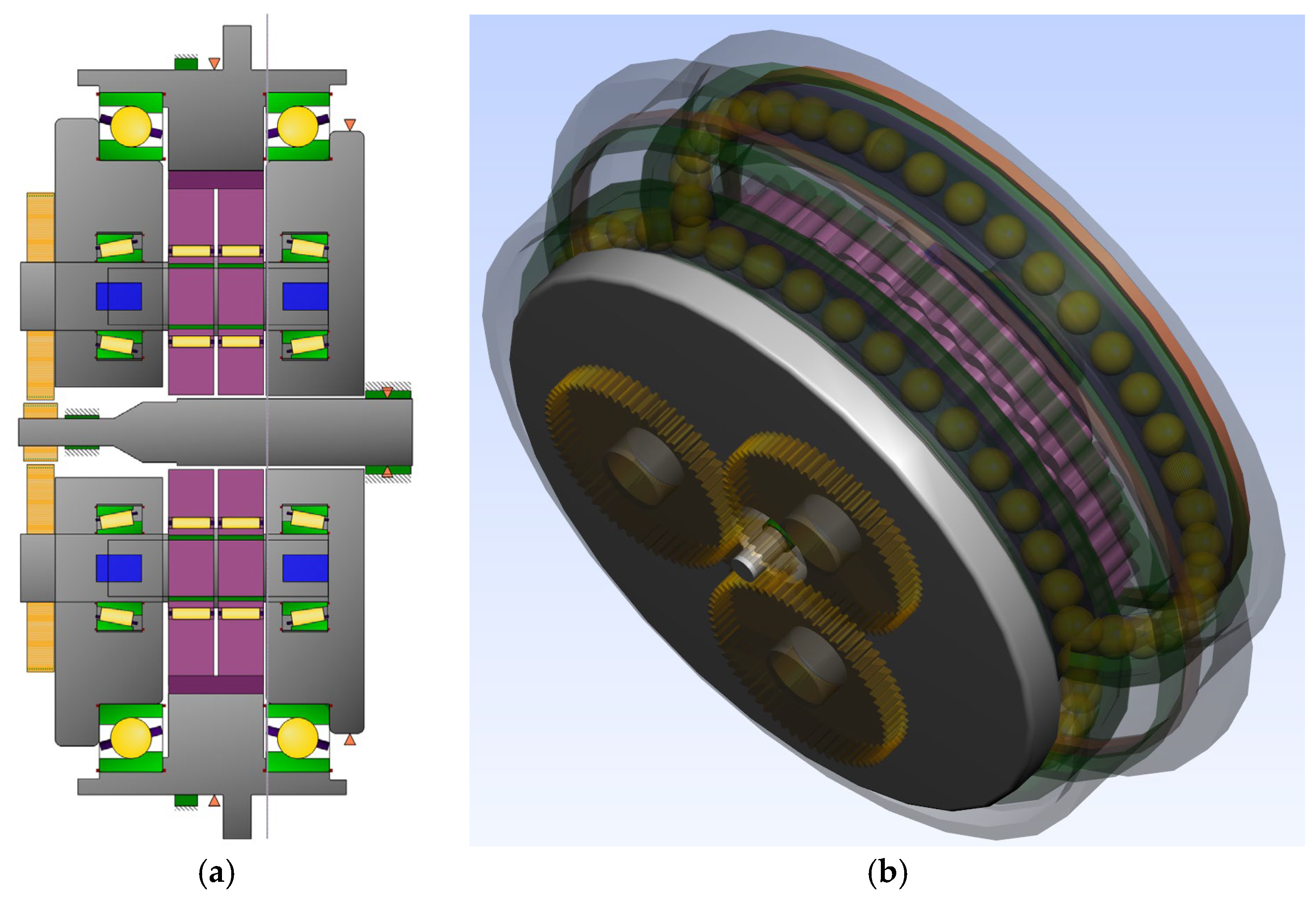
In Figure 18, the two-dimensional sectional view and the three-dimensional schematic diagram of the RV reducer model established in the Masta environment are presented. In this scheme, the transmission mode adopts the input via the gear shaft, the fixed needle gear housing, and the output from the planet carrier. Therefore, during the torque parameter setup, the driving torque speed on the needle gear housing is set to zero to fix the housing. Correspondingly, the output torque acting on the planet carrier is 5000 N·m, and the input speed is 1440 r/min.

3.2. Simulation Analysis of Critical Bearings

3.2.1. Simulation Results of Tapered Roller Bearings

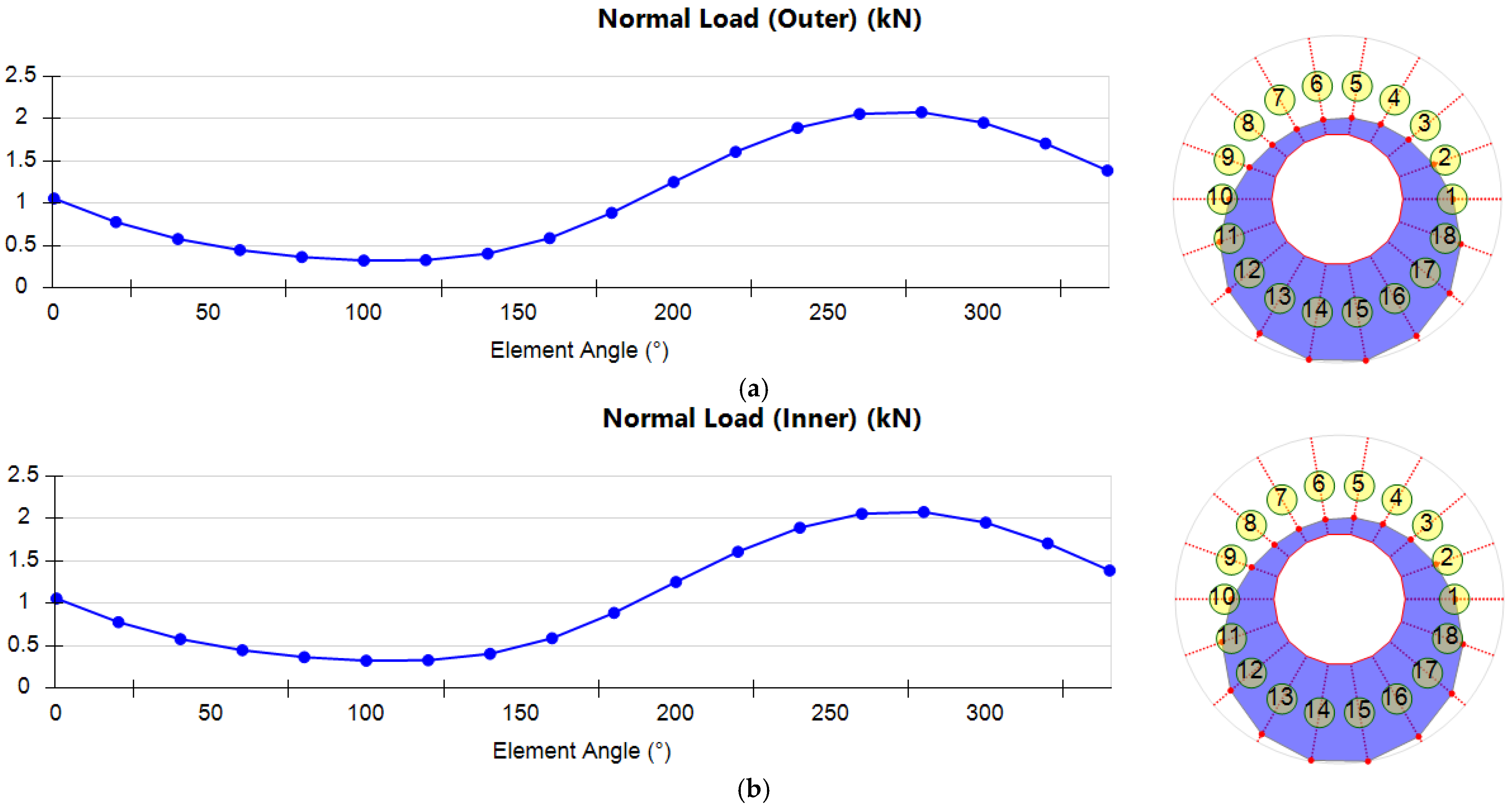
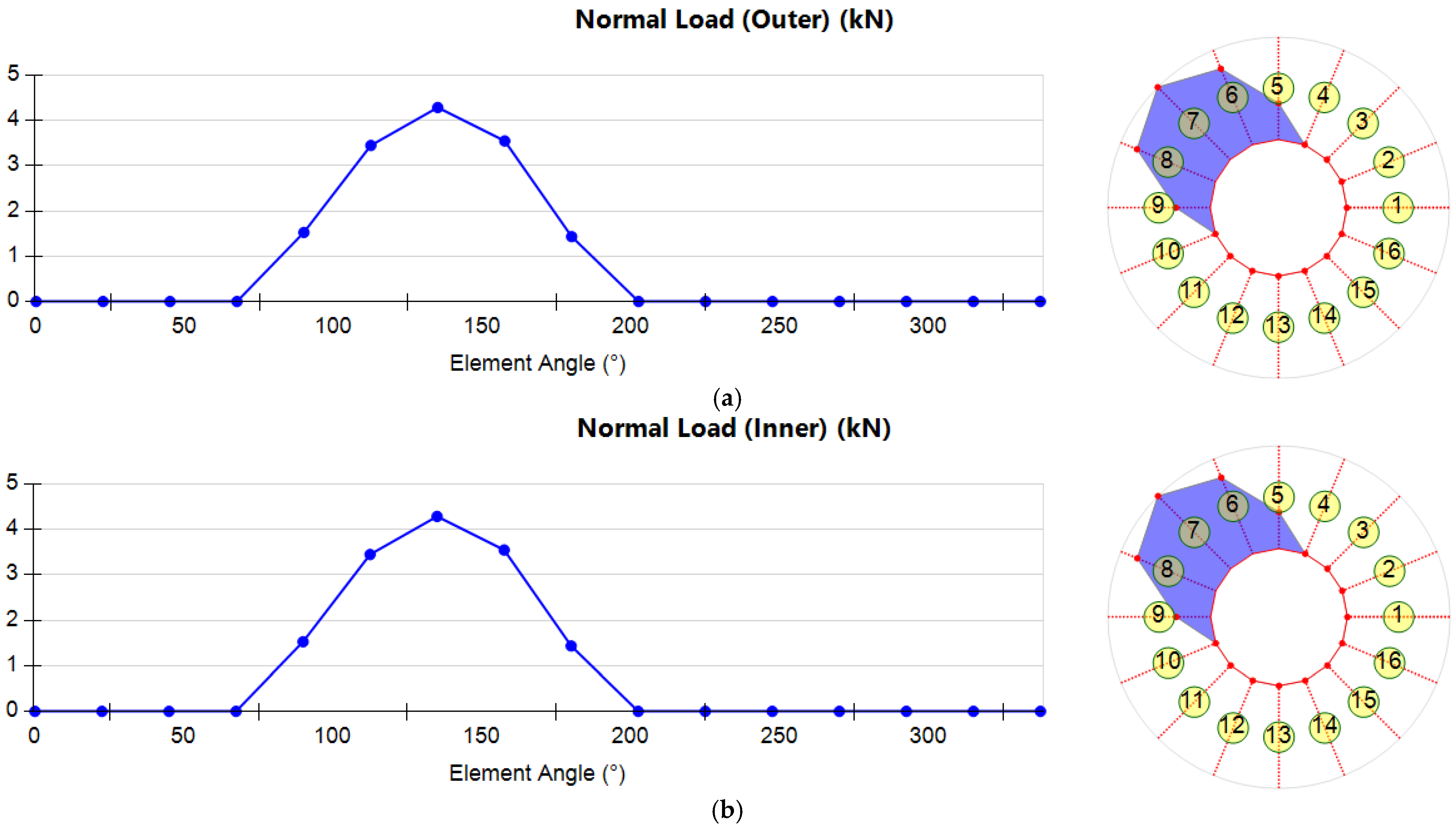
Figure 19 illustrates how the contact forces are distributed around the circumference for the rolling components interacting with the inner and outer raceways. As observed, each rolling component maintains engagement with both raceways, and the force magnitudes at corresponding angular positions are roughly similar. In addition, the patterns of force variation around the circle exhibit comparable non-uniform trends for the inner and outer raceways. The highest force values for both sides are around 2053 N, while the lowest force values are 384 N.
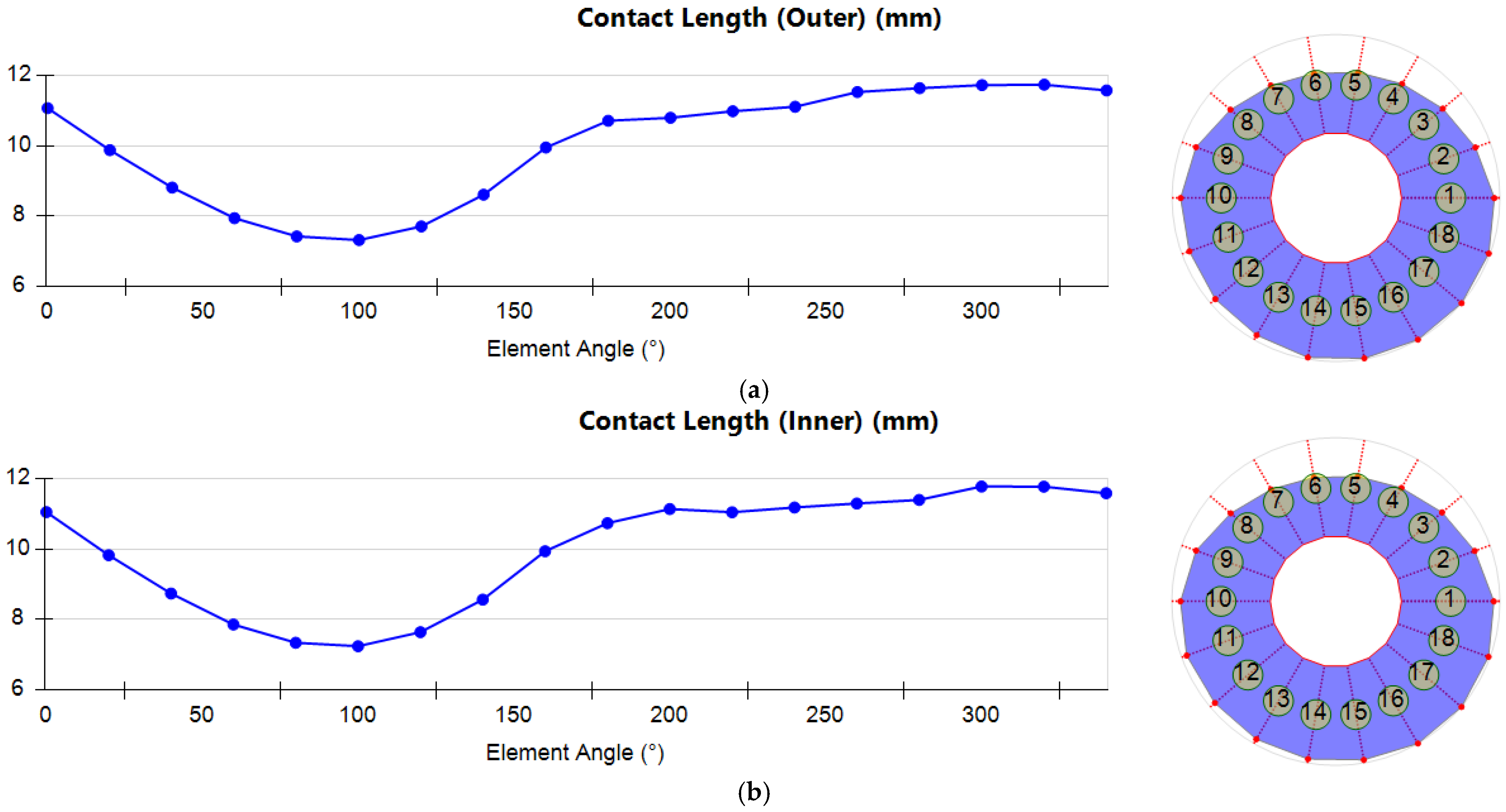
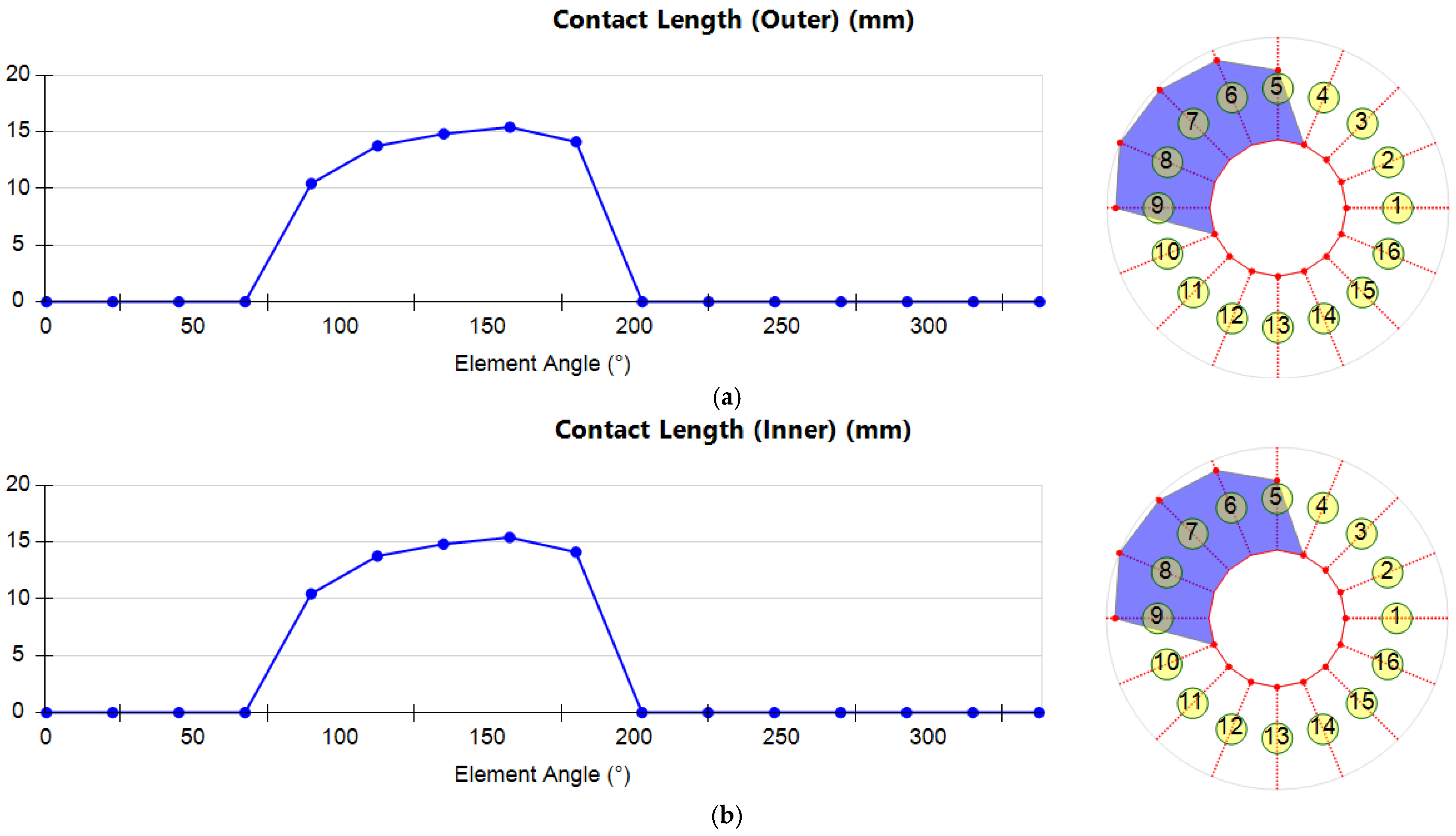
Similarly to the force distribution, Figure 20 depicts how the contact lengths vary around the circumference for the rolling components interacting with the raceways. The peak values of contact length on both the inner and outer raceways reach 11.84 mm, while the lowest values are 7.43 mm.
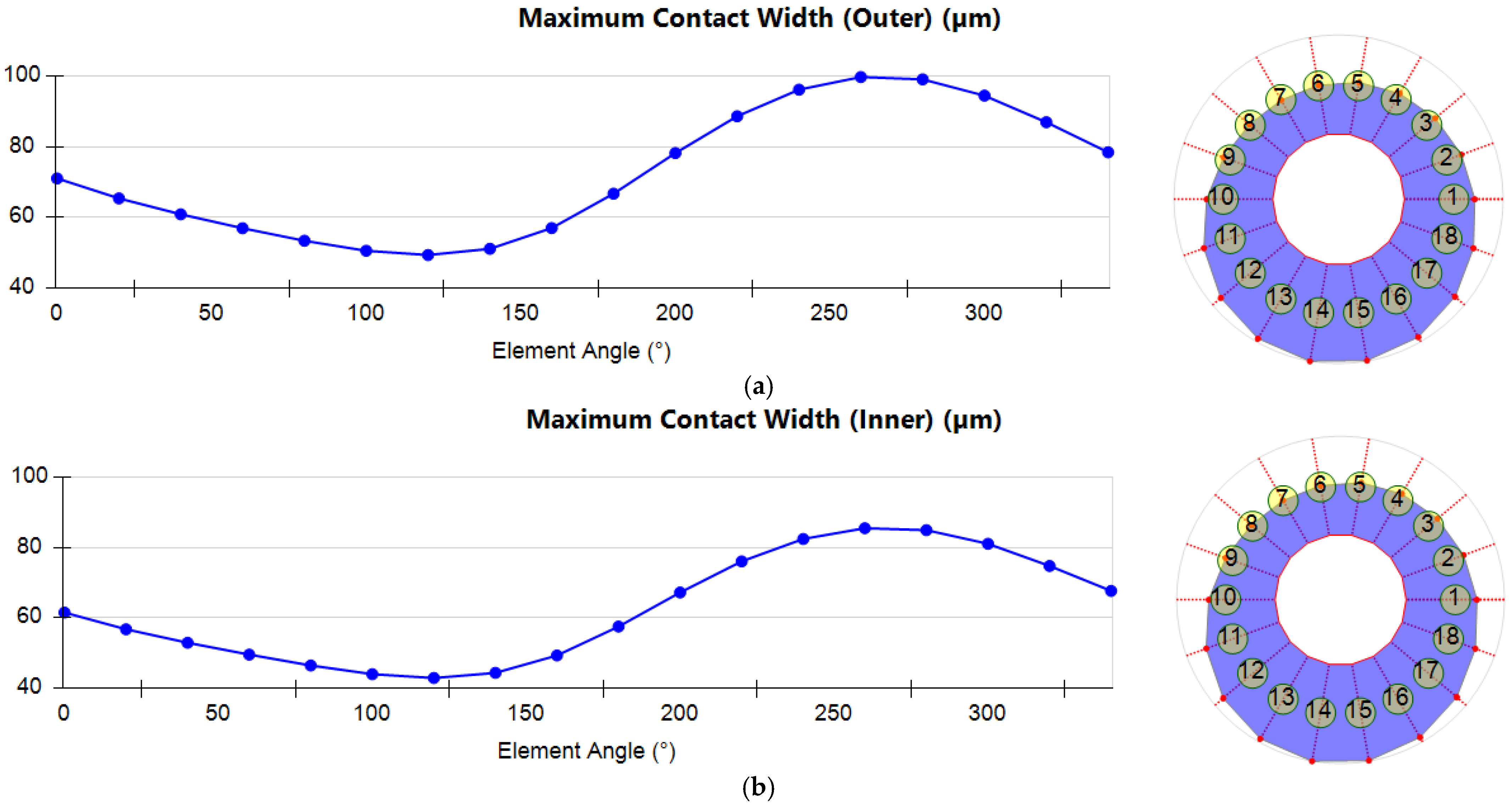
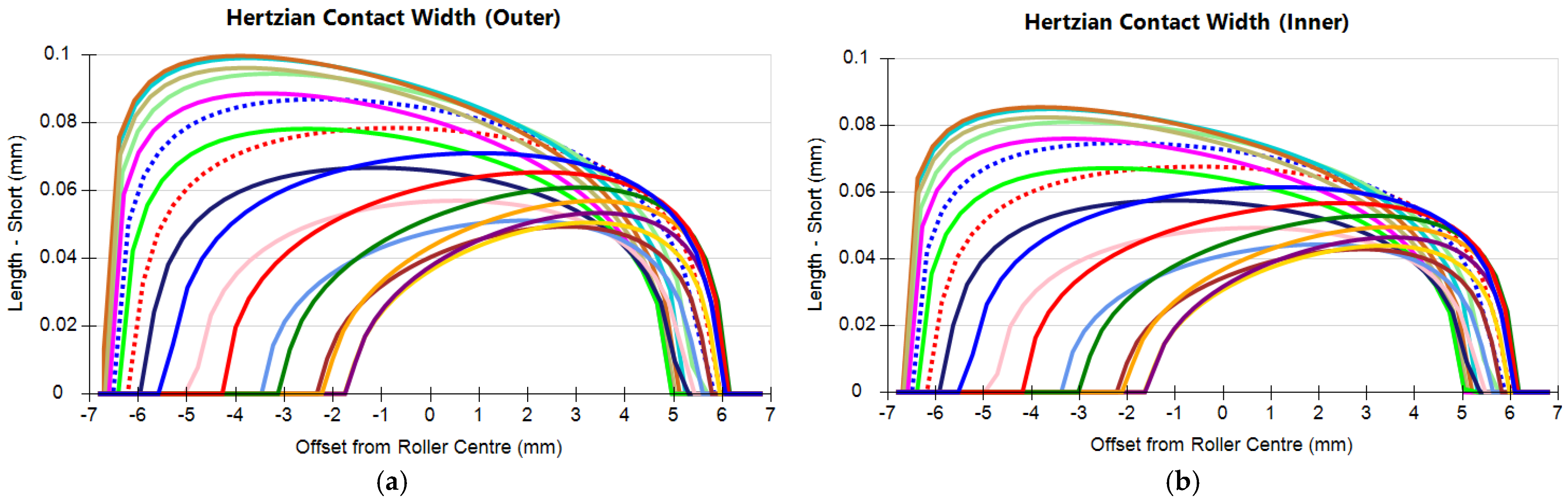
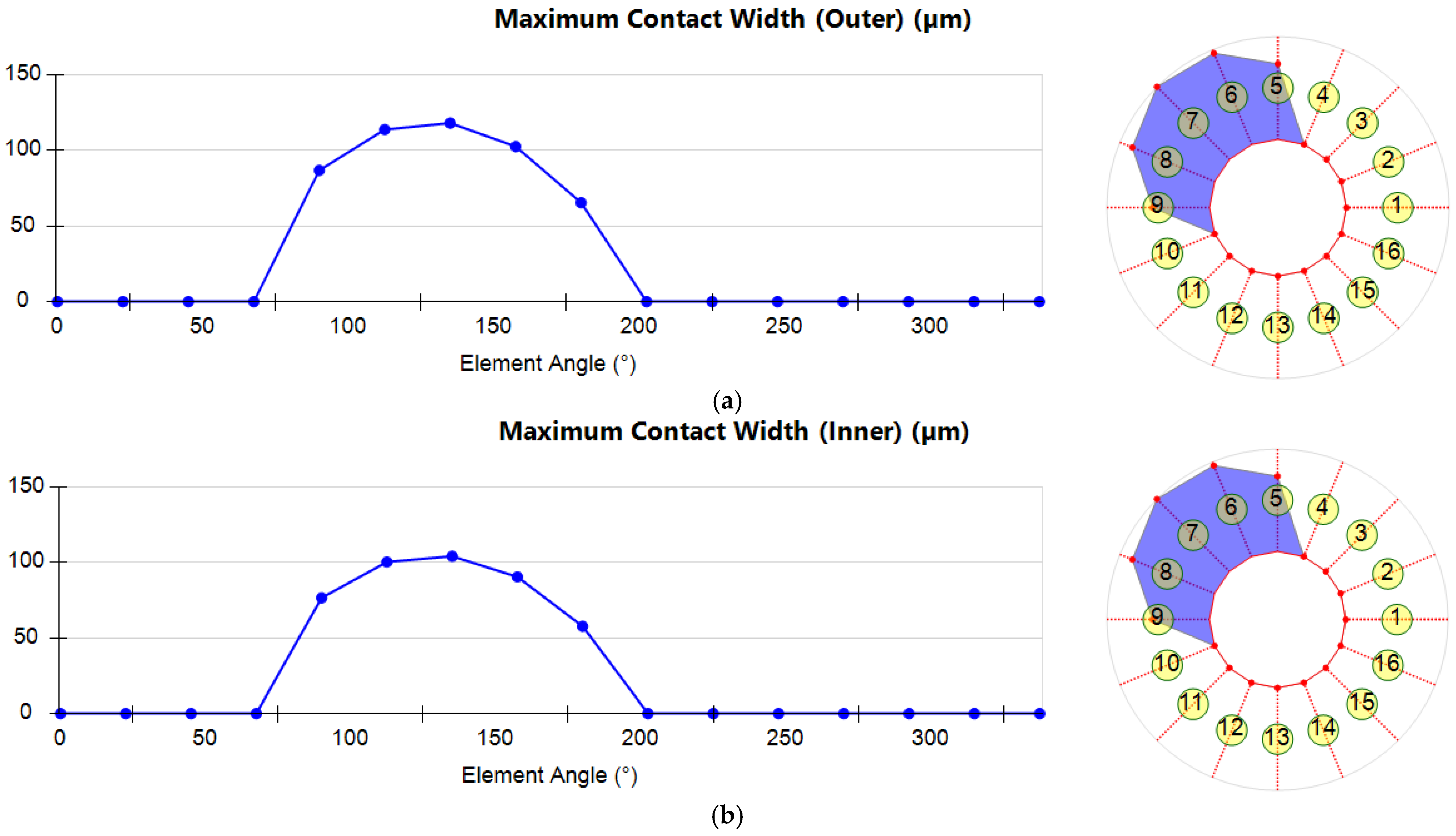
Similarly to the force distribution pattern, Figure 21 illustrates the maximum contact width distribution of the roller with the inner and outer raceways along the circumferential direction. The maximum contact width between the roller and the outer raceway is 99.34 μm, while the minimum is 51.71 μm. For the inner raceway, the maximum contact width is 84.27 μm, and the minimum is 52.11 μm.
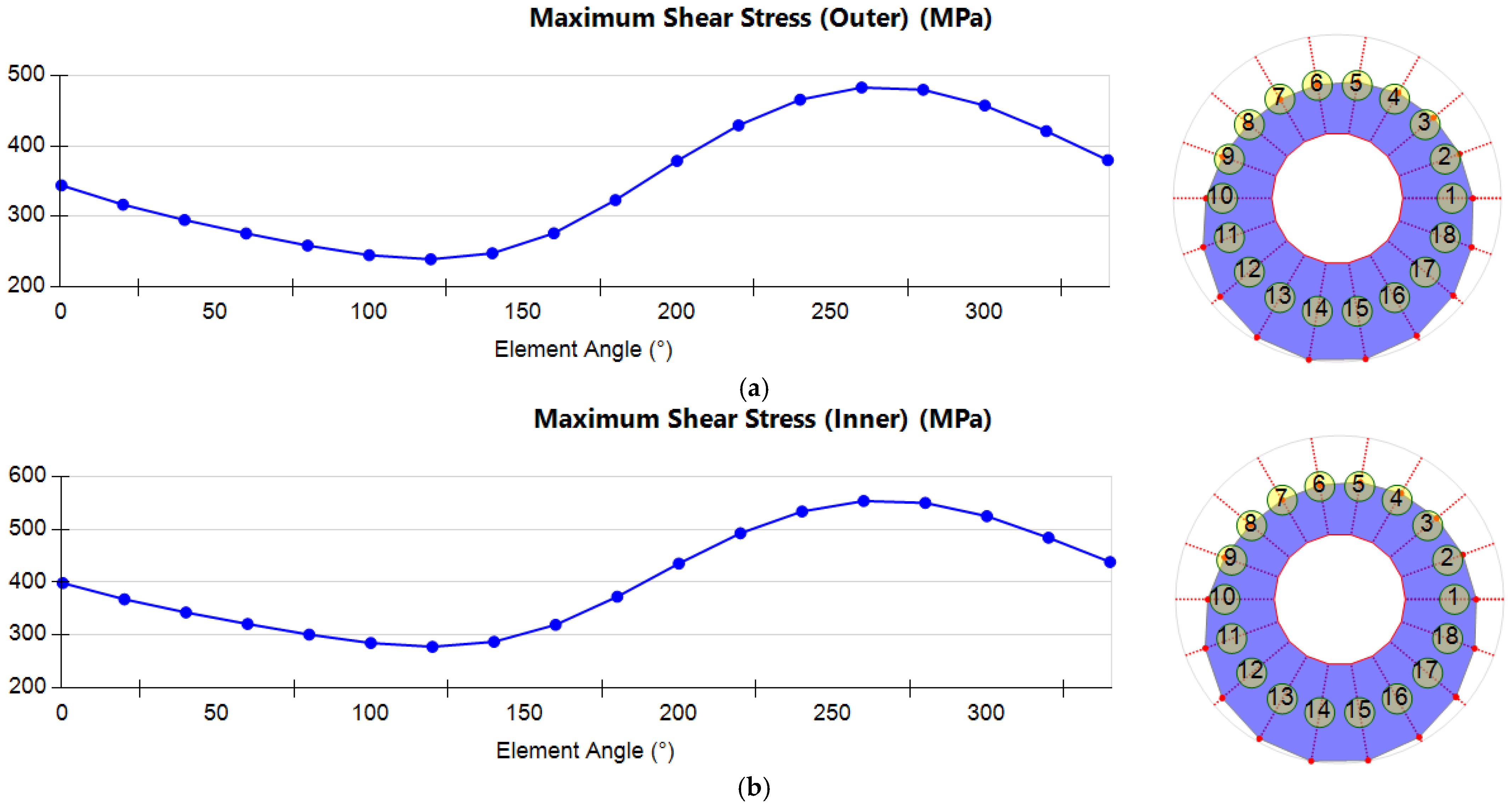
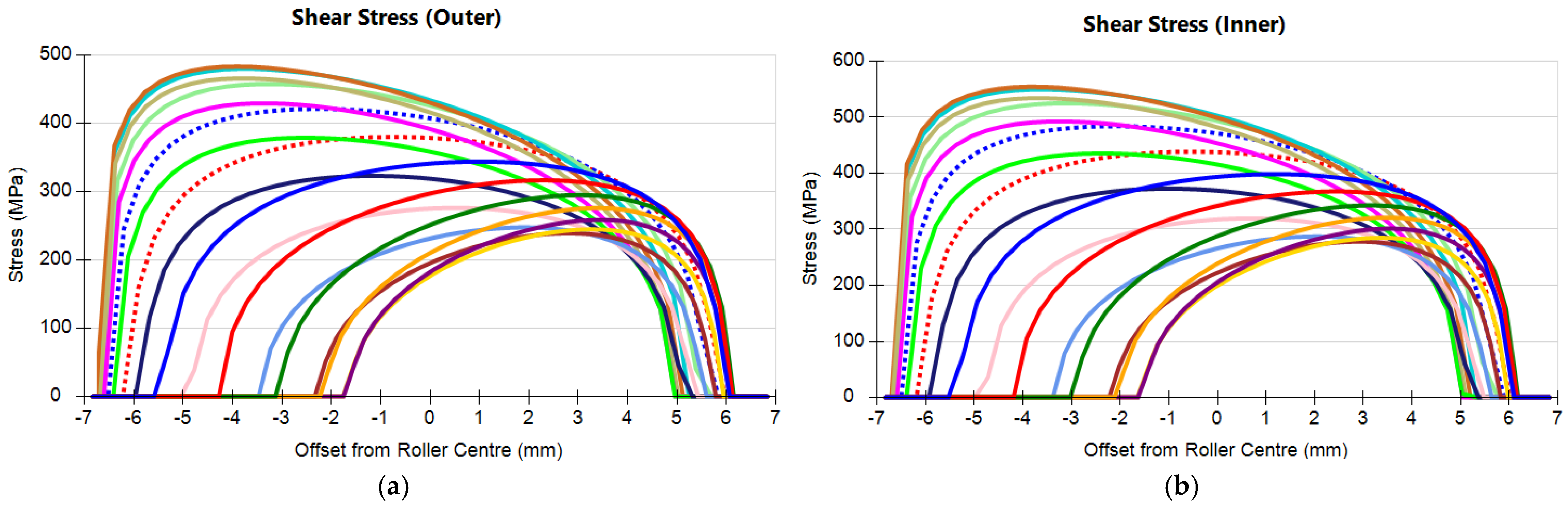
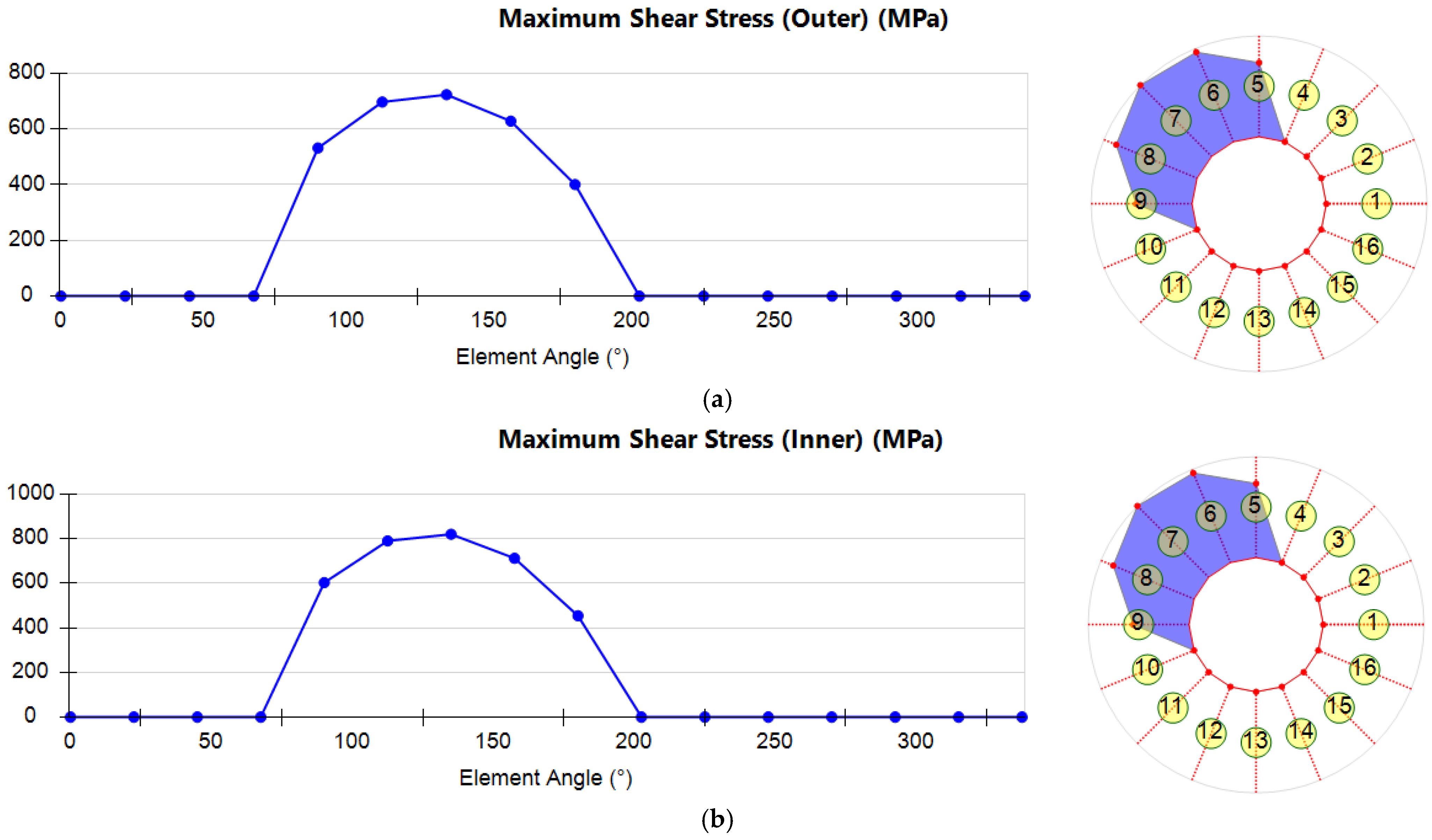
Analogous to the pattern of force distribution, Figure 22 presents how the peak shear stress varies circumferentially for the rolling components interacting with the inner and outer raceways. For the outer raceway, the highest and lowest shear stress values are 492 MPa and 243 MPa, respectively, while for the inner raceway the corresponding values are 597 MPa and 288 MPa.
In summary, the shear stress occurring between the bearing and the guide raceways remains below the allowable contact stress for bearing steel, thereby satisfying the design criteria.
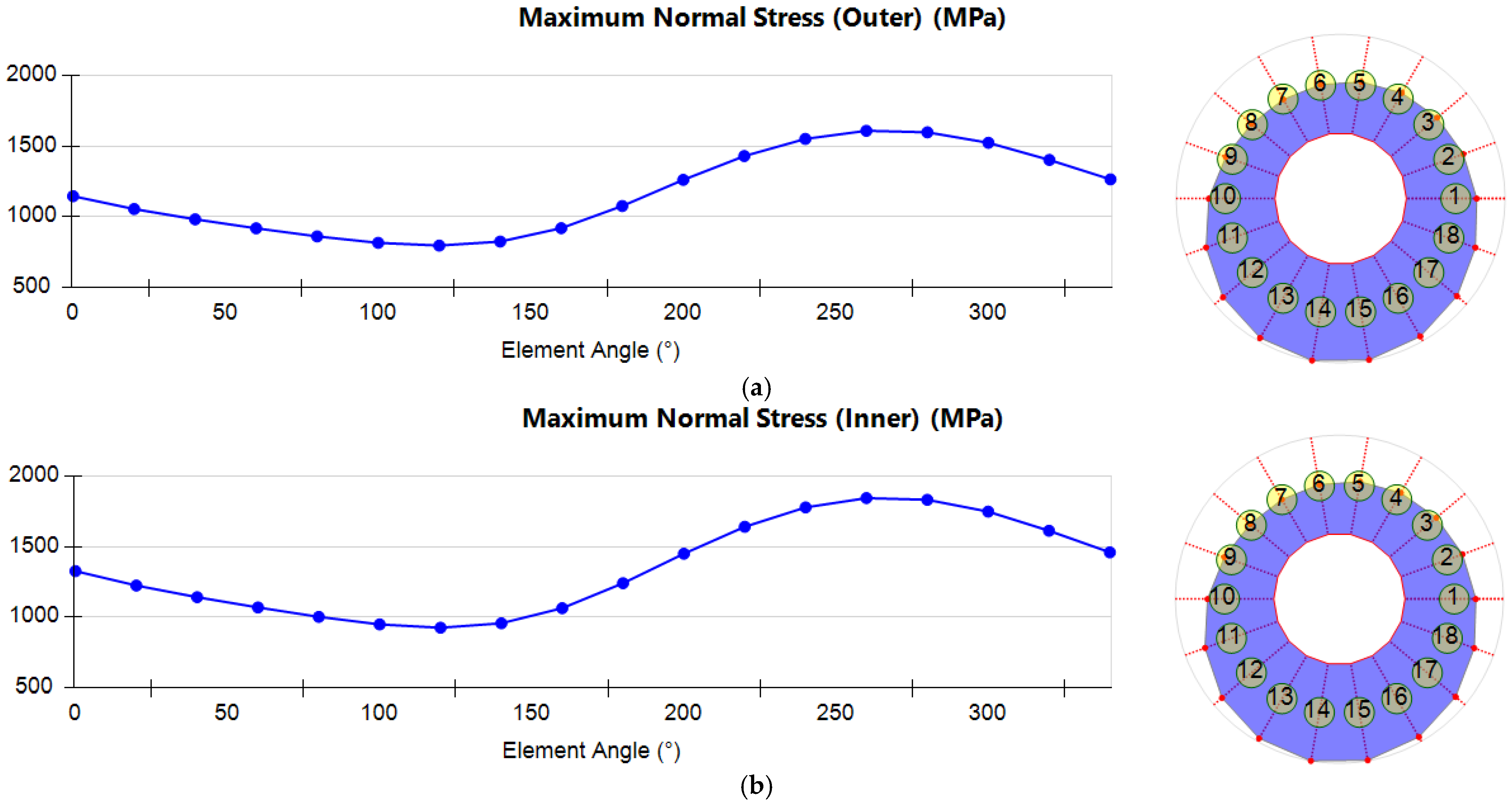
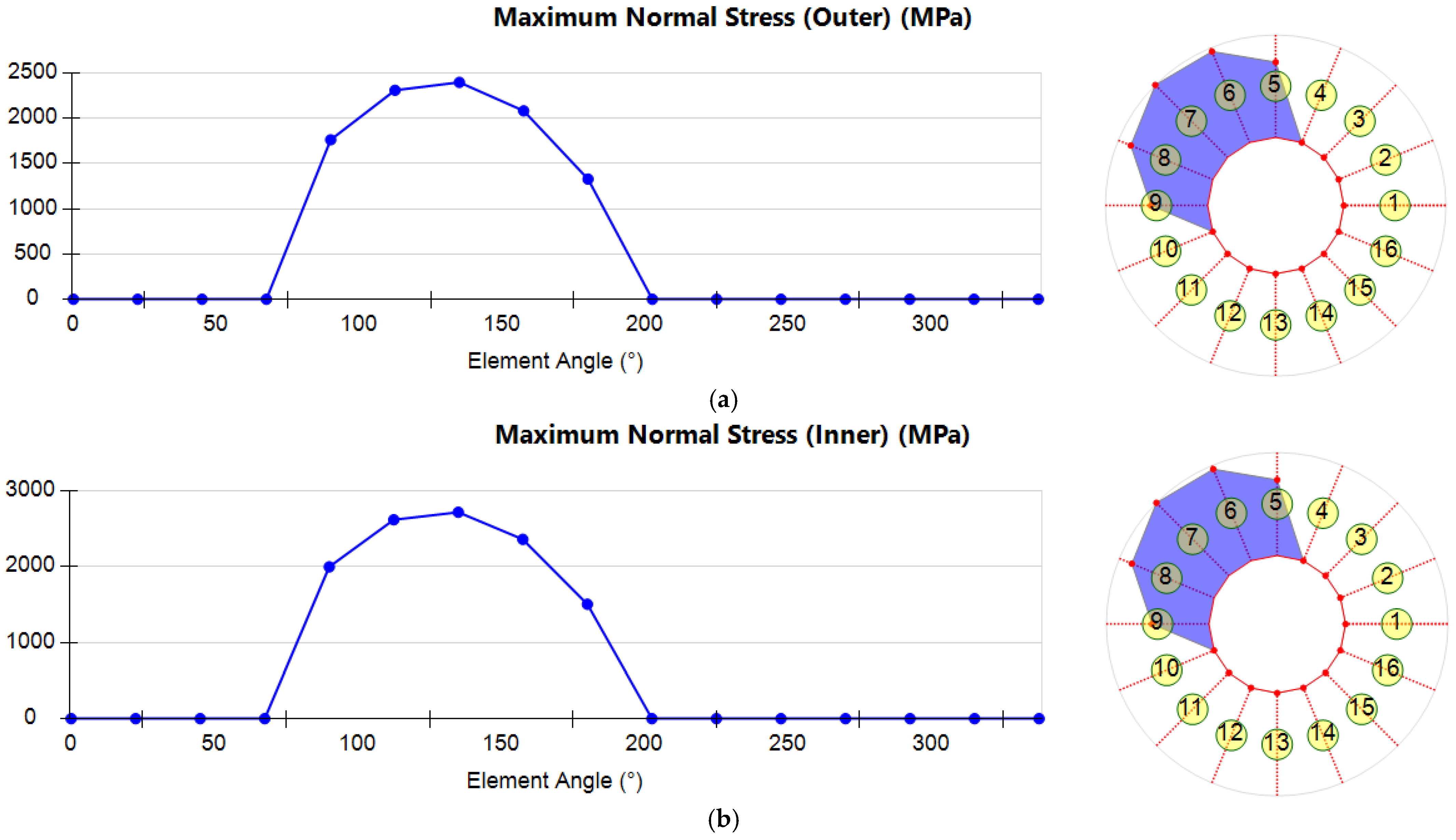
Analogous to the force distribution pattern, Figure 23 depicts how the peak contact pressure varies circumferentially for the rolling components interacting with the inner and outer raceways. For the outer raceway, the highest and lowest pressure values are 1629 MPa and 807 MPa, respectively, while for the inner raceway the corresponding values are 1883 MPa and 962 MPa, respectively.
Overall, the contact stresses are below the permissible limit of the bearing steel, satisfying the design requirements.
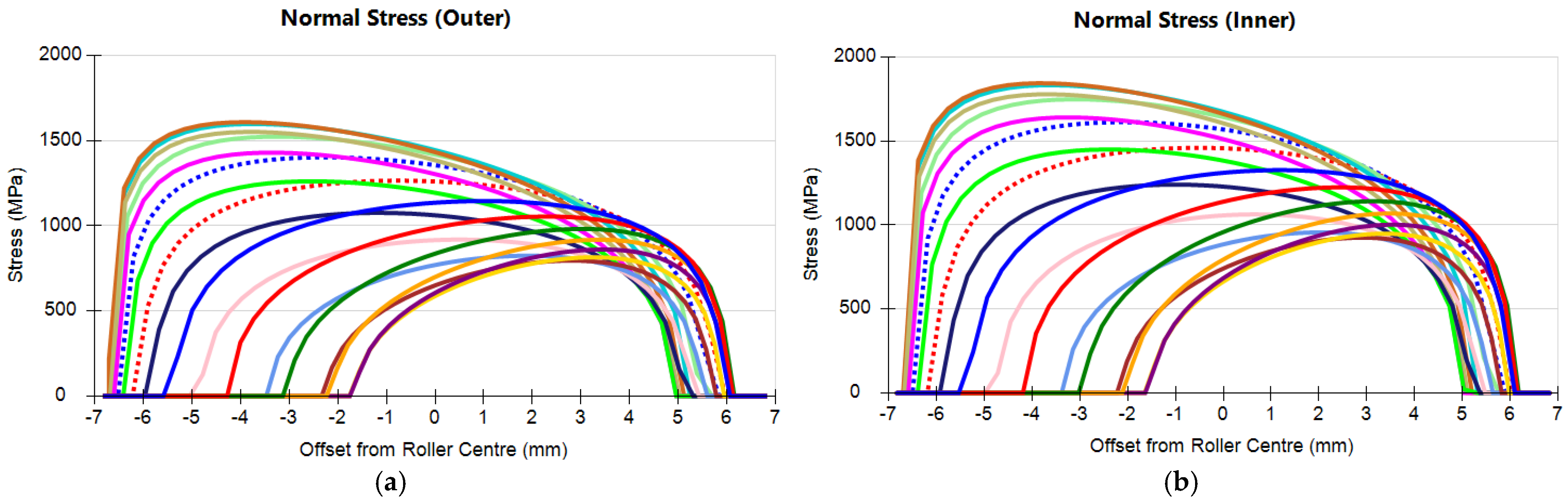
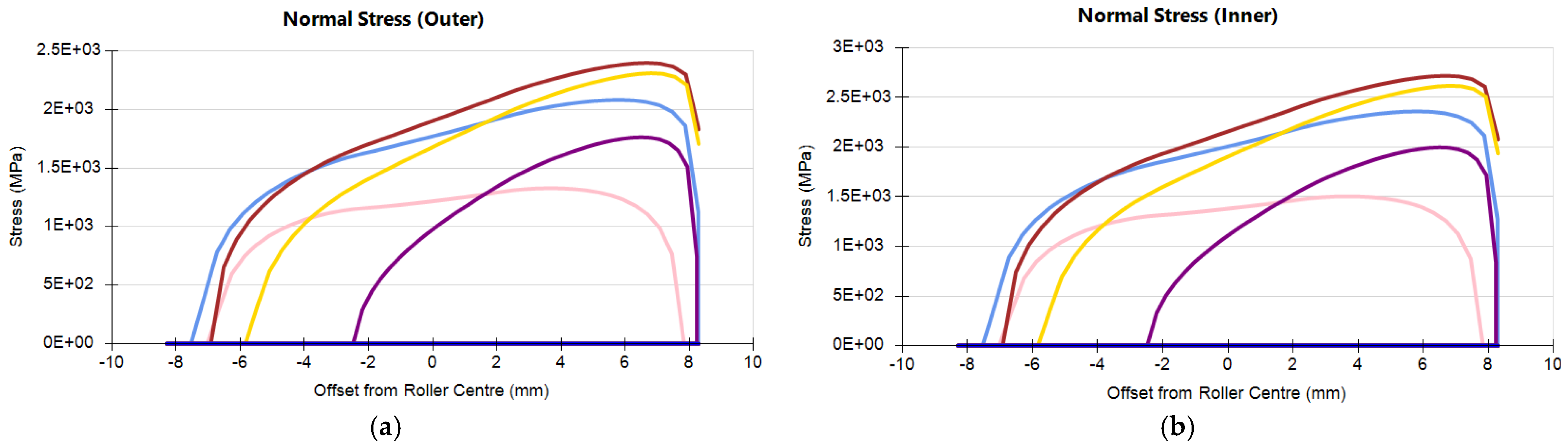
In Figure 24, the distribution of contact pressure along the axial direction shows similar patterns for both the inner and outer raceways, with values rising from the ends toward the mid-section. Because the intensity of contact varies among different rolling components, the extent of engagement along the shaft direction also differs. Some components display stress throughout the entire axial length, while others show zero values at both ends, indicating regions without engagement. In general, the pressure experienced at the interface with the inner raceway is somewhat greater than that at the outer raceway, with peak values of 1804 MPa and 1687 MPa, respectively. The results indicate that the contact stresses are within the allowable range of the bearing material.
Similarly to the shear stress pattern along the rolling element’s axial direction, Figure 25 illustrates the shear stress distribution of the roller and raceways along their own axes. The maximum shear stress between the roller and the inner raceway is 542 MPa, while that with the outer raceway is 486 MPa.
These values are below the allowable contact stress of the bearing steel, confirming the design’s reliability.
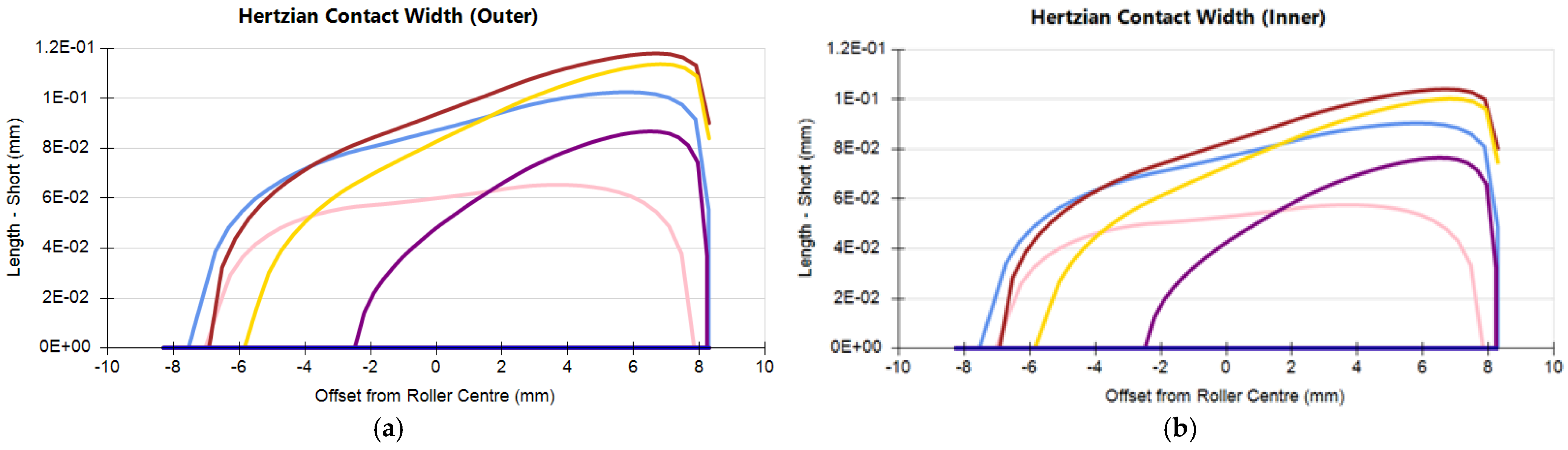
Analogous to the distribution trend of Hertzian contact width along the axis of the rolling components, Figure 26 depicts how the Hertzian contact widths vary along the axial direction for the rolling components interacting with the raceways. The largest Hertzian contact width on the inner raceway measures 0.0831 mm, while that on the outer raceway measures 0.1034 mm.

3.2.2. Simulation Results of Needle Roller Bearings

Figure 27 shows the distribution of load magnitudes around the circumference for the rolling components interacting with the inner and outer raceways. As observed, only a limited number of rolling elements engage simultaneously with both raceways at any given angular position. The contact forces at these positions are similar in magnitude, with the maximum force reaching approximately 4304 N. This pattern reflects the quasi-static assumptions of the model, where elastic deformation of the metallic components is present but small, and thus the engagement is partial yet sufficient to capture the overall load distribution.
Analogous to the pattern of force distribution, Figure 28 illustrates how contact length varies around the circumference for the rolling components interacting with the inner and outer raceways. The peak contact length measured on each of the inner and outer raceways is 16.17 mm.
Figure 29 depicts the peak contact width around the circumference for the rolling components interacting with the inner and outer raceways. The largest contact width on the outer raceway is 124.52 μm, while that on the inner raceway is 103.26 μm.
Figure 30 illustrates how peak contact pressure varies around the circumference for the rolling components interacting with the inner and outer raceways. The highest pressure values recorded on the outer and inner raceways are 2442 MPa and 2783 MPa, respectively.
Analogous to the force distribution pattern, Figure 31 illustrates how shear stress peaks vary around the circumference for the rolling components interacting with the inner and outer raceways. The highest shear stress values recorded on the outer and inner raceways are 728 MPa and 806 MPa, respectively.
In Figure 32, how contact pressure varies with axial position along the rolling components is shown. The distributions of contact pressure for the inner and outer raceways follow similar trends, both increasing from the ends toward the center. Because only some of the rolling components actually engage with the raceways while others do not, only a few curves have nonzero values and most remain at zero. In general, the pressure experienced at the interface with the inner raceway is somewhat greater than that with the outer raceway: the highest pressure on the inner raceway is 2713 MPa, while that on the outer raceway is 2411 MPa.
In summary, the contact stresses between the bearing and the raceways are below the allowable contact stress of the bearing steel used, and therefore satisfy the design requirements.
Analogous to how the normal stress varies along the rolling component axis, Figure 33 illustrates how shear stress changes with axial position for the rolling components interacting with the raceways. The highest shear stress associated with the inner raceway is 818 MPa, while that associated with the outer raceway is 726 MPa.
Therefore, the shear stresses between the bearing and the raceways are lower than the allowable contact stress of the bearing steel, and they meet the design requirements.
Following a similar trend to variations in Hertzian contact width along the rolling component axis, Figure 34 illustrates how these contact widths change along the axial direction for the rolling components interacting with the raceways. The largest Hertzian contact width measured on the inner raceway is 0.1345 mm, while that on the outer raceway is 0.1977 mm.

4. Results

This study presents an integrated framework combining theoretical modeling and MASTA-based parametric simulation to systematically investigate the contact mechanics and wear behavior of critical bearings (33006 tapered roller bearings and K35 × 55 × 21 needle roller bearings) in RV reducers, addressing the research gap of insufficient coupling analysis between bearing-level detailed characteristics and system-level transmission context. The key findings and contributions are summarized as follows: First, a static mechanics-based theoretical model was established for the RV reducer system, incorporating force analysis of crank arm bearings and crankshaft support bearings, and extending it to wear depth prediction by coupling contact pressure and sliding velocity. This model quantifies the load distribution, contact stress, and wear evolution of bearings under steady-state operating conditions, providing a rigorous theoretical basis for performance evaluation. For the tapered roller bearing, the maximum contact stresses on the inner and outer raceways at 500–2000 r/min are 1311–1336 MPa and 1336–1337.1 MPa, respectively; for the needle roller bearing, the corresponding values are 2027–2045 MPa and 2029.1–2029.6 MPa, all within the allowable stress range of bearing steel. The inner raceways of both bearings exhibit uniform wear (depth deviation < 2%), while the outer raceways show uneven wear due to non-uniform circumferential load distribution, with wear depth increasing linearly with rotational speed. Second, a high-fidelity parametric simulation model of the RV reducer was developed using MASTA software, accurately reproducing the two-stage transmission mechanism and bearing installation conditions. Cross-validation between theoretical and simulation results (deviation < 5% for key indicators such as contact stress and load distribution) confirms the reliability and accuracy of the theoretical model. The MASTA simulation further reveals detailed mechanical behaviors, including the axial distribution of contact pressure and shear stress, and the variation in Hertzian contact width, complementing the theoretical analysis with visualized and refined results. Third, the integrated approach of theoretical modeling and software simulation proposed in this study provides a reliable methodology for the performance assessment and life prediction of critical bearings in RV reducers. This framework avoids the limitations of single theoretical or simulation methods, enabling comprehensive analysis of contact mechanics and wear behavior that is difficult to achieve through experimental means alone—especially given the closed and complex structure of RV reducers, which makes part-level dynamic testing of internal bearings technically unfeasible.

5. Conclusions

An integrated theoretical and MASTA-based simulation framework is presented to assess the contact mechanics and wear behavior of critical bearings in RV reducers. This framework enables systematic evaluation of load distribution, contact stress, and wear trends, providing a reliable tool for performance assessment. It supports cross-validation with engineering software, offers guidance for design optimization, and lays the foundation for future experimental verification, and for practical improvements in bearing performance and service life.
The current model assumes quasi-static operating conditions and does not fully capture dynamic effects such as start–stop cycles, reversing loads, and inertial forces; the wear model uses a constant wear coefficient without accounting for changes caused by temperature rise or lubrication degradation; and the uniform deformation assumption for crankshaft bearings applies only to new reducers and does not account for load redistribution caused by wear-induced clearances. In addition, the internal contact forces have not been fully validated experimentally, which represents another limitation of this study. Future work will focus on conducting experimental validation through accelerated wear tests on complete RV reducers and 3D profilometry of bearing raceways to further improve the model’s accuracy and engineering applicability. The findings of this study provide valuable guidance for the design optimization, reliability enhancement, and service life extension of RV reducers in industrial robot applications.

Author Contributions

Methodology, W.K. and J.H.; software, W.K. and G.Q.; validation, W.K. and G.Q.; formal analysis, W.K. and J.H.; writing—original draft preparation, W.K. and J.H.; writing—review and editing, X.L.; visualization, W.K. and G.Q.; supervision, X.L.; project administration, X.L.; funding acquisition, X.L. All authors have read and agreed to the published version of the manuscript.

Funding

This work is supported by the National Natural Science Foundation of China (Grants No. 52005354).

Data Availability Statement

The original contributions presented in this study are included in the article. Further inquiries can be directed to the corresponding author.

Acknowledgments

The authors would like to express their sincere gratitude to Smart Manufacturing Technology (SMT) Company for providing the MASTA software, which played a crucial role in the parametric modeling, simulation analysis, and performance evaluation of the RV reducer in this study.

Conflicts of Interest

The authors declare no conflicts of interest.

Nomenclature

F i Contact normal force at the roller–cycloid interface F u i Frictional force at the roller–cycloid interface
F R Resultant contact force of roller l i Lever arm length from cycloid disc center to force line
e Eccentricity of the cycloidal disc z 2 Number of cycloidal disc lobes
r b g Radius of the circle on which crankshaft holes are positioned on the cycloidal wheel n Total number of crankshafts mounted to the cycloidal wheel
F b 1 Tangential component F b 2 Horizontal component
F b 3 Vertical component F B 1 Resultant force exerted by the cycloidal wheel on the crankshaft bearings
F B 1 X X-component of the resultant force F B 1 F B 1 Y Y-component of the resultant force F B 1
α i Orientation angle of the i-th crankshaft hole relative to the X-axis F p r k Radial force applied to the involute planetary gear along the distribution circle
F p t k Tangential force applied to the planetary gear along the distribution circle α k Pressure angle of the involute gear set
T s Actual input torque applied to the sun gear N Number of planetary gears
r s Pitch circle radius of the sun gear T s t Theoretical input torque
z p Total count of teeth on the planetary gear z s Total count of teeth on the sun gear
z c Total count of teeth on the cycloidal gear T d External torque applied to a single cycloidal gear
F q r 1 Radial component of the force at point A from the planet carrier F q r 2 Radial component of the force at point E from the planet carrier
F q t 1 Tangential component of the force at point A from the planet carrier F q t 2 Tangential component of the force at point E from the planet carrier
F q r y 1 Component of F q r 1 along the eccentric direction of the cycloidal gear F q r y 2 Component of F q r 2 along the eccentric direction of the cycloidal gear
F q r x 1 Component of F q r 1 perpendicular to the eccentric direction of the cycloidal gear F q r x 2 Component of F q r 2 perpendicular to the eccentric direction of the cycloidal gear
a Distance from the planetary gear center to the front planet carrier center b Distance from the front planet carrier center to the first cycloidal gear center
c Distance from the first cycloidal gear center to the second cycloidal gear center d Distance from the second cycloidal gear center to the rear planet carrier center
r p Pitch circle radius of the involute sun gear β i Angle subtended by F b 1 and F b 3 on the i crankshaft.
F q j p r 1 Radial component of the force at point A along the direction of F p r k derived from moment equilibrium F q j p r 2 Radial component of the force at point E along the direction of F p r k , complementary to F q j p r 1
F R 1 Resultant radial force on the crankshaft support bearing at point A F R 2 Resultant radial force on the crankshaft support bearing at point E
F T 1 Resultant tangential force on the crankshaft support bearing at point A F T 2 Resultant tangential force on the crankshaft support bearing at point E
F H 1 Total external resultant force on the crankshaft support bearing at point A, combining radial and tangential components F H 2 Total external resultant force on the crankshaft support bearing at point E, combining radial and tangential components
R im Outer radius of the inner raceway α f Angle formed by the conical rib of the inner raceway and the vertical axis
α i Inner contact angle α e Outer contact angle
μ o Angle formed by the normal vector at point D and the axis of the roller r f Radius of the circle passing through point D
D 1 Outer diameter of the rolling element D 2 Inner diameter of the rolling element
d i Inner diameter of the bearing d o Outer diameter of the bearing
l F B Axial distance from the roller axis intersection at point F to the contact point with the inner ring rib z f The horizontal separation from C to point D
r i Radius of the inner ring of the bearing δ r x   δ r y   δ r z Translational displacement of the inner ring along the x-axis, the y-axis and the z-axis
θ r x   θ r y Rotational displacement of the inner ring around the x-axis and the y-axis F r x   F r y   F r z Force on the inner ring along the x-axis, the y-axis and the z-axis
M r x   M r y Moment on the inner ring about the x-axis and the y-axis x Local coordinate along the roller generatrix
ξ Normalized coordinate along the roller generatrix L r Roller generatrix length
Q i   Q e Equivalent contact force on the inner raceway and the outer raceway M i   M e Equivalent moment at the inner raceway and the outer raceway
Q f Contact force at the roller–inner ring rib interface F c Centrifugal force due to roller orbital motion
M g Inertial moment due to roller self-rotation η   ζ Centroid displacement of the roller in translational motion
θ r Rotational displacement of the roller ψ j Angular displacement of the j-th roller along the normal direction
β r x   β r y Inner ring rotation along x-axis and the y-axis r j Roller pitch radius
r l Roller radial clearance z Roller profile modification factor
f 1   f 2 Logarithmic profile modification parameter θ r Roller deflection angle
ω c Rotational angular velocity of the cage m Roller mass
θ x r f   θ y r f Rotational displacement of the roller around x-axis and y-axis at the contact point μ 0 Initial angle offset in contact geometry
Q i j / e j Contact force between the roller and inner/outer raceway along line contact K n Stiffness coefficient in Hertzian contact theory
K f Stiffness coefficient for point contact V ( ψ j ) Function of local deformation at the j-th roller
ω ( ψ j ) Function related to roller rotation/angular displacement d L Relative sliding distance at the contact point
d V Local wear volume in the contact region d Q Local contact load at the contact point
k Wear coefficient K Dimensionless wear coefficient used to compute k
H Material hardness of the bearing steel d h Local wear depth at the contact area
p Contact stress at the contact point δ ( i q e q ) n Elastic displacement at the midpoint of the q-th rectangular element
Δ l Segment length along the roller generatrix a i q / e q Half-width of contact at the q-th rectangular element
D q Roller diameter at the q-th rectangular element p max , q Maximum contact pressure at the centroid of the q-th rectangular element
p q x i / e , y i / e Contact pressure at any position y within the q-th rectangular element ω i Angular velocity of the inner ring
ω b Spin rate of each roller around its own axis r b Roller radius after crowning for the q-th rectangular element
r e Distance from the bearing axis to the outer raceway at a given roller position r e r a c e w a y Radial distance from the bearing axis to a point along the outer raceway at coordinate ξ
r i r a c e w a y Radial distance from the bearing axis to a point along the inner raceway at coordinate ξ v i Differential sliding velocity at any point along the inner raceway within the roller–raceway contact region
v e Differential sliding velocity at any point along the outer raceway within the roller–raceway contact region V ¯ q Wear volume per unit time for the q-th rectangular element within the roller–raceway contact region
T Total service time of the bearing Z Number of rollers in the bearing
h e q Wear depth of the q-th rectangular segment on the outer raceway S e q Circumferential surface area associated with the q-th rectangular segment on the outer raceway
h i q Wear depth of the q-th rectangular segment on the inner raceway S i q Circumferential surface area associated with the q-th rectangular segment on the inner raceway

References

  1. Chen, Y.; Dong, F. Robot machining: Recent development and future research issues. Int. J. Adv. Manuf. Technol. 2013, 66, 1489–1497. [Google Scholar] [CrossRef]
  2. Wang, J.; Lv, H. Modification and optimization of cycloidal gear tooth profile based on machining error compensation. Appl. Sci. 2023, 13, 2581. [Google Scholar] [CrossRef]
  3. Hidaka, T.; Wang, H.-Y.; Ishida, T.; Matsumoto, K.; Hashimoto, M. Rotational transmission error of K-H-V planetary gears with cycloid gear: 1st report, analytical method of the rotational transmission error. Trans. Jpn. Soc. Mech. Eng. Ser. C 1994, 60, 645–653. [Google Scholar] [CrossRef]
  4. Ishida, T.; Wang, H.; Hidaka, T. Rotational transmission error of K-H-V planetary gears with cycloid gear (2nd report, effects of manufacturing and assembly errors on rotational transmission error). Trans. Jpn. Soc. Mech. Eng. Ser. C 1994, 60, 3510–3517. [Google Scholar] [CrossRef]
  5. Blanche, J.G.; Yang, D.C.H. Cycloid drives with machining tolerances. J. Mech. Trans. Autom. Sep. 1989, 111, 337–344. [Google Scholar] [CrossRef]
  6. Yang, D.C.H.; Blanche, J.G. Design and application guidelines for cycloid drives with machining tolerances. Mech. Mach. Theory 1990, 25, 487–501. [Google Scholar] [CrossRef]
  7. Bruzzone, F.; Rosso, C.; Theodossiades, S. Dynamic reduction technique for nonlinear analysis of spur gear pairs. Nonlinear Dyn. 2024, 112, 15797–15811. [Google Scholar] [CrossRef]
  8. Kim, K.H.; Lee, S.J.; Choi, S.H. Torsional rigidity of a two-stage cycloid drive. Trans. Korean Soc. Mech. Eng. A 2009, 33, 1217–1224. [Google Scholar] [CrossRef][Green Version]
  9. Zhang, Y.H.; Zhuo, C.; He, W.D. Virtual prototype simulation and transmission error analysis of RV reducers based on multibody dynamics theory. Appl. Mech. Mater. 2015, 789–790, 226–230. [Google Scholar] [CrossRef]
  10. Jin, S.-S.; Tong, X.-T.; Wang, Y.-L. Influencing factors on RV reducer dynamic transmission error using virtual prototype. Int. J. Autom. Technol. 2019, 13, 545–556. [Google Scholar] [CrossRef]
  11. Zhang, R.H.; Zhou, J.X.; Wei, Z. Study on transmission error and torsional stiffness of RV reducer under wear. J. Mech. Sci. Technol. 2022, 36, 4067–4081. [Google Scholar] [CrossRef]
  12. Li, X.; Chen, B.K.; Li, C.Y. Dynamic modelling and contact analysis of bearing-cycloid-pinwheel transmission mechanisms used in joint rotate vector reducers. Mech. Mach. Theory 2019, 139, 87–98. [Google Scholar] [CrossRef]
  13. Tao, Y.; Liu, H.; Wu, M.; Zheng, N.; Pei, J. The effect of cycloid gear wear on the transmission accuracy of the RV reducer. Machines 2024, 12, 511. [Google Scholar] [CrossRef]
  14. Zhang, K.; Guo, C.; Li, Y.; Su, Y.; Zhang, B.; Gao, P. Contact analysis for cycloid pinwheel mechanism by isogeometric finite element. Coatings 2023, 13, 2029. [Google Scholar] [CrossRef]
  15. Qi, L.; Yang, D.; Cao, B.; Li, Z.; Liu, H. Design principle and numerical analysis for cycloidal drive considering clearance, deformation, and friction. Alex. Eng. J. 2024, 91, 403–418. [Google Scholar] [CrossRef]
  16. Li, X.; Huang, J.; Ding, C.; Guo, R.; Niu, W. Dynamic modeling and analysis of an RV reducer considering tooth profile modifications and errors. Machines 2023, 11, 626. [Google Scholar] [CrossRef]
  17. Ahn, H.J.; Choi, B.M.; Lee, Y.H.; Pham, A.D. Impact analysis of tolerance and contact friction on an RV reducer using the finite element method. Int. J. Precis. Eng. Manuf. 2021, 22, 1285–1292. [Google Scholar] [CrossRef]
  18. Pang, X.; Liu, Q.; Guo, Y. Research on RV reducer shaft bearing force and load distribution analysis. Lubricants 2025, 13, 182. [Google Scholar] [CrossRef]
  19. Gao, S.; Zhang, Y.; Ji, S.; Wang, X.; Li, Y. Optimized design for crankshaft bearing of RV reducer based on genetic algorithm. J. Mech. Sci. Technol. 2025, 39, 1915–1928. [Google Scholar] [CrossRef]
  20. Xu, L.; Xia, C.; Chang, L. Dynamic modeling and vibration analysis of an RV reducer with defective needle roller bearings. Eng. Fail. Anal. 2024, 157, 107884. [Google Scholar] [CrossRef]
  21. Cui, Z.; Yang, X.; Han, Z.; Guan, J.; Li, R.; Meng, X. Fatigue life analysis of RV reducer crankshaft considering material inclusions. Int. J. Fatigue 2025, 200, 109127. [Google Scholar] [CrossRef]
  22. Zhang, Y.; Shi, X.; Tian, W. Study on wear of tapered roller bearing under different service conditions. J. Mech. Strength 2025, 47, 123–133. [Google Scholar] [CrossRef]
Figure 1. Geometric model and mechanism diagram of the RV reducer. 1—Sun gear; 2—Planet gear; 3—Crankshaft; 4—Cycloidal discs; 5—Pin gears; 6—Front planetary carrier; 7—Rear planetary carrier; 8—Tapered roller bearing; 9—Angular contact ball bearing; 10—Needle roller bearing.
Lubricants 14 00141 g001
Figure 2. Force analysis of cycloidal wheel and crankshaft system: (a) Cycloidal–pin force analysis; (b) Cycloidal–crankshaft force analysis.
Lubricants 14 00141 g002
Figure 3. Force analysis diagram of involute planetary gear transmission.
Lubricants 14 00141 g003
Figure 4. Crankshaft force diagram.
Lubricants 14 00141 g004
Figure 5. Geometrical schematic of roller bearing structure.
Lubricants 14 00141 g005
Figure 6. Force–displacement schematic of roller bearings: (a) end face view and (b) axial view.
Lubricants 14 00141 g006
Figure 7. Force–displacement schematic of rolling elements.
Lubricants 14 00141 g007
Figure 8. Flowchart of the cycloidal pinwheel tooth wear calculation.
Lubricants 14 00141 g008
Figure 9. Geometrical kinematic relationship of the roller bearing.
Lubricants 14 00141 g009
Figure 10. Contact forces: (a) between the roller and the inner race; (b) between the roller and the outer race; (c) along the inner raceway contact line; (d) along the outer raceway contact line.
Lubricants 14 00141 g010aLubricants 14 00141 g010b
Figure 11. Contact stress: (a) along the inner raceway contact line; (b) along the outer raceway contact line.
Lubricants 14 00141 g011
Figure 12. Relative slip velocity: (a) between the roller and the inner raceway; (b) between the roller and the outer raceway.
Lubricants 14 00141 g012
Figure 13. Wear depth: (a) Wear depth of the roller and inner raceway contact; (b) Wear depth of the roller and outer raceway contact; (c) along the generatrix of the inner raceway; (d) along the generatrix of the outer raceway.
Lubricants 14 00141 g013aLubricants 14 00141 g013b
Figure 14. Contact forces: (a) between the roller and the inner race; (b) between the roller and the outer race; (c) along the inner raceway contact line; (d) along the outer raceway contact line.
Lubricants 14 00141 g014aLubricants 14 00141 g014b
Figure 15. Contact stress: (a) along the inner raceway contact line; (b) along the outer raceway contact line.
Lubricants 14 00141 g015
Figure 16. Relative slip velocity: (a) between the roller and the inner raceway; (b) between the roller and the outer raceway.
Lubricants 14 00141 g016
Figure 17. Wear depth: (a) Wear depth of the rolling element and inner raceway contact; (b) Wear depth of the rolling element and outer raceway contact; (c) along the generatrix of the inner raceway; (d) along the generatrix of the outer raceway.
Lubricants 14 00141 g017aLubricants 14 00141 g017b
Figure 18. RV reducer model: (a) Two-dimensional sectional view; (b) Three-dimensional schematic diagram.
Lubricants 14 00141 g018
Figure 19. Circumferential contact force distribution between the roller and raceways: (a) Outer raceway; (b) Inner raceway.
Lubricants 14 00141 g019
Figure 20. Circumferential contact length distribution between the roller and raceways: (a) Outer raceway; (b) Inner raceway.
Lubricants 14 00141 g020
Figure 21. Maximum contact width distribution of the roller and raceways along the circumferential direction: (a) roller—outer raceway; (b) roller—inner raceway.
Lubricants 14 00141 g021
Figure 22. Shear stress distribution of the roller and raceways along the circumferential direction: (a) roller—outer raceway; (b) roller—inner raceway.
Lubricants 14 00141 g022
Figure 23. Normal stress distribution of the roller and raceways along the circumferential direction: (a) roller—outer raceway; (b) roller—inner raceway.
Lubricants 14 00141 g023
Figure 24. Normal stress distribution of the roller and raceways along the axial direction: (a) roller—outer raceway; (b) roller—inner raceway.
Lubricants 14 00141 g024
Figure 25. Shear stress distribution of the roller and raceways along the axial direction: (a) roller—outer raceway; (b) roller—inner raceway.
Lubricants 14 00141 g025
Figure 26. Hertzian contact width distribution of the roller and raceways along the axial direction: (a) roller—outer raceway; (b) roller—inner raceway.
Lubricants 14 00141 g026
Figure 27. Contact force distribution of the roller and raceways along the circumferential direction: (a) roller—outer raceway; (b) roller—inner raceway.
Lubricants 14 00141 g027
Figure 28. Contact length distribution of the roller and raceways along the circumferential direction: (a) roller—outer raceway; (b) roller—inner raceway.
Lubricants 14 00141 g028
Figure 29. Maximum contact width distribution of the roller and raceways along the circumferential direction: (a) roller—outer raceway; (b) roller—inner raceway.
Lubricants 14 00141 g029
Figure 30. Normal stress distribution of the roller and raceways along the circumferential direction: (a) roller—outer raceway; (b) roller—inner raceway.
Lubricants 14 00141 g030
Figure 31. Shear stress distribution of the roller and raceways along the circumferential direction: (a) roller—outer raceway; (b) roller—inner raceway.
Lubricants 14 00141 g031
Figure 32. Normal stress distribution of the roller and raceways along the axial direction: (a) roller—outer raceway; (b) roller—inner raceway.
Lubricants 14 00141 g032
Figure 33. Shear stress distribution of the roller and raceways along the axial direction: (a) roller—outer raceway; (b) roller—inner raceway.
Lubricants 14 00141 g033
Figure 34. Hertzian contact width distribution of the roller and raceways along the axial direction: (a) roller—outer raceway; (b) roller—inner raceway.
Lubricants 14 00141 g034
Table 1. Tapered Roller Bearing: 33006.
ParameterValueUnit
Inner diameter30mm
Outer diameter55mm
Width20mm
Rated static load capacity58.8kN
Grease lubrication speed6300r/min
Oil lubrication speed8000r/min
Table 2. Needle Roller Bearing: K35 × 55 × 21.
ParameterValueUnit
Inner diameter35mm
Outer diameter55mm
Width20mm
Rated static load capacity62.9kN
Grease lubrication speed9000r/min
Oil lubrication speed10,000r/min
Table 3. Main Design Parameters.
ParameterValueUnit
Module1.5mm
Number of teeth of the sun gear17-
Modification coefficient of the sun gear0.5892-
Face width of the sun gear15mm
Number of teeth of the planet gear61-
Modification coefficient of the planet gear0.5-
Face width of the planet gear12mm
Center distance60mm
Number of teeth of the cycloidal gear39-
Face width of the cycloidal gear20mm
Eccentricity2mm
Tooth profile modification (shift amount)0.003mm
Tooth profile modification (equal-distance amount)0.004mm
Number of pins40-
Radius of pin teeth4mm
Radius of pin-tooth distribution circle111.5mm
Length of pin teeth40mm
Radius of crank hole distribution circle60mm
Table 4. Material properties of the RV reducer components.
ComponentElastic Modulus (MPa)Density (kg/m3)Poisson’s Ratio
Input Sun Gear212,00078600.289
Planet Gear212,00078600.289
Planet Carrier211,00078700.277
Crankshaft219,00078300.300
Cycloidal Wheel219,00078300.300
Pin Gear211,00078700.277
Pin Wheel211,00078700.277
Disclaimer/Publisher’s Note: The statements, opinions and data contained in all publications are solely those of the individual author(s) and contributor(s) and not of MDPI and/or the editor(s). MDPI and/or the editor(s) disclaim responsibility for any injury to people or property resulting from any ideas, methods, instructions or products referred to in the content.