Article

Nonlinear Analysis of Dynamic Behavior in a High-Precision Mechanism with a Revolute Clearance Joint

1
School of Mechanical Engineering, Jiangsu University of Technology, Changzhou 213001, China
2
School of Mechanical Engineering, Nanjing University of Science and Technology, Nanjing 210094, China
3
School of Mechanical Engineering, Jiangsu University, Zhenjiang 212013, China
*
Author to whom correspondence should be addressed.
Lubricants 2026, 14(3), 122; https://doi.org/10.3390/lubricants14030122
Submission received: 13 February 2026 / Revised: 9 March 2026 / Accepted: 10 March 2026 / Published: 12 March 2026
(This article belongs to the Special Issue Advances in Tribology and Lubrication for Bearing Systems)

Abstract

Collision and wear are common phenomena in revolute clearance joints, caused by the positional deviation between the journal and bearing centers. The freedom of motion and contact–impact characteristics are reflected in the mechanism’s movement. The penetration behavior of the clearance joint is described using modified elastic contact model combined with Coulomb’s friction. In addition, the dynamic model of a high-precision mechanism with a clearance joint is established using Largrange’s equation. A dynamic performance experiment is also conducted. The results prove the validity of the proposed method. The kinematic accuracy of this mechanism is then used to evaluate the stability and motion error in a case study. Furthermore, the influence of the clearance joint on the dynamic behavior of the high-precision mechanism is thoroughly analyzed. The results show that the fluctuation range of the slider’s dynamic repeated precision for slider is only 0.022 mm under high-speed conditions, meeting the design requirement.

1. Introduction

High-frequency contact changes the clearance value of the revolute joint. In addition, the expansion of the motion space increases the nonlinear characteristics of mechanism, especially in actual machine production [1,2,3,4,5]. A topical issue is the influence of the clearance joint on the motion trajectory of the mechanism under different working conditions. The dynamic accuracy prediction of high-precision mechanisms is an essential evaluation factor in machine design [6,7,8,9,10]. In addition, the expression of the contact feature and the modeling methods of mechanical systems should be further developed to represent the performance and trajectory of the mechanism.
The description of contact–impact feature is the first important issue in the dynamic analysis of mechanisms with revolute clearance joints [11,12,13]. Machado [14] compared the expression of normal force model, which illustrates the applied force between solids during the collision process. It was revealed that deformation and energy loss were related to the parameters of the contact elements. For low coefficient-of-restitution impact, Gharib [15] built a restitution coefficient model based on Newton’s model, Poisson’s model and the energetic model. Momentum transmission was used to describe the impulse–velocity relationship. Wang and Li [16] described the clearance joint using a spring-damping model. The deformation of the mass-spring was defined as the impact penetration, and the rebound characteristics were determined by the damping coefficient. Considering the energy balance law, Hu [17] represented the impact process with the restitution coefficient. The relationship between penetration value and restitution velocity was given, which was used as the variable for the damping coefficient. Alves [18] studied the viscoelastic contact characteristics of solids. The effects of the restitution coefficient on the hysteresis damping factor were shown, providing a reference for the contact force model. Based on the finite element method, Tian [19] described the contact between solids by elastic deformation elements, and a hemispherical lubricant was assumed in the clearance joint to represent the elastohydrodynamic behavior of the lubricated joint. For dissipative contact features, Li [20] introduced an equivalent damping factor into the contact force model, which improved the suitability of the damping coefficient. According to nonlinear contact theory, Li [21] presented the relative positional relationship of clearance joint elements using a finite element methodology. The superiority and practicality of the proposed method were demonstrated in a case study. Based on the Gauss distribution function, the surface micro-structure feature was introduced into the contact solids by Cui [22], and the contact force was illustrated using the Greenwood–Williamson model. The simulation results displayed the transient dynamic response in high-frequency collisions.
In addition, the modeling methods of multibody systems with clearance joints have received more attention [23,24,25,26]. Chen [27,28] built the constraint equation of a spherical clearance joint using the L-N contact model, and the 4UPS-RPS system was obtained by the Newton–Euler equation. The results illustrated that vibration and chaos of the mechanism would be caused by the clearance joint. Considering the influence of time-varying load, Xiao [29,30] expanded the modeling method of a double-slider-crank mechanism with a translational joint. The dynamic equations were given, and the vibration response of the mechanism was revealed. A 3D clearance joint was introduced into the kinematic model of a multibody system by Bai [31,32]. The axial deviation of the clearance joint was described in two local coordinated systems, and the motion state of the multibody system was identified by the relative displacement. Based on the LuGre friction law, Tan [33] revised the friction force model and built the dynamic equations of a slider-crank mechanism using Lagrange’s equations. Simulation results and experiment test represented the dynamic stabilization of the mechanism, which is a key element in mechanism failure. Farahan [34] investigated the dynamic response of a four-bar mechanism with a clearance joint, and the dynamic model was solved using the Runge–Kutta approach. The results were analyzed using the fast Fourier transformation method, and the frequency spectrum of the mechanism revealed the bifurcation characteristics. Zhao [35] developed error modeling for a multi-closed-loop deployable mechanism, and the angle error was added to the kinematic equation. The case study illustrated that link deviation would appear due to the clearance, and impact force existed during the motion of the mechanism. Qian [36] proposed an interesting analysis approach for predicting the stability and accuracy of a planar multibody system with a clearance joint. According to information entropy theory, singular spectrum entropy was used to predict the probability distribution of motion error. Then, the complex contact–impact feature was explained, and the nonlinear evaluation of the mechanism could be obtained. Wang [37] conducted a comparative study of planar multibody systems. The experiment test showed the fluctuation characteristics of mechanisms with clearance joints, and a smaller clearance size alleviated the stronger amplitude and frequency in the inflection point.
Compared with the demonstration model, the high-precision mechanism in a press system has distinct characteristics. Actual industrial products should maintain a stable motion trajectory under complex working conditions. However, traditional evaluation models cannot be provide an accurate prediction for high-precision mechanisms in press systems. This work focuses on demonstrating and comparing the influence of the clearance joint on the dynamic behavior of high-precision mechanisms. Based on viscoelastic constitutive contact theory, modified contact force and friction models are presented. Moreover, the contact characteristics of clearance joints are embedded into the dynamic expressions of the high-precision mechanism, which are established by the Largrangian method. Then, the engineering application is taken into account to represent the motion trajectory of this mechanism, and the influence prediction of parameters can also be conducted and discussed.

2. Mathematical Model of Mechanism

2.1. Model of Contact and Friction

The contact and friction phenomena can be found in the clearance joint, and it is necessary to calculate the motion accuracy of the mechanism. The motion state of the journal and bearing is shown in Figure 1. It is clear that the relationship between the journal and bearing can be described as separation or contact [38,39,40]. During the contact of the solids, deformation appears at the contact point. Therefore, the distance between the journal center and the bearing center can be used to distinguish the motion state and penetration ( δ ), which is given as
e i j = r j O r i O
n = e i j / e i j
δ = e c
where e i j denotes the eccentric vector of journal and bearing, which is related to the eccentricity (e) and clearance (c).
When the contact and impact phenomena appear, the penetration is caused by the contact force [41,42]. The dissipative contact force model can be used to describe the dynamic response of contact solids, which comprises stiffness ( K n ) and the damping coefficient (D). It is noteworthy that energy loss can be described by the hysteresis damping factor [14,43]. Then, the expression is defined as
F n = K n δ 1.5 + D δ ˙
K n = 4 3 σ i + σ j R i R j R i R j
σ k = 1 υ m 2 E m           ( m = i , j )
D = 3 K n 1 c e 2 4 δ ˙ δ 1.5
where E m is the elastic modulus of the contact solids, which is determined by the values for the journal ( E i ) and the bearing ( E j ). υ m is Poisson’s ratio, and c e denotes the restitution coefficient. δ ˙ is the initial impact velocity.
Then, contact force model is rewritten as
F n = K n δ 1.5 1 + 3 1 c e 2 δ ˙ 4 δ ˙
In the tangential direction, the contact solids exhibit friction characteristics during the collision. Based on Coulomb’s friction theory, the friction force model is given as
F t = c f c d F n v t υ t
where c f is the friction coefficient, and υ t is the relative tangential velocity. c d denotes the dynamic correction coefficient, which is limited by the tolerances of the tangential velocity ( ν 0 and ν 1 ). It is given as
c d = 0                                 i f             υ t υ 0         υ t υ 0 υ 1 υ 0         i f       υ 0 υ t υ 1 1                             i f               υ t υ 1

2.2. Mechanical Equilibrium Equation

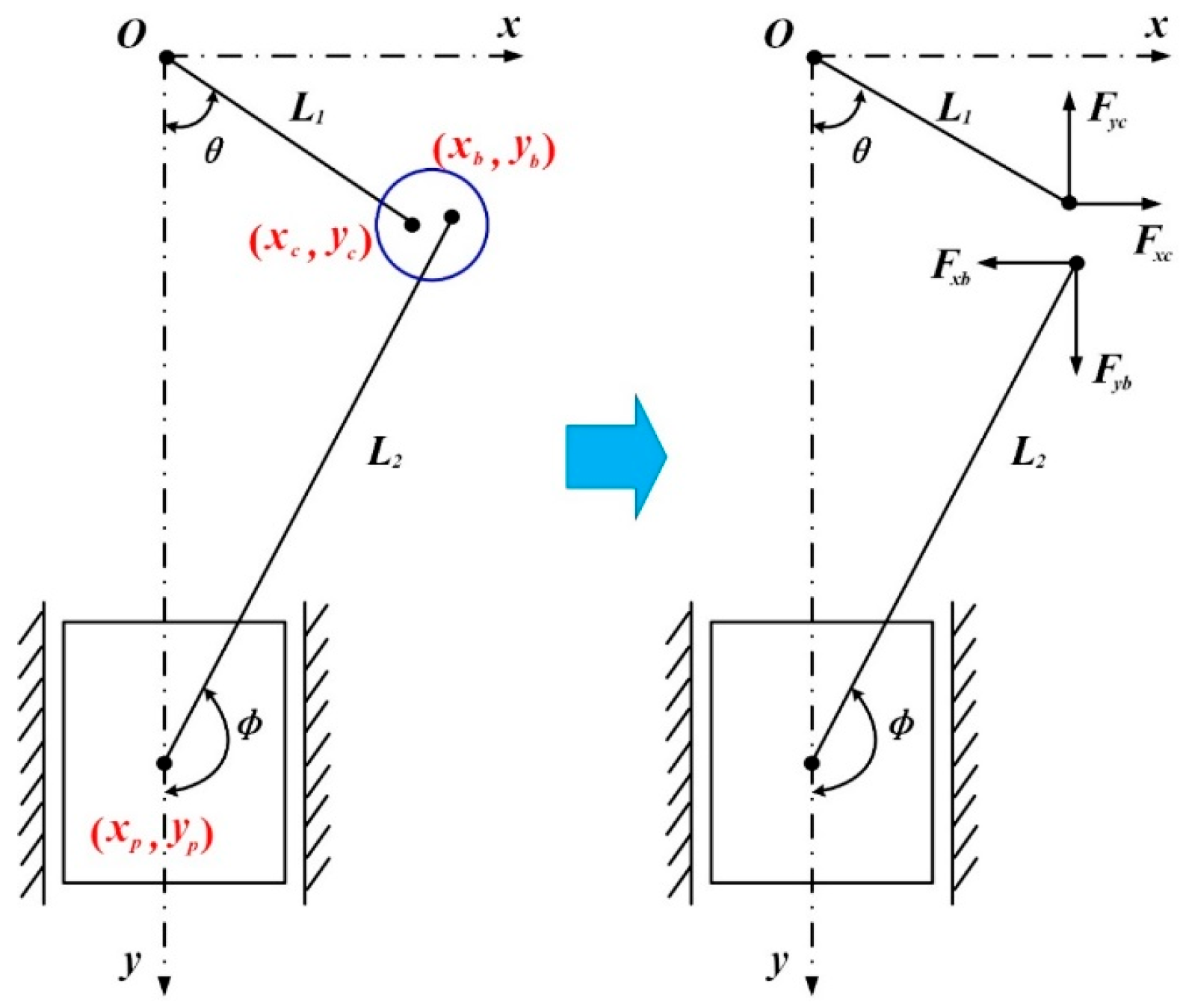
Figure 2 shows the schematic of the mechanism with a revolute clearance joint. A clearance joint is defined between the crank and the connecting rod, and the position of the slider changes during the motion [44]. The kinematic relationship can be expressed as
x c = L 1 s i n θ y c = L 1 c o s θ
x ˙ c = L 1 θ ˙ c o s θ y ˙ c = L 1 θ ˙ s i n θ
x ¨ c = L 1 θ ¨ c o s θ L 1 θ ˙ 2 s i n θ y ¨ c = L 1 θ ¨ s i n θ L 1 θ ˙ 2 c o s θ
I c θ ¨ = F x c L 1 c o s θ + F y c L 1 s i n θ T f
where L 1 is the length of the crank, and θ is the rotation angle of the crank. The position of the clearance joint (point c) can be expressed by xc and yc. Ic is the inertia of the crank. T f is the friction torque.
The geometrical parameters of the slider and the clearance joint are shown as
y p = L 1 c o s θ L 2 c o s y ˙ p = L 1 θ ˙ s i n θ + L 2 ˙ s i n y ¨ p = L 1 θ ¨ s i n θ L 1 θ ˙ 2 c o s θ + L 2 ¨ s i n + L 2 ˙ 2 c o s
x b = L 2 s i n y b = y p + L 2 c o s
x ˙ b = L 2 ˙ c o s y ˙ b = y ˙ p L 2 ˙ c o s
x ¨ b = L 2 ¨ c o s + L 2 ˙ 2 s i n y ¨ b = y ¨ p L 2 ¨ s i n s L 2 ˙ 2 c o s
where L2 and are the length and the rotation angle of the connecting rod.
Then, velocity characteristics of the slider and the connecting rod can be given as
x ˙ b y ˙ b y ˙ p ˙ 4 × 1 = 0 L 2 c o s 1 L 2 s i n 1 0 0 1 4 × 2 y ˙ p ˙ 2 × 1
And the kinetic energy equation of the mechanism is established by
T = 1 2 y ˙ p       ˙ K T M K y ˙ p ˙
where K 4 × 2 and M 4 × 4 are the velocity-coefficient matric and the mass matrix, which are defined as
K = 0 L 2 c o s 1 L 2 s i n 1 0 0 1
M = m 2 0 0 0 0 m 2 0 0 0 0 m p 0 0 0 0   I 2
where m 2 and m p are the masses of the connecting rod and the slider.   I 2 denotes the moment of inertia of the connecting rod.
Considering the effects of the element masses, the potential energy of this mechanism is given by
V = m p g y p 1 2 m 1 g L 1 c o s θ 1 2 m 2 g y p L 2 c o s k
tan = L 2 sin k L 1 cos θ y p L 1 cos θ L 1 cos k
Then, the motion equation of the high-precision mechanism is expressed as
d d t T V q i ˙ T V q i = Q i n c
where q i and Q i n c are the ith independent coordinate component and the generalized force component.
Considering the influence of slider acceleration, the dynamic equation of the mechanism is written using the Lagrange method [45]:
m p + m 2 L 2 m 2 s i n L 2 m 2 s i n     I 2 + L 2 2 m 2 y ¨ p ¨ + 0 ˙ L 2 m 2 c o s 0 0 y ˙ p ˙ = F y b F e F x b L 2 c o s F y b L 2 s i n
where F e is the external load.

3. Dynamic Response Analysis

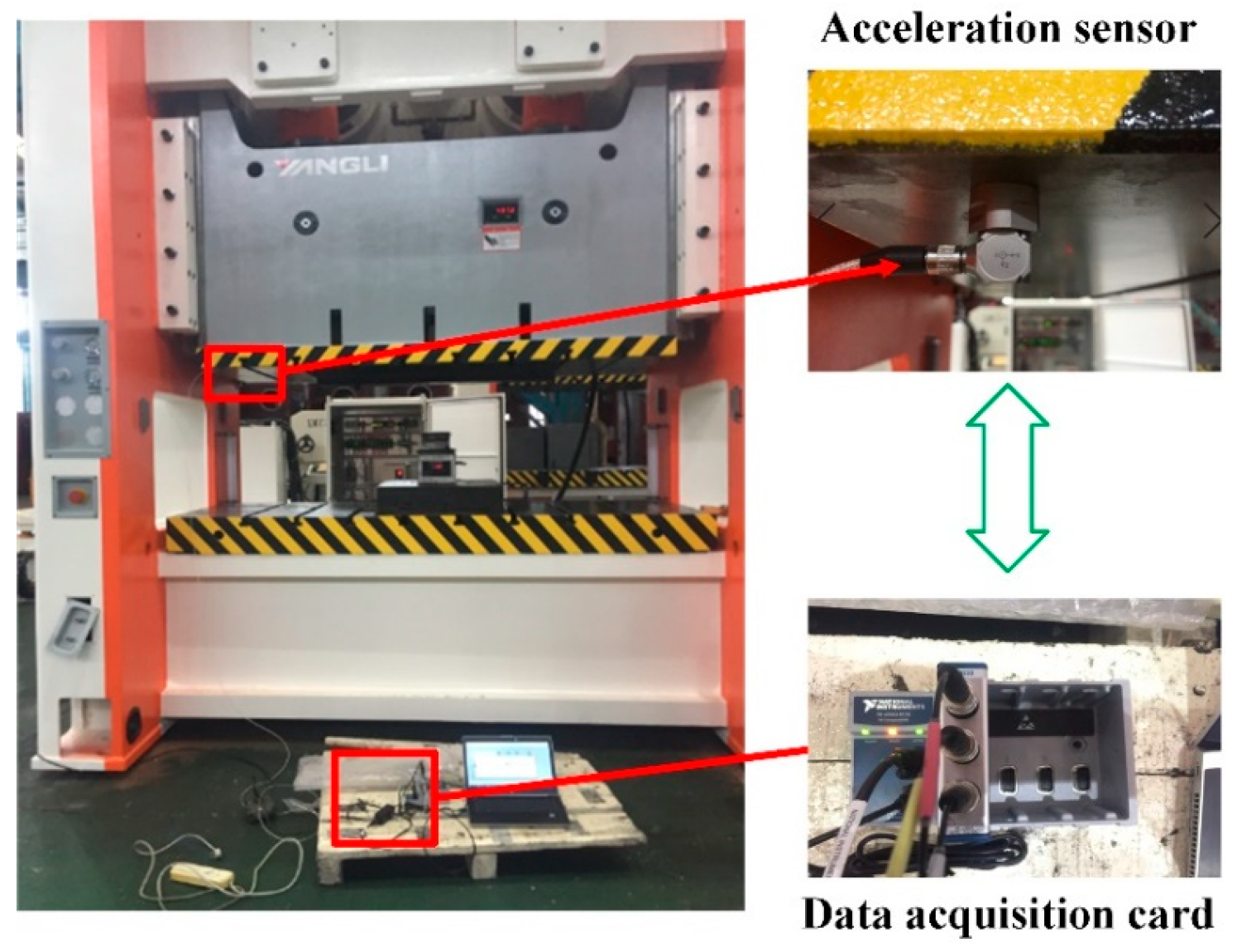
High-precision press systems are used to manufacture precision components, and the transmission mechanism can illustrate the effects of the clearance joint on the motion trajectory of multibody systems. The structure parameters of this mechanism should be listed by length (L1 = 0.015 m, L2 = 0.35 m) and mass (mcrank = 453.87 kg, mrod = 412.53 kg and mslider = 2700.71 kg). The density (7800 kg/m3), Poisson’ ratio (0.3) and restitution coefficient (0.9) are defined as the material parameters of the elements. The contact parameters include the maximum damping coefficient (0.1), the maximum penetration value (0.1 mm) and the friction coefficient (0.1). The restitution, damping and friction coefficients are taken from published data [20,43]. In Figure 3, the dynamic response experiment is conducted on the mechanism, and the slider acceleration is collected at different rotational speeds. The acceleration sensor (KISTLER) is installed below the slider, and the data cable is connected with the data acquisition card (NI). The data acquisition system is built in Labview, which performs filtering and noise reduction. Significantly, the acceleration sensor should satisfy the requirement of the maximum measuring range.
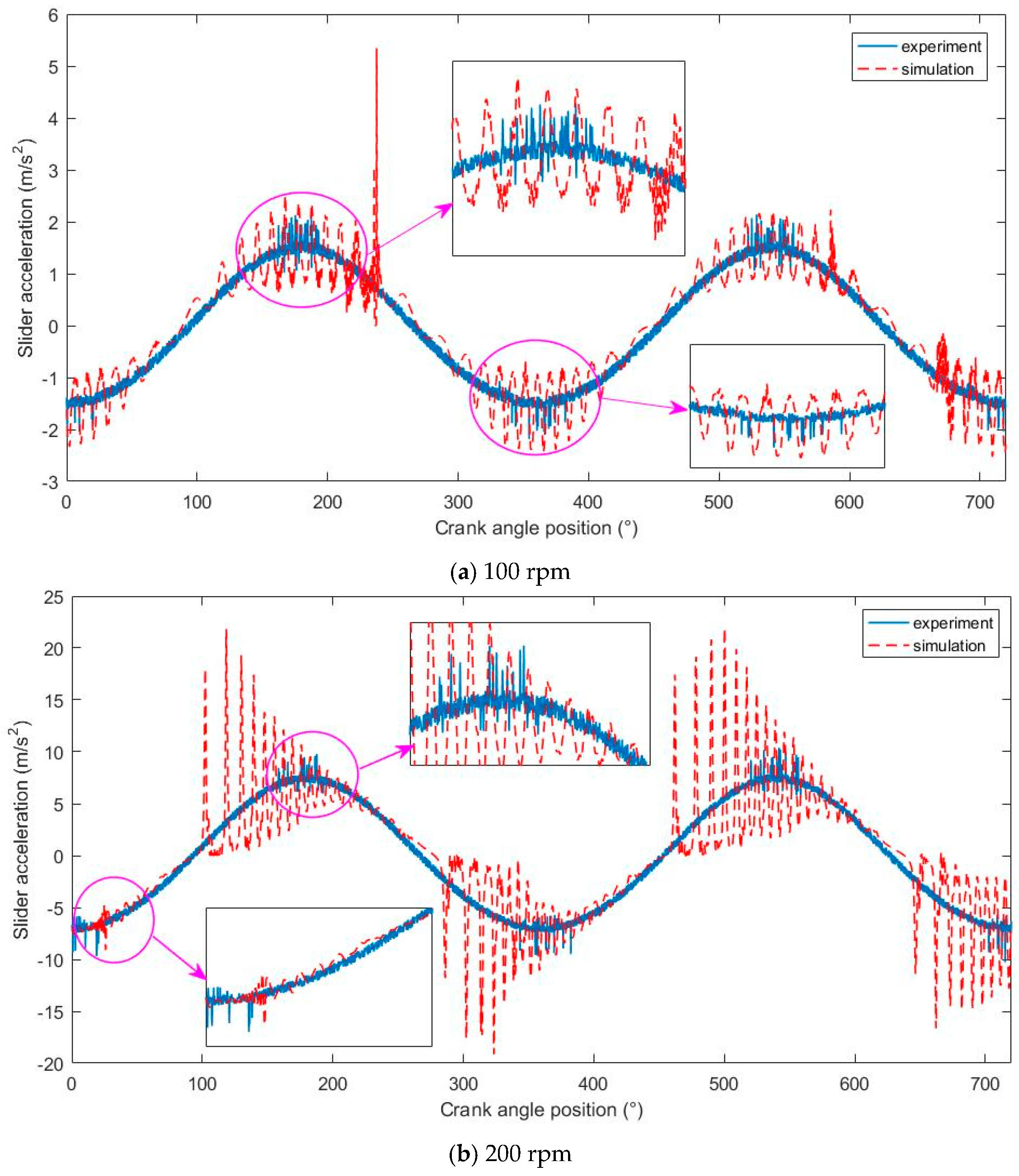
The comparison of simulation and experiment is shown in Figure 4. Obvious fluctuation is found during the motion period of the high-precision mechanism, especially near the end of the displacement. This indicates that changes in motion direction could strengthen the contact and impact in the clearance joint. Then, the reverse contact force enhances the transient energy variation, and the original movement trajectory cannot be maintained, which means that the dynamic behavior is unpredictable. At higher rotational speeds, frequency and contact characteristics of the high-precision mechanism are obvious. Based on the enlarged view (100 rpm), the deviation between simulation results and test data is only 0.226 m/s2 (7.459%) at the peak point. When the rotational speed increases to 200 rpm, this deviation value is 0.611 m/s2 (9.518%). And the mean value of this deviation is between 0.042 m/s2 and 0.168 m/s2. The simulation results reveal a similar variation inclination of the test data, and the effectiveness of the proposed model is verified.
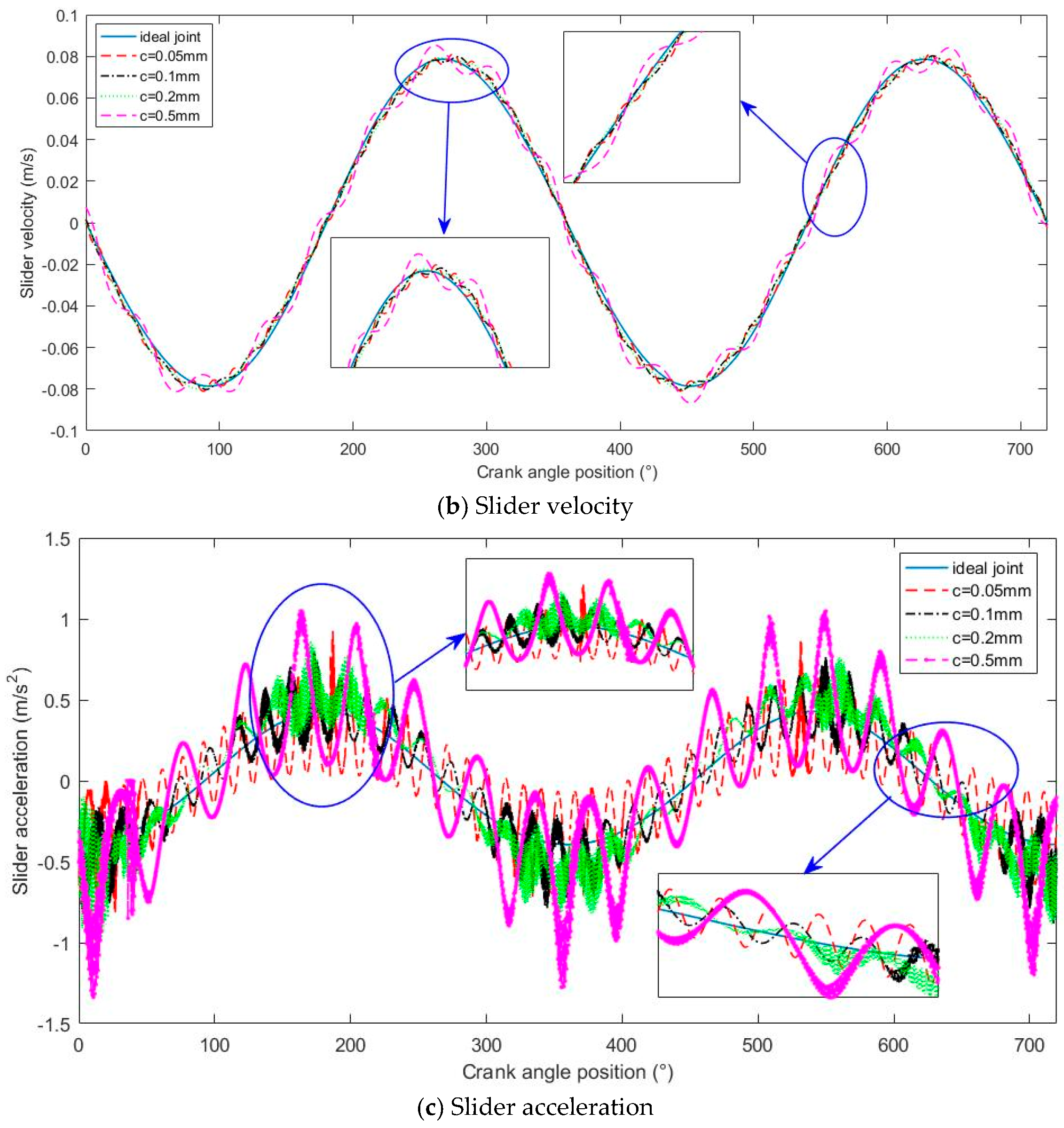
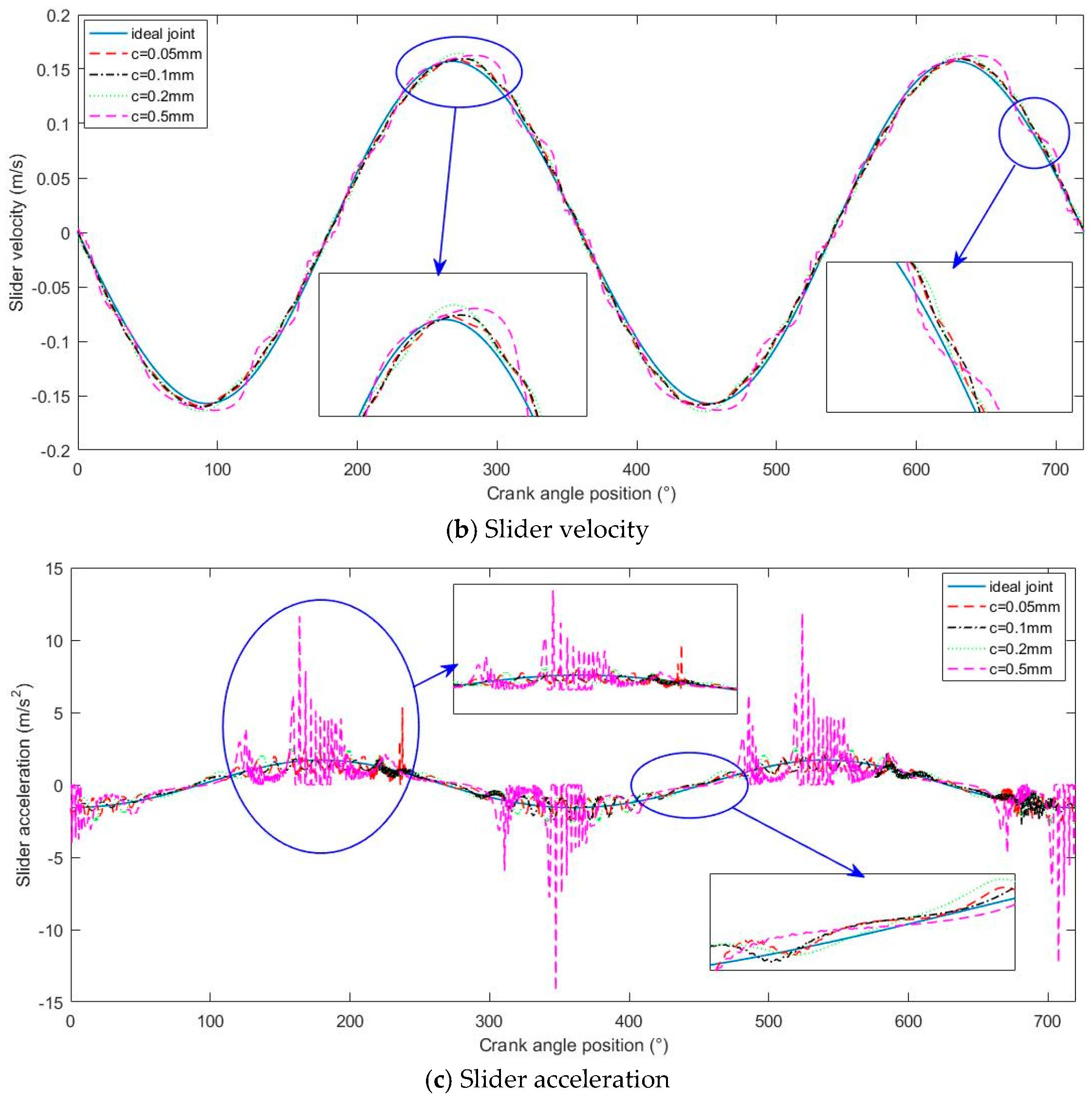
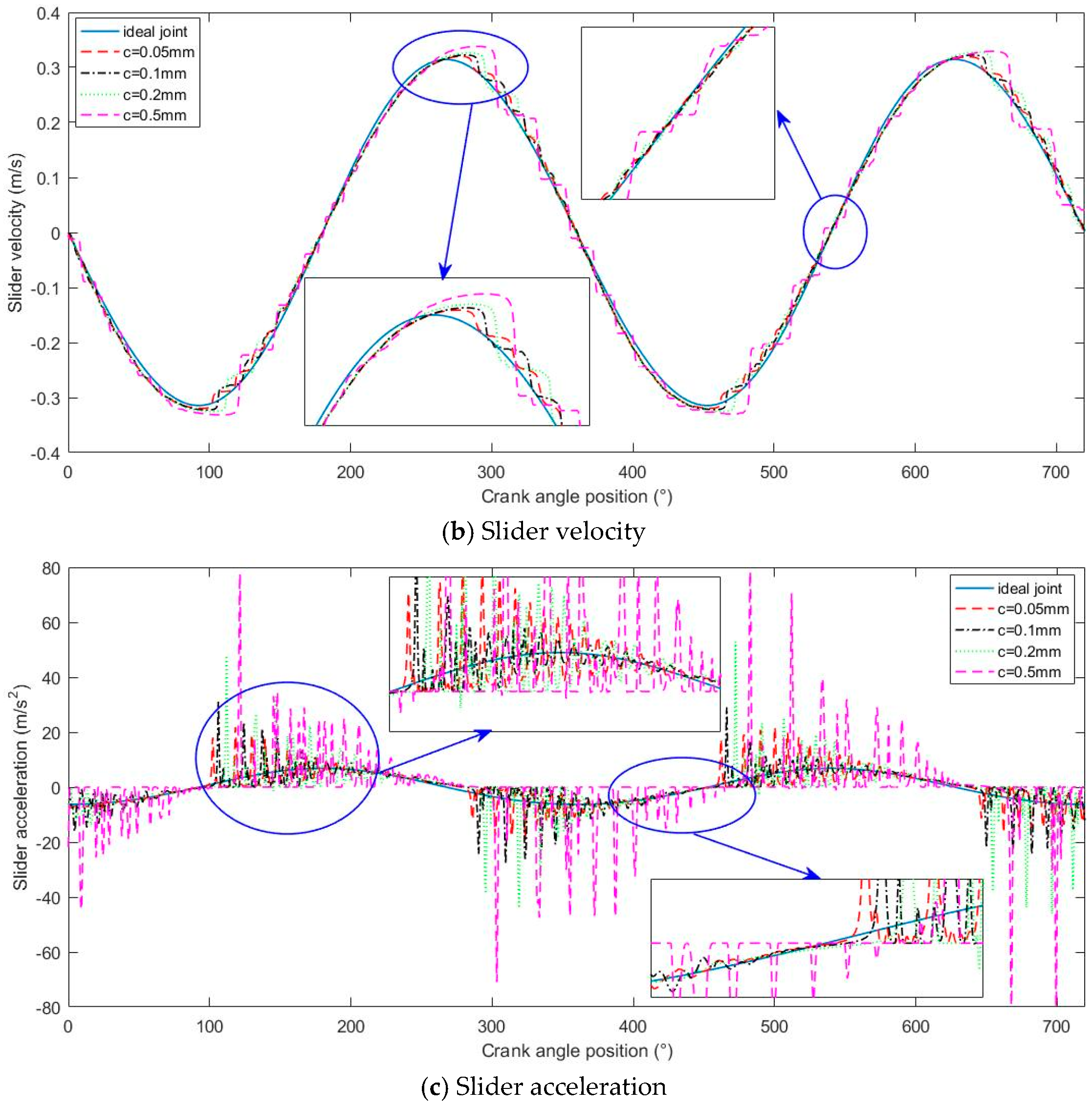
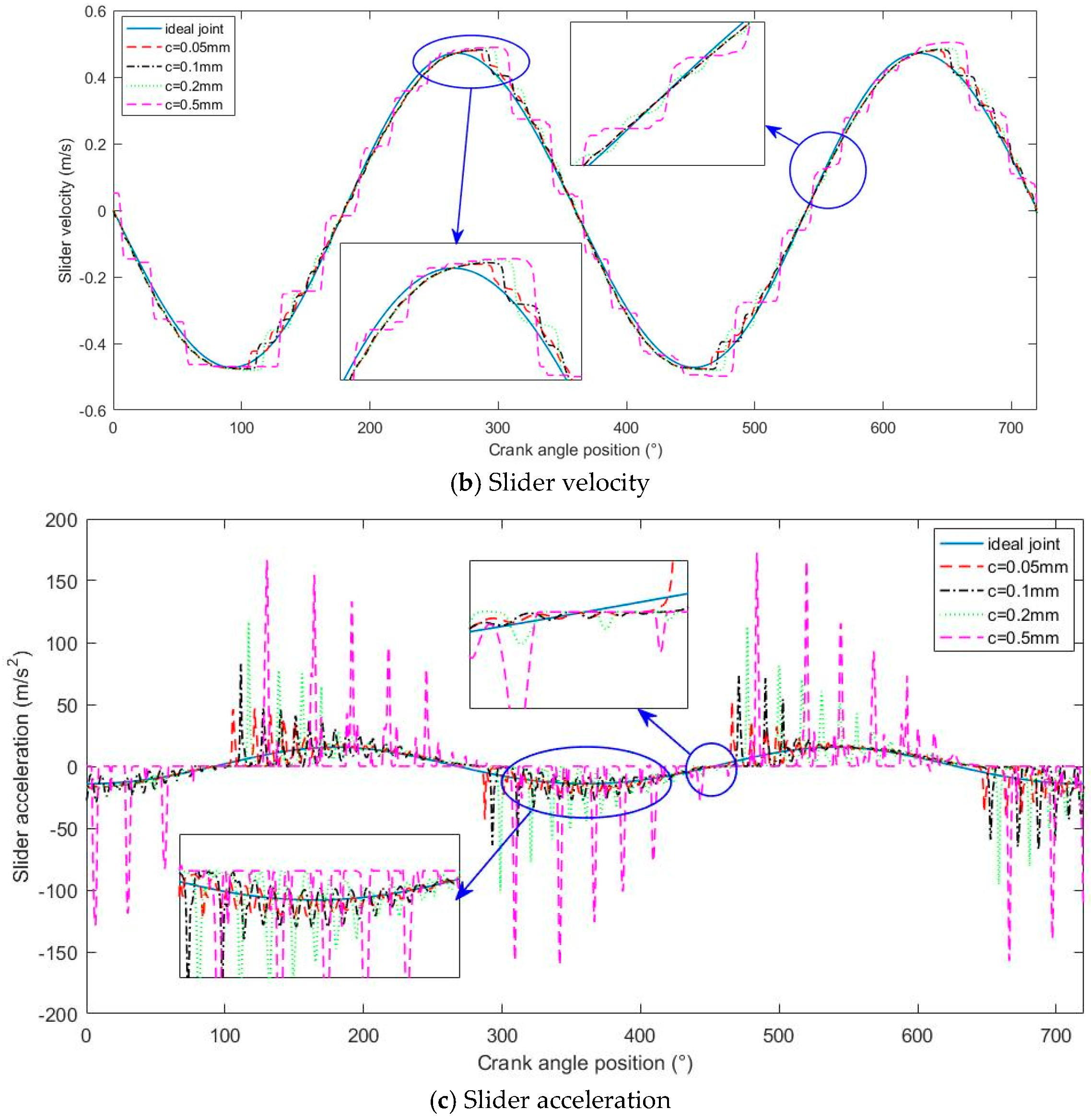
Relatively speaking, the slider velocity has the obvious contact response of the high-precision mechanism with a clearance joint. In the ideal joint, the slider velocity follows a smooth route during the motion period, even if it is located at the extreme position. With a smaller clearance size, the slider velocity can reveal the variation in motion state. The gradient of slider velocity also changes, and the folding feature gradually becomes clear. With the growth of clearance size, the curve of slider velocity shows a deformation point. When the rotational speed is 300 rpm, the obvious fluctuation and high-frequency variation in the slider velocity appear.
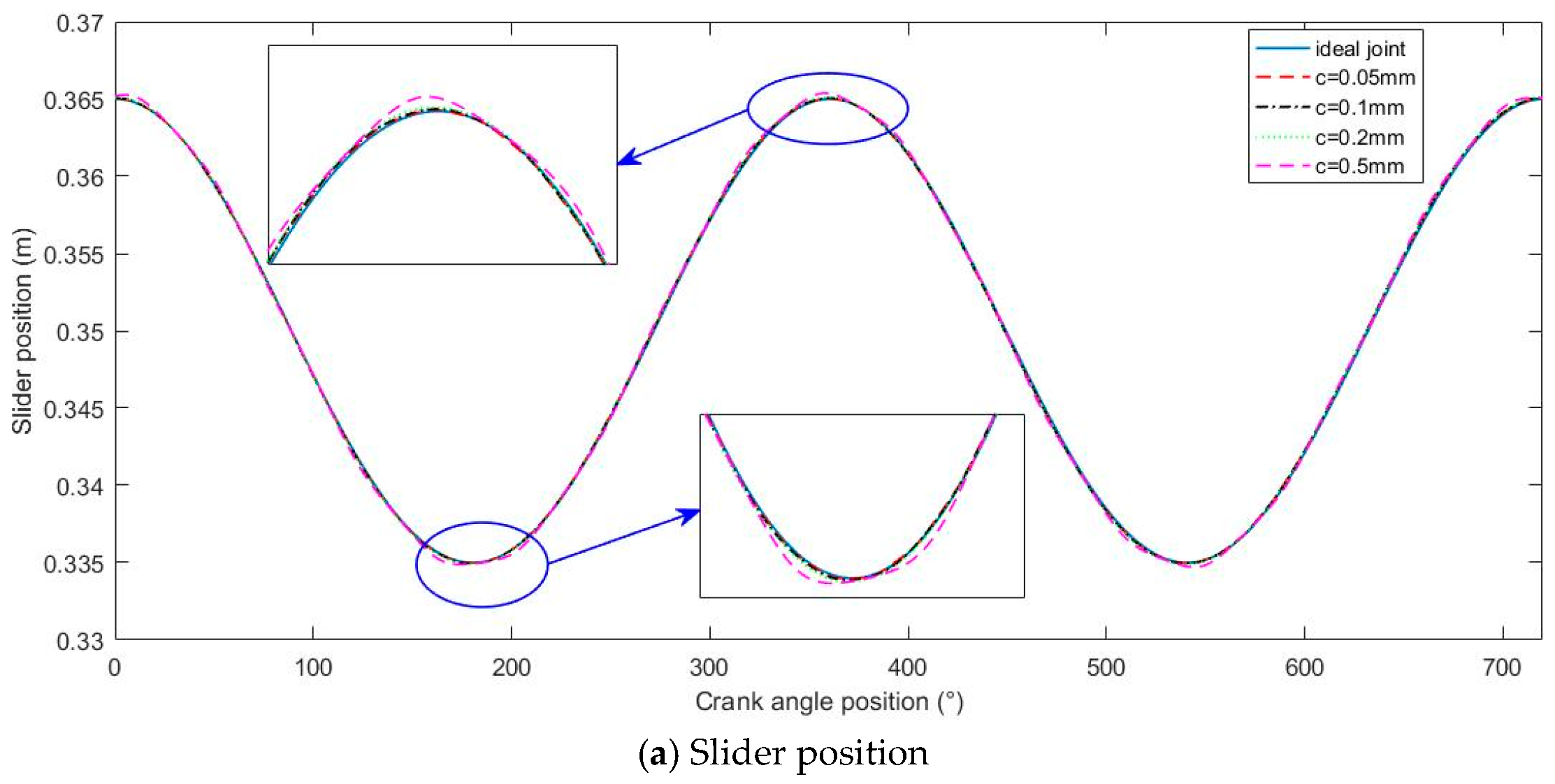
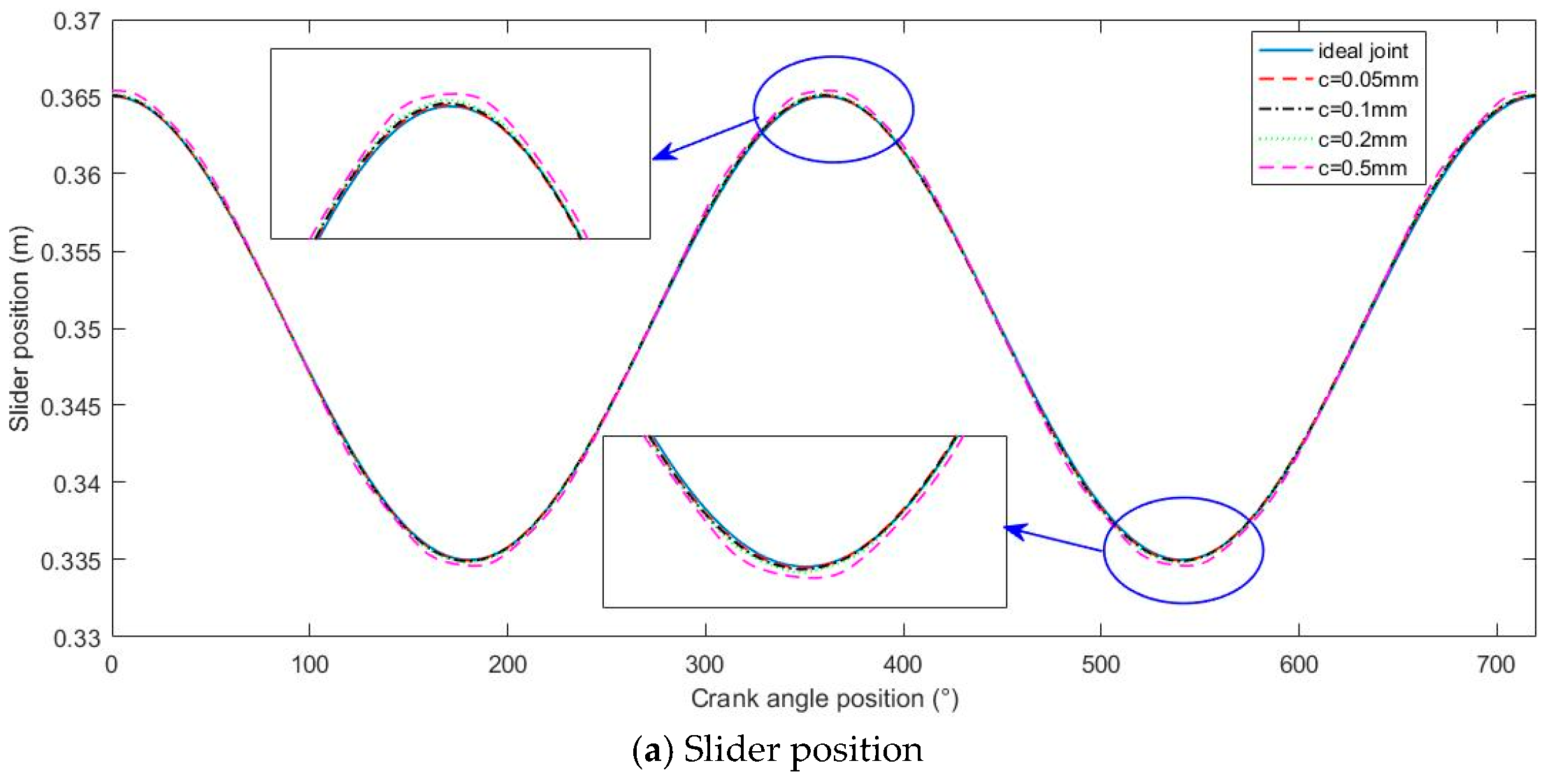
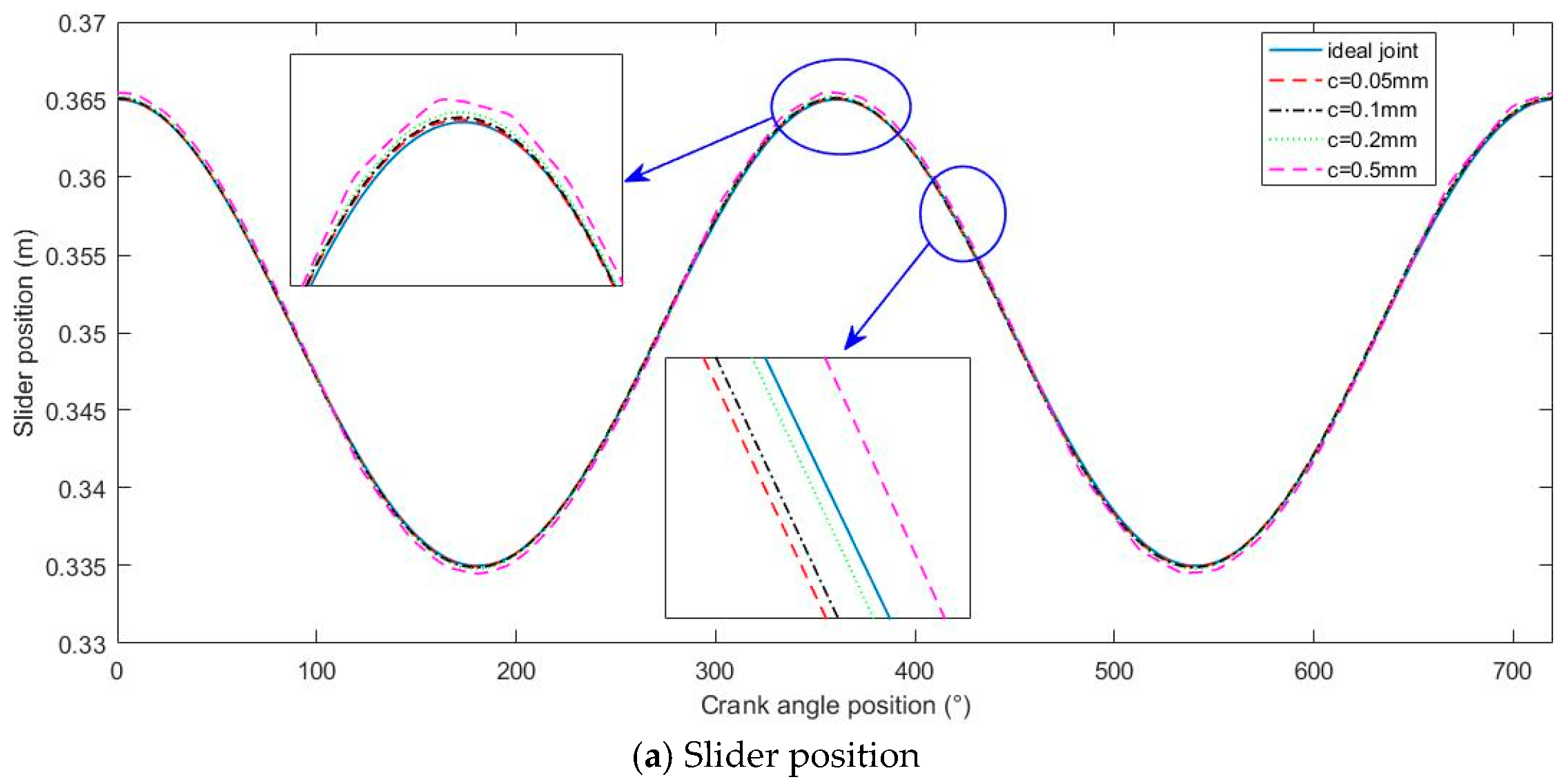
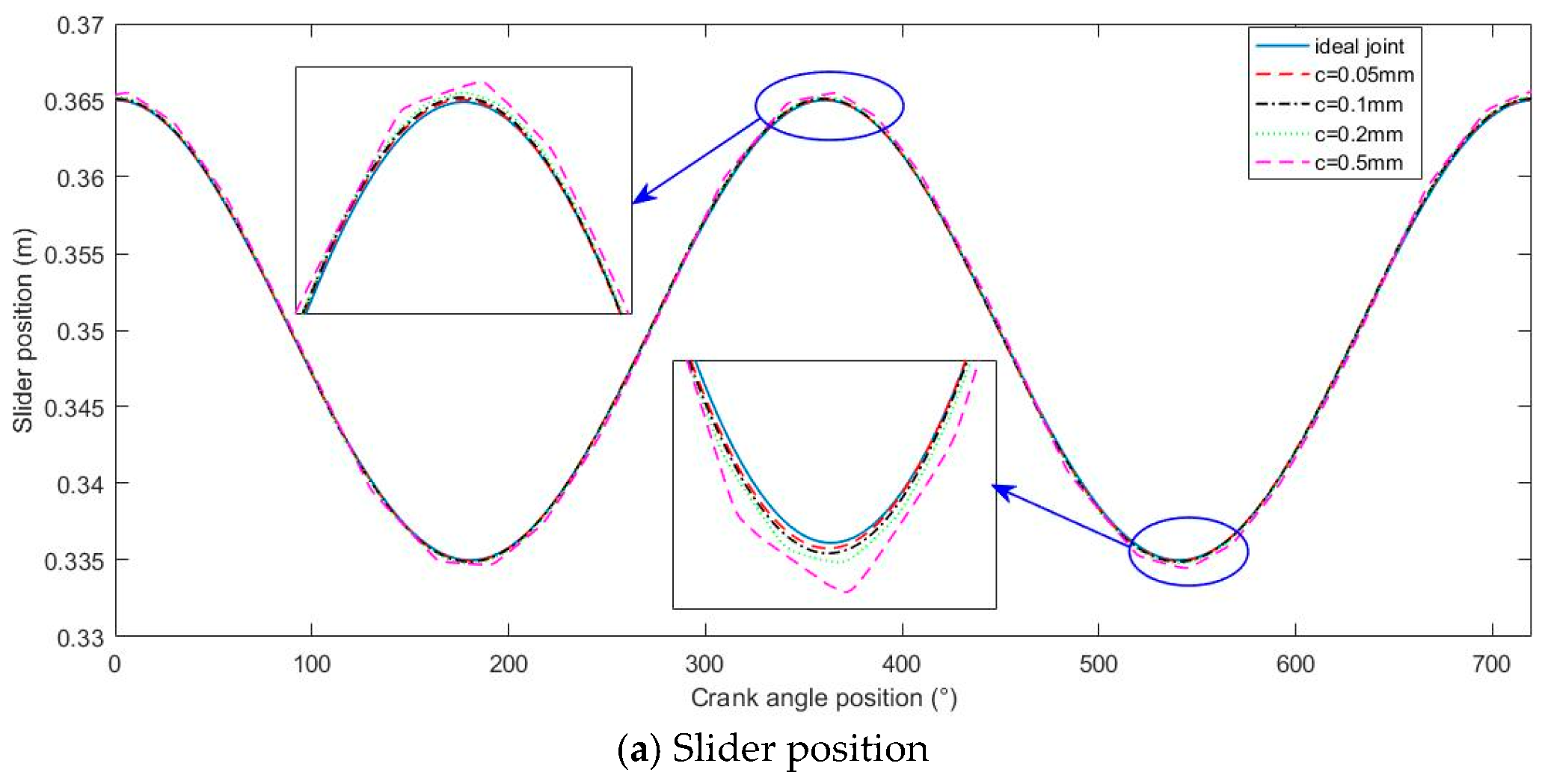
The coupled effects of clearance size and rotational speed on the movement trajectory of the high-precision mechanism are shown in Figure 5, Figure 6, Figure 7 and Figure 8. Clearance size and rotational speed are important parameters in the nonlinear dynamic analysis. Although the clearance size is smaller in the high-precision press system, wear can enlarge the clearance during operation. In order to show the nonlinear characteristics of the high-precision mechanism clearly, the maximum clearance size is defined as 0.5 mm and the rotational speed is selected based on actual working conditions [10,21,27]. The increase in clearance size strengthens the collision feature of the slider position at the extreme position. At higher rotational speeds, this phenomenon is more pronounced. When the clearance size is less than 0.5 mm, there is a slight deviation of the slider position between the revolute clearance joint and the ideal joint at 50 rpm. When the clearance size is 0.5 mm, the deviation value shows a different trend, and significant fluctuation appears under the same condition. Moreover, the curves of the slider position between the revolute clearance joint and the ideal joint become complete separated under high-speed conditions. The results show that a larger clearance size extends the motion range of the revolute joint, and a higher movement speed increases the inertia force of the element. With the higher speed (300 rpm) and larger clearance size (0.5 mm), the fluctuation and deformation can be found in the curve of the slider position, highlighting the negative influence of this coupled factor.
The slider acceleration can reflect the dynamic response of a high-precision mechanism with a revolute clearance joint. Compared with the ideal joint, obvious fluctuation is found throughout the entire movement period of the revolute clearance joint. Moreover, a stronger peak value can be found at the extreme position. When the machine operates at low speed, a higher transient impact force is generated, and larger deformation occurs in the revolute joint elements. As the rotation speed exceeds 100 rpm, a larger clearance size (0.5 mm) causes a longer vibration period of slider acceleration during system movement. The decay rate of vibration slows down under the same condition, which is related to the energy loss of contact and impact. In addition, it is noteworthy that the larger clearance size (0.5 mm) decreases the vibration frequency of the slider acceleration. This phenomenon can be explained by the fact that an increase in clearance size enlarges the relative motion range between the journal and bearing, extending the motion period and reducing the number of contacts.
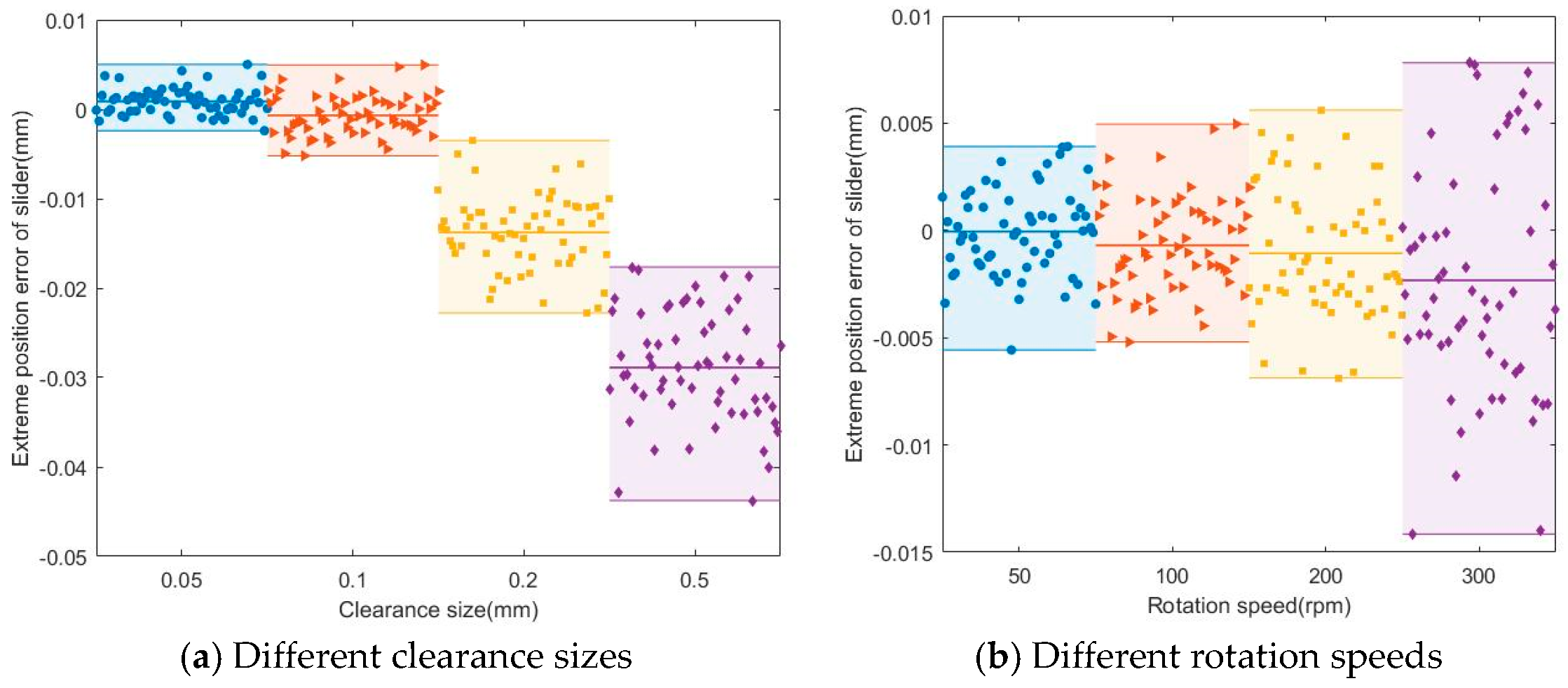
As an important evaluation indicator, the dynamic repeated precision at the extreme position represents the manufacturing performance of high-precision press systems. Clearance size and driving speed have a significant impact on the dynamic repeated precision at the extreme position (Figure 9). A larger clearance size not only reduces the dynamic repeated precision, but also causes a drift in the extreme position. The expansion of the motion range of the revolute joint element is a key factor contributing to the decline in dynamic repeated precision. under different working speeds, the average deviation value of the dynamic repeated precision shows a slight decrease. However, the distribution range of the extreme position becomes larger at higher speeds. The dispersion of the extreme position indicates that the nonlinear characteristics of the high-precision mechanism are more pronounced. When the clearance size is 0.05 mm, the fluctuation range of dynamic repeated precision is only 0.0073 mm, but this value increases to 0.0261 mm (0.5 mm). A similar phenomenon appears when changing rotation speed, and the fluctuation range reaches 0.022 mm under high-speed conditions (300 rpm). And motion trajectory of the slider deviates obviously from the planned route.

4. Nonlinear Characteristics Analysis

The motion state of a high-precision mechanism is a key concern in the dynamic evaluation of multibody systems. The center trajectory of the revolute clearance joint can reveal the motion state of the high-precision mechanism. Moreover, Poincaré portraits of the slider position represent the evolution characteristics of the high-precision mechanism with a revolute clearance joint. Therefore, the motion trajectory and Poincaré portraits are employed to conduct the nonlinear dynamic analysis of the high-precision mechanism.
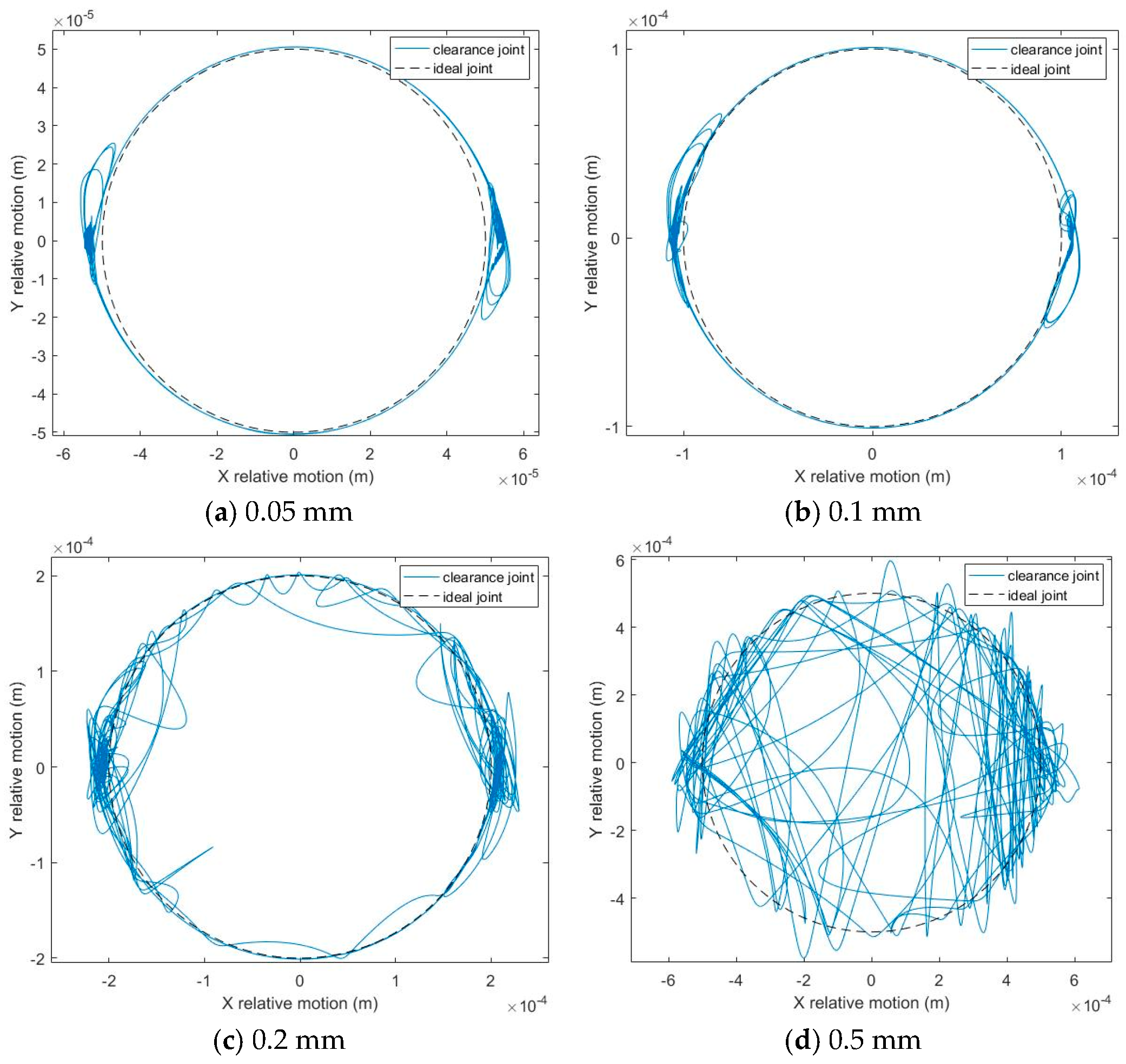
Figure 10 shows the influence of clearance size on the motion trajectory of the revolute clearance joint. The simulation results show that the journal almost moves along the contour line of the bearing when the clearance is small (c < 0.1 mm). An obvious impact phenomenon of the revolute joint elements is found at the extreme position, and penetration occurs between the contact elements. When the clearance increases (c = 0.2 mm), the motion trajectory of the revolute joint center becomes more complex. Meanwhile, the impact velocity and contact frequency increase significantly. And then, the movement route becomes unpredictable, which is an important factor leading to the nonlinear feature of the high-precision mechanism.
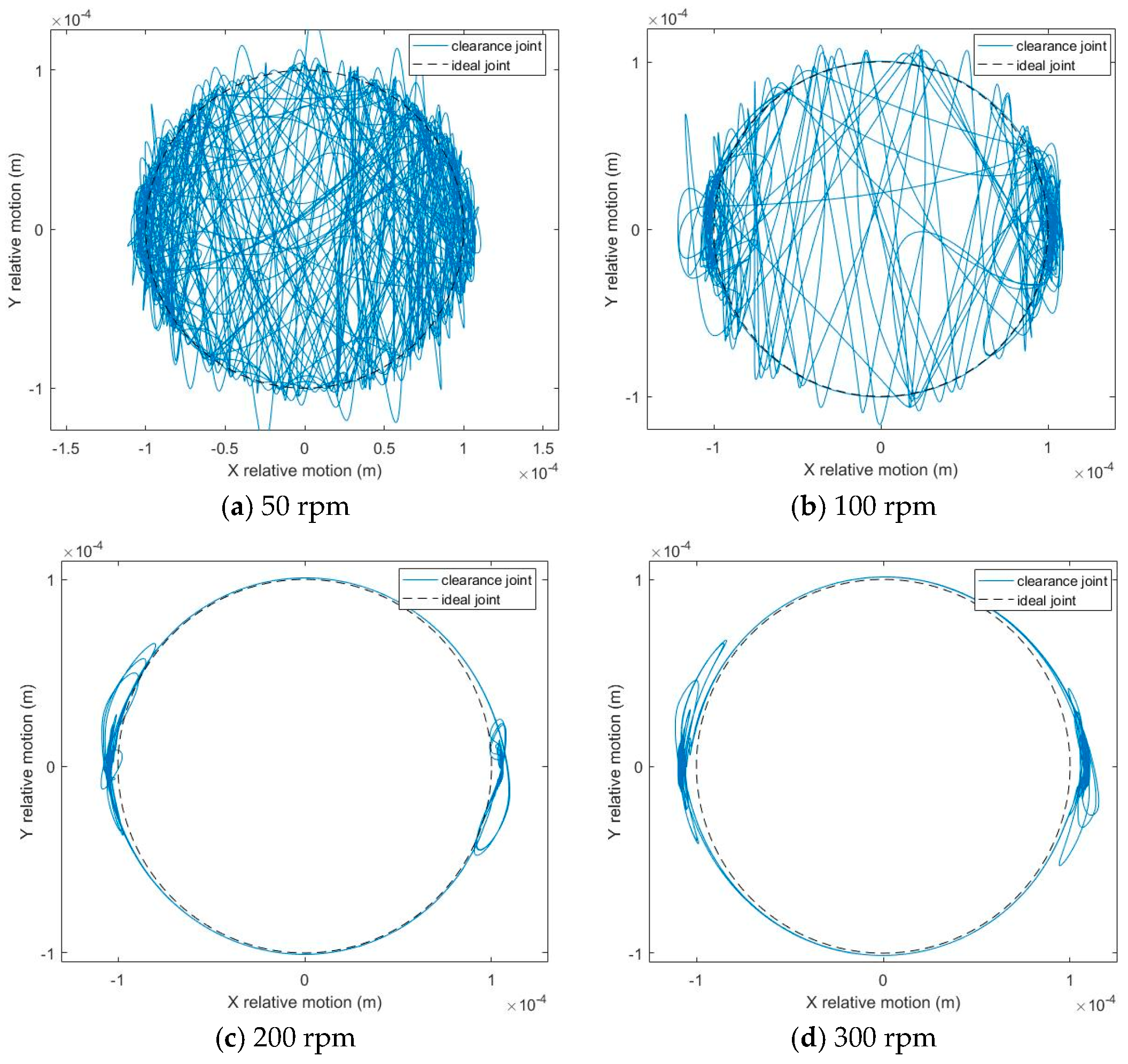
With the change in rotation speed, the motion trajectory of the revolute joint center is shown in Figure 11. A lower rotation speed increases the complexity of the motion route for the revolute joint center. Although a higher rotation speed can improve the initial contact velocity, the larger inertia force can maintain the motion state of the revolute joint elements. Then, the contact feature of the revolute joint elements occupies almost the entire motion period. Because the constraint conditions are weak, the penetration value of the contact elements is more significant at lower rotation speeds. The increase in free movement leads to separation between the journal and the bearing.
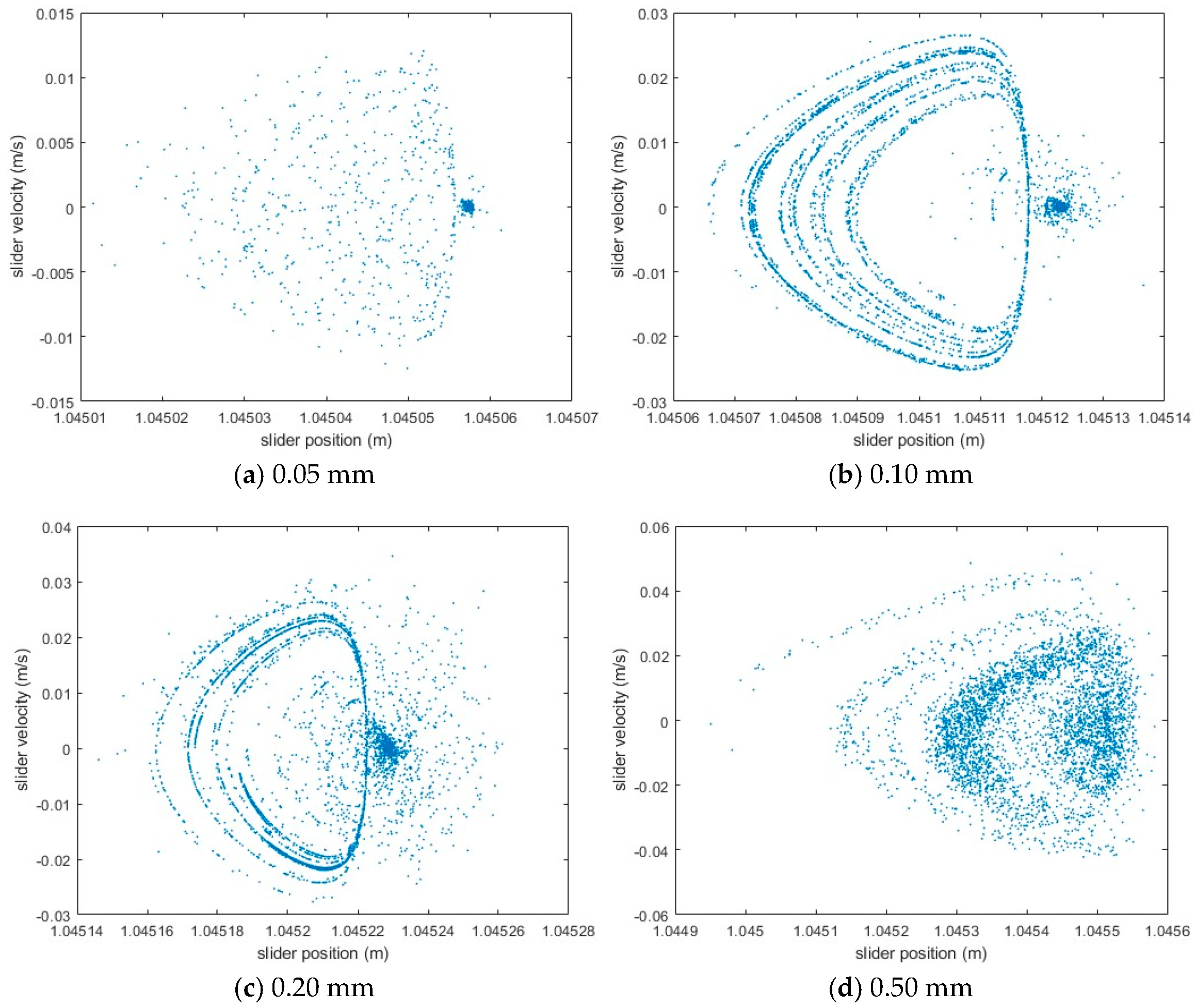
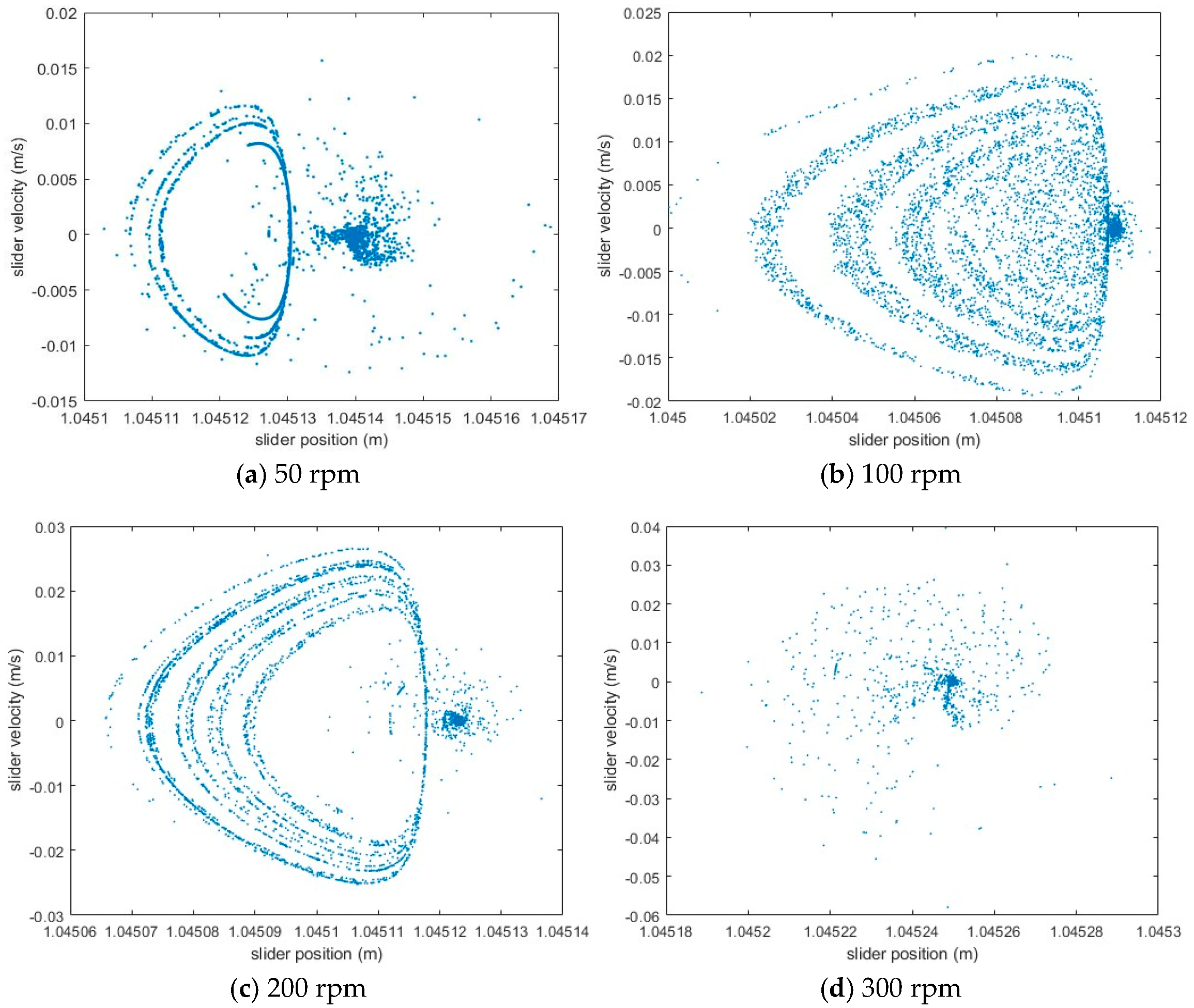
Figure 12 and Figure 13 show the Poincaré portraits of the high-precision mechanism with a revolute clearance joint. The structure feature (clearance) and the working environment (rotation speed) strongly affect the movement curve of the high-precision mechanism. The strange attractor of the slider position represents different patterns, including periodic and irregular features. When the clearance is small (c < 0.2 mm), most strange attractor points are concentrated in the central area. Although some points are separated, the discrepancy and deviation are small, and the main motion state remains periodic. However, the limited region of the strange attractor expands noticeably, and the structure characteristics become more complex. As a result, the motion of the high-precision mechanism with a revolute clearance joint cannot be predicted effectively. When the multibody system operates at high speed, the distribution of the stranger attractor becomes more concentrated. Although the slider velocity increases, the structural pattern of the Poincaré portraits becomes simple. However, lower speed increases the complexity of the structural pattern in the Poincaré portraits. Meanwhile, the nonlinear characteristics of the high-precision mechanism are enhanced, and the system enters an irregular movement state. This reduces the dynamic repeated accuracy, which is an important factor affecting the manufacturing accuracy of the high-precision press systems.

5. Conclusions

In this work, an applied approach is proposed to conduct the dynamic behavior and movement characteristics of a high-precision mechanism with a clearance joint. The relationship between the extrusion load and the contact characteristics is presented, and the stiffness coefficient is obtained. Then, the dissipative contact force model is introduced into the Largrane’s equations of the high-precision mechanism. The nonlinear dynamic analysis of the high-precision mechanism is performed using the proposed model. Under different conditions (clearance size and rotation speed), the engineering application study is conducted to illustrate the practicality of the proposed method.
The dynamic response analysis of the high-precision mechanism shows that the coupled effects of clearance size and rotation speed cannot be ignored. An increase in clearance size separates the movement trajectory of the high-precision mechanism with a revolute clearance joint from that of the ideal joint. A higher rotation speed not only increases contact velocity, but also increases contact frequency. With regard to the coupled effects of clearance size and rotation speed, the movement characteristics are sensitive to variations in the basic conditions. A dynamic performance experiment of the high-precision mechanism is also conducted, and the deviation value is only 0.611 m/s2, confirming that the proposed method provides an accurate prediction. Furthermore, the complex nonlinear behavior reveals that the movement trajectory of the high-precision mechanism with a clearance joint becomes unpredictable. Meanwhile, the larger inertial force can restrain the expansion of kinematic instability for the high-precision mechanism under specific conditions.
Moreover, the dynamic repeated precision at the extreme position is the main indicator for evaluating the machining accuracy and stability of press systems, which is different from traditional mechanisms. Therefore, the applied prediction of the high-precision mechanism can be evaluated using the dynamic repeated precision under specific operating conditions. Unfortunately, the lubricating effects cannot be considered in this study, although lubrication would improve the stability of high-precision mechanisms. In the future, the dynamic model of a high-precision mechanism with a lubricated revolute joint will be developed.

Author Contributions

Methodology, Y.C.; Software, Q.L.; Validation, Y.C. and X.Z.; Investigation, H.W.; Writing—original draft, X.W.; Writing—review & editing, Y.C. and K.W. All authors have read and agreed to the published version of the manuscript.

Funding

This research was funded by National Natural Science Foundation of China (No. 52405140).

Data Availability Statement

The data presented in this study are available on request from the corresponding author. The data are not publicly available due to privacy.

Acknowledgments

This work is supported by the “Outstanding Young Backbone Teacher of Jiangsu Qinglan Project” and National Natural Science Foundation of China (No. 52405140).

Conflicts of Interest

The authors declare no conflict of interest.

Nomenclature

e EccentricitycClearance
K n Stiffness coefficientDDamping coefficient
E m Elastic modulus of contact solids δ Penetration value
vnPoisson’s ratio c e Restitution coefficient
c f Friction coefficient υ t Relative tangential velocity
c d Dynamic correction coefficient θ Rotate angle of crank
L 1 Crank lengthIcInertia moment of crank
L2Connecting rod length T f Friction torque
m 2 Mass of connecting rod Rotate angle of connecting rod
m p Mass of slider I 2 Inertia moment of connecting rod
δ ˙ Initial contact velocity F e External load

References

  1. Dubowsky, S.; Morris, T.L. An analytical and experimental study of the acoustical noise produced by machine links. J. Vib. Acoust. Stress Reliab. Des. 1983, 105, 393–401. [Google Scholar] [CrossRef] [Scilit]
  2. Chen, X.L.; Jiang, S.Y. Nonlinear dynamic behavior analysis of multi-linkage mechanism with multiple lubrication clearances. Eur. J. Mech. B/Fluids 2022, 91, 177–193. [Google Scholar] [CrossRef] [Scilit]
  3. Wang, K.; Tian, Q. A nonsmooth method for spatial frictional contact dynamics of flexible multibody systems with large deformation. Int. J. Numer. Methods Eng. 2023, 124, 752–779. [Google Scholar] [CrossRef] [Scilit]
  4. Ghorbani, M.A.; Kisi, O.; Aalinezhad, M. A probe into the chaotic nature of daily streamflow time series by correlation dimension and largest Lyapunov methods. Appl. Math. Model. 2010, 34, 4050–4057. [Google Scholar] [CrossRef] [Scilit]
  5. Bolat, B.; Temiztas, B.A.; Sezer, E. Investigation of the effects of radial clearance on the screw conveyor performances for different inclinations. Particuology 2024, 92, 72–80. [Google Scholar] [CrossRef] [Scilit]
  6. Zhao, B.; Zhou, K.; Xie, Y.B. A new numerical method for planar multibody system with mixed lubricated revolute joint. Int. J. Mech. Sci. 2016, 113, 105–119. [Google Scholar] [CrossRef] [Scilit]
  7. Lai, X.M.; He, H.; Lai, Q.F. Computational prediction and experimental validation of revolute joint clearance wear in the low-velocity planar mechanism. Mech. Syst. Signal Process. 2017, 85, 963–976. [Google Scholar] [CrossRef] [Scilit]
  8. Gourc, E.; Seguy, S.; Michon, G. Quenching chatter instability in turning process with a vibro-impact nonlinear energy sink. J. Sound Vib. 2015, 355, 392–406. [Google Scholar] [CrossRef] [Scilit]
  9. Zhang, X.C.; Zhang, X.M. Minimizing the influence of revolute joint clearance using the planar redundantly actuated mechanism. Robot. Comput. Int. Manuf. 2017, 46, 104–113. [Google Scholar] [CrossRef] [Scilit]
  10. Saeed, E.; Esmaeil, S.; Mohsen, M. Application of the method of multiple scales for nonlinear vibration analysis of mechanical systems with dry and lubricated clearance joints. J Theore. App. Vib. Acous. 2017, 3, 41–60. [Google Scholar]
  11. Peng, H.J.; Song, N.N.; Li, F. A mechanistic-based data-driven approach for general friction modeling in complex mechanical system. J. Appl. Mech. 2022, 89, 071005. [Google Scholar] [CrossRef] [Scilit]
  12. Zheng, E.L.; Cui, S.; Zhu, R. Thermal error modeling and compensation of multilink high speed precision press system. Int. J. Adv. Manuf. Technol. 2021, 112, 1729–1743. [Google Scholar] [CrossRef] [Scilit]
  13. Chang, H.; Tian, Q.; Hu, H.Y. A geometrically exact triangular shell element based on reproducing kernel DMS-Splines. Comput. Model. Eng. Sci. 2023, 136, 825–860. [Google Scholar] [CrossRef] [Scilit]
  14. Machado, M.; Moreira, P.; Flores, P. Compliant contact force models in multibody dynamics: Evolution of the Hertz contact theory. Mech. Mach. Theory 2012, 53, 99–121. [Google Scholar] [CrossRef] [Scilit]
  15. Gharib, M.; Hurmuzlu, Y. A new contact force model for low coefficient of restitution impact. J. Appl. Mech. 2012, 79, 064506. [Google Scholar] [CrossRef] [Scilit]
  16. Wang, Y.; Li, F.M. Nonlinear dynamics modeling and analysis of two rods connected by a joint with clearance. Appl. Math. Model. 2015, 39, 2518–2527. [Google Scholar] [CrossRef] [Scilit]
  17. Hu, S.W.; Guo, X.L. A dissipative contact force model for impact analysis in multibody dynamics. Multibody Syst. Dyn. 2015, 35, 131–151. [Google Scholar] [CrossRef] [Scilit]
  18. Alves, J.; Peixinho, N.; Silva, M.T. A comparative study of the viscoelastic constitutive models for frictionless contact interfaces in solids. Mech. Mach. Theory 2015, 85, 172–188. [Google Scholar] [CrossRef] [Scilit]
  19. Tian, Q.; Luo, J.; Mikkola, A. A new elastohydrodynamic lubricated spherical joint model for rigid-flexible multibody dynamics. Mech. Mach. Theory 2017, 107, 210–228. [Google Scholar] [CrossRef] [Scilit]
  20. Li, J.L.; Huang, H.Z.; Yan, S.Z. Kinematic accuracy and dynamic performance of a simple planar space deployable mechanism with joint clearance considering parameter uncertainty. Acta Astronaut. 2017, 136, 34–45. [Google Scholar] [CrossRef] [Scilit]
  21. Li, Y.Y.; Wang, Z.L.; Wang, C. Planar rigid-flexible coupling spacecraft modeling and control considering solar array deployment and joint clearance. Acta Astronaut. 2018, 142, 138–151. [Google Scholar] [CrossRef] [Scilit]
  22. Cui, S.H.; Gu, L.; Wang, L.Q. Numerical analysis on the dynamic contact behavior of hydrodynamic journal bearings during start-up. Tribol. Int. 2018, 121, 260–268. [Google Scholar] [CrossRef] [Scilit]
  23. Xu, L.X.; Chen, B.K.; Li, C.Y. Dynamic modelling and contact analysis of bearing-cycloid-pinwheel transmission mechanisms used in joint rotate vector reducers. Mech. Mach. Theory 2019, 137, 432–458. [Google Scholar] [CrossRef] [Scilit]
  24. Xiao, M.H.; Geng, G.S.; Li, G.H. Analysis on dynamic precision reliability of high-speed precision press based on Monte Carlo method. Nonlinear Dyn. 2017, 90, 2979–2988. [Google Scholar] [CrossRef] [Scilit]
  25. Xiang, W.W.K.; Yan, S.Z.; Wu, J.N. Dynamic response and sensitivity analysis for mechanical systems with clearance joints and parameter uncertainties using Chebyshev polynomials method. Mech. Syst. Signal Process. 2020, 138, 106596. [Google Scholar] [CrossRef] [Scilit]
  26. Erkaya, S. Investigation of joint clearance effects on actuator power consumption in mechanical system. Measurement 2019, 134, 400–411. [Google Scholar] [CrossRef] [Scilit]
  27. Chen, X.L.; Wu, R.G.; Jia, Y.H. Dynamic response and chaotic characteristics analysis of spatial parallel mechanisms with multiple spherical clearance joints. J Vib. Eng. Tech. 2021, 10, 471–497. [Google Scholar] [CrossRef] [Scilit]
  28. Chen, X.L.; Wang, T.; Jiang, S. Study on dynamic behavior of planar multibody system with multiple lubrication clearance joints. Eur. J. Mech. A/Solids 2022, 91, 104404. [Google Scholar] [CrossRef] [Scilit]
  29. Xiao, S.G.; Liu, S.L.; Song, M.M. Coupling rub-impact dynamics of double translational joints with subsidence for time-varying load in a planar mechanical system. Multibody Syst. Dyn. 2020, 48, 451–486. [Google Scholar] [CrossRef] [Scilit]
  30. Xiao, S.G.; Liu, S.L.; Wang, H.Z. Nonlinear dynamics of coupling rub-impact of double translational joints with subsidence considering the flexibility of piston rod. Nonlinear Dyn. 2020, 100, 1203–1229. [Google Scholar] [CrossRef] [Scilit]
  31. Bai, Z.F.; Sun, Y. A study on dynamics of planar multibody mechanical systems with multiple revolute clearance joints. Eur. J. Mech. A/Solid. 2016, 60, 95–111. [Google Scholar] [CrossRef] [Scilit]
  32. Bai, Z.F.; Jiang, X.; Li, J.Y. Dynamic analysis of mechanical system considering radial and axial clearances in 3D revolute clearance joints. J. Vib. Control. 2020, 27, 1893–1909. [Google Scholar] [CrossRef] [Scilit]
  33. Tan, H.Y.; Hu, T.J.; Li, L. Effect of friction on the dynamic analysis of slider-crank mechanism with clearance joint. Int. J. Non-linear Mech. 2019, 115, 20–40. [Google Scholar] [CrossRef] [Scilit]
  34. Farahan, S.B.; Ghazavi, M.R.; Rahmanian, S. Bifurcation in a planar four-bar mechanism with revolute clearance joint. Nonlinear Dyn. 2017, 87, 955–973. [Google Scholar] [CrossRef] [Scilit]
  35. Zhao, Q.Q.; Guo, J.K.; Hong, J. Analysis of angular errors of the planar multi-closed-loop deployable mechanism with link deviations and revolute joint clearances. Aerosp. Sci. Technol. 2019, 87, 25–36. [Google Scholar] [CrossRef] [Scilit]
  36. Qian, M.B.; Yan, S.Z.; Zhang, L. A new method of nonlinear analysis for a mechanism with a cylindrical clearance joint using information entropy theory. Nonlinear Dyn. 2022, 108, 3903–3926. [Google Scholar] [CrossRef] [Scilit]
  37. Wang, X.P.; Liu, G.; Ma, S.J. Study on dynamic responses of planar multibody systems with dry revolute clearance joint: Numerical and experimental approaches. J. Sound Vib. 2019, 438, 116–138. [Google Scholar] [CrossRef] [Scilit]
  38. Erkaya, S. Investigation of joint clearance effects on welding robot manipulators. Robot. Comput. Integr. Manuf. 2012, 28, 449–457. [Google Scholar] [CrossRef] [Scilit]
  39. Gu, S.Z.; Chen, J.; Tian, Q. An implicit asynchronous variational integrator for flexible multibody dynamics. Comput. Methods Appl. Mech. Eng. 2022, 401, 115660. [Google Scholar] [CrossRef] [Scilit]
  40. Li, H.; Wang, D.S.; Xiao, Z.Y. Investigation of vibro-impact resistance of fiber reinforced composite plates with polyurea coating with elastic constraints. Aerosp. Sci. Technol. 2022, 121, 107196. [Google Scholar] [CrossRef] [Scilit]
  41. Lai, X.M.; Lai, Q.F.; Huang, H. New approach to assess and rank the impact of revolute joint wear on the kinematic accuracy in the low-velocity planar mechanism. Adv. Eng. Softw. 2016, 102, 71–82. [Google Scholar] [CrossRef] [Scilit]
  42. Xu, L.X. A method for modelling contact between circular and non-circular shapes with variable radii of curvature and its application in planar mechanical systems. Multibody Syst. Dyn. 2017, 39, 153–174. [Google Scholar] [CrossRef] [Scilit]
  43. Bai, Z.F.; Zhao, Y. A hybrid contact force model of revolute joint with clearance for planar mechanical systems. Int. J. Non Linear Mech. 2013, 48, 15–36. [Google Scholar] [CrossRef] [Scilit]
  44. Stefani, G.; De Angelis, M.; Andreaus, U. Numerical study on the response scenarios in a vibro-impact single-degree-of-freedom oscillator with two unilateral dissipative and deformable constraints. Commun. Nonlinear Sci. Numer. Simul. 2021, 99, 105818. [Google Scholar] [CrossRef] [Scilit]
  45. Song, N.N.; Wang, C.D.; Peng, H.J. A study of mechanism-data hybrid-driven method for multibody system via physics-informed neural network. Acta Mech. Sin. 2025, 41, 524159. [Google Scholar] [CrossRef] [Scilit]
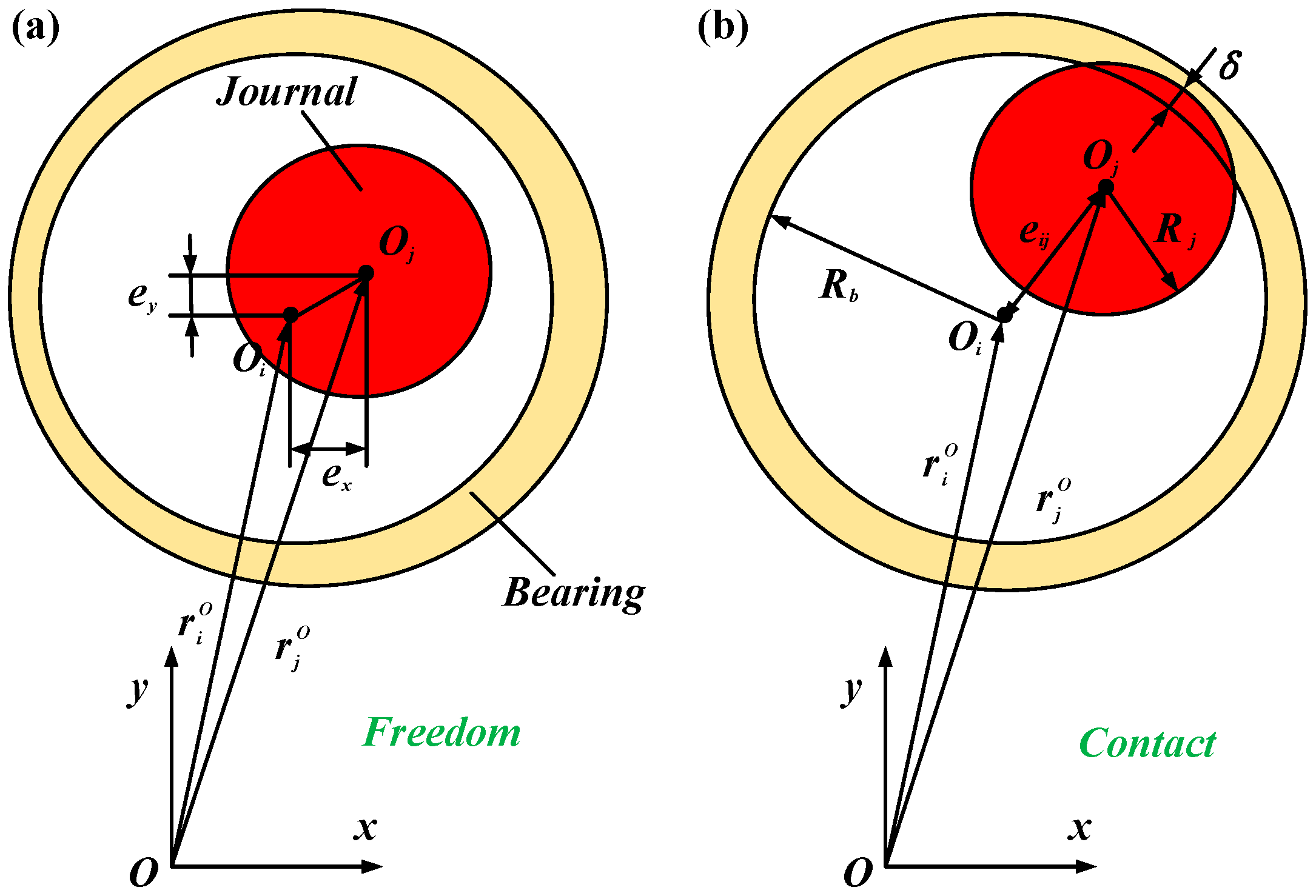
Figure 1. Motion state of revolute clearance joint: (a) freedom; (b) contact.
Lubricants 14 00122 g001
Figure 2. Schematic of a mechanism with a clearance joint.
Lubricants 14 00122 g002
Figure 3. Experiment diagram of mechanism.
Lubricants 14 00122 g003
Figure 4. Comparison of simulation and experiment.
Lubricants 14 00122 g004
Figure 5. Motion trajectory at different clearance sizes (50 rpm).
Lubricants 14 00122 g005aLubricants 14 00122 g005b
Figure 6. Motion trajectory at different clearance sizes (100 rpm).
Lubricants 14 00122 g006aLubricants 14 00122 g006b
Figure 7. Motion trajectory at different clearance sizes (200 rpm).
Lubricants 14 00122 g007aLubricants 14 00122 g007b
Figure 8. Motion trajectory at different clearance sizes (300 rpm).
Lubricants 14 00122 g008aLubricants 14 00122 g008b
Figure 9. Dynamic repeated precision at extreme position.
Lubricants 14 00122 g009
Figure 10. Effects of clearance size on motion trajectory (200 rpm).
Lubricants 14 00122 g010
Figure 11. Effects of rotation speed on motion trajectory (0.1 mm).
Lubricants 14 00122 g011
Figure 12. Poincaré portraits of the slider in the x-direction considering the effects of clearance sizes (200 rpm).
Lubricants 14 00122 g012
Figure 13. Poincaré portraits of the slider in the x-direction considering the effects of rotation speeds.
Lubricants 14 00122 g013
Disclaimer/Publisher’s Note: The statements, opinions and data contained in all publications are solely those of the individual author(s) and contributor(s) and not of MDPI and/or the editor(s). MDPI and/or the editor(s) disclaim responsibility for any injury to people or property resulting from any ideas, methods, instructions or products referred to in the content.