Review

Friction-Induced Vibration in Ship Water-Lubricated Bearings: A Review


1
School of Transportation and Logistics Engineering, Wuhan University of Technology, Wuhan 430063, China
2
State Key Laboratory of Maritime Technology and Safety, Wuhan University of Technology, Wuhan 430063, China
3
Institute for Reliability Engineering and Clean Energy, National Engineering Research Center for Water Transport Safety, Wuhan 430063, China
4
School of Naval Architecture, Ocean and Energy Power Engineering, Wuhan University of Technology, Wuhan 430063, China
*
Author to whom correspondence should be addressed.
Lubricants 2026, 14(3), 107; https://doi.org/10.3390/lubricants14030107
Submission received: 26 December 2025 / Revised: 18 January 2026 / Accepted: 24 February 2026 / Published: 28 February 2026
(This article belongs to the Special Issue Water Lubricated Bearings)

Abstract

As key components in efforts to achieve green and sustainable development in machinery, water-lubricated stern bearings are increasingly replacing traditional oil-lubricated bearings. However, water’s inherent properties—such as low viscosity and poor film-forming ability—can induce severe friction-induced vibration and noise under specific operational conditions. These issues not only accelerate wear but also compromise the vessel’s reliability and acoustic stealth, thereby limiting their wider application. This paper provides a comprehensive review of the research progress relating to friction-induced vibration in water-lubricated bearings. It delves into the underlying mechanisms, critiques the primary methodologies used in numerical simulations, summarizes key experimental approaches, and synthesizes the prevailing vibration suppression strategies. Finally, the study clearly outlines existing challenges and proposes directions for future research.

1. Introduction

As core supporting components of rotating machinery, the operational performance of bearings directly impacts the overall equipment’s reliability, efficiency, and service life [1,2]. Driven by the global push for sustainable development, water-lubricated bearings are progressively replacing oil-lubricated systems due to their superior eco-friendliness and cost-efficiency [3]. They are now widely used in marine propulsion system [4].
However, water-lubricated stern bearings utilize ambient water, distinguished from conventional oils by distinct physicochemical properties such as ultra-low viscosity and limited film-forming capability [5]. These characteristics can easily lead to inadequate lubrication and cavitation, making the system more prone to operating in boundary or mixed lubrication regimes [6,7]. This increases the likelihood of direct contact between friction pairs. Such differences introduce unique challenges for water-lubricated bearings, among which friction-induced vibration stands out as particularly critical. Water-lubricated bearings are significantly more susceptible to stick–slip phenomena under startup, shutdown, and low-speed heavy-load conditions, typically resulting in friction-induced vibrations such as chatter and squeal [8,9]. These vibrations accelerate bearing wear and reduce transmission efficiency. More critically, they may trigger severe resonance, leading to premature failure, shaft damage, and catastrophic system instability. Friction-induced vibration involves multiple disciplines, including solid mechanics, fluid dynamics, tribology, thermodynamics, and materials science [10]. Its underlying mechanisms are governed by the interplay of interfacial dynamics (e.g., negative damping and velocity-weakening friction), contact regimes (e.g., boundary or mixed lubrication), material properties (e.g., viscoelasticity and surface topography), structural parameters (e.g., stiffness and natural frequencies), and operating conditions (e.g., load and speed) [11,12]. Although friction vibration has been studied in tribology for a long time, comprehensive research on friction-induced vibration in water-lubricated bearings remains relatively limited. Existing studies are often scattered across fields such as tribology, vibration and noise control, and fluid dynamics, lacking comprehensive review and in-depth analysis of this specific issue.
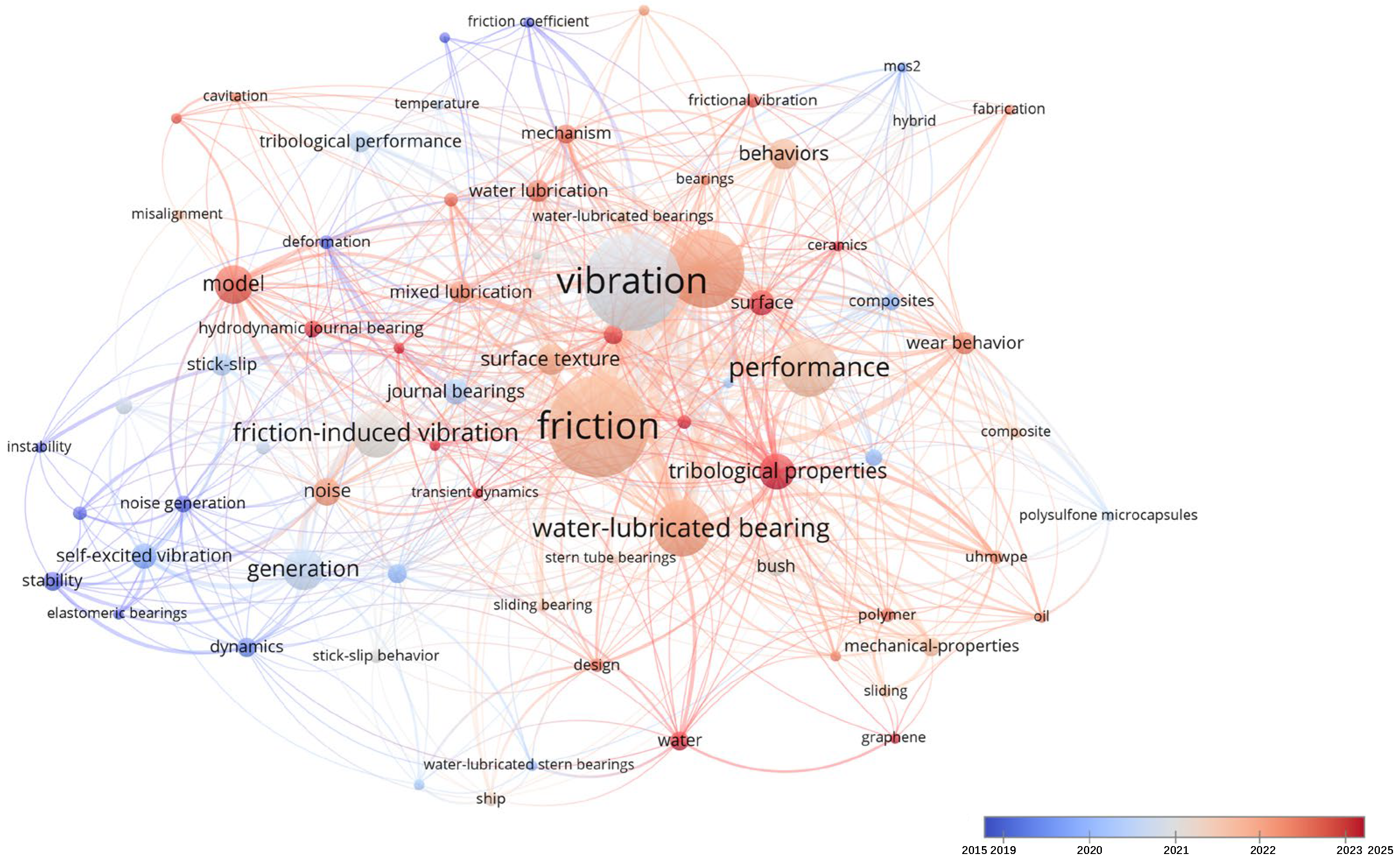
Keyword co-occurrence analysis was conducted to visualize the evolution of research themes, as shown in Figure 1. In this network map, the size of each node corresponds to the frequency of the keyword, reflecting its prevalence in the literature. The color gradient indicates the average publication year, transitioning from blue (earlier studies, circa 2015) to red (recent studies, circa 2025). It can be observed that earlier research primarily focused on fundamental dynamic mechanisms, characterized by keywords such as noise generation, self-excited vibration, instability, and elastomeric bearings. Recent research hotspots have shifted towards material performance and surface engineering, highlighted by keywords like tribological properties, composites, surface texture, and wear behavior. This transition suggests that the academic focus is moving from understanding the basic vibration mechanisms to exploring advanced materials and suppression strategies through surface optimization.
However, existing findings are often compartmentalized within isolated disciplines, lacking a unified theoretical framework. Consequently, this review addresses the central research challenge of integrating fragmented insights across tribology, nonlinear dynamics, and material science to effectively suppress the inherent instability of water-lubricated systems. Given the strategic importance of water-lubricated bearings in green development initiatives, along with the severity and complexity of their friction-induced vibration problems and the current inadequacy of comprehensive research, this article provides a comprehensive review focused on this critical issue. This comprehensive review is structured as follows: Section 2 examines the underlying mechanisms of friction-induced vibration in water-lubricated bearings. Section 3 critiques the primary numerical simulation methodologies and their application. Section 4 summarizes key experimental approaches and advanced measurement techniques. Section 5 synthesizes the prevailing vibration suppression strategies, including structural design, material pairing, and surface optimization. Finally, Section 6 outlines existing challenges and proposes directions for future research. The ultimate aim is to offer theoretical guidance and technical references for the design, manufacturing, operation, and maintenance of water-lubricated bearings. Through this comprehensive analysis, the review seeks to promote the development of these systems toward higher performance, lower vibration and noise, and extended service life. It is also hoped that this review will attract more researchers to this challenging and promising interdisciplinary field.

2. Mechanisms of Friction-Induced Vibration

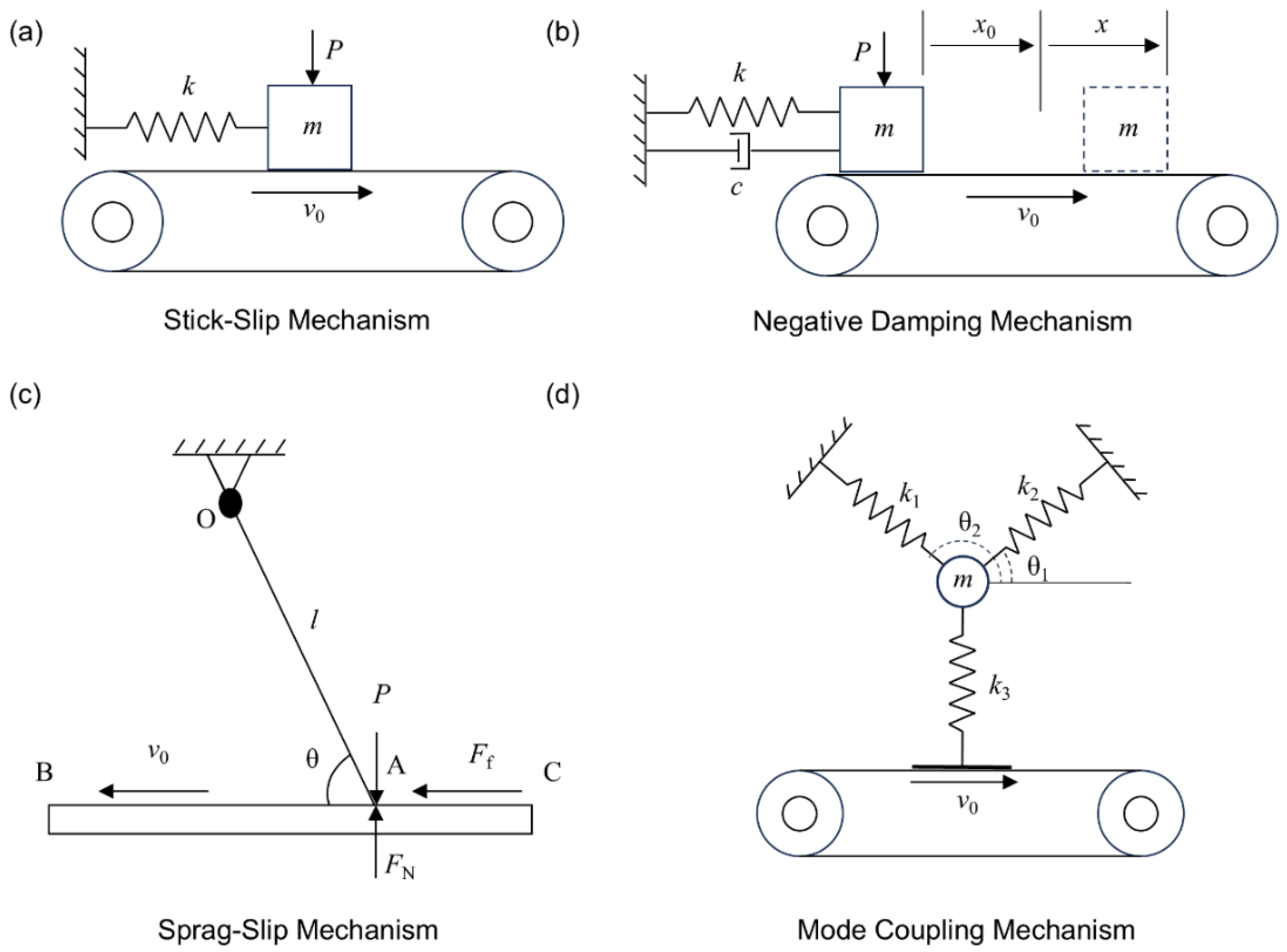
Friction-induced vibration, excited by frictional forces, is a highly complex physical phenomenon. Numerous factors influence the occurrence and characteristic of such vibrations, including the stiffness of the friction system, the value and direction of sliding velocity, the presence of reciprocating motion, the magnitude of the normal force, the material properties of the friction pair, the presence of lubrication at the contact interface, and environmental conditions [13,14]. The generation of friction-induced vibration and noise stems from the interaction between the contact interface and the system structure. No single theory can fully explain all friction vibration and noise phenomena. In early mechanistic studies, researchers attempted to use various theories to explain these phenomena and determine their root causes. This section summarizes the well-established explanatory mechanisms in the field of friction-induced vibration. Schematic diagrams of these four representative physical models are presented in Figure 2, illustrating the Stick–Slip (a), Negative Damping (b), Sprag–Slip (c), and Mode Coupling (d) mechanisms, respectively. These classical models provide the foundational theoretical basis for understanding the complex vibration behaviors in tribological systems.
Research on friction-induced vibration and noise began internationally in the 1930s. While studying the braking processes of different types of drum brakes, H.R. Mills observed that the friction coefficient decreased with increasing sliding speed, leading to self-excited vibration in the friction system. He proposed the “Friction Coefficient Decline Theory” to explain the mechanism behind friction-induced vibration. Subsequently, significant attention was paid to the issue of system instability caused by negative damping and energy input into the friction system due to the negative slope of the friction force relative to velocity [15,16,17]. Although the negative friction-velocity slope theory can explain some friction vibration and noise phenomena, subsequent research revealed that self-excited vibrations can still occur in friction systems even when the friction force increases with relative velocity [18]. This indicates that the theory is not universally applicable to all friction-induced phenomena.
Another mechanism used to explain friction noise is the stick–slip mechanism, proposed by Sinclair in 1955 and validated using a single-degree-of-freedom system [19]. When two surfaces in relative motion slide at low velocity under strong friction forces, and if one sliding surface has an elastic degree of freedom, the surface motion can become discontinuous, manifesting as a non-uniform stop-start phenomenon known as stick–slip motion. The stick–slip mechanism divides the motion of the friction pair into four stages: the first stage is forward slip, characterized by friction resisting forward relative motion; the second stage is backward slip, characterized by friction resisting backward relative motion; the third stage is the stick phase, where the driving force is less than the static friction force, causing the friction pair to adhere; the fourth stage is the break-away phase, where the friction force drops sharply, causing impact vibration between the friction pairs. It is the abrupt change in friction force that disrupts system stability and induces friction vibration. Many researchers have studied the stick–slip characteristics of friction coefficients under different operational parameters from the perspective of nonlinear vibration, using experiments or numerical calculations [20,21,22,23]. Stick–slip motion typically occurs under high load and low velocity and can explain low-frequency chatter in friction systems, but it cannot adequately account for high-frequency squeal phenomena.
Starting in the 1960s, researchers discovered that the generation of friction noise is closely related to the structure of the friction system. For a given friction system, minor changes in the assembly structure can significantly influence whether friction noise occurs. Spurr [24] noted the impact of structural changes on friction noise and, in 1961, proposed the “Sprag–Slip” theory to explain how structural changes cause friction noise. He argued that the geometric structure of the friction system has a far greater influence on friction noise than changes in the friction coefficient. In the model diagram, point O is a hinge joint, and bar BC moves horizontally at a constant velocity. The clamp angle between bar OA and bar BC is θ. Assuming the normal pressure at point A on bar BC is P, the reaction force at point A is F N , and the friction force is F f . Therefore, the moment balance equation at point O can be expressed as:
P l cos θ + F f l sin θ F N l cos θ = 0
Since the friction force F f = μ F N , combining with the equation yields the expression for the friction force F f based on the sprag angle θ:
F f = μ P 1 μ tan θ
When μ = cot θ , F f tends towards infinity, preventing relative motion between bar OA and bar BC, the BC surface experiences spragging. If both OA and BC are elastic bars, elastic deformation and recovery can lead to stick–slip motion between them. The sprag–slip mechanism has two distinct characteristics: first, it can predict system instability even when the friction coefficient does not change with speed; second, changes in the angle between the lever and the sliding surface play a crucial role in system stability, meaning geometric structural changes can induce vibration. However, this theory only explains vibrational behavior in the relative sliding direction and cannot account for friction vibration phenomena in the normal direction, showing clear limitations.
As research into the mechanisms of friction-induced vibration deepened, scholars in the 1980s began to propose that the generation of friction noise sometimes involves the simultaneous excitation of multiple structural modes, leading to instability in the normal or tangential directions of the friction pair. In 1984, Aronov [25], based on experimental observations, proposed the Friction Coupling mechanism for friction noise generation. The core idea is that without friction, the friction system lacks coupling and remains stable; when friction is introduced, it introduces an asymmetric factor that creates coupling within the system, destabilizing the system structure and thus causing friction noise.
In addition to the four classic mechanisms of friction-induced vibration and noise discussed above, several other theories have been subsequently developed, including the hammering theory [26], friction force time-lag theory [27], moving load theory [28], and double-modal separation theory [29]. However, the direct application of these classical models—often derived from dry friction or oil-lubricated contacts—to water-lubricated bearings faces limitations. It is crucial to emphasize that the tribo-dynamic behavior of water-lubricated systems is fundamentally distinct due to the lubricant’s unique physicochemical properties. The most critical differentiator is viscosity; water’s viscosity is approximately two orders of magnitude lower than that of oil, resulting in a fragile lubricant film that prone to breakdown, thereby keeping the bearing in a mixed lubrication regime dominated by stochastic asperity impacts. In stark contrast to oil films which provide substantial squeeze-film damping, the damping capacity of water is negligible, forcing the system to rely almost entirely on the liner material to dissipate vibration energy. Furthermore, the high Reynolds number of water makes the flow field highly susceptible to turbulence and cavitation, introducing unique high-frequency excitation sources rarely seen in laminar oil flows. It is necessary to combine multiple mechanisms in practical analysis, fully considering the actual conditions of the friction system, to thoroughly reveal the underlying mechanisms of friction-induced vibration in water-lubricated bearings.

3. Numerical Simulation of Friction-Induced Vibration

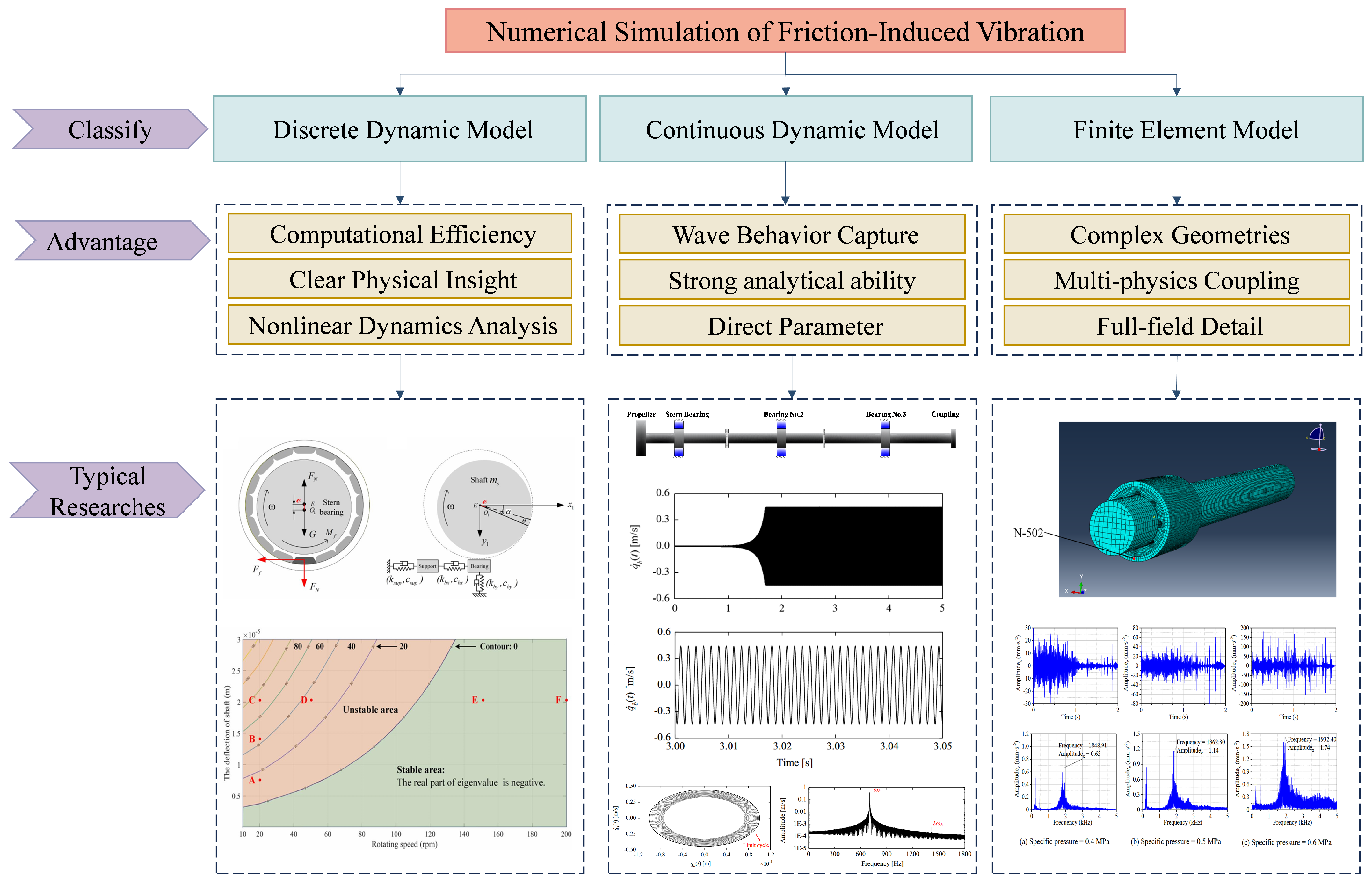
Numerical simulations of frictional vibration in water-lubricated bearings primarily employ discrete dynamic models, continuous dynamic models, and finite element models, as illustrated in Figure 3. This section reviews the mechanisms of friction-induced vibration in water-lubricated bearings from a numerical simulation perspective.
Discrete dynamic models, also known as lumped-mass models or “mass-spring-damper” models, simplify the propeller shaft system into one or several concentrated masses representing the inertia of shaft components. These masses are connected via springs and dampers that characterize the support stiffness and damping properties of the bearings [33,34]. Frictional effects are simulated by introducing nonlinear friction elements (e.g., the Stribeck model) that depend on relative velocity [35]. Early developments include the computationally efficient non-stiff friction model proposed by Leine et al. [36] in 1998, which avoided the limitations of rigid models and enabled the simulation of stick–slip vibrations using standard ODE solvers.
Researchers have progressively refined discrete models to capture complex instability mechanisms, evolving from simplified linear systems to high-fidelity nonlinear representations. Fundamental stability analyses utilized 2-DOF models to identify key governing parameters like normal load and damping [37]. Subsequently, recent advancements have introduced sophisticated 3-DOF and 4-DOF models to address multi-physics coupling. Specifically, by incorporating coupled lateral-torsional vibration modes, these models revealed that the interaction between bearing support and shaft dynamics significantly accelerates instability, particularly within negative friction-velocity gradient regions [38]. Furthermore, contemporary approaches have integrated stochastic rough surface perturbations and nonlinear friction elements using solvers like the Newmark-beta and Runge–Kutta methods. These analyses successfully differentiate between distinct instability regimes, specifically low-frequency ‘Chatter’ and high-frequency ‘Squeal’. Furthermore, they demonstrate that system divergence is often driven by the critical convergence of contact stiffness and vibration modes [39]. Discrete dynamic models offers high computational efficiency and model parameters with clear physical significance, facilitating the understanding and analysis of fundamental dynamic behaviors. It is particularly suitable for investigating the generation mechanisms of frictional vibration and the influence trends of factors such as friction coefficient, rotational speed, and support stiffness on system stability. However, the accuracy of the discrete dynamics model is limited, making it unable to precisely describe elastic deformation of bearing materials, higher-order vibration modes, distributed mass effects of the system, and other related phenomena.
Continuous Dynamic Models treat the rotating shaft and water-lubricated bearings as continuous elastic bodies, described by partial differential equations (PDEs). The shaft is typically modeled using Euler-Bernoulli or Timoshenko beam theory, while bearing support is represented by distributed or localized spring-damper boundary conditions [40]. Frictional excitation is introduced as a boundary condition. Continuum vibration models were initially applied to study frictional noise in vehicle braking systems, primarily composed of a disk and a slider. The numerical investigation by Ouyang et al. [15] in 1999 into a slider-flexible disk system with stick–slip friction revealed that while normal pressure and rotational speed drive instability, transverse damping suppresses it. Their work provides key insights into the mechanisms of brake squeal in non-smooth dry-friction systems. Regarding the continuum model of water-lubricated bearings, Zhang et al. [31] and Qin et al. [41] developed analytical models to study friction-induced instability in a propeller-shaft system with water-lubricated rubber bearings. Using complex eigenvalue analysis and the method of multiple scales, they revealed that nonlinear coupling and bearing vibration dominate the system’s self-excited vibrational response. Subsequently, building on this work, they adopted a high-dimensional analytical model that incorporated the coupling relationships among the torsional vibration of the continuous axle, transverse vibrations, and bearing self-excited vibrations under frictional excitation. The results revealed that the nonlinear nature and discontinuous characteristics of the tangential friction force are the root causes inducing system instability and multiple vibration couplings [42]. Huang et al. [43] proposed a numerical model with velocity-dependent and stick–slip friction to analyze the dynamical response of a marine propeller shaft system. Using a cooperative Newton–Raphson & Newmark-β method, they investigated key friction parameters and achieved an optimized design for stability based on stability analysis and experimental validation. This method accounts for the continuity and distributed parameter characteristics of the shaft system, providing a more accurate representation of shaft bending and closer alignment with physical reality. It also retains certain analytical qualities, aiding in the understanding of the intrinsic mechanisms of system vibration.
Finite Element Models discretize the water-lubricated bearing system into small elements, establishing approximate equations for each element and assembling them into a large system of equations for solution [44]. Currently, the finite element methods used in the field of friction-induced noise primarily include transient dynamic analysis and complex eigenvalue analysis, which investigate frictional noise from the perspectives of the time domain and frequency domain, respectively. Studies focusing on transient states (i.e., startup and shutdown) revealed that operating parameters often outweigh intrinsic friction coefficients in driving instability; for instance, specific pressure was found to be more critical than friction magnitude in determining vibration intensity [45], while startup transients consistently excite high-frequency vibrations even at low friction levels [46]. Regarding structural dynamics, coupled models incorporating rubber layer deformation and shaft-housing interactions demonstrated that optimizing the rubber lining effectively expands the contact area and reduces edge loading [47]. Furthermore, incorporating support stiffness and damping into these coupled systems has been shown to modulate vibration modes—shifting energy from high-frequency squeal to low-frequency chatter—and effectively suppress self-excited oscillations [48]. Existing research in related areas suggests that this approach accurately reflects the actual geometry, materials, and boundary conditions of the system, capturing detailed stress/strain distributions and complex nonlinear interactions. It can simulate large deformations of bearing materials, temperature fields, and perform various analyses such as modal, harmonic response, and transient dynamics, enabling a comprehensive evaluation of bearing system performance. However, the mechanistic analysis is less intuitive, making it challenging to extract clear physical insights from vast datasets. That said, the method offers low cost, simple operation, and extremely high efficiency, and is currently being widely adopted and applied across various engineering fields.
Numerical simulation of friction-induced vibration in water-lubricated bearings exhibits a trend toward increasingly sophisticated modeling, incorporating multi-degree-of-freedom dynamics, nonlinearity, and stochastic nature. However, the predictive accuracy of most models remains to be validated. Furthermore, modeling the coupling between hydrodynamic lubrication effects and solid contact in such bearings has not been sufficiently addressed, and the underlying multi-physics mechanisms require further clarification.

4. Experimental Investigation of Friction Vibration Performance

4.1. Typical Test Rigs

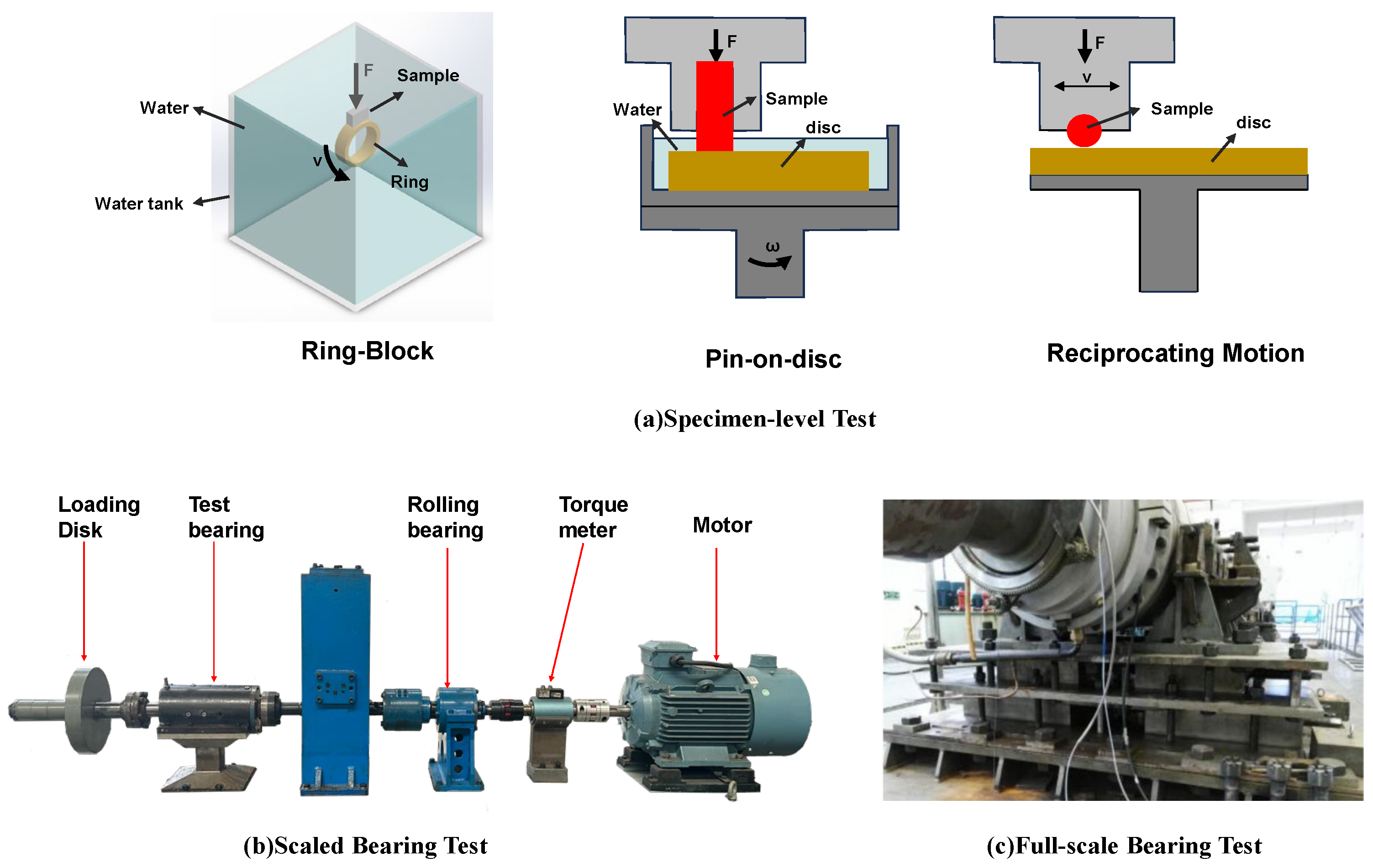
In the study of friction-induced vibration in water-lubricated bearings, test rigs serve as a critical link between theoretical models and engineering practice. Depending on the rig size and research objectives, they can be broadly categorized into two types: specimen-level tests and scaled/full-scale bearing tests, as classified in Figure 4.
Specimen-level test machines focus on the intrinsic tribological characteristics of the friction pair materials and the fundamental patterns of vibration and noise, isolating the complex geometry and system dynamics of actual bearings. Common configurations include standardized tribometers like ring-on-block, pin-on-disk, and reciprocating types, as well as custom-built testers. These machines induce relative sliding between materials simulating the shaft and bearing under controlled load, speed, and water lubrication conditions, enabling efficient and low-cost screening of material pairs and parametric studies. Their main advantage lies in the high degree of control and repeatability, making them particularly suitable for uncovering the underlying mechanisms of interfacial friction vibration.
For instance, Wu et al. [50] investigated the friction, wear, and vibration characteristics of common water-lubricated composite materials like Tenmat, Thordon, and BTG rubber under low-speed and heavy-load conditions using a ring-on-block configuration. Their findings indicated that BTG rubber exhibited superior tribological and vibration performance under identical operating conditions. Dong et al. [51] employed a pin-on-disk tester to study the stick–slip behavior of three polymer materials under water lubrication. Significant stick–slip was observed during the startup process, with the fiber-resin composite demonstrating better hydrophilicity, viscoelasticity, and the lowest friction noise. Zhang et al. [52] used a reciprocating tribometer to evaluate the friction, vibration, and noise of water-lubricated bearing materials modified with graphene nanosheets (GNS). The GNS imparted excellent self-lubricating properties to the modified polymer, reducing vibration and noise. These different test machines each have their specific emphases, suiting different research goals: the ring-on-block configuration most closely resembles the contact in journal bearings, ideal for assessing overall material performance under continuous rotation; the pin-on-disk machine facilitates detailed observation of fundamental mechanisms like stick–slip and wear scar analysis; the reciprocating tester simulates alternating motion, applicable for studying vibration and noise issues prone to occur at start-stop and reversal points. However, their limitation is evident—the simplified contact geometry cannot realistically simulate the complex dynamic coupling behavior exhibited by bearings within rotor systems.
Scaled or full-scale bearing test rigs overcome the shortcomings of specimen-level studies by enabling in-depth investigation of the friction vibration characteristics of water-lubricated bearings in environments approximating real service conditions. These rigs center on complete bearing components tested within controlled mechanical systems. Their designs are diverse, tailored to different research emphases, such as replicating real-world conditions like misalignment, bearing clearance, axial float, presence of sand/medium, and seawater corrosion. Horizontal radial bearing test rigs, driven by precision spindles and integrated with controlled water lubrication systems, allow systematic measurement of operational parameters. Dynamic characteristic test rigs for water-lubricated bearings incorporate rotors with well-defined dynamic properties. They can apply controlled excitation via shakers or introduce rotational excitation through unbalanced masses, revealing nonlinear vibrations and instability phenomena triggered by changes in friction state.
Yang et al. [53] and Wang et al. [54] used an SSB-100 marine stern bearing testing machine to measure the friction coefficient, noise, vibration frequency, and amplitude of water-lubricated rubber bearings under different conditions. Their research showed that higher rotational speeds lead to a lower friction coefficient and alter the friction vibration state. Within a certain range, increasing specific pressure enlarges the contact area, reducing the contact pressure between the tested bearing and the shaft, thereby changing the friction coefficient and vibration amplitude. As the cooling water temperature rises, friction vibration sometimes decreases, but the critical speed for noise generation increases due to rubber softening. Xing et al. [55] used a sliding bearing test rig to study two distinct types of friction-induced vibration with different amplitude-frequency characteristics that can be excited within a specific lubricated tribo-system. The strong-contact vibration response reflects the contact state between the friction pair surfaces, while the weak-contact vibration response reflects the friction state between them. Chang et al. [56] investigated the healthy operating conditions for water-lubricated bearings in ultra-long shaft systems. They found that controlling parameters like shaft speed, inlet water temperature, lubricating medium, bearing specific pressure, and bush surface topography can effectively modify the bearing’s speed characteristics, lubrication properties, and temperature rise characteristics. Li et al. [57] employed a marine propulsion shafting dynamic loading test bed to study the friction vibration of the stern bearing pair under wave impact. Their work revealed that when the ship propulsion shafting experiences non-synchronous frequency wave impacts (as opposed to synchronous frequency impacts), the dynamic behavior of the shafting exhibits highly nonlinear characteristics. A phase difference of approximately 180° between the rotational frequency wave impact and the vertical dynamic load of the stern bearing can effectively suppress friction vibration in the stern bearing.
Furthermore, full-scale simulation test rigs designed for specific engineering applications can highly replicate actual marine shaft systems. Liu et al. [49] established a distributed measurement system for a water-lubricated bearing on a full-scale propulsion shafting test rig, simultaneously acquiring axial water film pressure distribution, shaft center trajectory, and vibration acceleration. This enabled a systematic study of the tribo-dynamic characteristics across three lubrication sub-zones under operating conditions.
In summary, experimental methodologies constitute a complementary framework, characterized by distinct trade-offs between cost-efficiency and realistic dynamic fidelity. Specimen-level tests offer the advantage of rapid, low-cost material screening but are limited by their simplified contact geometry. Scaled bearing rigs provide a balanced platform for investigating hydrodynamic mechanisms, though they may suffer from scaling effects. Full-scale tests, while essential for capturing the authentic coupled dynamics of the shafting system, are constrained by their high resource demands and operational complexity. Therefore, a comprehensive research strategy often integrates these methods to bridge the gap from fundamental tribology to engineering application. Future development trends lean towards the deep integration of experimental research across different scales. Future efforts should integrate advanced online monitoring with high-fidelity digital twins to build a comprehensive multi-scale predictive framework. This approach connects micro-scale interfacial phenomena with macro-scale system dynamics, ultimately enabling the intelligent control of friction-induced vibration.

4.2. Key Measurement Techniques

In experimental studies on friction-induced vibration in water-lubricated bearings, the accurate measurement of key physical quantities is essential for uncovering underlying mechanisms and validating theoretical models. Experimental measurements typically encompass multiple aspects, including mechanical vibration, friction signals, acoustic emissions, lubricant film status, temperature distribution, and surface wear morphology, enabling a comprehensive analysis of complex tribological and dynamic behaviors. Among these, vibration acquisition is of primary importance. Conventional approaches involve mounting piezoelectric accelerometers on the bearing housing or adjacent structures to measure vibration acceleration responses [58,59]. Processing these time-domain signals allows identification of system natural frequencies, synchronous components induced by misalignment, as well as nonlinear features such as harmonics and resonance peaks associated with high-frequency squeal noise in friction vibration. However, piezoelectric sensors may interfere with the dynamic characteristics of the test structure and compromise measurement accuracy due to their own mass, environmental conditions, and other constraints [60,61].
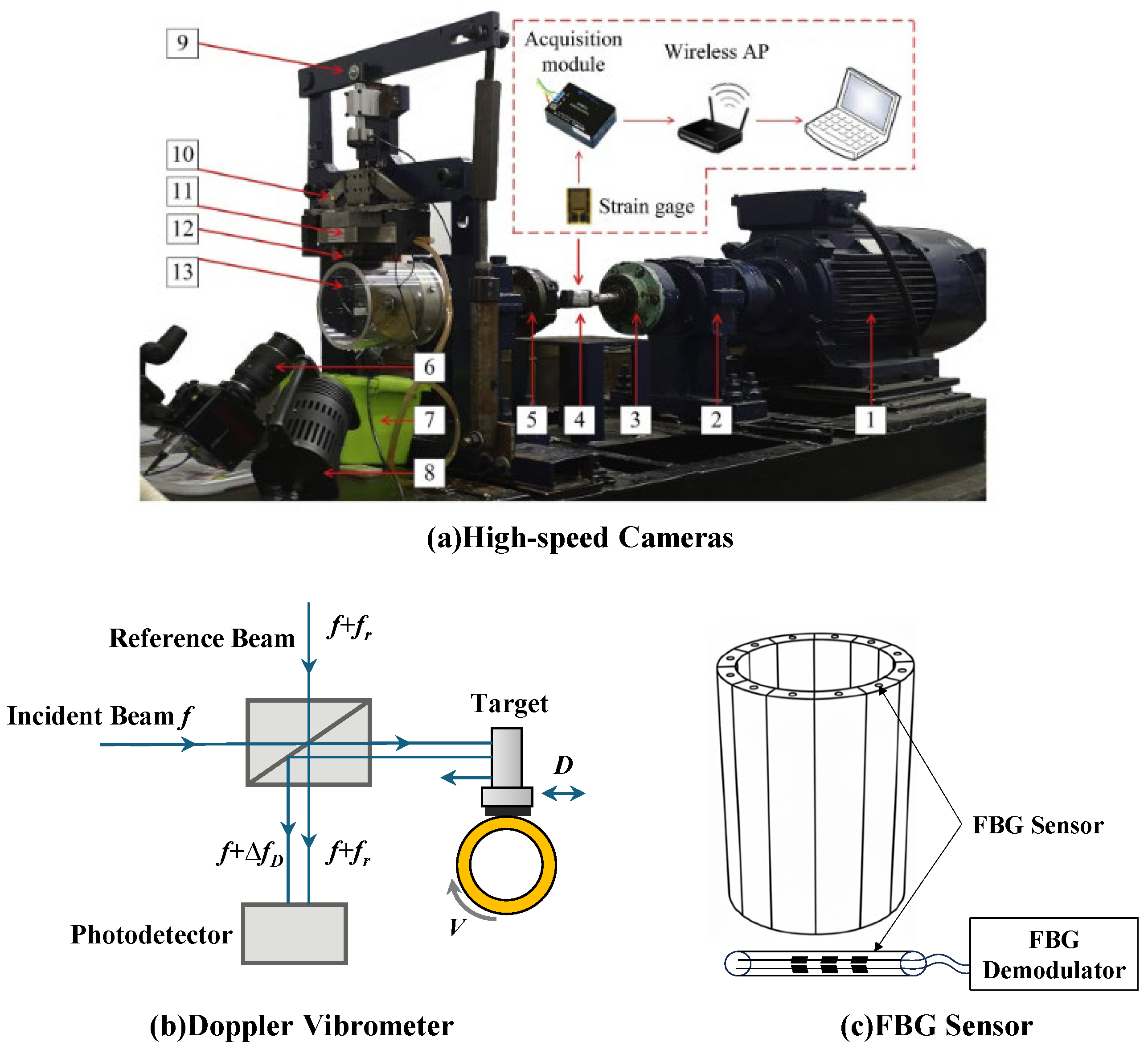
Several emerging vibration measurement techniques are now being adopted by researchers, as illustrated in Figure 5. For instance, Dong et al. [62] employed a non-contact laser Doppler vibrometer with the laser beam oriented perpendicular to the holder and parallel to the friction direction to measure deformation displacement in a ceramic ball within a ball-on-disk test rig, investigating vibration and noise behaviors during stick–slip motion. Wu et al. [63] proposed an embedded fiber Bragg grating (FBG) sensor to characterize internal stress in bearings, enabling the detection of abnormal wear and friction-induced noise faults. Kuang et al. [30,64] constructed a tribo-pair consisting of a glass shaft and a rubber block, using high-speed cameras to synchronously capture responses of the bearing material and shaft. Through integrated analysis of vibration, noise, friction, and images, they visually revealed the coupling process between frictional vibration and torsional vibration in a stern shaft system.
Each measurement technique possesses distinct characteristics suitable for specific research objectives. Traditional accelerometers are robust for general housing monitoring, while emerging non-contact methods like Doppler vibrometer and high-speed imaging offer superior insights into transient dynamics without introducing mass-loading effects. A detailed comparison of these techniques, highlighting their advantages and limitations in the context of water-lubricated bearings, is summarized in Table 1. Beyond single-parameter vibration testing, future research faces the challenging task of developing multi-parameter synchronous measurement and fusion analysis techniques. Such integrated diagnostic systems will be crucial for deciphering the mutually exciting and coupled physical nature of water-lubricated bearings, offering deeper insights into their complex dynamics.

5. Influencing Factors and Suppression Methods

The mechanisms underlying friction-induced vibration in water-lubricated bearings and the corresponding suppression strategies are profoundly dependent on the interactions among multiple internal system factors. The influencing factors can be primarily categorized into structural design, material pairing, and surface optimization. Consequently, effective vibration suppression requires a synergistic and optimized approach across these key areas.

5.1. Structural Design

At the structural design level, the macroscopic geometric parameters of the bearing form the foundation determining its dynamic lubrication performance and stability [65]. The thickness and hardness of the bearing material are structural parameters that cannot be overlooked [66]. Appropriate thickness provides room for elastic deformation while ensuring structural strength, whereas hardness directly determines the anti-deformation capability and wear resistance of the friction pair [67]. Orthogonal experimental studies have systematically evaluated the impact of liner geometry and material properties. These investigations consistently highlight that material hardness and layer thickness are the dominant factors influencing vibration performance, surpassing the effect of surface geometry [68]. Specifically, increasing the rubber hardness within an optimal range while reducing layer thickness has been proven effective in mitigating friction vibration intensity.
The clearance design between the bearing and the journal is key to achieving a stability balance [69]. Excessive clearance, while beneficial for lubricant flow and cooling, weakens the oil film stiffness and can easily induce low-frequency whirling [70]. Conversely, insufficient clearance may lead to local dry friction due to thermal expansion or manufacturing errors, triggering high-frequency squeal. Shi et al. [71] investigated the dynamic characteristics of water-lubricated bearings under small perturbations by combining elastohydrodynamic lubrication theory with Lagrangian dynamics modeling. Their study revealed that the eccentricity ratio, length-to-diameter ratio, radial clearance, and rotational speed significantly influence the dynamic behavior of water-lubricated rubber bearings, with particularly pronounced effects observed at higher eccentricity ratios. Xiang et al. [72] investigated the influence of radial clearance on the dynamic characteristics of water-lubricated bearings, considering asperity contact. Their study showed that as the radial clearance decreases, the stiffness and damping coefficients of the water film, as well as the contact stiffness of the asperities, all increase.
Furthermore, the design of lubrication grooves, such as axial/circumferential grooves, is crucial. Rational groove design ensures adequate supply and uniform distribution of lubricating water, facilitating the formation of a stable hydrodynamic film. Furthermore, it disrupts irregular pressure fields and flushes out wear debris, thereby preventing local pressure peaks and suppressing friction-induced vibration. Feng et al. [73] studied the comprehensive effects of groove structure parameters on the dynamic characteristics, stability, and unbalanced response of a water-lubricated hydrodynamic bearing-rotor system. Their results demonstrated that shallower and longer grooves enhance direct stiffness along the load direction. While groove structure had little influence on direct damping coefficients, it increased the cross-coupled damping coefficients.
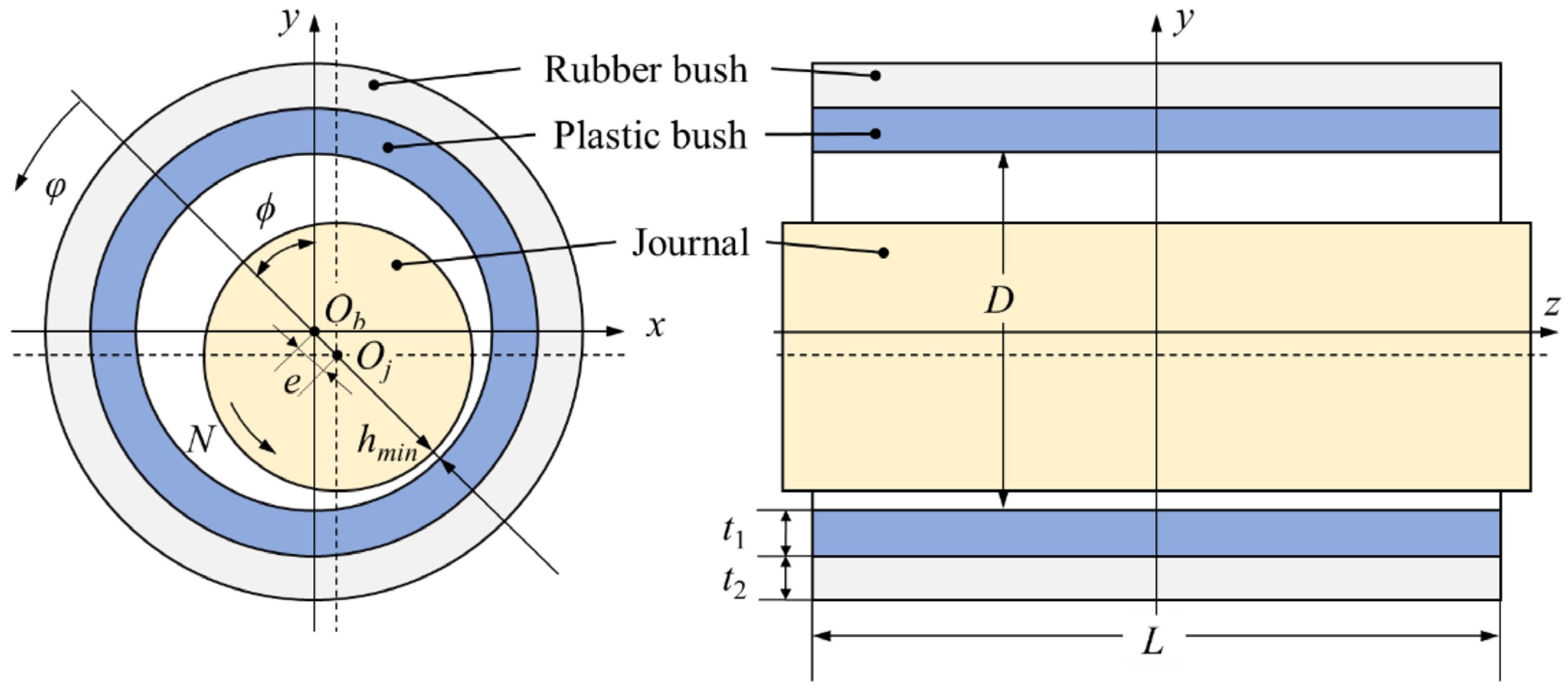
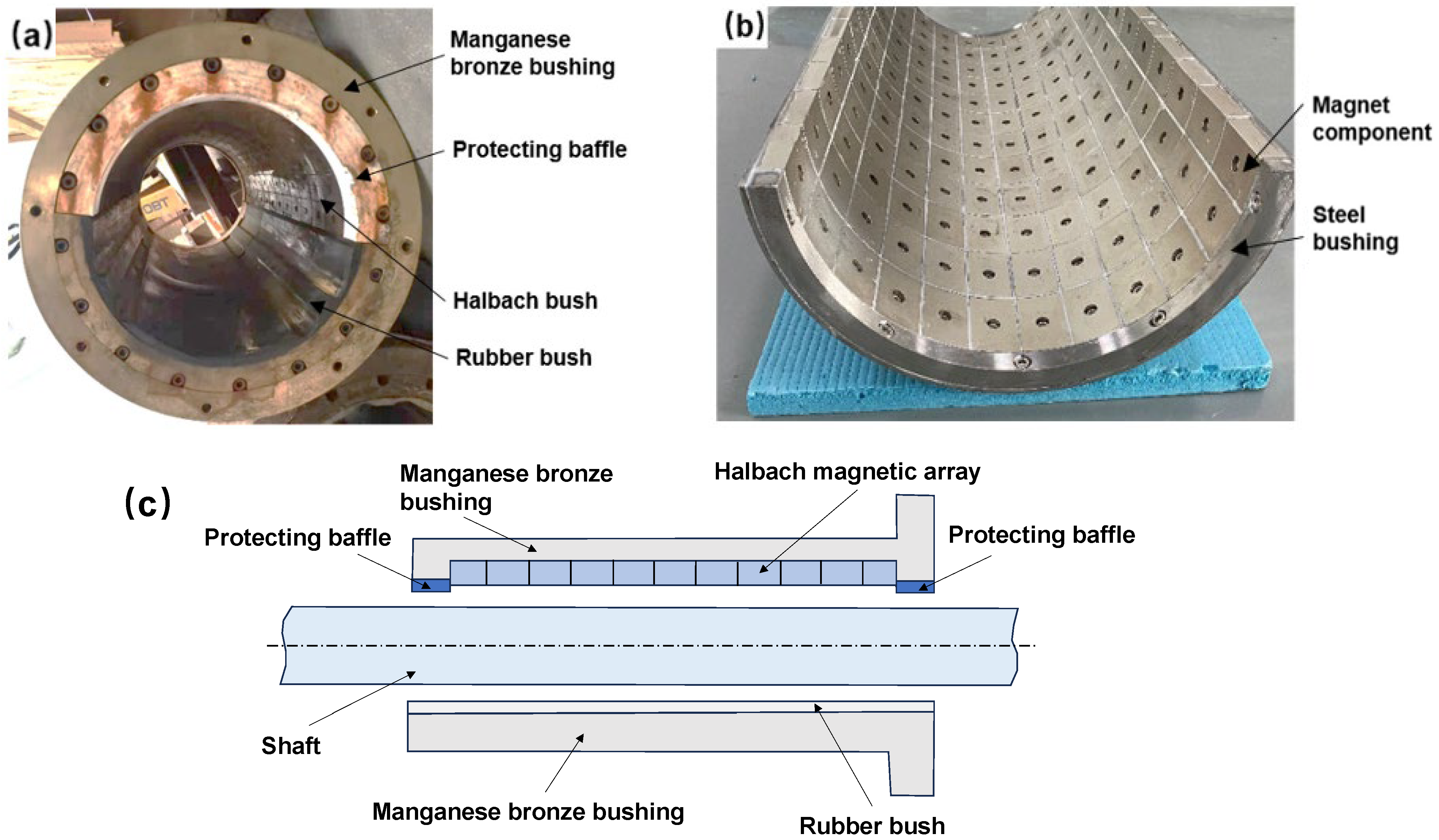
From the perspective of system dynamics, the vibration response of the rotor-bearing system is fundamentally governed by its support stiffness and damping characteristics [74,75]. Consequently, a series of studies have focused on vibration suppression through innovative bearing design. Litwin [76] fabricated a water-lubricated bearing with a three-layer composite material. The sliding surface in contact with the shaft ensured a low friction coefficient, the intermediate NBR layer provided good vibration damping performance and reduced sensitivity to shaft misalignment, and the external brass layer made the bearing easier to fit. Compared to rubber bearings of similar geometry, this design exhibited superior tribological and vibration damping performance. Figure 6 illustrates the structure of a typical multi-layer water-lubricated bearing. Xie et al. [7] established a two-way fluid–structure–acoustic interaction hydrodynamic model for a sandwich bushing bearing under typical operating conditions, analyzing its lubrication performance considering cavitation effects and acoustic radiation. The sandwich structure bearing was beneficial for noise reduction, and materials with smaller elastic modulus and density were more suitable as the interlayer material. The same team also developed a novel bidirectional tilting pad bearing to address uncertainties in shaft misalignment and contact, which could balance the effects of unidirectional vibration [77]. Liu et al. [78] proposed a water-lubricated stern bearing structure with a damping function and self-adaptive performance, comprising elastic elements and a damping alloy layer. The elastic elements facilitated uniform distribution of static and dynamic loads on the stern bearing, alleviating edge effects, ensuring uniform axial contact pressure distribution, and improving overall bearing performance. Thus, it prolonged the bearing’s service life and minimized friction-induced excitation. The damping alloy layer effectively attenuated the transmission of shaft vibration through the bearing to the foundation, optimizing vibration transmission characteristics.
The use of electromagnetic forces to alter instability conditions and eliminate self-excited vibrations has gradually been applied to water-lubricated bearings in recent years [80,81,82]. Wu et al. [83] integrated a Halbach array into a water-lubricated bearing bushing, as displayed in Figure 7. This figure presents both the physical prototype of the hybrid bearing and the schematic of the magnetic circuit, illustrating how the attractive forces are generated to counterbalance the shaft load. This design could reduce the static pressure on the bottom bushing by 37%. The calculated stiffness of the magnetic bearing was less than that of a conventional bearing, resulting in lower natural frequencies. This configuration effectively suppressed vibration peaks and reduced friction-induced vibration, also demonstrating excellent robustness against speed fluctuations and external loads.
In summary, suppressing friction vibration through bearing structural design is a task involving multiple parameters and scales. From fundamental properties like material hardness and thickness, to the optimization of macroscopic geometries like clearance and grooves, and further to novel structural schemes such as multi-layer composites, integrated damping, and magnetic regulation, structural innovation plays a key role in enhancing bearing dynamic performance. Future research should prioritize the systematic exploration of structure-material-lubrication coupling mechanisms. This holistic approach is essential for ensuring the long-term stability and low-vibration performance of bearings under extreme operating conditions.

5.2. Material Pairing

The selection of material pairings is central to determining the nature of the microscopic interactions at the friction pair interface [59]. An ideal material combination must possess good tribological properties while also considering compatibility with the water environment and mechanical strength [84]. It should effectively reduce friction force fluctuations under boundary and mixed lubrication regimes, thereby mitigating vibration excitation at its source. The addition of reinforcing fibers or fillers not only enhances wear resistance and load-bearing capacity but also alters the material’s damping characteristics, aiding in the dissipation of vibrational energy.
The incorporation of functional fillers and nanoparticles into polymer matrices is a widely adopted strategy to enhance tribological performance and suppress vibration. Yan et al. [85] modified nitrile rubber by incorporating a mixture of ultra-high molecular weight polyethylene and graphite powders. The resulting new material exhibited a relatively small negative slope in the friction-velocity relationship, leading to a lower probability of stick–slip phenomena and outstanding low-speed performance. From the perspective of reducing the fluctuation amplitude of the friction force by mitigating deformation behavior of worn material surfaces, Dong et al. developed several novel composite materials. These include a new polyimide (PI)-based composite incorporating MoS2 nanoparticles [86], a polymeric material composed of high-density polyethylene (HDPE) and tetrapod-like zinc oxide whisker (T-ZnOw) powder [87], and a novel composite with hexagonal boron nitride (h-BN) particles incorporated into a thermoplastic polyurethane (TPU) matrix [88]. These materials effectively eliminated or reduced friction-induced vibration and noise.
Furthermore, novel molecular architectures and energy dissipation strategies have been developed to address the limitations of conventional composite materials. Qu et al. [89] prepared a novel ternary NBR/PU/EP interpenetrating polymer network (IPN) with excellent damping and tribological properties for water-lubricated bearings. The NBR/PU/EP IPNs with a mass ratio of 100:40:60 demonstrated the widest effective damping temperature range, the lowest friction coefficient, and the lowest specific wear rate. These superior damping and tribological properties were attributed to a unique microphase continuous structure, as evidenced by TEM analysis. Cai et al. [90] focused on establishing a persistent lubrication mechanism and durable lubricating film on the contact surface to improve friction vibration in polymer materials. Introducing mesoporous polydopamine (MPDA) blended with UHMWPE helped alleviate friction-induced vibration, particularly that caused by intermittent adhesion and sliding motion. The MPDA nanoparticles were shown to act as water reservoirs, releasing and replenishing water according to load conditions, thereby maintaining persistent water-based lubrication on the composite surface. Zhang et al. [91] prepared a novel piezoelectric damping composite material, a barium titanate/carbon black/polyurethane composite (BaTiO3/CB/PU). The BaTiO3 component can convert mechanical energy generated by friction vibration into electrical energy, which is then dissipated as heat. Water cooling dissipates both the frictional heat and the piezoelectric damping heat. This energy dissipation method enhances damping capacity, thereby reducing friction-induced vibration and noise behavior.

5.3. Surface Condition Optimization

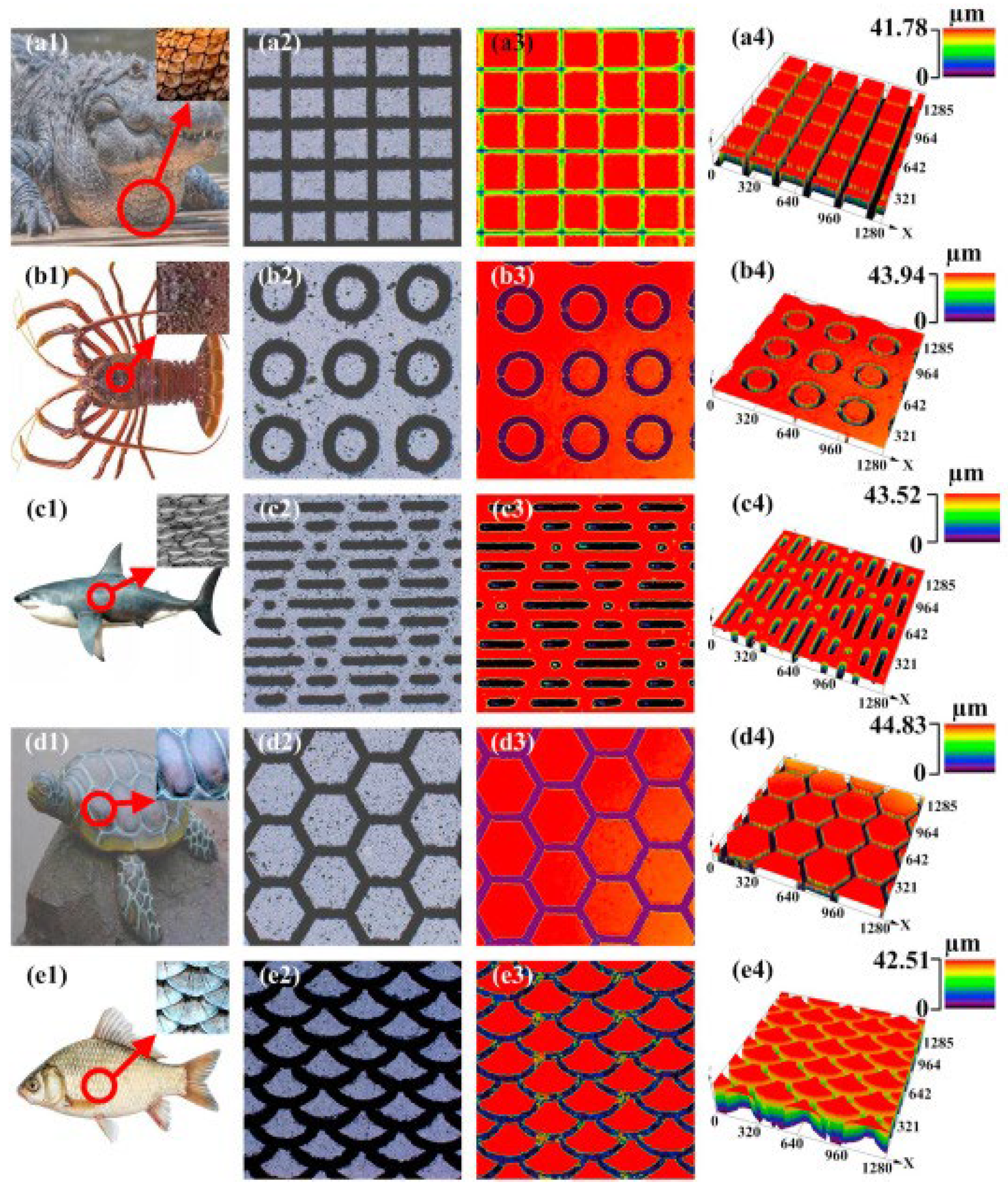
As an extension of material properties, the surface condition—specifically its micro-topography and chemical attributes—directly governs the contact mechanics at the interface and is closely linked to the generation of friction-induced vibration [92]. A precisely controlled surface roughness, achieved through advanced machining, creates peak-valley structures that act as micro-reservoirs and pressure-generating units at the microscopic level. This promotes the formation of a more stable lubricating film. Wang et al. [93] demonstrated that surface roughness plays a critical role in triggering and evolving squeal noise. Adhesion and tearing caused by surface asperities, such as the accumulation of wear debris and detachment of particles, introduce high-frequency components into the friction force, leading to a higher propensity for squeal. Deliberately created micro-dimple or micro-groove arrays, fabricated using techniques like laser surface texturing, can generate additional hydrodynamic effects, enhancing local film pressure. Simultaneously, they act as traps for wear debris, reducing three-body abrasive wear and thereby significantly improving the friction conditions and suppressing vibration. Yang et al. [94] showed that surface textures function to entrap wear debris and store water, effectively improving the wetting condition between the two friction surfaces and reducing the friction coefficient. This suppresses the formation of high-frequency friction force components. The textured slats exhibited lower friction coefficients, maximum vibration amplitudes, and overall vibration levels compared to non-textured samples. Gheiasri et al. [95] found that textures significantly reduced the friction coefficient under both poor lubrication and water-lubricated conditions. The dimple textures promoted the onset of hydrodynamic lubrication, and adjusting the density of surface dimple textures effectively increased the critical load, facilitating a transition in the lubrication regime. Building on this research, recent attention has gradually shifted towards bio-inspired surface structures [96], as illustrated in Figure 8. This figure classifies typical bionic designs into distinct categories based on their biological prototypes, such as crocodile skin-square, lobster shell-circle, and shark skin-diamond. Drawing on the excellent tribological characteristics of biological surface structures, a series of theoretical and experimental explorations have been conducted, providing new ideas for the design and application of surface textures.
Furthermore, surface modification techniques, such as depositing solid lubricant coatings with low shear strength or performing ion implantation, can effectively reduce the shear force during sliding without altering the bulk material properties. This results in smoother and more stable interfacial friction behavior, fundamentally weakening the excitation source that causes severe vibration. Liu et al. [98] selected various liquid lubricants—including liquid paraffin, tung oil (TO), dimethyl silicone oil (DSO), ionic liquid (IL), and hexamethylene diisocyanate (HDI)—as surface coatings for nitrile rubber (NBR). The application of liquid lubricants effectively reduced the friction, wear, and vibration amplitude of NBR, with TO demonstrating the best tribological performance.
In summary, the effective suppression of friction-induced vibration in water-lubricated bearings cannot rely on a single measure but constitutes a comprehensive systems engineering challenge. A comparative analysis indicates that structural optimization serves primarily as a passive regulation strategy to desensitize the system to excitation, whereas surface modification and advanced material design address the root cause by stabilizing the friction interface itself. Consequently, successful mitigation requires synergistic design across multiple dimensions: spanning structural dynamics, friction pair material systems, surface/interface properties, and the intelligent management of operating conditions. Looking forward, the ‘ultimate’ solution lies in a hybrid approach that integrates multi-factor coupling modeling, online monitoring, and active control. This evolution—from passive structural tuning to active interfacial engineering—represents the most promising trajectory for achieving high-performance, low-vibration, and long-term stable operation of next-generation propulsion systems.

6. Challenges and Future Perspectives

Although significant progress has been made in understanding friction-induced vibration in water-lubricated bearings, several scientific challenges and engineering bottlenecks remain. Based on the review of existing literature, future research should focus on the following key areas:
Deepening Multi-scale and Multi-physics Coupling Mechanisms: Current numerical models often simplify the interaction between the turbulent water film and the viscoelastic deformation of the liner. Future models need to rigorously incorporate fluid-solid-thermal coupling effect [99], especially under transient conditions like start-up and shut-down. Specifically, accurately modeling the stochastic impact of asperity contact in the mixed lubrication regime remains a challenge. The inherent fragility of the water film makes these microscopic interactions the dominant source of nonlinear instability, necessitating higher-fidelity contact algorithms [100,101]. At the fundamental level, researchers should further investigate the role of friction phonons in energy transport [102]. Understanding how interfacial frictional work is dissipated into heat or converted into vibrational energy via phonon excitation offers a novel atomic-scale perspective on the genesis of high-frequency squeal [103]. Consequently, developing sophisticated multi-scale models that bridge the gap from atomic phonon dynamics to macroscopic fluid-structure interaction is essential for revealing the evolution mechanism of self-excited vibration modes and predicting the critical velocity thresholds for squeal generation.
Integration of Digital Twins and AI: Traditional passive monitoring, which typically relies on simple threshold alarms, is increasingly insufficient for the complex and variable operating environments of modern smart ships. A promising frontier is the development of high-fidelity Digital Twin systems specifically for water-lubricated stern bearings [104]. By creating a virtual mirror of the physical system, researchers can fuse real-time multi-source sensor data (spanning vibration, temperature, and film pressure) with physics-based tribo-dynamic simulations. Advanced Machine Learning algorithms, particularly physics-informed neural networks and defect-guided models, can then be utilized to mine these fused datasets [105]. This approach enables the detection of subtle friction-induced vibration precursors—distinguishing between low-frequency chatter and high-frequency squeal—and the precise prediction of Remaining Useful Life even under limited fault data. Consequently, this integration of data-driven intelligence with physical principles will drive a paradigm shift from reactive maintenance to proactive, predictive management of bearing dynamic stability.
Breakthroughs in Material Science and Superlubricity: While current polymer composites have enhanced basic tribological performance, achieving stable water superlubricity (friction coefficient < 0.01) under realistic engineering loads remains a grand challenge due to the difficulty of maintaining a hydration layer under high pressure [106]. Future research must look beyond traditional formulations to explore novel hydrogel-based composites that mimic the unique load-bearing and lubrication mechanisms of articular cartilage [107]. Furthermore, the integration of 2D materials as interfacial modifiers offers a pathway to fundamentally eliminate the root causes of vibration, specifically stick–slip and negative friction-velocity slope by creating ultra-low shear interfaces. Additionally, the design of bio-inspired surfaces should evolve from simple static geometric patterns to multi-scale, functionalized architectures [108]. These advanced surfaces should not only entrap wear debris but also mimic the adaptive properties of biological tissues, such as self-lubrication and self-repairing capabilities, to ensure long-term stability in harsh marine environments.
From Passive to Active Control: Most current suppression methods, such as structural damping layers or fixed geometric optimization, are fundamentally passive. They are often effective only within narrow frequency bandwidths and cannot adapt to the variable speeds and loads typical of marine propulsion. Future designs should increasingly incorporate Active Vibration Control technologies to construct “smart bearings.” For instance, integrating electromagnetic actuators (e.g., active magnetic bearings) or smart piezoelectric materials into the bearing liner allows for the real-time modulation of stiffness and damping properties. Furthermore, magnetorheological elastomers, whose modulus can be tuned by external magnetic fields, offer a promising route for semi-active control. By establishing a closed-loop feedback system, these technologies enable the bearing to dynamically adjust its dynamic characteristics and actively suppress friction-induced instabilities (e.g., resonant squeal) the moment they are detected, thereby significantly widening the stable operating envelope.

7. Conclusions

This comprehensive review has thoroughly examined the current state of research on friction-induced vibration in water-lubricated bearings, covering fundamental mechanisms, numerical simulation approaches, experimental methodologies, and vibration suppression strategies. The analysis reveals that friction-induced vibration in water-lubricated bearings represents a complex, multi-physics phenomenon involving intricate interactions between tribological, structural, and hydrodynamic factors. However, numerous challenges remain to be addressed, which can be summarized as follows:
  • The mechanisms underlying friction-induced vibration are multifaceted, with no single theory capable of fully explaining all observed phenomena. Classical theories including friction coefficient–velocity slope, stick–slip, sprag–slip, and friction coupling provide partial explanations, but comprehensive understanding requires integrated approaches that consider multiple mechanisms simultaneously. The unique properties of water exacerbate these challenges, making the system significantly more prone to instability than its oil-lubricated counterparts.
  • Numerical simulation approaches have evolved from simple discrete models to sophisticated finite element analyses that can capture complex nonlinear behaviors. However, significant challenges remain in accurately modeling the coupling between hydrodynamic lubrication effects and solid contact, as well as validating model predictions against experimental data. The development of multi-physics models that can simultaneously account for fluid dynamics, structural mechanics, and tribological interactions represents a critical research direction.
  • Experimental investigations have benefited from advances in measurement technologies, enabling more comprehensive characterization of friction-induced vibration phenomena. Nevertheless, there remains a gap between specimen-level tests and full-scale bearing systems, with limited studies that bridge this scale difference. The integration of advanced sensing technologies with digital twin models offers promising avenues for creating more predictive experimental frameworks.
  • Vibration suppression strategies encompass structural design optimization, material pairing selection, and surface condition enhancement. Each approach offers distinct advantages but also limitations, highlighting the need for integrated solutions that address multiple aspects simultaneously. Emerging technologies such as smart materials, active control systems, and bio-inspired designs present exciting opportunities for next-generation vibration mitigation approaches.

Author Contributions

Conceptualization, X.G., X.Z. and J.H.; formal analysis, Z.Y. and Y.Y.; investigation, R.L. and Z.Y.; data curation, X.G.; writing—original draft preparation, X.G.; writing—review and editing, X.Z. and J.H.; visualization, X.G. and Y.Y.; supervision, W.O. and Y.J.; project administration, X.Z. and J.H.; funding acquisition, J.H. All authors have read and agreed to the published version of the manuscript.

Funding

This work was supported by the National Natural Science Foundation of China (Grant Nos. 52101370 and 52241102) and the Hubei Provincial Natural Science Foundation (Grant No. 2025AFD090).

Data Availability Statement

The original contributions presented in the study are included in the article, further inquiries can be directed to the corresponding author.

Conflicts of Interest

The authors declare no conflicts of interest.

References

  1. Litwin, W.; Olszewski, A. Water-Lubricated Sintered Bronze Journal Bearings-Theoretical and Experimental Research. Tribol. Trans. 2014, 57, 114–122. [Google Scholar] [CrossRef]
  2. Litwin, W. Influence of Local Bush Wear on Water Lubricated Sliding Bearing Load Carrying Capacity. Tribol. Int. 2016, 103, 352–358. [Google Scholar] [CrossRef]
  3. Barszczewska, A. Experimental Research on Insufficient Water Lubrication of Marine Stern Tube Journal Bearing with Elastic Polymer Bush. Pol. Marit. Res. 2020, 27, 91–102. [Google Scholar] [CrossRef]
  4. Liu, X.; Huang, J.; Yang, C.; Wang, P.; Xing, S.; Zhong, D.; Zhou, X. Effects of Graphene and CNTs Reinforcement on the Friction Mechanism of Nitrile Butadiene Rubber under Water Lubrication Conditions. Wear 2022, 500–501, 204334. [Google Scholar] [CrossRef]
  5. Chen, Z.; Wang, J.; Li, R.; Liu, Y. Nonlinear Friction Dynamics of Water-Lubricated Bearings under Transient Shocks Considering Cavitation and Turbulence Effects. Phys. Scr. 2024, 99, 105241. [Google Scholar] [CrossRef]
  6. Liu, Q.; Ouyang, W.; Li, R.; Yang, J. Experimental Exploration on the Nonlinear Dynamic Behavior of Marine Propeller Shaft-Bearing System. Ocean Eng. 2024, 310, 118595. [Google Scholar] [CrossRef]
  7. Xie, Z.; Jiao, J.; Yang, K. Theoretical and Experimental Study on the Fluid-Structure-Acoustic Coupling Dynamics of a New Water Lubricated Bearing. Tribol. Int. 2023, 177, 107982. [Google Scholar] [CrossRef]
  8. Popp, K.; Rudolph, M. Vibration Control to Avoid Stick-Slip Motion. J. Vib. Control 2004, 10, 1585–1600. [Google Scholar] [CrossRef]
  9. Zeng, H.; Huang, J.; Tian, Y.; Li, L.; Tirrell, M.V.; Israelachvili, J.N. Adhesion and Detachment Mechanisms between Polymer and Solid Substrate Surfaces: Using Polystyrene–Mica as a Model System. Macromolecules 2016, 49, 5223–5231. [Google Scholar] [CrossRef]
  10. Meehan, P.A. Prediction of Wheel Squeal Noise under Mode Coupling. J. Sound Vib. 2020, 465, 115025. [Google Scholar] [CrossRef]
  11. Xie, Z.; Yang, K.; Yang, M.; He, T.; Zhao, B.; Gao, W.; Zhang, X. Tribo-Dynamic Behaviors of a New Marine Bearing System with Micro-Asperity Effects: Theory and Experiment. Phys. Fluids 2025, 37, 023141. [Google Scholar] [CrossRef]
  12. Zhai, L.; Luo, Y.; Wang, Z.; Kitauchi, S.; Miyagawa, K. Nonlinear Vibration Induced by the Water-Film Whirl and Whip in a Sliding Bearing Rotor System. Chin. J. Mech. Eng. 2016, 29, 260–270. [Google Scholar] [CrossRef]
  13. Li, W.; Zhang, L.; Zhang, C.; Meng, D.; He, P. The Influence of Surface Topography on Friction Squeal-A Review. Proc. Inst. Mech. Eng. Part J-J. Eng. Tribol. 2022, 236, 2067–2086. [Google Scholar] [CrossRef]
  14. Sergienko, V.P.; Bukharov, S.N.; Kupreev, A.V. Noise and Vibration in Brake Systems of Vehicles. Part 1: Experimental Procedures. J. Frict. Wear 2008, 29, 234–241. [Google Scholar] [CrossRef]
  15. Ouyang, H.; Mottershead, J.E.; Cartmell, M.P.; Brookfield, D.J. Friction-Induced Vibration of an Elastic Slider on a Vibrating Disc. Int. J. Mech. Sci. 1999, 41, 325–336. [Google Scholar] [CrossRef]
  16. Saha, A.; Wahi, P.; Bhattacharya, B. Characterization of Friction Force and Nature of Bifurcation from Experiments on a Single-Degree-of-Freedom System with Friction-Induced Vibrations. Tribol. Int. 2016, 98, 220–228. [Google Scholar] [CrossRef]
  17. Chen, G.X.; Zhou, Z.R. Correlation of a Negative Friction–Velocity Slope with Squeal Generation under Reciprocating Sliding Conditions. Wear 2003, 255, 376–384. [Google Scholar] [CrossRef]
  18. Graf, M.; Ostermeyer, G.-P. Friction-Induced Vibration and Dynamic Friction Laws: Instability at Positive Friction–Velocity-Characteristic. Tribol. Int. 2015, 92, 255–258. [Google Scholar] [CrossRef]
  19. Sinclair, D. Frictional Vibrations. J. Appl. Mech 2021, 22, 207–214. [Google Scholar] [CrossRef]
  20. Paliwal, M.; Mahajan, A.; Don, J.; Chu, T.; Filip, P. Noise and Vibration Analysis of a Disc–Brake System Using a Stick–Slip Friction Model Involving Coupling Stiffness. J. Sound Vib. 2005, 282, 1273–1284. [Google Scholar] [CrossRef]
  21. Oestreich, M.; Hinrichs, N.; Popp, K. Bifurcation and Stability Analysis for a Non-Smooth Friction Oscillator. Arch. Appl. Mech. 1996, 66, 301–314. [Google Scholar] [CrossRef]
  22. Kang, J.; Krousgrill, C.M.; Sadeghi, F. Oscillation Pattern of Stick–Slip Vibrations. Int. J. Non-Linear Mech. 2009, 44, 820–828. [Google Scholar] [CrossRef]
  23. Lee, S.M.; Shin, M.W.; Lee, W.K.; Jang, H. The Correlation between Contact Stiffness and Stick–Slip of Brake Friction Materials. Wear 2013, 302, 1414–1420. [Google Scholar] [CrossRef]
  24. Spurr, R.T. A Theory of Brake Squeal. Proc. Inst. Mech. Eng. Automob. Div. 1961, 1961, 33–52. [Google Scholar] [CrossRef]
  25. Aronov, V.; D’Souza, A.F.; Kalpakjian, S.; Shareef, I. Interactions among Friction, Wear, and System Stiffness—Part 2: Vibrations Induced by Dry Friction. J. Tribol. 1984, 106, 59–64. [Google Scholar] [CrossRef]
  26. Rhee, S.K.; Tsang, P.H.S.; Wang, Y.S. Friction-Induced Noise and Vibration of Disc Brakes. Wear 1989, 133, 39–45. [Google Scholar] [CrossRef]
  27. Chen, G.X.; Zhou, Z.R. A Self-Excited Vibration Model Based on Special Elastic Vibration Modes of Friction Systems and Time Delays between the Normal and Friction Forces: A New Mechanism for Squealing Noise. Wear 2007, 262, 1123–1139. [Google Scholar] [CrossRef]
  28. Ouyang, H.; Mottershead, J.E.; Li, W. A Moving-Load Model for Disc-Brake Stability Analysis. J. Vib. Acoust. 2003, 125, 53–58. [Google Scholar] [CrossRef]
  29. Mottershead, J.E.; Chan, S.N. Brake Squeal—An Analysis of Symmetry and Flutter Instability. In Proceedings of the American Society of Mechanical Engineers Design Technical Conferences, Scottsdale, AZ, USA, 13–16 September 1992; Design Engineering Division (Publication) DE; American Society of Mechanical Engineers: New York, NY, USA, 1992; Volume 49, pp. 87–97. [Google Scholar]
  30. Kuang, F.; Zhou, X.; Liu, Z.; Huang, J.; Liu, X.; Qian, K.; Gryllias, K. Computer-Vision-Based Research on Friction Vibration and Coupling of Frictional and Torsional Vibrations in Water-Lubricated Bearing-Shaft System. Tribol. Int. 2020, 150, 106336. [Google Scholar] [CrossRef]
  31. Zhang, Z.; Zhang, Z.; Huang, X.; Hua, H. Stability and Transient Dynamics of a Propeller–Shaft System as Induced by Nonlinear Friction Acting on Bearing–Shaft Contact Interface. J. Sound Vib. 2014, 333, 2608–2630. [Google Scholar] [CrossRef]
  32. Zhou, Y.-J.; Wang, D.-G.; Guo, Y.-B.; Liu, S.-H. The Static Frictional Behaviors of Rubber for Pipe-Laying Operation. Appl. Sci. 2017, 7, 760. [Google Scholar] [CrossRef]
  33. Wu, C.; Shang, D.; Xiao, Y.; Zhang, C.; Liu, Y. Analytical Expressions of Friction-Induced Self-Excited Vibration Amplitudes of the Marine Rubber Bearing-Shaft System. J. Low Freq. Noise Vib. Act. Control 2024, 43, 20–40. [Google Scholar] [CrossRef]
  34. Lin, C.-G.; Zou, M.-S.; Zhang, H.-C.; Qi, L.-B.; Liu, S.-X. Influence of Different Parameters on Nonlinear Friction-Induced Vibration Characteristics of Water Lubricated Stern Bearings. Int. J. Nav. Archit. Ocean Eng. 2021, 13, 746–757. [Google Scholar] [CrossRef]
  35. Huang, Q.; Liu, H.; Ding, Z. Dynamical Response of the Shaft-Bearing System of Marine Propeller Shaft with Velocity-Dependent Friction. Ocean Eng. 2019, 189, 106399. [Google Scholar] [CrossRef]
  36. Leine, R.I.; van Campen, D.H.; de Kraker, A.; van den Steen, L. Stick-Slip Vibrations Induced by Alternate Friction Models. Nonlinear Dyn. 1998, 16, 41–54. [Google Scholar] [CrossRef]
  37. Han, H.S.; Lee, K.H. Experimental Verification of the Mechanism on Stick-Slip Nonlinear Friction Induced Vibration and Its Evaluation Method in Water-Lubricated Stern Tube Bearing. Ocean Eng. 2019, 182, 147–161. [Google Scholar] [CrossRef]
  38. Jin, Y.; Liu, Z.; Zhou, X. Theoretical, Numerical, and Experimental Studies on Friction Vibration of Marine Water-Lubricated Bearing Coupled with Lateral Vibration. J. Mar. Sci. Technol. 2020, 25, 298–311. [Google Scholar] [CrossRef]
  39. Lin, C.-G.; Zou, M.-S.; Sima, C.; Liu, S.-X.; Jiang, L.-W. Friction-Induced Vibration and Noise of Marine Stern Tube Bearings Considering Perturbations of the Stochastic Rough Surface. Tribol. Int. 2019, 131, 661–671. [Google Scholar] [CrossRef]
  40. Zhang, Z.; Chen, F.; Zhang, Z.; Hua, H. Analysis of Friction-Induced Vibration in a Propeller–Shaft System with Consideration of Bearing–Shaft Friction. Proc. Inst. Mech. Eng. Part C J. Mech. Eng. Sci. 2014, 228, 1311–1328. [Google Scholar] [CrossRef]
  41. Qin, W.; Zhang, Z.; Qin, H.; Zhang, Z. Self-Excited Vibration of a Flexibly Supported Shafting System Induced by Friction. J. Vib. Acoust. 2017, 139, 021004. [Google Scholar] [CrossRef]
  42. Zhang, Z.; Duan, N.; Lin, C.; Hua, H. Coupled Dynamic Analysis of a Heavily-Loaded Propulsion Shafting System with Continuous Bearing-Shaft Friction. Int. J. Mech. Sci. 2020, 172, 105431. [Google Scholar] [CrossRef]
  43. Huang, Q.; Liu, H.; Ding, Z. Impact Factors on Friction Induced Vibration of Shaft-Bearing System Considering Stick-Slip Behavior. Mar. Struct. 2022, 84, 103226. [Google Scholar] [CrossRef]
  44. Qin, W.; Qin, H.; Zheng, H.; Zhang, Z. The Coupled Effect of Bearing Misalignment and Friction on Vibration Characteristics of a Propulsion Shafting System. Proc. Inst. Mech. Eng. Part M-J. Eng. Marit. Environ. 2019, 233, 150–163. [Google Scholar] [CrossRef]
  45. Zhou, G.; Li, P.; Liao, D.; Zhang, Y.; Zhong, P. The Friction-Induced Vibration of Water-Lubricated Rubber Bearings during the Shutdown Process. Materials 2020, 13, 5818. [Google Scholar] [CrossRef] [PubMed]
  46. Zhang, Z.; Zhou, G.; Li, P.; Du, L.; He, M. Research on the Vibration Behavior of Ring-Block Friction Pair Made of Materials of Water-Lubricated Rubber Bearing under Special Operating Conditions. Appl. Sci. 2023, 13, 7676. [Google Scholar] [CrossRef]
  47. Liu, T.; Liu, Z. Simulation Analysis on Mechanical Properties of Water-Lubricated Damping Bearing of Underwater Vehicle. J. Braz. Soc. Mech. Sci. Eng. 2022, 44, 295. [Google Scholar] [CrossRef]
  48. Wu, C.; Chen, F.; Long, X. The Self-Excited Vibration Induced by Friction of the Shaft-Hull Coupled System with the Water-Lubricated Rubber Bearing and Its Stick-Slip Phenomenon. Ocean Eng. 2020, 198, 107002. [Google Scholar] [CrossRef]
  49. Liu, Q.; Wan, G.; Ouyang, W.; Jin, Y.; Wang, L. Distributed Tribo-Dynamic Characteristics of Full-Size Water-Lubricated Stern Bearing. Ocean Eng. 2025, 340, 122371. [Google Scholar] [CrossRef]
  50. Wu, K.; Zhou, G.; Mi, X.; Zhong, P.; Wang, W.; Liao, D. Tribological and Vibration Properties of Three Different Polymer Materials for Water-Lubricated Bearings. Materials 2020, 13, 3154. [Google Scholar] [CrossRef]
  51. Dong, C.; Shi, L.; Li, L.; Bai, X.; Yuan, C.; Tian, Y. Stick-Slip Behaviours of Water Lubrication Polymer Materials under Low Speed Conditions. Tribol. Int. 2017, 106, 55–61. [Google Scholar] [CrossRef]
  52. Zhang, L.; Yuan, C.; Dong, C.; Wu, Y.; Bai, X. Friction-Induced Vibration and Noise Behaviors of a Composite Material Modified by Graphene Nano-Sheets. Wear 2021, 476, 203719. [Google Scholar] [CrossRef]
  53. Yang, J.; Liu, Z.; Liang, X.; Wang, J.; Cheng, Q. Research on Friction Vibration of Marine Water Lubricated Rubber Bearing. Tribol. Online 2018, 13, 108–118. [Google Scholar] [CrossRef]
  54. Wang, H.; Liu, Z.; Zou, L.; Yang, J. Influence of Both Friction and Wear on the Vibration of Marine Water Lubricated Rubber Bearing. Wear 2017, 376, 920–930. [Google Scholar] [CrossRef]
  55. Xing, P.; Li, G.; Gao, H.; Wang, G. Experimental Investigation on Identifying Friction State in Lubricated Tribosystem Based on Friction-Induced Vibration Signals. Mech. Syst. Signal Process. 2020, 138, 106590. [Google Scholar] [CrossRef]
  56. Chang, X.; Liu, J.; Yan, X.; Sun, F.; Zhu, H.; Wang, C. Experimental Study on the Effects of Controllable Parameters on the Healthy Operation of SF-2A Material Water-Lubricated Stern Bearing in Multi-Point Ultra-Long Shaft Systems of Ships. J. Mar. Sci. Eng. 2025, 13, 14. [Google Scholar] [CrossRef]
  57. Li, R.; Ouyang, W.; Liu, Q.; Jin, Y.; Yang, J. Dynamic Bearing Characteristics of the Ship Stern Shaft-Bearing System with Wave Impact. Ocean Eng. 2024, 312, 119020. [Google Scholar] [CrossRef]
  58. Liu, Q.; Ouyang, W.; Li, R.; Jin, Y.; He, T. Experimental Research on Lubrication and Vibration Characteristics of Water-Lubricated Stern Bearing for Underwater Vehicles under Extreme Working Conditions. Wear 2023, 523, 204778. [Google Scholar] [CrossRef]
  59. Li, S.; Dong, C.; Yuan, C.; Bai, X. Effects of TiO2 Nano-Particles on Wear-Resistance and Vibration-Reduction Properties of a Polymer for Water-Lubricated Bearing. Wear 2023, 522, 204713. [Google Scholar] [CrossRef]
  60. Kuang, F.; Zhu, A.; Zhou, X.; Yuan, C.; Qin, H.; Cao, P.; Zhu, D.; Li, Q.; He, Q.; Wang, J. Invasion-Migration-Wear Mechanism of Hard Particles at the Interface of Water-Lubricated Rubber Bearing Under Friction Vibration Excitation. Tribol. Lett. 2025, 73, 27. [Google Scholar] [CrossRef]
  61. Zhu, A.; Ji, A.; Sheng, L.; Zhu, D.; Zheng, Q.; Zhou, X.; Wang, J.; Kuang, F. Computer Vision-Based Research on the Mechanism of Stick–Slip Vibration Suppression and Wear Reduction in Water-Lubricated Rubber Bearing by Surface Texture. Lubricants 2024, 12, 402. [Google Scholar] [CrossRef]
  62. Dong, C.; Mo, J.; Yuan, C.; Bai, X.; Tian, Y. Vibration and Noise Behaviors During Stick–Slip Friction. Tribol. Lett. 2019, 67, 103. [Google Scholar] [CrossRef]
  63. Wu, W.; Yang, X.; Shuai, C.; Huang, L.; Li, Z. Experimental Study on in-Situ Internal Stress Monitoring of Full-Size Water-Lubricated Journal Bearings by Embedded Fibre Bragg Gratings. Mech. Syst. Signal Proc. 2025, 222, 111775. [Google Scholar] [CrossRef]
  64. Kuang, F.; Zhou, X.; Huang, J.; Wang, H.; Zheng, P. Machine-Vision-Based Assessment of Frictional Vibration in Water-Lubricated Rubber Stern Bearings. Wear 2019, 426–427, 760–769. [Google Scholar] [CrossRef]
  65. Jin, Y.; Lu, J.; Ouyang, W.; Liu, Z.; Lao, K. Vibration Reduction Performance of Damping-Enhanced Water-Lubricated Bearing Using Fluid-Saturated Perforated Slabs. Chin. J. Mech. Eng. 2020, 33, 92. [Google Scholar] [CrossRef]
  66. Liu, S.; Yang, B. Optimal Placement of Water-Lubricated Rubber Bearings for Vibration Reduction of Flexible Multistage Rotor Systems. J. Sound Vib. 2017, 407, 332–349. [Google Scholar] [CrossRef]
  67. Hongling, Q.; Chang, Y.; Hefa, Z.; Xufei, L.; Zhixiong, L.; Xiang, X. Experimental Analysis on Friction-Induced Vibration of Water-Lubricated Bearings in a Submarine Propulsion System. Ocean Eng. 2020, 203, 107239. [Google Scholar] [CrossRef]
  68. Zhou, X.; Kuang, F.; Huang, J.; Liu, X.; Gryllias, K. Water-Lubricated Stern Bearing Rubber Layer Construction and Material Parameters: Effects on Frictional Vibration Based on Computer Vision. Tribol. Trans. 2021, 64, 65–81. [Google Scholar] [CrossRef]
  69. Chen, Z.; Wang, J.; Li, R.; Liu, Y. Research on the Transient Tribo-Dynamic Performance of Water-Lubricated Bearing Rotor System Considering Different Design Parameters. Proc. Inst. Mech. Eng. Part C-J. Eng. Mech. Eng. Sci. 2025, 239, 5395–5416. [Google Scholar] [CrossRef]
  70. Ren, T.; Feng, M. Theoretical and Experimental Study on the Stability of Water Lubricated High Speed Journal Bearing with Lobe Pockets. Tribol. Int. 2023, 187, 108665. [Google Scholar] [CrossRef]
  71. Shi, Y.F.; Li, M.; Zhu, G.H.; Yu, Y. Dynamics of a Rotor System Coupled with Water-Lubricated Rubber Bearings. Proc. Inst. Mech. Eng. Part C J. Mech. Eng. Sci. 2018, 232, 4263–4277. [Google Scholar] [CrossRef]
  72. Xiang, G.; Wang, Y.; Wang, C.; Lv, Z. Numerical Study on the Dynamic Characteristics of Water-Lubricated Rubber Bearing under Asperity Contact. Ind. Lubr. Tribol. 2021, 73, 572–580. [Google Scholar] [CrossRef]
  73. Feng, H.; Gao, Z.; Van Ostayen, R.A.J.; Zhang, X. A Numerical Investigation of the Effects of Groove Texture on the Dynamics of a Water-Lubricated Bearing–Rotor System. Lubricants 2023, 11, 242. [Google Scholar] [CrossRef]
  74. He, T.; Xie, Z.; Tao, X.; Yang, K.; Jiao, J.; Huang, M.; Ma, W. Analysis of the Tribological and Dynamic Performance of the Self-Adapting Water-Lubricated Stern Bearing. Lubricants 2022, 10, 245. [Google Scholar] [CrossRef]
  75. Zhang, X.; Gao, W.; Cui, J.; Shen, Y.; Huang, T.; Gao, G.; Cao, J. Experimental Study on the Lubrication and Vibration Properties of Rubber-Plastic Double-Layer Bush Water-Lubricated Bearings. Ind. Lubr. Tribol. 2025, 77, 538–546. [Google Scholar] [CrossRef]
  76. Litwin, W. Experimental Research on Water Lubricated Three Layer Sliding Bearing with Lubrication Grooves in the Upper Part of the Bush and Its Comparison with a Rubber Bearing. Tribol. Int. 2015, 82, 153–161. [Google Scholar] [CrossRef]
  77. Xie, Z.; Yang, K.; Gao, W.; Zhao, B.; Du, P.; Zhang, M. Rotor Dynamic Behaviors of a Novel Bearing System with Bi-Directional Tilting Effects: Experiment and Theory. Mech. Syst. Signal Process. 2024, 220, 111675. [Google Scholar] [CrossRef]
  78. Liu, Y.; Zhou, Y.; He, T.; Xia, Y. The Utilization of a Damping Structure in the Development of Self-Adaptive Water-Lubricated Stern Bearings. Lubricants 2024, 12, 32. [Google Scholar] [CrossRef]
  79. Shen, Y.; Zhang, Y.; Zhang, X.; Zheng, H.; Wei, G.; Wang, M. A Fluid-Structure Interaction Method for the Elastohydrodynamic Lubrication Characteristics of Rubber-Plastic Double-Layer Water-Lubricated Journal Bearings. Lubricants 2023, 11, 240. [Google Scholar] [CrossRef]
  80. Qin, H.; Yang, D.; Zheng, H.; Zhang, Z. Elimination of Friction-Induced Vibration of a Propulsion Shafting System by Auxiliary Electromagnetic Suspension. J. Vib. Control 2020, 26, 1549–1559. [Google Scholar] [CrossRef]
  81. Li, R.; Zhang, X.; Yang, P.; Han, Y.; Xiao, K.; Cao, Z.; Gong, X.; Shou, M. Magnetic-Controlled Friction Behavior of a Water-Lubricated Magnetorheological Rubber Bearing under Boundary Lubrication. Tribol. Int. 2024, 194, 109499. [Google Scholar] [CrossRef]
  82. Zhang, X.; Wang, Y.; Wang, K.; Jin, H.; Liu, W.; Li, Z. Nonlinear Vibration of a Propeller Propulsion Shafting with Frictional and Magnetic Excitations of Journal and Thrust Bearings. Mech. Syst. Signal Process. 2025, 230, 112660. [Google Scholar] [CrossRef]
  83. Wu, W.; Li, S.; Yang, X.; Shuai, C.; Li, Z.; Wang, X. Improvement of the Static and Dynamic Characteristics of Water-Lubricated Bearings With Integrated Halbach Magnet Arrays. Tribol. Trans. 2023, 66, 302–315. [Google Scholar] [CrossRef]
  84. Han, Y.; Yin, L.; Xiang, G.; Zhou, G.; Chen, H.; Zheng, X. An Experimental Study on the Tribological Performance of Water-Lubricated Journal Bearings with Three Different Materials. Ind. Lubr. Tribol. 2020, 72, 1159–1165. [Google Scholar] [CrossRef]
  85. Yan, Z.; Zhou, X.; Qin, H.; Niu, W.; Wang, H.; Liu, K.; Tang, Y. Study on Tribological and Vibration Performance of a New UHMWPE/Graphite/NBR Water Lubricated Bearing Material. Wear 2015, 332–333, 872–878. [Google Scholar] [CrossRef]
  86. Liu, S.; Dong, C.; Yuan, C.; Bai, X.; Tian, Y.; Zhang, G. A New Polyimide Matrix Composite to Improve Friction-Induced Chatter Performance through Reducing Fluctuation in Friction Force. Compos. Part B Eng. 2021, 217, 108887. [Google Scholar] [CrossRef]
  87. Dong, C.; Yuan, C.; Bai, X.; Tian, Y. A Novel Approach to Reduce Deformation Behaviors of HDPE Polymer during Friction. Appl. Surf. Sci. 2020, 503, 144311. [Google Scholar] [CrossRef]
  88. Wu, Y.; Dong, C.; Bai, X.; Yuan, C. Enhancing Friction and Vibration Reduction Properties of a Polymer Using H-BN Particles. Wear 2024, 536, 205142. [Google Scholar] [CrossRef]
  89. Qu, C.; Wang, T.; Wang, Q.; Chen, S. A Novel Ternary Interpenetrating Polymer Networks Based on NBR/PU/EP with Outstanding Damping and Tribological Properties for Water-Lubricated Bearings. Tribol. Int. 2022, 167, 107249. [Google Scholar] [CrossRef]
  90. Cai, T.; Dong, C.; Yuan, C.; Bai, X.; Jia, D.; Duan, H.; Zheng, Z. Enhancing Water Lubrication in UHMWPE Using Mesoporous Polydopamine Nanoparticles: A Strategy to Mitigate Frictional Vibration. ACS Appl. Mater. Interfaces 2024, 16, 62762–62775. [Google Scholar] [CrossRef]
  91. Zhang, L.; Dong, C.; Yuan, C.; Bai, X. Frictional Vibration Behaviors of a New Piezo-Damping Composite under Water-Lubricated Friction. Wear 2023, 522, 204842. [Google Scholar] [CrossRef]
  92. Drummond, C.; Israelachvili, J.; Richetti, P. Friction between Two Weakly Adhering Boundary Lubricated Surfaces in Water. Phys. Rev. E 2003, 67, 066110. [Google Scholar] [CrossRef]
  93. Wang, A.Y.; Mo, J.L.; Wang, X.C.; Zhu, M.H.; Zhou, Z.R. Effect of Surface Roughness on Friction-Induced Noise: Exploring the Generation of Squeal at Sliding Friction Interface. Wear 2018, 402, 80–90. [Google Scholar] [CrossRef]
  94. Yang, J.; Liu, Z.; Cheng, Q.; Liu, X.; Deng, T. The Effect of Wear on the Frictional Vibration Suppression of Water-Lubricated Rubber Slat with/without Surface Texture. Wear 2019, 426–427, 1304–1317. [Google Scholar] [CrossRef]
  95. Gheisari, R.; Polycarpou, A.A. Effect of Surface Microtexturing on Seawater-Lubricated Contacts under Starved and Fully-Flooded Conditions. Tribol. Int. 2020, 148, 106339. [Google Scholar] [CrossRef]
  96. Li, X.; Guo, Z.; Huang, Q.; Yuan, C. Application of Bionic Tribology in Water-Lubricated Bearing: A Review. J. Bionic. Eng. 2022, 19, 902–934. [Google Scholar] [CrossRef]
  97. Xing, Y.; Luo, C.; Wan, Y.; Huang, P.; Wu, Z.; Zhang, K. Formation of Bionic Surface Textures Composed by Mi-cro-Channels Using Nanosecond Laser on Si3N4-Based Ceramics. Ceram. Int. 2021, 47, 12768–12779. [Google Scholar] [CrossRef]
  98. Liu, Y.; Shuai, C.; Lu, G.; Yang, X.; Hu, X. Tribological Characteristics and Mechanism of Nitrile Butadiene Rubber Coated with Typical Liquid Lubricants. Polym. Test. 2022, 115, 107724. [Google Scholar] [CrossRef]
  99. Xie, Z.; Jiao, J.; He, T.; Xu, F.; Zhang, J. Lubrication Behaviors of a Novel Bearing with Fluid-Solid-Thermal (FST) Approach: Experimental and Theoretical Investigation. Tribol. Int. 2023, 185, 108481. [Google Scholar] [CrossRef]
  100. Prajapati, D.K.; Bjorling, M.; Katiyar, J.K. The Influence of Non-Gaussian Surface Topography and Contact Models on Mixed-Lubrication Parameters for Water-Lubricated Journal Bearings. J. Tribol. 2025, 147, 084503. [Google Scholar] [CrossRef]
  101. Yang, T.; Xiang, G.; Wang, C.; Wang, L.; Jia, H.; Wang, J. Investigation on the Transient Asperity Contact Behaviours of Water-Lubricated Bearing under Start-Stop Cycle. Int. J. Surf. Sci. Eng. 2025, 19, 76–94. [Google Scholar] [CrossRef]
  102. Sun, C.; Huang, S.; Tao, Y.; Duan, Z.; Han, Q.; Chen, K.; Kan, Y.; Ni, Z.; Wei, Z.; Zhang, Y.; et al. Phononic Insights into Sliding Friction. Friction 2025, 13, 9441043. [Google Scholar] [CrossRef]
  103. Dong, Y.; Liu, Y.; Tang, X.; Yang, F.; Wang, J.; Shi, B. Deciphering Origin of Nonmonotonic Temperature-Dependent Sliding Friction. Appl. Surf. Sci. 2025, 700, 163215. [Google Scholar] [CrossRef]
  104. Zou, Y.; Xiao, G.; Li, Q.; Biancardo, S.A. Intelligent Maritime Shipping: A Bibliometric Analysis of Internet Technologies and Automated Port Infrastructure Applications. J. Mar. Sci. Eng. 2025, 13, 979. [Google Scholar] [CrossRef]
  105. Soltani Motlagh, H.R.; Issa-Zadeh, S.B.; Zoolfakar, M.R.; Garay-Rondero, C.L. Enhancing Ship Propulsion Efficiency Predictions with Integrated Physics and Machine Learning. J. Mar. Sci. Eng. 2025, 13, 1487. [Google Scholar] [CrossRef]
  106. Li, S.; Gao, C.; Duan, C.; Zhang, S.; Zhang, P.; Zhang, Z. Achieving Oil-Based Superlubricity with near-Zero Wear via Synergistic Effect between PEEK-PTFE and PAO40 Containing DDP-Cu Nanoparticles. Tribol. Int. 2025, 208, 110645. [Google Scholar] [CrossRef]
  107. Guo, Z.; Bi, Y.; Wu, Z.; Yuan, C. Biomimetic PVA Hydrogel and MMT Reinforced TPU Water-Lubricated Bearing Materials for Superior Frictional Properties and Wear Resistance. Wear 2025, 571, 205786. [Google Scholar] [CrossRef]
  108. Wu, Z.; Yuan, C.; Guo, Z.; Yan, X. Bioinspired Water-Lubricated Bearing Materials of Marine Propulsion for Tribological Properties Advancements. J. Appl. Polym. Sci. 2025, 142, e57822. [Google Scholar] [CrossRef]
Figure 1. Keyword co-occurrence network visualization of friction-induced vibration in water-lubricated bearings (2015–2025).
Lubricants 14 00107 g001
Figure 2. Schematic diagram of classical friction-induced vibration mechanism models. (a) Stick-slip mechanism. (b) Negative damping mechanism. (c) Sprag-slip mechanism. (d) Mode coupling mechanism.
Lubricants 14 00107 g002
Figure 3. Pedigree diagram of numerical simulation method for friction vibration of water lubricated bearing [30,31,32].
Lubricants 14 00107 g003
Figure 4. Classification and schematic diagrams of test rigs for experimental investigation of friction-induced vibration in water-lubricated bearings. (a) Specimen-level test. (b) Scaled bearing test. (c) Full-scale bearing test [49].
Lubricants 14 00107 g004
Figure 5. Schematic diagram of the key measurement techniques. (a) High-speed cameras [30]. (b) Doppler vibrometer. (c) FBG sensor.
Lubricants 14 00107 g005
Figure 6. Rubber-plastic double-layer water-lubricated journal bearing geometry [79].
Lubricants 14 00107 g006
Figure 7. Halbach array into a water-lubricated bearing [83]. (a) The fabricated magnetic bearing. (b) The magnetic bush consists of 12 × 12 arrayed magnets that were fixed on a steel bushing using screws. (c) Schematic image of HMWLB indicating its basic components of bearing bush, bronze bushing, and protecting baffles.
Lubricants 14 00107 g007
Figure 8. Typical bio-inspired surface microstructures [97]. (a1a4) Crocodile skin-square textures; (b1b4) Lobster shell-circle textures; (c1c4) Shark skin-diamond textures; (d1d4) Tortoise shell-hexagon textures; (e1e4) Fish scales-sector textures.
Lubricants 14 00107 g008
Table 1. Comparative summary of vibration measurement techniques applied in water-lubricated bearing research.
Measurement TechniqueTypeKey AdvantagesMajor LimitationsTypical Application
Piezoelectric
Accelerometer
Contact
  • Cost-effective;
  • Wide frequency response;
  • Robust industrial standard.
  • Mass-loading effect on light structures;
  • Cannot measure rotating shafts directly.
General vibration monitoring of the bearing housing.
Eddy Current
Sensor
Non-contact
  • Robust in water environments;
  • Good for low-frequency displacement.
  • Limited frequency bandwidth;
  • Sensitive to target material properties.
Standard monitoring of shaft centerline orbit and film thickness.
Doppler
Vibrometer
Non-contact
  • High precision;
  • Zero mass-loading;
  • Direct velocity/displacement measurement.
  • High cost;
  • Requires line-of-sight;
  • Strict surface reflectivity requirements.
Precise tracking of shaft orbit and high-frequency squeal.
High-speed
Camera
Non-contact (Optical)
  • Full-field visualization;
  • Captures transient mode shapes and stick–slip evolution.
  • Huge data volume;
  • Requires intensive lighting.
Visualizing stick–slip deformation and mode shape evolution.
Fiber Bragg
Grating
Embedded/Contact
  • Immune to EMI;
  • Multiplexing capability;
  • Can be embedded inside the liner.
  • Fragile;
  • Sensitive to temperature;
  • High demodulation cost.
Monitoring internal strain and temperature deep within the bearing material.
Disclaimer/Publisher’s Note: The statements, opinions and data contained in all publications are solely those of the individual author(s) and contributor(s) and not of MDPI and/or the editor(s). MDPI and/or the editor(s) disclaim responsibility for any injury to people or property resulting from any ideas, methods, instructions or products referred to in the content.