Rotordynamic System-Level Effects of Three-Lobe Journal Bearings Including Manufacturing Variations

Abstract
1. Introduction
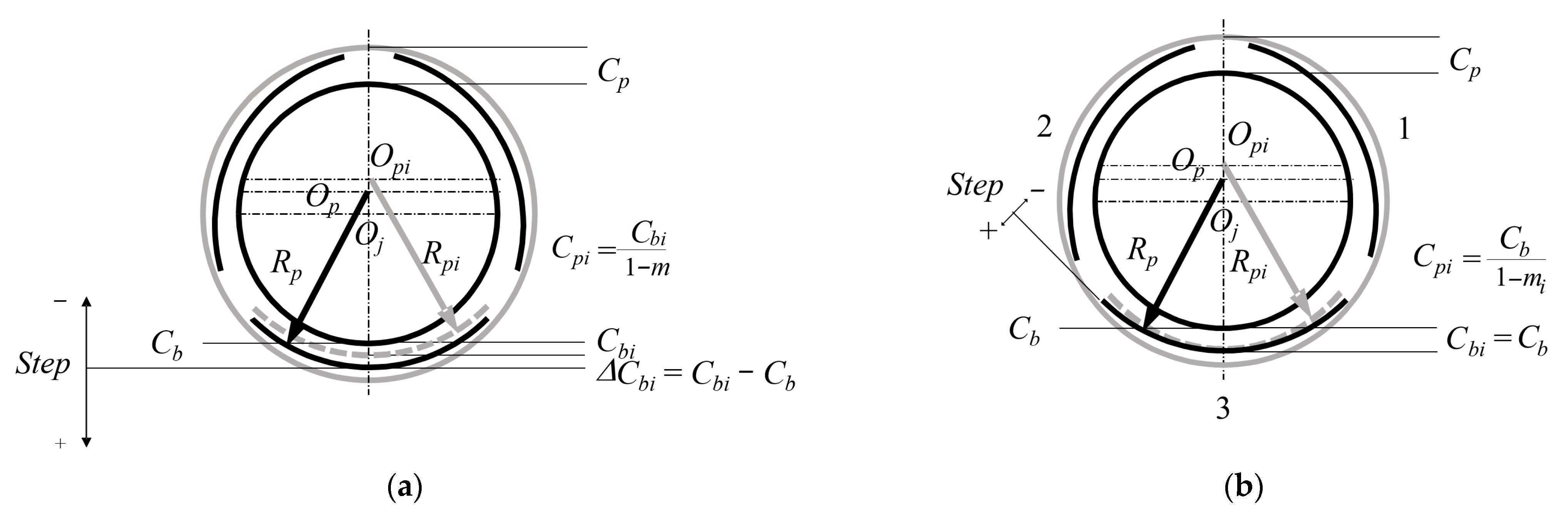
2. Bearing Factors
3. Surface Response Design of Experiments
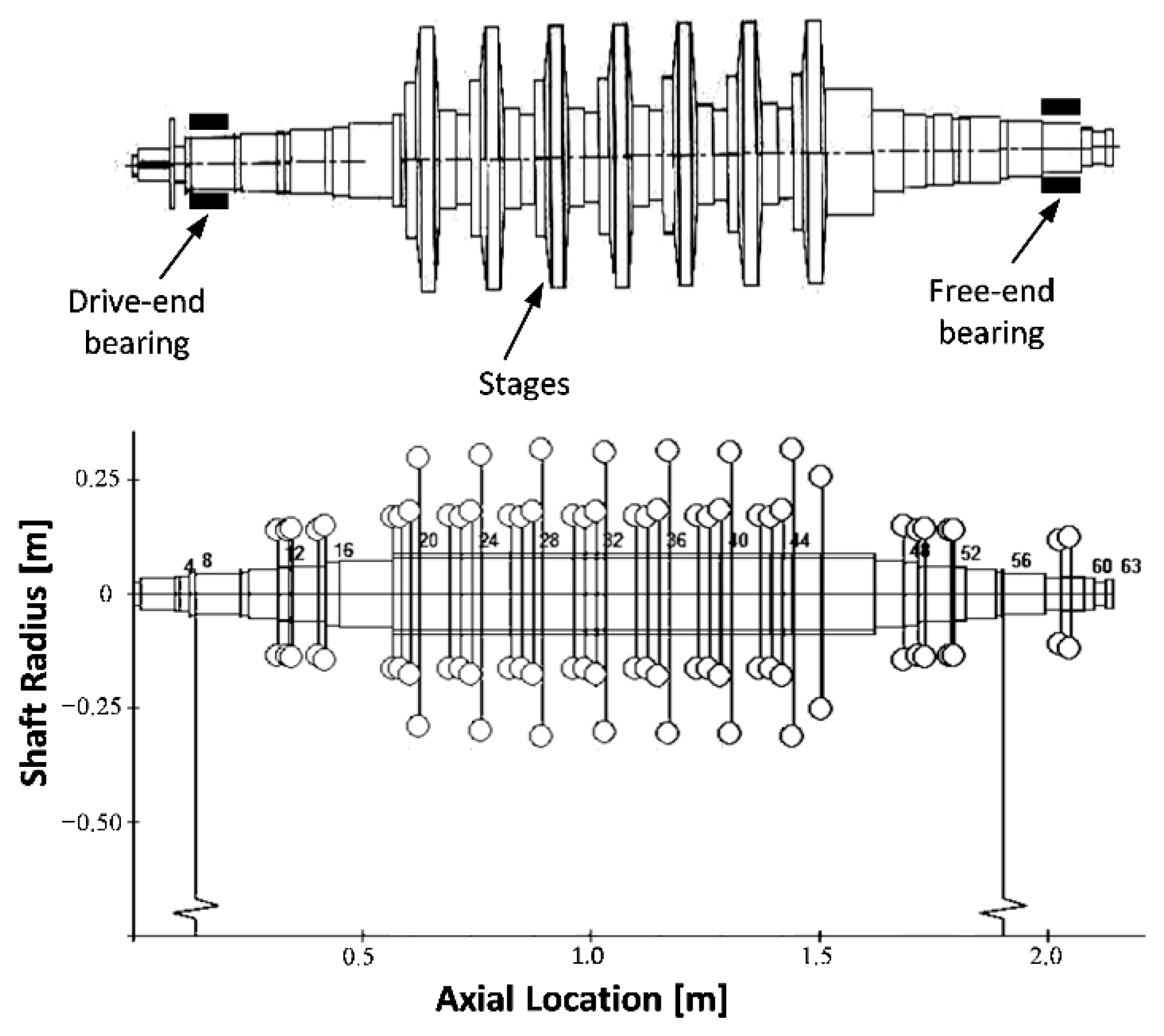
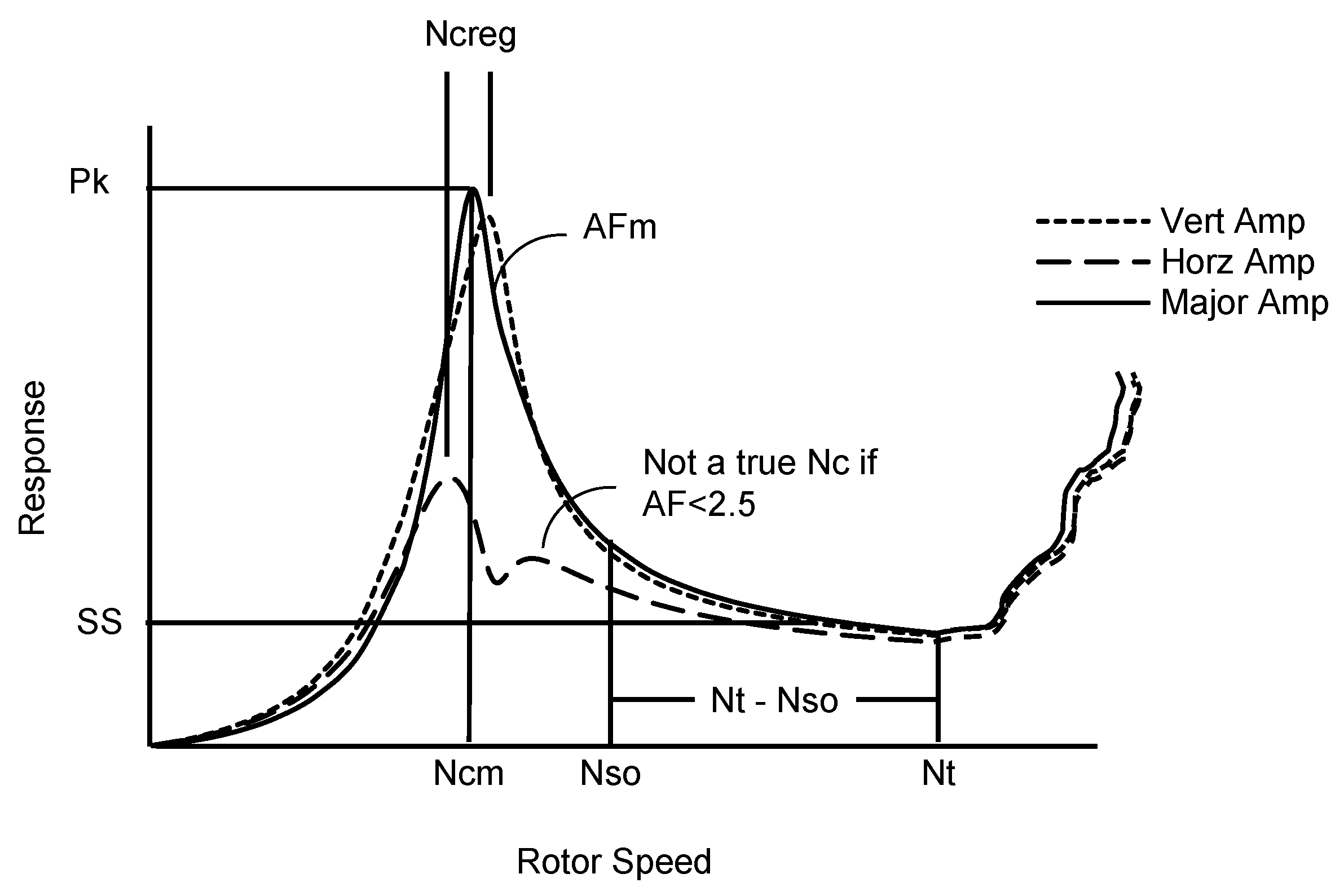
4. Machine Used for the Study and Response Variables
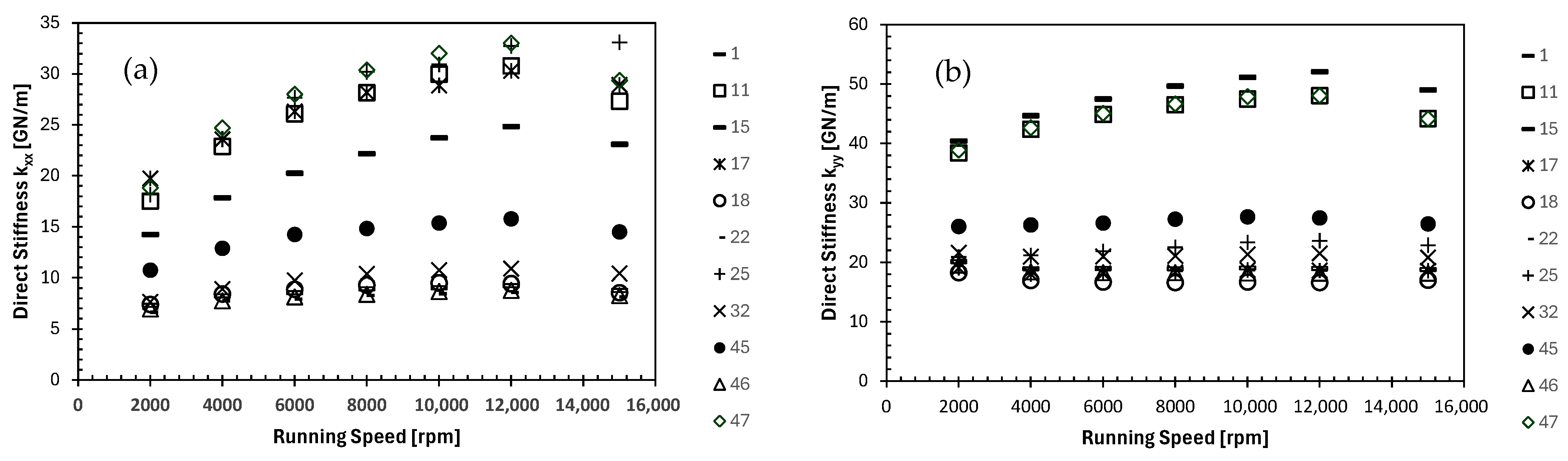
5. Preliminary Assessment at Component Level
6. System-Level Analysis
7. Maxima and Minima Using SRDOE Surrogate Models
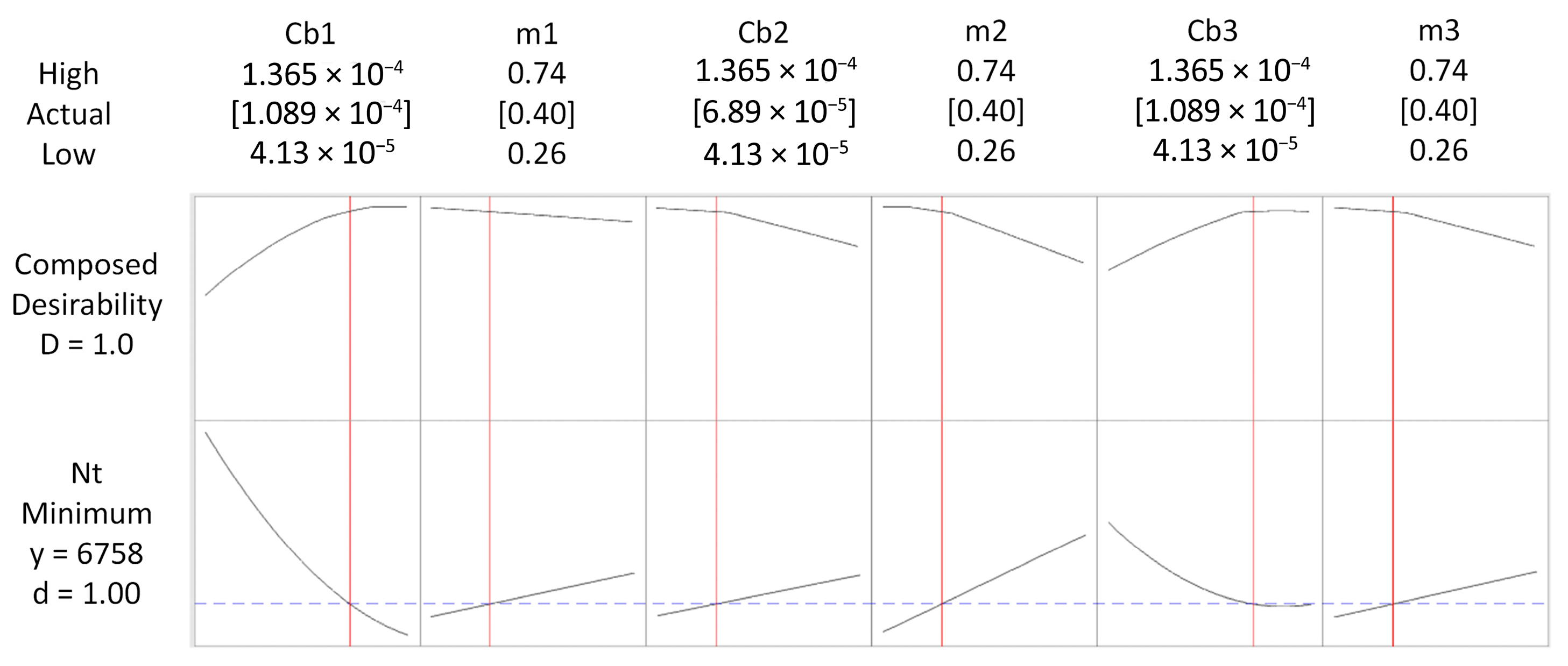
- Establish constraints: The boundaries for the bearing geometry are the Min and Max levels in Table 1.
- Define individual desirability d functions for each response: The method involves the transformation of each predicted response to a dimensionless partial desirability function, di. One- or two-sided functions are used. Li, Ti and Ui are the lowest, target and highest values obtained for the response i, respectively.
- 3.
- Maximize the overall desirability D in Equation (13) with respect to the input variables: This is calculated using the geometric mean. Customarily, an acceptable overall desirability is D > 0.5. A weighting strategy of 1 for all individual di was used. In other words, all responses have the same importance in the optimization process.
8. Conclusions
- System-level sensitivity to pad variation
- The imbalance response and stability are highly influenced by differences between pads. Critical speeds shifted by several hundred rpm and instability thresholds moved by several thousand rpm. These results highlight the need to include pad variability in system-level models.
- 2.
- Opposing trends in stiffness, damping, and cross-coupling
- Increased preload across pads raised stiffness and damping, improving imbalance response. However, it also increased cross-coupled stiffness, which undermines stability. The most critical conditions arose from uneven pad configurations. No single case consistently produced the highest or lowest coefficients, underscoring the nonlinear influence of pad variability.
- 3.
- Robustness requires considering variability
- Surface Response Design of Experiments (SRDOE) methods effectively captured the nonlinear influence of pad tolerances. These models revealed the most critical combinations of variables and showed that the conventional “max–min” assumption does not guarantee robustness.
- 4.
- Journal tolerances amplify effects
- When journal radius tolerances were included alongside pad variations, amplification factors and stability thresholds shifted further. The combined effects were more severe than those predicted by standard uniform pad assumptions in API guidelines.
- 5.
- Implications for design practice
- Worst-case conditions did not occur under uniform tolerance extremes. Instead, specific non-uniform pad arrangements produced the largest imbalance response and lowest stability margin. Ignoring pad-to-pad variability can underestimate worst-case behavior. Incorporating bearing dissimilar pads into rotordynamic analysis offers a more reliable approach for assessing turbomachinery performance and safety margins.
Author Contributions
Funding
Data Availability Statement
Conflicts of Interest
Nomenclature
| Bearing parameters | |
| Cb | Radial assembled pad clearance [m] |
| Cp | Radial as-machined pad clearance [m] |
| D | Bearing journal diameter [m] |
| f = Cp/D | Diametral clearance per each 1 mm bearing diameter [mm] |
| J | Journal radius, [m] |
| L | Bearing axial length [m] |
| m | Bearing preload [−] |
| Model Variables | |
| ax | Axis of vibration (horizontal, vertical, maximum) |
| i, j | Variable subindexes |
| k | Number of critical speeds per axis |
| min, max | Minimum and maximum values |
| x | Model independent variables (design variables) |
| y | Model dependent variable (responses) |
| Rotordynamic parameters | |
| DE Brg | Drive-end bearing |
| FE Brg | Free-end bearing |
| Midspan | Rotor midspan |
| Nos | Minimum operating speed [rpm] |
| Nso | Safe operating speed [rpm] |
| Pk | Peak at major axis of vibration [mm] |
| SM | Separation margin |
| SS | Steady-state at major axis of vibration [mm] |
| Tribological parameters | |
| flow | Pad inlet flow [lpm] |
| H | Film thickness [m] |
| P | Pressure [kPa] |
| Power | Power consumption [W] |
| T | Temperature [°C] |
| Statistical parameters | |
| d | Individual |
| D | Overall |
| p-value | Conditional probability |
References
- Pinkus, O. Analysis and characteristics of the three-lobe bearing. J. Basic Eng. 1959, 81, 49–55. [Google Scholar] [CrossRef]
- Li, D.F.; Choy, K.C.; Allaire, P.E. Stability and transient characteristics of four multilobe journal bearing configurations. J. Lubr. Technol. 1980, 102, 291–298. [Google Scholar] [CrossRef]
- Malik, M.; Sinhasan, R.; Chandra, M. Design data for three-lobe bearings. ASLE Trans. 1981, 24, 345–353. [Google Scholar] [CrossRef]
- Saruhan, H.; Rouch, K.E.; Roso, C.A. Design Optimization of Fixed Pad Journal Bearing for Rotor System Using a Genetic Algorithm Approach. In Proceedings of the International Symposium on Stability Control of Rotating Machinery (ISCORMA), Lake Tahoe, NV, USA, 20–24 August 2001; p. 3001. [Google Scholar]
- Urbiola-Soto, L.; Santibañez, R.; Lopez, M.; Ramirez, A.; Yañez, R. Rotordynamic Optimization of Fixed Pad Journal Bearings Using Surface Response Design of Experiments. ASME J. Eng. Gas Turbines Power 2016, 138, 122502. [Google Scholar] [CrossRef]
- Moroz, L.; Romanenko, L.; Kochurov, R.; Kashtanov, E. Hydrodynamic Journal Bearings Optimization Considering Rotor Dynamics Restrictions. In Proceedings of the ASME Turbo Expo 2018: Turbomachinery Technical Conference and Exposition. Volume 7B: Structures and Dynamics, Oslo, Norway, 11–15 June 2018. [Google Scholar] [CrossRef]
- API617; Axial Centrifugal Compressors Expander-Compressors. 8th ed. American Petroleum Institute: Washington, DC, USA, 2014. Available online: https://www.api.org/ (accessed on 12 December 2025).
- APIRP684; API Standard Paragraphs Rotodynamic Tutorial: Lateral Critical Speeds Unbalance Response Stability Train Torsional Rotor Balancing. 2nd ed. American Petroleum Institute: Washington, DC, USA, 2005. Available online: https://www.api.org/ (accessed on 12 December 2025).
- ISO 10439-1:2015; Petroleum, Petrochemical and Natural Gas Industries—Axial and Centrifugal Compressors and Expander-Compressors—Part 1: General Requirements. International Standard Organization: Geneva, Switzerland, 2015. Available online: https://www.iso.org/ (accessed on 12 December 2025).
- Dang, P.; Chatterton, S.; Pennacchi, P.; Vania, A.; Cangioli, F. Behavior of Tilting-Pad Journal Bearings with Large Machining Error on Pads. In Turbo Expo: Power for Land, Sea, and Air; ASME: New York, NY, USA, 2016; p. V07BT31A018. [Google Scholar] [CrossRef]
- Dang, V.; Chatterton, S.; Pennacchi, P.; Vania, A. Numerical Investigation of the Effect of Manufacturing Errors in Pads on the Behaviour of Tilting-Pad Journal Bearings. Proc. Inst. Mech. Eng. Part J J. Eng. Tribol. 2018, 232, 480–500. [Google Scholar] [CrossRef]
- Dang, V.; Chatterton, S.; Pennacchi, P.; Vania, A. Effect of the Load Direction on Non-Nominal Five-Pad Tilting Pad Journal Bearings. Tribol. Int. 2016, 98, 197–211. [Google Scholar] [CrossRef]
- Romero Quintini, J.C.; Pineda, S.; Matute, J.A.; Medina, L.U.; Gómez, J.L.; Diaz, S.E. Determining the Effect of Bearing Clearance and Preload Uncertainties on Tilting Pad Bearings Rotordynamic Coefficients. In Proceedings of the ASME Turbo Expo 2014: Turbine Technical Conference and Exposition, Düsseldorf, Germany, 16–20 June 2014. [Google Scholar] [CrossRef]
- Ruiz, R.O.; Diaz, S.E. Effect of Uncertainties in the Estimation of Dynamic Coefficients on Tilting Pad Journal Bearings. In Proceedings of the ASME 2016 International Mechanical Engineering Congress and Exposition, Phoenix, AZ, USA, 11–17 November 2016. [Google Scholar] [CrossRef]
- Urbiola-Soto, L. Multivariate Response Rotordynamic Modeling and Sensitivity Analysis of Tilting Pad Bearings. ASME J. Eng. Gas Turbines Power 2018, 140, 072502. [Google Scholar] [CrossRef]
- Pereira da Silva, H.A.; Nicoletti, R. Design of Tilting-Pad Journal Bearings Considering Bearing Clearance Uncertainty and Reliability Analysis. ASME J. Tribol. 2019, 141, 011703. [Google Scholar] [CrossRef]
- Urbiola-Soto, L. Influence of Manufacturing Variation on the Dynamic and Tribological Performance of Tilting Pad Journal Bearings. ASME J. Eng. Gas Turbines Power 2021, 143, 061017. [Google Scholar] [CrossRef]
- Hidalgo, D.; Ruiz, R.; Delgado, A. A novel framework for relationship of manufacturing tolerance and component-level performance of journal bearings. J. Appl. Math. Mod. 2022, 105, 566–583. [Google Scholar] [CrossRef]
- Urbiola-Soto, L.; Pennacchi, P. Rotor Stability Effects of Tilting Pad Journal Bearings with Assembled Clearance Asymmetry. ASME J. Eng. Gas Turbines Power 2022, 143, 081009. [Google Scholar] [CrossRef]
- Martin, F.A.; Ruddy, A.V. Effect of Manufacturing Tolerances on the Stability of Profile Bore Bearings. In Proceedings of the 3rd IMechE International Conference on Vibrations in Rotating Machinery, Heslington, UK, 11–13 September 1984; pp. 287–293. [Google Scholar]
- Roy, L.; Kakoty, S.K. Groove location for optimum performance of three- and four-lobe bearings using genetic algorithm. Proc. Inst. Mech. Eng. Part J J. Eng. Tribol. 2014, 229, 47–63. [Google Scholar] [CrossRef]
- Ma, X.; Xu, W.; Jin, S.; Zhang, X.; Li, B. Effects of Manufacturing Tolerances on Dynamic Properties of Journal Bearings. IOP Conf. Ser. Mater. Sci. Eng. 2020, 717, 012010. [Google Scholar] [CrossRef]
- Roy, B.; Roy, L.; Dey, S. Probing Asymmetric Uncertain Effect on Symmetric Three-Lobe Journal Bearing. Proc. Inst. Mech. Eng. Part J J. Eng. Tribol. 2023, 237, 1532–1547. [Google Scholar] [CrossRef]
- Montgomery, D.C. Design and Analysis of Experiments, 8th ed.; Wiley: Hoboken, NJ, USA, 2012. [Google Scholar]
- Nicholas, J.C. Tilting Pad Bearing Design. In Proceedings of the 23rd Turbomachinery Symposium, Dallas, TX, USA, 13–15 September 1994; pp. 179–194. Available online: https://oaktrust.library.tamu.edu/server/api/core/bitstreams/2ed8980c-4e0d-44f8-8c78-97882d54d306/content (accessed on 7 January 2026).
- Zeidan, F.Y.; Paquette, D.J. Tutorial On the Application of High Speed and High Performance Fluid Film Bearings in Rotating Machinery. In Proceedings of the 23rd Turbomachinery Symposium, Dallas, TX, USA, 13–15 September 1994; pp. 161–186. Available online: https://oaktrust.library.tamu.edu/items/d94c1639-1438-48fe-b95b-0515dbda09e8 (accessed on 7 January 2026).
- Crease, A.B. Field Experience and Correction of a Fractional Frequency Vibration Problem On a High Speed Centrifugal Compressor. In Proceedings of the 10th Turbomachinery Symposium, Dallas, TX, USA, 15 October 1981; pp. 47–54. Available online: https://oaktrust.library.tamu.edu/server/api/core/bitstreams/ba69189e-8109-4ab7-9cfb-97115688678f/content (accessed on 7 January 2026).
- Murphy, B.T. XLHydrodynTM Spreadsheets for Rotordynamic Analysis; Version 5.53; Rotating Machinery Analysis: Brevard, NC, USA, 2018. [Google Scholar]
- San Andrés, L. Modern Lubrication Theory; Notes 05. Dynamics of a Simple Rotor-Fluid Film Bearing System; Texas A&M University Digital Libraries: College Station, TX, USA, 2010; Available online: https://oaktrust.library.tamu.edu/handle/1969.1/93197 (accessed on 11 January 2025).


| Star | Min | Mean | Max | Star | |
|---|---|---|---|---|---|
| Factor Levels | −2.378 | −1 | 0 | 1 | 2.378 |
| Brg Clearance (Cb) [μm] | 41.3 | 68.9 | 88.9 | 108.9 | 136.5 |
| Preload (m) | 0.26 | 0.40 | 0.50 | 0.60 | 0.74 |
| Resulting parameters | Calculated from Equation (1) | ||||
| Pad Clearance (Cp) [μm] | 158 | 172 | 178 | 182 | 185 |
| f = Cp/D [μm/mm] | 1.55 | 1.70 | 1.75 | 1.79 | 1.82 |
| Run Order | Point Type | Cb1 | m1 | Cb2 | m2 | Cb3 | m3 |
|---|---|---|---|---|---|---|---|
| 1 | Factorial | −1 | −1 | −1 | −1 | −1 | −1 |
| 2 | Factorial | 1 | −1 | −1 | −1 | −1 | 1 |
| 3 | Factorial | −1 | 1 | −1 | −1 | −1 | 1 |
| 4 | Factorial | 1 | 1 | −1 | −1 | −1 | −1 |
| 5 | Factorial | −1 | −1 | 1 | −1 | −1 | 1 |
| 6 | Factorial | 1 | −1 | 1 | −1 | −1 | −1 |
| 7 | Factorial | −1 | 1 | 1 | −1 | −1 | −1 |
| 8 | Factorial | 1 | 1 | 1 | −1 | −1 | 1 |
| 9 | Factorial | −1 | −1 | −1 | 1 | −1 | 1 |
| 10 | Factorial | 1 | −1 | −1 | 1 | −1 | −1 |
| 11 | Factorial | −1 | 1 | −1 | 1 | −1 | −1 |
| 12 | Factorial | 1 | 1 | −1 | 1 | −1 | 1 |
| 13 | Factorial | −1 | −1 | 1 | 1 | −1 | −1 |
| 14 | Factorial | 1 | −1 | 1 | 1 | −1 | 1 |
| 15 | Factorial | −1 | 1 | 1 | 1 | −1 | 1 |
| 16 | Factorial | 1 | 1 | 1 | 1 | −1 | −1 |
| 17 | Factorial | −1 | −1 | −1 | −1 | 1 | 1 |
| 18 | Factorial | 1 | −1 | −1 | −1 | 1 | −1 |
| 19 | Factorial | −1 | 1 | −1 | −1 | 1 | −1 |
| 20 | Factorial | 1 | 1 | −1 | −1 | 1 | 1 |
| 21 | Factorial | −1 | −1 | 1 | −1 | 1 | −1 |
| 22 | Factorial | 1 | −1 | 1 | −1 | 1 | 1 |
| 23 | Factorial | −1 | 1 | 1 | −1 | 1 | 1 |
| 24 | Factorial | 1 | 1 | 1 | −1 | 1 | −1 |
| 25 | Factorial | −1 | −1 | −1 | 1 | 1 | −1 |
| 26 | Factorial | 1 | −1 | −1 | 1 | 1 | 1 |
| 27 | Factorial | −1 | 1 | −1 | 1 | 1 | 1 |
| 28 | Factorial | 1 | 1 | −1 | 1 | 1 | −1 |
| 29 | Factorial | −1 | −1 | 1 | 1 | 1 | 1 |
| 30 | Factorial | 1 | −1 | 1 | 1 | 1 | −1 |
| 31 | Factorial | −1 | 1 | 1 | 1 | 1 | −1 |
| 32 | Factorial | 1 | 1 | 1 | 1 | 1 | 1 |
| 33 | Star | −2.37841 | 0 | 0 | 0 | 0 | 0 |
| 34 | Star | 2.37841 | 0 | 0 | 0 | 0 | 0 |
| 35 | Star | 0 | −2.37841 | 0 | 0 | 0 | 0 |
| 36 | Star | 0 | 2.37841 | 0 | 0 | 0 | 0 |
| 37 | Star | 0 | 0 | −2.37841 | 0 | 0 | 0 |
| 38 | Star | 0 | 0 | 2.37841 | 0 | 0 | 0 |
| 39 | Star | 0 | 0 | 0 | −2.37841 | 0 | 0 |
| 40 | Star | 0 | 0 | 0 | 2.37841 | 0 | 0 |
| 41 | Star | 0 | 0 | 0 | 0 | −2.37841 | 0 |
| 42 | Star | 0 | 0 | 0 | 0 | 2.37841 | 0 |
| 43 | Star | 0 | 0 | 0 | 0 | 0 | −2.37841 |
| 44 | Star | 0 | 0 | 0 | 0 | 0 | 2.37841 |
| 45 | Center | 0 | 0 | 0 | 0 | 0 | 0 |
| 46 | Max Cb | 1 | −1 | 1 | −1 | 1 | −1 |
| 47 | Min Cb | −1 | 1 | −1 | 1 | −1 | 1 |
| Characteristic | Specification |
|---|---|
| Bearing diameter [mm], and L/D ratio | 101.6, and 0.5 |
| Pad arc [degrees], and pad offset | 100, 0.5 |
| Selected lubricant | ISO VG 32 |
| Oil supply temperature [°C] | 50 |
| Journal surface temperature [°C] | 53 |
| Oil inlet flow [lt/min] | 26.5 |
| Drive-end bearing load [N] | 2505 |
| Free-end bearing load [N] | 2210 |
| Average load per bearing [N] | 2358 |
| Case | Power [W] | Pmax [kPa] | Film Tmax [°C] | Hmin [microns] | Bearing Flow [Lt/min] |
|---|---|---|---|---|---|
| 1 | 2076 | 1468 | 88.1 | 38 | 22 |
| 11 | 2326 | 2409 | 95.4 | 27 | 16 |
| 15 | 2445 | 2555 | 89.4 | 30 | 19 |
| 17 | 2578 | 1840 | 92.0 | 22 | 18 |
| 18 | 1972 | 1445 | 91.2 | 37 | 20 |
| 22 | 2118 | 1551 | 87.1 | 37 | 23 |
| 25 | 2608 | 1810 | 92.1 | 21 | 18 |
| 32 | 2124 | 1696 | 85.5 | 40 | 24 |
| 45 | 2148 | 1817 | 90.9 | 34 | 20 |
| 46 | 2075 | 1454 | 87.6 | 38 | 23 |
| 47 | 2285 | 2549 | 95.0 | 28 | 17 |
| Response | R2 | R2 (adj) | R2 (pred) |
|---|---|---|---|
| Nt | 0.96 | 0.94 | 0.91 |
| Ncm | 0.82 | 0.79 | 0.71 |
| Ncreg | 0.93 | 0.91 | 0.85 |
| Afm | 0.89 | 0.87 | 0.77 |
| Nt-Nso | 0.94 | 0.93 | 0.91 |
| Midspan Pk | 0.91 | 0.89 | 0.82 |
| FE Brg Pk | 0.91 | 0.88 | 0.85 |
| DE Brg Pk | 0.88 | 0.86 | 0.82 |
| Midspan SS | 0.88 | 0.85 | 0.76 |
| FE Brg SS | 0.92 | 0.90 | 0.85 |
| DE Brg SS | 0.92 | 0.90 | 0.84 |
| Max Response | Cb1 | m1 | Cb2 | m2 | Cb3 | m3 | D | SRDOE | System-Level | Diff. [%] | Case |
|---|---|---|---|---|---|---|---|---|---|---|---|
| Nt [rpm] | −1 | 1 | 1 | 1 | −1 | 1 | 0.91 | 9164 | 9425 | 2.8 | 15 |
| Ncm [rpm] | 1 | 1 | −1 | −1 | −1 | −1 | 0.99 | 4647 | 4625 | −0.5 | 4 |
| Ncreg [rpm] | 1 | −1 | −1 | −1 | 1 | 1 | 1.00 | 1211 | 1100 | −10.1 | 18 |
| AFm | −1 | 1 | 1 | 1 | −1 | −1 | 0.70 | 9.9 | 8.4 | −18.2 | 48 |
| Nt−Nso [rpm] | −1 | 1 | 1 | 1 | −1 | 1 | 0.93 | 3882 | 3621 | −7.2 | 15 |
| Midspan Pk [µm] | −1 | 1 | 1 | 1 | −1 | −1 | 0.84 | 18.5 | 17.6 | −4.9 | 53 |
| FE Brg Pk [µm] | 1 | 1 | −1 | 1 | 1 | 1 | 0.95 | 2.3 | 2.2 | −6.0 | 51 |
| DE Brg Pk [µm] | 1 | 1 | −1 | 1 | 1 | 1 | 0.96 | 2.5 | 2.3 | −7.2 | 51 |
| Midspan SS [µm] | −1 | 1 | −1 | 1 | −1 | 1 | 0.90 | 4.1 | 4.1 | 0.2 | 47 |
| FE Brg SS [µm] | 1 | −1 | −1 | −1 | 1 | −1 | 1.00 | 1.5 | 1.5 | −4.6 | 18 |
| DE Brg SS [µm] | 1 | −1 | −1 | −1 | 1 | −1 | 1.00 | 1.5 | 1.4 | −4.3 | 18 |
| Max Response | Cb1 | m1 | Cb2 | m2 | Cb3 | m3 | D | SRDOE | System-Level | Diff. [%] | Case |
|---|---|---|---|---|---|---|---|---|---|---|---|
| Nt [rpm] | 1 | −1 | −1 | −1 | 1 | −1 | 0.95 | 6758 | 6800 | 0.6 | 18 |
| Ncm [rpm] | −1 | 1 | 1 | 1 | 1 | 1 | 0.87 | 4453 | 4450 | −0.1 | 52 |
| Ncreg [rpm] | −1 | 1 | 1 | −1 | 1 | 1 | 1.00 | 50 | 100 | 50.0 | 23 |
| AFm | 1 | −1 | 1 | 1 | 1 | 1 | 1.00 | 3.9 | 4.4 | 10.0 | 49 |
| Nt−Nso [rpm] | 1 | −1 | −1 | −1 | 1 | −1 | 1.00 | 1276 | 1449 | 12.0 | 18 |
| Midspan Pk [µm] | 1 | −1 | 1 | −1 | 1 | 1 | 1.00 | 7.7 | 8.5 | 8.9 | 22 |
| FE Brg Pk [µm] | −1 | −1 | 1 | −1 | 1 | −1 | 1.00 | 2.0 | 2.0 | 0.0 | 21 |
| DE Brg Pk [µm] | −1 | −1 | 1 | −1 | 1 | −1 | 1.00 | 2.1 | 2.1 | 0.5 | 21 |
| Midspan SS [µm] | 1 | −1 | 1 | −1 | 1 | 1 | 1.00 | 3.2 | 3.3 | 1.2 | 22 |
| FE Brg SS [µm] | −1 | 1 | −1 | 1 | 1 | 1 | 0.85 | 0.8 | 0.8 | 3.2 | 27 |
| DE Brg SS [µm] | −1 | 1 | −1 | 1 | 1 | −1 | 0.85 | 0.7 | 0.7 | 2.2 | 50 |
| Scenario | Cb1 | m1 | Cb2 | m2 | Cb3 | m3 | D | Case |
|---|---|---|---|---|---|---|---|---|
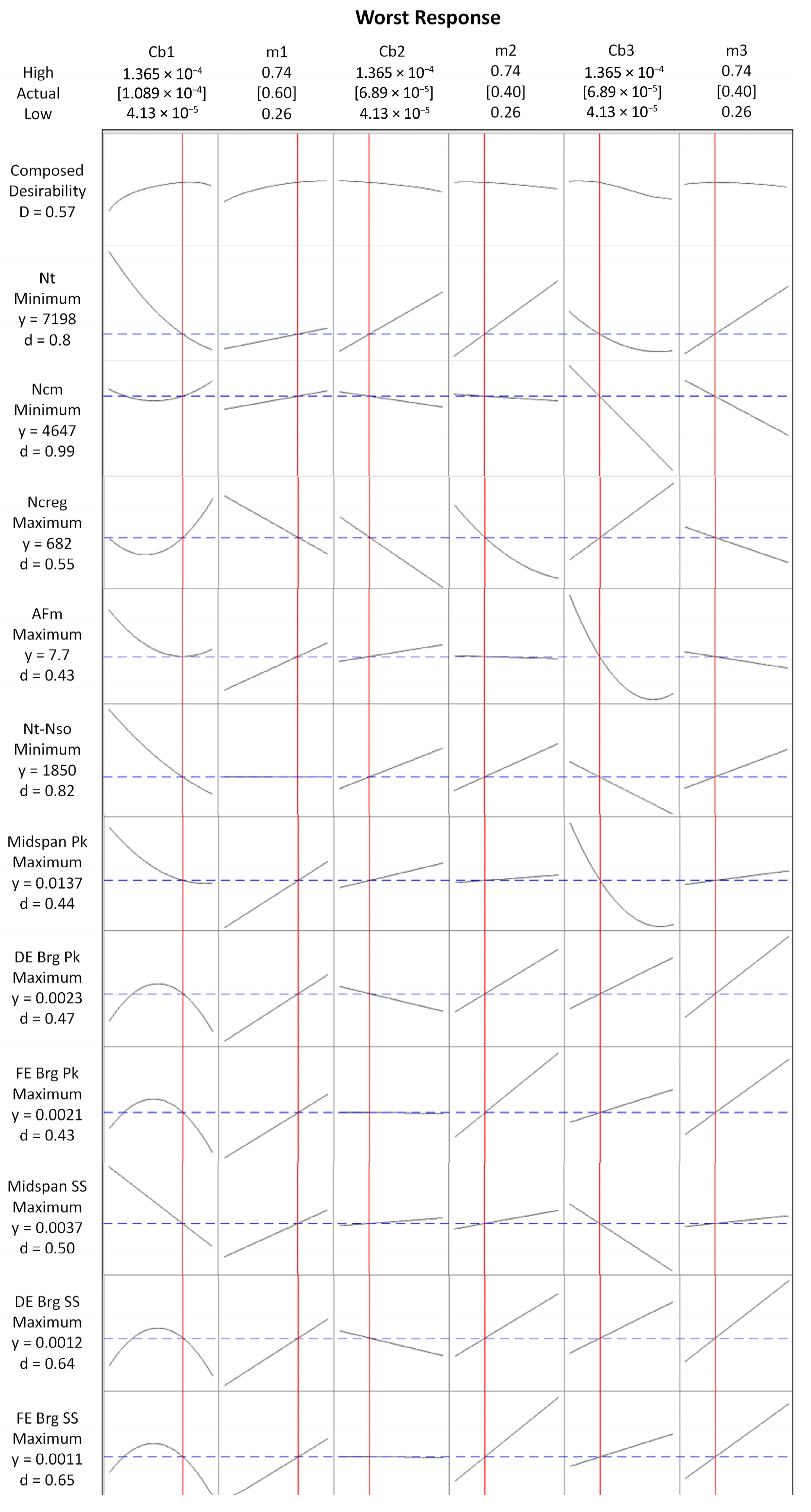
| Worst | 1 | 1 | −1 | −1 | −1 | −1 | 0.58 | 4 |
| Best | −1 | 0.48 | 1 | −1 | 1 | 1 | 0.72 | 54 |
| Response | Worst | Best | ||||
|---|---|---|---|---|---|---|
| SRDOE | System-Level | Diff. [%] | SRDOE | System-Level | Diff. [%] | |
| Nt [rpm] | 7198 | 7450 | 3.4 | 7965 | 8025 | 0.8 |
| Ncm [rpm] | 4647 | 4625 | −0.5 | 4473 | 4538 | 1.4 |
| Ncreg [rpm] | 682 | 725 | 6.0 | 55 | 175 | 68.5 |
| AFm | 7.7 | 7.7 | 0.5 | 5.1 | 5.1 | 0.0 |
| Nt−Nso [rpm] | 1850 | 2105 | 12.1 | 2743 | 2795 | 1.9 |
| Midspan Pk [µm] | 13.7 | 13.7 | 0.3 | 10.1 | 10.5 | 3.9 |
| FE Brg Pk [µm] | 2.1 | 2.1 | −0.5 | 2.1 | 2.1 | 0.0 |
| DE Brg Pk [µm] | 2.3 | 2.3 | −1.2 | 2.2 | 2.2 | 0.0 |
| Midspan SS [µm] | 3.7 | 3.8 | 1.9 | 3.6 | 3.6 | −2.1 |
| FE Brg SS [µm] | 1.2 | 1.2 | 1.5 | 0.9 | 1 | 6.1 |
| DE Brg SS [µm] | 1.1 | 1.1 | 1.7 | 0.9 | 0.8 | −6.5 |
| Case | Variable | Dissimilar pads | |
|---|---|---|---|
| Nom (Jmin) | Jmax | ||
| 18 | Nt min [rpm] | 6800 | 6825 |
| 48 | AFm max | 8.4 | 13.4 |
Disclaimer/Publisher’s Note: The statements, opinions and data contained in all publications are solely those of the individual author(s) and contributor(s) and not of MDPI and/or the editor(s). MDPI and/or the editor(s) disclaim responsibility for any injury to people or property resulting from any ideas, methods, instructions or products referred to in the content. |
© 2026 by the authors. Licensee MDPI, Basel, Switzerland. This article is an open access article distributed under the terms and conditions of the Creative Commons Attribution (CC BY) license.
Share and Cite
Ubiola-Soto, L.; Delgado, A. Rotordynamic System-Level Effects of Three-Lobe Journal Bearings Including Manufacturing Variations. Lubricants 2026, 14, 83. https://doi.org/10.3390/lubricants14020083
Ubiola-Soto L, Delgado A. Rotordynamic System-Level Effects of Three-Lobe Journal Bearings Including Manufacturing Variations. Lubricants. 2026; 14(2):83. https://doi.org/10.3390/lubricants14020083
Chicago/Turabian StyleUbiola-Soto, Leonardo, and Adolfo Delgado. 2026. "Rotordynamic System-Level Effects of Three-Lobe Journal Bearings Including Manufacturing Variations" Lubricants 14, no. 2: 83. https://doi.org/10.3390/lubricants14020083
APA StyleUbiola-Soto, L., & Delgado, A. (2026). Rotordynamic System-Level Effects of Three-Lobe Journal Bearings Including Manufacturing Variations. Lubricants, 14(2), 83. https://doi.org/10.3390/lubricants14020083