Skip to Content
LubricantsLubricants
  • Review
  • Open Access

7 February 2026

Tribological Properties of Biolubricants: A Comprehensive Bibliometric and Trend Analysis


,
,
,
and
1
Departamento de Engenharia Química, Campus do Pici, Universidade Federal do Ceará, Fortaleza 60455900, CE, Brazil
2
Departamento de Engenharia Mecânica, Universidade Estadual do Maranhão, São Luís 65055310, MA, Brazil
*
Author to whom correspondence should be addressed.

Abstract

Interest in replacing petroleum-based lubricants with bio-based alternatives is driven by growing demand for lubricants, in contrast to a decreasing supply of products derived from fossil resources, coupled with environmental concerns. Biolubricants offer several advantages over conventional petroleum-based lubricants, such as biodegradability and renewability. Researchers have been seeking solutions for these challenges over the years, employing various approaches, including the use of different raw materials, chemical modifications, and different types of additives. This review evaluates a total of 504 articles published between 2010 and 2025 in the Scopus database, with the help of RStudio, using the bibliometrix package. The objective is to provide an integrated bibliometric and systematic analysis, presenting the research landscape on the tribological properties of biolubricants, which may contribute to the development of novel investigation initiatives in the field. The main thematic trends, researchers, journals, and most active countries and institutions have been evaluated. Additionally, the most cited studies, recent advances and existing gaps are presented and discussed.

1. Introduction

Petroleum-based lubricant oils account for 85–90% of the global supply, which is a concerning issue, given that most petroleum-based lubricants are toxic and non-renewable [1,2]. Statistically, half of the total production of petroleum-based lubricants directly deteriorates in the environment, and just one liter of used oil has the potential to contaminate up to one million liters of water [3,4,5]. Combining environmental concerns with the decreasing supply of petroleum-derived resources, there is a growing interest in replacing conventional lubricants with biologically based alternatives (formally, biolubricants) [6,7,8]. Biolubricants offer several advantages over mineral lubricants, including biodegradability, renewability, excellent lubrication performance, wide viscosity range, lower volatility, high flash point, and minimal impact on human health and the environment [9,10,11,12].
The main limitations to large-scale adoption of biolubricants involve cost and performance, with eventual weaknesses, such as low oxidative stability and poor cold flow properties [13,14]. The final cost of the biolubricant depends mainly on the price of the chosen raw material [14]. This problem may be solved, for example, by using different sources of vegetable oils, microbial oils, animal fats and residual raw materials, for which performance results and synthesis procedures have been reported [15,16]. Another significant part of the product cost is associated with the chemical modification procedure used to improve the properties of the biolubricants [17]. Several chemical modification techniques have been reported [18,19,20,21,22,23,24], aiming to reduce costs and guarantee suitable performance using different types of catalysts, including enzymes. The growing interest in catalysis by enzymes such as lipases may be due to the fact that they generally require milder reaction conditions, reducing energy needs and lowering value byproducts [13].
Furthermore, it is essential to evaluate whether the lubricant meets the lubrication requirements of the target application, especially in terms of tribological characteristics [25]. Tribology is a scientific field that studies interacting surfaces in relative motion, encompassing vital aspects such as friction, lubrication, and wear [26]. Analysis of tribological performance is essential for improving efficiency, preventing thermal pollution, dissipating energy, and protecting materials by controlling friction and wear [27,28].
The implementation of novel technologies to minimize friction and wear in vehicles and machinery has the potential to reduce energy losses by up to 40% over the long term (15 years). It may also reduce CO2 emissions by up to 3140 MtCO2, resulting in savings of up to 970,000 million Euros [29]. The global lubricants market reached an estimated value of $134.65 billion in 2022, with a Compound Annual Growth Rate (CAGR) estimate of 4.0% from 2023 to 2030. This has been driven by increasing demand for automotive oils and greases due to the growing trade in vehicles and spare parts [30]. Meanwhile, the global biolubricants market was valued at US$2.2 billion in 2019, with growth estimated at a CAGR of 4.1% from 2020 to 2025, influenced by stringent laws and regulations as well as increased acceptance among end-users [31].
Therefore, the biolubricants market is expanding, encompassing a diverse range of research topics, making it essential for researchers to have access to an overview of the field that provides a comprehensive understanding, aiding in decision-making. Bibliometric analysis is an effective approach for assessing the current research landscape, identifying gaps, and organizing unstructured data, providing researchers with a comprehensive and unique view of their field of study [32]. Two recent reports have been published [33,34] with similar approaches of the present contribution, however, with a few gaps that could be filled. Study [33] presents a bibliometric analysis of tribological and physicochemical properties of vegetable-oil-based biolubricants, while study [34] presents a review on the production of biolubricants through transesterification. Both focused on specific aspects, but their scope and timeframe remain limited.
In this study, a comprehensive review of the literature on tribological properties of biolubricants was performed. An integrated approach was employed, combining a detailed bibliometric analysis with a systematic review of the most relevant studies, that may facilitate the assessment of the current research scenario, identification of gaps, challenges and emerging trends in this field of study.

2. Tribological Mechanisms and Lubrication Regimes of Biolubricants

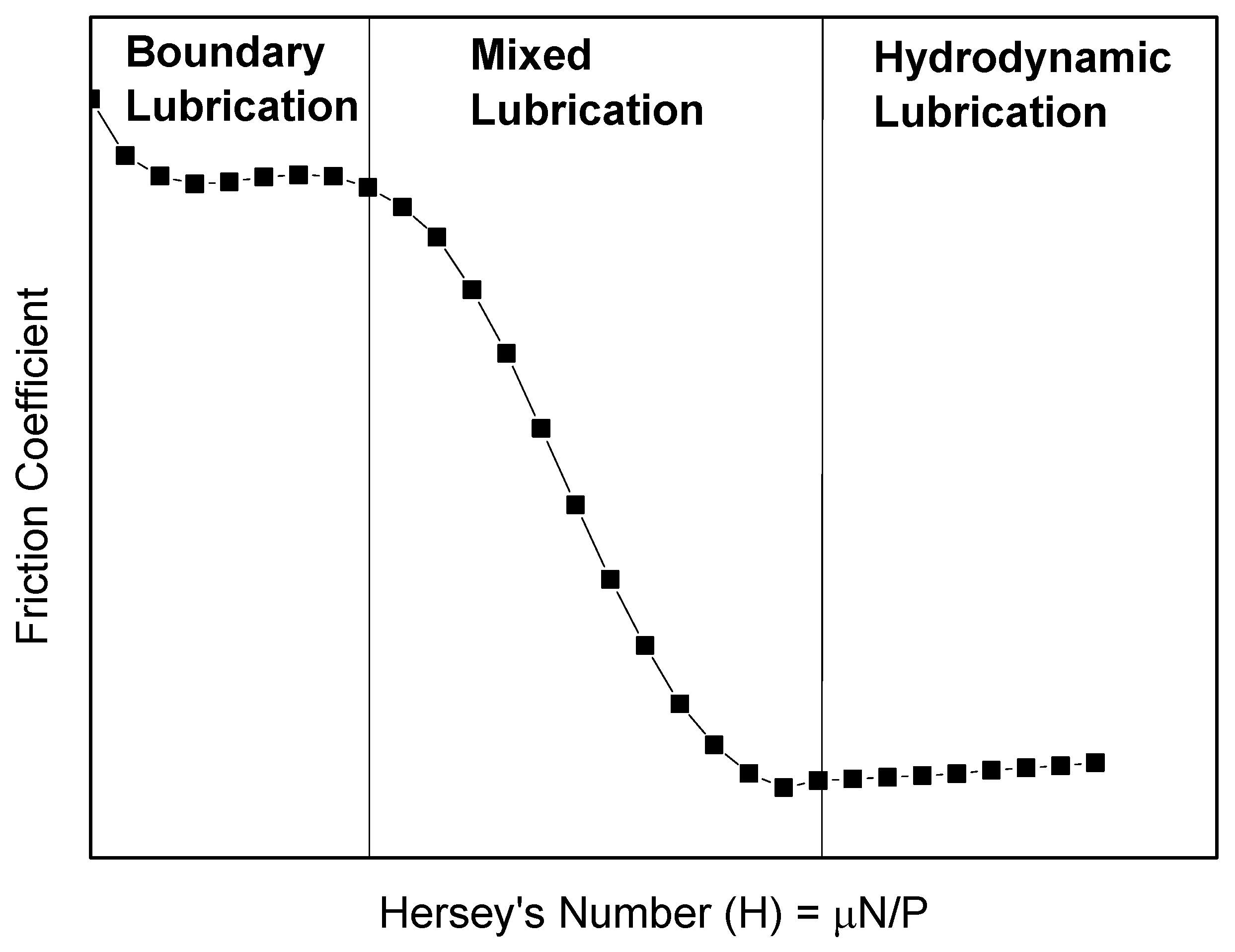
Lubrication is usually divided into three regimes: boundary, mixed, and hydrodynamic, illustrated using the Stribeck curve (Figure 1). In this curve, the friction coefficient varies with the Hersey number, related to operational parameters (viscosity, sliding speed, and load). In the case of biolubricants, their tribological efficiency varies according to interactions on contact surfaces and formation of a lubricating film. In the boundary lubrication regime, the lubricant thickness is less than the roughness of the tribological pair in contact, so friction and wear are governed by the interactions between the asperities. In this regime (Figure 2a), biolubricants typically exhibit higher tribological performance, since the presence of polar functional groups in the molecules favors adsorption to metallic surfaces.
Figure 1. Stribeck Curve.
Figure 2. Lubrication Regimes (a) Boundary; (b) Mixed and (c) Hydrodynamic.
The adsorbed lubricating film reduces metal-to-metal contact and consequently the friction coefficient and adhesive wear. When in the mixed lubrication regime (Figure 2b), the loads are supported by the adsorbed film and a partially developed hydrodynamic film. In this regime, high viscosity indices of the biolubricants are the differentiating factor for favoring the formation of a fluid film with higher rheological stability at different temperatures. In the hydrodynamic lubrication regime (Figure 2c), where there is total separation between the metallic surfaces, friction is governed by the viscous shear of the biolubricant. In this regime, the chemical polarity of the biolubricant molecules has a limited influence on tribological performance, being governed mainly by viscosity. Therefore, it is common to observe superior tribological performance when biolubricants are applied in boundary and mixed lubrication regimes where the polarity of the functional groups contributes to the formation of an adsorbed film on the surface of the tribological pair in contact [35,36,37].

3. Methodologies

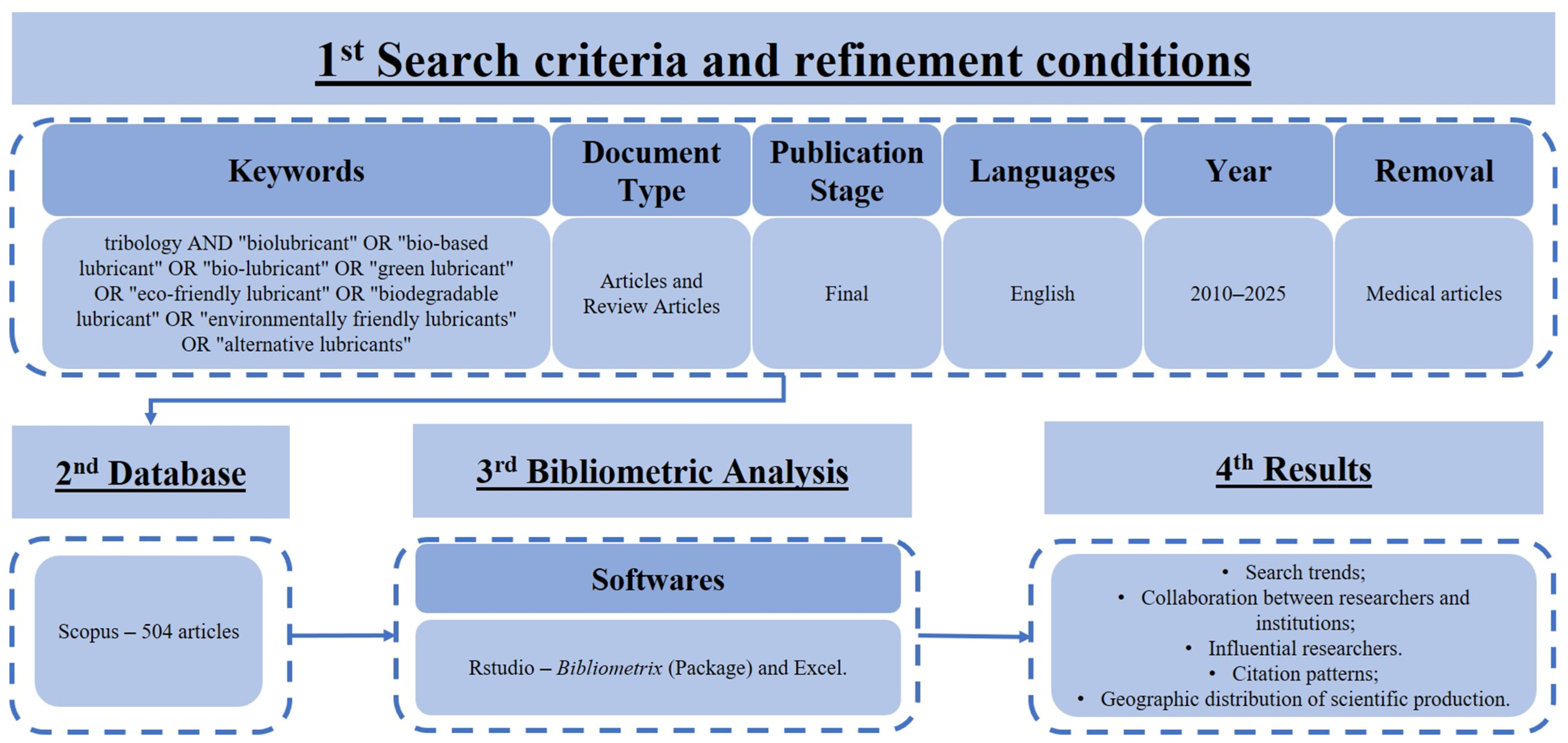
The keyword search algorithm of the Scopus database (selected due to its broader coverage and indexing criteria suitable for bibliometric analyses, as observed in previous studies [34,38,39]), as shown in Figure 3, was used in order to encompass a number of articles as large as possible, related to tribological studies of biolubricants, from 2010 to 2025, focusing on the most recently published studies. English was the selected language, and document types were refined to include “articles” and “review articles”.
Figure 3. Research methodological procedure.
The methodological procedure involved four steps. In the first step, the search and refinement criteria were established. This included the selection of keywords, publication types, language, publication stage and exclusion of articles from the medical field as they did not fit the scope of this study. Furthermore, a search using the time interval 2010–2025 in the second step resulted in 504 articles until 29 October 2025. Additional details of the search strategy are provided in the Supplementary Material.
In the third step, bibliometric analysis was carried out using the RStudio software (version 4.5.1) and the R bibliometrix package. This package offers a suite of tools for quantitative bibliometric research and is written in the R language, which is an open-source environment [40]. To assist in this process, Microsoft Excel software (MS Office Professional Plus 2019) was used to organize graphs and tables. Subsequently, in the fourth step, based on the information obtained, it was possible to identify research trends and their evolution over time, map collaborations among researchers and institutions, assess the geographical distribution of scientific production, and obtain other relevant results. With the most relevant obtained studies, systematic analysis was performed. Therefore, this study highlights trends and existing gaps, aiding in strategic decision-making related to research studies within the scope that was applied.

4. Results and Discussion

4.1. Quantitative Analysis of Publication Trends

Upon research on the Scopus platform, without imposing any time limitations, we identified a total of 534 publications spanning from October 1993 to December 2025. The first paper was published in 1993, authored by Fischer et al. [41], addressing the modification of mechanical and tribochemical properties of ceramics through implantation of titanium and argon ions on the surface of polycrystalline Si3N4 (silicon nitride) ceramics and how this modification affected the flexural strength, friction, wear and hardness of the ceramic materials. In addition, it also highlighted the importance of materials keeping up with environmental demands for systems that use environmentally friendly lubricants.
Tracking the chronological evolution in the next 10 years, only 10 publications were recorded up to 2003, indicating low research interest in this field, with an average of fewer than two publications per year. However, from 2004 onwards, the scenario began to change, with an increasing number of publications. Only in 2004, six articles were published. This surge in research in this field of study may be attributed to growing environmental concerns, and thus the pursuit of more sustainable and eco-friendly alternatives across various industrial sectors, as documented in the literature [42,43,44]. These publications predominantly focused on synthesis and characterization of biodegradable lubricants [44,45,46,47] and more environmentally friendly additives [42,48].
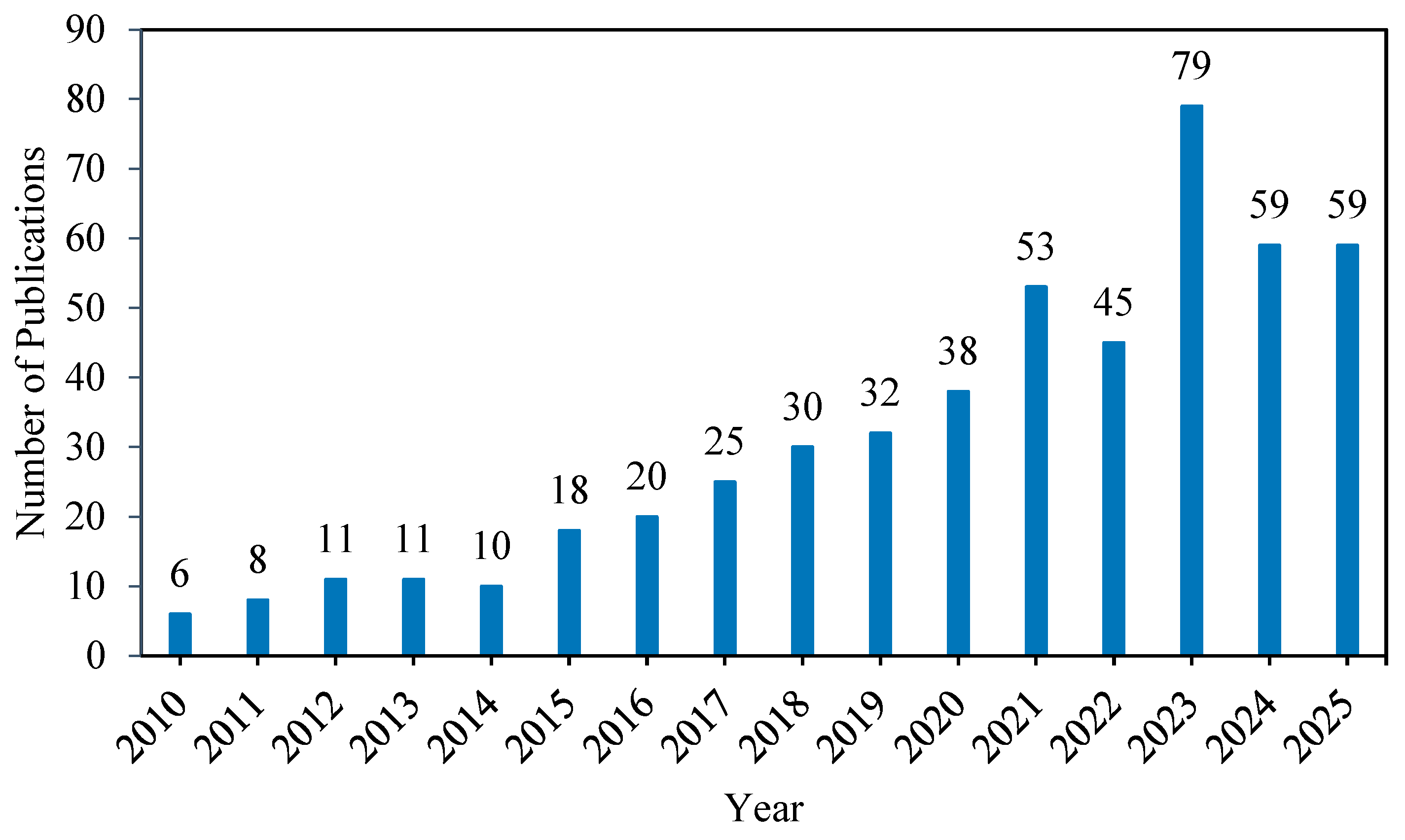
Over the last 15 years, from 2010 to 2025, the average number of publications has increased to around 31 papers per year, with a pattern of continuous growth, although there have been some fluctuations, as shown in Figure 4. This reflects the increasing popularity and acceptance of biolubricants due to their sustainable and eco-friendly properties, demonstrating real potential to replace conventional lubricants [1,49].
Figure 4. Annual publications related to the tribological properties of biolubricants from 2010 to 2025.
A significant increase in the number of publications occurred in 2021, totaling 53 papers. This increase can be attributed, in part, to the resumption of research that was interrupted due to the COVID-19 pandemic. The studies published in that year highlighted the need for the development of environmentally friendly lubricants with high performance, driven by environmental concerns, energy security, and the rapid advancements in new engine technologies, as well as the need to comply with increasingly stringent environmental regulations [50,51,52,53,54]. As seen in Figure 4, the peak of publications was in 2023, with a total of 79 articles. In the current year (2025), the number of publications already made is 59 articles, and following the current trend there is a possibility that this number will continue to increase in the coming years, surpassing the peak of 2023. The publications for this year cover a variety of topics, including review articles and experimental studies.

4.2. Quantitative Analysis of the Distribution of Scientific Journals

The publications that are considered in this study are distributed across 181 different journals, resulting in an average of almost three articles per journal. These data may suggest that there is scientific interest in the tribological properties of biodegradable lubricants and that there is probably room for novel studies and developments on the topic. For a more comprehensive evaluation, additional bibliometric indicators for each journal, such as H-index, impact factor, country of origin, total citations, average citation and year of publication for each journal, are shown in Table 1.
Table 1. The 15 main journals in research on tribological properties of biolubricants according to the number of publications from 2010 to 2025.
It is important to highlight that these last three parameters (total citations, number of publications and average citation) are specific to the group of articles under evaluation. It may be observed that journals with high impact factors also tend to have higher H-indices, indicating a proportional relationship between these metrics. This is because journals with higher impact factors typically publish papers with greater visibility and are more likely to receive citations, as evidenced by the average citation (AC) column. The year in which publications began (PY-Start column) is important for checking when each journal began publishing in a specific field, which directly affects the number of publications and/or citations received. There is a significant incidence of European journals, representing approximately 87% of the total, which may be largely attributed to strict regulations of European government agencies, aiming to replace mineral lubricants with biolubricants, using subsidies and tax incentives [53,54].

4.3. Distribution by Countries

The 15 most productive countries in the studied area, based on the number of papers published, according to information from the corresponding authors, are presented in Table 2. It is important to note that, out of 47 countries with publications in this field, the top 15 most productive countries account for approximately 80% of all publications. The most significant number of publications is concentrated in India (132 publications, approximately 26% of the total), followed by China (79 publications, approximately 16% of the total), and Malaysia (73 publications, approximately 14% of the total).
Table 2. The 15 most productive countries in research on tribological properties of biolubricants according to the number of publications from 2010 to 2025.
India’s leading position in biolubricant research is due to its abundance of coconut products, while Malaysia stands out for its significant production of palm oil [33]. Other reasons for India’s leadership may include the availability of low-cost oils with suitable lubricating properties, the expansion of the automotive lubricant market, and government incentives such as the Ecomark environmental label, which promotes environmentally friendly products [55,56]. Furthermore, India was the first country in the world to create a Ministry of Renewable Energy and is among the top five global investors in this sector [57]. Malaysia’s leading position may also be attributed to government policies encouraging the use of renewable energy sources, aiming to reduce dependence on fossil fuels, meet growing energy demand and reduce carbon emissions, such as the Fifth Fuel Policy, the National Energy Policy (2022–2040) and the National Energy Transition Roadmap (NETR) [58,59,60]. These initiatives also encourage the valorization of biomass for non-energy applications, such as the production of bitumens, lubricants and bio-based polymers [61].
The significant contribution of China in research may be explained by its high demand for lubricants, due to increasing use of motor vehicles resulting from its continuous and swift industrialization [62]. Furthermore, as reported by Wang et al. [63], China stands out in patent activity related to lubricants, with over 12,000 applications, which may be attributed to the expansion of domestic market demand after its accession to the World Trade Organization in 2001, along with sustained industrial and economic growth. This is also reinforced by government policies aimed at “carbon neutrality,” “peak carbon,” and the transformation of economic drivers, such as China’s Five-Year Plans, currently in their 14th edition, and the Made in China 2025 program [64,65].
The same countries mentioned above also have the highest number of citations, with Malaysia leading at 2487 citations, followed by India with 2401, and China with 2209. However, when evaluating the average number of citations per article (AC), some other countries stand out. United Kingdom takes the lead in this aspect, followed by USA, Malaysia and Portugal.
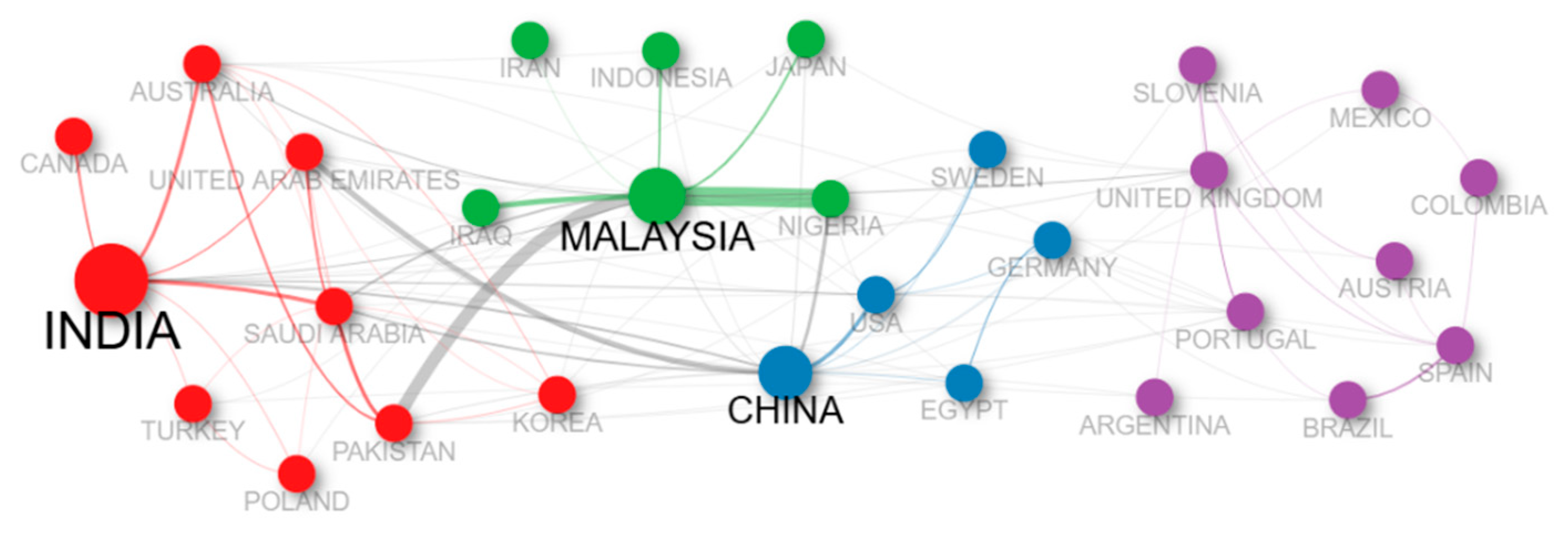
Additionally, the number of published papers (NP) is also indicated in Table 2, differentiating between those authored solely by authors from the same country (SCP) and those with contributions from authors from various countries (MCP). This international collaboration is crucial as it promotes the diversification of perspectives, raw materials, technologies, and methodological approaches, contributing significantly to the generation of high-quality research studies. The collaboration network among different countries is depicted in Figure 5. By examining this figure, we may observe that India, Malaysia, and China are the most active countries in collaborations within the field of biolubricants tribology. India maintains collaborations with both countries. The possible reasons for the interest of these three nations in biolubricant research have been previously discussed.
Figure 5. Collaboration network of countries in research on tribological properties of biolubricants.
India researchers lead a cluster of collaborations, primarily interacting with countries such as Australia, Saudi Arabia, the USA, the United Kingdom, Canada, and others with smaller contributions. In parallel, Malaysia leads another cluster, with significant interactions with Pakistan, Iraq, Iran, Indonesia, Nigeria, and other countries with less prominent participation. Simultaneously, China heads its own cluster of collaborations, with a focus on interactions with Japan, the USA, the United Kingdom, Sweden, Germany, and other countries with smaller roles.
In addition to these three countries, Spanish researchers also stand out with a large number of international collaborations, with over 50% of their publications resulting from partnerships with authors from other countries. Spain maintains significant collaborations with Brazil, Austria, Germany, the USA, the United Kingdom, Slovenia, and Colombia. This combined analysis of Figure 5 and Table 2 reveals the intricate network of collaborations in biolubricant research, highlighting the nations that excel and whose interactions continue to drive the development of the research field.

4.4. Distribution by Institutions

The study revealed that 503 institutions contributed to the publications within the scope of the tribology research field, thereby highlighting the variety of organizations that demonstrate interest in research in this area. However, it is worth highlighting that 300 of these institutions (approximately 60% of the total) have only one publication in the field. This indicates a high level of dispersion in the published studies, suggesting that only around 40% of all institutions have continuously dedicated themselves to this topic. This may reflect challenges such as resource limitations or changes in focus by researchers within these institutions. Furthermore, it suggests significant untapped potential in biolubricant research. However, it is essential to consider other factors before drawing definitive conclusions about the state of research in this field.
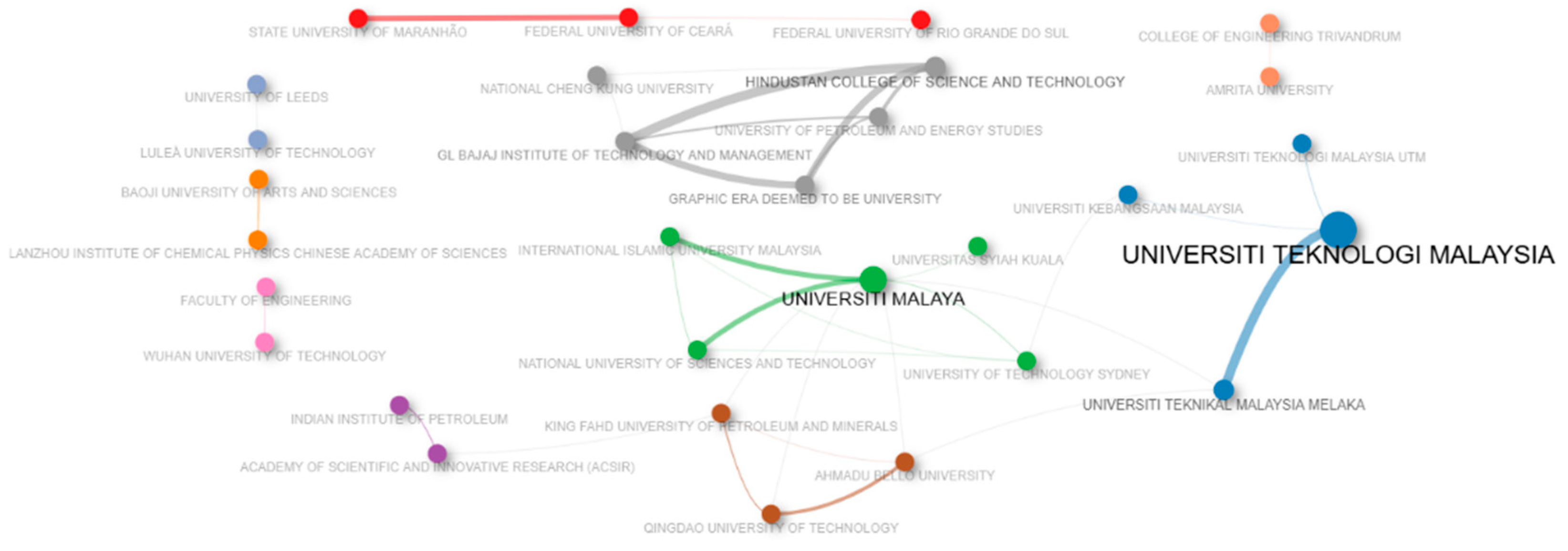
For a better discussion on this topic, the collaboration network among institutions in terms of publications is presented in Figure 6. Universiti Teknologi Malaysia (Malaysia) leads the publication ranking with 53 studies and also forms a cluster of interactions with other Malaysian universities such as Universiti Teknikal Malaysia Melaka, Universiti Kebangsaan Malaysia, Universiti Teknologi Malaysia UTM, and others with fewer prominence.
Figure 6. Collaboration network of institutions in research on tribological properties of biolubricants.
The University of Malaya (Malaysia) secures the second position in the publication ranking with 30 studies, forming a cluster of interactions with International Islamic University Malaysia (Malaysia), Universitas Syiah Kuala (Indonesia), National University of Sciences & Technology (Pakistan), University of Technology Sydney (Australia) and other institutions with relatively less prominence. The third place in the publications ranking, with 25 studies, is also occupied by a Malaysian university, Universiti Teknikal Malaysia Melaka, which mainly interacts with Ahmadu Bello University (Nigeria) and the universities that occupy the first and second place in this ranking.
The interaction among universities from different countries confirms the findings presented earlier in Figure 5, highlighting the scientific collaboration among authors from various nations. This interaction can also help explain why some institutions have only one research publication in the area. Often, these studies result from strategic partnerships between universities, where one institution may provide raw materials or equipment that complement the study of another. This aspect highlights the importance of international collaboration in biolubricant research, fostering an exchange of knowledge and resources that benefits the continuous development in this field.

4.5. Quantitative Analysis of the Distribution of Authors

This study involved 1365 authors, resulting in an average of approximately 2.7 authors per article, reinforcing previous observations that showed a large dispersion of researchers and extensive collaboration network. In Table 3, the top 15 authors are presented, responsible for approximately 39% of the total identified publications. The ranking listed in the first column was established based on the number of publications (NP).
Table 3. The 15 main authors with research on tribological properties of biolubricants according to number of publications from 2010 to 2025.
Information for each author such as H-index, corresponding country, total citations, average citation and year of publication are also included in Table 3. It is important to highlight that these last three parameters are specific to the group of papers under study. The most significant number of publications is by SYAHRULLAIL SS (32 publications), followed by KALAM MA (21 publications) and MASJUKI HH (16 publications). However, this ranking changes when considering the number of citations, with KALAM MA in 1st position, with a total of 1027 citations, followed by MASJUKI HH with 987, and ZHANG Y with 911.
The assessment of the average number of citations per article (AC) reveals that LI C stands out with an average of more than 80 citations per article, followed by ZHANG Y with an average of 75.9 citations. Both authors contributed to four of the 15 most cited articles (referenced as [66,67,68,69]) that will be presented later in Section 4.6. ZULKIFLI NWM also stands out with an average of 62.7 citations per article, driven mainly by his study of 2017 [1], which received 351 citations. It is observed that, in general, authors with a high H-index tend to publish articles with higher visibility, consequently leading to a higher number of citations for their studies, as indicated by the AC column. However, it is important to note that the H-index alone is not a comprehensive measure of a researcher’s quality, as it may be influenced by other factors such as career duration and research field. It should be noted that the H-index presented here is for the researcher in a broad context, while the citation data are specific to the research area under study.
To account for the factor of career duration, the PY start column was added. In Table 3, we can see that some authors started publications in 2011, while others only initiated their contributions many years later (2019–2023). The significant variation in the time span of their careers underscores the need for a comprehensive and careful analysis, considering multiple bibliometric indicators, in order to obtain more solid and representative evaluations.
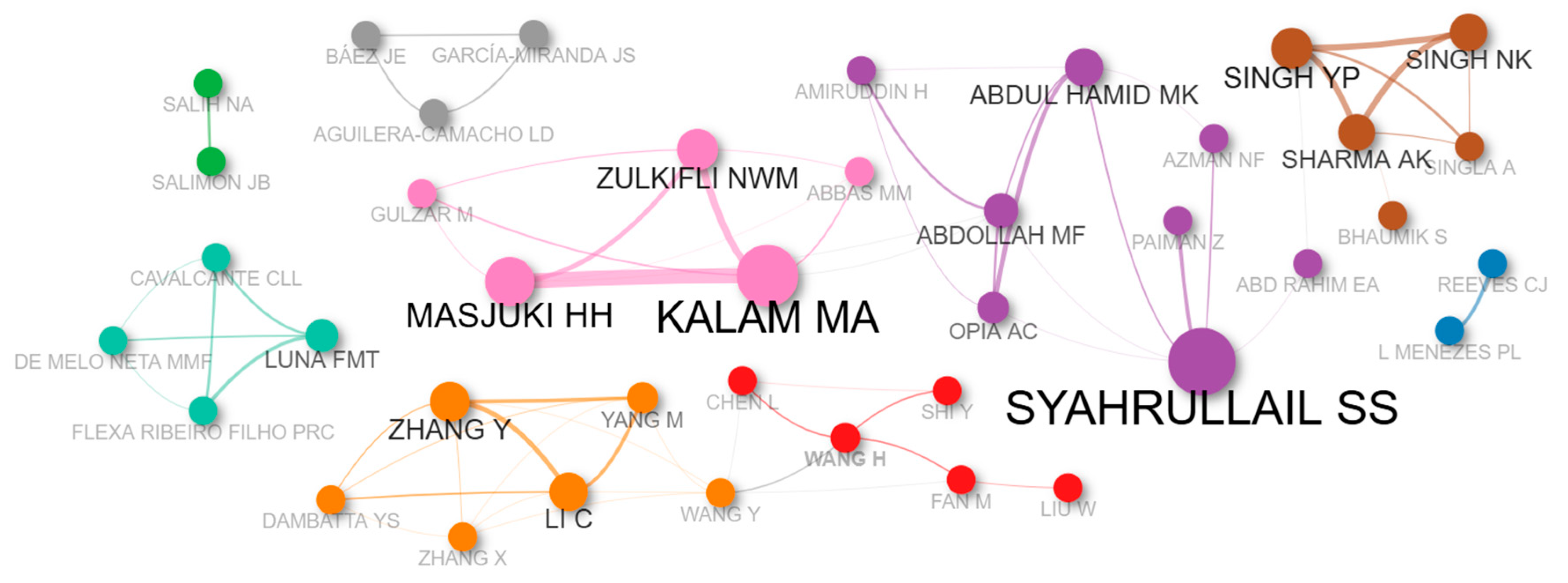
The collaboration network among authors when carrying out research is shown in Figure 7. KALAM MA, from Malaysia, leads a cluster with interaction with others, such as MASJUKI HH, GULZAR M, ZULKIFLI NWM and ABDOLLAH MF. All authors are from Malaysia, with the exception of GULZAR M (from Pakistan), corroborating what is observed in Figure 5 about the strong interaction between Malaysia and Pakistan in terms of publishing. KALAM MA serves as a bridge connecting these authors, but there is no publication in which all of them have collaborated simultaneously.
Figure 7. Author’s collaborative network in research on tribological properties of biolubricants.
The connection between ABDOLLAH MF and authors KALAM MA and MASJUKI HH is evident in a tribological study involving three vegetable base oils (sunflower, palm, and coconut) and tetrahedral amorphous diamond-like carbon coating under contact conditions, published in 2015 [70]. A study involving the collaboration of most authors, except for ABDOLLAH MFB, was published in 2018 [71] on the tribological compatibility of adding different additives to palm trimethylolpropane ester and diamond-like amorphous tetrahedral carbon coating. Similarities in the tribological behavior of a diamond-like carbon coating lubricated with bio-based lubricants show that the authors, especially KALAM MA and MASJUKI HH, maintained research in the field and achieved further advances [70,71].
LUNA FMT is the only Brazilian author listed in Table 3 and leads a collaborative group that includes CAVALCANTE CLL and DE MELO NETA MMF, both from the Federal University of Ceará, and FLEXA RIBEIRO FILHO PRC from the State University of Maranhão, institutions whose partnership is shown in Figure 6. The studies developed from the collaboration of these authors focus on the synthesis and performance evaluation of biolubricants derived from vegetable oils. For example, study [72] used castor oil as a raw material, while study [73] evaluated a residual fatty acid obtained from a fats and margarine factory. Both are non-edible raw materials that do not affect food safety.
SINGH Y leads a collaborative cluster which includes SHARMA A, SINGLA A and SINGH NK, all of whom originate from India, although they began their publications in the field in different years. In addition to the collaborations mentioned, these authors also establish connections with other researchers, as shown in Figure 7. An example of a publication that highlights the contribution of authors SINGH Y, SINGH NK and SHARMA A was published in 2020 [74]. This study investigates the impact of the addition of SiO2 nanoparticles on the tribological performance of a biolubricant derived from desert date oil (Balanites aegyptiaca).
Some authors have significant collaborations restricted to only one partner, as is the case for SALIMON J, who frequently collaborates with SALIH N, although they also co-author studies with other researchers [52,75,76]. The partnership between SALIMON J and SALIH N is notable because of how often they study together.
MENEZES PL and REEVES CJ, affiliated with the College of Engineering at the University of Nevada, also show intense collaboration (REEVES CJ is present in 70% of MENEZES PL publications). His most cited articles focused primarily on the use of additives, evaluating how particle size, surface roughness, and the composition of these additives influence the tribological performance of biolubricants [77,78,79].

4.6. Quantitative Analysis of Cited Articles

The 15 most relevant studies in the group of papers of this study, classified based on the number of citations received, are highlighted in Table 4. To enhance the analysis and consider evolution over time, information was added about the year of publication and the average number of citations per year. This allows for a more comprehensive view, since the table covers studies published from 2010 to 2022. The most cited paper is also the oldest one in the list, published in 2010, with an average of about 26 citations per year. It has only two authors, both from the USA (Palacio and Bhushan) [80]. This article consists of a literature review on various types of ionic liquids (ILs) for green molecular lubrication, including discussions on nanotribological, electrical properties, and spectroscopic analyses. The discussions on tribology presented in this study include conventional tribological measurements, such as pin-on-disc and four-sphere, and also nanotribological studies. An important discussion presented in the article is that ILs are considered environmentally friendly as they do not emit volatile organic compounds. However, it is important to note that ILs may cause corrosion to the substrate and generate corrosive, flammable, or toxic decomposition byproducts. These issues can be resolved through the use of additives or other strategies that are presented in the study. Furthermore, an area identified as needing further investigation is the assessment of the electrical and tribological properties of ILs, particularly considering their electrical conductivity.
Observing the citations received by this article, it is clear that it was referenced in older later publications, such as the one by Somers et al. [81], published in 2013, which provides a summary of the results achieved by various researchers in the use of ILs as lubricants. Furthermore, it has also been referenced in a more recent study [82], published in 2023, which offers a broad discussion on current developments in ILs research, whether as pure lubricants or additives, covering aspects from synthesis to tribological properties in macro and nano scales.
Table 4. The top 15 studies of literature based on citations with research on tribological properties of biolubricants from 2010 to 2025.
TCYEARAC_PYAUTHORTITLESOURCEREFC
396 201026.4PalacioA Review of Ionic Liquids for Green Molecular Lubrication in NanotechnologyTribol. Lett.[80]USA
390202078.0CaiIonic liquid lubricants: when chemistry meets tribologyChem Soc Rev[83]CHN
351201743.9SyahirA review on bio-based lubricants and their applicationsJ. Clean. Prod.[1]MYS
235202278.3WangTribology of enhanced turning using biolubricants: A comparative assessmentTribol. Int.[67]CHN
221202273.7ZhangNano-enhanced biolubricant in sustainable manufacturing: From processability to mechanismsFriction[69]CHN
211201830.1ChanTribological behavior of biolubricant base stocks and additivesRenew Sustain Energy Rev[49]MYS
198202266.0JiaLubrication-enhanced mechanisms of titanium alloy grinding using lecithin biolubricantTribol. Int.[68]CHN
173201314.4ChoEvaluation of hexagonal boron nitride nano-sheets as a lubricant additive in waterWear[84]KOR
167201516.7RaniEvaluation of physiochemical and tribological properties of rice bran oil—biodegradable and potential base stoke for industrial lubricantsInd Crops Prod[85]IND
156201719.5TalibTribological behavior of modified jatropha oil by mixing hexagonal boron nitride nanoparticles as a bio-based lubricant for machining processesJ. Clean. Prod.[86]MYS
148201111.1SalihThe physicochemical and tribological properties of oleic acid based triester biolubricantsInd Crops Prod[87]MYS
144201718.5WangExperimental evaluation on tribological performance of the wheel/workpiece interface in minimum quantity lubrication grinding with different concentrations of Al2O3 nanofluidsJ. Clean. Prod.[66]CHN
139201312.0ReevesThe Size Effect of Boron Nitride Particles on the Tribological Performance of Biolubricants for Energy Conservation and SustainabilityTribol. Lett.[77]USA
139201311.6ShahabuddinComparative tribological investigation of bio-lubricant formulated from a non-edible oil source (Jatropha oil)Ind Crops Prod[88]MYS
126201615.4ZulkifliLubricity of bio-based lubricant derived from different chemically modified fatty acid methyl esterTribol. Int.[89]MYS
TC: total citations; AC_PY = average citation per year; REF: reference; C: country; USA: United States; MYS: Malaysia; CHN: China; KOR: Republic of Korea; IND: India. Observation: The listing of authors and countries in this table refers to the information of the first author (last name only) of each article.
The second most frequently cited publication from 2020, averaging 78 citations per year, is also a literature review focused on the application of ILs as lubricants. This review addresses advances in research on ILs and their tribological properties when used as base oils, additives, and thin films, in addition to discussing the applicability of ILs as biodegradable lubricants [83]. The study involved the collaboration of four authors, all from China, but with two different affiliations, the Lanzhou Institute of Chemical Physics and Northwestern Polytechnical University. This collaboration between institutions is also observed in the cluster of Figure 6. The article provides an overview of ILs, along with future perspectives, intending to assist researchers in their decision-making processes. Furthermore, the study reports the interaction between electrical and tribological properties, using the application of electrical potentials to control the lubricity of ILs. This indicates that the gap highlighted earlier by Palacio and Bhushan [80] is being filled over the years.
Continuing with the articles listed in Table 4, the third most cited publication is a literature review published in 2017, with an average of 44 citations per year. This review addresses the potential of biolubricants in various applications, based on research advances available at the time of the study [1], involving eight authors, six from Malaysia, one from Saudi Arabia, and one from Pakistan. This is a literature review that begins by discussing natural vegetable oils, fatty acid composition, chemical modifications, as well as their physicochemical properties, and ionic liquids. It also outlines the tribological characteristics and potential applications of bio-based lubricants. The authors emphasize challenges for expanding the biolubricants market beyond conventional options (such as oxidative stability and cold flow behavior), like the development of high-performance biocatalysts on a large scale, a continuous supply of homogeneous raw materials, and competitiveness with the food industry when using edible oils.
A gap identified in the study is the lack of emphasis on advances in the field of nanoadditives, which may have been excluded due to refinement criteria. However, it is noteworthy to highlight that there were already studies on the addition of nanoparticles during the evaluated period, such as those mentioned in several articles [84,90,91,92]. This article [1] is frequently cited in current studies, both in literature reviews, such as the study by Monteiro et al. [93], which covers the general characteristics of biolubricant production and then focuses on production using lipases, and in experimental studies, such as the one by Opia et al. [94], that comprises a series of tests to assess the lubricity effectiveness of a sample of rapeseed oil modified with multi-walled carbon nanotubes and organic polymeric additives.
The fourth most cited publication, from 2022, is among the most recent in Table 4 and has an average of 78 citations per year, indicating significant relevance within its field. The study engaged the collaboration of nine authors, hailing from various countries including China, Saudi Arabia, India, the United States, and the United Arab Emirates [67]. The article provides a comparative assessment of tribological properties during turning processes using the minimum quantity lubrication technique for biolubricants. It also presents the main stages in the development of biolubricants with a minimum quantity lubrication method for difficult-to-machine materials. The authors initially introduce the minimum amount of lubrication, including discussions on limitations and tribological evaluation indicators such as tool wear and cutting force. Subsequently, a section on the optimization of this method using nanoparticles, cryogenic medium, ultrasonic vibration and textured tools begins. For each of these techniques, a comprehensive discussion is provided, highlighting observations reported in the literature. In conclusion, the authors provide a summary of the advantages and disadvantages of each reviewed optimization technique. The authors mention that the literature on the topic is limited and cannot meet the specific demands of this area. Furthermore, they highlight several gaps that need to be addressed and offer some potential solutions.
The article ranked as the fifth most cited, also published in 2022, boasts a significant average of 74 citations per year, involving 15 authors of different nationalities, including China, Saudi Arabia, Pakistan and the United Arab Emirates [69]. This study provides a comprehensive review of the literature on advances in minimum quantity lubrication using nano-enhanced biolubricants, exploring tribological, thermal, and surface quality aspects. Initially, it presents an overview of biolubricants, including the composition of saturated and unsaturated vegetable oils. Subsequently, various types of nano-enhancers for vegetable oils are presented, with a range of applications and their key characteristics. In order to evaluate the effectiveness of nano-enhanced biolubricants, comparative data are presented for biolubricant-based minimum quantify lubrication and metal-working fluids. In the former case, dry machining is used, while in the latter, conventional flood machining is employed. A section is dedicated to evaluating multifactorial influence on the performance of these samples and their optimization. Finally, the authors highlight gaps and possible solutions.
It is worth noting that two articles [67,69] share some similarities, as both provide literature reviews on the application of biolubricants in minimum quantity lubrication turning operations, albeit with different research focuses. The study by Wang et al. [67] has a broader scope, while the one by Zhang et al. [69] is specifically focused on nano-enhanced biolubricants. For the latter article [69], an erratum has been published, revising an incorrect figure presented in the original text [69].
The sixth study in the citations ranking (Table 4), published in 2018, with an average of 30.1 citations per year, is a literature review on base oils for biolubricants and their additives, with emphasis on their tribological properties [49]. The main sections of the article discuss basic tribological parameters, highlighting three key properties that affect friction and wear: the mechanical properties of the tribosystem, the lubrication regime and its conditions, and the physical and tribochemical properties of the lubricant. The influence of the molecular structure of biolubricant compounds on their properties is also reported, followed by the tribological performance of different base oils reported in the literature. This includes samples of unmodified vegetable oils, chemically modified oils, additives and commercial samples utilized for comparative analysis. Finally, the influence of additives on the tribological performance of biolubricants tested under different conditions is presented and discussed. This review may help in choosing the most viable additive(s) for researchers who already have a defined base oil or, conversely, if researchers want to evaluate the performance of a new additive, they can select base oils with undesirable performance in certain properties and study their improvement. The article has six authors, all from Malaysia. It is worth noting that this paper is frequently cited in more recent reports, such as the experimental study by Basiron et al. [25], which investigates the lubrication mechanism of ecological lubricant samples developed from non-edible vegetable oils and mineral oils mixed in different proportions. Furthermore, it is cited in further literature reviews, such as the one by Hamnas and Unnikrishnan [2]; a more recent overview of the biolubricants landscape, including applications and challenges.
The seventh most cited article was published in 2022 by Jia et al. [68] and has an average of 66 citations per year, with the collaboration of seven authors, five from China, one from India, and one from the United Arab Emirates. It is important to note that five of the authors who contributed to this article also participated in the article by Wang et al. [67], already mentioned above, including Yanbin Zhang, who stands out for the total number of citations, as evidenced in Table 3 (see Section 4.5 above). In contrast to the other articles, this is an experimental study that investigates the effects of adding lecithin on the properties of soybean oil and proposes a rectification method with lecithin biolubricant by electrostatic atomization with a minimum amount of lubrication [68]. The authors present the materials that were used, the experimental apparatus, and detail the configurations adopted for each of the four experimental groups that were performed. In the article, they discuss how the addition of lecithin affects the physical properties of soybean oil, evaluating different composition rates. They also report on grinding experiments under different lubrication conditions, concluding with an optimization of the lecithin concentration in the system.
One possibility for researchers interested in this field would be to evaluate the feasibility of using other vegetable oils, including non-edible oils, and/or implementing chemical modifications before adding the lectin. The study by Jia et al. [68] presents several recent citations, including a literature review by Zhang et al. [95], addressing a wide range of properties of vegetable-oil-based nano-biolubricants and their potential applications; and an experimental article by Xie et al. [96], investigating the thermal stability and performance of a biolubricant isolated from crude extract of Codonopsis pilosula.
The eighth study in the citations ranking was published in 2013, with an average of 14.4 citations per year and five authors, all from South Korea. This study evaluates the tribological performance of hexagonal boron nitride nanosheets used as an additive in water [84]. The authors commence by introducing water-based lubricants, which come with inherent limitations, and propose the incorporation of nanostructures to overcome these issues. The tribological tests were carried out in the ball-on-disc configuration, using a silicon carbide sphere and a silicon wafer. In the Section 4, they present a comparison of different proportions of nanosheets dispersed in water and the time-based variation in their dispersion. Several results are presented, including visualization of the appearance of the samples, sedimentation measurements, scanning electron microscopy, and analysis of the friction coefficient variations over sliding cycles, among others. An analysis that the authors could have carried out would be to evaluate the samples at shorter time intervals (example: 5 days) to verify when the behavior in the nanosheets begins to stabilize. This article was published in the journal “Wear”. It is interesting to note that this specific article is responsible for approximately 47% of the total citations of that journal, obviously considering only the set of articles that were included in the analysis of this study.
From the ninth to the fifteenth most cited articles (Table 4), the focus remains on the physicochemical and tribological evaluation of bio-based lubricants. Considering their similar scope to the studies previously discussed, these studies are briefly summarized below. The ninth article [85] evaluates several properties of rice bran oil, including physicochemical and tribological properties, comparing it with other vegetable oils (sunflower and coconut) and with the commercial SAE20W40 oil. To complement the evaluation of this oil’s potential, mixtures with commercial lubricants in different proportions could be tested, applying chemical modifications, or using it as an additive in conventional formulations. The tenth article in the ranking evaluates the tribological performance of a biolubricant derived from crude jatropha oil, modified by transesterification and additivated with boron nitride nanoparticles [86]. The study carried out two types of tribological tests: the four-ball test and the percussion torque test. One of the author’s conclusions was that tribological performance decreases when the concentration of nanoparticles exceeds 0.05% by weight due to the agglomeration of abrasive particles. A way to complement this study would be to evaluate the feasibility of other variations in the molar ratio between jatropha methyl ester (JME) and trimethylolpropane (TMP), considering that the best results were obtained for the samples with the highest molar ratio evaluated.
The eleventh paper in Table 4 [87] discusses modifications implemented in chemical reactions to produce triester derivatives based on oleic acid and presents their physicochemical and tribological characterization using the four-ball test. In the twelfth article in Table 4, a nanolubricant was developed by adding Al2O3 nanoparticles to palm oil, to be used in the surface grinding of a nickel-based alloy, in minimum quantity lubrication mode, evaluating tribological performance based on macro and micro parameters [66]. The study involved seven authors from different universities in China; this collaboration between institutions plays a crucial role in enriching research through the sharing of knowledge and resources. The thirteenth article in the ranking is an experimental study that investigated the influence of boron nitride particle size on the tribological performance of canola-oil-based lubricants, using a pin-on-disc tribometer [77]. Four particle sizes were evaluated (70 nm, 0.5, 1.5 and 5.0 μm), and the results showed that nanoscale particles provided superior tribological performance, also improving the performance of mixtures containing micrometric or submicrometric particles.
The fourteenth paper in Table 4 describes tribological characteristics of a biolubricant formulated from a mixture of Jatropha oil (in proportions ranging from 10% to 50% by volume) with the lubricant base SAE 40 [88]. The results indicated that among the evaluated percentages, the addition of 10% Jatropha oil is the most suitable for automotive applications; above this concentration degradation of the lubricating film occurs and an increase in the coefficient of friction. Articles [87,88], both published in the journal Industrial Crops and Products, together with paper [85] also from the same periodical, play a significant role in the considerable total number of citations attributed to this journal in the context of this study.
Finally, the fifteenth paper investigated the tribological behavior of polyols esters (trimethylolpropane and pentaerythritol) synthesized from methyl esters of palm oil [89]. The products were tested under extreme pressure and mixed lubrication conditions and achieved performance comparable to that of a fully formulated commercial lubricant. The study highlights the potential of these esters as base oils for lubricants but recommends further evaluation of other properties such as oxidative and thermal stability.
Evaluating those most cited papers, as well as the studies that reference them and the collaboration between authors, an increasing interest in the field of tribological properties of biolubricants is observed, accompanied by a significant diversification in terms of methodologies, themes and raw materials. This trend reflects a continuous commitment to reducing reliance on non-renewable resources, thus contributing to environmental preservation.

4.7. Quantitative Analysis of Frequent Keywords

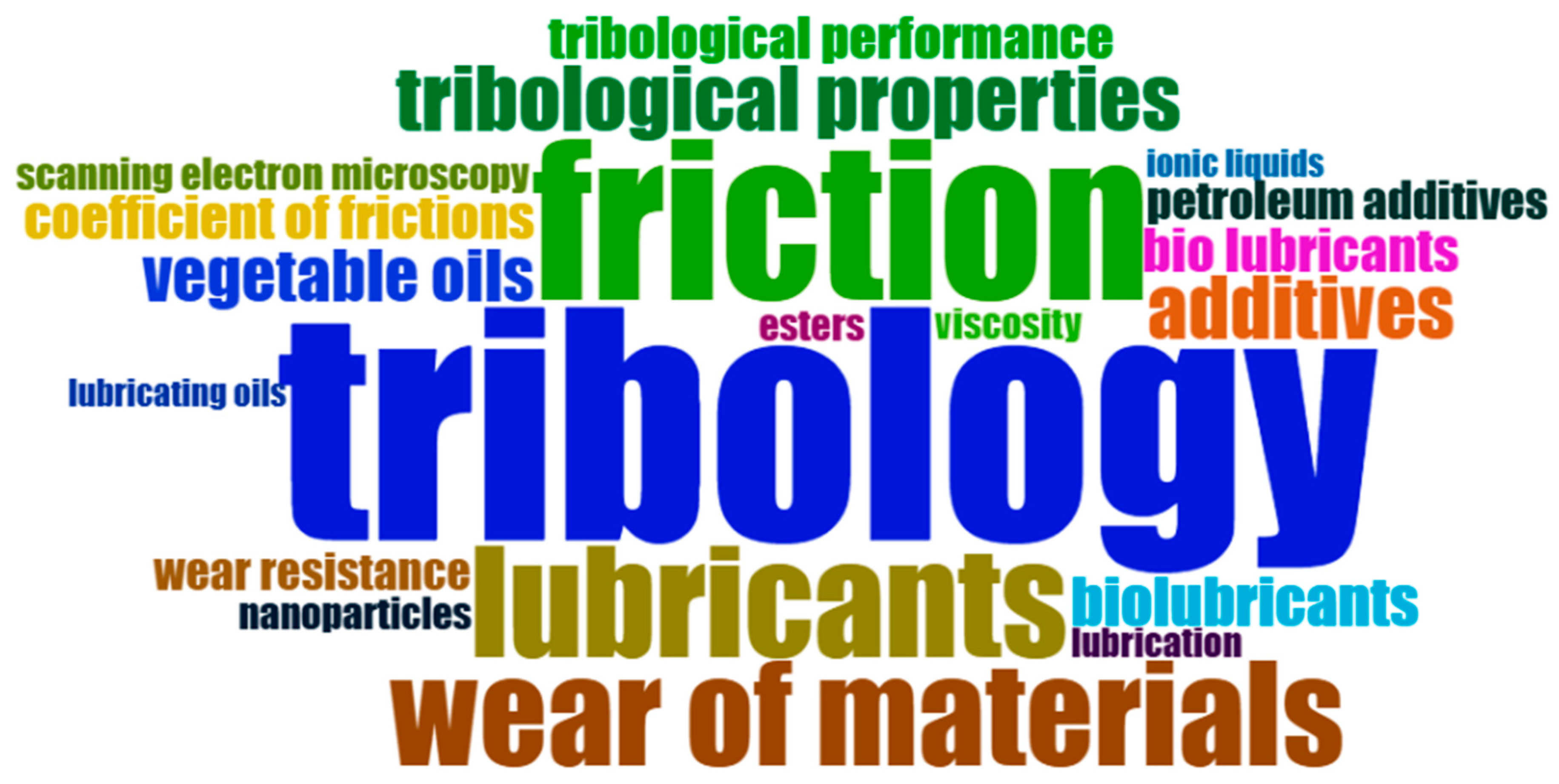
The word cloud containing the 20 most relevant keywords associated with publications that address tribological properties of biolubricants, within the sample that was evaluated in this study, is presented in Figure 8. It may be observed that the terms “biolubricants” (including similar terms like “bio lubricants” and “lubricants”) and “tribology”, and “tribological properties” prominently appear, since they are the main subjects of this analysis.
Figure 8. Word cloud attributed to the publications evaluated from 2010 to 2025.
The terms “friction”, “wear of materials” and “wear resistance” are also highlighted due to the importance of lubricants in reducing friction and wear between two interacting surfaces, consequently avoiding material and energy waste in industrial machinery [53,97,98,99]. The same importance extends to biolubricants, aiming to replace conventional (mineral) lubricants with more environmentally friendly lubricants. To present the same properties as mineral lubricants, it is also important to study the “lubrication” potential of biolubricants, another term that stands out in the word cloud. This property is essential to optimize the fuel consumption in an engine and to improve its performance under adverse conditions [100,101,102].
The term “vegetable oils” is emphasized because they are the most studied raw materials in the field of biolubricants [5,103,104] due to their inherent technical properties and biodegradability [104,105,106,107], both with or without chemical modifications, such as the synthesis of “esters” (another keyword present in Figure 8) [108,109,110,111,112,113]. Commonly used oils include soybean, canola, palm, sunflower, and castor oils, with increasing interest in non-edible or residual oils [114]. Biodegradability represents one of the main concerns in the field of lubrication, acting as a significant motivator for studies aimed at developing bio-based lubricants, characterized by their low toxicity and good biodegradability [16,115,116].
The term “ionic liquids” also shows some significance in the field of biolubricants, due to extensive studies on their viability as additives [117,118,119,120,121,122], their possible application as catalysts [123,124,125] and in microemulsion biolubricants formulations with vegetable oils [126,127,128]. This demonstrates the versatility and relevance of ionic liquids in biolubricant research. However, their application requires careful analysis, as some ionic fluids are derived from non-renewable sources and exhibit low biodegradability, which may limit their classification as a green alternative [129]. The first study within the scope of this review that addresses ionic liquids was published in 2010 and presents a literature review discussing different types of ionic liquids and their physical properties related to their lubricating behavior, with the most cited publication listed in Table 4 [80]. The two most recent articles, published in 2025, are experimental studies and include studies on amine-based protic ionic liquids as additives in polyethylene glycol, and an evaluation of the adsorption, interaction, and tribological behavior of aqueous lubricants of amino-acid-based ionic liquids [130,131].
Another term presented in the word cloud is “additives”. Additives play a crucial role in improving the lubricating performance of the base oil, compensating for existing deficiencies, even in the best base fluids [132,133,134]. The studies on additives are diverse, including the evaluation of potential use of biodiesel derived from vegetable oils and animal fat as additives [135], the effects of additivation with the methyl esters of Neem, Pongamia and Tamanu oils compared to commercial mineral oil SAE20W40 [136], and the use of pentaerythritol rosin ester as an environmentally friendly multifunctional additive [137]. Also, to improve the physicochemical and tribological properties of biolubricants, some articles evaluate the effect of adding “nanoparticles” (as seen in Figure 8) into their formulations [138,139,140,141,142,143]. According to Li et al. [144], the nanoparticles investigated for applications in biolubricants include metals (Cu, Fe, and Pd), metal oxides (TiO2, SiO2, and ZnO), boron-based particles (such as calcium and zinc borates), and carbon materials, including graphene, diamond, and carbon nanotubes.
Research on nanoparticles began in 2012 and has grown over time, with publication peaks in 2021 and 2023, with 11 articles each. The first study, published in 2012, focused on the synthesis of titanium-based lubricants soluble in mineral oil and nanoparticles modified with tetra-(2-ethylhexyl)thiuram disulfide and di(2-ethylhexyl) thiophosphonodisulfide [145]. The three most recent studies, published in 2025, address the tribological performance of copper oxide nanoparticles in modified Kusum oil, the effects of TiO2 and SiO2 nanoparticles in mixtures of canola oil and wheat germ, and a review article on different nanomaterials applied in tribology, relating to the areas of materials science and tribology [146,147,148].
“Scanning electron microscopy” is a commonly employed technique for characterization of nanomaterials and catalysts [120,149,150,151]. Furthermore, in this research area, it is extensively employed in evaluating surface wear [152,153,154,155,156], allowing for a detailed understanding of lubrication mechanisms. The term “petroleum additives” is related to studies assessing the potential of using bio-based lubricants as additives for commercial petroleum-derived lubricating oils [157,158,159], which may bring an interesting option to gradually introduce more sustainable alternatives into the lubricant market, stimulating further research without causing drastic changes to the industry as a whole.
The term “viscosity” also stands out for its importance in biolubricants, since it determines the resistance to flow and is directly related to temperature, pressure and formation of the lubricating film [160], being widely reported in the literature [100,161,162,163,164]. Other closely related terms appearing in the word cloud are “tribological performance” and “coefficient of frictions”, both essential parameters for evaluating a lubricant formulation and its ability to meet the needs of the machines and systems in which it will be employed. These parameters have been discussed in several articles, with the most commonly reported tribological test configurations being four-sphere, pin-on-disc, and sphere-on-disc tests [9,49,123,165].

4.8. Research Areas

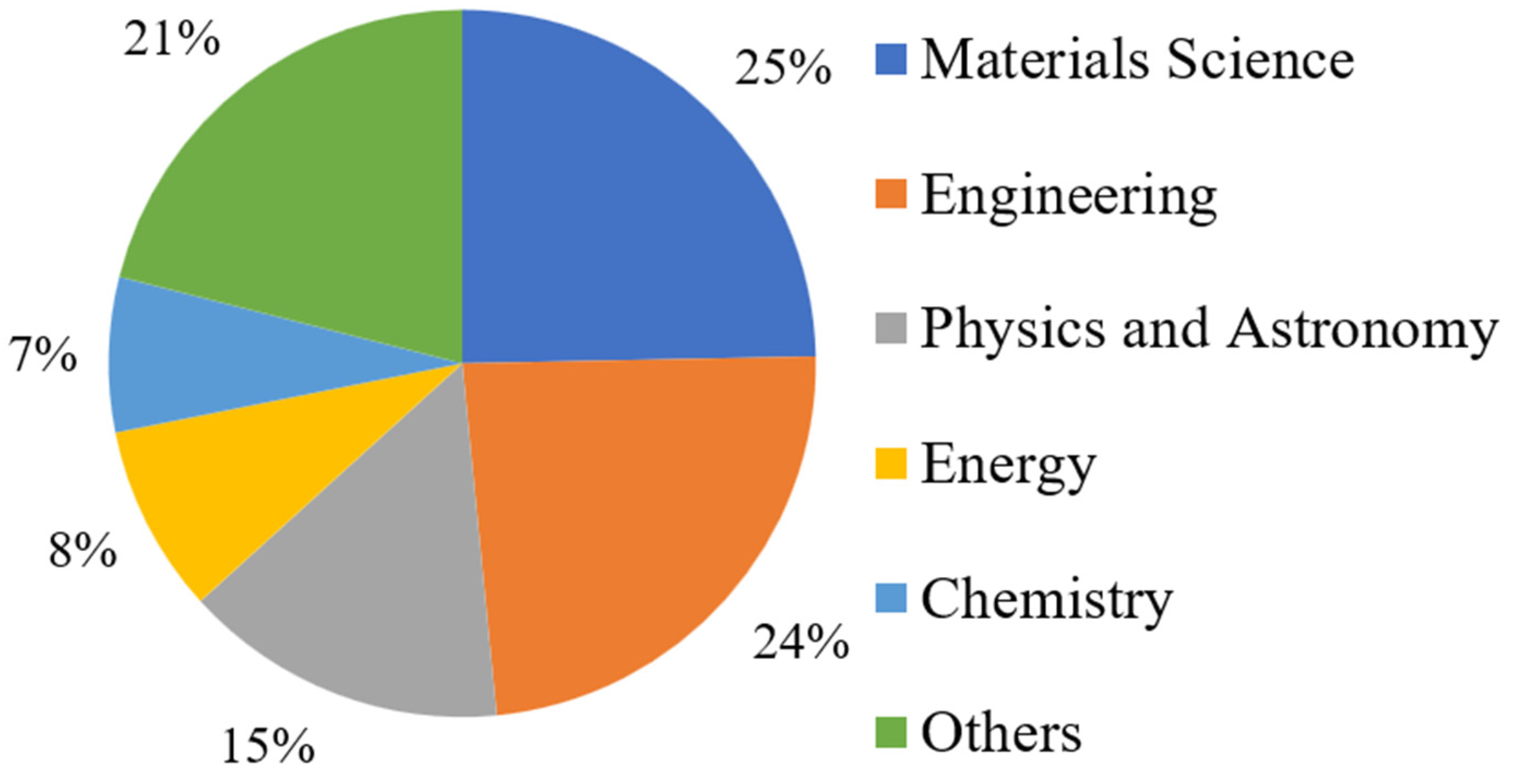
The articles were classified into a total of 18 research areas within the Scopus database. Several of these papers are affiliated with multiple research areas, and their distribution is not uniform, with eight areas having fewer than 20 papers each. The six main research areas are illustrated in Figure 9, encompassing approximately 80% of the evaluated papers of this study.
Figure 9. Distribution of research areas on tribological properties of biolubricants.
The most prominent research areas, in terms of the number of published papers, are “Materials Science” and “Engineering,” with 293 and 282 papers, respectively. One observation is that there are 201 papers registered in these two areas. Within these two areas of research simultaneously there are several research themes that are explored. For example, Sagisaka et al. [166] evaluated the potential application of environmentally friendly lubricants for cold forging of aluminum alloys. Another article, by Fan et al. [167], reports the ecotoxicity and tribological properties of lubricants derived from choline monocarboxylate ionic liquids. Furthermore, Vasco et al. performed a comparative tribological evaluation of a synthetic lubricant and a natural ester for air compressors application [168].
The “Physics and Astronomy” field comes next, with 176 papers, of which 168 are also registered in at least one of the areas previously mentioned. Examples of papers classified in this area without being classified in the previously mentioned areas include the article by Yin et al. [169], which primarily discusses the importance of oxidation resistance in the design of new nanoparticle additives in its study with alkyl-functionalized graphene oxide and nanoparticles of boric acid. Also, Narayanasarma et al. reported a range of properties including tribological and thermal properties of a polyolester lubricant used in household refrigerator compressors, enhanced with alumina nanoparticles and blended with sesame oil [170].
The fourth category, “Energy,” consists of 102 papers, with approximately half of them associated with the two largest areas, particularly “Engineering.” The fifth area, “Chemistry” comprises 84 related studies and exhibits a strong connection with other research areas. Examples of papers included in both areas simultaneously include the one by Gul et al. [171], which presented a study on optimizing transesterification reaction conditions for the synthesis of cotton biolubricant using Response Surface Methodology, and that of Shankar et al. [172], which assessed the tribological behavior and the biodegradability of a lubricant derived from a mixture of kapok oil with SAE20W40 mineral oil.
The remaining areas are collectively classified under the “Others” category for better visualization in the graph. These areas include, for example, “Chemical Engineering”, “Environmental Science”, “Agricultural and Biological Sciences”, and “Biochemistry, Genetics, and Molecular Biology”. It is important to mention that the papers cited above are just examples randomly selected to illustrate some studies related to the main areas of research, and there are several others that contribute to progress in these fields. The diverse array of areas that articles on bio-based lubricants encompass reflects their versatility and may indicate the collaborative efforts of experts from various knowledge areas, offering unique perspectives and insights.

5. Conclusions

In this review, a bibliometric analysis of the literature on tribological properties of biolubricants was carried out, presenting bibliometric indicators and a detailed assessment of the most cited studies. This may help professionals interested in tribological performance of biolubricants, providing a scenario of published studies within this recent field of research within the last 15 years, especially in identifying the most explored topics and eventual thematic gaps in the open literature. The analysis was based on 504 papers published between 2010 and 2025, providing a perspective on the evolution of this field of research. The following conclusions may be drawn from this study:
  • India, China, and Malaysia have generated the highest number of publications in this topic among all countries. India leads with 132 publications (26.2 of total production), followed by China with 79 publications (15.7%) and Malaysia with 73 publications (14.5%). In terms of total citations, Malaysia has the highest number (TC = 2487), followed by India (TC = 2401) and China (TC = 2209).
  • Based on the keywords that appear most frequently, high-demand research topics include petroleum additives, additives, ionic liquids, vegetable oils, and nanoparticles.
  • The use of additives is of significant interest to researchers in this field, particularly nanoparticles, as evidenced by the citation analysis, where seven of the fifteen most cited articles address nanoadditives. The use of nanoparticles has shown promising results for tribological performance and is the subject of recent research with diverse raw materials with great potential based on the number of citations in the articles evaluated in this study.
  • Analysis by research area shows that papers are highly concentrated in Materials Science (25%), Engineering (24%), and Chemistry (21%), which together account for 70% of total publications.
  • The application of ionic liquids in biolubricants is not a recent study, but it continues to evolve. This is an area where significant results have already been presented, with two articles among the fifteen most cited studies, totaling almost 800 citations, but there is still untapped potential.
  • The use of biolubricant derivatives and petroleum-based lubricants offers a method of gradually introducing this alternative to the market, reducing dependence on fossil derivatives, and highlighting its benefits to consumers and the industry.
  • Universiti Teknologi Malaysia appears as the institution with the highest number of publications on tribological performance of biolubricants (with 53 studies), followed by the University of Malaya (with 30 studies). These two institutions maintain collaborative networks with other organizations, some within Malaysia and others in different countries.
  • Although several raw materials have been reported for the formulation of biolubricant base oils, researchers still show significant concern about evaluating different raw materials, especially non-edible vegetable oils, to avoid competing with the food industry.
The trend suggests that research on tribological development of biolubricants will continue to expand, based on the analysis of the temporal evolution of scientific production, which, despite fluctuations over the years, continues to be an area of interest sustained by its potential and due to the need to respond to growing market demands in harmony with sustainable environmental development. Despite the significant progress reported in the literature, this analysis also highlights important research gaps. Very few studies clearly correlate tribological performance with lubrication regimes, limiting the understanding of the operating mechanisms of biolubricants. Furthermore, long-term stability, durability, and aging under realistic conditions remain poorly explored. Further studies are also needed to evaluate the scalability of chemical synthesis routes, as well as production costs, compliance with standards, and regulatory requirements, which are critical factors for the effective adoption of biolubricants in the market.

Supplementary Materials

The following supporting information can be downloaded at: https://www.mdpi.com/article/10.3390/lubricants14020077/s1.

Author Contributions

Conceptualization, M.M.F.M.N. and F.M.T.L.; methodology, M.M.F.M.N., R.R.C.M., P.R.C.F.R.F. and F.M.T.L.; software, M.M.F.M.N.; validation, R.R.C.M. and P.R.C.F.R.F.; formal analysis, M.M.F.M.N., R.R.C.M. and P.R.C.F.R.F.; investigation, M.M.F.M.N., R.R.C.M. and P.R.C.F.R.F.; resources, C.L.C.J. and F.M.T.L.; data curation, M.M.F.M.N.; writing—original draft preparation, M.M.F.M.N. and R.R.C.M.; writing—review and editing, P.R.C.F.R.F., C.L.C.J. and F.M.T.L.; visualization, M.M.F.M.N., R.R.C.M., P.R.C.F.R.F., C.L.C.J. and F.M.T.L.; supervision, C.L.C.J. and F.M.T.L.; project administration, C.L.C.J. and F.M.T.L.; funding acquisition, C.L.C.J. and F.M.T.L. All authors have read and agreed to the published version of the manuscript.

Funding

The authors wish to thank financial support provided by “Conselho Nacional de Desenvolvimento Científico e Tecnológico” (CNPq), “Fundação Cearense de Apoio ao Desenvolvimento Científico e Tecnológico” (FUNCAP, Research and Innovation Network on Renewable Energy, Rede VERDES, grant 07548003/2023). “Coordenação de Aperfeiçoamento do Pessoal do Ensino Superior” (CAPES). Ribeiro-Filho thanks the “Conselho Nacional de Desenvolvimento Científico e Tecnológico” (CNPq) for the financial support under Process No. 404427/2023-5, and the “Universidade Estadual do Maranhão” (UEMA) for granting the research productivity fellowship (2025–2027). M. Marliete F. Melo Neta thanks “Programa de Formação de Recursos Humanos—Agência Nacional de Petróleo, Gás Natural e Biocombustíveis/Financiadora de Estudos e Projetos” (PRH 05—ANP/UFC).

Data Availability Statement

The data that support the findings of this study are available on request from the corresponding author.

Conflicts of Interest

The authors declare no conflicts of interest.

References

  1. Syahir, A.Z.; Zulkifli, N.W.M.; Masjuki, H.H.; Kalam, M.A.; Alabdulkarem, A.; Gulzar, M.; Khuong, L.S.; Harith, M.H. A Review on Bio-Based Lubricants and Their Applications. J. Clean. Prod. 2017, 168, 997–1016. [Google Scholar] [CrossRef]
  2. Hamnas, A.; Unnikrishnan, G. Bio-Lubricants from Vegetable Oils: Characterization, Modifications, Applications and Challenges–Review. Renew. Sustain. Energy Rev. 2023, 182, 113413. [Google Scholar] [CrossRef]
  3. Environment Directorate General of the European Commission. Waste Oil. Available online: https://environment.ec.europa.eu/topics/waste-and-recycling/waste-oil_en (accessed on 1 October 2023).
  4. Hamdan, S.H.; Chong, W.W.F.; Ng, J.-H.; Chong, C.T.; Zhang, H. Nano-Tribological Characterisation of Palm Oil-Based Trimethylolpropane Ester for Application as Boundary Lubricant. Tribol. Int. 2018, 127, 1–9. [Google Scholar] [CrossRef]
  5. Kurre, S.K.; Yadav, J. A Review on Bio-Based Feedstock, Synthesis, and Chemical Modification to Enhance Tribological Properties of Biolubricants. Ind. Crops Prod. 2023, 193, 116122. [Google Scholar] [CrossRef]
  6. Abd Elhaseeb, D.M.; Ali, M.K.A.; Ezzat, M.; Mourad, M. A Review of the Tribological Properties of Nanoparticles Dispersed in Bio-Lubricants. Proc. Inst. Mech. Eng. Part J J. Eng. Tribol. 2023, 237, 27–52. [Google Scholar] [CrossRef]
  7. Mobarak, H.M.; Niza Mohamad, E.; Masjuki, H.H.; Kalam, M.A.; Al Mahmud, K.A.H.; Habibullah, M.; Ashraful, A.M. The Prospects of Biolubricants as Alternatives in Automotive Applications. Renew. Sustain. Energy Rev. 2014, 33, 34–43. [Google Scholar] [CrossRef]
  8. Regueira, T.; Lugo, L.; Fandiño, O.; López, E.R.; Fernández, J. Compressibilities and Viscosities of Reference and Vegetable Oils for Their Use as Hydraulic Fluids and Lubricants. Green Chem. 2011, 13, 1293. [Google Scholar] [CrossRef]
  9. McNutt, J.; He, Q. Development of Biolubricants from Vegetable Oils via Chemical Modification. J. Ind. Eng. Chem. 2016, 36, 1–12. [Google Scholar] [CrossRef]
  10. Opia, A.C.; Abdollah, M.F.B.; Hamid, M.K.A.; Veza, I. A Review on Bio-Lubricants as an Alternative Green Product:Tribological Performance, Mechanism, Challenges and Future Opportunities. Tribol. Online 2023, 18, 18–33. [Google Scholar] [CrossRef]
  11. Kania, D.; Yunus, R.; Omar, R.; Abdul Rashid, S.; Mohamad Jan, B. A Review of Biolubricants in Drilling Fluids: Recent Research, Performance, and Applications. J. Pet. Sci. Eng. 2015, 135, 177–184. [Google Scholar] [CrossRef]
  12. Salimon, J.; Salih, N.; Yousif, E. Biolubricants: Raw Materials, Chemical Modifications and Environmental Benefits. Eur. J. Lipid Sci. Technol. 2010, 112, 519–530. [Google Scholar] [CrossRef]
  13. Gryglewicz, S.; Muszyński, M.; Nowicki, J. Enzymatic Synthesis of Rapeseed Oil-Based Lubricants. Ind. Crops Prod. 2013, 45, 25–29. [Google Scholar] [CrossRef]
  14. Sarker, M.I.; Ngo, H.; Sharma, B.K.; Wagner, K.M.; Jones, K.C.; Powell, M.J. Green Synthesis of Trimethylolpropane Triisostearate and Triisooleate for Usage as Bio-Lubricants. Tribol. Int. 2023, 186, 108649. [Google Scholar] [CrossRef]
  15. Cirillo, C.; Iuliano, M.; Scarpa, D.; Sarno, M. Olive Mill Waste (OMW) as Raw Material for Bio-Lubricant Production by an Innovative Immobilized Lipase. Biocatal. Agric. Biotechnol. 2024, 57, 103078. [Google Scholar] [CrossRef]
  16. Zainal, N.A.; Zulkifli, N.W.M.; Gulzar, M.; Masjuki, H.H. A Review on the Chemistry, Production, and Technological Potential of Bio-Based Lubricants. Renew. Sustain. Energy Rev. 2018, 82, 80–102. [Google Scholar] [CrossRef]
  17. Ho, C.K.; McAuley, K.B.; Peppley, B.A. Biolubricants through Renewable Hydrocarbons: A Perspective for New Opportunities. Renew. Sustain. Energy Rev. 2019, 113, 109261. [Google Scholar] [CrossRef]
  18. Li, W.; Wang, X. Bio-Lubricants Derived from Waste Cooking Oil with Improved Oxidation Stability and Low-Temperature Properties. J. Oleo Sci. 2015, 64, 367–374. [Google Scholar] [CrossRef]
  19. Yosief, H.O.; Sarker, M.I.; Bantchev, G.B.; Dunn, R.O.; Cermak, S.C. Physico-Chemical and Tribological Properties of Isopropyl-Branched Chicken Fat. Fuel 2022, 316, 123293. [Google Scholar] [CrossRef]
  20. Yosief, H.O.; Sarker, M.I.; Bantchev, G.B.; Dunn, R.O.; Cermak, S.C. Chemical Modification of Beef Tallow for Lubricant Application. Ind. Eng. Chem. Res. 2022, 61, 9889–9900. [Google Scholar] [CrossRef]
  21. Shrivastava, S.; Prajapati, P.; Virendra; Srivastava, P.; Lodhi, A.P.S.; Kumar, D.; Sharma, V.; Srivastava, S.K.; Agarwal, D.D. Chemical Transesterification of Soybean Oil as a Feedstock for Stable Biodiesel and Biolubricant Production by Using Zn Al Hydrotalcites as a Catalyst and Perform Tribological Assessment. Ind. Crops Prod. 2023, 192, 116002. [Google Scholar] [CrossRef]
  22. Diaz, P.A.B.; Kronemberger, F.d.A.; Habert, A.C. A Pervaporation-Assisted Bioreactor to Enhance Efficiency in the Synthesis of a Novel Biolubricant Based on the Enzymatic Transesterification of a Castor Oil Based Biodiesel. Fuel 2017, 204, 98–105. [Google Scholar] [CrossRef]
  23. Chen, Y.; Biresaw, G.; Cermak, S.C.; Isbell, T.A.; Ngo, H.L.; Chen, L.; Durham, A.L. Fatty Acid Estolides: A Review. J. Am. Oil Chem. Soc. 2020, 97, 231–241. [Google Scholar] [CrossRef]
  24. Carvalho, W.C.A.; Luiz, J.H.H.; Fernandez-Lafuente, R.; Hirata, D.B.; Mendes, A.A. Eco-Friendly Production of Trimethylolpropane Triesters from Refined and Used Soybean Cooking Oils Using an Immobilized Low-Cost Lipase (Eversa>® Transform 2.0) as Heterogeneous Catalyst. Biomass Bioenergy 2021, 155, 106302. [Google Scholar] [CrossRef]
  25. Basiron, J.; Abdollah, M.F.B.; Abdullah, M.I.C.; Amiruddin, H. Lubricant Mechanisms of Eco-Friendly Lubricant Blended with Mineral Oil for Steel-Steel Contact. Tribol. Int. 2023, 186, 108653. [Google Scholar] [CrossRef]
  26. García-León, R.A.; Afanador-García, N.; Guerrero-Gómez, G. A Scientometric Review on Tribocorrosion in Hard Coatings. J. Bio- Tribo-Corros. 2023, 9, 39. [Google Scholar] [CrossRef]
  27. Pichler, J.; Maria Eder, R.; Besser, C.; Pisarova, L.; Dörr, N.; Marchetti-Deschmann, M.; Frauscher, M. A Comprehensive Review of Sustainable Approaches for Synthetic Lubricant Components. Green Chem. Lett. Rev. 2023, 16, 2185547. [Google Scholar] [CrossRef]
  28. Nosonovsky, M.; Bhushan, B. Green Tribology: Principles, Research Areas and Challenges. Philos. Trans. R. Soc. A Math. Phys. Eng. Sci. 2010, 368, 4677–4694. [Google Scholar] [CrossRef]
  29. Holmberg, K.; Erdemir, A. Influence of Tribology on Global Energy Consumption, Costs and Emissions. Friction 2017, 5, 263–284. [Google Scholar] [CrossRef]
  30. Grand View Research Lubricants Market Size, Share & Trends Analysis Report By Application (Automotive, Industrial, Marine, Aerospace), By Region (North America, Europe, Asia Pacific), And Segment Forecasts, 2023–2030. Available online: https://www.grandviewresearch.com/industry-analysis/lubricants-market (accessed on 1 October 2023).
  31. Joshi, J.R.; Bhanderi, K.K.; Patel, J.V. A Review on Bio-Lubricants from Non-Edible Oils-Recent Advances, Chemical Modifications and Applications. J. Indian Chem. Soc. 2023, 100, 100849. [Google Scholar] [CrossRef]
  32. Donthu, N.; Kumar, S.; Mukherjee, D.; Pandey, N.; Lim, W.M. How to Conduct a Bibliometric Analysis: An Overview and Guidelines. J. Bus. Res. 2021, 133, 285–296. [Google Scholar] [CrossRef]
  33. Lee, C.T.; Lee, M.B.; Mong, G.R.; Chong, W.W.F. A Bibliometric Analysis on the Tribological and Physicochemical Properties of Vegetable Oil–Based Bio-Lubricants (2010–2021). Environ. Sci. Pollut. Res. 2022, 29, 56215–56248. [Google Scholar] [CrossRef]
  34. Ahmad, U.; Naqvi, S.R.; Ali, I.; Naqvi, M.; Asif, S.; Bokhari, A.; Juchelková, D.; Klemeš, J.J. A Review on Properties, Challenges and Commercial Aspects of Eco-Friendly Biolubricants Productions. Chemosphere 2022, 309, 136622. [Google Scholar] [CrossRef]
  35. Ribeiro Filho, F.; Campos, P.R.; dos Santos e Santos, L. The influence of unsaturation modifications on the tribological characteristics of bio-based lubricants obtained from vegetable oils: A review. J. Braz. Soc. Mech. Sci. Eng. 2025, 47, 216. [Google Scholar] [CrossRef]
  36. Moreira, D.R.; Worman, M.; Ferreira, E.N.; Ribeiro Filho, P.R.C.F.; da Silva, L.M.R.; Arruda, T.B.M.G.; Rodrigues, F.E.A.; de Luna, F.M.T.; Petzhold, C.L.; Ricardo, N.M.P.S.; et al. Development of polyols analogous to neopentyl glycol and trimethylolpropane for the production of oleic acid-based biolubricants. Fuel 2025, 381, 133156. [Google Scholar] [CrossRef]
  37. Silva, T.F.; Melo Neta, M.M.F.D.; Ribeiro Filho, P.R.C.F.; Luna, F.M.T.D.; Cavalcante, C.L., Jr. Tribological Characteristics of Biolubricant Obtained by Transesterification of Grape Seed Oil. Lubricants 2024, 12, 459. [Google Scholar] [CrossRef]
  38. Neto, F.S.; da Silva Sousa, P.; Fernandes Melo, R.L.; de Castro Bizerra, V.; Dari, D.N.; dos Santos, K.M.; de Sousa Junior, P.G.; da Silva, J.L.; Fernández-Lucas, J.; da Silva Aires, F.I.; et al. Exploring Molecular Catalysis in the Enzymatic Synthesis of Biolubricants: A Comprehensive Review and Bibliometric Assessment. Mol. Catal. 2025, 583, 115191. [Google Scholar] [CrossRef]
  39. Da Fonseca-Soares, D.; Galvinicio, J.D.; Eliziário, S.A.; Ramos-Ridao, A.F. A Bibliometric Analysis of the Trends and Characteristics of Railway Research. Sustainability 2022, 14, 13956. [Google Scholar] [CrossRef]
  40. Aria, M.; Cuccurullo, C. Bibliometrix: An R-Tool for Comprehensive Science Mapping Analysis. J. Inf. 2017, 11, 959–975. [Google Scholar] [CrossRef]
  41. Fischer, W.; Wituschek, H.; Wolf, G.K.; Ferber, H.; Heinze, R.; Woydt, M. Modification of the Mechanical Surface Properties and Tribochemistry of Structural Ceramics by Ion Beam Techniques. Surf. Coat. Technol. 1993, 59, 249–254. [Google Scholar] [CrossRef]
  42. Huang, W.; Hou, B.; Zhang, P.; Dong, J. Tribological Performance and Action Mechanism of S-[2-(Acetamido) Thiazol-1-Yl] Dialkyl Dithiocarbamate as Additive in Rapeseed Oil. Wear 2004, 256, 1106–1113. [Google Scholar] [CrossRef]
  43. Murakawa, M.; Jin, M.; Hayashi, M. Study on Semidry/Dry Wire Drawing Using DLC Coated Dies. Surf. Coat. Technol. 2004, 177–178, 631–637. [Google Scholar] [CrossRef]
  44. Carnes, K. Offroad Hydraulic Fluids: Beyond Biodegradability. Tribol. Lubr. Technol. 2004, 60, 32. [Google Scholar]
  45. Adhvaryu, A.; Erhan, S.Z.; Perez, J.M. Tribological Studies of Thermally and Chemically Modified Vegetable Oils for Use as Environmentally Friendly Lubricants. Wear 2004, 257, 359–367. [Google Scholar] [CrossRef]
  46. Dörmő, N.; Bélafi-Bakó, K.; Bartha, L.; Ehrenstein, U.; Gubicza, L. Manufacture of an Environmental-Safe Biolubricant from Fusel Oil by Enzymatic Esterification in Solvent-Free System. Biochem. Eng. J. 2004, 21, 229–234. [Google Scholar] [CrossRef]
  47. Yunus, R.; Fakhru’l-Razi, A.; Ooi, T.L.; Iyuke, S.E.; Perez, J.M. Lubrication Properties of Trimethylolpropane Esters Based on Palm Oil and Palm Kernel Oils. Eur. J. Lipid Sci. Technol. 2004, 106, 52–60. [Google Scholar] [CrossRef]
  48. Ollinger, C. Self-Emulsifying, Bio-Based Lubricant…Naturally Better. Tribol. Lubr. Technol. 2004, 60, 40. [Google Scholar]
  49. Chan, C.-H.; Tang, S.W.; Mohd, N.K.; Lim, W.H.; Yeong, S.K.; Idris, Z. Tribological Behavior of Biolubricant Base Stocks and Additives. Renew. Sustain. Energy Rev. 2018, 93, 145–157. [Google Scholar] [CrossRef]
  50. Zhang, L.; Guo, Y.; Xu, H.; Li, G.; Zhao, F.; Zhang, G. A Novel Eco-Friendly Water Lubricant Based on in Situ Synthesized Water-Soluble Graphitic Carbon Nitride. Chem. Eng. J. 2021, 420, 129891. [Google Scholar] [CrossRef]
  51. Donato, M.T.; Colaço, R.; Branco, L.C.; Saramago, B. A Review on Alternative Lubricants: Ionic Liquids as Additives and Deep Eutectic Solvents. J. Mol. Liq. 2021, 333, 116004. [Google Scholar] [CrossRef]
  52. Samidin, S.; Salih, N.; Salimon, J. Synthesis and Characterization of Trimethylolpropane Based Esters as Green Biolubricant Basestock. Biointerface Res. Appl. Chem. 2021, 11, 13638–13651. [Google Scholar] [CrossRef]
  53. Shah, R.; Woydt, M.; Zhang, S. The Economic and Environmental Significance of Sustainable Lubricants. Lubricants 2021, 9, 21. [Google Scholar] [CrossRef]
  54. Bashiri, S.; Ghobadian, B.; Dehghani Soufi, M.; Gorjian, S. Chemical Modification of Sunflower Waste Cooking Oil for Biolubricant Production through Epoxidation Reaction. Mater. Sci. Energy Technol. 2021, 4, 119–127. [Google Scholar] [CrossRef]
  55. Nagendramma, P.; Kaul, S. Development of Ecofriendly/Biodegradable Lubricants: An Overview. Renew. Sustain. Energy Rev. 2012, 16, 764–774. [Google Scholar] [CrossRef]
  56. Srivastava, G. Framework for Brand Positioning of Automotive Lubricants by Using Structural Equation Modelling. Int. J. Manag. Pract. 2023, 16, 89. [Google Scholar] [CrossRef]
  57. Pata, U.K. Linking Renewable Energy, Globalization, Agriculture, CO2 Emissions and Ecological Footprint in BRIC Countries: A Sustainability Perspective. Renew. Energy 2021, 173, 197–208. [Google Scholar] [CrossRef]
  58. Mohd Chachuli, F.S.; Ahmad Ludin, N.; Md Jedi, M.A.; Hamid, N.H. Transition of Renewable Energy Policies in Malaysia: Benchmarking with Data Envelopment Analysis. Renew. Sustain. Energy Rev. 2021, 150, 111456. [Google Scholar] [CrossRef]
  59. Aghamohammadi, N.; Reginald, S.; Shamiri, A.; Zinatizadeh, A.; Wong, L.; Nik Sulaiman, N. An Investigation of Sustainable Power Generation from Oil Palm Biomass: A Case Study in Sarawak. Sustainability 2016, 8, 416. [Google Scholar] [CrossRef]
  60. Wong, C.-Y.; Keng, Z.-X.; Mohamad, Z.F.; Azizan, S.A. Patterns of Technological Accumulation: The Comparative Advantage and Relative Impact of Asian Emerging Economies in Low Carbon Energy Technological Systems. Renew. Sustain. Energy Rev. 2016, 57, 977–987. [Google Scholar] [CrossRef]
  61. Economic Planning Unit. National Energy Policy 2022–2040; Economic Planning Unit: Putrajaya, Malaysia, 2022. [Google Scholar]
  62. Singh, Y.; Sharma, A.; Singla, A. Non-Edible Vegetable Oil–Based Feedstocks Capable of Bio-Lubricant Production for Automotive Sector Applications—A Review. Environ. Sci. Pollut. Res. 2019, 26, 14867–14882. [Google Scholar] [CrossRef]
  63. Wang, M.; He, H.; Fang, X.; Li, H. The Development Status and Future Trends of Lubricant Additives Technology: Based on Patents Analysis. PLoS ONE 2024, 19, e0304888. [Google Scholar] [CrossRef]
  64. Asian Development Bank. The 14th Five-Year Plan of the People’s Republic of China—Fostering High-Quality Development; Asian Development Bank: Manila, Philippines, 2021. [Google Scholar]
  65. Zhang, Y.; Li, L.; Cui, X.; An, Q.; Xu, P.; Wang, W.; Jia, D.; Liu, M.; Dambatta, Y.S.; Li, C. Lubricant Activity Enhanced Technologies for Sustainable Machining: Mechanisms and Processability. Chin. J. Aeronaut. 2025, 38, 103203. [Google Scholar] [CrossRef]
  66. Wang, Y.; Li, C.; Zhang, Y.; Yang, M.; Zhang, X.; Zhang, N.; Dai, J. Experimental Evaluation on Tribological Performance of the Wheel/Workpiece Interface in Minimum Quantity Lubrication Grinding with Different Concentrations of Al2O3 Nanofluids. J. Clean. Prod. 2017, 142, 3571–3583. [Google Scholar] [CrossRef]
  67. Wang, X.; Li, C.; Zhang, Y.; Ali, H.M.; Sharma, S.; Li, R.; Yang, M.; Said, Z.; Liu, X. Tribology of Enhanced Turning Using Biolubricants: A Comparative Assessment. Tribol. Int. 2022, 174, 107766. [Google Scholar] [CrossRef]
  68. Jia, D.; Zhang, Y.; Li, C.; Yang, M.; Gao, T.; Said, Z.; Sharma, S. Lubrication-Enhanced Mechanisms of Titanium Alloy Grinding Using Lecithin Biolubricant. Tribol. Int. 2022, 169, 107461. [Google Scholar] [CrossRef]
  69. Zhang, Y.; Li, H.N.; Li, C.; Huang, C.; Ali, H.M.; Xu, X.; Mao, C.; Ding, W.; Cui, X.; Yang, M.; et al. Nano-Enhanced Biolubricant in Sustainable Manufacturing: From Processability to Mechanisms. Friction 2022, 10, 803–841. [Google Scholar] [CrossRef]
  70. Al Mahmud, K.A.H.; Kalam, M.A.; Masjuki, H.H.; Abdollah, M.F.B. Tribological Study of a Tetrahedral Diamond-Like Carbon Coating under Vegetable Oil–Based Lubricated Condition. Tribol. Trans. 2015, 58, 907–913. [Google Scholar] [CrossRef]
  71. Zahid, R.; Mufti, R.A.; Gulzar, M.; Bin Haji Hassan, M.; Alabdulkarem, A.; Varman, M.; Kalam, M.A.; Binti Mohd Zulkifli, N.W.; Yunus, R. Tribological Compatibility Analysis of Conventional Lubricant Additives with Palm Trimethylolpropane Ester (TMP) and Tetrahedral Amorphous Diamond-like Carbon Coating (Ta-C). Proc. Inst. Mech. Eng. Part J J. Eng. Tribol. 2018, 232, 999–1013. [Google Scholar] [CrossRef]
  72. Melo Neta, M.M.F.; Lima, G.R.R.; Tavares, P.d.O.; Figueredo, I.d.M.; Rocha, W.d.S.; Ribeiro Filho, P.R.C.F.; Cavalcante, C.L.; Luna, F.M.T. Thermo-Oxidative Stability and Tribological Properties of Biolubricants Obtained from Castor Oil Fatty Acids and Isoamyl Alcohol. Lubricants 2023, 11, 490. [Google Scholar] [CrossRef]
  73. Melo Neta, M.M.F.d.; Oliveira Tavares, P.d.; Ribeiro Filho, P.R.C.F.; Cavalcante, C.L.; Luna, F.M.T.d. Lubricants Basestock Oil Obtained from Residual Fatty Acids: Evaluation of Tribological Properties and Thermo-Oxidative Stability. J. Braz. Soc. Mech. Sci. Eng. 2025, 47, 65. [Google Scholar] [CrossRef]
  74. Singh, Y.; Singh, N.K.; Sharma, A. Effect of SiO2 Nanoparticles on the Tribological Behavior of Balanites Aegytiaca (Desert Date) Oil-Based Biolubricant. J. Bio- Tribo-Corros. 2021, 7, 16. [Google Scholar] [CrossRef]
  75. Al-Arafi, N.; Salih, N.; Salimon, J. Synthesis, Characterization, Tribological and Rheological Properties of Oleyl Oleate Based Biolubricant. Egypt. J. Chem. 2021, 65, 419–433. [Google Scholar] [CrossRef]
  76. Salih, N.; Salimon, J.; Abdullah, B.M.; Yousif, E. Thermo-Oxidation, Friction-Reducing and Physicochemical Properties of Ricinoleic Acid Based-Diester Biolubricants. Arab. J. Chem. 2017, 10, S2273–S2280. [Google Scholar] [CrossRef]
  77. Reeves, C.J.; Menezes, P.L.; Lovell, M.R.; Jen, T.-C. The Size Effect of Boron Nitride Particles on the Tribological Performance of Biolubricants for Energy Conservation and Sustainability. Tribol. Lett. 2013, 51, 437–452. [Google Scholar] [CrossRef]
  78. Reeves, C.J.; Menezes, P.L.; Lovell, M.R.; Jen, T.-C. The Influence of Surface Roughness and Particulate Size on the Tribological Performance of Bio-Based Multi-Functional Hybrid Lubricants. Tribol. Int. 2015, 88, 40–55. [Google Scholar] [CrossRef]
  79. Reeves, C.J.; Siddaiah, A.; Menezes, P.L. Tribological Study of Imidazolium and Phosphonium Ionic Liquid-Based Lubricants as Additives in Carboxylic Acid-Based Natural Oil: Advancements in Environmentally Friendly Lubricants. J. Clean. Prod. 2018, 176, 241–250. [Google Scholar] [CrossRef]
  80. Palacio, M.; Bhushan, B. A Review of Ionic Liquids for Green Molecular Lubrication in Nanotechnology. Tribol. Lett. 2010, 40, 247–268. [Google Scholar] [CrossRef]
  81. Somers, A.; Howlett, P.; MacFarlane, D.; Forsyth, M. A Review of Ionic Liquid Lubricants. Lubricants 2013, 1, 3–21. [Google Scholar] [CrossRef]
  82. Ali, M.K.A.; Abdelkareem, M.A.A.; Chowdary, K.; Ezzat, M.F.; Kotia, A.; Jiang, H. A Review of Recent Advances of Ionic Liquids as Lubricants for Tribological and Thermal Applications. Proc. Inst. Mech. Eng. Part J J. Eng. Tribol. 2023, 237, 3–26. [Google Scholar] [CrossRef]
  83. Cai, M.; Yu, Q.; Liu, W.; Zhou, F. Ionic Liquid Lubricants: When Chemistry Meets Tribology. Chem. Soc. Rev. 2020, 49, 7753–7818. [Google Scholar] [CrossRef]
  84. Cho, D.-H.; Kim, J.-S.; Kwon, S.-H.; Lee, C.; Lee, Y.-Z. Evaluation of Hexagonal Boron Nitride Nano-Sheets as a Lubricant Additive in Water. Wear 2013, 302, 981–986. [Google Scholar] [CrossRef]
  85. Rani, S.; Joy, M.L.; Nair, K.P. Evaluation of Physiochemical and Tribological Properties of Rice Bran Oil–Biodegradable and Potential Base Stoke for Industrial Lubricants. Ind. Crops Prod. 2015, 65, 328–333. [Google Scholar] [CrossRef]
  86. Talib, N.; Nasir, R.M.; Rahim, E.A. Tribological Behaviour of Modified Jatropha Oil by Mixing Hexagonal Boron Nitride Nanoparticles as a Bio-Based Lubricant for Machining Processes. J. Clean. Prod. 2017, 147, 360–378. [Google Scholar] [CrossRef]
  87. Salih, N.; Salimon, J.; Yousif, E. The Physicochemical and Tribological Properties of Oleic Acid Based Triester Biolubricants. Ind. Crops Prod. 2011, 34, 1089–1096. [Google Scholar] [CrossRef]
  88. Shahabuddin, M.; Masjuki, H.H.; Kalam, M.A.; Bhuiya, M.M.K.; Mehat, H. Comparative Tribological Investigation of Bio-Lubricant Formulated from a Non-Edible Oil Source (Jatropha Oil). Ind. Crops Prod. 2013, 47, 323–330. [Google Scholar] [CrossRef]
  89. Zulkifli, N.W.M.; Azman, S.S.N.; Kalam, M.A.; Masjuki, H.H.; Yunus, R.; Gulzar, M. Lubricity of Bio-Based Lubricant Derived from Different Chemically Modified Fatty Acid Methyl Ester. Tribol. Int. 2016, 93, 555–562. [Google Scholar] [CrossRef]
  90. Kim, H.-S.; Park, J.-W.; Park, S.-M.; Lee, J.-S.; Lee, Y.-Z. Tribological Characteristics of Paraffin Liquid with Nanodiamond Based on the Scuffing Life and Wear Amount. Wear 2013, 301, 763–767. [Google Scholar] [CrossRef]
  91. Arumugam, S.; Sriram, G. Synthesis and Characterization of Rapeseed Oil Bio-Lubricant Dispersed with Nano Copper Oxide: Its Effect on Wear and Frictional Behavior of Piston Ring–Cylinder Liner Combination. Proc. Inst. Mech. Eng. Part J J. Eng. Tribol. 2014, 228, 1308–1318. [Google Scholar] [CrossRef]
  92. Zareh-Desari, B.; Davoodi, B. Assessing the Lubrication Performance of Vegetable Oil-Based Nano-Lubricants for Environmentally Conscious Metal Forming Processes. J. Clean. Prod. 2016, 135, 1198–1209. [Google Scholar] [CrossRef]
  93. Monteiro, R.R.C.; Berenguer-Murcia, Á.; Rocha-Martin, J.; Vieira, R.S.; Fernandez-Lafuente, R. Biocatalytic Production of Biolubricants: Strategies, Problems and Future Trends. Biotechnol. Adv. 2023, 68, 108215. [Google Scholar] [CrossRef]
  94. Opia, A.C.; Abdollah, M.F.B.; Mamah, S.C.; Hamid, M.K.B.A.; Syahrullail, S.; Audu, I.A.; Johnson, C.; Basiron, J. Lubricity Effectiveness of Bio-Lubricant Modified with Multi-Wall Carbon Nanotube and Organic Polymer. Wear 2023, 528–529, 204974. [Google Scholar] [CrossRef]
  95. Zhang, X.; Li, C.; Zhou, Z.; Liu, B.; Zhang, Y.; Yang, M.; Gao, T.; Liu, M.; Zhang, N.; Said, Z.; et al. Vegetable Oil-Based Nanolubricants in Machining: From Physicochemical Properties to Application. Chin. J. Mech. Eng. 2023, 36, 76. [Google Scholar] [CrossRef]
  96. Xie, M.; Luo, Y.; Gao, T.; Li, R. Investigation on the Lubrication Component and Mechanism for a Biolubricant Isolated from the Agro-Waste Resource of Codonopsis Pilosula. Sci. Total Environ. 2023, 902, 166014. [Google Scholar] [CrossRef]
  97. Woma, T.Y.; Lawal, S.A.; Abdulrahman, A.S.; Olutoye, M.A.; Ojapah, M.M. Vegetable Oil Based Lubricants: Challenges and Prospects. Tribol. Online 2019, 14, 60–70. [Google Scholar] [CrossRef]
  98. Raof, N.A.; Hamid, H.A.; Mohamad Aziz, N.A.; Yunus, R. Prospects of Plant-Based Trimethylolpropane Esters in the Biolubricant Formulation for Various Applications: A Review. Front. Mech. Eng. 2022, 8, 833438. [Google Scholar] [CrossRef]
  99. Han, T.; Zhang, C.; Luo, J. Macroscale Superlubricity Enabled by Hydrated Alkali Metal Ions. Langmuir 2018, 34, 11281–11291. [Google Scholar] [CrossRef]
  100. Aguieiras, É.C.G.; Cavalcanti, E.D.C.; da Silva, P.R.; Soares, V.F.; Fernandez-Lafuente, R.; Bessa Assunção, C.L.; da Silva, J.A.C.; Freire, D.M.G. Enzymatic Synthesis of Neopentyl Glycol-Bases Biolubricants Using Biodiesel from Soybean and Castor Bean as Raw Materials. Renew. Energy 2020, 148, 689–696. [Google Scholar] [CrossRef]
  101. Berman, D.; Erdemir, A. Vanishing Friction: Progress toward mechanistic understanding and potential engineering applications. Tribol. Online 2024, 19, 237–246. [Google Scholar] [CrossRef]
  102. Ayyagari, A.; Alam, K.I.; Berman, D.; Erdemir, A. Progress in Superlubricity Across Different Media and Material Systems—A Review. Front. Mech. Eng. 2022, 8, 908497. [Google Scholar] [CrossRef]
  103. Heikal, E.K.; Elmelawy, M.S.; Khalil, S.A.; Elbasuny, N.M. Manufacturing of Environment Friendly Biolubricants from Vegetable Oils. Egypt. J. Pet. 2017, 26, 53–59. [Google Scholar] [CrossRef]
  104. Vignesh, S.; Iqbal, U.M. Preparation and Characterization of Bio-Based Nano Cutting Fluids for Tribological Applications. J. Dispers. Sci. Technol. 2023, 44, 1725–1737. [Google Scholar] [CrossRef]
  105. Woma, T.Y.; Lawal, S.A.; Abdulrahman, A.S.; Olutoye, M.A. Nigeria Jatropha Oil as Suitable Basestock for Biolubricant Production. J. Tribol. 2019, 23, 97–112. [Google Scholar]
  106. Narayana Sarma, R.; Vinu, R. Current Status and Future Prospects of Biolubricants: Properties and Applications. Lubricants 2022, 10, 70. [Google Scholar] [CrossRef]
  107. Cecilia, J.A.; Ballesteros Plata, D.; Alves Saboya, R.M.; Tavares de Luna, F.M.; Cavalcante, C.L.; Rodríguez-Castellón, E. An Overview of the Biolubricant Production Process: Challenges and Future Perspectives. Processes 2020, 8, 257. [Google Scholar] [CrossRef]
  108. Saboya, R.M.A.; Cecilia, J.A.; García-Sancho, C.; Sales, A.V.; de Luna, F.M.T.; Rodríguez-Castellón, E.; Cavalcante, C.L. Assessment of Commercial Resins in the Biolubricants Production from Free Fatty Acids of Castor Oil. Catal. Today 2017, 279, 274–285. [Google Scholar] [CrossRef]
  109. Panchal, T.; Chauhan, D.; Thomas, M.; Patel, J. Bio Based Grease A Value Added Product from Renewable Resources. Ind. Crops Prod. 2015, 63, 48–52. [Google Scholar] [CrossRef]
  110. Saboya, R.M.A.; Cecilia, J.A.; García-Sancho, C.; Sales, A.V.; de Luna, F.M.T.; Rodríguez-Castellón, E.; Cavalcante, C.L. Synthesis of Biolubricants by the Esterification of Free Fatty Acids from Castor Oil with Branched Alcohols Using Cationic Exchange Resins as Catalysts. Ind. Crops Prod. 2017, 104, 52–61. [Google Scholar] [CrossRef]
  111. Ng, B.Y.S.; Ong, H.C.; Lau, H.L.N.; Ishak, N.S.; Elfasakhany, A.; Lee, H.V. Production of Sustainable Two-Stroke Engine Biolubricant Ester Base Oil from Palm Fatty Acid Distillate. Ind. Crops Prod. 2022, 175, 114224. [Google Scholar] [CrossRef]
  112. Afifah, A.N.; Syahrullail, S.; Wan Azlee, N.I.; Che Sidik, N.A.; Yahya, W.J.; Abd Rahim, E. Biolubricant Production from Palm Stearin through Enzymatic Transesterification Method. Biochem. Eng. J. 2019, 148, 178–184. [Google Scholar] [CrossRef]
  113. Ferreira, A.R.O.; Silvestre-Albero, J.; Maier, M.E.; Ricardo, N.M.P.S.; Cavalcante, C.L., Jr.; Luna, F.M.T. Sulfonated MCM-41 as Potential Catalyst to Obtain Biolubricants from Vegetable Oil. Braz. J. Chem. Eng. 2022, 39, 991–1000. [Google Scholar] [CrossRef]
  114. Patel, J.R.; Chauhan, K.V.; Rawal, S.; Patel, N.P.; Subhedar, D. Advances and Challenges in Bio-Based Lubricants for Sustainable Tribological Applications: A Comprehensive Review of Trends, Additives, and Performance Evaluation. Lubricants 2025, 13, 440. [Google Scholar] [CrossRef]
  115. Luna, F.; Cecilia, J.; Saboya, R.; Barrera, D.; Sapag, K.; Rodríguez-Castellón, E.; Cavalcante, C. Natural and Modified Montmorillonite Clays as Catalysts for Synthesis of Biolubricants. Materials 2018, 11, 1764. [Google Scholar] [CrossRef]
  116. Hu, C.; Ai, J.; Ma, L.; Wen, P.; Fan, M.; Zhou, F.; Liu, W. Ester Oils Prepared from Fully Renewable Resources and Their Lubricant Base Oil Properties. ACS Omega 2021, 6, 16343–16355. [Google Scholar] [CrossRef]
  117. Khemchandani, B.; Somers, A.; Howlett, P.; Jaiswal, A.K.; Sayanna, E.; Forsyth, M. A Biocompatible Ionic Liquid as an Antiwear Additive for Biodegradable Lubricants. Tribol. Int. 2014, 77, 171–177. [Google Scholar] [CrossRef]
  118. Zheng, Z.; Liu, X.; Yu, H.; Feng, D.; Qiao, D. Natural Cholesterol-Derived Ionic Liquids Enhancing the Antiwear Property and Biodegradability of Mineral/Vegetable Oils. ACS Sustain. Chem. Eng. 2022, 10, 15574–15588. [Google Scholar] [CrossRef]
  119. Zheng, G.; Ding, T.; Huang, Y.; Zheng, L.; Ren, T. Fatty Acid Based Phosphite Ionic Liquids as Multifunctional Lubricant Additives in Mineral Oil and Refined Vegetable Oil. Tribol. Int. 2018, 123, 316–324. [Google Scholar] [CrossRef]
  120. Liñeira del Río, J.M.; López, E.R.; García, F.; Fernández, J. Tribological Synergies among Chemical-Modified Graphene Oxide Nanomaterials and a Phosphonium Ionic Liquid as Additives of a Biolubricant. J. Mol. Liq. 2021, 336, 116885. [Google Scholar] [CrossRef]
  121. Chen, B.; Liu, L.; Zhang, C.; Zhang, S.; Zhang, Y.; Zhang, P. Tribological Properties and Lubrication Mechanism of Protic Ionic Liquid-Modified Nanosilica as High-Temperature Antiwear Additive for Pentaerythritol Ester. Tribol. Int. 2022, 176, 107886. [Google Scholar] [CrossRef]
  122. Stolte, S.; Steudte, S.; Areitioaurtena, O.; Pagano, F.; Thöming, J.; Stepnowski, P.; Igartua, A. Ionic Liquids as Lubricants or Lubrication Additives: An Ecotoxicity and Biodegradability Assessment. Chemosphere 2012, 89, 1135–1141. [Google Scholar] [CrossRef]
  123. Zhang, W.; Ji, H.; Song, Y.; Ma, S.; Xiong, W.; Chen, C.; Chen, B.; Zhang, X. Green Preparation of Branched Biolubricant by Chemically Modifying Waste Cooking Oil with Lipase and Ionic Liquid. J. Clean. Prod. 2020, 274, 122918. [Google Scholar] [CrossRef]
  124. Zhu, L.; Zhao, Q.; Wu, X.; Zhao, G.; Wang, X. A Novel Phosphate Ionic Liquid Plays Dual Role in Synthetic Ester Oil: From Synthetic Catalyst to Anti-Wear Additive. Tribol. Int. 2016, 97, 192–199. [Google Scholar] [CrossRef]
  125. Amiril, S.A.S.; Rahim, E.A.; Syahrullail, S. A Review on Ionic Liquids as Sustainable Lubricants in Manufacturing and Engineering: Recent Research, Performance, and Applications. J. Clean. Prod. 2017, 168, 1571–1589. [Google Scholar] [CrossRef]
  126. Wang, A.; Chen, L.; Jiang, D.; Zeng, H.; Yan, Z. Vegetable Oil-Based Ionic Liquid Microemulsion Biolubricants: Effect of Integrated Surfactants. Ind. Crops Prod. 2014, 62, 515–521. [Google Scholar] [CrossRef]
  127. Wang, A.; Chen, L.; Xu, F.; Yan, Z. Phase Behavior of Epoxidized Soybean Oil-Based Ionic Liquid Microemulsions: Effects of Ionic Liquids, Surfactants, and Co-Surfactants. Colloids Surf. A Physicochem. Eng. Asp. 2015, 481, 500–505. [Google Scholar] [CrossRef]
  128. Wang, A.; Chen, L.; Jiang, D.; Yan, Z. Formation and Characterization of Epoxidized Soybean Oil Based Ionic Liquid Microemulsions. Colloids Surf. A Physicochem. Eng. Asp. 2014, 446, 97–101. [Google Scholar] [CrossRef]
  129. Gonçalves, A.R.P.; Paredes, X.; Cristino, A.F.; Santos, F.J.V.; Queirós, C.S.G.P. Ionic Liquids—A Review of Their Toxicity to Living Organisms. Int. J. Mol. Sci. 2021, 22, 5612. [Google Scholar] [CrossRef]
  130. Feng, Y.; Jabbarzadeh, A. Enhancing Metal Surface Adsorption and Tribological Performance of Water-Based Ionic Liquid Lubricants: The Role of Amino Acid Types. Appl. Surf. Sci. 2025, 713, 163711. [Google Scholar] [CrossRef]
  131. Patro, B.D.K.; Suvin, P. Investigation on the Tribological Performance of Protic Ionic Liquid as an Additive in PEG200 for Steel–Steel Contact. Proc. Inst. Mech. Eng. Part J J. Eng. Tribol. 2025, 239, 1129–1139. [Google Scholar] [CrossRef]
  132. Liew Yun Hsien, W. Utilization of Vegetable Oil as Bio-Lubricant and Additive. In Towards Green Lubrication in Machining; Spring: Berlin/Heidelberg, Germany, 2015; pp. 7–17. [Google Scholar]
  133. Özakın, B.; Gültekin, K.; Yurdgülü, H.İ. Improvement of Oxidation Stability, Hydrolytic Stability and Tribological Properties of Kaolin Particles Doped Bio-Based Green Palm Oil. Colloids Surf. A Physicochem. Eng. Asp. 2025, 712, 136441. [Google Scholar] [CrossRef]
  134. Timmapuram, V.S.; Dogra, S.; Kotia, A. AI-Driven Rheological and Tribological Performance Modeling of Transmission Oil Blended with Castor Oil and Enhanced with CeO2 and MWCNTs Additives for Sustainable Lubrication Systems. Lubricants 2025, 13, 523. [Google Scholar] [CrossRef]
  135. Hamdan, S.H.; Chong, W.W.F.; Ng, J.-H.; Ghazali, M.J.; Wood, R.J.K. Influence of Fatty Acid Methyl Ester Composition on Tribological Properties of Vegetable Oils and Duck Fat Derived Biodiesel. Tribol. Int. 2017, 113, 76–82. [Google Scholar] [CrossRef]
  136. Muthurathinam, S.G.; Perumal, A.V. Synthesis, Characterization and Tribological Investigation of Vegetable Oil Methyl Esters Based Bio-Lubricants. Ind. Crops Prod. 2023, 203, 117098. [Google Scholar] [CrossRef]
  137. Xu, Z.; Lou, W.; Zhao, G.; Zhang, M.; Hao, J.; Wang, X. Pentaerythritol Rosin Ester as an Environmentally Friendly Multifunctional Additive in Vegetable Oil-Based Lubricant. Tribol. Int. 2019, 135, 213–218. [Google Scholar] [CrossRef]
  138. Chowdary, K.; Kotia, A.; Lakshmanan, V.; Elsheikh, A.H.; Ali, M.K.A. A Review of the Tribological and Thermophysical Mechanisms of Bio-Lubricants Based Nanomaterials in Automotive Applications. J. Mol. Liq. 2021, 339, 116717. [Google Scholar] [CrossRef]
  139. Navada, M.K.; Rai, R.; A, G.; Patil, S. Synthesis and Characterization of Size Controlled Nano Copper Oxide Structures for Antioxidant Study and as Eco-Friendly Lubricant Additive for Bio-Oils. Ceram. Int. 2023, 49, 10402–10410. [Google Scholar] [CrossRef]
  140. Singh, Y.; Rahim, E.A.; Singh, N.K.; Sharma, A.; Singla, A.; Palamanit, A. Friction and Wear Characteristics of Chemically Modified Mahua (Madhuca Indica) Oil Based Lubricant with SiO2 Nanoparticles as Additives. Wear 2022, 508–509, 204463. [Google Scholar] [CrossRef]
  141. Singh, Y.; Kumar Singh, N.; Sharma, A.; Singla, A.; Singh, D.; Abd Rahim, E. Effect of ZnO Nanoparticles Concentration as Additives to the Epoxidized Euphorbia Lathyris Oil and Their Tribological Characterization. Fuel 2021, 285, 119148. [Google Scholar] [CrossRef]
  142. Zulhanafi, P.; Syahrullail, S.; Faizin, Z.N. Tribological Performance of Trimethylolpropane Ester Bio-Lubricant Enhanced by Graphene Oxide Nanoparticles and Oleic Acid as a Surfactant. Tribol. Int. 2023, 183, 108398. [Google Scholar] [CrossRef]
  143. Poornima, S.N.; Shantha, V. Experimental Investigation of the Characteristics and Tribological Effectiveness of Pongamia Pinnata Lubricant Oil Blended with Nanoadditives. Lubricants 2025, 13, 128. [Google Scholar] [CrossRef]
  144. Li, K.; Zhang, X.; Du, C.; Yang, J.; Wu, B.; Guo, Z.; Dong, C.; Lin, N.; Yuan, C. Friction Reduction and Viscosity Modification of Cellulose Nanocrystals as Biolubricant Additives in Polyalphaolefin Oil. Carbohydr. Polym. 2019, 220, 228–235. [Google Scholar] [CrossRef]
  145. Oganesova, E.Y.; Kuz’mina, G.N.; Bordubanova, E.G.; Khodzhaeva, V.L.; Ezhov, A.A.; Ivanov, V.K.; Parenago, O.P. Comparison of Antiwear Properties of Titanium-Containing Compounds. Pet Chem. 2012, 52, 204–207. [Google Scholar] [CrossRef]
  146. Prabhakaran, J.; Pali, H.S.; Singh, N.K. Development of Innovative Bio-Lubricant from Nonedible Oil Using Copper Oxide Nanoparticles. Energy Sources Part A Recovery Util. Environ. Eff. 2025, 47, 2558166. [Google Scholar] [CrossRef]
  147. Ravikiran; Prakash, K.R.; Vaibhav, K.M.; Sachin, B.; Prasad, C.D.; Babu, R.N. Enhancing Biodegradable Lubricants with SiO2 and TiO2 Nanoparticles: Effects on Viscosity, Tribological Behavior, Rheological Performance, and Sustainability. Biomass Convers. Biorefin. 2025, 15, 31575–31590. [Google Scholar] [CrossRef]
  148. Aroor, G.; Khan, M.A.; Shetty, A.R.; Rai, R.; Ganesha, H.; Navada, M.K. From Chemistry to Performance: How Nano Additives Are Transforming Bio-Lubricants for Enhanced Tribological Applications. J. Mol. Liq. 2025, 425, 127242. [Google Scholar] [CrossRef]
  149. Baskar, S.; Sriram, G.; Arumugam, S. Tribological Analysis of a Hydrodynamic Journal Bearing under the Influence of Synthetic and Biolubricants. Tribol. Trans. 2017, 60, 428–436. [Google Scholar] [CrossRef]
  150. Ivan-Tan, C.T.; Islam, A.; Yunus, R.; Taufiq-Yap, Y.H. Screening of Solid Base Catalysts on Palm Oil Based Biolubricant Synthesis. J. Clean. Prod. 2017, 148, 441–451. [Google Scholar] [CrossRef]
  151. Pavlovic, J.; Popova, M.; Mihalyi, R.M.; Mazaj, M.; Mali, G.; Kovač, J.; Lazarova, H.; Rajic, N. Catalytic Activity of SnO2- and SO4/SnO2-Containing Clinoptilolite in the Esterification of Levulinic Acid. Microporous Mesoporous Mater. 2019, 279, 10–18. [Google Scholar] [CrossRef]
  152. Syahir, A.Z.; Harith, M.H.; Zulkifli, N.W.M.; Masjuki, H.H.; Kalam, M.A.; Yusoff, M.N.A.M.; Zulfattah, Z.M.; Ibrahim, T.M. Compatibility of Ionic Liquid with Glycerol Monooleate and Molybdenum Dithiocarbamate as Additives in Bio-Based Lubricant. J. Tribol. 2020, 142, 061901. [Google Scholar] [CrossRef]
  153. Zulkifli, N.W.M.; Kalam, M.A.; Masjuki, H.H.; Shahabuddin, M.; Yunus, R. Wear Prevention Characteristics of a Palm Oil-Based TMP (Trimethylolpropane) Ester as an Engine Lubricant. Energy 2013, 54, 167–173. [Google Scholar] [CrossRef]
  154. Saxena, A.; Kumar, D.; Tandon, N. Unexplored Potential of Acacia and Guar Gum to Develop Bio-Based Greases with Impressive Tribological Performance: A Possible Alternative to Mineral Oil-Based Greases. Renew. Energy 2022, 200, 505–515. [Google Scholar] [CrossRef]
  155. Sabarinath, S.; Rajendrakumar, P.; Prabhakaran Nair, K. Evaluation of Tribological Properties of Sesame Oil as Biolubricant with SiO2 Nanoparticles and Imidazolium-Based Ionic Liquid as Hybrid Additives. Proc. Inst. Mech. Eng. Part J J. Eng. Tribol. 2019, 233, 1306–1317. [Google Scholar] [CrossRef]
  156. Ramalho, A.; Miranda, J.C. Tribological Characterization of Electroless NiP Coatings Lubricated with Biolubricants. Wear 2007, 263, 592–597. [Google Scholar] [CrossRef]
  157. Isah, S.; Zhang, J.; Biresaw, G.; Strahan, G.D.; Nunez, A.; Wyatt, V.T.; Ngo, H.; Ozbay, G. Synthesis of Dimer Acid 2-Ethylhexyl Esters and Their Physicochemical Properties as Biolubricant Base Stock and Their Potential as Additive in Commercial Base Oils. J. Am. Oil Chem. Soc. 2021, 98, 683–695. [Google Scholar] [CrossRef]
  158. Bezerra, R.d.C.d.F.; Rodrigues, F.E.A.; Arruda, T.B.M.G.; Moreira, F.B.d.F.; Chaves, P.O.B.; Assunção, J.C.d.C.; Ricardo, N.M.P.S. Babassu-Oil-Based Biolubricant: Chemical Characterization and Physicochemical Behavior as Additive to Naphthenic Lubricant NH-10. Ind. Crops Prod. 2020, 154, 112624. [Google Scholar] [CrossRef]
  159. Karmakar, G.; Ghosh, P.; Sharma, B. Chemically Modifying Vegetable Oils to Prepare Green Lubricants. Lubricants 2017, 5, 44. [Google Scholar] [CrossRef]
  160. de Sousa, I.G.; Mota, G.F.; Cavalcante, A.L.G.; Rocha, T.G.; da Silva Sousa, P.; Holanda Alexandre, J.Y.N.; da Silva Souza, J.E.; Neto, F.S.; Cavalcante, F.T.T.; Lopes, A.A.S.; et al. Renewable Processes of Synthesis of Biolubricants Catalyzed by Lipases. J. Environ. Chem. Eng. 2023, 11, 109006. [Google Scholar] [CrossRef]
  161. do Valle, C.P.; Rodrigues, J.S.; Fechine, L.M.U.D.; Cunha, A.P.; Queiroz Malveira, J.; Luna, F.M.T.; Ricardo, N.M.P.S. Chemical Modification of Tilapia Oil for Biolubricant Applications. J. Clean. Prod. 2018, 191, 158–166. [Google Scholar] [CrossRef]
  162. Prasannakumar, P.; Edla, S.; Thampi, A.D.; Arif, M.; Santhakumari, R. A Comparative Study on the Lubricant Properties of Chemically Modified Calophyllum Inophyllum Oils for Bio-Lubricant Applications. J. Clean. Prod. 2022, 339, 130733. [Google Scholar] [CrossRef]
  163. Madankar, C.S.; Dalai, A.K.; Naik, S.N. Green Synthesis of Biolubricant Base Stock from Canola Oil. Ind. Crops Prod. 2013, 44, 139–144. [Google Scholar] [CrossRef]
  164. Fernandes, K.V.; Cavalcanti, E.D.C.; Cipolatti, E.P.; Aguieiras, E.C.G.; Pinto, M.C.C.; Tavares, F.A.; da Silva, P.R.; Fernandez-Lafuente, R.; Arana-Peña, S.; Pinto, J.C.; et al. Enzymatic Synthesis of Biolubricants from By-Product of Soybean Oil Processing Catalyzed by Different Biocatalysts of Candida Rugosa Lipase. Catal. Today 2021, 362, 122–129. [Google Scholar] [CrossRef]
  165. Afifah, A.N.; Syahrullail, S.; Wan Azlee, N.I.; Rohah, A.M. Synthesis and Tribological Studies of Epoxidized Palm Stearin Methyl Ester as a Green Lubricant. J. Clean. Prod. 2021, 280, 124320. [Google Scholar] [CrossRef]
  166. Sagisaka, Y.; Nakamura, T.; Hayakawa, K.; Ishibashi, I. Evaluation of Environmentally Friendly Lubricant for Aluminum Cold Forging Using Friction Test Based on Spline Extrusion. J. Manuf. Process 2013, 15, 96–101. [Google Scholar] [CrossRef]
  167. Fan, M.; Zhang, S.; Ma, L.; Lu, Y.; Ai, J.; Du, X.; Sun, W.; Yang, D.; Zhou, F.; Liu, W. The Ecotoxicity and Tribological Properties of Choline Monocarboxylate Ionic Liquid Lubricants. Lubr. Sci. 2020, 32, 1–9. [Google Scholar] [CrossRef]
  168. Vasco, M.C.; Dill, L.P.; Moreira, H.C.; Wollmann, D.; Wilhelm, H.; Zanin, T.L.; Pintaude, G. Detailed Tribological Analysis of Compressor Lubricants Used in Electrical Technology. Lubr. Sci. 2023, 35, 346–360. [Google Scholar] [CrossRef]
  169. Yin, S.; Ye, C.; Chen, Y.; Jin, C.; Wu, H.; Wang, H. Dependence of the Lubrication Enhancement of Alkyl-Functionalized Graphene Oxide and Boric Acid Nanoparticles on the Anti-Oxidation Property. Colloids Surf. A Physicochem. Eng. Asp. 2022, 649, 129521. [Google Scholar] [CrossRef]
  170. Narayanasarma, S.; Mohan M, S.; Kuzhiveli, B.T. Comparative Evaluation of Physiochemical, Rheological, Tribological and Thermal Properties of Nanoparticle Loaded and Bio-Lube-Blended Polyolester Lubricant. J. Therm. Anal. Calorim. 2023, 148, 2905–2919. [Google Scholar] [CrossRef]
  171. Gul, M.; Zulkifli, N.W.M.; Kalam, M.A.; Masjuki, H.H.; Mujtaba, M.A.; Yousuf, S.; Bashir, M.N.; Ahmed, W.; Yusoff, M.N.A.M.; Noor, S.; et al. RSM and Artificial Neural Networking Based Production Optimization of Sustainable Cotton Bio-Lubricant and Evaluation of Its Lubricity & Tribological Properties. Energy Rep. 2021, 7, 830–839. [Google Scholar] [CrossRef]
  172. Shankar, S.; Manikandan, M.; Karupannasamy, D.K.; Jagadeesh, C.; Pramanik, A.; Basak, A.K. Investigations on the Tribological Behaviour, Toxicity, and Biodegradability of Kapok Oil Bio-Lubricant Blended with (SAE20W40) Mineral Oil. Biomass Convers. Biorefin. 2023, 13, 3669–3681. [Google Scholar] [CrossRef]
Disclaimer/Publisher’s Note: The statements, opinions and data contained in all publications are solely those of the individual author(s) and contributor(s) and not of MDPI and/or the editor(s). MDPI and/or the editor(s) disclaim responsibility for any injury to people or property resulting from any ideas, methods, instructions or products referred to in the content.

Article Metrics

Citations

Article Access Statistics

Multiple requests from the same IP address are counted as one view.