Article

The Effect of Heat Treatment on the Phase Composition and Tribological Behavior of Thermally Sprayed Al-Based Quasicrystalline Coatings


1
School of Materials Science and Engineering, Shenyang University of Technology, 111 Shenliao West Road, Shenyang 110870, China
2
Shi-changxu Innovation Center for Advanced Materials, Institute of Metal Research, Chinese Academy of Sciences, 72 Wenhua Road, Shenyang 110016, China
3
Liaoning Key Laboratory of Aero-Engine Materials Tribology, Institute of Metal Research, Chinese Academy of Sciences, 72 Wenhua Road, Shenyang 110016, China
4
School of Materials Science and Engineering, University of Science and Technology of China, 72 Wenhua Road, Shenyang 110016, China
5
Aviation Key Laboratory of Science and Technology on Advanced Corrosion and Protection for Aviation Material, AECC Beijing Institute of Aeronautical Materials, Beijing 100095, China
*
Authors to whom correspondence should be addressed.
Lubricants 2026, 14(2), 57; https://doi.org/10.3390/lubricants14020057
Submission received: 9 December 2025 / Revised: 21 January 2026 / Accepted: 25 January 2026 / Published: 28 January 2026

Abstract

Al-Cu-Fe quasicrystalline coatings were prepared using detonation spraying, followed by heat treatment at 450 °C for varying durations. Reciprocating sliding wear tests were conducted using an MTF-5000 tribological tester to investigate the tribological behavior of the coatings with varying phase compositions and contents. The results show that heat treatment significantly influences the phase composition and tribological behavior of the quasicrystalline coating. Regarding the phase composition, as the heat treatment duration increased, the phase constitution of the coating evolved from the initial three phases to five phases. The content of the quasicrystalline I phase remained essentially constant with increasing heat treatment time, but exhibited a notable decrease at 241 h mark. For the friction coefficient, shorter heat treatment times resulted in a relatively low range (0.35–0.37), while excessively long heat treatment times led to a significant increase in the friction coefficient (0.44–0.48). Regarding the wear rate, it decreased approximately linearly with increasing heat treatment time, reaching a minimum value after 136 h of treatment. At this point, it is the optimal heat treatment time. In essence, heat treatment modifies the wear mechanism and wear resistance of the coating by altering its phase composition and mechanical properties.

1. Introduction

Quasicrystals are solids that represent a state of matter intermediate between crystalline and amorphous materials [1]. They possess a fully ordered structure, yet lack the translational symmetry characteristic of crystals [2]. Consequently, they can exhibit macroscopic symmetries they are not permitted in crystals. Due to their unique structure, quasicrystals possess distinct advantages in electrical properties, thermal conductivity, mechanical properties, hydrogen storage characteristics, and surface properties [3,4,5,6,7,8,9]. Consequently, the tribological behaviors of quasicrystal coatings have gradually emerged as a research hotspot. The preparation methods for quasicrystalline thin films and coatings are primarily divided into two major categories: Physical Vapor Deposition (PVD) and Thermal Spraying Methods [10]. Common preparation techniques include vacuum evaporation deposition, magnetron sputtering, laser cladding, electron beam deposition, arc ion plating, and thermal spraying.
S Kurbanbekov et al. [11] investigated the influence of gas pressure during the high-velocity oxygen-fuel (HVOF) thermal spraying process on the phase composition, morphology, and wear behavior of an Al65Cu20Fe15 coating deposited on U8G tool steel. The results demonstrated that fine-tuning the gas pressure significantly affects the structural characteristics and wear resistance of the resultant quasicrystalline coating. Fu et al. [12] prepared coatings on plain 45# steel substrates using the high-velocity oxygen-fuel (HVOF) thermal spraying method, with FeAl crystalline powder and Al65Cu20Cr15 quasicrystalline powder as thermal spray materials. The results indicated that under identical testing conditions, the Al-Cu-Cr quasicrystalline coating exhibited a lower friction coefficient and less wear mass loss compared to the FeAl intermetallic coating, demonstrating superior friction-reducing and anti-wear tribological properties. W Wolf et al. [13] prepared two types of high-velocity oxygen-fuel (HVOF) coatings, primarily consisting of a quasicrystalline phase, using gas-atomized Al62.5Cu25Fe12.5 and Al67Cu20Fe5Cr8 powders on a ferritic stainless steel substrate. Samples subjected to sliding wear tests in a pin-on-disk configuration demonstrated that the Al-Cu-Fe quasicrystalline coating exhibited a significantly lower friction coefficient than typically observed for metallic alloys tested under dry sliding conditions. Furthermore, its wear resistance was markedly higher compared to other aluminum alloys and the Al-Cu-Fe-Cr quasicrystalline coating. A. A. et al. [14] investigated plasma-sprayed Al65Cu23Fe12 quasicrystalline coatings and found that the microhardness of the coating was positively correlated with the content of the icosahedral phase (I-phase) within the coating. Tribological tests on the quasicrystalline coating indicated that the friction coefficient of the deposited coating ranged from μ = 0.15 to 0.20. The wear resistance of the deposited coating was evaluated under dry sliding conditions with varying loads, sliding rates, and durations. The results demonstrated that the studied coatings exhibited high wear resistance. Zhou et al. [15] prepared wear-resistant Al-Cu-Fe-Cr quasicrystalline coatings on titanium alloy substrates using low-pressure plasma spraying (LPPS). The wear resistance of the coatings and the titanium alloy substrate was evaluated using a sliding wear tester. The coefficient of friction for the Al-Cu-Fe-Cr quasicrystalline coating ranged from 0.30 to 0.34, whereas that of the uncoated titanium alloy substrate varied from 0.44 to 0.49. The results indicate that the Al-Cu-Fe-Cr quasicrystalline coating effectively reduces the friction and wear of the titanium alloy substrate.
However, current tribological research primarily focuses on quasicrystalline coatings with a fixed microstructure (i.e., fixed phase content). As a multiphase material system, the microstructure and mechanical properties of quasicrystal coatings are significantly influenced by the heat treatment process, which leads to changes in the friction and wear behaviors. However, systematic investigations into the influence of heat treatment duration on the evolution of phase composition/content in quasicrystalline coatings, and its subsequent impact on their final properties and tribological performance, are scarcely reported. Therefore, this work aims to elucidate the mechanism by which heat treatment affects the tribological behavior of quasicrystalline coatings. This will be achieved by systematically investigating the variation patterns in the friction coefficient, wear rate, and wear mechanisms of coatings under different heat-treated conditions, in correlation with their microstructural evolution and mechanical properties. The findings are expected to provide a theoretical basis for enhancing the wear resistance of these coatings through the optimization of heat treatment processes.

2. Materials and Methods

2.1. Materials

The Al-Cu-Fe quasicrystalline system was selected as the research target for this study owing to its relatively simple phase structure, and, in particular, its characteristic of allowing easy modification of phase composition through heat treatment. Considering the operating environment of aero-engine compressor casings, we elected to conduct prolonged heat treatment at 450 °C to simulate actual service conditions. In this study, a multi-step thermal spraying process was employed to fabricate a quasicrystalline composite coating on a TC4 titanium alloy substrate. First, the TC4 substrate was pretreated by grit blasting to achieve a surface roughness (Ra) of approximately 0.267 μm, thereby enhancing the mechanical interlocking between the coating and the substrate. Subsequently, a NiCrAlY alloy bond coat with a thickness of 100–200 μm was deposited by atmospheric plasma spraying (APS). This bond coat serves to alleviate the stress caused by the difference in coefficients of thermal expansion between the substrate and the top coat, while improving the interfacial bonding strength. Finally, a wear-resistant Al-Cu-Fe quasicrystalline coating with a thickness of 100–200 μm was deposited on the bond coat by detonation spraying as the functional layer [16]. The as-sprayed quasicrystalline coating was found to be dense, with a porosity of only 1.7%. Microstructural analysis revealed that sound metallurgical and mechanical bonding was formed at both interfaces—between the bond coat and the TC4 substrate, and between the quasicrystalline coating and the bond coat—exhibiting intact interfaces without significant defects. The chemical compositions of the NiCrAlY powder, Al-Cu-Fe quasicrystalline powder, and TC4 titanium alloy are shown in Table 1. The coating preparation parameters are listed in Table 2.

2.2. Heat Treatment Methods

The as-sprayed coatings were heat-treated in an air atmosphere to tailor their microstructure and phase composition. For this purpose, a series of heat treatments were performed at a fixed temperature of 450 °C, with holding times of 2 h, 4 h, 9 h, 12 h, 16 h, 40 h, 68 h, 136 h, and 241 h.
The specific experimental procedure is as follows: First, the sample surfaces were wiped clean with anhydrous ethanol and air-dried prior to heat treatment. All nine samples were placed into an oven simultaneously, and heated at a rate of 10 °C/min to the preset temperature of 450 °C. Remove one sample at regular intervals until all samples have been taken out.

2.3. Experiment

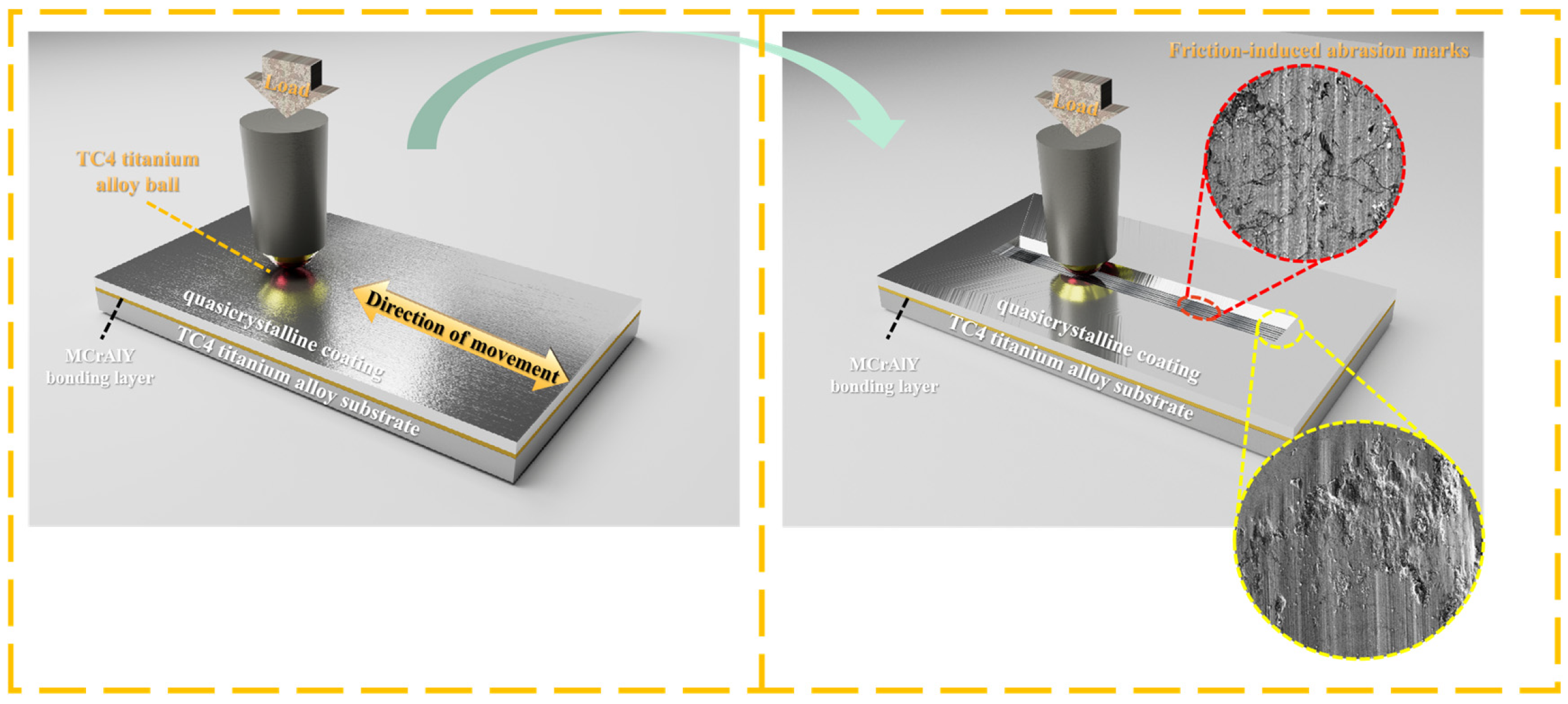
Dry sliding wear experiments were conducted by an MTF-5000 tribometer (Rtec, San Jose, CA, USA) equipped with a ball-on-plate reciprocating module. The plate was the quasicrystalline coating with a geometry of 20 mm × 30 mm. Prior to testing, the surface of the Al-Cu-Fe quasicrystalline coating samples underwent the following pretreatment: sequential grinding with 400 #, 800 #, 1200 #, and 2000 # silicon carbide sandpapers to remove surface oxides, spattered particles, and inherent roughness generated during the spraying process. This was followed by polishing using a 1 μm diamond abrasive paste to achieve a surface roughness of Ra ≤ 0.2 μm, ensuring consistent contact conditions between the coating and the counter ball. The ball was made of TC4 titanium with a diameter of 9.525 mm. Figure 1 was the schematic of the wear test.
To isolate the effect of heat treatment, the tests were performed under a fixed set of conditions (listed in Table 3) to enable a direct comparison between samples with different heat-treated states. Each test was repeated three times, and the average value of these replicates was reported as the final result.

2.4. Analytical Characterization

The microstructure surface/cross-section morphology and elemental composition of the Al-Cu-Fe quasicrystalline coating were analyzed using a ZEISS Gemini SEM 460 scanning electron microscope equipped with an energy dispersive spectrometer. EDS data is used solely for qualitative analysis of elemental distribution trends and to assist in verifying XRD phase identification results. The final phase identification should be based on XRD analysis in conjunction with standard reference cards. The microhardness of the quasicrystalline coating was determined using a TIME6610AT (Beijing TIME High Technology Ltd., Beijing, China) fully automatic microhardness tester. A load of 200 g was applied in accordance with national standards.
To quantitatively evaluate the coating fracture toughness (KIC) and establish a direct correlation with its “tough/brittle” characterization, the Vickers indentation fracture (IF) method was employed to measure the fracture toughness, while nanoindentation was used to determine the elastic modulus (a critical parameter for calculating fracture toughness). The specific testing protocol is outlined as follows:
Indentation Crack Length Testing: The same TIME6610AT fully automatic microhardness tester used for microhardness testing was employed. A load of 300 gf was applied with a dwell time of 15 s. After indentation, the crack lengths (c, the half-length from the indentation center to the crack tip) generated at the four corners of the indentation were observed and measured using a ZEISS Gemini SEM 460 scanning electron microscope.
Elastic Modulus Testing: The elastic modulus of the Al-Cu-Fe quasicrystalline coating was determined using a Hysitron TI 950 nanoindentation (Hysitron, Minneapolis, MN, USA) tester based on the Oliver-Pharr method. Formula (1) for Fracture Toughness Calculation is as follows:
K IC   =   δ ( E H ) 1 / 2 P C 3 / 2
where P represents the applied load, E denotes Young’s modulus (elastic modulus), H signifies the microhardness, and δ is a constant primarily dependent on the geometry and size of the indenter (here, δ = 0.016) [17,18].
A 3D profilometer model VR-3200 was employed to measure the wear volume (depth, and volume) and two-dimensional morphology of coated specimens after friction and wear. The wear volume of the coating was calculated using Formula (2):
V = SL
where V represents the wear volume; S represents the average cross-sectional area; and L represents the wear scar length.
Calculate the wear rate of the coating using Formula (3):
W r   =   V P S
Wr denotes the wear rate; V represents the wear volume; P indicates the load; S signifies the sliding distance.
The phase composition and phase content were determined using a SmartLab X-ray diffractometer (Rigaku Corporation, Tokyo, Japan) (scanning speed 10°/min, range 10–90°, emission power 9 kW). The quasicrystalline content in this study was calculated using the ratio of the total intensity of quasicrystalline peaks to the total intensity of all peaks [19]. The specific method involves first performing background subtraction and phase calibration on the XRD spectrum, then summing the intensities of the quasicrystalline peaks and dividing this sum by the total intensity of all peaks in the XRD spectrum. The resulting value represents the quasicrystalline phase content in the measured material [20]. This method is a semi-quantitative estimation and has a certain degree of error.

3. Results and Analysis

3.1. Analysis of Heat Treatment-Induced Changes in Phase Composition and Microhardness

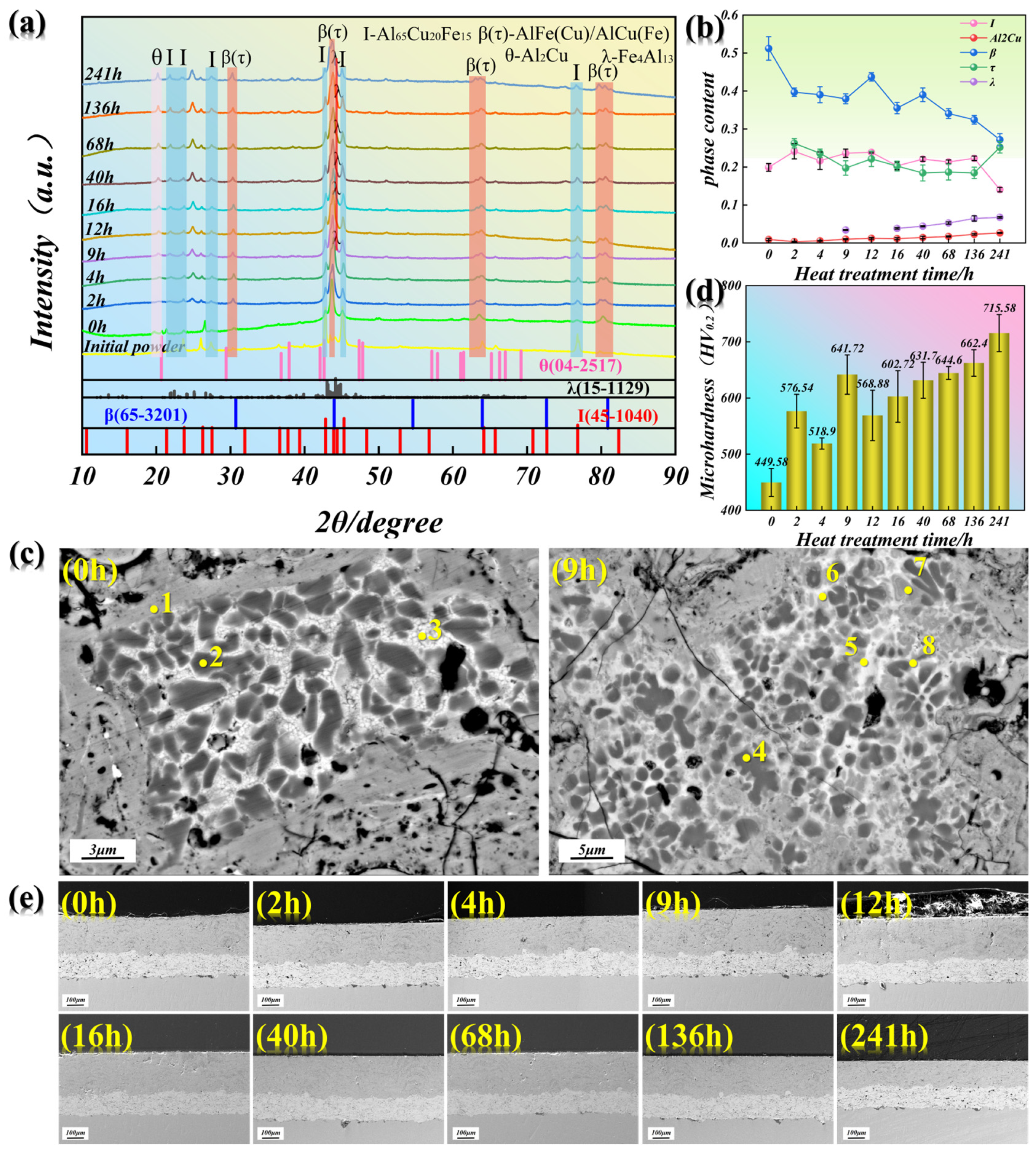
In Figure 2a, the XRD results for the quasicrystalline powder and the quasicrystalline coatings obtained with different heat treatment durations are shown. Figure 2b presents the phase content results for coatings with different heat treatment durations, calculated based on the XRD results. From the perspective of phase composition, both the raw powder and the as-sprayed coating (unheated) were composed of three phases: quasicrystalline phase I, non-quasicrystalline β-phase, and θ-phase. This indicates that no significant change in phase composition and content occurred during the thermal spraying process. For the heat-treated coatings, however, their phase composition underwent significant changes with the extension of heat treatment time. At a heat treatment time of 2 h, θ-phase emerged, and the number of phases in the quasicrystalline coating increased to four. When the heat treatment was further extended to 9 h, λ-phase appeared, bringing the total number of phases in the coating to five. With further extension of the heat treatment time (up to 241 h), the phase composition of the coating remained stable without further changes.
Regarding the phase content, among the initial three phases, the contents of the quasicrystalline I-phase and θ-Al2Cu phase remained unchanged or slightly increased with the extension of heating time, while the content of the β-phase significantly decreased. Therefore, the newly formed τ-phase and λ-phase may be related to the decomposition of the β-phase. During the heating process, thermal energy provided the driving force for phase transformations in the coating system, rendering the initially dominant metastable β-phase (a soft phase) unstable. The β-phase underwent solid solution decomposition, resulting in the formation of a more stable and harder τ-phase and a tougher λ-phase.
Figure 2c and Table 4 present the backscattered electron (BSE) morphology images and energy-dispersive spectroscopy (EDS) analysis results of the quasicrystalline coatings under different heat treatment states.
The EDS elemental atomic ratios at Point 1 are Al: 62.57%, Cu: 24.63%, and Fe: 12.80%. This ratio is consistent with the stoichiometry of the I-Al65Cu20Fe15 phase (Al:Cu:Fe ≈ 65:20:15). The ratios at Point 2 are Al: 68.02%, Cu: 16.57%, and Fe: 15.41%, aligning with the stoichiometry of the θ-Al2(Cu, Fe) phase (Al:(Cu + Fe) ≈ 2:1). At Point 3, the ratios are Al: 57.10%, Cu: 37.11%, and Fe: 5.78%, which matches the stoichiometry of the β-AlFe(Cu) phase (Al:(Cu + Fe) ≈ 1:1). The ratios at Point 4 are Al: 72.19%, Cu: 6.52%, and Fe: 21.29%, corresponding to the stoichiometry of the λ-Fe4Al13 phase (Al:Fe ≈ 13:4). Finally, at Point 5, the ratios are Al: 42.77%, Cu: 53.39%, and Fe: 3.84%, in agreement with the stoichiometry of the τ-AlCu(Fe) phase (Cu:(Al + Fe) ≈ 1:1). These EDS results further verify the phase identification obtained by XRD [21,22].
For the as-sprayed coating, the gray quasicrystalline I-phase served as the matrix phase of the coating, exhibiting a continuous distribution. In contrast, the gray–black θ-phase and white β-phase were present as a second phase with a eutectic-like structure, dispersedly distributed within the matrix phase. Within this eutectic-like structure, the β-phase acted as the matrix phase of the eutectic structure, while the θ-phase served as the strengthening phase (enveloped by the matrix phase), exhibiting an irregular polygonal shape with a grain size (major axis direction) of approximately 3 μm.
For the heat-treated coatings, the microstructure still exhibits the quasicrystalline I-phase as the matrix phase, with the eutectic-like structure acting as the strengthening phase and being dispersedly distributed on the matrix. Unlike the as-sprayed state, however, within the eutectic-like structure of the heat-treated coatings, while the θ-phase was refined, the matrix β-phase (of the eutectic-like structure) and its surroundings showed the appearance of a white τ-phase and a black λ-phase. Therefore, it can be inferred that the τ-phase and λ-phase were formed by the decomposition of the β-phase under 450 °C conditions.
Figure 2d presents the evolution of surface hardness of the Al-Cu-Fe quasicrystalline coating with varying heat treatment durations. The hardness of the various phases in the quasicrystalline coating decreases in the order of λ > I > τ > θ > β [21,23,24]. The as-sprayed coating exhibited the lowest hardness of 449.58 HV0.2. The hardness increased gradually with extending heat treatment time, reaching a maximum value of 715.58 HV0.2 at 241 h. Notably, distinct hardness increments occurred at 2 h and 9 h: the sharp rise at 2 h was likely attributed to the rapid transformation of the soft β-phase into τ-phase and quasicrystalline I-phase; at 9 h, the first precipitation of λ-phase (the hardest phase) induced a sudden surge in hardness. The hardness variation was evidently correlated with changes in the coating’s phase content: after heat treatment, the contents of Al2Cu and quasicrystalline I-phase remained unchanged or slightly increased, while β-phase content decreased, and τ-phase/λ-phase precipitated. However, τ-phase content varied minimally during heat treatment. Therefore, hardness likely exhibited a negative correlation with β-phase content and a positive correlation with λ-phase content.

3.2. Analysis of the Influence of Different Heat Treatment Durations on Coating Thickness, Homogeneity, and Macro-Defects

Low-magnification cross-sectional overview images (Figure 2e) of all heat-treated samples confirm the structural integrity and homogeneity of the Al-Cu-Fe quasicrystalline coatings. The total coating thickness (including the NiCrAlY bond coat) ranges from 105 to 190 μm, consistent with the target range (100–200 μm) specified in Section 2.1. No significant thickness fluctuations are observed within individual samples or across samples subjected to different heat treatment durations, indicating excellent deposition uniformity of the detonation spraying process.
Regarding macro-defects, all cross-sectional images reveal dense coating structures without noticeable transverse through-thickness cracks or interfacial delamination between the quasicrystalline coating, NiCrAlY bond coat, and TC4 substrate. Only minor isolated pores are present, which are inherent to the detonation spraying process. Even after prolonged heat treatment at 450 °C for 241 h (where sub-surface microcracks are observed in high-magnification views), no macro-defects (e.g., large-scale pores or penetrating cracks) are detected. This demonstrates that extended heat exposure does not degrade the coating’s macroscopic structure, providing a reliable foundation for subsequent tribological tests.

3.3. Analysis of the Fracture Toughness of Al-Cu-Fe Quasicrystalline Coatings

The fracture toughness and indentation crack length test results for Al-Cu-Fe quasicrystalline coatings and the bulk material are summarized in Table 5. The as-sprayed coating exhibited a fracture toughness of 1.37 MPa·m1/2. After heat treatment at 450 °C for varying durations, the fracture toughness of the coatings stabilized within the range of 1.4–1.55 MPa·m1/2, with no significant fluctuations. The indentation crack length of the untreated coating was 0.04 mm, while that of all heat-treated coatings was consistently 0.03 mm, indicating that heat treatment increased the crack propagation resistance of the coatings. In contrast, the fracture toughness of the Al-Cu-Fe quasicrystalline bulk material was only 1.2 MPa·m1/2, with an indentation crack length of 0.06 mm [25].
The results indicate that the fracture toughness of the Al-Cu-Fe quasicrystalline coating prepared by detonation spraying (1.4–1.55 MPa·m1/2) is slightly higher than that of the bulk quasicrystalline material (1.2 MPa·m1/2), with an increase of approximately 16.7–29.2%. However, it still falls within the lower limit range of toughness for brittle ceramics such as alumina, and no substantial breakthrough in toughness has been achieved. In addition, heat treatment does not alter its intrinsic property, and the material essentially remains brittle [26,27].
Future improvement directions: Enhance the comprehensive toughness through composite coating design (e.g., the toughened matrix of Al-Cu-Fe + Sn-based alloy [28]), optimization of spraying processes (reducing coating porosity and internal stress), regulation of quasicrystalline phase content (avoiding excessive brittleness), and other approaches.

3.4. Friction and Wear Test Results of Al-Cu-Fe Quasicrystalline Coatings

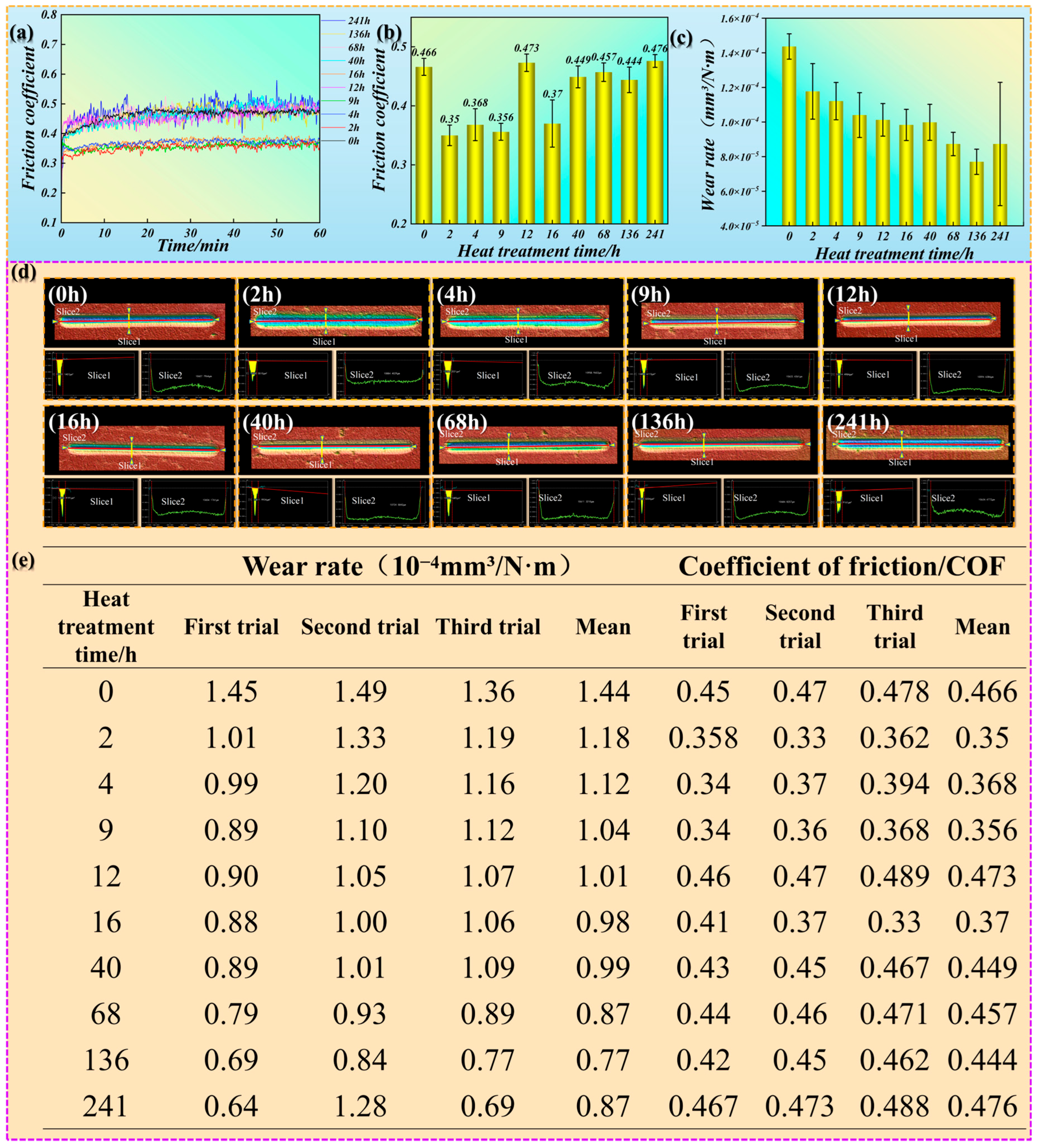
Figure 3a,b present the dynamic friction coefficient curves and summary of average friction coefficient results for samples subjected to different heat treatment durations, respectively. As indicated, changes in coating phase content induced by heat treatment time exert a pronounced influence on the coating’s friction coefficient. Specifically, for short heat treatment times (2–16 h, excluding 12 h), the friction coefficients of the coatings range from 0.35 to 0.37. In contrast, coatings heat-treated for 12 h and 40–241 h exhibit friction coefficients falling within 0.44–0.48. This is because the soft β-phase exerts a negative impact on the friction coefficient of the coating, whereas the quasicrystalline I-phase exerts a positive effect.
Figure 3c presents the wear rate curve of the coating. Figure 3d displays the three-dimensional wear scar morphology of the Al-Cu-Fe quasicrystalline coating. Figure 3e presents the friction coefficient and wear rate of the Al-Cu-Fe quasicrystalline coating from three repeated tests. It can be observed that the coating’s wear rate decreases gradually with increasing heat treatment time, reaching a minimum value at 136 h. By 241 h, the wear rate rebounds to the same level as that measured at 68 h. This is because the soft β-phase exerts a negative impact on the coating’s wear rate, whereas the quasicrystalline I-phase and λ-phase exert a positive effect on the wear rate.

3.5. Analysis of Friction and Wear Mechanisms in Al-Cu-Fe Quasicrystalline Coatings

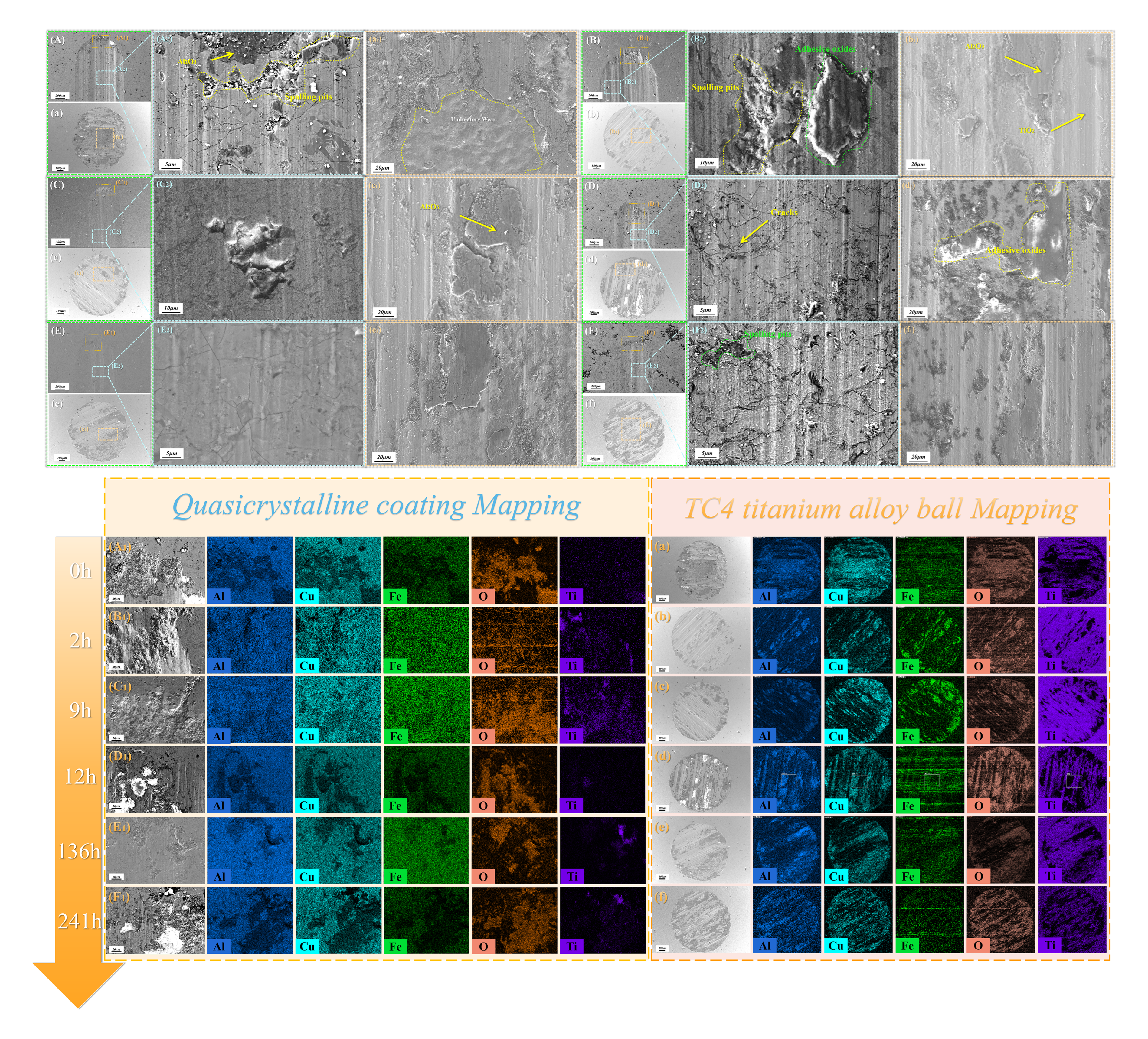
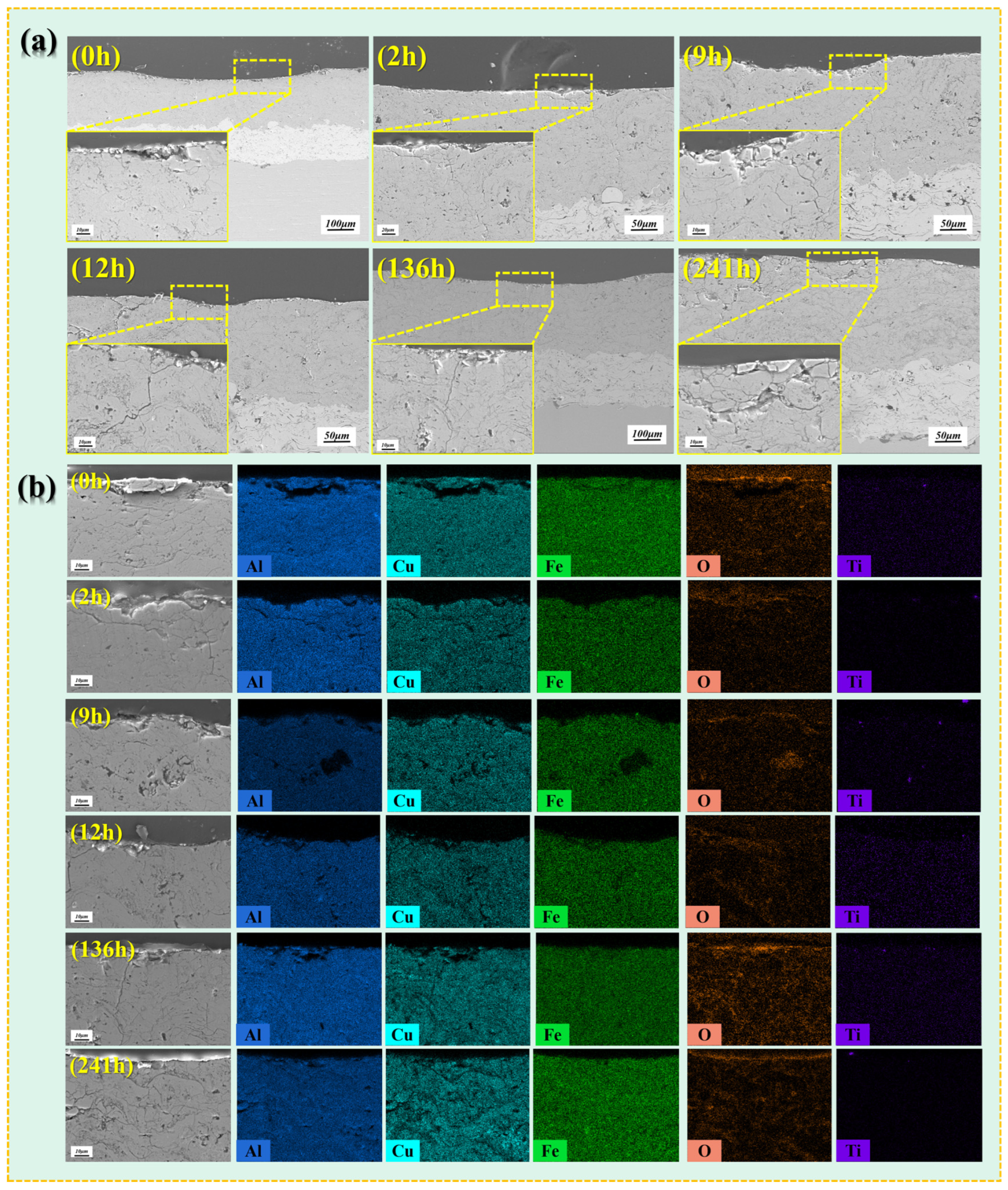
In Figure 4, the surface morphology of the Al-Cu-Fe quasicrystalline coating subjected to reciprocating wear is shown alongside the surface morphology and EDS elemental distribution of its counter-wearing titanium alloy balls. Due to the large number of samples, six representative specimens were selected for analysis.

3.5.1. As-Sprayed State (0 h)

It can be observed that the surface of the as-sprayed coating (Figure 4(A2)) contains some oxides, spallation pits, and numerous microcracks. The occurrence of numerous microcracks may be attributed to the intrinsic brittleness of the as-sprayed coating (with a fracture toughness of only 1.37 MPa·m1/2). Under cyclic frictional stress, the material cannot release energy through plastic deformation, resulting in stress concentration and subsequent crack initiation. Secondly, the β phase accounts for 51.21% without heat treatment, forming a continuous matrix composed of the soft β phase. However, the soft nature of the β phase only exacerbates local plastic deformation and is not the dominant factor for microcrack initiation. Under cyclic frictional loading, the overall brittleness of the coating leads to insufficient load-bearing capacity, causing cracks to propagate along phase boundaries or defect regions. As shown in Figure 5a, when cracks extend to the surface, local spallation occurs (forming spallation pits). Furthermore, according to the EDS elemental mapping in Figure 5b, oxidative wear first takes place on the wear scar, forming an oxide film on the surface. The oxide film fractures and undergoes local spallation due to its brittleness. and under cyclic stress, microcracks generate in the coating bulk. Crack propagation induces material spallation and the formation of hard wear debris. This is a typical spallation caused by the combination of abrasive wear and crack intersection [13,29], resulting in the highest wear rate of the coating. The surface of the counterbody titanium alloy ball (Figure 4a) exhibits adhered oxides and extensive wavy wear features, namely numerous grooves and plastic flow traces. The abrasive particles are mainly derived from the spalled debris of the quasicrystalline coating. These debris are pressed into the relatively soft TC4 titanium alloy surface during friction and scratch grooves like a plow during sliding, which is a typical abrasive wear behavior. Meanwhile, the plastic deformation and fatigue response of the material lead to plastic accumulation under periodic loading. Under the fluctuation of normal force, repeated plastic deformation occurs on the material surface, resulting in strain hardening and microcrack initiation. Eventually, wavy dimples are formed due to peeling, which is essentially spallation caused by crack intersection in brittle materials [30].

3.5.2. The 2 h Heat Treatment

The surface of the coating heat-treated for 2 h (Figure 4(B2)) exhibits irregular, flake-like depressions forming distinct height differences with the surrounding non-delaminated areas. The edges of the spalling pits are typically well defined, while their bottoms are rough and uneven. Fine, black, linear microcracks are commonly observed along the edges or within the pits, as well as on the flat substrate areas. On the right side of the image, marked by the green dashed box, irregularly shaped, blocky or flaky adherent oxides are visible on the substrate surface. Their surface texture distinctly differs from the underlying substrate material, appearing more porous. Phase composition evolution at 2 h: quasicrystalline phase (24.14%) + τ phase (26.25%) + β phase (39.69%). The content of the quasicrystalline phase increases, while the τ phase significantly rises, becoming a crucial hard phase in the coating. Concurrently, a large amount of τ phase precipitates, jointly forming the coating matrix with the remaining β phase. This creates an ideal composite structure where a “high-content, high-hardness quasicrystalline phase” is dispersed within a “toughened matrix reinforced by the τ phase.” This “hard-soft hybrid” structure substantially enhances hardness while also improving the matrix toughness. Frictional heat induces surface oxidation, generating oxides. The high hardness of the quasicrystalline phase enables the coating to effectively resist plastic deformation and plowing during friction, reducing direct metal-to-metal contact. As shown in the EDS element distribution map of the cross-section in Figure 5b, this creates conditions for the formation of oxide film on the surface during wear. These oxide particles adhere to the coating and mating surface under pressure [20,31], forming “adhered oxides” and provide conditions for oxidative wear and abrasive wear. Although the quasicrystalline phase strengthens the coating, the presence of substantial τ phase increases its overall brittleness. Under cyclic loading, cracks readily initiate and propagate within the hard, brittle τ phase or at its interfaces. When cracks reach the surface, they cause localized material detachment, forming spalling pits [30]. This indicates that the τ phase acts as a double-edged sword. On the surface of the counter-friction titanium alloy balls (Figure 4b), pronounced parallel grooves aligned with the friction direction were observed. The EDS element distribution map in Figure 4 reveals that the surface oxides of the titanium alloy ball are predominantly TiO2. This demonstrates that as coating hardness increases, hard quasicrystalline phase fragments and oxide abrasive particles shed from the coating plow into the softer TC4 surface, causing both abrasive wear and oxidative wear.

3.5.3. The 9 h Heat Treatment

The surface of the coating heat-treated for 9 h (Figure 4(C2)) exhibits irregular protrusions and tear-like structures in the central region. At this stage, the quasicrystalline I phase content reaches 23.64%, a relatively high level, while the τ and β phases decrease, and the λ phase is initially formed at 3.42%. The 23.64% quasicrystalline phase content represents an optimal level. The λ phase possesses extremely high hardness, primarily resisting plastic deformation. It is the main contributor to the coating’s high hardness, significantly increasing it to 641.72 HV. Its strong bonding with the substrate is crucial for load-bearing capacity. The quasicrystalline I phase and λ phase significantly strengthen the matrix. This composite structure of “hard quasicrystalline phase + tough intermetallic compound matrix” delivers outstanding comprehensive mechanical properties, resisting wear while effectively inhibiting crack initiation and propagation. The high hardness of the quasicrystalline phase fundamentally enables the coating to resist this plowing action. The protrusions and tear structures indicate adhesive wear. This demonstrates that under localized high pressure, material from the TC4 mating surface was torn off and transferred to the coating surface. This reflects strong interfacial interactions during friction, yet the coating matrix possesses sufficient strength to withstand this without causing large-scale spalling. The EDS elemental distribution maps in cross-sections (Figure 5a,b) reveal the presence of an oxide layer. This oxide film isolates the metal contact areas, transforming friction into oxide-to-oxide interaction and significantly reducing the wear rate. Cross-sectional morphology reveals a dense, intact coating structure with good adhesion to the substrate, showing no large-scale spalling or deep cracks. Only minor spalling pits are observed on the surface layer. This indirectly confirms that after 9 h of heat treatment, the coating contains a higher proportion of quasicrystalline phases and exhibits a high-strength λ phase, endowing it with excellent bonding strength and toughness that effectively suppresses spalling. At this stage, the wear mechanism is dominated by mild abrasive wear and oxidative wear [32]. The elemental distribution map of the counter-abrasive titanium alloy ball (Figure 4c) reveals that material from the aluminum–copper–iron quasicrystalline coating transferred and adhered to the relatively softer TC4 titanium alloy surface, causing oxidative wear. Detached coating particles and transferred layer fragments acted as abrasive grains, intensely plowing the TC4 surface (three-body abrasive wear) and producing pronounced plow marks.

3.5.4. The 12 h Heat Treatment

Numerous black, linear cracks initiate on the surface of the coating at 12 h of heat treatment (Figure 4(D2)). Irregular, flaky depressions, namely spallation pits, form at the ends or intersections of these cracks. Although the β phase content increases from 37.95% at 9 h to 43.72% at 12 h, the decrease in matrix stability is not solely caused by the sharp rise in the β phase content, but rather a combined result of the coating’s intrinsic brittleness and phase composition imbalance. On the one hand, the increased β phase content reduces the overall hardness of the matrix (decreasing from 641.72 HV0.2 at 9 h to a lower level at 12 h), impairing its load-bearing capacity. On the other hand, the coating lacks sufficient toughening phases (e.g., the λ phase has not precipitated stably at this stage) to compensate for its intrinsic brittleness, leading to a significant reduction in crack inhibition ability. Therefore, the variation in β phase content is a secondary factor affecting matrix properties, rather than the sole cause of intensified cracking and spallation. Cross-sectional observations reveal the presence of through-thickness cracks and large-area spallation pits inside the coating, which further confirms the typical failure characteristics of brittle materials under cyclic loading, rather than deformation failure dominated merely by the soft β phase. In addition, cross-sectional EDS elemental mapping (Figure 5b) indicates the existence of an oxide layer. Meanwhile, massive spallation pits and large through-thickness cracks extending from the surface to the interior of the coating are observed in the cross-section. The oxide film exhibits poor adhesion to the coating, and cracks propagate rapidly and interconnect along the weak phase boundaries or through the brittle phases. Due to insufficient matrix strength, cracks cannot be effectively inhibited, eventually resulting in massive spalling of the coating and the formation of macroscopic spallation pits [30]. This is a combination of abrasive wear and spalling wear. A large number of adhered oxides begin to appear on the counterbody titanium alloy ball (Figure 4d). This phenomenon may be attributed to the significant reduction in the hardness of the coating after 12 h of heat treatment: when the local friction temperature exceeds 400 °C, the oxide debris spalled from the coating is pressure-welded (adhered) to the TC4 surface during friction. EDS elemental mapping confirms the presence of Al2O3 and CuO, indicating the occurrence of adhesive wear at this stage [32]. Subsequently, these adhered oxides in turn act as abrasive particles [31], exacerbating the plowing effect on the coating, generating grooves, and leading to abrasive wear.

3.5.5. The 136 h Heat Treatment

The surface of the coating heat-treated for 136 h (Figure 4(E2)) exhibited numerous black, linear, meandering cracks crisscrossing the material surface, forming a complex network structure. These cracks exhibited varying orientations, uneven widths, and branching phenomena, indicating crack propagation and interconnection in multiple directions. At this stage, the content of the soft β phase reached a low level, while the content of the hard λ phase, typically exhibiting good toughness, increased to 6.47%. The quasicrystalline I phase content was relatively high, endowing this structure with superior load-bearing capacity and crack resistance [21]. Furthermore, a large longitudinal crack is visible in the cross-section of the coating (Figure 5a). This crack did not originate at the surface but was initiated in the subsurface layer due to shear stresses induced by cyclic friction loads. After achieving ultra-high hardness (662.4 HV), the coating’s toughness typically decreases accordingly. Under repeated stress, cracks initiate at stress concentration points within the coating, such as micro-defects and phase boundaries, and propagate parallel to the surface (a typical characteristic of longitudinal cracks). These cracks are highly dangerous; when they reach a certain length or connect with other cracks, they cause large-scale, laminar spalling of the coating [30]—the primary form of ultimate failure. Currently, these cracks are confined to the subsurface layer without causing surface spalling, thus maintaining a low macroscopic wear rate. The EDS elemental distribution map in Figure 5b reveals a continuous, dense oxide film composed of Al2O3 and CuO formed on the outermost layer of the wear scar. This dense oxide film is one factor contributing to the low wear rate, indicating oxidative wear. The counter-wearing titanium alloy ball (Figure 4e) exhibits uneven but sparse oxide distribution on its surface, along with uniform, shallow parallel scratches primarily resulting from plowing by oxide wear debris. The coating’s surface integrity ensures fine wear particles, leading to minimal damage to the TC4 substrate—characterized as mild abrasive wear.

3.5.6. The 241 h Heat Treatment

The coating subjected to 241 h of heat treatment (Figure 4(F2)) exhibits irregular, concave spalling pits on its surface. Numerous black linear cracks, distributed in an interlaced pattern, are observable around the spalling pits and in other areas. Moreover, the cross-section in Figure 5a clearly reveals a very long, branched longitudinal primary crack present in the coating’s subsurface layer. Connected to this are secondary cracks distributed in a network or parallel pattern, propagating parallel to the surface within the subsurface layer. This is a typical spalling feature caused by crack intersection, having already entered an accelerated propagation stage. Under extremely high contact stresses, the abrupt reduction in quasicrystalline phase I content during prolonged heat treatment eliminates the self-lubricating effect of quasicrystals. This leads to the maximum friction coefficient, a surge in τ phase content, and increased hardness accompanied by reduced material toughness. This combination of “ultra-high hardness and low toughness” renders the coating highly susceptible to crack initiation and propagation under cyclic loading. The formation of crack networks signifies severe disruption of internal bonding within the coating. When these cracks propagate to interconnections or extend to the surface, they trigger large-scale, catastrophic flaking of the coating. This represents the core failure mechanism and potential risk at the 241 h state. As shown in the EDS element distribution map (Figure 5b), a protective oxide film still forms during friction, undergoing oxidative wear. However, with severe cracks already present in the subsurface layer, the protective role of this oxide film becomes secondary. The coating’s lifespan is no longer governed by the consumption rate of the oxide film but by the crack propagation rate. The abrupt drop in quasicrystalline phase content causes the loss of self-lubrication, leading to a surge in adhesive oxides adhering to the mating titanium alloy ball surface (Figure 4f). The coating’s extremely high hardness (715.58 HV) transforms it into an exceptionally hard grinding wheel, severely plowing the softer TC4 surface. Simultaneously, hard particles shed from the coating subsurface (even before large-scale delamination) exacerbate abrasive wear on the TC4, resulting in severe surface damage.

4. Discussion

The combined experimental results demonstrate that heat treatment (duration) significantly influences the microstructure (phase composition and content) and mechanical properties (hardness) of quasicrystalline coatings, thereby affecting their tribological behavior (COF, and wear rate) and wear mechanisms. This will be discussed in greater detail below.

4.1. Mechanism of Heat Treatment Duration on Mechanical Properties (Hardness)

As shown in Figure 2b,c, the Vickers hardness of the untreated coating reached a minimum of 449.58 Hv0.2. As the heat treatment time increased, the coating’s Vickers hardness also showed a significant increase. At 2 h, the coating hardness increased to 576.54 Hv0.2. Analysis suggests this may be due to the heat treatment causing the β phase in the coating to transform into τ and I phases, with a noticeable increase in the quasicrystalline I phase and τ phase. The higher hardness of the I phase and τ phase led to an overall increase in the hardness of the coating after 2 h of heat treatment. At the 4 h mark, the hardness decreases, as shown in Figure 2b, due to a reduction in the content of the harder quasicrystalline I-phase and τ-phase, while the content of the softer β-phase remains almost unchanged, leading to an overall decrease in the hard phases within the coating. At 9 h, the coating’s Vickers hardness sharply increased to 641.72 HV0.2. During this period, the λ-Fe4Al13 phase formed for the first time, exhibiting a maximum hardness of 800 HV. Although accompanied by a decrease in the τ phase, the increase in the quasicrystalline I phase and the formation of the λ-Fe4Al13 phase contributed to the coating’s hardness increase. At 12 h, the λ-Fe4Al13 phase disappeared, and the content of the lower-hardness β phase increased, causing the coating hardness to decrease. After 16 h, although the content of the quasicrystalline phase slightly decreased, the increasing content of the λ-Fe4Al13 phase led to a gradual increase in coating hardness. At 241 h, despite the lowest quasicrystalline phase content, the λ-Fe4Al13 phase content gradually increased to 6.75%, and the τ phase also significantly increased, resulting in the highest hardness of the quasicrystalline coating reaching 715.58 Hv0.2 at 241 h. The results indicate that eliminating the β phase in quasicrystalline coatings is beneficial for improving coating hardness. The increase in microhardness of the quasicrystalline coating is primarily attributed to the precipitation of the high-hardness λ-Fe4Al13 phase. The increase in coating hardness is accompanied by a sacrifice in fracture toughness: after 241 h of heat treatment, the coating hardness reached a maximum value of 715.58 HV0.2, while its fracture toughness was 1.4 MPa·m1/2, slightly lower than the 1.55 MPa·m1/2 observed for the 136 h heat-treated coating.

4.2. Mechanism of Heat Treatment Duration on Friction Coefficient and Wear

The wear test results reveal that the effects of heat treatment (duration) on the coefficient of friction and wear rate follow entirely opposite patterns. Specifically, as heat treatment time increases, and the coefficient of friction gradually rises, while the wear rate progressively decreases. This phenomenon is clearly related to the microstructural changes induced by heat treatment and the corresponding micro-wear mechanisms.
The low friction coefficient observed during shorter heat treatment times (2–16 h, excluding 12 h) stems from a low β-phase content below 40%. This results in a diminished influence of the β-soft phase on the quasicrystalline coating, coupled with minimal variation in quasicrystalline phase content and a relatively high overall content. Among the coatings with higher friction coefficients at 12 h and 40 h–241 h, the 12 h sample exhibits a distinct increase in friction coefficient compared to other time intervals. Analysis suggests this may result from the formation of 43.72% β phase in the quasicrystalline coating during 12 h heat treatment-significantly higher than surrounding time intervals. At the 12 h mark, the system may be in a “transition zone” where metastable phases transform into stable phases. In the initial stage of heat treatment, atoms inside the coating are in an active rearrangement process. The decomposition or transformation pathway of the quasicrystalline phase may preferentially pass through an intermediate state primarily composed of the β phase. When β phase content becomes excessively high, the proportion of “soft regions” in the coating increased significantly, leading to a decline in the overall load-bearing capacity. During friction, soft phases are prone to plastic flow (plowing deformation), which consumes more energy, inducing a pronounced plowing effect on the coating surface and increasing frictional resistance. At 40 h, 68 h, and 136 h, the β-phase content gradually decreased while the quasicrystalline phase content remained constant, reducing the friction coefficient. At this stage, the λ-phase content gradually increased but remained low enough to avoid significant fluctuations in the friction coefficient. By 241 h, the friction coefficient reached its maximum of 0.476. At this point, the β-phase content was at its lowest, while the τ-phase content surged dramatically to 25.19%. The quasicrystalline phase plummeted to 14.07%, while the λ phase peaked at 6.8%. Quasicrystals possess a long-range quasiperiodic translational order structure; their abrupt depletion caused the coating to lose its self-lubricating capability. Furthermore, the significant difference in thermal expansion coefficients between the λ phase and the substrate led to the accumulation of interfacial stress, inducing microcracks. These cracks served as oxygen diffusion pathways, promoting the formation of oxides. The porous oxides disrupt the continuity of the lubricating film, transforming the friction interface into direct metal contact with increased adhesive force contribution.
The as-sprayed coating exhibits the highest wear rate, which may be attributed to its low quasicrystalline phase content and intrinsic brittleness (with a fracture toughness of only 1.37 MPa·m1/2). These characteristics prevent stress dissipation through plastic deformation during friction, thereby facilitating microcrack initiation [25]. Specifically, the content of the quasicrystalline I phase is relatively low (19.91%), limiting its inhibitory effect on wear. Additionally, the β phase content is as high as 51.21%. As an intermetallic compound, the β phase has a lower hardness than the quasicrystalline phase; however, there is a significant difference in crystal structure between the two phases—the quasicrystalline phase has a quasiperiodic translational order, while the β phase is an ordered crystal—resulting in poor interfacial bonding strength. The excessively high β phase content forms numerous soft regions inside the coating; under frictional shear force, the soft β phase tends to undergo plastic flow, though this is not the dominant driving factor for wear. Collectively, these factors accelerate material spallation of the coating during long-term reciprocating friction, leading to an excessively high wear rate.
From 2 h to 136 h of heat treatment, the wear rate of the coating decreases linearly. This is because the content of the quasicrystalline I phase slightly increases or remains stable, and its lamellar structure provides a self-lubricating effect, which significantly inhibits adhesive wear. Additionally, the fracture toughness gradually increases, effectively suppressing crack initiation and spallation. Meanwhile, the β phase content decreases linearly and significantly, reducing the spallation risk caused by plastic deformation induced by the continuity of the soft phase. The λ phase (Fe4Al13) has higher hardness than the τ phase, and it bears the main load through its high-hardness characteristic [23].
The wear rate reaches the minimum at 136 h. At this point, the content of the quasicrystalline I phase maintains a relatively high level (22.29%), and the content of the λ phase reaches 6.47%. These two phases synergistically form a combination of “hard phase load-bearing + self-lubrication”. Meanwhile, the fracture toughness achieves its maximum value, and the β phase content (32.44%) is within a reasonable range—this not only does not affect the functional exertion of the hard phases but also avoids excessive brittleness.
However, the wear rate rebounds to the level of 68 h at 241 h. This is because the content of the quasicrystalline I phase drops sharply to 14.07% at this stage, leading to the collapse of the self-lubricating effect induced by the quasiperiodic translational order of the quasicrystalline phase. The decomposition of the quasicrystalline phase further enhances the adhesion tendency. Additionally, the τ phase surges (25.19%) while the λ phase reaches 6.75%; excessively high hardness results in excessive brittleness of the material. Under cyclic frictional loading, subsurface cracks initiate, which are prone to propagation and spallation during wear, thereby accelerating wear instead. This may be the primary reason for the rebound in wear rate. This phenomenon is consistent with the conclusion demonstrated by Naugle et al. [23] via nanoindentation tests that the trade-off between ultra-high hardness and low toughness is an inherent characteristic of the Al-Cu-Fe quasicrystalline system. Excessive pursuit of hardness will lead to an increase in the crack propagation rate, which also explains the core mechanism underlying the rebound in wear rate of the coating treated for 241 h in this study.
This indicates that after 136 h of heat treatment, the coating achieved an optimal balance: the content of the quasicrystalline I phase is relatively high, while the contents of both the β and τ phases are low. The λ phase forms hard regions, effectively isolating the soft phase. Moreover, the fracture toughness reaches its maximum at this stage, contributing to the minimum wear rate and excellent wear resistance of the coating.
It can be observed from Figure 2d and Figure 3c that a negative correlation emerged between the Vickers hardness of the quasicrystalline coating and its wear rate. Under dry friction conditions, the high inherent hardness of the quasicrystalline coating is the primary reason for its excellent wear resistance [14].
As shown in Figure 4 and Figure 5, the wear mechanism of the coating underwent a systematic evolution with increasing heat treatment time. This evolution was closely related to changes in the content of the quasicrystalline I phase, though not a simple linear relationship.
First of all, in the as-sprayed (0 h) coating and the coating subjected to 12 h of heat treatment, although the contents of the quasicrystalline I phase are 19.91% and 23.88%, respectively, the intrinsic brittleness of the coatings (with low fracture toughness) prevents stress from dissipating through plastic deformation during friction, thus facilitating crack initiation. Both coatings exhibit a wear mechanism dominated by spallation. This phenomenon indicates that merely a high content of the quasicrystalline I phase is not the sole factor determining the wear resistance of the coating; the fracture toughness of the coating itself is also an important determining factor. When the coating matrix is dominated by the soft β phase with high content (0 h: 51.21%; 12 h: 43.72%), the quasicrystalline I phase cannot be effectively supported. Under frictional shear stress, the soft phase tends to undergo plastic flow (plowing deformation), causing it to spall off together with the surrounding matrix and thus aggravating material loss instead. At this point, the toughening effect of the quasicrystalline I phase is masked by the weakened matrix.
The microstructure and mechanical properties of the 2 h-heat-treated coating undergo significant transformation. Although the quasicrystalline I phase content increases, the core characteristic lies in the abrupt precipitation of the τ phase (reaching 26.25% content). At this point, the coating exhibits a relatively low fracture toughness of 1.4 MPa·m1/2. Although a significant increase in hardness has been achieved, the coating demonstrates higher brittleness. This indicates that the τ phase acts as a “double-edged sword”.
The microstructure of the coating heat-treated for 9 h shows significant optimization. The β phase content decreases to ~38%, while a substantial amount of strengthening λ phase precipitates. At this stage, the quasicrystalline phase content stabilizes at an optimal level of ~23%. This composite structure-featuring a “hard quasicrystalline phase + tough intermetallic compound matrix” significantly elevated coating hardness. The wear mechanism shifted from destructive spalling to a milder form dominated by oxidation wear and abrasive wear. A continuous protective oxide film formed on the coating surface, effectively reducing the wear rate.
However, when the heat treatment time was extended to 136 h and 241 h, the coating hardness reached its peak (662.4 HV, 715.58 HV), while the quasicrystalline phase I content was 22.29% at 136 h but significantly decreased to 14.07% at 241 h. Notably, during this ultra-high hardness stage, the wear mechanism of the coating exhibited new characteristics. As shown in Figure 4(F2), a densely distributed network of microcracks appeared on the worn surface. More importantly, cross-sectional views at 136 h and 241 h in Figure 5a revealed longitudinal macrocracks parallel to the surface in the subsurface layer. This indicates that the dominant wear mechanism shifted from surface damage to the propagation of fatigue cracks in the subsurface layer. Despite higher Quasicrystalline Phase I content at 136 h, the coating exhibits heightened sensitivity to crack initiation and propagation under cyclic loading within the context of overall ultra-high hardness and potentially diminished toughness. Particularly at the 241 h state, the sharp reduction in Quasicrystalline Phase I content may further degrade fracture toughness, facilitating crack propagation. This indicates that pursuing excessively high overall hardness at the expense of toughness (potentially accompanied by an abnormal reduction in Quasicrystalline Phase I) predisposes the coating to a latent, more hazardous internal failure mode.

4.3. Wear Mechanism Diagram

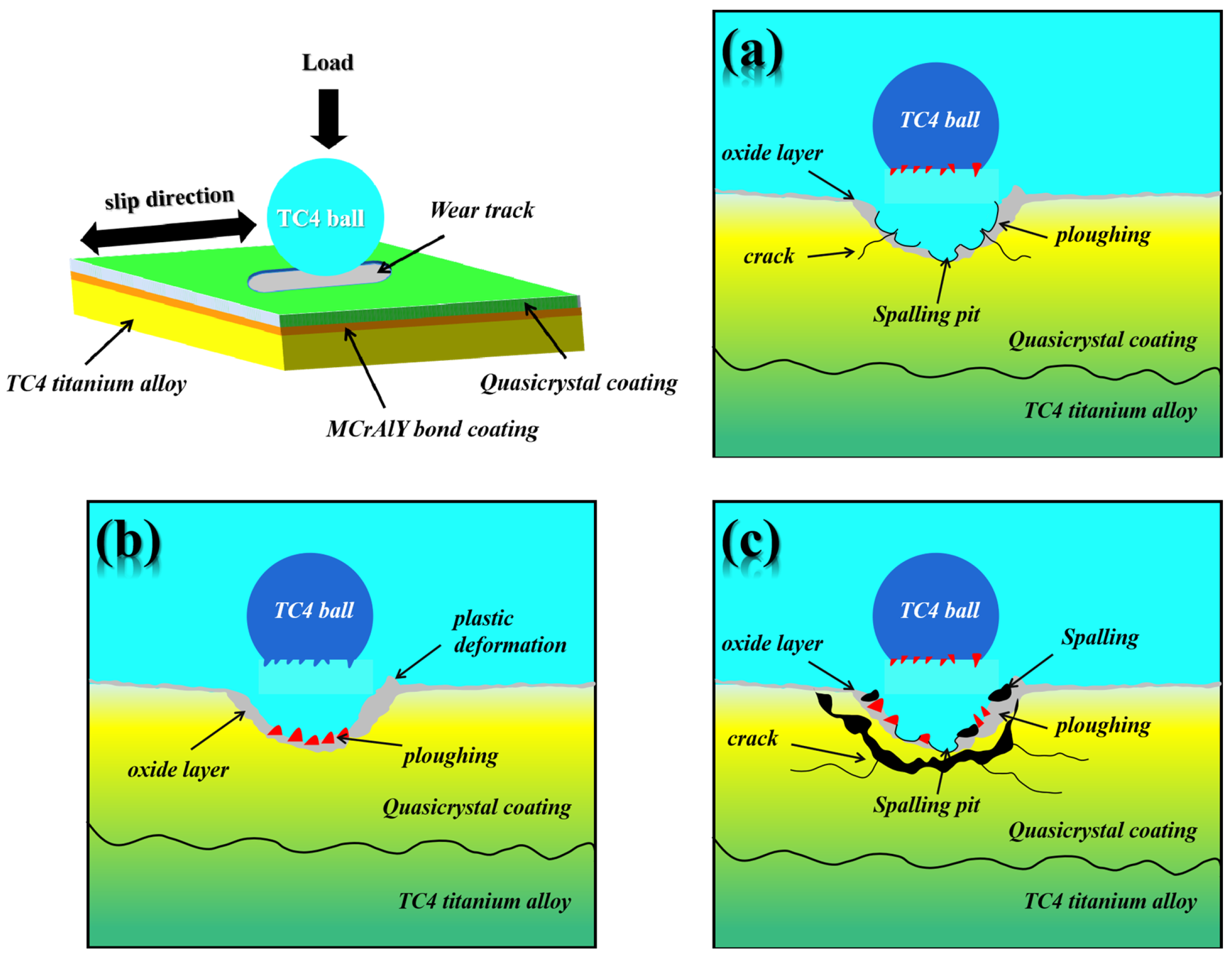
Based on the friction and wear test results from this study, combined with classical wear theory models (Figure 6), the evolution of wear mechanisms in aluminum–copper–iron quasicrystalline coatings under different heat treatment durations can be systematically elucidated. This model clearly illustrates the fundamental elements of the friction system: under applied load, the TC4 counter-ball moves along the sliding direction on the coating surface. Its wear behavior essentially represents a dynamic response process of the coating’s surface layer and subsurface layer under the combined effects of contact stress, shear stress, and thermal stress. The study reveals that the heat treatment process dominates the mechanism shift in this response process by altering the coating’s microstructure.
1. Initial and failure states (0 h and 12 h): spalling wear dominated by brittle fracture, abrasive wear, and mild oxidative wear
For the as-sprayed coating and the coating treated for 12 h, their microstructures contain a relatively high content of the soft β phase (51.21% and 43.72%, respectively), leading to insufficient matrix strength, low fracture toughness, and high brittleness of the coatings. As illustrated in the schematic diagram of Figure 6a, under cyclic frictional stress, the material cannot dissipate energy through plastic deformation, which causes stress concentration and induces crack initiation. This ultimately results in the massive material spallation as indicated in Figure 6a. Therefore, the dominant wear mechanism at this stage is spallation dominated by brittle fracture.
2. Optimizing transition states (2 h and 9 h): oxidation wear and abrasive wear mechanisms
When heat treatment promotes the precipitation of the τ phase (26.25% at 2 h) and further forms a toughened matrix composed of the τ and λ phases (at 9 h), the wear mechanism undergoes a significant improvement. At this stage, a continuous and dense oxide film can form on the coating surface; the wear mechanism consists of oxidative wear, dominated by abrasive wear. As shown in Figure 6b, the continuous oxide layer on the surface renders the wear process mild, resulting in a significant enhancement of wear resistance.
3. Surface protection and subsurface latent hazards (136 h): mechanisms of oxidative wear and mild abrasive wear
As shown in Figure 6b, the coating surface is covered by a complete, dense oxide layer, exhibiting ideal oxide wear. However, the key feature of the cross-section is the appearance of longitudinal cracks parallel to the surface, indicating that the damage center of gravity has shifted from the surface to the subsurface layer. At this stage, the coating exhibits high hardness (662.4 HV) and a low β-phase content (32.44%), alongside relatively high proportions of quasicrystalline I-phase and λ-phase. While the surface oxide film provides excellent protection, the extremely high hardness reduces the coating’s toughness. Under cyclic shear stress, cracks tend to initiate at subsurface stress concentration points and propagate transversely. Although the wear rate is low at this stage, there is an underlying risk of spalling due to crack propagation.
4. Subsurface crack network formation and catastrophic failure (241 h): mechanisms of oxidative wear and severe spalling wear dominated by brittle fracture
For coatings heat-treated at 241 h, hardness reaches its peak (>660 HV), β-phase content further decreases, and the quasicrystalline I-phase abruptly declines, potentially reducing coating toughness. The primary wear zone shifts from the surface to the subsurface layer. As illustrated in the model of Figure 6c, under extremely high contact stresses, cracks no longer originate solely at the surface. Instead, they initiate within the subsurface layer, where shear stresses are maximal, and propagate parallel to the surface, forming extensive longitudinal crack networks. Although surface oxidation wear persists, the propagation of subsurface cracks becomes the dominant mechanism governing the coating’s ultimate failure, such as flaking.
Heat treatment regulates the phase composition, thereby driving the evolution of the wear mechanism: from spalling wear and abrasive wear induced by brittle fracture in the initial stage, through optimized mild abrasive wear, to severe spalling wear caused by subsurface cracks as the dominant mechanism eventually. The 136 h state represents the peak performance, achieving the optimal balance between surface protection and damage control. In contrast, the 241 h state exhibits insufficient toughness due to excessive hardness pursuit, making subsurface spalling the bottleneck constraining service reliability. This study clarifies the importance of synergistic optimization of “hardness and toughness,” providing key theoretical support for the design of quasicrystalline coatings [6].
In summary, there exists an optimal range for the content of the quasicrystalline I phase in the Al-Cu-Fe coating (approximately 21–23% in this study). When it is rationally combined with a toughened matrix (strengthened by the τ and λ phases with the β phase content controlled below ~40%), the quasicrystalline I phase can exert its positive effects optimally, guiding the coating into a wear regime dominated by mild abrasive wear. Whereas when the matrix is excessively soft (with a high β phase content) or the coating overall exhibits extremely high brittleness (ultra-high hardness coupled with an excessively low quasicrystalline I phase content), the beneficial effects of the quasicrystalline I phase cannot be realized. In such cases, the coating shows low fracture toughness, and even suffers from aggravated brittle spallation or subsurface fatigue failure. Therefore, the key to optimizing the comprehensive performance of the coating via heat treatment lies in achieving an optimal balance between the quasicrystalline I phase content and matrix toughness, rather than merely pursuing the maximization of the quasicrystalline phase content or the extremization of hardness [23].

5. Conclusions

The influence mechanism of heat treatment on the tribological behavior of Al-Cu-Fe quasicrystalline coatings was systematically investigated via reciprocating sliding wear tests coupled with microstructural analysis. The coating’s friction coefficient and wear rate exhibited opposing trends with extended heat treatment duration: the former first decreased and then increased, while the latter showed an approximately monotonic decrease. Consequently, determining the optimal heat treatment parameters requires a balanced consideration of both factors. Heat treatment significantly alters the tribological behavior of the coatings by modifying their microstructure, which in turn changes the dominant wear mechanism. Specifically, as the heat treatment time increased, the phase composition of the coating evolved from the as-sprayed three-phase state to a five-phase state. Correspondingly, the primary wear mechanism transitioned from abrasive wear to oxidative wear. At 136 h of heat treatment, the wear rate reaches the lowest value, indicating the achievement of optimal wear resistance. At 2 h of heat treatment, the coefficient of friction (COF) is the lowest, demonstrating the best anti-friction performance. When the content of quasicrystalline phase I is 21–23%, regulating via heat treatment to enable its synergistic effect with strengthening phases (such as τ phase and λ phase) while effectively suppressing the content of the soft β phase is the key to obtaining quasicrystalline coatings with optimal strength–toughness matching and excellent wear resistance. Therefore, the tribological properties of quasicrystalline coatings can be effectively tailored through heat treatment. It is recommended to further develop numerical simulation methods for predicting coating service behavior in the future. By establishing finite element models that incorporate microstructural features (e.g., phase distribution, defects) of coatings, their stress distribution, crack propagation paths, and failure processes under complex loads and thermal environments can be simulated. Integrating machine learning methods to train on extensive experimental data aims to achieve accurate prediction of coating service life, ultimately enabling a transition from “time-based maintenance” to condition-based maintenance.

Author Contributions

T.X.: Conceptualization, formal analysis, methodology, software, writing—original draft; S.G.: investigation, supervision, validation, writing—review and editing; B.Z.: resources, validation, investigation; Y.F.: conceptualization, methodology, resources; D.D.: project administration, supervision, writing—review and editing. All authors have read and agreed to the published version of the manuscript.

Funding

This research was funded by the joint research project of China and Ukraine under the National Key Research and Development Program (KZ69230575).

Data Availability Statement

The original contributions presented in this study are included in the article. Further inquiries can be directed to the corresponding author.

Conflicts of Interest

Author Yongchao Fang was employed by the company AECC Beijing Institute of Aeronautical Materials. The remaining authors declare that the research was conducted in the absence of any commercial or financial relationships that could be construed as a potential conflict of interest.

References

  1. Shaitura, D.S.; Enaleeva, A.A. Fabrication of quasicrystalline coatings: A review. Crystallogr. Rep. 2007, 52, 945–952. [Google Scholar] [CrossRef]
  2. Korsunsky, A.M.; Salimon, A.I.; Pape, I.; Polyakov, A.M.; Fitch, A.N. The thermal expansion coefficient of mechanically alloyed Al-Cu-Fe quasicrystalline powders. Scr. Mater. 2000, 44, 217–222. [Google Scholar] [CrossRef]
  3. Li, X.; Deng, H.; Chi, Z.; Wang, P.; Sun, Z. Research on Material and Structure Characteristics of Quasicrystal Material. Equip. Manuf. Technol. 2009, 32–34. [Google Scholar]
  4. Wu, T.; Liu, Y.; Fan, Z. Research and application of quasicrystalline materials. China Sci. Technol. Inf. 2010, 37–39. [Google Scholar] [CrossRef]
  5. Cai, F.; Zhou, C.; Gong, S.; Xu, H. Effects of spraying powder composition and partide size on microstruduresof Al-Cu-Fe quasicrystalline coatings. J. Beijing Univ. Aeronaut. Astronaut. 2005, 31, 908–912. [Google Scholar]
  6. Huttunen-Saarivirta, E. Microstructure, fabrication and properties of quasicrystalline Al–Cu–Fe alloys: A review. J. Alloys Compd. 2004, 363, 154–178. [Google Scholar]
  7. Ding, L.F.; Su, G.C. Present Status of Research and Prospect Forecast of Quasicrystal Materials. Mod. Cast Iron 2007, 2, 65–67. [Google Scholar]
  8. Li, Z.; Xu, Z.; Li, X. Progress in Research on Application of Quasicrystalline Materials. Mater. Rep. 2002, 16, 9–11. [Google Scholar]
  9. Zhong, J.; Chen, Y.; Teng, L.; Shao, X.; Han, B.; Yan, F. State-of-the-art and Prospects of Quasicrystalline Coatings and Thin Films. Surf. Technol. 2020, 49, 19–25. [Google Scholar]
  10. Deng, H.Q.; Zhao, L.H.; Huang, W.Q. The Deposition Methods, Properties and Applications of Quasicrystalline Films and Coatings. J. Funct. Mater. 2001, 32, 115–117. [Google Scholar]
  11. Kurbanbekov, S.; Gaipov, T.; Saidakhmetov, P.; Tazhibayev, A.; Ramankulov, S.; Bekbayev, S.; Abdimutalip, A.; Baltabayeva, D. Microstructure, Phase Components, and Tribological Properties of Al65Cu20Fe15 Quasicrystal Coatings Deposited by HVOF. Lubricants 2025, 13, 297. [Google Scholar] [CrossRef]
  12. Fu, Y.; Zhou, F.; Gao, Y.; Yang, D.; Li, N. Surface Non-Sticking and Wear-Resisting Properties of High-Velocity Oxy-Fuel Sprayed Al-Cu-Cr Quasicrystalline Coatings. Rare Met. Mater. Eng. 2009, 38, 635–639. [Google Scholar]
  13. Wolf, W.; Koga, G.Y.; Schulz, R.; Savoie, S.; Kiminami, C.S.; Bolfarini, C.; Botta, W.J. Wear and Corrosion Performance of Al-Cu-Fe-(Cr) Quasicrystalline Coatings Produced by HVOF. J. Therm. Spray Technol. 2020, 29, 1195–1207. [Google Scholar] [CrossRef]
  14. Lepeshev, A.A.; Rozhkova, E.A.; Karpov, I.V.; Ushakov, A.V.; Fedorov, L.Y.; Dorozhkina, E.A.; Karpova, O.N. Microstructures and Tribological Properties of Al-Cu-Fe quasicrystalline plasma sprayed coatings. IOP Conf. Ser. Mater. Sci. Eng. 2016, 155, 12014. [Google Scholar] [CrossRef]
  15. Zhou, C.; Cai, F.; Kong, J.; Gong, S.; Xu, H. A study on the tribological properties of low-pressure plasma-sprayed Al–Cu–Fe–Cr quasicrystalline coating on titanium alloy. Surf. Coat. Technol. 2004, 187, 225–229. [Google Scholar] [CrossRef]
  16. Wang, Z.; Zhang, S.; Xing, Q.; Yu, R.; Gong, X.; Xiao, F.; Wang, H. Study on the Tribological Properties of Explosively Sprayed AlCuFeSc Quasicrystalline Coatings. Surf. Technol. 2023, 52, 197–206. [Google Scholar] [CrossRef]
  17. Wan, R.-G.; Luo, J.-M.; Zhou, X.-Y. A simple method for evaluating the fracture toughness of Al-Cu-Fe-B quasicrystal. J. Nanchang Hangkong Univ. 2002, 16, 75–77. [Google Scholar]
  18. Zhou, X.; Luo, J.; Wan, R. Evaluation of Fracture Toughness of Al-Cu-Fe-B Quasicrystal. Jiangxi Sci. 2001, 134–137. [Google Scholar] [CrossRef]
  19. Li, W.; Zhang, Y.; Yu, A.; Jin, G.; Wang, H. Influence Mechanism of the Quasicrystalline Phase Content on the Corrosion Resistance of AlCuFe-based Coatings. China Surf. Eng. 2023, 36, 135–144. [Google Scholar]
  20. Zhang, S.; Xing, Q.; Li, Z.; Wang, Z.; Zhao, H.; Wang, H. Study on tribological properties of explosion sprayed AlCuFeSc quasicrystal coating. Mater. Sci. Technol. 2024, 32, 25–33. [Google Scholar] [CrossRef]
  21. Li, X. A Study of Process in Al63Cu25Fe12 Quasicrystalline Combined with Mg/AI and Their Alloys. Ph.D. Thesis, Shanghai Jiao Tong University, Shanghai, China, 2007. [Google Scholar]
  22. Shen, F. Preparation and Analysis of the Thermophysical Properties of Al-Cu-Fe Ternary Quasicrystals. Master’s Thesis, Xi’an Technological University, Xi’an, China, 2022. [Google Scholar]
  23. Naugle, D.; Liang, H.; Lee, K.; Liang, H. Effects of Microstructure of Quasicrystal Alloys on Their Mechanical and Tribological Performance. J. Tribol. 2018, 140, 051605. [Google Scholar] [CrossRef]
  24. Zhang, L.; Dong, C. Current Status of Research on Properties and Applications of Quasicrystals. Mater. Rep. 2000, 14, 22–24. [Google Scholar]
  25. Srivastava, V.C.; Uhlenwinkel, V.; Schulz, A.; Zoch, H.W.; Mukhopadhyay, N.K.; Chowdhury, S.G. Synthesis of single phase i -AlCuFe bulk quasicrystal by spray forming. Int. J. Struct. Phys. Chem. Asp. Cryst. Mater. 2008, 223, 711–715. [Google Scholar] [CrossRef]
  26. Yokoyama, Y.; Inoue, A.; Masumoto, T. Mechanical Properties, Fracture Mode and Deformation Behavior of Al70Pd20Mn10 Single-Quasicrystal. Mater. Trans. JIM 1993, 34, 135–145. [Google Scholar] [CrossRef]
  27. Milman, Y.V.; Iefimov, M.O.; Golubenko, A.A.; Changliang, W.; Zhang, L.; Chonggao, Z.; Haoliang, T. Study of the Mechanical Behaviour of Al–Cu–Fe Quasicrystalline Coatings Across a Broad Range of Temperatures. Powder Metall. Met. Ceram. 2023, 61, 605–612. [Google Scholar] [CrossRef]
  28. Shao, T.; Cao, X.; Fleury, E.; Kim, D.H.; Hua, M.; Se, D. Tribological behavior of plasma sprayed Al–Cu–Fe+Sn quasicrystalline composite coatings. J. Non-Cryst. Solids 2003, 334, 466–470. [Google Scholar] [CrossRef]
  29. Fu, Y. Study on Particle Flattening, Microstructures and Properties of HVOF and Low Power Plasma Sprayed Al-Cu-Cr Quasicrystalline Coatings. Ph.D. Thesis, Dalian Maritime University, Dalian, China, 2010. [Google Scholar]
  30. Guo, X.; Chen, J.; Yu, H.; Liao, H.; Coddet, C. A study on the microstructure and tribological behavior of cold-sprayed metal matrix composites reinforced by particulate quasicrystal. Surf. Coat. Technol. 2015, 268, 94–98. [Google Scholar] [CrossRef]
  31. Hao, W. Preparation of Aluminum Based Quasicrystal Coating and Its Thermal Insulation-FrictionCorrosion Properties. Master’s Thesis, Harbin Engineering University, Harbin, China, 2022. [Google Scholar]
  32. Feng, L.P.; Shao, T.M.; Jin, Y.J.; Fleury, E.; Kim, D.H.; Chen, D.R. Temperature dependence of the tribological properties of laser re-melted Al–Cu–Fe quasicrystalline plasma sprayed coatings. J. Non-Cryst. Solids 2004, 351, 280–287. [Google Scholar] [CrossRef]
Figure 1. Principle diagram of reciprocating friction wear.
Lubricants 14 00057 g001
Figure 2. (a) XRD patterns of Al-Cu-Fe quasicrystalline powder and coatings with different heat treatment durations; (b) phase content variation curves of Al-Cu-Fe quasicrystalline coatings with different heat treatment durations; (c) backscattered electron micrographs of Al-Cu-Fe quasicrystalline coatings with different heat treatment durations (EDS compositions of points 1–8 are detailed in Table 4); (d) Vickers hardness of Al-Cu-Fe quasicrystalline coatings with different heat treatment durations; and (e) low-magnification overview images (at 100×) of coating cross-sections under different heat treatment durations.
Lubricants 14 00057 g002
Figure 3. (a) Dynamic friction coefficient curve of Al-Cu-Fe quasicrystalline coating; (b) average friction coefficient of Al-Cu-Fe quasicrystalline coating; (c) wear rate curve of Al-Cu-Fe quasicrystalline coating; (d) three-dimensional morphology of wear scar on Al-Cu-Fe quasicrystalline coating; and (e) friction coefficient and wear rate of Al-Cu-Fe quasicrystalline coating from three repeated tests.
Lubricants 14 00057 g003
Figure 4. Surface morphology of Al-Cu-Fe quasicrystalline coating during reciprocating wear: (A) original, (B) 2 h, (C) 9 h, (D) 12 h, (E) 136 h, and (F) 241 h; EDS elemental distribution maps of the worn surfaces corresponding to (A1F1) quasicrystalline coatings; and surface morphology and EDS elemental distribution maps of the counter-wearing titanium alloy ball: (a) original, (b) 2 h, (c) 9 h, (d) 12 h, (e) 136 h, and (f) 241 h. (A2F2) show the high-magnification morphology images at the center of the wear tracks; (a1f1) show the high-magnification morphology images of the counterparts.
Lubricants 14 00057 g004
Figure 5. (a) Cross-sectional morphology of the Al-Cu-Fe quasicrystalline coating under reciprocating wear; (b) EDS elemental distribution map of the wear cross-section of the Al-Cu-Fe quasicrystalline coating.
Lubricants 14 00057 g005
Figure 6. Schematic of reciprocating wear mechanism of Al-Cu-Fe quasicrystalline coating (a) surface spalling wear; (b) abrasive wear; and (c) subsurface spalling wear.
Lubricants 14 00057 g006
Table 1. Chemical composition of NiCrAlY powder, Al-Cu-Fe quasicrystalline powder, and TC4 titanium alloy (at %).
AlFeCuTiVNiCrY
NiCrAlY powder11.57----Bal.18.330.33
Al-Cu-Fe powder651520-----
TC4 titanium alloy9.230.19-Bal.2.99---
Table 2. Detonation spraying parameters.
ParametersOxygen-Fuel Filling Ratio/%Spraying Frequency/HzSpray Distance/mmPowder Feeding Rate/(g·s−1)Barrel Diameter/mm
Value50~601~4210~2500.1520
Table 3. Test parameters for wear testing.
ParametersValue
BallTC4
Rectangular blocksTC4 titanium alloy, Al-Cu-Fe quasicrystalline coating
Temperature25 °C
Load10 N
Sliding time3600 s
Frequency4 Hz
Displacement10 mm
Table 4. Component analysis of each points in Figure 2c.
LocationComposition (at.%)PhaseNote
AlCuFe
162.5724.6312.80I Phase (Al65Cu20Fe15, verified by XRD)The elemental ratio obtained by EDS for this phase should be considered as a qualitative reference only. The phase identification should be assigned based on the XRD results.
268.0216.5715.41θ Phase (Al2Cu, verified by XRD)
357.1037.115.78β Phase (AlFe(Cu), verified by XRD)
472.196.5221.29λ Phase (Fe4Al13, verified by XRD)
542.7753.393.84τ Phase (AlCu(Fe), verified by XRD)
653.9839.196.83β Phase (AlFe(Cu), verified by XRD)
761.0822.1716.75I Phase (Al65Cu20Fe15, verified by XRD)
867.0215.0617.92θ Phase (Al2Cu, verified by XRD)
Table 5. Fracture toughness and indentation crack length of quasicrystalline coatings and bulk material under different heat treatment durations.
SampleFracture Toughness (MPa·m1/2)Indentation Crack Length (mm)
As-sprayed Coating1.37 ± 0.050.04 ± 0.002
Heat-treated Coating (2–241 h)1.4~1.55 ± 0.050.03 ± 0.002
Al-Cu-Fe Bulk Quasicrystalline Material1.20.06
Disclaimer/Publisher’s Note: The statements, opinions and data contained in all publications are solely those of the individual author(s) and contributor(s) and not of MDPI and/or the editor(s). MDPI and/or the editor(s) disclaim responsibility for any injury to people or property resulting from any ideas, methods, instructions or products referred to in the content.