
Article

Nucleosynthesis of Elements Beyond Fe in C-O Shell Mergers

by
Lorenzo Roberti
1,2,3,5,*,†,
Agnese Falla
4,5 and
Luca Boccioli
6,†
1
Department of Physics and Geology, University of Perugia, 06123 Perugia, Italy
2
Konkoly Observatory, Research Centre for Astronomy and Earth Sciences, HUN-REN, Konkoly Thege Miklós út 15-17, H-1121 Budapest, Hungary
3
CSFK HUN-REN, MTA Centre of Excellence, Konkoly Thege Miklós út 15-17, H-1121 Budapest, Hungary
4
Dipartimento di Fisica, Sapienza Università di Roma, P.le A. Moro 5, 00185 Roma, Italy
5
Istituto Nazionale di Astrofisica, Osservatorio Astronomico di Roma, Via Frascati 33, 00040 Monte Porzio Catone, Italy
6
Department of Physics, University of California, Berkeley, CA 94720, USA
*
Author to whom correspondence should be addressed.
NuGrid Collaboration, http://nugridstars.org (accessed on 1 March 2026).
Galaxies 2026, 14(3), 47; https://doi.org/10.3390/galaxies14030047
Submission received: 9 March 2026 / Revised: 6 May 2026 / Accepted: 12 May 2026 / Published: 14 May 2026
(This article belongs to the Special Issue Neutron Capture Processes in the Universe)

Abstract

Carbon–oxygen (C–O) shell mergers in the final evolutionary stages of massive stars play a critical role in shaping the pre-supernova structure and the resulting nucleosynthesis. In this work, we investigate the impact of such a merger on the production of elements beyond the Iron peak, focusing on an extremely metal-poor ( [ Fe / H ] = 5 ) rotating 15 M stellar model. The results show that the merger favors the synthesis of weak s-process seeds and light p-nuclei, such as 88Sr, 94Mo, and 98Ru, via photodisintegration of heavier nuclei previously produced by rotational-induced nucleosynthesis. By simulating the subsequent core-collapse supernova explosion with a thermal bomb approach, we demonstrate that these chemical signatures are largely preserved, as the expanded structure of the merged shells significantly modifies the impact of the shock wave. These findings suggest that C–O shell mergers in early-generation stars could provide a primary-like source for intermediate and heavy elements, with important implications for the chemical evolution of the early Universe.

1. Introduction

Massive stars ( M 9 –10 M [1,2]) in their advanced evolutionary stages are governed by a non-linear interplay between nuclear burning, neutrino cooling, and the growth of convective regions. In stars less massive than ∼25 M , efficient O-burning shells often extend into the outer C- and Ne-rich layers, resulting in the creation of a single extended mixed zone during the final days prior to the core-collapse supernova (CCSN). This occurrence, known as a C–O shell merger, has significant implications for both the nucleosynthesis and the innermost structure of the star leading up to and during the CCSN stage [3,4,5,6,7].
The C–O shell merger leaves a peculiar signature in the chemical composition of the star that is preserved even after the CCSN, due to the extended radius of the newly formed mixed region [8]. This signature consists of several components: an enhanced production of the elements synthesized by O-burning (Si, S, Ar, Ca), and the production of odd-Z elements (P, Cl, K, Sc) via radiative proton captures during SPAr burning [4,7,9]. Radioactive nuclei such as 36Cl, 40K, 41Ca, and 44Ti can be efficiently produced as well ([10,11,12,13], and references therein). Furthermore, efficient photodisintegrations at the base of the O shell ( T 2.5–2.8 GK) can activate the “cold” γ –process and produce the p–nuclei with A > 110 [4,14,15].
In this paper, we discuss how C–O shell mergers affect the nucleosynthesis of elements beyond the Fe-peak in the case of a progenitor enriched in s-process elements.

2. Heavy Nuclei Nucleosynthesis in a C-O Shell Merger

We explore the heavy nuclei nucleosynthesis during a C–O shell merger in a 15 M stellar model at extremely low metallicity ( [ Fe / H ] = 5 ), with an initial equatorial rotation velocity of v ini = 600 km s 1 from [6]. The model is calculated with the FRANEC code [16,17], in which the structure, transport, and nucleosynthesis equations are solved simultaneously. The nuclear network is optimized to describe the s-process nucleosynthesis up to a neutron density of the order of ∼ 10 14 cm−3 and includes 524 isotopes and more than 3000 reactions. We note, however, that this configuration lacks the resolution required to fully resolve the reaction flows of the γ -process nucleosynthesis. Therefore, our analysis regarding this channel remains preliminary, leaving a detailed investigation for future studies. Notwithstanding this limitation, this model is particularly suitable to discuss how the nuclei beyond Fe behave in a merger, as the fast rotation allowed for an efficient s-process nucleosynthesis that produced a chemical composition enriched in both the main and heavy components. This result stems from two main features: the enhanced production of neutrons favored by rotational instabilities and the very low neutron-to-seed ratio due to the low metallicity [6,17,18,19]. The main features of this model, as well as the nuclear network construction and the s-process nucleosynthesis across the other models in the set, are discussed in detail in the original paper [6].
It is worth noting, however, that the key conditions (chemical composition, temperature, and density in the O shell) in this model are comparable to those found in other models with initial masses between roughly 12 and 30 M across different sets [2,4,17,20,21]. Therefore, this model is suitable to discuss the general properties of in-shell O-burning before and after the C–O shell merger.
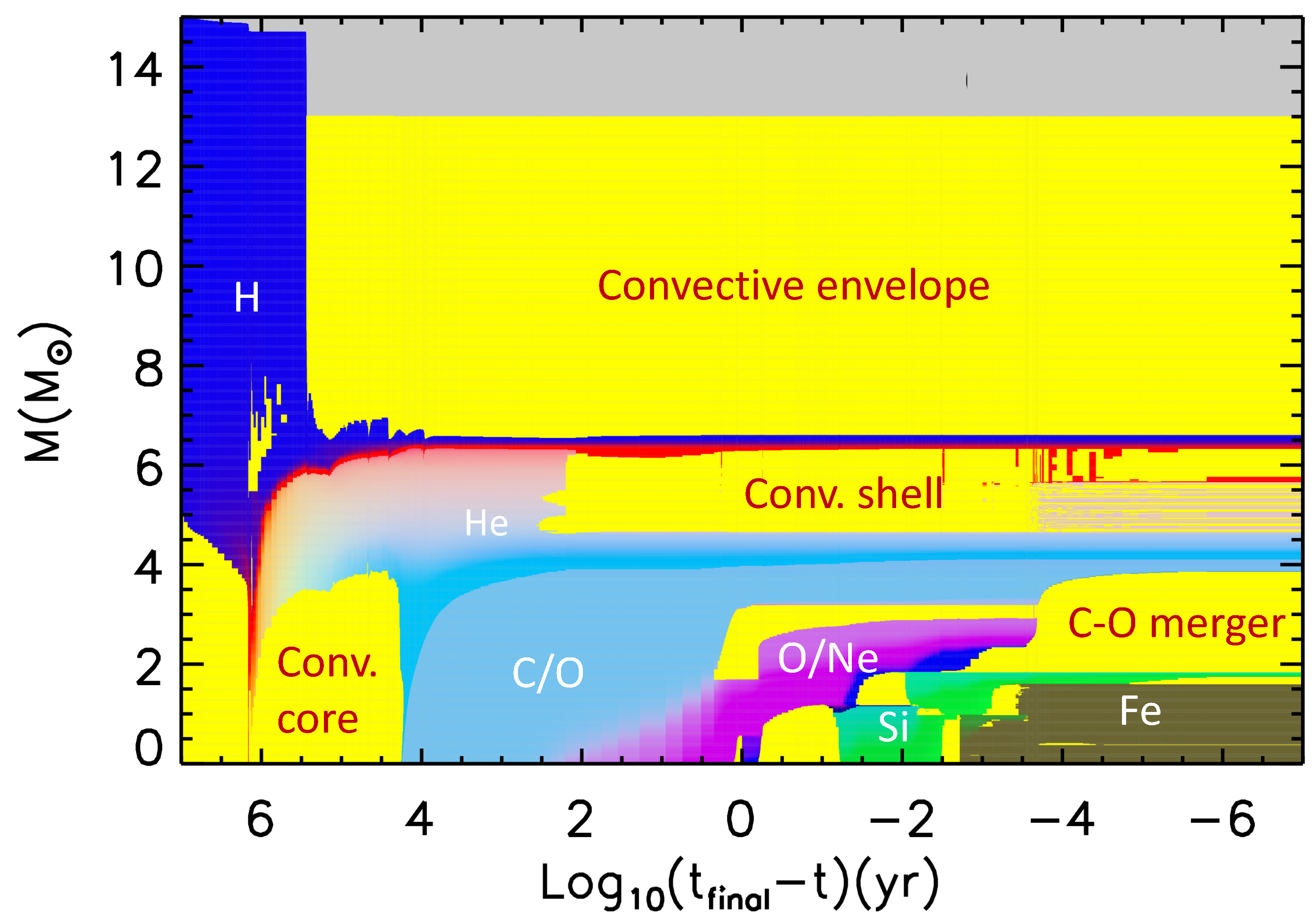
Figure 1 shows the evolution of the convective zones and the major fuels in the considered model via a Kippenhahn diagram. Following Si exhaustion, the stellar core begins its final contraction toward collapse. This phase lasts approximately two days and raises the temperature at the base of the convective O-burning shell, which develops at ∼2 M about 10 3 yr before the core collapse. As the core contracts, the bottom of the shell recedes in radius while the layers above expand due to efficient convection, allowing the convective zone to extend outward into the surrounding Ne, C, and O-rich layers (purple and light-blue zones in the Figure). Once the outer boundary of the convective zone starts mixing in these materials, a convective-reactive event is triggered. The ingested nuclei (C, Ne, and extra O) provide fresh fuel, generating the energy necessary to sustain further expansion and promote additional ingestion from the surrounding layers. Consequently, the O shell progresses in mass until it merges with the C convective shell a little before 10 4 yr from the collapse, reaching an extent of ∼4 M . This C–O shell merger eventually freezes once an active Si-burning shell forms outside the Fe core, which accelerates the final evolutionary stages of the massive star.
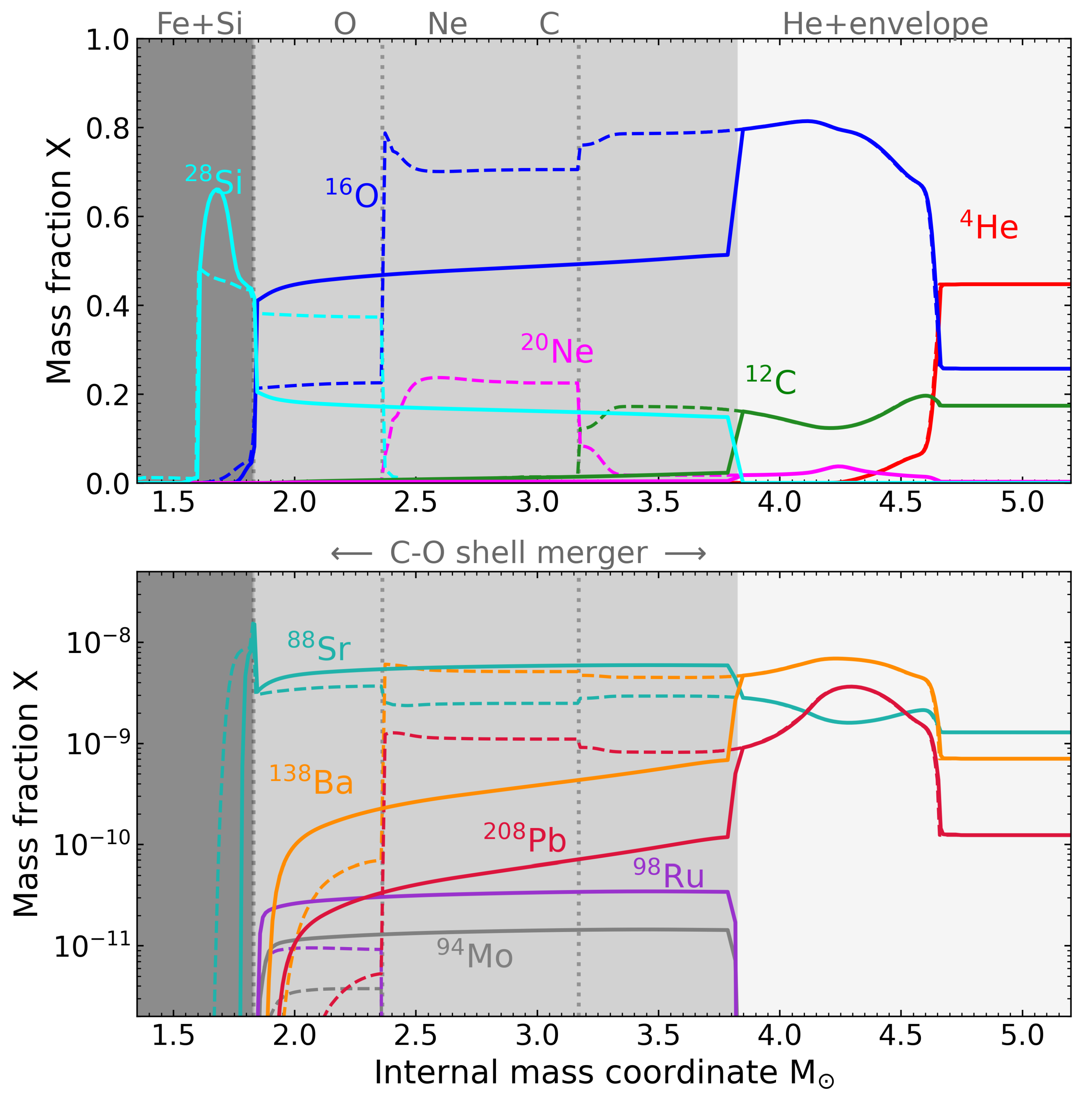
Let us now focus on the internal chemical composition of the star before and after the C–O shell merger and how this event impacts the tracers of the weak, main, and heavy s-process components: 88Sr, 138Ba, and 208Pb. Figure 2 shows the internal chemical composition before (dashed lines) and after (solid lines) the occurrence of the C–O shell merger. As the Figure shows, before the merger, the zone between ∼2.3–4.2 M contains the ashes of both central He burning and C shell burning. In this region, 138Ba is the most abundant among the three s-process tracers, followed by 88Sr and 208Pb. This is due to the low initial Fe (with a mass fraction of ∼ 10 8 ) and the large amount of 22Ne (with a mass fraction of ∼7 × 10 3 ) produced during He burning by the rotational mixing, which allowed for a very large neutron-to-seed ratio that favored the production of the main s-process component. Below this region, in the O burning shell (∼1.8–2.3 M ) efficient photodisintegrations have already started destroying 138Ba and 208Pb, while slightly contributing to the abundance of 88Sr and two typical p-process nuclei, 94Mo and 98Ru [22]. The shell merger reprocesses the material from the bottom of the former O shell (∼1.8 M ) up to the zone containing the ashes of the central He burning (∼3.8 M ). It is clearly visible that the merger mixes the heavy nuclei (138Ba and 208Pb) inward, towards higher temperatures, leading to their destruction. At the same time, 88Sr, 94Mo, and 98Ru are produced by the photodisintegrations at the bottom of the O shell and mixed outward. They are effectively preserved from further reprocessing because their nuclear destruction timescales are much longer than the convective turnover timescale (which is of the order of 60–70 s).
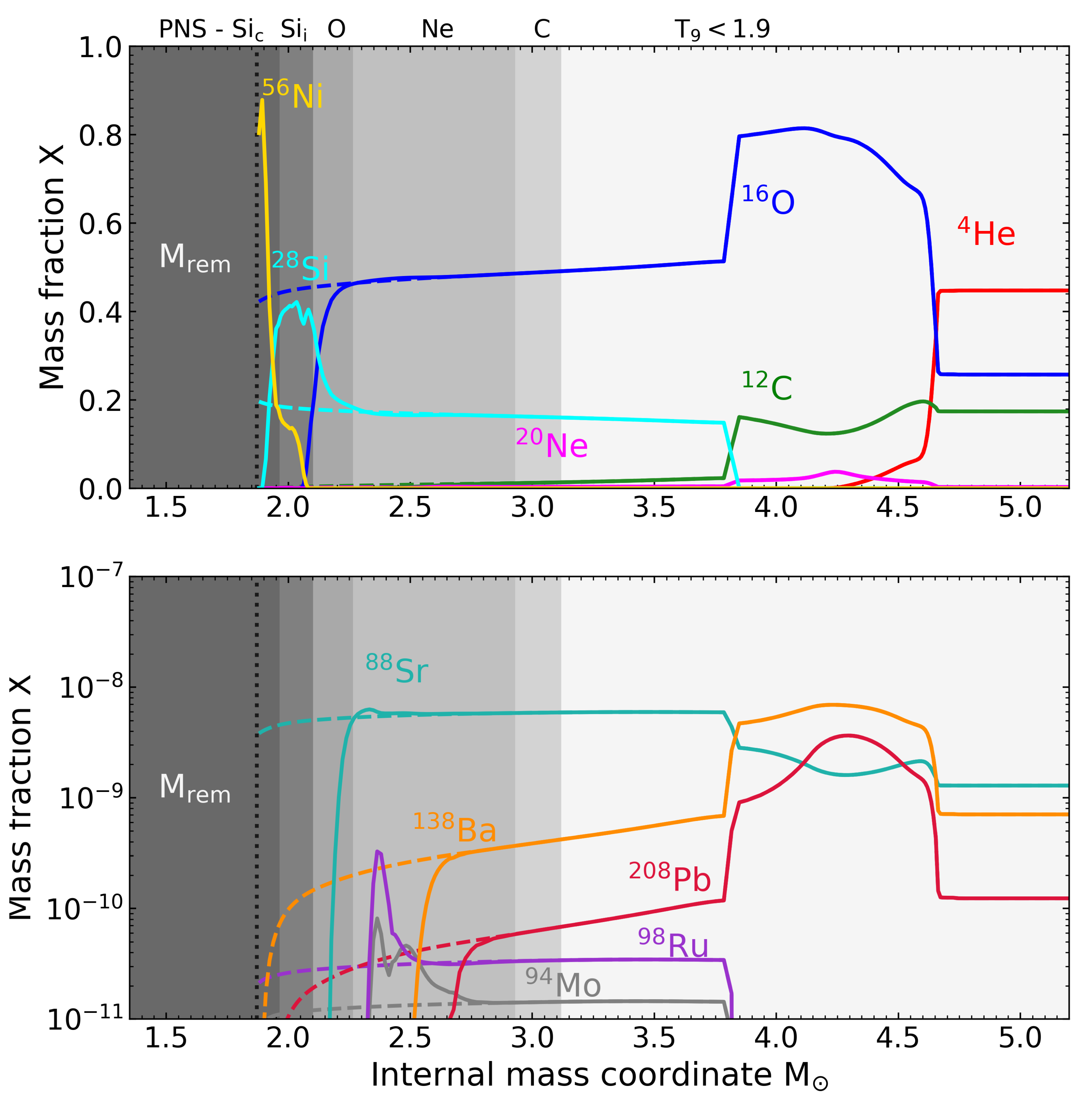
The internal chemical composition at the pre-supernova stage is subsequently modified by the passage of the supernova shock wave. In the present model, the explosion is simulated as a thermal bomb using the Lagrangian hydrodynamic code HYPERION [23]. Specifically, the explosion is triggered by depositing a minimum amount of thermal energy at a mass coordinate of 0.8 M (well within the Fe core), ensuring the full ejection of the mantle. The remnant mass is then determined by requiring the ejection of 0.07 M of 56Ni. While different collapse and explosion treatments can affect the explodability or alter the peak temperature of the shock and the extent of the explosive burning regions [12,24], the impact on a progenitor with a C–O merger is minimal. This is because the shock enters the expanded mixed region very early, and the peak temperature scales as T p e a k R * 3 / 4 , where R * is the radial coordinate. Figure 3 shows the chemical composition before (dashed lines) and after (solid lines) the core-collapse supernova explosion. As is well established, s-process nuclei are destroyed by most explosive burning stages up to explosive Ne burning ( T 3 GK). As shown in the Figure, some 88Sr, along with the p-nuclei 94Mo and 98Ru [25,26], are produced by photodisintegrations at ∼2.4 M , whereas 138Ba and 208Pb are destroyed by the shock up to 2.5 2.6 M .

3. Discussion and Conclusions

Nucleosynthesis in C–O shell mergers has been a subject of discussion for several years [3,7,27]. It represents a particularly powerful mechanism because, for many components, it involves primary production (as in the case of the elements between Si and Sc). Regarding the s- and γ -processes, these are typically considered secondary processes, as they depend strongly on the availability of seeds (Fe for the s-process, and heavy s- and r-nuclei for the γ -process). However, while remaining secondary in nature, we have shown that at low metallicity, the rotationally-enhanced s-process production combined with a C–O shell merger can lead to a significant rearrangement of the stellar material. This favors the weak component (88Sr) and the lighter, more neutron-rich p-nuclei, such as 94Mo and 98Ru. This result aligns with the findings of Ref. [28], which suggested that rotating models can produce γ -process seeds in situ and synthesize p-nuclei during the supernova stage. In the case of C–O shell mergers, this process is almost independent from the explosion; furthermore, the reprocessing of s-process-rich material in extremely metal-poor stars could have a significant impact on galactic chemical evolution of p-nuclei [29].
While it is possible to identify tracers of C-O shell mergers in extremely metal poor stars among intermediate-mass elements, such as K and Sc [7], this does not hold for heavy elements. The merger modifies the Sr/Ba ratio, but this signature is degenerate with the contribution of other s- and neutron capture process sources. Thus, single-star yields alone are insufficient for a direct comparison with observations. Future galactic chemical evolution modeling is necessary to determine the actual contribution of these mergers to the chemical enrichment of the galaxy.
At low metallicity, rotation is the mechanism responsible for the production of a significant s-process distribution from the available Fe. Moreover, this occurs only upon exceeding a rotational velocity threshold that depends on the initial mass, as demonstrated in Ref. [6]. As metallicity increases, the pristine chemical composition of the star reflects contributions from an increasing number of stellar generations, eventually reaching the solar distribution, where Sr exceeds Ba. Consequently, the impact of C–O mergers evolves with metallicity: regarding s-nuclei, photodisintegrations tend to favor the destruction of the weak component rather than its production at the expense of the main and heavy components. Regarding the γ -process, we simply note that varying the metallicity results in different s-process distributions, which act as seeds for both the cold γ -process occurring in C–O mergers and the classic γ -process in core-collapse supernovae. As discussed in Section 2, a comprehensive analysis of the γ -process nucleosynthesis requires a more extensive reaction network than that employed here and, consequently, we defer a detailed investigation of this process in fast-rotating, low-metallicity models to future work. Finally, we note that in population III stars, at zero low metallicity, the lack of Fe seeds hinders the production of heavy nuclei through neutron captures, rendering the impact of C-O mergers negligible regarding the production of both s- and p-nuclei.

Author Contributions

Conceptualization, L.R., A.F. and L.B.; Methodology, L.R., A.F. and L.B.; Software, L.R.; Validation, L.R., A.F. and L.B.; Formal analysis, L.R., A.F. and L.B.; Investigation, L.R., A.F. and L.B.; Resources, L.R.; Data curation, L.R.; Writing—original draft, L.R.; Writing—review & editing, L.R., A.F. and L.B.; Visualization, L.R.; Supervision, L.R.; Project administration, L.R. All authors have read and agreed to the published version of the manuscript.

Funding

This research was partially supported by the PRIN2022 project entitled “β-DEcays and NEutrons captures for astrophysical Branchings (DENEB)” (2022THRKMK), PRIN URKA Grant Number 2022rjlwhn, and the ChETEC-INFRA—Transnational Access Projects 22102724-ST and 23103142-ST. NuGrid was supported by the European Union’s Horizon 2020 research and innovation programme (ChETEC-INFRA—Project no. 101008324), the Lendület Program LP2023-10 of the Hungarian Academy of Sciences, the Hungarian NKFIH via K-project 138031 and NKKP Advanced grant 153697, and the IReNA network by NSF AccelNet (Grant No. OISE-1927130).

Data Availability Statement

Data is available at the Online Repository for the Franec Evolutionary Output (ORFEO) (https://orfeo.oa-roma.inaf.it, accessed on 1 March 2026) and upon reasonable request.

Conflicts of Interest

The authors declare no conflicts of interest.

References

  1. Limongi, M.; Roberti, L.; Chieffi, A.; Nomoto, K. Evolution and Final Fate of Solar Metallicity Stars in the Mass Range 7–15 M. I. The Transition from Asymptotic Giant Branch to Super-AGB Stars, Electron Capture, and Core-collapse Supernova Progenitors. Astrophys. J. Suppl. Ser. 2024, 270, 29. [Google Scholar] [CrossRef]
  2. Limongi, M.; Roberti, L.; Falla, A.; Chieffi, A.; Nomoto, K. The Chemical Yields of Stars in the Mass Range 9–15 M. Astrophys. J. Suppl. Ser. 2025, 279, 41. [Google Scholar] [CrossRef]
  3. Rauscher, T.; Heger, A.; Hoffman, R.D.; Woosley, S.E. Nucleosynthesis in Massive Stars with Improved Nuclear and Stellar Physics. Astrophys. J. 2002, 576, 323–348. [Google Scholar] [CrossRef]
  4. Ritter, C.; Herwig, F.; Jones, S.; Pignatari, M.; Fryer, C.; Hirschi, R. NuGrid stellar data set—II. Stellar yields from H to Bi for stellar models with MZAMS = 1–25 M and Z = 0.0001–0.02. Mon. Not. R. Astron. Soc. 2018, 480, 538–571. [Google Scholar] [CrossRef]
  5. Rizzuti, F.; Hirschi, R.; Varma, V.; Arnett, W.D.; Georgy, C.; Meakin, C.; Mocák, M.; Murphy, A.S.; Rauscher, T. Shell mergers in the late stages of massive star evolution: New insight from 3D hydrodynamic simulations. Mon. Not. R. Astron. Soc. 2024, 533, 687–704. [Google Scholar] [CrossRef]
  6. Roberti, L.; Limongi, M.; Chieffi, A. Zero and Extremely Low-metallicity Rotating Massive Stars: Evolution, Explosion, and Nucleosynthesis Up to the Heaviest Nuclei. Astrophys. J. Suppl. Ser. 2024, 270, 28, Erratum in Astrophys. J. Suppl. Ser. 2024, 272, 48. https://doi.org/10.3847/1538-4365/ad4f7d. [Google Scholar] [CrossRef]
  7. Roberti, L.; Pignatari, M.; Brinkman, H.E.; Jeena, S.K.; Sieverding, A.; Falla, A.; Limongi, M.; Chieffi, A.; Lugaro, M. The occurrence and impact of carbon-oxygen shell mergers in massive stars. Astron. Astrophys. 2025, 698, A216. [Google Scholar] [CrossRef]
  8. Roberti, L.; Pignatari, M.; Fryer, C.; Lugaro, M. The γ-process nucleosynthesis in core-collapse supernovae. II. Effect of the explosive recipe. Astron. Astrophys. 2024, 686, L8. [Google Scholar] [CrossRef]
  9. Roberti, L.; Pignatari, M. The SPAr burning: Proton captures powering carbon—Oxygen shell mergers in massive stars. Astron. Astrophys. 2025, 703, L15. [Google Scholar] [CrossRef]
  10. Chieffi, A.; Limongi, M. The Synthesis of 44Ti and 56Ni in Massive Stars. Astrophys. J. 2017, 836, 79. [Google Scholar] [CrossRef]
  11. Issa, J.; Herwig, F.; Mojzsis, S.J.; Pignatari, M. 3D Macro Physics and Light Odd-Z Element Production in O-C Shell Mergers: Implications for 40K Production and Radiogenic Heating Inventories of Rocky Exoplanets. Astrophys. J. 2026, 997, 314. [Google Scholar] [CrossRef]
  12. Boccioli, L.; Roberti, L. Explodability matters: How realistic neutrino-driven explosions change explosive nucleosynthesis yields. arXiv 2025, arXiv:2510.16365. [Google Scholar] [CrossRef]
  13. Boccioli, L.; Roberti, L.; Fryer, C.L.; Safi-Harb, S.; Jones, S.; Pignatari, M. Production of heavy α-elements and 44Ti in Cas A: Comparison to abundances from 1D core-collapse supernova models and evidence for Carbon-Oxygen shell mergers. arXiv 2026, arXiv:2603.24758. [Google Scholar] [CrossRef]
  14. Roberti, L.; Pignatari, M.; Psaltis, A.; Sieverding, A.; Mohr, P.; Fülöp, Z.; Lugaro, M. The γ-process nucleosynthesis in core-collapse supernovae—I. A novel analysis of cess yields in massive stars. Astron. Astrophys. 2023, 677, A22. [Google Scholar] [CrossRef]
  15. Issa, J.; Herwig, F.; Denissenkov, P.A.; Pignatari, M. Impact of 3D Macrophysics and Nuclear Physics on the p-nuclei in O–C Shell Mergers. Astrophys. J. 2026, 997, 41. [Google Scholar] [CrossRef]
  16. Chieffi, A.; Limongi, M. Pre-supernova Evolution of Rotating Solar Metallicity Stars in the Mass Range 13–120 M and their Explosive Yields. Astrophys. J. 2013, 764, 21. [Google Scholar] [CrossRef]
  17. Limongi, M.; Chieffi, A. Presupernova Evolution and Explosive Nucleosynthesis of Rotating Massive Stars in the Metallicity Range −3 ≤ [Fe/H] ≤ 0. Astrophys. J. Suppl. Ser. 2018, 237, 13. [Google Scholar] [CrossRef]
  18. Gallino, R.; Arlandini, C.; Busso, M.; Lugaro, M.; Travaglio, C.; Straniero, O.; Chieffi, A.; Limongi, M. Evolution and Nucleosynthesis in Low-Mass Asymptotic Giant Branch Stars. II. Neutron Capture and the S-Process. Astrophys. J. 1998, 497, 388. [Google Scholar] [CrossRef]
  19. Frischknecht, U.; Hirschi, R.; Pignatari, M.; Maeder, A.; Meynet, G.; Chiappini, C.; Thielemann, F.K.; Rauscher, T.; Georgy, C.; Ekström, S. s-process production in rotating massive stars at solar and low metallicities. Mon. Not. R. Astron. Soc. 2016, 456, 1803–1825. [Google Scholar] [CrossRef]
  20. Roberti, L.; Limongi, M.; Chieffi, A. Presupernova Evolution and Explosive Nucleosynthesis of Rotating Massive Stars. II. The Supersolar Models at [Fe/H] = 0.3. Astrophys. J. Suppl. Ser. 2024, 272, 15. [Google Scholar] [CrossRef]
  21. Falla, A.; Roberti, L.; Limongi, M.; Chieffi, A. The Role of Rotation on the Yields of the Two γ-Ray Emitters 26Al and 60Fe Ejected by Massive Stars. Astrophys. J. 2025, 991, 21. [Google Scholar] [CrossRef]
  22. Arnould, M. Possibility of synthesis of proton-rich nuclei in highly evolved stars. II. Astron. Astrophys. 1976, 46, 117–125. [Google Scholar]
  23. Limongi, M.; Chieffi, A. Hydrodynamical Modeling of the Light Curves of Core-collapse Supernovae with HYPERION. I. The Mass Range 13–25 iM/i sub⊙/sub, the Metallicities −3 ≤ [Fe/H] ≤ 0, and the Case of SN 1999em. Astrophys. J. 2020, 902, 95. [Google Scholar] [CrossRef]
  24. Boccioli, L.; Roberti, L.; Limongi, M.; Mathews, G.J.; Chieffi, A. Explosion Mechanism of Core-collapse Supernovae: Role of the Si/Si–O Interface. Astrophys. J. 2023, 949, 17. [Google Scholar] [CrossRef]
  25. Woosley, S.E.; Howard, W.M. The p-process in supernovae. Astrophys. J. Suppl. Ser. 1978, 36, 285–304. [Google Scholar] [CrossRef]
  26. Pignatari, M.; Göbel, K.; Reifarth, R.; Travaglio, C. The production of proton-rich isotopes beyond iron: The γ-process in stars. Int. J. Mod. Phys. E 2016, 25, 1630003. [Google Scholar] [CrossRef]
  27. Ritter, C.; Andrassy, R.; Côté, B.; Herwig, F.; Woodward, P.R.; Pignatari, M.; Jones, S. Convective-reactive nucleosynthesis of K, Sc, Cl and p-process isotopes in O-C shell mergers. Mon. Not. R. Astron. Soc. 2018, 474, L1–L6. [Google Scholar] [CrossRef]
  28. Choplin, A.; Goriely, S.; Hirschi, R.; Tominaga, N.; Meynet, G. The p-process in exploding rotating massive stars. Astron. Astrophys. 2022, 661, A86. [Google Scholar] [CrossRef]
  29. Travaglio, C.; Rauscher, T.; Heger, A.; Pignatari, M.; West, C. Role of Core-collapse Supernovae in Explaining Solar System Abundances of p Nuclides. Astrophys. J. 2018, 854, 18. [Google Scholar] [CrossRef]
Figure 1. The Kippenhahn diagram of the model discussed in this work (see text). The color code is based on the most abundant element in that region: H—blue; He—red; C/O—light blue; O/Ne—purple; O/Si—blue (only in the innermost regions); Si/S—light green; Fe—dark green. The convective zones are identified by the yellow regions.
Galaxies 14 00047 g001
Figure 2. Comparison between the abundances before (dashed lines) and after the C-O shell merger (solid lines) in the model discussed in this work. The upper panel shows the effect of the merger on the major fuels. The lower panels show instead the effect of the merger on some key s- and p-process isotopes (see text). The vertical dotted lines represent the location of the edges of the shells before the C-O shell merger. The light grey area is the region modified by the merger, the dark grey area represents instead the untouched deeper layers of the star after the merger, i.e., the Fe core and the Si shell.
Galaxies 14 00047 g002
Figure 3. As Figure 2, but for the pre-supernova (dashed lines) and post-supernova (solid lines) stages, with the inclusion of 56Ni. The gray bands in the plots mark each explosive burning stage in the corresponding mass coordinate (i.e., complete and incomplete Si burning, explosive O, Ne, and C burning). The vertical dotted line represent the mass-cut that divides the supernova ejecta from the remnant mass.
Galaxies 14 00047 g003
Disclaimer/Publisher’s Note: The statements, opinions and data contained in all publications are solely those of the individual author(s) and contributor(s) and not of MDPI and/or the editor(s). MDPI and/or the editor(s) disclaim responsibility for any injury to people or property resulting from any ideas, methods, instructions or products referred to in the content.