Article

On the Analysis Dependence of DESI Dynamical Dark Energy

by
Eoin Ó Colgáin
1,*,
Saeed Pourojaghi
2 and
M. M. Sheikh-Jabbari
2
1
Faculty of Science & Health, Atlantic Technological University, Ash Lane, F91 YW50 Sligo, Ireland
2
School of Physics, Institute for Research in Fundamental Sciences (IPM), Tehran P.O. Box 19395-5531, Iran
*
Author to whom correspondence should be addressed.
Galaxies 2025, 13(6), 133; https://doi.org/10.3390/galaxies13060133 (registering DOI)
Submission received: 4 September 2025 / Revised: 22 October 2025 / Accepted: 5 December 2025 / Published: 9 December 2025

Abstract

We continue scientific scrutiny of the DESI dynamical dark energy (DE) claim by explicitly demonstrating that the result depends on the analysis pipeline. Concretely, we define a likelihood that converts the w 0 w a CDM model back into the (flat) Λ CDM model, which we fit to DESI constraints on the Λ CDM model from DR1 Full-Shape (FS) modeling and BAO. We further incorporate CMB constraints. Throughout, we find that w 0 and w a are within 1 σ of the Λ CDM model. Our work makes it explicit that, in contrast to DR1 and DR2 BAO, there is no dynamical DE signal in FS modeling, even when combined with BAO and CMB. Moreover, one confirms late-time accelerated expansion today ( q 0 < 0 ) at ≳3.4 σ in FS modeling + BAO. On the contrary, DR1 and DR2 BAO fail to confirm q 0 < 0 under similar assumptions. Our analysis highlights the fact that trustable scientific results should be independent of the analysis pipeline.

1. Introduction

The DESI collaboration has presented a suite of dynamical DE claims [1,2,3]. These claims begin with baryon acoustic oscillation (BAO) data but become more statistically significant in the presence of external datasets. Overlooked in this discussion is the observation from [4] that DESI Full-Shape (FS) modeling of galaxy clustering exhibits no hint of a dynamical DE signal. Nevertheless, both DESI BAO and FS modeling prefer a lower value of the (flat) Λ CDM parameter Ω m relative to the Planck [5]. In combination with external datasets, this still suffices to produce a statistically significant dynamical DE signal.
DESI recently released the DR2 BAO results [3], showing that the combination DR2 BAO+CMB prefers dynamical DE at 3.1 σ . As remarked in [1,6,7,8,9,10,11,12], there are noticeable fluctuations in both DR1 and DR2 BAO, especially in luminous red galaxies (LRGs), which primarily drive the dynamical DE signal in DESI data alone. When combined with CMB and Type I supernovae (SNe) datasets, the overall discrepancy in Ω m between the datasets increases the significance [3].
Given that there is explicitly a dynamical DE signal in BAO [1,2,3] ( w 0 > 1 ) but implicitly no dynamical DE signal in FS modeling [4], there is a degree of confusion. What compounds the confusion is the omission of explicit FS modeling + BAO entries for the Chevallier–Polarski–Linder (CPL) w 0 w a CDM model [13,14] in Table 2 of the DESI DR1 FS modeling paper [2]: only FS + BAO in combination with both the CMB and SNe datasets are considered. FS + BAO in combination with CMB alone is not. The reason for the omission is the documented projection effects in Bayesian posteriors in the absence of SNe data [2] (see [15] for frequentist analysis).
On the other hand, Table 3 of the DR1 BAO paper [1] shows the analogous constraints for BAO. Thus, the point of our letter is to make it explicit that fits of the CPL model to DESI FS modeling and BAO constraints [4], both with and without CMB, lead to results consistent with Λ CDM within 1 σ . This addresses a gap in the current literature. The upshot of this outcome is that one can confirm late-time accelerated expansion today, q 0 < 0 , in DESI FS modeling + BAO alone confronted with the CPL model at ≳3.4 σ . As highlighted initially in [16], the same cannot currently be said for DESI DR1 and DR2 BAO.

2. Analysis

We employ a technique we have used in previous papers [6,17], allowing one to map the CPL model back into the Λ CDM model at a given redshift z i :
D M ( z i ) D H ( z i ) = E ( z i ) 0 z i z E ( z ) .
In the above, the left-hand side is computed for the CPL model,
D M ( z ) = c 0 z z H ( z ) , D H ( z ) = c H ( z ) H 2 ( z ) = H 0 2 [ Ω m ( 1 + z ) 3 + ( 1 Ω m ) ( 1 + z ) 3 ( 1 + ω 0 + ω a ) e 3 ω a z 1 + z ] ,
while the right-hand side of (1) is computed for the Λ CDM model, for which
E 2 ( z ) = 1 Ω ˜ m + Ω ˜ m ( 1 + z ) 3 .
Note that the matter density of the CPL model Ω m is distinct from that of the Λ CDM model Ω ˜ m . Henceforth, we denote the Λ CDM matter density parameter with a tilde to avoid confusion. Observe also that H 0 drops out from the left-hand side, so we simply fix H 0 = 70 km/s/Mpc. As a result, one is fitting only the ( Ω m , w 0 , w a ) parameters from the CPL model. We employ (1) only at low redshift where any contribution from radiation is negligible. We will discuss how one incorporates CMB in due course.
The mapping in (1) can be applied beyond CPL more generally to any FLRW model on the left-hand side to map it into the Λ CDM parameter Ω ˜ m . If there are no deviations from Λ CDM behaviour, one recovers a constant Ω ˜ m at all redshifts probed. There is overlap with the O m ( z ) diagnostic [18], but O m ( z ) is usually continuous, necessitating a reconstruction of E ( z ) H ( z ) / H 0 , whereas (1) begins from the cosmological distances at discrete redshifts typically constrained more directly by observations, e.g. BAO. In addition, O m ( z ) typically blows up at lower z (one can try propagating redshift errors to ameliorate this), whereas (1) propagates errors in both the numerator and denominator and cannot blow up at lower z. One could simply equate H ( z ) FLRW = H ( z ) Λ CDM , but then one would need to assume that H 0 FLRW = H 0 Λ CDM to obtain a constraint on Ω ˜ m . Here, we do not need to assume H 0 FLRW = H 0 Λ CDM since H 0 drops out in the ratio.
In our analysis we use of the constraints on Ω ˜ m provided by the DESI collaboration from FS modeling + BAO [4] in Table 1. One could use the constraints from FS modeling alone, but it will not change the conclusions since BAO does not have a strong bearing on FS modeling (see Table 10 of [4]). We define a log-likelihood L ( Ω m , w 0 , w a ) with input parameters ( Ω m , w 0 , w a ) from the CPL model. For each z i z eff in Table 1, we solve Equation (1) to identify the corresponding Ω ˜ m ( z i ) value from the Λ CDM model. From there, we define the log-likelihood
log L ( Ω m , w 0 , w a ) = 1 2 χ 2 = 1 2 i ( Ω ˜ m ( z i ) Ω ˜ m i ) 2 σ Ω ˜ m i 2 ,
where Ω ˜ m i denotes the central value of the Ω ˜ m values, and σ Ω ˜ m i denotes the errors in Table 1. Given the antisymmetric errors in Table 1, if Ω ˜ m ( z i ) > Ω ˜ m i we use the upper error, and vice versa. This ensures that our log-likelihood properly takes account of the differences in antisymmetric errors. Note, we are unaware of any work in the literature fitting model A to model B constraints by rewriting it as model B. This may be a novel workaround for model comparison.
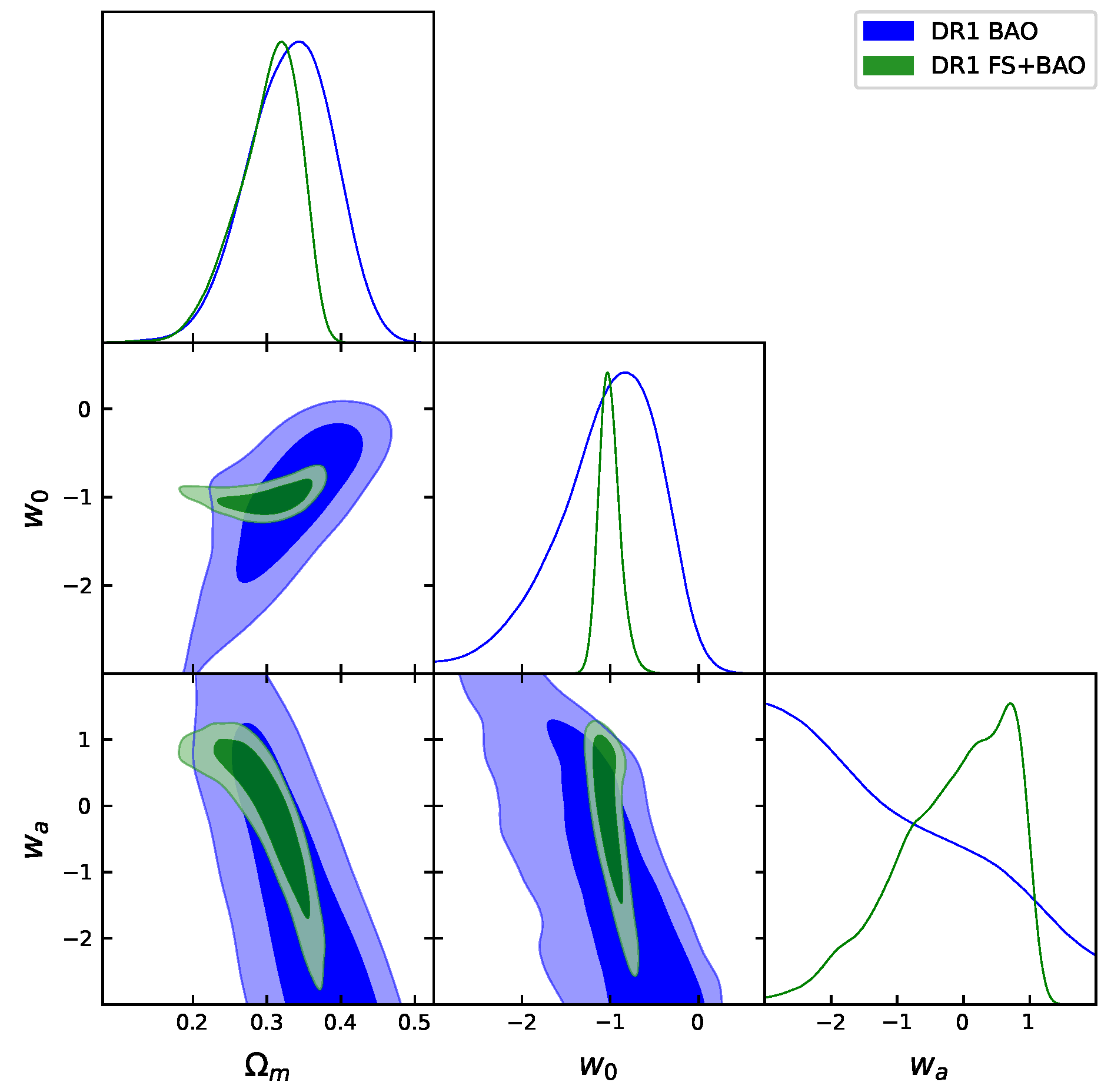
Once the log-likelihood is defined, one marginalizes over the CPL parameters ( Ω m , w 0 , w a ) with Markov Chain Monte Carlo (MCMC) to identify the parameters that best fit the DESI FS + BAO constraints. We employ emcee [19] with the DESI priors, w 0 [ 3 , 1 ] , w a [ 3 , 2 ] and w 0 + w a < 0 [1]. The result of this exercise is presented in Figure 1 and Table 2, where we use getdist [20] to plot the posteriors. The ( w 0 , w a ) values are within 1 σ of Λ CDM, ( w 0 , w a ) = ( 1 , 0 ) , so there is no trace of dynamical DE as expected. There is a concern that our methodology, namely fitting the CPL model through the Λ CDM model to Λ CDM constraints, risks washing out a dynamical DE signal even if one is present. In the Appendix A, we perform a consistency check to show that we can recover the dynamical DE signal in DESI DR1 BAO using both Bayesian and frequentist methods. Our MCMC posteriors are impacted by priors and projection/volume effects, but in a frequentist analysis it is clear that w 0 > 1 .
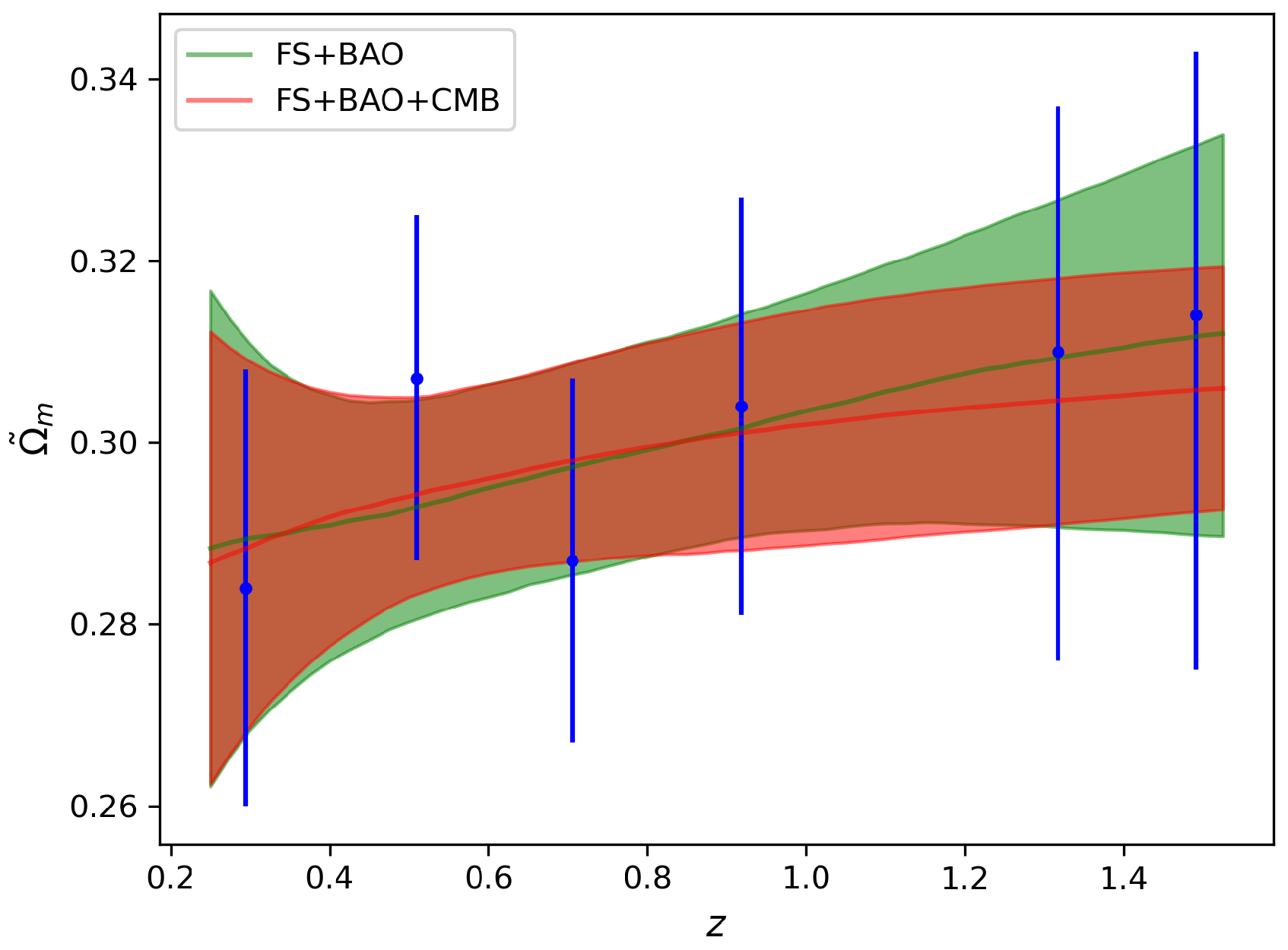
At this stage, there is a further consistency check one can perform. It is evident from the Ω ˜ m values in Table 1 and the blue constraints in Figure 2 that there is a mild increasing trend in the Ω ˜ m central values. We expect to see this in the best-fit CPL model when it is mapped back to Λ CDM. Given the MCMC chain, one can use (1) and redshifts in the range z [ 0.25 , 1.5 ] separated by a uniform Δ z = 0.025 to reconstruct a distribution of Ω ˜ m values at each redshift. One then isolates the 16th and 84th percentiles of Ω ˜ m at each redshift as the limits of the 68% confidence intervals and the median as the central value. What one expects to find through the consistency check is that the increasing trend evident in the blue constraints is mirrored in the resulting confidence interval band. As can be seen from Figure 2, one sees this feature in the green band.
The next step is to incorporate CMB to see if this makes a difference to the conclusions. Here, we follow the DESI collaboration and introduce the Gaussian priors on ( θ , ω b , ω m ) from appendix A of [3], where we define θ = r / D M ( z ) , ω b = Ω b h 2 and ω m = Ω m h 2 . Ω b is the baryonic matter density parameter, r denotes the comoving sound horizon at last scattering and h H 0 / ( 100 km / s / Mpc ) . This reintroduces H 0 , which drops out of the log-likelihood in (4) but is relevant for the CMB constraints. Furthermore, Ω b appears as a second additional parameter. Finally, we fix z = 1090 and introduce a radiation sector in the CPL model (2) with the standard a 4 scaling with fixed coefficient Ω r = 4.18 × 10 5 / h 2 . We add the CMB log-likelihood dependent on v = ( θ , ω b , ω m ) to the log-likelihood for FS modeling + BAO, which results in a log-likelihood that depends on ( H 0 , Ω m , Ω b , w 0 , w a ) :
log L ( H 0 , Ω m , Ω b , w 0 , w a ) = 1 2 i ( Ω ˜ m ( z i ) Ω ˜ m i ) 2 σ Ω ˜ m i 2 1 2 Δ v · C 1 · Δ v ,
where we define Δ v = v v theory . Expressions for v and C can be found in appendix A of [3] and one calculates v theory = ( θ , ω b , ω m ) from the log-likelihood input parameters. Marginalizing over the parameters through MCMC, while isolating ( Ω m , w 0 , w a ) for comparison, one obtains the result in Figure 1, where the corresponding 68 % confidence intervals can be found in Table 2. The consistency check of reconstructing Ω ˜ m appears in Figure 2, where we see that the red (brownish) confidence interval band shows the expected increasing redshift trend.
A number of comments are in order. First, comparing FS + BAO with and without CMB from Table 2, one can see the difference that CMB makes. CMB greatly increases the Ω m precision, and decreases the w a errors by a factor of 2–3, but there is no great increase in w 0 precision. This is also reflected in the reconstructed Ω ˜ m in Figure 2. What one sees is that the green and red (brownish) confidence intervals show little difference at lower redshifts, where the DE sector parameterized by ( w 0 , w a ) is most relevant, whereas at higher redshifts in the matter dominated regime, the confidence intervals contract appreciably. One also notes that the CMB is forcing the reconstruction to a relatively lower canonical Ω ˜ m 0.3 value at higher redshifts. Secondly, whether one employs CMB constraints or not, we find ( w 0 , w a ) values that are within 1 σ of Λ CDM.
Finally, we come to a key remark. In [16] it was noted that DESI DR1 [1] and DR2 BAO [3], when confronted with the CPL model, fail to confirm late-time accelerated expansion today, which is characterized by a negative deceleration parameter:1
q 0 = 1 2 1 + 3 w 0 ( 1 Ω m ) < 0 .
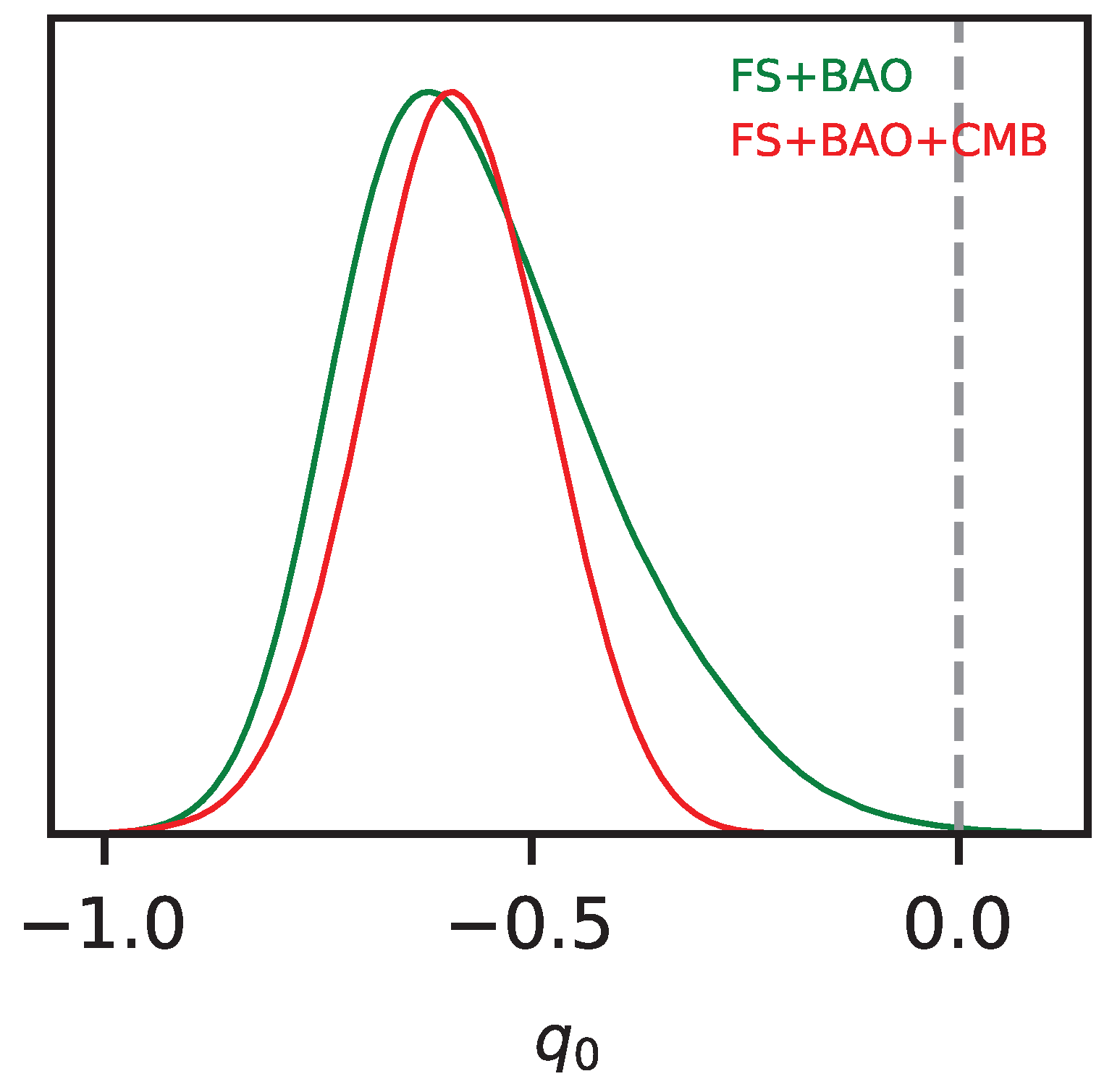
In contrast, from Table 2 and Figure 3, we see that FS + BAO confirms late-time accelerated expansion at 3.4 σ without CMB and at 5.4 σ with CMB. This highlights a key difference in the physical implications of BAO alone compared to FS + BAO.

3. Outlook

Where will future DESI results take us? What should be clear is that the DESI BAO and DESI FS modeling results need to converge. It is evident from the analysis in [16] that DESI BAO shows good consistency between DR1 and DR2 at higher redshifts but that fluctuations are still present in LRG and potentially the lowest redshift emission line galaxy (ELG) bin. More concretely, while LRG1 was primarily responsible for the dynamical DE signal in DR1 BAO data alone [6], in DR2 BAO, LRG2 is the main driver of the dynamical DE signal [16]. When data points move about to this extent, the risk is that fluctuations are present.
The point of this letter is to make the implicit explicit and provide results that were omitted in Table 2 of [2], namely constraints on the CPL model from DESI DR1 FS + BAO and FS + BAO + CMB. Projection effects were used to justify the omission of the results on the grounds that the mean and mode of posteriors did not agree [2]. From a mathematical perspective, this is puzzling since if the Λ CDM model is well constrained in redshift bins, this has implications for the CPL dark energy model; (1) is a mapping between any late-universe FLRW cosmology and Λ CDM. With additional nuisance parameters beyond cosmological parameters, projection effects can easily arise due to degeneracies between the parameters.
We have demonstrated that there is no hint of a dynamical DE signal in FS modeling, even when combined with CMB. To this end, we have employed a mapping between the CPL model and Λ CDM. This strategy of mapping model A to model B to fit model A to model B constraints may be a novel workaround; we are unaware of any examples. We test our method in Appendix A. However, given that one can run a horizontal constant Ω ˜ m line through the blue constraints in Figure 2, this is the expected and obvious result. Finally, while DESI DR1 and DR2 BAO fail to confirm late-time accelerated expansion today [16], we see that any combination with FS modeling does this in excess of 3 σ .
The interesting question now is, assuming BAO converges to FS modeling, what will happen when the blue constraints in Figure 2 shrink as FS modeling + BAO results are upgraded from DR1 to DR2? If the central values do not shift, this will leave an increasing Ω ˜ m trend with redshift. We remind the reader that in [6] it was conjectured that an increasing Ω ˜ m signal would emerge from DESI data, in particular BAO. The flip side of an increasing matter density parameter with redshift in the Λ CDM model is a decreasing Hubble constant H 0 with redshift in the Λ CDM model2, thereby corroborating Hubble tension, a discrepancy in H 0 between the early (high redshift) and late (low redshift) universe [25]. More generally, see [26] for a review of earlier observations of redshift-dependent Λ CDM parameters—a hallmark of model breakdown—in different observables. See also [27] for a recent relevant observation that redshift-dependent Λ CDM fitting parameters3 can be found in SDSS data.
Finally, great care is required when combining BAO and SNe datasets. One needs to check that BAO and SNe agree on cosmological distances in overlapping redshift ranges, e.g., [17]. Two groups [28,29] have recently reported a breakdown in the distance duality relation when DESI BAO is combined with SNe. The physical implications of such a breakdown are so profound (giving up conservation of photon propagation in a metric theory of gravity) that systematics must be present.

Author Contributions

Conceptualization, E.Ó.C. and M.M.S.-J.; methodology, E.Ó.C.; data analysis, E.Ó.C. and S.P.; writing, all authors contributed. All authors have read and agreed to the published version of the manuscript.

Funding

This research was supported by the COST (European Cooperation in Science and Technology) Action CA21136.

Data Availability Statement

No new data was created in this study.

Acknowledgments

This article/publication is based upon work from COST Action CA21136—“Addressing observational tensions in cosmology with systematics and fundamental physics (CosmoVerse)”, supported by COST (European Cooperation in Science and Technology).

Conflicts of Interest

The authors declare no conflicts of interest.

Appendix A. Methodology Check

In the main text we employed a log-likelihood that converts the CPL model into a Λ CDM model before fitting the resulting Λ CDM model to DESI DR1 FS + BAO Λ CDM constraints. For FS + BAO both with and without CMB, we found w 0 = 1 within 1 σ . A concern one may have is that any dynamical DE signal may be washed out by our methodology. Thus, the check that needs to be performed is to make sure that we can recover a w 0 > 1 (alternatively w a < 0 ) signal from a dataset with a bona fide dynamical DE signal. For this test we will make use of DESI DR1 BAO, which when confronted with the CPL model directly returns w 0 > 1 at an excess of 1 σ .
To begin, we need constraints on the Λ CDM parameter Ω ˜ m ( z i ) at effective redshift z i . Here we can import Table I of [6] where the DESI DR1 BAO constraints on D M ( z i ) and D H ( z i ) were converted into direct constraints on Ω ˜ m ( z i ) . We reproduce the constraints in Table A1, where it should be evident that one cannot interpolate a constant Ω ˜ m through the error bars (see Figure 1 of [6]). As a result, there is a hint of a Λ CDM deviation that is interpretable as dynamical DE. We now replace the constraints in Table 1 with the constraints in Table A1 to see what difference it makes. In Figure A1, we present a corner plot where the green posterior is the same as Figure 1.
Table A1. Constraints on Ω ˜ m from Table I of [6] based on DESI DR1 BAO.
z eff Ω ˜ m
0.51 0 . 67 0.17 + 0.18
0.71 0 . 219 0.069 + 0.087
0.93 0 . 276 0.047 + 0.053
1.32 0 . 345 0.078 + 0.11
2.33 0 . 375 0.069 + 0.088
Comparing the green (DR1 FS + BAO) and blue posteriors (DR1 BAO), we see key differences. First, with the DESI priors, the green posterior is constrained in the ( w 0 , w a ) -plane, whereas the blue posterior is not. This is not surprising as the fractional errors in Table 1 are smaller than Table A1; FS modeling + BAO constrains the Λ CDM model much better than BAO alone. We note that w 0 = 0 . 97 0.66 + 0.50 at 68% credible level ( 1 σ ) is consistent with w 0 = 1 within 1 σ , but the maximum of the log-likelihood from the MCMC chain occurs at w 0 = 0.31 , which is outside the credible interval. This points to a projection effect. Moreover, given the anti-correlation between w 0 and w a in the blue posterior, it should be clear that relaxing the lower bound w a 3 will drag the w 0 posterior to arbitrarily larger values that depend on the w a prior. In summary, there is evidence for dynamical DE in the w a posterior, but there is no signal in the w 0 posterior. This is due to the priors and marginalization as we will now demonstrate.
Figure A1. CPL parameter posteriors for DESI DR1 FS + BAO and DR1 BAO confronted to Λ CDM constraints on Ω ˜ m .
Galaxies 13 00133 g0a1
One can obtain a second perspective on this through frequentist profile likelihood methods following [30,31], where one bins the MCMC chain in w 0 bins. Frequentist methods are less prone to the impact of priors and projection effects. We refer the reader to the above references for the details, but the main idea is to define the profile likelihood ratio:
R ( w 0 ) = exp 1 2 ( χ min 2 ( w 0 ) χ min 2 ) ,
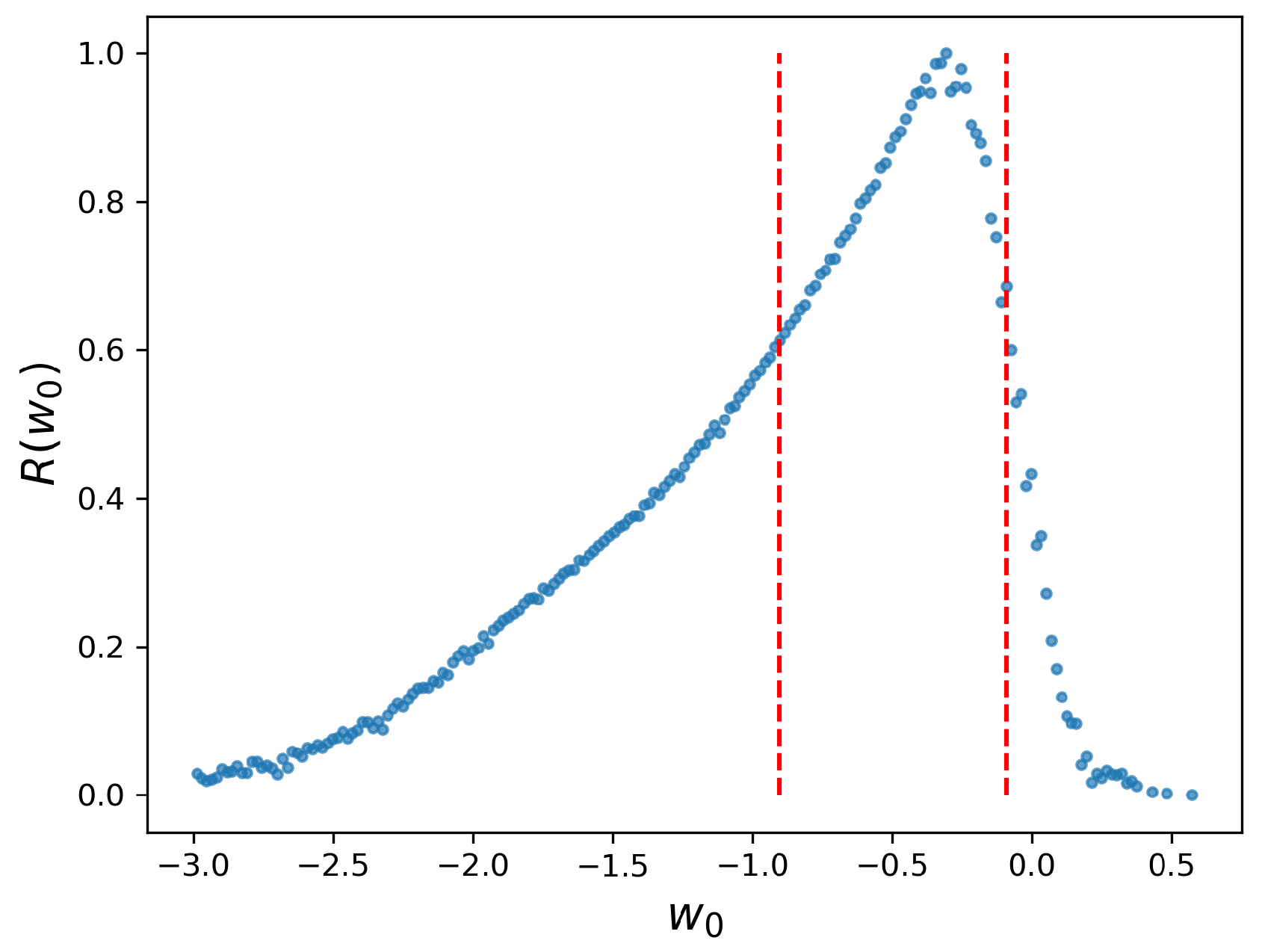
where χ min 2 ( w 0 ) is the minimum value of the χ 2 for the MCMC configurations in the bin centred on w 0 and χ min 2 is the global minimum for all MCMC configurations. We present R ( w 0 ) in Figure A2. Given R ( w 0 ) one can obtain a 68% confidence interval from Wilks’ theorem [32] through identifying the range of w 0 values with Δ χ 2 1 R ( w 0 ) e 1 2 0.607 . Strictly speaking, the theorem only holds for profile likelihoods close to Gaussian, but it is a quick way to obtain an indicative result. The resulting constraint on w 0 is w 0 = 0 . 31 0.60 + 0.21 , thereby confirming that w 0 > 1 beyond 1 σ . There is noise evident in R ( w 0 ) in Figure A2, but this comes about because MCMC is a poor optimizer and the R ( w 0 ) dots converge to a smooth R ( w 0 ) curve from below.4
What Figure A2 demonstrates is that marginalization over the DR1 BAO posterior in Figure A1 drags the projected 1D w 0 posterior back closer to w 0 = 1 through a volume/projection effect. Despite this difficulty in seeing the dynamical DE signal in Figure A1, it is clear that w a < 3 values are preferred and this dynamical DE signal is not evident in the green posterior. This is a like-for-like comparison with the same method.
Figure A2. w 0 profile likelihood for DESI DR1 BAO with log-likelihood in (4). Red dashed lines denote 68% confidence intervals estimated through Wilks’ theorem.
Galaxies 13 00133 g0a2

Notes

1
See also [21] for an earlier implicit observation that w 0 > 1 3 and [22,23] for later explicit observations that q 0 < 0 . Note that as (6) shows, w 0 < 1 3 is a necessary condition that implies q 0 < 0 only for Ω m = 0 .
2
See [24] for a manifestation of the anti-correlated trends.
3
Concretely, H 0 decreasing with redshift, Ω m increasing with redshift and σ 8 / S 8 increasing with redshift.
4
See Figure 4 of [33] for a comparison between profile likelihoods based on gradient decent and binning the MCMC chain. As explained by Trotta [34], both methods are acceptable.

References

  1. Adame, A.G.; Aguilar, J.; Ahlen, S.; Alam, S.; Alexander, D.M.; Alvarez, M.; Alves, O.; Anand, A.; Andrade, U.; Armengaud, E.; et al. DESI 2024 VI: Cosmological constraints from the measurements of baryon acoustic oscillations. JCAP 2025, 02, 021. [Google Scholar] [CrossRef]
  2. Adame, A.G.; Aguilar, J.; Ahlen, S.; Alam, S.; Alexander, D.M.; Prieto, C.A.; Alvarez, M.; Alves, O.; Anand, A.; Andrade, U.; et al. DESI 2024 VII: Cosmological Constraints from the Full-Shape Modeling of Clustering Measurements. arXiv 2024, arXiv:2411.12022. [Google Scholar] [CrossRef]
  3. Abdul Karim, M.; Aguilar, J.; Ahlen, S.; Alam, S.; Alexander, D.M.; Prieto, C.A.; Alvarez, M.; Alves, O.; Anand, A.; Andrade, U.; et al. DESI DR2 Results II: Measurements of Baryon Acoustic Oscillations and Cosmological Constraints. arXiv 2025, arXiv:2503.14738. [Google Scholar] [CrossRef]
  4. Adame, A.G.; Aguilar, J.; Ahlen, S.; Alam, S.; Alexander, D.M.; Prieto, C.A.; Alvarez, M.; Alves, O.; Anand, A.; Andrade, U.; et al. DESI 2024 V: Full-Shape Galaxy Clustering from Galaxies and Quasars. arXiv 2024, arXiv:2411.12021. [Google Scholar] [CrossRef]
  5. Aghanim, N.; Miville-Deschênes, M.A.; Pettorino, V.; Bucher, M.; Delabrouille, J.; Ganga, K.; Le Jeune, M.; Patanchon, G.; Rosset, C.; Roudier, G.; et al. Planck 2018 results. VI. Cosmological parameters. Astron. Astrophys. 2020, 641, A6, Erratum in Astron. Astrophys. 2021, 652, C4. [Google Scholar] [CrossRef]
  6. Ó Colgáin, E.; Dainotti, M.G.; Capozziello, S.; Pourojaghi, S.; Sheikh-Jabbari, M.M.; Stojkovic, D. Does DESI 2024 confirm ΛCDM? JHEAp 2026, 49, 100428. [Google Scholar] [CrossRef]
  7. Dinda, B.R. A new diagnostic for the null test of dynamical dark energy in light of DESI 2024 and other BAO data. JCAP 2024, 9, 62. [Google Scholar] [CrossRef]
  8. Wang, Z.; Lin, S.; Ding, Z.; Hu, B. The role of LRG1 and LRG2’s monopole in inferring the DESI 2024 BAO cosmology. Mon. Not. Roy. Astron. Soc. 2024, 534, 3869–3875. [Google Scholar] [CrossRef]
  9. Chudaykin, A.; Kunz, M. Modified gravity interpretation of the evolving dark energy in light of DESI data. Phys. Rev. D 2024, 110, 123524. [Google Scholar] [CrossRef]
  10. Liu, G.; Wang, Y.; Zhao, W. Impact of LRG1 and LRG2 in DESI 2024 BAO data on dark energy evolution. arXiv 2024, arXiv:2407.04385. [Google Scholar] [CrossRef]
  11. Vilardi, S.; Capozziello, S.; Brescia, M. Discriminating among cosmological models by data-driven methods. arXiv 2024, arXiv:2408.01563. [Google Scholar] [CrossRef]
  12. Sapone, D.; Nesseris, S. Outliers in DESI BAO: Robustness and cosmological implications. arXiv 2024, arXiv:2412.01740. [Google Scholar] [CrossRef]
  13. Chevallier, M.; Polarski, D. Accelerating universes with scaling dark matter. Int. J. Mod. Phys. D 2001, 10, 213–224. [Google Scholar] [CrossRef]
  14. Linder, E.V. Exploring the expansion history of the universe. Phys. Rev. Lett. 2003, 90, 091301. [Google Scholar] [CrossRef]
  15. Morawetz, J.; Zhang, H.; Bonici, M.; Percival, W.; Crespi, A.; Aguilar, J.N.; Ahlen, S.; Bianchi, D.; Brooks, D.; Castander, F.J.; et al. Frequentist Cosmological Constraints from Full-Shape Clustering Measurements in DESI DR1. arXiv 2025, arXiv:2508.11811. [Google Scholar]
  16. Ó Colgáin, E.; Pourojaghi, S.; Sheikh-Jabbari, M.M.; Yin, L. How much has DESI dark energy evolved since DR1? arXiv 2025, arXiv:2504.04417, 4417. [Google Scholar]
  17. Ó Colgáin, E.; Sheikh-Jabbari, M.M. DESI and SNe: Dynamical dark energy, Ωm tension or systematics? Mon. Not. R. Astron. Soc. Lett. 2025, 542, L24–L30. [Google Scholar] [CrossRef]
  18. Sahni, V.; Shafieloo, A.; Starobinsky, A.A. Two new diagnostics of dark energy. Phys. Rev. D 2008, 78, 103502. [Google Scholar] [CrossRef]
  19. Foreman-Mackey, D.; Hogg, D.W.; Lang, D.; Goodman, J. emcee: The MCMC Hammer. Publ. Astron. Soc. Pac. 2013, 125, 306–312. [Google Scholar] [CrossRef]
  20. Lewis, A. GetDist: A Python package for analysing Monte Carlo samples. arXiv 2019, arXiv:1910.13970. [Google Scholar] [CrossRef]
  21. Wang, D. The Self-Consistency of DESI Analysis and Comment on “Does DESI 2024 Confirm ΛCDM?”. arXiv 2024, arXiv:2404.13833. [Google Scholar] [CrossRef]
  22. Wang, D.; Mota, D. Did DESI DR2 truly reveal dynamical dark energy? arXiv 2025, arXiv:2504.15222. [Google Scholar] [CrossRef]
  23. Wang, J.; Yu, H.; Wu, P. Revisiting cosmic acceleration with DESI BAO. Eur. Phys. J. C 2025, 85, 853. [Google Scholar] [CrossRef]
  24. Ó Colgáin, E.; Pourojaghi, S.; Sheikh-Jabbari, M.M. Implications of DES 5YR SNe Dataset for ΛCDM. Eur. Phys. J. C 2025, 85, 286. [Google Scholar] [CrossRef]
  25. Di Valentino, E.; Said, J.L.; Riess, A.; Pollo, A.; Poulin, V.; Gómez-Valent, A.; Weltman, A.; Palmese, A.; Huang, C.D.; van de Bruck, C.; et al. The CosmoVerse White Paper: Addressing observational tensions in cosmology with systematics and fundamental physics. arXiv 2025, arXiv:2504.01669. [Google Scholar]
  26. Akarsu, O.; Ó Colgáin, E.; Sen, A.A.; Sheikh-Jabbari, M.M. ΛCDM Tensions: Localising Missing Physics through Consistency Checks. Universe 2024, 10, 305. [Google Scholar] [CrossRef]
  27. Mukherjee, P.; Sen, A.A. Model-Agnostic Cosmological Inference with SDSS-IV eBOSS: Simultaneous Probing for Background and Perturbed Universe. arXiv 2024, arXiv:2412.13973. [Google Scholar] [CrossRef]
  28. Teixeira, E.M.; Giarè, W.; Hogg, N.B.; Montandon, T.; Poudou, A.; Poulin, V. Implications of distance duality violation for the H0 tension and evolving dark energy. arXiv 2025, arXiv:2504.10464. [Google Scholar] [CrossRef]
  29. Afroz, S.; Mukherjee, S. Hint towards inconsistency between BAO and Supernovae Dataset: The Evidence of Redshift Evolving Dark Energy from DESI DR2 is Absent. arXiv 2025, arXiv:2504.16868. [Google Scholar] [CrossRef]
  30. Gómez-Valent, A. Fast test to assess the impact of marginalization in Monte Carlo analyses and its application to cosmology. Phys. Rev. D 2022, 106, 063506. [Google Scholar] [CrossRef]
  31. Ó Colgáin, E.; Pourojaghi, S.; Sheikh-Jabbari, M.M.; Sherwin, D. A comparison of Bayesian and frequentist confidence intervals in the presence of a late Universe degeneracy. Eur. Phys. J. C 2025, 85, 124. [Google Scholar] [CrossRef]
  32. Wilks, S.S. The Large-Sample Distribution of the Likelihood Ratio for Testing Composite Hypotheses. Annals Math. Statist. 1938, 9, 60–62. [Google Scholar] [CrossRef]
  33. Ó Colgáin, E.; Sheikh-Jabbari, M.M.; Yin, L. Do high redshift QSOs and GRBs corroborate JWST? Phys. Dark Univ. 2025, 49, 101975. [Google Scholar] [CrossRef]
  34. Trotta, R. Bayesian Methods in Cosmology. arXiv 2017, arXiv:1701.01467. [Google Scholar] [CrossRef]
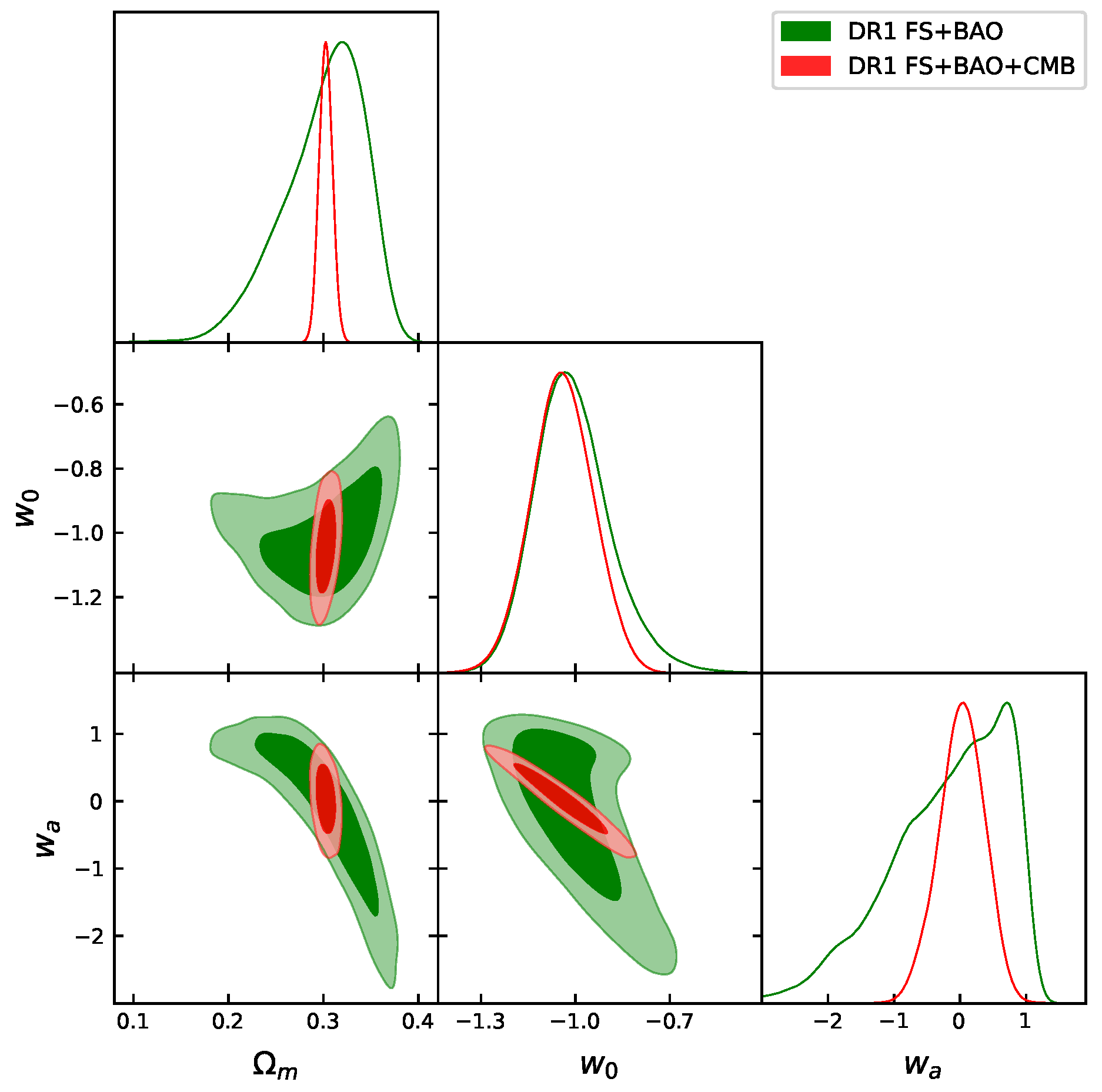
Figure 1. CPL parameter posteriors from DESI DR1 FS modeling + BAO with and without CMB.
Galaxies 13 00133 g001
Figure 2. Reconstructed Ω ˜ m from DESI DR1 FS modeling + BAO with and without CMB.
Galaxies 13 00133 g002
Figure 3. Reconstructed deceleration parameter q 0 posteriors from fits of the CPL model to DESI DR1 FS modeling + BAO with and without CMB.
Galaxies 13 00133 g003
Table 1. Constraints on Ω ˜ m from FS modeling + BAO from different tracers at different effective redshifts. Redshifts and constraints are reproduced from Table 1 and Table 10 of [4].
Tracer z eff Ω ˜ m
BGS 0.295 0.284 ± 0.024
LRG1 0.510 0.307 0.020 + 0.018
LRG2 0.706 0.287 ± 0.020
LRG3 0.919 0.304 ± 0.023
ELG2 1.317 0.310 0.034 + 0.027
QSO 1.491 0.314 0.039 + 0.029
Table 2. Constraints on the CPL parameters and reconstructed deceleration parameter q 0 from FS modeling + BAO with and without CMB.
Data Ω m w 0 w a q 0
FS + BAO 0.307 0.051 + 0.036 1.02 0.11 + 0.12 0.03 1.1 + 0.76 0.58 0.13 + 0.17
FS + BAO + CMB 0.3025 0.0069 + 0.0070 1.042 0.097 + 0.099 0.03 0.36 + 0.34 0.59 ± 0.11
Disclaimer/Publisher’s Note: The statements, opinions and data contained in all publications are solely those of the individual author(s) and contributor(s) and not of MDPI and/or the editor(s). MDPI and/or the editor(s) disclaim responsibility for any injury to people or property resulting from any ideas, methods, instructions or products referred to in the content.