
Article

Normal Spiral Grand-Design Morphologies in Self-Consistent N-Body Models
Research Center for Astronomy and Applied Mathematics, Academy of Athens, 11527 Athens, Greece
*
Author to whom correspondence should be addressed.
These authors contributed equally to this work.
Galaxies 2025, 13(6), 132; https://doi.org/10.3390/galaxies13060132

Submission received: 9 October 2025 / Revised: 25 November 2025 / Accepted: 1 December 2025 / Published: 8 December 2025

Abstract

Grand-design spiral structures typically emerge in N-body simulations of disk galaxies as barred-spiral configurations forming during the early evolutionary stages of the system. In this study, we explore the dynamical conditions that allow for the formation and sustained presence of a non-barred, bisymmetric grand-design spiral pattern in fully self-consistent N-body models over considerable time periods. We present a model in which such non-barred morphologies persist for approximately 2.5 Gyr. The simulation is carried out using a standard implementation of the GADGET-3 code, incorporating both stellar and gaseous components in the disk and embedding them within a live dark matter halo. A characteristic feature of the simulation is that during its normal spiral grand-design phase the disk remains submaximal. Star formation is active throughout the model’s evolution. Analysis of the resulting morphology indicates that dominant inner, symmetric spiral arms extend between the inner Lindblad resonance (ILR) and the radial inner 4:1 resonance. This structure is evident in both the stellar and gaseous components, exhibiting extensions and bifurcations consistent with predictions from orbital theory.

1. Introduction

The morphology of grand-design, non-barred (SA-type) spiral galaxies is rarely reproduced in self-consistent N-body simulations over secular timescales (i.e., ≳a few Gyr). In the vast majority of such numerical experiments, the emergence of grand-design spiral structure is typically accompanied by the development of a central bar. Bar instability is inherent in disks that are dynamically close to being “maximal” [1,2], so grand-design barred-spiral structures naturally arise in such models, particularly in simulations that also include gas (e.g., [3,4,5]). In contrast, “submaximal” disks [6] tend to inhibit or delay bar formation because of the stabilizing effect of the halo potential [7]. In these cases, however, the corresponding resulting spirals are typically flocculent or display multiple arms (e.g., [8,9,10]), while usually they are identified as transient (see e.g., [11]).
Nevertheless, in the local Universe, the morphology of grand-design spirals without bars is not uncommon among disk galaxies. An early observational study [12] reported that approximately 32 ± 10 % of SA galaxies exhibit symmetric, two-armed spiral patterns consistent with the classical grand-design classification. Subsequent near-infrared (NIR) observations, particularly at wavelengths around 2.1 μ m , revealed that disk galaxies tend to be less multi-armed, thereby increasing the apparent fraction of grand-design spirals [13]. However, it was observed that central bars become more prominent in these wavelengths (see, e.g., [14,15]), especially when galaxies with oval central distortions are also classified as barred. Yet, in the near-infrared, normal (i.e., non-barred), grand-design spiral structure is often encountered; in some cases, it becomes evident after deprojecting the images and considering K -band intensity maps relative to an axisymmetric background [16,17]. We also note that azimuthal age/color gradients across spiral arms, compatible with long-lived spirals have been identified in [18] for some non-barred grand design spirals.
In the past, gas response models [19,20] and early two-dimensional N-body simulations [21] suggested a correlation between the emergence of regular grand-design spiral structures and submaximal disk decompositions in the corresponding rotation curves. In all such cases, the resulting open, bisymmetric spiral patterns, with pitch angles exceeding 15°, reproduced key dynamical characteristics predicted by orbital and hydrodynamical models for similar galaxy types [22,23,24,25]. These patterns typically exhibit an inner bisymmetric spiral arm structure that splits or bifurcates near the inner 4:1 resonance, prior to reaching corotation. Spiral arm extensions reaching toward corotation, if present, are more pronounced in the gaseous component of the models [26], where they are generally fainter and display distinct pitch angles compared to the inner arms [27].
The longevity of spiral arms, whether they are transient or sustained features, has been a subject of long-standing debate and represents a central issue underlying all major theories of spiral structure (see [28]). The transient nature of spirals in non-barred models can be attributed, in part, to the ability of the modes to redistribute stellar mass radially and to modify the corresponding velocity dispersions, thereby altering the underlying equilibrium state [29]. Moreover, these modes can excite secondary perturbations that develop at the resonances of the preceding ones [30]. Nevertheless, efforts have been done to investigate whether a simulation initialized under appropriate conditions could sustain dominant, relatively long-lived wave modes (of the order of a few Gyr) of the kind proposed by [31] and subsequent authors. Notably, ref. [32] achieved the formation of persistent, normal spiral patterns by carefully adjusting the relative distributions of luminous and dark matter, as well as by including a bulge component in the initial model setup.
In continuity with the approach of [32], in this work, we present a self-consistent model employing the widely used N-body code GADGET-3, in which a typical grand-design spiral morphology persists over a significant portion of the system’s dynamical evolution, spanning a few Gyr. The analysis we present in this work focuses solely on the phase of the simulation during which the morphology under study is dominant. However, the full simulation extends over a significantly longer timespan, approximately 8 Gyr, during which it develops a bar and which will be presented in detail in a forthcoming paper. We remind that the spirals in barred-spiral systems may have totally different dynamics than in normal spirals (for a review see e.g., [33] and references therein).
The model configuration, including its initial setup and the methodology used to track its temporal evolution, is described in Section 2. In Section 3, we outline our main findings and detail the morphological features observed. We also analyze the evolution of the spiral pattern speed and identify the locations of resonances within the disk. A discussion of our results, summarizing our conclusions is provided in Section 4.

2. The Model and the Method

Numerical studies of isolated disk galaxies have been conducted using a variety of techniques: direct-summation codes offer high accuracy but are limited to small N or specialized hardware, whereas tree-based solvers (e.g., Barnes–Hut) reduce the computational cost while retaining adaptivity [34]. For the gas component, both Eulerian grid (fixed or adaptive mesh refinement) and Lagrangian (SPH) hydrodynamic schemes are widely employed (see e.g., [35]). Simulations further differ in computational platforms, ranging from CPU-based architectures to GRAPE/GPU-accelerated systems optimized specifically for N-body gravity (see e.g., [36]). In our study we perform numerical simulations of isolated disk galaxies using the code GADGET-3. Gravitational interactions are modeled in the code with a tree-based solver, evolved from the earlier GADGET-2 version, while fluids are represented by means of smoothed-particle hydrodynamics (SPH) [37]. Dark matter and stars are simulated as collisionless particles of constant mass and a gravitational softening length is introduced to limit unrealistic heating. The softening lengths are set to 100 and 50 pc for dark matter and stars respectively. The gaseous component is also represented by particles with a softening length chosen to be equal to the one used for the stellar particles.
The simulation includes the star formation and supernova feedback prescriptions in the standard GADGET-3 implementation. Following the implementation of [38] the gas particles represent a two phase interstellar medium. In this model the colder gas clouds are formed within a hotter diffuse medium and the gas in total follows an equation of state for the effective pressure of the form: P e f f = ( γ 1 ) ( ρ h o t u h o t + ρ c o l d u c o l d ) where ρ is the density and u the energy per unit mass for either the hot or the cold component and γ is the adiabatic index. The star formation rate (SFR) of the gas particles is computed with a Kennicutt-Schmidt relation [39] where the SFR density is proportional to the density of the gas to the power of α = 1.5 . In addition, supernova feedback is included, effectively as a mechanism that pressurizes the ISM, with every supernova outputting energy of 10 51 ergs to the surrounding medium. In the present simulation we do not include a black hole, hence there is no energetic input from processes associated with AGNs.
The galaxy presented in this study is initialized using the method introduced in [40] and extended in Springel et al. [41,42,43]. The dark matter halo follows a Hernquist profile [44] with concentration parameter c = 9.0 and viral velocity at R 200 , v 200 = 118 km / s . The stellar and gaseous disks are initialized having exponential radial density profiles with the same scalelength h s t a r s = h g a s and the scaleheight for the stellar disk is set to z s t a r s = 0.1 h s t a r s . The combined mass in the two disk components is 15% ( f d = 0.15 ) of the total mass, whereas the gas fraction ( m g a s / m d i s k ) is f g a s = 0.1 . The disk scalelength is set based on the halo spin parameter λ = 0.09 following [45], under the assumption that the fraction of the angular momentum of the disk to the total equals the disk mass fraction, that is J d = f d . In addition, a bulge with a mass fraction of f b = 0.09 is initialized following a Hernquist profile of scalelength b = 0.4 h s t a r s .
The simulation we present in this paper is a low resolution model that includes 1,076,000 particles, distributed between the 4 components, with N halo = 760,000, N disk = 150,000, N bulge = 90,000, N gas = 76,000. Despite the low resolution, this model reproduces all the features we want to discuss. The total mass in the simulation is 3.82 × 10 11 M h 1 . The stellar disk has a scalelength of h s t a r s = 3.89 kpc at time t = 0 which remains fairly constant for the early evolution of the system.
The Toomre Q stability parameter of the stellar disk has values slightly lower than 1 (around 0.9) for radii in the range of 4–10 kpc at the start of the simulation but quickly (within 0.5 Gyr) settles to values just above 1 for all radii. Regarding the SPH scheme employed, artificial viscosity is implemented following the prescription of [46], with artificial viscosity parameters ( α , β ) = ( 1 , 1 ) , while kernel interpolation is performed using 64 neighbours.
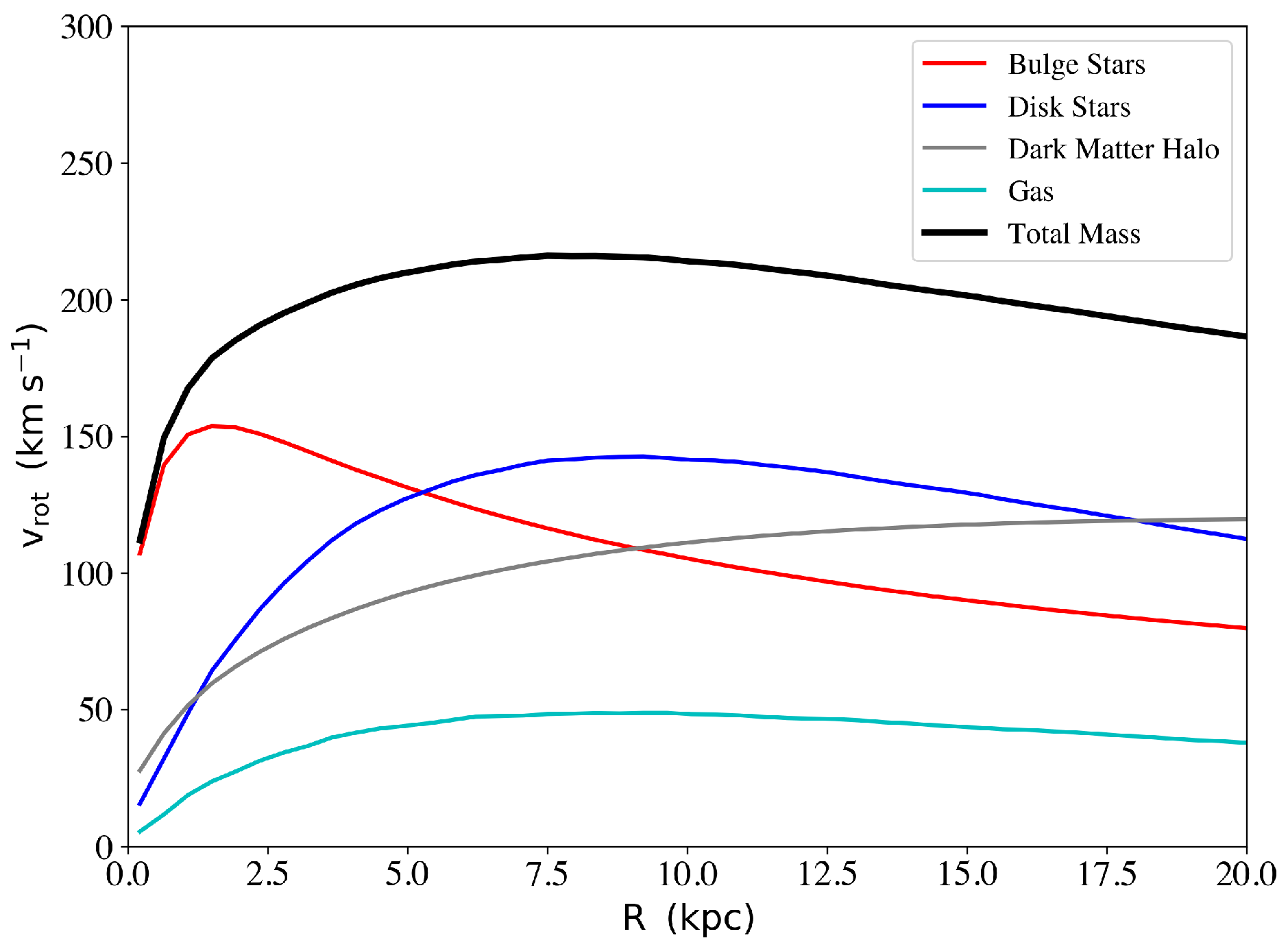
The initial configuration of the model used in this presentation is summarized in Figure 1, which shows the corresponding rotation curve. We observe that its decomposition into dark and luminous components does not support a maximum disk solution.

3. Results

3.1. The Global Morphological Evolution

We concentrate our analysis on the time interval during which the system develops normal grand-design spiral morphologies, approximately spanning the period 1 Gyr < t < 3.5 Gyr . Within this range, the model snapshots, when subjected to Fourier analysis, reveal a spiral pattern that, in the central regions, displays a predominantly bisymmetric morphology governed by the m = 2 component.
For the determination of the spiral arm pattern speed, we make use of the power spectrum in the angular velocity–radius ( Ω r ) plane. The power spectrum is computed for different azimuthal wavenumbers by performing a Fourier transform on a sequence of snapshots spanning a total duration of ∼800 Myr centered on the time of interest, i.e., 400 Myr before and 400 Myr after the time of the snapshot under investigation (see, e.g., [47,48]). In our analysis, we focus on the m = 2 mode, which dominates over the time interval under consideration. The pattern speed is then identified as the angular frequency corresponding to the maximum of the total power, summed over the radial range r = 0 8 kpc , in order to isolate the region of interest. We note that moderate variations in the adopted radial range have only a minor effect on the derived pattern speed. Representative power spectrum density diagrams are presented in Section 3.2.
Due to the finite temporal resolution of the simulation, the available angular velocity values ( Ω ) are discrete, determined by the duration of the time series (t∼800 Myr ). To obtain a more accurate estimate of the pattern speed, we first identify the angular velocity Ω i corresponding to the maximum of the total power, P i . We then consider the adjacent power values, P i 1 and P i + 1 , at the neighboring frequencies Ω i 1 and Ω i + 1 , respectively, and fit a Gaussian function to these three points. The position of the Gaussian peak is adopted as the refined estimate of the pattern speed. This approach improves the accuracy of the derived value, compensating for the limited temporal sampling and the possible sharing of power between adjacent Ω bins.
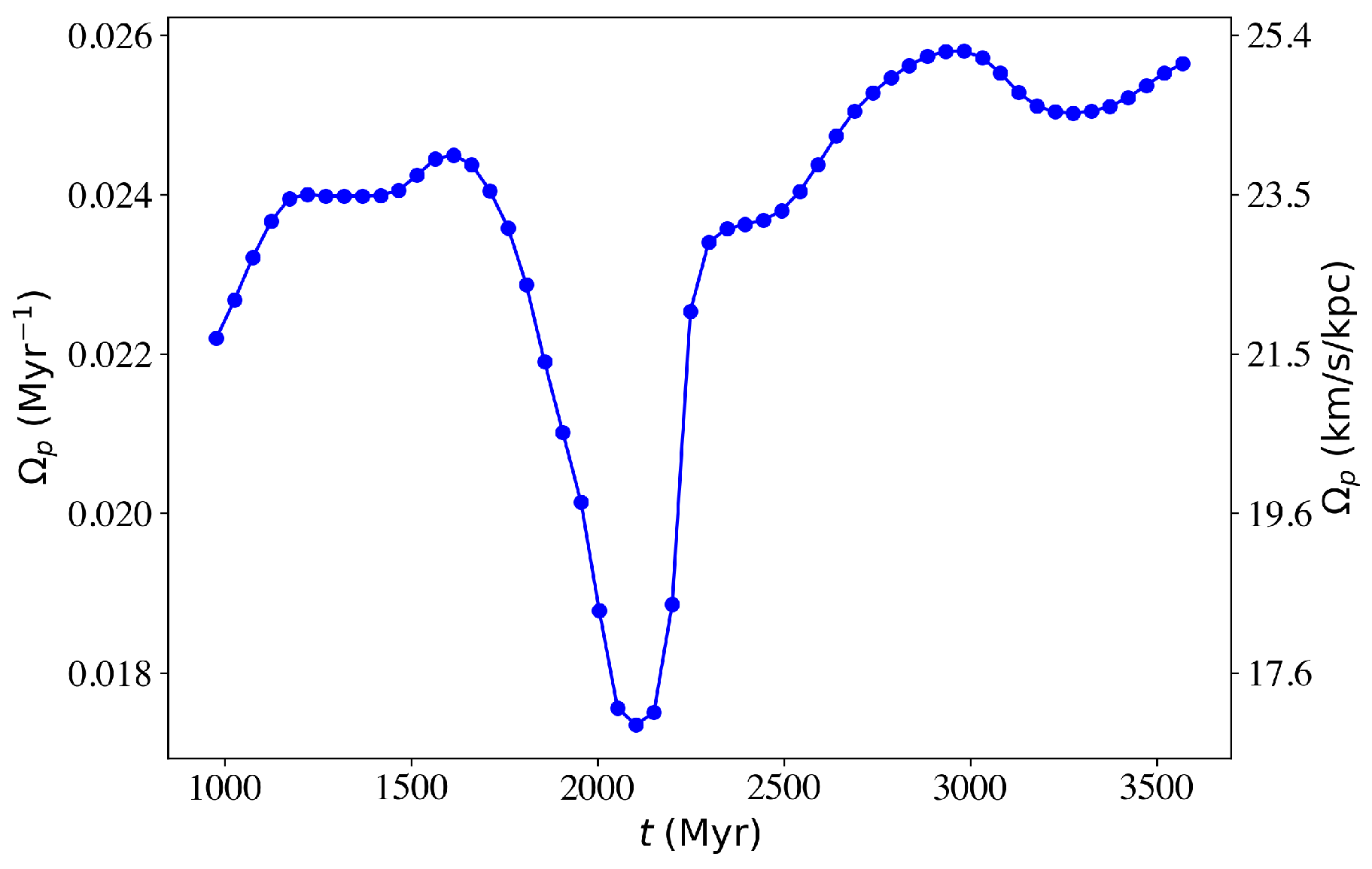
The temporal evolution of the pattern speed, Ω p , of the m = 2 component is shown in Figure 2. The variation of Ω p can be naturally divided into two sub-intervals: the first lasts for about 1 Gyr, beginning slightly before t = 1 Gyr , while the second extends from approximately t = 2.2 Gyr until t 3.5 Gyr , i.e., a duration of roughly 1.3 Gyr. During the first sub-interval, Ω p oscillates around 23.5 km s 1 kpc 1 , whereas during the second it fluctuates around 24.5 km s 1 kpc 1 , having a larger variance. Between these phases, Ω p drops to a local minimum at about 17 km s 1 kpc 1 . The precise boundaries of these intervals are not sharply defined, since the grand-design morphology persists throughout the entire ∼2.5 Gyr period displayed in Figure 2.
During 1 < t < 3.5 Gyr, Ω p varies within a narrow range. During the decreasing Ω p phase, the amplitude of m = 2 declines but the mode remains dominant, preserving the bisymmetric morphology. Qualitatively, this behavior may be interpreted as a transition between two modes, corresponding to the early and late phases shown in Figure 2, with the second mode emerging as the first fades. However, the dynamical characteristics of the two modes are remarkably similar. Thus, whether this behavior is viewed as a single fluctuating mode or as two closely related, consecutive modes is not crucial for the present analysis. Our focus is to examine the dynamics of the developing spiral structure in terms of the resonant mechanisms that govern and shape its morphology.
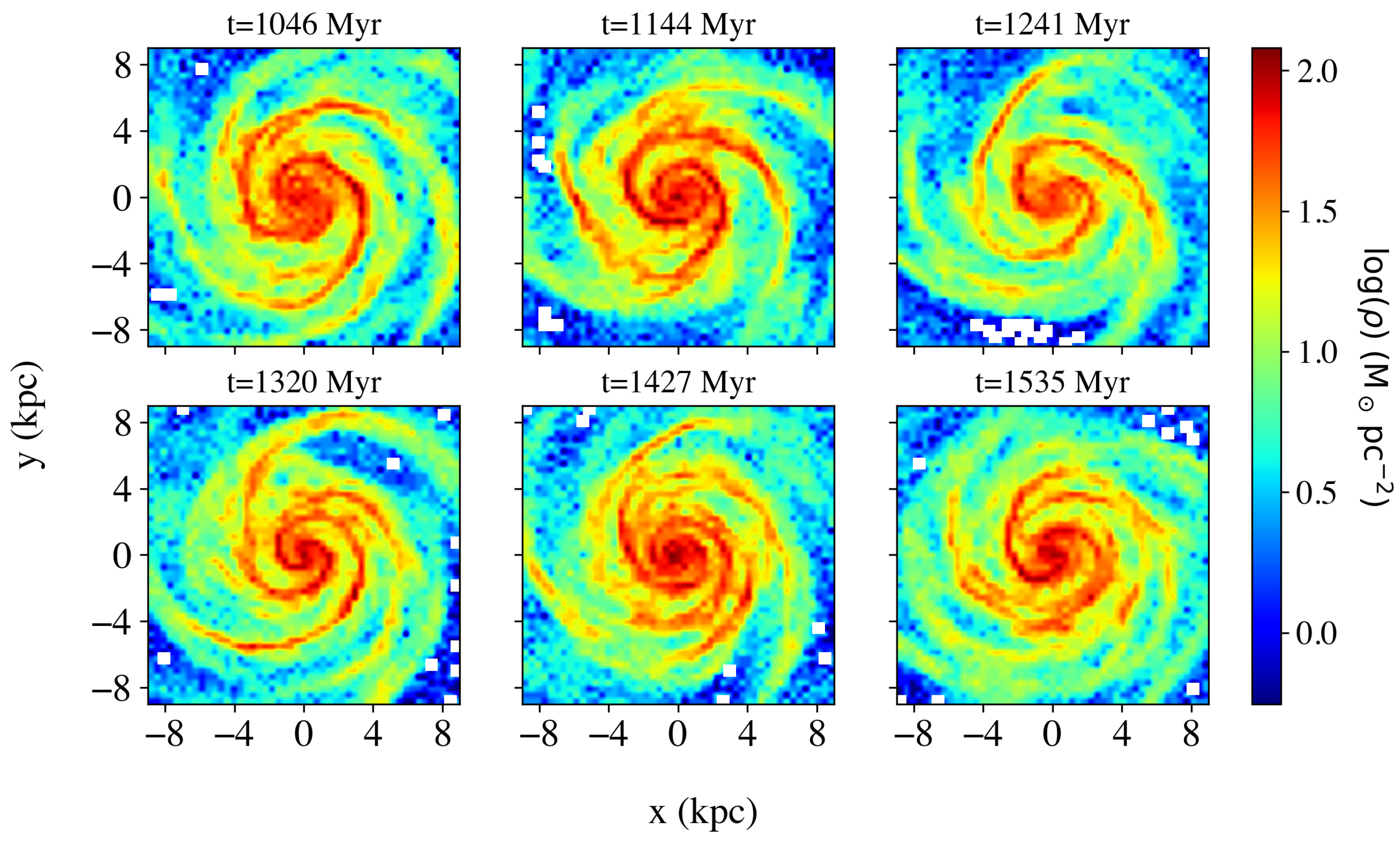
The normal grand-design spiral morphology is clearly present in both the stellar and gaseous components. Nevertheless, the spiral arms in the gaseous component are significantly more sharply defined, providing a more suitable basis for direct comparisons with the morphologies observed in real galaxies. Figure 3 presents representative snapshots of the gas component for times 1.046 Gyr t 1.535 Gyr , corresponding to the early phase of the pattern speed evolution shown in Figure 2.
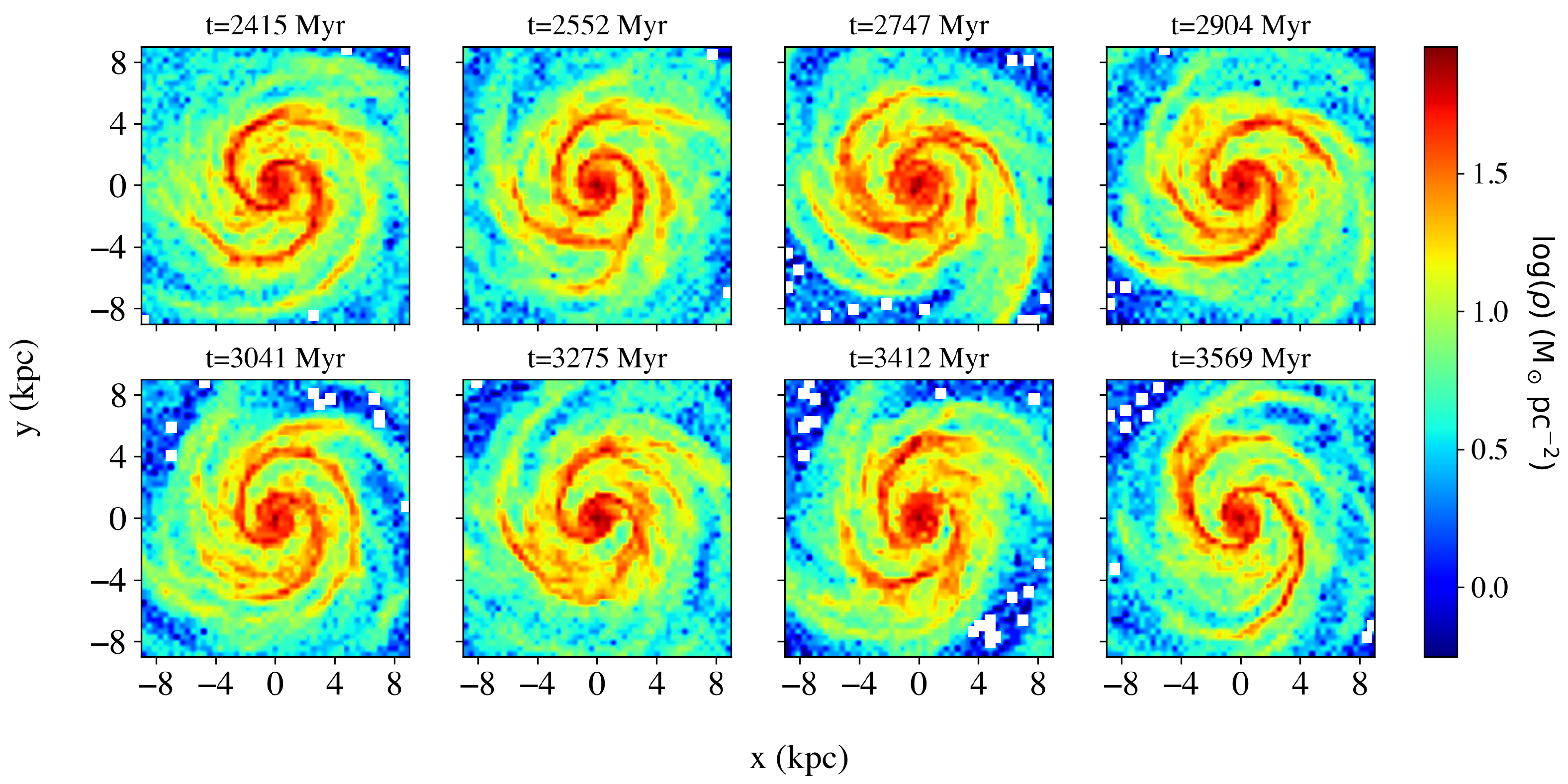
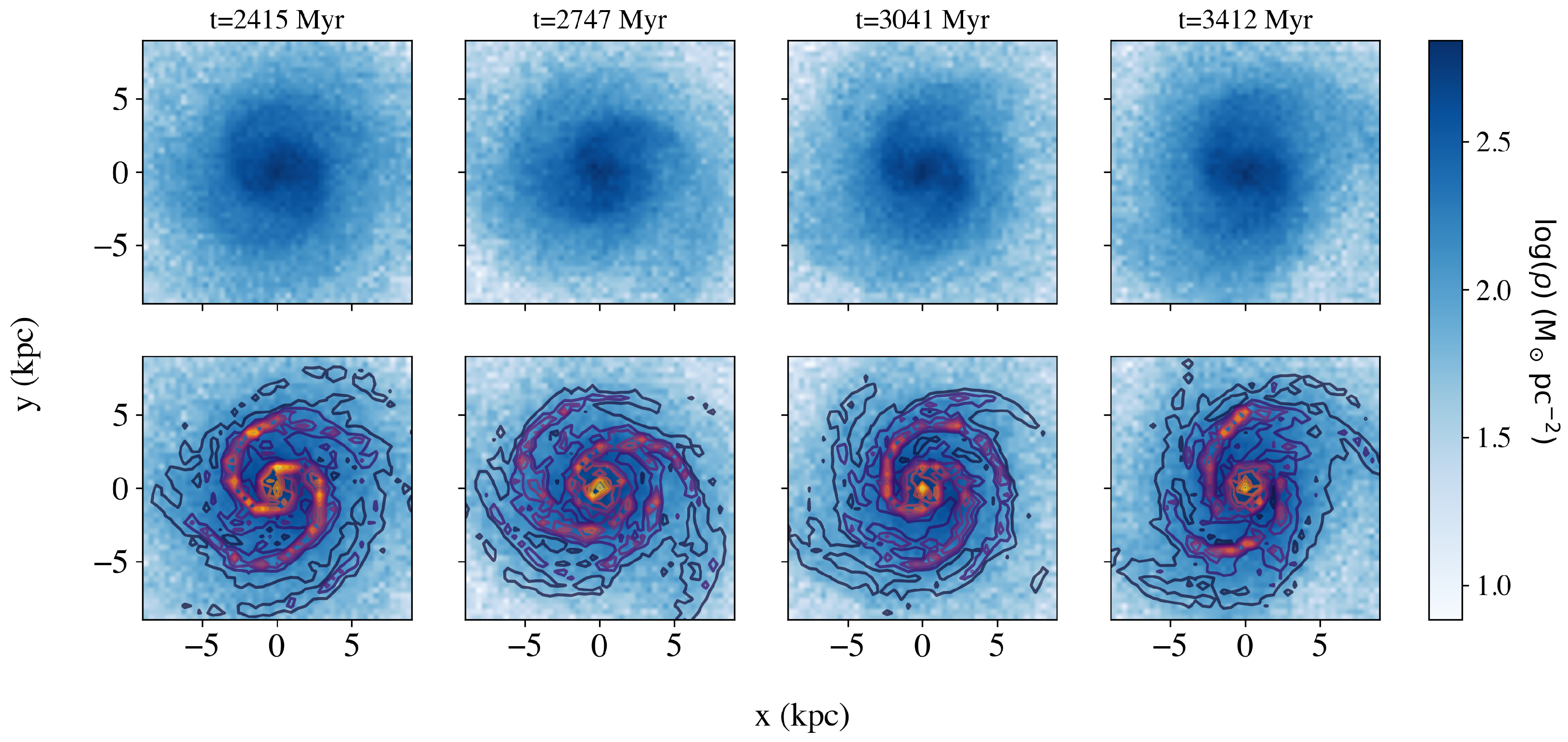
Figure 4 presents snapshots of the gaseous component corresponding to the late phase of the pattern speed evolution described in Figure 2, which extends slightly longer than the early phase. These snapshots, covering the interval 2.415 Gyr t 3.569 Gyr , illustrate the persistence of the grand-design spiral morphology over a period of time larger than 1 Gyr. It is noteworthy that even at the local minimum of the Ω p curve, around t = 2.1 Gyr, the system continues to exhibit a well-defined large-scale spiral morphology. In all given snapshots, the strong part of this pattern usually ends at about 1.5 exponential scale length of the stellar disk, while less organized spiral segments extend up to 2.5 scale lengths.
The global dynamical behavior and the evolution of the pattern speed of the stellar component are broadly consistent with those of the gaseous component. The morphological differences that arise are reminiscent of those observed between near-infrared and optical images of disk galaxies. Specifically, while the stellar disk also exhibits a normal spiral pattern, spatially coincident, to a large extent, with the gaseous arms, its spiral arms are considerably broader than those of the gaseous component. We also observe that beyond the bisymmetric part, all other extensions and fragments of spiral arms are very weak features. Representative snapshots of the disk stellar distribution during the late phase of the grand-design period, i.e., for t > 2.4 Gyr , are shown in the upper row of Figure 5. In the lower row of Figure 5 we supperpose colored contours showing the gas distribution at the same time. The magenta contours delineate the prominent inner spiral arms, whereas the black contours trace the more diffuse, outer spiral structure.

3.2. The Dynamics of Individual Snapshots

Following the method described in Section 3.1 for estimating the pattern speed of the m = 2 component, we identify horizontally extended peaks, which reveal organized patterns within the corresponding radial zones. These horizontal ridges indicate the frequency at which the m = 2 mode undergoes steady rotation [49]. This allows us to estimate the approximate location of the resonances of these bisymmetric spirals in individual snapshots.
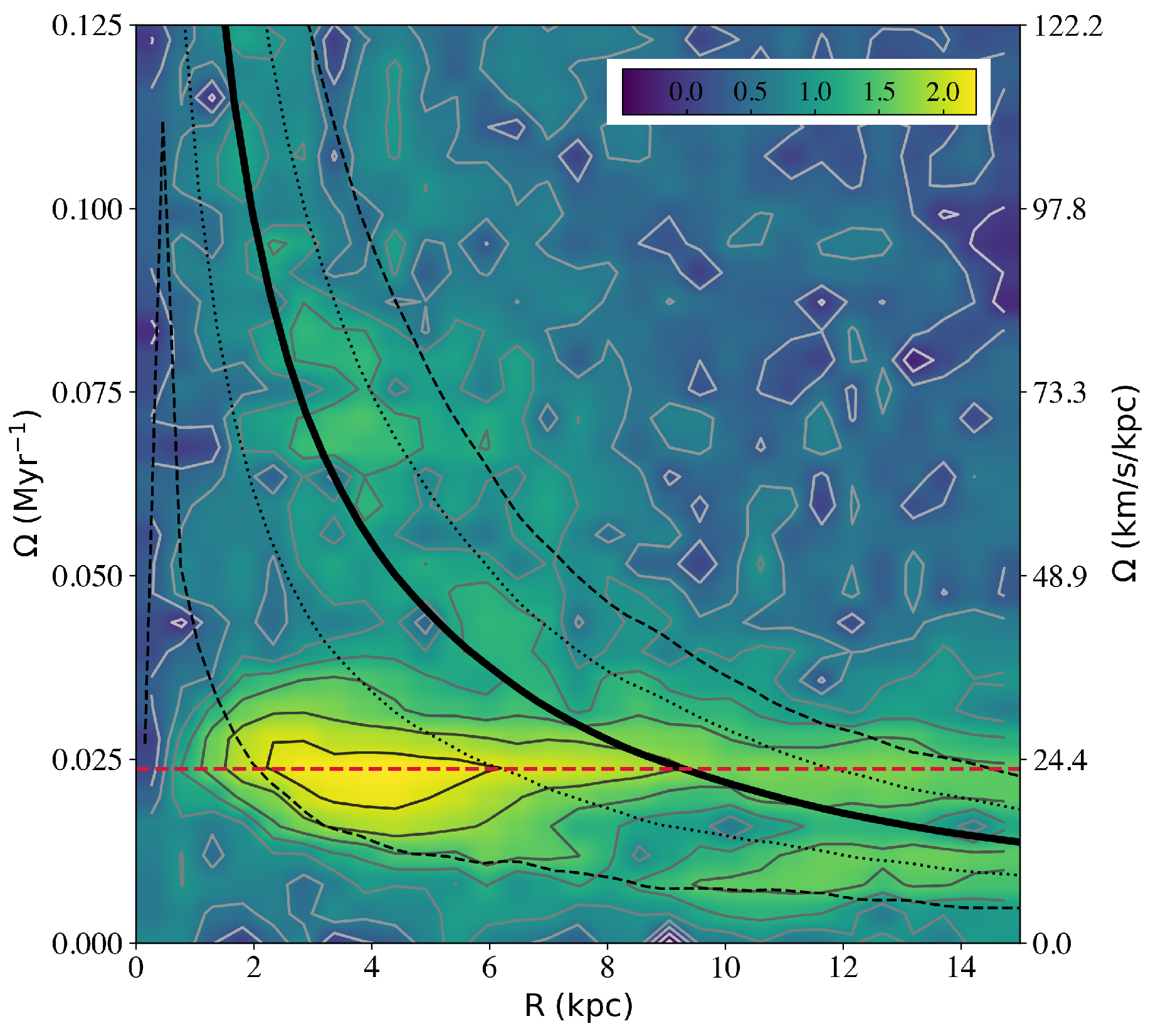
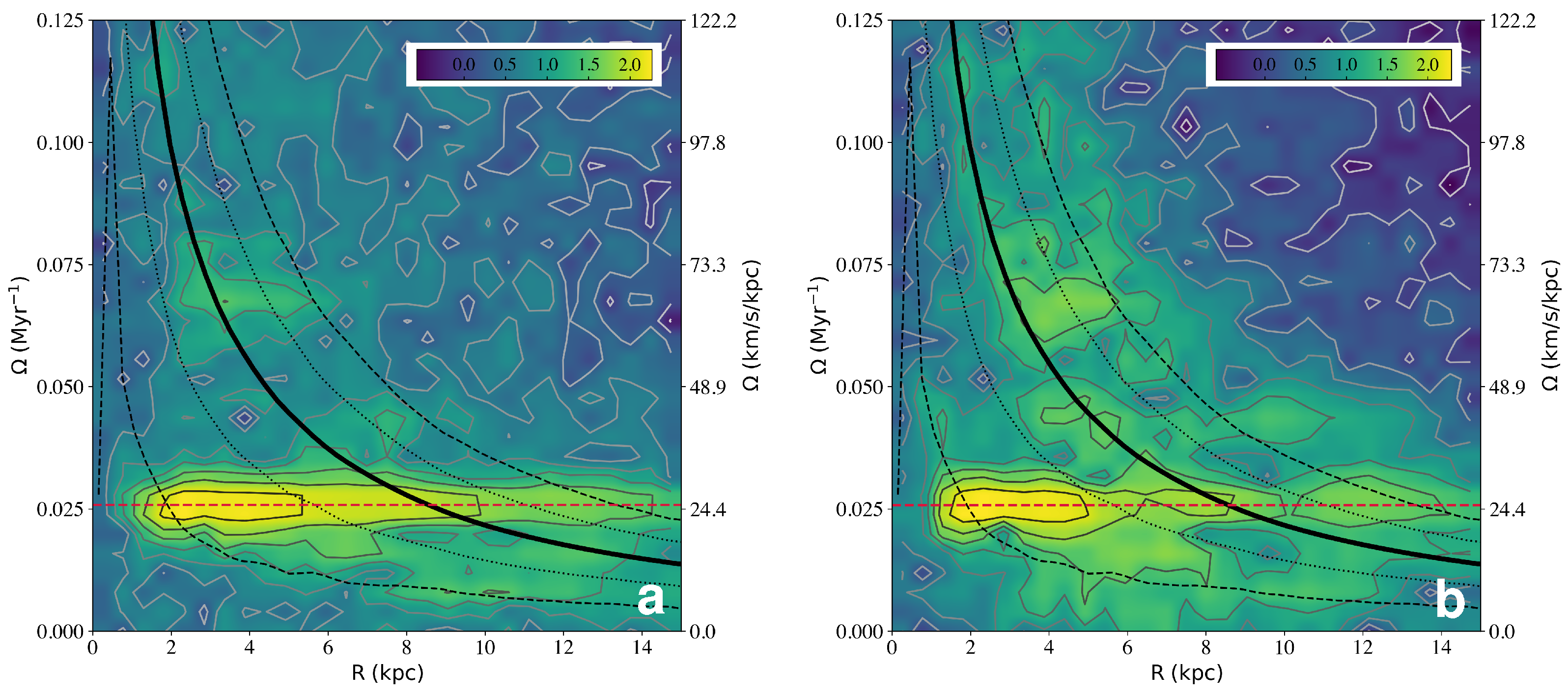
A representative power spectrum density diagram of the stellar component, centered at the snapshot corresponding to time t = 2.4 Gyr, is shown in Figure 6. In general, several modes coexist within the same time interval. By plotting the radial variation of Ω , Ω ± κ / 2 , Ω ± κ / 4 , where κ is the epicyclic frequency, we observe that power is essentially distributed between the outer Inner Lindblad Resonance (oILR) and the Outer Lindblad Resonance (OLR). When low-power contributions are neglected, however, a single dominant m = 2 mode becomes apparent, which can be associated with the observed grand–design spiral. In Figure 6, the high-power region of this mode peaks between the oILR and the inner 4:1 resonance. The isocontour terminating at the 4:1 resonance attains a level approximately four times higher than that of the contour extending to the OLR. The red horizontal dashed line represents the angular velocity corresponding to the maximum of the total power, estimated as described in Section 3.1. We note that the angular frequency of this mode is approximately close to 23 km s 1 kpc 1 .
We identify two distinct types of power spectrum morphologies in diagrams such as Figure 6. In the first case, the contours exhibit a continuous fading between the oILR and the OLR. In the second case, we also observe successive, lower-power peaks located close to the mean Ω p of the dominant mode. In general, the former type of contours is characteristic of the stellar component, whereas the latter appears in the gas component. A representative example is shown in Figure 7. In all cases, the contour level between the oILR and the inner 4:1 resonance is approximately four times higher than that of the contours extending to the OLR.

3.3. The Morphology of the Snapshots

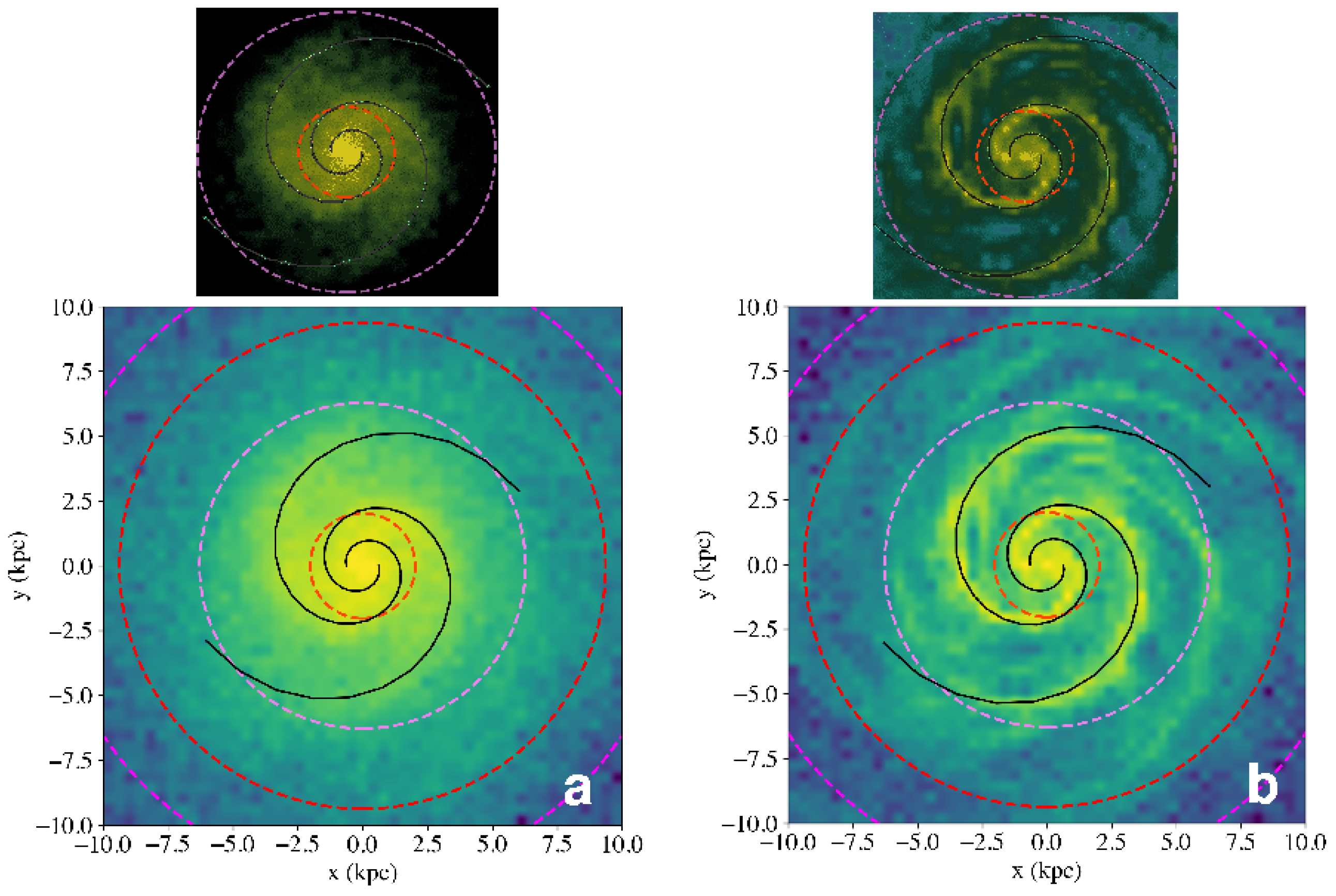
Reflecting the shape of the isocontours in the angular frequency power spectrum, the resulting spiral morphology exhibits a pronounced structure inside the inner 4:1 resonance. The appearance of the spiral arms in the snapshots is illustrated in Figure 8, which provides a representative example at t = 2.4 Gyr. In Figure 8a is given the stellar and in Figure 8b the gaseous component. The dashed circles denote, from inside outward, the oILR, 4:1, corotation, and OLR resonances.
The first notable feature is that any spiral structure beyond the inner light pink dashed circle, corresponding to the 4:1 resonance, appears fainter than the part between the oILR and the 4:1 resonance. A second key feature is that the prominent spiral segment is well fitted by a logarithmic spiral with a pitch angle of 16°. We find this by performing a one-dimensional Fourier analysis to determine the phases of the m = 2 component on a polar grid. The spirals superposed on the snapshots of Figure 8 were obtained by fitting these phases with a logarithmic spiral, which provided the best representation of the observed pattern. This strongly indicates an m = 2 symmetry, despite the presence of lower-intensity features in the gas component (Figure 8b) that bifurcate from the main pattern. Most prominent is a bifurcation from the right side of the upper arm, reminiscent of the so-called “elbows” of spiral arms frequently observed in spiral galaxies. Higher contrast representations of the snapshots are given on top of each panel.

4. Discussion and Conclusions

In this paper, we analyze the initial phase of a simulation extending over approximately 2.5 Gyr , during which the disk develops a well-defined, non-barred grand-design spiral morphology. That means it is dominated by the presence of an essentially bisymmetric spiral within a certain radius. This phase begins approximately 1 Gyr after the start of the simulation. During this period, we identify two intervals in which the spiral pattern speed varies only slightly, fluctuating between 23 Ω p 25.3 km s 1 kpc 1 . These intervals are separated by a short episode in which Ω p temporarily drops by about 7.5 km s 1 kpc 1 , without significantly affecting the overall bisymmetric morphology of the spiral pattern.
Although the grand-design spiral pattern speed, Ω p , varies during the simulation, this variation is minimal and not monotonic in the 1 < t < 3.5 Gyr window. During the decreasing Ω p phase within this time interval both the pattern speed and the amplitude of the m = 2 term decrease, but the bisymmetric morphology is not lost. The mode seems to re-organize itself in a state similar to that of the early phase, after reaching the local Ω p minimum. Whether we have a single fluctuating mode or two successive ones, the existence of two time subintervals during which the variation of Ω p remains small enables an investigation of the resonance locations in the disks for individual snapshots. We find that in both the stellar and gaseous components a prominent bisymmetric spiral extends between the oILR and the inner 4:1 resonance (most conspicuous in the gas). Within this range, the main spiral can be reasonably fitted by a logarithmic spiral.
In our models, the occurrence of the 4:1 resonance is systematically accompanied by arm bifurcations, in agreement with the behavior predicted for strong, open spirals by the early orbital analysis in [22]. As anticipated from stellar orbit models [23,24], these bifurcations are generally weaker in the stellar component than in the corresponding gaseous responses [25,26,50], a trend that is also borne out in the present simulations, where the bifurcations are more clearly expressed in the gas. We note however, that several theoretical and numerical studies report analogous features at the ultraharmonic resonance, though not always linked to the termination of a bisymmetric grand-design pattern [51,52,53]. Furthermore we note that in barred-spiral systems arm bifurcations may arise from dynamical mechanisms entirely distinct from those discussed in the present work (see, e.g., [33] and references therein).
The global spiral morphology of our model does not terminate at the 4:1 resonance; however, beyond this radius the extensions appear asymmetric, fragmented, and generally fainter, being discernible primarily in the gas. Fourier analysis of the snapshots indicates that the m = 2 component is no longer dominant beyond the inner 4:1 resonance. Instead, higher-order terms ( m > 2 ), with amplitudes lower in general than the strong inner m = 2 mode, prevail. Moreover, these higher-order terms exhibit a transient character, as their shape and extent vary from snapshot to snapshot.
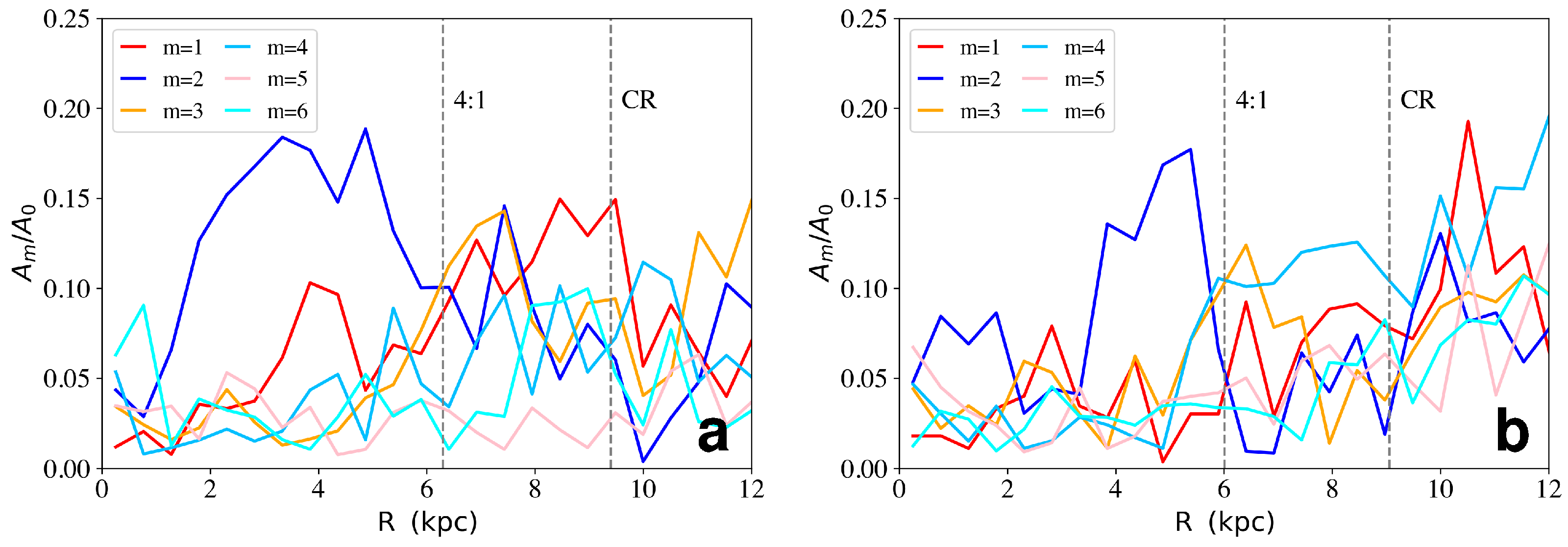
This morphology can be assessed from the plots of the relative amplitudes of the various Fourier terms as a function of radius in the stellar component. The m = 2 term dominates up to the 4:1 resonance in all snapshots exhibiting the grand–design morphology. Figure 9a shows the variation of the relative amplitude in the stellar disk for the snapshot of Figure 8. Between the 4:1 resonance and corotation, the m = 1 and m = 3 terms become more significant. Notably, this agrees with the morphology of the gaseous component in the corresponding region (Figure 8b), which is more clearly discernible than in the stellar disk.
The dominance of odd-m Fourier components in several snapshots near and beyond the 4:1 resonance arises primarily from arm bifurcations, which develop preferentially on only one side of the pattern, as illustrated by the pronounced branching of the upper spiral arm near the 4:1 resonance in Figure 8b. This is consistent with morphologies reproduced in previous SPH response models of specific grand–design galaxies, which exhibit an odd number of spiral segments, or arm extensions, beyond an inner bisymmetric pattern (see, e.g., Figure 4 in [26]). However, some snapshots reveal more symmetric structures, in which the m = 4 term becomes locally comparable in amplitude to the odd terms in the vicinity of the 4:1 resonance (see, for example, the corresponding amplitude variation for an earlier snapshot in Figure 9b at t = 1.6 Gyr).
Furthermore, the amplitude of the stellar m = 2 component in the grand–design spirals closely matches that observed in several grand–design spiral galaxies of similar Hubble types and pitch angles in the near-infrared [16,17]. This close agreement highlights the strong correspondence between the dynamical and morphological properties of the stellar component in our snapshots and those observed in NIR images of grand–design, non-barred spiral galaxies. In contrast, the structures seen in the gas component closely resemble the features observed in optical images of galaxies of the same type.
The dominance of a bisymmetric component in the near-infrared morphology of non-barred spiral galaxies, frequently accompanied, at larger radii and in optical wavelengths, by asymmetric arm extensions or a transition to a multi-arm pattern, is a common characteristic of galaxies of the type examined here. A representative example is NGC 628 (e.g., [54,55]). The dynamical origin of several morphological features reproduced in our models, such as the “elbows” and arm bifurcations, as well as the occurrence of spiral segments approximately parallel to one of the primary arms (Figure 3 and Figure 4), warrants further dedicated investigation. Nevertheless, we note that analogous structures, especially prominent in the optical, are observed in a number of grand-design spirals, including NGC 2997 and NGC 5247 (see e.g., [56,57,58]). We also note that the recent observational analysis in [55] finds that the non-barred, bisymmetric grand-design spiral pattern in NGC 628 is consistent with a rigidly rotating density-wave mode whose prominent two-armed component terminates well inside corotation.
The difficulty of a spiral wave, based on particles trapped around x 1 periodic orbits, in crossing the 4:1 resonance was first noted by [22,23]. Subsequently, ref. [24] demonstrated that these limitations depend on the Hubble type of the galaxy, while [25,26] showed that the corresponding gaseous responses of slowly rotating spiral patterns closely reproduce the morphologies of specific Sb and Sc galaxies observed in optical wavelengths. The main conclusion of these studies is that the morphology of open, normal, grand–design spirals is characterized by an inner bisymmetric spiral, whereas asymmetric, multi–armed structures may appear at larger radii. Subsequent studies with response models have supported this interpretation [50]. This behavior arises from non–linear phenomena associated with the inner 4:1 resonance. Moreover, ref. [19,20] showed that spiral patterns terminating inside the corotation radius are associated with rotation curves of submaximal disk models, a result consistent with earlier two–dimensional N–body simulations where regular grand–design spirals developed in submaximal disks [21].
In the present work, we once again adopt a submaximal disk configuration and arrive at similar conclusions by employing a standard GADGET–3 simulation that includes star formation. The choice of a submaximal disk is crucial, as it effectively suppresses the onset of bar instabilities. Furthermore, consistent with the findings of [32], explicitly incorporating a bulge component plays a key role in shielding the inner Lindblad resonance (ILR) from incoming spiral waves. Both of these conditions appear essential for the development of non-barred spiral patterns dominated by m = 2 modes, in agreement also with observational studies [59]. In our simulations, as in those of [32], the prominent spiral features remain confined within the 4:1 resonance.
Our results provide further indications that the striking grand-design morphology observed in spiral galaxies is controlled by the dynamics near the inner 4:1 resonance. This resonance effectively terminates the inner bisymmetric spiral pattern, which extends over approximately 1.5–2 exponential scale lengths of the stellar disk. We note that during the normal spiral grand-design phase of the simulation, the disk remains submaximal.
The interval during which the model exhibits a normal (non–barred) grand–design morphology spans only part of the total 8 Gyr simulation. Ultimately, the system becomes bar–unstable. The transition phase and the properties of the resulting bar will be analyzed in a subsequent paper. The main conclusion of the present work is that the dynamical mechanisms associated with the 4:1 resonance can arise naturally also in fully self-consistent N-body simulations (here implemented with the standard GADGET-3 framework, including gas and star formation) in a manner consistent with the behavior inferred from orbital and hydrodynamical response models.

Author Contributions

Conceptualization and methodology, P.A.P.; software, validation and formal analysis, P.O.; writing, P.A.P.; visualization, P.O.; supervision and project administration, P.A.P. All authors have read and agreed to the published version of the manuscript.

Funding

This work was funded by the Sectoral Development Program (OΠΣ 5223471) of the Greek Ministry of Education, Religious Affairs and Sports, through the National Development Program (NDP) 2021-25.

Data Availability Statement

The data underlying this article will be shared on reasonable request to the corresponding author.

Acknowledgments

PAP would like to thank Max-Planck-Institute for Astrophysics for the opportunity to visit and work on parts of this project while at the institute. This work was supported by the Sectoral Development Program (OΠΣ 5223471) of the Greek Ministry of Education, Religious Affairs and Sports, through the National Development Program (NDP) 2021-25. It was conducted as part of project 200/1022, supported by the Research Committee of the Academy of Athens. We acknowledge fruitful discussions and comments by P. Grosbøl.

Conflicts of Interest

The authors declare no conflicts of interest.

Abbreviations

The following abbreviations are used in this manuscript:
AGNActive Galactic Nuclei
ILRInner Lindblad Resonance
iILRinner Inner Lindblad Resonance
NIRNear-infrared
oILRouter Inner Lindblad Resonance
OLROuter Lindblad Resonance
SFRStar Formation Rate
SPHSmoothed Particle Hydrodynamics

References

  1. van Albada, T.S.; Sancisi, R. Dark Matter in Spiral Galaxies. Philos. Trans. R. Soc. Lond. Ser. A 1986, 320, 447–464. [Google Scholar] [CrossRef]
  2. Bosma, A. Dark Matter in Galaxies: Observational overview. In Dark Matter in Galaxies; Ryder, S., Pisano, D., Walker, M., Freeman, K., Eds.; Astronomical Society of the Pacific: San Francisco, CA, USA, 2004; Volume 220, pp. 39–50. [Google Scholar] [CrossRef]
  3. Fux, R. 3D self-consistent N-body barred models of the Milky Way. II. Gas dynamics. Astron. Astrophys. 1999, 345, 787–812. [Google Scholar] [CrossRef]
  4. Athanassoula, E.; Machado, R.E.G.; Rodionov, S.A. Bar formation and evolution in disc galaxies with gas and a triaxial halo: Morphology, bar strength and halo properties. Mon. Not. R. Astron. Soc. 2013, 429, 1949–1969. [Google Scholar] [CrossRef]
  5. Grand, R.J.J.; Kawata, D.; Cropper, M. Dynamics of stars around spiral arms in an N-body/SPH simulated barred spiral galaxy. Mon. Not. R. Astron. Soc. 2012, 426, 167–180. [Google Scholar] [CrossRef]
  6. Courteau, S.; Rix, H.W. Maximal Disks and the Tully-Fisher Relation. Astrophys. J. 1999, 513, 561–571. [Google Scholar] [CrossRef]
  7. Athanassoula, E.; Misiriotis, A. Morphology, photometry and kinematics of N-body bars-I. Three models with different halo central concentrations. Mon. Not. R. Astron. Soc. 2002, 330, 35–52. [Google Scholar] [CrossRef]
  8. Wada, K.; Baba, J.; Saitoh, T.R. Interplay between Stellar Spirals and the Interstellar Medium in Galactic Disks. Astrophys. J. 2011, 735, 1. [Google Scholar] [CrossRef]
  9. Grand, R.J.J.; Kawata, D.; Cropper, M. The dynamics of stars around spiral arms. Mon. Not. R. Astron. Soc. 2012, 421, 1529–1538. [Google Scholar] [CrossRef]
  10. Mata-Chávez, M.D.; Gómez, G.C.; Puerari, I. Analysis of the spiral structure in a simulated galaxy. Mon. Not. R. Astron. Soc. 2014, 444, 3756–3760. [Google Scholar] [CrossRef]
  11. Sellwood, J.A.; Carlberg, R.G. Transient Spirals as Superposed Instabilities. Astrophys. J. 2014, 785, 137. [Google Scholar] [CrossRef]
  12. Elmegreen, D.M.; Elmegreen, B.G.; Dressler, A. Flocculent and grand design spiral arm structure in cluster galaxies. Mon. Not. R. Astron. Soc. 1982, 201, 1035–1039. [Google Scholar] [CrossRef]
  13. Block, D.L.; Bertin, G.; Stockton, A.; Grosbol, P.; Moorwood, A.F.M.; Peletier, R.F. 2.1 μm images of the evolved stellar disk and the morphological classification of spiral galaxies. Astron. Astrophys. 1994, 288, 365–382. [Google Scholar]
  14. Block, D.L.; Wainscoat, R.J. Morphological differences between optical and infrared images of the spiral galaxy NGC309. Nature 1991, 353, 48–50. [Google Scholar] [CrossRef]
  15. Seigar, M.S.; Chorney, N.E.; James, P.A. Near-infrared constraints on the driving mechanisms for spiral structure. Mon. Not. R. Astron. Soc. 2003, 342, 1–7. [Google Scholar] [CrossRef]
  16. Grosbol, P.J.; Patsis, P.A. Stellar disks of optically flocculent and grand design spirals. Decoupling of stellar and gaseous disks. Astron. Astrophys. 1998, 336, 840–854. [Google Scholar]
  17. Grosbøl, P.; Patsis, P.A.; Pompei, E. Spiral galaxies observed in the near-infrared K band. I. Data analysis and structural parameters. Astron. Astrophys. 2004, 423, 849–859. [Google Scholar] [CrossRef]
  18. Martínez-García, E.E.; González-Lópezlira, R.A. Signatures of Long-lived Spiral Patterns. Astrophys. J. 2013, 765, 105. [Google Scholar] [CrossRef]
  19. Kranz, T.; Slyz, A.; Rix, H.W. Probing for Dark Matter within Spiral Galaxy Disks. Astrophys. J. 2001, 562, 164–178. [Google Scholar] [CrossRef]
  20. Kranz, T.; Slyz, A.; Rix, H.W. Dark Matter within High Surface Brightness Spiral Galaxies. Astrophys. J. 2003, 586, 143–151. [Google Scholar] [CrossRef]
  21. Patsis, P.A.; Kaufmann, D.E. Resonances and the morphology of spirals in N-body simulations. Astron. Astrophys. 1999, 352, 469–478. [Google Scholar]
  22. Contopoulos, G.; Grosbol, P. Stellar dynamics of spiral galaxies: Nonlinear effects at the 4/1 resonance. Astron. Astrophys. 1986, 155, 11–23. [Google Scholar]
  23. Contopoulos, G.; Grosbol, P. Stellar dynamics of spiral galaxies: Self-consistent models. Astron. Astrophys. 1988, 197, 83–90. [Google Scholar]
  24. Patsis, P.A.; Contopoulos, G.; Grosbol, P. Self-consistent spiral galactic models. Astron. Astrophys. 1991, 243, 373. [Google Scholar]
  25. Patsis, P.A.; Hiotelis, N.; Contopoulos, G.; Grosbol, P. Hydrodynamic simulations of open normal spiral galaxies: OLR, corotation and 4/1 models. Astron. Astrophys. 1994, 286, 46–59. [Google Scholar]
  26. Patsis, P.A.; Grosbol, P.; Hiotelis, N. Interarm features in gaseous models of spiral galaxies. Astron. Astrophys. 1997, 323, 762–774. [Google Scholar]
  27. Chaves-Velasquez, L.; Patsis, P.A.; Puerari, I.; Moreno, E.; Pichardo, B. Dynamics of Thick, Open Spirals in PERLAS Potentials. Astrophys. J. 2019, 871, 79. [Google Scholar] [CrossRef]
  28. Sellwood, J.A.; Masters, K.L. Spirals in Galaxies. Annu. Rev. Astron. Astrophys. 2022, 60, 73–120. [Google Scholar] [CrossRef]
  29. Sellwood, J.A. Spiral Instabilities in N-body Simulations. I. Emergence from Noise. Astrophys. J. 2012, 751, 44. [Google Scholar] [CrossRef]
  30. Sygnet, J.F.; Tagger, M.; Athanassoula, E.; Pellat, R. Non-linear coupling of spiral modes in disc galaxies. Mon. Not. R. Astron. Soc. 1988, 232, 733–752. [Google Scholar] [CrossRef]
  31. Bertin, G.; Lin, C.C.; Lowe, S.A.; Thurstans, R.P. Modal Approach to the Morphology of Spiral Galaxies. II. Dynamical Mechanisms. Astrophys. J. 1989, 338, 104. [Google Scholar] [CrossRef]
  32. Saha, K.; Elmegreen, B. Long-lived Spiral Structure for Galaxies with Intermediate-size Bulges. Astrophys. J. 2016, 826, L21. [Google Scholar] [CrossRef]
  33. Athanassoula, E.; Romero-Gómez, M.; Masdemont, J.J. Rings, spirals and manifolds. Mem. Soc. Astron. Ital. Suppl. 2011, 18, 97. [Google Scholar]
  34. Barnes, J.; Hut, P. A hierarchical O(N log N) force-calculation algorithm. Nature 1986, 324, 446–449. [Google Scholar] [CrossRef]
  35. Few, C.G.; Dobbs, C.; Pettitt, A.; Konstandin, L. Testing hydrodynamics schemes in galaxy disc simulations. Mon. Not. R. Astron. Soc. 2016, 460, 4382–4396. [Google Scholar] [CrossRef]
  36. Athanassoula, E.; Bosma, A.; Lambert, J.C.; Makino, J. Performance and accuracy of a GRAPE-3 system for collisionless N-body simulations. Mon. Not. R. Astron. Soc. 1998, 293, 369–380. [Google Scholar] [CrossRef]
  37. Springel, V. The cosmological simulation code GADGET-2. Mon. Not. R. Astron. Soc. 2005, 364, 1105–1134. [Google Scholar] [CrossRef]
  38. Springel, V.; Hernquist, L. Cosmological smoothed particle hydrodynamics simulations: A hybrid multiphase model for star formation. Mon. Not. R. Astron. Soc. 2003, 339, 289–311. [Google Scholar] [CrossRef]
  39. Kennicutt, R.C., Jr. The Global Schmidt Law in Star-forming Galaxies. Astrophys. J. 1998, 498, 541–552. [Google Scholar] [CrossRef]
  40. Hernquist, L. N-Body Realizations of Compound Galaxies. Astrophys. J. Suppl. Ser. 1993, 86, 389. [Google Scholar] [CrossRef]
  41. Springel, V.; White, S.D.M. Tidal tails in cold dark matter cosmologies. Mon. Not. R. Astron. Soc. 1999, 307, 162–178. [Google Scholar] [CrossRef]
  42. Springel, V. Modelling star formation and feedback in simulations of interacting galaxies. Mon. Not. R. Astron. Soc. 2000, 312, 859–879. [Google Scholar] [CrossRef]
  43. Springel, V.; Hernquist, L. Formation of a Spiral Galaxy in a Major Merger. Astrophys. J. 2005, 622, L9–L12. [Google Scholar] [CrossRef]
  44. Hernquist, L. An Analytical Model for Spherical Galaxies and Bulges. Astrophys. J. 1990, 356, 359. [Google Scholar] [CrossRef]
  45. Mo, H.J.; Mao, S.; White, S.D.M. The formation of galactic discs. Mon. Not. R. Astron. Soc. 1998, 295, 319–336. [Google Scholar] [CrossRef]
  46. Monaghan, J.J. Smoothed particle hydrodynamics. Astron. Astrophys. Rev. 1992, 30, 543–574. [Google Scholar] [CrossRef]
  47. Quillen, A.C.; Dougherty, J.; Bagley, M.B.; Minchev, I.; Comparetta, J. Structure in phase space associated with spiral and bar density waves in an N-body hybrid galactic disc. Mon. Not. R. Astron. Soc. 2011, 417, 762–784. [Google Scholar] [CrossRef]
  48. Grand, R.J.J.; Kawata, D.; Cropper, M. Spiral arm pitch angle and galactic shear rate in N-body simulations of disc galaxies. Astron. Astrophys. 2013, 553, A77. [Google Scholar] [CrossRef]
  49. Sellwood, J.A.; Athanassoula, E. Unstable modes from galaxy simulations. Mon. Not. R. Astron. Soc. 1986, 221, 195–212. [Google Scholar] [CrossRef]
  50. Martos, M.; Hernandez, X.; Yáñez, M.; Moreno, E.; Pichardo, B. A plausible Galactic spiral pattern and its rotation speed. Mon. Not. R. Astron. Soc. 2004, 350, L47–L51. [Google Scholar] [CrossRef]
  51. Artymowicz, P.; Lubow, S.H. Dynamics of Ultraharmonic Resonances in Spiral Galaxies. Astrophys. J. 1992, 389, 129. [Google Scholar] [CrossRef]
  52. Chakrabarti, S.; Laughlin, G.; Shu, F.H. Branch, Spur, and Feather Formation in Spiral Galaxies. Astrophys. J. 2003, 596, 220–239. [Google Scholar] [CrossRef]
  53. Pérez-Villegas, A.; Gómez, G.C.; Pichardo, B. The galactic branches as a possible evidence for transient spiral arms. Mon. Not. R. Astron. Soc. 2015, 451, 2922–2932. [Google Scholar] [CrossRef]
  54. Seigar, M.S. Is Messier 74 a barred spiral galaxy?. Near-infrared imaging of M 74. Astron. Astrophys. 2002, 393, 499–502. [Google Scholar] [CrossRef]
  55. Speights, J.C.; Aust, V.; Lu, Q. Spiral Density Waves in the Multiple-armed Galaxy NGC 628. Astrophys. J. 2025, 981, 115. [Google Scholar] [CrossRef]
  56. Ho, I.T.; Meidt, S.E.; Kudritzki, R.P.; Groves, B.A.; Seibert, M.; Madore, B.F.; Schinnerer, E.; Rich, J.A.; Kobayashi, C.; Kewley, L.J. Azimuthal variations of gas-phase oxygen abundance in NGC 2997. Astron. Astrophys. 2018, 618, A64. [Google Scholar] [CrossRef]
  57. Khoperskov, S.A.; Khoperskov, A.V.; Khrykin, I.S.; Korchagin, V.I.; Casetti-Dinescu, D.I.; Girard, T.; van Altena, W.; Maitra, D. Global gravitationally organized spiral waves and the structure of NGC 5247. Mon. Not. R. Astron. Soc. 2012, 427, 1983–1993. [Google Scholar] [CrossRef]
  58. Grosbøl, P.; Dottori, H. Star formation in grand-design, spiral galaxies. Young, massive clusters in the near-infrared. Astron. Astrophys. 2012, 542, A39. [Google Scholar] [CrossRef]
  59. Bittner, A.; Gadotti, D.A.; Elmegreen, B.G.; Athanassoula, E.; Elmegreen, D.M.; Bosma, A.; Muñoz-Mateos, J.C. How do spiral arm contrasts relate to bars, disc breaks and other fundamental galaxy properties? Mon. Not. R. Astron. Soc. 2017, 471, 1070–1087. [Google Scholar] [CrossRef]
Figure 1. The rotation curve of our model. The black curve, at the top is the total rotation curve, while the other curves indicate the contribution of the bulge (red), the disk (blue), the dark matter (grey) and gas (light blue) components, respectively.
Galaxies 13 00132 g001
Figure 2. The pattern speed variation of the m = 2 component during the normal grand-design phase of the model.
Galaxies 13 00132 g002
Figure 3. Representative snapshots of the gas component illustrating the normal (non-barred) grand-design morphology during the early phase of its prevalence. The color coding indicates the density distribution, as specified by the color bar on the right-hand side of the figure.
Galaxies 13 00132 g003
Figure 4. As in Figure 3 but for the late phase of the normal grand-design period of the model (see Figure 2). During this phase the inner bisymmetric spiral grand-design can be even more clearly observed.
Galaxies 13 00132 g004
Figure 5. (Upper row): Snapshots of the stellar disk component during the late phase of the normal grand-design period, illustrating the characteristic spiral morphology of the stellar component. Darker shades correspond to higher surface densities, as indicated by the color bar on the right-hand side. (Lower row): Isodensity contours of the gaseous component are superimposed on the corresponding stellar distributions. The overall dynamical behavior of the stellar and gaseous disks exhibits a consistent large-scale morphology.
Galaxies 13 00132 g005
Figure 6. The power spectrum density diagram for the m = 2 stellar component for a time interval of 800 Myr, centered at t = 2.4 Gyr. The power is given in logarithmic scale following the color bar at the upper right corner of the figure. The solid black curve corresponds to Ω , the dotted curves to Ω ± κ / 4 and the black dashed ones to Ω ± κ / 2 . The red horizontal line indicates the angular velocity associated with the maximum value of the total power spectrum, as determined following the procedure outlined in Section 3.1.
Galaxies 13 00132 g006
Figure 7. (a) The power spectrum density diagram for the m = 2 stellar component for a time interval of 800 Myr, centered at t = 2.9 Gyr. (b) The corresponding power spectrum density diagram for the gas. In the latter case we observe local maxima of lower power along the Ω p of the dominant mode. Horizontal red lines and black curves as in Figure 6.
Galaxies 13 00132 g007
Figure 8. Spiral morphology at t = 2.4 Gyr: (a) stars, (b) gas. Dashed circles mark, from inside outward, the oILR, 4:1, corotation, and OLR resonances. On top of each panel we give high contrast versions of each image, for the region inside the 4:1 resonance. The superposed logarithmic spirals of a 16° pitch angle are best fittings of the m = 2 phases of the spirals.
Galaxies 13 00132 g008
Figure 9. The relative amplitudes of the various Fourier terms as a function of radius in the stellar component. (a) At t = 2.4 Gyr and (b) at t = 1.6 Gyr. We observe the prevalence of the m = 2 term between the oILR and 4:1 resonances. It corresponds to a bisymmetric, grand-design normal spiral.
Galaxies 13 00132 g009
Disclaimer/Publisher’s Note: The statements, opinions and data contained in all publications are solely those of the individual author(s) and contributor(s) and not of MDPI and/or the editor(s). MDPI and/or the editor(s) disclaim responsibility for any injury to people or property resulting from any ideas, methods, instructions or products referred to in the content.