
Acid-Suppressive Therapy Choice and Risk of Treatment Escalation in Inflammatory Bowel Disease: A Real-World Comparative Retrospective Study to Inform Personalized Treatment



Abstract
1. Introduction
2. Methods and Materials
2.1. Data Source
2.2. Study Population, Patient Selection, and Exclusions
2.3. Cohort Construction
2.4. Outcomes
2.5. Covariate Selection
2.6. Primary and Sensitivity Statistical Analysis
2.7. Statistical Analysis
3. Results
3.1. Baseline Characteristics
3.2. Association of PPI Use with Clinical Outcomes
3.3. Dose–Response Analysis (≥2 Prescriptions)
3.4. Subgroup Analysis by IBD Subtype
4. Discussion
5. Conclusions
Author Contributions
Funding
Institutional Review Board Statement
Informed Consent Statement
Data Availability Statement
Conflicts of Interest
Abbreviations
| IBD | Inflammatory bowel disease |
| PPI | Proton pump inhibitor |
| H2RA | H2-histamine receptor antagonist |
| ER | Emergency room |
| UC | Ulcerative colitis |
| CD | Crohn’s disease |
| C. difficile | Clostridium difficile |
Appendix A

| Item No. | STROBE Recommendation | Location in Manuscript |
|---|---|---|
| 1 | Identify study design in title/abstract; provide balanced summary | Title; Abstract |
| 2 | Explain scientific background and rationale | Introduction |
| 3 | State specific objectives and hypotheses | Introduction |
| 4 | Present key elements of study design early | Methods: Study Design |
| 5 | Describe setting, locations, and relevant dates | Methods: Setting & Data Source |
| 6a | Eligibility criteria, participant selection | Methods: Participants |
| 6b | Matching criteria and numbers matched | Methods: Propensity Score Matching |
| 7 | Define exposures, outcomes, confounders, and effect modifiers | Methods: Variables & Definitions |
| 8 | Data sources and assessment methods | Methods: Data Sources |
| 9 | Describe efforts to address potential bias | Methods: Bias Mitigation |
| 10 | Explain study size/rationale | Methods: Study Size |
| 11 | Handling of quantitative variables | Methods: Statistical Analysis |
| 12a | Describe all statistical methods, including confounding control | Methods: Statistical Analysis |
| 12b | Methods for subgroup analyses/interactions | Methods: Secondary Analyses |
| 12c | Explain handling of missing data | Methods: Missing Data |
| 12d | Handling of loss to follow-up | Not applicable (retrospective cohort) |
| 12e | Sensitivity analyses | Methods: Sensitivity Analyses |
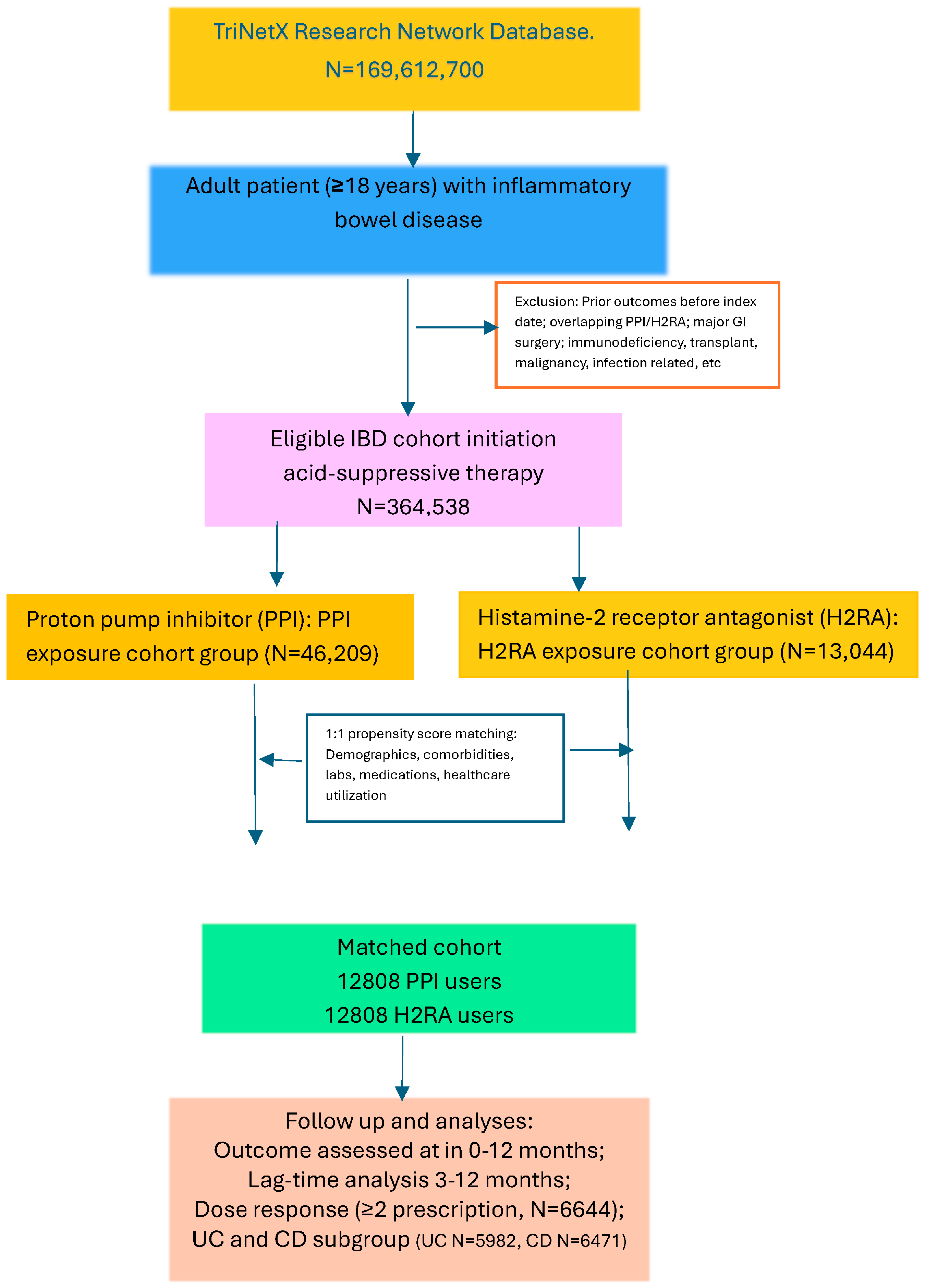
| 13a | Report numbers at each study stage | Results: Cohort Flow |
| 13b | Give reasons for non-participation | Not applicable |
| 13c | Flow diagram | Methods: patient selection |
| 14a | Characteristics of study participants | Results: Baseline Characteristics |
| 14b | Number with missing data | Methods & Results |
| 14c | Summarize follow-up time | Not applicable |
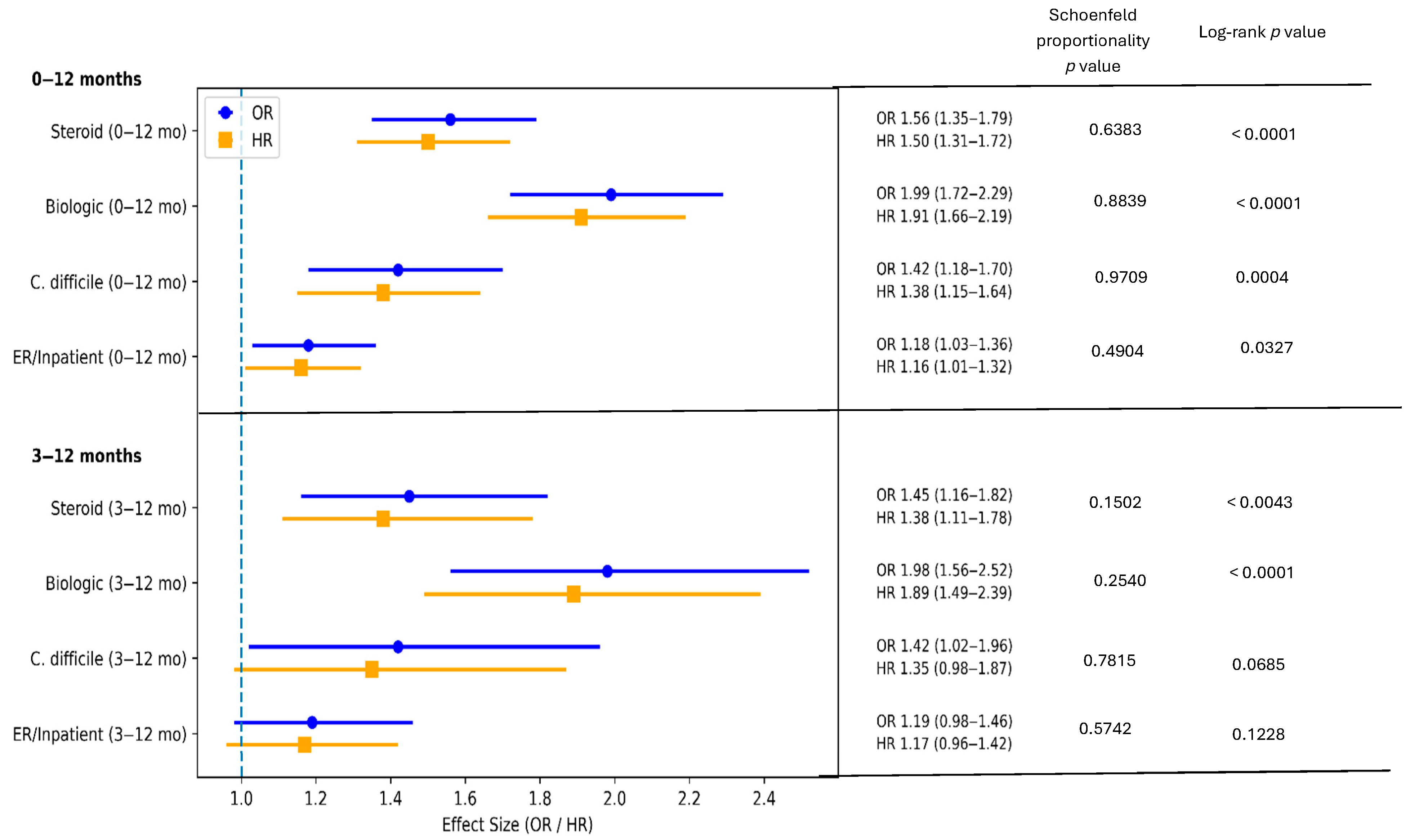
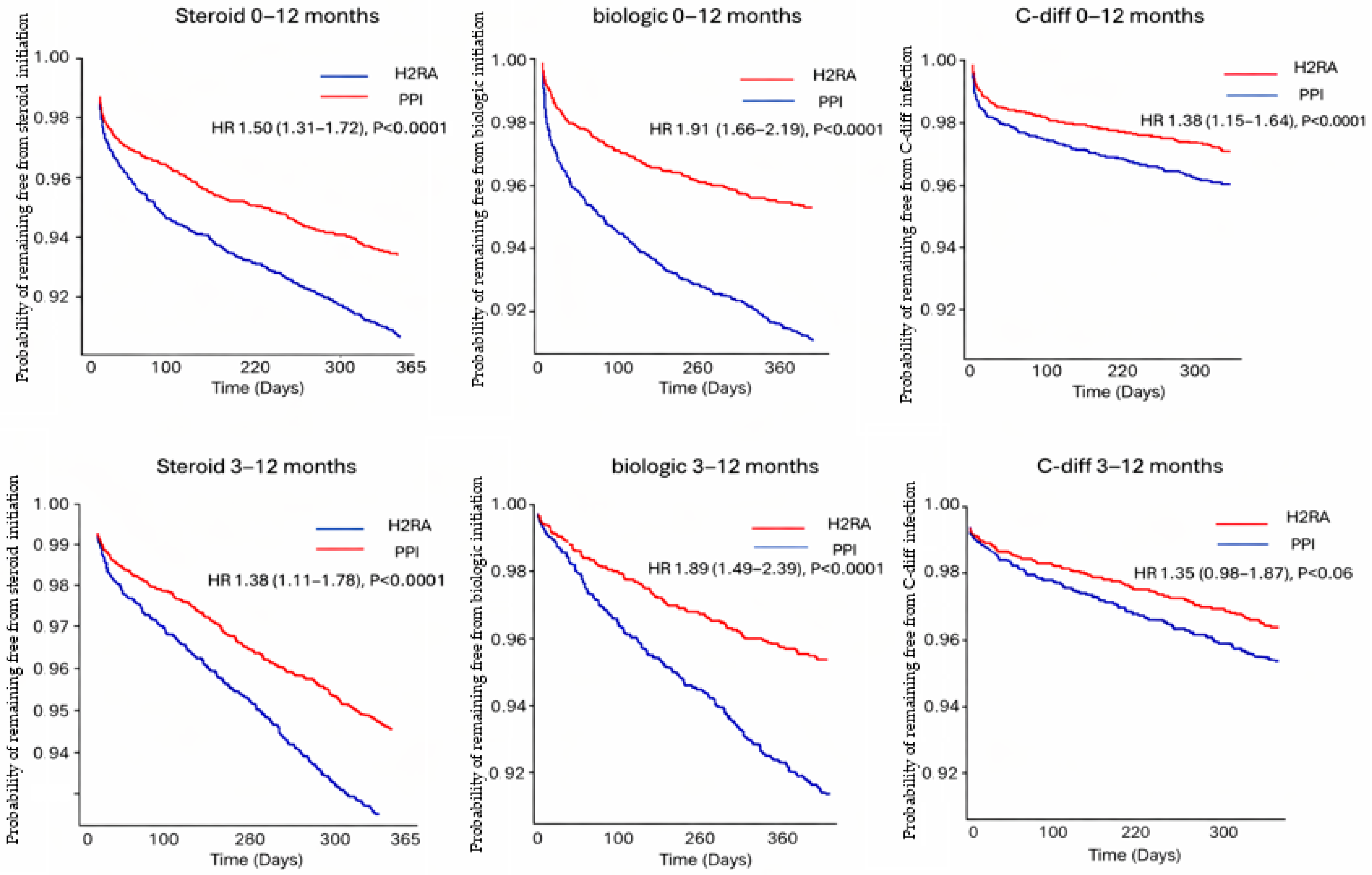
| 15 | Outcome events or summary measures | Results: Cumulative Risk & Event Data |
| 16a | Provide unadjusted/adjusted estimates with precision | Results: Odd ratios, Hazard ratios |
| 16b | Report category boundaries | Methods: Variable Definitions |
| 16c | Translate estimates into absolute risk | Results: Cumulative Risks |
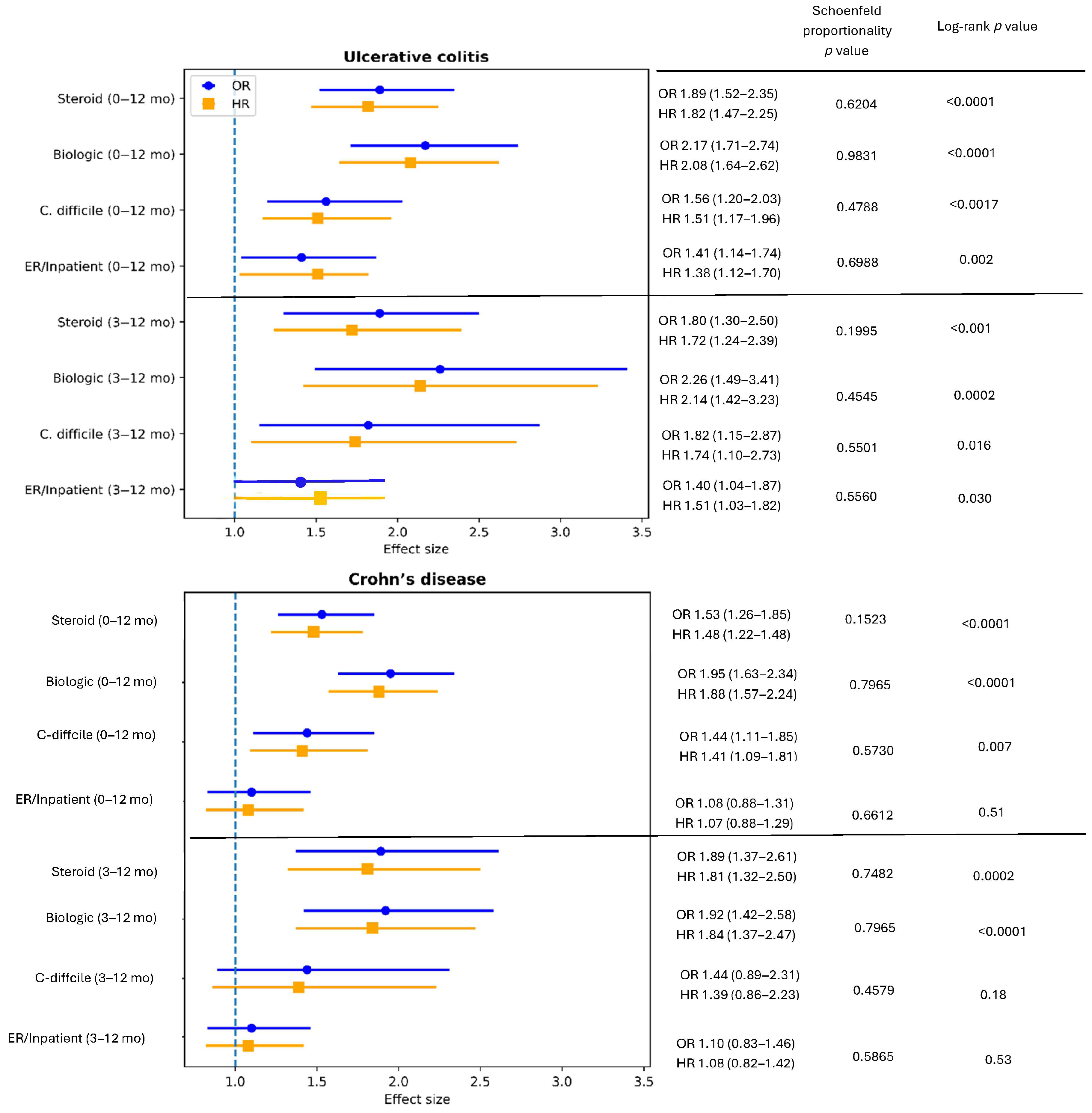
| 17 | Report subgroup/sensitivity analyses | Results: Secondary Analyses |
| 18 | Summarize key results | Discussion: Summary of Findings |
| 19 | Discuss limitations | Discussion: Limitations |
| 20 | Interpret results cautiously | Discussion: Interpretation |
| 21 | Discuss generalizability | Discussion: Generalizability |
| 22 | Funding sources and role | Funding Statement |
| 23 | Ethical approval/IRB exemption | Ethics Statement |
| Search Terms | Associated Code |
|---|---|
| Crohn’s Disease | ICD-10: K50 * |
| Ulcerative Colitis | ICD-10: K51 * |
| Gastro-Esophageal Reflux Disease | ICD: K21 |
| Scleroderma | ICD-10: M34 |
| Hypertension | ICD-10: I10 |
| Chronic Ischemic Heart Disease | ICD-10: I25 |
| Chronic Obstructive Pulmonary Disease | ICD-10: J44 |
| Lupus Erythematosus | ICD-10: L93 |
| Sjörgen Syndrome | ICD-10: M35.0 |
| Type 1 Diabetes Mellitus | ICD-10: E10 |
| Type 2 Diabetes Mellitus | ICD-10: E11 |
| Overweight and obesity | ICD-10: E66 |
| Stem Cell Transplant | TNX Curated 1005 |
| Antineoplastic Agents | ATC L01 |
| Transplanted Organ and Tissue | ICD-10: Z94 |
| Short Bowel Syndrome | ICD-10: K90.82 |
| Celiac Disease | ICD-10: K90.0 |
| Diverticular Disease of Intestine | ICD-10: K57 * |
| Acute Vascular Disorder of Intestine | ICD-10: K55.0 |
| Other Chronic Pancreatitis | ICD-10: K86.1 |
| Malignant Neoplasm of Colon | ICD-10: C18 |
| Colorectal surgeries and procedures | CPT: 1007463, 1007422, 1007570, 1007695, 1007952, 1007592, 1007596, 1007620, 1007663, 1007671, 1007687, 1007692, 1007591, 1007692, 45385, 45390, 45382, 45388 SNOMED CT: 4558008, 118839001, 118840004, 118841000, ICD-9: 46.2 |
| Colonoscopy | SNOMED: 73761001 |
| Unspecific Noninfective Gastroenteritis and Colitis | ICD-10: K52 |
| Postsurgical Malabsorption | ICD-10: K91 |
| Ehlers–Danlos Syndrome | ICD-10: Q79.6 |
| Intestinal Adhesions with Obstruction | ICD-10: K56.5 |
| Unspecified Diseases of Spinal Cord | ICD-10: G95 |
| Rheumatoid Arthritis | ICD-10: M06 |
| SLE | ICD-10: L93 |
| Multiple Sclerosis | ICD-10: G35 |
| Amyloidosis | ICD-10: E85 |
| Atherosclerosis | ICD-10: I70 |
| Peripheral Vascular Disease | ICD-10: I73.9 |
| Coronary Artery Disease | ICD-10: I25.1 |
| Heart Failure | ICD-10: I50 |
| Chronic Kidney Disease | ICD-10: N18 |
| Tobacco Use Disorder | ICD-10: F17 |
| Alcohol Use Disorder | ICD-10: F10 |
| Other Specified Noninfective Gastroenteritis and Colitis | ICD-10: K52.8 |
| Noninfective Gastroenteritis and Colitis, Unspecified | ICD-10: K52.9 |
| Chronic Obstructive Lung Disease | ICD-10: J44 |
| Other Unspecified Intestinal Obstruction | ICD-10: K56.6 |
| Fistula of Intestine | ICD-10: K63.2 |
| Intestinal Failure | ICD-10: K90.83 |
| Erythrocyte Sedimentation Rate | TNX Curated 9066 |
| C-reactive protein | TNX Curated 9063 |
| Hemoglobin A1C | TNX Curated 9037 |
| Calprotectin, Fecal | CPT: 83993 |
| Long-Term Use of Immunosuppressive Biologic | ICD-10:Z79.620 |
| Acute Peptic Ulcer without Hemorrhage or Perforation | ICD-10: K27.3 |
| Chronic Peptic Ulcer without Hemorrhage or Perforation | ICD-10: K27.7 |
| Peptic Ulcer with Hemorrhage | ICD-10: K27.0 |
| Ulcer of Esophagus | ICD-10: K22.1 |
| Ulcer of Esophagus without Bleeding | ICD-10: K22.10 |
| Glucagon-like Protein-1 Receptor Agonists | ATC: A10BJ |
| Proton Pump Inhibitors (PPIs) | RxNorm: 7646, 40790, 283742, 6387, 114979, 1929516 |
| H2-Receptor Antagonist (H2RA) | RxNorm: 4278, 2546, 6056, 9143 |
| Non-Steroid Anti-Inflammatories | RxNorm: 5640, 1191, 7258, 3355, 35827, 41493 |
| Methotrexate | RxNorm:6851 |
| Steroid | RxNorm: 8640, 6902, 5492, 19831 |
| Azathioprine | RxNorm: 1256 |
| Biologic medicine | RxNorm: 1538097, 847083 |
| Human Immunodeficiency Virus (HIV) Disease | ICD-10: B20 |
| Aspirin | RxNorm: 1191 |
| Anticoagulants | VA -: BL 110 |
| Antibiotics | RxNorm: 2582, AM117, AM 118, S01 AE |
| Hospital inpatient or Observation Service | CPT: 1013659 |
References
- Forgacs, I.; Loganayagam, A. Overprescribing proton pump inhibitors. BMJ 2008, 336, 2–3. [Google Scholar] [CrossRef] [Scilit]
- Heidelbaugh, J.J.; Kim, A.H.; Chang, R.; Walker, P.C. Overutilization of proton-pump inhibitors: What the clinician needs to know. Therap. Adv. Gastroenterol. 2012, 5, 219–232. [Google Scholar] [CrossRef] [Scilit]
- Bin, X.; Yang, M.; Nguyen, L.H.; He, Q.; Zhen, J.; Yu, Y.; Di, M.; Qin, X.; Lu, Q.; Kuo, Z.C.; et al. Regular Use of Proton Pump Inhibitor and the Risk of Inflammatory Bowel Disease: Pooled Analysis of 3 Prospective Cohorts. Gastroenterology 2021, 161, 1842–1852.e10. [Google Scholar] [CrossRef] [Scilit] [PubMed]
- Bavishi, C.; Dupont, H.L. Systematic review: The use of proton pump inhibitors and increased susceptibility to enteric infection. Aliment. Pharmacol. Ther. 2011, 34, 1269–1281. [Google Scholar] [CrossRef] [Scilit]
- Abrahami, D.; Pradhan, R.; Yin, H.; Yanofsky, R.; McDonald, E.M.; Bitton, A.; Azoulay, L. Proton pump inhibitors and the risk of inflammatory bowel disease: Population-based cohort study. Gut 2023, 72, 1288–1295. [Google Scholar] [CrossRef] [Scilit]
- Sachs, G.; Shin, J.M.; Howden, C.W. Review article: The clinical pharmacology of proton pump inhibitors. Aliment. Pharmacol. Ther. 2006, 23, 2–8. [Google Scholar] [CrossRef] [Scilit] [PubMed]
- Imhann, F.; Bonder, M.J.; Vila, A.V.; Fu, J.; Mujagic, Z.; Vork, L.; Tigchelaar, E.F.; Jankipersadsing, S.A.; Cenit, M.C.; Harmsen, H.J.M.; et al. Proton pump inhibitors affect the gut microbiome. Gut 2016, 65, 740–748. [Google Scholar] [CrossRef] [Scilit]
- Tariq, R.; Singh, S.; Gupta, A.; Pardi, D.S.; Khanna, S. Association of Gastric Acid Suppression with Recurrent Clostridium difficile Infection: A Systematic Review and Meta-analysis. JAMA Intern. Med. 2017, 177, 784–791. [Google Scholar] [CrossRef] [Scilit]
- Deshpande, A.; Pant, C.; Pasupuleti, V.; Rolston, D.D.K.; Jain, A.; Deshpande, N.; Thota, P.; Sferra, T.J.; Hernandez, A.V. Association between proton pump inhibitor therapy and Clostridium difficile infection in a meta-analysis. Clin. Gastroenterol. Hepatol. 2012, 10, 225–233. [Google Scholar] [CrossRef] [Scilit] [PubMed]
- Foppa, C.; Rizkala, T.; Repici, A.; Hassan, C.; Spinelli, A. Microbiota and IBD: Current knowledge and future perspectives. Dig. Liver Dis. 2024, 56, 911–922. [Google Scholar] [CrossRef] [Scilit]
- Stange, E.F.; Schroeder, B.O. Microbiota and mucosal defense in IBD: An update. Expert Rev. Gastroenterol. Hepatol. 2019, 13, 963–976. [Google Scholar] [CrossRef] [Scilit] [PubMed]
- Choden, T.; Zhang, H.; Sakuraba, A. Influence of proton pump inhibitor use on clinical outcomes of patients with inflammatory bowel disease. Ann. Med. 2023, 55, 2198775. [Google Scholar] [CrossRef] [Scilit] [PubMed]
- Lin, Y.-T.; Lin, T.-Y.; Hung, S.-C.; Yiu, P.-Y.; Wu, P.-H.; Chuang, Y.-S.; Hung, W.-C.; Chiu, Y.-W.; Kuo, M.-C.; Wu, C.-Y. Anti-Acid Drug Treatment Induces Changes in the Gut Microbiome Composition of Hemodialysis Patients. Microorganisms 2021, 9, 286. [Google Scholar] [CrossRef] [Scilit] [PubMed]
- TriNetX. Available online: https://trinetx.com (accessed on 10 January 2026).
- Von Elm, E.; Altman, D.G.; Egger, M.; Pocock, S.J.; Gøtzsche, P.C.; Vandenbroucke, J.P.; STROBE Initiative. Strengthening the Reporting of Observational Studies in Epidemiology (STROBE) statement: Guidelines for reporting observational studies. J. Clin. Epidemiol. 2008, 61, 344–349. [Google Scholar] [CrossRef] [Scilit]
- Austin, P.C. Balance diagnostics for comparing the distribution of baseline covariates between treatment groups in propensity-score matched samples. Stat. Med. 2009, 28, 3083–3107. [Google Scholar] [CrossRef] [Scilit] [PubMed]
- Haukoos, J.S.; Lewis, R.J. The Propensity Score. JAMA 2015, 314, 1637–1638. [Google Scholar] [CrossRef] [Scilit]
- Austin, P.C. The use of propensity score methods with survival or time-to-event outcomes: Reporting measures of effect similar to those used in randomized experiments. Stat. Med. 2014, 33, 1242–1258. [Google Scholar] [CrossRef] [Scilit]
- Zhang, Z.; Reinikainen, J.; Adeleke, K.A.; Pieterse, M.E.; Groothuis-Oudshoorn, C.G.M. Time-varying covariates and coefficients in Cox regression models. Ann. Transl. Med. 2018, 6, 121. [Google Scholar] [CrossRef] [Scilit]
- Tamim, H.; Monfared, A.A.; LeLorier, J. Application of lag-time into exposure definitions to control for protopathic bias. Pharmacoepidemiol. Drug Saf. 2007, 16, 250–258. [Google Scholar] [CrossRef] [Scilit]
- Suissa, S.; Dell’Aniello, S. Time-related biases in pharmacoepidemiology. Pharmacoepidemiol. Drug Saf. 2020, 29, 1101–1110. [Google Scholar] [CrossRef] [Scilit] [PubMed]
- Qiu, P.; Ishimoto, T.; Fu, L.; Zhang, J.; Zhang, Z.; Liu, Y. The Gut Microbiota in Inflammatory Bowel Disease. Front. Cell. Infect. Microbiol. 2022, 12, 733992. [Google Scholar] [CrossRef] [Scilit]
- Singh, N.; Bernstein, C.N. Environmental risk factors for inflammatory bowel disease. United Eur. Gastroenterol. J. 2022, 10, 1047–1053. [Google Scholar] [CrossRef] [Scilit] [PubMed]
- Seto, C.T.; Jeraldo, P.; Orenstein, R.; Chia, N.; DiBaise, J.K. Erratum to: Prolonged use of a proton pump inhibitor reduces microbial diversity: Implications for Clostridium difficile susceptibility. Microbiome 2016, 4, 10. [Google Scholar] [CrossRef] [Scilit]
- Imhann, F.; Vila, A.V.; Bonder, M.J.; Manosalva, A.G.L.; Koonen, D.P.Y.; Fu, J.; Wijmenga, C.; Zhernakova, A.; Weersma, R.K. The influence of proton pump inhibitors and other commonly used medication on the gut microbiota. Gut Microbes 2017, 8, 351–358. [Google Scholar] [CrossRef] [Scilit] [PubMed]
- Finke, M.; Boven, A.; Vlieghe, E.; Engstrand, L.; Orsini, N.; Brusselaers, N. Proton pump inhibitors and the risk of Clostridioides difficile infection: A systematic review and dose-response meta-analysis. J. Infect. 2025, 90, 106488. [Google Scholar] [CrossRef] [Scilit] [PubMed]
- Vich Vila, A.; Imhann, F.; Collij, V.; Jankipersadsing, S.A.; Gurry, T.; Mujagic, A.; Kurilshikov, A.; Bonder, M.J.; Jiang, X.; Tigchelaar, E.F.; et al. Gut microbiota composition and functional changes in inflammatory bowel disease and irritable bowel syndrome. Sci. Transl. Med. 2018, 10, eaap8914. [Google Scholar] [CrossRef] [Scilit] [PubMed]
- Lloyd-Price, J.; Arze, C.; Ananthakrishnan, A.N.; Schirmer, M.; Avila-Pacheco, J.; Poon, T.W.; Andrews, E.; Ajami, N.J.; Bonham, K.S.; Brislawn, C.J.; et al. Multi-omics of the gut microbial ecosystem in inflammatory bowel diseases. Nature 2019, 569, 655–662. [Google Scholar] [CrossRef] [Scilit]
- Fowler, J.F.; Eubank, T.A.; Garey, K.W. Proton pump inhibitor effect on macrophage and neutrophil function: A systematic review. Front. Immunol. 2024, 15, 1477993. [Google Scholar] [CrossRef] [Scilit]
- Zhang, M.; Liu, W.; Liu, Y.; Cheng, Q.; Zhang, X.; Qian, N.; Qi, J.; Chen, T.; Yu, Y. Proton pump inhibitor increases intestinal epithelial paracellular permeability via the p38-MAPK/NF-kappaB signaling pathway. Mol. Biol. Rep. 2025, 53, 170. [Google Scholar] [CrossRef] [Scilit]
- Massironi, S.; Solitano, V.; Furfaro, F.; D’Amico, F.; Zilli, A.; Allocca, M.; Peyrin-Biroulet, L.; Jairath, V.; Danese, S. Impact of type 2 diabetes on clinical outcomes and advanced therapy use in patients with Crohn’s disease: A real-world propensity score-matched analysis. J. Crohns Colitis 2025, 19, jjaf157. [Google Scholar] [CrossRef] [Scilit] [PubMed]


| Characteristic | Before Match | After Match | ||||
|---|---|---|---|---|---|---|
| Cohort, No. | SMD | Cohort, No. | SMD | |||
| PPI | H2RA | PPI | H2RA | |||
| Total No. | 46,209 | 13,044 | 12,808 | 12,808 | ||
| A. Demographics | ||||||
| Age, mean ± SD (years) | 52.1 ± 19.3 | 47.7 ± 19.0 | 0.234 | 48.0 ± 19.3 | 48.0 ± 19.0 | 0.004 |
| Female, n (%) | 22,378 (47.6) | 7039 (53.8) | 0.126 | 6922 (54.0) | 6836 (53.4) | 0.005 |
| Male, n (%) | 24,591 (52.3) | 6037 (46.1) | 0.126 | 5873 (45.9) | 5966 (46.6) | 0.003 |
| White race, n (%) | 30,162 (64.2) | 9479 (72.5) | 0.179 | 9253 (72.2) | 9291 (72.5) | 0.001 |
| Not Hispanic or Latino, n (%) | 26,500 (56.4) | 9098 (69.4) | 0.2724 | 8858 (69.1) | 8849 (69.0) | 0.0015 |
| Black or African American, n (%) | 2927 (6.2) | 1385 (10.6) | 0.158 | 1330 (10.4) | 1312 (10.2) | 0.015 |
| Hispanic or Latino, n (%) | 1589 (3.4) | 567 (4.3) | 0.050 | 567 (4.4) | 549 (4.3) | 0.005 |
| Asian, n (%) | 1149 (2.5) | 395 (3.0) | 0.0349 | 383 (3.0) | 385 (3.0) | 0.0001 |
| Unknown Ethnicity, n (%) | 18,901 (40.2) | 3438 (26.2) | 0.3002 | 3408 (26.6) | 3421 (26.7) | 0.002 |
| Unknown race, n (%) | 10,968 (23.3) | 1292 (9.9) | 0.3684 | 1349 (10.5) | 1292 (10.1) | 0.014 |
| American Indian or Alaska Native, n (%) | 131 (0.3) | 44 (0.3) | 0.0103 | 31 (0.2) | 44 (0.3) | 0.018 |
| Native Hawaiian or Other Pacific Islander, n (%) | 77 (0.2) | 31 (0.2) | 0.013 | 29 (0.2) | 30 (0.2) | 0.007 |
| B. Comorbidities | ||||||
| Heart failure, n (%) | 3141 (6.68%) | 616 (4.70%) | 0.086 | 598 (4.66%) | 616 (4.80%) | 0.007 |
| Chronic ischemic heart disease, n (%) | 5250 (11.17%) | 1114 (8.50%) | 0.090 | 1110 (8.66%) | 1111 (8.66%) | 0.000 |
| Alcohol related disorders, n (%) | 1852 (3.94%) | 424 (3.24%) | 0.038 | 438 (3.42%) | 421 (3.28%) | 0.007 |
| Overweight and obesity, n (%) | 5778 (12.29%) | 1686 (12.87%) | 0.017 | 1624 (12.66%) | 1642 (12.80%) | 0.004 |
| Body mass index [BMI] 40.0–44.9, adult, n (%) | 597 (1.27%) | 203 (1.55%) | 0.024 | 220 (1.72%) | 195 (1.52%) | 0.015 |
| Body mass index [BMI] 30–39, adult, n (%) | 2411 (5.13%) | 763 (5.82%) | 0.030 | 757 (5.90%) | 741 (5.78%) | 0.005 |
| Type 1 diabetes mellitus, n (%) | 508 (1.08%) | 140 (1.07%) | 0.001 | 124 (0.97%) | 138 (1.08%) | 0.011 |
| Long-term (current) use of immunosuppressive biologic, n (%) | 219 (0.47%) | 134 (1.02%) | 0.065 | 114 (0.89%) | 113 (0.88%) | 0.001 |
| Ulcer of esophagus, n (%) | 322 (0.69%) | 20 (0.15%) | 0.083 | 39 (0.30%) | 20 (0.16%) | 0.031 |
| Ulcer of esophagus without bleeding, n (%) | 247 (0.53%) | 18 (0.14%) | 0.068 | 30 (0.23%) | 18 (0.14%) | 0.022 |
| Acute peptic ulcer, without hemorrhage or perforation, n (%) | 77 (0.16%) | 10 (0.08%) | 0.025 | 10 (0.08%) | 10 (0.08%) | 0.000 |
| Chronic peptic ulcer, without hemorrhage or perforation, n (%) | 20 (0.04%) | 10 (0.08%) | 0.014 | 10 (0.08%) | 10 (0.08%) | 0.000 |
| Acute peptic ulcer, with hemorrhage, n (%) | 15 (0.03%) | 10 (0.08%) | 0.019 | 10 (0.08%) | 10 (0.08%) | 0.000 |
| COPD, n (%) | 3182 (6.77%) | 631 (4.82%) | 0.084 | 606 (4.73%) | 628 (4.90%) | 0.008 |
| Hypertension, n (%) | 15,678 (33.4) | 3608 (27.6) | 0.126 | 3673 (28.7) | 3584 (28.0) | 0.013 |
| GERD, n (%) | 15,723 (33.5) | 2686 (20.5) | 0.294 | 2774 (21.7) | 2684 (21.0) | 0.053 |
| Type 2 diabetes, n (%) | 6513 (13.9) | 1336 (10.2) | 0.112 | 1338 (10.5) | 1333 (10.4) | 0.002 |
| Chronic kidney disease, n (%) | 3551 (7.6) | 815 (6.2) | 0.052 | 828 (6.5) | 810 (6.3) | 0.004 |
| Nicotine dependence, n (%) | 2747 (5.9) | 886 (6.7) | 0.038 | 822 (6.4) | 868 (6.7) | 0.014 |
| C. Laboratory Variables | ||||||
| CRP, mean ± SD (mg/L) | 32.91 ± 56.28 | 27.44 ± 49.75 | 0.103 | 33.05 ± 56.03 | 27.60 ± 49.85 | 0.09 |
| CRP ≤ 10 mg/L, n (%) | 8541 (18.1) | 2329 (17.8) | 0.010 | 2210 (17.2) | 2256 (17.5) | 0.009 |
| ESR, mean ± SD (mm/hr) | 24.10 ± 24.48 | 23.75 ± 24.39 | 0.015 | 25.21 ± 24.85 | 23.84 ± 24.44 | 0.056 |
| ESR ≤ 20 mm/hr, n (%) | 6334 (13.4) | 2027 (15.5) | 0.057 | 1951 (15.2) | 1949 (15.2) | 0.000 |
| Hemoglobin A1c, mean ± SD | 6.13 ± 1.40 | 5.99 ± 1.35 | 0.100 | 6.05 ± 1.39 | 6.00 ± 1.35 | 0.036 |
| HbA1c ≥ 7%, n (%) | 2242 (4.8) | 534 (4.0) | 0.034 | 506 (4.0) | 530 (4.1) | 0.010 |
| HbA1c ≥ 8%, n (%) | 1432 (3.1) | 355 (2.7) | 0.020 | 343 (2.7) | 351 (2.7) | 0.004 |
| HbA1c ≥ 9%, n (%) | 919 (2.0) | 242 (1.8) | 0.008 | 238 (1.9) | 240 (1.9) | 0.001 |
| Calprotectin, fecal, n (%) | 1147 (2.4) | 486 (3.7) | 0.074 | 474 (3.7) | 458 (3.6) | 0.007 |
| D. Medications | ||||||
| Anticoagulants, n (%) | 15,998 (34.0) | 4284 (32.7) | 0.029 | 4260 (33.2) | 4224 (33.0) | 0.006 |
| Methylprednisolone, n (%) | 7520 (16.0) | 3616 (27.6) | 0.284 | 3397 (26.5) | 3387 (26.4) | 0.002 |
| Prednisone, n (%) | 8566 (18.2) | 2854 (21.8) | 0.089 | 2769 (21.6) | 2771 (21.6) | 0.000 |
| Ibuprofen, n (%) | 5238 (11.2) | 2299 (17.5) | 0.183 | 2150 (16.8) | 2167 (16.9) | 0.004 |
| Fluoroquinolones, n (%) | 8294 (17.7) | 2049 (15.6) | 0.054 | 2008 (15.7) | 2020 (15.7) | 0.003 |
| Aspirin, n (%) | 8287 (17.6) | 1953 (14.9) | 0.074 | 1862 (14.5) | 1936 (15.1) | 0.016 |
| Hydrocortisone, n (%) | 5012 (10.7) | 2008 (15.3) | 0.139 | 1852 (14.4) | 1859 (14.5) | 0.002 |
| Budesonide, n (%) | 4016 (8.6) | 998 (7.6) | 0.034 | 1010 (7.9) | 975 (7.6) | 0.010 |
| Clindamycin, n (%) | 2119 (4.5) | 835 (6.4) | 0.082 | 822 (6.4) | 800 (6.2) | 0.007 |
| Azathioprine, n (%) | 3142 (6.7) | 622 (4.8) | 0.084 | 628 (4.9) | 617 (4.8) | 0.004 |
| Naproxen, n (%) | 2142 (4.6) | 585 (4.5) | 0.005 | 552 (4.3) | 569 (4.4) | 0.006 |
| Vedolizumab, n (%) | 597 (1.3) | 457 (3.5) | 0.146 | 398 (3.1) | 356 (2.8) | 0.019 |
| Ustekinumab, n (%) | 665 (1.4) | 329 (2.5) | 0.079 | 331 (2.6) | 302 (2.4) | 0.015 |
| Cephalosporin 3rd generation, n (%) | 6844 (14.6) | 1622 (12.4) | 0.064 | 1574 (12.3) | 1598 (12.5) | 0.006 |
| Cephalosporin 4th generation, n (%) | 908 (1.9) | 222 (1.6) | 0.018 | 221 (1.7) | 221 (1.7) | 0.000 |
| Methotrexate, n (%) | 0 (0%) | 0 (0%) | 0 (0%) | 0 (0%) | ||
| E. Health Care Utilization | ||||||
| Hospital Inpatient and Observation Services, n (%) | 8577 (18.3) | 2268 (17.3) | 0.025 | 2307 (17.9) | 2253 (17.6) | 0.011 |
| Pulmonary procedures, n (%) | 4775 (10.2) | 1534 (11.7) | 0.050 | 1290 (10.1) | 1516 (11.8) | 0.056 |
| Exposure Definition | Follow-Up | Outcome | OR (95% CI) | HR (95% CI) |
|---|---|---|---|---|
| ≥2 prescriptions | 0–12 months | Steroid | 1.15 (0.98–1.35) | 1.14 (0.97–1.33) |
| Biologic | 1.56 (1.31–1.86) | 1.54 (1.30–1.82) | ||
| C. difficile | 1.26 (1.02–1.57) | 1.26 (1.02–1.56) | ||
| ER/Inpatient Visit | 1.09 (0.92–1.30) | 1.11 (0.94–1.31) | ||
| 3–12 months | Steroid | 1.20 (0.87–1.46) | 1.19 (0.93–1.52) | |
| Biologic | 1.48 (1.12–1.97) | 1.45 (1.09–1.93) | ||
| C. difficile | 1.42 (0.95–2.11) | 1.40 (0.94–2.09) | ||
| ER/Inpatient Visit | 1.12 (0.87–1.45) | 1.14 (0.89–1.46) |
Disclaimer/Publisher’s Note: The statements, opinions and data contained in all publications are solely those of the individual author(s) and contributor(s) and not of MDPI and/or the editor(s). MDPI and/or the editor(s) disclaim responsibility for any injury to people or property resulting from any ideas, methods, instructions or products referred to in the content. |
© 2026 by the authors. Licensee MDPI, Basel, Switzerland. This article is an open access article distributed under the terms and conditions of the Creative Commons Attribution (CC BY) license.
Share and Cite
Sun, Y.; Veccia, D.; Song, G.; Waghray, N. Acid-Suppressive Therapy Choice and Risk of Treatment Escalation in Inflammatory Bowel Disease: A Real-World Comparative Retrospective Study to Inform Personalized Treatment. J. Pers. Med. 2026, 16, 193. https://doi.org/10.3390/jpm16040193
Sun Y, Veccia D, Song G, Waghray N. Acid-Suppressive Therapy Choice and Risk of Treatment Escalation in Inflammatory Bowel Disease: A Real-World Comparative Retrospective Study to Inform Personalized Treatment. Journal of Personalized Medicine. 2026; 16(4):193. https://doi.org/10.3390/jpm16040193
Chicago/Turabian StyleSun, Yan, Donovan Veccia, Gengqing Song, and Nisheet Waghray. 2026. "Acid-Suppressive Therapy Choice and Risk of Treatment Escalation in Inflammatory Bowel Disease: A Real-World Comparative Retrospective Study to Inform Personalized Treatment" Journal of Personalized Medicine 16, no. 4: 193. https://doi.org/10.3390/jpm16040193
APA StyleSun, Y., Veccia, D., Song, G., & Waghray, N. (2026). Acid-Suppressive Therapy Choice and Risk of Treatment Escalation in Inflammatory Bowel Disease: A Real-World Comparative Retrospective Study to Inform Personalized Treatment. Journal of Personalized Medicine, 16(4), 193. https://doi.org/10.3390/jpm16040193