Artificial Intelligence in Minimally Invasive and Robotic Gastrointestinal Surgery: Major Applications and Recent Advances

Abstract
1. Introduction
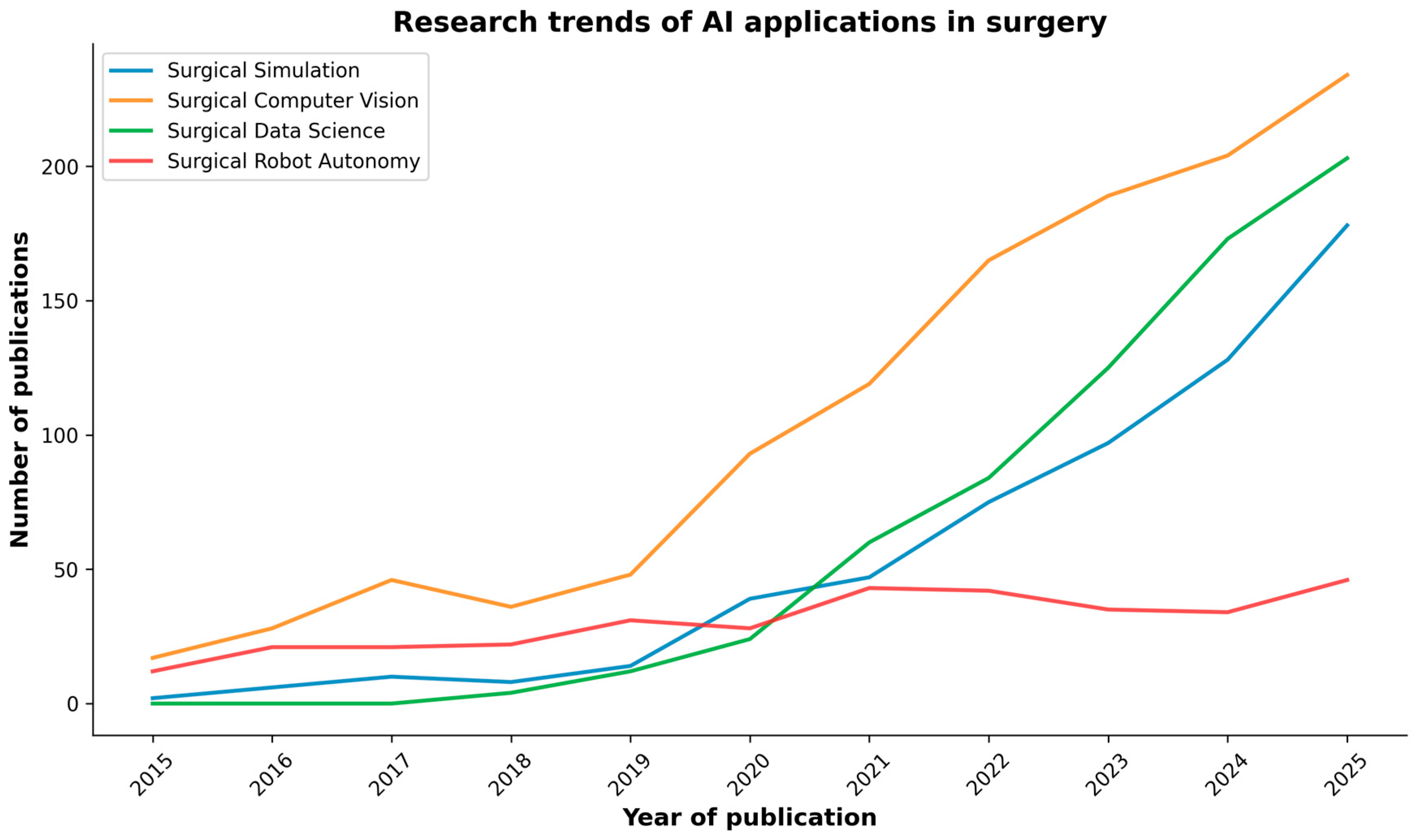
Search Strategy and Study Selection
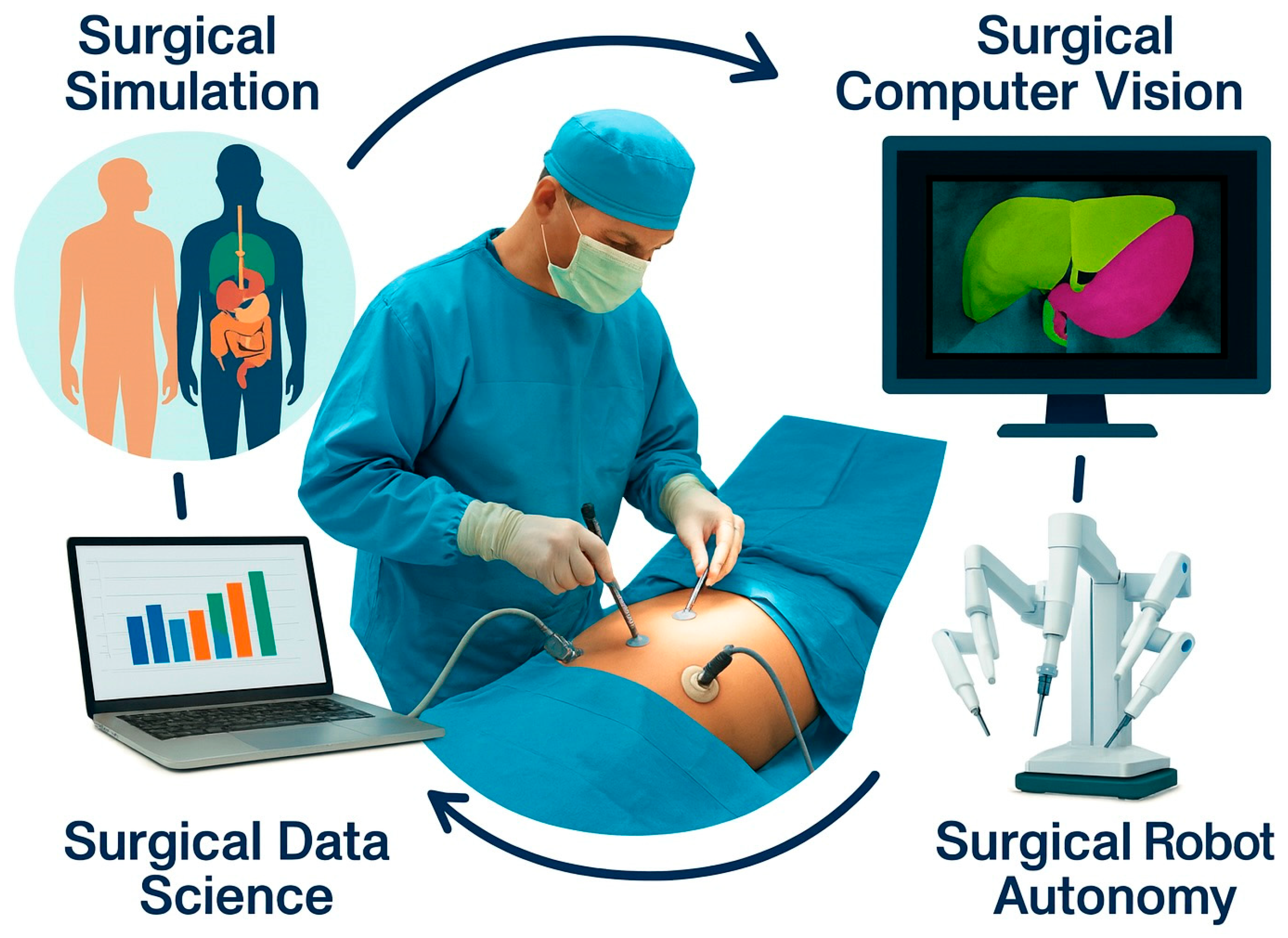
2. Surgical Simulation
3. Surgical Computer Vision
4. Surgical Data Science
5. Surgical Robot Autonomy
| Technical Application | Clinical Application | Data Modality | AI Model/Method | Outcome | References |
|---|---|---|---|---|---|
| Surgical Simulation | |||||
| Skill assessment | GI | VR, kinematics | Supervised scoring | Intraoperative expert tutoring | [21] |
| Planning | Colorectal | VR, medical imaging, digital twins | Anatomy segmentation | Improved efficiency, planning fidelity | [22,35,36,37,38,39,40] |
| Coaching, training | Laparoscopy, cholecystectomy | VR, telemetry | Analytics | Scalable coaching workflows | [23,24,25,26,27,28,29,30,31] |
| Autonomous task execution | GI | Image RGBD, kinematics | RL, IL | Benchmark for AI agents training | [41,42,43] |
| Surgical Computer Vision | |||||
| Scene understanding | Laparoscopy | Video RGB | CNN detection | Improved spatial understanding and contextualization | [44,45] |
| Tool segmentation | Laparoscopy, cholecystectomy | Video RGB | CNN segmentation | Improved spatial understanding and contextualization | [46,73] |
| Tool and object detection | Laparoscopy | Video RGB | CNN detection | Improved spatial understanding and contextualization | [47,48,49,50,58] |
| Unsafe event detection | Laparoscopy, cholecystectomy | Video RGB | CNN detection | Timing of critical steps | [51,52] |
| Safety verification | Critical view of Safety scoring | Video RGB | CNN data aggregation | Near real-time safety check | [53,54,55] |
| Anatomy segmentation | GI dissection | Video RGB | CNN segmentation | Enhanced intraoperative guidance | [56,57] |
| Anatomy segmentation | Colonoscopy | Video RGB | CNN detection | Enhanced intraoperative guidance | [67,68,69] |
| Workflow/Phase recognition | GI | Video RGB | Transformer temporal detection | Enhanced intraoperative guidance | [59,60,61,62,63,64,65,66] |
| Multi modal frameworks | GI | Video RGB, text, kinematics | LLM, VLM, VLA | Robust perception and planning | [70,71,72] |
| Surgical Data Science | |||||
| Outcome prediction | GI, bariatric, colorectal | Video RGB | RNN regression | Procedure outcome prediction | [74,86,87] |
| Outcome prediction | Colorectal | Perioperative data | Classification | Mid/Long term readmission prediction | [75] |
| Unsafe event prediction | GI, Gastrectomy | Perioperative data | Classification | Procedural events prediction | [76,82,83,84,85,89,90] |
| Skill classification and assessment | GI | Video, kinematics | CNN classification | Automated skill assessment | [77,78,81] |
| Case duration prediction | GI | Perioperative data | Regression | Automated case duration prediction | [79,80] |
| Safety verification system | GI | Video RGB, sensors | Regression | Perioperative unsafe events detection | [91] |
| Surgical Robot Autonomy | |||||
| Camera control | Laparoscopy, Endoscopy | Video, kinematics | RL, visual servoing, voice control | Autonomous tool-centering camera | [97,98,99,100,101,102,103] |
| Blood suction | Laparoscopy | Image RGBD, forces | RL, sim to real | Autonomous blood suction | [104,105] |
| Tissue retraction | GI | Video RGBD, forces | RL, sim to real | Autonomous organ exposure and tissue tensioning | [106,107,108,116] |
| Suturing | GI | Video RGB, kinematics | CNN segmentation, planning and control | Autonomous anastomosis | [95,96,109,110,111,112] |
| Surgical tasks | GI | Video RGB, kinematics | Diffusion models | Autonomous surgical subtasks | [113,114] |
| Surgical tasks | GI, ex-vivo cholecystectomy | Text, video RGB, kinematics | VLA, Transformers, Diffusion models | Hierarchical, Language-conditioned policy | [115,116] |
6. Discussion
6.1. Multidisciplinary Implementation and Integration Across Data Sources
6.2. Need for Robust Validation and Benchmarking
6.3. Ethical and Legal Considerations in GI Surgical AI
7. Conclusions
Author Contributions
Funding
Institutional Review Board Statement
Informed Consent Statement
Data Availability Statement
Acknowledgments
Conflicts of Interest
Abbreviations
| AI | Artificial Intelligence |
| ML | Machine Learning |
| DL | Deep Learning |
| GI | Gastrointestinal |
| MR | Mixed Reality |
| VR | Virtual Reality |
| CV | Computer Vision |
| SL | Supervised Learning |
| RL | Reinforcement Learning |
| IL | Imitation Learning |
| RNN | Recurrent Neural Network |
| CNN | Convolutional Neural Network |
| LLM | Large Language Model |
| VLM | Vision Language Model |
| VLA | Vision Language Action Model |
References
- Varghese, C.; Harrison, E.M.; O’grady, G.; Topol, E.J. Artificial intelligence in surgery. Nat. Med. 2024, 30, 1257–1268. [Google Scholar] [CrossRef]
- Pescio, M.; Kundrat, D.; Dagnino, G. Endovascular robotics: Technical advances and future directions. Minim. Invasive Ther. Allied Technol. 2025, 34, 239–252. [Google Scholar] [CrossRef] [PubMed]
- Huang, Y.; Zhang, F.; Zhang, F.; Wu, X.; Xinye, Y. Machine learning-driven inverse design of puncture needles with tailored mechanics. Minim. Invasive Ther. Allied Technol. 2025, 35, 18–27. [Google Scholar] [CrossRef]
- Dagnino, G.; Kundrat, D. Robot-assistive minimally invasive surgery: Trends and future directions. Int. J. Intell. Robot. Appl. 2024, 8, 812–826. [Google Scholar] [CrossRef]
- Ammirati, C.A.; Arezzo, A.; Gaetani, C.; Strazzarino, G.A.; Faletti, R.; Bergamasco, L.; Barisone, F.; Fonio, P.; Morino, M. Can we apply the concept of sentinel lymph nodes in rectal cancer surgery? Minim. Invasive Ther. Allied Technol. 2024, 33, 334–340. [Google Scholar] [CrossRef] [PubMed]
- Baldari, L.; Boni, L.; Cassinotti, E. Lymph node mapping with ICG near-infrared fluorescence imaging: Technique and results. Minim. Invasive Ther. Allied Technol. 2023, 32, 213–221. [Google Scholar] [CrossRef]
- Benzoni, I.; Fricano, M.; Borali, J.; Bonafede, M.; Celotti, A.; Tarasconi, A.; Ranieri, V.; Totaro, L.; Quarti, L.M.; Dendena, A.; et al. Fluorescence-guided mesorectal nodes harvesting associated with local excision for early rectal cancer: Technical notes. Minim. Invasive Ther. Allied Technol. 2025, 34, 290–296. [Google Scholar] [CrossRef]
- Takahashi, M.; Nakazawa, K.; Usami, Y.; Mori, K.; Suzuki, J.; Asami, S.; Okada, Y.; Tajima, H.; Kozawa, E.; Baba, Y. Feasibility and clinical outcomes of CT-guided percutaneous gastrostomy with non-guidewire device. Minim. Invasive Ther. Allied Technol. 2025, 35, 28–33. [Google Scholar] [CrossRef]
- Igami, T.; Hayashi, Y.; Yokyama, Y.; Mori, K.; Ebata, T. Development of real-time navigation system for laparoscopic hepatectomy using magnetic micro sensor. Minim. Invasive Ther. Allied Technol. 2024, 33, 129–139. [Google Scholar] [CrossRef]
- Mintz, Y.; Brodie, R. Introduction to artificial intelligence in medicine. Minim. Invasive Ther. Allied Technol. 2019, 28, 73–81. [Google Scholar] [CrossRef] [PubMed]
- Hao, J.; Cheng, D.; Jiang, J.; Zuo, B.; Zhang, Y. Real-time indocyanine green fluorescence imaging and navigation for cone unit laparoscopic hepatic resection of intrahepatic duct stone: A case series study. Minim. Invasive Ther. Allied Tech-Nologies 2024, 33, 351–357. [Google Scholar] [CrossRef]
- Koseoglu, B.; Ozercan, A.Y.; Colak, A.; Basboga, S.; Tuncel, A. Can near-infrared imaging distinguish a gelatin-based matrix granuloma from a malignancy in a kidney? Minim. Invasive Ther. Allied Technol. 2024, 33, 58–62. [Google Scholar] [CrossRef]
- Oderda, M.; Marquis, A.; Calleris, G.; D’aGate, D.; Delsedime, L.; Vissio, E.; Dematteis, A.; Gatti, M.; Faletti, R.; Marra, G.; et al. Transperineal 3D fusion imaging-guided targeted microwaves ablation for low to intermediate-risk prostate cancer: Results of a phase I-II study. Minim. Invasive Ther. Allied Technol. 2025, 34, 194–202. [Google Scholar] [CrossRef]
- Ward, T.M.; Mascagni, P.; Ban, Y.; Rosman, G.; Padoy, N.; Meireles, O.; Hashimoto, D.A. Computer vision in surgery. Surgery 2021, 169, 1253–1256. [Google Scholar] [CrossRef] [PubMed]
- Maier-Hein, L.; Eisenmann, M.; Sarikaya, D.; März, K.; Collins, T.; Malpani, A.; Fallert, J.; Feussner, H.; Giannarou, S.; Mascagni, P.; et al. Surgical data science—From concepts toward clinical translation. Med. Image Anal. 2022, 76, 102306. [Google Scholar] [CrossRef] [PubMed]
- Park, J.J.; Tiefenbach, J.; Demetriades, A.K. The role of artificial intelligence in surgical simulation. Front. Med. Technol. 2022, 4, 1076755. [Google Scholar] [CrossRef]
- Martin, J.W.; Scaglioni, B.; Norton, J.C.; Subramanian, V.; Arezzo, A.; Obstein, K.L.; Valdastri, P. Enabling the future of colonoscopy with intelligent and autonomous magnetic manipulation. Nat. Mach. Intell. 2020, 2, 595–606. [Google Scholar] [CrossRef] [PubMed]
- Attanasio, A.; Scaglioni, B.; De Momi, E.; Fiorini, P.; Valdastri, P. Autonomy in Surgical Robotics. Annu. Rev. Control Robot. Auton. Syst. 2021, 4, 651–679. [Google Scholar] [CrossRef]
- Handa, P.; Goel, N.; Indu, S.; Gunjan, D. AI-KODA score application for cleanliness assessment in video capsule endoscopy frames. Minim. Invasive Ther. Allied Technol. 2024, 33, 311–320. [Google Scholar] [CrossRef]
- Wang, J.; Tozzi, F.; Ganjouei, A.A.; Romero-Hernandez, F.; Feng, J.; Calthorpe, L.; Castro, M.; Davis, G.; Withers, J.; Zhou, C.; et al. Machine learning improves prediction of postoperative outcomes after gastrointestinal surgery: A systematic review and meta-analysis. J. Gastrointest. Surg. 2024, 28, 956–965. [Google Scholar] [CrossRef]
- Bogar, P.Z.; Virag, M.; Bene, M.; Hardi, P.; Matuz, A.; Schlegl, A.T.; Toth, L.; Molnar, F.; Nagy, B.; Rendeki, S.; et al. Validation of a novel, low-fidelity virtual reality simulator and an artificial intelligence assessment ap-proach for peg transfer laparoscopic training. Sci. Rep. 2024, 14, 16702. [Google Scholar] [CrossRef]
- Cremese, R.; Godard, C.; Bénichou, A.; Blanc, T.; Quemada, I.; Vestergaard, C.L.; Hajj, B.; Barbier-Chebbah, A.; Laurent, F.; Masson, J.-B. Virtual reality-augmented differentiable simulations for digital twin applications in surgical planning. Sci. Rep. 2025, 15, 24377. [Google Scholar] [CrossRef]
- Riddle, E.W.; Kewalramani, D.; Narayan, M.; Jones, D.B. Surgical Simulation: Virtual Reality to Artificial Intelligence. Curr. Probl. Surg. 2024, 61, 101625. [Google Scholar] [CrossRef] [PubMed]
- Kyeremeh, J.; Asciak, L.; Blackmur, J.P.; Luo, X.; Picard, F.; Shu, W.; Stewart, G.D. Digital twins assisted surgery: A conceptual framework for transforming surgical training and navigation. The Surgeon, 2025; in press. [Google Scholar] [CrossRef] [PubMed]
- Wang, X.; Yang, J.; Zhou, B.; Tang, L.; Liang, Y. Integrating mixed reality, augmented reality, and artificial intelligence in complex liver surgeries: Enhancing precision, safety, and outcomes. iLIVER 2025, 4, 100167. [Google Scholar] [CrossRef] [PubMed]
- Fazlollahi, A.M.; Bakhaidar, M.; Alsayegh, A.; Yilmaz, R.; Winkler-Schwartz, A.; Mirchi, N.; Langleben, I.; Ledwos, N.; Sabbagh, A.J.; Bajunaid, K.; et al. Effect of Artificial Intelligence Tutoring vs Expert Instruction on Learning Simulated Surgical Skills Among Medical Students: A Randomized Clinical Trial. JAMA Netw. Open 2022, 5, e2149008. [Google Scholar] [CrossRef]
- Giglio, B.; Albeloushi, A.; Alhaj, A.K.; Alhantoobi, M.; Saeedi, R.; Davidovic, V.; Uthamacumaran, A.; Yilmaz, R.; Lapointe, J.; Balasubramaniam, N.; et al. Artificial Intelligence–Augmented Human Instruction and Surgical Simulation Performance: A Randomized Clinical Trial. JAMA Surg. 2025, 160, 993–1003. [Google Scholar] [CrossRef]
- Wu, S.; Tang, M.M.; Liu, J.B.; Qin, D.; Wang, Y.B.; Zhai, S.; Bi, E.; Li, Y.; Wang, C.; Xiong, Y.; et al. Impact of an AI-based laparoscopic cholecystectomy coaching program on the surgical performance: A ran-domized controlled trial. Int. J. Surg. 2024, 110, 7816–7823. [Google Scholar] [CrossRef]
- Suh, I.; Li, H.; Li, Y.; Nelson, C.; Oleynikov, D.; Siu, K.-C. Using Virtual Reality Simulators to Enhance Laparoscopic Cholecystectomy Skills Learning. Appl. Sci. 2025, 15, 8424. [Google Scholar] [CrossRef]
- Vitale, S.G.; Carugno, J.; Saponara, S.; Mereu, L.; Haimovich, S.; Pacheco, L.A.; Giannini, A.; Chellani, M.; Urman, B.; De Angelis, M.C.; et al. What is the impact of simulation on the learning of hysteroscopic skills by residents and medical students? A systematic review. Minim. Invasive Ther. Allied Technol. 2024, 33, 373–386. [Google Scholar] [CrossRef]
- Yilmaz, R.; Bakhaidar, M.; Alsayegh, A.; Hamdan, N.A.; Fazlollahi, A.M.; Tee, T.; Langleben, I.; Winkler-Schwartz, A.; Laroche, D.; Santaguida, C.; et al. Real-Time multifaceted artificial intelligence vs In-Person instruction in teaching surgical technical skills: A randomized controlled trial. Sci. Rep. 2024, 14, 15130. [Google Scholar] [CrossRef]
- Mirchi, N.; Bissonnette, V.; Yilmaz, R.; Ledwos, N.; Winkler-Schwartz, A.; Del Maestro, R.F. The Virtual Operative As-sistant: An explainable artificial intelligence tool for simulation-based training in surgery and medicine. PLoS ONE 2020, 15, e0229596. [Google Scholar] [CrossRef]
- Power, D.; Burke, C.; Madden, M.G.; Ullah, I. Automated assessment of simulated laparoscopic surgical skill perfor-mance using deep learning. Sci. Rep. 2025, 15, 13591. [Google Scholar] [CrossRef] [PubMed]
- Yilmaz, R.; Winkler-Schwartz, A.; Mirchi, N.; Reich, A.; Christie, S.; Tran, D.H.; Ledwos, N.; Fazlollahi, A.M.; Santaguida, C.; Sabbagh, A.J.; et al. Continuous monitoring of surgical bimanual expertise using deep neural networks in virtual reality sim-ulation. npj Digit. Med. 2022, 5, 54. [Google Scholar] [CrossRef]
- Hamabe, A.; Ishii, M.; Kamoda, R.; Sasuga, S.; Okuya, K.; Okita, K.; Akizuki, E.; Miura, R.; Korai, T.; Takemasa, I. Artificial intelligence-based technology to make a three-dimensional pelvic model for preoperative sim-ulation of rectal cancer surgery using MRI. Ann. Gastroenterol. Surg. 2022, 6, 788–794. [Google Scholar] [CrossRef]
- Kazami, Y.; Kaneko, J.; Keshwani, D.; Takahashi, R.; Kawaguchi, Y.; Ichida, A.; Ishizawa, T.; Akamatsu, N.; Arita, J.; Hasegawa, K. Artificial intelligence enhances the accuracy of portal and hepatic vein extraction in computed tomography for virtual hepatectomy. J. Hepato-Biliary-Pancreat. Sci. 2022, 29, 359–368. [Google Scholar] [CrossRef] [PubMed]
- Ali, O.; Bône, A.; Accardo, C.; Acidi, B.; Facque, A.; Valleur, P.; Salloum, C.; Rohe, M.-M.; Vignon-Clementel, I.; Vibert, E.; et al. Automatic Generation of Liver Virtual Models with Artificial Intelligence: Application to Liver Resection Complexity Prediction. Ann. Surg. 2025. online ahead of print. [Google Scholar] [CrossRef]
- Li, L.; Cheng, S.; Li, J.; Yang, J.; Wang, H.; Dong, B.; Yin, X.; Shi, H.; Gao, S.; Gu, F.; et al. Randomized comparison of AI enhanced 3D printing and traditional simulations in hepatobiliary surgery. npj Digit. Med. 2025, 8, 293. [Google Scholar] [CrossRef]
- Sagberg, K.; Lie, T.; Peterson, H.F.; Hillestad, V.; Eskild, A.; Bø, L.E. A new method for placental volume measurements using tracked 2D ultrasound and automatic image segmentation. Minim. Invasive Ther. Allied Technol. 2025, 34, 230–238. [Google Scholar] [CrossRef] [PubMed]
- Halder, S.; Lawrence, M.C.; Testa, G.; Periwal, V. Donor-specific digital twin for living donor liver transplant recovery. Biol. Methods Protoc. 2025, 10, bpaf037. [Google Scholar] [CrossRef]
- Scheikl, P.M.; Gyenes, B.; Younis, R.; Haas, C.; Neumann, G.; Wagner, M.; Mathis-Ullrich, F. LapGym—An Open Source Framework for Reinforcement Learning in Robot-Assisted Laparoscopic Surgery. J. Mach. Learn. Res. 2023, 24, 1–42. [Google Scholar]
- Long, Y.; Lin, A.; Kwok, D.H.C.; Zhang, L.; Yang, Z.; Shi, K.; Song, L.; Fu, J.; Lin, H.; Wei, W.; et al. Surgical embodied intelligence for generalized task autonomy in laparoscopic robot-assisted surgery. Sci. Robot. 2025, 10, eadt3093. [Google Scholar] [CrossRef]
- Moghani, M.; Nelson, N.; Ghanem, M.; Diaz-Pinto, A.; Hari, K.; Azizian, M.; Goldberg, K.; Huver, S.; Garg, A. SuFIA-BC: Generating High Quality Demonstration Data for Visuomotor Policy Learning in Surgical Subtasks. arXiv 2025, arXiv:2504.14857. [Google Scholar]
- Twinanda, A.P.; Shehata, S.; Mutter, D.; Marescaux, J.; de Mathelin, M.; Padoy, N. EndoNet: A Deep Architecture for Recognition Tasks on Laparoscopic Videos. IEEE Trans. Med. Imaging 2017, 36, 86–97. [Google Scholar] [CrossRef] [PubMed]
- Guédon, A.C.P.; Meij, S.E.P.; Osman, K.N.M.M.H.; Kloosterman, H.A.; van Stralen, K.J.; Grimbergen, M.C.M.; Eijsbouts, Q.A.J.; Dobbelsteen, J.J.v.D.; Twinanda, A.P. Deep learning for surgical phase recognition using endoscopic videos. Surg. Endosc. 2021, 35, 6150–6157. [Google Scholar] [CrossRef]
- Alabi, O.; Toe, K.K.Z.; Zhou, Z.; Budd, C.; Raison, N.; Shi, M.; Vercauteren, T. CholecInstanceSeg: A Tool Instance Segmentation Dataset for Laparoscopic Surgery. Sci. Data 2025, 12, 825. [Google Scholar] [CrossRef] [PubMed]
- Yamazaki, Y.; Kanaji, S.; Matsuda, T.; Oshikiri, T.; Nakamura, T.; Suzuki, S.; Hiasa, Y.; Otake, Y.; Sato, Y.; Kakeji, Y. Automated Surgical Instrument Detection from Laparoscopic Gastrectomy Video Images Using an Open Source Convolutional Neural Network Platform. J. Am. Coll. Surg. 2020, 230, 725–732e1. [Google Scholar] [CrossRef]
- Benavides, D.; Cisnal, A.; Fontúrbel, C.; de la Fuente, E.; Fraile, J.C. Real-Time Tool Localization for Laparoscopic Surgery Using Convolutional Neural Network. Sensors 2024, 24, 4191. [Google Scholar] [CrossRef]
- Kitaguchi, D.; Lee, Y.; Hayashi, K.; Nakajima, K.; Kojima, S.; Hasegawa, H.; Takeshita, N.; Mori, K.; Ito, M. Development and Validation of a Model for Laparoscopic Colorectal Surgical Instrument Recognition Using Convolutional Neural Network–Based Instance Segmentation and Videos of Laparoscopic Procedures. JAMA Netw. Open 2022, 5, e2226265. [Google Scholar] [CrossRef]
- Hu, R.M.; Tang, M.M.; Jin, Y.; Xiang, L.M.; Li, K.; Peng, B.M.; Liu, J.B.; Qin, D.; Liang, L.B.; Li, Y.; et al. Development and application of an intelligent platform for automated recognition of surgical instruments in laparoscopic procedures: A multicenter retrospective study (experimental studies). Int. J. Surg. 2025, 111, 5048–5057. [Google Scholar] [CrossRef]
- Kitaguchi, D.; Fujino, T.; Takeshita, N.; Hasegawa, H.; Mori, K.; Ito, M. Limited generalizability of single deep neural network for surgical instrument segmentation in different surgical environments. Sci. Rep. 2022, 12, 12575. [Google Scholar] [CrossRef]
- Mascagni, P.; Alapatt, D.M.; Urade, T.; Vardazaryan, A.M.; Mutter, D.M.; Marescaux, J.M.; Costamagna, G.; Dallemagne, B.; Padoy, N. A Computer Vision Platform to Automatically Locate Critical Events in Surgical Videos: Documenting Safety in Laparoscopic Cholecystectomy. Ann. Surg. 2021, 274, e93–e95. [Google Scholar] [CrossRef]
- Mascagni, P.; Vardazaryan, A.M.; Alapatt, D.M.; Urade, T.; Emre, T.M.; Fiorillo, C.; Pessaux, P.; Mutter, D.; Marescaux, J.M.; Costamagna, G.; et al. Artificial Intelligence for Surgical Safety: Automatic Assessment of the Critical View of Safety in Lapa-roscopic Cholecystectomy Using Deep Learning. Ann. Surg. 2022, 275, 955–961. [Google Scholar] [CrossRef]
- Hegde, S.; Namazi, B.; Mahnken, H.; Dumas, R.M.; Sankaranarayana, G. Automated Prediction of Critical View of Safety Criteria in Laparoscopic Cholecystectomy Using Deep Learning. J. Am. Coll. Surg. 2022, 235, S71. [Google Scholar] [CrossRef]
- Kawamura, M.; Endo, Y.; Fujinaga, A.; Orimoto, H.; Amano, S.; Kawasaki, T.; Kawano, Y.; Masuda, T.; Hirashita, T.; Kimura, M.; et al. Development of an artificial intelligence system for real-time intraoperative assessment of the Critical View of Safety in laparoscopic cholecystectomy. Surg. Endosc. 2023, 37, 8755–8763. [Google Scholar] [CrossRef]
- Kolbinger, F.R.; Rinner, F.M.; Jenke, A.C.; Carstens, M.; Krell, S.; Leger, S.; Distler, M.; Weitz, J.; Speidel, S.; Bodenstedt, S. Anatomy segmentation in laparoscopic surgery: Comparison of machine learning and human expertise—An experimental study. Int. J. Surg. 2023, 109, 2962–2974. [Google Scholar] [CrossRef] [PubMed]
- Kumazu, Y.; Kobayashi, N.; Senya, S.; Negishi, Y.; Kinoshita, K.; Fukui, Y.; Mita, K.; Osaragi, T.; Misumi, T.; Shinohara, H. AI-based visualization of loose connective tissue as a dissectable layer in gastrointestinal surgery. Sci. Rep. 2025, 15, 152. [Google Scholar] [CrossRef] [PubMed]
- Ao, X.; Leng, Y.; Gan, Y.; Cheng, Z.; Lin, H.; QiaoLi, J.F.; Wang, J.; Wu, T.; Zhou, L.; Li, H.; et al. Gauze detection and segmentation in laparoscopic liver surgery: A multi-center study. Eur. J. Med. Res. 2025, 30, 905. [Google Scholar] [CrossRef]
- Padoy, N. Machine and deep learning for workflow recognition during surgery. Minim. Invasive Ther. Allied Technol. 2019, 28, 82–90. [Google Scholar] [CrossRef] [PubMed]
- Kitaguchi, D.; Takeshita, N.; Matsuzaki, H.; Hasegawa, H.; Igaki, T.; Oda, T.; Ito, M. Deep learning-based automatic surgical step recognition in intraoperative videos for transanal total mesorectal excision. Surg. Endosc. 2022, 36, 1143–1151. [Google Scholar] [CrossRef]
- Sasaki, K.; Ito, M.; Kobayashi, S.; Kitaguchi, D.; Matsuzaki, H.; Kudo, M.; Hasegawa, H.; Takeshita, N.; Sugimoto, M.; Mitsunaga, S.; et al. Automated surgical workflow identification by artificial intelligence in laparoscopic hepatectomy: Experimental research. Int. J. Surg. 2022, 105, 106856. [Google Scholar] [CrossRef]
- Ortenzi, M.; Ferman, J.R.; Antolin, A.; Bar, O.; Zohar, M.; Perry, O.; Asselmann, D.; Wolf, T. A novel high accuracy model for automatic surgical workflow recognition using artificial intelligence in laparoscopic totally extraperitoneal inguinal hernia repair (TEP). Surg. Endosc. 2023, 37, 8818–8828. [Google Scholar] [CrossRef]
- Liu, Y.; Boels, M.; Garcia-Peraza-Herrera, L.C.; Vercauteren, T.; Dasgupta, P.; Granados, A.; Ourselin, S. LoViT: Long Video Transformer for surgical phase recognition. Med. Image Anal. 2025, 99, 103366. [Google Scholar] [CrossRef]
- Yang, H.Y.; Hong, S.S.; Yoon, J.; Park, B.; Yoon, Y.; Han, D.H.; Choi, G.H.; Choi, M.-K.; Kim, S.H. Deep learning-based surgical phase recognition in laparoscopic cholecystectomy. Ann. Hepatobiliary Pancreat. Surg. 2024, 28, 466–473. [Google Scholar] [CrossRef]
- Komatsu, M.; Kitaguchi, D.; Yura, M.; Takeshita, N.; Yoshida, M.; Yamaguchi, M.; Kondo, H.; Kinoshita, T.; Ito, M. Automatic surgical phase recognition-based skill assessment in laparoscopic distal gastrectomy using multicenter videos. Gastric Cancer 2024, 27, 187–196. [Google Scholar] [CrossRef]
- Matsumoto, S.; Kawahira, H.; Fukata, K.; Doi, Y.; Kobayashi, N.; Hosoya, Y.; Sata, N. Laparoscopic distal gastrectomy skill evaluation from video: A new artificial intelligence-based in-strument identification system. Sci. Rep. 2024, 14, 12432. [Google Scholar] [CrossRef] [PubMed]
- Ng, W.Y.; Li, Y.; Pan, T.; Sun, Y.; Dou, Q.; Heng, P.A.; Chiu, P.W.Y.; Li, Z. A Simultaneous Polyp and Lumen Detection Framework Toward Autonomous Robotic Colonoscopy. IEEE Trans. Med. Robot. Bionics 2024, 6, 163–174. [Google Scholar] [CrossRef]
- Sharif, M.; Khan, M.A.; Rashid, M.; Yasmin, M.; Afza, F.; Tanik, U.J. Deep CNN and geometric features-based gastrointestinal tract diseases detection and classification from wireless capsule endoscopy images. J. Exp. Theor. Artif. Intell. 2021, 33, 577–599. [Google Scholar] [CrossRef]
- Till, H.; Esposito, C.; Yeung, C.K.; Patkowski, D.; Shehata, S.; Rothenberg, S.; Singer, G.; Till, T. Artificial intelligence based surgical support for experimental laparoscopic Nissen fundoplication. Front. Pediatr. 2025, 13, 1584628. [Google Scholar] [CrossRef]
- Low, C.H.; Wang, Z.; Zhang, T.; Zeng, Z.; Zhuo, Z.; Mazomenos, E.B.; Jin, Y. SurgRAW: Multi-Agent Workflow with Chain-of-Thought Reasoning for Surgical Intelligence. arXiv 2025, arXiv:2503.10265. [Google Scholar] [CrossRef]
- Xu, M.; Huang, Z.; Zhang, J.; Zhang, X.; Dou, Q. Surgical Action Planning with Large Language Models. In Medical Image Computing and Computer Assisted Intervention—MICCAI 2025; Gee, J.C., Alexander, D.C., Hong, J., Iglesias, J.E., Sudre, C.H., Venkataraman, A., Golland, P., Kim, J.H., Park, J., Eds.; Springer Nature: Cham, Switzerland, 2026; pp. 563–572. [Google Scholar] [CrossRef]
- Ng, C.K.; Bai, L.; Wang, G.; Wang, Y.; Gao, H.; Kun, Y.; Jin, C.; Zeng, T.; Ren, H. EndoVLA: Dual-Phase Vision-Language-Action for Precise Autonomous Tracking in Endoscopy. In Proceedings of the 9th Annual Conference on Robot Learning, Seoul, Republic of Korea, 27–30 September 2025. PMLR 305:4958-4974. [Google Scholar]
- Leoncini, P.; Marzola, F.; Pescio, M.; Casadio, M.; Arezzo, A.; Dagnino, G. A reproducible framework for synthetic data generation and instance segmentation in robotic suturing. Int. J. CARS 2025, 20, 1567–1576. [Google Scholar] [CrossRef]
- Addison, P.; Bitner, D.; Carsky, K.; Kutana, S.; Dechario, S.; Antonacci, A.; Mikhail, D.; Pettit, S.; Chung, P.J.; Filicori, F. Outcome prediction in bariatric surgery through video-based assessment. Surg. Endosc. 2023, 37, 3113–3118. [Google Scholar] [CrossRef]
- Chen, K.A.; Joisa, C.U.; Stitzenberg, K.B.; Stem, J.; Guillem, J.G.; Gomez, S.M.; Kapadia, M.R. Development and Validation of Machine Learning Models to Predict Readmission After Colorectal Surgery. J. Gastrointest. Surg. 2022, 26, 2342–2350. [Google Scholar] [CrossRef] [PubMed]
- Chung, J.H.; Kim, Y.; Lee, D.; Lim, D.; Hwang, S.-H.; Lee, S.-H.; Jung, W. Machine learning-based real-time prediction of duodenal stump leakage from gastrectomy in gastric cancer patients. Front. Surg. 2025, 12, 1550990. [Google Scholar] [CrossRef]
- Igaki, T.; Kitaguchi, D.; Matsuzaki, H.; Nakajima, K.; Kojima, S.; Hasegawa, H.; Takeshita, N.; Kinugasa, Y.; Ito, M. Automatic Surgical Skill Assessment System Based on Concordance of Standardized Surgical Field Development Using Artificial Intelligence. JAMA Surg. 2023, 158, e231131. [Google Scholar] [CrossRef] [PubMed]
- Kiyasseh, D.; Laca, J.; Haque, T.F.; Miles, B.J.; Wagner, C.; Donoho, D.A.; Anandkumar, A.; Hung, A.J. A multi-institutional study using artificial intelligence to provide reliable and fair feedback to surgeons. Commun. Med. 2023, 3, 42. [Google Scholar] [CrossRef] [PubMed]
- Kwong, M.; Noorchenarboo, M.; Grolinger, K.; Hawel, J.; Schlachta, C.M.; Elnahas, A. Optimizing surgical efficiency: Predicting case duration of common general surgery procedures using machine learning. Surg. Endosc. 2025, 39, 5227–5234. [Google Scholar] [CrossRef]
- Zhao, B.; Waterman, R.S.; Urman, R.D.; Gabriel, R.A. A Machine Learning Approach to Predicting Case Duration for Robot-Assisted Surgery. J. Med. Syst. 2019, 43, 32. [Google Scholar] [CrossRef]
- Lavanchy, J.L.; Zindel, J.; Kirtac, K.; Twick, I.; Hosgor, E.; Candinas, D.; Beldi, G. Automation of surgical skill assessment using a three-stage machine learning algorithm. Sci. Rep. 2021, 11, 5197. [Google Scholar] [CrossRef]
- Li, R.; Zhao, Z.; Yu, J. Development and validation of a machine learning model for predicting early postoperative complications after radical gastrectomy. Front. Oncol. 2025, 15, 1631260. [Google Scholar] [CrossRef]
- Mascarenhas, M.; Mendes, F.; Fonseca, F.; Carvalho, E.; Santos, A.; Cavadas, D.; Barbosa, G.; da Costa, A.P.; Martins, M.; Bunaiyan, A.; et al. A Novel Deep Learning Model for Predicting Colorectal Anastomotic Leakage: A Pioneer Multi-center Transatlantic Study. JCM 2025, 14, 5462. [Google Scholar] [CrossRef] [PubMed]
- Ouakasse, F.; Mosaif, A. Integrating IoMT and AI for Real-Time Surgical Risk Assessment and Decision Support. In Proceedings of the 2025 International Conference on Circuit, Systems and Communication (ICCSC), Fez, Morocco, 19–20 June 2025; pp. 1–4. [Google Scholar] [CrossRef]
- Pretto, G.; Silva, D.d.O.; Morales, V.H.d.F. Artificial Intelligence as a Tool to Support Decision-Making in the Management of Intraoperative Hypotension. Int. J. Cardiovasc. Sci. 2025, 38, e20240221. [Google Scholar] [CrossRef]
- Ruan, X.; Fu, S.; Storlie, C.B.; Mathis, K.L.; Larson, D.W.; Liu, H. Real-time risk prediction of colorectal surgery-related post-surgical complications using GRU-D model. J. Biomed. Inform. 2022, 135, 104202. [Google Scholar] [CrossRef] [PubMed]
- Wen, R.; Zheng, K.; Zhang, Q.; Zhou, L.; Liu, Q.; Yu, G.; Gao, X.; Hao, L.; Lou, Z.; Zhang, W. Machine learning-based random forest predicts anastomotic leakage after anterior resection for rectal cancer. J. Gastrointest. Oncol. 2021, 12, 921–932. [Google Scholar] [CrossRef]
- Yanagida, Y.; Takenaka, S.; Kitaguchi, D.; Hamano, S.; Tanaka, A.; Mitarai, H.; Suzuki, R.; Sasaki, K.; Takeshita, N.; Ishimaru, T.; et al. Surgical skill assessment using an AI-based surgical phase recognition model for laparoscopic chole-cystectomy. Surg. Endosc. 2025, 39, 5018–5026. [Google Scholar] [CrossRef]
- Zeng, S.; Li, L.; Hu, Y.; Luo, L.; Fang, Y. Machine learning approaches for the prediction of postoperative complication risk in liver resection patients. BMC Med. Inf. Decis. Mak. 2021, 21, 371. [Google Scholar] [CrossRef]
- Zhou, C.-M.; Li, H.; Xue, Q.; Yang, J.-J.; Zhu, Y. Artificial intelligence algorithms for predicting post-operative ileus after laparoscopic surgery. Heliyon 2024, 10, e26580. [Google Scholar] [CrossRef] [PubMed]
- Yu, X.; Wang, Z.; Wu, J.; Weng, D. Artificial intelligence-based perioperative safety verification system improved the performance of surgical safety verification execution. Am. J. Transl. Res. 2024, 16, 1295–1305. [Google Scholar] [CrossRef]
- Grüne, B.; Burger, R.; Bauer, D.; Schäfer, A.; Rothfuss, A.; Stallkamp, J.; Rassweiler, J.; Kriegmair, M.C.; Rassweiler-Seyfried, M.-C. Robotic-assisted versus manual Uro Dyna-CT-guided puncture in an ex-vivo kidney phantom. Minim. Invasive Ther. Allied Technol. 2024, 33, 102–108. [Google Scholar] [CrossRef]
- Lee, A.; Baker, T.S.; Bederson, J.B.; Rapoport, B.I. Levels of autonomy in FDA-cleared surgical robots: A systematic review. npj Digit. Med. 2024, 7, 103. [Google Scholar] [CrossRef]
- Yang, G.-Z.; Cambias, J.; Cleary, K.; Daimler, E.; Drake, J.; Dupont, P.E.; Hata, N.; Kazanzides, P.; Martel, S.; Patel, R.V.; et al. Medical robotics—Regulatory, ethical, and legal considerations for increasing levels of autonomy. Sci. Robot. 2017, 2, eaam8638. [Google Scholar] [CrossRef]
- Shademan, A.; Decker, R.S.; Opfermann, J.D.; Leonard, S.; Krieger, A.; Kim, P.C.W. Supervised autonomous robotic soft tissue surgery. Sci. Transl. Med. 2016, 8, 337ra64. [Google Scholar] [CrossRef]
- Saeidi, H.; Opfermann, J.D.; Kam, M.; Wei, S.; Leonard, S.; Hsieh, M.H.; Kang, J.U.; Krieger, A. Autonomous robotic laparoscopic surgery for intestinal anastomosis. Sci. Robot. 2022, 7, eabj2908. [Google Scholar] [CrossRef]
- Gruijthuijsen, C.; Garcia-Peraza-Herrera, L.C.; Borghesan, G.; Reynaerts, D.; Deprest, J.; Ourselin, S.; Vercauteren, T.; Poorten, E.V. Robotic Endoscope Control Via Autonomous Instrument Tracking. Front. Robot. AI 2022, 9, 832208. [Google Scholar] [CrossRef]
- Ma, X.; Song, C.; Chiu, P.W.; Li, Z. Autonomous Flexible Endoscope for Minimally Invasive Surgery with Enhanced Safety. IEEE Robot. Autom. Lett. 2019, 4, 2607–2613. [Google Scholar] [CrossRef]
- Wagner, M.; Bihlmaier, A.; Kenngott, H.G.; Mietkowski, P.; Scheikl, P.M.; Bodenstedt, S.; Schiepe-Tiska, A.; Vetter, J.; Nickel, F.; Speidel, S.; et al. A learning robot for cognitive camera control in minimally invasive surgery. Surg. Endosc. 2021, 35, 5365–5374. [Google Scholar] [CrossRef]
- Kazanzides, P.; Chen, Z.; Deguet, A.; Fischer, G.S.; Taylor, R.H.; DiMaio, S.P. An open-source research kit for the da Vinci® Surgical System. In Proceedings of the 2014 IEEE International Conference on Robotics and Automation (ICRA), Hong Kong, China, 31 May–7 June 2014; pp. 6434–6439. [Google Scholar] [CrossRef]
- Paul, R.A.; Jawad, L.; Shankar, A.; Majumdar, M.; Herrick-Thomason, T.; Pandya, A. Evaluation of a Voice-Enabled Autonomous Camera Control System for the da Vinci Surgical Robot. Robotics 2024, 13, 10. [Google Scholar] [CrossRef]
- Yu, L.; Xia, Y.; Wang, P.; Sun, L. Automatic adjustment of laparoscopic pose using deep reinforcement learning. Mech. Sci. 2022, 13, 593–602. [Google Scholar] [CrossRef]
- Shi, J.; Zhou, C.; Wang, L.; Lin, W.; Zhou, S.; He, Z.; Ma, H.; Hu, J.; Feng, D. Hands-Free Camera Assistant: Autonomous Laparoscope Manipulation in Robot-Assisted Surgery. Robot. Comput. Surg. 2025, 21, e70103. [Google Scholar] [CrossRef] [PubMed]
- Ou, Y.; Soleymani, A.; Li, X.; Tavakoli, M. Autonomous Blood Suction for Robot-Assisted Surgery: A Sim-to-Real Re-inforcement Learning Approach. IEEE Robot. Autom. Lett. 2024, 9, 7246–7253. [Google Scholar] [CrossRef]
- Zargarzadeh, S.; Mirzaei, M.; Ou, Y.; Tavakoli, M. From Decision to Action in Surgical Autonomy: Multi-Modal Large Language Models for Robot-Assisted Blood Suction. IEEE Robot. Autom. Lett. 2025, 10, 2598–2605. [Google Scholar] [CrossRef]
- Singh, A.; Shi, W.; Wang, M.D. Autonomous Soft Tissue Retraction Using Demonstration-Guided Rein-forcement Learning. arXiv 2023, arXiv:2309.00837. [Google Scholar] [CrossRef]
- Scheikl, P.M.; Tagliabue, E.; Gyenes, B.; Wagner, M.; Dall’ALba, D.; Fiorini, P.; Mathis-Ullrich, F. Sim-to-Real Transfer for Visual Reinforcement Learning of Deformable Object Manipulation for Ro-bot-Assisted Surgery. IEEE Robot. Autom. Lett. 2023, 8, 560–567. [Google Scholar] [CrossRef]
- Shahkoo, A.A.; Abin, A.A. Autonomous Tissue Manipulation via Surgical Robot Using Deep Reinforcement Learning and Evolutionary Algorithm. IEEE Trans. Med. Robot. Bionics 2023, 5, 30–41. [Google Scholar] [CrossRef]
- Hari, K.; Kim, H.; Panitch, W.; Srinivas, K.; Schorp, V.; Dharmarajan, K.; Ganti, S.; Sadjadpour, T.; Goldberg, K. STITCH: Augmented Dexterity for Suture Throws Including Thread Coordination and Handoffs. arXiv 2024, arXiv:2404.05151. [Google Scholar] [CrossRef]
- Hari, K.; Chen, Z.; Kim, H.; Goldberg, K. STITCH 2.0: Extending Augmented Suturing with EKF Needle Estimation and Thread Management. IEEE Robot. Autom. Lett. 2025, 10, 12700–12707. [Google Scholar] [CrossRef]
- Vargas, H.F.; Vivas, A.; Bastidas, S.; Gomez, H.; Correa, K.; Muñoz, V. Advances towards autonomous robotic suturing: Integration of finite element force analysis and instantaneous wound detection through deep learning. Biomed. Signal Process. Control 2025, 101, 107181. [Google Scholar] [CrossRef]
- Varier, V.M.; Rajamani, D.K.; Goldfarb, N.; Tavakkolmoghaddam, F.; Munawar, A.; Fischer, G.S. Collaborative Suturing: A Reinforcement Learning Approach to Automate Hand-off Task in Suturing for Surgical Robots. In Proceedings of the 2020 29th IEEE International Conference on Robot and Human Interactive Communication (RO-MAN), Naples, Italy, 31 August–4 September 2020; pp. 1380–1386. [Google Scholar] [CrossRef]
- Xu, W.; Tan, Z.; Cao, Z.; Ma, H.; Wang, G.; Wang, H.; Wang, W.; Du, Z. DP4AuSu: Autonomous Surgical Framework for Suturing Manipulation Using Diffusion Policy with Dynamic Time Wrapping-Based Locally Weighted Regression. Int. J. Med. Robot. Comput. Assist. Surg. 2025, 21, e70072. [Google Scholar] [CrossRef] [PubMed]
- Haworth, J.; Chen, J.-T.; Nelson, N.; Kim, J.W.; Moghani, M.; Finn, C.; Krieger, A. SutureBot: A Precision Framework & Benchmark For Autonomous End-to-End Suturing. arXiv 2025, arXiv:2510.20965. [Google Scholar] [CrossRef]
- Kim, J.W.; Zhao, T.Z.; Schmidgall, S.; Deguet, A.; Kobilarov, M.; Finn, C.; Krieger, A. Surgical Robot Transformer (SRT): Imitation Learning for Surgical Tasks. arXiv 2024, arXiv:2407.12998. [Google Scholar] [CrossRef]
- Abdelaal, A.E.; Fang, J.; Reinhart, T.N.; Mejia, J.A.; Zhao, T.Z.; Bohg, J.; Okamura, A.M. Force-Aware Autonomous Robotic Surgery. arXiv 2025, arXiv:2501.11742. [Google Scholar] [CrossRef]
- Kim, J.W.; Chen, J.-T.; Hansen, P.; Shi, L.X.; Goldenberg, A.; Schmidgall, S.; Scheikl, P.M.; Deguet, A.; White, B.M.; Tsai, D.R.; et al. SRT-H: A Hierarchical Framework for Autonomous Surgery via Language Conditioned Imitation Learning. Sci. Robot. 2025, 10, eadt5254. [Google Scholar] [CrossRef] [PubMed]
- Bar, O.; Neimark, D.; Zohar, M.; Hager, G.D.; Girshick, R.; Fried, G.M.; Wolf, T.; Asselmann, D. Impact of data on generalization of AI for surgical intelligence applications. Sci. Rep. 2020, 10, 22208. [Google Scholar] [CrossRef] [PubMed]
- Rad, A.A.; Vardanyan, R.; Athanasiou, T.; Maessen, J.; Nia, P.S. The ethical considerations of integrating artificial intelligence into surgery: A review. Interdiscip. CardioVasc Thorac. Surg. 2025, 40, ivae192. [Google Scholar] [CrossRef]


Disclaimer/Publisher’s Note: The statements, opinions and data contained in all publications are solely those of the individual author(s) and contributor(s) and not of MDPI and/or the editor(s). MDPI and/or the editor(s) disclaim responsibility for any injury to people or property resulting from any ideas, methods, instructions or products referred to in the content. |
© 2026 by the authors. Licensee MDPI, Basel, Switzerland. This article is an open access article distributed under the terms and conditions of the Creative Commons Attribution (CC BY) license.
Share and Cite
Pescio, M.; Marzola, F.; Distefano, G.; Leoncini, P.; Ammirati, C.A.; Barontini, F.; Dagnino, G.; Arezzo, A. Artificial Intelligence in Minimally Invasive and Robotic Gastrointestinal Surgery: Major Applications and Recent Advances. J. Pers. Med. 2026, 16, 71. https://doi.org/10.3390/jpm16020071
Pescio M, Marzola F, Distefano G, Leoncini P, Ammirati CA, Barontini F, Dagnino G, Arezzo A. Artificial Intelligence in Minimally Invasive and Robotic Gastrointestinal Surgery: Major Applications and Recent Advances. Journal of Personalized Medicine. 2026; 16(2):71. https://doi.org/10.3390/jpm16020071
Chicago/Turabian StylePescio, Matteo, Francesco Marzola, Giovanni Distefano, Pietro Leoncini, Carlo Alberto Ammirati, Federica Barontini, Giulio Dagnino, and Alberto Arezzo. 2026. "Artificial Intelligence in Minimally Invasive and Robotic Gastrointestinal Surgery: Major Applications and Recent Advances" Journal of Personalized Medicine 16, no. 2: 71. https://doi.org/10.3390/jpm16020071
APA StylePescio, M., Marzola, F., Distefano, G., Leoncini, P., Ammirati, C. A., Barontini, F., Dagnino, G., & Arezzo, A. (2026). Artificial Intelligence in Minimally Invasive and Robotic Gastrointestinal Surgery: Major Applications and Recent Advances. Journal of Personalized Medicine, 16(2), 71. https://doi.org/10.3390/jpm16020071