Review

Molecular Bases of Serotonin Reuptake Inhibitor Antidepressant-Attributed Effects in COVID-19: A New Insight on the Role of Bradykinins


1
National Egyptian Center for Toxicological Researches, Faculty of Medicine, University of Cairo, Cairo 11956, Egypt
2
Department of Medical and Toxicological Critical Care, Lariboisière Hospital, Paris-Diderot University, INSERM UMRS-1144, 75010 Paris, France
*
Author to whom correspondence should be addressed.
J. Pers. Med. 2022, 12(9), 1487; https://doi.org/10.3390/jpm12091487
Submission received: 5 August 2022 / Revised: 4 September 2022 / Accepted: 8 September 2022 / Published: 11 September 2022
(This article belongs to the Special Issue Recent Advances on Coronavirus Disease 2019 (COVID-19))

Abstract

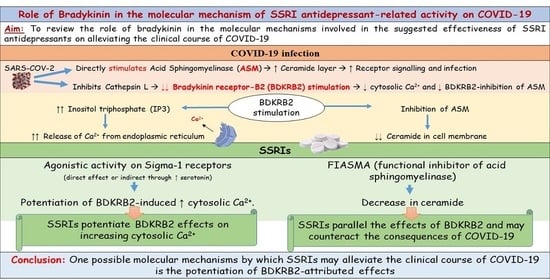
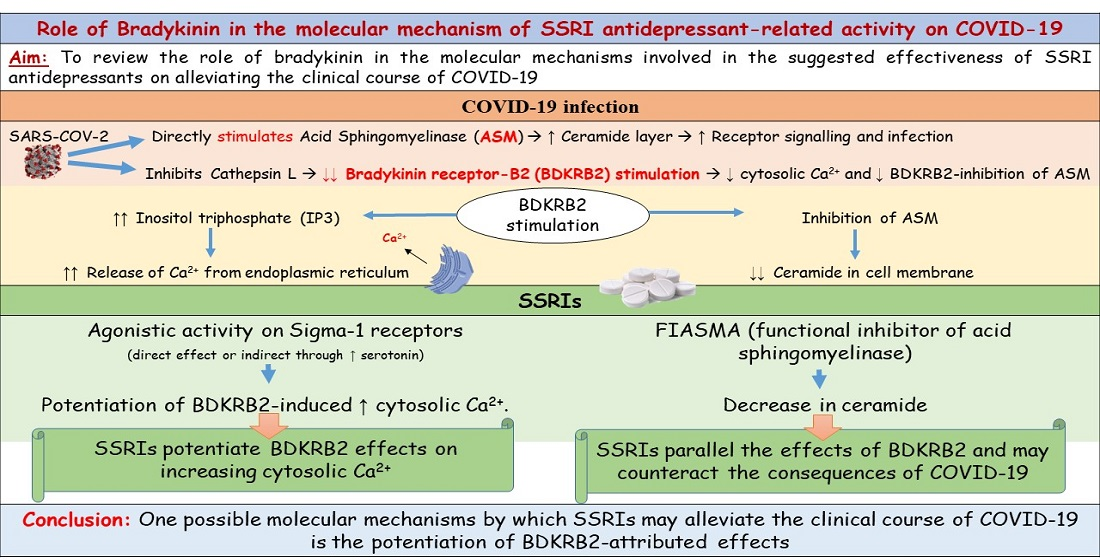
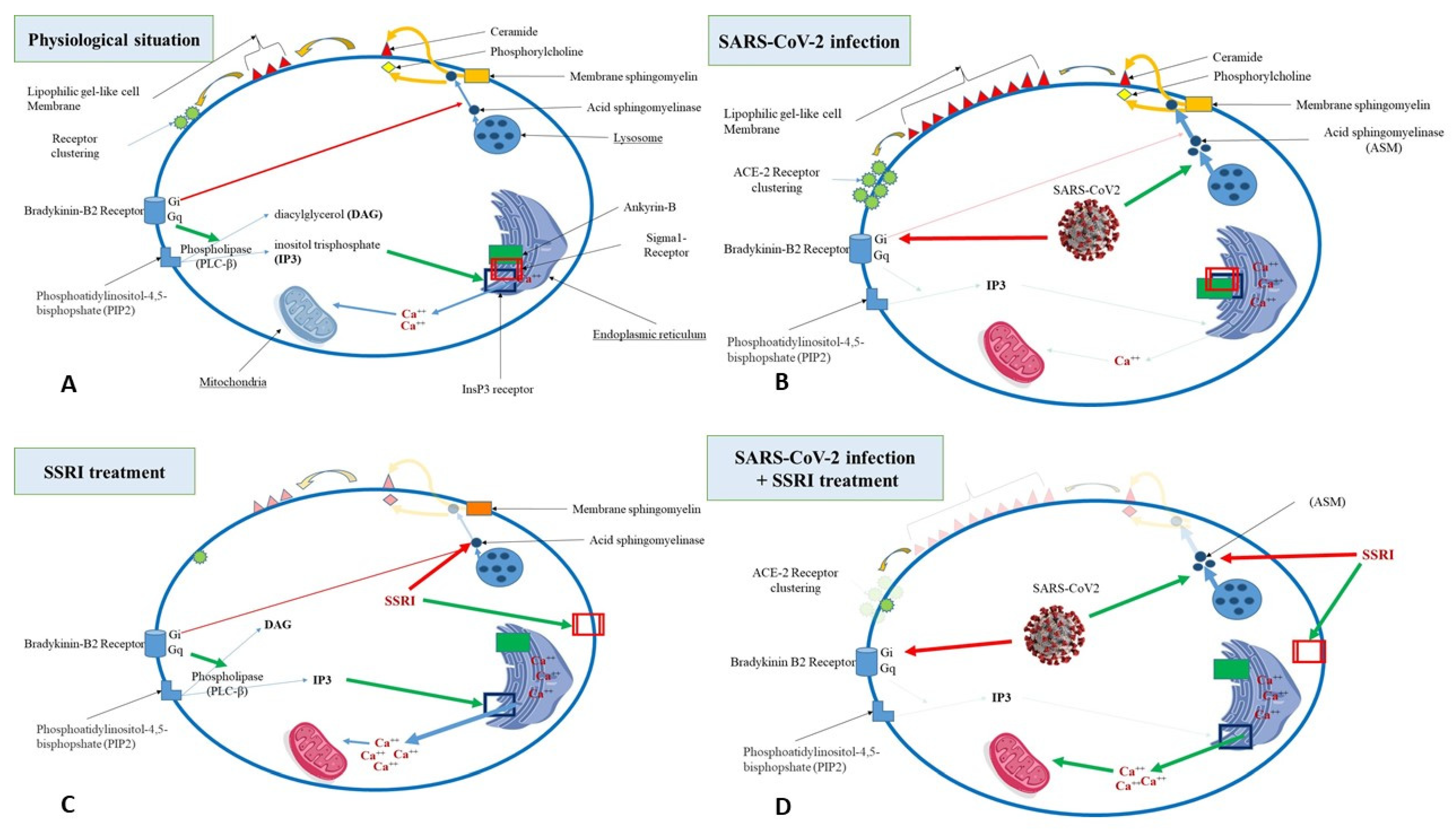
Widely available effective drugs to treat coronavirus disease-2019 (COVID-19) are still limited. Various studies suggested the potential contribution of selective serotonin-reuptake inhibitor (SSRI) antidepressants to alleviate the clinical course of COVID-19. Initially, SSRI antidepressant-attributed anti-COVID-19 activity was attributed to their direct agonistic or indirect serotonin-mediated stimulation of sigma-1 receptors (Sig1-R). Thereafter, attention was drawn to the property of SSRI antidepressants to decrease ceramide production, as functional inhibitors of acid sphingomyelinase. Ceramides are cell membrane waxy lipids formed by sphingosine and a fatty acid, playing a major role in receptor signaling and infection. In COVID-19 patients, ceramide production is increased due to acid sphingomyelinase activation. Here, we aimed to review the relationships between bradykinins and the proposed pathways supporting SSRI antidepressant-attributed effectiveness in COVID-19. In COVID-19 patients, bradykinin receptor-B1 stimulation is enhanced following the downregulation of angiotensin-converting enzyme-2, which is responsible for the inactivation of des-Arg9-bradykinin, a bradykinin metabolite, contrasting with the decrease in bradykinin receptor-B2 (BDKRB2) stimulation, which results from the inhibition of cathepsin L, a kininogenase involved in bradykinin production and present at the infection site. Sig1-R stimulation modulates the inflammatory response by regulating cytokine production and counterbalances COVID-19-attributed BDKRB2 inhibition by potentiating its effects on the cytosolic calcium concentration. Moreover, the beneficial effects obtained with acid sphingomyelinase inhibition are parallel to those expected with BDKRB2 stimulation in COVID-19. Altogether, these findings suggest that one ultimate pathway of SSRI antidepressant-attributed anti-COVID-19 activity is the potentiation of BDKRB2 effects shown to be inhibited in COVID-19. In conclusion, SSRI antidepressants are able to interact positively with the pathophysiological mechanisms involved in COVID-19. However, their exact benefits in preventing morbidities or improving the outcome in COVID-19 patients remain unknown.
Keywords: SSRI; COVID-19; acid sphingomyelinase; sigma-1 receptor; bradykinin; bradykinin receptor SSRI; COVID-19; acid sphingomyelinase; sigma-1 receptor; bradykinin; bradykinin receptor
Graphical Abstract