


Three Pathways of Cancer Cachexia: Inflammation, Changes in Adipose Tissue and Loss of Muscle Mass—The Role of miRNAs

 , and
, and 
Abstract
1. Introduction
1.1. Cancer Cachexia
1.2. miRNA
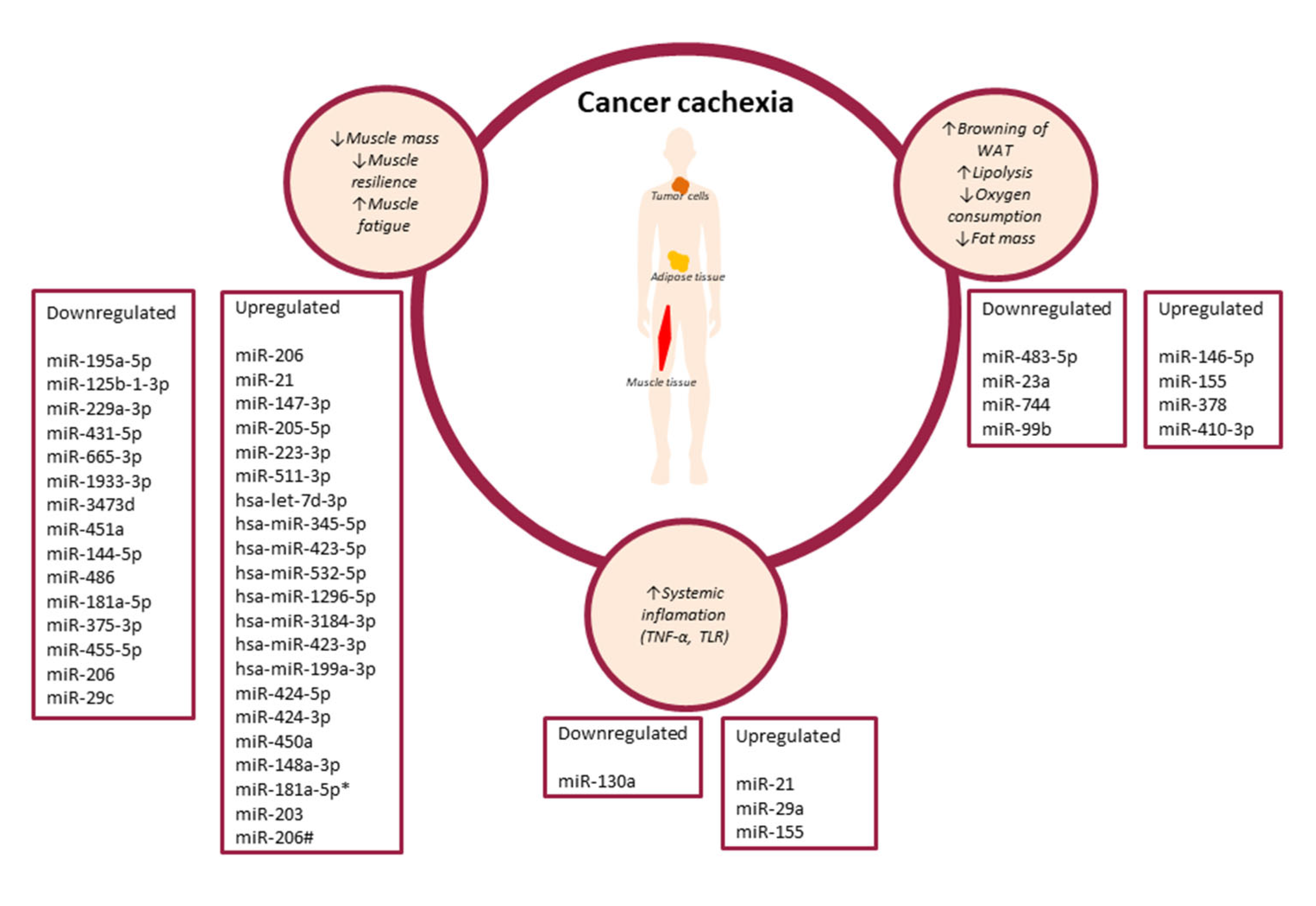
1.2.1. The Role of miRNAs in the Regulation of Proinflammatory Cytokines Involved in Cancer Cachexia
1.2.2. Role of miRNAs in Cancer Cachexia-Related Adipose Tissue Remodelling
1.2.3. The Role of miRNAs in Cancer Cachexia-Related Muscle Tissue Remodelling
2. Summary
Author Contributions
Funding
Institutional Review Board Statement
Informed Consent Statement
Data Availability Statement
Acknowledgments
Conflicts of Interest
References
- Bray, F.; Ferlay, J.; Soerjomataram, I.; Siegel, R.L.; Torre, L.A.; Jemal, A. Global cancer statistics 2018: Globocan estimates of incidence and mortality worldwide for 36 cancers in 185 countries. CA. Cancer J. Clin. 2018, 68, 394–424. [Google Scholar] [CrossRef] [Scilit] [PubMed]
- Kottorou, A.; Dimitrakopoulos, F.I.; Tsezou, A. Non-coding RNAs in cancer-associated cachexia: Clinical implications and future perspectives. Transl. Oncol. 2021, 14, 101101. [Google Scholar] [CrossRef] [Scilit] [PubMed]
- Fearon, K.; Strasser, F.; Anker, S.D.; Bosaeus, I.; Bruera, E.; Fainsinger, R.L.; Jatoi, A.; Loprinzi, C.; MacDonald, N.; Mantovani, G.; et al. Definition and classification of cancer cachexia: An international consensus. Lancet. Oncol. 2011, 12, 489–495. [Google Scholar] [CrossRef] [Scilit]
- Fearon, K.C.H.; Glass, D.J.; Guttridge, D.C. Cancer cachexia: Mediators, signaling, and metabolic pathways. Cell Metab. 2012, 16, 153–166. [Google Scholar] [CrossRef] [Scilit] [PubMed]
- Smith, B.D.; Smith, G.L.; Hurria, A.; Hortobagyi, G.N.; Buchholz, T.A. Future of cancer incidence in the United States: Burdens upon an aging, changing nation. J. Clin. Oncol. 2009, 27, 2758–2765. [Google Scholar] [CrossRef] [Scilit] [PubMed]
- Mattox, T.W. Cancer Cachexia: Cause, Diagnosis, and Treatment. Nutr. Clin. Pract. 2017, 32, 599–606. [Google Scholar] [CrossRef] [Scilit]
- Johns, N.; Stephens, N.A.; Fearon, K.C.H. Muscle wasting in cancer. Int. J. Biochem. Cell Biol. 2013, 45, 2215–2229. [Google Scholar] [CrossRef] [Scilit]
- Bindels, L.B.; Delzenne, N.M. Muscle wasting: The gut microbiota as a new therapeutic target? Int. J. Biochem. Cell Biol. 2013, 45, 2186–2190. [Google Scholar] [CrossRef] [Scilit]
- Loumaye, A.; Thissen, J.-P. Biomarkers of cancer cachexia. Clin. Biochem. 2017, 50, 1281–1288. [Google Scholar] [CrossRef] [Scilit]
- Fouladiun, M.; Körner, U.; Bosaeus, I.; Daneryd, P.; Hyltander, A.; Lundholm, K.G. Body composition and time course changes in regional distribution of fat and lean tissue in unselected cancer patients on palliative care--correlations with food intake, metabolism, exercise capacity, and hormones. Cancer 2005, 103, 2189–2198. [Google Scholar] [CrossRef] [Scilit]
- Hall, K.D.; Baracos, V.E. Computational modeling of cancer cachexia. Curr. Opin. Clin. Nutr. Metab. Care 2008, 11, 214–221. [Google Scholar] [CrossRef] [Scilit] [PubMed]
- Lim, S.; Brown, J.L.; Washington, T.A.; Greene, N.P. Development and progression of cancer cachexia: Perspectives from bench to bedside. Sport. Med. Health Sci. 2020, 2, 177–185. [Google Scholar] [CrossRef] [Scilit] [PubMed]
- Reinhart, B.J.; Slack, F.J.; Basson, M.; Pasquinelli, A.E.; Bettinger, J.C.; Rougvie, A.E.; Horvitz, H.R.; Ruvkun, G. The 21-nucleotide let-7 RNA regulates developmental timing in Caenorhabditis elegans. Nature 2000, 403, 901–906. [Google Scholar] [CrossRef] [Scilit] [PubMed]
- Mohr, A.M.; Mott, J.L. Overview of microRNA biology. Semin. Liver Dis. 2015, 35, 3–11. [Google Scholar] [CrossRef] [Scilit] [PubMed]
- Porkka, K.P.; Pfeiffer, M.J.; Waltering, K.K.; Vessella, R.L.; Tammela, T.L.J.; Visakorpi, T. MicroRNA expression profiling in prostate cancer. Cancer Res. 2007, 67, 6130–6135. [Google Scholar] [CrossRef] [Scilit] [PubMed]
- Sun, D.; Ding, Z.; Shen, L.; Yang, F.; Han, J.; Wu, G. miR-410-3P inhibits adipocyte differentiation by targeting IRS-1 in cancer-associated cachexia patients. Lipids Health Dis. 2021, 20, 115. [Google Scholar] [CrossRef] [Scilit]
- He, B.; Zhao, Z.; Cai, Q.; Zhang, Y.; Zhang, P.; Shi, S.; Xie, H.; Peng, X.; Yin, W.; Tao, Y.; et al. miRNA-based biomarkers, therapies, and resistance in Cancer. Int. J. Biol. Sci. 2020, 16, 2628–2647. [Google Scholar] [CrossRef] [Scilit]
- Zhang, B.; Li, B.; Qin, F.; Bai, F.; Sun, C.; Liu, Q. Expression of serum microRNA-155 and its clinical importance in patients with heart failure after myocardial infarction. J. Int. Med. Res. 2019, 47, 6294–6302. [Google Scholar] [CrossRef] [Scilit]
- Shioya, M.; Obayashi, S.; Tabunoki, H.; Arima, K.; Saito, Y.; Ishida, T.; Satoh, J. Aberrant microRNA expression in the brains of neurodegenerative diseases: MiR-29a decreased in Alzheimer disease brains targets neurone navigator 3. Neuropathol. Appl. Neurobiol. 2010, 36, 320–330. [Google Scholar] [CrossRef] [Scilit]
- Ben-Dov, I.Z.; Tan, Y.-C.; Morozov, P.; Wilson, P.D.; Rennert, H.; Blumenfeld, J.D.; Tuschl, T. Urine microRNA as potential biomarkers of autosomal dominant polycystic kidney disease progression: Description of miRNA profiles at baseline. PLoS ONE 2014, 9, e86856. [Google Scholar] [CrossRef] [Scilit]
- Migdalska-Sęk, M.; Modrzewska, B.; Kordiak, J.; Pastuszak-Lewandoska, D.; Kiszałkiewicz, J.M.; Bielec, F.; Antczak, A.; Brzeziańska-Lasota, E. Diagnostic value of PPARδ and miRNA-17 expression levels in patients with non-small cell lung cancer. Sci. Rep. 2021, 11, 24136. [Google Scholar] [CrossRef] [Scilit] [PubMed]
- Hess, A.-K.; Müer, A.; Mairinger, F.D.; Weichert, W.; Stenzinger, A.; Hummel, M.; Budach, V.; Tinhofer, I. MiR-200b and miR-155 as predictive biomarkers for the efficacy of chemoradiation in locally advanced head and neck squamous cell carcinoma. Eur. J. Cancer 2017, 77, 3–12. [Google Scholar] [CrossRef] [Scilit] [PubMed]
- Tang, D.; Zhang, Q.; Zhao, S.; Wang, J.; Lu, K.; Song, Y.; Zhao, L.; Kang, X.; Wang, J.; Xu, S.; et al. The expression and clinical significance of microRNA-1258 and heparanase in human breast cancer. Clin. Biochem. 2013, 46, 926–932. [Google Scholar] [CrossRef] [Scilit]
- Cheng, H.H.; Plets, M.; Li, H.; Higano, C.S.; Tangen, C.M.; Agarwal, N.; Vogelzang, N.J.; Hussain, M.; Thompson, I.M.J.; Tewari, M.; et al. Circulating microRNAs and treatment response in the Phase II SWOG S0925 study for patients with new metastatic hormone-sensitive prostate cancer. Prostate 2018, 78, 121–127. [Google Scholar] [CrossRef] [Scilit] [PubMed]
- Du, X.; Zhang, J.; Wang, J.; Lin, X.; Ding, F. Role of miRNA in Lung Cancer-Potential Biomarkers and Therapies. Curr. Pharm. Des. 2018, 23, 5997–6010. [Google Scholar] [CrossRef] [Scilit]
- Wang, L.Q.; Kumar, S.; Calin, G.A.; Li, Z.; Chim, C.S. Frequent methylation of the tumour suppressor miR-1258 targeting PDL1: Implication in multiple myeloma-specific cytotoxicity and prognostification. Br. J. Haematol. 2020, 190, 249–261. [Google Scholar] [CrossRef] [Scilit]
- Nagachinta, S.; Bouzo, B.L.; Vazquez-Rios, A.J.; Lopez, R.; Fuente, M. de la Sphingomyelin-Based Nanosystems (SNs) for the Development of Anticancer miRNA Therapeutics. Pharmaceutics 2020, 12, 189. [Google Scholar] [CrossRef] [Scilit] [PubMed]
- Cortez, M.A.; Valdecanas, D.; Niknam, S.; Peltier, H.J.; Diao, L.; Giri, U.; Komaki, R.; Calin, G.A.; Gomez, D.R.; Chang, J.Y.; et al. In Vivo Delivery of miR-34a Sensitizes Lung Tumors to Radiation Through RAD51 Regulation. Mol. Ther. Nucleic Acids 2015, 4, e270. [Google Scholar] [CrossRef] [Scilit]
- Raeisi, F.; Mahmoudi, E.; Dehghani-Samani, M.; Hosseini, S.S.E.; Ghahfarrokhi, A.M.; Arshi, A.; Forghanparast, K.; Ghazanfari, S. Differential Expression Profile of miR-27b, miR-29a, and miR-155 in Chronic Lymphocytic Leukemia and Breast Cancer Patients. Mol. Ther. Oncolytics 2020, 16, 230–237. [Google Scholar] [CrossRef] [Scilit]
- Bartel, D.P. MicroRNAs: Genomics, Biogenesis, Mechanism, and Function. Cell 2004, 116, 281–297. [Google Scholar] [CrossRef] [Scilit]
- Sutandyo, N. The role of microRNA in cancer cachexia and muscle wasting: A review article. Casp. J. Intern. Med. 2021, 12, 124–128. [Google Scholar] [CrossRef] [Scilit]
- Arends, J.; Bachmann, P.; Baracos, V.; Barthelemy, N.; Bertz, H.; Bozzetti, F.; Fearon, K.; Hütterer, E.; Isenring, E.; Kaasa, S.; et al. ESPEN guidelines on nutrition in cancer patients. Clin. Nutr. 2017, 36, 11–48. [Google Scholar] [CrossRef] [Scilit] [PubMed]
- Powrózek, T.; Mlak, R.; Brzozowska, A.; Mazurek, M.; Gołębiowski, P.; Małecka-Massalska, T. miRNA-130a Significantly Improves Accuracy of SGA Nutritional Assessment Tool in Prediction of Malnutrition and Cachexia in Radiotherapy-Treated Head and Neck Cancer Patients. Cancers 2018, 10, 294. [Google Scholar] [CrossRef] [Scilit]
- Fabbri, M.; Paone, A.; Calore, F.; Galli, R.; Gaudio, E.; Santhanam, R.; Lovat, F.; Fadda, P.; Mao, C.; Nuovo, G.J.; et al. MicroRNAs bind to Toll-like receptors to induce prometastatic inflammatory response. Proc. Natl. Acad. Sci. USA 2012, 109, E2110–E2116. [Google Scholar] [CrossRef] [Scilit] [PubMed]
- Yehia, R.; Schaalan, M.; Abdallah, D.M.; Saad, A.S.; Sarhan, N.; Saleh, S. Impact of TNF-α Gene Polymorphisms on Pancreatic and Non-Small Cell Lung Cancer-Induced Cachexia in Adult Egyptian Patients: A Focus on Pathogenic Trajectories. Front. Oncol. 2021, 11, 4739. [Google Scholar] [CrossRef] [Scilit]
- Bing, C.; Russell, S.; Becket, E.; Pope, M.; Tisdale, M.J.; Trayhurn, P.; Jenkins, J.R. Adipose atrophy in cancer cachexia: Morphologic and molecular analysis of adipose tissue in tumour-bearing mice. Br. J. Cancer 2006, 95, 1028–1037. [Google Scholar] [CrossRef] [Scilit] [PubMed]
- Mandrup, S.; Lane, M.D. Regulating adipogenesis. J. Biol. Chem. 1997, 272, 5367–5370. [Google Scholar] [CrossRef] [Scilit]
- Chen, L.; Song, J.; Cui, J.; Hou, J.; Zheng, X.; Li, C.; Liu, L. microRNAs regulate adipocyte differentiation. Cell Biol. Int. 2013, 37, 533–546. [Google Scholar] [CrossRef] [Scilit]
- Blum, D.; Omlin, A.; Baracos, V.E.; Solheim, T.S.; Tan, B.H.L.; Stone, P.; Kaasa, S.; Fearon, K.; Strasser, F. Cancer cachexia: A systematic literature review of items and domains associated with involuntary weight loss in cancer. Crit. Rev. Oncol. Hematol. 2011, 80, 114–144. [Google Scholar] [CrossRef] [Scilit]
- Tsoli, M.; Moore, M.; Burg, D.; Painter, A.; Taylor, R.; Lockie, S.H.; Turner, N.; Warren, A.; Cooney, G.; Oldfield, B.; et al. Activation of thermogenesis in brown adipose tissue and dysregulated lipid metabolism associated with cancer cachexia in mice. Cancer Res. 2012, 72, 4372–4382. [Google Scholar] [CrossRef] [Scilit]
- Das, S.K.; Eder, S.; Schauer, S.; Diwoky, C.; Temmel, H.; Guertl, B.; Gorkiewicz, G.; Tamilarasan, K.P.; Kumari, P.; Trauner, M.; et al. Adipose triglyceride lipase contributes to cancer-associated cachexia. Science 2011, 333, 233–238. [Google Scholar] [CrossRef] [Scilit] [PubMed]
- Thompson, M.P.; Koons, J.E.; Tan, E.T.; Grigor, M.R. Modified lipoprotein lipase activities, rates of lipogenesis, and lipolysis as factors leading to lipid depletion in C57BL mice bearing the preputial gland tumor, ESR-586. Cancer Res. 1981, 41, 3228–3232. [Google Scholar] [PubMed]
- Tisdale, M.J. Cachexia in cancer patients. Nat. Rev. Cancer 2002, 2, 862–871. [Google Scholar] [CrossRef] [Scilit] [PubMed]
- Di, W.; Zhang, W.; Zhu, B.; Li, X.; Tang, Q.; Zhou, Y. Colorectal cancer prompted adipose tissue browning and cancer cachexia through transferring exosomal miR-146b-5p. J. Cell. Physiol. 2021, 236, 5399–5410. [Google Scholar] [CrossRef] [Scilit] [PubMed]
- Wu, Q.; Sun, S.; Li, Z.; Yang, Q.; Li, B.; Zhu, S.; Wang, L.; Wu, J.; Yuan, J.; Wang, C.; et al. Breast cancer-released exosomes trigger cancer-associated cachexia to promote tumor progression. Adipocyte 2019, 8, 31–45. [Google Scholar] [CrossRef] [Scilit]
- Kulyté, A.; Lorente-Cebrián, S.; Gao, H.; Mejhert, N.; Agustsson, T.; Arner, P.; Rydén, M.; Dahlman, I. MicroRNA profiling links miR-378 to enhanced adipocyte lipolysis in human cancer cachexia. Am. J. Physiol. Endocrinol. Metab. 2014, 306, 267–274. [Google Scholar] [CrossRef] [Scilit]
- Güller, I.; Russell, A.P. MicroRNAs in skeletal muscle: Their role and regulation in development, disease and function. J. Physiol. 2010, 588, 4075–4087. [Google Scholar] [CrossRef] [Scilit]
- Armstrong, V.S.; Fitzgerald, L.W.; Bathe, O.F. Cancer-Associated Muscle Wasting—Candidate Mechanisms and Molecular Pathways. Int. J. Mol. Sci. 2020, 21, 9268. [Google Scholar] [CrossRef] [Scilit]
- Argilés, J.M.; Busquets, S.; Felipe, A.; López-Soriano, F.J. Molecular mechanisms involved in muscle wasting in cancer and ageing: Cachexia versus sarcopenia. Int. J. Biochem. Cell Biol. 2005, 37, 1084–1104. [Google Scholar] [CrossRef] [Scilit]
- Burckart, K.; Beca, S.; Urban, R.J.; Sheffield-Moore, M. Pathogenesis of muscle wasting in cancer cachexia: Targeted anabolic and anticatabolic therapies. Curr. Opin. Clin. Nutr. Metab. Care 2010, 13, 410–416. [Google Scholar] [CrossRef] [Scilit]
- He, W.A.; Calore, F.; Londhe, P.; Canella, A.; Guttridge, D.C.; Croce, C.M. Microvesicles containing miRNAs promote muscle cell death in cancer cachexia via TLR7. Proc. Natl. Acad. Sci. USA 2014, 111, 4525–4529. [Google Scholar] [CrossRef] [Scilit] [PubMed]
- Miao, C.; Zhang, W.; Feng, L.; Gu, X.; Shen, Q.; Lu, S.; Fan, M.; Li, Y.; Guo, X.; Ma, Y.; et al. Cancer-derived exosome miRNAs induce skeletal muscle wasting by Bcl-2-mediated apoptosis in colon cancer cachexia. Mol. Ther. Nucleic Acids 2021, 24, 923–938. [Google Scholar] [CrossRef] [Scilit] [PubMed]
- Soares, R.J.; Cagnin, S.; Chemello, F.; Silvestrin, M.; Musaro, A.; De Pitta, C.; Lanfranchi, G.; Sandri, M. Involvement of microRNAs in the regulation of muscle wasting during catabolic conditions. J. Biol. Chem. 2014, 289, 21909–21925. [Google Scholar] [CrossRef] [Scilit] [PubMed]
- Lee, D.E.; Brown, J.L.; Rosa-Caldwell, M.E.; Blackwell, T.A.; Perry, R.A.; Brown, L.A.; Khatri, B.; Seo, D.; Bottje, W.G.; Washington, T.A.; et al. Cancer cachexia-induced muscle atrophy: Evidence for alterations in microRNAs important for muscle size. Physiol. Genom. 2017, 49, 253–260. [Google Scholar] [CrossRef] [Scilit] [PubMed]
- Narasimhan, A.; Ghosh, S.; Stretch, C.; Greiner, R.; Bathe, O.F.; Baracos, V.; Damaraju, S. Small RNAome profiling from human skeletal muscle: Novel miRNAs and their targets associated with cancer cachexia. J. Cachexia. Sarcopenia Muscle 2017, 8, 405–416. [Google Scholar] [CrossRef] [Scilit]
- Van de Worp, W.R.P.H.; Schols, A.M.W.J.; Dingemans, A.M.C.; Op den Kamp, C.M.H.; Degens, J.H.R.J.; Kelders, M.C.J.M.; Coort, S.; Woodruff, H.C.; Kratassiouk, G.; Harel-Bellan, A.; et al. Identification of microRNAs in skeletal muscle associated with lung cancer cachexia. J. Cachexia. Sarcopenia Muscle 2020, 11, 452–463. [Google Scholar] [CrossRef] [Scilit]
- Chen, D.; Goswami, C.P.; Burnett, R.M.; Anjanappa, M.; Bhat-Nakshatri, P.; Muller, W.; Nakshatri, H. Cancer affects microRNA expression, release, and function in cardiac and skeletal muscle. Cancer Res. 2014, 74, 4270–4281. [Google Scholar] [CrossRef] [Scilit]
- Okugawa, Y.; Yao, L.; Toiyama, Y.; Yamamoto, A.; Shigemori, T.; Yin, C.; Omura, Y.; Ide, S.; Kitajima, T.; Shimura, T.; et al. Prognostic impact of sarcopenia and its correlation with circulating miR-21 in colorectal cancer patients. Oncol. Rep. 2018, 39, 1555–1564. [Google Scholar] [CrossRef] [Scilit]
- Pin, F.; Beltrà, M.; Garcia-Castillo, L.; Pardini, B.; Birolo, G.; Matullo, G.; Penna, F.; Guttridge, D.; Costelli, P. Extracellular vesicles derived from tumour cells as a trigger of energy crisis in the skeletal muscle. J. Cachexia. Sarcopenia Muscle 2022, 13, 481–494. [Google Scholar] [CrossRef] [Scilit]
- Scott, I.C.; Tomlinson, W.; Walding, A.; Isherwood, B.; Dougall, I.G. Large-scale isolation of human skeletal muscle satellite cells from post-mortem tissue and development of quantitative assays to evaluate modulators of myogenesis. J. Cachexia. Sarcopenia Muscle 2013, 4, 157–169. [Google Scholar] [CrossRef] [Scilit]
- Okugawa, Y.; Toiyama, Y.; Hur, K.; Yamamoto, A.; Yin, C.; Ide, S.; Kitajima, T.; Fujikawa, H.; Yasuda, H.; Koike, Y.; et al. Circulating miR-203 derived from metastatic tissues promotes myopenia in colorectal cancer patients. J. Cachexia. Sarcopenia Muscle 2019, 10, 536–548. [Google Scholar] [CrossRef] [Scilit] [PubMed]
- Gomes, J.L.P.; Tobias, G.C.; Fernandes, T.; Silveira, A.C.; Negrão, C.E.; Chammas, R.; Brum, P.C.; Oliveira, E.M. Effects of Aerobic Exercise Training on MyomiRs Expression in Cachectic and Non-Cachectic Cancer Mice. Cancers 2021, 13, 5728. [Google Scholar] [CrossRef] [Scilit] [PubMed]
- Xie, K.; Xiong, H.; Xiao, W.; Xiong, Z.; Hu, W.; Ye, J.; Xu, N.; Shi, J.; Yuan, C.; Chen, Z.; et al. Downregulation of miR-29c promotes muscle wasting by modulating the activity of leukemia inhibitory factor in lung cancer cachexia. Cancer Cell Int. 2021, 21, 627. [Google Scholar] [CrossRef] [Scilit] [PubMed]
- Nicola, N.A.; Babon, J.J. Leukemia inhibitory factor (LIF). Cytokine Growth Factor Rev. 2015, 26, 533–544. [Google Scholar] [CrossRef] [Scilit] [PubMed]

| Authors (Year of Publication) | Study Group/Cancer Type | Race/Nationality | Anticancer Treatment (Surgery, CTH, RT) | Study Material | Studied Mirna | Time-Point of miRNA Assessment (before or after Anticancer Treatment/Experimental Model Manipulation) | miRNA Change in Patients with Cachexia or in Cachectic Models | miRNA-Related Targets/Changes in the Studied Material |
|---|---|---|---|---|---|---|---|---|
| Powrozek et al. (2018) [33] | Patients with HNC (n = 70, without cachexia, n = 33, with cachexia, n = 37) | Poland | IMRT | Plasma | miR-130a | Before | Downregulated | TNF-α |
| Fabbri et al. (2012) [34] | B6 mice with LLC (n = 18) Cell Cultures (A549, SK-MES, HEK-293) | - | - | Cell Culture/animal model | miR-21 miR-29a | - | Upregulated | TLR (murine TLR7, human TLR8) |
| Yehia et al. (2021) [35] | Patients with pancreatic cancer or NSCLC (n = 203, without cachexia, n = 94, with cachexia, n = 109) | Egypt | CTH (GEM+CIS) | Serum | miR-155 | After | Upregulated | TNF-α (through TNF- α: SOCS1, TAB2, Foxp3) |
| Authors (Year of Publication) | Study Group/Cancer Type | Race/Nationality | Anticancer Treatment (Surgery, CTH, RT) | Study Material | Studied miRNA | Time-Point of miRNA Assessment (before or after Anticancer Treatment) | miRNA Change | miRNA-Related Targets/Changes in the Studied Material |
|---|---|---|---|---|---|---|---|---|
| Wenjuan Di et al. (2021) [44] | Patients with colorectal cancer (n = 48) Healthy volunteers (n = 48) Male C57BL/6 mice (n = 6) | Asian (China) | - | Cancerous tissue samples | miR-146-5p | - | Upregulated | Browning of WAT Accelerated lipolysis Decreased oxygen consumption Fat mass loss |
| Wu et al. (2019) [45] | Patients with breast cancer (n = 108) Cell culture (C2C12) | - | - | Cell culture | miR-155 | - | Upregulated | Browning of WAT Anomalous conversion and increased catabolism of muscle cells Lipolysis Muscle loss |
| Kulyté et al. (2014) [46] | Patients with gastrointestinal cancer (pancreas, stomach, liver metastasis) (n = 21, without cachexia, n = 11, with cachexia, n = 10) | Sweden | Surgery | Abdominal subcutaneous adipose tissue | miR-483–5p miR-23a miR-744 miR-99b miR-378 | Before | Upregulated (miR-378) Downregulated miR-483-5p miR-23a miR-744 miR-99b | Accelerated lipolysis (miR-378) |
| Sun et al. (2021) [16] | Patients with gastric cancer (n = 60, without cachexia, n = 30, with cachexia, n = 30) | Asian (China) | Surgery | Exosomes from serum/tissue | miR-410-3p | Before | Upregulated | Adipogenesis inhibition |
| Authors (Year of Publication) | Study Group | Race/Nationality | Anticancer Treatment (Surgery, CTH, RT) | Study Material | Studied miRNA | Time-Point of miRNA Assessment (before or after Anticancer Treatment) | miRNA Change | miRNA-Related Targets/Changes in the Studied Material |
|---|---|---|---|---|---|---|---|---|
| He et al. (2014) [51] | Wild-type C57B6 male mice with LLC (number of subjects not provided) Cell lines of lung cancer and pancreatic adenocarcinoma (A549, LCC, H460, AsPC-1, Panc-2, MEFs MDA-MB-231, MIA-PaCa, MCF7, C2C12) | - | - | Wild-type C57B6 male mice serum Cell lines | miR-21 | - | Upregulated in myoblasts (cell line) | Myoblast apoptosis |
| Miao et al. (2021) [52] | Male BALB/c mice without tumour (n = 8) and with C26 (n = 8) Patients with colon cancer (n = 21, without cachexia n = 13, with cachexia n = 8) Healthy volunteers (n = 19) Cell line (C2C12) | Asian (China) | - | Serum and exosomes from mice and human subjects Mice muscle tissue Cell line | miR-195a-5p, miR-125b-1-3p | - | Upregulated | Downregulation of Bcl-2 gene Muscle atrophy |
| Soares et al. (2014) [53] | BALB/c mice with colon carcinoma (C26) (n = 3) Cell line (C2C12) | - | - | Muscle tissue Cell line | miR-206 miR-21 | - | Upregulated | Numerous different genes regulated by both miRNAs Muscle atrophy |
| Lee et al. (2017) [54] | C57BL6/J mice with LLC (n = 8) or without LLC (control, n = 8) | - | - | Muscle tissue | miR-147-3p miR-299a-3p miR -1933-3p miR-511-3p miR-3473d miR-233-3p miR-431-5p miR-665-3p miR-205-3p | - | Downregulated: miR-229a-3p miR-431-5p miR-665-3p miR-1933-3p miR-3473d Upregulated: miR-147-3p miR-205-5p miR-223-3p miR-511-3p | Muscle atrophy |
| Narasimhan et al. (2017) [55] | Patients with pancreatic and colorectal cancer (with liver metastasis) (n = 42, without cachexia n = 20, with cachexia n = 22) | Canada | Surgery | Muscle tissues (biopsies) | hsa-let-7d-3p hsa-miR-345-5p hsa-miR-423-5p hsa-miR-532-5p hsa-miR-1296-5p hsa-miR-3184-3p hsa-miR-423-3p hsa-miR-199a-3p | Before treatment | Upregulated | Numerous different genes regulated by studied miRNAs Muscle atrophy |
| van de Worp et al. (2020) [56] | NSCLC patients (n = 26, 11 without cachexia, 15 with cachexia) Healthy volunteers (n = 22) | Netherlands | - | Muscle tissue (biopsies) | hsa-miR-424-5p hsa-miR-451a hsa-miR-144-5p hsa-miR-424-3p hsa-miR-450a-5p | Before treatment | Upregulated: miR-424-5p miR-424-3p miR-450a Downregulated:miR-451a miR-144-5p | Muscle atrophy |
| Chen et al. (2014) [57] | Patients with breast cancer (n = 79) MMTV-PyMT (n = 4) and MMTV-Her2 (n = 4) transgenic mice Cell culture (C2C12) | USA | - | Human serumTransgenic mice models (serum, cancerous tissue, cardiac and skeletal muscle tissue) Cell culture | miR-486 | - | Downregulated | Downregulation of PTEN and FOXO1A genes Decreased signalling through PI3K/Akt pathway Downregulation of MyoD transcription factor Muscle atrophy |
| Okugawa et al. (2018) [58] | Patients with colorectal cancer (serum, n = 153, cancerous tissue, n = 134) | Asian (Japan) | - | SerumCancerous tissue | miR-21 | Before surgery | Upregulated | Sarcopenia Low PMI |
| Pin et al. (2022) [59] | BALB/c mice with or without C26 (n = 8) Male Wistar rats with or without AH-130 (n = 8) Cell lines (C2C12, LCC, C26) | - | - | Microvesicles from C26 or LLC cells Plasma of mice and rats Cell line | miR-181a-5p miR-375-3p miR-455-5p miR-148a-3p miR-181a-5p | - | Downregulated miR-181a-5p miR-375-3p miR-455-5p Upregulated miR-148a-3p miR-181a-5p | Upregulated miRNAs lead to downregulation of Myf5, Myog, Myh4, Myh7 genes Delayed differentiation Disorganized mitochondrial system |
| Okugawa et al. (2019) [61] | Patients with colorectal cancer (n = 183) Cell line (SkMC) | Asian (Japan) | CTH (5-FU) | Cancerous tissue Serum Cell line | miR-203 | Before surgery | Upregulated | Downregulation of BIRC5 Decreased skeletal muscles mass (decreased PMI) Skeletal muscle cells proliferation inhibition and apoptosis |
| Gomes et al. (2021) [62] | BALB/c female healthy mice (n = 17) or with colon cancer (n = 19) c57 healthy female mice (n = 13) or non-cachectic transgenic mice with spontaneous breast cancer (n = 16) | - | - | Serum Skeletal muscle tissue | miRNA-486 miRNA -206 | - | Upregulated miR-206 (Breast cancer) Downregulated miR-206 (Colon cancer) miRNA-486 | Muscle wasting |
| Xie et al. (2021) [63] | C57BL/6 mice with (n = 3) or without (n = 3) LLC Cell culture (C2C12) | - | - | C57BL/6 mice tissue Cell culture | miR-29c | - | Downregulated | Upregulation of LIF, JAK/STAT and p38 MAPK pathwaysMuscle wasting |
Publisher’s Note: MDPI stays neutral with regard to jurisdictional claims in published maps and institutional affiliations. |
© 2022 by the authors. Licensee MDPI, Basel, Switzerland. This article is an open access article distributed under the terms and conditions of the Creative Commons Attribution (CC BY) license (https://creativecommons.org/licenses/by/4.0/).
Share and Cite
Homa-Mlak, I.; Pigoń-Zając, D.; Wawrejko, P.; Małecka-Massalska, T.; Mlak, R. Three Pathways of Cancer Cachexia: Inflammation, Changes in Adipose Tissue and Loss of Muscle Mass—The Role of miRNAs. J. Pers. Med. 2022, 12, 1438. https://doi.org/10.3390/jpm12091438
Homa-Mlak I, Pigoń-Zając D, Wawrejko P, Małecka-Massalska T, Mlak R. Three Pathways of Cancer Cachexia: Inflammation, Changes in Adipose Tissue and Loss of Muscle Mass—The Role of miRNAs. Journal of Personalized Medicine. 2022; 12(9):1438. https://doi.org/10.3390/jpm12091438
Chicago/Turabian StyleHoma-Mlak, Iwona, Dominika Pigoń-Zając, Paweł Wawrejko, Teresa Małecka-Massalska, and Radosław Mlak. 2022. "Three Pathways of Cancer Cachexia: Inflammation, Changes in Adipose Tissue and Loss of Muscle Mass—The Role of miRNAs" Journal of Personalized Medicine 12, no. 9: 1438. https://doi.org/10.3390/jpm12091438
APA StyleHoma-Mlak, I., Pigoń-Zając, D., Wawrejko, P., Małecka-Massalska, T., & Mlak, R. (2022). Three Pathways of Cancer Cachexia: Inflammation, Changes in Adipose Tissue and Loss of Muscle Mass—The Role of miRNAs. Journal of Personalized Medicine, 12(9), 1438. https://doi.org/10.3390/jpm12091438

