Artificial Intelligence for Preoperative Prediction of Lymph Node Metastasis and Depth of Invasion in Oral Tongue Squamous Cell Carcinoma: A Systematic Review and Meta-Analysis
 , and
, and
Abstract
1. Introduction
2. Materials and Methods
2.1. Search Strategy
2.2. Study Selection
2.3. Data Extraction and Quality Assessment

| Study | AI-Specific Methodological Items | Score | |||||||
|---|---|---|---|---|---|---|---|---|---|
| ICC Reported | Imbalance Handled | External Validation | Calibration | DCA | Clinician Comparison | Reporting Guideline | Code/Data Available | ||
| Committeri et al. [21] † | ✗ | ✗ | ✗ | ✗ | ✗ | ✗ | ✗ | ✓ (Zenodo) | 1/8 |
| Csüry et al. [22] † | ✗ | ✗ | ✗ | ✗ | ✗ | ✗ | ✗ | ✗ | 0/8 |
| Han et al. [23] | ✗ | ✗ | ✗ | ✗ | ✗ | ✗ | ✗ | ✗ | 0/8 |
| Kubo et al. [24] | ✗ | ✓ (SMOTE) | ✗ | ✗ | ✗ | ✗ | ✗ | ✗ | 1/8 |
| Kudoh et al. [17] | ✗ | ✗ | ✗ | ✗ | ✗ | ✗ | ✗ | ✗ | 0/8 |
| Lan et al. [25] | ✗ | ✓ (SMOTE) | ✓ (True Ext) | ✓ | ✓ | ✗ | ✓ (STARD) | ✗ | 5/8 |
| Liu et al. [26] | ✓ | ✗ | ✗ | ✓ | ✗ | ✗ | ✗ | ✗ | 2/8 |
| Vidiri et al. [27] | ✓ | ✓ (SMOTE-NC) | ✗ | ✗ | ✗ | ✗ | ✓ (TRIPOD) | ✗ | 3/8 |
| Wang et al. [28] | ✗ | ✗ | ✗ | ✓ | ✓ | ✗ | ✗ | ✗ | 2/8 |
| Wang et al. [29] † | ✓ | ✗ | ✗ | ✗ | ✗ | ✗ | ✗ | ✗ | 1/8 |
| Yuan et al. [30] | ✓ | ✗ | ✗ | ✗ | ✗ | ✗ | ✗ | ✗ | 1/8 |
| Zhong et al. [31] | ✓ | ✗ | ✗ | ✗ | ✗ | ✓ (NRI) | ✗ | ✓ (GitHub) | 3/8 |
| Total ✓ | 5/12 | 3/12 | 1/12 | 3/12 | 2/12 | 1/12 | 2/12 | 2/12 | |
3. Results
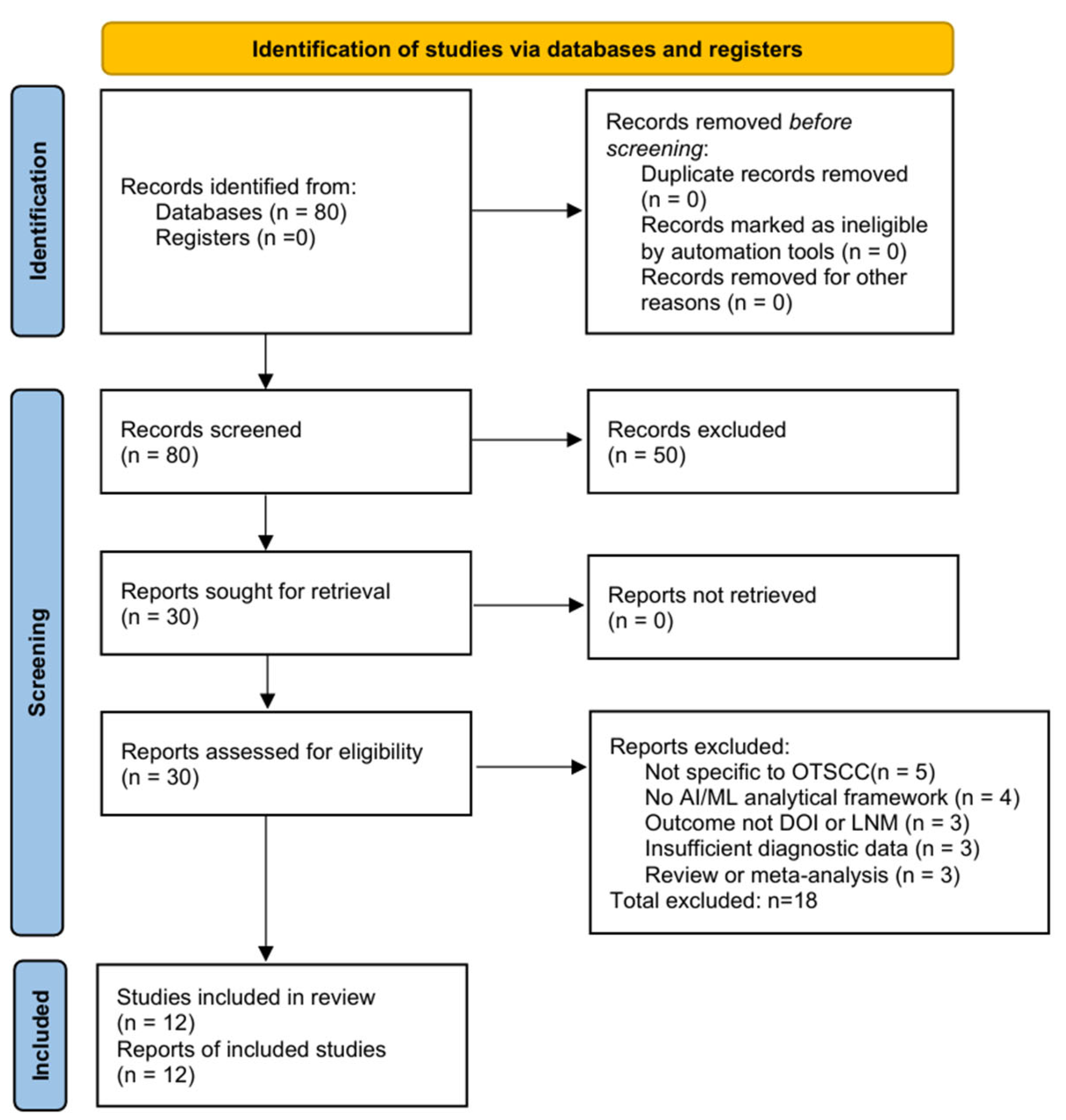
3.1. Literature Search and Study Selection
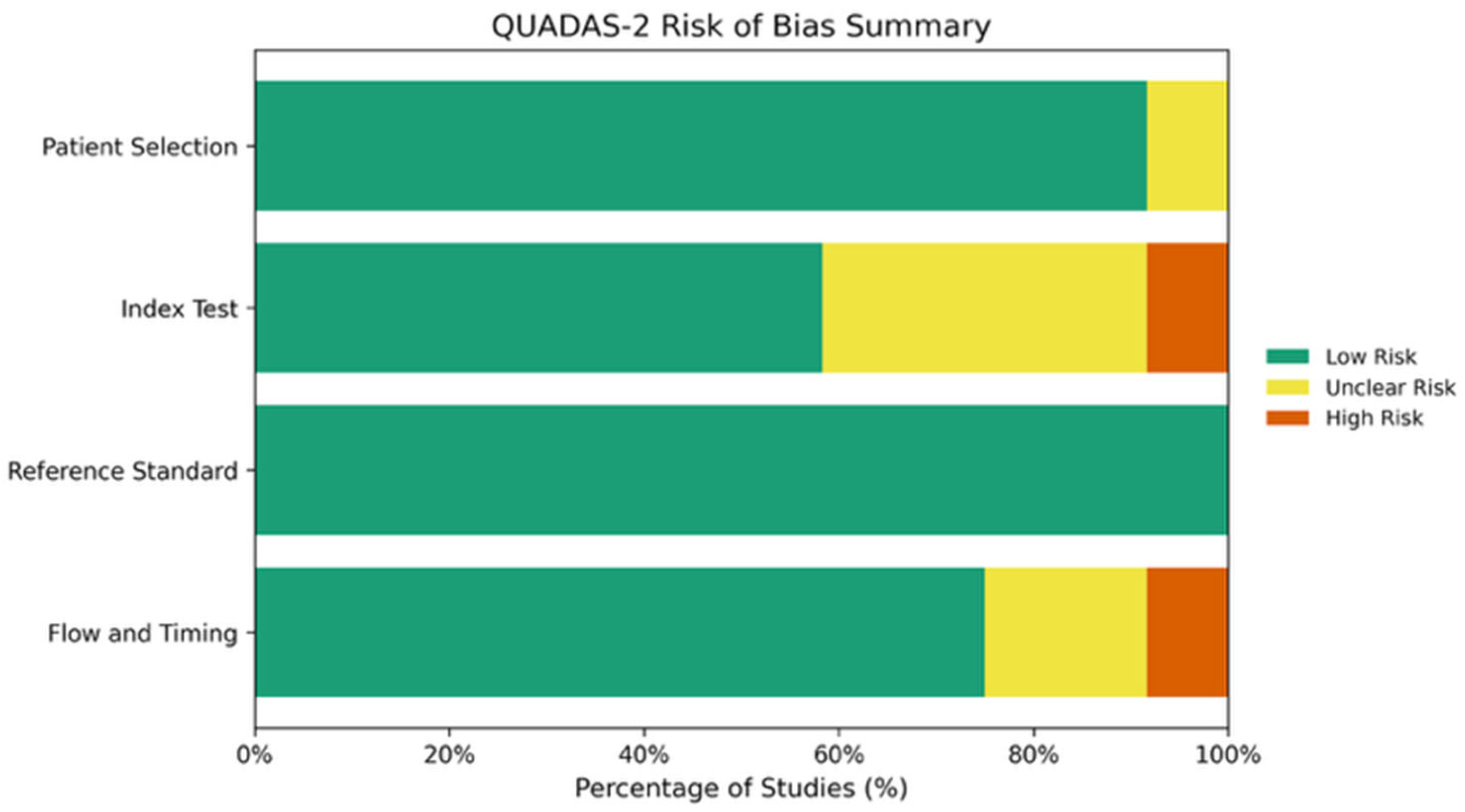
3.2. Quality Assessment
3.3. Methodological Quality Items
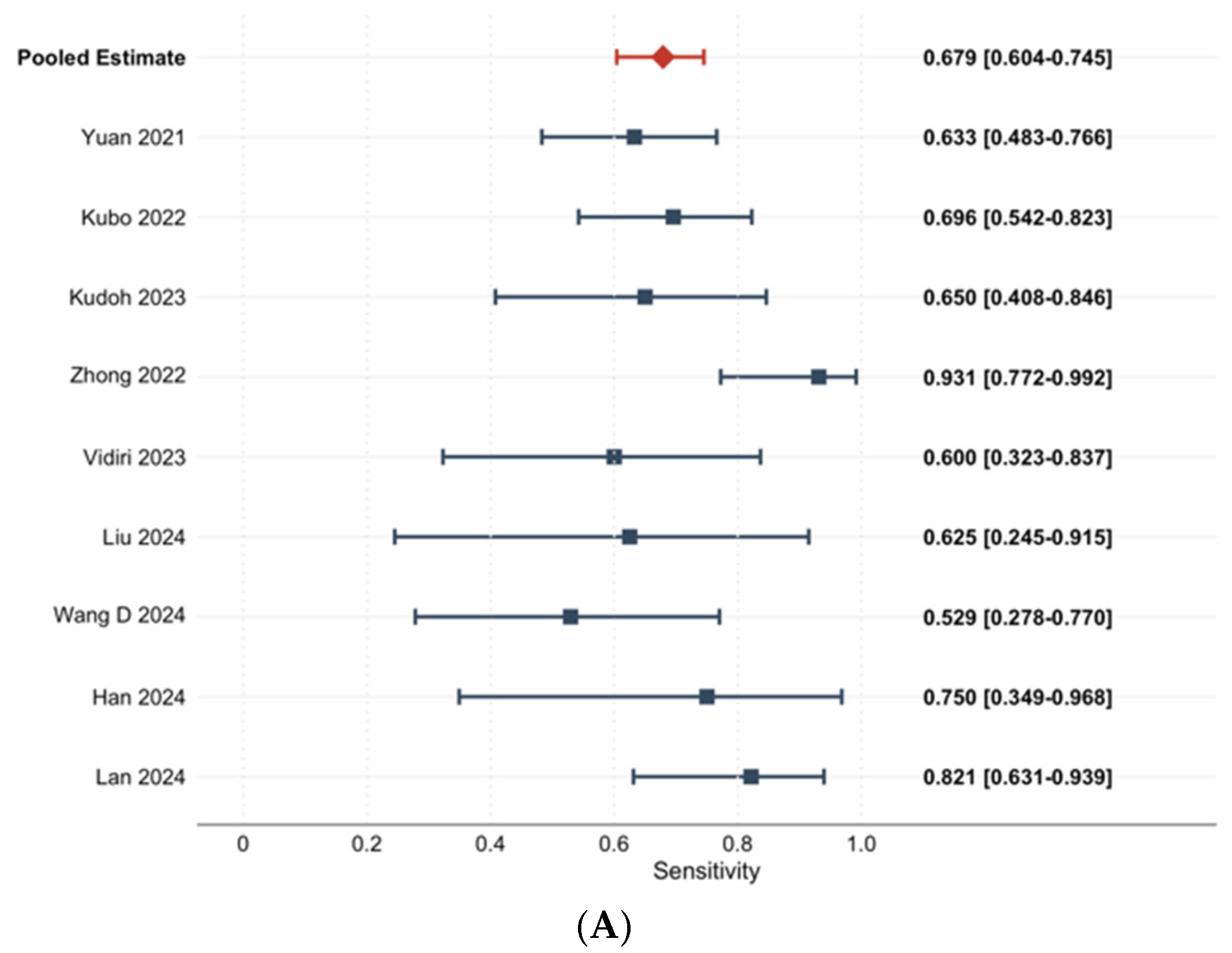
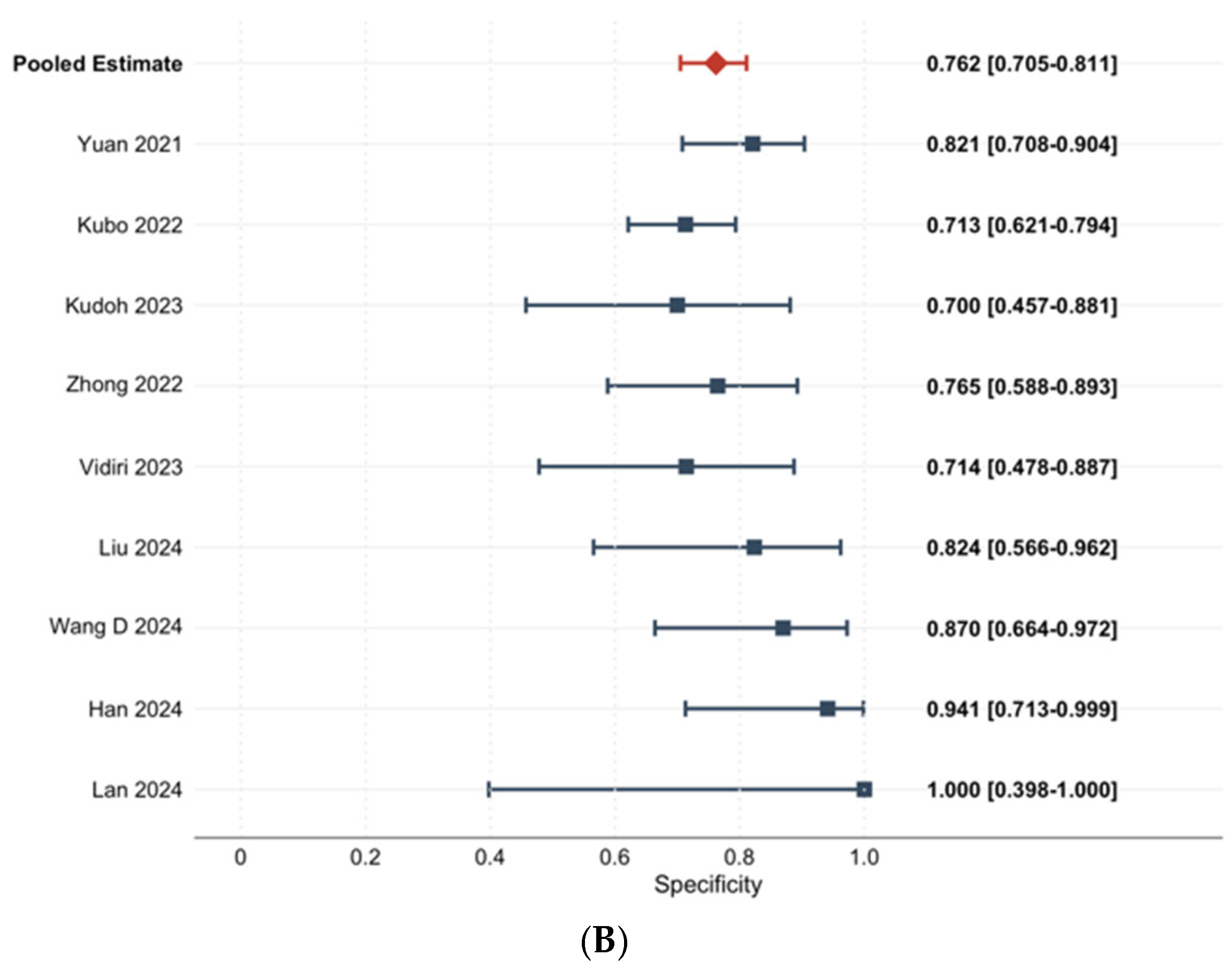
3.4. Diagnostic Accuracy
4. Discussion
Supplementary Materials
Author Contributions
Funding
Institutional Review Board Statement
Informed Consent Statement
Data Availability Statement
Conflicts of Interest
Appendix A
| PubMed (MEDLINE) | ||
|---|---|---|
| Step | Search Query | Results |
| #1 AI/ML | (“artificial intelligence”[MeSH Terms] OR “machine learning”[MeSH Terms] OR “deep learning”[MeSH Terms] OR “neural networks, computer”[MeSH Terms] OR “artificial intelligence”[Title/Abstract] OR “machine learning”[Title/Abstract] OR “deep learning”[Title/Abstract] OR “radiomics”[Title/Abstract] OR “radiomic”[Title/Abstract] OR “texture analysis”[Title/Abstract] OR “convolutional neural network*”[Title/Abstract] OR “random forest”[Title/Abstract] OR “support vector machine”[Title/Abstract] OR “transfer learning”[Title/Abstract]) | — |
| #2 Disease | (“tongue neoplasms”[MeSH Terms] OR “mouth neoplasms”[MeSH Terms] OR “oral tongue”[Title/Abstract] OR “tongue squamous cell carcinoma”[Title/Abstract] OR “OTSCC”[Title/Abstract] OR “oral squamous cell carcinoma”[Title/Abstract] OR “OSCC”[Title/Abstract] OR “oral cavity cancer”[Title/Abstract] OR “tongue cancer”[Title/Abstract] OR “oral cavity neoplasm*”[Title/Abstract] OR “lingual squamous cell carcinoma”[Title/Abstract]) | — |
| #3 Outcomes | (“lymphatic metastasis”[MeSH Terms] OR “neoplasm staging”[MeSH Terms] OR “lymph node metastasis”[Title/Abstract] OR “lymph node metastases”[Title/Abstract] OR “occult metastasis”[Title/Abstract] OR “occult metastases”[Title/Abstract] OR “cervical lymph node”[Title/Abstract] OR “cervical nodal”[Title/Abstract] OR “depth of invasion”[Title/Abstract] OR “DOI”[Title/Abstract] OR “tumor invasion”[Title/Abstract]) | — |
| #4 Combined | #1 AND #2 AND #3 | 80 |
| Summary | ||
| Database | Records | After Dedup |
| PubMed (MEDLINE) | 80 | — |
| Total | 80 | 80 |
| Study | QUADAS-2 Domains | AI-Specific Items | Discordance | |||||||||||
|---|---|---|---|---|---|---|---|---|---|---|---|---|---|---|
| PS | Ref Std | Idx Test | F&T | All Low? | ICC | Imbal | ExtVal | Calib | DCA | Clin Cmp | Rpt Gdln | Code | ||
| Yuan et al. [30] | Low | Low | Low | Low | Yes | Yes | No | No | No | No | No | No | No | All QUADAS-2 domains low risk; 7/8 AI criteria unmet. |
| Kubo et al. [24] | Low | Low | Unclear | Low | No | No | Yes | No | No | No | No | No | No | |
| Zhong et al. [31] | Low | Low | Low | Low | Yes | Yes | No | No | No | No | Yes | No | Yes | All QUADAS-2 domains low risk; 5/8 AI criteria unmet. |
| Kudoh et al. [17] | Low | Low | Unclear | Low | No | No | No | No | No | No | No | No | No | |
| Vidiri et al. [27] | Low | Low | Low | Unclear | No | Yes | Yes | No | No | No | No | Yes | No | |
| Han et al. [23] | Low | Low | Low | Low | Yes | No | No | No | No | No | No | No | No | All QUADAS-2 domains low risk; 8/8 AI criteria unmet. |
| Liu et al. [26] | Low | Low | Low | Low | Yes | Yes | No | No | Yes | No | No | No | No | All QUADAS-2 domains low risk; 6/8 AI criteria unmet. |
| Wang et al. [28] | Low | Low | Low | Low | Yes | No | No | No | Yes | Yes | No | No | No | All QUADAS-2 domains low risk; 6/8 AI criteria unmet. |
| Lan et al. [25] | Low | Low | Low | Low | Yes | No | Yes | Yes | Yes | Yes | No | Yes | No | Highest AI adherence: 5/8 items fulfilled. |
| Committeri et al. [21] | Low | Low | High | High | No | No | No | No | No | No | No | No | Yes | QUADAS-2 concerns consistent with AI-specific methodological gaps. |
| Csüry et al. [22] | Low | Low | Unclear | Unclear | No | No | No | No | No | No | No | No | No | |
| Wang et al. [29] | Unclear | Low | Unclear | Low | No | Yes | No | No | No | No | No | No | No | |
References
- Ramadan, S.; Mokhtari, T.E.; Al-Qurayshi, Z.; Rich, J.T.; Harbison, R.A.; Zolkind, P.; Jackson, R.S.; Pipkorn, P.; Kang, S.Y.; Mazul, A.L.; et al. Trends in incidence of oral cavity squamous cell carcinoma in the United States, 2001–2019. Surg. Oncol. Insights 2024, 1, 100055. [Google Scholar] [CrossRef]
- Stepan, K.O.; Mazul, A.L.; Larson, J.; Shah, P.; Jackson, R.S.; Pipkorn, P.; Kang, S.Y.; Puram, S.V. Changing epidemiology of oral cavity cancer in the United States. Otolaryngol. Head Neck Surg. 2023, 168, 761–768. [Google Scholar] [CrossRef]
- Sakr, Y.; Hamdy, O.; Eldeghedi, M.; Abdelaziz, R.; El Moctar, E.M.S.; Alharazin, M.; Awny, S. Shifting epidemiology trends in tongue cancer: A retrospective cohort study. Cancers 2023, 15, 5680. [Google Scholar] [CrossRef] [PubMed]
- Chaudhary, N.; Verma, R.K.; Agarwal, U.; Gupta, S.; Jaitly, S. Incidence of occult metastasis in clinically N0 oral tongue squamous cell carcinoma and its association with tumour staging, thickness, and differentiation. J. Head Neck Physicians Surg. 2017, 5, 75–80. [Google Scholar] [CrossRef]
- Merck Manual Professional Version. Oral Squamous Cell Carcinoma. Available online: https://www.merckmanuals.com/professional/ear-nose-and-throat-disorders/tumors-of-the-head-and-neck/oral-squamous-cell-carcinoma (accessed on 15 September 2024).
- Ghantous, Y.; Nashef, A.; Sidransky, D.; Abdelraziq, M.; Alkeesh, K.; Araidy, S.; Koch, W.; Brait, M.; Abu El-Naaj, I. Clinical and prognostic significance of the eighth edition oral cancer staging system. Cancers 2022, 14, 4632. [Google Scholar] [CrossRef] [PubMed]
- Van Dijk, L.V.; Fuller, C.D. Artificial intelligence and radiomics in head and neck cancer care: Opportunities, mechanics, and challenges. ASCO Educ. Book 2021, 41, e225–e235. [Google Scholar] [CrossRef]
- Broggi, G.; Maniaci, A.; Lentini, M.; Palicelli, A.; Zanelli, M.; Zizzo, M.; Koufopoulos, N.; Salzano, S.; Mazzucchelli, M.; Caltabiano, R. Artificial intelligence in head and neck cancer diagnosis: A comprehensive review with emphasis on radiomics, histopathological, and molecular applications. Cancers 2024, 16, 3623. [Google Scholar] [CrossRef]
- Wang, T.W.; Wang, C.K.; Hong, J.S.; Lin, Y.H.; Wang, S.Y.; Lu, C.F.; Wu, Y.T. Prognostic power of radiomics in head and neck cancers: Insights from a meta-analysis. Comput. Methods Programs Biomed. 2025, 262, 108683. [Google Scholar] [CrossRef]
- Alabi, R.O.; Elmusrati, M.; Leivo, I.; Almangush, A.; Mäkitie, A.A. Artificial intelligence-driven radiomics in head and neck cancer: Current status and future prospects. Int. J. Med. Inform. 2024, 188, 105464. [Google Scholar] [CrossRef]
- Valizadeh, P.; Jannatdoust, P.; Pahlevan-Fallahy, M.T.; Hassankhani, A.; Amoukhteh, M.; Bagherieh, S.; Ghadimi, D.J.; Gholamrezanezhad, A. Diagnostic accuracy of radiomics and artificial intelligence models in diagnosing lymph node metastasis in head and neck cancers: A systematic review and meta-analysis. Neuroradiology 2025, 67, 449–467. [Google Scholar] [CrossRef]
- Song, B.; Yadav, I.; Tsai, J.C.; Madabhushi, A.; Kann, B.H. Artificial intelligence for head and neck squamous cell carcinoma: From diagnosis to treatment. ASCO Educ. Book 2025, 45, e472464. [Google Scholar] [CrossRef] [PubMed]
- Tortora, M.; Gemini, L.; Scaravilli, A.; Ugga, L.; Ponsiglione, A.; Stanzione, A.; D’arco, F.; D’anna, G.; Cuocolo, R. Radiomics applications in head and neck tumor imaging: A narrative review. Cancers 2023, 15, 1174. [Google Scholar] [CrossRef] [PubMed]
- Huynh, B.N.; Groendahl, A.R.; Tomic, O.; Liland, K.H.; Knudtsen, I.S.; Hoebers, F.; van Elmpt, W.; Malinen, E.; Dale, E.; Futsaether, C.M. Head and neck cancer treatment outcome prediction: A comparison between machine learning with conventional radiomics features and deep learning radiomics. Front. Med. 2023, 10, 1217037. [Google Scholar] [CrossRef] [PubMed]
- Varoquaux, G.; Cheplygina, V. Machine learning for medical imaging: Methodological failures and recommendations for the future. npj Digit. Med. 2022, 5, 48. [Google Scholar] [CrossRef]
- Collins, G.S.; Moons, K.G.M.; Dhiman, P.; Riley, R.D.; Beam, A.L.; Van Calster, B.; Ghassemi, M.; Liu, X.; Reitsma, J.B.; van Smeden, M.; et al. TRIPOD+AI statement: Updated guidance for reporting clinical prediction models that use regression or machine learning methods. BMJ 2024, 385, e078378. [Google Scholar] [CrossRef]
- Kudoh, T.; Haga, A.; Kudoh, K.; Takahashi, A.; Sasaki, M.; Kudo, Y.; Ikushima, H.; Miyamoto, Y. Radiomics analysis of [18F]-fluoro-2-deoxyglucose positron emission tomography for the prediction of cervical lymph node metastasis in tongue squamous cell carcinoma. Oral Radiol. 2023, 39, 41–50. [Google Scholar] [CrossRef]
- Reitsma, J.B.; Glas, A.S.; Rutjes, A.W.; Scholten, R.J.; Bossuyt, P.M.; Zwinderman, A.H. Bivariate analysis of sensitivity and specificity produces informative summary measures in diagnostic reviews. J. Clin. Epidemiol. 2005, 58, 982–990. [Google Scholar] [CrossRef]
- Harbord, R.M.; Deeks, J.J.; Egger, M.; Whiting, P.; Sterne, J.A.C. A unification of models for meta-analysis of diagnostic accuracy studies. Biostatistics 2007, 8, 239–251. [Google Scholar] [CrossRef]
- Deeks, J.J.; Macaskill, P.; Irwig, L. The performance of tests of publication bias and other sample size effects in systematic reviews of diagnostic test accuracy was assessed. J. Clin. Epidemiol. 2005, 58, 882–893. [Google Scholar] [CrossRef]
- Committeri, U.; Fusco, R.; Di Bernardo, E.; Abbate, V.; Salzano, G.; Maglitto, F.; Dell’Aversana Orabona, G.; Piombino, P.; Bonavolontà, P.; Arena, A.; et al. Radiomics metrics combined with clinical data in the surgical management of early-stage (cT1–T2 N0) tongue squamous cell carcinomas: A preliminary study. Biology 2022, 11, 468. [Google Scholar] [CrossRef]
- Csűry, T.D.; Csűry, A.Z.; Balk, M.; Kist, A.M.; Rupp, R.; Mueller, S.K.; Sievert, M.; Iro, H.; Eckstein, M.; Gostian, A.O. The modified Polsby–Popper score, a novel quantitative histomorphological biomarker and its potential to predict lymph node positivity and cancer-specific survival in oral tongue squamous cell carcinoma. Cancer Med. 2024, 13, e6824. [Google Scholar] [CrossRef] [PubMed]
- Han, W.; Wang, Y.; Li, T.; Dong, Y.; Dang, Y.; He, L.; Xu, L.; Zhou, Y.; Li, Y.; Wang, X. A CT-based integrated model for preoperative prediction of occult lymph node metastasis in early tongue cancer. PeerJ 2024, 12, e17254. [Google Scholar] [CrossRef] [PubMed]
- Kubo, K.; Kawahara, D.; Murakami, Y.; Takeuchi, Y.; Katsuta, T.; Imano, N.; Nishibuchi, I.; Saito, A.; Konishi, M.; Kakimoto, N.; et al. Development of a radiomics and machine learning model for predicting occult cervical lymph node metastasis in patients with tongue cancer. Oral Surg. Oral Med. Oral Pathol. Oral Radiol. 2022, 134, 93–101. [Google Scholar] [CrossRef] [PubMed]
- Lan, T.; Kuang, S.; Liang, P.; Ning, C.; Li, Q.; Wang, L.; Wang, Y.; Lin, Z.; Hu, H.; Yang, L.; et al. MRI-based deep learning and radiomics for prediction of occult cervical lymph node metastasis and prognosis in early-stage oral and oropharyngeal squamous cell carcinoma: A diagnostic study. Int. J. Surg. 2024, 110, 4648–4659. [Google Scholar] [CrossRef]
- Liu, J.; Song, L.; Zhou, J.; Yu, M.; Hu, Y.; Zhang, J.; Song, P.; Ye, Y.; Wang, J.; Feng, G.; et al. Prediction of prognosis of tongue squamous cell carcinoma based on clinical MR imaging data modeling. Technol. Cancer Res. Treat. 2023, 22, 15330338231207006. [Google Scholar] [CrossRef]
- Vidiri, A.; Marzi, S.; Piludu, F.; Lucchese, S.; Dolcetti, V.; Polito, E.; Mazzola, F.; Marchesi, P.; Merenda, E.; Sperduti, I.; et al. Magnetic resonance imaging-based prediction models for tumor stage and cervical lymph node metastasis of tongue squamous cell carcinoma. Comput. Struct. Biotechnol. J. 2023, 21, 4277–4287. [Google Scholar] [CrossRef]
- Wang, D.; He, X.; Huang, C.; Li, W.; Li, H.; Huang, C.; Hu, C. Magnetic resonance imaging-based radiomics and deep learning models for predicting lymph node metastasis of squamous cell carcinoma of the tongue. Oral Surg. Oral Med. Oral Pathol. Oral Radiol. 2024, 138, 214–224. [Google Scholar] [CrossRef]
- Wang, F.; Tan, R.; Feng, K.; Hu, J.; Zhuang, Z.; Wang, C.; Hou, J.; Liu, X. Magnetic resonance imaging-based radiomics features associated with depth of invasion predicted lymph node metastasis and prognosis in tongue cancer. J. Magn. Reson. Imaging 2022, 56, 196–209. [Google Scholar] [CrossRef]
- Yuan, Y.; Ren, J.; Tao, X. Machine learning-based MRI texture analysis to predict occult lymph node metastasis in early-stage oral tongue squamous cell carcinoma. Eur. Radiol. 2021, 31, 6429–6437. [Google Scholar] [CrossRef]
- Zhong, Y.W.; Jiang, Y.; Dong, S.; Wu, W.J.; Wang, L.X.; Zhang, J.; Huang, M.W. Tumor radiomics signature for artificial neural network-assisted detection of neck metastasis in patients with tongue cancer. J. Neuroradiol. 2022, 49, 213–218. [Google Scholar] [CrossRef]
- Sounderajah, V.; Ashrafian, H.; Rose, S.; Shah, N.H.; Ghassemi, M.; Golub, R.; Kahn, C.E.; Esteva, A.; Karthikesalingam, A.; Mateen, B.; et al. A quality assessment tool for artificial intelligence-centered diagnostic test accuracy studies: QUADAS-AI. Nat. Med. 2021, 27, 1663–1665. [Google Scholar] [CrossRef] [PubMed]
- Deng, C.; Hu, J.; Tang, P.; Xu, T.; He, L.; Zeng, Z.; Sheng, J. Application of CT and MRI images based on artificial intelligence to predict lymph node metastases in patients with oral squamous cell carcinoma: A subgroup meta-analysis. Front. Oncol. 2024, 14, 1395159. [Google Scholar] [CrossRef] [PubMed]
- Acosta, J.N.; Falcone, G.J.; Rajpurkar, P.; Topol, E.J. Multimodal biomedical AI. Nat. Med. 2022, 28, 1773–1784. [Google Scholar] [CrossRef] [PubMed]
- Koçak, B.; Durmaz, E.Ş.; Ateş, E.; Kılıçkesmez, Ö. Radiomics with artificial intelligence: A practical guide for beginners. Diagn. Interv. Radiol. 2019, 25, 485–495. [Google Scholar] [CrossRef]
- Vogel, D.W.T.; Thoeny, H.C. Cross-sectional imaging in cancers of the head and neck: How we review and report. Cancer Imaging 2016, 16, 20. [Google Scholar] [CrossRef]
- Van Calster, B.; McLernon, D.J.; van Smeden, M.; Wynants, L.; Steyerberg, E.W. Calibration: The Achilles heel of predictive analytics. BMC Med. 2019, 17, 230. [Google Scholar] [CrossRef]
- Kelly, C.J.; Karthikesalingam, A.; Suleyman, M.; Corrado, G.; King, D. Key challenges for delivering clinical impact with artificial intelligence. BMC Med. 2019, 17, 195. [Google Scholar] [CrossRef]
- Yu, A.C.; Mohajer, B.; Eng, J. External validation of deep learning algorithms for radiologic diagnosis: A systematic review. Radiol. Artif. Intell. 2022, 4, e210064. [Google Scholar] [CrossRef]
- Lambin, P.; Leijenaar, R.T.H.; Deist, T.M.; Peerlings, J.; de Jong, E.E.C.; van Timmeren, J.; Sanduleanu, S.; Larue, R.T.H.M.; Even, A.J.G.; Jochems, A.; et al. Radiomics: The bridge between medical imaging and personalized medicine. Nat. Rev. Clin. Oncol. 2017, 14, 749–762. [Google Scholar] [CrossRef]
- Park, J.E.; Kim, D.; Kim, H.S.; Park, S.Y.; Kim, J.Y.; Cho, S.J.; Shin, J.H.; Kim, J.H. Quality of science and reporting of radiomics in oncologic studies: Room for improvement according to radiomics quality score and TRIPOD statement. Eur. Radiol. 2020, 30, 523–536. [Google Scholar] [CrossRef]
- Zwanenburg, A.; Vallières, M.; Abdalah, M.A.; Aerts, H.J.W.L.; Andrearczyk, V.; Apte, A.; Ashrafinia, S.; Bakas, S.; Beukinga, R.J.; Boellaard, R.; et al. The Image Biomarker Standardization Initiative: Standardized quantitative radiomics for high-throughput image-based phenotyping. Radiology 2020, 295, 328–338. [Google Scholar] [CrossRef]
- Mongan, J.; Moy, L.; Kahn, C.E., Jr. Checklist for artificial intelligence in medical imaging (CLAIM): A guide for authors and reviewers. Radiol. Artif. Intell. 2020, 2, e200029. [Google Scholar] [CrossRef]


| Study | Endpoint Definition | Clinical Population | Subgroup | Classification Rationale |
|---|---|---|---|---|
| Yuan et al. [30] | Lymph node metastasis defined as pN+ on elective neck dissection histopathology in clinically node-negative (cN0) patients. | cN0, early-stage (cT1–T2) | OLNM | cN0-restricted population with immediate postoperative histopathological confirmation of occult lymph node metastasis; classified as OLNM. |
| Kubo et al. [24] | Cervical lymph node metastasis defined as pathologically confirmed nodal involvement detected either at elective neck dissection or within 1-year follow-up in cN0 patients. | cN0, early-stage | OLNM | cN0-restricted cohort with delayed detection of cervical nodal metastasis within a predefined follow-up period; considered conceptually equivalent to OLNM and included in primary analysis, with additional sensitivity evaluation. |
| Han et al. [23] | Lymph node metastasis defined as pN+ on surgical histopathology in a cN0-restricted cohort. | cT1–T2, multi-center pooled | OLNM | cN0-restricted population with immediate histopathological confirmation; validation strategy classified as internal, as training and validation data were derived from a pooled dataset prior to splitting. |
| Lan et al. [25] | Lymph node metastasis defined as histopathologically confirmed nodal involvement in clinically node-negative patients. | cN0, early-stage; multi-center | OLNM | cN0-restricted, multicenter cohort; the only study employing true external validation using an independent institutional dataset with different MRI scanners. |
| Kudoh et al. [17] | Cervical lymph node metastasis defined as surgically confirmed or clinically detected nodal involvement in a mixed cN0/cN+ population. | Mixed cN0/cN+ | LNM | Mixed cN0/cN+ population including surgically confirmed and late-detected metastases; classified as general LNM according to prespecified decision rules. |
| Zhong et al. [31] | Lymph node metastasis defined as pN+ on surgical histopathology in a mixed-stage cohort. | Mixed cN0/cN+ | LNM | Mixed cN0/cN+ cohort; although cN0-specific results were reported, independently extractable 2 × 2 data were unavailable; full-cohort data were therefore used for quantitative synthesis. |
| Vidiri et al. [27] | Primary endpoint: lymph node metastasis defined as pN+ on surgical histopathology; secondary endpoint: DOI/pT stage prediction. | Mixed cN0/cN+ | LNM | Mixed cN0/cN+ population; LNM prediction model included in primary analysis; DOI/pT model summarized separately in narrative form. |
| Liu et al. [26] | Lymph node metastasis defined as histopathologically confirmed nodal involvement in a mixed T/N stage cohort | Mixed stages (all T/N), multi-sequence MRI | LNM | Mixed-stage cohort including all T and N stages; cN0-specific 2 × 2 data were not independently extractable; classified as general LNM per decision rule #2. |
| Wang et al. [28] | Lymph node metastasis defined as pathologically confirmed nodal involvement; clinical nodal status incorporated as a model input variable. | Mixed cN0/cN+ | LNM | Mixed cN0/cN+ population; predictive model incorporated clinical lymph node status as a covariate; classified as general LNM. |
| Committeri et al. [21] † | Lymph node metastasis prediction as reported; independently extractable 2 × 2 contingency data not provided. | Mixed | — | Excluded from the primary meta-analysis due to high risk of bias (Index Test and Flow & Timing domains of QUADAS-2), absence of an independent validation set, and lack of directly reported 2 × 2 contingency data. |
| Csüry et al. [22] † | Lymph node metastasis predicted using postoperative histopathologic whole-slide imaging features rather than preoperative imaging data. | Mixed | — | Excluded from the primary quantitative synthesis because model input was based on postoperative histopathology rather than preoperative imaging; included in extended sensitivity analysis (k = 11). |
| Wang et al. [29] † | Lymph node metastasis prediction as reported; insufficient independently extractable diagnostic contingency data for quantitative synthesis. | Mixed | — | Included in systematic review only; insufficient independently extractable 2 × 2 data for primary quantitative synthesis. |
| Study | Patient Selection | Reference Standard | Index Test | Flow & Timing |
|---|---|---|---|---|
| Yuan et al. [30] | Low | Low | Low | Low |
| Kubo et al. [24] | Low | Low | Unclear | Low |
| Zhong et al. [31] | Low | Low | Low | Low |
| Kudoh et al. [17] | Low | Low | Unclear | Low |
| Vidiri et al. [27] | Low | Low | Low | Unclear |
| Han et al. [23] | Low | Low | Low | Low |
| Liu et al. [26] | Low | Low | Low | Low |
| Wang et al. [28] | Low | Low | Low | Low |
| Lan et al. [25] | Low | Low | Low | Low |
| Committeri et al. [21] † | Low | Low | High | High |
| Csüry et al. [22] † | Low | Low | Unclear | Unclear |
| Wang et al. [29] † | Unclear | Low | Unclear | Low |
| Low risk, n/12 (%) | 11 (91.7%) | 12 (100%) | 7 (58.3%) | 9 (75.0%) |
| Study | N | Age | Imaging | Outcome | Best Model | SE | SP | AUC | Validation | Subgroup | Analysis |
|---|---|---|---|---|---|---|---|---|---|---|---|
| Yuan et al. [30] | 68 | NR | MRI | OLNM | ANN | 0.633 | 0.821 | 0.800 | 5-fold CV | OLNM | Primary (k = 9) |
| Kubo et al. [24] | 62 | NR | CT | OLNM | SVM | 0.696 | 0.713 | 0.720 | LOOCV | OLNM | Primary (k = 9) |
| Zhong et al. [31] | 161 | NR | CT | LNM | RF | 0.931 | 0.765 | 0.850 | 10-fold CV | LNM | Primary (k = 9) |
| Kudoh et al. [17] | 40 | 66 ± 14 | PET/CT | LNM | Thresholding | 0.650 | 0.700 | 0.790 | 5-fold CV | LNM | Primary (k = 9) |
| Vidiri et al. [27] | 36 | 61 | MRI | LNM | RF | 0.600 | 0.714 | NR | Random split | LNM | Primary (k = 9) |
| Han et al. [23] | 125 | NR | CECT | OLNM | LightGBM | 0.750 | 0.941 | 0.824 | Random split | OLNM | Primary (k = 9) |
| Liu et al. [26] | 25 † | 56.9 ± 11.3 | MRI | LNM | SVM | 0.625 | 0.824 | 0.868 | Train/test | LNM | Primary (k = 9) |
| Wang et al. [28] | 80 | NR | MRI | LNM | MLP | 0.529 | 0.870 | 0.747 | Random split | LNM | Primary (k = 9) |
| Lan et al. [25] | 319 | NR | MRI | OLNM | ResNet50 + Rad | 0.821 | 1.00 | 0.878 | External | OLNM | Primary (k = 9) |
| Committeri et al. [21] † | ≈53 | NR | Mixed | LNM | CIDT | NR | NR | NR | None (resubst.) | — | SA only (k = 11) |
| Csüry et al. [22] † | 211 | NR | Histopath | LNM | RF/SVM | NR | NR | 0.830 | 5-fold CV | — | SA only (k = 11) |
| Wang et al. [29] † | NR | NR | Mixed | LNM | Logistic | NR | NR | NR | NR | — | SR only |
Disclaimer/Publisher’s Note: The statements, opinions and data contained in all publications are solely those of the individual author(s) and contributor(s) and not of MDPI and/or the editor(s). MDPI and/or the editor(s) disclaim responsibility for any injury to people or property resulting from any ideas, methods, instructions or products referred to in the content. |
© 2026 by the authors. Licensee MDPI, Basel, Switzerland. This article is an open access article distributed under the terms and conditions of the Creative Commons Attribution (CC BY) license.
Share and Cite
Ho, Y.-Y.; Hsu, C.-W.; Chu, T.-Y.; Lin, C.-J.; Ho, Y.-H.; Wu, C.-H.; Lin, C.-P. Artificial Intelligence for Preoperative Prediction of Lymph Node Metastasis and Depth of Invasion in Oral Tongue Squamous Cell Carcinoma: A Systematic Review and Meta-Analysis. Diagnostics 2026, 16, 774. https://doi.org/10.3390/diagnostics16050774
Ho Y-Y, Hsu C-W, Chu T-Y, Lin C-J, Ho Y-H, Wu C-H, Lin C-P. Artificial Intelligence for Preoperative Prediction of Lymph Node Metastasis and Depth of Invasion in Oral Tongue Squamous Cell Carcinoma: A Systematic Review and Meta-Analysis. Diagnostics. 2026; 16(5):774. https://doi.org/10.3390/diagnostics16050774
Chicago/Turabian StyleHo, Yi-Yun, Chun-Wei Hsu, Ta-Yi Chu, Chun-Ju Lin, Yi-Hsin Ho, Cheng-Hsien Wu, and Ching-Po Lin. 2026. "Artificial Intelligence for Preoperative Prediction of Lymph Node Metastasis and Depth of Invasion in Oral Tongue Squamous Cell Carcinoma: A Systematic Review and Meta-Analysis" Diagnostics 16, no. 5: 774. https://doi.org/10.3390/diagnostics16050774
APA StyleHo, Y.-Y., Hsu, C.-W., Chu, T.-Y., Lin, C.-J., Ho, Y.-H., Wu, C.-H., & Lin, C.-P. (2026). Artificial Intelligence for Preoperative Prediction of Lymph Node Metastasis and Depth of Invasion in Oral Tongue Squamous Cell Carcinoma: A Systematic Review and Meta-Analysis. Diagnostics, 16(5), 774. https://doi.org/10.3390/diagnostics16050774