Evaluation of the Course of Acute-Phase Reactants in the Postoperative Period of Newborns and Their Diagnostic Utility in Identifying Postoperative Sepsis


Abstract
1. Introduction
2. Materials and Methods
2.1. Inclusion Criteria
2.2. Exclusion Criteria
2.3. Study Protocol
- Proven sepsis was defined as the presence of clinical and laboratory findings consistent with sepsis, in which the causative microorganism was identified by blood culture or, in culture-negative cases, by molecular methods (Polymerase Chain Reaction, 16S rRNA), antigen-based assays, or other specific diagnostic techniques.
- Clinical sepsis was defined as cases with clinical and laboratory findings suggestive of sepsis but without microbiological confirmation in cultures. Patients with European Medicines Agency (EMA) neonatal sepsis scores ≥ 6 were considered as having clinical sepsis. EMA scoring provides a standardized “common language” for case definition; because it integrates clinical signs with laboratory findings, it was considered appropriate for use in this study [11].
2.4. Demographic and Clinical Data
2.5. Laboratory Data
2.6. Statistical Analysis
- Normality testing: Data distribution was assessed with the Shapiro–Wilk test.
- Group comparisons: Independent samples t-test was used for parametric variables, and the Mann-Whitney U test was applied for nonparametric variables.
- Categorical variables: Chi-square test or Fisher’s exact test was used as appropriate.
- Multivariable logistic regression analysis was performed to evaluate the association between postoperative biomarker levels and sepsis status, adjusting for surgical type, birth weight, and APGAR scores.
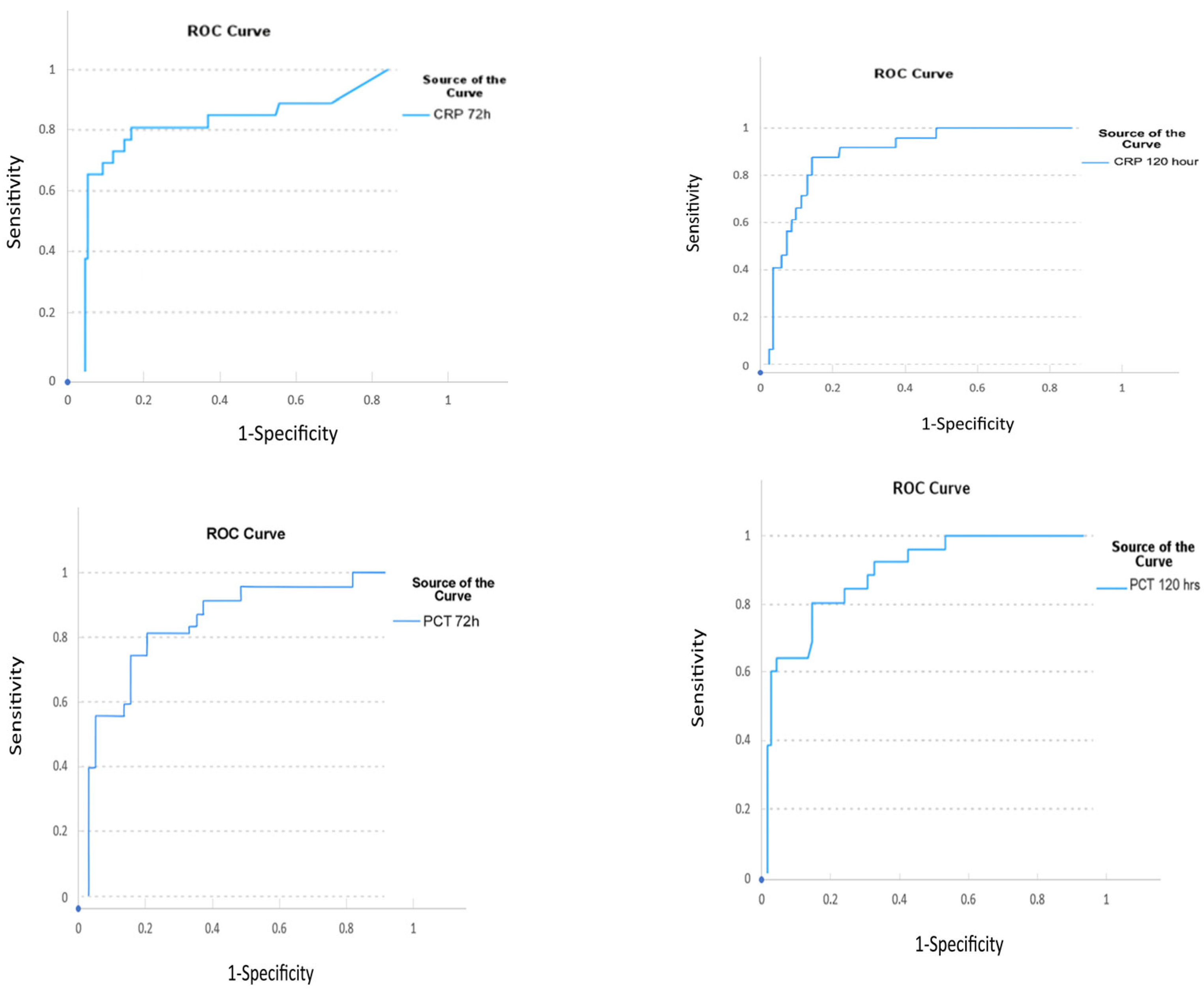
- Diagnostic test performance: Receiver Operating Characteristic (ROC) curve analysis was performed to evaluate the predictive value of CRP and PCT levels for sepsis. Sensitivity, specificity, area under the curve (AUC), and optimal cut-off values were calculated. The Youden index was used to determine optimal cut-off thresholds.
3. Results
3.1. Demographic and Clinical Characteristics
3.2. Laboratory Findings
3.3. ROC Analysis
3.4. Postoperative Kinetics of Biomarkers
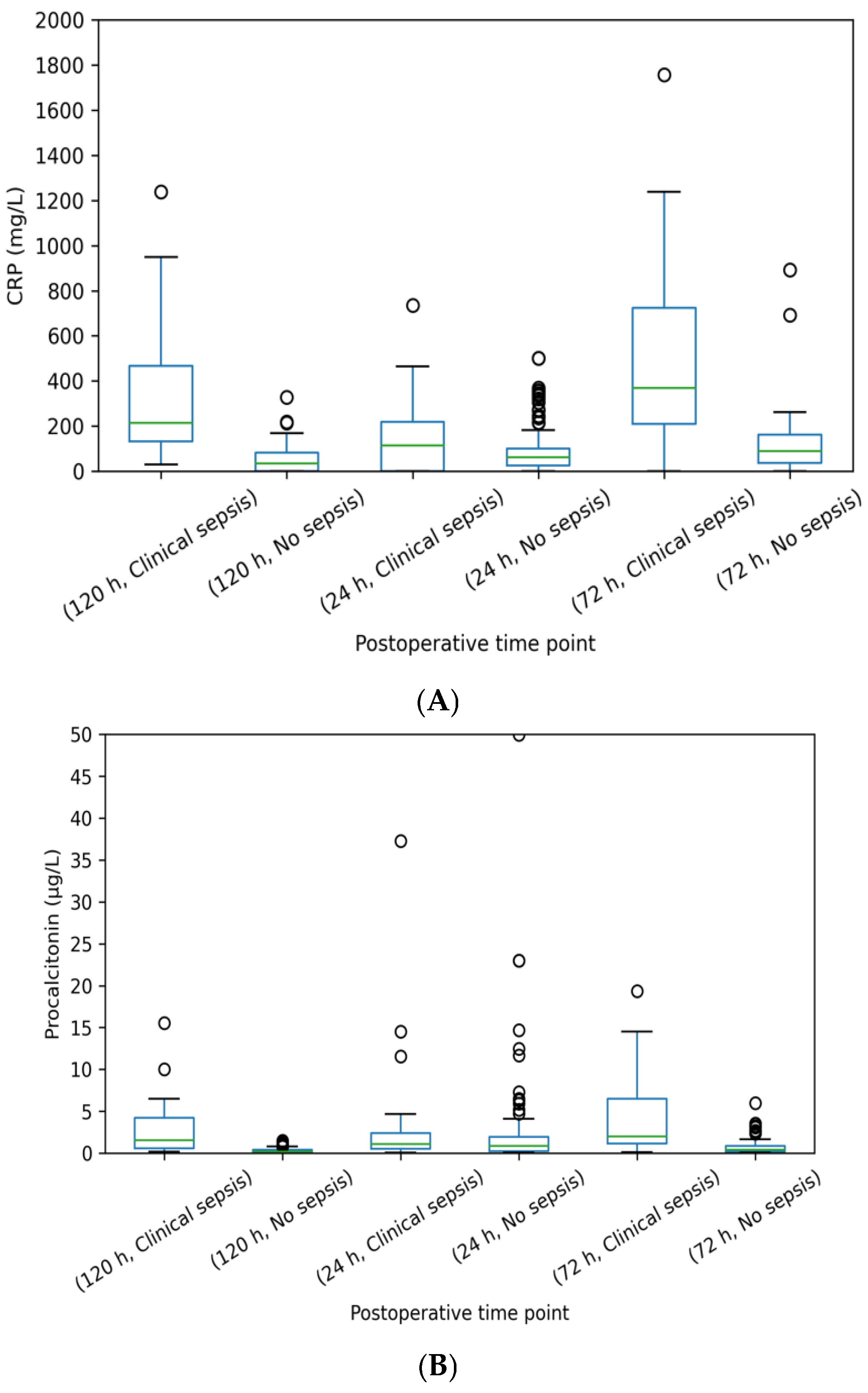
- Figure 2A. Boxplots illustrating postoperative serum CRP levels (mg/L) at 24, 72, and 120 h in neonates with clinical sepsis and without sepsis. Boxes represent the median and interquartile range (IQR), whiskers indicate the range of non-outlier values, and individual dots denote outliers. The boxplot presentation allows clear visualization of data distribution and relative differences between groups across postoperative time points.
- Figure 2B. Boxplots illustrating postoperative serum PCT levels (µg/L) at 24, 72, and 120 h in neonates with clinical sepsis and without sepsis. Data are displayed according to sepsis status and time point using uniform axis scaling. Boxes represent the median and interquartile range (IQR), whiskers indicate the range of non-outlier values, and dots represent outliers. This visualization highlights the temporal divergence of PCT levels between septic and non-septic infants, particularly at 72 h after surgery
4. Discussion
5. Conclusions
Author Contributions
Funding
Institutional Review Board Statement
Informed Consent Statement
Data Availability Statement
Conflicts of Interest
Abbreviations
| AUC | area under the curve |
| CRP | c-reactive protein |
| IL-6 | interleukin-6 |
| MPV | mean platelet volume |
| NICU | neonatal intensive care unit |
| PCT | procalcitonin |
| TNF-α | tumor necrosis factor-alpha |
| WBC | white blood cell |
References
- Ng, P.C.; Lam, H.S. Biomarkers for late-onset neonatal sepsis: Cytokines and beyond. Clin. Perinatol. 2010, 37, 599–610. [Google Scholar] [CrossRef] [PubMed] [PubMed Central]
- Wynn, J.L.; Wong, H.R. Pathophysiology and treatment of septic shock in neonates. Clin. Perinatol. 2010, 37, 439–479. [Google Scholar] [CrossRef] [PubMed] [PubMed Central]
- Eichberger, J.; Resch, E.; Resch, B. Diagnosis of Neonatal Sepsis: The Role of Inflammatory Markers. Front. Pediatr. 2022, 10, 840288. [Google Scholar] [CrossRef] [PubMed] [PubMed Central]
- Benitz, W.E. Adjunct laboratory tests in the diagnosis of early-onset neonatal sepsis. Clin. Perinatol. 2010, 37, 421–438. [Google Scholar] [CrossRef] [PubMed]
- Yang, K.D.; He, Y.; Xiao, S.; Ai, Q.; Yu, J.L. Identification of progranulin as a novel diagnostic biomarker for early-onset sepsis in neonates. Eur. J. Clin. Microbiol. Infect. Dis. 2020, 39, 2405–2414. [Google Scholar] [CrossRef] [PubMed]
- Bölke, E.; Jehle, P.M.; Trautmann, M.; Götz, I.; Krebs, B.; Steinbach, G.; Orth, K. Different acute-phase response in newborns and infants undergoing surgery. Pediatr Res. 2002, 51, 333–338. [Google Scholar] [CrossRef]
- Sharma, D.; Farahbakhsh, N.; Shastri, S.; Sharma, P. Biomarkers for diagnosis of neonatal sepsis: A literature review. J. Matern. Fetal Neonatal Med. 2018, 31, 1646–1659. [Google Scholar] [CrossRef] [PubMed]
- Davidson, J.; Tong, S.; Hauck, A.; Lawson, D.S.; da Cruz, E.; Kaufman, J. Kinetics of procalcitonin and C-reactive protein and the relationship to postoperative infection in young infants undergoing cardiovascular surgery. Pediatr. Res. 2013, 74, 413–419. [Google Scholar] [CrossRef] [PubMed] [PubMed Central]
- Goyal, M.; Mascarenhas, D.; Rr, P.; Haribalakrishna, A. Diagnostic Accuracy of Point-of-Care Testing of C-Reactive Protein, Interleukin-6, and Procalcitonin in Neonates with Clinically Suspected Sepsis: A Prospective Observational Study. Med. Princ. Pract. 2024, 33, 291–298. [Google Scholar] [CrossRef] [PubMed] [PubMed Central]
- Boscarino, G.; Migliorino, R.; Carbone, G.; Davino, G.; Dell’Orto, V.G.; Perrone, S.; Principi, N.; Esposito, S. Biomarkers of Neonatal Sepsis: Where We Are and Where We Are Going. Antibiotics 2023, 12, 1233. [Google Scholar] [CrossRef] [PubMed] [PubMed Central]
- European Medicines Agency. Guideline on the Investigation of Medicinal Products for the Treatment of Neonatal Sepsis; EMA/CHMP/EWP/92306/2006; European Medicines Agency: London, UK, 2010. [Google Scholar]
- Norman-Bruce, H.; Umana, E.; Mills, C.; Mitchell, H.; McFetridge, L.; McCleary, D.; Waterfield, T. Diagnostic test accuracy of procalcitonin and C-reactive protein for predicting invasive and serious bacterial infections in young febrile infants: A systematic review and meta-analysis. Lancet Child. Adolesc. Health 2024, 8, 358–368. [Google Scholar] [CrossRef] [PubMed]
- Rees, C.A.; Lim, J.; Westbrook, A.L.; El Helou, R.; Schmid, A.; Rubin-Smith, J.; Shreeve, K.; Rotman, C.; Govindapillai, S.; Dorney, K.; et al. Systematic review and meta-analysis of the diagnostic value of four biomarkers in detecting neonatal sepsis in low- and middle-income countries. BMJ Paediatr. Open 2023, 7, e001627. [Google Scholar] [CrossRef] [PubMed] [PubMed Central]
- Beaumont, R.; Tang, K.; Gwee, A. The Sensitivity and Specificity of Procalcitonin in Diagnosing Bacterial Sepsis in Neonates. Hosp. Pediatr. 2024, 14, 199–208. [Google Scholar] [CrossRef] [PubMed]
- Bobillo-Perez, S.; Girona-Alarcon, M.; Sole-Ribalta, A.; Guitart, C.; Felipe, A.; Hernandez, L.; Balaguer, M.; Cambra, F.J.; Jordan, I. Infection…what else? The usefulness of procalcitonin in children after cardiac surgery. PLoS ONE 2021, 16, e0254757. [Google Scholar] [CrossRef] [PubMed] [PubMed Central]
- Benitz, W.E.; Han, M.Y.; Madan, A.; Ramachandra, P. Serial serum C-reactive protein levels in the diagnosis of neonatal infection. Pediatrics 1998, 102, E41. [Google Scholar] [CrossRef] [PubMed]
- Miyosawa, Y.; Akazawa, Y.; Kamiya, M.; Nakamura, C.; Takeuchi, Y.; Kusakari, M.; Nakamura, T. Presepsin as a predictor of positive blood culture in suspected neonatal sepsis. Pediatr. Int. 2018, 60, 157–161. [Google Scholar] [CrossRef] [PubMed]
- Klingenberg, C.; Kornelisse, R.F.; Buonocore, G.; Maier, R.F.; Stocker, M. Culture-Negative Early-Onset Neonatal Sepsis—At the Crossroad Between Efficient Sepsis Care and Antimicrobial Stewardship. Front Pediatr. 2018, 6, 285. [Google Scholar] [CrossRef]
- Rao, H.; Dutta, S.; Menon, P.; Attri, S.; Sachdeva, N.; Malik, M. Procalcitonin and C-reactive protein for diagnosing post-operative sepsis in neonates. J. Paediatr. Child. Health 2022, 58, 593–599. [Google Scholar] [CrossRef] [PubMed]
- Neunhoeffer, F.; Plinke, S.; Renk, H.; Hofbeck, M.; Fuchs, J.; Kumpf, M.; Zundel, S.; Seitz, G. Serum Concentrations of Interleukin-6, Procalcitonin, and C-Reactive Protein: Discrimination of Septical Complications and Systemic Inflammatory Response Syndrome after Pediatric Surgery. Eur. J. Pediatr. Surg. 2016, 26, 180–185. [Google Scholar] [CrossRef] [PubMed]
- Zant, R.; Melter, M.; Knoppke, B.; Ameres, M.; Kunkel, J. Kinetics of interleukin-6, procalcitonin, and C-reactive protein after pediatric liver transplantation. Transplant. Proc. 2014, 46, 3507–3510. [Google Scholar] [CrossRef] [PubMed]
- Li, X.; Wang, X.; Li, S.; Yan, J.; Li, D. Diagnostic Value of Procalcitonin on Early Postoperative Infection After Pediatric Cardiac Surgery. Pediatr. Crit. Care Med. 2017, 18, 420–428. [Google Scholar] [CrossRef] [PubMed]
- Liu, H.H.; Zhang, M.W.; Guo, J.B.; Li, J.; Su, L. Procalcitonin and C-reactive protein in early diagnosis of sepsis caused by either Gram-negative or Gram-positive bacteria. Ir. J. Med. Sci. 2017, 186, 207–212. [Google Scholar] [CrossRef] [PubMed]
- Zhang, J.; Chen, L.; Yang, Y.; Liu, X.; Yuan, Y.; Song, S.R.; Zhao, Y.; Mao, J. Clinical and laboratory findings to differentiate late-onset sepsis caused by Gram-negative vs Gram-positive bacteria among perterm neonates: A retrospective cohort study. Int. Immunopharmacol. 2023, 116, 109769. [Google Scholar] [CrossRef] [PubMed]
- Duan, Y.H.; Guo, P.; Liang, Y.B.; Chen, Y.; Chang, Z.Y. Analysis of Clinical Characteristics and Diagnostic Efficacy of Blood Indicators in Neonatal Sepsis with Different Pathogenic Bacteria. Mediterr. J. Hematol. Infect. Dis. 2025, 17, e2025048. [Google Scholar] [CrossRef]
- Anugu, N.R.; Khan, S. Comparing the Diagnostic Accuracy of Procalcitonin and C-Reactive Protein in Neonatal Sepsis: A Systematic Review. Cureus 2021, 13, e19485. [Google Scholar] [CrossRef] [PubMed] [PubMed Central]
- Mittal, A.K.; Patel, M.; Shekhawat, D.S.; Singh, P.; Singh, K. Comparing the diagnosis accuracy and efficacy of presepsin (sCD14) and nCD64 in neonatal sepsis: A systematic review and meta-analysis. Clin. Epidemiol. Glob. Health 2025, 32, 101957. [Google Scholar] [CrossRef]
- Sundara, S.V.; Lu, X.; Busmail, H.; Weerakoon, S.; Avula, S.; Mandefro, B.T.; Mohammed, L. C-reactive Protein Versus Procalcitonin in the Early Diagnosis of Neonatal Sepsis: A Systematic Review. Cureus 2025, 17, e90353. [Google Scholar] [CrossRef] [PubMed]
- Tuzun, F.; Ozkan, H.; Cetinkaya, M.; Yucesoy, E.; Kurum, O.; Cebeci, B.; Cakmak, E.; Ozkutuk, A.; Keskinoglu, P.; Baysal, B.; et al. Is European Medicines Agency (EMA) sepsis criteria accurate for neonatal sepsis diagnosis or do we need new criteria? PLoS ONE 2019, 14, e0218002. [Google Scholar] [CrossRef]



| Proven Sepsis (n = 16) | Clinical Sepsis (n = 25) | No Sepsis (n = 94) | p | |
|---|---|---|---|---|
| Gestational age, weeks * | 36.1 ± 4.2 | 35.9 ± 3.7 | 36.9 ± 1.7 | 0.148 |
| Birthweight, g * | 2712 ± 870 | 2558 ± 850 | 2855 ± 530 | 0.027 |
| Male, n (%) | 7 (44) | 12 (48) | 43 (45.7) | 0.901 |
| C/S, n (%) | 6 (37.5) | 10 (40) | 46 (49) | 0.901 |
| Apgar score at 5th min ** | 8 (6–9) | 7 (6–9) | 8 (5–10) | 0.010 |
| Postnatal age at surgery, day ** | 4 (1–86) | 4 (1–86) | 3 (1–36) | 0.452 |
| Duration of postoperative invasiv Mechanical ventilation, day ** | 0 (0–4) | 0 (0–27) | 0 (0–39) | 0.696 |
| Mortality, n (%) | 1 (6.3) | 2 (8) | 7 (7.4) | 0.245 |
| Clinical Sepsis (n = 25) | No Sepsis (n = 94) | p | |
|---|---|---|---|
| Preoperative | |||
| WBC (×1000/µL) * | 12.8 ± 4.7 | 15 ± 4.3 | 0.25 |
| Neutrophil (×1000/µL) * | 6.7 ± 3.5 | 7 ± 4.1 | 0.86 |
| Lymphocyte (×1000/µL) * | 7 ± 3.8 | 5.5 ± 2.6 | 0.76 |
| Platelet (×1000/µL) * | 238 ± 91 | 310 ± 126 | 0.37 |
| MPV, fL * | 9.7 ± 0.9 | 10 ± 1 | 0.12 |
| Albumin g/dL | 31 ± 5.3 | 31 ± 4.1 | 0.507 |
| Lactate mmol/L * | 3.1 ± 1.4 | 2.8 ± 1.2 | 0.298 |
| C-reactive protein, mg/L ** | 0 (0–9.6) | 0 (0–8.6) | 0.509 |
| Procalcitonin, µg/L ** | 0.17 (0.07–3.5) | 0.16 (0–4.6) | 0.5 |
| Postoperative 24th hour | |||
| WBC (×1000/µL) * | 12 ± 7.2 | 12.4 ± 4.1 | 0.93 |
| Neutrophil (×1000/µL) * | 8.3 ± 5.3 | 7.6 ± 3.7 | 0.77 |
| Lymphocyte (×1000/µL) * | 2.4 ± 1.9 | 3.3 ± 1.6 | 0.05 |
| Platelet (×1000/µL) * | 248 ± 194 | 296 ± 142 | 0.75 |
| MPV, fL * | 10.3 ± 1.2 | 10 ± 1 | 0.27 |
| Albumin g/dL | 23.5 ± 3.4 | 25 ± 4.1 | 0.056 |
| Lactate mmol/L * | 2.6 ± 1.5 | 2.5 ± 1.2 | 0.84 |
| C-reactive protein, mg/L ** | 11.5 (0–80.7) | 0 (0.09–50) | 0.146 |
| Procalcitonin, µg/L ** | 1.09 (0.08–241) | 0.96 (0.06–148) | 0.518 |
| Postoperative 72nd hour | |||
| WBC (×1000/µL) * | 11.5 ± 5.6 | 12 ± 4.5 | 0.310 |
| Neutrophil (×1000/µL) * | 7.5 ± 5 | 6.6 ± 3.7 | 0.429 |
| Lymphocyte (×1000/µL) * | 3.3 ± 1.9 | 3.8 ± 1.7 | 0.14 |
| Platelet (×1000/µL) * | 287 ± 185 | 346 ± 163 | 0.125 |
| MPV, fL * | 10.6 ± 1.2 | 10.3 ± 1.2 | 0.289 |
| Albumin g/dL | 22 ± 4.2 | 25 ± 3.9 | 0.054 |
| Lactate mmol/L * | 3.1 ± 1.4 | 2.8 ± 1.2 | 0.489 |
| C-reactive protein, mg/L ** | 26.2 (0–175) | 11.5 (0–223) | 0.04 |
| Procalcitonin, µg/L ** | 1.6 (1–183) | 0.45 (0.06–148) | <0.01 |
| Postoperative 120th hour | |||
| WBC (×1000/µL) * | 12 ± 7 | 12.6 ± 5 | 0.660 |
| Neutrophil (×1000/µL) * | 7.1 ± 5.3 | 5.3 ± 3.4 | 0.174 |
| Lymphocyte (×1000/µL) * | 3.9 ± 1.9 | 4.6 ± 1.9 | 0.103 |
| Platelet (×1000/µL) * | 327 ± 173 | 432 ± 199 | 0.019 |
| MPV, fL * | 10.6 ± 1 | 10 ± 1.2 | 0.353 |
| Albumin g/dL | 23.5 ± 4.4 | 26.5 ± 5 | 0.008 |
| C-reactive protein, mg/L ** | 13.3 (0–76.6) | 4.9 (0–124) | 0.002 |
| Lactate mmol/L * | 2.7 ± 1.4 | 2 ± 0.8 | 0.152 |
| Procalcitonin, µg/L ** | 1.99 (0.16–140) | 0.2 (0.05–10) | <0.01 |
| Proven Sepsis (n = 16) | No Sepsis (n = 94) | p | |
|---|---|---|---|
| Postoperative 24th hour | |||
| 15.5 (0–73.5) | 6.1 (0–50) | 0.093 |
| 1.09 (0–37.3) | 0.09(0.06–148) | 0.436 |
| Postoperative 72nd hour | |||
| 25 (0–175) | 10.6 (0–89) | 0.026 |
| 1.4 (0.1–14.5) | 0.43 (0.07–6) | 0.04 |
| Postoperative 120th hour | |||
| 10.2 (0–76.6) | 3.5 (0–33) | 0.013 |
| 0.47 (0.08–15.6) | 0.19 (0.05–1.52) | 0.043 |
| AUC | p | Cut-Off Value | Sensitivity (%) | Specificity (%) | Asymptotic 95% Confidence Interval | ||
|---|---|---|---|---|---|---|---|
| Lower Bound | Upper Bound | ||||||
| CRP 72 h (mg/L) | 0.802 | <0.01 | 20 | 79 | 79 | 0.686 | 0.924 |
| PCT 72 h (µg/L) | 0.911 | <0.01 | 1.2 | 83 | 84 | 0.853 | 0.971 |
| CRP 120 h (mg/L) | 0.838 | <0.01 | 10.13 | 78 | 77 | 0.764 | 0.939 |
| PCT 120 h (µg/L) | 0.856 | <0.01 | 0.57 | 78 | 83 | 0.789 | 0.943 |
| Odds Ratio (Exp(B)) | 95% Confidence Interval | p Value | |
|---|---|---|---|
| Clinical sepsis | |||
| Birth weight, g | 0.90 | 0.83–0.97 | 0.013 |
| Apgar score at 5 min | 0.86 | 0.75–0.99 | 0.043 |
| CRP at 72 h | 1.05 | 1.01–1.10 | 0.018 |
| PCT at 72 h | 1.62 | 1.30–2.02 | <0.001 |
| Abdominal surgery | 0.42 | 0.23–0.76 | 0.006 |
| CRP at 120 h | 1.07 | 1.02–1.13 | 0.007 |
| PCT at 120 h | 2.85 | 1.35–6.01 | 0.006 |
| Abdominal surgery | 0.55 | 0.33–0.92 | 0.027 |
| Proven sepsis | |||
| CRP at 72 h | 1017 | 0.994–1.040 | 0.043 |
Disclaimer/Publisher’s Note: The statements, opinions and data contained in all publications are solely those of the individual author(s) and contributor(s) and not of MDPI and/or the editor(s). MDPI and/or the editor(s) disclaim responsibility for any injury to people or property resulting from any ideas, methods, instructions or products referred to in the content. |
© 2026 by the authors. Licensee MDPI, Basel, Switzerland. This article is an open access article distributed under the terms and conditions of the Creative Commons Attribution (CC BY) license.
Share and Cite
Deniz, E.; Sero, L.; Tuncel, D.; Okur, N. Evaluation of the Course of Acute-Phase Reactants in the Postoperative Period of Newborns and Their Diagnostic Utility in Identifying Postoperative Sepsis. Diagnostics 2026, 16, 545. https://doi.org/10.3390/diagnostics16040545
Deniz E, Sero L, Tuncel D, Okur N. Evaluation of the Course of Acute-Phase Reactants in the Postoperative Period of Newborns and Their Diagnostic Utility in Identifying Postoperative Sepsis. Diagnostics. 2026; 16(4):545. https://doi.org/10.3390/diagnostics16040545
Chicago/Turabian StyleDeniz, Erkan, Leyla Sero, Duygu Tuncel, and Nilufer Okur. 2026. "Evaluation of the Course of Acute-Phase Reactants in the Postoperative Period of Newborns and Their Diagnostic Utility in Identifying Postoperative Sepsis" Diagnostics 16, no. 4: 545. https://doi.org/10.3390/diagnostics16040545
APA StyleDeniz, E., Sero, L., Tuncel, D., & Okur, N. (2026). Evaluation of the Course of Acute-Phase Reactants in the Postoperative Period of Newborns and Their Diagnostic Utility in Identifying Postoperative Sepsis. Diagnostics, 16(4), 545. https://doi.org/10.3390/diagnostics16040545