Article

Association of Arterial PaCO2 with the Survival of Mechanically Ventilated Patients with Acute Respiratory Failure: A Multicenter Retrospective Cohort Study

1
Department of Pediatric Intensive Care Unit, Children’s Hospital of Nanjing Medical University, Nanjing 210008, China
2
The Second Affiliated Hospital of Nanjing Medical University, Nanjing 210011, China
3
Department of Critical Care Medicine, Sir Run Run Hospital, Nanjing Medical University, Nanjing 211100, China
4
Pediatrics Department, Tongzhou District Hospital of Nantong City, Nantong 226300, China
*
Authors to whom correspondence should be addressed.
These authors contributed equally to this work.
Diagnostics 2026, 16(3), 489; https://doi.org/10.3390/diagnostics16030489

Submission received: 25 November 2025 / Revised: 16 January 2026 / Accepted: 25 January 2026 / Published: 5 February 2026
(This article belongs to the Special Issue Diagnosis and Management of Emergency and Critical Illness)

Abstract

Background/Objectives: Acute respiratory failure (ARF) is associated with a high mortality. This study aimed to explore the association of arterial partial pressure of carbon dioxide (PaCO2) in relation to survival outcomes in mechanically ventilated patients with ARF. Methods: This multicenter retrospective cohort study integrated the data from the eICU Collaborative Research Database (eICU-CRD; n = 10,946), the Medical Information Mart for Intensive Care IV (MIMIC-IV; n = 6683), and clinical records from two university-affiliated intensive care units in China (n = 410). The patients were categorized into low, normal, and high PaCO2 groups using a restricted cubic spline model to explore the relationship between PaCO2 and mortality. The 28-day survival distributions among the three groups were compared using Kaplan–Meier curves, with statistical significance assessed via the log-rank test. A multivariable Cox proportional hazards model was constructed to evaluate the independent prognostic value of PaCO2 for multiple complications. Hazard ratios (HRs) and 95% confidence intervals (CIs) were calculated for the low and high PaCO2 groups relative to the normal PaCO2 group. Results: A U-shaped relationship was observed between PaCO2 and mortality, with both low PaCO2 (<36.4 mmHg) and high PaCO2 (>57.9 mmHg) associated with an increased mortality risk. Kaplan–Meier survival analysis demonstrated that patients in the intermediate PaCO2 range (36.4–57.9 mmHg) exhibited the highest survival rate (65.2%), whereas those in the low and high PaCO2 groups had significantly lower survival rates (60.0% and 63.2%) (log-rank test, p < 0.001). Adjusted survival analyses further revealed that complications such as sepsis and chronic kidney disease significantly influenced the mortality across PaCO2 strata. Compared with the intermediate PaCO2 group, the hazard of death increased by 25.5% in the low PaCO2 group and by 18.9% in the high PaCO2 group. Conclusions: This retrospective analysis indicates that arterial PaCO2 levels within the optimal range are associated with improved survival in patients with acute respiratory failure (ARF) on mechanical ventilation, but prospective studies are needed to establish causality and consider potential confounding factors.

1. Introduction

Acute respiratory failure (ARF) is a critical condition marked by the sudden impairment of gas exchange, and responsible for hypoxemia, hypercapnia, or both. Due to its high prevalence and mortality rates, ARF imposes a considerable burden on patients and healthcare systems alike, often requiring mechanical ventilation or treatments at intensive care unit (ICUs) [1,2]. Conventional therapies, such as mechanical ventilation and pharmacological interventions, just obtain limited survival outcomes [3], underscoring the urgent need for more effective treatment strategies.
Recent studies have highlighted the prognostic significance of specific clinical parameters in ARF. For instance, arterial blood gas parameters, particularly the arterial partial pressure of carbon dioxide (PaCO2), have shown substantial influences on the mortality [4]. Prior studies have reported that both low and high extremes of PaCO2 are associated with worse outcomes in ARF patients, particularly those receiving mechanical ventilation [4,5]. However, previous studies mainly focused on the impact of ventilation modes and intervention timing on survival rates or emphasized the correlation between dynamic changes in PaCO2 and prognosis. This study aims to optimize ventilation strategies by setting stable target values for PaCO2 to improve patient outcomes. There is currently no clear consensus on the optimal PaCO2 target for mechanically ventilated patients. Determining the ideal range for PaCO2 can provide valuable reference values for clinicians when implementing lung-protective ventilation.
Here, we performed a comprehensive retrospective analysis utilizing large-scale, multicenter critical care databases, specifically the eICU Collaborative Research Database (eICU-CRD) and the Medical Information Mart for Intensive Care IV (MIMIC-IV). The big clinical data in these databases ensured the generalizability of our findings [6,7]. By evaluating the association between varying levels of PaCO2 and survival outcomes in patients with ARF, we provided robust evidence that could inform clinical decision-making and optimize treatment strategies.

2. Materials and Methods

2.1. Data Sources

This retrospective study drew upon two publicly available, large-scale intensive care databases: the eICU Collaborative Research Database version 2.0 (eICU-CRD 2.0) and the Medical Information Mart for Intensive Care version IV 2.0 (MIMIC-IV 2.0). Additionally, data were obtained from Sir Run Run Hospital (SRRH) and the Second Affiliated Hospital of Nanjing Medical University (SFH, NJUM). The eICU-CRD 2.0, developed by the Philips eICU Research Institute, is a multicenter database covering over 200 hospitals across the United States from 2014 to 2015. This telehealth-oriented database focuses exclusively on adult ICU patients and includes continuous and intermittent vital signs, laboratory measurements, pharmaceutical records, detailed care plan information, admission diagnoses, and treatment information [8]. MIMIC-IV 2.0 is a publicly accessible database containing the medical data of adult patients (aged ≥18 years) admitted to the Beth Israel Deaconess Medical Center in Boston, Massachusetts, USA between 2008 and 2019 involving the demographic data, vital sign measurements, laboratory test results, medication and procedure records, ICD codes, and length of hospital stay [9]. The database has completed data desensitization so that the researchers can use the data without patients’ consent. Anyone who has passed the Collaborative Institutional Training Initiative Program can request access to the database [10]. To obtain access, we passed the online training courses and exams.

2.2. Participants

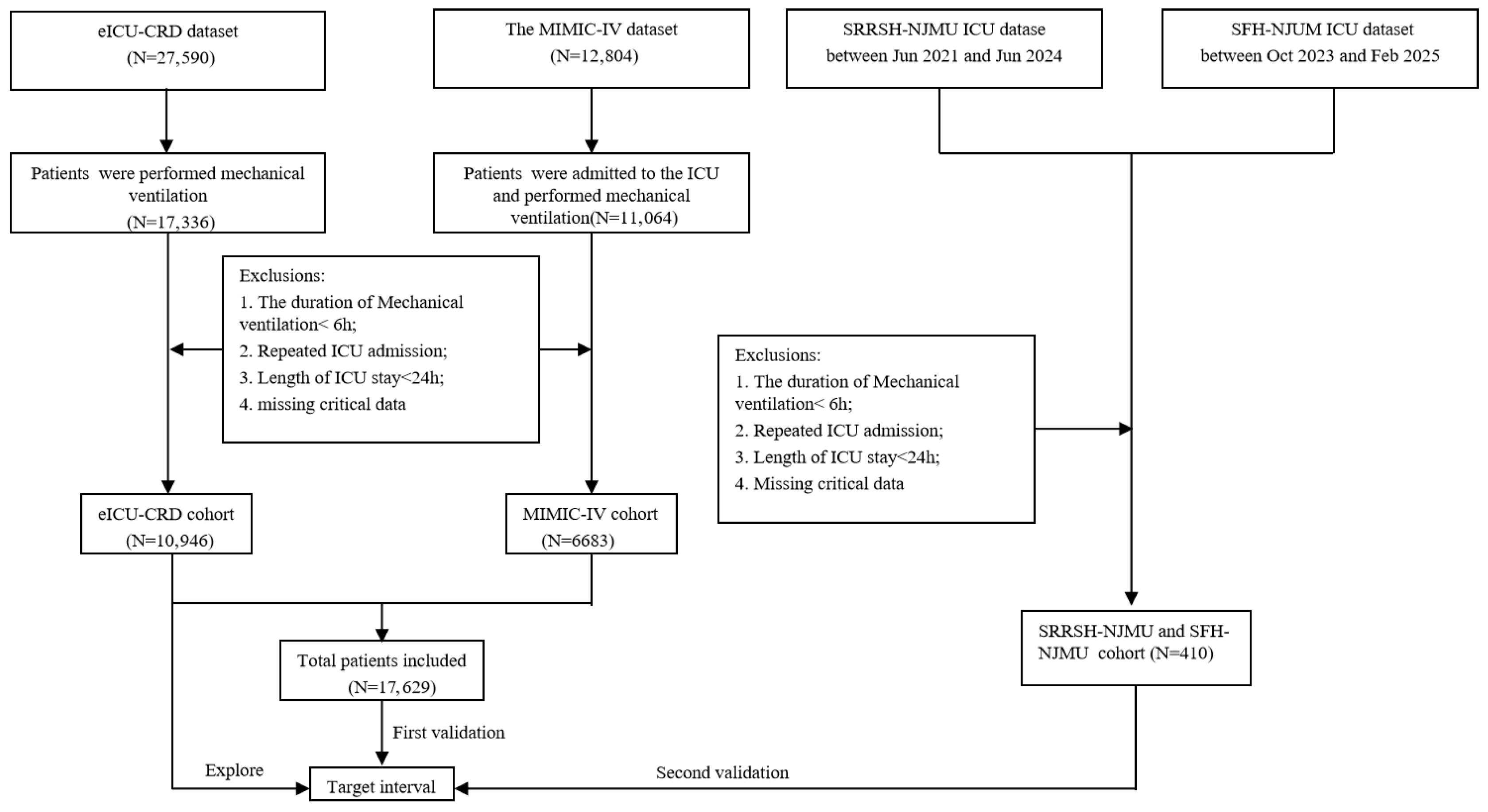
The study population was derived from the eICU-CRD, MIMIC-IV, SRRSH-NJMU, and SFH-NJMU databases and included patients diagnosed with ARF and receiving mechanical ventilation. Diagnoses were set based on the International Classification of Diseases, 9th and 10th Revisions (ICD-9 and ICD-10) by the World Health Organization. Patients were excluded if they met any of the following criteria: (1) duration of mechanical ventilation <6 h; (2) repeated ICU admissions; (3) ICU stay <24 h; or (4) missing key clinical data. The patient selection process is illustrated in Figure 1.

2.3. Data Extraction

Clinical data were extracted from the eICU-CRD 2.0 and MIMIC-IV 2.0 databases using structured query language (SQL), and additional data were collected from SRRSH-NJMU and SFH-NJMU. Data within the initial 72 h following ICU admission were collected, and categorized as follows: (1) laboratory tests, including platelet count, white blood cell (WBC) count, hemoglobin concentration, total bilirubin (TBIL), and serum creatinine levels; (2) demographics and vital signs, including sex, age, race, heart rate, respiratory rate, mean arterial pressure (MAP), Sequential Organ Failure Assessment (SOFA) score, Acute Physiology and Chronic Health Evaluation III (APS III) score, and Charlson Comorbidity Index (CCI), as well as ICU-related variables (length of ICU stay and duration of mechanical ventilation); (3) comorbidities, including sepsis, myocardial infarction, congestive heart failure, cerebrovascular disease, chronic lung disease, kidney disease, and severe liver disease. For arterial blood gas analysis, the maximum PaCO2 value within 48 h after the initiation of mechanical ventilation was extracted. Respiratory parameters, including respiratory frequency (RF), positive end-expiratory pressure (PEEP), tidal volume (TV), and the PaO2/FiO2 ratio (P/F ratio), were averaged over the first 72 h of mechanical ventilation. The primary exposure was the time-weighted averages PaCO2 (TWA-PaCO2) during mechanical ventilation in each patient. The specific calculation method was as follows: All PaCO2 measurements were extracted during the patient’s mechanical ventilation time. We arranged them in time order on the time axis, then used the computer to make a smooth curve through all the measurement points. The function of the smooth curve was denoted as f(x),so the time-weighted average of each patient can be calculated as x ¯ = i = 1 n 1 t i t i + 1 f ( x ) d x t n t 1 , where n represents the amount of PaCO2 measurements during each patient’s ventilation time [11].

2.4. Statistical Analysis

Clinical data were extracted using SQL. Continuous variables were described as medians with interquartile ranges (IQRs) when not normally distributed. For group comparisons, Student’s t-test was applied to normally distributed continuous variables, while the Mann–Whitney U test was used for non-normally distributed variables. Categorical variables were compared using either the chi-square test or Fisher’s exact test, as appropriate, and results were reported as proportions.
To evaluate the effect of PaCO2 on survival outcomes, a restricted cubic spline (RCS) transformation was applied to model potential nonlinear relationships. An unadjusted Cox proportional hazards model was constructed, and the RCS curve was generated using the “ggrcs” package (overall p < 0.001; nonlinearity p < 0.001). HRs were estimated, and the point at which HR = 1 was identified as the reference value. The HR curve across PaCO2 levels was visualized using the “ggplot2” package, with confidence intervals and annotations for key points. Based on the HR = 1 reference threshold, patients were classified into three groups: hypocapnia, normocapnia, and hypercapnia. Kaplan–Meier survival curves were constructed for each group, and intergroup survival differences were evaluated using the log-rank test. Using cohort data from the merged MIMIC-IV and eICU-CRD databases as an external validation cohort, we applied the Cox proportional hazards model to assess the association between different PaCO2 levels and 28-day all-cause mortality across patients with various complications.
All statistical analyses were performed using R software (version 4.4.3, R Development Core Team). A two-sided p-value < 0.05 was considered statistically significant.

3. Results

3.1. Baseline Characteristics

According to the inclusion criteria, a total of 17,630 patients with ARF were included in the analysis, comprising 10,946 from the eICU-CRD and 6684 from the MIMIC-IV database (Table 1). In the eICU-CRD cohort, the median age was 63.00 years (IQR, 52.00–73.00) in the survival group and 69.00 years (IQR, 58.00–79.00) in the non-survival group. Similarly, in the MIMIC-IV cohort, the median age was 65.00 years (IQR, 54.00–76.00) among survivors and 70.00 years (IQR, 59.00–81.00) among non-survivors. The majority of patients in both databases were of Caucasian ethnicity (75% in eICU-CRD and 57% in MIMIC-IV). No significant differences were observed in sex between survival and non-survival groups. In all subgroups, males accounted for more than 50% of the population. In comparison to the non-survival group, the survival group exhibited significantly lower values for WBC count, platelet count, TBIL, creatinine, heart rate, and respiratory rate. Conversely, survivors exhibited higher MAP, hemoglobin levels, tidal volume, and P/F ratio compared with non-survivors. Arterial blood gas parameters differed significantly: survivors exhibited higher base excess (BE), pH, and bicarbonate (HCO3-) levels than non-survivors (p < 0.001), indicating a stronger capacity to realize internal homeostasis. Severity and comorbidity indices, including the Charlson Comorbidity Index (CCI), SOFA score, and APS III score, were significantly lower in the survival group compared with the non-survival group (p < 0.001). Compared with non-survivors, survivors had a lower prevalence of comorbid conditions. In the eICU-CRD cohort, the incidences of myocardial infarction (5.2% vs. 6.6%, p = 0.01), cerebrovascular disease (7.0% vs. 13.1%, p < 0.001), chronic kidney disease (6.9% vs. 9.1%, p < 0.001), severe liver disease (1.0% vs. 3.4%, p < 0.001), and sepsis (23.1% vs. 32.5%, p < 0.001) were significantly lower in the survival group. Similarly, in the MIMIC-IV cohort, the survivors had lower rates of myocardial infarction (18.0% vs. 21.5%, p = 0.001), chronic kidney disease (22.2% vs. 26.5%, p < 0.001), and severe liver disease (6.5% vs. 13.2%, p < 0.001). These comorbidities may be associated with poorer prognoses among patients with ARF. No significant differences were observed between survival and non-survival groups regarding the prevalence of congestive heart failure or chronic pulmonary disease in either database. Both databases indicate that the duration of ICU hospitalization for surviving patients is significantly longer compared to that of deceased patients (p < 0.001). Conversely, deceased patients tended to require a longer duration of mechanical ventilation (p < 0.001).
For a parallel comparison, an identical baseline analysis was conducted on the internally collected cohort. In the SRRSH-NJMU and SFH-NJMU cohorts, the incidence of chronic kidney disease (18.8% vs. 30.7%, p = 0.009) was significantly lower in the survival group. The survival group exhibited significantly lower values for TBIL and creatinine. Arterial blood gas parameters differed significantly: Survivors exhibited higher levels of base excess (BE) (p < 0.001) and pH (p = 0.001) than non-survivors. However, there was no statistical difference in other indicators, which may be due to the small sample size (Supplementary Table S1).

3.2. Nonlinear Impact of PaCO2 on Hazard Ratio (HR)

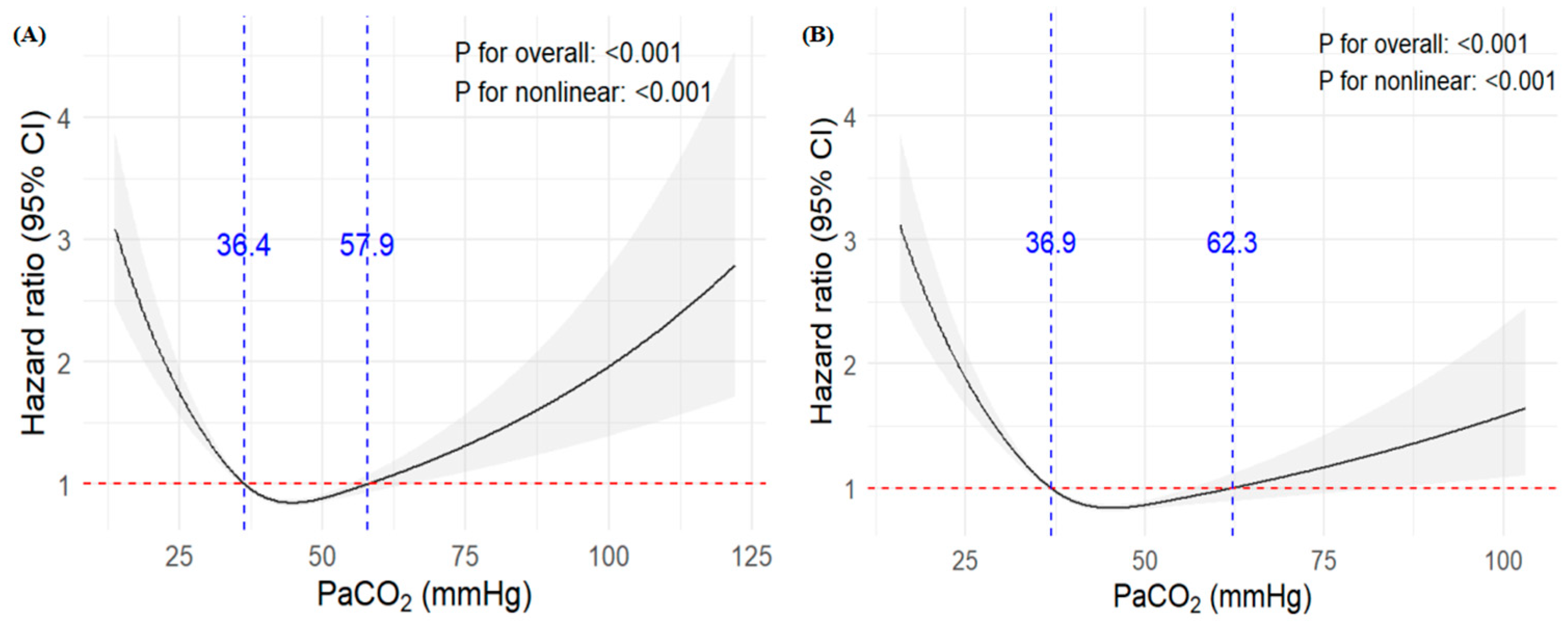
In the eICU-CRD cohort, a U-shaped relationship was observed between PaCO2 and ICU mortality in patients with ARF, by applying an RCS in conjunction with a Cox proportional hazards model. This suggests that both excessively high and low PaCO2 levels are associated with increased HRs for mortality. Two inflection points corresponding to HR = 1 were identified at PaCO2 levels of 36.4 mmHg and 57.9 mmHg, which served as reference thresholds. The shaded region in Figure 2A represents the 95% confidence interval. Within the range of 36.4 to 57.9 mmHg, the RCS curve remained relatively flat, reflecting narrower confidence intervals and a greater statistical stability. In contrast, a PaCO2 value below 36.4 mmHg or above 57.9 mmHg was associated with a marked increase in HR, indicating a significantly higher risk of ICU mortality. A similar U-shaped relationship was observed in the MIMIC-IV cohort (Figure 2B). As shown in the eICU-CRD RCS analysis, patients were stratified into three groups based on these thresholds: hypocapnia (PaCO2 < 36.4 mmHg), normocapnia (36.4 mmHg ≤ PaCO2 ≤ 57.9 mmHg), and hypercapnia (PaCO2 > 57.9 mmHg).

3.3. Unadjusted Survival Analysis by PaCO2 Levels

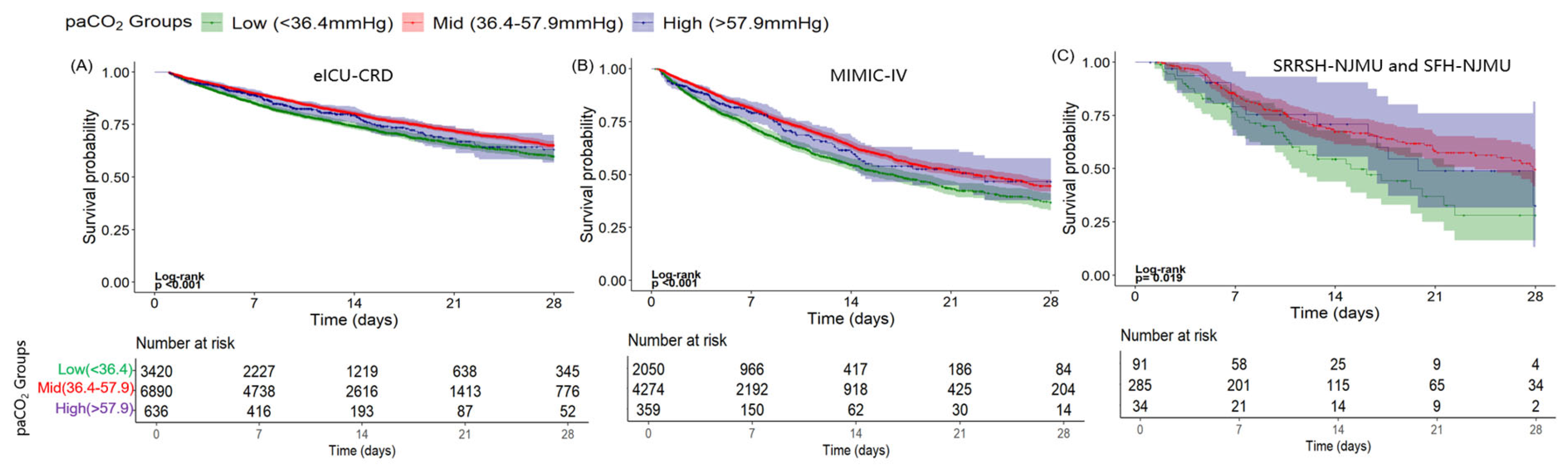
Kaplan–Meier survival curves were generated to evaluate the 28-day in-hospital mortality across the three PaCO2 groups, revealing significant differences in survival probability. In the eICU-CRD cohort, the patients within the intermediate PaCO2 range (36.4–57.9 mmHg) exhibited the highest survival rate, whereas both the low PaCO2 group (<36.4 mmHg) and the high PaCO2 group (>57.9 mmHg) demonstrated substantially lower survival probabilities. The log-rank test showed statistically significant differences among the groups (p < 0.001), as illustrated in Figure 3A. This survival pattern was consistent across external datasets, including the MIMIC-IV cohort and the validation cohorts from Sir Run Run Hospital (SRRH) and the Second Affiliated Hospital of Nanjing Medical University (SFH), as shown in Figure 3B,C.

3.4. Adjusted Survival Analysis Considering Complications

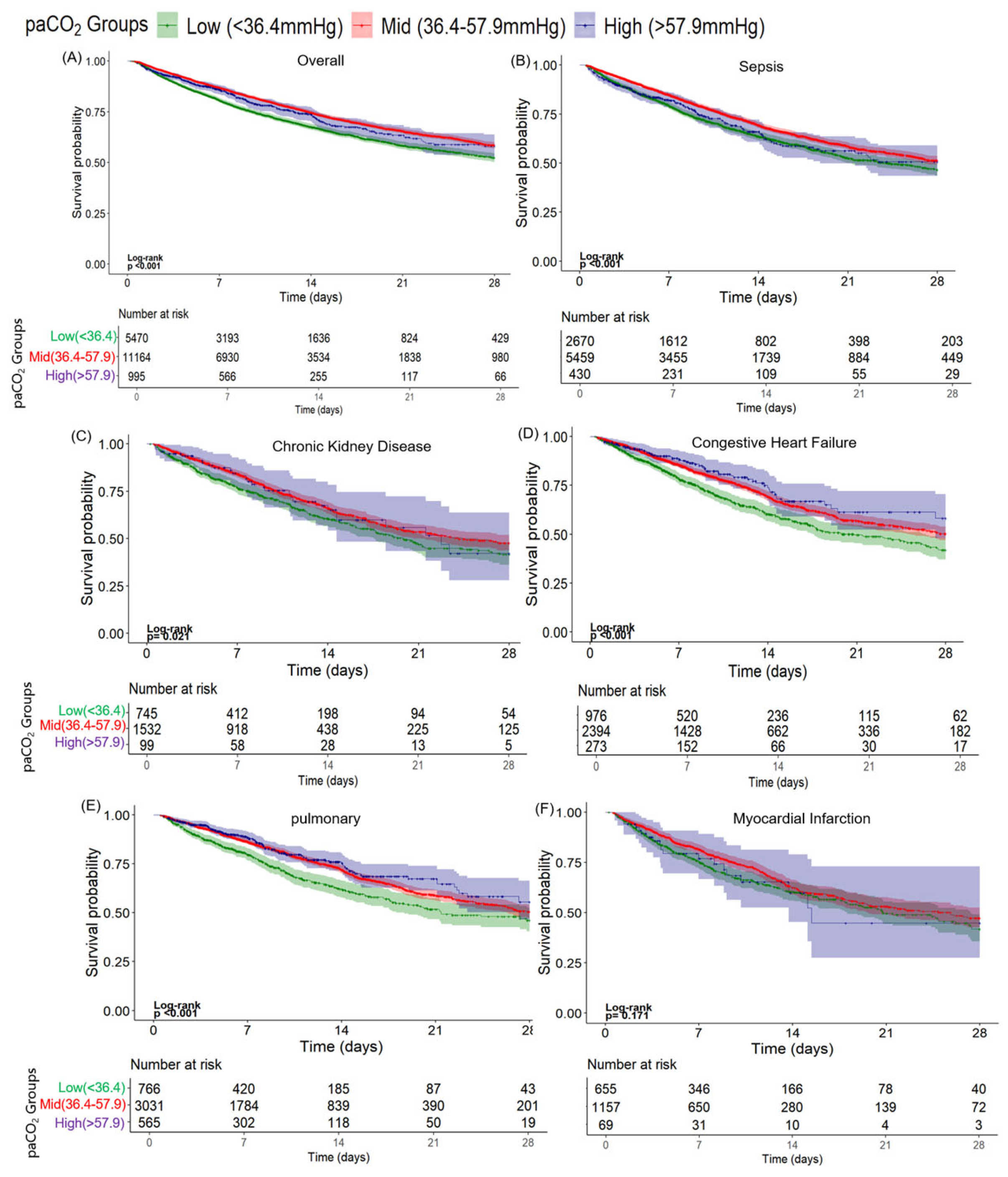
To further examine the prognostic value of PaCO2 levels in the context of comorbid conditions, the MIMIC-IV and eICU-CRD databases were combined to form an external validation cohort. Patients were stratified according to the presence of specific organ-related complications, and Kaplan–Meier survival curves were generated for each subgroup (Figure 4). A Cox proportional hazards regression model was applied, using the normocapnia group as the reference. The relative mortality risks associated with hypocapnia and hypercapnia were assessed across different comorbidity subgroups (Table 2). Among patients with sepsis, the PaCO2 level was significantly associated with the mortality risk (log-rank test, p < 0.001; Figure 4B). Compared with the normocapnia group, the HR for the hypocapnia group increased by approximately 25.5% (HR 1.255; 95% CI: 1.156–1.362). In the hypercapnia group, the mortality risk increased by approximately 18.9% (HR 1.189; 95% CI: 0.991–1.426), approaching the conventional threshold for statistical significance (p = 0.05).
A similar pattern was observed in the chronic kidney disease (CKD) subgroup (log-rank test, p = 0.021; Figure 4C). In comparison with normocapnic patients, those with hypocapnia had a 27.05% higher mortality risk (HR 1.271; 95% CI: 1.092–1.478). The hypercapnia group showed a 6.59% but not significant increase in mortality risk (HR 1.066; 95% CI: 0.737–1.542). Among patients with congestive heart failure (CHF), the PaCO2 level was significantly associated with the mortality risk (log-rank test, p < 0.001; Figure 4D). Compared with the normocapnia group, the patients in the low PaCO2 group exhibited a 36.76% increase in mortality risk (HR 1.368; 95% CI: 1.196–1.564). In contrast, the high PaCO2 group showed a 16.21% reduction in mortality risk (HR 0.838; 95% CI: 0.636–1.104), although this decrease was not statistically significant. In the subgroup with pulmonary complications, the mortality risk varied across PaCO2 stratifications (log-rank test, p < 0.001; Figure 4E). Compared with the normocapnia group, the low PaCO2 group had a 39.05% increased mortality risk (HR 1.391; 95% CI: 1.203–1.607), while the high PaCO2 group had an 11.08% decrease in risk that was not significant (HR 0.889; 95% CI: 0.727–1.088). In contrast, no significant association was found between PaCO2 level and mortality risk in the myocardial infarction (MI) subgroup (log-rank test, p = 0.171; Figure 4F). In this subgroup, the mortality risk in the low PaCO2 group was elevated by 20.4% compared to the normocapnia group (HR 1.204; 95% CI: 1.019–1.423), while the high PaCO2 group showed a 20.7% reduction in risk (HR 0.793; 95% CI: 0.769–1.894), although the latter association was not statistically significant.
After stratification by etiology, except for COPD, the association direction between PaCO2 and prognosis was consistent for ARDS, severe pneumonia, and cerebrovascular diseases, supporting 36.4–57.9 mmHg as a safe target range for acute respiratory failure patients on mechanical ventilation (Supplementary Figure S1).

4. Discussion

Acute respiratory failure (ARF) is a critical and complex clinical syndrome that is characterized by the respiratory system’s inability to maintain adequate gas exchange, which ultimately leads to severe hypoxemia or hypercapnia, conditions that can be life-threatening [12]. This syndrome poses a significant burden not only on the patients who suffer from it, enduring high rates of morbidity and mortality, but also on healthcare systems that are increasingly challenged to manage the rising demands for intensive care resources and specialized treatments [13]. The high incidence of ARF, particularly as a result of conditions such as pneumonia, sepsis, and acute respiratory distress syndrome (ARDS), underscores the urgent need for effective diagnostic and therapeutic strategies that can be implemented swiftly and efficiently [14]. Current management approaches primarily involve the use of mechanical ventilation and various pharmacological interventions; however, these methods have demonstrated limited efficacy in improving long-term survival rates and enhancing overall patient outcomes, indicating a pressing need for innovative solutions and comprehensive care strategies in the treatment of this serious condition [15].
In this multicenter retrospective study utilizing the eICU-CRD and MIMIC-IV databases, we investigated the association between PaCO2 and survival outcomes in patients with ARF. Our findings supported that both low and high extremes of PaCO2 are associated with an increased mortality risk [16,17]. Furthermore, we identified a PaCO2 range associated with a more favorable prognosis. This finding may inform future clinical research and generates a hypothesis for optimizing care strategies in patients with ARF [18,19].
In the subgroup analysis of comorbidities, the ARF patients complicated by sepsis or CKD had the lowest mortality risk in the normocapnia group, while both hypocapnia and hypercapnia were associated with a higher risk. Interestingly, in patients with coexisting pulmonary disease or chronic CHF, hypercapnia was linked to a lower mortality compared to normocapnia. Previous studies have similarly suggested potential cardioprotective effects of hypercapnia [20], possibly through stimulating brain natriuretic peptide (BNP) secretion [21]. Several studies have also proposed that mild to moderate hypercapnia may mitigate the harmful effects of elevated respiratory rate [22], improve ventilation-perfusion matching, and reduce the expression of inflammatory cytokines [23]. In patients experiencing acute exacerbations of chronic obstructive pulmonary disease (COPD), chronic CO2 retention is common due to long-term ventilatory limitation [24]. These patients often develop compensated respiratory acidosis and may tolerate higher baseline PaCO2 levels without notable adverse effects, in contrast to acutely ill individuals without prior CO2 retention [25]. Similar to patients with acute respiratory distress syndrome (ARDS), permissive hypercapnia is often adopted in acute COPD exacerbations to avoid complications such as barotrauma and dynamic lung overdistension from aggressive ventilatory support [26].
We observed that non-survivors had a significantly longer duration of mechanical ventilation (MV) in both cohorts. This counterintuitive finding echoes previous reports [27], which can be explained by reverse causality. Patients who died early did not have sufficient time to accumulate days of ventilation. In contrast, those who survived continued to receive mechanical ventilation, thereby increasing their length of ICU stay. Other factors include refractory hypoxemia, events related to mechanical ventilation, and delayed weaning from life-sustaining treatment. These factors prolonged the duration of mechanical ventilation and simultaneously increased mortality. Thus, the duration of mechanical ventilation seems to serve as a proxy for disease severity rather than a direct causal pathway leading to death.
This study addresses a critical gap in understanding ARF by examining the implications of varying PaCO2 levels on patient outcomes in a large, heterogeneous patient population. Although previous studies have established a link between abnormal PaCO2 levels and adverse outcomes in ARF, the distinctive contribution of the present study lies in its comprehensive analysis of extremely low and high PaCO2 levels using large-scale, multicenter databases. This approach enhances the external validity of the findings and provides novel insights into how these extreme values are associated with mortality risk. The multicenter design contrasts with prior investigations constrained by limited sample sizes or single-center cohorts, underscoring the value of broad, population-level analyses across diverse clinical settings [28,29]. Importantly, this is the first study to clearly demonstrate a U-shaped relationship between PaCO2 level and ICU mortality.
The findings of this study carry potential clinical implications. This study demonstrates that maintaining PaCO2 within an optimal range is crucial for improving the survival in patients with ARF. Specifically, we identified PaCO2 thresholds associated with a higher mortality risk, which may help clinicians refine mechanical ventilation strategies and more effectively monitor the respiratory status of critically ill patients. The upper limit of our range (57.9 mmHg) significantly exceeds the typical thresholds of concern in many clinical settings. This finding offers retrospective observational support for the safety range suggested by landmark trials on lung-protective ventilation. The 2000 ARMA trial demonstrated a mortality reduction with low tidal volume ventilation; in that study, PaCO2 levels in the intervention group frequently exceeded 50 mmHg, and a predefined protocol for managing respiratory acidosis triggered only when pH fell below 7.30 [30]. Our data indicate that no increased mortality risk was observed up to approximately 58 mmHg within this range, which aligns with the safety profile observed in that pivotal trial.
Furthermore, a post hoc analysis of the LUNG SAFE cohort specifically investigating hypercapnia found that mild to moderate hypercapnia, defined as PaCO2 levels up to 55 mmHg on the first day of ARDS, was not associated with increased mortality. This finding further reinforces the view that clinically tolerable hypercapnia includes higher PaCO2 values than traditionally assumed [31]. The 2023 ESICM Adult ARDS Guidelines do not set an upper limit for PaCO2; instead, they emphasize that lung-protective ventilation can continue as long as pH is ≥7.20 and hemodynamic stability is maintained [32]. Similarly, a recent multicenter randomized controlled trial (RCT) in ventilated neonates targeting PaCO2 levels of 60–75 mmHg showed no increase in intraventricular hemorrhage or mortality [33]. These results are consistent with current clinical guidelines emphasizing individualized patient management to optimize outcomes [34]. Accordingly, our findings support the incorporation of these PaCO2-based thresholds into routine clinical protocols aimed at reducing ARF-related mortality.
We still acknowledge the inherent limitations of this study. A retrospective design inherently carries the risk of bias, and potential confounding variables may not have been fully accounted for in our models. Additionally, use of only database-derived data may have restricted the range of clinical variables; we could only rely on arterial blood gas values extracted from electronic health records and had no access to clinicians’ real-time therapeutic intent, meaning we could not determine whether elevated carbon dioxide levels were intentional or not. Specifically, our database could not differentiate unintentional hypercapnia from intentional permissive hypercapnia, potentially affecting the accuracy of outcome evaluation. Future research should focus on prospective studies that incorporate a wider range of clinical variables or biomarker analyses to provide a more comprehensive understanding of ARF and its predictors [35,36]. Although this study excluded a large number of cases due to strict inclusion and exclusion criteria, these exclusions are related to data quality or confounding factors. This approach theoretically reduces the impact of selection bias on the main associations. While our findings highlight the association between PaCO2 level and mortality, further research is needed to explore the mechanisms underlying this relationship, in order to inform the development of targeted therapeutic strategies and improve the prognosis of ARF patients.

5. Conclusions

In this retrospective analysis, we observed an association between arterial PaCO2 levels within a specific range and increased survival rates. This was specifically noted in patients with acute respiratory failure on mechanical ventilation. Although this association remains significant after adjusting for available confounding factors, unmeasured factors such as treatment response, undiagnosed conditions or safety events may influence PaCO2 levels and outcomes. Our findings suggest a hypothesis that targeted management of PaCO2 may improve survival rates, but its validation in prospective studies is needed before clinical implementation.

Supplementary Materials

The following supporting information can be downloaded at: https://www.mdpi.com/article/10.3390/diagnostics16030489/s1, Table S1: Baseline characteristics of patients from SRRSH-NJMU and SFH-NJMU cohort. Figure S1: ARF etiological subgroup analysis.

Author Contributions

X.G. designed the study. L.C. and Y.X. passed the exam to receive access to MIMIC-IV and eICU-CRD. L.J. provided the data of validation cohort. Y.Q. and S.Z. extracted, collected, and analyzed the data. Y.S. provided critical review. L.C. and Y.X. prepared tables and figures and wrote the manuscript. L.J., X.G., and H.M. reviewed the results and interpreted the data. All authors have read and agreed to the published version of the manuscript.

Funding

This research was supported by Nanjing Health Technology Development Project (No. YKK21150).

Institutional Review Board Statement

The establishment and initial data collection of this database was authorized by the Massachusetts Institute of Technology (Cambridge, MA,USA) and Beth Israel Deaconess Medical Center (Boston, MA, USA). and consent was obtained for the original data collection. (approval code 66858392, approval date 14 December 2024).

Informed Consent Statement

All individual information pertaining to the study participants was anonymized, and a waiver of informed consent was obtained.

Data Availability Statement

The data used in the present study were obtained from the MIMIC-IV and eICU-CRD database (version 2.0), which requires credential access. Researchers may obtain the dataset by applying through PhysioNet and completing the CITI training program. Data will be made available on reasonable request.

Acknowledgments

The present study data was based on the MIMIC-IV and eICU-CRD database. We would like to thank all staff and patients involved in the construction of the MIMIC-IV and eICU-CRD database.

Conflicts of Interest

The authors declare no conflicts of interest.

Abbreviations

PaCO2Partial pressure of carbon dioxide
MIMIC-IVMedical Information Mart for Intensive Care IV
eICU-CRDeICU Collaborative Research Database
RCSRestricted cubic spline
ICUIntensive care unit
BMIBody mass index
MAPMean arterial pressure
WBCWhite blood cell count
ScrSerum creatinine
pHPotential of hydrogen
BEBase excess
RFRespiratory frequency
PEEPPositive end-expiratory pressure
SOFASequential organ failure assessment
APSIIIAcute Physiology Score III
ARDSAcute respiratory distress syndrome
COPDChronic obstructive pulmonary disease

References

  1. Mason, C.; Dooley, N.; Griffiths, M. Acute respiratory distress syndrome. Clin. Med. 2017, 17, 439–443. [Google Scholar] [CrossRef]
  2. Fujishima, S. Guideline-based management of acute respiratory failure and acute respiratory distress syndrome. J. Intensive Care 2023, 11, 10. [Google Scholar] [CrossRef] [PubMed]
  3. Filippini, D.F.L.; Smit, M.R.; Bos, L.D.J. Subphenotypes in Acute Respiratory Distress Syndrome: Universal Steps Toward Treatable Traits. Anesth. Analg. 2024. Online ahead of print. [Google Scholar] [CrossRef] [PubMed]
  4. Zhang, R.; Chen, H.; Teng, R.; Li, Z.; Yang, Y.; Qiu, H.; Liu, L. Association between the time-varying arterial carbon dioxide pressure and 28-day mortality in mechanically ventilated patients with acute respiratory distress syndrome. BMC Pulm. Med. 2023, 23, 129. [Google Scholar] [CrossRef]
  5. Bruni, A.; Neri, G.; Cammarota, G.; Bosco, V.; Biamonte, E.; Troisi, L.; Boscolo, A.; Navalesi, P.; Longhini, F.; Garofalo, E. High-frequency percussive ventilation in acute respiratory failure. ERJ Open Res. 2024, 10, 00401–2024. [Google Scholar] [CrossRef]
  6. Zhong, H.; Poeran, J.; Liu, J.; Illescas, A.; Cozowicz, C.; Memtsoudis, S.G. Tranexamic acid and perioperative myocardial infarction: A retrospective database analysis. Br. J. Anaesth. 2022, 129, e132–e134. [Google Scholar] [CrossRef]
  7. Mitterhauser, M.; Wadsak, W. Imaging biomarkers or biomarker imaging? Pharmaceuticals 2014, 7, 765–778. [Google Scholar] [CrossRef] [PubMed]
  8. Pollard, T.J.; Johnson, A.E.W.; Raffa, J.D.; Celi, L.A.; Mark, R.G.; Badawi, O. The eICU Collaborative research database, a freely available multi-center database for critical care research. Sci. Data 2018, 5, 180178. [Google Scholar] [CrossRef]
  9. Johnson, A.E.W.; Bulgarelli, L.; Shen, L.; Gayles, A.; Shammout, A.; Horng, S.; Pollard, T.J.; Hao, S.; Moody, B.; Gow, B.; et al. MIMIC-IV, a freely accessible electronic health record dataset. Sci. Data 2023, 10, 1. [Google Scholar] [CrossRef]
  10. Le Gall, A.; Eustache, G.; Coquet, A.; Seguin, P.; Launey, Y. End-tidal carbon dioxide and arterial to end-tidal carbon dioxide gradient are associated with mortality in patients with neurological injuries. Sci. Rep. 2024, 14, 19172. [Google Scholar] [CrossRef]
  11. Feng, M.; Zhou, J. Relationship between time-weighted average glucose and mortality in critically ill patients: A retrospective analysis of the MIMIC-IV database. Sci. Rep. 2024, 14, 4721. [Google Scholar] [CrossRef]
  12. Panetti, B.; Bucci, I.; Di Ludovico, A.; Pellegrino, G.M.; Di Filippo, P.; Di Pillo, S.; Chiarelli, F.; Attanasi, M.; Papa, G.F.S. Acute Respiratory Failure in Children: A Clinical Update on Diagnosis. Children 2024, 11, 1232. [Google Scholar] [CrossRef]
  13. Ginestra, J.C.; Mitchell, O.J.L.; Anesi, G.L.; Christie, J.D. COVID-19 Critical Illness: A Data-Driven Review. Annu. Rev. Med. 2022, 73, 95–111. [Google Scholar] [CrossRef]
  14. Eremenko, A.A.; Zyulyaeva, T.P. Postoperative acute respiratory failure in cardiac surgery. Khirurgiia 2019, 8, 5–11. [Google Scholar] [CrossRef]
  15. Weiss, E.; Zahar, J.R.; Alder, J.; Asehnoune, K.; Bassetti, M.; Bonten, M.J.M.; Chastre, J.; De Waele, J.; Dimopoulos, G.; Eggimann, P.; et al. Elaboration of Consensus Clinical Endpoints to Evaluate Antimicrobial Treatment Efficacy in Future Hospital-acquired/Ventilator-associated Bacterial Pneumonia Clinical Trials. Clin. Infect. Dis. 2019, 69, 1912–1918. [Google Scholar] [CrossRef]
  16. Cai, G.; Zhang, X.; Ou, Q.; Zhou, Y.; Huang, L.; Chen, S.; Zeng, H.; Jiang, W.; Wen, M. Optimal Targets of the First 24-h Partial Pressure of Carbon Dioxide in Patients with Cerebral Injury: Data from the MIMIC-III and IV Database. Neurocrit. Care 2022, 36, 412–420. [Google Scholar] [CrossRef] [PubMed]
  17. Wong, A.I.; Cheung, P.C.; Kamaleswaran, R.; Martin, G.S.; Holder, A.L. Machine Learning Methods to Predict Acute Respiratory Failure and Acute Respiratory Distress Syndrome. Front. Big Data 2020, 3, 579774. [Google Scholar] [CrossRef]
  18. Li, X.Y.; Tang, X.; Wang, R.; Yuan, X.; Zhao, Y.; Wang, L.; Li, H.-C.; Chu, H.-W.; Li, J.; Mao, W.-P.; et al. High-Flow Nasal Cannula for Chronic Obstructive Pulmonary Disease with Acute Compensated Hypercapnic Respiratory Failure: A Randomized, Controlled Trial. Int. J. Chron. Obstruct. Pulmon. Dis. 2020, 15, 3051–3061. [Google Scholar] [CrossRef] [PubMed]
  19. Cannon, J.; Pamplin, J.; Zonies, D.; Mason, P.; Sine, C.; Cancio, L.; McNeill, J.; Colombo, C.; Osborn, E.; Ricca, R.; et al. Acute Respiratory Failure. Mil. Med. 2018, 183, 123–129. [Google Scholar] [CrossRef]
  20. Chi, L.; Wang, N.; Yang, W.; Wang, Q.; Zhao, D.; Sun, T.; Li, W. Protection of Myocardial Ischemia-Reperfusion by Therapeutic Hypercapnia: A Mechanism Involving Improvements in Mitochondrial Biogenesis and Function. J. Cardiovasc. Transl. Res. 2019, 12, 467–477. [Google Scholar] [CrossRef] [PubMed]
  21. Dreher, M.; Schulte, L.; Müller, T.; Ekkernkamp, E.; Zirlik, A. Influence of effective noninvasive positive pressure ventilation on inflammatory and cardiovascular biomarkers in stable hypercapnic COPD patients. Respir. Med. 2015, 109, 1300–1304. [Google Scholar] [CrossRef]
  22. Madotto, F.; Rezoagli, E.; McNicholas, B.A.; Pham, T.; Slutsky, A.S.; Bellani, G.; Laffey, J.G. Patterns and Impact of Arterial CO2 Management in Patients With Acute Respiratory Distress Syndrome: Insights From the LUNG SAFE Study. Chest 2020, 158, 1967–1982. [Google Scholar] [CrossRef]
  23. Morales Quinteros, L.; Bringué Roque, J.; Kaufman, D.; Artigas Raventós, A. Importance of carbon dioxide in the critical patient: Implications at the cellular and clinical levels. Med. Intensiv. (Engl. Ed.) 2019, 43, 234–242. [Google Scholar] [CrossRef]
  24. Wei, X.; Yu, N.; Ding, Q.; Ren, J.; Mi, J.; Bai, L.; Li, J.; Qi, M.; Guo, Y. The features of AECOPD with carbon dioxide retention. BMC Pulm. Med. 2018, 18, 124. [Google Scholar] [CrossRef]
  25. Ribeiro, C.; Jácome, C.; Oliveira, P.; Luján, M.; Conde, S. Impact of outpatient adaptation to home mechanical ventilation on health-related quality of life in patients with COPD: The OutVent study. ERJ Open Res. 2024, 10, 00125–2024. [Google Scholar] [CrossRef] [PubMed]
  26. Long, B.; Rezaie, S.R. Evaluation and Management of Asthma and Chronic Obstructive Pulmonary Disease Exacerbation in the Emergency Department. Emerg. Med. Clin. N. Am. 2022, 40, 539–563. [Google Scholar] [CrossRef] [PubMed]
  27. Roedl, K.; Amann, D.; Eichler, L.; Fuhrmann, V.; Kluge, S.; Müller, J. The chronic ICU patient: Is intensive care worthwhile for patients with very prolonged ICU-stay (≥ 90 days)? Eur. J. Intern. Med. 2019, 69, 71–76. [Google Scholar] [CrossRef]
  28. Rowan, C.M.; McArthur, J.; Hsing, D.D.; Gertz, S.J.; Smith, L.S.; Loomis, A.; Fitzgerald, J.C.; Nitu, M.E.; Moser, E.A.S.; Duncan, C.N.; et al. Acute Respiratory Failure in Pediatric Hematopoietic Cell Transplantation: A Multicenter Study. Crit. Care Med. 2018, 46, e967–e974. [Google Scholar] [CrossRef]
  29. Guo, F.; Hao, L.; Zhen, Q.; Diao, M.; Zhang, C. Multicenter study on the prognosis associated with respiratory support for children with acute hypoxic respiratory failure. Exp. Ther. Med. 2016, 12, 3227–3232. [Google Scholar] [CrossRef] [PubMed][Green Version]
  30. Acute Respiratory Distress Syndrome Network; Brower, R.G.; Matthay, M.A.; Morris, A.; Schoenfeld, D.; Thompson, B.T.; Wheeler, A. Ventilation with lower tidal volumes as compared with traditional tidal volumes for acute lung injury and the acute respiratory distress syndrome. N. Engl. J. Med. 2000, 342, 1301–1308. [Google Scholar] [CrossRef]
  31. Madotto, F.; Rezoagli, E.; Pham, T.; Schmidt, M.; McNicholas, B.; Protti, A.; Panwar, R.; Bellani, G.; Fan, E.; van Haren, F.; et al. LUNG SAFE Investigators and the ESICM Trials Group. Hyperoxemia and excess oxygen use in early acute respiratory distress syndrome: Insights from the LUNG SAFE study. Crit. Care 2020, 24, 125. [Google Scholar] [CrossRef] [PubMed]
  32. Grasselli, G.; Calfee, C.S.; Camporota, L.; Poole, D.; Amato, M.B.P.; Antonelli, M.; Arabi, Y.M.; Baroncelli, F.; Beitler, J.R.; Bellani, G.; et al. ESICM guidelines on acute respiratory distress syndrome: Definition, phenotyping and respiratory support strategies. Intensive Care Med. 2023, 49, 727–759. [Google Scholar] [CrossRef]
  33. Travers, C.P.; Gentle, S.J.; Shukla, V.V.; Aban, I.; Yee, A.J.; Armstead, K.M.; Benz, R.L.; Laney, D.; Ambalavanan, N.; Carlo, W.A. Late Permissive Hypercapnia for Mechanically Ventilated Preterm Infants: A Randomized Trial. Pediatr. Pulmonol. 2025, 60, e71165. [Google Scholar] [CrossRef]
  34. Wood, C.; Kataria, V.; Modrykamien, A.M. The acute respiratory distress syndrome. Bayl. Univ. Med. Cent. Proc. 2020, 33, 357–365. [Google Scholar] [CrossRef]
  35. Jia, X.; Yan, C.; Xu, S.; Gu, X.; Wan, Q.; Hu, X.; Li, J.; Liu, G.; Caikai, S.; Guo, Z. Predictive factors for failure of non-invasive positive pressure ventilation in immunosuppressed patients with acute respiratory failure. Zhonghua Wei Zhong Bing Ji Jiu Yi Xue 2018, 30, 107–111. [Google Scholar] [CrossRef] [PubMed]
  36. Zhang, H.; Li, J.; Deng, S.; Liu, C.; Liu, M.; Hu, S.; Wang, S.; Fan, M. Risk Prediction Models for Enteral Nutrition Aspiration in Adult Inpatients: A Systematic Review and Critical Appraisal. J. Clin. Nurs. 2025. Online ahead of print. [Google Scholar] [CrossRef] [PubMed]
Figure 1. The flow chart of participant selection.
Diagnostics 16 00489 g001
Figure 2. Restricted cubic spline regression analysis of PaCO2 with all-cause mortality. Restricted cubic spline regression analysis of PaCO2 and all-cause mortality in eICU-CRD (A) and MIMIC-IV (B) datasets.
Diagnostics 16 00489 g002
Figure 3. Kaplan–Meier survival analysis curves of the three cohorts. Kaplan–Meier curves showing the cumulative probability of all-cause mortality within 28 days for the Medical Information Mart for eICU-CRD cohort (A), the MIMIC-IV cohort (B), and the cohort from two university-affiliated hospitals (C).
Diagnostics 16 00489 g003
Figure 4. Merging the eICU-CRD and MIMIC-IV datasets. The cumulative probability of 28-day all-cause mortality for patients with ARF combined with different complications as follows: (A) overall, (B) sepsis, (C) chronic kidney disease, (D) congestive heart failure, (E) pulmonary disease, (F) myocardial infarction.
Diagnostics 16 00489 g004
Table 1. Baseline characteristics of patients from eICU-CRD and MIMIC-IV cohort.
eICU-CRD MIMIC-IV
Survival (N = 8626)Death (N = 2320)p-ValueSurvival (N = 4631)Death (N = 2052)p-Value
Baseline variables      
Age63.00 [52.00, 73.00]69.00 [58.00, 79.00]<0.00165.00 [54.00, 76.00]70.00 [59.00, 81.00]<0.001
Gender, n (%)  0.593  0.427
Female3874 (44.1)1057(45.6) 1961 (42.3)891 (43.4) 
Male4752 (55.9)1263 (54.4) 2670 (57.7)1161 (56.6) 
Ethnicity, n (%)  0.102  <0.001
African American1071 (12.4)244 (10.5) 488 (10.5)178 ( 8.7) 
Hispanic/Native American538 ( 6.2)151 (6.5) 146 ( 3.2)69 ( 3.4) 
Caucasian6454 (74.8)1708 (76.7) 2964 (64.0)1216 (59.3) 
Asian130 (1.5)28 ( 1.2) 127 ( 2.7)53 ( 2.6) 
Other/Unknown433 ( 5.0)117 ( 5.0) 906 (19.6)536 (26.1) 
BMI27.93 [23.63, 33.73]27.00 [22.97, 32.95]<0.00128.43 [24.32, 34.04]27.22 [23.25, 32.50]<0.001
Comorbidities, n (%)      
Myocardial infarction 8175 (94.8)2166 (93.4)0.0103797 (82.0)1610 (78.5)0.001
Congestive heart failure 7605 (88.2)2042 (88.0)0.8753016 (65.1)1323 (64.5)0.626
Cerebrovascular disease 8020 (93.0)2016 (86.9)<0.0014089 (88.3)1785 (87.0)0.141
Pulmonary disease6850 (79.4)1836 (79.1)0.7953143 (67.9)1438 (70.1)0.077
Chronic kidney disease 8031 (93.1)2109 (90.9)<0.0013604 (77.8)1509 (73.5)<0.001
Sever liver severe 8541 (99.0)2241 (96.6)<0.0014331 (93.5)1781 (86.8)<0.001
Sepsis6635 (76.9) 1565 (67.5)<0.0013989 (86.1)1824 (88.9) 0.002
Vital signs      
Heart rate (b/min)85.95 [77.32, 95.29]90.82 [80.75, 101.60]<0.00184.62 [75.16, 95.23]89.64 [78.50, 102.24]<0.001
MAP84.75 [78.73, 91.45]78.86 [72.73, 86.13]<0.00177.87 [72.91, 84.43]74.11 [69.24, 80.09]<0.001
Respiratory rate (b/min)19.22 [17.38, 21.48]20.89 [18.24, 23.80]<0.00119.45 [17.19, 21.97]20.96 [18.24, 24.41]<0.001
Laboratory parameters      
Total Bilirubin (mg/dL)0.70 [0.43, 1.10]0.90 [0.60, 1.70]<0.0010.73 [0.40, 1.77]0.96 [0.50, 2.99]<0.001
Hemoglobin (g/dL)12.30 [10.70, 13.90]11.90 [10.40, 13.70]<0.0019.20 [8.00, 10.70]8.90 [7.70, 10.40]<0.001
WBC (K/mcL)15.90 [11.80, 21.20]18.80 [13.59, 25.50]<0.00113.80 [10.10, 18.85]16.10 [11.10, 22.60]<0.001
Platelets (K/mcL)262.00 [191.00, 363.00]288.00 [220.75, 368.25]<0.001157.00 [103.00, 218.50]135.00 [68.00, 203.00]<0.001
Scr (mg/dL)1.21 [0.86, 2.21]1.80 [1.09, 3.40]<0.0010.70 [0.50, 1.00]0.90 [0.60, 1.10]<0.001
PH7.43 [7.38, 7.47]7.41 [7.35, 7.47]<0.0017.33 [7.26, 7.39]7.27 [7.17, 7.36]<0.001
PaCO2 (mmHg)40.00 [35.52, 45.78]39.06 [33.80, 45.29]<0.00140.02 [36.00, 45.69]38.81 [34.09, 44.59]<0.001
BE (mEq/L)0.60 [−2.60, 4.00]−1.00 [−4.80, 3.10]<0.001−0.50 [−3.30, 1.83]−3.17 [−7.34, 0.00]<0.001
HCO3 (mmol/L)25.00 [22.00, 28.50]24.00 [20.50, 27.60]<0.00125.00 [22.00, 28.08]22.40 [18.82, 25.75]<0.001
Ventilator parameters      
RF (b/min)19.00 [16.00, 22.00]21.00 [18.00, 25.00]<0.00120.00 [16.00, 24.00]22.00 [18.00, 28.00]<0.001
Tidal volume492.00 [430.00, 515.00]468.00 [410.00, 500.00]<0.001480.00 [430.00, 500.00]450.00 [400.00, 500.00]<0.001
PEEP5.00 [5.00, 6.00]5.00 [5.00, 8.00]<0.0019.00 [5.60, 12.00]10.00 [6.00, 13.53]<0.001
PaO2/FiO2 ratio227.27 [192.31, 250.00]200.00 [150.83, 238.10]<0.00199.34 [97.12, 192.77]98.42 [95.85, 163.25]<0.001
Score system      
SOFA6.00 [5.00, 9.00]10.00 [7.00, 13.00]<0.0017.00 [4.00, 9.00]9.00 [6.00, 13.00]<0.001
APSIII 60.00 [44.00, 78.00]78.00 [58.00, 101.00]<0.00151.00 [38.00, 66.00]70.50 [52.75, 91.00]<0.001
Charlson Index 1.00 [0.00, 2.00]2.00 [0.00, 3.00]<0.0015.00 [3.00, 7.00]6.00 [4.00, 8.00]<0.001
Length of stay      
ICU length of stay, day11.51 [6.48, 19.97]7.09 [3.46, 12.72]<0.0017.47 [3.93, 13.73]5.39 [2.50, 10.40]<0.001
MV length of time, day2.73 [1.16, 6.90]3.60 [1.67, 7.14]<0.0011.33 [0.67, 2.75]1.62 [0.75, 3.54]<0.001
Table 2. Cox proportional hazards model for 28-day all-cause mortality.
CharacterNormalHypocapniaHypercapnia
HR (95% Cl)HR (95% Cl)p-ValueHR (95% Cl)p-Value
Overall11.347 (1.265–1.434)<0.0011.103 (0.962–1.264) 0.160
Sepsis11.255 (1.156–1.362)<0.0011.189 (0.991–1.426)0.063
Chronic Kidney Disease11.270 (1.092–1.478)0.0021.066 (0.737–1.542)0.735
Congestive Heart Failure11.368 (1.196–1.546)<0.0010.838 (0.636–1.104)0.208
Pulmonary Disease11.391 (1.203–1.607)<0.0010.889 (0.727–1.088)0.254
Myocardial Infarction11.204 (1.019–1.423)0.0291.207 (0.769–1.894)0.415
Disclaimer/Publisher’s Note: The statements, opinions and data contained in all publications are solely those of the individual author(s) and contributor(s) and not of MDPI and/or the editor(s). MDPI and/or the editor(s) disclaim responsibility for any injury to people or property resulting from any ideas, methods, instructions or products referred to in the content.