Toward Safer Diagnoses: A SEIPS-Based Narrative Review of Diagnostic Errors


Abstract
1. Introduction
2. Methods
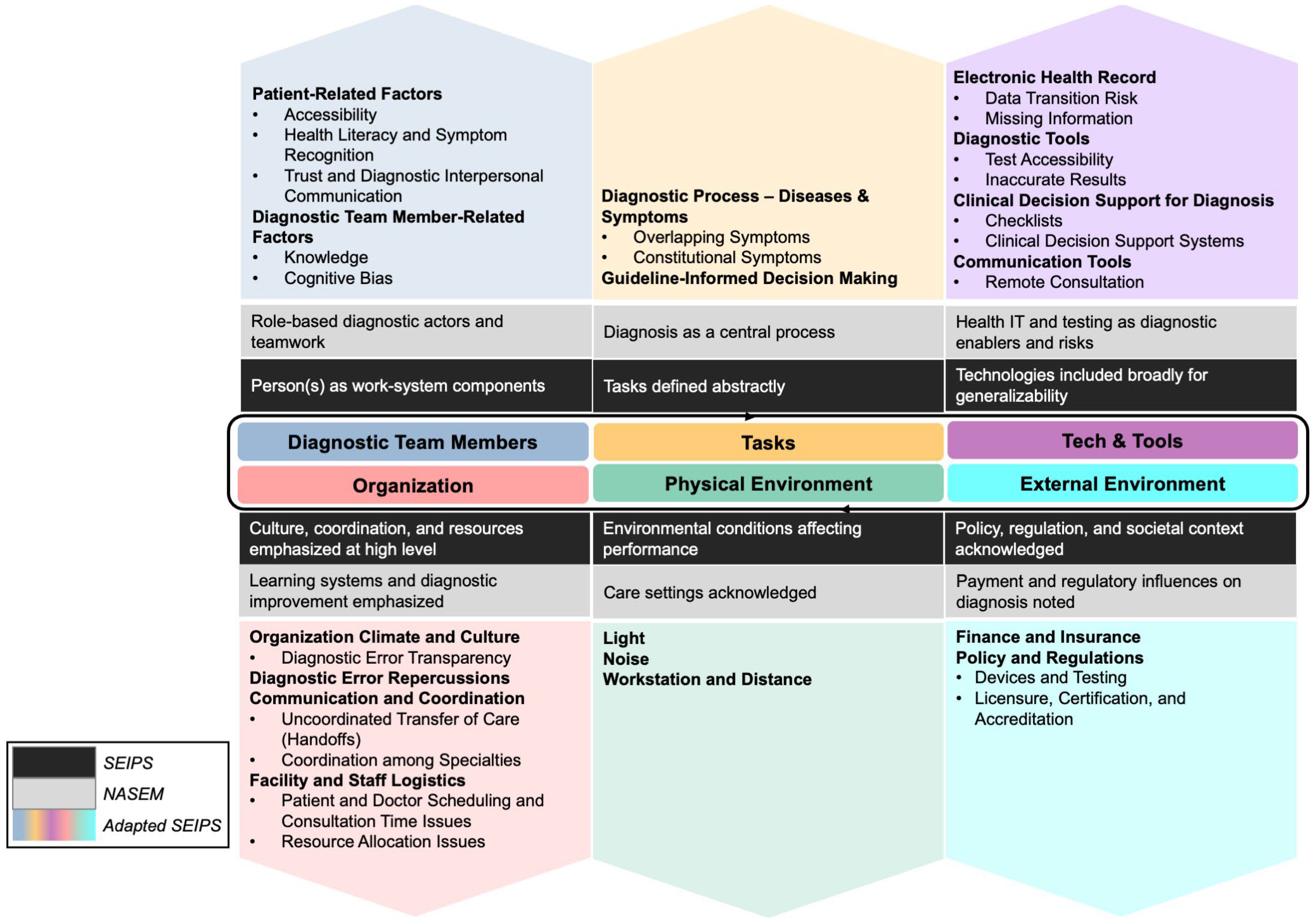
2.1. Framework Orientation and SEIPS Adaptation
- (1)
- Diagnostic Team Members: SEIPS conceptualizes “person(s)” broadly, and the NASEM framework emphasizes role-based diagnostic actors and teamwork. To add diagnostic specificity and analytic symmetry, we distinguished patient-related factors from diagnostic team member–related factors. Patient-related factors include Accessibility, Health Literacy and Symptom Recognition, and Trust and Diagnostic Interpersonal Communication, which directly shape the quality, completeness, and timing of diagnostic information entering the system. Diagnostic team member–related factors include Knowledge and Cognitive Bias that influence hypothesis formation, evidence interpretation, and follow-up decisions. By distinguishing patient-related and diagnostic team member–related contributors at this level, the framework extends SEIPS’ person-centered logic by adding the depth of diagnosis to the work system, explicitly modeling how information is generated, filtered, and acted upon by different actors within the diagnostic process.
- (2)
- Tasks: SEIPS characterizes tasks using general attributes such as complexity and ambiguity, whereas NASEM treats diagnosis itself as the central process. To bridge this conceptual mismatch, we expanded the Tasks domain to include Diagnostic Process —Diseases & Symptoms, treating disease and symptom characteristics (e.g., Overlapping Symptoms and Constitutional Symptoms) as task inputs that systematically increase diagnostic uncertainty and cognitive workload. We also added Guideline-Informed Decision Making as a task-structuring element to capture how guideline definitions, exclusions, and constraints shape diagnostic decision making, particularly in the presence of comorbidities, atypical presentations, and unclear criteria for diagnostic accuracy or timeliness.
- (3)
- Technologies and Tools: SEIPS addresses technologies broadly in terms of usability and fit, while NASEM emphasizes health information technology as both an enabler and a source of diagnostic risk. To reflect diagnosis-specific technological contributors while maintaining the SEIPS structure, we added Diagnostic Tests as a distinct subcategory to represent diagnostic tests and related technologies, including issues of Test Accessibility and Inaccurate Results. We also explicitly included Clinical Decision Support for Diagnosis, encompassing both Checklists and computerized Clinical Decision Support Systems (CDSS), to capture how decision aids can mitigate premature closure while also introducing risks related to automation bias, limited generalizability, and reduced transparency.
- (4)
- Organization: SEIPS emphasizes culture, coordination, and resource constraints, and NASEM emphasizes learning systems and transparency. To connect these perspectives mechanistically, we added Diagnostic Error Repercussions to represent legal, reputational, and psychological consequences that influence clinician behavior, reporting, and defensive practices. We also explicitly delineated Organization Climate and Culture, including Diagnostic Error Transparency, hierarchical pressures, and peer norms that affect speaking up and feedback. In addition, we specified Communication and Coordination subcategories, including Uncoordinated Transfer of Care (handoffs) and Collaboration among Specialties, to capture how fragmented responsibility and information discontinuities contribute to diagnostic delay and error.
- (5)
- Physical Environment: We retained SEIPS’ focus on environmental conditions (e.g., Lighting, Noise, Workstation Layout and Distance) but added diagnosis-relevant mechanisms that affect perception, attention, and examination quality.
- (6)
- External Environment: Both SEIPS and NASEM acknowledge the influence of policy, regulation, and payment at a high level. We therefore added Policy and Regulations as an explicit subcategory to capture regulatory oversight, accreditation requirements, and standards shaping diagnostic tools, documentation, and permissible practice, alongside financial and insurance constraints affecting access, testing, and follow-up.
2.2. Review Approach and Justification
2.3. Scope and Boundaries
2.4. Literature Identification and Search Approach
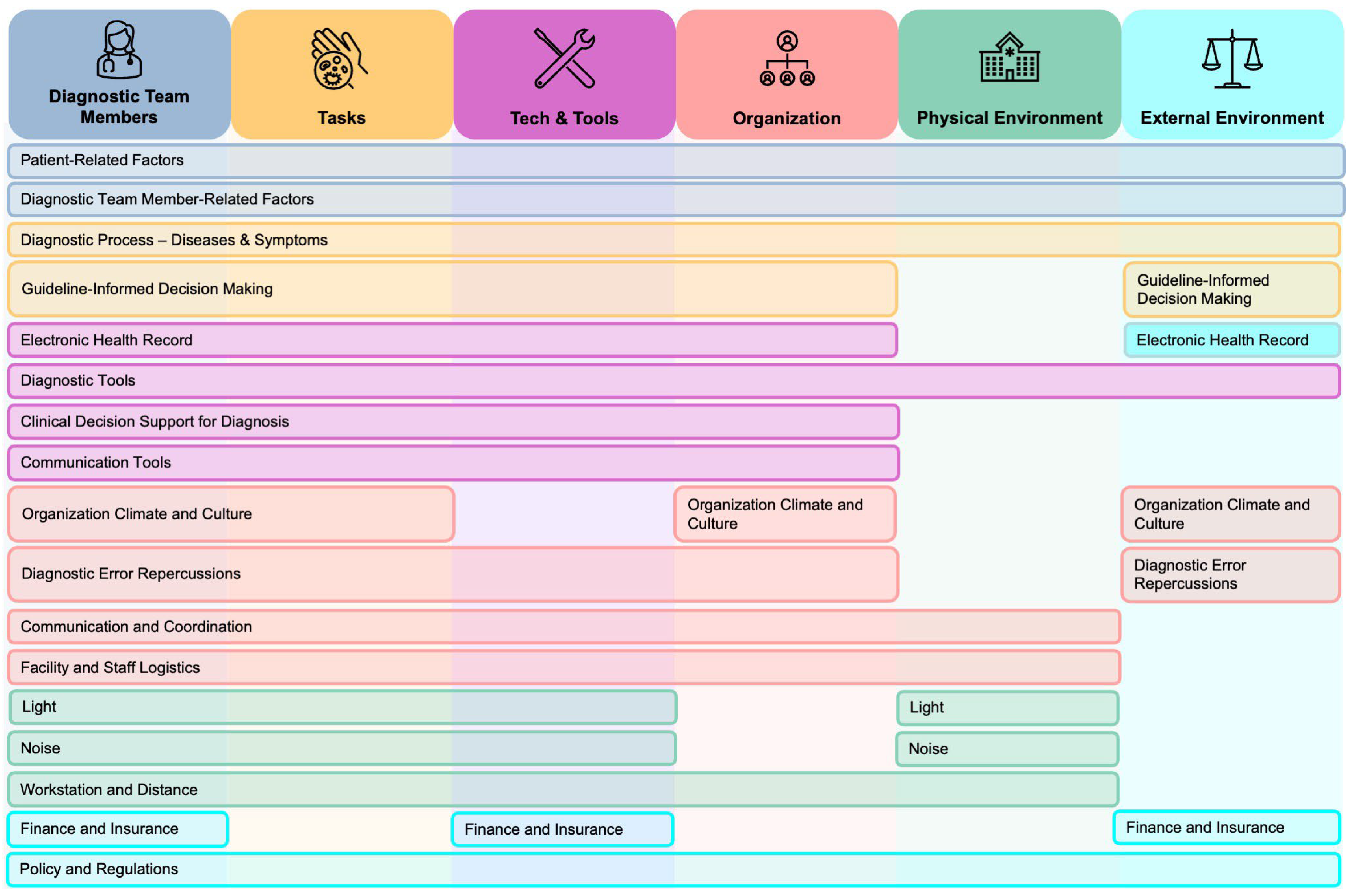
2.5. Contributory Factor Interactions
3. Diagnostic Team Members
3.1. Patient-Related Factors
3.1.1. Accessibility
3.1.2. Health Literacy & Symptom Recognition
3.1.3. Trust and Diagnostic Interpersonal Communication
3.2. Diagnostic Team Member-Related Factors
3.2.1. Knowledge
3.2.2. Cognitive Bias
4. Tasks
4.1. Diagnostic Process—Diseases & Symptoms
4.1.1. Overlapping Symptoms
4.1.2. Constitutional Symptoms
4.2. Guideline-Informed Decision Making
5. Technologies and Tools
5.1. Electronic Health Record (EHR)
5.1.1. Data Transition Risk
5.1.2. Missing Information
5.2. Diagnostic Tests
5.2.1. Test Accessibility
5.2.2. Inaccurate Results
5.3. Clinical Decision Support for Diagnosis
5.3.1. Checklists
5.3.2. Clinical Decision Support Systems (CDSS)
5.4. Communication Tools
Remote Consultation
6. Organization
6.1. Organization Climate and Culture
Diagnostic Error Transparency
6.2. Diagnostic Error Repercussions
6.3. Communication and Coordination
6.3.1. Uncoordinated Transfer of Care (Handoffs)
6.3.2. Collaboration Among Specialties
6.4. Facility and Staff Logistics
6.4.1. Patient & Doctor Scheduling and Consultation Time Issues
6.4.2. Resource Allocation Issues
7. Physical Environment
7.1. Light
7.2. Noise
7.3. Workstation Layout and Distance
8. External Environment
8.1. Finance & Insurance
8.2. Policy & Regulations—Devices and Testing
8.3. Policy & Regulations—Licensure, Certification and Accreditation
9. Limitation
10. Conclusions
11. Future Directions
Author Contributions
Funding
Institutional Review Board Statement
Informed Consent Statement
Data Availability Statement
Conflicts of Interest
References
- Graber, M.L.; Wachter, R.M.; Cassel, C.K. Bringing Diagnosis into the Quality and Safety Equations. JAMA 2012, 308, 1211–1212. [Google Scholar] [CrossRef]
- Slawomirski, L.; Klazinga, N. The Economics of Patient Safety: Strengthening a Value-Based Approach to Reducing Patient Harm at National Level. Available online: https://www.oecd.org/en/publications/the-economics-of-patient-safety_761f2da8-en.html (accessed on 23 December 2024).
- Laposata, M. The Definition and Scope of Diagnostic Error in the US and How Diagnostic Error Is Enabled. J. Appl. Lab. Med. 2018, 3, 128–134. [Google Scholar] [CrossRef] [PubMed]
- Zwaan, L.; Singh, H. The Challenges in Defining and Measuring Diagnostic Error. Diagnosis 2015, 2, 97–103. [Google Scholar] [CrossRef] [PubMed]
- Satterfield, K.; Rubin, J.C.; Friedman, C.P. Toward a Learning Ecosystem for Diagnostic Excellence; University of Michigan Library: Ann Arbor, MI, USA, 2018. [Google Scholar]
- Bhise, V.; Singh, H. Measuring Diagnostic Safety of Inpatients: Time to Set Sail in Uncharted Waters. Diagnosis 2015, 2, 1–2. [Google Scholar] [CrossRef] [PubMed]
- Graber, M. Diagnostic Errors in Medicine: A Case of Neglect. Jt. Comm. J. Qual. Patient Saf. 2005, 31, 106–113. [Google Scholar] [CrossRef]
- Singh, H.; Meyer, A.N.D.; Thomas, E.J. The Frequency of Diagnostic Errors in Outpatient Care: Estimations from Three Large Observational Studies Involving US Adult Populations. BMJ Qual. Saf. 2014, 23, 727–731. [Google Scholar] [CrossRef]
- Committee on Diagnostic Error in Health Care; Board on Health Care Services; Institute of Medicine; The National Academies of Sciences, Engineering, and Medicine. Improving Diagnosis in Health Care; Balogh, E.P., Miller, B.T., Ball, J.R., Eds.; National Academies Press: Washington, DC, USA, 2015; ISBN 978-0-309-37769-0. [Google Scholar]
- Shrank, W.H.; Rogstad, T.L.; Parekh, N. Waste in the US Health Care System: Estimated Costs and Potential for Savings. JAMA 2019, 322, 1501–1509. [Google Scholar] [CrossRef]
- Newman-Toker, D.E.; Peterson, S.M.; Badihian, S.; Hassoon, A.; Nassery, N.; Parizadeh, D.; Wilson, L.M.; Jia, Y.; Omron, R.; Tharmarajah, S.; et al. Diagnostic Errors in the Emergency Department: A Systematic Review; AHRQ Comparative Effectiveness Reviews; Agency for Healthcare Research and Quality (US): Rockville, MD, USA, 2022. [Google Scholar]
- Šimundić, A.-M. Measures of Diagnostic Accuracy: Basic Definitions. EJIFCC 2009, 19, 203–211. [Google Scholar]
- Leeflang, M.M.G.; Deeks, J.J.; Gatsonis, C.; Bossuyt, P.M.M. Systematic Reviews of Diagnostic Test Accuracy. Ann. Intern. Med. 2008, 149, 889–897. [Google Scholar] [CrossRef]
- Mullen, C.J.R.; Barr, R.D.; Franco, E.L. Timeliness of Diagnosis and Treatment: The Challenge of Childhood Cancers. Br. J. Cancer 2021, 125, 1612–1620. [Google Scholar] [CrossRef]
- Ansar, A.; Lewis, V.; McDonald, C.F.; Liu, C.; Rahman, M.A. Defining Timeliness in Care for Patients with Lung Cancer: A Scoping Review. BMJ Open 2022, 12, e056895. [Google Scholar] [CrossRef] [PubMed]
- Dahm, M.R.; Crock, C. Understanding and Communicating Uncertainty in Achieving Diagnostic Excellence. JAMA 2022, 327, 1127–1128. [Google Scholar] [CrossRef] [PubMed]
- Usher, M.; Sahni, N.; Herrigel, D.; Simon, G.; Melton, G.B.; Joseph, A.; Olson, A. Diagnostic Discordance, Health Information Exchange, and Inter-Hospital Transfer Outcomes: A Population Study. J. Gen. Intern. Med. 2018, 33, 1447–1453. [Google Scholar] [CrossRef] [PubMed]
- Singh, H.; Giardina, T.D.; Forjuoh, S.N.; Reis, M.D.; Kosmach, S.; Khan, M.M.; Thomas, E.J. Electronic Health Record-Based Surveillance of Diagnostic Errors in Primary Care. BMJ Qual. Saf. 2012, 21, 93–100. [Google Scholar] [CrossRef]
- Franco, J.; Elghouche, A.N.; Harris, M.S.; Kokoska, M.S. Diagnostic Delays and Errors in Head and Neck Cancer Patients: Opportunities for Improvement. Am. J. Med. Qual. 2017, 32, 330–335. [Google Scholar] [CrossRef]
- Fusar-Poli, L.; Brondino, N.; Politi, P.; Aguglia, E. Missed Diagnoses and Misdiagnoses of Adults with Autism Spectrum Disorder. Eur. Arch. Psychiatry Clin. Neurosci. 2022, 272, 187–198. [Google Scholar] [CrossRef]
- Triplett, J.D.; Qiu, J.; O’Brien, B.; Gopinath, S.; Trewin, B.; Spring, P.J.; Shaffi, M.; Ip, J.; Chan, F.; Chen, L.; et al. Diagnosis, Differential Diagnosis and Misdiagnosis of Susac Syndrome. Eur. J. Neurol. 2022, 29, 1771–1781. [Google Scholar] [CrossRef]
- Feller, D.J.; Bear Don’t Walk, O.J., IV; Zucker, J.; Yin, M.T.; Gordon, P.; Elhadad, N. Detecting Social and Behavioral Determinants of Health with Structured and Free-Text Clinical Data. Appl. Clin. Inform. 2020, 11, 172–181. [Google Scholar] [CrossRef]
- Goodday, S.M.; Kormilitzin, A.; Vaci, N.; Liu, Q.; Cipriani, A.; Smith, T.; Nevado-Holgado, A. Maximizing the Use of Social and Behavioural Information from Secondary Care Mental Health Electronic Health Records. J. Biomed. Inform. 2020, 107, 103429. [Google Scholar] [CrossRef]
- Wittink, H.; Oosterhaven, J. Patient Education and Health Literacy. Musculoskelet. Sci. Pract. 2018, 38, 120–127. [Google Scholar] [CrossRef]
- Barwise, A.; Leppin, A.; Dong, Y.; Huang, C.; Pinevich, Y.; Herasevich, S.; Soleimani, J.; Gajic, O.; Pickering, B.; Kumbamu, A. What Contributes to Diagnostic Error or Delay? A Qualitative Exploration Across Diverse Acute Care Settings in the United States. J. Patient Saf. 2021, 17, 239–248. [Google Scholar] [CrossRef]
- Huynh, K.; Brito, J.P.; Bylund, C.L.; Prokop, L.J.; Ospina, N.S. Understanding Diagnostic Conversations in Clinical Practice: A Systematic Review. Patient Educ. Couns. 2023, 116, 107949. [Google Scholar] [CrossRef] [PubMed]
- O’Sullivan, E.; Schofield, S. Cognitive Bias in Clinical Medicine. J. R. Coll. Physicians Edinb. 2018, 48, 225–232. [Google Scholar] [CrossRef] [PubMed]
- Rockwell, M.S.; Frazier, M.C.; Stein, J.S.; Dulaney, K.A.; Parker, S.H.; Davis, G.C.; Rockwell, J.A.; Castleman, B.L.; Sunstein, C.R.; Epling, J.W. A “Sludge Audit” for Health System Colorectal Cancer Screening Services. Am. J. Manag. Care 2023, 29, e222–e228. [Google Scholar] [CrossRef] [PubMed]
- Rao, S.K.; Kimball, A.B.; Lehrhoff, S.R.; Hidrue, M.K.; Colton, D.G.; Ferris, T.G.; Torchiana, D.F. The Impact of Administrative Burden on Academic Physicians: Results of a Hospital-Wide Physician Survey. Acad. Med. 2017, 92, 237. [Google Scholar] [CrossRef]
- Michtalik, H.J.; Yeh, H.-C.; Pronovost, P.J.; Brotman, D.J. Impact of Attending Physician Workload on Patient Care: A Survey of Hospitalists. JAMA Intern. Med. 2013, 173, 375–377. [Google Scholar] [CrossRef]
- Clapper, T.C. TeamSTEPPS® Is an Effective Tool to Level the Hierarchy in Healthcare Communication by Empowering All Stakeholders. J. Commun. Healthc. 2018, 11, 241–244. [Google Scholar] [CrossRef]
- Grubenhoff, J.A.; Ziniel, S.I.; Cifra, C.L.; Singhal, G.; McClead, R.E.J.; Singh, H. Pediatric Clinician Comfort Discussing Diagnostic Errors for Improving Patient Safety: A Survey. Pediatr. Qual. Saf. 2020, 5, e259. [Google Scholar] [CrossRef]
- Graber, M.L.; Franklin, N.; Gordon, R. Diagnostic Error in Internal Medicine. Arch. Intern. Med. 2005, 165, 1493–1499. [Google Scholar] [CrossRef]
- Ladell, M.M.; Jacobson, N.L.; Yale, S.C.; McDermott, K.L.; Papautsky, E.L.; Catchpole, K.R.; Scanlon, M.C. The Problem with How We View Medical (and Diagnostic) Error in Emergency Medicine. Acad. Emerg. Med. 2025, 32, 340–347. [Google Scholar] [CrossRef]
- Holden, R.J.; Carayon, P.; Gurses, A.P.; Hoonakker, P.; Hundt, A.S.; Ozok, A.A.; Rivera-Rodriguez, A.J. SEIPS 2.0: A Human Factors Framework for Studying and Improving the Work of Healthcare Professionals and Patients. Ergonomics 2013, 56, 1669–1686. [Google Scholar] [CrossRef] [PubMed]
- Carayon, P.; Wooldridge, A.; Hoonakker, P.; Hundt, A.S.; Kelly, M.M. SEIPS 3.0: Human-Centered Design of the Patient Journey for Patient Safety. Appl. Ergon. 2020, 84, 103033. [Google Scholar] [CrossRef] [PubMed]
- Greenhalgh, T.; Thorne, S.; Malterud, K. Time to Challenge the Spurious Hierarchy of Systematic over Narrative Reviews? Eur. J. Clin. Investig. 2018, 48, e12931. [Google Scholar] [CrossRef] [PubMed]
- Hall, S.; Leeder, E. Narrative Reanalysis: A Methodological Framework for a New Brand of Reviews. Res. Synth. Methods 2024, 15, 1017–1030. [Google Scholar] [CrossRef]
- Sukhera, J. Narrative Reviews: Flexible, Rigorous, and Practical. J. Grad. Med. Educ. 2022, 14, 414–417. [Google Scholar] [CrossRef]
- Dianatinasab, M.; Fararouei, M.; Mohammadianpanah, M.; Zare-Bandamiri, M. Impact of Social and Clinical Factors on Diagnostic Delay of Breast Cancer: A Cross-Sectional Study. Medicine 2016, 95, e4704. [Google Scholar] [CrossRef]
- Smith, J.G.; Plover, C.M.; McChesney, M.C.; Lake, E.T. Isolated, Small, and Large Hospitals Have Fewer Nursing Resources than Urban Hospitals: Implications for Rural Health Policy. Public Health Nurs. 2019, 36, 469–477. [Google Scholar] [CrossRef]
- Wercholuk, A.N.; Parikh, A.A.; Snyder, R.A. The Road Less Traveled: Transportation Barriers to Cancer Care Delivery in the Rural Patient Population. JCO Oncol. Pract. 2022, 18, 652–662. [Google Scholar] [CrossRef]
- Green-Hernandez, C. Transportation Challenges in Rural Healthcare. Nurse Pract. 2006, 31, 10. [Google Scholar] [CrossRef]
- Cohen, A.S.A.; Berrios, C.D.; Zion, T.N.; Barrett, C.M.; Moore, R.; Boillat, E.; Belden, B.; Farrow, E.G.; Thiffault, I.; Zuccarelli, B.D.; et al. Genomic Answers for Kids: Toward More Equitable Access to Genomic Testing for Rare Diseases in Rural Populations. Am. J. Hum. Genet. 2024, 111, 825–832. [Google Scholar] [CrossRef] [PubMed]
- Drake, C.; Zhang, Y.; Chaiyachati, K.H.; Polsky, D. The Limitations of Poor Broadband Internet Access for Telemedicine Use in Rural America: An Observational Study. Ann. Intern. Med. 2019, 171, 382–384. [Google Scholar] [CrossRef] [PubMed]
- Clark, M.; Lee, A.; Kupets, R. Limitations in Correspondence Programs for Cervical Cancer Screening: Who Are the Women We Are Missing? J. Obstet. Gynaecol. Can. 2019, 41, 1410–1415. [Google Scholar] [CrossRef] [PubMed]
- Walker, M.J.; Meggetto, O.; Gao, J.; Espino-Hernández, G.; Jembere, N.; Bravo, C.A.; Rey, M.; Aslam, U.; Sheppard, A.J.; Lofters, A.K.; et al. Measuring the Impact of the COVID-19 Pandemic on Organized Cancer Screening and Diagnostic Follow-up Care in Ontario, Canada: A Provincial, Population-Based Study. Prev. Med. 2021, 151, 106586. [Google Scholar] [CrossRef]
- McLeod, N.M.H.; Saeed, N.R.; Ali, E.A. Oral Cancer: Delays in Referral and Diagnosis Persist. Br. Dent. J. 2005, 198, 681–684. [Google Scholar] [CrossRef]
- Arhi, C.S.; Burns, E.M.; Bottle, A.; Bouras, G.; Aylin, P.; Ziprin, P.; Darzi, A. Delays in Referral from Primary Care Worsen Survival for Patients with Colorectal Cancer: A Retrospective Cohort Study. Br. J. Gen. Pract. 2020, 70, e463–e471. [Google Scholar] [CrossRef]
- Vang, S.S.; Dunn, A.; Margolies, L.R.; Jandorf, L. Delays in Follow-up Care for Abnormal Mammograms in Mobile Mammography Versus Fixed-Clinic Patients. J. Gen. Intern. Med. 2022, 37, 1619–1625. [Google Scholar] [CrossRef]
- Institute of Medicine (US) Committee on Health Literacy Health Literacy. Health Literacy: A Prescription to End Confusion; Nielsen-Bohlman, L., Panzer, A.M., Kindig, D.A., Eds.; National Academies Press: Washington, DC, USA, 2004; ISBN 978-0-309-09117-6. [Google Scholar]
- Richards, D.; Morren, J.A.; Pioro, E.P. Time to Diagnosis and Factors Affecting Diagnostic Delay in Amyotrophic Lateral Sclerosis. J. Neurol. Sci. 2020, 417, 117054. [Google Scholar] [CrossRef]
- Mann, C.; Gooberman-Hill, R. Health Care Provision for Osteoarthritis: Concordance between What Patients Would like and What Health Professionals Think They Should Have. Arthritis Care Res. 2011, 63, 963–972. [Google Scholar] [CrossRef]
- Kwok, C.S.; Burke, H.; McDermott, S.; Welsh, V.; Barker, D.; Patwala, A.; Duckett, S.; Satchithananda, D.; Mallen, C.D. Missed Opportunities in the Diagnosis of Heart Failure: Evaluation of Pathways to Determine Sources of Delay to Specialist Evaluation. Curr. Heart Fail. Rep. 2022, 19, 247–253. [Google Scholar] [CrossRef]
- Weiss, B.D. Health Literacy; American Medical Association: Chicago, IL, USA, 2003. [Google Scholar]
- Murugesu, L.; Heijmans, M.; Rademakers, J.; Fransen, M.P. Challenges and Solutions in Communication with Patients with Low Health Literacy: Perspectives of Healthcare Providers. PLoS ONE 2022, 17, e0267782. [Google Scholar] [CrossRef]
- Wittenberg, E.; Ferrell, B.; Kanter, E.; Buller, H. Health Literacy: Exploring Nursing Challenges to Providing Support and Understanding. Clin. J. Oncol. Nurs. 2018, 22, 53–61. [Google Scholar] [CrossRef]
- Safeer, R.S.; Keenan, J. Health Literacy: The Gap between Physicians and Patients. Am. Fam. Physician 2005, 72, 463–468. [Google Scholar]
- Sylwander, C.; Wahl, A.K.; Andersson, M.L.E.; Haglund, E.; Larsson, I. Health Literacy in Individuals with Knee Pain-a Mixed Methods Study. BMC Public Health 2023, 23, 1656. [Google Scholar] [CrossRef]
- Cornett, S. Assessing and Addressing Health Literacy. Online J. Issues Nurs. 2009, 14. [Google Scholar] [CrossRef]
- Shame, Health Literacy and Consent—Barry Lyons, Luna Dolezal. 2024. Available online: https://journals.sagepub.com/doi/abs/10.1177/14777509231218203 (accessed on 15 October 2024).
- Hong, H.; Oh, H.J. The Effects of Patient-Centered Communication: Exploring the Mediating Role of Trust in Healthcare Providers. Health Commun. 2020, 35, 502–511. [Google Scholar] [CrossRef] [PubMed]
- Kwame, A.; Petrucka, P.M. A Literature-Based Study of Patient-Centered Care and Communication in Nurse-Patient Interactions: Barriers, Facilitators, and the Way Forward. BMC Nurs. 2021, 20, 158. [Google Scholar] [CrossRef] [PubMed]
- Colombo, B.; Aurelio, B.; Wallace, H.J.; Heath, J.L. Exploring Patients’ Trust from a New Perspective. A Text-Analysis Study. Health Commun. 2023, 38, 3040–3050. [Google Scholar] [CrossRef] [PubMed]
- Sullivan, L.S. Trust, Risk, and Race in American Medicine. Hastings Cent. Report. 2020, 50, 18–26. [Google Scholar] [CrossRef]
- Meyerson, B.E.; Russell, D.M.; Kichler, M.; Atkin, T.; Fox, G.; Coles, H.B. I Don’t Even Want to Go to the Doctor When I Get Sick Now: Healthcare Experiences and Discrimination Reported by People Who Use Drugs, Arizona 2019. Int. J. Drug Policy 2021, 93, 103112. [Google Scholar] [CrossRef]
- Cuevas, A.G.; O’Brien, K.; Saha, S. African American Experiences in Healthcare: I Always Feel like I’m Getting Skipped Over. Health Psychol. 2016, 35, 987–995. [Google Scholar] [CrossRef]
- Moscrop, A.; Siskind, D.; Stevens, R. Mental Health of Young Adult Patients Who Do Not Attend Appointments in Primary Care: A Retrospective Cohort Study. Fam. Pract. 2012, 29, 24–29. [Google Scholar] [CrossRef]
- Shefer, G.; Henderson, C.; Howard, L.M.; Murray, J.; Thornicroft, G. Diagnostic Overshadowing and Other Challenges Involved in the Diagnostic Process of Patients with Mental Illness Who Present in Emergency Departments with Physical Symptoms—A Qualitative Study. PLoS ONE 2014, 9, e111682. [Google Scholar] [CrossRef]
- Kaufman, E.; Mcdonell, M.; Cristofalo, M.; Ries, R. Exploring Barriers to Primary Care For Patients with Severe Mental Illness: Frontline Patient and Provider Accounts. Issues Ment. Health Nurs. 2012, 33, 172–180. [Google Scholar] [CrossRef]
- Ferguson, W.J.; Candib, L.M. Culture, Language, and the Doctor-Patient Relationship. Fam. Med. 2002, 34, 353–361. [Google Scholar] [PubMed]
- Hairston, D.R.; Gibbs, T.A.; Wong, S.S.; Jordan, A. Clinician Bias in Diagnosis and Treatment. In Racism and Psychiatry: Contemporary Issues and Interventions; Medlock, M.M., Shtasel, D., Trinh, N.-H.T., Williams, D.R., Eds.; Springer International Publishing: Cham, Switzerland, 2019; pp. 105–137. ISBN 978-3-319-90197-8. [Google Scholar]
- Piccardi, C.; Detollenaere, J.; Bussche, P.; Willems, S. Social Disparities in Patient Safety in Primary Care: A Systematic Review. Int. J. Equity Health 2018, 17, 114. [Google Scholar] [CrossRef] [PubMed]
- Schinkel, S.; Schouten, B.C.; Kerpiclik, F.; Van Den Putte, B.; Van Weert, J.C.M. Perceptions of Barriers to Patient Participation: Are They Due to Language, Culture, or Discrimination? Health Commun. 2019, 34, 1469–1481. [Google Scholar] [CrossRef] [PubMed]
- Akbari, H.; Mohammadi, M.; Hosseini, A. Disease-Related Stigma, Stigmatizers, Causes, and Consequences: A Systematic Review. Iran. J. Public Health 2023, 52, 2042–2054. [Google Scholar] [CrossRef]
- Knaak, S.; Mantler, E.; Szeto, A. Mental Illness-Related Stigma in Healthcare: Barriers to Access and Care and Evidence-Based Solutions. Healthc. Manag. Forum 2017, 30, 111–116. [Google Scholar] [CrossRef]
- Corrigan, P. How Stigma Interferes with Mental Health Care. Am. Psychol. 2004, 59, 614–625. [Google Scholar] [CrossRef]
- Corrigan, P.W.; Druss, B.G.; Perlick, D.A. The Impact of Mental Illness Stigma on Seeking and Participating in Mental Health Care. Psychol. Sci. Public. Interest 2014, 15, 37–70. [Google Scholar] [CrossRef]
- Chang, C. Increasing Mental Health Literacy via Narrative Advertising. J. Health Commun. 2008, 13, 37–55. [Google Scholar] [CrossRef] [PubMed]
- Smith, G.D.; Hebdon, M. Mental Health Help-Seeking Behaviour in Men. J. Adv. Nurs. 2024, 80, 851–853. [Google Scholar] [CrossRef] [PubMed]
- Ali, S.N. Religious Minorities and Medicine: The Collision of Health Care and Faith. In Stigma and Prejudice: Touchstones in Understanding Diversity in Healthcare; Parekh, R., Childs, E.W., Eds.; Springer International Publishing: Cham, Switzerland, 2016; pp. 41–66. ISBN 978-3-319-27580-2. [Google Scholar]
- Bm, G.; Jl, V.; Rg, M.; Rs, L.; Be, L. Association between Primary Care Physician Diagnostic Knowledge and Death, Hospitalisation and Emergency Department Visits Following an Outpatient Visit at Risk for Diagnostic Error: A Retrospective Cohort Study Using Medicare Claims. BMJ Open 2021, 11, e041817. [Google Scholar] [CrossRef] [PubMed]
- Dulyapach, K.; Ngamchaliew, P.; Vichitkunakorn, P.; Sornsenee, P.; Choomalee, K. Prevalence and Associated Factors of Delayed Diagnosis of Type 2 Diabetes Mellitus in a Tertiary Hospital: A Retrospective Cohort Study. Int. J. Public Health 2022, 67, 1605039. [Google Scholar] [CrossRef]
- Kumbhare, D.; Ahmed, S.; Sander, T.; Grosman-Rimon, L.; Srbely, J. A Survey of Physicians’ Knowledge and Adherence to the Diagnostic Criteria for Fibromyalgia. Pain Med. 2018, 19, 1254–1264. [Google Scholar] [CrossRef]
- Hooftman, J.; Dijkstra, A.C.; Suurmeijer, I.; Van Der Bij, A.; Paap, E.; Zwaan, L. Common Contributing Factors of Diagnostic Error: A Retrospective Analysis of 109 Serious Adverse Event Reports from Dutch Hospitals. BMJ Qual. Saf. 2024, 33, 642–651. [Google Scholar] [CrossRef]
- Harrold, L.R.; Field, T.S.; Gurwitz, J.H. Knowledge, Patterns of Care, and Outcomes of Care for Generalists and Specialists. J. Gen. Intern. Med. 1999, 14, 499–511. [Google Scholar] [CrossRef]
- Garrido, A.Q.; Wainstein, A.J.A.; Brandão, M.P.A.; de Vasconcellos Santos, F.A.; Bittencourt, F.V.; Ledsham, C.; Drummond-Lage, A.P. Diagnosis of Cutaneous Melanoma: The Gap Between the Knowledge of General Practitioners and Dermatologists in a Brazilian Population. J. Cancer Educ. 2020, 35, 819–825. [Google Scholar] [CrossRef]
- Scott, I.A.; Campbell, D.A. The Gaps in Specialists’ Diagnoses. Med. J. Aust. 2018, 208, 196–197. [Google Scholar] [CrossRef]
- Glosup, J.G.; Axelrod, M.C. Systematic Error Revisited; Lawrence Livermore National Lab. (LLNL): Livermore, CA, USA, 1996. [Google Scholar]
- Kahneman, D. Thinking, Fast and Slow; Thinking, fast and slow; Farrar, Straus and Giroux: New York, NY, USA, 2011; p. 499. ISBN 978-0-374-27563-1. [Google Scholar]
- Bate, L.; Hutchinson, A.; Underhill, J.; Maskrey, N. How Clinical Decisions Are Made. Br. J. Clin. Pharmacol. 2012, 74, 614–620. [Google Scholar] [CrossRef]
- Norman, G.; Sherbino, J.; Dore, K.; Wood, T.; Young, M.; Gaissmaier, W.; Kreuger, S.; Monteiro, S. The Etiology of Diagnostic Errors: A Controlled Trial of System 1 Versus System 2 Reasoning. Acad. Med. 2014, 89, 277–284. [Google Scholar] [CrossRef]
- Gojanovic, B.; Fourchet, F.; Gremeaux, V. Cognitive Biases Cloud Our Clinical Decisions and Patient Expectations: A Narrative Review to Help Bridge the Gap between Evidence-Based and Personalized Medicine. Ann. Phys. Rehabil. Med. 2022, 65, 101551. [Google Scholar] [CrossRef] [PubMed]
- Webster, C.S.; Taylor, S.; Weller, J.M. Cognitive Biases in Diagnosis and Decision Making during Anaesthesia and Intensive Care. BJA Educ. 2021, 21, 420–425. [Google Scholar] [CrossRef] [PubMed]
- Marewski, J.N.; Gigerenzer, G. Heuristic Decision Making in Medicine. Dialogues Clin. Neurosci. 2012, 14, 77–89. [Google Scholar] [CrossRef] [PubMed]
- Tversky, A.; Kahneman, D. Judgment under Uncertainty: Heuristics and Biases. Science 1974, 185, 1124–1131. [Google Scholar] [CrossRef]
- Busby, L.P.; Courtier, J.L.; Glastonbury, C.M. Bias in Radiology: The How and Why of Misses and Misinterpretations. Radiographics 2018, 38, 236–247. [Google Scholar] [CrossRef]
- Florman, J.; Almeder, L.; Trowbridge, R. A Primer on Cognitive Errors Illustrated Through the Lens of a Neurosurgical Practice. J. Maine Med. Cent. 2020, 2, 4. [Google Scholar] [CrossRef]
- Murani, R.; Manocha, R.H.K. Avoiding Anchoring Bias in Unexplained Chronic Pain: An Unexpected Diagnosis of Synovial Osteochondromatosis. BMJ Case Rep. CP 2021, 14, e240462. [Google Scholar] [CrossRef]
- Heider, F. The Psychology of Interpersonal Relations; Psychology Press: New York, NY, USA, 1982; ISBN 978-0-203-78115-9. [Google Scholar]
- Tversky, A.; Kahneman, D. Availability: A Heuristic for Judging Frequency and Probability. Cogn. Psychol. 1973, 5, 207–232. [Google Scholar] [CrossRef]
- Li, P.; Cheng, Z.Y.; Liu, G.L. Availability Bias Causes Misdiagnoses by Physicians: Direct Evidence from a Randomized Controlled Trial. Intern. Med. 2020, 59, 3141–3146. [Google Scholar] [CrossRef]
- Kunitomo, K.; Harada, T.; Watari, T. Cognitive Biases Encountered by Physicians in the Emergency Room. BMC Emerg. Med. 2022, 22, 148. [Google Scholar] [CrossRef]
- Al-Maghrabi, M.; Mamede, S.; Schmidt, H.G.; Omair, A.; Al-Nasser, S.; Alharbi, N.S.; Magzoub, M.E.M.A. Overconfidence, Time-on-Task, and Medical Errors: Is There a Relationship? Adv. Med. Educ. Pract. 2024, 15, 133–140. [Google Scholar] [CrossRef]
- Lam, J.A.; Feller, E. Are We Right When We’re Certain? Overconfidence in Medicine. R I Med. J. (2013) 2020, 103, 11–12. [Google Scholar]
- Friedman, C.P.; Gatti, G.G.; Franz, T.M.; Murphy, G.C.; Wolf, F.M.; Heckerling, P.S.; Fine, P.L.; Miller, T.M.; Elstein, A.S. Do Physicians Know When Their Diagnoses Are Correct? J. Gen. Intern. Med. 2005, 20, 334–339. [Google Scholar] [CrossRef]
- Friedman, C.; Gatti, G.; Elstein, A.; Franz, T.; Murphy, G.; Wolf, F. Are Clinicians Correct When They Believe They Are Correct? Implications for Medical Decision Support. Stud. Health Technol. Inform. 2001, 84, 454–458. [Google Scholar] [CrossRef] [PubMed]
- Kuhn, J.; van den Berg, P.; Mamede, S.; Zwaan, L.; Bindels, P.; van Gog, T. Improving Medical Residents’ Self-Assessment of Their Diagnostic Accuracy: Does Feedback Help? Adv. Health Sci. Educ. 2022, 27, 189–200. [Google Scholar] [CrossRef] [PubMed]
- Odum, A.L. Delay Discounting: I’m a k, You’re a k. J. Exp. Anal. Behav. 2011, 96, 427–439. [Google Scholar] [CrossRef] [PubMed]
- Yeh, Y.-H.; Myerson, J.; Green, L. Delay Discounting, Cognitive Ability, and Personality: What Matters? Psychon. Bull. Rev. 2021, 28, 686–694. [Google Scholar] [CrossRef]
- Theodossi, A.; Spiegelhalter, D.J.; McFarlane, I.G.; Williams, R. Doctors’ Attitudes to Risk in Difficult Clinical Decisions: Application of Decision Analysis in Hepatobiliary Disease. Br. Med. J. (Clin. Res. Ed.) 1984, 289, 213–216. [Google Scholar] [CrossRef]
- Epling, J.; Rockwell, M.; Stein, J.; Davis, G.; Rockwell, J.; Parker, S. “Sludge Audit” to Identify Barriers to Colorectal Cancer Screening. Ann. Fam. Med. 2023, 21, 3842. [Google Scholar] [CrossRef]
- Heuer, A.J. More Evidence That the Healthcare Administrative Burden Is Real, Widespread and Has Serious Consequences Comment on Perceived Burden Due to Registrations for Quality Monitoring and Improvement in Hospitals: A Mixed Methods Study. Int. J. Health Policy Manag. 2022, 11, 536–538. [Google Scholar] [CrossRef] [PubMed]
- Dugdale, D.C.; Epstein, R.; Pantilat, S.Z. Time and the Patient–Physician Relationship. J. Gen. Intern. Med. 1999, 14, S34. [Google Scholar] [CrossRef] [PubMed]
- Gupta, A.; Harrod, M.; Quinn, M.; Manojlovich, M.; Fowler, K.E.; Singh, H.; Saint, S.; Chopra, V. Mind the Overlap: How System Problems Contribute to Cognitive Failure and Diagnostic Errors. Diagnosis 2018, 5, 151–156. [Google Scholar] [CrossRef]
- Farri, O.; Monsen, K.A.; Pakhomov, S.V.; Pieczkiewicz, D.S.; Speedie, S.M.; Melton, G.B. Effects of Time Constraints on Clinician–Computer Interaction: A Study on Information Synthesis from EHR Clinical Notes. J. Biomed. Inform. 2013, 46, 1136–1144. [Google Scholar] [CrossRef]
- Panesar, S.; de Silva, D.; Carson-Stevens, A.; Cresswell, K.; Salvilla, S.; Slight, S.; Javad, S.; Netuveli, G.; Larizgoitia, I.; Donaldson, L.; et al. How Safe Is Primary Care? A Systematic Review. BMJ Qual. Saf. 2015, 25, 544–553. [Google Scholar] [CrossRef]
- Nuamah, J.K.; Mehta, R.K. Chapter 11—Design for Stress, Fatigue, and Workload Management. In Design for Health; Sethumadhavan, A., Sasangohar, F., Eds.; Academic Press: New York, NY, USA, 2020; pp. 201–226. ISBN 978-0-12-816427-3. [Google Scholar]
- Reiner, B.I.; Krupinski, E. The Insidious Problem of Fatigue in Medical Imaging Practice. J. Digit. Imaging 2011, 25, 3–6. [Google Scholar] [CrossRef]
- West, C.P.; Dyrbye, L.N.; Shanafelt, T.D. Physician Burnout: Contributors, Consequences and Solutions. J. Intern. Med. 2018, 283, 516–529. [Google Scholar] [CrossRef]
- Welp, A.; Meier, L.L.; Manser, T. Emotional Exhaustion and Workload Predict Clinician-Rated and Objective Patient Safety. Front. Psychol. 2015, 5, 1573. [Google Scholar] [CrossRef]
- Gwathmey, K.G.; Corcia, P.; McDermott, C.J.; Genge, A.; Sennfält, S.; de Carvalho, M.; Ingre, C. Diagnostic Delay in Amyotrophic Lateral Sclerosis. Eur. J. Neurol. 2023, 30, 2595–2601. [Google Scholar] [CrossRef]
- Rozenbaum, M.H.; Large, S.; Bhambri, R.; Stewart, M.; Young, R.; van Doornewaard, A.; Dasgupta, N.; Masri, A.; Nativi-Nicolau, J. Estimating the Health Benefits of Timely Diagnosis and Treatment of Transthyretin Amyloid Cardiomyopathy. J. Comp. Eff. Res. 2021, 10, 927–938. [Google Scholar] [CrossRef]
- Hussain, M.; Kumar, P.; Khan, S.; Gordon, D.K.; Khan, S. Similarities Between Depression and Neurodegenerative Diseases: Pathophysiology, Challenges in Diagnosis and Treatment Options. Cureus 2020, 12, e11613. [Google Scholar] [CrossRef]
- Karantzoulis, S.; Galvin, J.E. Distinguishing Alzheimer’s Disease from Other Major Forms of Dementia. Expert Rev. Neurother. 2011, 11, 1579–1591. [Google Scholar] [CrossRef] [PubMed]
- Moua, T.; Wood, K. COPD and PE: A Clinical Dilemma. Int. J. Chron. Obs. Pulmon Dis. 2008, 3, 277–284. [Google Scholar] [CrossRef]
- Pellicori, P.; Cleland, J.G.F.; Clark, A.L. Chronic Obstructive Pulmonary Disease and Heart Failure: A Breathless Conspiracy. Heart Fail. Clin. 2020, 16, 33–44. [Google Scholar] [CrossRef] [PubMed]
- Maixner, W.; Fillingim, R.B.; Williams, D.A.; Smith, S.B.; Slade, G.D. Overlapping Chronic Pain Conditions: Implications for Diagnosis and Classification. J. Pain 2016, 17, T93–T107. [Google Scholar] [CrossRef]
- Chang, S.; Vaccarella, L.; Olatunji, S.; Cebulla, C.; Christoforidis, J. Diagnostic Challenges in Retinitis Pigmentosa: Genotypic Multiplicity and Phenotypic Variability. Curr. Genom. 2011, 12, 267–275. [Google Scholar] [CrossRef]
- Yu, H.; Zhang, V.W. Precision Medicine for Continuing Phenotype Expansion of Human Genetic Diseases. Biomed Res. Int. 2015, 2015, 745043. [Google Scholar] [CrossRef]
- Westen, D. Prototype Diagnosis of Psychiatric Syndromes. World Psychiatry 2012, 11, 16–21. [Google Scholar] [CrossRef]
- Bidari, A.; Parsa, B.G.; Ghalehbaghi, B. Challenges in Fibromyalgia Diagnosis: From Meaning of Symptoms to Fibromyalgia Labeling. Korean J. Pain 2018, 31, 147–154. [Google Scholar] [CrossRef]
- Kostopoulou, O.; Delaney, B.C.; Munro, C.W. Diagnostic Difficulty and Error in Primary Care—A Systematic Review. Fam. Pract. 2008, 25, 400–413. [Google Scholar] [CrossRef]
- Sánchez Velarde, E.S.; Sotelo-de Ávila, A.A.; Rico-Asención, I.O.; Alemán, N.R.; González, R.-S.; Ramírez-Sotelo, M.G.; Cabrera-Llanos, A.I. Fuzzy-State Machine for Triage Priority Classifier in Emergency Room. In Proceedings of the World Congress on Medical Physics and Biomedical Engineering, Toronto, Canada, 7–12 June 2015; Jaffray, D.A., Ed.; Springer International Publishing: Cham, Switzerland, 2015; pp. 1488–1491. [Google Scholar]
- Bosch, X.; Mota Gomes, T.; Montori-Palacin, E.; Moreno, P.; López-Soto, A. Time to Diagnosis and Presenting Symptoms of Patients Diagnosed with Cancer Through Emergency and Nonemergency Routes: A Large Retrospective Study From a High-Volume Center. JCO Oncol. Pract. 2024, 20, 932–942. [Google Scholar] [CrossRef]
- Pearson, C.; Poirier, V.; Fitzgerald, K.; Rubin, G.; Hamilton, W. Cross-Sectional Study Using Primary Care and Cancer Registration Data to Investigate Patients with Cancer Presenting with Non-Specific Symptoms. BMJ Open 2020, 10, e033008. [Google Scholar] [CrossRef]
- Goyal, S.; Roscoe, J.; Ryder, W.D.J.; Gattamaneni, H.R.; Eden, T.O.B. Symptom Interval in Young People with Bone Cancer. Eur. J. Cancer 2004, 40, 2280–2286. [Google Scholar] [CrossRef] [PubMed]
- Rockwell, M.S.; Wu, Y.; Salamoun, M.; Hulver, M.W.; Epling, J.W. Patterns of Clinical Care Subsequent to Nonindicated Vitamin D Testing in Primary Care. J. Am. Board. Fam. Med. 2020, 33, 569–579. [Google Scholar] [CrossRef] [PubMed]
- Mustafa, Z.; Ghaffari, M. Diagnostic Methods, Clinical Guidelines, and Antibiotic Treatment for Group A Streptococcal Pharyngitis: A Narrative Review. Front. Cell. Infect. Microbiol. 2020, 10, 563627. [Google Scholar] [CrossRef] [PubMed]
- Cohen, J.F.; Korevaar, D.A.; Altman, D.G.; Bruns, D.E.; Gatsonis, C.A.; Hooft, L.; Irwig, L.; Levine, D.; Reitsma, J.B.; de Vet, H.C.W.; et al. STARD 2015 Guidelines for Reporting Diagnostic Accuracy Studies: Explanation and Elaboration. BMJ Open 2016, 6, e012799. [Google Scholar] [CrossRef]
- Rodziewicz, T.L.; Houseman, B.; Vaqar, S.; Hipskind, J.E. Medical Error Reduction and Prevention. In StatPearls; StatPearls Publishing: Treasure Island, FL, USA, 2024. [Google Scholar]
- Newman-Toker, D.E. A Unified Conceptual Model for Diagnostic Errors: Underdiagnosis, Overdiagnosis, and Misdiagnosis. Diagnosis 2014, 1, 43–48. [Google Scholar] [CrossRef]
- Lugtenberg, M.; Burgers, J.S.; Clancy, C.; Westert, G.P.; Schneider, E.C. Current Guidelines Have Limited Applicability to Patients with Comorbid Conditions: A Systematic Analysis of Evidence-Based Guidelines. PLoS ONE 2011, 6, e25987. [Google Scholar] [CrossRef]
- Wyatt, K.D.; Stuart, L.M.; Brito, J.P.; Carranza Leon, B.; Domecq, J.P.; Prutsky, G.J.; Egginton, J.S.; Calvin, A.D.; Shah, N.D.; Murad, M.H.; et al. Out of Context: Clinical Practice Guidelines and Patients With Multiple Chronic Conditions A Systematic Review. Med. Care 2014, 52, S92–S100. [Google Scholar] [CrossRef]
- Mustafa, R.A.; Wiercioch, W.; Arevalo-Rodriguez, I.; Cheung, A.; Prediger, B.; Ivanova, L.; Ventresca, M.; Brozek, J.; Santesso, N.; Bossuyt, P.; et al. Decision Making about Healthcare-Related Tests and Diagnostic Test Strategies. Paper 4: International Guidelines Show Variability in Their Approaches. J. Clin. Epidemiol. 2017, 92, 38–46. [Google Scholar] [CrossRef]
- Mikati, I.K.E.; Morgan, R.L.; Murad, M.H.; Sultan, S.; Falck-Ytter, Y.; Mustafa, R.A. Testing Guidelines during Times of Crisis: Challenges and Limitations of Developing Rapid and Living Guidelines. Clin. Microbiol. Infect. 2023, 29, 424–428. [Google Scholar] [CrossRef] [PubMed]
- Nakhleh, R.E.; Nosé, V.; Colasacco, C.; Fatheree, L.A.; Lillemoe, T.J.; McCrory, D.C.; Meier, F.A.; Otis, C.N.; Owens, S.R.; Raab, S.S.; et al. Interpretive Diagnostic Error Reduction in Surgical Pathology and Cytology: Guideline From the College of American Pathologists Pathology and Laboratory Quality Center and the Association of Directors of Anatomic and Surgical Pathology. Arch. Pathol. Lab. Med. 2015, 140, 29–40. [Google Scholar] [CrossRef] [PubMed]
- Kerr, E.A.; Heisler, M.; Krein, S.L.; Kabeto, M.; Langa, K.M.; Weir, D.; Piette, J.D. Beyond Comorbidity Counts: How Do Comorbidity Type and Severity Influence Diabetes Patients’ Treatment Priorities and Self-Management? J. Gen. Intern. Med. 2007, 22, 1635–1640. [Google Scholar] [CrossRef] [PubMed]
- Uhlig, K.; Leff, B.; Kent, D.; Dy, S.; Brunnhuber, K.; Burgers, J.S.; Greenfield, S.; Guyatt, G.; High, K.; Leipzig, R.; et al. A Framework for Crafting Clinical Practice Guidelines That Are Relevant to the Care and Management of People with Multimorbidity. J. Gen. Intern. Med. 2014, 29, 670–679. [Google Scholar] [CrossRef]
- Maciejewski, M.L.; Bayliss, E.A. Approaches to Comparative Effectiveness Research in Multimorbid Populations. Med. Care 2014, 52, S23. [Google Scholar] [CrossRef]
- Boersma, P. Prevalence of Multiple Chronic Conditions Among US Adults, 2018. Prev. Chronic Dis. 2020, 17, E106. [Google Scholar] [CrossRef]
- Charlson, M.E.; Wells, M.T. Comorbidity: From a Confounder in Longitudinal Clinical Research to the Main Issue in Population Management. Psychother. Psychosom. 2022, 91, 145–151. [Google Scholar] [CrossRef]
- NICE. National Institute for Health and Care Excellence: Guidelines; National Institute for Health and Care Excellence (NICE): London, UK, 2003. [Google Scholar]
- Muth, C.; Blom, J.W.; Smith, S.M.; Johnell, K.; Gonzalez-Gonzalez, A.I.; Nguyen, T.S.; Brueckle, M.-S.; Cesari, M.; Tinetti, M.E.; Valderas, J.M. Evidence Supporting the Best Clinical Management of Patients with Multimorbidity and Polypharmacy: A Systematic Guideline Review and Expert Consensus. J. Intern. Med. 2019, 285, 272–288. [Google Scholar] [CrossRef]
- Hughes, L.D.; McMurdo, M.E.T.; Guthrie, B. Guidelines for People Not for Diseases: The Challenges of Applying UK Clinical Guidelines to People with Multimorbidity. Age Ageing 2013, 42, 62–69. [Google Scholar] [CrossRef]
- Beigel, J.H. Toward Better Clinical Data in Emerging Infectious Diseases. Clin. Infect. Dis. 2009, 48, 1647–1648. [Google Scholar] [CrossRef] [PubMed]
- Dagens, A.; Sigfrid, L.; Cai, E.; Lipworth, S.; Cheng, V.; Harris, E.; Bannister, P.; Rigby, I.; Horby, P. Scope, Quality, and Inclusivity of Clinical Guidelines Produced Early in the COVID-19 Pandemic: Rapid Review. BMJ 2020, 369, m1936. [Google Scholar] [CrossRef] [PubMed]
- Kanji, J.N.; Zelyas, N.; MacDonald, C.; Pabbaraju, K.; Khan, M.N.; Prasad, A.; Hu, J.; Diggle, M.; Berenger, B.M.; Tipples, G. False Negative Rate of COVID-19 PCR Testing: A Discordant Testing Analysis. Virol. J. 2021, 18, 13. [Google Scholar] [CrossRef] [PubMed]
- Raab, S.S.; Grzybicki, D.M. Quality in Cancer Diagnosis. CA A Cancer J. Clin. 2010, 60, 139–165. [Google Scholar] [CrossRef]
- Nayar, R.; Wilbur, D.C. The Pap Test and Bethesda 2014. Cancer Cytopathol. 2015, 123, 271–281. [Google Scholar] [CrossRef]
- Kwak, J.Y. Thyroid Imaging Reporting and Data System (TIRADS). Korean Thyroid. Assoc. 2013, 6, 106–109. [Google Scholar] [CrossRef]
- Bijan, B.; Gelezhe, P.; Blokhin, I.; Nikolaev, A.; Morozov, S. Standardized Reporting Systems. In Structured Reporting in Radiology; Fatehi, M., Pinto dos Santos, D., Eds.; Springer International Publishing: Cham, Switzerland, 2022; pp. 21–70. ISBN 978-3-030-91349-6. [Google Scholar]
- Ambinder, E.P. Electronic Health Records. J. Oncol. Pract. 2005, 1, 57–63. [Google Scholar] [CrossRef]
- Castaneda, C.; Nalley, K.; Mannion, C.; Bhattacharyya, P.; Blake, P.; Pecora, A.; Goy, A.; Suh, K.S. Clinical Decision Support Systems for Improving Diagnostic Accuracy and Achieving Precision Medicine. J. Clin. Bioinform. 2015, 5, 4. [Google Scholar] [CrossRef]
- Krevat, S.A.; Samuel, S.; Boxley, C.; Mohan, V.; Siegal, D.; Gold, J.A.; Ratwani, R.M. Identifying Electronic Health Record Contributions to Diagnostic Error in Ambulatory Settings Through Legal Claims Analysis. JAMA Netw. Open 2023, 6, e238399. [Google Scholar] [CrossRef]
- Lammers, E.J.; Zheng, K. Characteristics Associated with Hospital Health IT Vendor Switching and Dropping. AMIA Annu. Symp. Proc. 2011, 2011, 742–749. [Google Scholar]
- Schreiber, R.; Garber, L. Data Migration: A Thorny Issue in Electronic Health Record Transitions—Case Studies and Review of the Literature. ACI Open 2020, 04, e48–e58. [Google Scholar] [CrossRef]
- Huang, C.; Koppel, R.; McGreevey, J.D., III; Craven, C.K.; Schreiber, R. Transitions from One Electronic Health Record to Another: Challenges, Pitfalls, and Recommendations. Appl. Clin. Inform. 2020, 11, 742–754. [Google Scholar] [CrossRef] [PubMed]
- Fu, S.; Vassilaki, M.; Ibrahim, O.A.; Petersen, R.C.; Pagali, S.; St Sauver, J.; Moon, S.; Wang, L.; Fan, J.W.; Liu, H.; et al. Quality Assessment of Functional Status Documentation in EHRs across Different Healthcare Institutions. Front. Digit. Health 2022, 4, 958539. [Google Scholar] [CrossRef] [PubMed]
- Fu, S.; Wen, A.; Schaeferle, G.M.; Wilson, P.M.; Demuth, G.; Ruan, X.; Liu, S.; Storlie, C.; Liu, H. Assessment of Data Quality Variability across Two EHR Systems through a Case Study of Post-Surgical Complications. AMIA Summits Transl. Sci. Proc. 2022, 2022, 196–205. [Google Scholar] [PubMed]
- Poulos, J.; Zhu, L.; Shah, A.D. Data Gaps in Electronic Health Record (EHR) Systems: An Audit of Problem List Completeness during the COVID-19 Pandemic. Int. J. Med. Inform. 2021, 150, 104452. [Google Scholar] [CrossRef]
- Wang, A.Y.; Osborne, J.D.; Danila, M.I.; Naidech, A.M.; Liebovitz, D.M. AllergyMap: An Open Source Corpus of Allergy Mention Normalizations. AMIA Annu. Symp. Proc. 2021, 2020, 1249–1257. [Google Scholar]
- Gettinger, A.; Csatari, A. Transitioning from a Legacy EHR to a Commercial, Vendor-Supplied, EHR: One Academic Health System’s Experience. Appl. Clin. Inform. 2012, 3, 367–376. [Google Scholar] [CrossRef]
- Kapoor, A.; Kim, J.; Zeng, X.; Harris, S.T.; Anderson, A. Weighing the Odds: Assessing Underdiagnosis of Adult Obesity via Electronic Medical Record Problem List Omissions. Digit. Health 2020, 6, 2055207620918715. [Google Scholar] [CrossRef]
- Arzy, S.; Brezis, M.; Khoury, S.; Simon, S.R.; Ben-Hur, T. Misleading One Detail: A Preventable Mode of Diagnostic Error? J. Eval. Clin. Pract. 2009, 15, 804–806. [Google Scholar] [CrossRef]
- Rahman, P. Medical History and Physical Examinations: Tools for Early Diagnosis and Means to Avoid Unnecessary Investigations. J. Clin. Rev. Case Rep. 2020, 5, 460–465. [Google Scholar] [CrossRef]
- Weiner, S.J.; Wang, S.; Kelly, B.; Sharma, G.; Schwartz, A. How Accurate Is the Medical Record? A Comparison of the Physician’s Note with a Concealed Audio Recording in Unannounced Standardized Patient Encounters. J. Am. Med. Inform. Assoc. 2020, 27, 770–775. [Google Scholar] [CrossRef] [PubMed]
- Yang, D.X.; Khera, R.; Miccio, J.A.; Jairam, V.; Chang, E.; Yu, J.B.; Park, H.S.; Krumholz, H.M.; Aneja, S. Prevalence of Missing Data in the National Cancer Database and Association with Overall Survival. JAMA Netw. Open 2021, 4, e211793. [Google Scholar] [CrossRef] [PubMed]
- Khajouei, R.; Abbasi, R.; Mirzaee, M. Errors and Causes of Communication Failures from Hospital Information Systems to Electronic Health Record: A Record-Review Study. Int. J. Med. Inform. 2018, 119, 47–53. [Google Scholar] [CrossRef] [PubMed]
- Tsou, A.Y.; Lehmann, C.U.; Michel, J.; Solomon, R.; Possanza, L.; Gandhi, T. Safe Practices for Copy and Paste in the EHR. Appl. Clin. Inform. 2017, 26, 12–34. [Google Scholar] [CrossRef]
- Wang, R.; Carrington, J.M.; Hammarlund, N.; Sanchez, O.; Revere, L. An Evaluation of Copy and Paste Events in Electronic Notes of Patients with Hospital Acquired Conditions. Int. J. Med. Inform. 2023, 170, 104934. [Google Scholar] [CrossRef]
- O’Donnell, H.C.; Kaushal, R.; Barrón, Y.; Callahan, M.A.; Adelman, R.D.; Siegler, E.L. Physicians’ Attitudes Towards Copy and Pasting in Electronic Note Writing. J. Gen. Intern. Med. 2008, 24, 63–68. [Google Scholar] [CrossRef]
- Graber, M.L.; Byrne, C.; Johnston, D. The Impact of Electronic Health Records on Diagnosis. Diagnosis 2017, 4, 211–223. [Google Scholar] [CrossRef]
- Davy, A.; Borycki, E.M. Copy and Paste in the Electronic Medical Record: A Scoping Review. Knowl. Manag. E-Learn. An. Int. J. 2021, 13, 522–535. [Google Scholar] [CrossRef]
- Crosby, D.; Bhatia, S.; Brindle, K.M.; Coussens, L.M.; Dive, C.; Emberton, M.; Esener, S.; Fitzgerald, R.C.; Gambhir, S.S.; Kuhn, P.; et al. Early Detection of Cancer. Science 2022, 375, eaay9040. [Google Scholar] [CrossRef]
- Gasparri, R.; Guaglio, A.; Spaggiari, L. Early Diagnosis of Lung Cancer: The Urgent Need of a Clinical Test. J. Clin. Med. 2022, 11, 4398. [Google Scholar] [CrossRef]
- Wang, W.; Wei, C. Advances in the Early Diagnosis of Hepatocellular Carcinoma. Genes Dis. 2020, 7, 308–319. [Google Scholar] [CrossRef] [PubMed]
- Soares, R.L. Irritable Bowel Syndrome: A Clinical Review. World J. Gastroenterol. 2014, 20, 12144–12160. [Google Scholar] [CrossRef] [PubMed]
- McNerney, R.; Maeurer, M.; Abubakar, I.; Marais, B.; Mchugh, T.D.; Ford, N.; Weyer, K.; Lawn, S.; Grobusch, M.P.; Memish, Z.; et al. Tuberculosis Diagnostics and Biomarkers: Needs, Challenges, Recent Advances, and Opportunities. J. Infect. Dis. 2012, 205, S147–S158. [Google Scholar] [CrossRef] [PubMed]
- McNerney, R. Diagnostics for Developing Countries. Diagnostics 2015, 5, 200–209. [Google Scholar] [CrossRef]
- Zhang, L.; Weng, T.-P.; Wang, H.-Y.; Sun, F.; Liu, Y.-Y.; Lin, K.; Zhou, Z.; Chen, Y.-Y.; Li, Y.-G.; Chen, J.-W.; et al. Patient Pathway Analysis of Tuberculosis Diagnostic Delay: A Multicentre Retrospective Cohort Study in China. Clin. Microbiol. Infect. 2021, 27, 1000–1006. [Google Scholar] [CrossRef]
- Orkisz, M. Practical Aspects of Machine Diagnostics Accuracy. In Proceedings of the 2017 IEEE 11th International Symposium on Diagnostics for Electrical Machines, Power Electronics and Drives (SDEMPED), Tinos, Greece, 29 August–1 September 2017; pp. 260–266. [Google Scholar]
- Ismail, A.A. When Laboratory Tests Can Mislead Even When They Appear Plausible. Clin. Med. 2017, 17, 329–332. [Google Scholar] [CrossRef]
- Swets, J.A. Measuring the Accuracy of Diagnostic Systems. Science 1988, 240, 1285–1293. [Google Scholar] [CrossRef]
- Segnan, N.; Minozzi, S.; Ponti, A.; Bellisario, C.; Balduzzi, S.; González-Lorenzo, M.; Gianola, S.; Armaroli, P. Estimate of False-Positive Breast Cancer Diagnoses from Accuracy Studies: A Systematic Review. J. Clin. Pathol. 2017, 70, 282–294. [Google Scholar] [CrossRef]
- Watson, O.J.; Sumner, K.M.; Janko, M.; Goel, V.; Winskill, P.; Slater, H.C.; Ghani, A.; Meshnick, S.R.; Parr, J.B. False-Negative Malaria Rapid Diagnostic Test Results and Their Impact on Community-Based Malaria Surveys in Sub-Saharan Africa. BMJ Glob. Health 2019, 4, e001582. [Google Scholar] [CrossRef]
- Mandrekar, J.N. Receiver Operating Characteristic Curve in Diagnostic Test Assessment. J. Thorac. Oncol. 2010, 5, 1315–1316. [Google Scholar] [CrossRef]
- Søreide, K.; Kørner, H.; Søreide, J.A. Diagnostic Accuracy and Receiver-Operating Characteristics Curve Analysis in Surgical Research and Decision Making. Ann. Surg. 2011, 253, 27–34. [Google Scholar] [CrossRef]
- Halligan, S.; Altman, D.G.; Mallett, S. Disadvantages of Using the Area under the Receiver Operating Characteristic Curve to Assess Imaging Tests: A Discussion and Proposal for an Alternative Approach. Eur. Radiol. 2015, 25, 932–939. [Google Scholar] [CrossRef]
- Winters, B.D.; Gurses, A.P.; Lehmann, H.; Sexton, J.B.; Rampersad, C.J.; Pronovost, P.J. Clinical Review: Checklists—Translating Evidence into Practice. Crit. Care 2009, 13, 210. [Google Scholar] [CrossRef] [PubMed]
- Rosen, M.A.; Pronovost, P.J. Advancing the Use of Checklists for Evaluating Performance in Health Care. Acad. Med. 2014, 89, 963–965. [Google Scholar] [CrossRef] [PubMed]
- Ely, J.W.; Graber, M.L.; Croskerry, P. Checklists to Reduce Diagnostic Errors. Acad. Med. 2011, 86, 307–313. [Google Scholar] [CrossRef] [PubMed]
- Kramer, H.S.; Drews, F.A. Checking the Lists: A Systematic Review of Electronic Checklist Use in Health Care. J. Biomed. Inform. 2017, 71, S6–S12. [Google Scholar] [CrossRef]
- Ely, J.W.; Graber, M.A. Checklists to Prevent Diagnostic Errors: A Pilot Randomized Controlled Trial. Diagnosis 2015, 2, 163–169. [Google Scholar] [CrossRef]
- Graber, M.L.; Sorensen, A.V.; Biswas, J.; Modi, V.; Wackett, A.; Johnson, S.; Lenfestey, N.; Meyer, A.N.D.; Singh, H. Developing Checklists to Prevent Diagnostic Error in Emergency Room Settings. Diagnosis 2014, 1, 223–231. [Google Scholar] [CrossRef]
- Sibbald, M.; de Bruin, A.B.H.; Yu, E.; van Merrienboer, J.J.G. Why Verifying Diagnostic Decisions with a Checklist Can Help: Insights from Eye Tracking. Adv. Health Sci. Educ. Theory Pract. 2015, 20, 1053–1060. [Google Scholar] [CrossRef]
- Chew, K.S.; van Merrienboer, J.J.G.; Durning, S.J. Investing in the Use of a Checklist during Differential Diagnoses Consideration: What’s the Trade-Off? BMC Med. Educ. 2017, 17, 234. [Google Scholar] [CrossRef]
- Sibbald, M.; de Bruin, A.B.H.; van Merrienboer, J.J.G. Checklists Improve Experts’ Diagnostic Decisions. Med. Educ. 2013, 47, 301–308. [Google Scholar] [CrossRef] [PubMed]
- Catchpole, K.; Russ, S. The Problem with Checklists. BMJ Qual. Saf. 2015, 24, 545–549. [Google Scholar] [CrossRef] [PubMed]
- Burian, B.K.; Clebone, A.; Dismukes, K.; Ruskin, K.J. More Than a Tick Box: Medical Checklist Development, Design, and Use. Anesth. Analg. 2018, 126, 223–232. [Google Scholar] [CrossRef] [PubMed]
- Chen, Z.; Liang, N.; Zhang, H.; Li, H.; Yang, Y.; Zong, X.; Chen, Y.; Wang, Y.; Shi, N. Harnessing the Power of Clinical Decision Support Systems: Challenges and Opportunities. Open Heart 2023, 10, e002432. [Google Scholar] [CrossRef]
- Sutton, R.T.; Pincock, D.; Baumgart, D.C.; Sadowski, D.C.; Fedorak, R.N.; Kroeker, K.I. An Overview of Clinical Decision Support Systems: Benefits, Risks, and Strategies for Success. npj Digit. Med. 2020, 3, 17. [Google Scholar] [CrossRef]
- Ahmed, R.W. Decision Support System for Early Diagnosis of Heart Diseases. VFAST Trans. Softw. Eng. 2023, 11, 124–130. [Google Scholar] [CrossRef]
- Gong, E.J.; Bang, C.S.; Lee, J.J.; Baik, G.H.; Lim, H.; Jeong, J.H.; Choi, S.W.; Cho, J.; Kim, D.Y.; Lee, K.B.; et al. Deep Learning-Based Clinical Decision Support System for Gastric Neoplasms in Real-Time Endoscopy: Development and Validation Study. Endoscopy 2023, 55, 701–708. [Google Scholar] [CrossRef] [PubMed]
- Masood, A.; Naseem, U.; Rashid, J.; Kim, J.; Razzak, I. Review on Enhancing Clinical Decision Support System Using Machine Learning. CAAI Trans. Intell. Technol. 2024. [Google Scholar] [CrossRef]
- Ali, S.W.; Asif, M.; Zia, M.Y.I.; Rashid, M.; Syed, S.A.; Nava, E. CDSS for Early Recognition of Respiratory Diseases Based on AI Techniques: A Systematic Review. Wirel. Pers. Commun. 2023, 131, 739–761. [Google Scholar] [CrossRef]
- Choi, D.-J.; Park, J.J.; Ali, T.; Lee, S. Artificial Intelligence for the Diagnosis of Heart Failure. npj Digit. Med. 2020, 3, 54. [Google Scholar] [CrossRef]
- Miao, S.; Ji, P.; Zhu, Y.; Meng, H.; Jing, M.; Sheng, R.; Zhang, X.; Ding, H.; Guo, J.; Gao, W.; et al. The Construction and Application of a Clinical Decision Support System for Cardiovascular Diseases: Multimodal Data-Driven Development and Validation Study. JMIR Med. Inform. 2025, 13, e63186. [Google Scholar] [CrossRef]
- Tao, L.; Zhang, C.; Zeng, L.; Zhu, S.; Li, N.; Li, W.; Zhang, H.; Zhao, Y.; Zhan, S.; Ji, H. Accuracy and Effects of Clinical Decision Support Systems Integrated with BMJ Best Practice–Aided Diagnosis: Interrupted Time Series Study. JMIR Med. Inform. 2020, 8, e16912. [Google Scholar] [CrossRef]
- Harada, T.; Miyagami, T.; Kunitomo, K.; Shimizu, T. Clinical Decision Support Systems for Diagnosis in Primary Care: A Scoping Review. Int. J. Environ. Res. Public Health 2021, 18, 8435. [Google Scholar] [CrossRef]
- Yanagita, Y.; Shikino, K.; Ishizuka, K.; Uchida, S.; Li, Y.; Yokokawa, D.; Tsukamoto, T.; Noda, K.; Uehara, T.; Ikusaka, M. Improving Diagnostic Accuracy Using a Clinical Diagnostic Support System for Medical Students during History-Taking: A Randomized Clinical Trial. BMC Med. Educ. 2023, 23, 477. [Google Scholar] [CrossRef]
- Gong, E.J.; Bang, C.S.; Lee, J.J.; Jeong, H.M.; Baik, G.H.; Jeong, J.H.; Dick, S.; Lee, G.H. Clinical Decision Support System for All Stages of Gastric Carcinogenesis in Real-Time Endoscopy: Model Establishment and Validation Study. J. Med. Internet Res. 2023, 25, e50448. [Google Scholar] [CrossRef]
- Tarumi, S.; Takeuchi, W.; Chalkidis, G.; Rodriguez-Loya, S.; Kuwata, J.; Flynn, M.; Turner, K.M.; Sakaguchi, F.H.; Weir, C.; Kramer, H.; et al. Leveraging Artificial Intelligence to Improve Chronic Disease Care: Methods and Application to Pharmacotherapy Decision Support for Type-2 Diabetes Mellitus. Methods Inf. Med. 2021, 60, e32–e43. [Google Scholar] [CrossRef]
- Vincent, A.C.S.R.; Sengan, S. Edge Computing-Based Ensemble Learning Model for Health Care Decision Systems. Sci. Rep. 2024, 14, 26997. [Google Scholar] [CrossRef] [PubMed]
- Kotsis, F.; Bächle, H.; Altenbuchinger, M.; Dönitz, J.; Njipouombe Nsangou, Y.A.; Meiselbach, H.; Kosch, R.; Salloch, S.; Bratan, T.; Zacharias, H.U.; et al. Expectation of Clinical Decision Support Systems: A Survey Study among Nephrologist End-Users. BMC Med. Inform. Decis. Mak. 2023, 23, 239. [Google Scholar] [CrossRef]
- Chen, S.-H.; Wu, C.-C.; Chen, K.-F. Navigating AI in Cardiology: A Scoping Review of Integration through Clinical Decision Support Systems for Acute Coronary Syndrome. Biomed. J. 2025, 48, 100853. [Google Scholar] [CrossRef] [PubMed]
- Zikos, D.; DeLellis, N. CDSS-RM: A Clinical Decision Support System Reference Model. BMC Med. Res. Methodol. 2018, 18, 137. [Google Scholar] [CrossRef]
- Pinsky, M.R.; Bedoya, A.; Bihorac, A.; Celi, L.; Churpek, M.; Economou-Zavlanos, N.J.; Elbers, P.; Saria, S.; Liu, V.; Lyons, P.G.; et al. Use of Artificial Intelligence in Critical Care: Opportunities and Obstacles. Crit. Care 2024, 28, 113. [Google Scholar] [CrossRef]
- Elhaddad, M.; Hamam, S. AI-Driven Clinical Decision Support Systems: An Ongoing Pursuit of Potential. Cureus 2024, 16, e57728. [Google Scholar] [CrossRef]
- Kücking, F.; Hübner, U.; Przysucha, M.; Hannemann, N.; Kutza, J.-O.; Moelleken, M.; Erfurt-Berge, C.; Dissemond, J.; Babitsch, B.; Busch, D. Automation Bias in AI-Decision Support: Results from an Empirical Study. Stud. Health Technol. Inform. 2024, 317, 298–304. [Google Scholar] [CrossRef]
- Cabitza, F.; Famiglini, L.; Fregosi, C.; Pe, S.; Parimbelli, E.; La Maida, G.A.; Gallazzi, E. From Oracular to Judicial: Enhancing Clinical Decision Making through Contrasting Explanations and a Novel Interaction Protocol. In Proceedings of the 30th International Conference on Intelligent User Interfaces, Cagliari, Italy, 24–27 March 2025; Association for Computing Machinery: New York, NY, USA, 2025; pp. 745–754. [Google Scholar]
- Nurek, M.; Kostopoulou, O.; Delaney, B.C.; Esmail, A. Reducing Diagnostic Errors in Primary Care. A Systematic Meta-Review of Computerized Diagnostic Decision Support Systems by the LINNEAUS Collaboration on Patient Safety in Primary Care. Eur. J. Gen. Pract. 2015, 21, 8–13. [Google Scholar] [CrossRef]
- Jussupow, E.; Spohrer, K.; Heinzl, A.; Gawlitza, J. Augmenting Medical Diagnosis Decisions? An Investigation into Physicians’ Decision-Making Process with Artificial Intelligence. Inf. Syst. Res. 2021, 32, 713–735. [Google Scholar] [CrossRef]
- Jnr, B.A. Use of Telemedicine and Virtual Care for Remote Treatment in Response to COVID-19 Pandemic. J. Med. Syst. 2020, 44, 132. [Google Scholar] [CrossRef]
- Haleem, A.; Javaid, M.; Singh, R.P.; Suman, R. Telemedicine for Healthcare: Capabilities, Features, Barriers, and Applications. Sens. Int. 2021, 2, 100117. [Google Scholar] [CrossRef] [PubMed]
- Vodička, S.; Zelko, E. Remote Consultations in General Practice—A Systematic Review. Slov. J. Public Health 2022, 61, 224–230. [Google Scholar] [CrossRef] [PubMed]
- Cui, M.M.; Leng, M.; Arbanas, J.; Romanov, A.; Tseng, C.-H.; Wei, M.Y.; Damberg, C.L.; Harawa, N.; Mafi, J.N.; Sarkisian, C. Higher than Expected Telemedicine Use by Racial and Ethnic Minority and Cognitively Impaired Medicare Beneficiaries. Health Aff. Sch. 2025, 3, qxae175. [Google Scholar] [CrossRef]
- Rothschild, B. Telemedicine in Musculoskeletal Health: Adaptations, Efficacy, and Implications for Practice. HSS J. 2021, 17, 360–361. [Google Scholar] [CrossRef]
- Gerhardt, C.A.; Foels, R.; Grewe, S.; Baldwin, B.T. Assessing the Diagnostic Accuracy of Teledermatology Consultations at a Local Veterans Affairs Dermatology Clinic. Cureus 2021, 13, e15406. [Google Scholar] [CrossRef]
- Waheed, M.; Xiong, H.; Tong, K.; Lau, A.Y. What Physical Examinations Are Observed during an In-Person GP Consultation? Automatic Extraction Using a Text-Based Approach. Int. J. Med. Inform. 2024, 192, 105632. [Google Scholar] [CrossRef]
- Davoodi, N.M.; Chen, K.; Zou, M.; Li, M.; Jiménez, F.; Wetle, T.F.; Goldberg, E.M. Emergency Physician Perspectives on Using Telehealth with Older Adults during COVID-19: A Qualitative Study. J. Am. Coll. Emerg. Physicians Open 2021, 2, e12577. [Google Scholar] [CrossRef]
- Lee, P.S.; Koo, S.; Panter, S. The Value of Physical Examination in the Era of Telemedicine. J. R. Coll. Physicians Edinb. 2021, 51, 85–90. [Google Scholar] [CrossRef]
- Rametta, S.C.; Fridinger, S.E.; Gonzalez, A.K.; Xian, J.; Galer, P.D.; Kaufman, M.; Prelack, M.S.; Sharif, U.; Fitzgerald, M.P.; Melamed, S.E.; et al. Analyzing 2589 Child Neurology Telehealth Encounters Necessitated by the COVID-19 Pandemic. Neurology 2020, 95, e1257–e1266. [Google Scholar] [CrossRef]
- Vasireddy, S.; Wig, S.; Hannides, M. Technical Factors Can Impact on Remote Consultations in Rheumatology: Results from a Service Evaluation during the COVID-19 Pandemic. Rheumatol. Int. 2022, 42, 999–1007. [Google Scholar] [CrossRef] [PubMed]
- Wagner, R.; Lima, T.C.; da Silva, M.R.T.; Rabha, A.C.P.; Ricieri, M.C.; Fachi, M.M.; Afonso, R.C.; Motta, F.A. Assessment of Pediatric Telemedicine Using Remote Physical Examinations with a Mobile Medical Device: A Nonrandomized Controlled Trial. JAMA Netw. Open 2023, 6, e2252570. [Google Scholar] [CrossRef] [PubMed]
- Seuren, L.M.; Wherton, J.; Greenhalgh, T.; Cameron, D.; A’Court, C.; Shaw, S.E. Physical Examinations via Video for Patients With Heart Failure: Qualitative Study Using Conversation Analysis. J. Med. Internet Res. 2020, 22, e16694. [Google Scholar] [CrossRef] [PubMed]
- Stock, G.N.; McFadden, K.L.; Gowen, C.R. Organizational Culture, Critical Success Factors, and the Reduction of Hospital Errors. Int. J. Prod. Econ. 2007, 106, 368–392. [Google Scholar] [CrossRef]
- Agency and Communion Predict Speaking Up in Acute Care Teams—Mona Weiss, Michaela Kolbe, Gudela Grote, Micha Dambach, Adrian Marty, Donat R. Spahn, Bastian Grande. 2014. Available online: https://journals.sagepub.com/doi/full/10.1177/1046496414531495?casa_token=OsGp4dV_tjUAAAAA:7RrZ4m2d6PZBzxu6GHwGqgsrJTg5MFKf5LGwM9uq_Qmp4SvGPxOtORnkhsFnxwZkuUE67RuwV8eRQA (accessed on 17 November 2024).
- Seiden, S.C.; Galvan, C.; Lamm, R. Role of Medical Students in Preventing Patient Harm and Enhancing Patient Safety. Qual. Saf. Health Care 2006, 15, 272–276. [Google Scholar] [CrossRef]
- Cunningham, T.R.; Geller, E.S. Organizational Behavior Management in Health Care: Applications for Large-Scale Improvements in Patient Safety. In Advances in Patient Safety: New Directions and Alternative Approaches (Vol. 2: Culture and Redesign); Henriksen, K., Battles, J.B., Keyes, M.A., Grady, M.L., Eds.; Advances in Patient Safety; Agency for Healthcare Research and Quality (US): Rockville, MD, USA, 2008; Volume 2. [Google Scholar]
- Newman, A.R. Nurses’ Perceptions of Diagnosis and Prognosis-Related Communication: An Integrative Review. Cancer Nurs. 2016, 39, E48–E60. [Google Scholar] [CrossRef]
- Kreindler, S.A.; Dowd, D.A.; Dana Star, N.; Gottschalk, T. Silos and Social Identity: The Social Identity Approach as a Framework for Understanding and Overcoming Divisions in Health Care. Milbank Q. 2012, 90, 347–374. [Google Scholar] [CrossRef]
- Waring, J.J. Beyond Blame: Cultural Barriers to Medical Incident Reporting. Soc. Sci. Med. 2005, 60, 1927–1935. [Google Scholar] [CrossRef]
- Bell, S.K.; White, A.A.; Yi, J.C.; Yi-Frazier, J.P.; Gallagher, T.H. Transparency When Things Go Wrong: Physician Attitudes About Reporting Medical Errors to Patients, Peers, and Institutions. J. Patient Saf. 2017, 13, 243–248. [Google Scholar] [CrossRef]
- Lipitz-Snyderman, A.; Kale, M.; Robbins, L.; Pfister, D.; Fortier, E.; Pocus, V.; Chimonas, S.; Weingart, S.N. Peers without Fears? Barriers to Effective Communication among Primary Care Physicians and Oncologists about Diagnostic Delays in Cancer. BMJ Qual. Saf. 2017, 26, 892–898. [Google Scholar] [CrossRef]
- Godager, G.; Scott, A. Physician Behavior and Health Outcomes; Zimmermann, K.F., Ed.; Springer: Cham, Switzerland, 2023. [Google Scholar] [CrossRef]
- Naome, T.; James, M.; Christine, A.; Mugisha, T.I. Practice, Perceived Barriers and Motivating Factors to Medical-Incident Reporting: A Cross-Section Survey of Health Care Providers at Mbarara Regional Referral Hospital, Southwestern Uganda. BMC Health Serv. Res. 2020, 20, 276. [Google Scholar] [CrossRef] [PubMed]
- Brattebø, G.; Flaatten, H.K. Errors in Medicine: Punishment versus Learning Medical Adverse Events Revisited—Expanding the Frame. Curr. Opin. Anaesthesiol. 2023, 36, 240–245. [Google Scholar] [CrossRef] [PubMed]
- Harbitz, M.B.; Stensland, P.S.; Abelsen, B. Medical Malpractice in Norway: Frequency and Distribution of Disciplinary Actions for Medical Doctors 2011–2018. BMC Health Serv. Res. 2021, 21, 324. [Google Scholar] [CrossRef] [PubMed]
- Papinaho, O.; Häggman-Laitila, A.; Liedenpohja, A.-M.; Kangasniemi, M. Integrative Review of Studies about Nurses Who Have Been Disciplined by Their Professional Regulatory Bodies. J. Nurs. Manag. 2019, 27, 1588–1603. [Google Scholar] [CrossRef]
- Bishop, T.F.; Ryan, A.M.; Casalino, L.P. Paid Malpractice Claims for Adverse Events in Inpatient and Outpatient Settings. JAMA 2011, 305, 2427–2431. [Google Scholar] [CrossRef]
- Plebani, M. Defensive Medicine and Diagnostic Testing. Diagnosis 2014, 1, 151–154. [Google Scholar] [CrossRef]
- Nahed, B.V.; Babu, M.A.; Smith, T.R.; Heary, R.F. Malpractice Liability and Defensive Medicine: A National Survey of Neurosurgeons. PLoS ONE 2012, 7, e39237. [Google Scholar] [CrossRef]
- Li, S.; Brantley, E. Malpractice Liability Risk and Use of Diagnostic Imaging Services: A Systematic Review of the Literature. J. Am. Coll. Radiol. 2015, 12, 1403–1412. [Google Scholar] [CrossRef]
- Cho, S.; Lee, J.; Ryu, K.; Suh, D.C. Diagnosis of Cerebral Aneurysm Via Magnetic Resonance Angiography Screening: Emphasis on Legal Responsibility Increases False Positive Rate. Neurointervention 2018, 13, 48–53. [Google Scholar] [CrossRef]
- Lorenc, T.; Khouja, C.; Harden, M.; Fulbright, H.; Thomas, J. Defensive Healthcare Practice: Systematic Review of Qualitative Evidence. BMJ Open 2024, 14, e085673. [Google Scholar] [CrossRef]
- Alert, S.E. Inadequate Hand-off Communication. Sentinel Event. Alert 2017, 1–6. [Google Scholar]
- Ross, J. Successful Handoffs Lead to Smooth Transitions in Health Care. J. Perianesth Nurs. 2020, 35, 685–686. [Google Scholar] [CrossRef] [PubMed]
- Desmedt, M.; Ulenaers, D.; Grosemans, J.; Hellings, J.; Bergs, J. Clinical Handover and Handoff in Healthcare: A Systematic Review of Systematic Reviews. Int. J. Qual. Health Care 2021, 33, mzaa170. [Google Scholar] [CrossRef] [PubMed]
- Santhosh, L.; Lyons, P.G.; Rojas, J.C.; Ciesielski, T.M.; Beach, S.; Farnan, J.M.; Arora, V. Characterising ICU–Ward Handoffs at Three Academic Medical Centres: Process and Perceptions. BMJ Qual. Saf. 2019, 28, 627–634. [Google Scholar] [CrossRef] [PubMed]
- Maughan, B.C.; Lei, L.; Cydulka, R.K. ED Handoffs: Observed Practices and Communication Errors. Am. J. Emerg. Med. 2011, 29, 502–511. [Google Scholar] [CrossRef]
- Wells, A.; Devaraj, A.; Renzoni, E.A.; Denton, C.P. Multidisciplinary Evaluation in Patients with Lung Disease Associated with Connective Tissue Disease. Semin. Respir. Crit. Care Med. 2019, 40, 184–193. [Google Scholar] [CrossRef]
- Wells, M.; Alawi, S.; Thin, K.Y.M.; Gunawardena, H.; Brown, A.R.; Edey, A.; Pauling, J.D.; Barratt, S.L.; Adamali, H.I. A Multidisciplinary Approach to the Diagnosis of Antisynthetase Syndrome. Front. Med. 2022, 9, 959653. [Google Scholar] [CrossRef]
- Goodchild, G.; Peters, R.J.; Cargill, T.N.; Martin, H.; Fadipe, A.; Leandro, M.; Bailey, A.; Collier, J.; Firmin, L.; Chouhan, M.; et al. Experience from the First UK Inter-Regional Specialist Multidisciplinary Meeting in the Diagnosis and Management of IgG4-Related Disease. Clin. Med. 2020, 20, e32–e39. [Google Scholar] [CrossRef]
- Kassirian, S.; Dzioba, A.; Hamel, S.; Patel, K.; Sahovaler, A.; Palma, D.A.; Read, N.; Venkatesan, V.; Nichols, A.C.; Yoo, J.; et al. Delay in Diagnosis of Patients with Head-and-Neck Cancer in Canada: Impact of Patient and Provider Delay. Curr. Oncol. 2020, 27, 467–477. [Google Scholar] [CrossRef]
- Gupta, D.; Denton, B. Appointment Scheduling in Health Care: Challenges and Opportunities. IIE Trans. 2008, 40, 800–819. [Google Scholar] [CrossRef]
- Kuiper, A.; de Mast, J.; Mandjes, M. The Problem of Appointment Scheduling in Outpatient Clinics: A Multiple Case Study of Clinical Practice. Omega 2021, 98, 102122. [Google Scholar] [CrossRef]
- LaGanga, L.R.; Lawrence, S.R. Clinic Overbooking to Improve Patient Access and Increase Provider Productivity*. Decis. Sci. 2007, 38, 251–276. [Google Scholar] [CrossRef]
- Murray, M.; Berwick, D.M. Advanced Access: Reducing Waiting and Delays in Primary Care. JAMA 2003, 289, 1035–1040. [Google Scholar] [CrossRef] [PubMed]
- Adams, J.L.; George, B.P.; Dorsey, E.R. Neurologic Care … Anytime? Neurol. Clin. Pract. 2016, 6, 472–474. [Google Scholar] [CrossRef] [PubMed]
- Apornak, A. Human Resources Allocation in the Hospital Emergency Department during COVID-19 Pandemic. Int. J. Healthc. Manag. 2021, 14, 264–270. [Google Scholar] [CrossRef]
- Arroll, B.; Roskvist, R.; Moir, F.; Walsh, E.; Louis, D.; Buttrick, L.; Khalil, N.; Mount, V.; Dowrick, C. The First Consultation with a Depressed Patient: A Qualitative Study of GPs’ Approaches to Diagnosis. J. Fam. Med. Prim. Care 2022, 11, 3934–3942. [Google Scholar] [CrossRef]
- Wilson, A.; Childs, S. The Relationship between Consultation Length, Process and Outcomes in General Practice: A Systematic Review. Br. J. Gen. Pract. 2002, 52, 1012–1020. [Google Scholar]
- Freeman, G.K.; Horder, J.P.; Howie, J.G.R.; Hungin, A.P.; Hill, A.P.; Shah, N.C.; Wilson, A. Evolving General Practice Consultation in Britain: Issues of Length and Context. BMJ Br. Med. J. 2002, 324, 880–882. [Google Scholar] [CrossRef]
- Irving, G.; Neves, A.L.; Dambha-Miller, H.; Oishi, A.; Tagashira, H.; Verho, A.; Holden, J. International Variations in Primary Care Physician Consultation Time: A Systematic Review of 67 Countries. BMJ Open 2017, 7, e017902. [Google Scholar] [CrossRef]
- Dadrass, F.; Joyce, C. LB958 A Retrospective Study of Skin Biopsy Diagnostic Accuracy among Dermatologists throughout the Day: Do Physicians Experience Diagnostic or Procedure Fatigue? J. Investig. Dermatol. 2022, 142, B19. [Google Scholar] [CrossRef]
- Ellis, P.M.; Vandermeer, R. Delays in the Diagnosis of Lung Cancer. J. Thorac. Dis. 2011, 3, 183–188. [Google Scholar] [CrossRef] [PubMed]
- Osei, E.; Akweongo, P.; Binka, F. Factors Associated with DELAY in Diagnosis among Tuberculosis Patients in Hohoe Municipality, Ghana. BMC Public Health 2015, 15, 721. [Google Scholar] [CrossRef] [PubMed]
- Ong, M.-S.; Magrabi, F.; Coiera, E. Delay in Reviewing Test Results Prolongs Hospital Length of Stay: A Retrospective Cohort Study. BMC Health Serv. Res. 2018, 18, 369. [Google Scholar] [CrossRef] [PubMed]
- Xie, J.; Zhuang, W.; Ang, M.; Chou, M.C.; Luo, L.; Yao, D.D. Analytics for Hospital Resource Planning—Two Case Studies. Prod. Oper. Manag. 2021, 30, 1863–1885. [Google Scholar] [CrossRef]
- White, D.L.; Froehle, C.M.; Klassen, K.J. The Effect of Integrated Scheduling and Capacity Policies on Clinical Efficiency. Prod. Oper. Manag. 2011, 20, 442–455. [Google Scholar] [CrossRef]
- Green, L. Queueing Analysis in Healthcare. In Patient Flow: Reducing Delay in Healthcare Delivery; Hall, R.W., Ed.; Springer US: Boston, MA, USA, 2006; pp. 281–307. ISBN 978-0-387-33636-7. [Google Scholar]
- Vischer, J.C.; Fischer, G.-N. User evaluation of the work environment: A diagnostic approach. Le Trav. Hum. 2005, 68, 73–96. [Google Scholar] [CrossRef]
- Dianat, I.; Sedghi, A.; Bagherzade, J.; Jafarabadi, M.A.; Stedmon, A.W. Objective and Subjective Assessments of Lighting in a Hospital Setting: Implications for Health, Safety and Performance. Ergonomics 2013, 56, 1535–1545. [Google Scholar] [CrossRef]
- Degnan, A.J.; Ghobadi, E.H.; Hardy, P.; Krupinski, E.; Scali, E.P.; Stratchko, L.; Ulano, A.; Walker, E.; Wasnik, A.P.; Auffermann, W.F. Perceptual and Interpretive Error in Diagnostic Radiology—Causes and Potential Solutions. Acad. Radiol. 2019, 26, 833–845. [Google Scholar] [CrossRef]
- Allahdadi, M.; Hashemi, M.; Hajivand, K. Assessing the Satisfaction of Dermatologists with Examination Equipment (Case Study: Color Recognition Tools). In Proceedings of the International Conference on Marketing and Design: Intersection and Challenges, Faro, Portugal, 18–19 October 2018. [Google Scholar]
- Linzer, M.; Sullivan, E.E.; Olson, A.P.J.; Khazen, M.; Mirica, M.; Schiff, G.D. Improving Diagnosis: Adding Context to Cognition. Diagnosis 2023, 10, 4–8. [Google Scholar] [CrossRef]
- Beyea, S.C. Interruptions and Distractions in Health Care: Improved Safety with Mindfulness. 2014. Available online: https://psnet.ahrq.gov/perspective/interruptions-and-distractions-health-care-improved-safety-mindfulness (accessed on 12 January 2026).
- Mariconte, R.; Giliberti, C.; Cavuto, C.; Strigari, L. Noise in Healthcare Facilities. In Proceedings of the 22nd International Congress on Sound and Vibration, Florence, Italy, 12–16 July 2015. [Google Scholar]
- Groom, D. The Effect of Background Noise on Cardiac Auscultation. Am. Heart J. 1956, 52, 781–790. [Google Scholar] [CrossRef]
- Baker, K.; Rodger, J. Assessing Causes of Alarm Fatigue in Long-Term Acute Care and Its Impact on Identifying Clinical Changes in Patient Conditions. Inform. Med. Unlocked 2020, 18, 100300. [Google Scholar] [CrossRef]
- Gunn, R.; Davis, M.M.; Hall, J.; Heintzman, J.; Muench, J.; Smeds, B.; Miller, B.F.; Miller, W.L.; Gilchrist, E.; Levey, S.B.; et al. Designing Clinical Space for the Delivery of Integrated Behavioral Health and Primary Care. J. Am. Board. Fam. Med. 2015, 28, S52–S62. [Google Scholar] [CrossRef] [PubMed]
- Real, K.; Bardach, S.H.; Bardach, D.R. The Role of the Built Environment: How Decentralized Nurse Stations Shape Communication, Patient Care Processes, and Patient Outcomes. Health Commun. 2017, 32, 1557–1570. [Google Scholar] [CrossRef] [PubMed]
- Real, K.; Santiago, J.; Fay, L.; Isaacs, K.; Carll-White, A. The Social Logic of Nursing Communication and Team Processes in Centralized and Decentralized Work Spaces. Health Commun. 2019, 34, 1751–1763. [Google Scholar] [CrossRef]
- Floss, M.; Hoedebecke, K.; Vidal-Alaball, J. Where Is the Patient’s Chair? Differences in General Practitioner Consultation Room Layouts—An Exploratory Questionnaire. F1000Research 2019, 8, 1439. [Google Scholar] [CrossRef]
- Duffy, V.G.; Lightner, N. Advances in Human Factors and Ergonomics in Healthcare: Proceedings of the AHFE 2016 International Conference on Human Factors and Ergonomics in Healthcare, 27–31 July 2016, Walt Disney World®, Orlando, FL, USA; Springer: Cham, Switzerland, 2016; ISBN 978-3-319-41652-6. [Google Scholar]
- Feiler, J.L.; Stichler, J.F. Ergonomics in Healthcare Facility Design, Part 2: Support Areas. JONA J. Nurs. Adm. 2011, 41, 97–99. [Google Scholar] [CrossRef]
- Hills, L. Computer Ergonomics: The Medical Practice Guide to Developing Good Computer Habits. J. Med. Pract. Manag. 2011, 26, 221–224. [Google Scholar]
- Bentley, H.; Wu, T.; Russell, M.; Fitzgerald, S.; Chapman, N.; Kolof, H.; Yong-Hing, C.J. Assessment of Musculoskeletal Discomfort and Evaluation of Radiology Workstation Ergonomics in a National Radiology Workforce. Acad. Radiol. 2023, 30, 2101–2107. [Google Scholar] [CrossRef]
- Amirthanayagam, A.; O’Neill, S.; Goss, C.; Moss, E.L. Physical and Psychological Impact of Surgery on the Operating Surgeon. Int. J. Gynecol. Cancer 2024, 34, 459–467. [Google Scholar] [CrossRef]
- Adiga, U. Enhancing Occupational Health and Ergonomics for Optimal Workplace Well-Being: A Review. Int. J. Chem. Biochem. Sci. 2023, 11, 157–164. [Google Scholar]
- Freihoefer, K.; Nyberg, G.; Vickery, C. Clinic Exam Room Design: Present and Future. HERD 2013, 6, 138–156. [Google Scholar] [CrossRef] [PubMed]
- Applefeld, M.M. The Jugular Venous Pressure and Pulse Contour. In Clinical Methods: The History, Physical, and Laboratory Examinations; Walker, H.K., Hall, W.D., Hurst, J.W., Eds.; Butterworths: Boston, MA, USA, 1990; ISBN 978-0-409-90077-4. [Google Scholar]
- Qayyum, M.A.; Sabri, A.A.; Aslam, F. Medical Aspects Taken for Granted. McGill J. Med. MJM 2007, 10, 47–49. [Google Scholar] [CrossRef] [PubMed]
- Access to Medical Care for Individuals with Mobility Disabilities. Available online: https://www.ada.gov/resources/medical-care-mobility/ (accessed on 7 September 2024).
- Fragala, G.; Labreche, M.; Wawzynieki, P. Benefits Achieved for Patients Through Application of Height-Adjustable Examination Tables. J. Patient Exp. 2017, 4, 138–143. [Google Scholar] [CrossRef] [PubMed]
- Andersen, R.M.; Davidson, P.L. Improving Access to Care in America: Individual and Contextual Indicators. In Changing the U.S. Health Care System: Key Issues in Health Services Policy and Management, 3rd ed.; Jossey-Bass: San Francisco, CA, USA, 2007; pp. 3–31. ISBN 978-0-7879-8524-0. [Google Scholar]
- Buchmueller, T.; Ham, J.C.; Shore-Sheppard, L.D. The Medicaid Program. In Economics of Means-Tested Transfer Programs in the United States, Volume 1; University of Chicago Press: Chicago, IL, USA, 2015. [Google Scholar]
- “We Just Never Have Enough Time”. Clinician Views of Lung Cancer Screening Processes and Implementation|Annals of the American Thoracic Society. Available online: https://www.atsjournals.org/doi/full/10.1513/AnnalsATS.202003-262OC (accessed on 21 November 2024).
- Hughes, D.R.; Espinoza, W.; Fein, S.; Rula, E.Y.; McGinty, G. Patient Cost-Sharing and Utilization of Breast Cancer Diagnostic Imaging by Patients Undergoing Subsequent Testing After a Screening Mammogram. JAMA Netw. Open 2023, 6, e234893. [Google Scholar] [CrossRef]
- Satya-Murti, S.; Shepard, K.M.; Kaufman, J.M. An Analysis of AAN’s Evidence-Based Guideline for IVIg Use in Neurologic Disorders. Neurol. Clin. Pract. 2012, 2, 134–138. [Google Scholar] [CrossRef]
- Gruber, J. Medicaid. In Means-Tested Transfer Programs in the United States; University of Chicago Press: Chicago, IL, USA, 2000. [Google Scholar] [CrossRef]
- Fleming, T.R.; Demets, D.L.; McShane, L.M. Discussion: The Role, Position, and Function of the FDA—The Past, Present, and Future. Biostatistics 2017, 18, 417–421. [Google Scholar] [CrossRef]
- Gutman, S. The Role of Food and Drug Administration Regulation of in Vitro Diagnostic Devices—Applications to Genetics Testing. Clin. Chem. 1999, 45, 746–749. [Google Scholar] [CrossRef]
- Johnson, J.; Sarata, A. Regulation of Clinical Tests: In Vitro Diagnostic (IVD) Devices, Laboratory Developed Tests (LDTs), and Genetic Tests. Available online: https://www.congress.gov/crs-product/R43438 (accessed on 8 April 2025).
- Food and Drug Administration. Applying Human Factors and Usability Engineering to Medical Devices; Food and Drug Administration: Washington, DC, USA, 2016. [Google Scholar]
- Krainak, D.M.; Zeng, R.; Li, N.; Woods, T.O.; Delfino, J.G. US Regulatory Considerations for Low Field Magnetic Resonance Imaging Systems. MAGMA 2023, 36, 347–354. [Google Scholar] [CrossRef]
- Park, J.H.; Wang, C.; Shin, H. FDA-Cleared Home Sleep Apnea Testing Devices. npj Digit. Med. 2024, 7, 123. [Google Scholar] [CrossRef]
- Rivers, P.A.; Dobalian, A.; Germinario, F.A. A Review and Analysis of the Clinical Laboratory Improvement Amendment of 1988: Compliance Plans and Enforcement Policy. Health Care Manag. Rev. 2005, 30, 93–102. [Google Scholar] [CrossRef]
- Szalados, J.E. Clinical Labs: CLIA and Other Evolving Challenges. In The Medical-Legal Aspects of Acute Care Medicine: A Resource for Clinicians, Administrators, and Risk Managers; Szalados, J.E., Ed.; Springer International Publishing: Cham, Switzerland, 2021; pp. 463–477. ISBN 978-3-030-68570-6. [Google Scholar]
- Young, D.S. Reforming Laboratory Reimbursement: Issues, Impact and Innovations. A Summary of the Clinical Chemistry Forum Held on 15 November 2001. Clin. Chem. 2002, 48, 792–795. [Google Scholar] [CrossRef]
- Killeen, A.A. Laboratory Sanctions for Proficiency Testing Sample Referral and Result Communication: A Review of Actions From 1993–2006. Arch. Pathol. Lab. Med. 2009, 133, 979–982. [Google Scholar] [CrossRef]
- Office of the National Coordinator for Health Information Technology (ONC); Department of Health and Human Services. Health Information Technology: Initial Set of Standards, Implementation Specifications, and Certification Criteria for Electronic Health Record Technology. Final Rule. Fed. Regist. 2010, 75, 44589–44654. [Google Scholar]
- Dean, F.; Sittig, P.; Joan, S.; Ash, P.; Singh, H. The SAFER Guides: Empowering Organizations to Improve the Safety and Effectiveness of Electronic Health Records. Am. J. Manag. Care 2014, 20, 418–423. [Google Scholar]
- Sittig, D.F.; Ash, J.S.; Singh, H. ONC Issues Guides for SAFER EHRs. J. AHIMA 2014, 85, 50–52. [Google Scholar]
- National Institute of Standards and Technology (NIST). Health Information Technology Usability; NIST: Gaithersburg, MD, USA. Available online: https://www.nist.gov/programs-projects/health-information-technology-usability (accessed on 12 January 2026).
- Shaw, C.D. Toolkit for Accreditation Programs; The International Society for Quality In Health Care: East Melbourne, Australia, 2004. [Google Scholar]
- Eisenberg, D.M.; Cohen, M.H.; Hrbek, A.; Grayzel, J.; Rompay, M.I.V.; Cooper, R.A. Credentialing Complementary and Alternative Medical Providers. Ann. Intern. Med. 2002, 137, 965–973. [Google Scholar] [CrossRef]
- Melnick, D.E.; Dillon, G.F.; Swanson, D.B. Medical Licensing Examinations in the United States. J. Dent. Educ. 2002, 66, 595–599. [Google Scholar] [CrossRef]
- Berlin, L. Medical Errors, Malpractice, and Defensive Medicine: An Ill-Fated Triad. Diagnosis 2017, 4, 133–139. [Google Scholar] [CrossRef]
- Landess, J. State Medical Boards, Licensure, and Discipline in the United States. Focus (Am. Psychiatr. Publ.) 2019, 17, 337–342. [Google Scholar] [CrossRef]
- Dadlani, A.; Columnists, G.; Mills, J.A.; Strawn, J.R. Licensure Actions Against Psychiatric Clinicians: A Cohort Analysis of National Practitioner Database Reports. J. Psychiatr. Pract. 2025, 31, 35–41. [Google Scholar] [CrossRef]
- Al, R.; Pr, V. Licensure Accreditation and Certification: Approaches to Health Services Quality; Center for Human Services, Quality Assurance Project: Bethesda, MD, USA, 1999. [Google Scholar]
- Levinson, W.; Holmboe, E. Maintenance of Certification in Internal Medicine: Facts and Misconceptions. Arch. Intern. Med. 2011, 171, 174–176. [Google Scholar] [CrossRef] [PubMed]
- Gray, B.M.; Vandergrift, J.L.; Johnston, M.M.; Reschovsky, J.D.; Lynn, L.A.; Holmboe, E.S.; McCullough, J.S.; Lipner, R.S. Association Between Imposition of a Maintenance of Certification Requirement and Ambulatory Care–Sensitive Hospitalizations and Health Care Costs. JAMA 2014, 312, 2348–2357. [Google Scholar] [CrossRef] [PubMed]
- Alkhenizan, A.; Shaw, C. Impact of Accreditation on the Quality of Healthcare Services: A Systematic Review of the Literature. Ann. Saudi Med. 2011, 31, 407–416. [Google Scholar] [CrossRef] [PubMed]
- Hussein, M.; Pavlova, M.; Ghalwash, M.; Groot, W. The Impact of Hospital Accreditation on the Quality of Healthcare: A Systematic Literature Review. BMC Health Serv. Res. 2021, 21, 1057. [Google Scholar] [CrossRef]
- Araujo, C.A.S.; Siqueira, M.M.; Malik, A.M. Hospital Accreditation Impact on Healthcare Quality Dimensions: A Systematic Review. Int. J. Qual. Health Care 2020, 32, 531–544. [Google Scholar] [CrossRef]
- Hospital Accreditation. The Joint Commission. Available online: https://www.jointcommission.org/what-we-offer/accreditation/health-care-settings/hospital/ (accessed on 27 March 2025).
- Schmaltz, S.P.; Williams, S.C.; Chassin, M.R.; Loeb, J.M.; Wachter, R.M. Hospital Performance Trends on National Quality Measures and the Association with Joint Commission Accreditation. J. Hosp. Med. 2011, 6, 454–461. [Google Scholar] [CrossRef]
- Josefson, D. Hospitals Must Inform Patients of Errors. BMJ 2001, 323, 9. [Google Scholar] [CrossRef]
- de Oliveira, J.L.C.; Matsuda, L.M. Disqualification of Certification by Hospital Accreditation: Perceptions of Professional Staff. Texto Contexto—Enferm. 2016, 25, e4430014. [Google Scholar] [CrossRef]
- Moffett, M.L.; Morgan, R.O.; Ashton, C.M. Strategic Opportunities in the Oversight of the U.S. Hospital Accreditation System. Health Policy 2005, 75, 109–115. [Google Scholar] [CrossRef]
- Wolpaw, J.T.; Adair, K.C. Shoe Covers but Not Burnout? Making Burnout Reduction a Criteria for Centers for Medicare and Medicaid Services Funding Would Protect Patients. J. Patient Saf. 2021, 17, 68–70. [Google Scholar] [CrossRef]
- Regnier, K.; Travlos, D.V.; Pace, D.; Powell, S.; Hunt, A. Leading Change Together: Supporting Collaborative Practice through Joint Accreditation for Interprofessional Continuing Education. J. Eur. CME 2022, 11, 2146372. [Google Scholar] [CrossRef]
- Singh, H.; Giardina, T.D.; Meyer, A.N.D.; Forjuoh, S.N.; Reis, M.D.; Thomas, E.J. Types and Origins of Diagnostic Errors in Primary Care Settings. JAMA Intern. Med. 2013, 173, 418–425. [Google Scholar] [CrossRef]
- Meppelink, C.S.; van Weert, J.C.; Haven, C.J.; Smit, E.G. The Effectiveness of Health Animations in Audiences with Different Health Literacy Levels: An Experimental Study. J. Med. Internet Res. 2015, 17, e3979. [Google Scholar] [CrossRef] [PubMed]
- Calderón, J.L.; Shaheen, M.; Hays, R.D.; Fleming, E.S.; Norris, K.C.; Baker, R.S. Improving Diabetes Health Literacy by Animation. Diabetes Educ. 2014, 40, 361–372. [Google Scholar] [CrossRef] [PubMed]
- Li, W.; Han, L.Q.; Guo, Y.J.; Sun, J. Using WeChat Official Accounts to Improve Malaria Health Literacy among Chinese Expatriates in Niger: An Intervention Study. Malar. J. 2016, 15, 567. [Google Scholar] [CrossRef] [PubMed]
- Musso, M.; Pinna, R.; Trombin, M.; Carrus, P.P. Social Media to Improve Health Promotion and Health Literacy for Patients Engagement. In Proceedings of the Digital Transformation and New Challenges; Zaramenskikh, E., Fedorova, A., Eds.; Springer International Publishing: Cham, Switzerland, 2020; pp. 103–120. [Google Scholar]
- Roberts, M.; Callahan, L.; O’Leary, C. Social Media: A Path to Health Literacy. Inf. Serv. Use 2017, 37, 177–187. [Google Scholar] [CrossRef]
- Kim, H.; Goldsmith, J.V.; Sengupta, S.; Mahmood, A.; Powell, M.P.; Bhatt, J.; Chang, C.F.; Bhuyan, S.S. Mobile Health Application and E-Health Literacy: Opportunities and Concerns for Cancer Patients and Caregivers. J. Cancer Educ. 2019, 34, 3–8. [Google Scholar] [CrossRef]
- Hendawi, R.; Alian, S.; Li, J. A Smart Mobile App to Simplify Medical Documents and Improve Health Literacy: System Design and Feasibility Validation. JMIR Form. Res. 2022, 6, e35069. [Google Scholar] [CrossRef]
- Walters, R.; Leslie, S.J.; Polson, R.; Cusack, T.; Gorely, T. Establishing the Efficacy of Interventions to Improve Health Literacy and Health Behaviours: A Systematic Review. BMC Public Health 2020, 20, 1040. [Google Scholar] [CrossRef]
- Levin-Zamir, D.; Leung, A.Y.M.; Dodson, S.; Rowlands, G.; Peres, F.; Uwamahoro, N.; Desouza, J.; Pattanshetty, S.; Baker, H. Health Literacy in Selected Populations: Individuals, Families, and Communities from the International and Cultural Perspective. Inf. Serv. Use 2017, 37, 131–151. [Google Scholar] [CrossRef]
- Daniel, M.; Carney, M.; Khandelwal, S.; Merritt, C.; Cole, M.; Malone, M.; Hemphill, R.R.; Peterson, W.; Burkhardt, J.; Hopson, L.; et al. Cognitive Debiasing Strategies: A Faculty Development Workshop for Clinical Teachers in Emergency Medicine. MedEdPORTAL 2017, 13, 10646. [Google Scholar] [CrossRef]
- Royce, C.S.; Hayes, M.M.; Schwartzstein, R.M. Teaching Critical Thinking: A Case for Instruction in Cognitive Biases to Reduce Diagnostic Errors and Improve Patient Safety. Acad. Med. 2019, 94, 187–194. [Google Scholar] [CrossRef] [PubMed]
- Fukami, T. Enhancing Healthcare Accountability for Administrators: Fostering Transparency for Patient Safety and Quality Enhancement. Cureus 2024, 16, e66007. [Google Scholar] [CrossRef] [PubMed]
- Bontempo, A.C. Patient Attitudes toward Clinicians’ Communication of Diagnostic Uncertainty and Its Impact on Patient Trust. SSM—Qual. Res. Health 2023, 3, 100214. [Google Scholar] [CrossRef]
- Wright, B.; Faulkner, N.; Bragge, P.; Graber, M. What Interventions Could Reduce Diagnostic Error in Emergency Departments? A Review of Evidence, Practice and Consumer Perspectives. Diagnosis 2019, 6, 325–334. [Google Scholar] [CrossRef]
- Burden, M.; McBeth, L.; Keniston, A. Salient Measures of Hospitalist Workload. JAMA Netw. Open 2023, 6, e2328165. [Google Scholar] [CrossRef]
- Haapalainen, E.; Kim, S.; Forlizzi, J.F.; Dey, A.K. Psycho-Physiological Measures for Assessing Cognitive Load. In Proceedings of the 12th ACM International Conference on Ubiquitous Computing, Copenhagen, Denmark, 26–29 September 2010; ACM: New York, NY, USA, 2010; pp. 301–310. [Google Scholar]
- Burden, M.; Keniston, A.; Pell, J.; Yu, A.; Dyrbye, L.; Kannampallil, T. Unlocking Inpatient Workload Insights with Electronic Health Record Event Logs. J. Hosp. Med. 2025, 20, 79–84. [Google Scholar] [CrossRef]
- Singh, H.; Schiff, G.D.; Graber, M.L.; Onakpoya, I.; Thompson, M.J. The Global Burden of Diagnostic Errors in Primary Care. BMJ Qual. Saf. 2017, 26, 484–494. [Google Scholar] [CrossRef]
- Shenvi, E.C.; El-Kareh, R. Clinical Criteria to Screen for Inpatient Diagnostic Errors: A Scoping Review. Diagnosis 2015, 2, 3–19. [Google Scholar] [CrossRef]
- Garber, A.; Garabedian, P.; Wu, L.; Lam, A.; Malik, M.; Fraser, H.; Bersani, K.; Piniella, N.; Motta-Calderon, D.; Rozenblum, R.; et al. Developing, Pilot Testing, and Refining Requirements for 3 EHR-Integrated Interventions to Improve Diagnostic Safety in Acute Care: A User-Centered Approach. Jamia Open 2023, 6, ooad031. [Google Scholar] [CrossRef]
- Golinelli, D.; Pecoraro, V.; Tedesco, D.; Negro, A.; Berti, E.; Camerlingo, M.D.; Alberghini, L.; Lippi Bruni, M.; Rolli, M.; Grilli, R. Population Risk Stratification Tools and Interventions for Chronic Disease Management in Primary Care: A Systematic Literature Review. BMC Health Serv. Res. 2025, 25, 526. [Google Scholar] [CrossRef]
- Murphy, D.R.; Meyer, A.N.; Sittig, D.F.; Meeks, D.W.; Thomas, E.J.; Singh, H. Application of Electronic Trigger Tools to Identify Targets for Improving Diagnostic Safety. BMJ Qual. Saf. 2019, 28, 151–159. [Google Scholar] [CrossRef]
- Dillon, E.C.; Tai-Seale, M.; Meehan, A.; Martin, V.; Nordgren, R.; Lee, T.; Nauenberg, T.; Frosch, D.L. Frontline Perspectives on Physician Burnout and Strategies to Improve Well-Being: Interviews with Physicians and Health System Leaders. J. Gen. Intern. Med. 2020, 35, 261–267. [Google Scholar] [CrossRef]



| SEIPS Categories | Search Terms |
|---|---|
| Diagnostic Team Member | logistic barrier, medical resource imbalance, telemedicine infrastructure in rural area, referral delay, health literacy, symptom recognition, patient–clinician communication, patient mental health, cultural and social disparities, social stigma, clinician knowledge, clinician expertise, clinician cognitive bias, heuristic, anchoring bias, attribution bias, availability bias, confidence bias, delay discounting |
| Tasks | diagnostic process, symptom presentation, overlapping symptoms, clinical guidelines, clinical decision-making tasks |
| Technologies and Tools | EHR data, EHR usability, HER documentation quality, diagnostic test accuracy, diagnostic test accessibility, clinical decision support, clinical checklist, clinical decision support system, remote communication |
| Organization | clinical organizational culture, clinical power hierarchy, peer pressure, diagnostic repercussion, malpractice consequence, handoffs, clinical team coordination, clinical team communication, interdisciplinary collaboration, appointment scheduling, limited available schedule, consultation time constraint, lab testing turnaround, equipment availability |
| Physical Environment | lighting, noise, ergonomics, workspace design, environmental distractions |
| External Environment | insurance policy, coverage limitations, regulatory requirements, FDA medical device usability, licensure and certification requirements, accreditation standards |
Disclaimer/Publisher’s Note: The statements, opinions and data contained in all publications are solely those of the individual author(s) and contributor(s) and not of MDPI and/or the editor(s). MDPI and/or the editor(s) disclaim responsibility for any injury to people or property resulting from any ideas, methods, instructions or products referred to in the content. |
© 2026 by the authors. Licensee MDPI, Basel, Switzerland. This article is an open access article distributed under the terms and conditions of the Creative Commons Attribution (CC BY) license.
Share and Cite
Yen, C.; Epling, J.W.; Rockwell, M.; Vaughn-Cooke, M. Toward Safer Diagnoses: A SEIPS-Based Narrative Review of Diagnostic Errors. Diagnostics 2026, 16, 347. https://doi.org/10.3390/diagnostics16020347
Yen C, Epling JW, Rockwell M, Vaughn-Cooke M. Toward Safer Diagnoses: A SEIPS-Based Narrative Review of Diagnostic Errors. Diagnostics. 2026; 16(2):347. https://doi.org/10.3390/diagnostics16020347
Chicago/Turabian StyleYen, Carol, John W. Epling, Michelle Rockwell, and Monifa Vaughn-Cooke. 2026. "Toward Safer Diagnoses: A SEIPS-Based Narrative Review of Diagnostic Errors" Diagnostics 16, no. 2: 347. https://doi.org/10.3390/diagnostics16020347
APA StyleYen, C., Epling, J. W., Rockwell, M., & Vaughn-Cooke, M. (2026). Toward Safer Diagnoses: A SEIPS-Based Narrative Review of Diagnostic Errors. Diagnostics, 16(2), 347. https://doi.org/10.3390/diagnostics16020347