Clinical Strategies to Improve the Accuracy of Articulating Paper for Detecting Occlusal Contact Points in Adults with Natural Dentitions

 , , and
Abstract
1. Introduction
2. Materials and Methods
3. Results
4. Discussion
5. Conclusions
Author Contributions
Funding
Institutional Review Board Statement
Informed Consent Statement
Data Availability Statement
Acknowledgments
Conflicts of Interest
References
- Mpungose, S.K.; Geerts, G.A. Analyzing complete denture occlusal contacts: Accuracy and reliability. Int. J. Prosthodont. 2016, 29, 50–52. [Google Scholar] [CrossRef][Green Version]
- Prieto-Barrio, P.; Khoury-Ribas, L.; Rovira-Lastra, B.; Ayuso-Montero, R.; Martinez-Gomis, J. Variation in dental occlusal schemes two years after placement of single-implant posterior crowns: A preliminary study. J. Oral Implantol. 2022, 48, 110–116. [Google Scholar] [CrossRef]
- Rovira-Lastra, B.; Flores-Orozco, E.I.; Ayuso-Montero, R.; Peraire, M.; Martinez-Gomis, J. Peripheral, functional and postural asymmetries related to the preferred chewing side in adults with natural dentition. J. Oral Rehabil. 2016, 43, 279–285. [Google Scholar] [CrossRef] [PubMed]
- Lee, H.S.; Ko, K.H.; Huh, Y.H.; Cho, L.R.; Park, C.J. Correlation between occlusal contact area at various levels of interocclusal thicknesses and masticatory performance. J. Oral Rehabil. 2022, 49, 522–528. [Google Scholar] [CrossRef] [PubMed]
- Ustrell-Barral, M.; Zamora-Olave, C.; Khoury-Ribas, L.; Rovira-Lastra, B.; Martinez-Gomis, J. Relationship between sleep bruxism and masticatory performance in healthy adults: A cross-sectional study. J. Prosthet. Dent. 2025, 134, 712–722. [Google Scholar] [CrossRef]
- Velásquez, B.; Rodríguez, M.; Mosquera, V.; Álvarez, E.; Chauca, L.; Mena, A. Occlusal analysis in natural dentition: Systematic review. Eur. J. Dent. 2023, 17, 615–622. [Google Scholar] [CrossRef]
- Seth-Johansen, C.; Gotfredsen, K. Validity and reliability of digital occlusal analyzing methods in dentistry: A systematic review. J. Dent. 2025, 163, 106124. [Google Scholar] [CrossRef]
- Ayuso-Montero, R.; Mariano-Hernandez, Y.; Khoury-Ribas, L.; Rovira-Lastra, B.; Willaert, E.; Martinez-Gomis, J. Reliability and validity of T-scan and 3D intraoral scanning for measuring the occlusal contact area. J. Prosthodont. 2020, 29, 19–25. [Google Scholar] [CrossRef]
- Kordaß, B.; Amlang, A.; Hugger, A.; Behrendt, C.; Ruge, S. Number and localization of occlusal contact areas on natural posterior teeth without dental findings—Evaluations of the regional baseline study (SHIP-1) with the Greifswald Digital Analyzing System (GEDAS). Int. J. Comput. Dent. 2022, 25, 47–56. [Google Scholar]
- Wang, Q.; Zhao, Z.; Zhou, M.; Zheng, X.; An, N.; Niu, L.; Tay, F.R.; Ma, C.; Wang, F. In vivo evaluation of the reliability and validity of three digital occlusion analysis methods. J. Dent. 2022, 127, 104355. [Google Scholar] [CrossRef] [PubMed]
- Rovira-Lastra, B.; Khoury-Ribas, L.; Flores-Orozco, E.I.; Ayuso-Montero, R.; Chaurasia, A.; Martinez-Gomis, J. Accuracy of digital and conventional systems in locating occlusal contacts: A clinical study. J. Prosthet. Dent. 2024, 132, 115–122. [Google Scholar] [CrossRef]
- Wang, Q.; Zhao, Z.; Li, J.; Zhao, R.; Zhou, M.; Tang, K.; Bai, S.; Ma, C.; Wang, F. In vivo evaluation of T-Scan in quantifying occlusal contact. J. Oral Rehabil. 2024, 51, 1675–1683. [Google Scholar] [CrossRef]
- Qadeer, S.; Özcan, M.; Edelhoff, D.; Van Pelt, H. Accuracy, reliability and clinical implications of static compared to quantifiable occlusal indicators. Eur. J. Prosthodont. Restor. Dent. 2021, 29, 130–141. [Google Scholar] [PubMed]
- Bostancıoğlu, S.E.; Toğay, A.; Tamam, E. Comparison of two different digital occlusal analysis methods. Clin. Oral Investig. 2022, 26, 2095–2109. [Google Scholar] [CrossRef] [PubMed]
- Morsy, N.; El Kateb, M. Accuracy of intraoral scanners for static virtual articulation: A systematic review and meta-analysis of multiple outcomes. J. Prosthet. Dent. 2024, 132, 546–552. [Google Scholar] [CrossRef]
- Rubió-Ferrer, G.; Rovira-Lastra, B.; Khoury-Ribas, L.; Flores-Orozco, E.I.; Ayuso-Montero, R.; Martinez-Gomis, J. Reference values and reliability of occlusal force distribution and occlusal time measured by the T-Scan system in adults with healthy dentition. J. Prosthodont. 2024, 33, 558–564. [Google Scholar] [CrossRef] [PubMed]
- Morsy, N.; Hammad, I. Recording maximal intercuspation and border positions of the mandible with intraoral scanner using the acquisition software’s multi-occlusion function. J. Adv. Prosthodont. 2024, 16, 221. [Google Scholar] [CrossRef]
- Wei, D.; Yi, X.; Lin, Y.; Di, P. An innovative evaluation method for clinical comparative analysis of occlusal contact regions obtained via intraoral scanning and conventional impression procedures: A clinical trial. Clin. Oral Investig. 2024, 28, 543. [Google Scholar] [CrossRef]
- Buduru, S.; Cadar, I.A.; Tăut, M.; Negucioiu, M.; Manziuc, M.; Ifrim, C.; Țig, I. Digital assessment of dental occlusion. Rom. J. Oral Rehabil. 2024, 16, 434–441. [Google Scholar] [CrossRef]
- Iacob, S.; Cadar, D.; Chisnoiu, A.; Berar, A.; Fluerașu, M.; Buduru, R.; Manziuc, M.; Buduru, S. Clinical aspects of recording occlusal contacts using conventional methods and intra-oral scanning. Rom. J. Oral Rehabil. 2024, 16, 267–275. [Google Scholar] [CrossRef]
- Reich, K.M.; Tatzber, V.; Skolka, A.; Piehslinger, E.; Lettner, S.; Kundi, M.; Sagl, B. A comparative study of digital and conventional occlusal indicators: Accuracy and reliability of the T-Scan Novus, wax occlusogram, and articulating silk in clinical application. J. Dent. 2025, 156, 105695. [Google Scholar] [CrossRef]
- King, C.W.; Chuy, V.; Laran, A.; d’Incau, E.; Naveau, A. In vitro comparison of digital occlusal analyzers and articulating paper in static and dynamic occlusion. J. Dent. 2026, 164, 106215. [Google Scholar] [CrossRef]
- Millstein, P.; Maya, A. An evaluation of occlusal contact marking indicators: A descriptive quantitative method. J. Am. Dent. Assoc. 2001, 132, 1280–1286. [Google Scholar] [CrossRef] [PubMed]
- Brizuela-Velasco, A.; Álvarez-Arenal, Á.; Ellakuria-Echevarria, J.; del Río-Highsmith, J.; Santamaría-Arrieta, G.; Martín-Blanco, N. Influence of articulating paper thickness on occlusal contacts registration: A preliminary report. Int. J. Prosthodont. 2015, 28, 360–362. [Google Scholar] [CrossRef]
- Bozhkova, T.; Musurlieva, N.; Slavchev, D.; Dimitrova, M.; Rimalovska, S. Occlusal indicators used in dental practice: A survey study. Biomed. Res. Int. 2021, 2021, 2177385. [Google Scholar] [CrossRef] [PubMed]
- Fraile, C.; Ferreiroa, A.; Romeo, M.; Alonso, R.; Pradíes, G. Clinical study comparing the accuracy of interocclusal records digitally obtained by three different devices. Clin. Oral Investig. 2022, 26, 1957–1962. [Google Scholar] [CrossRef]
- Saad, M.N.; Weiner, G.; Ehrenberg, D.; Weiner, S. Effects of load and indicator type upon occlusal contact markings. J. Biomed. Mater. Res. B Appl. Biomater. 2008, 85, 18–22. [Google Scholar] [CrossRef]
- Kerstein, R.B.; Radke, J. Clinician accuracy when subjectively interpreting articulating paper markings. CRANIO 2014, 32, 13–23. [Google Scholar] [CrossRef] [PubMed]
- Esposito, R.; Masedu, F.; Cicciù, M.; Tepedino, M.; Denaro, M.; Ciavarella, D. Reliability of recording occlusal contacts using intraoral scanner and articulating paper: A prospective study. J. Dent. 2024, 142, 104872. [Google Scholar] [CrossRef]
- Afrashtehfar, K.I.; Brägger, U.; Igarashi, K.; Belser, U.C. A modified technique for the intraoral assessment of static occlusal contacts. J. Prosthet. Dent. 2018, 119, 909–911. [Google Scholar] [CrossRef]
- Bausch. Bausch Articulating Papers and Foils Catalog. 2025. Available online: https://bauschpaper.com/wp-content/uploads/2025/04/BauschEN-Catalog-2025.pdf (accessed on 8 January 2026).
- Beninati, C.J.; Katona, T.R. The combined effects of salivas and occlusal indicators on occlusal contact forces. J. Oral Rehabil. 2019, 46, 468–474. [Google Scholar] [CrossRef]
- Gagnier, J.J.; de Arruda, G.T.; Terwee, C.B.; Mokkink, L.B. COSMIN reporting guideline for studies on measurement properties of patient-reported outcome measures: Version 2.0. Qual. Life Res. 2025, 34, 1901–1911. [Google Scholar] [CrossRef]
- Qadeer, S.; Türp, J.C. Number of occlusal contacts during maximum intercuspation in dentate adults: A systematised review. J. Oral Rehabil. 2023, 50, 617–626. [Google Scholar] [CrossRef]
- Banks, R.; Rovira-Lastra, B.; Martinez-Gomis, J.; Chaurasia, A.; Li, Y. H-FCBFormer: Hierarchical fully convolutional branch transformer for occlusal contact segmentation with articulating paper. In Medical Image Understanding and Analysis; Yap, M.H., Kendrick, C., Behera, A., Cootes, T., Zwiggelaar, R., Eds.; Springer Nature: Cham, Switzerland, 2024; pp. 72–86. [Google Scholar]
- Flores-Orozco, E.I.; Ignatova-Mishutina, T.; Hernandez-Zamora, M.O.; De-Haro-López, C.; Osuna-Hernández, M.G.; Escobedo-Jiménez, X.P.; Flores-Hernández, F.L.; Rodríguez-Correa, L.; Rovira-Lastra, B.; Martinez-Gomis, J. Side switch frequency while masticating different chewing materials and its relationship with other masticatory behaviors and sensory perceptions. Arch. Oral Biol. 2023, 155, 105804. [Google Scholar] [CrossRef] [PubMed]
- Schelb, E.; Kaiser, D.A.; Brukl, C.E. Thickness and marking characteristics of occlusal registration strips. J. Prosthet. Dent. 1985, 54, 122–126. [Google Scholar] [CrossRef] [PubMed]
- Malta Barbosa, J.; Urtula, A.B.; Hirata, R.; Caramês, J. Thickness evaluation of articulating papers and foils. J. Esthet. Restor. Dent. 2018, 30, 70–72. [Google Scholar] [CrossRef]
- Saraçoğlu, A.; Ozpinar, B. In vivo and in vitro evaluation of occlusal indicator sensitivity. J. Prosthet. Dent. 2002, 88, 522–526. [Google Scholar] [CrossRef] [PubMed]
- Sigvardsson, J.; Nilsson, S.; Ransjö, M.; Westerlund, A. Digital quantification of occlusal contacts: A methodological study. Int. J. Environ. Res. Public Health 2021, 18, 5297. [Google Scholar] [CrossRef]



| Method | Occlusal Contact Points | ||
|---|---|---|---|
| Occlusal Points Mean Number (95%CI) | Inter-Rater Reliability ICC (95%CI) | Test–Retest Reliability ICC (95%CI) | |
| Occlufast Rock | 12.9 (11.5–14.2) | 0.999 (0.998–0.999) | 0.976 (0.951–0.988) |
| Articulating Paper | |||
| 100 µm; passive; mandibular | 13.2 (11.9–14.6) | 0.877 (0.764–0.938) | 0.648 (0.395–0.810) |
| 100 µm; active; mandibular | 13.3 (12.1–14.6) | 0.634 (0.368–0.803) | 0.752 (0.553–0.871) |
| 100 µm; passive; maxillary | 12.1 (10.7–13.5) | 0.780 (0.592–0.887) | 0.662 (0.378–0.826) |
| 100 µm; active; maxillary | 12.1 (10.8–13.5) | 0.812 (0.643–0.904) | 0.698 (0.469–0.839) |
| 100 µm; passive; mandibular AND maxillary | 9.1 (7.7–10.4) | 0.809 (0.449–0.922) | 0.816 (0.657–0.906) |
| 100 µm; active; mandibular AND maxillary | 9.2 (8.0–10.5) | 0.614 (0.328–0.794) | 0.795 (0.623–0.894) |
| 100 µm; passive; mandibular OR maxillary | 15.0 (13.5–16.5) | 0.842 (0.703–0.919) | 0.684 (0.296–0.855) |
| 100 µm; active; mandibular OR maxillary | 14.7 (13.5–15.9) | 0.614 (0.346–0.790) | 0.580 (0.293–0.771) |
| 200 µm; passive; mandibular | 11.6 (10.3–13.0) | 0.797 (0.624–0.896) | 0.726 (0.511–0.856) |
| 200 µm; active; mandibular | 11.7 (10.5–12.9) | 0.752 (0.550–0.871) | 0.680 (0.436–0.830) |
| 200 µm; passive; maxillary | 10.5 (9.3–11.8) | 0.772 (0.583–0.882) | 0.552 (0.253–0.754) |
| 200 µm; active; maxillary | 10.7 (9.6–11.8) | 0.768 (0.575–0.880) | 0.543 (0.250–0.746) |
| 200 µm; passive; mandibular AND maxillary | 8.8 (7.8–9.8) | 0.558 (0.199–0.771) | 0.587 (0.301–0.776) |
| 200 µm; active; mandibular AND maxillary | 9.5 (8.5–10.5) | 0.617 (0.336–0.795) | 0.622 (0.351–0.796) |
| 200 µm; passive; mandibular OR maxillary | 12.2 (10.8–13.5) | 0.744 (0.538–0.867) | 0.702 (0.475–0.842) |
| 200 µm; active; mandibular OR maxillary | 11.8 (10.6–13.0) | 0.754 (0.553–0.872) | 0.630 (0.362–0.801) |
| True-Positive Points (%) | False-Positive Points (%) | Cusp-Tip False-Positive Points (n) | |||||
|---|---|---|---|---|---|---|---|
| Variable | Categories | Mean (95%CI) | Significance | Mean (95%CI) | Significance | Mean (95%CI) | Significance |
| Session | 0.76 | 0.40 | 0.79 | ||||
| Test | 81.3% (78–85) | 14.5% (11–18) | 1.2 (0.9–1.4) | ||||
| Retest | 80.7% (77–85) | 15.5% (13–19) | 1.2 (1.0–1.4) | ||||
| Paper Thickness | 0.36 | <0.001 | <0.001 | ||||
| 100 µm | 82.0% (78–86) | 20.6% (17–24) | 1.8 (1.5–2.0) | ||||
| 200 µm | 80.0% (76–84) | 9.4% (6–13) | 0.6 (0.4–0.9) | ||||
| Arch examined | <0.001 | <0.001 | 0.49 | ||||
| Mandibular | 84.5% (81–87) | 15.1% (12–18) | 1.1 (0.8–1.4) | ||||
| Maxillary | 78.8% (75–83) | 14.8% (11–18) | 1.2 (1.0–1.5) | ||||
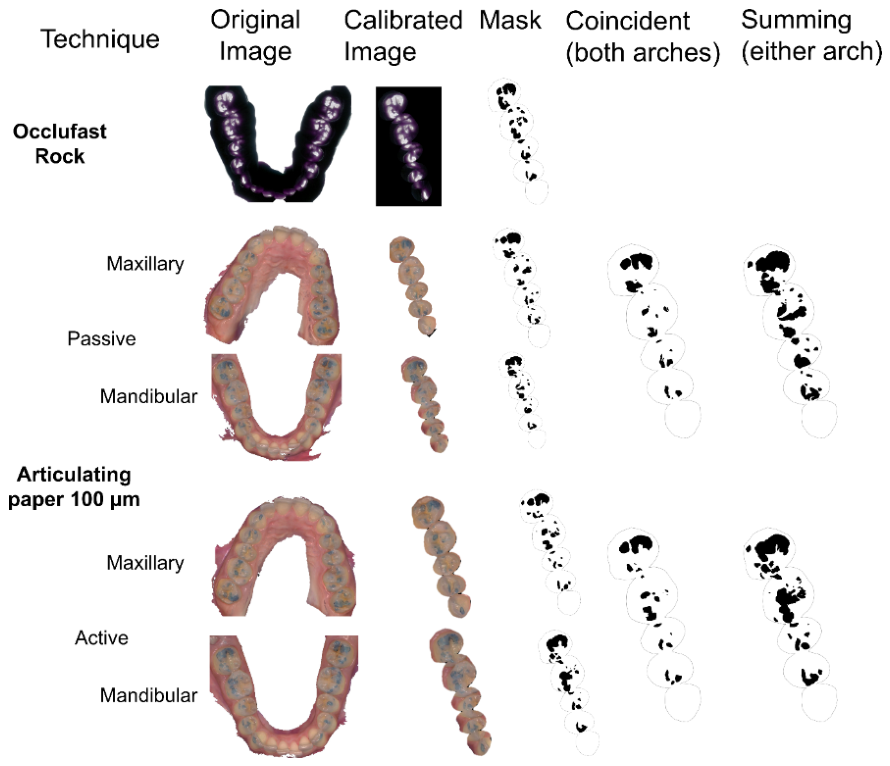
| Coinciding | 72.3% (68–77) | 2.0% (1–3) | |||||
| Sum | 88.5% (86–91) | 28.1% (23–33) | |||||
| Clinical technique | 0.76 | 0.34 | 0.76 | ||||
| Passive | 80.0% (76–84) | 14.6% (12–18) | 1.2 (1.0–1.4) | ||||
| Pulling | 82.0% (79–85) | 15.4% (12–19) | 1.2 (0.9–1.4) | ||||
| Overall mean | 81.0% (78–84) | 15.0% (12–18) | 1.2 (1.0–1.4) | ||||
Disclaimer/Publisher’s Note: The statements, opinions and data contained in all publications are solely those of the individual author(s) and contributor(s) and not of MDPI and/or the editor(s). MDPI and/or the editor(s) disclaim responsibility for any injury to people or property resulting from any ideas, methods, instructions or products referred to in the content. |
© 2026 by the authors. Licensee MDPI, Basel, Switzerland. This article is an open access article distributed under the terms and conditions of the Creative Commons Attribution (CC BY) license.
Share and Cite
Rovira-Lastra, B.; ElOtmani-Sabiri, S.; Ustrell-Barral, M.; Khoury-Ribas, L.; Martinez-Gomis, J. Clinical Strategies to Improve the Accuracy of Articulating Paper for Detecting Occlusal Contact Points in Adults with Natural Dentitions. Diagnostics 2026, 16, 1450. https://doi.org/10.3390/diagnostics16101450
Rovira-Lastra B, ElOtmani-Sabiri S, Ustrell-Barral M, Khoury-Ribas L, Martinez-Gomis J. Clinical Strategies to Improve the Accuracy of Articulating Paper for Detecting Occlusal Contact Points in Adults with Natural Dentitions. Diagnostics. 2026; 16(10):1450. https://doi.org/10.3390/diagnostics16101450
Chicago/Turabian StyleRovira-Lastra, Bernat, Sanaa ElOtmani-Sabiri, Mireia Ustrell-Barral, Laura Khoury-Ribas, and Jordi Martinez-Gomis. 2026. "Clinical Strategies to Improve the Accuracy of Articulating Paper for Detecting Occlusal Contact Points in Adults with Natural Dentitions" Diagnostics 16, no. 10: 1450. https://doi.org/10.3390/diagnostics16101450
APA StyleRovira-Lastra, B., ElOtmani-Sabiri, S., Ustrell-Barral, M., Khoury-Ribas, L., & Martinez-Gomis, J. (2026). Clinical Strategies to Improve the Accuracy of Articulating Paper for Detecting Occlusal Contact Points in Adults with Natural Dentitions. Diagnostics, 16(10), 1450. https://doi.org/10.3390/diagnostics16101450