Artificial Intelligence in Sports Medicine: A Decision-Centered Framework for the Future Sports Physician

 ,
,  ,
,  ,
,  , , , and
Abstract
1. Introduction
2. Methods
2.1. Study Design
2.2. Identification of the Research Question
- Injury risk assessment and prevention;
- Musculoskeletal diagnostic support;
- Rehabilitation monitoring;
- Return-to-play (RTP) decision-making;
- Performance and workload management;
- Clinical workflow and cognitive support.
2.3. Eligibility Criteria
- Injury risk prediction or prevention in athletes;
- AI-assisted musculoskeletal imaging or diagnostics;
- AI-based rehabilitation monitoring or movement analysis;
- AI-supported RTP assessment;
- Performance or workload monitoring systems;
- AI applications supporting clinical workflow or decision support.
2.4. Information Sources and Search Strategy
- “artificial intelligence”;
- “machine learning”;
- “deep learning”;
- “sports medicine”;
- “injury prediction”;
- “rehabilitation”;
- “return to play”;
- “wearables”;
- “digital health”.
2.5. Study Selection and Data Synthesis
3. Transformation Areas in Sports Medicine
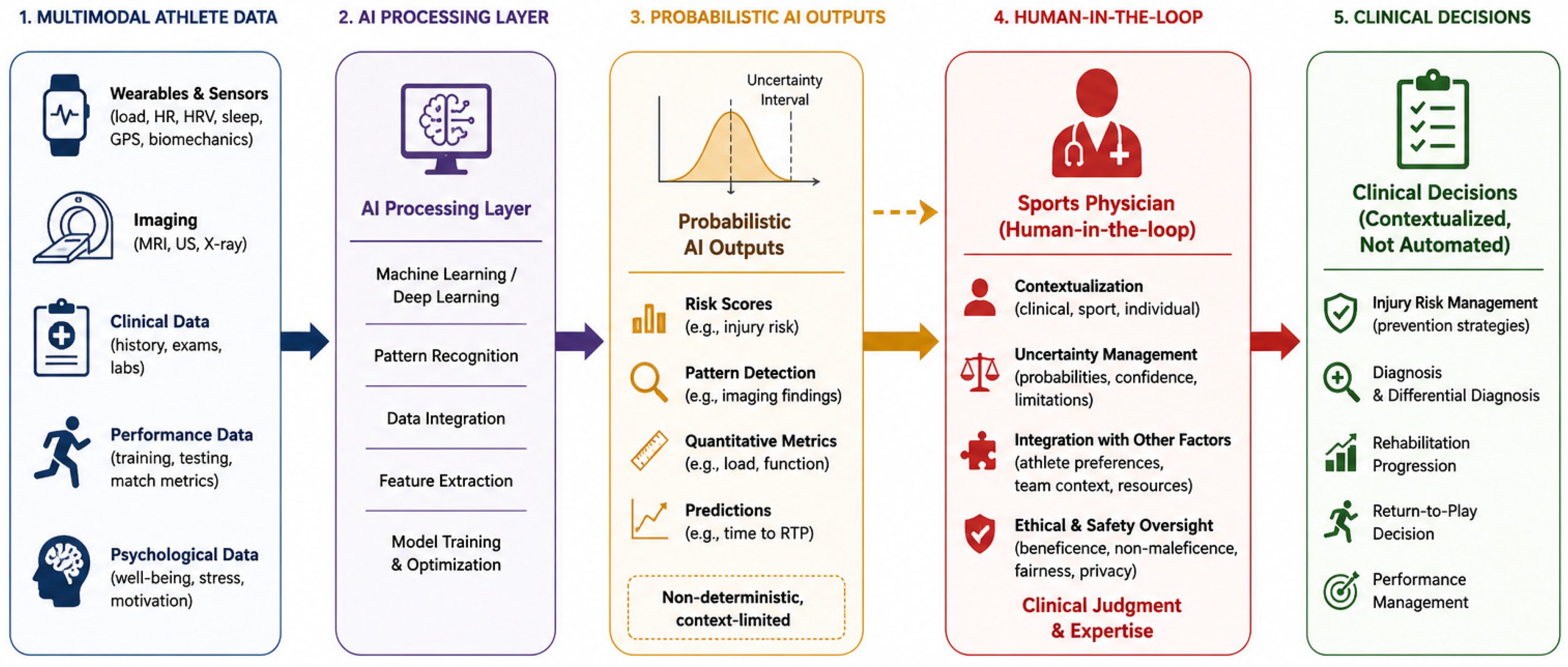
- Which clinical decision is being augmented?
- What does AI add compared with traditional practice?
- Which limitations or risks emerge from AI integration?
- Why does physician oversight remain essential?
3.1. Risk Stratification and Injury Prevention
3.2. Diagnostic Augmentation in Musculoskeletal Imaging

| Study | Clinical Task | Imaging Modality | AI Approach | Main Performance |Metric(s)/Main Finding | Validation Setting | Methodological Considerations/ Limitations | Level of Evidence (Interpretative) * | Relevance to Sports Medicine |
|---|---|---|---|---|---|---|---|---|
| Duron et al., 2021 [46] | Detection/localization of appendicular fractures | Radiography | Commercial DL-based fracture detection aid | AI assistance increased reader sensitivity by 8.7% and specificity by 4.1%, without loss of reading speed | Multicenter cross-sectional reader study | Acute trauma setting; not athlete-specific; evaluates reader augmentation rather than autonomous deployment | ●●● | Relevant for same-day sport trauma triage, especially missed fractures |
| Guermazi et al., 2022 [47] | Fracture recognition across multiple skeletal regions | Radiography | DL-based detection support | AI improved fracture detection sensitivity across most regions and did not lengthen reading time; patient-level gain significant in most anatomical regions | Multireader validation study | Performance depends on body region and case mix; trauma workflow rather than longitudinal athlete follow-up | ●●● | Strong relevance for sideline-to-imaging acute injury pathways |
| Jacques et al., 2024 [48] | Wrist/hand fracture detection using CT-based ground truth | Radiography | Commercial AI algorithm | AI improved radiologists’ sensitivity for wrist/hand fractures versus standard reading, with a CT reference standard | Comparative reader study | Focused anatomical task; may not generalize to other injury types or athlete-adapted bone morphology | ●●○ | High relevance in athletes with subtle carpal/metacarpal trauma |
| Liu et al., 2019 [51] | Complete ACL tear detection | Knee MRI | Deep CNN pipeline | Reported AUC ~0.98 with sensitivity ~0.96 and specificity ~0.96 in internal testing | Retrospective, internally validated dataset | Highly task-specific; likely optimized imaging protocol; limited evidence on external generalizability and partial tears | ●○○ | Relevant to sport knee injury diagnosis, but not sufficient alone for RTP decisions |
| Astuto et al., 2021 [52] | Detection and grading of cartilage, bone marrow, meniscal, and ACL abnormalities | Knee MRI | 3D deep learning | High sensitivity/specificity/accuracy reported for lesion-severity scoring; DL assistance also improved interreader agreement | Retrospective study using 1435 MRI exams derived from prior datasets | Knee-focused; reader-assistance paradigm; limited sport-specific validation; broad lesion label quality may influence outputs | ●●○ | Relevant for the structured interpretation of complex post-traumatic knee MRI |
| Thomas et al., 2020 [53] | Automated staging of radiographic knee osteoarthritis severity | Radiography | Deep neural network | Performance comparable to fellowship-trained musculoskeletal radiologists for KL severity staging | Large retrospective dataset (Osteoarthritis Initiative) | Degenerative rather than athletic population; indirect sports relevance; classification task may not map cleanly to symptoms/function | ●●○ | More relevant to long-term joint health than acute athlete imaging |
| Hahn et al., 2022 [54] | Accelerated shoulder MRI with preserved diagnostic quality | Shoulder MRI | Deep learning–based image reconstruction (DLR) | 67% scan-time reduction with similar subjective image quality, artifacts, and diagnostic performance compared with standard sequences | Comparative diagnostic study | Reconstruction study, not a lesion-detection model; focuses on efficiency and image quality rather than outcome prediction | ●●● | Highly relevant for improving workflow in the shoulder imaging of athletes |
| Wu et al., 2025 [55] | Torn vs intact rotator cuff tendon detection | Ultrasound | YOLOv7-CBAM attentional DL model | Reported high diagnostic accuracy and improved interobserver reliability for ultrasound-based rotator cuff tear detection | Single-center diagnostic dataset with MRI comparison | Early evidence; operator dependence and acquisition variability remain major barriers; no clear external validation | ●○○ | Relevant because the US is widely used in team and outpatient sports medicine |
| Scott et al., 2024 [56] | Automated tendon segmentation to quantify structural change in tendinopathy | Ultrasound | Texture-based segmentation using GLCM + hidden Gaussian Markov random fields | Demonstrated feasibility of automated tendon segmentation for quantitative tendon assessment | Development/feasibility study | Quantification-focused, not full clinical diagnosis; external clinical validation lacking | ●○○ | Potentially useful for longitudinal monitoring of tendinopathy in athletes |
3.3. Rehabilitation and Functional Recovery
3.4. Return-to-Play Decision-Making
| Study | Clinical Context | Data Sources | AI/Data-Driven Approach | Main Performance Metric(s)/Main Finding | Validation Setting | Level of Evidence (Interpretative) * | Limitations | Relevance to RTP |
|---|---|---|---|---|---|---|---|---|
| Jauhiainen et al., 2022 [36] | ACL injury risk (elite female athletes) | Screening test battery (strength, biomechanics) | ML (multiple models) | AUC values up to ~0.79 for ACL injury prediction, depending on model configuration; moderate discrimination in identifying athletes at increased injury risk. | Prospective cohort | ●●● | Focus on injury prediction, not RTP; no direct readiness outcome | Indirect relevance: informs RTP risk stratification |
| Karnuta et al., 2020 [35] | Injury prediction (MLB players) | Performance + injury history | ML vs regression | Machine learning models outperformed traditional regression approaches in predicting next-season injury risk, with improved predictive accuracy across large-scale retrospective data. | Large retrospective dataset | ●●○ | Not RTP-specific; population = baseball players | Relevant for post-RTP risk estimation |
| Desai, 2024 [10] | AI in RTP decision-making | Multimodal (wearables, biomechanics, context) | Narrative synthesis of AI approaches | No original performance metrics; narrative synthesis highlighting the potential of AI to support RTP decision-making through multimodal data integration. | Narrative review | ●○○ | No performance metrics; heterogeneous evidence | Framework-level relevance |
| Leckey et al., 2024 [15] | Injury risk modeling | Load, physiological, and contextual variables | ML (review) | No pooled performance metric; included studies showed highly variable model performance, with limited external validation and inconsistent methodological quality. | Systematic/scoping review | ●○○ | Not RTP-specific; heterogeneity of methods | Supports probabilistic risk framing in RTP decisions |
4. Artificial Intelligence-Enabled Sports Medicine Devices
- Prospective clinical study = highest level in this context;
- Multicenter validation = moderate;
- Retrospective validation = limited;
- Limited/unclear validation = weak evidence.
5. Ethical, Professional, and Organizational Implications of AI in Sports Medicine
6. The Future Sports Physician: Skills and Roles
7. Conclusions
Author Contributions
Funding
Institutional Review Board Statement
Informed Consent Statement
Data Availability Statement
Conflicts of Interest
References
- Palermi, S.; Vecchiato, M.; Saglietto, A.; Niederseer, D.; Oxborough, D.; Ortega-Martorell, S.; Olier, I.; Castelletti, S.; Baggish, A.; Maffessanti, F.; et al. Unlocking the potential of artificial intelligence in sports cardiology: Does it have a role in evaluating athlete’s heart? Eur. J. Prev. Cardiol. 2024, 31, 470–482. [Google Scholar] [CrossRef]
- Palermi, S.; Vecchiato, M.; Ng, F.S.; Attia, Z.; Cho, Y.; Anselmino, M.; De Ferrari, G.M.; Saglietto, A.; Sau, A.; Chiu, I.-M.; et al. Artificial intelligence and the electrocardiogram: A modern renaissance. Eur. J. Intern. Med. 2025, 140, 106329. [Google Scholar] [CrossRef]
- Khosravi, M.; Zare, Z.; Mojtabaeian, S.M.; Izadi, R. Artificial Intelligence and Decision-Making in Healthcare: A Thematic Analysis of a Systematic Review of Reviews. Health Serv. Res. Manag. Epidemiol. 2024, 11, 23333928241234864. [Google Scholar] [CrossRef]
- Guelmami, N.; Fekih-Romdhane, F.; Mechraoui, O.; Bragazzi, N.L. Injury Prevention, Optimized Training and Rehabilitation: How Is AI Reshaping the Field of Sports Medicine. New Asian J. Med. 2023, 1, 30–34. [Google Scholar] [CrossRef]
- Cheng, K.; Guo, Q.; He, Y.; Lu, Y.; Xie, R.; Li, C.; Wu, H. Artificial Intelligence in Sports Medicine: Could GPT-4 Make Human Doctors Obsolete? Ann. Biomed. Eng. 2023, 51, 1658–1662. [Google Scholar] [CrossRef] [PubMed]
- Ramkumar, P.N.; Luu, B.C.; Haeberle, H.S.; Karnuta, J.M.; Nwachukwu, B.U.; Williams, R.J. Sports Medicine and Artificial Intelligence: A Primer. Am. J. Sports Med. 2022, 50, 1166–1174. [Google Scholar] [CrossRef] [PubMed]
- Claudino, J.G.; de Oliveira Capanema, D.; de Souza, T.V.; Serrão, J.C.; Pereira, A.C.M.; Nassis, G.P. Current Approaches to the Use of Artificial Intelligence for Injury Risk Assessment and Performance Prediction in Team Sports: A Systematic Review. Sports Med. Open 2019, 5, 28. [Google Scholar] [CrossRef]
- Herring, S.A.; Putukian, M.; LeClere, L.E.; Bennett, C.; Boyajian-O’nEill, L.; Carter, D.; Chang, C.J.; Day, C.; Day, M.A.; Economopoulos, K.; et al. The Team Physician Consensus Statement 2024 Update. Curr. Sports Med. Rep. 2025, 24, 116–125. [Google Scholar] [CrossRef] [PubMed]
- Naik, N.; Hameed, B.M.Z.; Shetty, D.K.; Swain, D.; Shah, M.; Paul, R.; Aggarwal, K.; Ibrahim, S.; Patil, V.; Smriti, K.; et al. Legal and Ethical Consideration in Artificial Intelligence in Healthcare: Who Takes Responsibility? Front. Surg. 2022, 9, 862322. [Google Scholar] [CrossRef]
- Desai, V. The Future of Artificial Intelligence in Sports Medicine and Return to Play. Semin. Musculoskelet. Radiol. 2024, 28, 203–212. [Google Scholar] [CrossRef]
- Musat, C.L.; Mereuta, C.; Nechita, A.; Tutunaru, D.; Voipan, A.E.; Voipan, D.; Mereuta, E.; Gurau, T.V.; Gurău, G.; Nechita, L.C. Diagnostic Applications of AI in Sports: A Comprehensive Review of Injury Risk Prediction Methods. Diagnostics 2024, 14, 2516. [Google Scholar] [CrossRef] [PubMed]
- Mishra, N.; Habal, B.G.M.; Garcia, P.S.; Garcia, M.B. Harnessing an AI-Driven Analytics Model to Optimize Training and Treatment in Physical Education for Sports Injury Prevention. In Proceedings of the 2024 8th International Conference on Education and Multimedia Technology, Tokyo, Japan, 22–24 June 2024; pp. 309–315. [Google Scholar] [CrossRef]
- Palermi, S.; Vittadini, F.; Pedret, C.; Vecchiato, M.; Della Villa, F.; Corsini, A.; Jokela, A.; Lempainen, L. From the Field to the Screen: A Scoping Review of Video Analysis as a Tool for Understanding Thigh Muscle-Tendon Injuries in Football. Clin. J. Sport Med. 2025, 35, 675–686. [Google Scholar] [CrossRef]
- Palermi, S.; Annarumma, G.; Spinelli, A.; Massa, B.; Serio, A.; Vecchiato, M.; Demeco, A.; Brugin, E.; Sirico, F.; Giada, F.; et al. Acceptability and Practicality of a Quick Musculoskeletal Examination into Sports Medicine Pre-Participation Evaluation. Pediatr. Rep. 2022, 14, 207–216. [Google Scholar] [CrossRef] [PubMed]
- Leckey, C.; van Dyk, N.; Doherty, C.; Lawlor, A.; Delahunt, E. Machine learning approaches to injury risk prediction in sport: A scoping review with evidence synthesis. Br. J. Sports Med. 2024, 59, 491–500. [Google Scholar] [CrossRef]
- Amendolara, A.; Pfister, D.; Settelmayer, M.; Shah, M.; Wu, V.; Donnelly, S.; Johnston, B.; Peterson, R.; Sant, D.; Kriak, J.; et al. An Overview of Machine Learning Applications in Sports Injury Prediction. Cureus 2023, 15, e46170. [Google Scholar] [CrossRef]
- Bhatia, V. Exploring Machine Learning Applications in Sports Injury Prediction Analysis. Int. J. Res. Appl. Sci. Eng. Technol. 2024, 12, 1300–1307. [Google Scholar] [CrossRef]
- Freitas, D.N.; Mostafa, S.S.; Caldeira, R.; Santos, F.; Fermé, E.; Gouveia, É.R.; Morgado-Dias, F. Predicting noncontact injuries of professional football players using machine learning. PLoS ONE 2025, 20, e0315481. [Google Scholar] [CrossRef]
- Naglah, A.; Khalifa, F.; Mahmoud, A.; Ghazal, M.; Jones, P.; Murray, T.; Elmaghraby, A.S.; El-Baz, A. Athlete-Customized Injury Prediction using Training Load Statistical Records and Machine Learning. In Proceedings of the 2018 IEEE International Symposium on Signal Processing and Information Technology, ISSPIT 2018, Louisville, KY, USA, 6–8 December 2018; pp. 459–464. [Google Scholar] [CrossRef]
- Nobari, H. Takes Two to Tango: Digital Twins and AI Revolutionize Sports Science and Medicine. Acta Kinesiol. 2024, 18, 56–57. [Google Scholar] [CrossRef]
- Dos’Santos, T.; Thomas, C.; McBurnie, A.; Comfort, P.; Jones, P.A. Biomechanical Determinants of Performance and Injury Risk During Cutting: A Performance-Injury Conflict? Sports Med. 2021, 51, 1983–1998. [Google Scholar] [CrossRef]
- Li, N.; Hu, W.; Ma, Y.; Xiang, H. Machine learning prediction of pulmonary oxygen uptake from muscle oxygen in cycling. J. Sports Sci. 2024, 42, 1299–1307. [Google Scholar] [CrossRef] [PubMed]
- Hedge, E.T.; Amelard, R.; Hughson, R.L. Prediction of oxygen uptake kinetics during heavy-intensity cycling exercise by machine learning analysis. J. Appl. Physiol. 2023, 134, 1530–1536. [Google Scholar] [CrossRef]
- Tomaszewski, M.; Lukanova-Jakubowska, A.; Majorczyk, E.; Dzierżanowski, Ł. From data to decision: Machine learning determination of aerobic and anaerobic thresholds in athletes. PLoS ONE 2024, 19, e0309427. [Google Scholar] [CrossRef]
- Huang, S.C.; Lee, C.H.; Hsu, C.C.; Chang, S.Y.; Chen, Y.A.; Chiu, C.H.; Hsiao, C.C.; Su, H.R. Prediction for blood lactate during exercise using an artificial intelligence—Enabled electrocardiogram: A feasibility study. Front. Physiol. 2023, 14, 1253598. [Google Scholar] [CrossRef]
- Rothschild, J.A.; Stewart, T.; Kilding, A.E.; Plews, D.J. Predicting daily recovery during long-term endurance training using machine learning analysis. Eur. J. Appl. Physiol. 2024, 124, 3279–3290. [Google Scholar] [CrossRef] [PubMed]
- Santhosh, P.K.; Kaarthick, B. Fatigue and stamina prediction of athletic person on track using thermal facial biomarkers and optimized machine learning algorithm. Sci. Rep. 2025, 15, 25974. [Google Scholar] [CrossRef] [PubMed]
- Qian, H.; Lee, S. A multidimensional prediction model for overtraining risk in youth soccer players: Integrating physiological and psychological markers. J. Sports Sci. 2025, 43, 1819–1834. [Google Scholar] [CrossRef]
- Jianjun, Q.; Isleem, H.F.; Almoghayer, W.J.K.; Khishe, M. Predictive athlete performance modeling with machine learning and biometric data integration. Sci. Rep. 2025, 15, 16365. [Google Scholar] [CrossRef]
- Alfonso, C.; Clarke, D.C.; Capdevila, L. Individual training prescribed by heart rate variability, heart rate and well-being scores in experienced cyclists. Sci. Rep. 2025, 15, 34023. [Google Scholar] [CrossRef]
- Biró, A.; Cuesta-Vargas, A.I.; Szilágyi, L. AI-Assisted Fatigue and Stamina Control for Performance Sports on IMU-Generated Multivariate Times Series Datasets. Sensors 2024, 24, 132. [Google Scholar] [CrossRef] [PubMed]
- Shringarpure, A.; Shetty, R.; Surve, A.; Vidhate, A. Sports Injury Prediction System using Random Forest Classifier. ITM Web Conf. 2022, 44, 03068. [Google Scholar] [CrossRef]
- Van Eetvelde, H.; Mendonça, L.D.; Ley, C.; Seil, R.; Tischer, T. Machine learning methods in sport injury prediction and prevention: A systematic review. J. Exp. Orthop. 2021, 8, 27. [Google Scholar] [CrossRef] [PubMed]
- Ayala, F.; López-Valenciano, A.; Gámez Martín, J.A.; Croix, M.D.S.; Vera-Garcia, F.J.; García-Vaquero, M.D.P.; Ruiz-Pérez, I.; Myer, G.D. A Preventive Model for Hamstring Injuries in Professional Soccer: Learning Algorithms. Int. J. Sports Med. 2019, 40, 344–353. [Google Scholar] [CrossRef]
- Karnuta, J.M.; Luu, B.C.; Haeberle, H.S.; Saluan, P.M.; Frangiamore, S.J.; Stearns, K.L.; Farrow, L.D.; Nwachukwu, B.U.; Verma, N.N.; Makhni, E.C.; et al. Machine Learning Outperforms Regression Analysis to Predict Next-Season Major League Baseball Player Injuries: Epidemiology and Validation of 13,982 Player-Years From Performance and Injury Profile Trends, 2000–2017. Orthop. J. Sports Med. 2020, 8, 2325967120963046. [Google Scholar] [CrossRef]
- Jauhiainen, S.; Kauppi, J.P.; Krosshaug, T.; Bahr, R.; Bartsch, J.; Äyrämö, S. Predicting ACL Injury Using Machine Learning on Data From an Extensive Screening Test Battery of 880 Female Elite Athletes. Am. J. Sports Med. 2022, 50, 2917–2924. [Google Scholar] [CrossRef]
- Huhn, S.; Axt, M.; Gunga, H.C.; Maggioni, M.A.; Munga, S.; Obor, D.; Sié, A.; Boudo, V.; Bunker, A.; Sauerborn, R.; et al. The Impact of Wearable Technologies in Health Research: Scoping Review. JMIR Mhealth Uhealth 2022, 10, e34384. [Google Scholar] [CrossRef]
- Quistberg, D.A. Potential of artificial intelligence in injury prevention research and practice. Inj. Prev. 2024, 30, 89. [Google Scholar] [CrossRef] [PubMed]
- Melo, M.; Maia, M.; Padrão, G.; Brandão, D.; Bezerra, E.; Spineti, J.; Giusti, L.; Soares, J. Data-Centric AI for predicting non-contact injuries in professional soccer players. In Simpósio Brasileiro de Banco de Dados (SBBD); SBC: Porto Alegre, Brazil, 2024; Volume 39, pp. 167–180. [Google Scholar] [CrossRef]
- Palermi, S.; Scavone, A.; Anzà, M.; Gregorace, E.; Vecchiato, M.; Bordalo, M.; Forster, B.B.; Jacobson, J.A.; Myers, C.; Iriarte, I.; et al. Diagnostic ultrasound of muscle injuries: What the sports medicine clinician should know. Br. J. Sports Med. 2025, 59, bjsports-2025-110255. [Google Scholar] [CrossRef]
- Gitto, S.; Serpi, F.; Albano, D.; Risoleo, G.; Fusco, S.; Messina, C.; Sconfienza, L.M. AI applications in musculoskeletal imaging: A narrative review. Eur. Radiol. Exp. 2024, 8, 22. [Google Scholar] [CrossRef]
- Guermazi, A.; Omoumi, P.; Tordjman, M.; Fritz, J.; Kijowski, R.; Regnard, N.-E.; Carrino, J.; Kahn, C.E.; Knoll, F.; Rueckert, D.; et al. How AI May Transform Musculoskeletal Imaging. Radiology 2024, 310, e230764. [Google Scholar] [CrossRef] [PubMed]
- Xue, D.; Xu, H.L.; Wang, W. Progress on artificial intelligence assisted X-ray film recognition in orthopedics. Zhongguo Gu Shang = China J. Orthop. Traumatol. 2020, 33, 887–890. [Google Scholar] [CrossRef]
- Oettl, F.C.; Zsidai, B.; Oeding, J.F.; Hirschmann, M.T.; Feldt, R.; Fendrich, D.; Kraeutler, M.J.; Winkler, P.W.; Szaro, P.; Samuelsson, K.; et al. Artificial intelligence-assisted analysis of musculoskeletal imaging—A narrative review of the current state of machine learning models. Knee Surg. Sports Traumatol. Arthrosc. 2025, 33, 3032. [Google Scholar] [CrossRef]
- Vahdani, A.M.; Shariatnia, M.; Rajpurkar, P.; Pareek, A. Towards trustworthy artificial intelligence in musculoskeletal medicine: A narrative review on uncertainty quantification. Knee Surg. Sports Traumatol. Arthrosc. 2025, 33, 3418–3437. [Google Scholar] [CrossRef]
- Duron, L.; Ducarouge, A.; Gillibert, A.; Lainé, J.; Allouche, C.; Cherel, N.; Zhang, Z.; Nitche, N.; Lacave, E.; Pourchot, A.; et al. Assessment of an AI Aid in Detection of Adult Appendicular Skeletal Fractures by Emergency Physicians and Radiologists: A Multicenter Cross-sectional Diagnostic Study. Radiology 2021, 300, 120–129. [Google Scholar] [CrossRef] [PubMed]
- Guermazi, A.; Tannoury, C.; Kompel, A.J.; Murakami, A.M.; Ducarouge, A.; Gillibert, A.; Li, X.; Tournier, A.; Lahoud, Y.; Jarraya, M.; et al. Improving Radiographic Fracture Recognition Performance and Efficiency Using Artificial Intelligence. Radiology 2022, 302, 627–636. [Google Scholar] [CrossRef]
- Jacques, T.; Cardot, N.; Ventre, J.; Demondion, X.; Cotten, A. Commercially-available AI algorithm improves radiologists’ sensitivity for wrist and hand fracture detection on X-ray, compared to a CT-based ground truth. Eur. Radiol. 2024, 34, 2885–2894. [Google Scholar] [CrossRef] [PubMed]
- Debs, P.; Fayad, L.M. The promise and limitations of artificial intelligence in musculoskeletal imaging. Front. Radiol. 2023, 3, 1242902. [Google Scholar] [CrossRef]
- Aspetar Sports Medicine Journal—The Present and Future of Ai in Musculoskeletal Sports Imaging. Available online: https://journal.aspetar.com/en/journals/volume-14-targeted-topic-imaging-in-sports-medicine (accessed on 3 July 2025).
- Liu, F.; Guan, B.; Zhou, Z.; Samsonov, A.; Rosas, H.; Lian, K.; Sharma, R.; Kanarek, A.; Kim, J.; Guermazi, A.; et al. Fully Automated Diagnosis of Anterior Cruciate Ligament Tears on Knee MR Images by Using Deep Learning. Radiol. Artif. Intell. 2019, 1, 180091. [Google Scholar] [CrossRef]
- Astuto, B.; Flament, I.; Namiri, N.K.; Shah, R.; Bharadwaj, U.; Link, T.M.; Bucknor, M.D.; Pedoia, V.; Majumdar, S. Automatic Deep Learning-assisted Detection and Grading of Abnormalities in Knee MRI Studies. Radiol. Artif. Intell. 2021, 3, e200165. [Google Scholar] [CrossRef]
- Thomas, K.A.; Kidziński, Ł.; Halilaj, E.; Fleming, S.L.; Venkataraman, G.R.; Oei, E.H.G.; Gold, G.E.; Delp, S.L. Automated Classification of Radiographic Knee Osteoarthritis Severity Using Deep Neural Networks. Radiol. Artif. Intell. 2020, 2, e190065. [Google Scholar] [CrossRef] [PubMed]
- Hahn, S.; Yi, J.; Lee, H.J.; Lee, Y.; Lim, Y.J.; Bang, J.Y.; Kim, H.; Lee, J. Image Quality and Diagnostic Performance of Accelerated Shoulder MRI with Deep Learning-Based Reconstruction. AJR Am. J. Roentgenol. 2022, 218, 506–516. [Google Scholar] [CrossRef]
- Wu, K.T.; Chen, P.C.; Chou, W.Y.; Chang, C.; Lien, J.J. Diagnostic Accuracy and Interobserver Reliability of Rotator Cuff Tear Detection with Ultrasonography Are Improved with Attentional Deep Learning. Arthroscopy 2025, 41, 2708–2716. [Google Scholar] [CrossRef]
- Scott, I.; Connell, D.; Moulton, D.; Waters, S.; Namburete, A.; Arnab, A.; Malliaras, P. An automated method for tendon image segmentation on ultrasound using grey-level co-occurrence matrix features and hidden Gaussian Markov random fields. Comput. Biol. Med. 2024, 169, 107872. [Google Scholar] [CrossRef]
- Palermi, S.; Massa, B.; Vecchiato, M.; Mazza, F.; De Blasiis, P.; Romano, A.M.; Di Salvatore, M.G.; Della Valle, E.; Tarantino, D.; Ruosi, C.; et al. Indirect Structural Muscle Injuries of Lower Limb: Rehabilitation and Therapeutic Exercise. J. Funct. Morphol. Kinesiol. 2021, 6, 75. [Google Scholar] [CrossRef]
- Gnasso, R.; Palermi, S.; Picone, A.; Tarantino, D.; Fusco, G.; Messina, M.M.; Sirico, F. Robotic-Assisted Rehabilitation for Post-Stroke Shoulder Pain: A Systematic Review. Sensors 2023, 23, 8239. [Google Scholar] [CrossRef]
- Botta, R.M.; Palermi, S.; Tarantino, D. High-intensity interval training for chronic pain conditions: A narrative review. J. Exerc. Rehabil. 2022, 18, 10–19. [Google Scholar] [CrossRef]
- Palermi, S.; Vittadini, F.; Pasta, G.; Zappia, M.; Corsini, A.; Pedret, C.; Vergani, L.; Leo, I.; Nanni, G.; Vecchiato, M.; et al. The challenge of thigh tendon reinjuries: An expert opinion. J. Basic Clin. Physiol. Pharmacol. 2024, 35, 335–345. [Google Scholar] [CrossRef] [PubMed]
- Palermi, S.; Vittadini, F.; Vecchiato, M.; Corsini, A.; Demeco, A.; Massa, B.; Pedret, C.; Dorigo, A.; Gallo, M.; Pasta, G.; et al. Managing Lower Limb Muscle Reinjuries in Athletes: From Risk Factors to Return-to-Play Strategies. J. Funct. Morphol. Kinesiol. 2023, 8, 155. [Google Scholar] [CrossRef] [PubMed]
- Braun, B.J.; Histing, T.; Menger, M.M.; Herath, S.C.; Mueller-Franzes, G.A.; Grimm, B.; Marmor, M.T.; Truhn, D. Wearable activity data can predict functional recovery after musculoskeletal injury: Feasibility of a machine learning approach. Injury 2024, 55, 111254. [Google Scholar] [CrossRef] [PubMed]
- Abasi, A.; Nazari, A.; Moezy, A.; Aghda, S.A.F. Machine learning models for reinjury risk prediction using cardiopulmonary exercise testing (CPET) data: Optimizing athlete recovery. BioData Min. 2025, 18, 16. [Google Scholar] [CrossRef]
- Dhanke, J.A.; Maurya, R.K.; Navaneethan, S.; Mavaluru, D.; Nuhmani, S.; Mishra, N.; Venugopal, E. Recurrent Neural Model to Analyze the Effect of Physical Training and Treatment in Relation to Sports Injuries. Comput. Intell. Neurosci. 2022, 2022, 1359714. [Google Scholar] [CrossRef]
- Seçkin, A.Ç.; Ateş, B.; Seçkin, M. Review on Wearable Technology in Sports: Concepts, Challenges and Opportunities. Appl. Sci. 2023, 13, 10399. [Google Scholar] [CrossRef]
- Jokela, A.; Valle, X.; Kosola, J.; Rodas, G.; Til, L.; Burova, M.F.; Pleshkov, P.; Andersson, H.A.; Pasta, G.; Manetti, P.; et al. Mechanisms of Hamstring Injury in Professional Soccer Players: Video Analysis and Magnetic Resonance Imaging Findings. Clin. J. Sport. Med. 2023, 33, 217–224. [Google Scholar] [CrossRef]
- Ayas, A.Y.; Aydin, H.; Çetinkaya, A.; Güney, Z. Artificial Intelligence (AI)-Based Self-Deciding Character Development Application in Two-Dimensional Video Games. Bilgi. İlet. Teknol. Derg. 2023, 5, 1–19. [Google Scholar] [CrossRef]
- Matijevich, E.S.; Scott, L.R.; Volgyesi, P.; Derry, K.H.; Zelik, K.E. Combining wearable sensor signals, machine learning and biomechanics to estimate tibial bone force and damage during running. Hum. Mov. Sci. 2020, 74, 102690. [Google Scholar] [CrossRef]
- Toelle, T.R.; Utpadel-Fischler, D.A.; Haas, K.K.; Priebe, J.A. App-based multidisciplinary back pain treatment versus combined physiotherapy plus online education: A randomized controlled trial. npj Digit. Med. 2019, 2, 34. [Google Scholar] [CrossRef] [PubMed]
- Lal, H.; Mohanta, S.; Kumar, J.; Patralekh, M.K.; Lall, L.; Katariya, H.; Arya, R.K. Telemedicine-Rehabilitation and Virtual Reality in Orthopaedics and Sports Medicine. Indian. J. Orthop. 2023, 57, 7–19. [Google Scholar] [CrossRef]
- Aniket; Verma, I.; Gupta, I.; Midha, D.; Armugam, N.; Aniket, A. The Use of AI and Machine Learning in Injury Risk Predictions and Analyzing Movements—A Narrative Review. Int. J. Nov. Res. Dev. 2025, 10, e297–e301. [Google Scholar] [CrossRef]
- Menta, R.; D’Angelo, K. Challenges surrounding return-to-play (RTP) for the sports clinician: A case highlighting the need for a thorough three-step RTP model. J. Can. Chiropr. Assoc. 2016, 60, 311–321. Available online: https://pmc.ncbi.nlm.nih.gov/articles/PMC5178014/ (accessed on 5 August 2025). [PubMed]
- Palermi, S.; Brugin, E.; Schiavon, M.; Di Franco, F.T.; Sartori, P.; Baioccato, V.; Vecchiato, M. Sport-related pneumomediastinum in a synchronized swimmer: From diagnosis to return to play. Physician Sportsmed. 2025, 53, 185–188. [Google Scholar] [CrossRef]
- Hamdaoui, T.; Ghennam, N.; Bouchouareb, R.; Ghouili, H. Exploring the Integration and Implications of Artificial Intelligence Chatbots in the Realm of Sports Science Research, Training, and Rehabilitation. Tunis. J. Sports Sci. Med. 2024, 2, 6–16. [Google Scholar] [CrossRef]
- Reis, F.J.J.; Alaiti, R.K.; Vallio, C.S.; Hespanhol, L. Artificial intelligence and Machine Learning approaches in sports: Concepts, applications, challenges, and future perspectives. Braz. J. Phys. Ther. 2024, 28, 101083. [Google Scholar] [CrossRef]
- Schulc, A.; Leite, C.B.G.; Csákvári, M.; Lattermann, L.; Zgoda, M.F.; Farina, E.M.; Lattermann, C.; Tősér, Z.; Merkely, G. Identifying Anterior Cruciate Ligament Injuries Through Automated Video Analysis of In-Game Motion Patterns. Orthop. J. Sports Med. 2024, 12, 23259671231221580. [Google Scholar] [CrossRef]
- Yang, Y.; Zhang, Q.; Li, C.; Marta, D.S.; Batool, N.; Folkesson, J. Human-Centric Autonomous Systems with LLMs for User Command Reasoning. In Proceedings of the 2024 IEEE Winter Conference on Applications of Computer Vision Workshops, WACVW 2024, Waikoloa, HI, USA, 4–8 January 2024; pp. 988–994. Available online: https://arxiv.org/abs/2311.08206 (accessed on 16 February 2026).
- Selvaraju, R.R.; Cogswell, M.; Das, A.; Vedantam, R.; Parikh, D.; Batra, D. Grad-CAM: Visual Explanations from Deep Networks via Gradient-Based Localization. In Proceedings of the IEEE International Conference on Computer Vision 2017, Venice, Italy, 22–29 October 2017; pp. 618–626. [Google Scholar] [CrossRef]
- Alaiti, R.K.; Vallio, C.S.; da Silva, A.G.M.; Gobbi, R.G.; Pécora, J.R.; Helito, C.P. Predicting ACL Reconstruction Failure with Machine Learning: Development of Machine Learning Prediction Models. Orthop. J. Sports Med. 2025, 13, 23259671251324519. [Google Scholar] [CrossRef] [PubMed]
- Zaborova, V.; Ivashkin, V.; Zolnikova, O.; Ivashkin, K.; Dzhakhaya, N.; Kurbatova, A.; Chebotareva, E.; Izyumina, T.; Avdeeva, T.; Zyuzin, D.; et al. Machine Learning in the Field of Sports Medicine and Rehabilitation Science. Power Syst. Technol. 2024, 48, 7409–7422. [Google Scholar] [CrossRef]
- Chen, T.; Xian, Y.; Chen, T. Relationship between training load and recovery rate in artificial intelligence-based sports rehabilitation training. Mol. Cell. Biomech. 2025, 22, 1419. [Google Scholar] [CrossRef]
- Anthamatten, A.; Holt, J.E. Integrating Artificial Intelligence Into Virtual Simulations to Develop Entrustable Professional Activities. J. Nurse Pract. 2024, 20, 105192. [Google Scholar] [CrossRef]
- Khan, R.A.; Jawaid, M.; Khan, A.R.; Sajjad, M. ChatGPT—Reshaping medical education and clinical management. Pak. J. Med. Sci. 2023, 39, 605. [Google Scholar] [CrossRef]
- Elhaddad, M.; Hamam, S. AI-Driven Clinical Decision Support Systems: An Ongoing Pursuit of Potential. Cureus 2024, 16, e57728. [Google Scholar] [CrossRef] [PubMed]
- Chen, Z.; Liang, N.; Zhang, H.; Li, H.; Yang, Y.; Zong, X.; Chen, Y.; Wang, Y.; Shi, N. Harnessing the power of clinical decision support systems: Challenges and opportunities. Open Heart 2023, 10, e002432. [Google Scholar] [CrossRef]
- Ahsan, M. Chatbot Generative Pre-trained Transformer and artificial intelligence in sports physical therapy and rehabilitation. Saudi J. Sports Med. 2023, 23, 61–62. [Google Scholar] [CrossRef]
- Mir, M.M.; Mir, G.M.; Raina, N.T.; Mir, S.M.; Mir, S.M.; Miskeen, E.; Alharthi, M.H.; Alamri, M.M.S. Application of Artificial Intelligence in Medical Education: Current Scenario and Future Perspectives. J. Adv. Med. Educ. Prof. 2023, 11, 133–140. [Google Scholar] [CrossRef]
- Baykaner, T.; Noseworthy, P.A.; Wan, E.Y. Implementing AI in clinical practice: Practical insights on integrating AI through digital dashboards and beyond. Heart Rhythm. 2024, 21, e259. [Google Scholar] [CrossRef]
- Ye, J.; Woods, D.; Jordan, N.; Starren, J. The role of artificial intelligence for the application of integrating electronic health records and patient-generated data in clinical decision support. AMIA Summits Transl. Sci. Proc. 2024, 2024, 459–467. Available online: https://pmc.ncbi.nlm.nih.gov/articles/PMC11141850/ (accessed on 5 August 2025).
- Radhwi, O.O.; Khafaji, M.A. The wizard of artificial intelligence: Are physicians prepared? J. Fam. Community Med. 2024, 31, 344–350. [Google Scholar] [CrossRef] [PubMed]
- Ting Sim, J.Z.; Fong, Q.W.; Huang, W.; Tan, C.H. Machine learning in medicine: What clinicians should know. Singap. Med. J. 2023, 64, 91–97. [Google Scholar] [CrossRef]
- Benjamens, S.; Dhunnoo, P.; Meskó, B. The state of artificial intelligence-based FDA-approved medical devices and algorithms: An online database. npj Digit. Med. 2020, 3, 118. [Google Scholar] [CrossRef] [PubMed]
- Joshi, G.; Jain, A.; Araveeti, S.R.; Adhikari, S.; Garg, H.; Bhandari, M. FDA-Approved Artificial Intelligence and Machine Learning (AI/ML)-Enabled Medical Devices: An Updated Landscape. Electronics 2024, 13, 498. [Google Scholar] [CrossRef]
- Cheng, X.; Lin, X.; Shen, X.L.; Zarifis, A.; Mou, J. The dark sides of AI. Electron. Mark. 2022, 32, 11. [Google Scholar] [CrossRef]
- Topol, E.J. High-performance medicine: The convergence of human and artificial intelligence. Nat. Med. 2019, 25, 44–56. [Google Scholar] [CrossRef] [PubMed]
- Noseworthy, P.A.; Attia, Z.I.; Brewer, L.P.C.; Hayes, S.N.; Yao, X.; Kapa, S.; Friedman, P.A.; Lopez-Jimenez, F. Assessing and Mitigating Bias in Medical Artificial Intelligence: The Effects of Race and Ethnicity on a Deep Learning Model for ECG Analysis. Circ. Arrhythm. Electrophysiol. 2020, 13, E007988. [Google Scholar] [CrossRef]
- Mennella, C.; Maniscalco, U.; De Pietro, G.; Esposito, M. Ethical and regulatory challenges of AI technologies in healthcare: A narrative review. Heliyon 2024, 10, e26297. [Google Scholar] [CrossRef] [PubMed]
- World Health Organization. Ethics and Governance of Artificial Intelligence for Health: WHO Guidance; World Health Organization: Geneva, Switzerland, 2021; pp. 1–148. Available online: https://iris.who.int/handle/10665/341996 (accessed on 28 January 2026).
- Murdoch, B. Privacy and artificial intelligence: Challenges for protecting health information in a new era. BMC Med. Ethics 2021, 22, 122. [Google Scholar] [CrossRef]


| Device/Platform | Clinical Domain | Primary Function | AI Technology | Regulatory Status | Relevance to Sports Medicine | Validation Level * |
|---|---|---|---|---|---|---|
| BoneView® (Gleamer) | MSK Radiography | Automated fracture detection on X-ray | CNN-based deep learning | FDA-cleared (510 [k]) | Reduces missed fractures and supports rapid diagnosis in acute trauma | Retrospective + external validation |
| TechCare Trauma (Milvue) | Trauma radiology | Detection and localization of fractures and elbow effusion on X-ray | Deep learning | FDA 510(k) cleared | Facilitates rapid triage of skeletal injuries across multiple anatomical regions | Retrospective validation |
| AZtrauma (AZmed/Nexus-MD) | Trauma Radiology | Automated detection of skeletal abnormalities | Deep learning | FDA-cleared (510 [k]) | Supports prioritization of imaging findings in acute injury settings | Limited published validation |
| OsteoDetect | MSK Radiography | Detection of distal radius fractures on wrist X-ray | Deep learning | FDA De Novo authorized | Supports the detection of subtle wrist fractures frequently seen in athletes | Prospective clinical study |
| Aidoc C-Spine | Spine CT | Automated cervical fracture detection | Deep learning | FDA 510(k) cleared | Assists in the rapid identification of cervical spine injuries in trauma | Multicenter validation |
| Avicenna.AI | Spine CT | Vertebral fracture detection | Deep learning | FDA 510(k) cleared | Improves detection of occult vertebral injuries | Retrospective + external validation |
| Clarius MSK AI | MSK Ultrasound | Automated identification and quantitative measurement of tendons and joints | ML-based segmentation | FDA-cleared (510 [k]) | Enhances reproducibility of MSK ultrasound examinations | Limited clinical validation |
| MuscleView™ 2.0 | MSK MRI | Automated muscle composition analysis | DL-based segmentation | FDA-cleared (510 [k]) | Enables quantitative monitoring of muscle asymmetry during rehabilitation | Limited published validation |
| SubtleMR | MRI Workflow | Image denoising and accelerated MRI reconstruction | Deep Learning | FDA 510(k) | Enhances efficiency of MRI acquisition in clinical workflows | Multicenter validation |
| ImageBiopsy Lab—LAMA/HIPPO/FROG | MSK Imaging | Automated skeletal measurements (spine, hip, lower limb) | DL-based measurement algorithms | FDA-cleared (510 [k]) | Supports objective longitudinal assessment of musculoskeletal structures | Limited validation |
| AIR Recon DL (GE HealthCare) | MRI workflow | AI-assisted MRI reconstruction and denoising | Deep learning reconstruction | FDA 510(k) cleared | Improves MRI acquisition speed and image quality | Multicenter validation |
| Notch Motion System | Motion Capture | Wearable IMU-based movement analysis | Sensor fusion + ML | FDA De Novo authorized | Provides objective movement metrics for rehabilitation and RTP monitoring | Early clinical validation |
| Zibrio SmartScale | Balance Assessment | Postural stability and fall-risk estimation | ML pattern recognition | FDA 510(k) cleared | Supports neuromotor and balance assessment | Limited validation |
| PeekMed Web | Orthopedic planning | AI-assisted surgical planning from imaging | AI-based image analysis | FDA 510(k) cleared | Supports orthopedic decision-making for hip, knee, and limb procedures | Limited clinical validation |
| Domain | What AI Enables | Key Physician Responsibility | Clinical Risk If Misapplied |
|---|---|---|---|
| AI literacy and critical appraisal | Access to predictive models, performance metrics (e.g., discrimination, calibration), and automated outputs | Critically evaluate model validity, recognize bias, interpret uncertainty, and avoid inappropriate reliance on algorithmic outputs | Misinterpretation of outputs, overreliance on AI (automation bias), and inappropriate clinical decisions |
| Integration of multimodal data | Aggregation of imaging, wearable data, biomechanical metrics, rehabilitation parameters, and athlete-reported outcomes | Synthesize heterogeneous data into coherent clinical interpretation and individualized management strategies | Fragmented decision-making, overemphasis on isolated metrics, loss of clinical coherence |
| Contextual clinical reasoning | Structured and quantitative insights into physiological and functional parameters | Integrate sport-specific and contextual factors (e.g., competition demands, psychological readiness, environmental stressors, career implications) not captured by AI systems | Decontextualized decisions, inappropriate RTP clearance, neglect of psychosocial factors |
| Ethical oversight and communication | Risk stratification outputs, probabilistic predictions, and data-driven recommendations | Ensure transparency, protect data privacy, communicate uncertainty, and support shared decision-making with athletes and stakeholders | Loss of athlete trust, misuse of data, and ethically inappropriate decisions in high-stakes contexts |
| Human–AI interaction and decision accountability | Continuous AI support across diagnostic and monitoring workflows | Validate and take responsibility for final decisions, integrating AI outputs with clinical judgment and real-world context | Diffusion of responsibility, medico-legal vulnerability, and uncritical acceptance of AI recommendations |
Disclaimer/Publisher’s Note: The statements, opinions and data contained in all publications are solely those of the individual author(s) and contributor(s) and not of MDPI and/or the editor(s). MDPI and/or the editor(s) disclaim responsibility for any injury to people or property resulting from any ideas, methods, instructions or products referred to in the content. |
© 2026 by the authors. Licensee MDPI, Basel, Switzerland. This article is an open access article distributed under the terms and conditions of the Creative Commons Attribution (CC BY) license.
Share and Cite
Palermi, S.; Pucciatti, R.; Regnard, N.-E.; Guermazi, A.; Araujo, F.; Demeco, A.; Mekki, Y.; D’Antona, G.; Guarnera, A.; Cerciello, S.; et al. Artificial Intelligence in Sports Medicine: A Decision-Centered Framework for the Future Sports Physician. Diagnostics 2026, 16, 1448. https://doi.org/10.3390/diagnostics16101448
Palermi S, Pucciatti R, Regnard N-E, Guermazi A, Araujo F, Demeco A, Mekki Y, D’Antona G, Guarnera A, Cerciello S, et al. Artificial Intelligence in Sports Medicine: A Decision-Centered Framework for the Future Sports Physician. Diagnostics. 2026; 16(10):1448. https://doi.org/10.3390/diagnostics16101448
Chicago/Turabian StylePalermi, Stefano, Rita Pucciatti, Nor-Eddine Regnard, Ali Guermazi, Fabiano Araujo, Andrea Demeco, Yosra Mekki, Giuseppe D’Antona, Alessia Guarnera, Simone Cerciello, and et al. 2026. "Artificial Intelligence in Sports Medicine: A Decision-Centered Framework for the Future Sports Physician" Diagnostics 16, no. 10: 1448. https://doi.org/10.3390/diagnostics16101448
APA StylePalermi, S., Pucciatti, R., Regnard, N.-E., Guermazi, A., Araujo, F., Demeco, A., Mekki, Y., D’Antona, G., Guarnera, A., Cerciello, S., Guzzini, M., & Vecchiato, M. (2026). Artificial Intelligence in Sports Medicine: A Decision-Centered Framework for the Future Sports Physician. Diagnostics, 16(10), 1448. https://doi.org/10.3390/diagnostics16101448