Phenotype Correlations of Neurological Manifestations in Wolfram Syndrome: Predictive Modeling in a Spanish Cohort



Abstract
1. Introduction
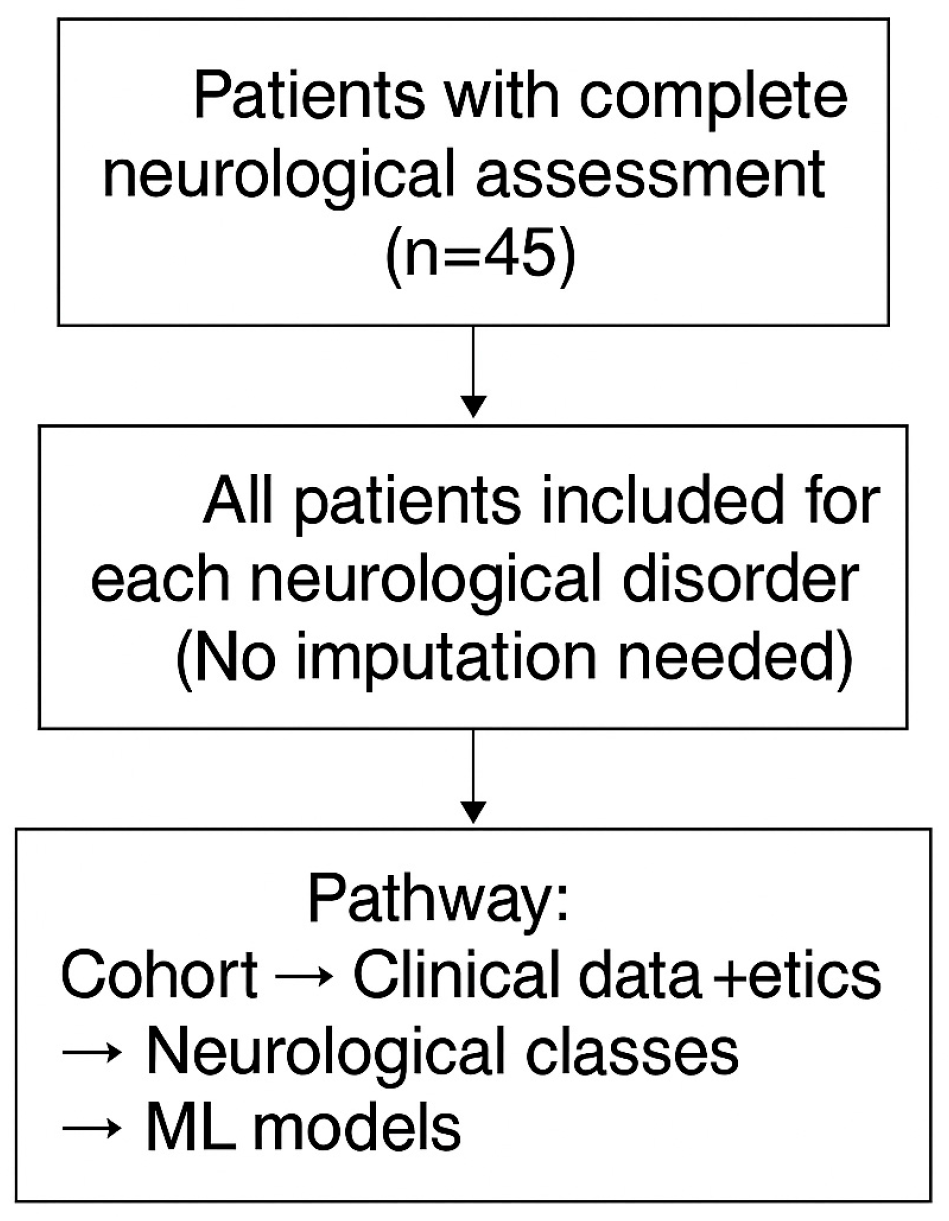
2. Materials and Methods
2.1. Study Design and Participants
2.2. Clinical and Cognitive Assessment
2.3. The Genetic Attributes
- •
- Type 0: No wolframin production (both alleles carry nonsense mutations, deletions, duplications, or splice defects leading to premature termination)
- •
- Type 1: Partial production (~50%), typically in compound heterozygotes with one missense and one truncating variant; the residual protein is largely misfolded.
- •
- Type 2: Two missense variants resulting in misfolded proteins with partial or absent function.
- •
- Type 3: Autosomal dominant heterozygous condition producing ~50% normal protein and ~50% misfolded protein.
- •
- Type_mut1_exon and Type_mut2_exon describe the type of mutation on each allele and the exon in which it occurs.
- •
- Mut12_Exon_Class captures whether both mutations occur in exon 4, both in exon 8, or one in each.
- •
- Mut1_Protein_Class and Mut2_Protein_Class represent the predicted protein-level effect of each allele.
- •
- Genetic_Condition indicates whether the patient is homozygous, compound heterozygous, or triple heterozygous.
- •
- Wolframin_Class groups patients into the four predicted protein-production classes described above (Types 0–3).
- •
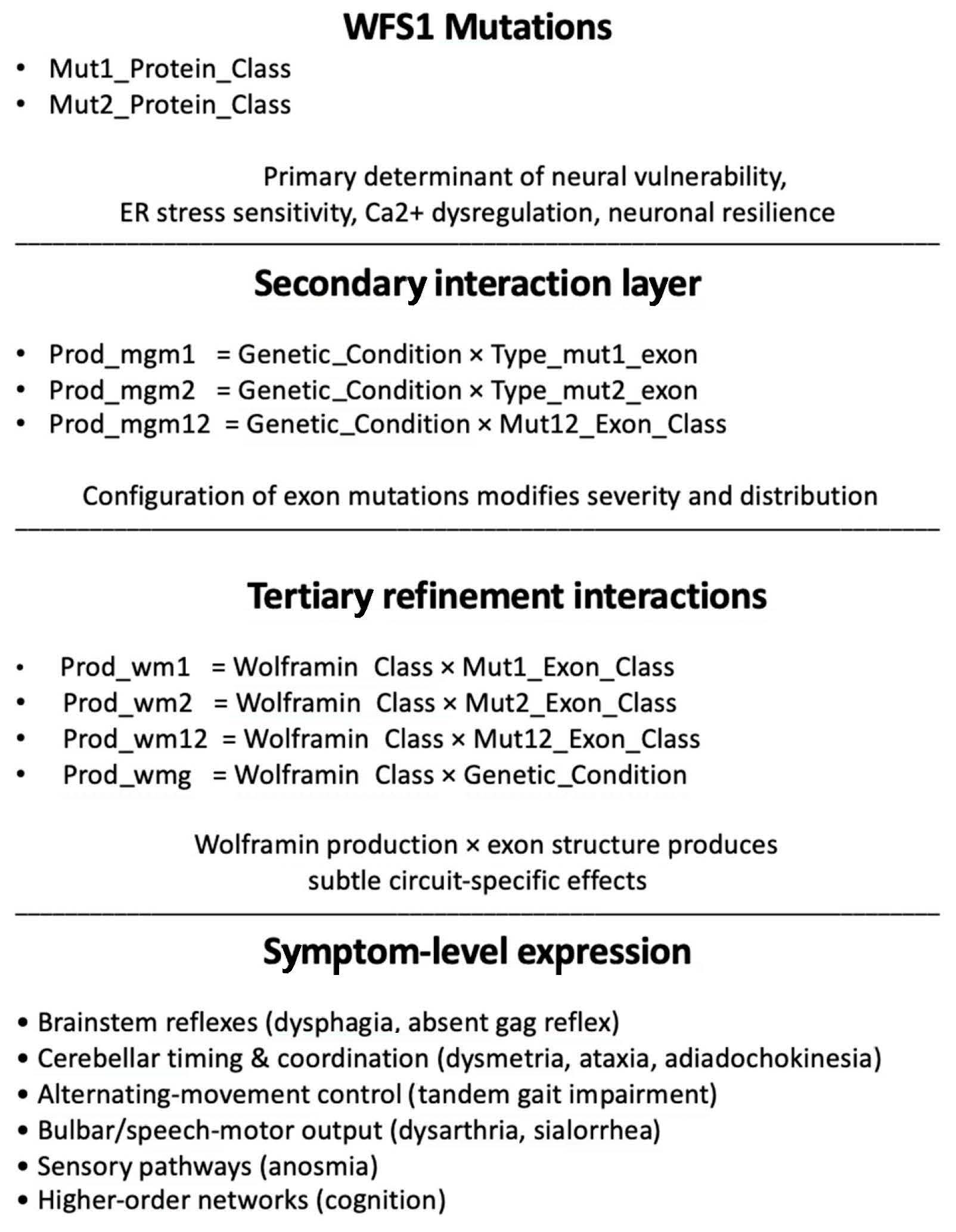
- Prod_wm1 = Wolframin_Class × Type_mut1_exon.
- •
- Prod_wm2 = Wolframin_Class × Type_mut2_exon.
- •
- Prod_wm12 = Wolframin_Class × Mut12_Exon_Class.
- •
- Prod_wmg = Wolframin_Class × Genetic_Condition.
- •
- Prod_mgm1 = Genetic_Condition × Type_mut1_exon.
- •
- Prod_mgm2 = Genetic_Condition × Type_mut2_exon.
- •
- Prod_mgm12 = Genetic_Condition × Mut12_Exon_Class.
2.4. Machine Learning Model
- (1)
- to train predictive models capable of estimating the likelihood of neurological symptoms from detailed genetic descriptors, and,
- (2)
- to identify and rank the genetic predictors most strongly associated with each neurological manifestation. By integrating BRF classification, stability-based feature importance, and calibrated probability estimation, this approach provides a data-driven means of uncovering genotype–phenotype relationships and supports a more mechanistic understanding of neurological vulnerability in Wolfram syndrome.
3. Results
3.1. Epidemiology
3.2. Cognitive and Neurological Manifestations
- •
- Superior intelligence: ≥130.
- •
- High/above average intelligence: 115–129.
- •
- Average intelligence: 85–114.
- •
- Low intelligence (borderline or below average): 70–84
- •
- Intellectual disability: ≤69.
3.3. Correlation Structure Among Neurological Manifestations
3.4. Genotype–Phenotype Correlation Analysis
3.5. Key Clinical-Genetic Findings in Wolfram Syndrome
- •
- Early and highly prevalent motor–autonomic deficits (dysphagia, sialorrhea, absent gag reflex, dysmetria)
- •
- Intermediate cerebellar and motor-coordination involvement (gait instability, ataxia, dysarthria, tandem gait impairment, anosmia)
- •
- Later cognitive decline, associated with high rates of homozygosity and severe protein-loss variants
3.6. Machine Learning Model Performance and Feature Importance
- •
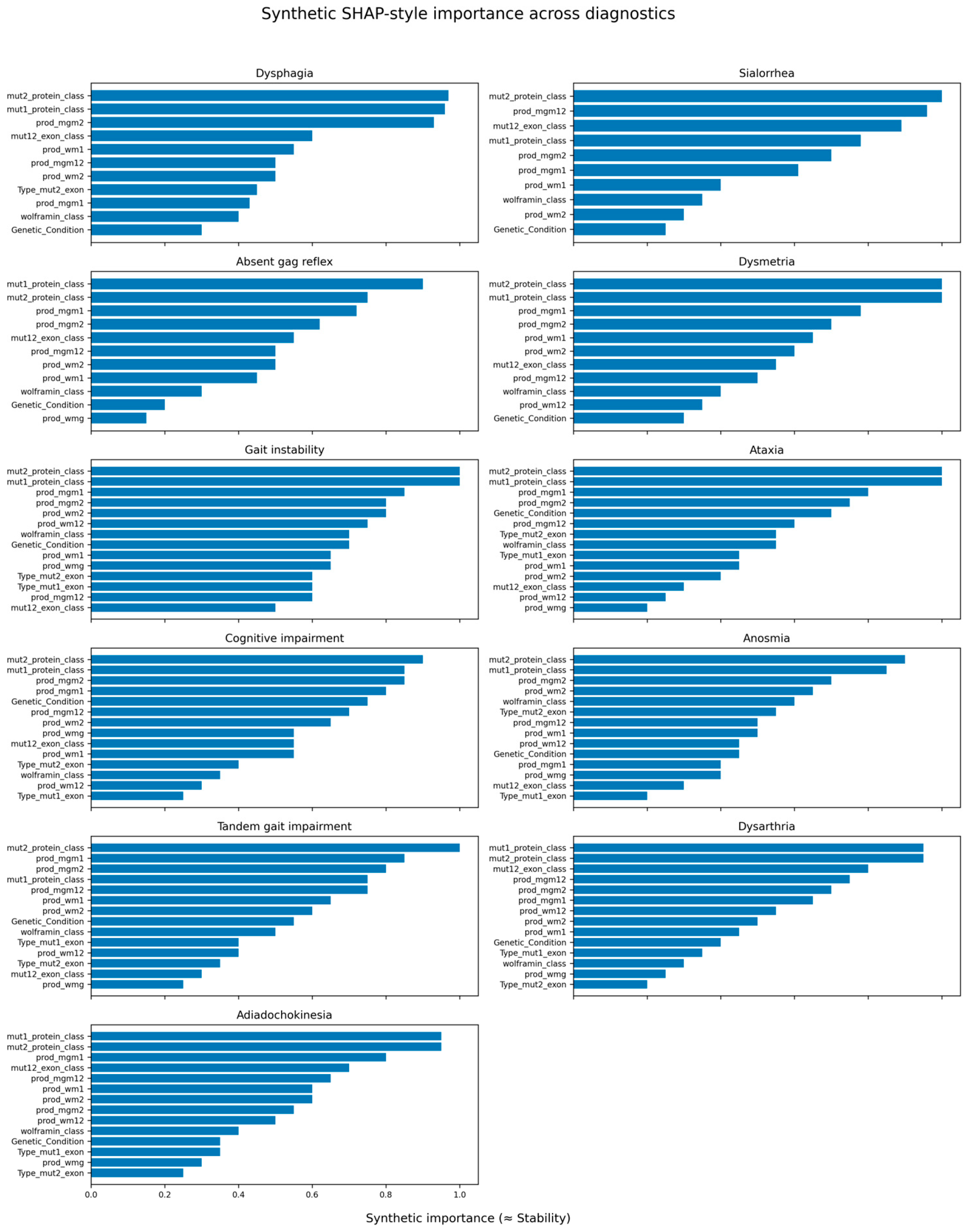
- Dominant: .
- •
- Consistent Secondary: .
- •
- Weak: .
4. Discussion
4.1. Genetic Mechanisms and Phenotypic Expression of Neurological Disorders
4.2. Predictive Modeling and Variable Importance
- High Predictability Class: Ataxia, Gait Instability and Absent Gag Reflex. These symptoms showed the highest raw AUC values and exceptional calibrated performance (AUC > 0.95). Their strong predictability aligns with well-established cerebellar and brainstem involvement in Wolfram syndrome, suggesting direct and consistent genetic influence.
- Intermediate Predictability Class: Dysmetria, Cognitive Impairment, Anosmia, Adiadochokinesia and Impaired Tandem Gait. These symptoms demonstrated moderate raw discrimination but substantial calibration gains. Their multifactorial nature and involvement of broader neural systems likely dilute genotype–phenotype coupling, yet calibration reveals meaningful underlying structure.
- Low Predictability Class: Dysphagia, Sialorrhea, Dysarthria. These symptoms exhibited the weakest raw predictive performance, with calibration improving results but not to the level of more genetically constrained manifestations. Their heterogeneity and dependence on multiple physiological pathways limit purely genetic predictability.
- •
- Motor coordination phenotypes (Dysmetria, Ataxia, Tandem Gait Impairment, Adiadochokinesia): Strong protein dependence suggests that cerebellar and cerebello-thalamo-cortical loops are highly vulnerable to wolframin deficits. Prod_mgm signals imply that mutation configuration across alleles affects the degree of dysfunction.
- •
- Brainstem reflex phenotypes (Dysphagia, Absent Gag Reflex). Protein-level effects dominate, consistent with selective vulnerability of motor nuclei and sensory integration centers. Prod_mgm terms suggest that some exon combinations might exacerbate these deficits.
- •
- Sensory phenotypes (Anosmia). Strong protein effect, but overall lighter interaction structure, consistent with olfactory circuits being affected mainly by global wolframin insufficiency.
- •
- Speech-related phenotypes (Dysarthria, Sialorrhea). Protein-driven with coherent Prod_mgm contributions, likely reflecting combined cerebellar, corticobulbar, and brainstem involvement.
- •
- Cognitive Impairment. Still strongly protein-class driven, with modest contributions from Genetic_Condition and Prod_mgm terms, reflecting more distributed vulnerability across neural systems.
4.3. Clinical and Translational Implications
4.4. Current Therapeutic Strategies and Clinical Trials in Wolfram Syndrome
4.5. Limitations and Future Perspectives
5. Conclusions
Supplementary Materials
Author Contributions
Funding
Institutional Review Board Statement
Informed Consent Statement
Data Availability Statement
Acknowledgments
Conflicts of Interest
References
- Barrett, T.G.; Bundey, S.E.; Macleod, A.F. Neurodegeneration and diabetes: UK nationwide study of Wolfram (DIDMOAD) syndrome. Lancet 1995, 346, 1458–1463. [Google Scholar] [CrossRef]
- Cremers, C.; Wijdeveld, P.; Pinckers, A. Juvenile diabetes mellitus, optic atrophy, hearing loss, diabetes insipidus, atonia of the urinary tract and bladder, and other abnormalities (Wolfram syndrome). A review of 88 cases from the literature with personal observations on 3 new patients. Acta Paediatr. Scand. Suppl. 1977, 66, 1–16. [Google Scholar] [CrossRef]
- Urano, F. Wolfram syndrome: Diagnosis, management, and treatment. Curr. Diabetes Rep. 2016, 16, 6. [Google Scholar] [CrossRef] [PubMed]
- Inoue, H.; Tanizawa, Y.; Wasson, J.; Behn, P.; Kalidas, K.; Bernal-Mizrachi, E.; Mueckler, M.; Marshall, H.; Donis-Keller, H.; Crock, P.; et al. A gene encoding a transmembrane protein is mutated in patients with diabetes mellitus and optic atrophy (Wolfram syndrome). Nat. Genet. 1998, 20, 143–148. [Google Scholar] [CrossRef]
- Fonseca, S.G.; Fukuma, M.; Lipson, K.L.; Nguyen, L.X.; Allen, J.R.; Oka, Y.; Urano, F. WFS1 is a novel component of the unfolded protein response and maintains homeostasis of the endoplasmic reticulum in pancreatic β cells. J. Biol. Chem. 2005, 280, 39609–39615. [Google Scholar] [CrossRef]
- Lee, E.M.; Verma, M.; Palaniappan, N.; Pope, E.M.; Lee, S.; Blacher, L.; Neerumalla, P.; An, W.; Campbell, T.; Brown, C.; et al. Genotype and clinical characteristics of patients with Wolfram syndrome and WFS1-related disorders. Front. Genet. 2023, 14, 1198171. [Google Scholar] [CrossRef]
- Antenora, A.; Lieto, M.; Santorelli, F.M.; Peluso, S.; Saccà, F.; De Michele, G.; Filla, A. Be aware of Wolfram syndrome when examining ataxic patients. J. Neurol. 2016, 263, 1862–1863. [Google Scholar] [CrossRef]
- Samara, A.; Lugar, H.M.; Hershey, T.; Shimony, J.S. Longitudinal assessment of neuroradiologic features in Wolfram syndrome. AJNR Am. J. Neuroradiol. 2020, 41, 2364–2369. [Google Scholar] [CrossRef]
- Lugar, H.M.; Koller, J.M.; Rutlin, J.; Eisenstein, S.A.; Neyman, O.; Narayanan, A.; Chen, L.; Shimony, J.S.; Hershey, T. Evidence for altered neurodevelopment and neurodegeneration in Wolfram syndrome using longitudinal morphometry. Sci. Rep. 2019, 9, 6010. [Google Scholar] [CrossRef] [PubMed]
- Hershey, T.; Lugar, H.M.; Shimony, J.S.; Rutlin, J.; Koller, J.M.; Perantie, D.C.; Paciorkowski, A.R.; Eisenstein, S.A.; Permutt, M.A. Early brain vulnerability in Wolfram syndrome. PLoS ONE 2012, 7, e40604. [Google Scholar] [CrossRef] [PubMed]
- Esteban-Bueno, G.; Fernández-Martínez, J.L. Gonadal dysfunction in Wolfram syndrome: A prospective study. Diagnostics 2025, 15, 1594. [Google Scholar] [CrossRef]
- Esteban-Bueno, G.; Berenguel Hernández, A.M.; Fernández Fernández, N.; Navarro Cabrero, M.; Coca, J.R. Neurosensory affectation in patients affected by Wolfram syndrome: Descriptive and longitudinal analysis. Healthcare 2023, 11, 1888. [Google Scholar] [CrossRef] [PubMed]
- Chen, C.; Liaw, A.; Breiman, L. Using Random Forest to Learn Imbalanced Data; Technical Report 666; Department of Statistics, University of California: Berkeley, CA, USA, 2004. [Google Scholar]
- Pickett, K.A.; Duncan, R.P.; Hoekel, J.; Marshall, B.; Hershey, T.; Earhart, G.M. Early presentation of gait impairment in Wolfram Syndrome. Orphanet J. Rare Dis. 2012, 7, 92. [Google Scholar] [CrossRef]
- Atiq, E.S.A.; Ghatak, A.; Raj, A. 41 A case of wolfram syndrome: Understanding a rare genetic disorder. BMJ Paediatr. Open 2024, 8, A15.1. [Google Scholar] [CrossRef]
- Lemaître, G.; Nogueira, F.; Aridas, C.K. Imbalanced-learn: A Python toolbox to tackle the curse of imbalanced datasets in machine learning. J. Mach. Learn. Res. 2017, 18, 1–5. [Google Scholar]
- Zadrozny, B.; Elkan, C. Transforming classifier scores into accurate multiclass probability estimates. In Proceedings of the Eight ACM SIGKDD International Conference on Knowledge Discovery and Data Mining, Edmonton, AB, Canada, 23–26 July 2002; pp. 694–699. [Google Scholar] [CrossRef]
- Platt, J.C. Probabilistic outputs for support vector machines and comparisons to regularized likelihood methods. In Advances in Large Margin Classifiers; Smola, A.J., Bartlett, P.L., Schölkopf, B., Schuurmans, D., Eds.; MIT Press: Cambridge, MA, USA, 1999; pp. 61–74. [Google Scholar]
- Brier, G.W. Verification of forecasts expressed in terms of probability. Mon. Weather Rev. 1950, 78, 1–3. [Google Scholar] [CrossRef]
- Breiman, L. Random forests. Mach. Learn. 2001, 45, 5–32. [Google Scholar] [CrossRef]
- Kuhn, M.; Johnson, K. Applied Predictive Modeling; Springer: New York, NY, USA, 2013. [Google Scholar] [CrossRef]
- Jurca, A.D.; Galea-Holhos, L.B.; Jurca, A.A.; Atasie, D.; Petchesi, C.D.; Severin, E.; Jurca, C.M. Wolfram syndrome type I case report and review—Focus on early diagnosis and genetic variants. Medicina 2024, 60, 1064. [Google Scholar] [CrossRef] [PubMed]
- Du, D.; Tuhuti, A.; Ma, Y.; Abuduniyimu, M.; Li, S.; Ma, G.; Zynat, J.; Guo, Y. Wolfram syndrome type 1: A case series. Orphanet J. Rare Dis. 2023, 18, 359. [Google Scholar] [CrossRef]
- Delvecchio, M.; Iacoviello, M.; Pantaleo, A.; Resta, N. Clinical spectrum associated with Wolfram syndrome type 1 and type 2: A review on genotype–phenotype correlations. Int. J. Environ. Res. Public Health 2021, 18, 4796. [Google Scholar] [CrossRef]
- Rigoli, L.; Caruso, V.; Salzano, G.; Lombardo, F. Wolfram syndrome 1: From genetics to therapy. Int. J. Environ. Res. Public Health 2022, 19, 3225. [Google Scholar] [CrossRef]
- Gupta, P.; Vu, T.A.; Lamoureux, E.L. Beyond Visual Acuity—A Comprehensive Assessment of Vision and Cognition in Older Adults With Visual Impairment. JAMA Netw. Open 2021, 4, e2119033. [Google Scholar] [CrossRef]
- Lin, F.R.; Ferrucci, L.; Metter, E.J.; An, Y.; Zonderman, A.B.; Resnick, S.M. Hearing loss and cognition in the Baltimore Longitudinal Study of Aging. Neuropsychology 2011, 25, 763–770. [Google Scholar] [CrossRef]
- Taffner, B.; Saraiva, P.; Saraiva, F. Wolfram Syndrome: Report of Three Siblings with Early Vision Loss and Documented Lesion of the Entire Visual Pathway. Ophthalmol. Res. Int. J. 2015, 4, 131–137. [Google Scholar] [CrossRef]
- Reiersen, A.M.; Noel, J.S.; Doty, T.; Sinkre, R.A.; Narayanan, A.; Hershey, T. Psychiatric diagnoses and medications in Wolfram syndrome. Scand. J. Child Adolesc. Psychiatry Psychol. 2022, 10, 163–174. [Google Scholar] [CrossRef]
- Warren, R.E.; Frier, B.M. Hypoglycaemia and cognitive function. Diabetes Obes. Metab. 2005, 7, 493–503. [Google Scholar] [CrossRef]
- Fonseca, L.M.; Strong, R.W.; Singh, S.; Bulger, J.D.; Cleveland, M.; Grinspoon, E.; Janess, K.; Jung, L.; Miller, K.; Passell, E.; et al. Glycemic Variability and Fluctuations in Cognitive Status in Adults With Type 1 Diabetes (GluCog): Observational Study Using Ecological Momentary Assessment of Cognition. JMIR Diabetes 2023, 8, e39750. [Google Scholar] [CrossRef]
- Pickett, K.A.; Duncan, R.P.; Paciorkowski, A.R.; Permutt, M.A.; Marshall, B.; Hershey, T.; Earhart, G.M. Balance impairment in individuals with Wolfram syndrome. Gait Posture 2012, 36, 619–624. [Google Scholar] [CrossRef]
- U, J.; Santhanam, J.; Rm, R.; Saideekshit, T.; Sn, M.S. Beyond Vision and Hearing: A Case Report of Wolfram Syndrome. Cureus 2024, 16, e65107. [Google Scholar] [CrossRef] [PubMed]
- Meng, X.; D’Arcy, C. Education and dementia in the context of the cognitive reserve hypothesis: A systematic review with meta-analyses and qualitative analyses. PLoS ONE 2012, 7, e38268. [Google Scholar] [CrossRef] [PubMed]
- Mondini, S.; Madella, I.; Zangrossi, A.; Bigolin, A.; Tomasi, C.; Michieletto, M.; Villani, D.; Di Giovanni, G.; Mapelli, D. Cognitive reserve in dementia: Implications for cognitive training. Front. Aging Neurosci. 2016, 8, 84. [Google Scholar] [CrossRef] [PubMed]
- Caruso, V.; Raia, A.; Rigoli, L. Wolfram Syndrome 1: A Neuropsychiatric Perspective on a Rare Disease. Genes 2024, 15, 984. [Google Scholar] [CrossRef] [PubMed]
- de Azevedo, M.C.D.; Charchat-Fichman, H.; Damazio, V.M.M. Environmental interventions to support orientation and social engagement of people with Alzheimer’s disease. Dement. Neuropsychol. 2021, 15, 510–523. [Google Scholar] [CrossRef]
- Mendes, L.; Oliveira, J.; Barbosa, F.; Castelo-Branco, M. A Conceptual View of Cognitive Intervention in Older Adults With and Without Cognitive Decline—A Systemic Review. Front. Aging 2022, 3, 844725. [Google Scholar] [CrossRef]
- Esteban-Bueno, G.; Jiménez-Soto, A.; Fernández-Martínez, J.L.; Fernández-Vilas, E.; Coca, J.R. Circadian Rhythm and Psychiatric Features in Wolfram Syndrome: Toward Chrono Diagnosis and Chronotherapy. Diagnostics 2025, 15, 2338. [Google Scholar] [CrossRef] [PubMed]



| Variable | Categories | Frequency in Cohort |
|---|---|---|
| WFS1 genotype | 1 = WFS1 homozygote 2 = WFS1 compound heterozygote 3 = WFS1 triple heterozygote (one allele with two mutations + the homologous allele with one mutation) | 48.9% heterozygotes |
| Allele | Variants Identified (c.DNA) |
|---|---|
| Mutation 1 (Allele 1) | ex4 c.409_424dup16; ex4 c.472 G>A; ex4c.489_424dup; ex4 c.506delA; ex8c.1060_1062delTTC; ex8 c.1096 C>T; ex8 c.1113 G>A; ex8 c.1124 G>A; ex8 c.1230_1233delCTCT; ex8 c.1289 C>A; ex8 c.1558 C>T; ex8 c.1582 T>G; ex8 c.2020 G>A; ex8 c.2051 C>T; ex8 c.2118 C>A; ex8 c.2206 G>A; ex8 c.2209 G>A; ex8 c.2564 C>G; ex8 c.873 C>A; ex8 c.963_966del4; ex8 c.977 C>T |
| Mutation 2 (Allele 2) | ex4 c.409_424dup16; ex8 c.1113 G>A; ex8 c.1230_1233del; ex8 c.1230_1233delCTCT; ex8 c.1329 C>G; ex8 c.1340 T>C; ex8 c.1456_1457insT; ex8 c.1462_1463ins12; ex8 c.1511 C>T; ex8 c.1525_1538del15; ex8 c.1558 C>T; ex8 c.1582 T>G; ex8 c.1612 T>C; ex8 c.2020 G>A; ex8 c.2118 C>A; ex8 c.2206 G>A; ex8 c.2206 G>C; ex8 c.2209 G>A; ex8 c.2257 G>T; ex8 c.854 G>T; ex8 c.873 C>A; ex8 c.873C>A; ex8 c.963_966del; ex8 c1463_1474 |
| Allele | Variants Identified (WFS1 Protein) |
|---|---|
| Mutation 1 (Allele 1) | None; Ala326Val; Ala684Val; Arg375His; Gln366X; Gln520X; Glu158Lys; Glu169GlyfsX2118; Glu674Arg; Glu737Lys; Gly736Arg; Gly736Ser; His322fsX; Phe354del; Phe354fs*; Phe854del; Phedel; Ser430X; Ser855fs*; Trp371X; Tyr706X; TyrX*; Val142Glyfs*118; Val142Glyfs*X; Val142fs*; Val142fs251*; Val142fsX; Val142fsX110; Val412Serfs*29; Val412SerfsX29; Val412Serfs*29; Y528D |
| Mutation 2 (Allele 2) | None; Arg285Leu; Gln486Leufs*57X; Gln520X; Glu674Arg; Glu737Lys; Glu753X; Gly736Arg; Gly736Ser; His322Thrfs*; Leu447Pro; Phe538Leu; Pro504Leu; Ser443Arg; Trp371X; Tyr706X; Val142fs*; Val142fs110; Val142fs251*; Val142fsX110; Val412Serfs*29; Val412SerfsX; Val491ProinsLeuIleThrVal; Val509_Tyr513del5; Valfs*; Y528D |
| Variable | Definition/Description |
|---|---|
| Mut1_Protein_Class | Protein effect of mutation on allele 1. |
| Mut2_Protein_Class | Protein effect of mutation on allele 2. |
| Mut12_Exon_Class | Classification based on whether both mutations are located in the same exon (exon 4, exon 8) or in different exons. |
| Type_mut1_exon | Type of mutation affecting allele 1 and its corresponding exon. |
| Type _mut2_exon | Type of mutation affecting allele 2 and its corresponding exon. |
| Genetic_Condition | Categorical variable indicating zygosity (homozygous, compound heterozygous, triple heterozygous). |
| Wolframin_Class | Classification of wolframin protein production: Type 0: No protein (premature stop codon).Type 1: ~50% protein, likely non-functional (misfolding).Type 2: Misfolded protein from both alleles. Type 3: Autosomal dominant case, ~50% normal protein production. |
| Prod_wm1 | Interaction term: Wolframin class × Mut1_Exon_Class. |
| Prod_wm2 | Interaction term: Wolframin class × Mut2_Exon_Class. |
| Prod_wm12 | Interaction term: Wolframin class × Mut12_Exon_Class. |
| Prod_wmg | Interaction term: Wolframin class × Genetic_Condition. |
| Prod_mgm1 | Interaction term: Genetic_Condition × Mut1_Exon_Class. |
| Prod_mgm2 | Interaction term: Genetic_Condition × Mut2_Exon_Class. |
| Prod_mgm12 | Interaction term: Genetic_Condition × Mut12_Exon_Class. |
| Characteristic | n (%)/Mean ± SD |
|---|---|
| Total patients | 45 |
| Sex | Male:25 (55.5%) Female: 20 (44.5%) |
| Genetic confirmation available | 43 (95.6%) |
| Parental consanguinity | 12 (26.7%) |
| Siblings within cohort | 17 (37.8%) |
| Ethnicity | White:39 (86%) Romani: 4 Arab origin: 2 |
| Vital status (2024) | Survivors: 35 Deceased: 10 |
| Age (survivors) | 27.5 ± 11.1 years |
| Attribute | No. of Disorders | mean_abs_corr | max_abs_corr |
|---|---|---|---|
| Prod_wmg | 7 | 0.41 | 0.57 |
| Prod_wm12 | 8 | 0.37 | 0.56 |
| Prod_mgm12 | 10 | 0.43 | 0.55 |
| Mut12_exon_class | 9 | 0.4 | 0.55 |
| Wolframin_Class | 7 | 0.38 | 0.54 |
| Prod_mgm2 | 11 | 0.42 | 0.54 |
| Prod_wm1 | 6 | 0.38 | 0.52 |
| Prod_wm2 | 6 | 0.38 | 0.52 |
| Genetic_Condition | 9 | 0.42 | 0.51 |
| Prod_mgm1 | 7 | 0.41 | 0.47 |
| Type _mut2_exon | 3 | 0.39 | 0.42 |
| Mut2_protein_class | 3 | 0.35 | 0.38 |
| Type _mut1_exon | 1 | 0.35 | 0.35 |
| Symptom | Onset (yrs) | M (%) | Homozygotes (%) | Key Genetic Findings | Wolframin Class |
|---|---|---|---|---|---|
| Dysphagia | 23.1 ± 7.3 | 66.7 | 63 | Val142fsX110. | Type 0 (>70%) |
| Sialorrhea | 24.0 ± 7.4 | 60.0 | 68 | Val142fsX110. | Type 0 (68%) |
| Absence of Gag Reflex | 23.4 ± 6.4 | 53.3 | 63 | Val142fsX110 & Trp371X. | Type 0 (67%) |
| Dysmetria | 24.1 ± 5.7 | 60.0 | 75 | Val142fsX110. | Type 0 (80%) |
| Gait Instability | 26.0 ± 4.5 | 62.5 | 62 | Val142fsX110 & ex4 c.409_424dup16. | Type 0 (69%) |
| Ataxia | 26.0 ± 4.5 | 62.5 | 75 | Val142fsX110. | Type 0 (83%) |
| Cognitive Decline | 29.9 ± 12.2 | 56.2 | 81 | Val142fsX110 & Trp371X. | Type 0 (81%) |
| Anosmia | 26.3 ± 6.2 | 55.6 | 78 | Val142fs251 &Val142fsX110. | Type 0 (78%) |
| Impaired Tandem Gait | 21.8 ± 6.0 | 62.1 | 66 | Val142fs*, ex4c.409_424dup16. | Type 0 (69%) |
| Dysarthria | 27.5 ± 8.1 | 53.9 | 77 | Val142fs*, ex8 c.2206 G>A. | Type 0 (69%) |
| Adiadochokinesia | 26.3 ± 8.3 | 58.9 | 82 | Val142fs*,ex4 c.409_424dup16. | Type 0 (76%) |
| Symptom | Prevalence | Train Accuracy | Accuracy | AUC | Precision | Recall | F1-score | Confusion Matrix |
|---|---|---|---|---|---|---|---|---|
| Dysphagia | 60.00% | 0.813 | 0.578 ± 0.134 | 0.642 ± 0.156 | 0.634 ± 0.120 | 0.697 ± 0.218 | 0.649 ± 0.148 | |
| Sialorrhea | 55.60% | 0.827 | 0.653 ± 0.118 | 0.682 ± 0.169 | 0.681 ± 0.142 | 0.742 ± 0.199 | 0.694 ± 0.134 | |
| Absent_gag_reflex | 66.70% | 0.883 | 0.659 ± 0.147 | 0.691 ± 0.184 | 0.755 ± 0.121 | 0.742 ± 0.193 | 0.733 ± 0.138 | |
| Dysmetria | 44.40% | 0.796 | 0.643 ± 0.134 | 0.711 ± 0.168 | 0.607 ± 0.176 | 0.667 ± 0.229 | 0.614 ± 0.158 | |
| Gait_instability | 64.40% | 0.848 | 0.727 ± 0.131 | 0.754 ± 0.171 | 0.803 ± 0.120 | 0.787 ± 0.178 | 0.781 ± 0.117 | |
| Ataxia | 53.30% | 0.875 | 0.743 ± 0.116 | 0.839 ± 0.127 | 0.766 ± 0.157 | 0.797 ± 0.164 | 0.765 ± 0.114 | |
| Cognitive_impairment | 35.60% | 0.775 | 0.666 ± 0.141 | 0.725 ± 0.155 | 0.546 ± 0.191 | 0.736 ± 0.237 | 0.604 ± 0.169 | |
| Anosmia | 40.00% | 0.799 | 0.649 ± 0.139 | 0.732 ± 0.155 | 0.579 ± 0.215 | 0.618 ± 0.236 | 0.571 ± 0.183 | |
| Tandem_gait_abnormal | 64.40% | 0.802 | 0.647 ± 0.158 | 0.645 ± 0.183 | 0.745 ± 0.153 | 0.704 ± 0.211 | 0.706 ± 0.156 | |
| Dysarthria | 28.90% | 0.738 | 0.571 ± 0.147 | 0.606 ± 0.170 | 0.354 ± 0.223 | 0.575 ± 0.329 | 0.412 ± 0.221 | |
| Adiadochokinesia | 37.80% | 0.781 | 0.730 ± 0.134 | 0.720 ± 0.192 | 0.622 ± 0.175 | 0.802 ± 0.223 | 0.684 ± 0.166 |
| Symptom | AUC-R | AUC-I | AUC-P | Brier -R | Brier-I | Brier-P |
|---|---|---|---|---|---|---|
| Dysphagia | 0.550 | 0.888 | 0.871 | 0.290 | 0.146 | 0.216 |
| Sialorrhea | 0.595 | 0.934 | 0.938 | 0.249 | 0.124 | 0.17 |
| Absent gag reflex | 0.647 | 0.971 | 0.962 | 0.195 | 0.075 | 0.126 |
| Dysmetria | 0.627 | 0.916 | 0.934 | 0.280 | 0.117 | 0.186 |
| Gait instability | 0.690 | 0.961 | 0.971 | 0.221 | 0.079 | 0.14 |
| Ataxia | 0.823 | 0.964 | 0.968 | 0.178 | 0.059 | 0.108 |
| Cognitive impairment | 0.656 | 0.927 | 0.939 | 0.250 | 0.115 | 0.154 |
| Anosmia | 0.643 | 0.907 | 0.919 | 0.272 | 0.127 | 0.169 |
| Impaired tandem gait | 0.575 | 0.940 | 0.873 | 0.296 | 0.122 | 0.178 |
| Dysarthria | 0.589 | 0.921 | 0.916 | 0.261 | 0.124 | 0.192 |
| Adiadochokinesia | 0.653 | 0.918 | 0.922 | 0.244 | 0.134 | 0.171 |
| Symptom | Dominant Predictors | Consistent Secondary Predictors | Weak/Marginal Predictors |
|---|---|---|---|
| Dysphagia | mut1_protein, mut2_protein | prod_mgm1/mgm2/mgm12. | Wolframin features, exon classes |
| Symptom | Dominant Predictors | Consistent Secondary Predictors | Weak/Marginal Predictors |
| Sialorrhea | mut2_protein, mut1_protein | prod_mgm1/mgm12/mgm2; mut12_exon_class | Wolframin features |
| Absent Gag Reflex | mut1_protein, mut2_protein | prod_mgm1/mgm2/mgm12, mut12_exon_class | Wolframin features, genomic context |
| Dysmetria | mut2_protein, mut1_protein | prod_mgm1/mgm2; Wolframin features | Exon features |
| Gait Instability | mut2_protein, mut1_protein | prod_mgm1/mgm2; prod_wm1/wm2/wm12; wolframin_class; Genetic_Condition | Exon-level variables; prod_wmg; mut12_exon_class |
| Ataxia | mut2_protein, mut1_protein | prod_mgm1/mgm2 | Wolframin features, exon classes, genomic context (weak) |
| Cognitive Impairment | mut1_protein, mut2_protein | prod_mgm1/mgm2; Genetic_Condition | Wolframin features, exon classes |
| Anosmia | mut1_protein, mut2_protein | prod_mgm2; small WM contributions | Exon classes, prod features |
| Tandem Gait Impairment | mut2_protein, mut1_protein | prod_mgm1/mgm2/mgm12 | Wolframin features, exon classes (very small) |
| Dysarthria | mut1_protein, mut2_protein | prod_mgm1/mgm2/mgm12 | Wolframin features, exon classes (small) |
| Adiadochokinesia | mut1_protein, mut2_protein | prod_mgm1/mgm12/mgm2 | Wolframin features |
Disclaimer/Publisher’s Note: The statements, opinions and data contained in all publications are solely those of the individual author(s) and contributor(s) and not of MDPI and/or the editor(s). MDPI and/or the editor(s) disclaim responsibility for any injury to people or property resulting from any ideas, methods, instructions or products referred to in the content. |
© 2025 by the authors. Licensee MDPI, Basel, Switzerland. This article is an open access article distributed under the terms and conditions of the Creative Commons Attribution (CC BY) license (https://creativecommons.org/licenses/by/4.0/).
Share and Cite
Esteban-Bueno, G.; Botella, L.-M.; Fernández-Martínez, J.L. Phenotype Correlations of Neurological Manifestations in Wolfram Syndrome: Predictive Modeling in a Spanish Cohort. Diagnostics 2025, 15, 3213. https://doi.org/10.3390/diagnostics15243213
Esteban-Bueno G, Botella L-M, Fernández-Martínez JL. Phenotype Correlations of Neurological Manifestations in Wolfram Syndrome: Predictive Modeling in a Spanish Cohort. Diagnostics. 2025; 15(24):3213. https://doi.org/10.3390/diagnostics15243213
Chicago/Turabian StyleEsteban-Bueno, Gema, Luisa-María Botella, and Juan Luis Fernández-Martínez. 2025. "Phenotype Correlations of Neurological Manifestations in Wolfram Syndrome: Predictive Modeling in a Spanish Cohort" Diagnostics 15, no. 24: 3213. https://doi.org/10.3390/diagnostics15243213
APA StyleEsteban-Bueno, G., Botella, L.-M., & Fernández-Martínez, J. L. (2025). Phenotype Correlations of Neurological Manifestations in Wolfram Syndrome: Predictive Modeling in a Spanish Cohort. Diagnostics, 15(24), 3213. https://doi.org/10.3390/diagnostics15243213