Article

Non-Instrumental and Instrumental Tools Validity in Bruxism Diagnostics

by
Adrian Marcel Popescu
1,†,
Mihaela Ionescu
2,*,
Diana Elena Vlăduțu
1,*,†,
Sanda Mihaela Popescu
3,†,
Iulia Roxana Marinescu
3,
Monica Scrieciu
1 and
Veronica Mercuț
1
1
Department of Dental Prosthetics, Faculty of Dentistry, University of Medicine and Pharmacy of Craiova, 200349 Craiova, Romania
2
Department of Medical Informatics and Biostatistics, Faculty of Dentistry, University of Medicine and Pharmacy of Craiova, 200349 Craiova, Romania
3
Department of Oral Rehabilitation, Faculty of Dentistry, University of Medicine and Pharmacy of Craiova, 200349 Craiova, Romania
*
Authors to whom correspondence should be addressed.
These authors contributed equally to this work.
Diagnostics 2025, 15(2), 200; https://doi.org/10.3390/diagnostics15020200

Submission received: 26 November 2024 / Revised: 5 January 2025 / Accepted: 10 January 2025 / Published: 16 January 2025
(This article belongs to the Special Issue Diagnostics and Management in Oral and Maxillofacial Medicine)

Abstract

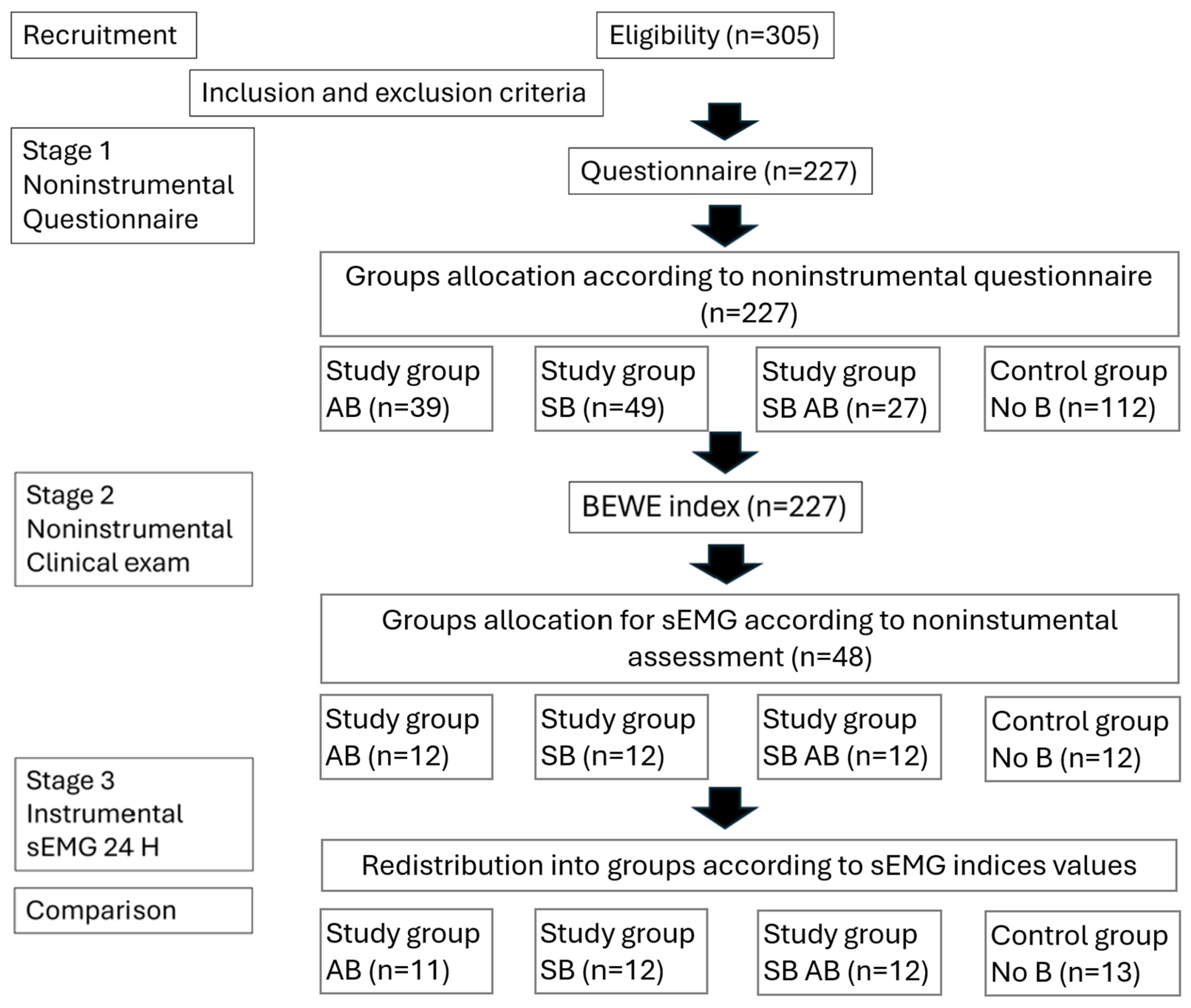
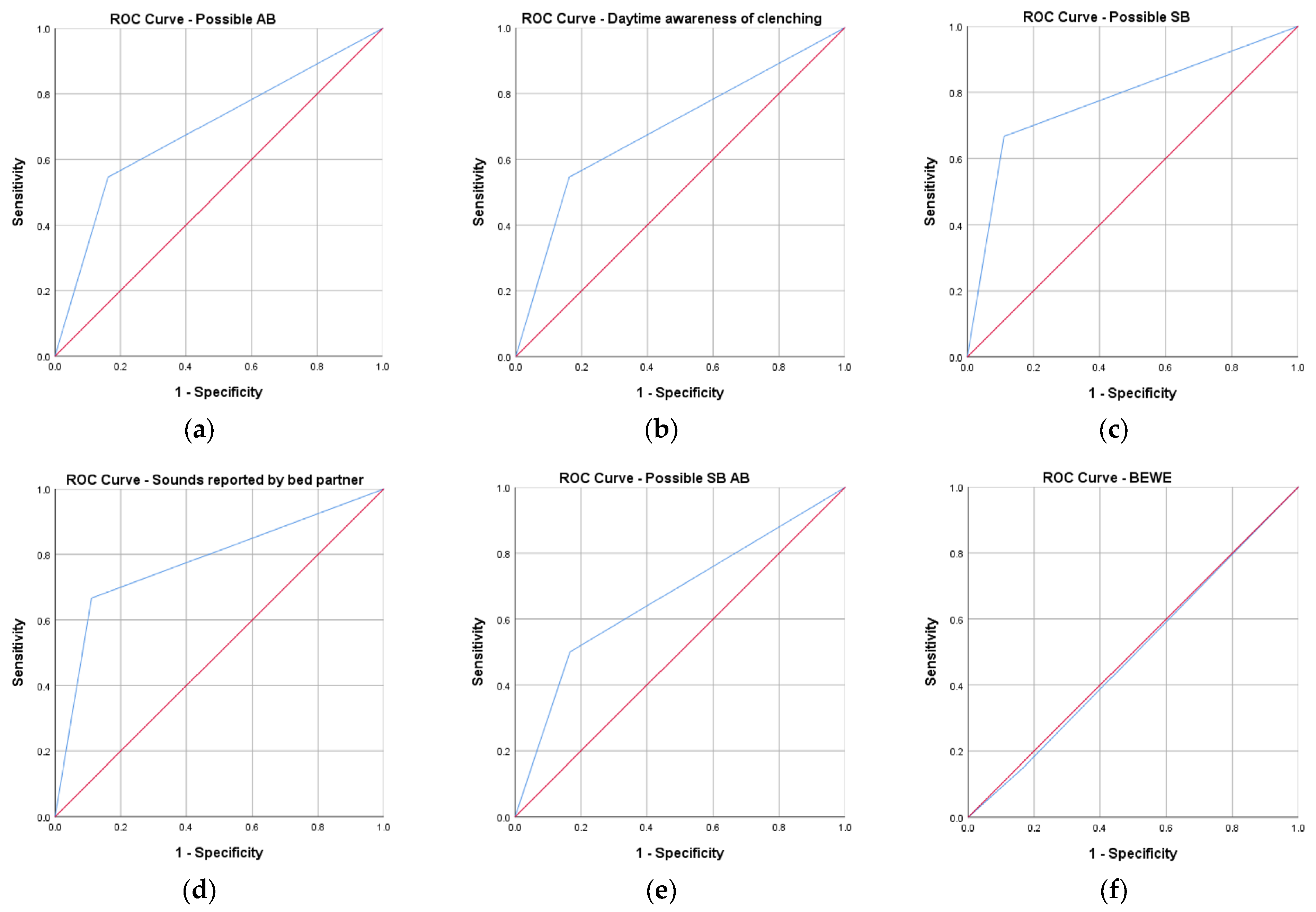
Background/Objectives: The study aimed to validate the diagnostic system proposed by the Standardized Tool for the Assessment of Bruxism (STAB) by correlating the results obtained based on questionnaire and non-instrumental and instrumental tools. Methods: The study had three stages (questionnaire, clinical examination, and electromyographic study). The subjects completed a questionnaire and clinical exam. Positive signs of bruxism included oral mucosal signs and the presence of dental wear according to the BEWE index. In stage three, sEMG was performed after allocating subjects into four groups according to the questionnaire and clinical exam results: sleep bruxism (SB), awake bruxism (AB), sleep and awake bruxism (SB AB), and no bruxism (no B). After the third stage, a new selection was made, and the subjects were divided into four groups, according to sEMG results. Diagnostic accuracy was computed for possible bruxism SB and grinding and clenching sound diagnosis, possible bruxism AB and AB acknowledgment, possible bruxism SB AB, and tooth wear index. Results: For SB, the sensitivity and specificity of the tools were the highest. The non-instrumental questionnaire and clinical assessment identified 67% of SB cases and 89% without SB. For AB, the specificity was higher (84%), while the sensitivity was lower (55%), as almost half of the subjects were not aware of the presence of AB. The tests showed a low sensitivity (15%) but a high specificity (83%) for tooth wear. The absence of tooth wear was frequently associated with the absence of bruxism, while the presence of tooth wear did not necessarily imply the existence of bruxism. Conclusions: Non-instrumental evaluation of bruxism through questionnaires and clinical exams is valuable, especially for SB. Instrumental evaluation through electromyography remains a gold standard for bruxism diagnosis.
Keywords: bruxism diagnostic; questionnaire; clinical exam; clenching; grinding; sEMG; stress; anxiety; dental wear; masticatory muscles activity bruxism diagnostic; questionnaire; clinical exam; clenching; grinding; sEMG; stress; anxiety; dental wear; masticatory muscles activity