Article

Ultrasound Imaging of the Superficial Fascia in the Upper Limb: Arm and Forearm

1
Department of Neurosciences, Institute of Human Anatomy, University of Padua, 35121 Padua, Italy
2
Department of Medicine—DIMED, School of Radiology, Radiology Institute, University of Padua, 35128 Padova, Italy
*
Author to whom correspondence should be addressed.
Diagnostics 2022, 12(8), 1884; https://doi.org/10.3390/diagnostics12081884

Submission received: 5 July 2022 / Revised: 26 July 2022 / Accepted: 31 July 2022 / Published: 4 August 2022
(This article belongs to the Special Issue Recent Advances in Bone and Joint Imaging)

Abstract

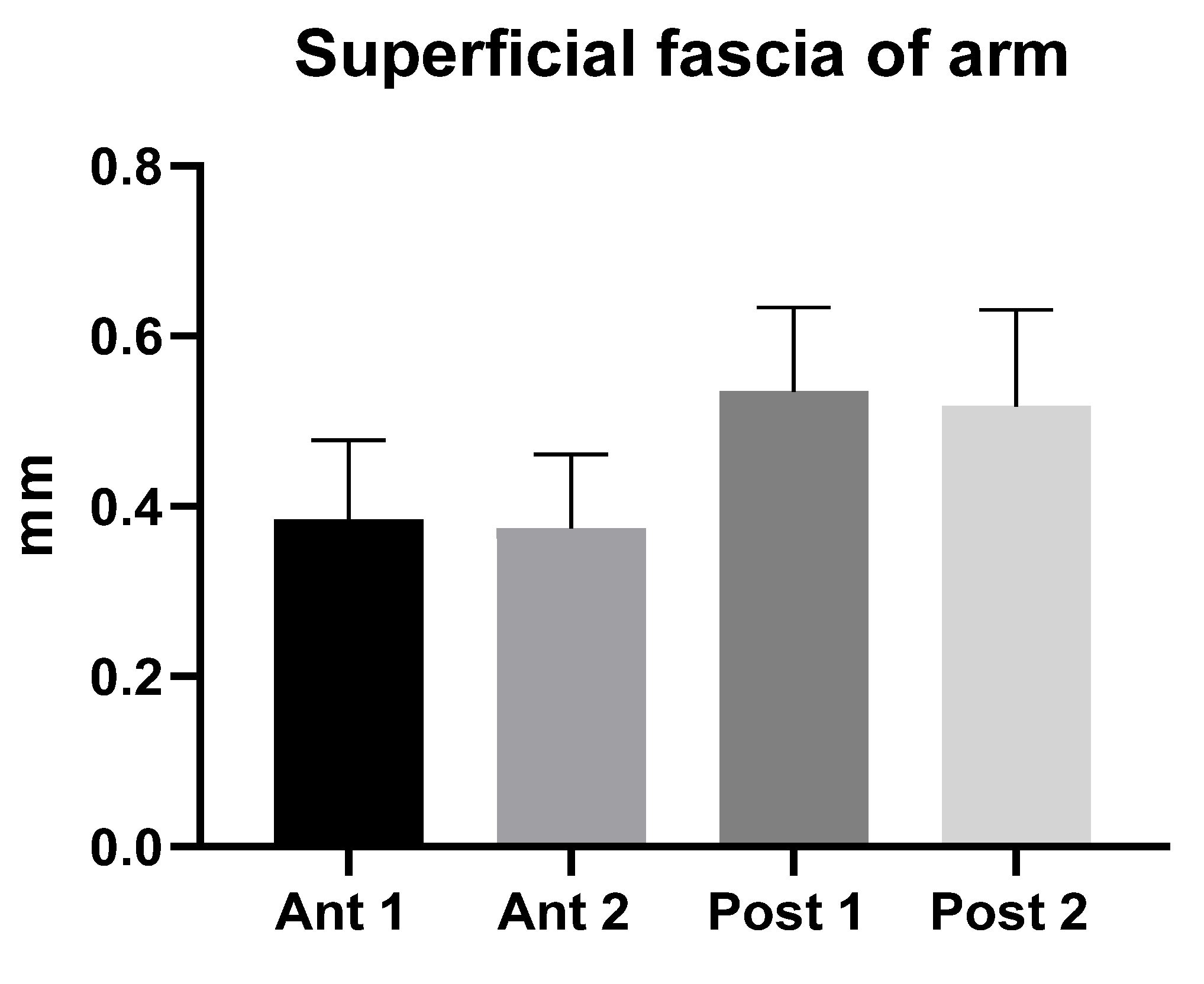
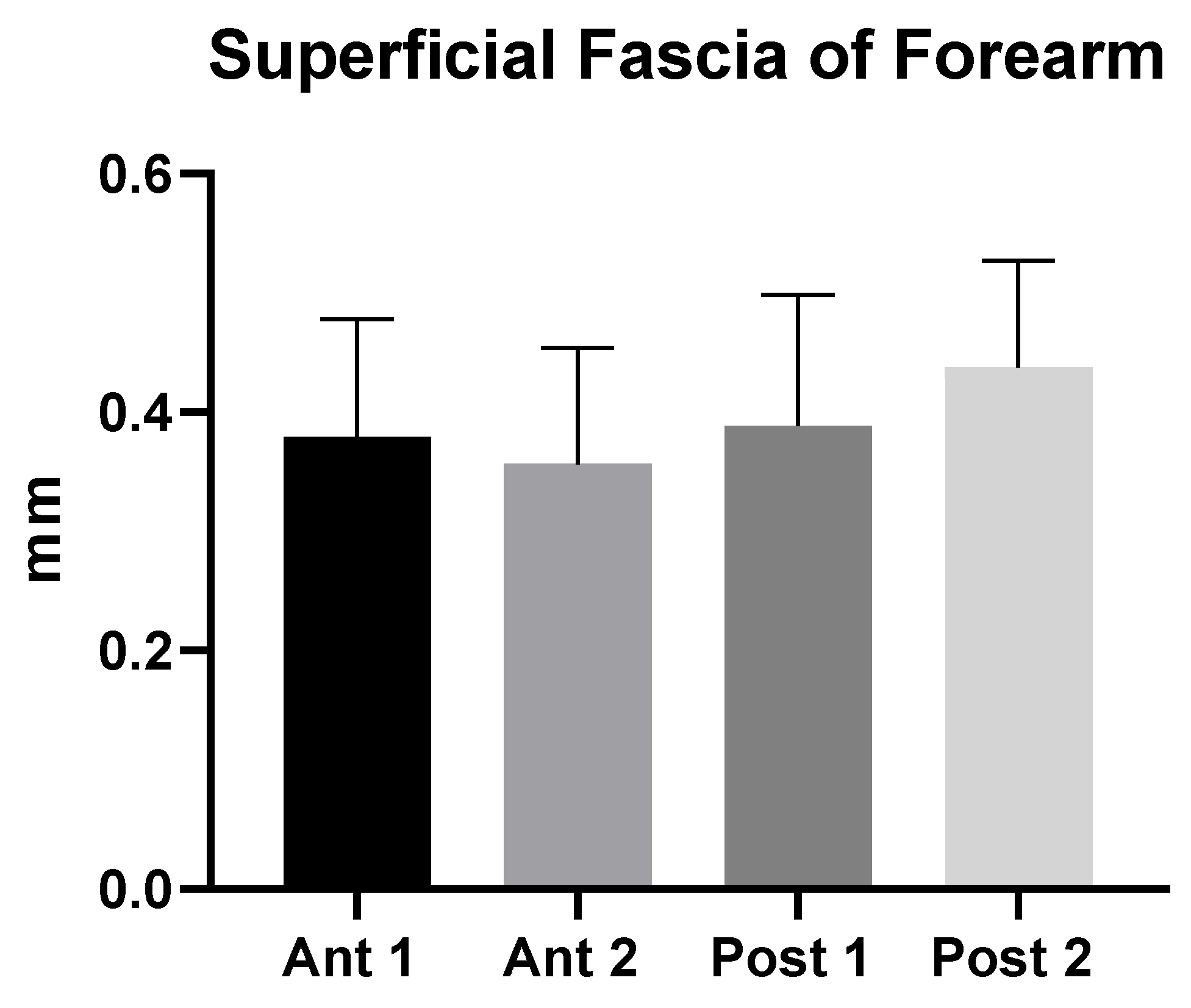
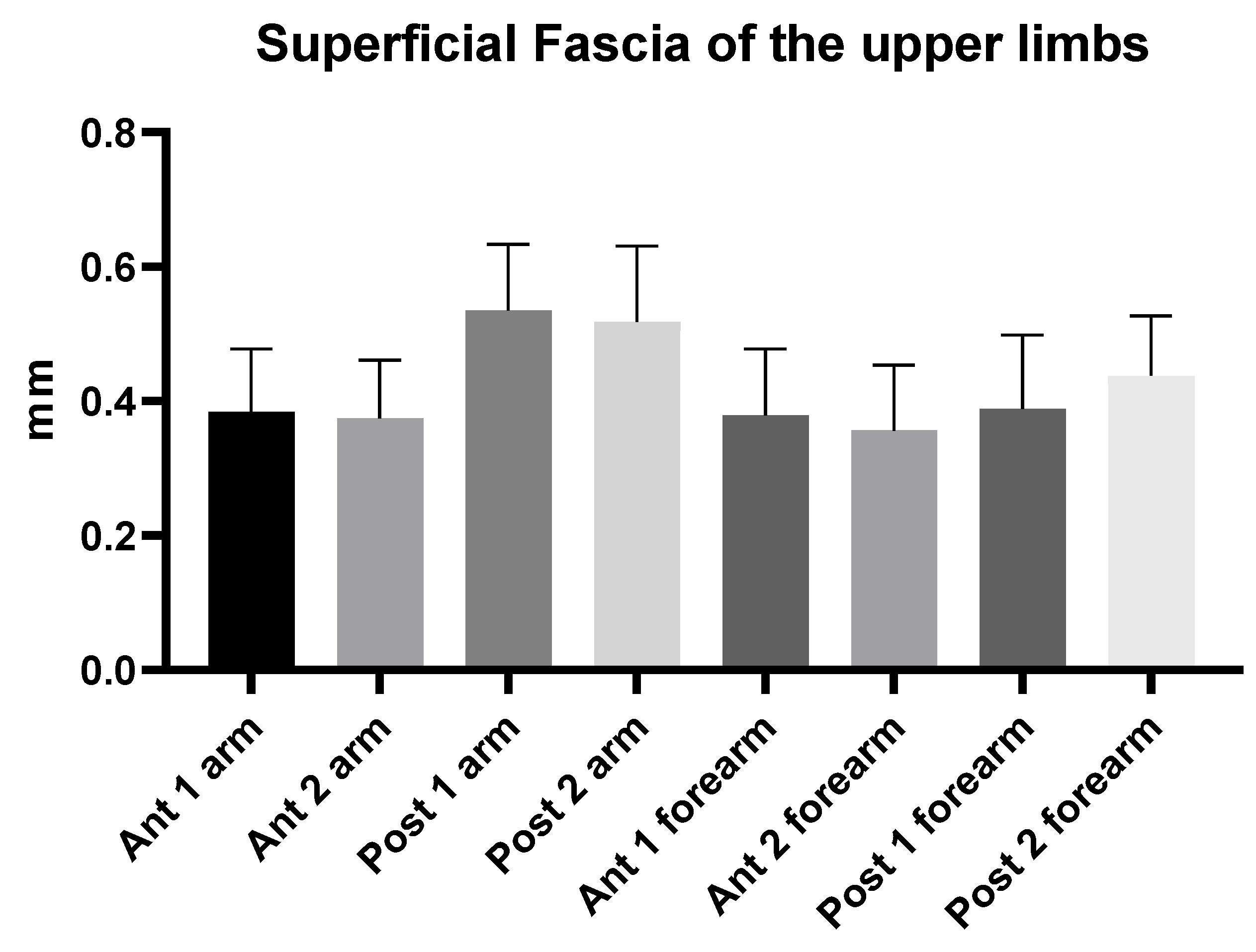
The superficial fascia has received much attention in recent years due to its important role of compartmentalizing the subcutaneous tissue. Ultrasound (US) imaging, owing to its high definition, provides the possibility of better visualizing and measuring its thickness. The aim of this study was to measure and compare, with US imaging, the thickness of superficial fascia in the arm and forearm in different regions/levels. An observational study has been performed using US imaging to measure superficial fascia thickness in the anterior and posterior regions at different levels in a sample of 30 healthy volunteers. The results for superficial fascia thickness revealed statistically significant differences (p < 0.0001) in the arm between the anterior and posterior regions; in terms of forearm, some statistically significant differences were found between regions/levels. However, in the posterior region/levels of the arm, the superficial fascia was thicker (0.53 ± 0.10 mm) than in the forearm (0.41 ± 0.10 mm); regarding the anterior regions/levels, the superficial fascia of the arm (0.40 ± 0.10 mm) was not statistically different than the forearm (0.40 ± 0.12 mm). In addition, the intra-rater reliability was good (ICC2,k: 0.88). US helps to visualize and assess the superficial fascia inside the subcutaneous tissue, improving the diagnosis of fascial dysfunction, and one of the Us parameters to reliably assess is the thickness in different regions and levels.
Keywords: superficial fascia; subcutaneous tissue; ultrasonography; thickness; reliability superficial fascia; subcutaneous tissue; ultrasonography; thickness; reliability