Article

An Enhanced Multiple Sclerosis Disease Diagnosis via an Ensemble Approach
1
Computer Science and Engineering Department, Faculty of Electronic Engineering, Menoufia University, Menouf 32952, Egypt
2
College of Computing and Information Technology, Arab Academy for Science, Technology, and Maritime Transport, Smart Village 12577, Egypt
*
Author to whom correspondence should be addressed.
These authors contributed equally to this work.
Diagnostics 2022, 12(7), 1771; https://doi.org/10.3390/diagnostics12071771

Submission received: 27 April 2022 / Revised: 25 June 2022 / Accepted: 18 July 2022 / Published: 21 July 2022
(This article belongs to the Section Machine Learning and Artificial Intelligence in Diagnostics)

Abstract

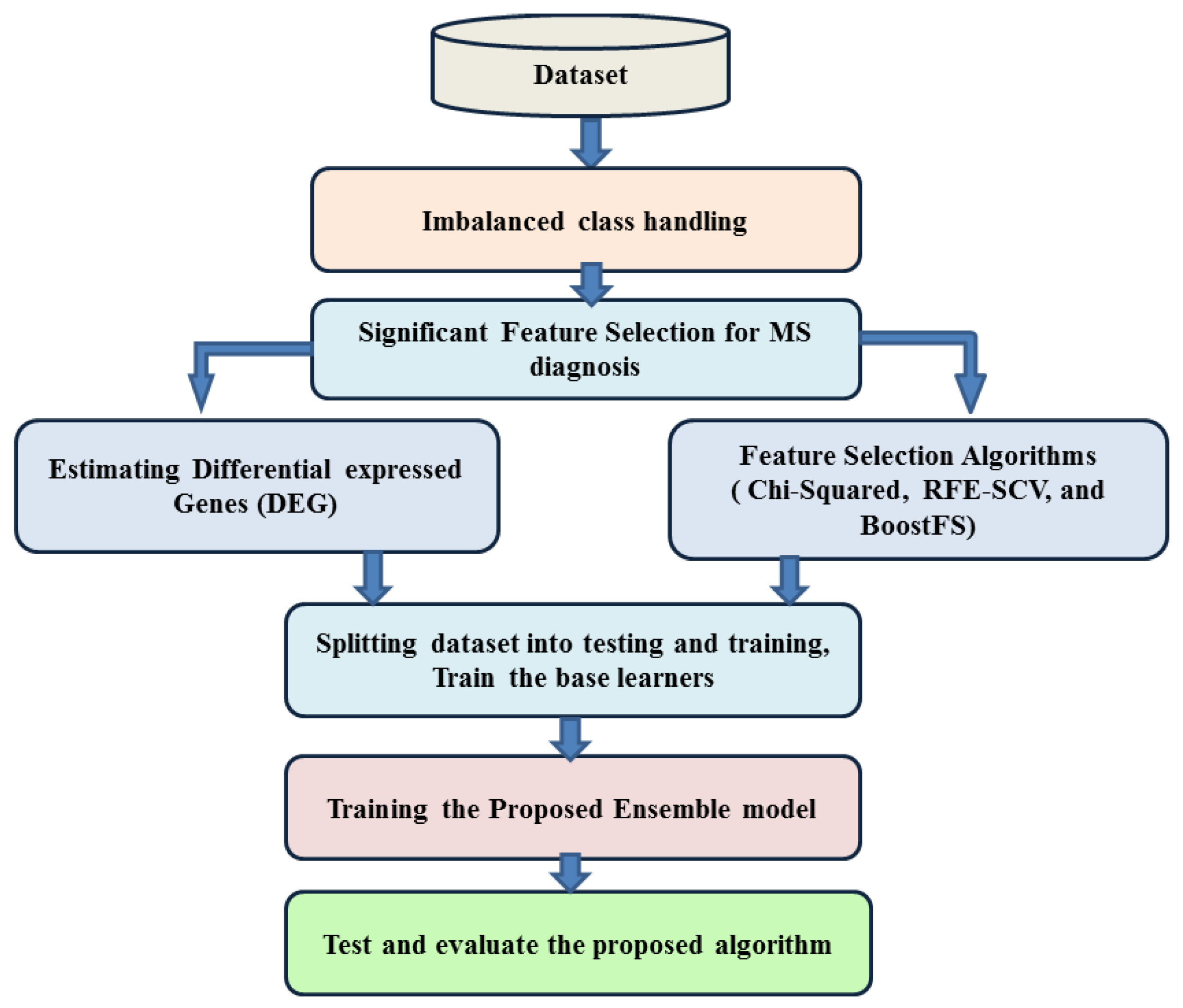
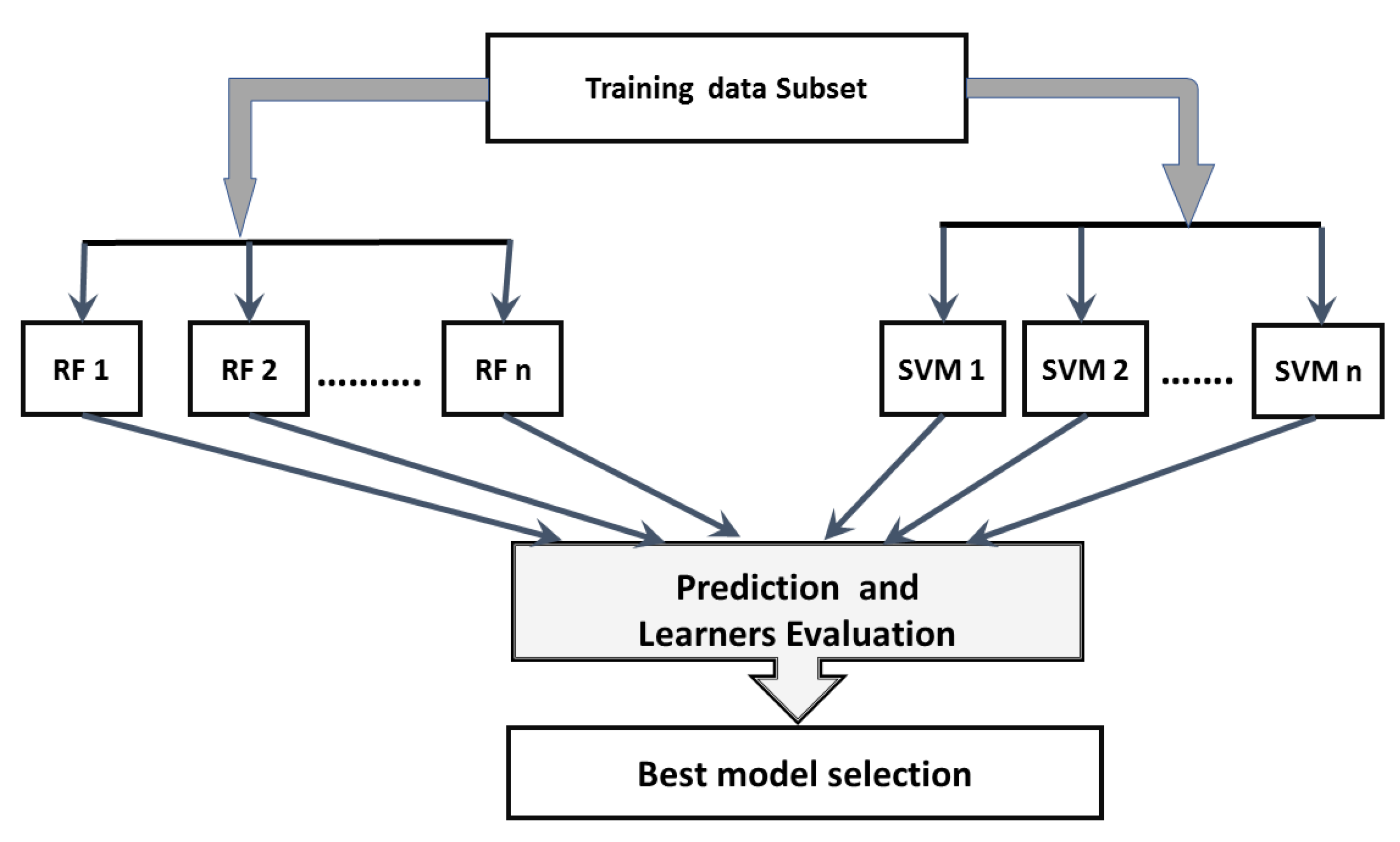
Multiple Sclerosis (MS) is a disease attacking the central nervous system. According to MS Atlas’s most recent statistics, there are more than 2.8 million people worldwide diagnosed with MS. Recently, studies started to explore machine learning techniques to predict MS using various data. The objective of this paper is to develop an ensemble approach for diagnosis of MS using gene expression profiles, while handling the class imbalance problem associated with the data. A hierarchical ensemble approach employing voting and boosting techniques is proposed. This approach adopts a heterogeneous voting approach using two base learners, random forest and support vector machine. Experiments show that our approach outperforms state-of-the-art methods, with the highest recorded accuracy being 92.81% and 93.5% with BoostFS and DEGs for feature selection, respectively. Conclusively, the proposed approach is able to efficiently diagnose MS using the gene expression profiles that are more relevant to the disease. The approach is not merely an ensemble classifier outperforming previous work; it also identifies differentially expressed genes between normal samples and patients with multiple sclerosis using a genome-wide expression microarray. The results obtained show that the proposed approach is an efficient diagnostic tool for MS.
Keywords: ensemble learning; multiple sclerosis; diagnosis; gene expression; differentially expressed genes ensemble learning; multiple sclerosis; diagnosis; gene expression; differentially expressed genes