Article

Prediction of Target Epidural Blood Patch Treatment Efficacy in Spontaneous Intracranial Hypotension Using Follow-Up MRI

1
Department of Radiology, Taichung Veterans General Hospital, Taichung 40705, Taiwan
2
Division of Hematology/Medical Oncology, Department of Medicine, Taichung Veterans General Hospital, Taichung 40705, Taiwan
3
College of Medicine, National Chung Hsing University, Taichung 40227, Taiwan
4
School of Medicine, Chung-Shan University, Taichung 40201, Taiwan
5
Department of Life Science, Tunghai University, Taichung 40704, Taiwan
6
College of Medicine, China Medical University, Taichung 406040, Taiwan
7
Department of Anesthesiology, Taichung Veterans General Hospital, Taichung 40705, Taiwan
8
Department of Financial Engineering, Providence University, Taichung 43301, Taiwan
9
Department of Data Science and Big Data Analytics, Providence University, Taichung 43301, Taiwan
10
Department of Neurology, Taichung Veterans General Hospital, Taichung 40705, Taiwan
11
School of Medicine, National Yang-Ming Chiao-Tung University, Taipei 30010, Taiwan
*
Author to whom correspondence should be addressed.
These authors contributed equally to this work.
Diagnostics 2022, 12(5), 1158; https://doi.org/10.3390/diagnostics12051158

Submission received: 20 April 2022 / Revised: 4 May 2022 / Accepted: 5 May 2022 / Published: 6 May 2022
(This article belongs to the Special Issue Diagnostic Imaging of Spinal Disorders)

Abstract

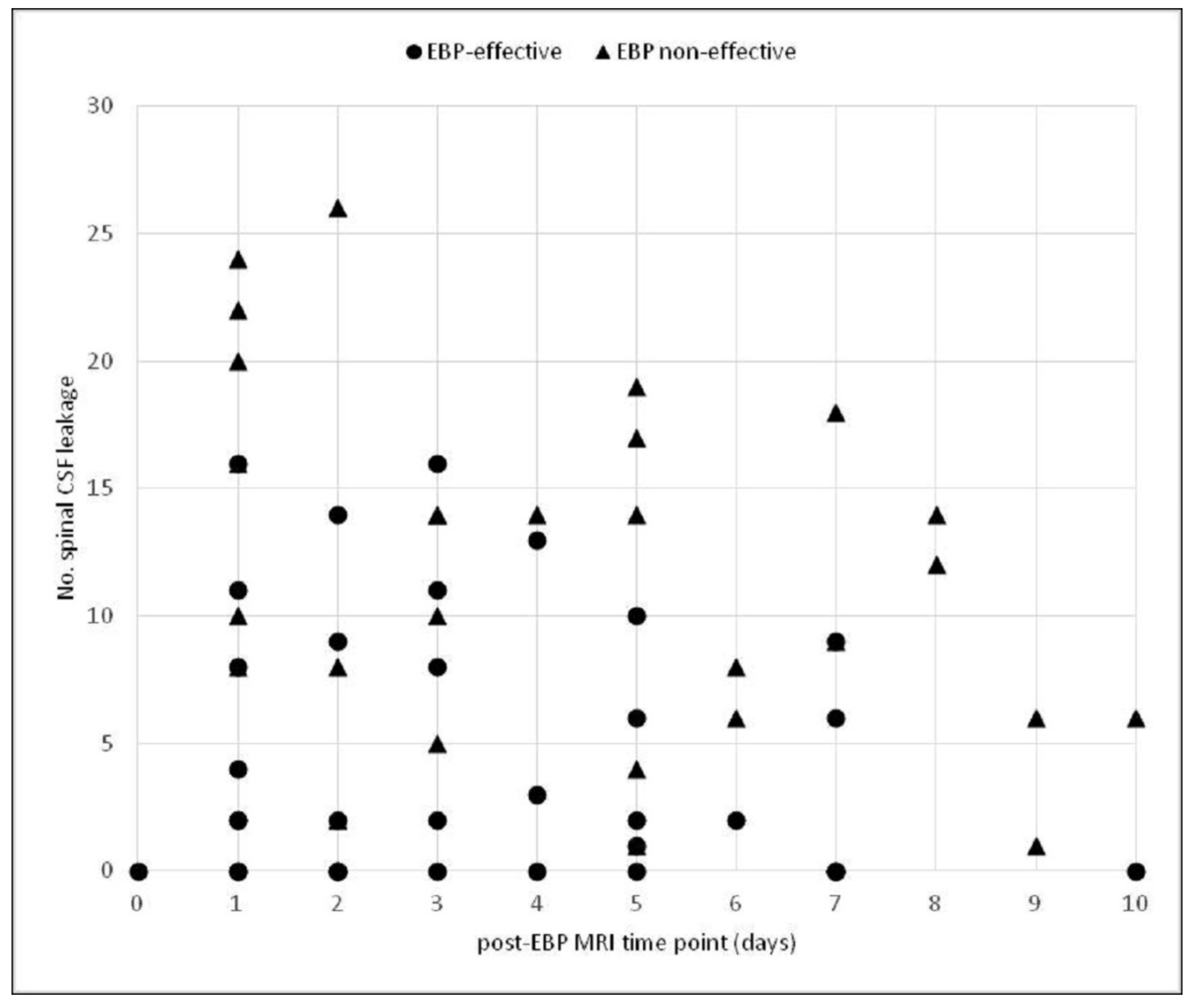
Objectives: Epidural blood patching (EBP) is the mainstay therapy for spontaneous intracranial hypotension (SIH). MRI is used for evaluating spinal CSF leakage. Post-EBP MRI has been. shown to be effective in predicting the efficacy of EBP. However, there are few reports on how post-EBP MRI findings may change with time. The aim of this study was to evaluate the relationship between post-EBP MRI findings at different time points and the corresponding effectiveness of EBP. Methods: We retrospectively reviewed 63 SIH patients who had received target EBP. All patients received an MRI follow-up within 10 days (post-EBP MRI) and at 3 months after EBP (3-month MRI). A sub-group analysis was performed at different post-EBP MRI time points (0–2, 3–6, and 7–10 days). The relationships between the post-EBP MRI findings and the EBP effectiveness were evaluated. Results: Thirty-five (55.56%) patients were assigned to the EBP-effective group, and 28 (44.44%) were assigned to the EBP non-effective group according to the 3-month MRI. Compared to the EBP non-effective group, the EBP-effective group had significantly lower numbers of spinal CSF leakage in the post-EBP MRI (4.49 vs. 11.71; p = 0.000) and greater numbers of leakage improvement (7.66 vs. 2.96; p = 0.003). For patients who received post-EBP MRI during periods of 0–10, 0–2, 3–6, and 7–10 days, the cutoff values of numbers of spinal CSF leakage for predicting EBP failure were 4, 6, 4, and 5, respectively, with an AUC above 0.77. Conclusion: By using post-EBP MRI, which only takes approximately 20 min, predicting EBP efficacy became possible in SIH patients. This study provides cutoff values of numbers of spinal CSF leakage at different follow-up times to serve as clues of if further EBP is needed, which provides the novelty of the current study.
Keywords: SIH; CSF; leakage; EBP; MRM SIH; CSF; leakage; EBP; MRM