Opinion

Preparing Laboratories for Interconnected Health Care

by
Andreas Bietenbeck
1,* and
Thomas Streichert
2
1
Institut für Laboratoriumsmedizin, Medizinische Mikrobiologie und Technische Hygiene, München Klinik, 80804 Munich, Germany
2
Institut für Klinische Chemie, Universität zu Köln, Medizinische Fakultät und Uniklinik Köln, 50937 Cologne, Germany
*
Author to whom correspondence should be addressed.
Diagnostics 2021, 11(8), 1487; https://doi.org/10.3390/diagnostics11081487

Submission received: 11 June 2021 / Revised: 26 July 2021 / Accepted: 28 July 2021 / Published: 17 August 2021
(This article belongs to the Section Machine Learning and Artificial Intelligence in Diagnostics)

Abstract

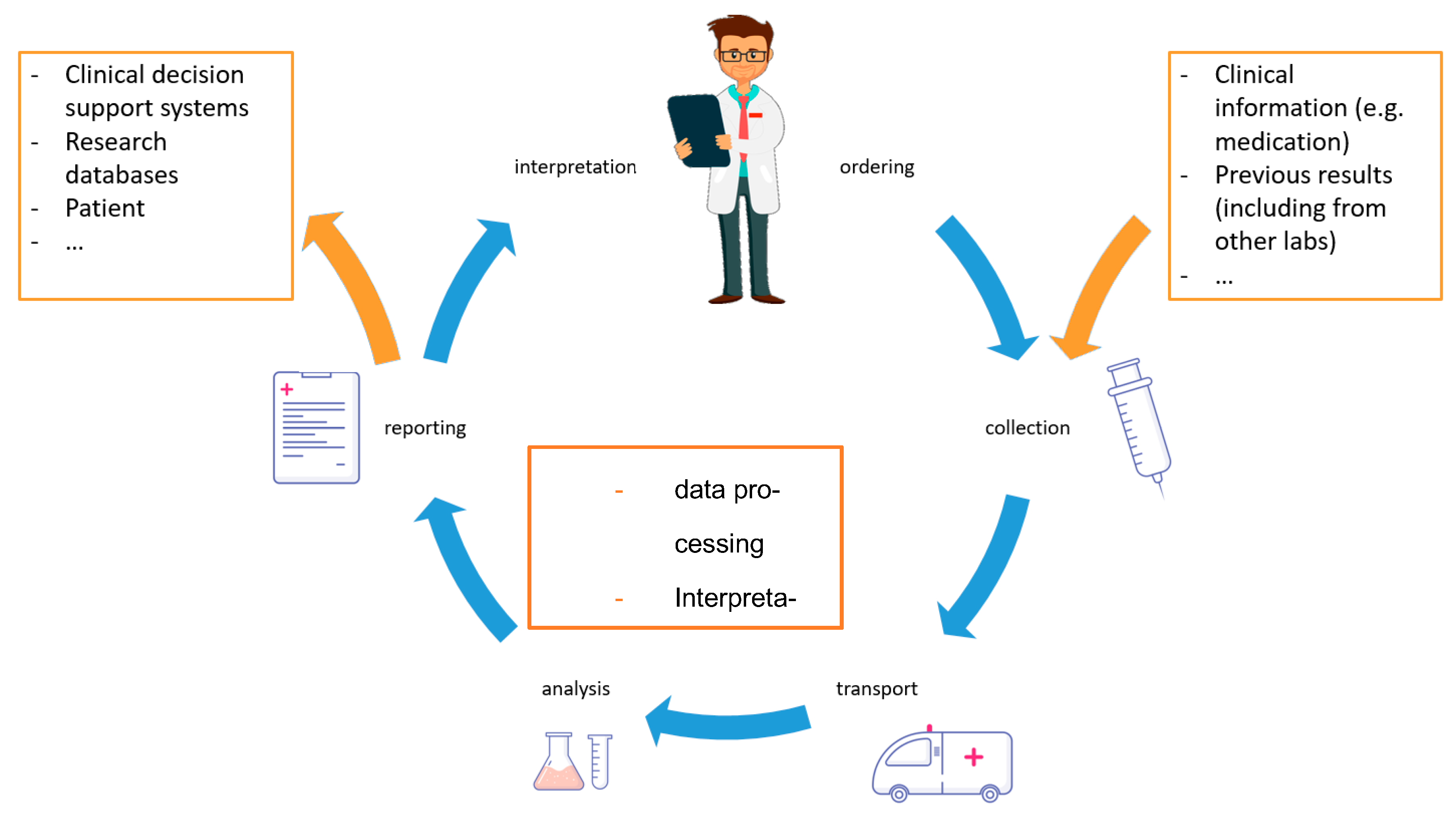
In an increasingly interconnected health care system, laboratory medicine can facilitate diagnosis and treatment of patients effectively. This article describes necessary changes and points to potential challenges on a technical, content, and organizational level. As a technical precondition, electronic laboratory reports have to become machine-readable and interpretable. Terminologies such as Logical Observation Identifiers Names and Codes (LOINC), Nomenclature for Properties and Units (NPU), Unified Code for Units of Measure (UCUM), and SNOMED-CT can lead to the necessary semantic interoperability. Even if only single “atomized” results of the whole report are extracted, the necessary information for correct interpretation must be available. Therefore, interpretive comments, e.g., concerns about an increased measurement uncertainty must be electronically attached to every affected measurement result. Standardization of laboratory analyses with traceable standards and reference materials will enable knowledge transfer and safe interpretation of laboratory analyses from multiple laboratories. In an interconnected health care system, laboratories should strive to transform themselves into a data hub that not only receives samples but also extensive information about the patient. On that basis, they can return measurement results enriched with high-quality interpretive comments tailored to the individual patient and unlock the full potential of laboratory medicine.
Keywords: interconnected healthcare; LOINC; SNOMED-CT; UCUM; NPU interconnected healthcare; LOINC; SNOMED-CT; UCUM; NPU