Article

Quantification of Ground Glass Opacities Can Be Useful to Describe Disease Activity in Systemic Sclerosis

by
Domenico Sambataro
1,2,†,
Gianluca Sambataro
1,3,*,†,
Francesca Pignataro
4,
Wanda Maglione
4,
Lorenzo Malatino
2,
Carlo Vancheri
3,
Michele Colaci
2 and
Nicoletta Del Papa
3
1
Artroreuma S.R.L., Outpatient of Rheumatology Associated with the National Health System corso S. Vito 53, 95030 Mascalucia, Italy
2
Department of Clinical and Experimental Medicine, Internal Medicine Unit, Cannizzaro Hospital, University of Catania, via Messina 829, 95100 Catania, Italy
3
Regional Referral Centre for Rare Lung Diseases, A. O. U. “Policlinico-Vittorio Emanuele” Department of Clinical and Experimental Medicine, University of Catania, 95123 Catania, Italy
4
Scleroderma Clinic, Department of Rheumatology, ASST G. Pini-CTO, 20122 Milan, Italy
*
Author to whom correspondence should be addressed.
These authors contributed equally to this work.
Diagnostics 2020, 10(4), 225; https://doi.org/10.3390/diagnostics10040225

Submission received: 22 March 2020 / Revised: 10 April 2020 / Accepted: 13 April 2020 / Published: 16 April 2020
(This article belongs to the Special Issue Clinical and Radiological Features of Interstitial Lung Diseases)

Abstract

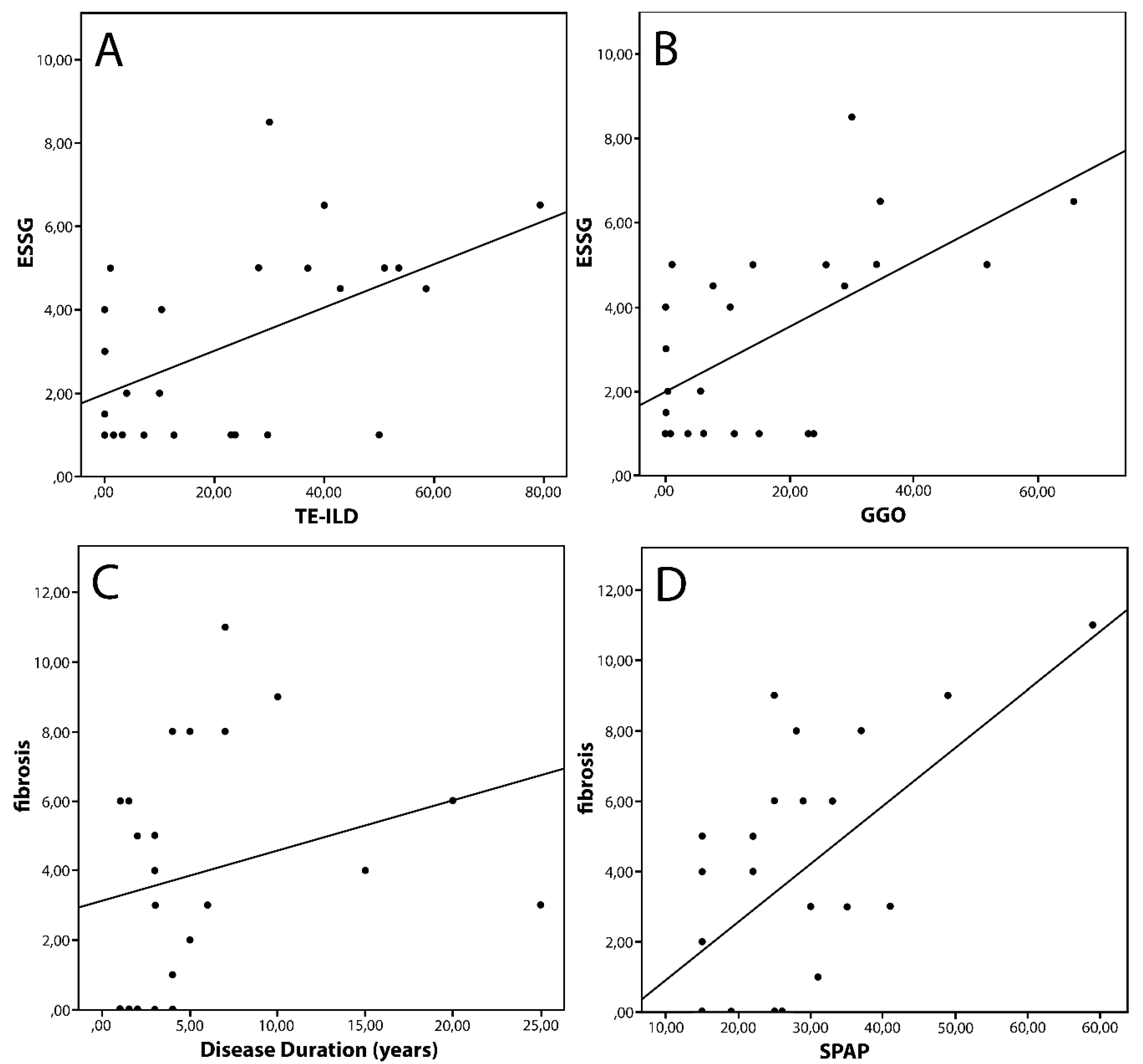
Interstitial lung disease (ILD) is the main cause of death in systemic sclerosis (SSc) patients. Usually, patients have lung involvement characterized by ground glass opacities (GGOs), but honeycombing (HC) is also possible. The Wells score is a semi-quantitative index, which is able to assess ILD by distinguishing its main components. The aim of this work is to evaluate the Wells score in relation to the disease activity (DA) index. We enrolled 40 consecutive SSc-ILD patients (26 diffuse cutaneous form, dcSSc, and 14 limited form, lcSSc). All patients were evaluated by the European Scleroderma Study Group (ESSG) index, high-resolution computed tomography, transthoracic echocardiogram, pulmonary function tests (PTSs), and nailfold videocapillaroscopy for the number of microhemorrhages (NEMO) score. In our study, the total extent of ILD (TE-ILD), fibrosis and GGOs correlated with dyspnea (p = 0.03, 0.01 and 0.01 respectively), but not with the ESSG index. Considering only the dcSSc patients, TE-ILD and GGOs correlated with the ESSG index (r = 0.5 p = 0.009), while fibrosis grade correlated with disease duration and systolic pulmonary artery pressure. In conclusion, our data suggest that GGO correlates with DA, while fibrosis may be a sign of disease damage. The quantification of pulmonary involvement using the Wells score can be a useful tool for assessing the appropriate treatment in SSc patients.
Keywords: systemic sclerosis; interstitial lung disease; lung fibrosis; ground glass opacities; honeycombing; high resolution computed tomography; disease activity; NEMO score; Wells score; disease severity systemic sclerosis; interstitial lung disease; lung fibrosis; ground glass opacities; honeycombing; high resolution computed tomography; disease activity; NEMO score; Wells score; disease severity