Neurosensory Integration and Balance Adaptation: Personalization of Postural Control Through the Prism of Individual Spatial Perception




Abstract
1. Introduction
2. Literature Search Strategy
Search Strategy

| Stage | Description | Numbers/Criteria |
|---|---|---|
| Databases searched | PubMed/MEDLINE, Scopus, Web of Science Core Collection | - |
| Time frame | January 2000–May 2026 | Start date selected to capture emergence of modern multisensory integration models and early VR applications in balance research |
| Language restrictions | English, Russian | Peer-reviewed articles only |
| Search string components | (“postural control” OR “balance”) AND (“sensory reweighting” OR “sensorimotor integration”) AND (“virtual reality” OR “sensory conflict”) AND (“field dependence” OR “cognitive style”) | - |
| Full-text eligibility assessment | Assessment against inclusion/exclusion criteria | Assessed: 118; Excluded: 44 (insufficient methodological detail, no mechanistic data, overlapping publications) |
| Studies included in synthesis | Narrative, thematic synthesis | 73 studies |
| Thematic distribution of included studies | Categorization by primary focus |
|
| Quality appraisal approach | Narrative review design; formal risk-of-bias assessment not applied | Critical appraisal of experimental design, sample characteristics, VR hardware specifications, and relevance to proposed neurocognitive framework |
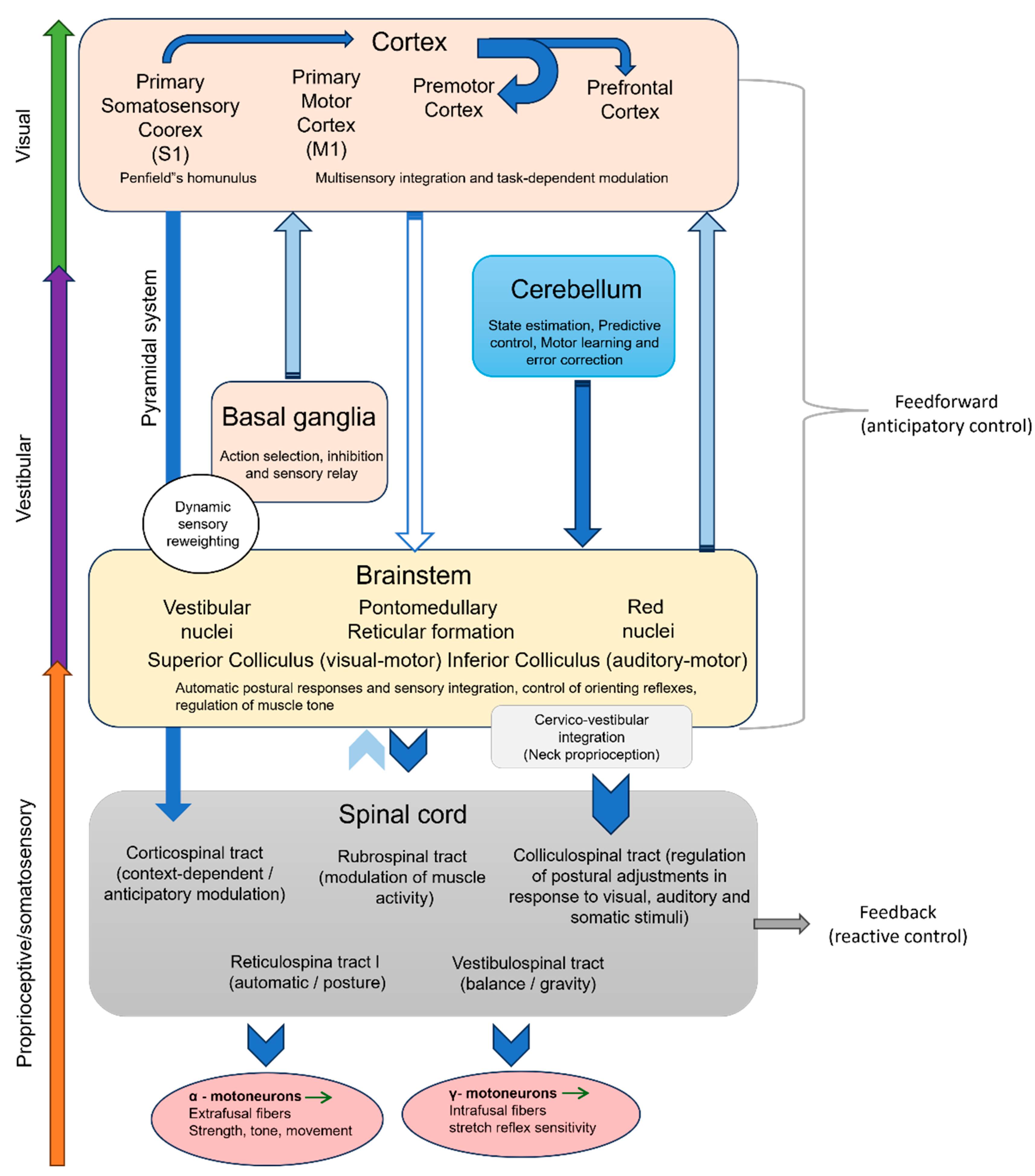
3. Modern Theories of Postural Control
3.1. Dual Mechanisms of Stability: Reactive and Anticipatory Control
3.2. Neural Substrates: A Multi-Level Hierarchical Network
3.3. Experimental and Neurophysiological Methods for Probing Postural Control Mechanisms
3.4. Biomechanical Strategies and Segmental Organization
4. Cognitive Styles of Sensory Integration
4.1. Field-Dependence/Independence as a Determinant of Sensory Strategy
4.2. Diagnostic Approaches: From Embedded Figures to Postural Metrics
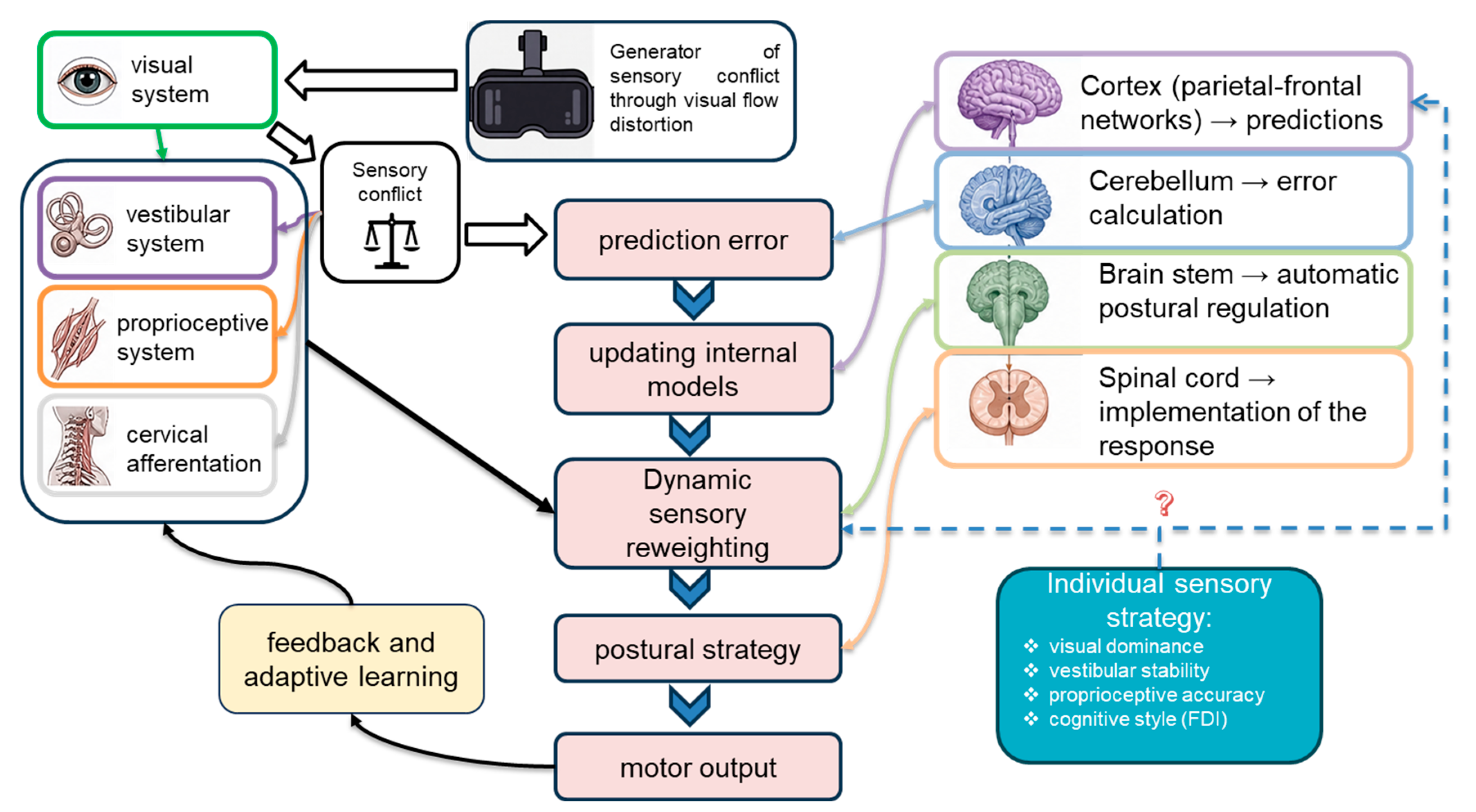
5. Immersive Virtual Reality as a Neuromodulation Tool
5.1. Virtual Reality as a Platform for Controlled Sensory Conflict
5.2. Neurophysiological Mechanisms of Adaptation in Virtual Environments
5.3. Age-Related Changes in Sensory Reweighting
5.4. Individual Variability and the Role of Cognitive Styles in VR Response
5.5. From Universal Protocols to Personalized Neuromodulation
6. Discussion
6.1. Methodological and Technical Limitations of VR in Postural Research
6.2. Translational Gaps and Future Directions for Personalized VR Rehabilitation
6.3. Causal Interpretations and Alternative Hypotheses
6.4. Translational Implications for Clinical Populations
6.5. Methodological Limitations
7. Conclusions
Author Contributions
Funding
Institutional Review Board Statement
Informed Consent Statement
Data Availability Statement
Conflicts of Interest
References
- Takakusaki, K. Functional Neuroanatomy for Posture and Gait Control. J. Mov. Disord. 2017, 10, 1. [Google Scholar] [CrossRef] [PubMed]
- Keshner, E.A.; Mallinson, A.I.; Longridge, N.S.; Sinno, S.; Petersen, H.; Perrin, P. Evolution of postural control assessment: From dynamic posturography to virtual reality. Front. Neurol. 2023, 13, 1054346. [Google Scholar] [CrossRef] [PubMed]
- Assländer, L.; Peterka, R.J. Sensory reweighting dynamics in human postural control. J. Neurophysiol. 2014, 111, 1852–1864. [Google Scholar] [CrossRef] [PubMed]
- Dewan, B.M.; James, C.R.; Kumar, N.A.; Burgess, N.; Zupancic, S.; Sawyer, S.F. Adaptation in motor strategies for postural control associated with sensory reweighting. Hum. Mov. Sci. 2023, 89, 103098. [Google Scholar] [CrossRef] [PubMed]
- Sadeghi, M.; Bristow, T.; Fakorede, S.; Liao, K.; Palmer, J.A.; Lyons, K.E.; Pahwa, R.; Huang, C.-K.; Akinwuntan, A.; Devos, H. The Effect of Sensory Reweighting on Postural Control and Cortical Activity in Parkinson’s Disease: A Pilot Study. Arch. Rehabil. Res. Clin. Transl. 2024, 6, 100368. [Google Scholar] [CrossRef] [PubMed]
- Isableu, B.; Ohlmann, T.; Crémieux, J.; Amblard, B. How dynamic visual field dependence-independence interacts with the visual contribution to postural control. Hum. Mov. Sci. 1998, 17, 367–391. [Google Scholar] [CrossRef]
- Sakaki, Y.; Hasegawa, N.; Kawata, A.; Akagi, H.; Sawada, M.; Mani, H. Effect of Difference of Sensory Modality in Cognitive Task on Postural Control During Quiet Stance. Sensors 2025, 25, 1273. [Google Scholar] [CrossRef] [PubMed]
- Danna-dos-Santos, A.; Ribeiro Dos Santos, M.M.; Magalhães, A.T.; Cardoso, V.S.; Driusso, P.; Mochizuki, L.; Degani, A.M. Visuo-postural dependency index (VPDI) in human postural control. BMC Sports Sci. Med. Rehabil. 2021, 13, 7. [Google Scholar] [CrossRef] [PubMed]
- Yu, Y.; Lauer, R.T.; Tucker, C.A.; Thompson, E.D.; Keshner, E.A. Visual dependence affects postural sway responses to continuous visual field motion in individuals with cerebral palsy. Dev. Neurorehabilit. 2018, 21, 531–541. [Google Scholar] [CrossRef] [PubMed]
- Massion, J. Movement, posture and equilibrium: Interaction and coordination. Prog. Neurobiol. 1992, 38, 35–56. [Google Scholar] [CrossRef] [PubMed]
- Jacobs, J.V.; Horak, F.B. Cortical control of postural responses. J. Neural Transm. 2007, 114, 1339–1348. [Google Scholar] [CrossRef] [PubMed]
- Mochizuki, G.; Boe, S.G.; Marlin, A.; McIlroy, W.E. Performance of a concurrent cognitive task modifies pre- and post-perturbation-evoked cortical activity. Neuroscience 2017, 348, 143–152. [Google Scholar] [CrossRef] [PubMed]
- Omura, Y.; Kaminishi, K.; Chiba, R.; Takakusaki, K.; Ota, J. A Neural Controller Model Considering the Vestibulospinal Tract in Human Postural Control. Front. Comput. Neurosci. 2022, 16, 785099. [Google Scholar] [CrossRef] [PubMed]
- Ketterer, J.; Gollhofer, A.; Ringhof, S.; Assländer, L.; Granacher, U.; Gehring, D. Effects of balance training with visual input manipulations on balance performance and sensory integration in healthy young adults: A randomized controlled trial. Sci. Rep. 2024, 14, 28589. [Google Scholar] [CrossRef] [PubMed]
- Lee, J.; Phu, S.; Lord, S.R.; Okubo, Y. Effects of immersive virtual reality training on balance, gait and mobility in older adults: A systematic review and meta-analysis. Gait Posture 2024, 110, 129–137. [Google Scholar] [CrossRef] [PubMed]
- Honeine, J.-L.; Schieppati, M. Time-interval for integration of stabilizing haptic and visual information in subjects balancing under static and dynamic conditions. Front. Syst. Neurosci. 2014, 8, 190. [Google Scholar] [CrossRef] [PubMed]
- Kubicki, A.; Mourey, F.; Bonnetblanc, F. Balance control in aging: Improvements in anticipatory postural adjustments and updating of internal models. BMC Geriatr. 2015, 15, 162. [Google Scholar] [CrossRef] [PubMed]
- Missen, K.J.; Carpenter, M.G.; Assländer, L. Velocity dependence of sensory reweighting in human balance control. J. Neurophysiol. 2024, 132, 454–460. [Google Scholar] [CrossRef] [PubMed]
- Monaghan, A.S.; Takla, T.; Ofori, E.; Peterson, D.S.; Wu, W.; Fritz, N.E.; Longhurst, J.K. The Neural Contributions to Reactive Balance Control: A Scoping Review of EEG, fNIRS, MRI, and PET Studies. Brain Sci. 2025, 15, 1330. [Google Scholar] [CrossRef] [PubMed]
- Saj, A.; Borel, L.; Honoré, J. Functional Neuroanatomy of Vertical Visual Perception in Humans. Front. Neurol. 2019, 10, 142. [Google Scholar] [CrossRef] [PubMed]
- Wittenberg, E.; Thompson, J.; Nam, C.S.; Franz, J.R. Neuroimaging of Human Balance Control: A Systematic Review. Front. Hum. Neurosci. 2017, 11, 170. [Google Scholar] [CrossRef] [PubMed]
- Dijkstra, B.W.; Bekkers, E.M.J.; Gilat, M.; De Rond, V.; Hardwick, R.M.; Nieuwboer, A. Functional neuroimaging of human postural control: A systematic review with meta-analysis. Neurosci. Biobehav. Rev. 2020, 115, 351–362. [Google Scholar] [CrossRef] [PubMed]
- Mizes, K.G.C.; Lindsey, J.; Escola, G.S.; Ölveczky, B.P. The role of motor cortex in motor sequence execution depends on demands for flexibility. Nat. Neurosci. 2024, 27, 2466–2475. [Google Scholar] [CrossRef] [PubMed]
- Hitier, M.; Besnard, S.; Smith, P.F. Vestibular pathways involved in cognition. Front. Integr. Neurosci. 2014, 8, 59. [Google Scholar] [CrossRef] [PubMed]
- Ghai, S.; Ghai, I.; Effenberg, A.O. Effects of Dual Tasks and Dual-Task Training on Postural Stability: A Systematic Review and Meta-Analysis. Clin. Interv. Aging 2017, 12, 557–577. [Google Scholar] [CrossRef] [PubMed]
- Woollacott, M.; Shumway-Cook, A. Attention and the control of posture and gait: A review of an emerging area of research. Gait Posture 2002, 16, 1–14. [Google Scholar] [CrossRef] [PubMed]
- Smith, J.A.; Tain, R.; Sharp, K.G.; Glynn, L.M.; Van Dillen, L.R.; Henslee, K.; Jacobs, J.V.; Cramer, S.C. Identifying the neural correlates of anticipatory postural control: A novel fMRI paradigm. Hum. Brain Mapp. 2023, 44, 4088–4100. [Google Scholar] [CrossRef] [PubMed]
- Bazanova, O.M.; Kovaleva, A.V. Psychophysiological Indicators of Postural Control: Contribution of the Russian Scientific School. Part I. Hum. Physiol. 2022, 48, 207–228. [Google Scholar] [CrossRef] [PubMed]
- Rinaldi, N.M.; Polastri, P.F.; Barela, J.A. Age-related changes in postural control sensory reweighting. Neurosci. Lett. 2009, 467, 225–229. [Google Scholar] [CrossRef] [PubMed]
- Behtani, L.; Paromov, D.; Moïn-Darbari, K.; Houde, M.-S.; Bacon, B.A.; Maheu, M.; Leroux, T.; Champoux, F. Sensory Reweighting for Postural Control in Older Adults with Age-Related Hearing Loss. Brain Sci. 2023, 13, 1623. [Google Scholar] [CrossRef] [PubMed]
- Ernst, M.O.; Banks, M.S. Humans integrate visual and haptic information in a statistically optimal fashion. Nature 2002, 415, 429–433. [Google Scholar] [CrossRef] [PubMed]
- Viljanen, A.; Kaprio, J.; Pyykko, I.; Sorri, M.; Pajala, S.; Kauppinen, M.; Koskenvuo, M.; Rantanen, T. Hearing as a Predictor of Falls and Postural Balance in Older Female Twins. J. Gerontol. A Biol. Sci. Med. Sci. 2009, 64A, 312–317. [Google Scholar] [CrossRef] [PubMed]
- Jiam, N.T.; Li, C.; Agrawal, Y. Hearing loss and falls: A systematic review and meta-analysis. Laryngoscope Investig. Otolaryngol. 2020, 5, 589–599. [Google Scholar] [CrossRef] [PubMed]
- Barollo, F.; Hassan, M.; Petersen, H.; Rigoni, I.; Ramon, C.; Gargiulo, P.; Fratini, A. Cortical Pathways During Postural Control: New Insights From Functional EEG Source Connectivity. IEEE Trans. Neural Syst. Rehabil. Eng. 2022, 30, 72–84. [Google Scholar] [CrossRef] [PubMed]
- Shamantseva, N.; Sakun, I.; Klishkovskaia, T.; Aksenov, A.; Lyakhovetskii, V.; Moshonkina, T. Postural control in humans: A study using transcutaneous spinal cord stimulation. Exp. Physiol. 2026, 111, 2163–2175. [Google Scholar] [CrossRef] [PubMed]
- Horak, F.B.; Nashner, L.M. Central programming of postural movements: Adaptation to altered support-surface configurations. J. Neurophysiol. 1986, 55, 1369–1381. [Google Scholar] [CrossRef] [PubMed]
- Simonsen, E.B. Contributions to the understanding of gait control. Dan. Med. J. 2014, 61, B4823. [Google Scholar] [PubMed]
- Pettorossi, V.E.; Schieppati, M. Neck Proprioception Shapes Body Orientation and Perception of Motion. Front. Hum. Neurosci. 2014, 8, 895. [Google Scholar] [CrossRef] [PubMed]
- Peterka, R.J. Sensorimotor Integration in Human Postural Control. J. Neurophysiol. 2002, 88, 1097–1118. [Google Scholar] [CrossRef] [PubMed]
- Witkin, H.A.; Goodenough, D.R. Cognitive Styles, Essence And Origins: Field Dependence And Field Independence; Psychological Issues; International Universities Press: New York, NY, USA, 1981; ISBN 978-0-8236-1003-7. [Google Scholar]
- Loram, I.D.; Lakie, M.; Gawthrop, P.J. Visual control of stable and unstable loads: What is the feedback delay and extent of linear time-invariant control? J. Physiol. 2009, 587, 1343–1365. [Google Scholar] [CrossRef] [PubMed]
- Tinajero, C.; Páramo, M.F. Field dependence-independence cognitive style and academic achievement: A review of research and theory. Eur. J. Psychol. Educ. 1998, 13, 227–251. [Google Scholar] [CrossRef]
- Bikchentaeva, L.; Nikulina, M.; Shulman, A.; Baltin, M.; Zheltukhina, A.; Semenova, E.; Smirnova, V.; Klepikova, S.; Baltina, T. Different Factors Influencing Postural Stability during Transcutaneous Electrical Stimulation of the Cervical Spinal Cord. J. Funct. Morphol. Kinesiol. 2024, 9, 142. [Google Scholar] [CrossRef] [PubMed]
- Baltin, M.; Vinogradova, E.; Bravyy, Y.; Onishchenko, D. Biomechanical determinants of quadriceps femoris strength contribution to dynamic postural stability. Russ. J. Biomech. 2025, 29, 45–53. [Google Scholar] [CrossRef]
- Shamantseva, N.; Timofeeva, O.; Semenova, V.; Andreeva, I.; Moshonkina, T. Transcutaneous spinal cord stimulation modulates quiet standing in healthy adults: Stimulation site and cognitive style matter. Front. Neurosci. 2024, 18, 1467182. [Google Scholar] [CrossRef] [PubMed]
- Maneuvrier, A.; Decker, L.M.; Renaud, P.; Ceyte, G.; Ceyte, H. Field (In)dependence Flexibility Following a Virtual Immersion Is Associated With Cybersickness and Sense of Presence. Front. Virtual Real. 2021, 2, 706712. [Google Scholar] [CrossRef]
- Slifstein, M.; Kegeles, L.S.; Xu, X.; Thompson, J.L.; Urban, N.; Castrillon, J.; Hackett, E.; Bae, S.-A.; Laruelle, M.; Abi-Dargham, A. Striatal and extrastriatal dopamine release measured with PET and [18F] fallypride. Synapse 2010, 64, 350–362. [Google Scholar] [CrossRef] [PubMed]
- Liu, X.; Wang, G.; Zhang, R.; Ren, Z.; Wang, D.; Liu, J.; Wang, J.; Gao, Y. Sensory reweighting and self-motion perception for postural control under single-sensory and multisensory perturbations in older Tai Chi practitioners. Front. Hum. Neurosci. 2024, 18, 1482752. [Google Scholar] [CrossRef] [PubMed]
- Isableu, B.; Ohlmann, T.; Crémieux, J.; Amblard, B. Selection of spatial frame of reference and postural control variability. Exp. Brain Res. 1997, 114, 584–589. [Google Scholar] [CrossRef] [PubMed]
- Barbanchon, C.; Mouraux, D.; Baudry, S. Repeated exposure to virtual reality decreases reliance on visual inputs for balance control in healthy adults. Hum. Mov. Sci. 2024, 96, 103236. [Google Scholar] [CrossRef] [PubMed]
- Şirvan Tongar, S.; Yazici-Mutlu, Ç. How virtual reality is impacting balance: An examination of postural stability. J. Bodyw. Mov. Ther. 2024, 38, 81–85. [Google Scholar] [CrossRef] [PubMed]
- Wilson, E.B.; Bergquist, J.S.; Wright, W.G.; Jacobs, D.A. Gait stability in virtual reality: Effects of VR display modality in the presence of visual perturbations. J. Neuroeng. Rehabil. 2025, 22, 32. [Google Scholar] [CrossRef] [PubMed]
- Miehlbradt, J.; Cuturi, L.F.; Zanchi, S.; Gori, M.; Micera, S. Immersive virtual reality interferes with default head-trunk coordination strategies in young children. Sci. Rep. 2021, 11, 17959. [Google Scholar] [CrossRef] [PubMed]
- Teng, X.; Wilcox, L.M.; Allison, R.S. The effect of gain adaptation on perception and posture. Sci. Rep. 2025, 15, 39605. [Google Scholar] [CrossRef] [PubMed]
- Yang, Y.; Kang, S.; Kim, M.; Kim, G.J.; Kim, H. BalanceVR: Balance training to increase tolerance to cybersickness in immersive virtual reality. Virtual Real. 2025, 29, 39. [Google Scholar] [CrossRef]
- Tian, M.-Y.; Lee, M.-H.; Kim, J.-H.; Kim, M.-K. Effectiveness of Virtual Reality Therapy on Static Postural Control and Dynamic Balance in Stroke Patients: Systematic Review, Meta-Analysis, and Meta-Regression of Randomized Controlled Trials. Medicina 2025, 62, 90. [Google Scholar] [CrossRef] [PubMed]
- Christofoletti, G.; Béé, G.M.D.S.; Reginato, O.; Rodrigues, N.O.; Franco, S.S.P.C.; De Souza Pegorare, A.B.G. Effects of 3D Virtual Reality on Postural Control in Young Adults: Clinical and Practical Implications. Clin. Pract. 2026, 16, 40. [Google Scholar] [CrossRef] [PubMed]
- Rosiak, O.; Pietrzak, N.; Szczęsna, A.; Kulczak, I.; Zwoliński, G.; Kamińska, D.; Konopka, W.; Jozefowicz-Korczynska, M. The effect of Immersive Virtual Reality on balance: An exploratory study on the feasibility of head-mounted displays for balance evaluation. Sci. Rep. 2024, 14, 3481. [Google Scholar] [CrossRef] [PubMed]
- Zhang, B.; Liu, Y.; Lin, Z.; Li, C. Effect of virtual reality-based training on postural balance in children and adolescents with neurodevelopmental disorders: A systematic review and meta-analysis. Front. Public Health 2026, 13, 1719286. [Google Scholar] [CrossRef] [PubMed]
- Fransson, P.-A.; Patel, M.; Jensen, H.; Lundberg, M.; Tjernström, F.; Magnusson, M.; Ekvall Hansson, E. Postural instability in an immersive Virtual Reality adapts with repetition and includes directional and gender specific effects. Sci. Rep. 2019, 9, 3168. [Google Scholar] [CrossRef] [PubMed]
- Neumann, S.; Mvomo, C.; Ravi, D.; Schulte, F.; Assländer, L.; Easthope Awai, C. Visual Dependence in Postural Control Is Increased in Older Adults. Aging Dis. 2025. [Google Scholar] [CrossRef] [PubMed]
- Oh, M.; Lee, H.; Han, S.; Hopkins, J.T. Virtual Reality-Based Assessment of Static Postural Control Among Individuals With Chronic Ankle Instability, Copers, and Controls. J. Sport Rehabil. 2026, 35, 200–206. [Google Scholar] [CrossRef] [PubMed]
- Gerber, E.D.; Huang, C.-K.; Moon, S.; Devos, H.; Luchies, C.W. Sensory reweighting of postural control requires distinct rambling and trembling sway adaptations. Gait Posture 2024, 112, 16–21. [Google Scholar] [CrossRef] [PubMed]
- Abayasiri, A.M.; Padilha Lanari Bo, A.; Baghaei, N.; Dick, T.J.M. Virtual Reality illusions systematically perturb balance in young and older adults. Gait Posture 2026, 128, 110172. [Google Scholar] [CrossRef] [PubMed]
- Bendixen, J.B.; Biddinger, B.T.; Simon, J.E.; Monfort, S.M.; Grooms, A.D.R. Effects of virtual reality immersion on postural stability during a dynamic transition task. Sports Biomech. 2025, 24, 859–873. [Google Scholar] [CrossRef] [PubMed]
- Tomita, Y.; Mani, H.; Hasegawa, N. Visual feedback adaptation enhances arm-posture coordination during floor-surface perturbations. Front. Hum. Neurosci. 2025, 19, 1699598. [Google Scholar] [CrossRef] [PubMed]
- Imaoka, Y.; Hauri, L.; Flury, A.; De Bruin, E.D. Linking cognitive functioning and postural balance control through virtual reality environmental manipulations. Front. Aging Neurosci. 2022, 14, 954050. [Google Scholar] [CrossRef] [PubMed]
- Levin, M.F.; Weiss, P.L.; Keshner, E.A. Emergence of Virtual Reality as a Tool for Upper Limb Rehabilitation: Incorporation of Motor Control and Motor Learning Principles. Phys. Ther. 2015, 95, 415–425. [Google Scholar] [CrossRef] [PubMed]
- Rebenitsch, L.; Owen, C. Review on Cybersickness in Applications and Visual Displays. Virtual Real. 2016, 20, 101–125. [Google Scholar] [CrossRef]
- Dunsky, A. The Effect of Balance and Coordination Exercises on Quality of Life in Older Adults: A Mini-Review. Front. Aging Neurosci. 2019, 11, 318. [Google Scholar] [CrossRef] [PubMed]
- Bayot, M.; Dujardin, K.; Tard, C.; Defebvre, L.; Bonnet, C.T.; Allart, E.; Delval, A. The Interaction between Cognition and Motor Control: A Theoretical Framework for Dual-Task Interference Effects on Posture, Gait Initiation, Gait and Turning. Neurophysiol. Clin. 2018, 48, 361–375. [Google Scholar] [CrossRef] [PubMed]
- Borel, L.; Alescio-Lautier, B. Posture and Cognition in the Elderly: Interaction and Contribution to the Rehabilitation Strategies. Neurophysiol. Clin. 2014, 44, 95–107. [Google Scholar] [CrossRef] [PubMed]
- Brauer, S.G.; Woollacott, M.; Shumway-Cook, A. The Interacting Effects of Cognitive Demand and Recovery of Postural Stability in Balance-Impaired Elderly Persons. J. Gerontol. A Biol. Sci. Med. Sci. 2001, 56, M489–M496. [Google Scholar] [CrossRef] [PubMed]


Disclaimer/Publisher’s Note: The statements, opinions and data contained in all publications are solely those of the individual author(s) and contributor(s) and not of MDPI and/or the editor(s). MDPI and/or the editor(s) disclaim responsibility for any injury to people or property resulting from any ideas, methods, instructions or products referred to in the content. |
© 2026 by the authors. Licensee MDPI, Basel, Switzerland. This article is an open access article distributed under the terms and conditions of the Creative Commons Attribution (CC BY) license.
Share and Cite
Baltin, M.; Nikulina, M.; Sabirova, D.; Baltina, T. Neurosensory Integration and Balance Adaptation: Personalization of Postural Control Through the Prism of Individual Spatial Perception. Life 2026, 16, 1125. https://doi.org/10.3390/life16071125
Baltin M, Nikulina M, Sabirova D, Baltina T. Neurosensory Integration and Balance Adaptation: Personalization of Postural Control Through the Prism of Individual Spatial Perception. Life. 2026; 16(7):1125. https://doi.org/10.3390/life16071125
Chicago/Turabian StyleBaltin, Maxim, Margarita Nikulina, Diana Sabirova, and Tatyana Baltina. 2026. "Neurosensory Integration and Balance Adaptation: Personalization of Postural Control Through the Prism of Individual Spatial Perception" Life 16, no. 7: 1125. https://doi.org/10.3390/life16071125
APA StyleBaltin, M., Nikulina, M., Sabirova, D., & Baltina, T. (2026). Neurosensory Integration and Balance Adaptation: Personalization of Postural Control Through the Prism of Individual Spatial Perception. Life, 16(7), 1125. https://doi.org/10.3390/life16071125