Article

BMI-Dependent Correlations of Sex Hormone Genes with Simple Endometrial Hyperplasia
1
Department of Medical Biological Disciplines, Belgorod State National Research University, 308015 Belgorod, Russia
2
Department of Biology, Medical Genetics and Ecology, Kursk State Medical University, 305041 Kursk, Russia
3
Research Institute for Genetic and Molecular Epidemiology, Kursk State Medical University, 305041 Kursk, Russia
*
Author to whom correspondence should be addressed.
Life 2026, 16(6), 937; https://doi.org/10.3390/life16060937
Submission received: 9 April 2026 / Revised: 14 May 2026 / Accepted: 25 May 2026 / Published: 2 June 2026

Abstract

The aim of the work was to identify the features of associations of single nucleotide polymorphisms (SNPs) that determine the level of sex hormones in the body with simple endometrial hyperplasia without atypia (EnHs) in women with different body mass index (BMI). Two groups of BMI-differing subjects (BMI < 25 [n = 766]: 196 EnHs, 570 control and BMI ≥ 25 [n = 727]: 324 EnHs, 403 control) with a total number of 1493 women were formed to conduct this study. Nine SNPs meaningful for the level of sex hormones (proven in genome-wide association studies [GWAS]) such as rs34670419 [G>T] ZKSCAN5, rs148982377 [T>C] ZNF789, rs11031002 [T>A] FSHB, rs11031005 [T>C] FSHB, rs112295236 [C>G] SLC22A10, rs117145500 [A>C] CHD9, rs727428 [C>T] SHBG, rs1641549 [C>T] TP53, rs117585797 [C>A] ANO2 were considered by us. In general, in the studied sample (EnHs/control, n = 1493), an association of interactions of rs148982377 [T>C] ZNF789 × BMI with EnHs (OR = 1.11) was revealed. As a result of a comparative analysis, we found that rs148982377 [T>C] ZNF789 was associated with EnHs in women with a BMI ≥ 25 (OR = 1.77) and was not linked with the disease in women with a BMI < 25. Both common protective factors for EnHs were also identified in women with BMI ≥ 25 and BMI < 25 (rs11031002 [T>A] FSHB (OR = 0.43 and OR = 0.46 respectively) and rs11031005 [T>C] FSHB (OR = 0.46 and OR = 0.58 respectively)). At the same time, in the BMI ≥ 25 cohort, the risk effect of the TT*rs11031002-rs11031005 haplotype (OR = 3.27) was more pronounced, and the contribution of interlocus interactions of sex hormone genes with EnHs formation was more significant (7 SNPs in 12 models) than in the BMI < 25 group (OR = 2.31 and 4 SNPs in 3 models). In conclusion, the presented work is exploratory and demonstrates differences in the nature of the association with EnHs in women with different BMI of the testosterone-determining polymorphism: SNP rs148982377 [T>C] ZNF789 was associated with EnHs in women with a BMI ≥ 25 and was not linked with the disease in women with a BMI < 25.

1. Introduction

Endometrial hyperplasia (EnH) is based on damage to the endometrium of the uterus due to a higher proliferation of glandular structures, leading to an imbalance in glandular-stromal ratios [1]. The prevalence of EnH in general among the female population (18–90 years old) reaches 132 per 100,000 women-years (simple EnH—58, complex—63, atypical—17 per 100,000 women-years) [2]. EnH is an age-dependent disease: disorder is occasionally recorded in women under 30 years of age (6 per 100,000 women-years), and its frequency reaches the highest level in the age categories of 50–54 years (simple (EnHs)—142, complex—212 per 100,000 women-years) and 60–64 years (atypical EnH—54 per 100,000 women-years old) [2]. The most frequent and pronounced symptom of EnH is abnormal uterine bleeding, which reduces the quality of life of women [3,4,5,6]. Among women with disease progression and the development of endometrial cancer within 1 year after the diagnosis of EnH, a 40% probability of malignant transformation for atypical hyperplasia and a 10% probability for GPE with the absence of atypia are shown [7]. The cumulative 20-year risk of disease progression is less than 5% in EnH without atypia and 28% in atypical EnH [8].
The role of obesity and overweight as a risk factor for EnH is beyond doubt [3,4,5]. In overweight women (BMI = 25–29.9 kg/m2), the risk of complex EnH is 3 times higher than in women with normal body weight, and in obese women (BMI > 30 kg/m2), these indicators are already 3.7 (for EnH without atypia) and 4.6 (for complex EnH) [9]. It is indicated that there are significantly higher risks of developing EnH in women with a BMI > 40 (13-fold for EnH with atypia and 23-fold for complex EnH) [9]. In patients with abnormal uterine bleeding with a BMI > 30, complex EnH or endometrial cancer are registered 4 times more often than in women with a lower BMI [10]. It is believed that with overweight/obesity, hyperestrogenism develops (due to an increase in the extra-gonadal synthesis of estrogens from androstenedione, a decrease in the level of sex hormone binding protein [SHBG], and the development of anovulation), leading to a more pronounced proliferation of endometrial cells [3,4,6,9,11]. Along with this, hormonal changes such as deficiency of progesterone effects, disturbances in the ratio of follicle-stimulating hormones (FSH) and luteinizing hormones (LH), androgen effects, etc., are important in EnH formation [3,4,5,12,13].
Genome-wide association studies (GWAS), especially those actively conducted in recent years, have established genetic determinants (SNPs) correlating with sex hormone concentrations and their metabolites (progesterone, estradiol, testosterone, SHBG, LH, FSH, dehydroepiandrosterone (DHEAS), etc.) in the organism [14,15,16,17,18,19,20,21,22,23,24]. On the one hand, a number of studies have shown numerous associations of GWAS-significant polymorphic variants (and strongly linked loci) that determine the level of sex hormones with the development of such hormone- and BMI-dependent signs/diseases of the female reproductive organs such as age at menarche/menopause, breast cancer, endometriosis, polycystic ovaries, uterine fibroids, ovarian cyst, etc. [25,26,27,28,29,30,31,32,33,34,35,36,37,38,39,40,41]; on the other hand, a significant modifying effect of BMI (obesity/overweight) on the SNP–disease correlations in various diseases has been demonstrated [42,43,44,45,46]. For EnH, despite the paramount importance of both sex hormones and obesity/overweight in the pathophysiology of this disease, no similar studies have been conducted to date.
It should be noted that the number of genetic studies of EnH is extremely small—only a few studies have been conducted aimed at finding associations of the disease with the SNPs of limited groups of candidate genes (menarche, apoptosis, estrogen receptors, growth factors, cytochromes, tumor necrosis factors, chemokines, interleukins, etc.) [47,48,49,50,51,52]; heritability indicators of EnH are not known, and GWAS have not been conducted. Thus, at the moment there is no single unambiguous understanding of the genetic determinants of EnH, and the few genetic data obtained on this issue are fragmentary, often contradict each other, and do not take into account the combined influence of such risk factors for EnHs development as obesity and SNP candidate genes, which determines the relevance of this work.

2. Materials and Methods

2.1. Study Subjects

When planning this work, we calculated the number of samples (EnHs/control) in each of the studied subgroups of women (BMI < 25; BMI ≥ 25) necessary to obtain representative results (required power = 80%, α = 0.05, establishment of differences in the frequencies of polymorphic variants between “EnHs-control” in the framework of the additive model at the level of OR = 1.35–1.60). Calculations performed using the Quanto program (version 1.2.4) indicate that the total sample size in each of the considered subgroups (BMI < 25; BMI ≥ 25) should be at least 700 women.
Two groups of BMI-differing subjects (BMI < 25 [n = 766]: 196 EnHs, 570 control and BMI ≥ 25 [n = 727]: 324 EnHs, 403 control) with a total number of 1493 women were formed for this study. The sample for the study was formed in 2006–2013 by qualified gynecologists of the perinatal center at the Regional Clinical Hospital based on the following inclusion criteria [53,54,55,56,57]: (a) were born [lived] in Central Russia; (b) Russian nationality (self-identification was carried out); (c) were not relatives; (d) gave voluntary consent to participate in the study. The exclusion criteria were: (a) non-Russian nationality; (b) born [living] outside Central Russia; (b) having severe chronic pathology of vital organs, oncopathology, or serious autoimmune disorders; (c) refusal to participate in the study. The EnHs group included patients with a disease diagnosis such as simple endometrial hyperplasia without atypia verified by morphological method (endometrial tissue obtained as a result of hysteroscopy or curettage was analyzed) [52,58]. The control group was formed during the same period of time (2006–2013) and included individuals without any (clinical, anamnestic, ultrasound) manifestations of female reproductive organ (pelvis) pathology [52]. The research design was reviewed in detail at the planning stage and approved by the specialists of the regional ethics committee.
It should be emphasized that only EnHs was studied in this work. This is due to the fact that this is a single histological subtype of EnH, which makes it possible to form a homogeneous (by histological subtype) sample of patients and thereby reduce the risks of obtaining distorted estimates of associative relationships due to the heterogeneity of the sample. Also, the simultaneous inclusion of several samples of patients with different histological subtypes would significantly increase the likelihood of false positive results, which would require additional adjustments for multiple comparisons, which in turn would lead to false negative results.

2.2. SNPs Laboratory Examination

The work used DNA obtained by us in a previously performed study (2008–2013) of EnHs candidate genes [52]. DNA stored in Kelvinators at t = −80 degrees in the Belgorod State University biobank. DNA samples were stored in Kelvinators at a low temperature (t = −80 °C) and had the required degree of purity (ratio 260 nm/280 nm, in the range of 1.7–2.0), which was monitored during the preparation of DNA samples for genetic testing. For genotyping from stock DNA samples (highly concentrated DNA stored in a biobank), a working collection of DNA samples in concentrations ranging from 10–20 ng/mL was prepared. Measurements of DNA purity and concentration during the preparation of the working collection were carried out on a NanoDrop™ 2000 device (Thermo Fisher Scientific, Waltham, MA, USA).
Nine polymorphic gene variants meaningful at the level of sex hormones (proven in GWAS, Table S1) such as rs34670419 [G>T] ZKSCAN5, rs148982377 [T>C] ZNF789, rs11031002 [T>A] FSHB, rs11031005 [T>C] FSHB, rs112295236 [C>G] SLC22A10, rs117145500 [A>C] CHD9, rs727428 [C>T] SHBG, rs1641549 [C>T] TP53, rs117585797 [C>A] ANO2 were considered by us. The aforementioned SNPs have considerable functionality (HaploReg data [59], Table S2) and are correlated with the organism level of the following sex hormones: total and bioavailable testosterone, its metabolites [17,19,20,21,22,23], estradiol [16,19], DHEAS [15,16], cortisol/DHEAS ratio [15]), SHBG [14,16,20,24], free androgen index (FAI) [16,22], progesterone [16], FSH/FSHB [16,18], and LH [16]. Real-time PCR (TaqMan method) [60,61], implemented in a CFX96 device (Bio-Rad Laboratories, Hercules, CA, USA), was used to obtain experimental data on the EnHs/controls genotypes at the 9 loci under consideration. To confirm the quality of the laboratory data obtained, positive/negative control samples were used during each polymerase chain reaction (96-well plates were used), and blind re-genotyping of DNA samples randomly taken from the total EnHs/controls sample (about 5%) was also performed [62,63].

2.3. Statistical Analysis of Genetic Data

Previously, before carrying out the associative analysis, a comparison of the observed and expected values in accordance with HWE in the distribution of genotypes at all loci in all studied groups [BMI < 25; BMI ≥ 25 and EnHs; control] was performed [64]. In order to minimize errors associated with false-positive results (due to multiple testing), we introduced the necessary adjustments for multiple comparisons at each stage of the study.
At the initial stage of the study, we analyzed the associations of SNP × BMI interactions with EnHs using the logistic regression method (association parameters [OR, 95%CI] [65,66,67] were calculated), implemented in the gPlink program (v. 1.07) [68], in a combined sample of patients (n = 520) and controls (n = 973). BMI was included in the analysis as a quantitative variable. The calculations were performed using the additive genetic model, which is the most commonly used in genetic research (including GWAS). To minimize false-positive results associated with multiple comparisons in the analysis of 9 SNPs, we used a permutation test and calculated the p(perm) indicator [69]. The permutation test is effective for solving the problem of multiple comparisons when analyzing large arrays of GWAS data without reducing power [69]. The results were considered statistically significant at p(perm) ≤ 0.05. The Bonferroni correction was not introduced here, since only one comparison pair (patients/controls) was analyzed within the framework of one genetic model (additive), adjusted for the number of analyzed SNPs (n = 9) due to permutation testing.
To identify the BMI-dependent peculiarity of “EnHs-SNP” connections, we conducted a comparative analysis of the associations of individual SNPs alleles and genotypes, their haplotypes, and interlocus interactions in two BMI-distinct groups [BMI < 25; BMI ≥ 25]. To identify correlation of the individual SNPs with EnHs (association parameters [OR, 95%CI] [65,66,67] were calculated in one genetic model (additive)), we used the gPlink program [68]. When performing calculations, covariates were taken into account. After conducting a comparative analysis of the biomedical characteristics of EnHs/control in groups with different BMI [BMI < 25; BMI ≥ 25] (data from Table 1), a list of parameters was determined that were included as covariates (characteristics for which differences were found between EnHs and control) when identifying SNP-disease associations. So, the covariates in both groups under consideration were such factors as BMI (p < 0.001 [BMI ≥ 25]), history of infertility (p < 0.01 [BMI < 25; BMI ≥ 25]), family history of uterus benign proliferative disorder (p < 0.001 [BMI < 25; BMI ≥ 25]), chronic endometritis (p < 0.01 [BMI < 25] and p < 0.001 [BMI ≥ 25]), fewer births (p < 0.01 [BMI < 25; BMI ≥ 25]), and higher number of induced abortions (p < 0.001 [BMI < 25; BMI ≥ 25]). The problem of multiple comparisons at this stage of the study (assessment of associations of individual SNPs with EnHs in two comparison groups) was solved by introducing an additional Bonferroni correction (equal to the number of pairs of groups being compared, n = 2 [BMI < 25; BMI ≥ 25]), using permutation testing (to correct the number of analyzed SNPs), and analyzing only one of the most commonly accepted genetic models (additive). Thus, the associations of individual SNPs with EnHs, which corresponded to a level of p(perm) < 0.025, were considered statistically significant. EnHs-associated loci were measured for statistical power by Quanto (v.1.2.4) [70].
When analyzing the associations of haplotypes with EnHs in the two groups of women under consideration [BMI < 25; BMI ≥ 25], two Bonferroni corrections were introduced to solve the problem of multiple comparisons (minimizing false-positive results), taking into account: (a) the number of possible haplotypes for the two analyzed loci, rs11031002-rs11031005 FSHB (n = 4); (b) the number of analyzed groups (n = 2, BMI < 25; BMI ≥ 25). We also used permutation testing to confirm the significance of the associations [69]. So, association of haplotypes with EnHs that had a statistical significance level of at least p(perm) ≤ 0.0062 [0.05/4/2] was considered statistically significant.
Two programs such as MB-DDR (v. 2.6) [71] and MDR (v. 3.0.2) [72] were used by us to identify and visualize, respectively, the interlocus (intergenic) interactions involved in EnHs susceptibility. Importantly, for confirmatory permutation testing [68], we selected models that satisfy the following level of statistical significance (two Bonferroni corrections were additionally introduced, taking into account (a) the number of possible combinations of 9 studied loci at different levels of interaction [2, 3 and 4 level interactions] [39,41], and (b) the number of analyzed groups [n = 2, BMI < 25; BMI ≥ 25]. So, models were selected that had a level of statistical significance at least–PBonf < 0.69 × 10⁻³ [0.05/36/2] (2-level models); PBonf < 2.97 × 10⁻⁴ [0.05/84/2] (3-level); or PBonf < 1.96 × 10⁻⁴ [0.05/126/2] (4-level). The work included the best models for which p(perm) ≤ 0.001.

2.4. EnHs-Involved SNP/Gene/Protein Presumptive Functionality

The hypothetical functionality of EnHs-involved loci (taking into account strongly coupled variants at r2 ≥ 0.80 [73] and EnHs-related biological pathways) were studied at the final stage of our study in a comparative aspect for groups with BMI < 25 and BMI ≥ 25. To do this, we used in silico methodology [65] and a wide range of modern bioinformatic online databases [73] such as GTExportal (accessed on 13 March 2024) [74]; HaploReg (accessed on 16 March 2024) [59]; Gene Ontology (accessed on 19 March 2024) [75]; PolyPhen2 (accessed on 22 March 2024) [76]; STRING (accessed on 25 March 2024) [77]; and SIFT (accessed on 29 March 2024) [78].

3. Results

In the studied groups of women (EnHs, control) with different BMI (BMI < 25; BMI ≥ 25), the distribution of analyzed polymorphisms obeyed the Hardy–Weinberg law (Pbonferroni > 0.05/2 group/9 SNPs = 0.00278) (Tables S3 and S4).
In general, the studied sample (EnHs [n = 520]/control [n = 973], n = 1493) revealed an association of interactions of rs148982377 [T>C] ZNF789 × BMI with EnHs: OR = 1.11, 95%CI = 1.02–1.22, p = 0.019, p(perm) = 0.024 (Table 2).
The analysis of SNP associations with EnHs among women with a BMI < 25 showed the involvement of two polymorphic loci in the development of the disease, including rs11031002 [T>A] FSHB (OR = 0.46; 95%CI = 0.28–0.74; p = 0.002; p(perm) = 0.002; power = 94.75%) and rs11031005 [T>C] FSHB (OR = 0.58; 95%CI = 0.39–0.93; p = 0.024; p(perm) = 0.025; power = 78.93%) (Table 2). The EnHs risk value of the TT*rs11031002-rs11031005 FSHB haplotype was revealed (OR = 2.31; p = 0.0004; p(perm) = 0.003) (Table 3).
In women with a BMI ≥ 25, the three polymorphisms of sex hormone genes such as rs11031002 [T>A] FSHB (OR = 0.43, 95%CI = 0.29–0.65, p = 0.00005, p(perm) = 0.00007; power = 99.11%), rs11031005 [T>C] FSHB (OR = 0.46, 95%CI = 0.32–0.68, p = 0.00009, p(perm) = 0.0002, power = 98.25%), and rs148982377 [T>C] ZNF789 (OR = 1.77, 95%CI = 1.11–2.84, p = 0.017, p(perm) = 0.023, power = 77.78%) were EnHs-associated (Table 2). Statistically reliable data were obtained on the association of haplotypes of the rs11031002–rs11031005 haploblock of the FSHB gene with EnHs formation: the TT*rs11031002–rs11031005 haplotype showed associations with the disease (OR = 3.27; p = 4 × 10⁻⁹; p(perm) = 1 × 10⁻⁶).
Thus, in this section of the work, as a result of a comparative analysis, we have established both common protective factors for EnHs in women with a BMI ≥ 25 and BMI < 25 (rs11031002 [T>A] and rs11031005 [T>C] FSHB) and a specific risk factor for the development of the disease in individuals with a BMI ≥ 25 (rs148982377 [T>C] ZNF789 was associated with EnHs in women with a BMI ≥ 25 (OR = 1.77) and was not linked with the disease in women with a BMI < 25). The unidirectional effects of minor alleles of polymorphisms, which are common protective factors for the development of the disease in women with different BMI, are noteworthy: the alleles A rs11031002 FSHB and C rs11031005 FSHB have a protective value in the occurrence of the disease in women with a BMI ≥ 25 and a BMI < 25. Their reference alleles in the haplotype (TT*rs11031002-rs11031005 FSHB) were associated with a significantly higher risk of disease formation in both women with a BMI ≥ 25 (OR = 3.27) and women with a BMI < 25 (OR = 2.31), and at the same time, as can be seen from the above OR indicators, the risk effect of this haplotype in women with a BMI ≥ 25 is more pronounced (by 41%) than in women with a BMI < 25.
As a result of statistical modeling, only 3 models of 4 SNPs interactions (rs34670419 [G>T] ZKSCAN5, rs11031002 [T>A], rs11031005 [T>C] FSHB, and rs117585797 [C>A] ANO2) of three levels (one model for each level) associated with EnHs were obtained in women with a BMI < 25 at a p(perm) ≤ 0.001 (Table 4), in which only six specific combinations of genotypes (two at each level) were disorder-associated (Table S5). The two-locus interaction rs11031002 [T>A] FSHB × rs11031005 [T>C] FSHB is the basis of all three most significant models. The highest level of statistical significance and the highest degree of severity of the correlation with EnHs was recorded for two protective combinations of genotypes, including two (rs11031002 TA × rs11031005 TT; beta = −3.36, p = 0.00004) and three (rs11031002 TA × rs117585797 CC × rs11031005 TT; beta = −3.36, p = 0.00004) loci (Table S5).
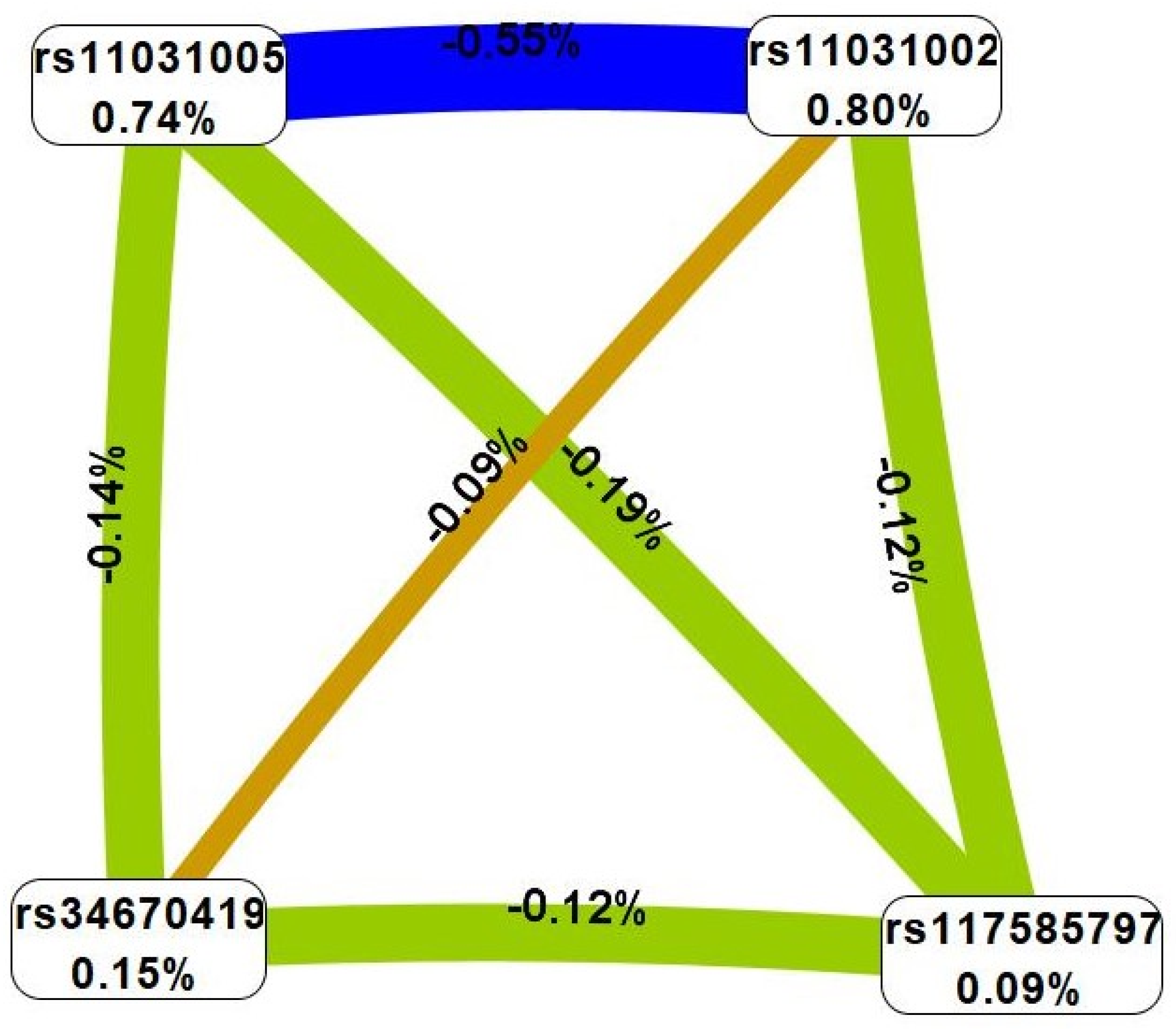
The constructed interlocus interactions graph of all 4 SNPs linked with EnHs in women with a BMI < 25 (as part of haplotypes and intergenic interactions models) revealed further pronounced antagonistic interactions between polymorphisms rs11031005 [T>C] FSHB and rs11031002 [T>A] FSHB (determines −0.55% of the disorder variance) (Figure 1).
The results obtained during the modeling of intergenic interactions that determine EnHs susceptibility in women with a BMI of ≥25 are presented in Table 4. We established 12 interlocus interaction models covering all studied three levels (2, 3 and 4 SNPs), including 7 loci of sex hormone genes (rs148982377 [T>C] ZNF789, rs34670419 [G>T] ZKSCAN5, rs11031002 [T>A], rs11031005 [T>C] FSHB, rs112295236 [C>G] SLC22A10, rs117585797 [C>A] ANO2, and rs117145500 [A>C] CHD9), associated with the EnHs risk at p(perm) < 0.001. Half of these models (6/12) were four-locus. Almost all models included two polymorphisms of the FSHB gene—rs11031002 [T>A] (12/12, 100%) and rs11031005 [T>C] (11/12, 91.67%)—and the epistatic interaction of these two loci was the basis of 91.67% of all the most significant models (11/12, 91.67%). The majority of EnHs-significant polymorphisms (4 SNPs: rs148982377 [T>C] ZNF789, rs34670419 [G>T] ZKSCAN5, rs112295236 [C>G] SLC22A10, rs117585797 [C>A] ANO2) were an integral part of 4 models each (33.33%). In total, 42 different multi-level combinations of genotypes were obtained (5 [11.90%]—2 loci, 16 [38.10%]—3 loci, 21 [50.00%]—4 loci), determining the risk of developing EnHs in women with a BMI ≥ 25 (Table S6), among which a majority (26/42, 61.90%) had a protective value in relation to the disease, and a minority (16/42, 38.10%) was at risk. Four protective combinations of genotypes demonstrated the highest level of statistical significance of association with EnHs, and for two of them this parameter exceeded the value accepted as a standard in GWAS (p = 5 × 10⁻⁸): rs11031002*TT × rs11031005*TT (beta = 1.17, p = 6 × 10⁻⁹), rs11031002*TT × rs117585797*CC × rs11031005*TT (beta = 1.04, p = 5 × 10⁻⁸), rs11031002*TT × rs112295236*CC × rs11031005*TT (beta = 0.92, p = 2 × 10⁻⁷), rs11031002*TT × rs117585797*CC × rs112295236*CC × rs11031005*TT (beta = 0.87, p = 4 × 10⁻⁷) (Table S6).
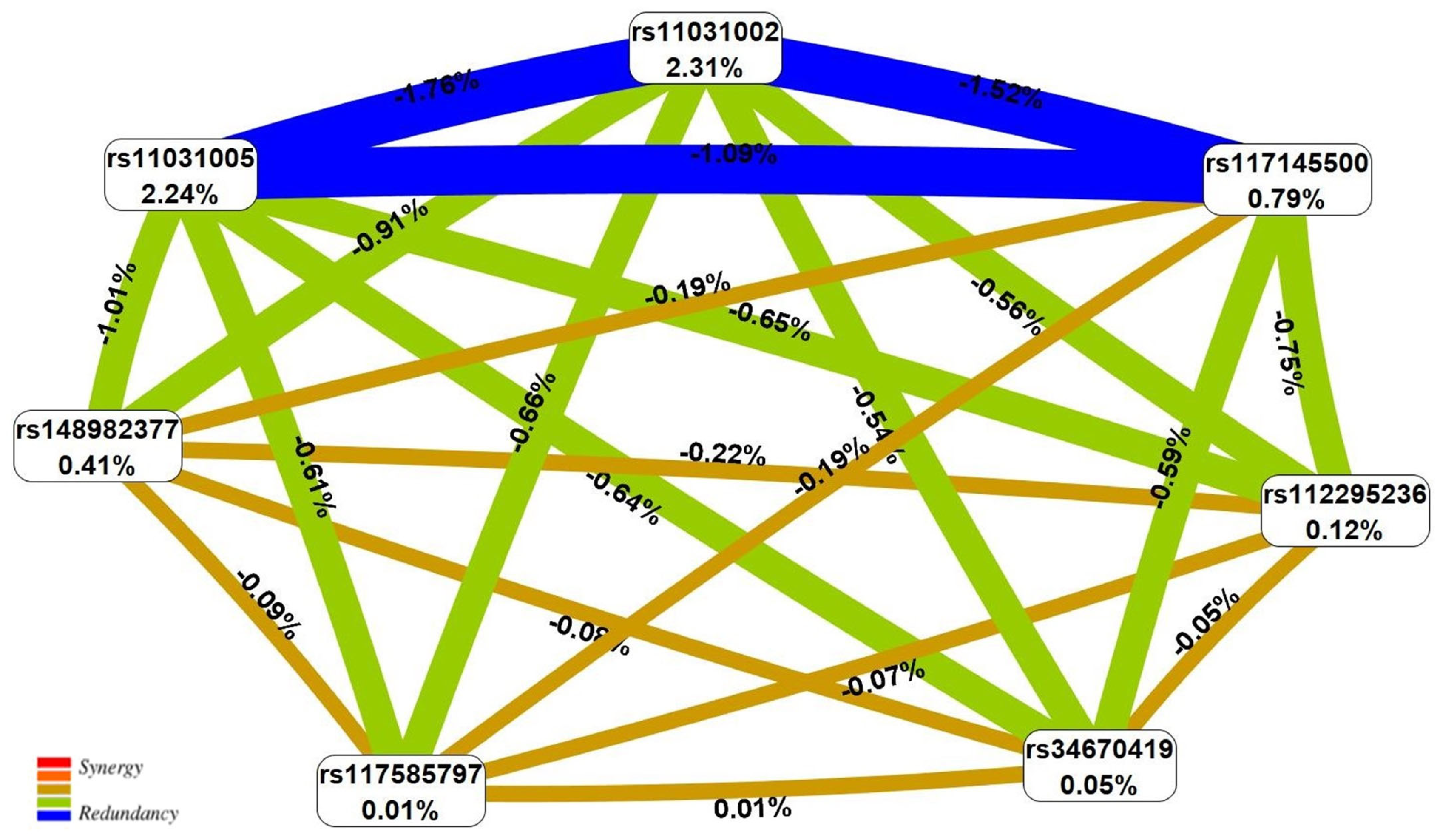
The results of qualitative (nature of interaction) and quantitative (percentage of entropy of the disease) assessment of the contribution of polymorphic loci and their epistatic interactions to EnHs susceptibility in women with a BMI ≥ 25, in the form of graphs, are presented in Figure 2. We found pronounced antagonistic interactions at the level of −1.09–−1.76% between the three loci—rs11031002 [T>A], rs11031005 [T>C] FSHB, and rs117145500 [A>C] CHD9 (shown in blue in the figures)—and expressed independent effects of rs11031002 [T>A] (2.31%) and rs11031005 [T>C] (2.24%) of the FSHB gene. Epistatic interactions of SNP rs148982377 [T>C] ZNF789 (the main effect in the disease formation in women with a BMI ≥ 25) with rs11031002 [T>A] and rs11031005 [T>C] FSHB also have an antagonistic orientation (moderate antagonism, indicated in green in the Figure 2) and affect −0.91–−1.01% of the EnHs variance in the study group of women.
Thus, we have established a greatly more significant contribution of the interlocus interactions of the considered sex hormone candidate genes to EnHs formation in women with BMI ≥ 25 (7 SNPs in 12 models) compared with women with BMI < 25 (4 SNPs in 3 models), with approximately the same volumes of studied samples in these groups (n = 766 [BMI < 25] and n = 727 [BMI ≥ 25]) and the same threshold level of selection of the most significant models (p(perm) ≤ 0.001).

3.1. Presumptive Functionality of Loci Involved in Susceptibility to EnHs in Women with Different BMI

In this section of the work, the hypothetical functional significance of SNPs was assessed, which showed an association with the developing EnHs in women with different BMI: 7 SNPs in individuals with a BMI ≥ 25 (rs11031002 [T>A] and rs11031005 [T>C] FSHB, rs148982377 [T>C] ZNF789, rs34670419 [G>T] ZKSCAN5, rs112295236 [C>G] SLC22A10, rs117585797 [C>A] ANO2, rs117145500 [A>C] CHD9) and 4 SNPs in individuals with BMI < 25 (rs11031002 [T>A] and rs11031005 [T>C] FSHB, rs34670419 [G>T] ZKSCAN5, rs117585797 [C>A] ANO2) in the body as a whole, with an emphasis on adipose tissue.

3.1.1. Epigenetic Changes

Among women with a BMI ≥ 25, seven SNPs associated with EnHs and 76 strongly linked loci have regulatory effects on 9 different genes—CHD9, ANO2, RP11-467J12.4, FSHB, SLC22A24, SLC22A10, SLC22A25, ZKSCAN5, and ZNF789 (Table S7). In the group of women with a BMI < 25, four SNPs associated with EnHs and 4 proxy variants have regulatory effects on 4 different genes—ANO2, FSHB, ZKSCAN5, and ZNF789 (Table S7).
Interestingly, hypothetical significant regulatory effects (located in the region of promoters, enhancers, active promoters) in various cell lines of adipose tissue (mesenchymal stem cells, which are precursors of adipocytes, fat cells, etc.) exhibit polymorphic loci that demonstrate the main effects in EnHs formation in women with a BMI ≥ 25 (rs148982377 [T>C] ZNF789, OR = 1.77; strongly coupled SNP rs34670419 [G>T] ZKSCAN5) (Table 5). The SNP rs112295236 [C>G] SLC22A10 (and its strongly linked loci) exhibit significant epigenetic effects (they were localized in the area of potential enhancers) in the region of SLC22A10, SLC22A24, and SLC22A25 genes in adipose tissue (adipose derived mesenchymal stem cell cultured cells). The impact epigenetic effects in adipose tissue of polymorphisms located in the region of the genes ZKSCAN5 and ZNF789 (rs148982377 [T>C] ZNF789 and rs34670419 [G>T] ZKSCAN5) identified by us in silico may be one of the biomedical justifications for the involvement of SNPs of sex hormone genes in EnHs formation in women with different BMI.

3.1.2. Regulatory Influences on Gene Expression (eQTL)

Among women with a BMI ≥ 25, five EnHs-causal SNPs and 61 strongly linked loci are associated with the transcription level of 10 different genes—CYP3A7, ATL3, GS1-259H13.2, OR2AE1, PTCD1, TRIM4, ZKSCAN5, ARL14EP, SLC22A10 and SLC22A9 (Tables S8 and S9). In the group of women with a BMI < 25, four EnHs-associated SNPs and three proxy variants also affected the expression of 7 genes (CYP3A7, GS1-259H13.2, OR2AE1, PTCD1, TRIM4, ZKSCAN5, ARL14EP) (Tables S8 and S9).
Interestingly, four EnHs-correlated polymorphic loci were eQTL impact in adipose tissue—rs11031002 [T>A] and rs11031005 [T>C] FSHB, rs148982377 [T>C] ZNF789, rs34670419 [G>T] ZKSCAN5 (Table S8)—and two strongly linked to rs11031005 [T>C] FSHB SNPs (rs11031006, rs74485684) (Table S9). Thus, minor allelic variants A rs11031002 and C rs11031005 FSHB (protective factors for EnHs development in both women with a BMI ≥ 25 and BMI < 25) were associated with higher ARL14EP transcription in subcutaneous adipose tissue (NES = 0.25; p = 2.9 × 10⁻⁶ and NES = 0.25; p = 5.3 × 10⁻⁶ respectively) (Table S8). Two SNPs which were in linkage disequilibrium (LD) with the rs11031005 [T>C] FSHB SNPs, rs11031006 and rs74485684, were also correlated with the expression level of the same gene in subcutaneous adipose tissue (Table S9). The minor allele C rs148982377 ZNF789 (the main risk factor for EnHs development in women with a BMI ≥ 25) was associated with increased transcriptional activity of the CYP3A7 gene in visceral adipose tissue (NES = 0.74; p = 1.7 × 10⁻⁷) (Table S8). The expression of the same gene in visceral adipose tissue was also influenced by rs34670419 [G>T] ZKSCAN5 (Table S9), which was associated with EnHs within the framework of interlocus interactions and at the same time was in disequilibrium with rs148982377 [T>C] ZNF789 (Table S9).

3.1.3. Regulatory Influences on Gene Splicing (sQTL)

Two polymorphisms involved in the formation of susceptibility to EnHs in women with different BMI—rs148982377 [T>C] ZNF789 (the main risk factor for EnHs development in women with a BMI ≥ 25) and rs34670419 [G>T] ZKSCAN5 (associated with the disease in both BMI groups as part of interlocus interactions) were associated with the level of GPC2 alternative splicing (Tables S10 and S11).
So, it can be summarized that 7 SNPs and 76 proxy loci associated with the risk of developing EnHs in women with a BMI ≥ 25 were presumptively functionally significant for 18 genes (CHD9, RP11-467J12.4, ANO2, FSHB, ZKSCAN5, ZNF789, CYP3A7, GPC2, GS1-259H13.2, OR2AE1, PTCD1, TRIM4, ARL14EP, ATL3, SLC22A10, SLC22A9, SLC22A24, SLC22A25) and 12 regulatory proteins (FOXA1, FOXA2, CFOS, P300, GATA2, HDAC2, TCF4, MAFF, CEBPB, RXRA, SP1, MAFK). Also, 4 SNPs and 4 LD variants correlated with EnHs in women with a BMI < 25 were presumptively functionally significant for 11 genes (ANO2, FSHB, ZKSCAN5, ZNF789, CYP3A7, GPC2, GS1-259H13.2, OR2AE1, PTCD1, TRIM4, ARL14EP).
At the same time, the loci associated with EnHs in women with different BMI showed their functionality in relation to 7 genes (ZKSCAN5, ZNF789, SLC22A24, SLC22A10, SLC22A25, CYP3A7, ARL14EP) in adipose tissue. Based on these data, at the next stage of our work, an assessment of protein interactions and their biological pathways was carried out in two directions: (a) in a comparative aspect for women with BMI < 25 and BMI ≥ 25; (b) for genes whose functionality in adipose tissue depends on EnHs-significant loci.

3.1.4. Biological Pathways of EnHs-Involved Protein Interactions

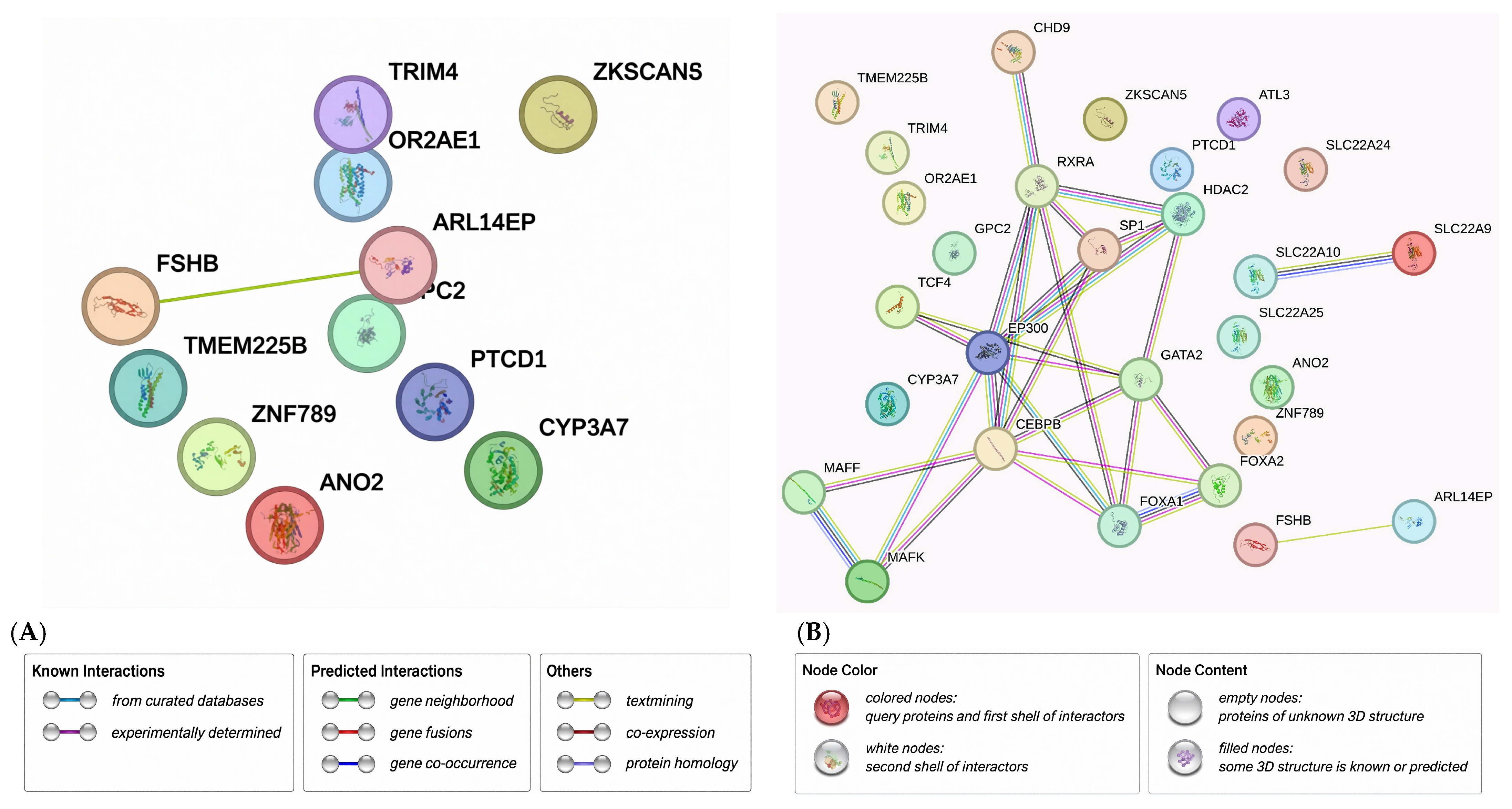
Using the STRING program, we evaluated the interaction of 11 proteins involved in the formation of EnHs in women with BMI < 25 (all 11 were encoded by genes functionally associated with 8 loci [4 EnHs-related loci and 4 LD SNPs]) and 30 proteins involved in the formation of EnHs in women with BMI ≥ 25 (18 were encoded by genes functionally correlated with 83 polymorphisms (7 EnHs-causal loci and 76 LD SNPs) and 12 regulatory proteins). The results are presented in Figure 3.
Based on the information presented in Figure 3, we can state significant differences in the interaction of proteins (and their involvement in biological pathways) involved in the formation of EnHs in the groups of women with BMI < 25 and BMI ≥ 25 under consideration. Thus, among women with a BMI < 25, EnHs-impact protein interactions were rather insignificant (only interactions of FSHB with ARL14EP were recorded, score = 0.474) (Figure 3A) and they were involved according to the Monarch database in the regulation of dehydroepiandrosterone sulphate (EFO:0007001; p = 0.0018) (PTCD1, ZNF789, ZKSCAN5) and progesterone (EFO:0007004; p = 0.0481) (ZNF789, ZKSCAN5) levels. On the contrary, in women with a BMI ≥ 25, EnHs-impact protein interactions were more pronounced (the role of hub-proteins was performed by CHD9, FOXA1, FOXA2,300, GATA2, HDAC2, TCF4, MAFF, CEBPB, RXRA, SP1, MAFK) (Figure 3B) and they were involved in numerous mechanisms of transcription regulation: regulation of transcription by RNA polymerase II (GO: 0006357; p = 0.0134) (FOXA1, EP300, CEBPB, SP1, ZNF789, TCF4, ZKSCAN5, MAFK, GATA2, FOXA2, FSHB, RXRA, HDAC2, MAFF), RNA polymerase II cis-regulatory region sequence-specific DNA binding (GO: 0000978; p = 0.0011) (FOXA1, CEBPB, SP1, ZNF789, MAFK, GATA2, ZKSCAN5, TCF4, FOXA2, RXRA, MAFF), RNA polymerase II-specific DNA-binding transcription factor binding (GO:0061629; p = 0.0031) (EP300, CEBPB, SP1, GATA2, RXRA, HDAC2), transcription factor binding (GO: 0008134; p = 0.0040) (EP300, CEBPB, SP1, GATA2, TCF4, RXRA, HDAC2), transcription co-regulator binding (GO: 0001221; p = 0.0063) (EP300, SP1, GATA2, RXRA], etc. It is important to note the presence of adipose-specific biological pathways in the protein interactions in women with a BMI ≥ 25 (shown in Figure 3B): adipogenesis (WP236; p = 0.0096) (CEBPB, SP1, GATA2, RXRA), transcriptional cascade regulating adipogenesis (WP4211; p = 0.0263) (CEBPB, GATA2), and transcriptional regulation of white adipocyte differentiation (HSA-381340; p = 0.0040 (EP300, CEBPB, CHD9, RXRA). Interestingly, according to the KEGG database, the protein interactions under consideration in women with a BMI ≥ 25 were significant for such a biological pathway as transcriptional misregulation in cancer (hsa05202; p = 0.0349) (CEBPB, SP1, RXRA, HDAC2).
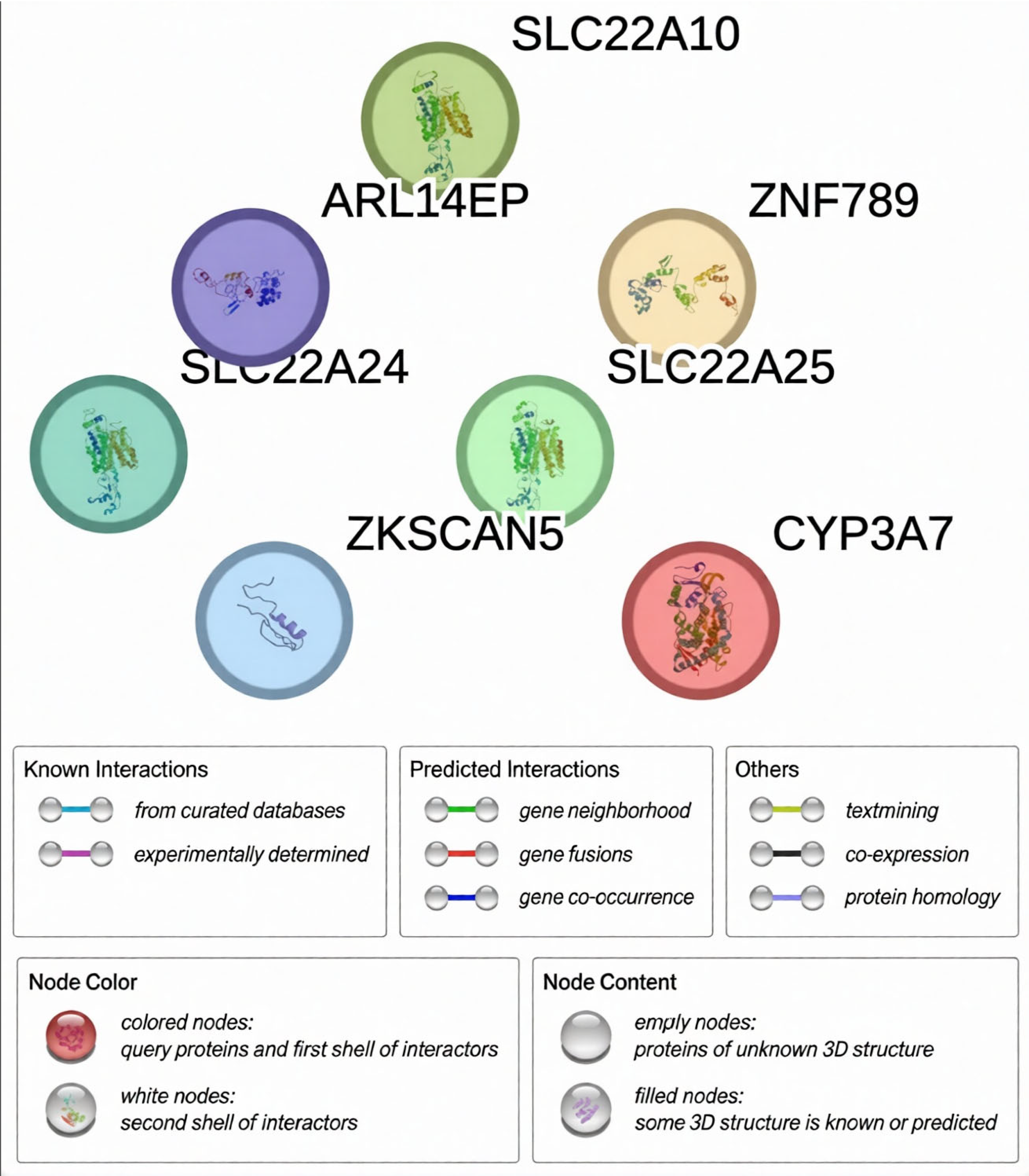
When studying the interaction of proteins whose genes were functionally significant in adipose tissue and depend on loci associated with EnHs development, no pronounced interactions were revealed (Figure 4). According to the Monarch database, these proteins affect progesterone measurement (EFO:0007004; p = 0.0369) (ZNF789, ZKSCAN5), and according to Protein Domains and Features (InterPro) materials, they interact due to major facilitator superfamily domain (IPR0208463; p = 0.0314) (SLC22A25, SLC22A10, SLC22A24) and MFS transporter superfamily (IPR036259; p = 0.0451) (SLC22A25, SLC22A10, SLC22A24).

4. Discussion

In the studied sample (EnHs/control, n = 1493), an association of interactions of rs148982377 [T>C] ZNF789 × BMI with EnHs (OR = 1.11) was revealed. As a result of a comparative analysis, we found that rs148982377 [T>C] ZNF789 was associated with EnHs among women with a BMI ≥ 25 (OR = 1.77) and was not linked with the disease in women with a BMI < 25. Both common protective factors for EnHs were also identified in women with BMI ≥ 25 and BMI < 25 (rs11031002 [T>A] FSHB (OR = 0.43 and OR = 0.46 respectively) and rs11031005 [T>C] FSHB (OR = 0.46 and OR = 0.58 respectively)). At the same time, in women with a BMI ≥ 25, the risk effect of the TT*rs11031002–rs11031005 haplotype (OR = 3.27) is more pronounced (by 41%) and the contribution of interlocus interactions of sex hormone genes to EnHs formation was more significant (7 SNPs in 12 models) than in women with a BMI < 25 (OR = 2.31 and 4 SNPs in 3 models respectively).
In the sample we studied, the BMI in patients with EnHs (26.94 ± 5.56) was significantly higher (p < 0.001) than in the control (25.22 ± 4.52), overweight/obesity significantly increased the risk of developing EnHs (OR = 2.34 95%CI 1.86–2.93 p = 0.005), and overweight/obesity, according to the data obtained in this work, were significant modifiers of the involvement of SNPs of sex hormone genes in the disorder formation. The association of overweight and obesity with EnHs risk has been indicated in numerous studies [9,10,79]. In the work of Epplein et al., a sample of 892 women (an equal number of patients with EnHs and controls were studied) convincingly showed a significant increase in disease risk in women younger than 52 years with an increase in BMI: compared with women who were not overweight (BMI ≤ 24.9), the EnHs risk with atypia increased 2.3-fold (BMI 25–29.9), 3.7-fold (BMI 30–39.9), or 13.0-fold (BMI ≥ 40), and the risk of complex EnHs increased 3.0-fold (BMI 25–29.9), 4.6-fold (BMI 30–39.9), or 23.0-fold (BMI ≥ 40) [9]. A retrospective analysis of 916 premenopausal women with abnormal uterine bleeding showed that patients with a BMI>30 developed complex EnHs or endometrial cancer 4 times more often than women with a lower BMI [10].
Overweight and obesity cause an increased level of estrogens in the female organism (relative to progesterone), which is risky for the occurrence of EnHs, and this may be based on a number of biological mechanisms [5,9,79,80]. Firstly, the secretory activity of the adrenal glands increases, which leads to an increase in the number of androgen precursors, which can then be converted to estradiol in peripheral tissues (mainly adipose) [5].
Secondly, the conversion of androgens (androstenedione) into estrogens (estrone) increases in excess adipose tissue [5,9,79]. Estrogens, interacting with their specific receptors, through various genomic mechanisms (due to changes in the transcriptional activity of targeted genes [estrogen-dependent genes], whose protein products are involved in the processes of growth, differentiation, angiogenesis, and apoptosis,) and non-genomic biological pathways (due to interaction with various proteins such as adapter proteins, G-class proteins, cytoplasmic kinases (PI3K, MAPK, AKT), growth factor receptors (IGFR1,EGFR, etc.), signaling enzymes (adenyl cyclase), etc.) [81] affect the proliferative activity of cells, including endometrial cells [5,9,79].
Thirdly, the SHBG content, which is a key regulator of free estrogens and testosterone levels, decreases, which leads to an increase in the concentration of biologically active forms of these sex hormones [79]. A direct, pronounced association of BMI (overweight/obesity) with estrogens and androgens and an inverse correlation with SHBG have been convincingly shown in numerous studies, including those performed by the method of Mendelian randomization of GWAS data [82,83,84]. At the same time, a decrease in BMI in women caused a decrease in the concentration of estrogens and testosterone and an increase in SHBG levels [85,86], while an increase in BMI led to a significant increase in estradiol levels (by 45–68%), estrone (21–34%), free forms of estradiol (101%) and testosterone (35%), as well as a decrease in the concentration of SHBG (by 6–35%) [87], which certainly may be of paramount importance in EnHs pathophysiology.
Fourth, various disorders of folliculogenesis are formed and anovulation develops [5,76,88,89]. In obese women compared with non-obese individuals, during a prospective longitudinal study of 42 subjects, significant changes were recorded at various stages of folliculogenesis: reduced follicle recruitment, fewer progressive follicles, a reduced number of anovulatory follicles that have achieved dominance, a smaller diameter of ovulatory follicles, and luteal phase defects associated with low progesterone levels [89]. In the work of Yeung et al., among obese women, compared with individuals with normal body weight, lower levels of progesterone (−15%), LH (−17%) and FSH (−23%), higher concentrations of free estradiol (+22%), and large changes in the amplitude of LH and FSH throughout the cycle were revealed. Changes in the levels of free estradiol, LH and FSH, but with a lesser degree of severity, were also observed in overweight women (BMI = 25–30) [88]. It is indicated that with an average age of manifestation of EnH with atypia of more than 40 years, in women with chronic amenorrhea (chronic anovulation), the EnH risk increases significantly already at the age of 20–30 years [80]. A sample of 1200 women showed a significant increase in the risk of anovulation in women with an increase in BMI [90].
Ultimately, the above pathophysiological mechanisms cause the formation of a more pronounced imbalance in the estrogens–progesterone system in obese and overweight women (hyperestrogenism with a relative lack of progesterone), which leads to estrogen-induced excessive proliferation of endometrial cells and the appearance of EnH [5,9,79], and can also modify the disease-significant risk effects of hormone-related polymorphic loci, which we established in our study.
In this work it was found that the allele C rs148982377 [T>C] ZNF789 (OR = 1.77) serves as a specific risk factor for the formation of the disease in women who are overweight/obese. Based on in silico data, we have shown that the allele variant C rs148982377 [T>C] ZNF789, which is risky for EnHs, was associated with higher expression of the CYP3A7 gene in visceral adipose tissue. The expression product of the CYP3A7 gene is the protein of the same name (CYP3A7, cytochrome P450, family 3, subfamily A, member 7), which is a member of the cytochrome P450 enzyme superfamily. The enzyme CYP3A7 participates in the processes of hydroxylation (16α-hydroxylation) of the metabolite of testosterone and DHEAS-estrone to 16α-hydroxyestrone (16α-OHE1) [91,92]. It is noted in the literature that 16α-OHE1 is a highly active estrogenic metabolite, more potent than the widely known estradiol [92]. It is believed that 16α-OHE1, binding to estrogen receptors, exhibits strong mitogenic effects on endometrial cells [93,94], which may explain the links we have identified between the highly productive allele C rs148982377 [T>C] ZNF789 with respect to the CYP3A7 gene and an increased risk of developing EnHs in overweight/obese women. It is important to note that with overweight/obesity, the processes of peripheral conversion of androgens into estrogens in adipose tissue are much more intense [94] and therefore, in obese women, more pronounced pathological effects can be expected (increased risks of developing EnH, endometrial cancer, etc.) increased levels of estrogens and their active metabolites (16α-OHE1, etc.) [4,5,95,96].
So, the results obtained by us in silico and the literature data on this issue suggest a possible pathophysiological justification for the associations of rs148982377 [T>C] ZNF789 identified by us with the EnHs risk (OR = 1.77): “increased expression of CYP3A7 in adipose tissue in overweight/obese women with the allele C rs148982377 [T>C] ZNF789 → increased highly active metabolite of estrone—16α-OHE1, under the action of overly synthesized CYP3A7 → more pronounced mitogenic effects of 16α-OHE1 on the endometrium → increased risk of developing EnHs”!
There are indications in the literature (although contradictory) of a link between the level of CYP3A7 production and endometrial cancer [95,96,97]. In an experimental paper by Fishman et al. it has been shown that in women with breast and endometrial cancer, compared with controls, 16α-hydroxylation was significantly increased [95]. The authors note that an increased risk of breast and endometrial cancer may be mediated by one of the products of 16α-hydroxylation—16α-OHE1 [95]. The risk value of 16α-OHE1 in endometrial cancer in postmenopausal women is also shown in the work of Zeleniuch-Jacquotte et al. [96]. At the same time, in a study by Hevir et al. a lower level of CYP3A7 was found in the endometrium of patients with endometrial cancer [97]. There are studies that have not revealed the association of 16α-OHE1 with endometrial cancer in postmenopausal women [98,99].
Four different studies presented in the GWAS catalog show the relationship of polymorphism rs148982377 [T>C] ZNF789 with the level of androgens and their metabolites, as well as a wide range of other metabolites: DHEAS [16], bioavailable testosterone (in premenopausal women) [20], 6α-hydroxy-DHEAS [100], DHEAS, androsterone sulfate, epiandrosterone sulfate, (3β, 17β) androstenediol disulfate, (3α, 17α) androstenediol monosulfate, X-21470, X-26109, X-24947, etc. [23]. At the same time, the allelic variant C (according to our data, it has an EnHs risk value in overweight/obese women) was associated with lower levels of androgens and their metabolites. In another GWAS, an association of SNP rs148982377 [T>C] ZNF789 with the DNA repair protein RAD51 (homologue 4) was found [101]. In the work of Diener et al., associations of rs148982377 [T>C] ZNF789 with nine different metabolites of steroid hormones, mainly DHEAS and androsterone conjugates, have also been demonstrated [102].
Located at a distance of 55.8 kb from the EnHs-causal locus rs148982377 [T>C] ZNF789 and strongly linked to it, the SNP rs34670419 ZKSCAN5 in a number of GWAS has shown significant associations with progesterone levels [16], DHEAS and cortisol ratio/DHEAS [15], and 4-androsten-3beta,17beta-diol disulfate, 4-androsten-3beta,17beta-diol monosulfate levels [21]; it is also correlated with the risk of endometrial cancer [103] and bone mineral density [104]. Two more SNPs were associated with the metabolite X-21410 and androsterone sulfate, which were in LD with rs148982377 [T>C] ZNF789—rs12535424 (r2 = 0.67/D’ = 1.00) [21] and rs13243267 (r2 = 0.67/D’ = 1.00) respectively [105].
Based on the above literature data, it can be concluded that the allele C rs148982377 [T>C] ZNF789, which is a risk factor for EnHs formation in overweight/obese women (OR = 1.77), determines the low level of various androgens and their metabolites in the organism. It can be assumed that relatively low levels of androgens in women with overweight adipose tissue do not provide the protective effects of testosterone at the proper level (as opposed to the proliferative effects of estrogens [13]) in relation to EnHs, and consequently the processes of folliculogenesis are disrupted both at an early stage (oocyte metabolism, growth/maturation of primordial follicles, etc.) and at late stages (insufficient inhibition of estrogen formation; impaired corpus luteum formation and progesterone production; insufficient inhibition of endometrial proliferative activity, etc.) [13,106,107,108,109,110,111,112,113,114].
So, in this study, a difference in the nature of association of testosterone-determining polymorphism in women with different BMI was found: testosterone-reducing allele C rs148982377 [T>C] ZNF789 (but at the same time increasing the level of active metabolites of estrogens, 16α-OHE1) increases the disorder risk in women with a BMI ≥ 25 (OR = 1.77), and it was not associated with the disease in women with a BMI < 25. The data on the nature of testosterone associations with proliferative activity of endometrial cells (including the EnH risk [risk/protective value]) available in numerous literature sources [12,13,90,106,107,108,109,110,111,112,113,114] are multidirectional, and the inconsistency of these relationships and their biomedical justifications persists at the present time despite a large number of experimental works conducted by various scientific teams on this topic [13]. On the one hand, data were obtained on the stimulating effect of testosterone/DHT on endometrial cell proliferation in ARCO mouse models [115], rodents undergoing ovariectomy [116,117], and female transsexuals treated with testosterone [118]; higher concentrations of androgens (as well as estradiol) were detected in patients with adenomatous EnH compared with the control [119]; and the risk of EnH development in such a hyperandrogenic disease as polycystic ovary was increased (due to its characteristic anovulatory cycles) [3,4]. On the other hand, there are numerous experimental/clinical results indicating the antiproliferative effect of androgens on endometrial cells [12,13,120,121,122,123,124,125]. Thus, experimental studies (in vitro) on endometrial cell lines [106,107,108,109,110,111,112,113] and isolated endometrial epithelial cells [126] have shown the inhibitory effect of androgens (androstenedione/testosterone/DHT) on cell proliferation, in contrast to the proliferative effect of estrogens [13]. Among the clinical evidence of the antiproliferative effect of androgens on the uterine endometrium, the results of numerous studies on the use of a synthetic androgen, danazol, in the treatment of EnH can be cited [121,122,123,124,125]. At the same time, it should be noted that the above-mentioned studies, which indicate both antiproliferative and endometrial cell proliferation-stimulating effects of testosterone, are characterized by an extremely pronounced diversity, both in the studied research objects (genetically modified mice, rodents undergoing ovariectomy, female transsexuals, EnH patients, etc.) and the research methodology/techniques used in this work (comparative analysis of androgens in patients/controls, the use of androgens in the treatment of EnH patients and female transsexuals, the study of phenotypic effects in experimental animals undergoing ovariectomy or having knockouts of individual genes, etc.). This makes it significantly difficult to identify any patterns/factors that explain to one degree or another such markedly different (opposite-directional) effects of androgens found in these studies. There is an obvious need to continue experimental research on this topic, the results of which would allow us to conduct sufficiently powerful meta-analyses on this issue and make it possible to identify possible causes/factors/mechanisms underlying such contradictory results. There are isolated studies in the literature indicating differences in the biological effects of testosterone in women with different BMI, including such a testosterone/BMI-related risk factor for EnH development as anovulation [90]. After analyzing the results of observation of 1200 women, the authors found an increased risk of anovulation with an increase in BMI (OR = 1.03) (while taking into account adjustments for the content of free testosterone in the blood serum, lipids, and other factors) [90]. Based on the data obtained, the authors conclude that in women with regular menstruation, anovulation may be independently associated with both testosterone levels and obesity [90]. At the same time, genetic studies that examine the role of factors (polymorphisms) that determine the level of testosterone in the body in EnHs formation have not yet been performed, and therefore we do not have the opportunity to conduct a correct comparative genetic analysis on this topic. Further more-detailed genetic and epidemiological studies, including experimental work on functional genomics and proteomics, are needed to identify additional factors (environmental, genetic) that determine the features of the relationship between BMI, androgens, and EnHs, including confirming the modifying effect of overweight/obesity registered in our study on the nature of the association of functionally significant SNPs of sex hormone genes with the risk of developing EnHs.
It should be noted that previously performed genetic and epidemiological studies in the population of the Central Chernozem region of Russia under study also showed a significant modifying effect of overweight/obesity on the relationship of a number of candidate genes’ polymorphism with hormone-dependent diseases such as breast cancer (gene SNPs of matrix metalloproteinases and SHBG) [42,43], knee osteoarthritis (SNP of GWAS-significant genes for osteoarthritis of the knee joint) [45], preeclampsia (SNP of GWAS-significant genes for hypertension) [44], and uterine fibroids (SHBG gene SNPs) [46], which suggests a significant role of such an environmental risk factor for hormone-dependent diseases such as overweight/obesity (BMI) in the epigenetic regulation of the phenotypic effects of functionally significant polymorphism in these diseases. A detailed study of the mechanisms (including genetic ones) of BMI-dependent modification of the phenotypic manifestation of hereditary risk factors in various diseases will allow a deeper understanding of the pathophysiology of these disorders.
This study identified common genetic risk/protection factors for EnHs development in women with different BMI, which are polymorphisms rs11031002 [T>A] and rs11031005 [T>C] FSHB. Minor alleles of these SNPs reduced the disease risk in women with a BMI < 25 (OR = 0.46 and OR = 0.58 respectively) and a BMI ≥ 25 (OR = 0.43 and OR = 0.46 respectively), and reference alleles of these loci (as part of the TT*rs11031002-rs11031005 haplotype) increased the EnHs risk (OR = 2.31 [BMI < 25] and OR = 3.27 [BMI ≥ 25]). GWAS data indicate the relationship of rs11031002 [T>A] and rs11031005 [T>C] FSHB and LD SNPs (rs11031006; rs10835638; rs11031010; rs12294104) with the content of such important regulators of the organism hormonal status as LH and FSH/FSHB [16,18,27,101,127,128,129,130,131,132,133,134]. An imbalance in the content/ratios of LH and FSH can lead to disturbances in the formation of estrogens and progesterone, as a result of which hyperestrogenism (absolute/relative) may develop with a deficiency of progesterone influences, which increases the EnHs risk [3,4,5]. An EnH-significant consequence of pronounced LH/FSH-mediated disorders may be the occurrence of anovulations [135,136], the persistence of which for a long time (chronic anovulation) can lead to the activation of estrogen-induced endometrial proliferation against the background of a deficiency of antiproliferative progesterone effects, which ultimately contributes to EnH development [4,5].
The present study has a number of limitations: (a) The results of the work were obtained on one ethno-territorial group of women (Russians of Central Russia) and they need to be confirmed (replicated) by an independent cohort (including other ethnic groups), so they can be assessed as preliminary. (b) In this study, data were obtained for only one morphological subtype of EnH (EnHs) and further study/confirmation of the identified associative relationships in samples of patients with another histological subtype of EnH—EnH with atypia (intraepithelial neoplasia of the endometrium)—is necessary, since this particular subtype of the disease has a high risk of oncotransformation. It should be noted that EnHs and intraepithelial neoplasia of the endometrium have a specific pathophysiology, and therefore the nature of associative relationships in these two different subtypes of EnH may differ significantly and require a detailed independent study. (c) This work was carried out on two compared subgroups of women (BMI < 25; BMI ≥ 25) using several polymorphisms (9 SNPs), with simultaneous comprehensive association analysis (assessment of associations of individual SNPs; analysis of haplotype relationships; study of inter-loci interactions), which required the introduction of necessary corrections for multiple comparisons at each stage of the study (Bonferroni corrections, permutation testing), which allowed us to obtain sufficiently balanced results (taking into account the possible risks of false-positive and false-negative results). At the same time, this moment is the basis for recognizing the results obtained as research and determines the need for their confirmation in more homogeneous (not requiring the introduction of numerous corrections for multiple comparisons) genetic studies. (d) Women in the control group (who did not have any (clinical, anamnestic, ultrasound) manifestations of diseases of the female reproductive organs) lacked histological confirmation of a normal endometrium, which may lead to some potential misclassification of women in this group and cause some distortion (weakening) of identified associations.

5. Conclusions

The presented work is exploratory and demonstrates differences in the nature of the association with EnHs in women with different BMI of a testosterone-determining polymorphism: SNP rs148982377 [T>C] ZNF789 was associated with EnHs in women with a BMI ≥ 25 and was not linked with the disease in women with a BMI < 25.

Supplementary Materials

The following supporting information can be downloaded at: https://www.mdpi.com/article/10.3390/life16060937/s1, Table S1: The GWAS data about associations of the studied candidate genes polymorphisms with the level of sex hormones; Table S2: The regulatory potential of the studied SNPs; Table S3: The allele and genotype frequencies of the studied SNPs in the endometrial hyperplasia and control groups with BMI < 25; Table S4: The allele and genotype frequencies of the studied SNPs in the endometrial hyperplasia and control groups with BMI ≥ 25; Table S5: Genotype combinations associated with endometrial hyperplasia among BMI < 25 female; Table S6: Genotype combinations associated with endometrial hyperplasia among BMI ≥ 25 female; Table S7: Regulatory effects of the EH-associated loci and SNPs in high LD (r2 ≥ 0.80); Table S8: The eQTL effects of the EH-associated SNPs in various tissues/organs; Table S9: eQTL values of SNPs in high LD (r2 ≥ 0.80) with the EH-associated polymorphisms; Table S10: The sQTL effects of the EH-associated SNPs in various tissues/organs; Table S11: sQTL values of SNPs in high LD (r2 ≥ 0.80) with the EH-associated polymorphisms.

Author Contributions

Conceptualization, V.C. and I.P.; methodology, V.C. and M.S.; data curation, K.T. and M.C. (Maria Churnosova); formal analysis, E.R., I.S. and A.P.; Project administration, M.C. (Mikhail Churnosov); writing—original draft, V.C. and I.P.; writing—review and editing, E.R., I.A. and M.C. (Mikhail Churnosov). All authors provided final approval of the version to be published. All authors are accountable for all aspects of the work in ensuring that questions related to the accuracy or integrity of any part of the work are appropriately investigated and resolved. All authors have read and agreed to the published version of the manuscript.

Funding

This research was funded by the Russian Science Foundation, grant number 25-25-00034, https://rscf.ru/en/project/25-25-00034/ (accessed on 22 December 2025).

Institutional Review Board Statement

This study was conducted according to the guidelines of the Declaration of Helsinki, and approved by the Local Ethical Committee of the Belgorod State University (10 April 2008, No. 4).

Informed Consent Statement

Informed consent was obtained from all subjects involved in this study.

Data Availability Statement

The data generated in the present study are available from the corresponding author upon reasonable request.

Conflicts of Interest

The authors declare no conflicts of interest.

Abbreviations

The following abbreviations are used in this manuscript:
BMIBody mass index
EHsSimple endometrial hyperplasia without atypia
SNPSingle nucleotide polymorphism
GWASGenome-wide studies
OROdds ratio
SHBGSex hormone-binding globulin
LHLuteinizing hormone
FSHFollicle-stimulating hormone
LDLinkage disequilibrium

References

  1. Cree, I.A.; White, V.A.; Indave, B.I.; Lokuhetty, D. Revising the WHO classification: Female genital tract tumours. Histopathology 2020, 76, 151–156. [Google Scholar] [CrossRef] [PubMed]
  2. Reed, S.D.; Newton, K.M.; Clinton, W.L.; Epplein, M.; Garcia, R.; Allison, K.; Voigt, L.F.; Weiss, N.S. Incidence of endometrial hyperplasia. Am. J. Obstet. Gynecol. 2009, 200, 678.e1–678.e6. [Google Scholar] [CrossRef] [PubMed]
  3. Chandra, V.; Kim, J.J.; Benbrook, D.M.; Dwivedi, A.; Rai, R. Therapeutic options for management of endometrial hyperplasia. J. Gynecol. Oncol. 2016, 27, e8. [Google Scholar] [CrossRef]
  4. Sanderson, P.A.; Critchley, H.O.; Williams, A.R.; Arends, M.J.; Saunders, P.T. New concepts for an old problem: The diagnosis of endometrial hyperplasia. Hum. Reprod. Update 2017, 23, 232–254. [Google Scholar] [CrossRef]
  5. Nees, L.K.; Heublein, S.; Steinmacher, S.; Juhasz-Böss, I.; Brucker, S.; Tempfer, C.B.; Wallwiener, M. Endometrial hyperplasia as a risk factor of endometrial cancer. Arch. Gynecol. Obstet. 2022, 306, 407–421. [Google Scholar] [CrossRef]
  6. Petersdorf, K.; Groettrup-Wolfers, E.; Overton, P.M.; Seitz, C.; Schulze-Rath, R. Endometrial hyperplasia in pre-menopausal women: A systematic review of incidence, prevalence, and risk factors. Eur. J. Obstet. Gynecol. Reprod. Biol. 2022, 271, 158–171. [Google Scholar] [CrossRef]
  7. Lacey, J.V.; Ioffe, O.B.; Ronnett, B.M.; Rush, B.B.; Richesson, D.A.; Chatterjee, N.; Langholz, B.; Glass, A.G.; Sherman, M.E. Endometrial carcinoma risk among women diagnosed with endometrial hyperplasia: The 34-year experience in a large health plan. Br. J. Cancer 2008, 98, 45–53. [Google Scholar] [CrossRef] [PubMed]
  8. Trimble, C.L.; Kauderer, J.; Zaino, R.; Silverberg, S.; Lim, P.C.; Burke, J.J., 2nd; Alberts, D.; Curtin, J. Concurrent endometrial carcinoma in women with a biopsy diagnosis of atypical endometrial hyperplasia: A Gynecologic Oncology Group study. Cancer 2006, 106, 812–819. [Google Scholar] [CrossRef]
  9. Epplein, M.; Reed, S.D.; Voigt, L.F.; Newtonm, K.W.; Holt, V.L.; Weiss, N.S. Risk of complex and atypical endometrial hyperplasia in relation to anthropometric measures and reproductive history. Am. J. Epidemiol. 2008, 168, 563–570. [Google Scholar] [CrossRef]
  10. Wise, M.R.; Gill, P.; Lensen, S.; Thompson, J.M.; Farquhar, C.M. Body mass index trumps age in decision for endometrial biopsy: Cohort study of symptomatic premenopausal women. Am. J. Obstet. Gynecol. 2016, 215, 598.e1–598.e8. [Google Scholar] [CrossRef]
  11. Alsudairi, H.N.; Alrasheed, A.T.; Dvornyk, V. Estrogens and uterine fibroids: An integrated view. Res. Results Biomed. 2021, 7, 156–163. [Google Scholar] [CrossRef]
  12. Lv, M.; Yu, J.; Huang, Y.; Ma, J.; Xiang, J.; Wang, Y.; Li, L.; Zhang, Z.; Liao, H. Androgen Signaling in Uterine Diseases: New Insights and New Targets. Biomolecules 2022, 12, 1624. [Google Scholar] [CrossRef] [PubMed]
  13. Lissaman, A.C.; Girling, J.E.; Cree, L.M.; Campbell, R.E.; Ponnampalam, A.P. Androgen signalling in the ovaries and endometrium. Mol. Hum. Reprod. 2023, 29, gaad017. [Google Scholar] [CrossRef]
  14. Prescott, J.; Thompson, D.J.; Kraft, P.; Chanock, S.J.; Audley, T.; Brown, J.; Leyland, J.; Folkerd, E.; Doody, D.; Hankinson, S.E.; et al. Genome-wide association study of circulating estradiol, testosterone, and sex hormone-binding globulin in postmenopausal women. PLoS ONE 2012, 7, e37815. [Google Scholar] [CrossRef]
  15. Wood, A.R.; Perry, J.R.; Tanaka, T.; Hernandez, D.G.; Zheng, H.F.; Melzer, D.; Gibbs, J.R.; Nalls, M.A.; Weedon, M.N.; Spector, T.D.; et al. Imputation of variants from the 1000 Genomes Project modestly improves known associations and can identify low-frequency variant-phenotype associations undetected by HapMap based imputation. PLoS ONE 2013, 8, e64343. [Google Scholar] [CrossRef]
  16. Ruth, K.S.; Beaumont, R.N.; Tyrrell, J.; Jones, S.E.; Tuke, M.A.; Yaghootkar, H.; Wood, A.R.; Freathy, R.M.; Weedon, M.N.; Frayling, T.M.; et al. Genetic evidence that lower circulating FSH levels lengthen menstrual cycle, increase age at menopause and impact female reproductive health. Hum. Reprod. 2016, 31, 473–481. [Google Scholar] [CrossRef] [PubMed]
  17. Ruth, K.S.; Day, F.R.; Tyrrell, J.; Thompson, D.J.; Wood, A.R.; Mahajan, A.; Beaumont, R.N.; Wittemans, L.; Martin, S.; Busch, A.S.; et al. Using human genetics to understand the disease impacts of testosterone in men and women. Nat. Med. 2020, 26, 252–258. [Google Scholar] [CrossRef]
  18. Gudjonsson, A.; Gudmundsdottir, V.; Axelsson, G.T.; Gudmundsson, E.F.; Jonsson, B.G.; Launer, L.J.; Lamb, J.R.; Jennings, L.L.; Aspelund, T.; Emilsson, V.; et al. A genome-wide association study of serum proteins reveals shared loci with common diseases. Nat. Commun. 2022, 13, 480. [Google Scholar] [CrossRef] [PubMed]
  19. Haas, C.B.; Hsu, L.; Lampe, J.W.; Wernli, K.J.; Lindström, S. Cross-ancestry Genome-wide Association Studies of Sex Hormone Concentrations in Pre- and Postmenopausal Women. Endocrinology 2022, 163, bqac020. [Google Scholar] [CrossRef]
  20. Harrison, S.; Davies, N.M.; Howe, L.D.; Hughes, A. Testosterone and socioeconomic position: Mendelian randomization in 306,248 men and women in UK Biobank. Sci. Adv. 2021, 7, eabf8257. [Google Scholar] [CrossRef]
  21. Hysi, P.G.; Mangino, M.; Christofidou, P.; Falchi, M.; Karoly, E.D.; Nihr Bioresource Investigators; Mohney, R.P.; Valdes, A.M.; Spector, T.D.; Menni, C. Metabolome Genome-Wide Association Study Identifies 74 Novel Genomic Regions Influencing Plasma Metabolites Levels. Metabolites 2022, 12, 61. [Google Scholar] [CrossRef]
  22. Leinonen, J.T.; Mars, N.; Lehtonen, L.E.; Ahola-Olli, A.; Ruotsalainen, S.; Lehtimäki, T.; Kähönen, M.; Raitakari, O.; FinnGen Consortium; Piltonen, T.; et al. Genetic analyses implicate complex links between adult testosterone levels and health and disease. Commun. Med. 2023, 3, 4. [Google Scholar] [CrossRef]
  23. Chen, Y.; Lu, T.; Pettersson-Kymmer, U.; Stewart, I.D.; Butler-Laporte, G.; Nakanishi, T.; Cerani, A.; Liang, K.Y.H.; Yoshiji, S.; Willett, J.D.S.; et al. Genomic atlas of the plasma metabolome prioritizes metabolites implicated in human diseases. Nat. Genet. 2023, 55, 44–53. [Google Scholar] [CrossRef]
  24. Thareja, G.; Belkadi, A.; Arnold, M.; Albagha, O.M.E.; Graumann, J.; Schmidt, F.; Grallert, H.; Peters, A.; Gieger, C.; TQGPR Consortium; et al. Differences and commonalities in the genetic architecture of protein quantitative trait loci in European and Arab populations. Hum. Mol. Genet. 2023, 32, 907–916. [Google Scholar] [CrossRef]
  25. Day, F.R.; Hinds, D.A.; Tung, J.Y.; Stolk, L.; Styrkarsdottir, U.; Saxena, R.; Bjonnes, A.; Broer, L.; Dunger, D.B.; Halldorsson, B.V.; et al. Causal mechanisms and balancing selection inferred from genetic associations with polycystic ovary syndrome. Nat. Commun. 2015, 6, 8464. [Google Scholar] [CrossRef] [PubMed]
  26. Day, F.R.; Ruth, K.S.; Thompson, D.J.; Lunetta, K.L.; Pervjakova, N.; Chasman, D.I.; Stolk, L.; Finucane, H.K.; Sulem, P.; Bulik-Sullivan, B.; et al. Large-scale genomic analyses link reproductive aging to hypothalamic signaling, breast cancer susceptibility and BRCA1-mediated DNA repair. Nat. Genet. 2015, 47, 1294–1303. [Google Scholar] [CrossRef] [PubMed]
  27. Hayes, M.G.; Urbanek, M.; Ehrmann, D.A.; Armstrong, L.L.; Lee, J.Y.; Sisk, R.; Karaderi, T.; Barber, T.M.; McCarthy, M.I.; Franks, S.; et al. Genome-wide association of polycystic ovary syndrome implicates alterations in gonadotropin secretion in European ancestry populations. Nat. Commun. 2015, 6, 7502, Erratum in Nat. Commun. 2016, 7, 10762. https://doi.org/10.1038/ncomms10762. Erratum in Nat. Commun. 2020, 11, 2158. https://doi.org/10.1038/s41467-020-15793-w. [Google Scholar] [CrossRef]
  28. Day, F.R.; Thompson, D.J.; Helgason, H.; Chasman, D.I.; Finucane, H.; Sulem, P.; Ruth, K.S.; Whalen, S.; Sarkar, A.K.; Albrecht, E.; et al. Genomic analyses identify hundreds of variants associated with age at menarche and support a role for puberty timing in cancer risk. Nat. Genet. 2017, 49, 834–841. [Google Scholar] [CrossRef]
  29. Day, F.; Karaderi, T.; Jones, M.R.; Meun, C.; He, C.; Drong, A.; Kraft, P.; Lin, N.; Huang, H.; Broer, L.; et al. Large-scale genome-wide meta-analysis of polycystic ovary syndrome suggests shared genetic architecture for different diagnosis criteria. PLoS Genet. 2018, 14, e1007813, Erratum in PLoS Genet. 2019, 15, e1008517. [Google Scholar] [CrossRef]
  30. Dimou, N.L.; Papadimitriou, N.; Gill, D.; Christakoudi, S.; Murphy, N.; Gunter, M.J.; Travis, R.C.; Key, T.J.; Fortner, R.T.; Haycock, P.C.; et al. Sex hormone binding globulin and risk of breast cancer: A Mendelian randomization study. Int. J. Epidemiol. 2019, 48, 807–816. [Google Scholar] [CrossRef] [PubMed]
  31. Gallagher, C.S.; Mäkinen, N.; Harris, H.R.; Rahmioglu, N.; Uimari, O.; Cook, J.P.; Shigesi, N.; Ferreira, T.; Velez-Edwards, D.R.; Edwards, T.L.; et al. Genome-wide association and epidemiological analyses reveal common genetic origins between uterine leiomyomata and endometriosis. Nat. Commun. 2019, 10, 4857, Correction in Nat. Commun. 2022, 13, 5543. [Google Scholar] [CrossRef]
  32. Kichaev, G.; Bhatia, G.; Loh, P.R.; Gazal, S.; Burch, K.; Freund, M.K.; Schoech, A.; Pasaniuc, B.; Price, A.L. Leveraging polygenic functional enrichment to improve GWAS power. Am. J. Hum. Genet. 2019, 104, 65–75. [Google Scholar] [CrossRef]
  33. Adewuyi, E.O.; Sapkota, Y.; International Endogene Consortium (IEC); 23andMe Research Team; International Headache Genetics Consortium (IHGC); Auta, A.; Yoshihara, K.; Nyegaard, M.; Griffiths, L.R.; Montgomery, G.W.; et al. Shared molecular genetic mechanisms underlie endometriosis and migraine comorbidity. Genes 2020, 11, 268. [Google Scholar] [CrossRef] [PubMed]
  34. Dapas, M.; Lin, F.T.J.; Nadkarni, G.N.; Sisk, R.; Legro, R.S.; Urbanek, M.; Hayes, M.G.; Dunaif, A. Distinct subtypes of polycystic ovary syndrome with novel genetic associations: An unsupervised, phenotypic clustering analysis. PLoS Med. 2020, 17, e1003132. [Google Scholar] [CrossRef] [PubMed]
  35. Garitazelaia, A.; Rueda-Martínez, A.; Arauzo, R.; de Miguel, J.; Cilleros-Portet, A.; Marí, S.; Bilbao, J.R.; Fernandez-Jimenez, N.; García-Santisteban, I. A Systematic two-sample Mendelian randomization analysis identifies shared genetic origin of endometriosis and associated phenotypes. Life 2021, 11, 24. [Google Scholar] [CrossRef] [PubMed]
  36. Tyrmi, J.S.; Arffman, R.K.; Pujol-Gualdo, N.; Kurra, V.; Morin-Papunen, L.; Sliz, E.; FinnGen Consortium; Estonian Biobank Research Team; Piltonen, T.T.; Laisk, T.; et al. Leveraging Northern European population history: Novel low-frequency variants for polycystic ovary syndrome. Hum. Reprod. 2022, 37, 352–365. [Google Scholar] [CrossRef]
  37. Sakaue, S.; Kanai, M.; Tanigawa, Y.; Karjalainen, J.; Kurki, M.; Koshiba, S.; Narita, A.; Konuma, T.; Yamamoto, K.; Akiyama, M.; et al. A cross-population atlas of genetic associations for 220 human phenotypes. Nat. Genet. 2021, 53, 1415–1424. [Google Scholar] [CrossRef]
  38. Chen, F.; Wen, W.; Long, J.; Shu, X.; Yang, Y.; Shu, X.O.; Zheng, W. Mendelian randomization analyses of 23 known and suspected risk factors and biomarkers for breast cancer overall and by molecular subtypes. Int. J. Cancer 2022, 151, 372–380. [Google Scholar] [CrossRef]
  39. Golovchenko, I.; Aizikovich, B.; Golovchenko, O.; Reshetnikov, E.; Churnosova, M.; Aristova, I.; Ponomarenko, I.; Churnosov, M. Sex Hormone Candidate Gene Polymorphisms Are Associated with Endometriosis. Int. J. Mol. Sci. 2022, 23, 13691. [Google Scholar] [CrossRef]
  40. Sliz, E.; Tyrmi, J.S.; Rahmioglu, N.; Zondervan, K.T.; Becker, C.M.; FinnGen; Uimari, O.; Kettunen, J. Evidence of a causal effect of genetic tendency to gain muscle mass on uterine leiomyomata. Nat. Commun. 2023, 14, 542. [Google Scholar] [CrossRef]
  41. Ponomarenko, I.; Pasenov, K.; Churnosova, M.; Sorokina, I.; Aristova, I.; Churnosov, V.; Ponomarenko, M.; Reshetnikov, E.; Churnosov, M. Sex-Hormone-Binding Globulin Gene Polymorphisms and Breast Cancer Risk in Caucasian Women of Russia. Int. J. Mol. Sci. 2024, 25, 2182. [Google Scholar] [CrossRef]
  42. Pavlova, N.; Demin, S.; Churnosov, M.; Reshetnikov, E.; Aristova, I.; Churnosova, M.; Ponomarenko, I. The Modifying Effect of Obesity on the Association of Matrix Metalloproteinase Gene Polymorphisms with Breast Cancer Risk. Biomedicines 2022, 10, 2617. [Google Scholar] [CrossRef] [PubMed]
  43. Ponomarenko, I.; Pasenov, K.; Churnosova, M.; Sorokina, I.; Aristova, I.; Churnosov, V.; Ponomarenko, M.; Reshetnikova, Y.; Reshetnikov, E.; Churnosov, M. Obesity-Dependent Association of the rs10454142 PPP1R21 with Breast Cancer. Biomedicines 2024, 12, 818. [Google Scholar] [CrossRef] [PubMed]
  44. Abramova, M.; Churnosova, M.; Efremova, O.; Aristova, I.; Reshetnikov, E.; Polonikov, A.; Churnosov, M.; Ponomarenko, I. Effects of pre-pregnancy over-weight/obesity on the pattern of association of hypertension susceptibility genes with preeclampsia. Life 2022, 12, 2018. [Google Scholar] [CrossRef]
  45. Novakov, V.; Novakova, O.; Churnosova, M.; Aristova, I.; Ponomarenko, M.; Reshetnikova, Y.; Churnosov, V.; Sorokina, I.; Ponomarenko, I.; Efremova, O.; et al. Polymorphism rs143384 GDF5 reduces the risk of knee osteoarthritis development in obese individuals and increases the disease risk in non-obese population. Arthroplasty 2024, 6, 12. [Google Scholar] [CrossRef]
  46. Ponomarenko, M.; Reshetnikov, E.; Churnosova, M.; Aristova, I.; Abramova, M.; Novakov, V.; Churnosov, V.; Polonikov, A.; Churnosov, M.; Ponomarenko, I. Obesity/Overweight as a Meaningful Modifier of Associations Between Gene Polymorphisms Affecting the Sex Hormone-Binding Globulin Content and Uterine Myoma. Life 2025, 15, 1459. [Google Scholar] [CrossRef] [PubMed]
  47. Altuchova, O.B.; Demakova, N.A.; Koneva, O.A.; Pachomov, S.P.; Orlova, V.S.; Golovchenko, O.V. Genetic factors of uterine hyperplastic processes. Res. J. Pharm. Biol. Chem. 2014, 6, 1397–1400. [Google Scholar]
  48. Demakova, N.A.; Altuchova, O.B.; Orlova, V.S.; Pachomov, S.P.; Krikun, E.N. Associations of Cytokines Genetic Polymorphisms with Development of Endometrial Hyperplasia. Res. J. Pharm. Biol. Chem. 2014, 5, 1041–1045. [Google Scholar]
  49. Ivanova, T.I.; Krikunova, L.I.; Ryabchenko, N.I.; Mkrtchyan, L.S.; Khorokhorina, V.A.; Salnikova, L.E. Association of the Apolipoprotein E 2 Allele with Concurrent Occurrence of Endometrial Hyperplasia and Endometrial Carcinoma. Oxidative Med. Cell. Longev. 2015, 2015, 593658. [Google Scholar] [CrossRef]
  50. van der Putten, L.J.M.; van Hoof, R.; Tops, B.B.J.; Snijders, M.P.L.M.; van den Berg-van Erp, S.H.; van der Wurff, A.A.M.; Bulten, J.; Pijnenborg, J.M.A.; Massuger, L.F.A.G. Molecular profiles of benign and (pre)malignant endometrial lesions. Carcinogenesis 2017, 38, 329–335. [Google Scholar] [CrossRef][Green Version]
  51. Demakova, N.A. Molecular and genetic characteristics of patients with hyperplasia and endometric polyps. Res. Results Biomed. 2018, 4, 26–39. (In Russian) [Google Scholar] [CrossRef]
  52. Ponomarenko, I.; Reshetnikov, E.; Polonikov, A.; Sorokina, I.; Yermachenko, A.; Dvornyk, V.; Churnosov, M. Candidate genes for age at menarche are associated with endometrial hyperplasia. Gene 2020, 757, 144933. [Google Scholar] [CrossRef] [PubMed]
  53. Golovchenko, I.O. Genetic determinants of sex hormone levels in endometriosis patients. Res. Results Biomed. 2023, 9, 5–21. (In Russian) [Google Scholar] [CrossRef]
  54. Pasenov, K.N. Features of associations of SHBG-related genes with breast cancer in women, depending on the presence of hereditary burden and mutations in the BRCA1/CHEK2 genes. Res. Results Biomed. 2024, 10, 69–88. (In Russian) [Google Scholar] [CrossRef]
  55. Ponomarenko, M.; Reshetnikov, E.; Churnosova, M.; Aristova, I.; Abramova, M.; Novakov, V.; Churnosov, V.; Polonikov, A.; Plotnikov, D.; Churnosov, M.; et al. Genetic Variants Linked with the Concentration of Sex Hormone-Binding Globulin Correlate with Uterine Fibroid Risk. Life 2025, 15, 1150. [Google Scholar] [CrossRef]
  56. Ponomarenko, M.S. The relationship between the genetic determinants of SHBG and the hormonal profile of patients with uterine fibroids. Res. Results Biomed. 2025, 11, 628–642. (In Russian) [Google Scholar] [CrossRef]
  57. Ponomareva, T.A. Genetic variants of sex hormone-binding globulin and hormonal profile in patients with genital endometriosis. Res. Results Biomed. 2025, 11, 75–90. (In Russian) [Google Scholar] [CrossRef]
  58. Kurman, R.J.; International Agency for Research on Cancer; World Health Organization. WHO Classification of Tumors of Female Reproductive Organs, 4th ed.; International Agency for Research on Cancer: Lyon, France, 2014; 307p.
  59. Ward, L.D.; Kellis, M. HaploReg v4: Systematic mining of putative causal variants, cell types, regulators and target genes for human complex traits and disease. Nucleic. Acids Res. 2016, 44, D877–D881. [Google Scholar] [CrossRef] [PubMed]
  60. Reshetnikov, E.; Churnosova, M.; Reshetnikova, Y.; Stepanov, V.; Bocharova, A.; Serebrova, V.; Trifonova, E.; Ponomarenko, I.; Sorokina, I.; Efremova, O.; et al. Maternal Age at Menarche Genes Determines Fetal Growth Restriction Risk. Int. J. Mol. Sci. 2024, 25, 647. [Google Scholar] [CrossRef]
  61. Ivanova, T.; Churnosova, M.; Abramova, M.; Plotnikov, D.; Ponomarenko, I.; Reshetnikov, E.; Aristova, I.; Sorokina, I.; Churnosov, M. Sex-Specific Features of the Correlation between GWAS-Noticeable Polymorphisms and Hypertension in Europeans of Russia. Int. J. Mol. Sci. 2023, 24, 7799. [Google Scholar] [CrossRef]
  62. Reshetnikova, Y.; Churnosova, M.; Stepanov, V.; Bocharova, A.; Serebrova, V.; Trifonova, E.; Ponomarenko, I.; Sorokina, I.; Efremova, O.; Orlova, V.; et al. Maternal Age at Menarche Gene Polymorphisms Are Associated with Offspring Birth Weight. Life 2023, 13, 1525. [Google Scholar] [CrossRef]
  63. Churnosov, M.; Abramova, M.; Reshetnikov, E.; Lyashenko, I.V.; Efremova, O.; Churnosova, M.; Ponomarenko, I. Polymorphisms of hypertension susceptibility genes as a risk factors of preeclampsia in the Caucasian population of central Russia. Placenta 2022, 129, 51–61. [Google Scholar] [CrossRef]
  64. Novakov, V.; Novakova, O.; Churnosova, M.; Sorokina, I.; Aristova, I.; Polonikov, A.; Reshetnikov, E.; Churnosov, M. Intergenic Interactions of SBNO1, NFAT5 and GLT8D1 Determine the Susceptibility to Knee Osteoarthritis among Europeans of Russia. Life 2023, 13, 405. [Google Scholar] [CrossRef]
  65. Ponomareva, T.; Altukhova, O.; Churnosova, M.; Aristova, I.; Reshetnikov, E.; Churnosov, M.; Ponomarenko, I. Gene Polymorphisms Determining Sex Hormone-Binding Globulin Levels and Endometriosis Risk. Int. J. Mol. Sci. 2025, 26, 11630. [Google Scholar] [CrossRef]
  66. Pavlova, N.; Demin, S.; Churnosov, M.; Reshetnikov, E.; Aristova, I.; Churnosova, M.; Ponomarenko, I. Matrix Metalloproteinase Gene Polymorphisms Are Associated with Breast Cancer in the Caucasian Women of Russia. Int. J. Mol. Sci. 2022, 23, 12638. [Google Scholar] [CrossRef]
  67. Eliseeva, N.; Ponomarenko, I.; Reshetnikov, E.; Dvornyk, V.; Churnosov, M. LOXL1 gene polymorphism candidates for exfoliation glaucoma are also associated with a risk for primary open-angle glaucoma in a Caucasian population from central Russia. Mol. Vis. 2021, 27, 262–269. [Google Scholar]
  68. Purcell, S.; Neale, B.; Todd-Brown, K.; Thomas, L.; Ferreira, M.A.; Bender, D.; Maller, J.; Sklar, P.; de Bakker, P.I.; Daly, M.J.; et al. PLINK: A tool set for whole-genome association and population-based linkage analyses. Am. J. Hum. Genet. 2007, 81, 559–575. [Google Scholar] [CrossRef]
  69. Che, R.; Jack, J.R.; Motsinger-Reif, A.A.; Brown, C.C. An adaptive permutation approach for genome-wide association study: Evaluation and recommendations for use. BioData Min. 2014, 7, 9. [Google Scholar] [CrossRef]
  70. Gauderman, W.; Morrison, J. QUANTO 1.1: A Computer Program for Power and Sample Size Calculations Genetic–Epidemiology Studies. 2006. Available online: http://hydra.usc.edu/gxe (accessed on 18 May 2024).
  71. Calle, M.L.; Urrea, V.; Malats, N.; Van Steen, K. Mbmdr: An R package for exploring gene–gene interactions associated with binary or quantitative traits. Bioinformatics 2010, 26, 2198–2199. [Google Scholar] [CrossRef][Green Version]
  72. Moore, J.H.; Gilbert, J.C.; Tsai, C.T.; Chiang, F.T.; Holden, T.; Barney, N.; White, B.C. A flexible computational framework for detecting, characterizing, and interpreting statistical patterns of epistasis in genetic studies of human disease susceptibility. J. Theor. Biol. 2006, 241, 252–261. [Google Scholar] [CrossRef]
  73. Ivanova, T.; Churnosova, M.; Abramova, M.; Ponomarenko, I.; Reshetnikov, E.; Aristova, I.; Sorokina, I.; Churnosov, M. Risk Effects of rs1799945 Polymorphism of the HFE Gene and Intergenic Interactions of GWAS-Significant Loci for Arterial Hypertension in the Caucasian Population of Central Russia. Int. J. Mol. Sci. 2023, 24, 8309. [Google Scholar] [CrossRef]
  74. GTEx Consortium. The GTEx Consortium atlas of genetic regulatory effects across human tissues. Science 2020, 36, 1318–1330. [Google Scholar] [CrossRef]
  75. Gene Ontology Consortium. The Gene Ontology resource: Enriching a GOld mine. Nucleic Acids Res. 2021, 49, D325–D334. [Google Scholar] [CrossRef]
  76. Adzhubei, I.A.; Schmidt, S.; Peshkin, L.; Ramensky, V.E.; Gerasimova, A.; Bork, P.; Kondrashov, A.S.; Sunyaev, S.R. A method and server for predicting damaging missense mutations. Nat. Methods 2010, 7, 248–249. [Google Scholar] [CrossRef]
  77. Szklarczyk, D.; Kirsch, R.; Koutrouli, M.; Nastou, K.; Mehryary, F.; Hachilif, R.; Gable, A.L.; Fang, T.; Doncheva, N.T.; Pyysalo, S.; et al. The STRING database in 2023: Protein-protein association networks and functional enrichment analyses for any sequenced genome of interest. Nucleic Acids Res. 2023, 51, D638–D646. [Google Scholar] [CrossRef]
  78. Kumar, P.; Henikoff, S.; Ng, P.C. Predicting the effects of coding non-synonymous variants on protein function using the SIFT algorithm. Nat. Protoc. 2009, 7, 1073–1081. [Google Scholar] [CrossRef]
  79. Charalampakis, V.; Tahrani, A.A.; Helmy, A.; Gupta, J.K.; Singhal, R. Polycystic ovary syndrome and endometrial hyperplasia: An overview of the role of bariatric surgery in female fertility. Eur. J. Obstet. Gynecol. Reprod. Biol. 2016, 207, 220–226. [Google Scholar] [CrossRef] [PubMed]
  80. Armstrong, A.J.; Hurd, W.W.; Elguero, S.; Barker, N.M.; Zanotti, K.M. Diagnosis and management of endometrial hyperplasia. J. Minim. Invasive Gynecol. 2012, 19, 562–571. [Google Scholar] [CrossRef]
  81. Bhardwaj, P.; Au, C.C.; Benito-Martin, A.; Ladumor, H.; Oshchepkova, S.; Moges, R.; Brown, K.A. Estrogens and breast cancer: Mechanisms involved in obesity-related development, growth and progression. J. Steroid. Biochem. Mol. Biol. 2019, 189, 161–170. [Google Scholar] [CrossRef]
  82. Baglietto, L.; English, D.R.; Hopper, J.L.; MacInnis, R.J.; Morris, H.A.; Tilley, W.D.; Krishnan, K.; Giles, G.G. Circulating steroid hormone concentrations in postmenopausal women in relation to body size and composition. Breast Cancer Res. Treat. 2009, 115, 171–179. [Google Scholar] [CrossRef]
  83. Liedtke, S.; Schmidt, M.E.; Vrieling, A.; Lukanova, A.; Becker, S.; Kaaks, R.; Zaineddin, A.K.; Buck, K.; Benner, A.; Chang-Claude, J.; et al. Postmenopausal sex hormones in relation to body fat distribution. Obesity 2012, 20, 1088–1095. [Google Scholar] [CrossRef]
  84. Goudswaard, L.J.; Bell, J.A.; Hughes, D.A.; Corbin, L.J.; Walter, K.; Davey Smith, G.; Soranzo, N.; Danesh, J.; Di Angelantonio, E.; Ouwehand, W.H.; et al. Effects of adiposity on the human plasma proteome: Observational and Mendelian randomisation estimates. Int. J. Obes. 2021, 45, 2221–2229. [Google Scholar] [CrossRef]
  85. Campbell, K.L.; Foster-Schubert, K.E.; Alfano, C.M.; Wang, C.C.; Wang, C.Y.; Duggan, C.R.; Mason, C.; Imayama, I.; Kong, A.; Xiao, L.; et al. Reduced-calorie dietary weight loss, exercise, and sex hormones in postmenopausal women: Randomized controlled trial. J. Clin. Oncol. 2012, 30, 2314–2326. [Google Scholar] [CrossRef]
  86. de Roon, M.; May, A.M.; McTiernan, A.; Scholten, R.J.P.M.; Peeters, P.H.M.; Friedenreich, C.M.; Monninkhof, E.M. Effect of exercise and/or reduced calorie dietary interventions on breast cancer-related endogenous sex hormones in healthy postmenopausal women. Breast Cancer Res. 2018, 20, 81. [Google Scholar] [CrossRef]
  87. Chen, Y.W.; Hang, D.; Kværner, A.S.; Giovannucci, E.; Song, M. Associations between body shape across the life course and adulthood concentrations of sex hormones in men and pre- and postmenopausal women: A multicohort study. Br. J. Nutr. 2022, 127, 1000–1009. [Google Scholar] [CrossRef] [PubMed]
  88. Yeung, E.H.; Zhang, C.; Albert, P.S.; Mumford, S.L.; Ye, A.; Perkins, N.J.; Wactawski-Wende, J.; Schisterman, E.F. Adiposity and sex hormones across the menstrual cycle: The BioCycle Study. Int. J. Obes. 2013, 37, 237–243. [Google Scholar] [CrossRef] [PubMed]
  89. Oldfield, A.L.; Vanden Brink, H.; Carter, F.E.; Jarrett, B.Y.; Lujan, M.E. Obesity is associated with alterations in antral follicle dynamics in eumenorrheic women. Hum. Reprod. 2023, 38, 459–470. [Google Scholar] [CrossRef]
  90. Bloom, M.S.; Perkins, N.J.; Sjaarda, L.A.; Mumford, S.L.; Ye, A.; Kim, K.; Kuhr, D.L.; Nobles, C.J.; Connell, M.T.; Schisterman, E.F. Adiposity is associated with anovulation independent of serum free testosterone: A prospective cohort study. Paediatr. Perinat. Epidemiol. 2021, 35, 174–183. [Google Scholar] [CrossRef] [PubMed]
  91. Sood, D.; Johnson, N.; Jain, P.; Siskos, A.P.; Bennett, M.; Gilham, C.; Busana, M.C.; Peto, J.; Dos-Santos-Silva, I.; Keun, H.C.; et al. CYP3A7*1C allele is associated with reduced levels of 2-hydroxylation pathway oestrogen metabolites. Br. J. Cancer 2017, 116, 382–388. [Google Scholar] [CrossRef]
  92. Sun, Y.; Sangam, S.; Guo, Q.; Wang, J.; Tang, H.; Black, S.M.; Desai, A.A. Sex Differences, Estrogen Metabolism and Signaling in the Development of Pulmonary Arterial Hypertension. Front. Cardiovasc. Med. 2021, 8, 719058. [Google Scholar] [CrossRef]
  93. Sepkovic, D.W.; Bradlow, H.L. Estrogen hydroxylation--the good and the bad. Ann. N. Y. Acad. Sci. 2009, 1155, 57–67. [Google Scholar] [CrossRef]
  94. Brinton, L.A.; Trabert, B.; Anderson, G.L.; Falk, R.T.; Felix, A.S.; Fuhrman, B.J.; Gass, M.L.; Kuller, L.H.; Pfeiffer, R.M.; Rohan, T.E.; et al. Serum Estrogens and Estrogen Metabolites and Endometrial Cancer Risk among Postmenopausal Women. Cancer Epidemiol. Biomark. Prev. 2016, 25, 1081–1089. [Google Scholar] [CrossRef]
  95. Fishman, J.; Schneider, J.; Hershcope, R.J.; Bradlow, H.L. Increased estrogen-16 alpha-hydroxylase activity in women with breast and endometrial cancer. J. Steroid. Biochem. 1984, 20, 1077–1081. [Google Scholar] [CrossRef] [PubMed]
  96. Zeleniuch-Jacquotte, A.; Shore, R.E.; Afanasyeva, Y.; Lukanova, A.; Sieri, S.; Koenig, K.L.; Idahl, A.; Krogh, V.; Liu, M.; Ohlson, N.; et al. Postmenopausal circulating levels of 2- and 16α-hydroxyestrone and risk of endometrial cancer. Br. J. Cancer. 2011, 105, 1458–1464. [Google Scholar] [CrossRef] [PubMed]
  97. Hevir, N.; Sinkovec, J.; Rižner, T.L. Disturbed expression of phase I and phase II estrogen-metabolizing enzymes in endometrial cancer: Lower levels of CYP1B1 and increased expression of S-COMT. Mol. Cell Endocrinol. 2011, 331, 158–167. [Google Scholar] [CrossRef]
  98. Zhao, H.; Jiang, Y.; Liu, Y.; Yun, C.; Li, L. Endogenous estrogen metabolites as biomarkers for endometrial cancer via a novel method of liquid chromatography-mass spectrometry with hollow fiber liquid-phase microextraction. Horm. Metab. Res. 2015, 47, 158–164. [Google Scholar] [CrossRef] [PubMed]
  99. Dallal, C.M.; Lacey, J.V., Jr.; Pfeiffer, R.M.; Bauer, D.C.; Falk, R.T.; Buist, D.S.; Cauley, J.A.; Hue, T.F.; LaCroix, A.Z.; Tice, J.A.; et al. Estrogen Metabolism and Risk of Postmenopausal Endometrial and Ovarian Cancer: The B ∼ FIT Cohort. Horm. Cancer 2016, 7, 49–64. [Google Scholar] [CrossRef]
  100. Schlosser, P.; Scherer, N.; Grundner-Culemann, F.; Monteiro-Martins, S.; Haug, S.; Steinbrenner, I.; Uluvar, B.; Wuttke, M.; Cheng, Y.; Ekici, A.B.; et al. Genetic studies of paired metabolomes reveal enzymatic and transport processes at the interface of plasma and urine. Nat. Genet. 2023, 55, 995–1008. [Google Scholar] [CrossRef]
  101. Pietzner, M.; Wheeler, E.; Carrasco-Zanini, J.; Cortes, A.; Koprulu, M.; Wörheide, M.A.; Oerton, E.; Cook, J.; Stewart, I.D.; Kerrison, N.D.; et al. Mapping the proteo-genomic convergence of human diseases. Science 2021, 374, eabj1541. [Google Scholar] [CrossRef]
  102. Diener, C.; Dai, C.L.; Wilmanski, T.; Baloni, P.; Smith, B.; Rappaport, N.; Hood, L.; Magis, A.T.; Gibbons, S.M. Genome-microbiome interplay provides insight into the determinants of the human blood metabolome. Nat. Metab. 2022, 4, 1560–1572. [Google Scholar] [CrossRef]
  103. O’Mara, T.A.; Glubb, D.M.; Amant, F.; Annibali, D.; Ashton, K.; Attia, J.; Auer, P.L.; Beckmann, M.W.; Black, A.; Bolla, M.K.; et al. Identification of nine new susceptibility loci for endometrial cancer. Nat. Commun. 2018, 9, 3166. [Google Scholar] [CrossRef]
  104. Medina-Gomez, C.; Kemp, J.P.; Trajanoska, K.; Luan, J.; Chesi, A.; Ahluwalia, T.S.; Mook-Kanamori, D.O.; Ham, A.; Hartwig, F.P.; Evans, D.S.; et al. Life-Course Genome-wide Association Study Meta-analysis of Total Body BMD and Assessment of Age-Specific Effects. Am. J. Hum. Genet. 2018, 102, 88–102. [Google Scholar] [CrossRef]
  105. Krumsiek, J.; Suhre, K.; Evans, A.M.; Mitchell, M.W.; Mohney, R.P.; Milburn, M.V.; Wägele, B.; Römisch-Margl, W.; Illig, T.; Adamski, J.; et al. Mining the unknown: A systems approach to metabolite identification combining genetic and metabolic information. PLoS Genet. 2012, 8, e1003005. [Google Scholar] [CrossRef] [PubMed]
  106. Neulen, J.; Wagner, B.; Runge, M.; Breckwoldt, M. Effect of progestins, androgens, estrogens and antiestrogens on 3H-thymidine uptake by human endometrial and endosalpinx cells in vitro. Arch. Gynecol. 1987, 240, 225–232. [Google Scholar] [CrossRef] [PubMed]
  107. Rose, G.L.; Dowsett, M.; Mudge, J.E.; White, J.O.; Jeffcoate, S.L. The inhibitory effects of danazol, danazol metabolites, gestrinone, and testosterone on the growth of human endometrial cells in vitro. Fertil. Steril. 1988, 49, 224–228. [Google Scholar] [CrossRef]
  108. Gregoraszczuk, E. The interaction of testosterone and gonadotropins in stimulating estradiol and progesterone secretion by cultures of corpus luteum cells isolated from pigs in early and midluteal phase. Endocrinol. Jpn. 1991, 38, 229–237. [Google Scholar] [CrossRef]
  109. Carrizo, D.G.; Rastrilla, A.M.; Tellería, C.M.; Aguado, L.I. Androstenedione stimulates progesterone production in corpora lutea of pregnant rats: An effect not mediated by oestrogen. J. Steroid. Biochem. Mol. Biol. 1994, 51, 191–197. [Google Scholar] [CrossRef]
  110. Murray, A.A.; Gosden, R.G.; Allison, V.; Spears, N. Effect of androgens on the development of mouse follicles growing in vitro. J. Reprod. Fertil. 1998, 113, 27–33. [Google Scholar] [CrossRef] [PubMed]
  111. Walters, K.A.; Allan, C.M.; Handelsman, D.J. Androgen actions and the ovary. Biol. Reprod. 2008, 78, 380–389. [Google Scholar] [CrossRef]
  112. Marshall, E.; Lowrey, J.; MacPherson, S.; Maybin, J.A.; Collins, F.; Critchley, H.O.; Saunders, P.T. In silico analysis identifies a novel role for androgens in the regulation of human endometrial apoptosis. J. Clin. Endocrinol. Metab. 2011, 96, E1746–E1755. [Google Scholar] [CrossRef]
  113. Park, S.B.; Han, M. Inhibitory effects of androstenedione on endometrial cells: Implications for poor reproductive outcome among women with androgen excess. Eur. J. Obstet. Gynecol. Reprod. Biol. 2013, 171, 295–300. [Google Scholar] [CrossRef]
  114. Løssl, K.; Freiesleben, N.l.C.; Wissing, M.L.; Birch Petersen, K.; Holt, M.D.; Mamsen, L.S.; Anderson, R.A.; Andersen, C.Y. Biological and clinical rationale for androgen priming in ovarian stimulation. Front. Endocrinol. 2020, 11, 627. [Google Scholar] [CrossRef] [PubMed]
  115. Choi, J.P.; Zheng, Y.; Skulte, K.A.; Handelsman, D.J.; Simanainen, U. Development and Characterization of Uterine Glandular Epithelium Specific Androgen Receptor Knockout Mouse Model. Biol. Reprod. 2015, 93, 120. [Google Scholar] [CrossRef]
  116. Nantermet, P.V.; Masarachia, P.; Gentile, M.A.; Pennypacker, B.; Xu, J.; Holder, D.; Gerhold, D.; Towler, D.; Schmidt, A.; Kimmel, D.B.; et al. Androgenic induction of growth and differentiation in the rodent uterus involves the modulation of estrogen-regulated genetic pathways. Endocrinology 2005, 146, 564–578. [Google Scholar] [CrossRef] [PubMed][Green Version]
  117. Simitsidellis, I.; Gibson, D.A.; Cousins, F.L.; Esnal-Zufiaurre, A.; Saunders, P.T. A Role for Androgens in Epithelial Proliferation and Formation of Glands in the Mouse Uterus. Endocrinology 2016, 157, 2116–2128. [Google Scholar] [CrossRef]
  118. Futterweit, W.; Deligdisch, L. Histopathological effects of exogenously administered testosterone in 19 female to male transsexuals. J. Clin. Endocrinol. Metab. 1986, 62, 16–21. [Google Scholar] [CrossRef]
  119. Vitoratos, N.; Gregoriou, O.; Hassiakos, D.; Zourlas, P.A. The role of androgens in the late-premenopausal woman with adenomatous hyperplasia of the endometrium. Int. J. Gynaecol. Obstet. Off. Organ Int. Fed. Gynaecol. Obstet. 1991, 34, 157–161. [Google Scholar] [CrossRef]
  120. Simitsidellis, I.; Saunders, P.T.K.; Gibson, D.A. Androgens and endometrium: New insights and new targets. Mol. Cell. Endocrinol. 2018, 465, 48–60. [Google Scholar] [CrossRef]
  121. Sedati, A.; Mariani, L.; Giovinazzi, R.; Yacoub, M.; Atlante, G. The effectiveness of danazol therapy in postmenopausal women affected by endometrial hyperplasia. Clin. Exp. Obstet. Gynecol. 1992, 19, 161–165. [Google Scholar]
  122. Mariani, L.; Sedati, A.; Giovinazzi, R.; Sindico, R.; Atlante, G. Postmenopausal endometrial hyperplasia: Role of danazol therapy. Int. J. Gynaecol. Obstet. Off. Organ Int. Fed. Gynaecol. Obstet. 1994, 44, 155–159. [Google Scholar] [CrossRef] [PubMed]
  123. Soh, E.; Sato, K. Clinical effects of danazol on endometrial hyperplasia in menopausal and postmenopausal women. Cancer 1990, 66, 983–988. [Google Scholar] [CrossRef]
  124. Grio, R.; Piacentino, R.; Marchino, G.L.; Bocci, A.; Navone, R. Danazol in the treatment of endometrial hyperplasia. Panminerva Med. 1993, 35, 231–233. [Google Scholar]
  125. Tamaoka, Y.; Orikasa, H.; Sumi, Y.; Sakakura, K.; Kamei, K.; Nagatani, M.; Ezawa, S. Treatment of endometrial hyperplasia with a danazol-releasing intrauterine device: A prospective study. Gynecol. Obstet. Investig. 2004, 58, 42–48. [Google Scholar] [CrossRef] [PubMed]
  126. Tuckerman, E.M.; Okon, M.A.; Li, T.; Laird, S.M. Do androgens have a direct effect on endometrial function? An in vitro study. Fertil. Steril. 2000, 74, 771–779. [Google Scholar] [CrossRef] [PubMed]
  127. Saxena, R.; Bjonnes, A.C.; Georgopoulos, N.A.; Koika, V.; Panidis, D.; Welt, C.K. Gene variants associated with age at menopause are also associated with polycystic ovary syndrome, gonadotrophins and ovarian volume. Hum. Reprod. 2015, 30, 1697–1703. [Google Scholar] [CrossRef]
  128. Mbarek, H.; van de Weijer, M.P.; van der Zee, M.D.; Ip, H.F.; Beck, J.J.; Abdellaoui, A.; Ehli, E.A.; Davies, G.E.; Baselmans, B.M.L.; Nivard, M.G.; et al. Biological insights into multiple birth: Genetic findings from UK Biobank. Eur. J. Hum. Genet. 2019, 27, 970–979. [Google Scholar] [CrossRef]
  129. Ruth, K.S.; Campbell, P.J.; Chew, S.; Lim, E.M.; Hadlow, N.; Stuckey, B.G.; Brown, S.J.; Feenstra, B.; Joseph, J.; Surdulescu, G.L.; et al. Genome-wide association study with 1000 genomes imputation identifies signals for nine sex hormone-related phenotypes. Eur. J. Hum. Genet. 2016, 24, 284–290. [Google Scholar] [CrossRef] [PubMed] [PubMed Central]
  130. Tian, Y.; Zhao, H.; Chen, H.; Peng, Y.; Cui, L.; Du, Y.; Wang, Z.; Xu, J.; Chen, Z.J. Variants in FSHB are associated with polycystic ovary syndrome and luteinizing hormone level in han chinese women. J. Clin. Endocrinol. Metab. 2016, 5, 2178–2184. [Google Scholar] [CrossRef] [PubMed]
  131. Rull, K.; Grigorova, M.; Ehrenberg, A.; Vaas, P.; Sekavin, A.; Nõmmemees, D.; Adler, M.; Hanson, E.; Juhanson, P.; Laan, M. FSHB −211 G>T is a major genetic modulator of reproductive physiology and health in childbearing age women. Hum. Reprod. 2018, 33, 954–966. [Google Scholar] [CrossRef]
  132. Trevisan, C.M.; de Oliveira, R.; Christofolini, D.M.; Barbosa, C.P.; Bianco, B. Effects of a polymorphism in the promoter region of the follicle-stimulating hormone subunit beta (FSHB) gene on female reproductive outcomes. Genet. Test. Mol. Biomark. 2019, 23, 39–44. [Google Scholar] [CrossRef] [PubMed]
  133. Bianco, B.; Loureiro, F.A.; Trevisan, C.M.; Peluso, C.; Christofolini, D.M.; Montagna, E.; Laganà, A.S.; Barbosa, C.P. Effects of FSHR and FSHB Variants on hormonal profile and reproductive outcomes of infertile women with endometriosis. Front. Endocrinol. 2021, 12, 760616. [Google Scholar] [CrossRef]
  134. Schubert, M.; Pérez Lanuza, L.; Wöste, M.; Dugas, M.; Carmona, F.D.; Palomino-Morales, R.J.; Rassam, Y.; Heilmann-Heimbach, S.; Tüttelmann, F.; Kliesch, S.; et al. A GWAS in Idiopathic/Unexplained Infertile Men Detects a Genomic Region Determining Follicle-Stimulating Hormone Levels. J. Clin. Endocrinol. Metab. 2022, 107, 2350–2361. [Google Scholar] [CrossRef]
  135. Burger, H.G.; Hale, G.E.; Dennerstein, L.; Robertson, D.M. Cycle and hormone changes during perimenopause: The key role of ovarian function. Menopause 2008, 15, 603–612. [Google Scholar] [CrossRef]
  136. Hambridge, H.L.; Mumford, S.L.; Mattison, D.R.; Ye, A.; Pollack, A.Z.; Bloom, M.S.; Mendola, P.; Lynch, K.L.; Wactawski-Wende, J.; Schisterman, E.F. The influence of sporadic anovulation on hormone levels in ovulatory cycles. Hum. Reprod. 2013, 28, 1687–1694. [Google Scholar] [CrossRef]
Figure 1. The entropy graph of the SNP × SNP interactions with simple endometrial hyperplasia among BMI < 25 female based on the MDR analysis. Positive values of entropy indicate synergistic interactions while the negative values indicate redundancy. The red and orange colors denote strong and moderate synergism, respectively; brown denotes the independent effect; and green and blue denote moderate and strong antagonism.
Life 16 00937 g001
Figure 2. The entropy graph of the SNP × SNP interactions with simple endometrial hyperplasia among BMI ≥ 25 female based on the MDR analysis. Positive values of entropy indicate synergistic interactions while the negative values indicate redundancy. The red and orange colors denote strong and moderate synergism, respectively; brown denotes the independent effect; and green and blue denote moderate and strong antagonism.
Life 16 00937 g002
Figure 3. A network of protein interactions associated with EnHs in women with a BMI < 25 (A) and women with a BMI ≥ 25 (B) (STRING data).
Life 16 00937 g003
Figure 4. A protein-interactions network whose genes were functionally significant in adipose tissue and depend on EnHs-associated interactions (STRING data).
Life 16 00937 g004
Table 1. Phenotypic characteristics of the study participants.
ParametersBMI ≥ 25BMI < 25
Cases
X ¯ ± SD/% (n)
Controls
X ¯ ± SD/% (n)
pCases
X ¯ ± SD/% (n)
Controls
X ¯ ± SD/% (n)
p
N324403-196570-
Age, years45.15 ± 9.3244.07 ± 8.27>0.0536.21 ± 8.6235.28 ± 8.13 >0.05
BMI, kg/m230.16 ± 4.4828.51 ± 3.88<0.00121.61 ± 1.8121.42 ± 1.83>0.05
Family history of benign proliferative diseases of the uterus *34.26 (111)19.11 (77)<0.00130.61 (60)15.61 (89)<0.001
Married85.80 (278)85.86 (346)>0.0585.71 (168)85.96 (490)>0.05
Smoker (yes)14.81 (48)15.14 (61)>0.0517.86 (35)18.42 (105)>0.05
Drinking alcohol (≥7 drinks per week)2.78 (9)1.74 (7)>0.054.08 (8)4.04 (23)>0.05
Oral contraceptive use9.87 (32)10.17 (41)>0.059.69 (19)10.00 (57)>0.05
Age at first oral contraceptive use (mean, years)23.35 ± 2.3723.72 ± 2.37>0.0523.21 ± 2.3123.54 ± 2.32>0.05
Age at menarche and menstrual cycle
Age at menarche, years13.14 ± 1.2613.09 ± 1.23>0.0513.44 ± 1.2913.36 ± 1.27>0.05
Duration of bleeding menstrual (mean, days)5.11 ± 1.384.94 ± 0.94>0.055.14 ± 1.394.97 ± 0.96>0.05
Menstrual cycle length (mean, days)27.96 ± 2.1628.19 ± 2.26>0.0527.92 ± 2.1328.17 ± 2.24>0.05
Reproductive characteristics
Age at first birth (mean, years)21.11 ± 2.3521.57 ± 3.44>0.0521.26 ± 2.3521.72 ± 3.42>0.05
No of gravidities (mean)3.03 ± 2.492.63 ± 1.56>0.052.61 ± 2.342.23 ± 1.51>0.05
No of births (mean)1.32 ± 0.901.71 ± 0.68<0.011.11 ± 0.821.41 ± 0.63<0.01
No of spontaneous abortions (mean)0.21 ± 0.430.22 ± 0.48>0.050.23 ± 0.510.23 ± 0.49>0.05
No of induced abortions (mean)1.52 ± 1.580.88 ± 0.90<0.0011.21 ± 1.510.48 ± 0.91<0.001
No of stillbirths0.03 ± 0.160.02 ± 0.14>0.050.02 ± 0.120.01 ± 0.11>0.05
History of infertility12.34 (40)5.21 (21)<0.0111.22 (22)5.09 (29)<0.01
Gynecological pathologies
Cervical disorders28.70 (93)28.54 (115)>0.0522.96 (45)22.81 (130)>0.05
History of sexually transmitted disease26.23 (85)26.55 (107)>0.0526.53 (52)27.19 (155)>0.05
Chronic endometritis16.05 (52)7.20 (29)<0.00110.71 (21)4.56 (26)<0.01
Chronic inflammation of adnexa36.11 (117)34.24 (138)>0.0531.12 (61)30.35 (173)>0.05
Uterine leiomyoma58.33 (189)--40.31 (79)--
Endometriosis36.73 (119)--32.65 (64)--
Adenomyosis21.30 (69)--19.39 (38)--
Note: *—mother had endometrial hyperplasia, uterine leiomyoma, endometriosis, adenomyosis, p values < 0.01 are shown in bold.
Table 2. Associations of the SNP-BMI interaction with EnHs in total cohorts of patient/control and associations of the studied polymorphisms with EnHs among BMI < 25 and BMI ≥ 25 females.
ChrSNPMinor AlleleGenenSNP-BMI Interaction * Female with BMI < 25 Female with BMI ≥ 25
OR95%CIPnOR95%CIPnOR95%CIP
L95U95L95U95L95U95
7rs148982377CZNF78914511.111.021.220.0197410.680.351.340.2687101.771.112.840.017
7rs34670419TZKSCAN514501.060.971.160.2107420.740.371.490.4037081.300.742.250.361
11rs11031002AFSHB14270.990.931.050.7397350.460.280.740.0026920.430.290.650.00005
11rs11031005CFSHB14520.980.931.040.4767440.580.390.930.0247080.460.320.680.00009
11rs112295236GSLC22A1014401.020.951.100.5707371.660.972.860.0657031.050.641.710.845
12rs117585797AANO214280.990.911.090.9527320.660.281.560.3436961.100.502.440.814
16rs117145500CCHD914271.020.971.070.4897330.680.421.100.1136941.130.791.620.495
17rs727428TSHBG14401.030.991.060.0797400.810.621.060.1277001.050.831.340.665
17rs1641549TTP5314301.000.971.030.9777350.950.721.260.7076950.920.711.210.561
Note: OR—odds ratio; 95%CI–95% confidence interval. All results were obtained for the additive model after adjusting for covariates (*—no covariates were used). Pperm values < 0.025 are shown in bold.
Table 3. Haplotypes of FSHB gene SNPs and the risk of EnHs among BMI < 25 and BMI ≥ 25 females.
SNPFrequencyORpPperm
rs11031002rs11031005Endometrial HyperplasiaControls
female with BMI < 25
AC0.0660.1140.640.057-
TC0.0110.0150.440.196-
AT0.0050.0140.012 × 10−63 × 10−5
TT0.9180.8582.310.00040.003
female with BMI ≥ 25
AC0.0670.1120.710.106-
TC0.0080.0350.125 × 10−53 × 10−4
AT0.0050.0340.048 × 10−71 × 10−6
TT0.9200.8193.274 × 10−91 × 10−6
Note: OR—odds ratio; p–significance level. The results were obtained by the logistic regression analysis with adjustment for covariates. Statistically significant results are highlighted in bold, taking into account the permutation test (1000 permutations were performed).
Table 4. SNP × SNP interactions significantly associated with endometrial hyperplasia among BMI < 25 and BMI ≥ 25 female.
NSNP × SNP Interaction ModelsNHbetaHWHNLbetaLWLPperm
female with BMI < 25
Two-order interaction models (p < 6.81 × 10⁻⁵)
1rs11031002 FSHB × rs11031005 FSHB10.8411.542−0.8610.210.001
Three-order interaction models (p < 3.91 × 10⁻⁵)
2rs11031002 FSHB × rs117585797 ANO2 × rs11031005 FSHB10.7911.851−3.3616.91<0.001
Four-order interaction models (p < 1.50 × 10⁻⁵)
3rs11031002 FSHB × rs117585797 ANO2 × rs11031005 FSHB × rs34670419 ZKSCAN510.7111.431−3.1714.37<0.001
female with BMI ≥ 25
Two-order interaction models (p < 8.95 × 10⁻⁶)
1rs11031002 FSHB × rs11031005 FSHB11.1733.752−2.4037.02<0.001
2rs117145500 CHD9 × rs11031002 FSHB10.6313.551−1.1319.72<0.001
Three-order interaction models (p < 3.34 × 10⁻⁹)
3rs11031002 FSHB × rs112295236 SLC22A10 × rs11031005 FSHB10.9227.392−2.6938.36<0.001
4rs11031002 FSHB × rs117585797 ANO2 × rs11031005 FSHB11.0429.522−2.5437.75<0.001
5rs11031002 FSHB × rs11031005 FSHB × rs148982377 ZNF78921.1030.702−2.6336.22<0.001
6rs11031002 FSHB × rs11031005 FSHB × rs34670419 ZKSCAN510.8723.062−2.4534.97<0.001
Four-order interaction models (p < 5.02 × 10⁻⁹)
7rs11031002 FSHB × rs117585797 ANO2 × rs112295236 SLC22A10 × rs11031005 FSHB10.8625.672−2.6838.06<0.001
8rs11031002 FSHB × rs117585797 ANO2 × rs11031005 FSHB × rs148982377 ZNF78920.9726.822−2.8036.49<0.001
9rs11031002 FSHB × rs112295236 SLC22A10 × rs11031005 FSHB × rs148982377 ZNF78920.8725.022−2.7936.02<0.001
10rs11031002 FSHB × rs117585797 ANO2 × rs11031005 FSHB × rs34670419 ZKSCAN510.8322.192−2.6035.57<0.001
11rs11031002 FSHB × rs112295236 SLC22A10 × rs11031005 FSHB × rs34670419 ZKSCAN520.9227.962−2.5935.05<0.001
12rs11031002 FSHB × rs11031005 FSHB × rs148982377 ZNF789 × rs34670419 ZKSCAN520.8421.272−2.5634.18<0.001
Note: NH—number of significant high risk genotypes in the interaction; betaH—regression coefficient for high risk exposition in the step2 analysis; WH–Wald statistic for high risk category; NL—number of significant low risk genotypes in the interaction; betaL—regression coefficient for low risk exposition in the step2 analysis; WL–Wald statistic for low risk category; Padj-perm—permutation p-value for the interaction model (1.000 permutations). The results were obtained using the MB-MDR method with adjustment for covariates.
Table 5. Presumptive functional significance of the EnHs-associated SNP rs148982377 [T>C] ZNF789 (and proxy rs34670419 [G>T] ZKSCAN5) in women with BMI ≥ 25 in adipose tissue.
SNPMesenchymal Stem Cell-Derived Adipocyte Cultured CellsAdipose-Derived Mesenchymal Stem Cell Cultured CellsAdipose Nuclei
rs148982377 [T>C] ZNF789 H3K9ac_ProH3K4me1_Enh
H3K9ac_Pro
rs34670419 [G>T] ZKSCAN5H3K4me3_ProH3K4me3_ProH3K4me3_Pro
Note: indicated by their location in the regions of histone proteins marking enhancers (H3K4me1), promoters (H3K4me3) and active promoters (H3K9ac) according to HaploReg v.4.2.
Disclaimer/Publisher’s Note: The statements, opinions and data contained in all publications are solely those of the individual author(s) and contributor(s) and not of MDPI and/or the editor(s). MDPI and/or the editor(s) disclaim responsibility for any injury to people or property resulting from any ideas, methods, instructions or products referred to in the content.