Therapeutic Applications of Natural Products in Biomedicine and Pharmacotherapy

 ,
, 
 , , , , ,
Abstract
1. Introduction
2. Classification of Natural Products: Chemical and Biosynthetic Perspectives
2.1. Alkaloids
- Origin of biosynthesis: Amino acids like tryptophan, tyrosine, ornithine, and lysine are the main sources of alkaloids [26].
- Chemical scaffold core: Nitrogen-containing heterocyclic frameworks, such as indole, isoquinoline, tropane, and purine systems, are what define them [27].
- Advantageous pharmacophore characteristics: Strong ionic contacts and π–π stacking with biological targets, including receptors and enzymes, are made possible by the presence of protonatable nitrogen atoms, aromatic π systems, and specified stereochemistry [28].
- Relevance to therapy: Alkaloids have various pharmacological properties, such as analgesic (morphine), antimalarial (quinine), and anticancer (vinblastine) effects [29].
- Principal restrictions: Toxicity, a restricted therapeutic index, and difficulties with synthesis or extraction often restrict their clinical application.
2.2. Isoprenoids
- Origin of biosynthesis: The mevalonate (MVA) or methylerythritol phosphate (MEP) routes are used to biosynthesize terpenoids from isoprene (C5) units [30].
- Chemical scaffold core: They are made up of repeated isoprene units that form linear or polycyclic hydrocarbon frameworks [31].
- Advantageous pharmacophore characteristics: Their action is mostly dependent on hydrophobic polycyclic cores, epoxide groups, and oxygenated functions like alcohols and peroxides.
- Relevance to therapy: Terpenoids with strong biological action, such as paclitaxel (anticancer) and artemisinin (antimalarial), are clinically significant [32].
- Principal restrictions: They often have restricted bioavailability, poor water solubility, and formulation difficulties.
2.3. Phenolics and Polyphenols
- Origin of biosynthesis: The phenylpropanoid and shikimate pathways are the primary sources of these chemicals [33].
- Chemical scaffold core: They often have conjugated systems of aromatic rings with one or more hydroxyl groups [34].
- Advantageous pharmacophore characteristics: Metal chelation, radical scavenging, and hydrogen bonding are all made easier by phenolic hydroxyl groups.
- Relevance to therapy: Resveratrol and other phenolic compounds have anti-inflammatory, antioxidant, and epigenetic modulatory properties [35].
- Principal restrictions: Low bioavailability, quick metabolism, and restricted membrane permeability limit their use.
2.4. Flavonoids
- Origin of biosynthesis: Derived from the production of phenylpropanoids [36].
- Chemical scaffold core: Their structure is C6–C3–C6, with a heterocyclic pyran ring connecting two aromatic rings.
- Planar aromatic systems and numerous hydroxyl groups enable interaction with enzymes, receptors, and nucleic acids, providing advantageous pharmacophore characteristics [37].
- Relevance to therapy: Quercetin and other flavonoids have anti-inflammatory, antioxidant, and enzyme-inhibiting qualities [38].
- Principal restrictions: They are often constrained by low systemic availability, quick metabolic breakdown, and inadequate absorption [39].
2.5. Glycosides
- Origin of biosynthesis: Made by combining sugar parts with different aglycone structures, such as terpenoids, phenolics, and steroids.
- Chemical scaffold core: Made up of an aglycone (non-sugar moiety) connected to a glycone (sugar) [40].
- The glycosidic bond influences solubility, stability, and receptor engagement, which are all advantageous pharmacophore characteristics [41].
- Relevance to therapy: Digoxin, a cardiotonic, and salicin, an anti-inflammatory, are two examples.
- Principal restrictions: They often have varied pharmacokinetics, a limited therapeutic index, and hydrolytic instability.
2.6. Polyketides and Macrolides
- Origin of biosynthesis: Produced by polyketide synthases by the condensation of acetate and propionate molecules.
- Chemical scaffold core: Characterized by aromatic polyketide structures and macrocyclic lactones [42].
- Advantageous pharmacophore characteristics: Activity depends on lactone rings, ketone groups, and glycosidic substitutions.
- Relevance to therapy: Add essential medications like doxorubicin (anticancer) and erythromycin (antibiotic) [43].
- Principal restrictions: Toxicity, the development of resistance, and metabolic instability are among the limitations.
2.7. Peptides and Depsipeptides
- Origin of biosynthesis: Derived from both non-ribosomal and ribosomal routes of peptide synthesis.
- Chemical scaffold core: Consists of amino acid pieces connected by ester or amide bonds to form circular or straight structures [44].
- Advantageous pharmacophore characteristics: High amphiphilic qualities, structural stiffness, and hydrogen bonding capability [45].
- Relevance to therapy: It is used in immunosuppressive and antibacterial treatments, such as cyclosporine and vancomycin [46].
- Principal restrictions: They have significant manufacturing costs, limited oral bioavailability, and enzymatic breakdown.
2.8. Steroids and Saponins
- Origin of biosynthesis: Derived from the mevalonate pathway through triterpenoid biosynthetic intermediates.
- Chemical scaffold core: Characterized by a nucleus of cyclopentanoperhydrophenanthrene [48].
- Advantageous pharmacophore characteristics: Hydrophobic core with functional alterations like glycosylation and hydroxylation.
- Relevance to therapy: They play a role in membrane contacts, anti-inflammatory activities, and hormone control [49].
- Principal restrictions: Linked to toxicity, metabolic instability, and off-target hormonal effects.
3. Natural Products in Major Therapeutic Areas
3.1. Anticancer Agents
3.2. Antimicrobial and Antiviral Agents
3.3. Anti-Inflammatory Agents and Immunomodulatory Agents
3.4. Cardiovascular Therapeutics
3.5. Neuroprotective and CNS-Active Natural Product
3.6. Antidiabetic Agents and Metabolic Disorder Agents
4. Structure–Activity Relationships (SAR) of Bioactive Natural Products
4.1. Functional Groups That Determine Bioactivity
- Hydroxyl Groups (-OH): Often found in polyphenols like quercetin and epigallocatechin gallate, they positively affect hydrogen bond formation and enhance antioxidant activity through free radical scavenging and metal chelation, while also effectively chelating metals. The increase in hydroxylation can be associated with an increase in antioxidant capacity but a decrease in membrane permeability.
- Carbonyl and Lactones Moieties: In the case of camptothecin, the α-hydroxy-δ-lactone ring is involved in the stabilization of the drug–enzyme–DNA tertiary complex. Hydrolysis or ring opening has an appreciable negative effect on activity.
- Amine Functionalities: Alkaloids such as morphine are based on the fact that the key of their action is that they contain protonatable tertiary amines, which in turn interact ionically with receptor residues.
- Epoxide and Peroxide Bridges: The endoperoxide linkage in artemisinin is important in the generation of active oxygen species in the parasitic cell.
- Substituent Mapping Insight: Usually electron donating groups (-OH, -OCH3) will enhance the radical scavenging and enzyme inhibitory actions, whereas electronegative groups may increase the metabolic stability of the drug and drastically increase the target selectivity of the drug molecule.
4.2. Stereochemistry and Conformational Effect
- In paclitaxel, the arrangement of atoms in the C13 side chain is important for how it connects to tubulin and helps stabilize microtubules.
- For vincristine, the dimeric indole–indoline structure and its specific arrangement are what allow it to interact with β-tubulin.
- Flavonoids exhibit planar conformations facilitating p–p stacking interactions with nutrient nucleic acids and proteins; flexible glycosides have conformational adaptability of membrane permeability.
- Conformational rigidity vs. flexibility: Rigid scaffolds will be more exclusive to binding sites while the flexible substituents will be more adaptable/increase pharmacokinetics.
4.3. Pharmacophore Mapping of Natural Products
4.4. Optimization of SAR
4.4.1. Taxane Derivatives
4.4.2. Podophyllotoxin Analogs
4.4.3. Curcumin Analogs
4.4.4. Statin Optimization
4.5. SAR Trends and Design Principles
- The hydrogen-bond donors/acceptors improve the binding with the target.
- For a compound to be permeable by membranes, lipophilicity balance (logP) is crucial.
- Rigid core + flexible side chain— a combination of both often produces best activity.
- Glycosylation, which is the process of adding sugar molecules to proteins or lipids, will increase solubility and may decrease permeability.
- Bio-isosteric replacement can be used to increase metabolic stability without loss of activity.
5. Chemical Modification Semisynthetic Derivatives
5.1. Strategies for Structural Optimization
5.2. Prodrug Design from Natural Scaffolds
5.3. Synthetic Analogs Inspired by Natural Products
5.4. Improving Potency, Selectivity, and Stability
6. Mechanisms of Action at Molecular and Cellular Levels
6.1. Enzyme Inhibition
6.2. Receptor Modulation
6.3. Modulation of Signal Transduction Pathways
6.4. Interaction with Nucleic Acids and the Epigenetic Targets
7. Pharmacokinetics and ADMET Considerations
7.1. Absorption and Bioavailability
7.2. Distribution and Plasma Protein Binding
7.3. Metabolism: Phase I and Phase II Biotransformation
7.4. Toxicity and Safety Profiles
7.5. Drug–Herb Interactions
8. Advanced Drug Delivery Systems for Natural Products
8.1. Nanoparticle-Based Delivery Systems
8.2. Liposomes and Phytosomes
8.3. Polymeric and Targeted Delivery Systems
8.4. Strategies for Enhancing Solubility and Stability
9. Analytical Techniques and Structure Elucidation
9.1. Chromatographic Techniques for Isolation and Purification
9.1.1. Thin-Layer Chromatography (TLC) and High-Performance Thin-Layer Chromatography (HPTLC)
9.1.2. High-Performance Liquid Chromatography (HPLC) and UHPLC
9.1.3. Gas Chromatography (GC) and GC–MS
9.2. Spectroscopic Techniques for Structural Elucidation
9.2.1. Nuclear Magnetic Resonance (NMR) Spectroscopy
- 1D NMR (one-dimensional nuclear magnetic resonance) for both 1H (proton) and 13C (carbon-13) shows the chemical environments, multiplicity, and coupling constants.
- 2D NMR techniques (COSY, HSQC, HMBC, NOESY/ROESY) prove the proton–proton and proton–carbon correlations and fully solve the structure, even for very complex molecules [181]. For example, the determination of the complete stereochemistry in polycyclic molecules like artemisinin and paclitaxel has been made with the help of advanced multidimensional NMR technique.
9.2.2. Mass Spectrometry (MS) and Tandem MS (MS/MS)
9.2.3. Infrared (IR) and UV–Visible Spectroscopy
9.3. Hyphenated and Advanced Analytical Techniques
9.3.1. LC-MS/MS and LC-HRMS
9.3.2. X-Ray Crystallography
9.3.3. Techniques Manuscript CD, ORD, VCD (Chiroptical)
9.4. Quantitative Analysis and Standardization of Natural Products
- Epigallocatechin gallate in botanical extracts.
- Ginsenosides in the Panax species.
- Withaniferin A in Withania somnifera.
9.5. Dereplication, Metabolomics, and Chemo-Informatics Approaches
10. Challenges and Barriers in Natural Product-Based Drug Development
10.1. Scientific and Chemical Challenges in Natural Product Research
10.2. Pharmacokinetic and Pharmacodynamic Limitations
10.3. Standardization, Quality Control, and Regulatory Barriers
10.4. Sustainability, Biodiversity, and Ethical Considerations
10.5. Emerging Technologies and Future Directions
10.6. Supply and Sustainability Issues
10.7. Structural Complexity and Synthesis Barriers
10.8. Standardization and Quality Control
10.9. Regulatory Challenges
11. Future Perspectives and Emerging Trends
11.1. Marine and Microbial Natural Products
11.2. Genome Mining and Synthetic Biology
11.3. Multi-Target and Network Pharmacology Approaches
11.4. Personalized Medicine and Natural Products
12. Future Outlook
13. Conclusions
Author Contributions
Funding
Institutional Review Board Statement
Informed Consent Statement
Data Availability Statement
Acknowledgments
Conflicts of Interest
Abbreviations
| ADMET | Absorption, Distribution, Metabolism, Excretion, and Toxicity |
| BGC | Biosynthetic Gene Cluster |
| CD | Circular Dichroism |
| CNS | Central Nervous System |
| GC-MS | Gas Chromatography-Mass Spectroscopy |
| HPLC | High- Performance Liquid Chromatography |
| HRMS | High-Resolution Mass Spectrometry |
| ICH | International Council for Harmonization |
| LC-MS/MS | Liquid Chromatography-tandem Mass Spectrometry |
| NMR | Nuclear Magnetic Resonance |
| ORD | Optical Rotatory Dispersion |
| PK | Pharmacokinetics |
| PD | Pharmacodynamics |
| PCA | Principal Component Analysis |
| PLS-DA | Partial Least Squares Discriminant Analysis |
| QSAR | Quantitative Structure–Activity Relationship |
| RP-HPLC | Reversed-Phase High Performance Liquid Chromatography |
| SAR | Structure–Activity Relationship |
| VCD | Vibrational Circular Dichroism |
References
- Chunarkar-Patil, P.; Kaleem, M.; Mishra, R.; Ray, S.; Ahmad, A.; Verma, D.; Bhayye, S.; Dubey, R.; Singh, H.N.; Kumar, S. Anticancer Drug Discovery Based on Natural Products: From Computational Approaches to Clinical Studies. Biomedicines 2024, 12, 201. [Google Scholar] [CrossRef] [Scilit]
- Hashem, S.; Ali, T.A.; Akhtar, S.; Nisar, S.; Sageena, G.; Ali, S.; Al-Mannai, S.; Therachiyil, L.; Mir, R.; Elfaki, I.; et al. Targeting cancer signaling pathways by natural products: Exploring promising anti-cancer agents. Biomed. Pharmacother. 2022, 150, 113054. [Google Scholar] [CrossRef] [Scilit]
- Ping, Y.; Xu, S.; Kong, W. Stereoselective Nondirected α-C(sp3)–H Functionalization of Oxygen Heterocycles. Acc. Chem. Res. 2025, 58, 2477–2495. [Google Scholar] [CrossRef] [Scilit]
- Mohd Zaid, N.A.; Sekar, M.; Bonam, S.R.; Gan, S.H.; Lum, P.T.; Begum, M.Y.; Mat Rani, N.N.I.; Vaijanathappa, J.; Wu, Y.S.; Subramaniyan, V.; et al. Promising Natural Products in New Drug Design, Development, and Therapy for Skin Disorders: An Overview of Scientific Evidence and Understanding Their Mechanism of Action. Drug Des. Devel. Ther. 2023, 16, 23–66. [Google Scholar] [CrossRef] [Scilit]
- Wu, S.; Pang, Y.; He, Y.; Zhang, X.; Peng, L.; Guo, J.; Zeng, J. A comprehensive review of natural products against atopic dermatitis: Flavonoids, alkaloids, terpenes, glycosides and other compounds. Biomed. Pharmacother. 2021, 140, 111741. [Google Scholar] [CrossRef] [Scilit] [PubMed]
- Song, L.; Zhang, W.; Tang, S.Y.; Luo, S.M.; Xiong, P.Y.; Liu, J.Y.; Hu, H.C.; Chen, Y.Q.; Jia, B.; Yan, Q.H.; et al. Natural products in traditional Chinese medicine: Molecular mechanisms and therapeutic targets of renal fibrosis and state-of-the-art drug delivery systems. Biomed. Pharmacother. 2024, 170, 116039. [Google Scholar] [CrossRef] [Scilit] [PubMed]
- Zhang, H.W.; Lv, C.; Zhang, L.J.; Guo, X.; Shen, Y.W.; Nagle, D.G.; Zhou, Y.D.; Liu, S.H.; Zhang, W.D.; Luan, X. Application of omics- and multi-omics-based techniques for natural product target discovery. Biomed. Pharmacother. 2021, 141, 111833. [Google Scholar] [CrossRef] [Scilit]
- Irannejad, S. The history of medicinal plants in traditional Persian medicine. In Therapeutic Medicinal Plants in Traditional Persian Medicine; CRC Press: Boca Raton, FL, USA, 2023; pp. 6–12. [Google Scholar]
- Pal, D.; Nayak, A.K. Bioactive Natural Products for Pharmaceutical Applications; Springer: Cham, Switzerland, 2021. [Google Scholar]
- Shaikh, N.; Bamne, F.; Ali, A.; Momin, M.; Khan, T. Herbal Medicine: Exploring Its Scope Across Belief Systems of the Indian Medicine BT—Herbal Medicine Phytochemistry: Applications and Trends; Izah, S.C., Ogwu, M.C., Akram, M., Eds.; Springer International Publishing: Cham, Switzerland, 2024; pp. 1279–1304. [Google Scholar] [CrossRef] [Scilit]
- Juárez, I.C.; Díaz-Nuñez, J.L. The Revival of Natural Products in Developing New Antimicrobial Drugs: An Opportunity for Sustainable Management. In New Drugs Targeting Antibiotic-Resistant Bacteria: Recent Advances; Bentham Science Publishers: SAIF Zone, United Arab Emirates, 2025; pp. 31–48. [Google Scholar]
- Cunha-Ferreira, I.C.; Vizzotto, C.S.; Peixoto, J.; Krüger, R.H. Antibiotic Resistance Crisis: From Bacterial Bioprospecting to Artificial Intelligence. Environ. Microbiol. Rep. 2025, 17, e70267. [Google Scholar] [CrossRef] [Scilit] [PubMed]
- Wang, M.; Chen, L.; Zhang, Z.; Wang, Q. Recent advances in genome mining and synthetic biology for discovery and biosynthesis of natural products. Crit. Rev. Biotechnol. 2025, 45, 236–256. [Google Scholar] [CrossRef] [Scilit]
- Han, T.; Nazarbekov, A.; Zou, X.; Lee, S.Y. Recent advances in systems metabolic engineering. Curr. Opin. Biotechnol. 2023, 84, 103004. [Google Scholar] [CrossRef] [Scilit]
- Liu, J.; Li, K.; Yi, Z.; Saqirile; Wang, C.; Yang, R. Oxidative–Inflammatory Crosstalk and Multi-Target Natural Agents: Decoding Diabetic Vascular Complications. Curr. Issues Mol. Biol. 2025, 47, 614. [Google Scholar] [CrossRef] [Scilit] [PubMed]
- Abbas, K.; Mustafa, M.; Alam, M.; Habib, S.; Ahmad, W.; Adnan, M.; Hassan, M.I.; Usmani, N. Multi-target approach to Alzheimer’s disease prevention and treatment: Antioxidant, anti-inflammatory, and amyloid- modulating mechanisms. Neurogenetics 2025, 26, 39. [Google Scholar] [CrossRef] [Scilit]
- Casari, G.; Romaldi, B.; Scirè, A.; Minnelli, C.; Marzioni, D.; Ferretti, G.; Armeni, T. Epigenetic Properties of Compounds Contained in Functional Foods Against Cancer. Biomolecules 2024, 15, 15. [Google Scholar] [CrossRef] [Scilit]
- Xue, J.C.; Yuan, S.; Meng, H.; Hou, X.T.; Li, J.; Zhang, H.M.; Chen, L.L.; Zhang, C.H.; Zhang, Q.G. The role and mechanism of flavonoid herbal natural products in ulcerative colitis. Biomed. Pharmacother. 2023, 158, 114086. [Google Scholar] [CrossRef] [Scilit]
- Shen, X.; Yin, F. The mechanisms and clinical application of Traditional Chinese Medicine Lianhua-Qingwen capsule. Biomed. Pharmacother. 2021, 142, 111998. [Google Scholar] [CrossRef] [Scilit] [PubMed]
- Mwangi, R.W.; Macharia, J.M.; Wagara, I.N.; Bence, R.L. The medicinal properties of Cassia fistula L: A review. Biomed. Pharmacother. 2021, 144, 112240. [Google Scholar] [CrossRef] [Scilit]
- Seshadri, K.; Abad, A.N.; Nagasawa, K.K.; Yost, K.M.; Johnson, C.W.; Dror, M.J.; Tang, Y. Synthetic Biology in Natural Product Biosynthesis. Chem. Rev. 2025, 125, 3814–3931. [Google Scholar] [CrossRef] [Scilit]
- Timofeeva, A.M.; Galyamova, M.R.; Sedykh, S.E. Bacterial Siderophores: Classification, Biosynthesis, Perspectives of Use in Agriculture. Plants 2022, 11, 3065. [Google Scholar] [CrossRef] [Scilit]
- Pavan, M.E.; López, N.I.; Pettinari, M.J. Melanin biosynthesis in bacteria, regulation and production perspectives. Appl. Microbiol. Biotechnol. 2020, 104, 1357–1370. [Google Scholar] [CrossRef] [Scilit]
- Moyo, P.; Invernizzi, L.; Mianda, S.M.; Rudolph, W.; Andayi, A.W.; Wang, M.; Crouch, N.R.; Maharaj, V.J. Prioritised identification of structural classes of natural products from higher plants in the expedition of antimalarial drug discovery. Nat. Prod. Bioprospecting 2023, 13, 37. [Google Scholar] [CrossRef] [Scilit] [PubMed]
- Guo, X.; Luo, W.; Wu, L.; Zhang, L.; Chen, Y.; Li, T.; Li, H.; Zhang, W.; Liu, Y.; Zheng, J.; et al. Natural products from herbal medicine self-assemble into advanced bioactive materials. Adv. Sci. 2024, 11, 2403388. [Google Scholar] [CrossRef] [Scilit]
- Gutiérrez-Grijalva, E.P.; López-Martínez, L.X.; Contreras-Angulo, L.A.; Elizalde-Romero, C.A.; Heredia, J.B. Plant Alkaloids: Structures and Bioactive Properties. In Plant-Derived Bioactives: Chemistry and Mode of Action; Swamy, M.K., Ed.; Springer: Singapore, 2020; pp. 85–117. [Google Scholar] [CrossRef] [Scilit]
- Ferreira, M.-J.U. Alkaloids in Future Drug Discovery. Molecules 2022, 27, 1347. [Google Scholar] [CrossRef] [Scilit] [PubMed]
- Semmar, N. Nitrogen-Containing Compounds. In Secondary Metabolites in Plant Stress Adaptation: Analytic Space of Secondary Metabolites; Springer International Publishing: Cham, Switzerland, 2024; pp. 111–152. [Google Scholar] [CrossRef] [Scilit]
- Babu, V.L.A.; Banu, S. Plant-Derived Alkaloids and Terpenoids and Their Therapeutic Potential. In Pharmacology of Plants and Plant Derived Biologically Active Molecules; CRC Press: Boca Raton, FL, USA, 2025; pp. 101–122. [Google Scholar]
- Rodrigues, J.S.; Lindberg, P. Engineering cyanobacteria as host organisms for production of terpenes and terpenoids. In Cyanobacteria Biotechnology; WILEY: Hoboken, NJ, USA, 2021; pp. 267–300. [Google Scholar]
- Sathee, L.; Malini, M.K.; Kumar, P.; Kumar, S. Terpenoid production through mevalonate and methylerythritol phosphate pathway and regulation of environmental stress tolerance. In Biology and Biotechnology of Environmental Stress Tolerance in Plants; Apple Academic Press: Palm Bay, FL, USA, 2023; pp. 67–100. [Google Scholar]
- Terpenes, N.S. Secondary Metabolites in Plant Stress Adaptation: Analytic Space of Secondary Metabolites; Springer International Publishing: Cham, Switzerland, 2024; pp. 71–109. [Google Scholar] [CrossRef] [Scilit]
- Marchiosi, R.; dos Santos, W.D.; Constantin, R.P.; de Lima, R.B.; Soares, A.R.; Finger-Teixeira, A.; Mota, T.R.; de Oliveira, D.M.; Foletto-Felipe, M.D.P.; Abrahão, J.; et al. Biosynthesis and metabolic actions of simple phenolic acids in plants. Phytochem. Rev. 2020, 19, 865–906. [Google Scholar] [CrossRef] [Scilit]
- Tak, Y.; Kaur, M.; Gautam, C.; Kumar, R.; Tilgam, J.; Natta, S. Phenolic Biosynthesis and Metabolic Pathways to Alleviate Stresses in Plants. In Plant Phenolics in Abiotic Stress Management; Lone, R., Khan, S., Al-Sadi, A.M., Eds.; Springer Nature: Singapore, 2023; pp. 63–87. [Google Scholar] [CrossRef] [Scilit]
- Kumar, S.; Abedin, M.M.; Singh, A.K.; Das, S. Role of Phenolic Compounds in Plant-Defensive Mechanisms. In Plant Phenolics in Sustainable Agriculture: Volume 1; Lone, R., Shuab, R., Kamili, A.N., Eds.; Springer: Singapore, 2020; pp. 517–532. [Google Scholar] [CrossRef] [Scilit]
- Gangapuram, M.; Redda, K.K. Flavonoids: Sources, Chemical Classification, and Pharmacological Activities. In Flavonoids and Anti-Aging; CRC Press: Boca Raton, FL, USA, 2023; pp. 1–22. [Google Scholar]
- Deore, B.; Vartak, R. Structure–activity relationship between flavonoids and chronic metabolic diseases. In Role of Flavonoids in Chronic Metabolic Diseases: From Bench to Clinic; Scrivener Publishing LLC: Beverly, MA, USA, 2024; pp. 51–66. [Google Scholar]
- Patil, M.; Murumkar, C. The classes and biosynthesis of flavonoids. In Flavonoids as Nutraceuticals; Apple Academic Press: Palm Bay, FL, USA, 2024; pp. 233–251. [Google Scholar]
- Arora, V.; Sharma, N.; Tarique, M.; Vyas, G.; Sharma, R.B. Sharma An overview of flavonoids: A diverse group of bioactive phytoconstituents. Curr. Tradit. Med. 2023, 9, 1–12. [Google Scholar] [CrossRef] [Scilit]
- Tian, X.Y.; Li, M.X.; Lin, T.; Qiu, Y.; Zhu, Y.T.; Li, X.L.; Tao, W.D.; Wang, P.; Ren, X.X.; Chen, L.P. A review on the structure and pharmacological activity of phenylethanoid glycosides. Eur. J. Med. Chem. 2021, 209, 112563. [Google Scholar] [CrossRef] [Scilit]
- Yulvianti, M.; Zidorn, C. Chemical Diversity of Plant Cyanogenic Glycosides: An Overview of Reported Natural Products. Molecules 2021, 26, 719. [Google Scholar] [CrossRef] [Scilit] [PubMed]
- Kizhakkekalam, V.K.; Chakraborty, K.; Joy, M. Oxygenated elansolid-type of polyketide spanned macrolides from a marine heterotrophic Bacillus as prospective antimicrobial agents against multidrug-resistant pathogens. Int. J. Antimicrob. Agents 2020, 55, 105892. [Google Scholar] [CrossRef] [Scilit]
- Wilson, D.M.; Driedger, D.J.; Liu, D.Y.; Keerthisinghe, S.; Hermann, A.; Bieniossek, C.; Linington, R.G.; Britton, R.A. Targeted sampling of natural product space to identify bioactive natural product-like polyketide macrolides. Nat. Commun. 2024, 15, 2534. [Google Scholar] [CrossRef] [Scilit]
- Zeng, M.; Tao, J.; Xu, S.; Bai, X.; Zhang, H. Marine Organisms as a Prolific Source of Bioactive Depsipeptides. Mar. Drugs 2023, 21, 120. [Google Scholar] [CrossRef] [Scilit]
- Farah, H.I.; Supratman, U.; Hidayat, A.T.; Maharani, R. An overview of the synthesis of biologically active cyclodepsipeptides. ChemistrySelect 2022, 7, e202103470. [Google Scholar] [CrossRef] [Scilit]
- Ribeiro, R.; Pinto, E.; Fernandes, C.; Sousa, E. Marine Cyclic Peptides: Antimicrobial Activity and Synthetic Strategies. Mar. Drugs 2022, 20, 397. [Google Scholar] [CrossRef] [Scilit] [PubMed]
- Quan, Y.; Ren, H.; Liu, S.; Zhao, X.; Hao, J. Identification and molecular mechanism of novel antioxidant peptides from tiger nut (Cyperus esculentus L.). Food Biosci. 2025, 63, 105738. [Google Scholar] [CrossRef] [Scilit]
- Li, Y.; Yang, H.; Li, Z.; Li, S.; Li, J. Advances in the Biosynthesis and Molecular Evolution of Steroidal Saponins in Plants. Int. J. Mol. Sci. 2023, 24, 2620. [Google Scholar] [CrossRef] [Scilit]
- Passos, F.R.S.; Araújo-Filho, H.G.; Monteiro, B.S.; Shanmugam, S.; de Souza Araújo, A.A.; da Silva Almeida, J.R.G.; Thangaraj, P.; Júnior, L.J.Q.; Quintans, J.D.S.S. Anti-inflammatory and modulatory effects of steroidal saponins and sapogenins on cytokines: A review of pre-clinical research. Phytomedicine 2022, 96, 153842. [Google Scholar] [CrossRef] [Scilit]
- Huang, M.; Lu, J.-J.; Ding, J. Natural Products in Cancer Therapy: Past, Present and Future. Nat. Prod. Bioprospecting 2021, 11, 5–13. [Google Scholar] [CrossRef] [Scilit]
- Newman, D.J.; Cragg, G.M. Natural Products as Sources of New Drugs over the Nearly Four Decades from 01/1981 to 09/2019. J. Nat. Prod. 2020, 83, 770–803. [Google Scholar] [CrossRef] [Scilit] [PubMed]
- Zhang, L.; Song, J.; Kong, L.; Yuan, T.; Li, W.; Zhang, W.; Hou, B.; Lu, Y.; Du, G. The strategies and techniques of drug discovery from natural products. Pharmacol. Ther. 2020, 216, 107686. [Google Scholar] [CrossRef] [Scilit]
- Chaachouay, N.; Zidane, L. Plant-Derived Natural Products: A Source for Drug Discovery and Development. Drugs Drug Candidates 2024, 3, 184–207. [Google Scholar] [CrossRef] [Scilit]
- Yakkala, P.A.; Penumallu, N.R.; Shafi, S.; Kamal, A. Prospects of Topoisomerase Inhibitors as Promising Anti-Cancer Agents. Pharmaceuticals 2023, 16, 1456. [Google Scholar] [CrossRef] [Scilit]
- Okoro, C.O.; Fatoki, T.H. A Mini Review of Novel Topoisomerase II Inhibitors as Future Anticancer Agents. Int. J. Mol. Sci. 2023, 24, 2532. [Google Scholar] [CrossRef] [Scilit]
- Buzun, K.; Bielawska, A.; Bielawski, K.; Gornowicz, A. DNA topoisomerases as molecular targets for anticancer drugs. J. Enzym. Inhib. Med. Chem. 2020, 35, 1781–1799. [Google Scholar] [CrossRef] [Scilit]
- Sun, D.; Li, X.; Nie, S.; Liu, J.; Wang, S. Disorders of cancer metabolism: The therapeutic potential of cannabinoids. Biomed. Pharmacother. 2023, 157, 113993. [Google Scholar] [CrossRef] [Scilit] [PubMed]
- Marinescu, M. Benzimidazole-Triazole Hybrids as Antimicrobial and Antiviral Agents: A Systematic Review. Antibiotics 2023, 12, 1220. [Google Scholar] [CrossRef] [Scilit]
- Parham, S. Antimicrobial and Antiviral Properties of Herbal Materials. Antioxidants 2020, 9, 1309. [Google Scholar] [CrossRef] [Scilit]
- Zenchenko, A.A.; Drenichev, M.S.; Il’ICheva, I.A.; Mikhailov, S.N. Antiviral and Antimicrobial Nucleoside Derivatives: Structural Features and Mechanisms of Action. Mol. Biol. 2021, 55, 786–812. [Google Scholar] [CrossRef] [Scilit]
- Moudgil, K.D.; Venkatesha, S.H. The Anti-Inflammatory and Immunomodulatory Activities of Natural Products to Control Autoimmune Inflammation. Int. J. Mol. Sci. 2022, 24, 95. [Google Scholar] [CrossRef] [Scilit] [PubMed]
- Jeppesen, R.; Christensen, R.H.; Pedersen, E.M.; Nordentoft, M.; Hjorthøj, C.; Köhler-Forsberg, O.; Benros, M.E. Efficacy and safety of anti-inflammatory agents in treatment of psychotic disorders—A comprehensive systematic review and meta-analysis. Brain Behav. Immun. 2020, 90, 364–380. [Google Scholar] [CrossRef] [Scilit] [PubMed]
- Mal’tseva, V.N.; Goltyaev, M.V.; Turovsky, E.A.; Varlamova, E.G. Immunomodulatory and Anti-Inflammatory Properties of Selenium-Containing Agents: Their Role in the Regulation of Defense Mechanisms against COVID-19. Int. J. Mol. Sci. 2022, 23, 2360. [Google Scholar] [CrossRef] [Scilit]
- Sostaric, S.; Petersen, A.C.; Goodman, C.A.; Gong, X.; Aw, T.J.; Brown, M.J.; Garnham, A.; Steward, C.H.; Murphy, K.T.; Carey, K.A.; et al. Oral digoxin effects on exercise performance, K+ regulation and skeletal muscle Na+, K+-ATPase in healthy humans. J. Physiol. 2022, 600, 3749–3774. [Google Scholar] [CrossRef] [Scilit]
- Chen, R.; Zhang, H.; Tang, B.; Luo, Y.; Yang, Y.; Zhong, X.; Chen, S.; Xu, X.; Huang, S.; Liu, C. Macrophages in cardiovascular diseases: Molecular mechanisms and therapeutic targets. Signal Transduct. Target. Ther. 2024, 9, 130. [Google Scholar] [CrossRef] [Scilit]
- Uddin, M.J.; Zidorn, C. Traditional Herbal Medicines Against CNS Disorders from Bangladesh. Nat. Prod. Bioprospecting 2020, 10, 377–410. [Google Scholar] [CrossRef] [Scilit]
- Pal, R.S.; Pal, Y.; Lagah, J.; Katiyar, D.; Punniyakotti, S. Molecular Contrivance of Deed of Neuroprotective Biomolecules. Curr. Drug Ther. 2024, 19, 621–627. [Google Scholar] [CrossRef] [Scilit]
- Hu, E.; Li, Z.; Li, T.; Yang, X.; Ding, R.; Jiang, H.; Su, H.; Cheng, M.; Yu, Z.; Li, H.; et al. A novel microbial and hepatic biotransformation-integrated network pharmacology strategy explores the therapeutic mechanisms of bioactive herbal products in neurological diseases: The effects of Astragaloside IV on intracerebral hemorrhage as an example. Chin. Med. 2023, 18, 40. [Google Scholar] [CrossRef] [Scilit]
- Stanciu, S.; Rusu, E.; Miricescu, D.; Radu, A.C.; Axinia, B.; Vrabie, A.M.; Ionescu, R.; Jinga, M.; Sirbu, C.A. Links between Metabolic Syndrome and Hypertension: The Relationship with the Current Antidiabetic Drugs. Metabolites 2023, 13, 87. [Google Scholar] [CrossRef] [Scilit]
- Rahman, M.M.; Dhar, P.S.; Anika, F.; Ahmed, L.; Islam, M.R.; Sultana, N.A.; Cavalu, S.; Pop, O.; Rauf, A. Exploring the plant-derived bioactive substances as antidiabetic agent: An extensive review. Biomed. Pharmacother. 2022, 152, 113217. [Google Scholar] [CrossRef] [Scilit]
- Piccirillo, F.; Mastroberardino, S.; Nusca, A.; Frau, L.; Guarino, L.; Napoli, N.; Ussia, G.P.; Grigioni, F. Novel Antidiabetic Agents and Their Effects on Lipid Profile: A Single Shot for Several Cardiovascular Targets. Int. J. Mol. Sci. 2023, 24, 10164. [Google Scholar] [CrossRef] [Scilit]
- Debnath, P.; Deb, V.K.; Nath, S.; Guha, A.; Adhikari, S. Structure-activity relationship of plant-derived bioactive compounds in anti-cancer therapy. In Plant Derived Bioactive Compounds in Human Health and Disease; CRC Press: Boca Raton, FL, USA, 2024; pp. 66–94. [Google Scholar]
- Shamsudin, N.F.; Ahmed, Q.U.; Mahmood, S.; Ali Shah, S.A.; Khatib, A.; Mukhtar, S.; Alsharif, M.A.; Parveen, H.; Zakaria, Z.A. Antibacterial Effects of Flavonoids and Their Structure-Activity Relationship Study: A Comparative Interpretation. Molecules 2022, 27, 1149. [Google Scholar] [CrossRef] [Scilit]
- Wang, Z.; Zheng, Y.; Lai, Z.; Hu, X.; Wang, L.; Wang, X.; Li, Z.; Gao, M.; Yang, Y.; Wang, Q.; et al. Effect of monosaccharide composition and proportion on the bioactivity of polysaccharides: A review. Int. J. Biol. Macromol. 2024, 254, 127955. [Google Scholar] [CrossRef] [Scilit]
- Golbargi, F.; Gharibzahedi, S.M.T.; Zoghi, A.; Mohammadi, M.; Hashemifesharaki, R. Microwave-assisted extraction of arabinan-rich pectic polysaccharides from melon peels: Optimization, purification, bioactivity, and techno-functionality. Carbohydr. Polym. 2021, 256, 117522. [Google Scholar] [CrossRef] [Scilit]
- Chen, X.; Wang, Y.; Ma, N.; Tian, J.; Shao, Y.; Zhu, B.; Wong, Y.K.; Liang, Z.; Zou, C.; Wang, J. Target identification of natural medicine with chemical proteomics approach: Probe synthesis, target fishing and protein identification. Signal Transduct. Target. Ther. 2020, 5, 72. [Google Scholar] [CrossRef] [Scilit]
- Goldup, S.M. The End of the Beginning of Mechanical Stereochemistry. Acc. Chem. Res. 2024, 57, 1696–1708. [Google Scholar] [CrossRef] [Scilit]
- Zhou, Z.; Cai, G.; Zhang, Z.; Li, G.; Lou, D.; Qu, S.; Li, Y.; Huang, M.; Liu, W.; Zheng, Z.; et al. Conformational Chirality of Single-Crystal Covalent Organic Frameworks. J. Am. Chem. Soc. 2024, 146, 34064–34069. [Google Scholar] [CrossRef] [Scilit]
- Zhang, Q.; Crespi, S.; Toyoda, R.; Costil, R.; Browne, W.R.; Qu, D.H.; Tian, H.; Feringa, B.L. Stereodivergent Chirality Transfer by Noncovalent Control of Disulfide Bonds. J. Am. Chem. Soc. 2022, 144, 4376–4382. [Google Scholar] [CrossRef] [Scilit]
- Seidel, T.; Wieder, O.; Garon, A.; Langer, T. Applications of the pharmacophore concept in natural product inspired drug design. Mol. Inform. 2020, 39, 2000059. [Google Scholar] [CrossRef] [Scilit]
- Varma, D.A.; Singh, M.; Wakode, S.; Dinesh, N.E.; Vinaik, S.; Asthana, S.; Tiwari, M. Structure-based pharmacophore mapping and virtual screening of natural products to identify polypharmacological inhibitor against c-MET/EGFR/VEGFR-2. J. Biomol. Struct. Dyn. 2023, 41, 2956–2970. [Google Scholar] [CrossRef] [Scilit] [PubMed]
- Saeed, M.; Saeed, A.; Alam, J.; Alreshidi, M. Receptor-Based Pharmacophore Modeling in the Search for Natural Products for COVID-19 Mpro. Molecules 2021, 26, 1549. [Google Scholar] [CrossRef] [Scilit] [PubMed]
- Wang, C.; Aguilar, A.; Ojima, I. Strategies for the drug discovery and development of taxane anticancer therapeutics. Expert Opin. Drug Discov. 2022, 17, 1193–1207. [Google Scholar] [CrossRef] [Scilit]
- Hao, M.; Xu, H. Chemistry and biology of podophyllotoxins: An update. Chem. Eur. J. 2024, 30, e202302595. [Google Scholar] [CrossRef] [Scilit] [PubMed]
- Purushothaman, A.; Rose, K.T.; Jacob, J.M.; Varatharaj, R.; Shashikala, K.; Janardanan, D. Curcumin analogues with improved antioxidant properties: A theoretical exploration. Food Chem. 2022, 373, 131499. [Google Scholar] [CrossRef] [Scilit]
- Rodrigues, F.C.; Kumar, N.A.; Thakur, G. The potency of heterocyclic curcumin analogues: An evidence-based review. Pharmacol. Res. 2021, 166, 105489. [Google Scholar] [CrossRef] [Scilit]
- Iatan, I.; Mancini, G.B.J.; Yeoh, E.; Hegele, R.A. Statin associated muscle symptoms (SAMS): Strategies for prevention, assessment and management. Expert Rev. Cardiovasc. Ther. 2023, 21, 423–435. [Google Scholar] [CrossRef] [Scilit] [PubMed]
- Warden, B.A.; Guyton, J.R.; Kovacs, A.C.; Durham, J.A.; Jones, L.K.; Dixon, D.L.; Jacobson, T.A.; Duell, P.B. Assessment and management of statin-associated muscle symptoms (SAMS): A clinical perspective from the National Lipid Association. J. Clin. Lipidol. 2023, 17, 19–39. [Google Scholar] [CrossRef] [Scilit] [PubMed]
- Koukiou, G. SAR Features and Techniques for Urban Planning—A Review. Remote Sens. 2024, 16, 1923. [Google Scholar] [CrossRef] [Scilit]
- Dinarvand, M.; Spain, M. Identification of Bioactive Compounds from Marine Natural Products and Exploration of Structure-Activity Relationships (SAR). Antibiotics 2021, 10, 337. [Google Scholar] [CrossRef] [Scilit]
- Barba-Ostria, C.; Carrera-Pacheco, S.E.; Gonzalez-Pastor, R.; Heredia-Moya, J.; Mayorga-Ramos, A.; Rodríguez-Pólit, C.; Zúñiga-Miranda, J.; Arias-Almeida, B.; Guamán, L.P. Evaluation of Biological Activity of Natural Compounds: Current Trends and Methods. Molecules 2022, 27, 4490. [Google Scholar] [CrossRef] [Scilit]
- da Rosa, R.; Schenkel, E.P.; Campos, L.S. Bernardes Semisynthetic and newly designed derivatives based on natural chemical scaffolds: Moving beyond natural products to fight Trypanosoma cruzi. Phytochem. Rev. 2020, 19, 105–122. [Google Scholar] [CrossRef] [Scilit]
- Pan, C.; Han, Y.; Lu, J. Design and Optimization of Lattice Structures: A Review. Appl. Sci. 2020, 10, 6374. [Google Scholar] [CrossRef] [Scilit]
- Wu, J.; Sigmund, O.; Groen, J.P. Topology optimization of multi-scale structures: A review. Struct. Multidiscip. Optim. 2021, 63, 1455–1480. [Google Scholar] [CrossRef] [Scilit]
- Lü, X.; Wu, Y.; Lian, J.; Zhang, Y.; Chen, C.; Wang, P.; Meng, L. Energy management of hybrid electric vehicles: A review of energy optimization of fuel cell hybrid power system based on genetic algorithm. Energy Convers. Manag. 2020, 205, 112474. [Google Scholar] [CrossRef] [Scilit]
- Huang, W.; Wang, Y.; Tian, W.; Cui, X.; Tu, P.; Li, J.; Shi, S.; Liu, X. Biosynthesis Investigations of Terpenoid, Alkaloid, and Flavonoid Antimicrobial Agents Derived from Medicinal Plants. Antibiotics 2022, 11, 1380. [Google Scholar] [CrossRef] [Scilit]
- Cojocaru, E.; Ghitman, J.; Pircalabioru, G.G.; Zaharia, A.; Iovu, H.; Sarbu, A. Electrospun/3D-Printed Bicomponent Scaffold Co-Loaded with a Prodrug and a Drug with Antibacterial and Immunomodulatory Properties. Polymers 2023, 15, 2854. [Google Scholar] [CrossRef] [Scilit] [PubMed]
- Couvreur, P.; Lepetre-Mouelhi, S.; Garbayo, E.; Blanco-Prieto, M.J. Self-assembled lipid–prodrug nanoparticles. Nat. Rev. Bioeng. 2023, 1, 749–768. [Google Scholar] [CrossRef] [Scilit]
- Chaturvedi, P.; Sharma, R.; Khare, S.; Singh, T.; Shrivastava, D.; Singh, A.; Sarolia, J. Prodrug-based drug delivery systems: Strategic approaches and emerging challenges in targeted therapeutics. Naunyn. Schmiedebergs. Arch. Pharmacol. 2026, 399, 4811–4826. [Google Scholar] [CrossRef] [Scilit]
- Feng, C.; Wang, Y.; Xu, J.; Zheng, Y.; Zhou, W.; Wang, Y.; Luo, C. Precisely tailoring molecular structure of doxorubicin prodrugs to enable stable nanoassembly, rapid activation, and potent antitumor effect. Pharmaceutics 2024, 16, 1582. [Google Scholar] [CrossRef] [Scilit]
- Bao, R.; Zhang, H.; Tang, Y. Biomimetic Synthesis of Natural Products: A Journey To Learn, To Mimic, and To Be Better. Acc. Chem. Res. 2021, 54, 3720–3733. [Google Scholar] [CrossRef] [Scilit]
- Gao, Y.; Ma, D. In Pursuit of Synthetic Efficiency: Convergent Approaches. Acc. Chem. Res. 2021, 54, 569–582. [Google Scholar] [CrossRef] [Scilit]
- Grigalunas, M.; Burhop, A.; Christoforow, A.; Waldmann, H. Pseudo-natural products and natural product-inspired methods in chemical biology and drug discovery. Curr. Opin. Chem. Biol. 2020, 56, 111–118. [Google Scholar] [CrossRef] [Scilit]
- Sun, D.; Gao, W.; Hu, H.; Zhou, S. Why 90% of clinical drug development fails and how to improve it? Acta Pharm. Sin. B 2022, 12, 3049–3062. [Google Scholar] [CrossRef] [Scilit]
- Nagai, Y.; Miyakawa, N.; Takuwa, H.; Hori, Y.; Oyama, K.; Ji, B.; Takahashi, M.; Huang, X.P.; Slocum, S.T.; DiBerto, J.F.; et al. Deschloroclozapine, a potent and selective chemogenetic actuator enables rapid neuronal and behavioral modulations in mice and monkeys. Nat. Neurosci. 2020, 23, 1157–1167. [Google Scholar] [CrossRef] [Scilit] [PubMed]
- van der Kolk, M.R.; Janssen, M.A.C.H.; Rutjes, F.P.J.T.; Blanco-Ania, D. Cyclobutanes in small-molecule drug candidates. ChemMedChem 2022, 17, e202200020. [Google Scholar] [CrossRef] [Scilit]
- Basilaia, M.; Chen, M.H.; Secka, J.; Gustafson, J.L. Atropisomerism in the Pharmaceutically Relevant Realm. Acc. Chem. Res. 2022, 55, 2904–2919. [Google Scholar] [CrossRef] [Scilit]
- Afzal, O.; Yusuf, M.; Ahsan, M.J.; Altamimi, A.S.A.; Bakht, M.A.; Ali, A.; Salahuddin. Chemical Modification of Curcumin into Its Semi-Synthetic Analogs Bearing Pyrimidinone Moiety as Anticancer Agents. Plants 2022, 11, 2737. [Google Scholar] [CrossRef] [Scilit]
- Grandclaudon, C.; Birudukota, N.S.; Elgaher, W.A.; Jumde, R.P.; Yahiaoui, S.; Arisetti, N.; Hennessen, F.; Huettel, S.; Stadler, M.; Herrmann, J.; et al. Semisynthesis and biological evaluation of amidochelocardin derivatives as broad-spectrum antibiotics. Eur. J. Med. Chem. 2020, 188, 112005. [Google Scholar] [CrossRef] [Scilit] [PubMed]
- Kumar, C.; Chibber, P.; Painuli, R.; Haq, S.A.; Vishwakarma, R.A.; Singh, G.; Satti, N.K.; Phatake, R.S. Scoparone chemical modification into semi-synthetic analogues featuring 3-substitution for their anti-inflammatory activity. Mol. Divers. 2024, 28, 2467–2478. [Google Scholar] [CrossRef] [Scilit] [PubMed]
- Tchounwou, P.B.; Dasari, S.; Noubissi, F.K.; Ray, P.; Kumar, S. Advances in our understanding of the molecular mechanisms of action of cisplatin in cancer therapy. J. Exp. Pharmacol. 2021, 13, 303–328. [Google Scholar] [CrossRef] [Scilit]
- Foretz, M.; Guigas, B.; Viollet, B. Metformin: Update on mechanisms of action and repurposing potential. Nat. Rev. Endocrinol. 2023, 19, 460–476. [Google Scholar] [CrossRef] [Scilit]
- Alfei, S.; Schito, A.M. β-Lactam Antibiotics and β-Lactamase Enzymes Inhibitors, Part 2: Our Limited Resources. Pharmaceuticals 2022, 15, 476. [Google Scholar] [CrossRef] [Scilit]
- Wróbel, A.; Arciszewska, K.; Maliszewski, D.; Drozdowska, D. Trimethoprim and other nonclassical antifolates an excellent template for searching modifications of dihydrofolate reductase enzyme inhibitors. J. Antibiot. 2020, 73, 5–27. [Google Scholar] [CrossRef] [Scilit]
- Koyiparambath, V.P.; Prayaga Rajappan, K.; Rangarajan, T.M.; Al-Sehemi, A.G.; Pannipara, M.; Bhaskar, V.; Nair, A.S.; Sudevan, S.T.; Kumar, S.; Mathew, B. Deciphering the detailed structure–activity relationship of coumarins as Monoamine oxidase enzyme inhibitors—An updated review. Chem. Biol. Drug Des. 2021, 98, 655–673. [Google Scholar] [CrossRef] [Scilit] [PubMed]
- Chun, J.; Giovannoni, G.; Hunter, S.F. Sphingosine 1-phosphate Receptor Modulator Therapy for Multiple Sclerosis: Differential Downstream Receptor Signalling and Clinical Profile Effects. Drugs 2021, 81, 207–231. [Google Scholar] [CrossRef] [Scilit] [PubMed]
- Zhuang, Y.; Krumm, B.; Zhang, H.; Zhou, X.E.; Wang, Y.; Huang, X.P.; Liu, Y.; Cheng, X.; Jiang, Y.; Jiang, H.; et al. Mechanism of dopamine binding and allosteric modulation of the human D1 dopamine receptor. Cell Res. 2021, 31, 593–596. [Google Scholar] [CrossRef] [Scilit]
- Stein, R.M.; Kang, H.J.; McCorvy, J.D.; Glatfelter, G.C.; Jones, A.J.; Che, T.; Slocum, S.; Huang, X.P.; Savych, O.; Moroz, Y.S.; et al. Virtual discovery of melatonin receptor ligands to modulate circadian rhythms. Nature 2020, 579, 609–614. [Google Scholar] [CrossRef] [Scilit]
- He, Y.; Sun, M.M.; Zhang, G.G.; Yang, J.; Chen, K.S.; Xu, W.W.; Li, B. Targeting PI3K/Akt signal transduction for cancer therapy. Signal Transduct. Target. Ther. 2021, 6, 425. [Google Scholar] [CrossRef] [Scilit] [PubMed]
- Glaviano, A.; Foo, A.S.; Lam, H.Y.; Yap, K.C.; Jacot, W.; Jones, R.H.; Eng, H.; Nair, M.G.; Makvandi, P.; Geoerger, B.; et al. PI3K/AKT/mTOR signaling transduction pathway and targeted therapies in cancer. Mol. Cancer 2023, 22, 138. [Google Scholar] [CrossRef] [Scilit]
- Morgan, D.; Berggren, K.L.; Spiess, C.D.; Smith, H.M.; Tejwani, A.; Weir, S.J.; Lominska, C.E.; Thomas, S.M.; Gan, G.N. Mitogen-activated protein kinase-activated protein kinase-2 (MK2) and its role in cell survival, inflammatory signaling, and migration in promoting cancer. Mol. Carcinog. 2022, 61, 173–199. [Google Scholar] [CrossRef] [Scilit] [PubMed]
- Wu, Y.; Zeng, M.; Cao, B.; Zhang, B.; Zheng, X.; Feng, W. Material basis and mechanism of Ephedra sinica in interfering with wind-chill cold. Int. Immunopharmacol. 2025, 152, 114432. [Google Scholar] [CrossRef] [Scilit]
- Bure, I.V.; Nemtsova, M.V.; Kuznetsova, E.B. Histone Modifications and Non-Coding RNAs: Mutual Epigenetic Regulation and Role in Pathogenesis. Int. J. Mol. Sci. 2022, 23, 5801. [Google Scholar] [CrossRef] [Scilit]
- Genz, L.R.; Nair, S.; Sweeney, A.; Topf, M. Drug targeting of protein-nucleic acid interactions. Curr. Opin. Struct. Biol. 2025, 95, 103165. [Google Scholar] [CrossRef] [Scilit] [PubMed]
- Wu, Y.L.; Lin, Z.J.; Li, C.C.; Lin, X.; Shan, S.K.; Guo, B.; Zheng, M.H.; Li, F.; Yuan, L.Q.; Li, Z.H. Epigenetic regulation in metabolic diseases: Mechanisms and advances in clinical study. Signal Transduct. Target. Ther. 2023, 8, 98. [Google Scholar] [CrossRef] [Scilit] [PubMed]
- Konstantakos, V.; Nentidis, A.; Krithara, A.; Paliouras, G. CRISPR–Cas9 gRNA efficiency prediction: An overview of predictive tools and the role of deep learning. Nucleic Acids Res. 2022, 50, 3616–3637. [Google Scholar] [CrossRef] [Scilit]
- Shu, H.; Zhang, R.; Xiao, K.; Yang, J.; Sun, X. G-Quadruplex-Binding Proteins: Promising Targets for Drug Design. Biomolecules 2022, 12, 648. [Google Scholar] [CrossRef] [Scilit]
- Fatima, H.; Ibrahim, A.; Hamdani, S.D.A.; Rajput, T.A.; Noor, A.; Gul, A.; Babar, M.M. Natural Product Formulations to Overcome Poor ADMET Properties. In Drug Discovery and Design Using Natural Products; Cruz, J.N., Ed.; Springer Nature: Cham, Switzerland, 2023; pp. 435–452. [Google Scholar] [CrossRef] [Scilit]
- Ancuceanu, R.; Lascu, B.E.; Drăgănescu, D.; Dinu, M. In Silico ADME Methods Used in the Evaluation of Natural Products. Pharmaceutics 2025, 17, 1002. [Google Scholar] [CrossRef] [Scilit]
- Durán-Iturbide, N.A.; Díaz-Eufracio, B.I.; Medina-Franco, J.L. In Silico ADME/Tox Profiling of Natural Products: A Focus on BIOFACQUIM. ACS Omega 2020, 5, 16076–16084. [Google Scholar] [CrossRef] [Scilit]
- Flores-Holguín, N.; Ortega-Castro, J.; Frau, J.; Glossman-Mitnik, D. Conceptual DFT-Based Computational Peptidology, Pharmacokinetics Study and ADMET Report of the Veraguamides A–G Family of Marine Natural Drugs. Mar. Drugs 2022, 20, 97. [Google Scholar] [CrossRef] [Scilit]
- Phansalkar, P.S.; Zhang, Z.; Verenich, S.; Gerk, P.M. Pharmacokinetics and Bioavailability Enhancement of Natural Products. In Natural Products for Cancer Chemoprevention: Single Compounds and Combinations; Pezzuto, J.M., Vang, O., Eds.; Springer International Publishing: Cham, Switzerland, 2020; pp. 109–141. [Google Scholar] [CrossRef] [Scilit]
- Yang, J.; Li, K.; He, D.; Gu, J.; Xu, J.; Xie, J.; Zhang, M.; Liu, Y.; Tan, Q.; Zhang, J. Toward a better understanding of metabolic and pharmacokinetic characteristics of low-solubility, low-permeability natural medicines. Drug Metab. Rev. 2020, 52, 19–43. [Google Scholar] [CrossRef] [Scilit]
- Sharmila, A.; Bhadra, P.; Kishore, C.; Selvaraj, C.I.; Kavalakatt, J.; Bishayee, A. Nanoformulated Terpenoids in Cancer: A Review of Therapeutic Applications, Mechanisms, and Challenges. Cancers 2025, 17, 3013. [Google Scholar] [CrossRef] [Scilit]
- Paroha, S.; Dewangan, R.P.; Sahoo, P.K. Pharmaceutical Technology for Improving the Bioavailability of Natural Products. In Sustainable Agriculture Reviews 43: Pharmaceutical Technology for Natural Products Delivery Vol. 1 Fundamentals and Applications; Saneja, A., Panda, A.K., Lichtfouse, E., Eds.; Springer International Publishing: Cham, Switzerland, 2020; pp. 1–32. [Google Scholar] [CrossRef] [Scilit]
- Wanat, K. Biological barriers, and the influence of protein binding on the passage of drugs across them. Mol. Biol. Rep. 2020, 47, 3221–3231. [Google Scholar] [CrossRef] [Scilit]
- Roy, K.S.; Nazdrajić, E.; Shimelis, O.I.; Ross, M.J.; Chen, Y.; Cramer, H.; Pawliszyn, J. Optimizing a High-Throughput Solid-Phase Microextraction System to Determine the Plasma Protein Binding of Drugs in Human Plasma. Anal. Chem. 2021, 93, 11061–11065. [Google Scholar] [CrossRef] [Scilit]
- Šegan, S.; Mosić, M.; Šukalović, V.; Jevtić, I. Experimental and computational analysis of lipophilicity and plasma protein binding properties of potent tacrine based cholinesterase inhibitors. J. Chromatogr. B 2025, 1253, 124481. [Google Scholar] [CrossRef] [Scilit]
- Kops, C.d.B.; Šícho, M.; Mazzolari, A.; Kirchmair, J. GLORYx: Prediction of the Metabolites Resulting from Phase 1 and Phase 2 Biotransformations of Xenobiotics. Chem. Res. Toxicol. 2021, 34, 286–299. [Google Scholar] [CrossRef] [Scilit]
- Shanu-Wilson, J.; Evans, L.; Wrigley, S.; Steele, J.; Atherton, J.; Boer, J. Biotransformation: Impact and Application of Metabolism in Drug Discovery. ACS Med. Chem. Lett. 2020, 11, 2087–2107. [Google Scholar] [CrossRef] [Scilit]
- Zhang, S.; Mao, B.; Cui, S.; Zhang, Q.; Zhao, J.; Tang, X.; Chen, W. Absorption, metabolism, bioactivity, and biotransformation of epigallocatechin gallate. Crit. Rev. Food Sci. Nutr. 2024, 64, 6546–6566. [Google Scholar] [CrossRef] [Scilit]
- Niżnik, Ł. Safety and Green Synthesis: A Critical Review. Int. J. Mol. Sci. 2024, 25, 4057. [Google Scholar] [CrossRef] [Scilit]
- Kumar, R.; Kumar, A.; Kumar, B.; Goyal, A. Phytochemical Investigation and toxicity profiling of Premna latifolia Roxb. leaves extract in rodents. Comp. Clin. Pathol. 2025, 34, 455–472. [Google Scholar] [CrossRef] [Scilit]
- Seukep, A.J.; Mbuntcha, H.G.; Matieta, V.Y.; Kuete, V.; Guo, M.-Q. HPLC-ESI-QTOF-MS profiling of antibacterial bioactive solvent fractions of Senna alata (L.) roxb (Fabaceae) leaves, and in silico prediction of pharmacokinetic, drug-likeness, and toxicity of major phyto-components. J. Ethnopharmacol. 2025, 344, 119492. [Google Scholar] [CrossRef] [Scilit]
- Kheoane, P.S.; Mokhetho, K.C.; Mokhele, S.; Mbara, K.C.; Leonard, C.M.; Gadaga, T.H.; Tarirai, C. Evaluation of Southern African wild edible plants for potential herb-drug interactions through ex vivo p-glycoprotein and in vitro cytochrome P450 3A4 inhibitory effects. Phytomed. Plus 2025, 5, 100681. [Google Scholar] [CrossRef] [Scilit]
- Bolla, L.; Srivastava, P.; Ravichandiran, V.; Nanjappan, S.K. Cytochrome P450 and P-gp Mediated Herb-Drug Interactions and Molecular Docking Studies of Garcinol. Membranes 2021, 11, 992. [Google Scholar] [CrossRef] [Scilit]
- Rana, H.; Pandey, R.; Singh, P. Transport Mechanism and Site of Herb-Drug Interaction. In Herb-Drug Interactions: A Medicinal Approach; Bentham Science Publishers: SAIF Zone, United Arab Emirates, 2025; pp. 159–172. [Google Scholar]
- Wang, S.; Yang, C.; Chen, L. LSA-DDI: Learning stereochemistry-aware drug interactions via 3D feature fusion and contrastive cross-attention. Int. J. Mol. Sci. 2025, 26, 6799. [Google Scholar] [CrossRef] [Scilit]
- Muteeb, G.; El-Morsy, M.T.; Abo-Taleb, M.A.; Mohamed, S.K.; Khafaga, D.S.R. Herbal Medicine: Enhancing the Anticancer Potential of Natural Products in Hepatocellular Carcinoma Therapy Through Advanced Drug Delivery Systems. Pharmaceutics 2025, 17, 673. [Google Scholar] [CrossRef] [Scilit]
- Lv, Y.; Li, W.; Liao, W.; Jiang, H.; Liu, Y.; Cao, J.; Lu, W.; Feng, Y. Nano-Drug Delivery Systems Based on Natural Products. Int. J. Nanomed. 2024, 19, 541–569. [Google Scholar] [CrossRef] [Scilit]
- Laffleur, F.; Keckeis, V. Advances in drug delivery systems: Work in progress still needed? Int. J. Pharm. 2020, 590, 119912. [Google Scholar] [CrossRef] [Scilit]
- Dang, Y.; Guan, J. Nanoparticle-based drug delivery systems for cancer therapy. Smart Mater. Med. 2020, 1, 10–19. [Google Scholar] [CrossRef] [Scilit] [PubMed]
- Al Bostami, R.D.; Abuwatfa, W.H.; Husseini, G.A. Recent Advances in Nanoparticle-Based Co-Delivery Systems for Cancer Therapy. Nanomaterials 2022, 12, 2672. [Google Scholar] [CrossRef] [Scilit]
- Onugwu, A.L.; Ugorji, O.L.; Ufondu, C.A.; Ihim, S.A.; Echezona, A.C.; Nwagwu, C.S.; Onugwu, S.O.; Uzondu, S.W.; Agbo, C.P.; Ogbonna, J.D.; et al. Nanoparticle-based delivery systems as emerging therapy in retinoblastoma: Recent advances, challenges and prospects. Nanoscale Adv. 2023, 5, 4628–4648. [Google Scholar] [CrossRef] [Scilit]
- Chen, F.; Alphonse, M.; Liu, Q. Strategies for nonviral nanoparticle-based delivery of CRISPR/Cas9 therapeutics. Wiley Interdiscip. Rev. Nanomed. Nanobiotechnol. 2020, 12, e1609. [Google Scholar] [CrossRef] [Scilit] [PubMed]
- Wang, X.; Sun, K.; Dong, J.; Ge, Y.; Liu, H.; Jin, X.; Pei, X.; Wang, P.; Jiang, J.; Wang, T.; et al. Carrier-free nanoparticles based on natural products trigger dual” synergy and attenuation” for enhanced phototherapy of liver cancer. Mater. Today Bio. 2025, 35, 102278. [Google Scholar] [CrossRef] [Scilit] [PubMed]
- Singh, S.; Ushir, Y.V.; Prajapati, B. Phytosomes and herbosomes: A vesicular drug delivery system for improving the bioavailability of natural products. In Lipid-Based Drug Delivery Systems; Jenny Stanford Publishing: Singapore, 2023; pp. 423–460. [Google Scholar]
- Alharbi, W.S.; Almughem, F.A.; Almehmady, A.M.; Jarallah, S.J.; Alsharif, W.K.; Alzahrani, N.M.; Alshehri, A.A. Phytosomes as an Emerging Nanotechnology Platform for the Topical Delivery of Bioactive Phytochemicals. Pharmaceutics 2021, 13, 1475. [Google Scholar] [CrossRef] [Scilit]
- Gupta, M.K.; Sansare, V.; Shrivastava, B.; Jadhav, S.; Gurav, P. Comprehensive review on use of phospholipid based vesicles for phytoactive delivery. J. Liposome Res. 2022, 32, 211–223. [Google Scholar] [CrossRef] [Scilit]
- Zhi, K.; Raji, B.; Nookala, A.R.; Khan, M.M.; Nguyen, X.H.; Sakshi, S.; Pourmotabbed, T.; Yallapu, M.M.; Kochat, H.; Tadrous, E.; et al. PLGA Nanoparticle-Based Formulations to Cross the Blood–Brain Barrier for Drug Delivery: From R&D to cGMP. Pharmaceutics 2021, 13, 500. [Google Scholar] [CrossRef] [Scilit]
- Binaymotlagh, R.; Haghighi, F.H.; Chronopoulou, L.; Palocci, C. Liposome–Hydrogel Composites for Controlled Drug Delivery Applications. Gels 2024, 10, 284. [Google Scholar] [CrossRef] [Scilit] [PubMed]
- Feitosa, V.A.; de Jesus Andreoli Pinto, T.; Dua, K.; Cerize, N.N.P. Chapter 26—Advances in polymeric nanoparticles for drug delivery systems in cancer: Production and characterization. In Advanced Drug Delivery Systems in the Management of Cancer; Dua, K., Mehta, M., de Jesus Andreoli Pinto, T., Pont, L.G., Williams, K.A., Rathbone, M.J., Eds.; Academic Press: Cambridge, MA, USA, 2021; pp. 331–341. [Google Scholar] [CrossRef] [Scilit]
- Michaelides, K.; Al Tahan, M.A.; Zhou, Y.; Trindade, G.F.; Cant, D.J.; Pei, Y.; Dulal, P.; Al-Khattawi, A. New Insights on the Burst Release Kinetics of Spray-Dried PLGA Microspheres. Mol. Pharm. 2024, 21, 6245–6256. [Google Scholar] [CrossRef] [Scilit] [PubMed]
- Zlibut, E.; May, J.C.; Wei, Y.; Gessmann, D.; Wood, C.S.; Bernat, B.A.; Pugh, T.E.; Palmer-Jones, L.; Cosquer, R.P.; Dybeck, E.; et al. Noncovalent Host–Guest Complexes of Artemisinin with α-, β-, and γ- Cyclodextrin Examined by Structural Mass Spectrometry Strategies. Anal. Chem. 2023, 95, 8180–8188. [Google Scholar] [CrossRef] [Scilit]
- Bajwa, N.; Singh, P.A.; Naryal, S.; Sharma, T.; Sijwal, P.S.; Baldi, A. Execution of Quality by Design Approach for Preparation and Optimization of Inclusion Complexes: In-vivo and ex-vivo Assessment. Anal. Chem. Lett. 2022, 12, 715–729. [Google Scholar] [CrossRef] [Scilit]
- Pongsamart, K.; Limwikrant, W.; Ruktanonchai, U.R.; Charoenthai, N.; Puttipipatkhachorn, S. Preparation, characterization and antimalarial activity of dihydroartemisinin/β-cyclodextrin spray-dried powder. J. Drug Deliv. Sci. Technol. 2022, 73, 103434. [Google Scholar] [CrossRef] [Scilit]
- Hu, Y.; McClements, D.J.; Li, X.; Chen, L.; Long, J.; Jiao, A.; Xie, F.; Wang, J.; Jin, Z.; Qiu, C. Improved art bioactivity by encapsulation within cyclodextrin carboxylate. Food Chem. 2022, 384, 132429. [Google Scholar] [CrossRef] [Scilit]
- Ma, X. Recent Advances in Mass Spectrometry-Based Structural Elucidation Techniques. Molecules 2022, 27, 6466. [Google Scholar] [CrossRef] [Scilit] [PubMed]
- Radoičić, A.; Ristivojević, P.; Radosavljević-Stevanović, N. Recent applications of high-performance thin-layer chromatography (HPTLC) in forensic drug analysis. JPC–J. Planar Chromatogr.–Mod. TLC 2024, 37, 407–414. [Google Scholar] [CrossRef] [Scilit]
- Ivanova, S.; Todorova, V.; Dyankov, S.; Ivanov, K. High-Performance Thin-Layer Chromatography (HPTLC) Method for Identification of Meloxicam and Piroxicam. Processes 2022, 10, 394. [Google Scholar] [CrossRef] [Scilit]
- Sherma, J.; Rabel, F. Review of advances in planar chromatography-mass spectrometry published in the period 2015–2019. J. Liq. Chromatogr. Relat. Technol. 2020, 43, 394–412. [Google Scholar] [CrossRef] [Scilit]
- Nakamura, K.; Saito, S.; Shibukawa, M. Intrinsic difference between phenyl hexyl- and octadecyl-bonded silicas in the solute retention selectivity in reversed-phase liquid chromatography with aqueous mobile phase. J. Chromatogr. A 2020, 1628, 461450. [Google Scholar] [CrossRef] [Scilit]
- Xu, Z.; Yu, K.; Zhang, M.; Ju, Y.; He, J.; Jiang, Y.; Li, Y.; Jiang, J. Accurate Clinical Detection of Vitamin D by Mass Spectrometry: A Review. Crit. Rev. Anal. Chem. 2025, 55, 815–839. [Google Scholar] [CrossRef] [Scilit]
- Brown, C.; Dornan, L.; Muldoon, M.; Hembre, R.; Stevenson, P.; Manesiotis, P. Comparison of three stationary phases in the separation of polyphenyls by liquid chromatography. J. Chromatogr. A 2022, 1671, 462992. [Google Scholar] [CrossRef] [Scilit]
- Gély, C.A.; Picard-Hagen, N.; Chassan, M.; Garrigues, J.-C.; Gayrard, V.; Lacroix, M.Z. Contribution of Reliable Chromatographic Data in QSAR for Modelling Bisphenol Transport across the Human Placenta Barrier. Molecules 2023, 28, 500. [Google Scholar] [CrossRef] [Scilit] [PubMed]
- Rontani, J.-F. Use of Gas Chromatography-Mass Spectrometry Techniques (GC-MS, GC-MS/MS and GC-QTOF) for the Characterization of Photooxidation and Autoxidation Products of Lipids of Autotrophic Organisms in Environmental Samples. Molecules 2022, 27, 1629. [Google Scholar] [CrossRef] [Scilit]
- Dangol, S.; Poudel, D.K.; Ojha, P.K.; Maharjan, S.; Poudel, A.; Satyal, R.; Rokaya, A.; Timsina, S.; Dosoky, N.S.; Satyal, P.; et al. Essential Oil Composition Analysis of Cymbopogon Species from Eastern Nepal by GC-MS and Chiral GC-MS, and Antimicrobial Activity of Some Major Compounds. Molecules 2023, 28, 543. [Google Scholar] [CrossRef] [Scilit] [PubMed]
- Carpita, N.C.; Shea, E.M. Linkage structure of carbohydrates by gas chromatography-mass spectrometry (GC-MS) of partially methylated alditol acetates. In Analysis of Carbohydrates by GLC and MS; CRC press: Boca Raton, FL, USA, 2021; pp. 157–216. [Google Scholar]
- Antequera, T.; Caballero, D.; Grassi, S.; Uttaro, B.; Perez-Palacios, T. Evaluation of fresh meat quality by Hyperspectral Imaging (HSI), Nuclear Magnetic Resonance (NMR) and Magnetic Resonance Imaging (MRI): A review. Meat Sci. 2021, 172, 108340. [Google Scholar] [CrossRef] [Scilit]
- Fleming, I.; Williams, D. 1D Nuclear Magnetic Resonance Spectra. In Spectroscopic Methods in Organic Chemistry; Springer International Publishing: Cham, Switzerland, 2019; pp. 123–276. [Google Scholar] [CrossRef] [Scilit]
- Akash, M.S.H.; Rehman, K. Comprehensive Insights into Nuclear Magnetic Resonance Spectroscopy. In Essentials of Pharmaceutical Analysis; Springer Nature: Singapore, 2025; pp. 439–532. [Google Scholar] [CrossRef] [Scilit]
- Neagu, A.-N.; Jayathirtha, M.; Baxter, E.; Donnelly, M.; Petre, B.A.; Darie, C.C. Applications of Tandem Mass Spectrometry (MS/MS) in Protein Analysis for Biomedical Research. Molecules 2022, 27, 2411. [Google Scholar] [CrossRef] [Scilit]
- López-Fernández, O.; Domínguez, R.; Pateiro, M.; Munekata, P.E.; Rocchetti, G.; Lorenzo, J.M. Determination of Polyphenols Using Liquid Chromatography–Tandem Mass Spectrometry Technique (LC–MS/MS): A Review. Antioxidants 2020, 9, 479. [Google Scholar] [CrossRef] [Scilit]
- Fehérvári, E.; Uray, K.; Schlosser, G. Advances and Challenges in Structural Studies of Bioactive Peptide-Anthracycline Conjugates: A Mass Spectrometric Insight. Int. J. Mol. Sci. 2025, 26, 4896. [Google Scholar] [CrossRef] [Scilit]
- Vogt, C.; Wondergem, C.S.; Weckhuysen, B.M. Ultraviolet-Visible (UV-Vis) Spectroscopy. In Springer Handbook of Advanced Catalyst Characterization; Wachs, I.E., Bañares, M.A., Eds.; Springer International Publishing: Cham, Switzerland, 2023; pp. 237–264. [Google Scholar] [CrossRef] [Scilit]
- Saraswat, M.; Portela-González, A.; Wulff, K.; Eckhardt, A.K. P-Centered Dibenzophospholyl Radical: A Matrix Isolation IR, UV/Vis and ESR Spectroscopic Study. J. Org. Chem. 2025, 90, 10616–10624. [Google Scholar] [CrossRef] [Scilit] [PubMed]
- Choi, H.I.; Kim, T.; Kim, J.W.; Lee, G.J.; Choi, J.; Chae, Y.J.; Kim, E.; Koo, T.S. Rat Pharmacokinetics and In Vitro Metabolite Identification of KM-819, a Parkinson’s Disease Candidate, Using LC-MS/MS and LC-HRMS. Molecules 2024, 29, 1004. [Google Scholar] [CrossRef] [Scilit]
- Verhegghe, M.; De Block, J.; Heyndrickx, M.; Van Coillie, E.; Van Poucke, C.; Duquenne, B. Application of LC-HRMS identified marker peptides in an LC-MS/MS method for detection and quantification of heat-resistant proteolytic activity in raw milk. Int. J. Dairy Technol. 2021, 74, 286–296. [Google Scholar] [CrossRef] [Scilit]
- Maveyraud, L.; Mourey, L. Protein X-ray Crystallography and Drug Discovery. Molecules 2020, 25, 1030. [Google Scholar] [CrossRef] [Scilit]
- Wolff, A.M.; Nango, E.; Young, I.D.; Brewster, A.S.; Kubo, M.; Nomura, T.; Sugahara, M.; Owada, S.; Barad, B.A.; Ito, K.; et al. Mapping protein dynamics at high spatial resolution with temperature-jump X-ray crystallography. Nat. Chem. 2023, 15, 1549–1558. [Google Scholar] [CrossRef] [Scilit]
- Petrovic, A.G.; Berova, N.; Alonso-Gómez, J.L. Absolute configuration and conformational analysis of chiral compounds via experimental and theoretical prediction of chiroptical properties: ORD, ECD, and VCD. Struct. Elucid. Org. Chem. Search Right Tools 2015, 65–104. [Google Scholar] [CrossRef] [Scilit]
- Mazzeo, G.; Santoro, E.; Andolfi, A.; Cimmino, A.; Troselj, P.; Petrovic, A.G.; Superchi, S.; Evidente, A.; Berova, N. Absolute Configurations of Fungal and Plant Metabolites by Chiroptical Methods. ORD, ECD, and VCD Studies on Phyllostin, Scytolide, and Oxysporone. J. Nat. Prod. 2013, 76, 588–599. [Google Scholar] [CrossRef] [Scilit]
- Chauthe, S.K.; Sharma, R.J.; Aqil, F.; Gupta, R.C.; Singh, I.P. Quantitative NMR: An applicable method for quantitative analysis of medicinal plant extracts and herbal products. Phytochem. Anal. 2012, 23, 689–696. [Google Scholar] [CrossRef] [Scilit]
- Pauli, G.F.; Jaki, B.U.; Lankin, D.C. Quantitative 1H NMR: Development and Potential of a Method for Natural Products Analysis. J. Nat. Prod. 2005, 68, 133–149. [Google Scholar] [CrossRef] [Scilit]
- Wang, Z.-F.; You, Y.-L.; Li, F.-F.; Kong, W.-R.; Wang, S.-Q. Research Progress of NMR in Natural Product Quantification. Molecules 2021, 26, 6308. [Google Scholar] [CrossRef] [Scilit] [PubMed]
- Mauduit, M.; Greff, S.; Derrien, M.; Simmler, C. Describing the complex chemistry of benthic seawater: From exometabolite sampling strategies to MS-based metabolomics. Nat. Prod. Rep. 2025, 42, 1020–1036. [Google Scholar] [CrossRef] [Scilit]
- Liu, M.; Grkovic, T.; Liu, X.; Han, J.; Zhang, L.; Quinn, R.J. A systems approach using OSMAC, Log P and NMR fingerprinting: An approach to novelty. Synth. Syst. Biotechnol. 2017, 2, 276–286. [Google Scholar] [CrossRef] [Scilit] [PubMed]
- Riyanti; Marner, M.; Hartwig, C.; Patras, M.A.; Wodi, S.I.M.; Rieuwpassa, F.J.; Ijong, F.G.; Balansa, W.; Schäberle, T.F. Sustainable Low-Volume Analysis of Environmental Samples by Semi-Automated Prioritization of Extracts for Natural Product Research (SeaPEPR). Mar. Drugs 2020, 18, 649. [Google Scholar] [CrossRef] [Scilit]
- de Oliveira, M.G.; de Souza, W.R.N.; Rodrigues, R.P.; Kawano, D.F.; Borges, L.L.; da Silva, V.B. Pharmacophore Mapping of Natural Products for Pancreatic Lipase Inhibition. In Emerging Research in Science and Engineering Based on Advanced Experimental and Computational Strategies; La Porta, F.d.A., Taft, C.A., Eds.; Springer International Publishing: Cham, Switzerland, 2020; pp. 305–338. [Google Scholar] [CrossRef] [Scilit]
- Sheng, Y.; Wang, J.; Liu, S.; Jiang, Y. IMN4NPD: An integrated molecular networking workflow for natural product dereplication. Anal. Chem. 2024, 96, 2990–2997. [Google Scholar] [CrossRef] [Scilit]
- Jiménez-Luna, J.; Grisoni, F.; Weskamp, N.; Schneider, G. Artificial intelligence in drug discovery: Recent advances and future perspectives. Expert Opin. Drug Discov. 2021, 16, 949–959. [Google Scholar] [CrossRef] [Scilit] [PubMed]
- Nasim, N.; Sandeep, I.S.; Mohanty, S. Plant-derived natural products for drug discovery: Current approaches and prospects. Nucleus 2022, 65, 399–411. [Google Scholar] [CrossRef] [Scilit]
- Xie, S.; Zhan, F.; Zhu, J.; Xu, S.; Xu, J. The latest advances with natural products in drug discovery and opportunities for the future: A 2025 update. Expert Opin. Drug Discov. 2025, 20, 827–843. [Google Scholar] [CrossRef] [Scilit]
- Demarque, D.P.; Espindola, L.S. Challenges, advances and opportunities in exploring natural products to control arboviral disease vectors. Front. Chem. 2021, 9, 779049. [Google Scholar] [CrossRef] [Scilit]
- Zhang, L.; Mao, H.; Liu, Q.; Gani, R. Chemical product design—Recent advances and perspectives. Curr. Opin. Chem. Eng. 2020, 27, 22–34. [Google Scholar] [CrossRef] [Scilit]
- Ansari, J.A.; Mahdi, A.A.; Alam, Z. Medicinal Chemistry: Opportunities and Challenges. In Medicinal and Environmental Chemistry: Experimental Advances and Simulations (Part I); Bentham Science Publishers: Singapore, 2021; pp. 14–41. [Google Scholar]
- Shah, Z.; Gohar, U.F.; Jamshed, I.; Mushtaq, A.; Mukhtar, H.; Zia-UI-Haq, M.; Toma, S.I.; Manea, R.; Moga, M.; Popovici, B. Podophyllotoxin: History, Recent Advances and Future Prospects. Biomolecules 2021, 11, 603. [Google Scholar] [CrossRef] [Scilit]
- Jin, L.; Song, Z.; Cai, F.; Ruan, L.; Jiang, R. Chemistry and Biological Activities of Naturally Occurring and Structurally Modified Podophyllotoxins. Molecules 2022, 28, 302. [Google Scholar] [CrossRef] [Scilit]
- Venisse, N.; Peytavin, G.; Bouchet, S.; Gagnieu, M.C.; Garraffo, R.; Guilhaumou, R.; Solas, C.; Monitoring, S.T.D.; ANRS-AC43 Clinical Pharmacology Committee. Concerns about pharmacokinetic (PK) and pharmacokinetic-pharmacodynamic (PK-PD) studies in the new therapeutic area of COVID-19 infection. Antivir. Res. 2020, 181, 104866. [Google Scholar] [CrossRef] [Scilit]
- Chowdhury, E.A.; Meno-Tetang, G.; Chang, H.Y.; Wu, S.; Huang, H.W.; Jamier, T.; Chandran, J.; Shah, D.K. Current progress and limitations of AAV mediated delivery of protein therapeutic genes and the importance of developing quantitative pharmacokinetic/pharmacodynamic (PK/PD) models. Adv. Drug Deliv. Rev. 2021, 170, 214–237. [Google Scholar] [CrossRef] [Scilit]
- Wen, H.; Wang, C.; Li, J.; Jiao, Z. Precision cardio-oncology: Use of mechanistic pharmacokinetic and pharmacodynamic modeling to predict cardiotoxicities of anti-cancer drugs. Front. Oncol. 2022, 11, 814699. [Google Scholar] [CrossRef] [Scilit]
- Mody, H.; Vaidya, T.R.; Ait-Oudhia, S. In vitro to clinical translational pharmacokinetic/pharmacodynamic modeling of doxorubicin (DOX) and dexrazoxane (DEX) interactions: Safety assessment and optimization. Sci. Rep. 2023, 13, 3100. [Google Scholar] [CrossRef] [Scilit]
- Jones, I.C.; Dass, C.R. Doxorubicin-induced cardiotoxicity: Causative factors and possible interventions. J. Pharm. Pharmacol. 2022, 74, 1677–1688. [Google Scholar] [CrossRef] [Scilit]
- Bhutani, V.; Varzideh, F.; Wilson, S.; Kansakar, U.; Jankauskas, S.S.; Santulli, G. Doxorubicin-induced cardiotoxicity: A comprehensive update. J. Cardiovasc. Dev. Dis. 2025, 12, 207. [Google Scholar] [CrossRef] [Scilit]
- Rajendran, A.; Prakasham, K.; Sampathrajan, V.; Natarajan, K.; Palanisamy, R.; Natesan, S.; Senthil, K. Quantification of Withaferin A: An Optimization Study for Sample Pre-treatment Process Coupled with UHPLC–MS/MS Determination. Chromatographia 2025, 88, 927–938. [Google Scholar] [CrossRef] [Scilit]
- Bailey, R.L. Current regulatory guidelines and resources to support research of dietary supplements in the United States. Crit. Rev. Food Sci. Nutr. 2020, 60, 298–309. [Google Scholar] [CrossRef] [Scilit]
- Modi, S.J.; Tiwari, A.; Ghule, C.; Pawar, S.; Saste, G.; Jagtap, S.; Singh, R.; Deshmukh, A.; Girme, A.; Hingorani, L. Pharmacokinetic Study of Withanosides and Withanolides from Withania somnifera Using Ultra-High Performance Liquid Chromatography-Tandem Mass Spectrometry (UHPLC-MS/MS). Molecules 2022, 27, 1476. [Google Scholar] [CrossRef] [Scilit]
- Bieling, C.; Eser, U.; Plieninger, T. Towards a better understanding of values in sustainability transformations: Ethical perspectives on landscape stewardship. Ecosyst. People 2020, 16, 188–196. [Google Scholar] [CrossRef] [Scilit]
- Jacques, P. Sustainability: The Basics; Routledge: London, UK, 2020. [Google Scholar]
- Nguyen, D.Q.; Nguyen, N.L.; Nguyen, V.T.; Nguyen, T.H.G.; Do, T.T.T.; Nguyen, T.H.; Dung, D.H.; Nguyen, T.K.L.; Nguyen, Q.H.; Le, T.T.; et al. Isolation and Identification of Vincristine and Vinblastine Producing Endophytic Fungi from Catharanthus roseus (L.) G. Don. Russ. J. Plant Physiol. 2024, 70, 188. [Google Scholar] [CrossRef] [Scilit]
- Lachenmeier, D.W.; Montagnon, C. Convention on Biological Diversity (CBD) and the Nagoya Protocol: Implications and Compliance Strategies for the Global Coffee Community. Foods 2024, 13, 254. [Google Scholar] [CrossRef] [Scilit]
- Saldívar-González, F.I.; Aldas-Bulos, V.D.; Medina-Franco, J.L.; Plisson, F. Natural product drug discovery in the artificial intelligence era. Chem. Sci. 2022, 13, 1526–1546. [Google Scholar] [CrossRef] [Scilit]
- Krishnamoorthy, S.; Dua, A.; Gupta, S. Role of emerging technologies in future IoT-driven Healthcare 4.0 technologies: A survey, current challenges and future directions. J. Ambient Intell. Humaniz. Comput. 2023, 14, 361–407. [Google Scholar] [CrossRef] [Scilit]
- Zhang, K.; Aslan, A.B. AI technologies for education: Recent research & future directions. Comput. Educ. Artif. Intell. 2021, 2, 100025. [Google Scholar] [CrossRef] [Scilit]
- Dimitriadou, E.; Lanitis, A. A critical evaluation, challenges, and future perspectives of using artificial intelligence and emerging technologies in smart classrooms. Smart Learn. Environ. 2023, 10, 12. [Google Scholar] [CrossRef] [Scilit]
- Gupta, R.; Srivastava, D.; Sahu, M.; Tiwari, S.; Ambasta, R.K.; Kumar, P. Artificial intelligence to deep learning: Machine intelligence approach for drug discovery. Mol. Divers. 2021, 25, 1315–1360. [Google Scholar] [CrossRef] [Scilit]
- Kuskov, A.N.; Kukovyakina, E.V. Nanotechnology-Based Drug Delivery Systems. Pharmaceutics 2025, 17, 817. [Google Scholar] [CrossRef] [Scilit]
- Emeihe, E.V.; Nwankwo, E.I.; Ajegbile, M.D.; Olaboye, J.A.; Maha, C.C. Revolutionizing drug delivery systems: Nanotechnology-based approaches for targeted therapy. Int. J. Life Sci. Res. Arch. 2024, 7, 40–58. [Google Scholar] [CrossRef] [Scilit]
- Güven, E. Nanotechnology-based drug delivery systems in orthopedics. Jt. Dis. Relat. Surg. 2021, 32, 267. [Google Scholar] [CrossRef] [Scilit] [PubMed]
- Mullowney, M.W.; Duncan, K.R.; Elsayed, S.S.; Garg, N.; van der Hooft, J.J.; Martin, N.I.; Meijer, D.; Terlouw, B.R.; Biermann, F.; Blin, K.; et al. Artificial intelligence for natural product drug discovery. Nat. Rev. Drug Discov. 2023, 22, 895–916. [Google Scholar] [CrossRef] [Scilit]
- Dzobo, K. The Role of Natural Products as Sources of Therapeutic Agents for Innovative Drug Discovery. Compr. Pharmacol. 2022, 408–422. [Google Scholar] [CrossRef] [Scilit]
- Najmi, A.; Javed, S.A.; Al Bratty, M.; Alhazmi, H.A. Modern Approaches in the Discovery and Development of Plant-Based Natural Products and Their Analogues as Potential Therapeutic Agents. Molecules 2022, 27, 349. [Google Scholar] [CrossRef] [Scilit] [PubMed]
- Conrado, G.G.; da Rosa, R.; Reis, R.D.; Pessa, L.R. Building Natural Product–Based Libraries for Drug Discovery: Challenges and Opportunities from a Brazilian Pharmaceutical Industry Perspective. Rev. Bras. Farmacogn. 2024, 34, 706–721. [Google Scholar] [CrossRef] [Scilit]
- Jung, E.J.; Kim, H.J.; Shin, S.C.; Kim, G.S.; Jung, J.M.; Hong, S.C.; Chung, K.H.; Kim, C.W.; Lee, W.S. Anticancer Effect by Combined Treatment of Artemisia annua L. Polyphenols and Docetaxel in DU145 Prostate Cancer Cells and HCT116 Colorectal Cancer Cells. Curr. Issues Mol. Biol. 2024, 46, 1621–1634. [Google Scholar] [CrossRef] [Scilit]
- Jung, E.J.; Kim, H.J.; Shin, S.C.; Kim, G.S.; Jung, J.M.; Hong, S.C.; Kim, C.W.; Lee, W.S. Artemisia annua L. Polyphenols Enhance the Anticancer Effect of β-Lapachone in Oxaliplatin-Resistant HCT116 Colorectal Cancer Cells. Int. J. Mol. Sci. 2023, 24, 17505. [Google Scholar] [CrossRef] [Scilit]
- Wright, B.A.; Sarpong, R. Molecular complexity as a driving force for the advancement of organic synthesis. Nat. Rev. Chem. 2024, 8, 776–792. [Google Scholar] [CrossRef] [Scilit]
- Karageorgis, G.; Foley, D.J.; Laraia, L.; Waldmann, H. Principle and design of pseudo-natural products. Nat. Chem. 2020, 12, 227–235. [Google Scholar] [CrossRef] [Scilit]
- Ancajas, C.M.F.; Oyedele, A.S.; Butt, C.M.; Walker, A.S. Advances, opportunities, and challenges in methods for interrogating the structure activity relationships of natural products. Nat. Prod. Rep. 2024, 41, 1543–1578. [Google Scholar] [CrossRef] [Scilit]
- Atanasov, A.G.; Zotchev, S.B.; Dirsch, V.M.; the International Natural Product Sciences Taskforce; Supuran, C.T. Natural products in drug discovery: Advances and opportunities. Nat. Rev. Drug Discov. 2021, 20, 200–216. [Google Scholar] [CrossRef] [Scilit]
- Patnala, S.; Kanfer, I. Chapter 6—Quality control, extraction methods, and standardization: Interface between traditional use and scientific investigation. In Herbal Medicine in Andrology; Henkel, R., Agarwal, A., Eds.; Academic Press: Cambridge, MA, USA, 2021; pp. 175–187. [Google Scholar] [CrossRef] [Scilit]
- Muley, A.; Tekade, M.; Soni, S.; Mullick, P.; Nagaraja, S.; Tekade, R.K. Identification, Standardization, and Quality Control of Herbal Preparations. In Biomolecular and Safety Considerations of Phytopharmaceuticals; CRC Press: Boca Raton, FL, USA, 2026; pp. 69–102. [Google Scholar]
- Balekundri, A.; Mannur, V. Quality control of the traditional herbs and herbal products: A review. Futur. J. Pharm. Sci. 2020, 6, 67. [Google Scholar] [CrossRef] [Scilit]
- Årdal, C.; Balasegaram, M.; Laxminarayan, R.; McAdams, D.; Outterson, K.; Rex, J.H.; Sumpradit, N. Antibiotic development—Economic, regulatory and societal challenges. Nat. Rev. Microbiol. 2020, 18, 267–274. [Google Scholar] [CrossRef] [Scilit]
- Inês, C.; Guilherme, P.L.; Esther, M.-G.; Swantje, G.; Stephen, H.; Lars, H. Regulatory challenges and opportunities for collective renewable energy prosumers in the EU. Energy Policy 2020, 138, 111212. [Google Scholar] [CrossRef] [Scilit]
- Post, M.J.; Levenberg, S.; Kaplan, D.L.; Genovese, N.; Fu, J.; Bryant, C.J.; Negowetti, N.; Verzijden, K.; Moutsatsou, P. Scientific, sustainability and regulatory challenges of cultured meat. Nat. Food 2020, 1, 403–415. [Google Scholar] [CrossRef] [Scilit]
- Almufarreh, A.; Arshad, M. Promising Emerging Technologies for Teaching and Learning: Recent Developments and Future Challenges. Sustainability 2023, 15, 6917. [Google Scholar] [CrossRef] [Scilit]
- Kamble, S.S.; Gunasekaran, A.; Parekh, H.; Mani, V.; Belhadi, A.; Sharma, R. Digital twin for sustainable manufacturing supply chains: Current trends, future perspectives, and an implementation framework. Technol. Forecast. Soc. Change 2022, 176, 121448. [Google Scholar] [CrossRef] [Scilit]
- Voser, T.M.; Campbell, M.D.; Carroll, A.R. How different are marine microbial natural products compared to their terrestrial counterparts? Nat. Prod. Rep. 2022, 39, 7–19. [Google Scholar] [CrossRef] [Scilit]
- Abdel-Razek, A.S.; El-Naggar, M.E.; Allam, A.; Morsy, O.M.; Othman, S.I. Microbial Natural Products in Drug Discovery. Processes 2020, 8, 470. [Google Scholar] [CrossRef] [Scilit]
- Stien, D. Marine Microbial Diversity as a Source of Bioactive Natural Products. Mar. Drugs 2020, 18, 215. [Google Scholar] [CrossRef] [Scilit]
- Costantini, M. Genome Mining and Synthetic Biology in Marine Natural Product Discovery. Mar. Drugs 2020, 18, 615. [Google Scholar] [CrossRef] [Scilit] [PubMed]
- Medema, M.H.; de Rond, T.; Moore, B.S. Mining genomes to illuminate the specialized chemistry of life. Nat. Rev. Genet. 2021, 22, 553–571. [Google Scholar] [CrossRef] [Scilit]
- Kenshole, E.; Herisse, M.; Michael, M.; Pidot, S.J. Natural product discovery through microbial genome mining. Curr. Opin. Chem. Biol. 2021, 60, 47–54. [Google Scholar] [CrossRef] [Scilit]
- Batool, S.; Javed, M.R.; Aslam, S.; Noor, F.; Javed, H.M.F.; Seemab, R.; Rehman, A.; Aslam, M.F.; Paray, B.A.; Gulnaz, A. Network Pharmacology and Bioinformatics Approach Reveals the Multi-Target Pharmacological Mechanism of Fumaria indica in the Treatment of Liver Cancer. Pharmaceuticals 2022, 15, 654. [Google Scholar] [CrossRef] [Scilit] [PubMed]
- Qayoom, H.; Alkhanani, M.; Almilaibary, A.; Alsagaby, S.A.; Mir, M.A. A network pharmacology-based investigation of brugine reveals its multi-target molecular mechanism against Breast Cancer. Med. Oncol. 2023, 40, 202. [Google Scholar] [CrossRef] [Scilit]
- Li, S.; Ding, Q.; Wang, X. “Network Target” Theory and Network Pharmacology. In Network Pharmacology; Li, S., Ed.; Springer: Singapore, 2021; pp. 1–34. [Google Scholar] [CrossRef] [Scilit]
- Tang, X.; Cai, L.; Meng, Y.; Xu, J.; Lu, C.; Yang, J. Indicator regularized non-negative matrix factorization method-based drug repurposing for COVID-19. Front. Immunol. 2021, 11, 603615. [Google Scholar] [CrossRef] [Scilit]
- Zhou, Y.; Peng, S.; Wang, H.; Cai, X.; Wang, Q. Review of Personalized Medicine and Pharmacogenomics of Anti-Cancer Compounds and Natural Products. Genes 2024, 15, 468. [Google Scholar] [CrossRef] [Scilit] [PubMed]
- Singh, T.P.; Natraj, B.H. Next-generation probiotics: A promising approach towards designing personalized medicine. Crit. Rev. Microbiol. 2021, 47, 479–498. [Google Scholar] [CrossRef] [Scilit] [PubMed]
- Li, K.; Yang, J.; Peng, Y.; Zheng, H.; Fu, Z.; Li, M.; Zhou, W.; Yu, G. Advances in metal ion–mediated macromolecular drug delivery. Int. J. Pharm. 2025, 689, 126501. [Google Scholar] [CrossRef] [Scilit]

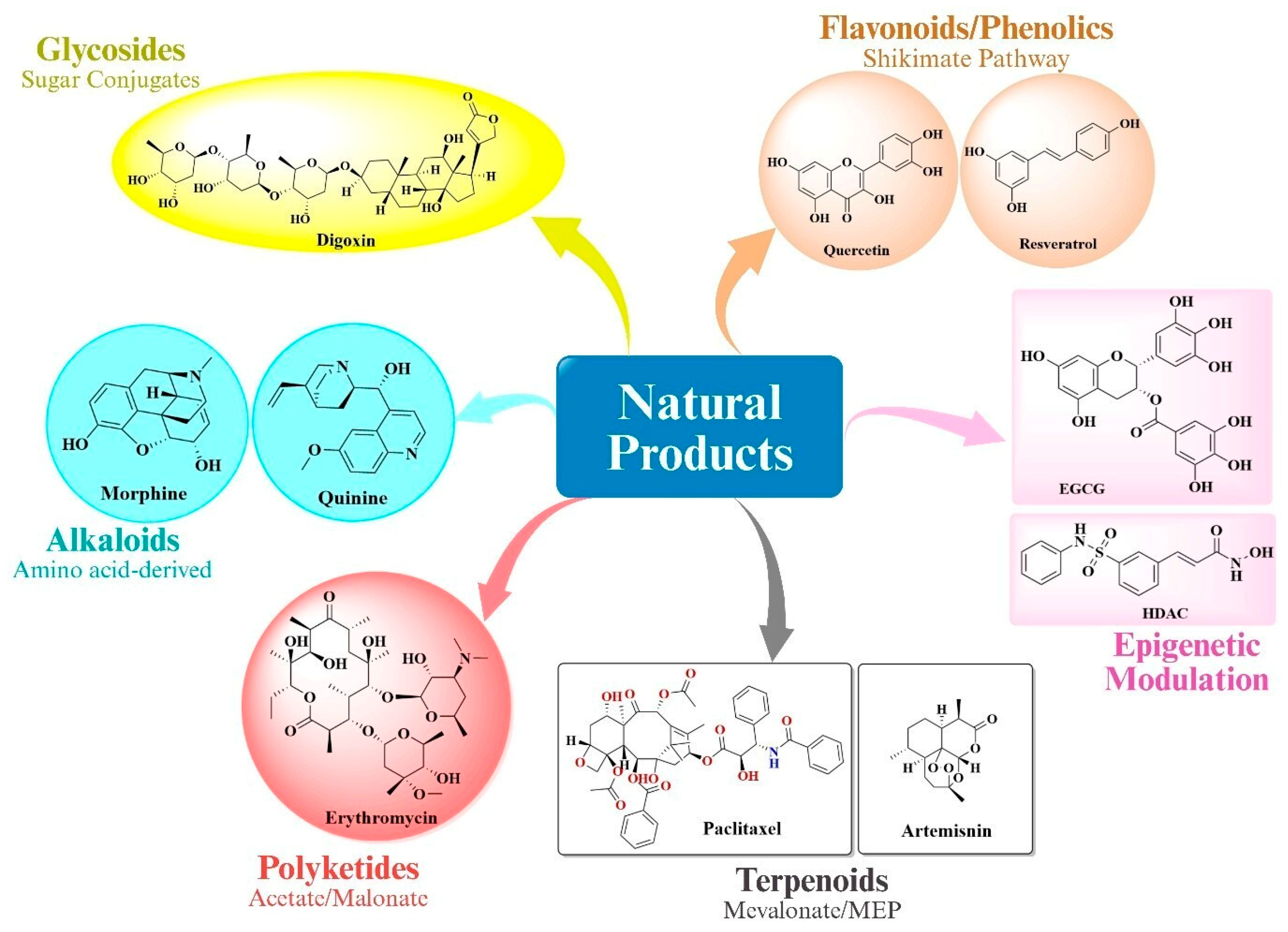


| Major Class of Natural Products | Biosynthetic Origin | Representative Compounds | Major Therapeutic Applications |
|---|---|---|---|
| Alkaloids | Amino acid-derived pathways | morphine, quinine, berberine | analgesic, antimalarial, antimicrobial, anticancer |
| Isoprenoids (Terpenoids) | Mevalonate (MVA) and methylerythritol phosphate (MEP) pathways | artemisinin, menthol, paclitaxel | antimalarial, anti-inflammatory, anticancer |
| Phenolics and Polyphenols | Shikimate and phenylpropanoid pathways | quercetin, resveratrol, curcumin | antioxidant, cardioprotective, anticancer |
| Flavonoids (Subclass of Polyphenols) | Combined shikimate and malonate pathways | catechin, kaempferol, luteolin | antioxidant, anti-inflammatory, neuroprotective |
| Steroids | Mevalonate pathway via triterpenoid intermediates | diosgenin, corticosteroids | anti-inflammatory, hormonal regulation |
| Glycosidic Derivatives of Natural Products | Formed by glycosylation of terpenoids, phenolics, steroids, and other aglycones | digoxin, sennosides, salicin | cardiotonic, laxative, anti-inflammatory |
| Polyketides | Acetate/malonate pathway | erythromycin, tetracycline | antibacterial, antifungal |
| Peptides and Non-ribosomal Peptides | Ribosomal and non-ribosomal peptide synthesis | cyclosporine, vancomycin | immunosuppressive, antimicrobial |
| Therapeutic Area | Natural Product | Mechanism/Target | Clinical Status | Key Advantages | Major Limitations |
|---|---|---|---|---|---|
| Anticancer | Paclitaxel | Microtubule stabilization | Approved | High efficacy | Poor solubility, resistance |
| Anticancer | Doxorubicin | DNA intercalation, Topo II inhibition | Approved | Broad activity | Cardiotoxicity |
| Antimalarial | Artemisinin | ROS via endoperoxide cleavage | Approved | Rapid action | Short half-life, resistance |
| Antibacterial | Vancomycin | Cell wall synthesis inhibition | Approved | Effective vs. Gram+ | Nephrotoxicity, resistance |
| Anti-inflammatory | Curcumin | NF-κB inhibition | Clinical trials | Multi-target | Low bioavailability |
| Cardiovascular | Digoxin | Na+/K+/ATPase inhibition | Approved | Strong efficacy | Narrow therapeutic index |
| Lipid-lowering | Lovastatin | HMG-CoA reductase inhibition | Approved | Proven benefit | Muscle toxicity risk |
| Neuroprotective | Galantamine | AChE inhibition | Approved | CNS activity | Moderate efficacy |
| Antidiabetic | Berberine | AMPK activation | Clinical/preclinical | Metabolic regulation | Variable bioavailability |
| Class | Key Pharmacophore Features | Representative Insight |
|---|---|---|
| Alkaloids | Protonatable nitrogen + aromatic ring | Enables receptor binding |
| Flavonoids | Phenolic OH + planar ring system | Antioxidant and enzyme interaction |
| Terpenoids | Hydrophobic core + oxygenated groups | Membrane interaction and target binding |
| Glycosides | Sugar moiety + active aglycone | Modulates solubility and PK (Pharmacokinetics) |
| Polyketides | Macrocycle + carbonyl groups | Enzyme inhibition and binding |
| Parent Compound | Derivative | Modification Strategy | Pharmacokinetic Impact | Therapeutic Impact |
|---|---|---|---|---|
| Paclitaxel | Docetaxel | Side-chain modification | ↑ Solubility, stability | ↑ Anticancer efficacy |
| Artemisinin | Artesunate | Esterification | ↑ Bioavailability | ↑ Antimalarial activity |
| Morphine | Codeine | Methylation | ↑ Oral absorption | ↓ Potency, altered safety |
| Camptothecin | Irinotecan | Prodrug formation | ↑ Stability | ↑ Clinical usability |
| Lovastatin | Simvastatin | Side-chain modification | ↑ Potency | Improved lipid lowering |
| Compound | Oral Bioavailability | Metabolism | Half-Life (Approx.) | Toxicity Concern |
|---|---|---|---|---|
| Curcumin | Low | Rapid glucuronidation | Short | Minimal |
| Resveratrol | Low | Extensive metabolism | Short | Minimal |
| Doxorubicin | Moderate | Hepatic metabolism | ~20–48 h | Cardiotoxicity |
Disclaimer/Publisher’s Note: The statements, opinions and data contained in all publications are solely those of the individual author(s) and contributor(s) and not of MDPI and/or the editor(s). MDPI and/or the editor(s) disclaim responsibility for any injury to people or property resulting from any ideas, methods, instructions or products referred to in the content. |
© 2026 by the authors. Licensee MDPI, Basel, Switzerland. This article is an open access article distributed under the terms and conditions of the Creative Commons Attribution (CC BY) license.
Share and Cite
Sah, A.K.; Patel, S.; Kumar, R.; Mishra, P.S.; Mishra, R.; Umarovich, A.I.; Elshaikh, R.H.; Agarwal, S.; Bhardwaj, A.; Choudhary, R.K.; et al. Therapeutic Applications of Natural Products in Biomedicine and Pharmacotherapy. Life 2026, 16, 873. https://doi.org/10.3390/life16060873
Sah AK, Patel S, Kumar R, Mishra PS, Mishra R, Umarovich AI, Elshaikh RH, Agarwal S, Bhardwaj A, Choudhary RK, et al. Therapeutic Applications of Natural Products in Biomedicine and Pharmacotherapy. Life. 2026; 16(6):873. https://doi.org/10.3390/life16060873
Chicago/Turabian StyleSah, Ashok Kumar, Sakshi Patel, Rahul Kumar, Prem Shankar Mishra, Rakhi Mishra, Abdulkhakov Ikhtiyor Umarovich, Rabab H. Elshaikh, Shagun Agarwal, Ashwani Bhardwaj, Ranjay Kumar Choudhary, and et al. 2026. "Therapeutic Applications of Natural Products in Biomedicine and Pharmacotherapy" Life 16, no. 6: 873. https://doi.org/10.3390/life16060873
APA StyleSah, A. K., Patel, S., Kumar, R., Mishra, P. S., Mishra, R., Umarovich, A. I., Elshaikh, R. H., Agarwal, S., Bhardwaj, A., Choudhary, R. K., & Alfeel, A. H. (2026). Therapeutic Applications of Natural Products in Biomedicine and Pharmacotherapy. Life, 16(6), 873. https://doi.org/10.3390/life16060873