Article

Genome-Wide Characterization and Expression Profiling of the CCR Gene Family Associated with Stem Strength in Upland Cotton (Gossypium hirsutum L.)


Institute of Cotton, Hebei Academy of Agriculture and Forestry Sciences, Key Laboratory of Cotton Biology and Genetic Breeding in Huanghuaihai Semiarid Area, Ministry of Agriculture and Rural Affairs, Hebei Key Laboratory of Cotton Bio-Breeding and Cultivation Physiology, Shijiazhuang 050051, China
*
Authors to whom correspondence should be addressed.
These authors contributed equally to this work.
Life 2026, 16(5), 861; https://doi.org/10.3390/life16050861 (registering DOI)
Submission received: 27 April 2026 / Revised: 18 May 2026 / Accepted: 19 May 2026 / Published: 21 May 2026

Abstract

In this study, we performed the first genome-wide identification and characterization of the cinnamoyl-CoA reductase (CCR) gene family in upland cotton (Gossypium hirsutum), focusing on its potential association with stem strength. We identified 76 GhCCR genes and classified them into four subfamilies. We then analyzed their evolutionary relationships, conserved domains, synteny, promoter cis-elements, and expression patterns. All GhCCR proteins possess the NADB_Rossmann superfamily domain, and family expansion appears to have been driven mainly by segmental and tandem duplications. A small number of GhCCR genes showed relatively high expression in leaf, pistil, and torus tissues, while genes such as GhCCR3/9/10 exhibited elevated transcript levels under abiotic stress conditions. RT-qPCR results indicated that three candidate GhCCR genes (GhCCR25, GhCCR52 and GhCCR64) were significantly more highly expressed in multiple tissues of the stiff-stem line JY-25 than in the soft-stem line JR-15. Together, these findings suggest that GhCCR genes may contribute to the regulation of growth, development, and stress adaptation in G. hirsutum. However, direct biochemical or genetic validation is required to confirm their functional roles in lignin biosynthesis and stem rigidity.

1. Introduction

Cotton, the world’s most crucial natural textile raw material, is integral to the global agricultural and trade landscape due to its diverse applications in fiber, food, and feed [1,2]. However, its productivity remains highly vulnerable to abiotic stresses such as cold, drought, and salinity, which can severely reduce yields [3,4,5]. Furthermore, lodging—stem bending or breaking under strong winds—poses a significant threat to both yield and quality, especially during harvest. Lodging not only reduces yield and fiber quality but also severely impairs mechanical harvesting efficiency, as bent or broken stalks cannot be picked cleanly, leading to increased harvest losses and higher production costs [6,7]. Stem strength in cotton is determined by a complex interplay of genetic, physiological, epigenetic, and environmental factors. Key mechanical properties, including rigidity and strength, are strongly correlated with lignin content and are further modulated by the composition of lignin monomers and their interactions with other cell wall components [8,9]. With climate change expected to exacerbate these environmental challenges, developing resilient cotton varieties has become an urgent priority for ensuring the sustainability of global cotton production [10].
Plant cell walls constitute a highly dynamic and precisely regulated extracellular matrix capable of real-time perception of morphogenetic signals and integration of diverse stress-induced environmental changes [11,12]. The directed deposition of lignin within secondary cell walls is the primary mechanism underpinning cell wall thickening and enhanced mechanical strength, serving as a core physiological module for plant adaptation to terrestrial environments and multiple stresses by synergistically enhancing cell wall integrity, regulating water and solute dynamics, and indirectly stabilizing membrane structures [13,14,15]. Stress signals such as abscisic acid (ABA) and reactive oxygen species (ROS) rapidly activate the phenylpropanoid pathway, elevating the activity of key enzymes including phenylalanine ammonia-lyase (PAL), 4-coumarate: coenzyme A ligase (4CL), cinnamoyl-CoA reductase (CCR), and cinnamyl alcohol dehydrogenase (CAD), leading to extensive polymerization of lignin monomers within xylem vessels, fibers, and root endodermis [16,17,18,19]. Lignin synthesis genes play crucial roles across species: in Oryza sativa, Os4CL4 enhances aluminum tolerance by modifying cell walls to reduce aluminum binding, while OsPAL8 overexpression boosts resistance via salicylic acid and lignin synthesis pathways under regulation by OsMYB30 [17]; in Triticum aestivum, TaCAD12 overexpression upregulates defense and lignin synthesis genes to combat Fusarium wilt [20]; and in Solanum tuberosum, StPAL1 expression is significantly upregulated by drought, high temperature, and methyl jasmonate (MeJA), indicating its role in abiotic stress defense [21].
The CCR gene family encodes the first key enzyme in the lignin-specific biosynthesis pathway. Unlike PAL and 4CL, which are involved in multiple phenylpropanoid pathways, CCR acts as the first dedicated enzyme for monolignol biosynthesis and is considered a key rate-limiting step specifically for lignin formation [13,18]. Gene copy numbers vary across species, with Triticum aestivum possessing 20, Capsicum spp. 38, and Dalbergia odorifera 24 [22,23,24]. The CCR gene families of Dalbergia odorifera, pepper (Capsicum chinense) and wheat (Triticum aestivum) all exhibit sequence conservation, with their core members being involved in lignin biosynthesis. Their promoter regions all contain cis-acting elements associated with stress, light, hormone and growth/development responses, and the genes show tissue-specific expression patterns with inducible expression in response to external stimuli. However, the CCR gene families of these three species vary considerably in terms of their size, classification and chromosomal distribution. These CCR genes significantly influence plant growth, development, and stress resistance. For example, in O. sativa, OsCCR10 is directly activated by the transcription factor OsNAC5, enhancing drought tolerance during vegetative growth by regulating lignin accumulation [25]. Concurrently, the expression of OsCCR17 and OsCCR21 is induced by both biotic and abiotic stresses, indicating their defensive roles [26]. In B. napus, overexpression of BnaCCR2.b increased stem lignin content by 2.28–2.76%, thereby boosting resistance to Sclerotinia sclerotiorum [27]. In the economically important tree species Morus alba, downregulation of MaCCR1 altered lignin content and stunted growth [28]. Conversely, reduced expression of the maize CCR1 gene did not affect overall growth but led to a slight decrease in lignin content and significant structural alterations [29]. These findings collectively indicate a potential pleiotropic role of CCR genes in coordinating plant development and stress adaptation, which may underpin their strategic value as candidate targets for molecular breeding [18].
Based on the long-completed whole-genome sequencing of G. hirsutum, this study systematically identified the GhCCR gene family, addressing a current research gap. We characterized its phylogenetic relationships, conserved domains, and gene structures. Transcriptomic analysis revealed tissue-specific variations in GhCCR transcript abundance. Expression profiling under three abiotic stresses (cold, NaCl, and PEG-simulated drought) further identified key GhCCR candidates implicated in growth regulation and stress resistance. RT-qPCR results showed that expression levels of three GhCCR genes (GhCCR25, GhCCR52, and GhCCR64) were significantly higher in the roots and stems of a stiff-stem line (JY-25) than in a soft-stem line (JR-15), suggesting their possible role in promoting lignin synthesis. These findings offer preliminary insights into the GhCCR gene family’s function in regulating stem strength and provide a theoretical foundation for future mechanistic research in cotton.

2. Results

2.1. Identification and Phylogenetic Analysis of the GhCCR Gene Family

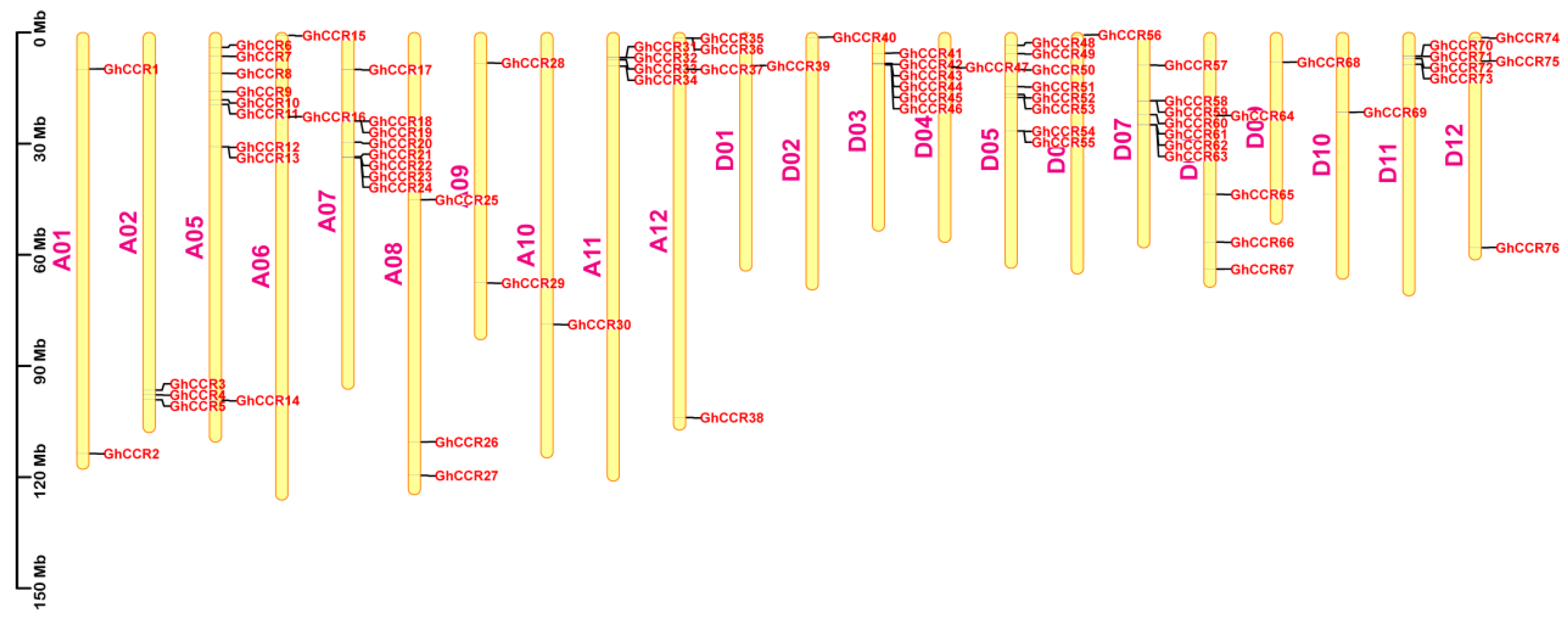
To identify GhCCR genes, we performed BLAST (TBtools_windows-x64_2_376) searches using known CCR protein sequences from A. thaliana as queries against the G. hirsutum genome. The search was conducted with an E-value threshold of 1 × 10⁻¹⁰ and a minimum sequence identity of 50%. Candidate hits were further validated by confirming the presence of the conserved NADB_Rossmann domain and the FR_SDR_e domain using NCBI CDD and Pfam databases. A total of 76 GhCCR genes were identified and systematically named GhCCR1 to GhCCR76 based on their chromosomal order (Table S1). These genes are distributed across 22 chromosomes (Figure 1). Chromosome A05 contains the most members (nine genes), while chromosomes A10, D01, D02, D06, D09, and D10 each harbor only a single GhCCR gene. Nine tandem repeat clusters were identified, with the largest cluster containing four consecutive genes (GhCCR42–GhCCR45) (Table S2). Analysis of physicochemical properties shows that GhCCR proteins vary in length from 97 to 596 amino acids, with molecular weights exceeding 10 kDa (Table S1). Their theoretical isoelectric points (pI) range from 5.02 to 9.33, with 21 genes (28%) encoding basic proteins. Only eight members (~11%) are predicted to be unstable (instability index > 40). In terms of hydrophobicity, 63% of GhCCR proteins are hydrophilic and 37% are hydrophobic. Subcellular localization predictions (Plant-mPLoc) indicate that the majority of GhCCR proteins are targeted to the Golgi apparatus. Eight genes (GhCCR3, 5, 12, 36, 42, 43, 44, 61) are predicted to localize to the chloroplast, cytoplasm, or nucleus.
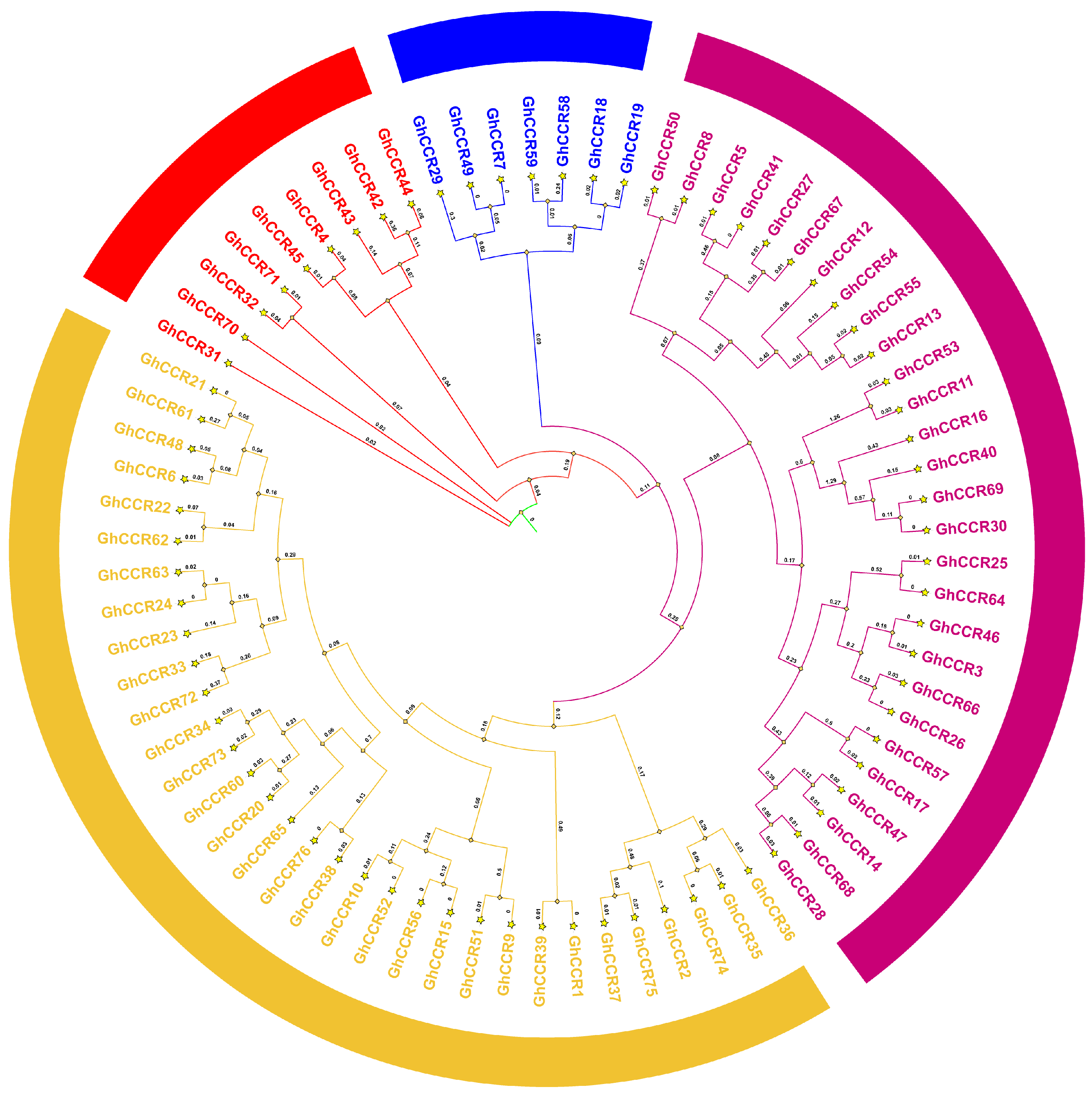
Phylogenetic analysis was performed using the Neighbor-Joining (NJ) method in MEGA7.0 with 5000 bootstrap replicates. The NJ method was chosen because it is computationally efficient for large datasets and produced consistent topologies when compared with maximum likelihood (ML) analysis. This analysis classified the 76 GhCCR proteins into four distinct subfamilies: I (7 members), II (28 members), III (32 members), and IV (9 members) (Figure 2).

2.2. Analysis of Conserved Motifs, Protein Domains, and Gene Structure of GhCCR Genes

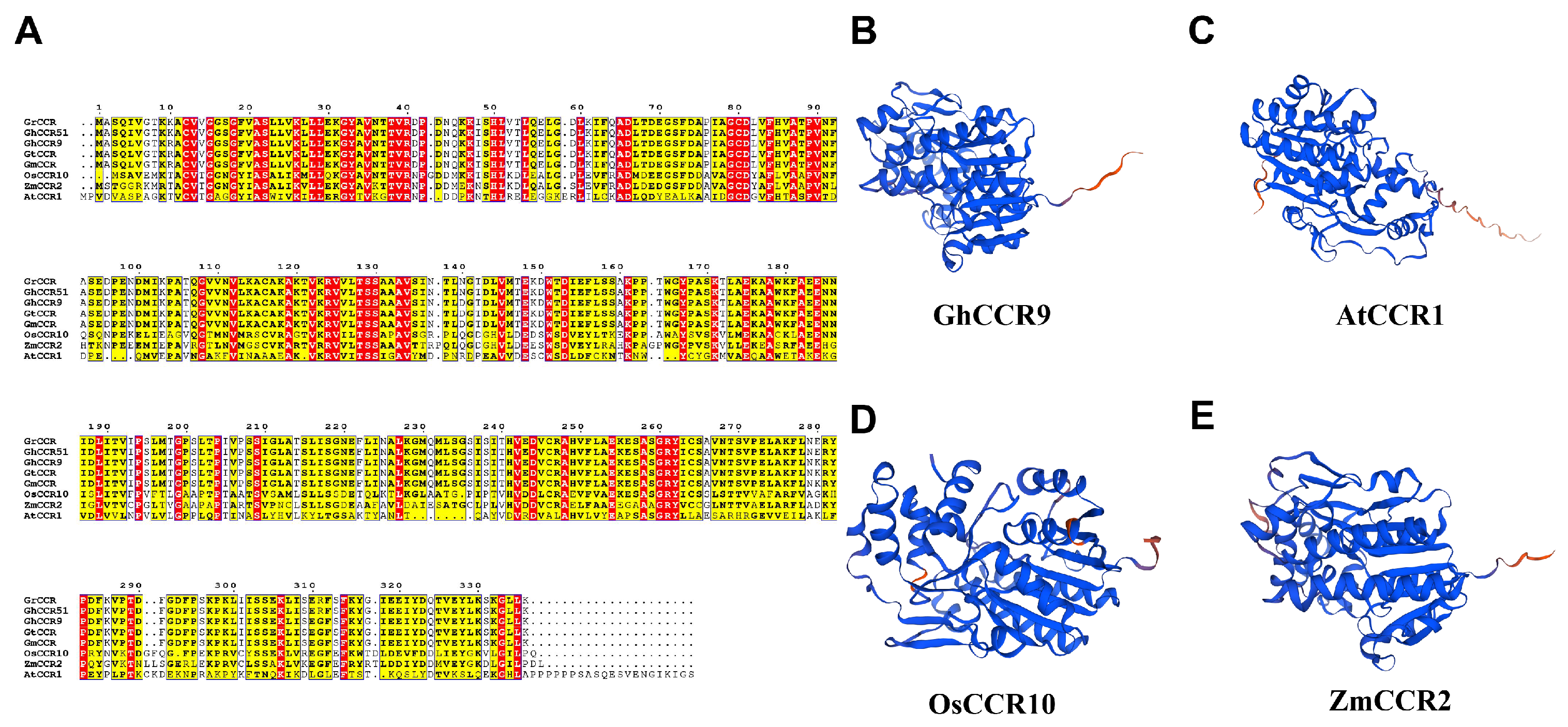
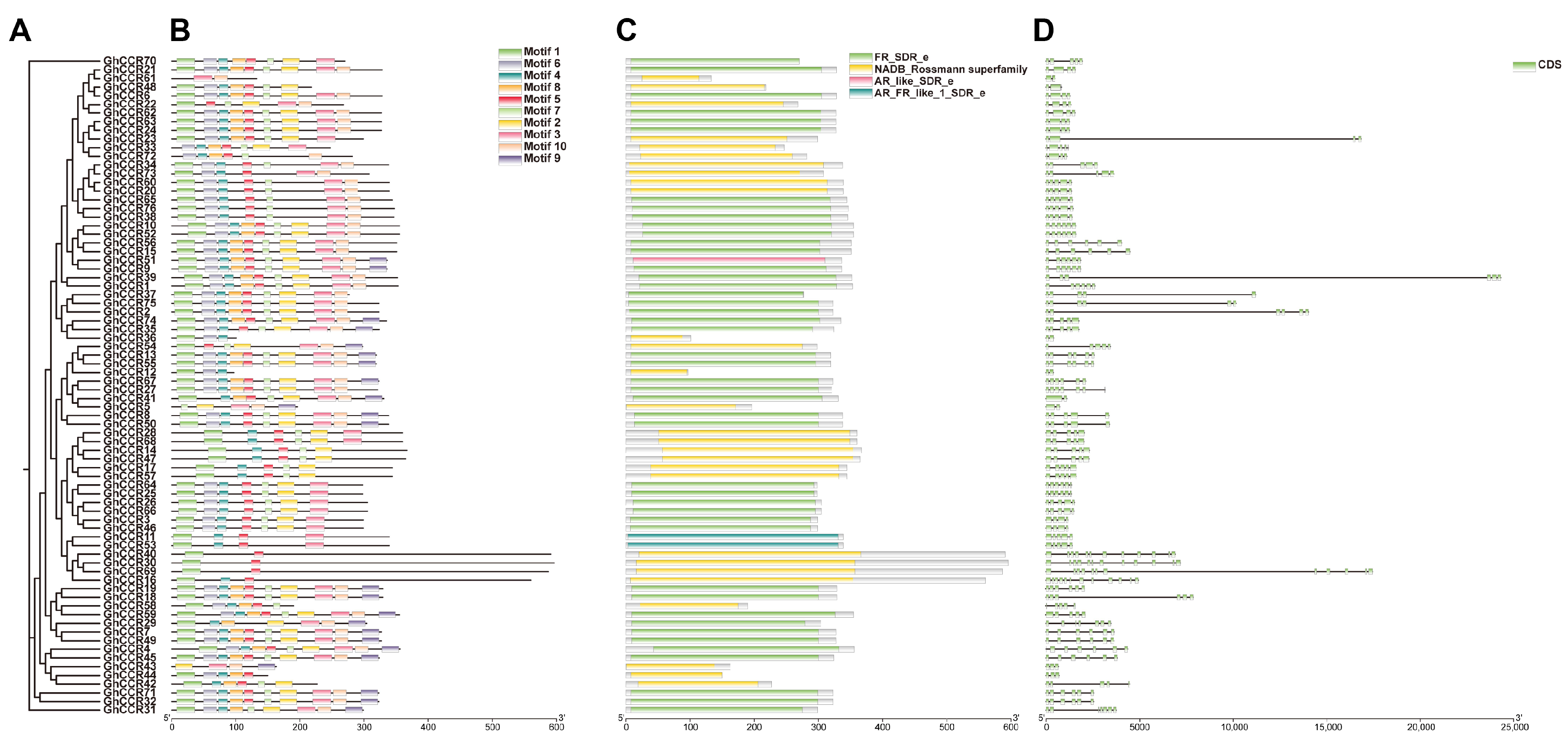
Analysis of conserved protein motifs revealed that most of the 76 GhCCR members contain approximately eight conserved motifs, with Motif 1 and Motif 5 being the most prevalent (Figure 3B, Table S3). Genes clustered on the same phylogenetic branch tend to share highly similar motif compositions, indicating strong sequence conservation within subfamilies. Domain architecture analysis reveals that the majority of members in this gene family harbor the conserved FR_SDR_e domain, with a large proportion additionally carrying the NADB_Rossmann superfamily domain. Multiple sequence alignment revealed that all 76 GhCCR proteins contain the canonical NAD(P)H-binding motif (VTGALFGKT) and the conserved active-site residues characteristic of CCR enzymes, indicating that the catalytic core is preserved across the entire family (Figure 3B,C). Gene structure analysis shows that GhCCR genes contain 2 to 12 exons and 1 to 11 introns (Figure 3D). Cross-species sequence alignment and protein tertiary structure comparison revealed that CCR proteins are highly conserved (Figure 4A–E and Figure S2). The predicted tertiary structures (Figure 4B–E and Figure S2B–D) show that GhCCR9, GhCCR51, AtCCR1, OsCCR10, ZmCCR2 AtCCR2, GhCCR8 and GhCCR50 all adopt a typical Rossmann fold, characterized by a central β-sheet flanked by α-helices, which is consistent with their conserved NAD(P)H-binding and catalytic functions. The high structural similarity among these distantly related species further supports the functional conservation of CCR enzymes in lignin biosynthesis. Ka/Ks analysis indicates that GhCCRs are under purifying selection.

2.3. Collinearity Analysis of the CCR Gene Family in G. hirsutum

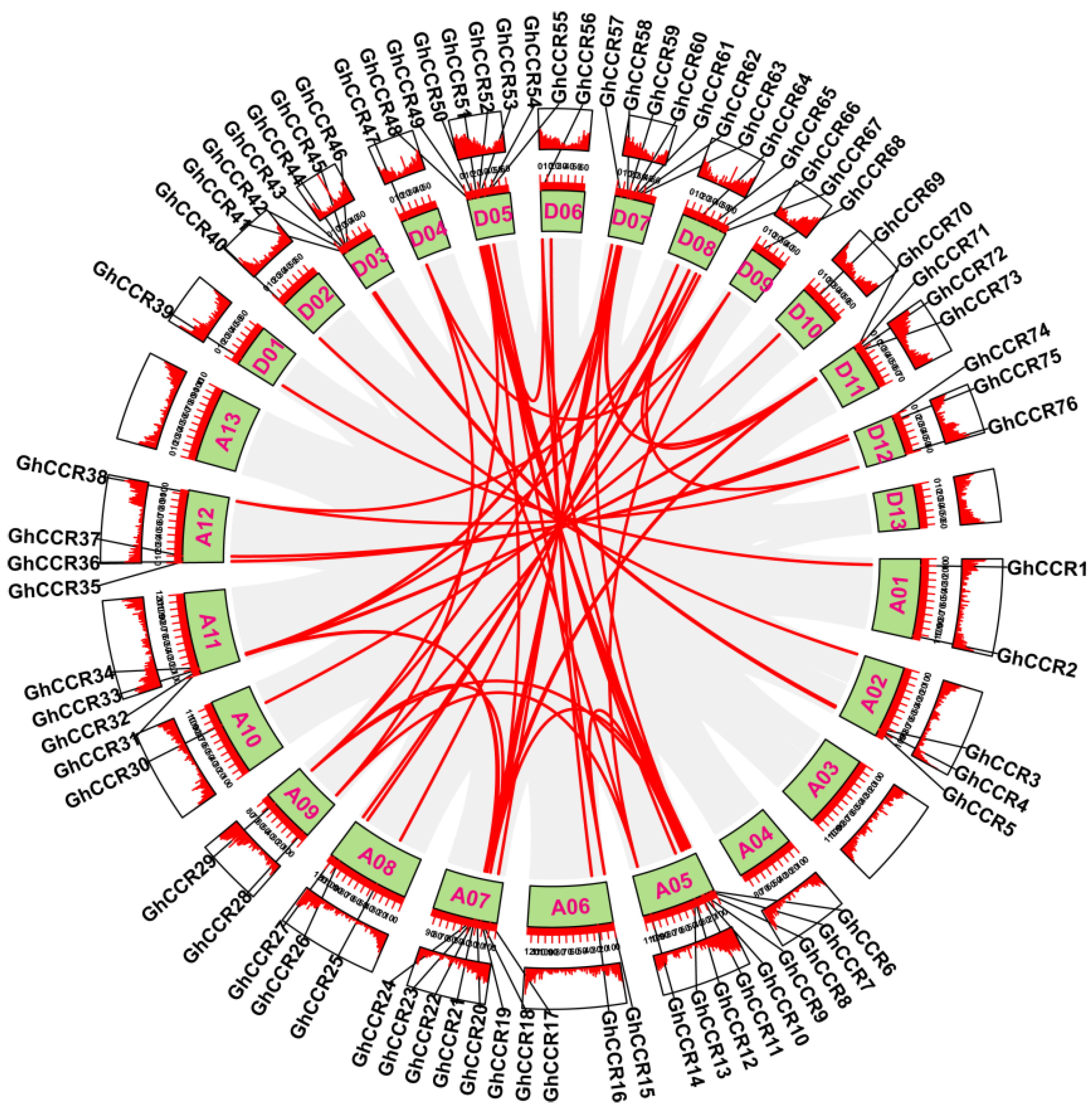
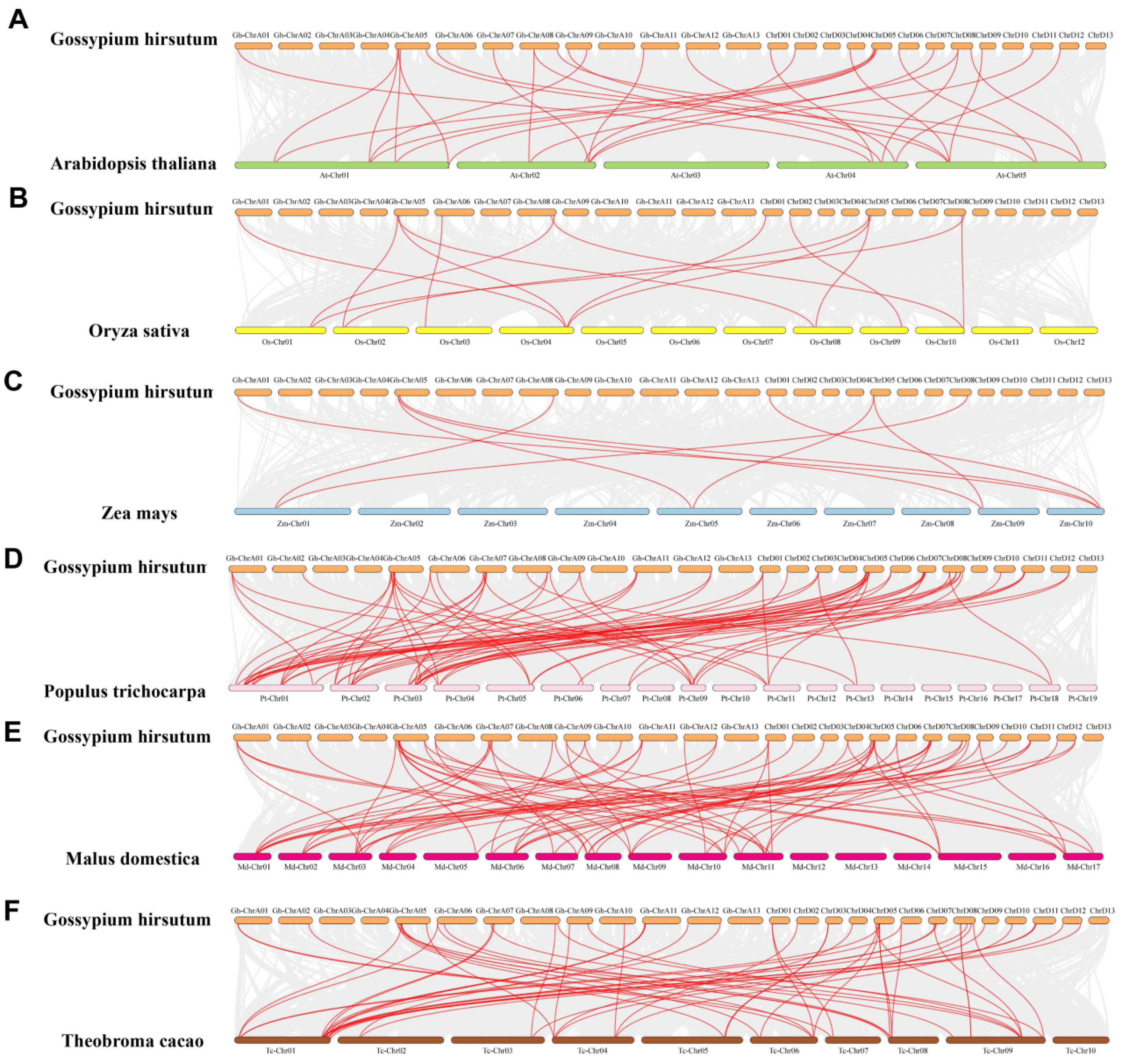
The GhCCR gene family in G. hirsutum has expanded through multiple duplication events during evolution. Within the cotton genome, the 76 GhCCR genes formed 58 segmentally duplicated gene pairs (Figure 5). Comparative synteny analysis was further performed between G. hirsutum and six other plant species: A. thaliana, O. sativa, Z. mays, P. trichocarpa, Malus domestica, Theobroma cacao, Brassica napus, Cucumis sativus and Medicago sativa (Figure 6A–F and Figure S3). This analysis identified numerous homologous gene pairs: 30 with A. thaliana, 14 with O. sativa, 9 with Z. mays, 69 with P. trichocarpa, 55 with M. domestica, 55 with T. cacao, 43 with B. napus, 41 with C. sativus and 29 with M. sativa.

2.4. Analysis of Cis-Acting Elements Within the GhCCR Gene Family

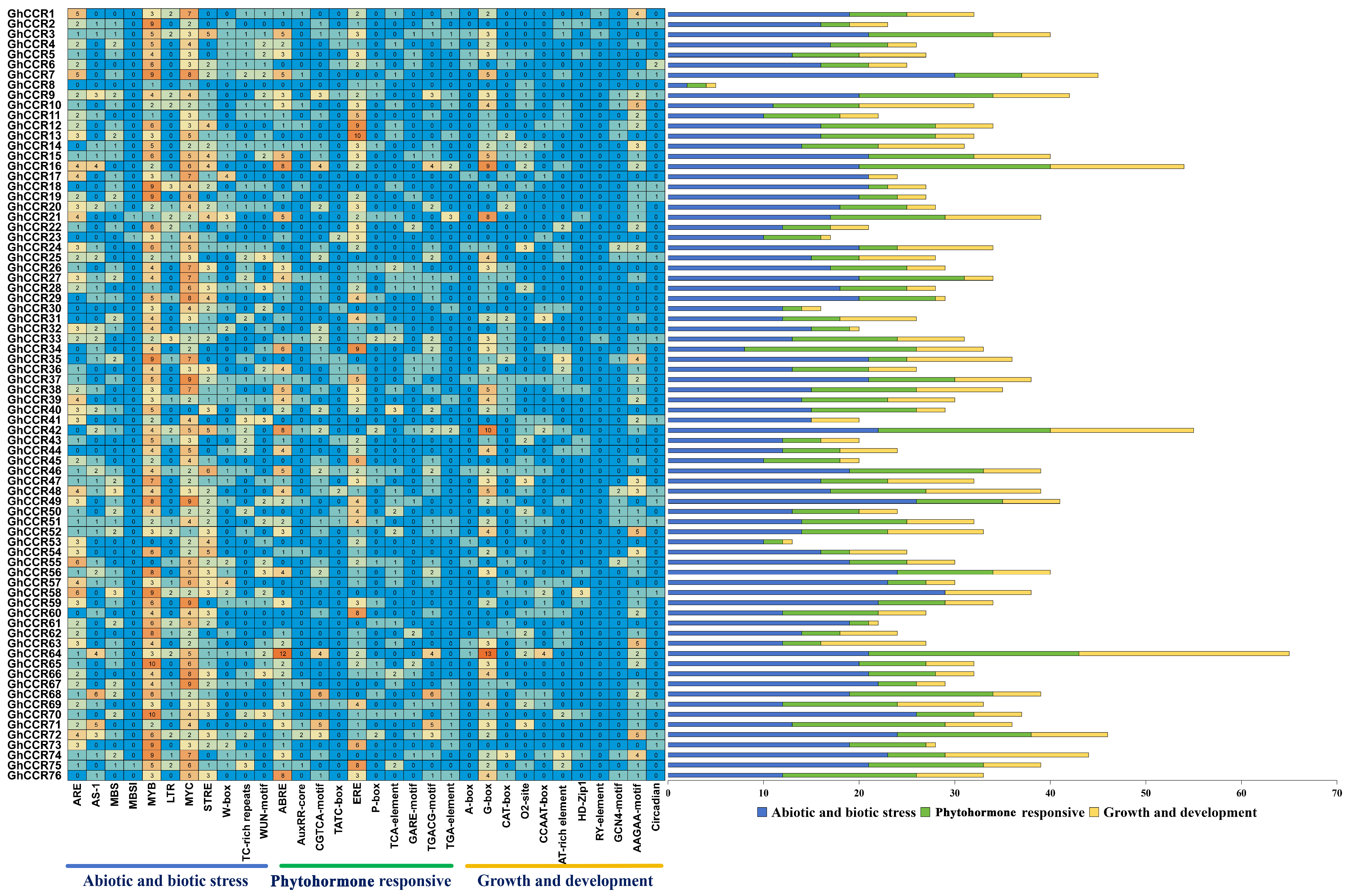
Promoter cis-element analysis predicts diverse regulatory functions for GhCCR genes. Analysis of the 2000 bp promoter regions using the PlantCARE database identified numerous cis-acting elements (Figure 7). These elements were classified into three functional categories: abiotic/biotic stress response, phytohormone response, and plant growth/development.
Notably, promoters of specific genes are enriched in elements associated with particular functions. For example, GhCCR7 contains a high frequency of stress-responsive elements (e.g., MYB, MYC, ARE), suggesting a possible role in stress adaptation that requires experimental confirmation. In contrast, the promoter of GhCCR64 is enriched with ABRE elements (involved in abscisic acid signaling) and multiple G-box elements, implying a potential link to ABA signaling; however, direct experimental evidence is needed to confirm functional regulation.

2.5. Transcriptome Analysis of the G. hirsutum GhCCR Gene Family

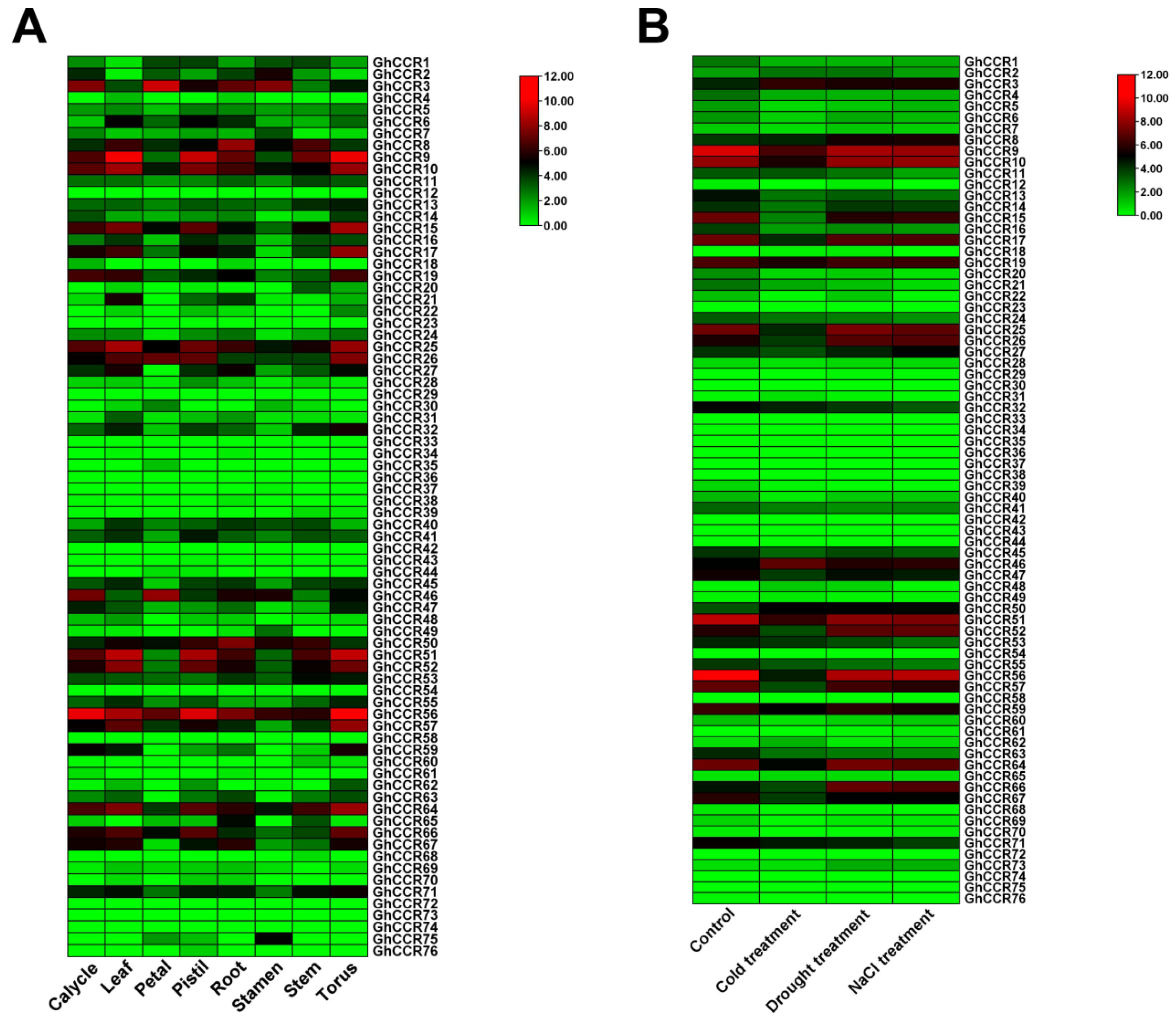
To elucidate the potential roles of GhCCR genes in development and stress adaptation, their expression profiles were analyzed using publicly available transcriptome data. Heatmaps were generated to visualize expression patterns across eight different cotton tissues and under three abiotic stress conditions: salinity, cold, and drought (Figure 8A,B).
The analysis revealed distinct expression patterns. In tissues, most GhCCR genes showed low expression (e.g., GhCCR36/37), while a few, such as GhCCR10 and GhCCR56, were highly expressed in almost all plant tissues, suggesting tissue-specific functions in growth and development. Under abiotic stress, approximately half of the genes remained lowly expressed. However, several genes, including GhCCR3 and GhCCR50, were significantly upregulated, indicating their potential involvement in stress response pathways.

2.6. Comparative Expression Analysis of CCR Genes Between Stiff-Stem (JY-25) and Soft-Stem (JR15) Cotton Lines

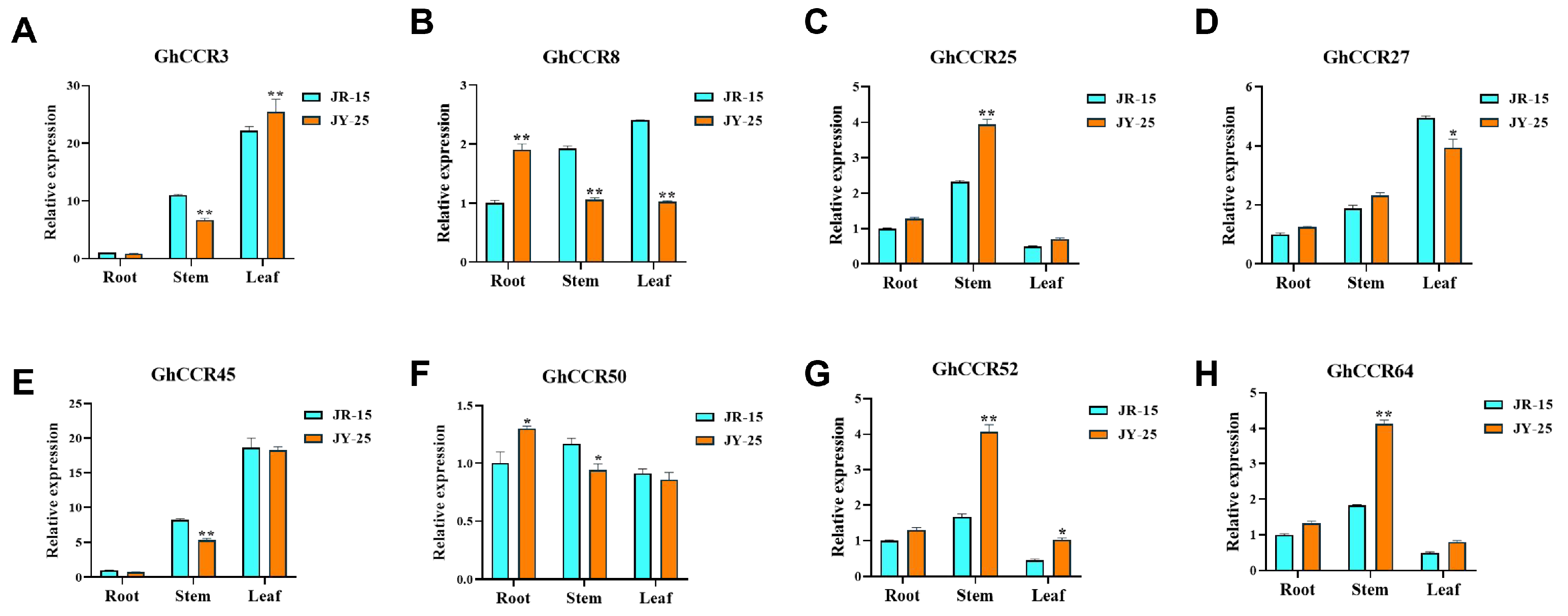
To investigate the association between CCR genes and stem mechanical strength in cotton, we performed RT-qPCR analysis of eight selected GhCCR candidates in two contrasting lines: the stiff-stem line JY-25 and the soft-stem line JR-15. In the JY-25 strain, the contents of lignin and hemicellulose were both higher than those in the JR-15 strain, while the cellulose content showed no significant difference (Figure S1). The lignin content was directly quantified using the acetyl bromide method. The results revealed that GhCCR25, GhCCR52 and GhCCR64 exhibited higher expression levels in the stems of JY-25 compared to JR-15. While GhCCR8 showed elevated expression specifically in the roots of JY-25, the expression of GhCCR45 did not differ significantly between the two lines. Meanwhile, the expression levels of GhCCR3, GhCCR27, and GhCCR50 also showed little difference between the two cotton lines. Notably, GhCCR25/52/64 expression was markedly upregulated in the stems of JY-25, suggesting a potential association with stem rigidity; however, functional validation is required to establish a causal role.

3. Discussion

Mechanistically, CCR catalyzes the reduction in cinnamoyl-CoA to cinnamaldehyde, the first committed step in the monolignol biosynthesis pathway. This reaction not only determines the total lignin content but also affects the ratio of guaiacyl (G) to syringyl (S) monomers, which profoundly influences cell wall mechanical properties, including stem bending strength and fracture resistance [13,18]. The number of GhCCR gene family members identified in this study (76) shows significant variation compared to species such as A. thaliana (11), P. trichocarpa (11), O. sativa (33), and T. aestivum (115). These numerical differences across species reflect key evolutionary events such as whole-genome duplication and subsequent gene loss within the CCR family [22,24]. On this basis, the member expansion of the GhCCR family is closely associated with the allopolyploidization history of G. hirsutum, which drives gene family expansion and leads to obvious interspecific numerical differences. Moreover, the expanded GhCCR genes have undergone functional divergence, providing abundant genetic resources for cotton to adapt to variable environmental stresses and maintain normal growth and development. Furthermore, GhCCR members exhibited an obvious uneven and non-random distribution across different cotton chromosomes. Such chromosomal distribution pattern is not a random event, but closely associated with genome evolution, segmental duplication events, and chromosomal rearrangement. The uneven enrichment of GhCCR genes on certain chromosomes implies that these chromosomes may serve as critical carriers for the expansion and functional differentiation of the CCR gene family, and further suggests that the clustered distribution of GhCCR members on partial chromosomes may be conducive to the coordinated expression and functional collaboration of adjacent genes involved in lignin biosynthesis and stress adaptation. Over time, homologous gene differentiation driven by segmental duplication (SD) and tandem duplication (TD) may have led to novel gene structures and functions [30]. As an allotetraploid, G. hirsutum harbors 58 segmentally duplicated gene pairs and 9 tandem repeat clusters, likely linked to its polyploidization history and evolutionary forces (Figure 1 and Figure 5). Sequence alignment analysis indicates that GhCCR9 and GhCCR51 in G. hirsutum share a closer evolutionary relationship with AtCCR1 in A. thaliana. These genes also contain the highest number of conserved motifs and show closer phylogenetic relationships with CCR genes from most other crops (Figure 4A). These results indicate that Subfamily III, to which GhCCR9/51 belong, may retain a conserved function associated with lignin biosynthesis. We also searched for AtCCR2 homologs among GhCCR genes and identified GhCCR8 and GhCCR50 (Figure S2), which share high sequence and structural similarity with AtCCR2. These genes are upregulated under multiple abiotic stresses (Figure 8B), aligning with the reported stress-inducible role of AtCCR2. In contrast, our candidate genes GhCCR25/52/64 are more closely related to AtCCR1 (Figure 4A), supporting their potential role in constitutive lignification and stem strength. It is widely recognized that even genes within the same gene family frequently differ in their functions. Accordingly, we hypothesize that the other three GhCCR subfamilies in G. hirsutum may have undergone functional divergence during long-term evolution and thereby participate in diverse biological processes.
Plant CCR genes universally harbor a conserved NAD(P)H-binding domain (VTGALFGKT) and a characteristic structural motif, which are central not only to lignin biosynthesis but also to the cross-regulation between plant development and defense responses [11]. Within the GhCCR family, most genes clustered on the same phylogenetic branch share identical conserved motifs and exhibit highly similar gene structures, including consistent numbers of exons and introns (Figure 3D). The gene architecture characterized by fewer and shorter introns in the GhCCR family suggests a potential association with more rapid transcriptional responsiveness to environmental changes, which may confer enhanced functional efficiency under stress [31]. Comparative synteny analysis revealed that the GhCCR family exhibits the highest number of collinear gene pairs with P. trichocarpa (69), followed by M. domestica (55) and T. cacao (55). Among herbaceous dicots, B. napus (allotetraploid) shows 43 collinear pairs, while C. sativus and M. sativa have 41 and 29 pairs, respectively (Figure 6 and Figure S3). Collinearity counts with these herbaceous dicots are generally higher than those with the monocots O. sativa (14) and Z. mays (9), but remain lower than with P. trichocarpa. These findings indicate that the degree of synteny is influenced by multiple factors, including phylogenetic distance, genome duplication history (cotton, B. napus, and M. sativa are polyploids), and lineage-specific retention of duplicated genes. Thus, the higher collinearity with P. trichocarpa likely reflects both close taxonomic relatedness and shared genomic features, rather than a generic property of woody plants.
Promoters are key regulatory DNA sequences upstream of gene coding regions and central hubs in gene expression networks, making the analysis of their cis-acting elements fundamental for predicting gene function and deciphering regulatory logic [32,33]. This study shows that the promoters of the GhCCR gene family contain diverse cis-regulatory elements, which can be categorized into three groups: abiotic/biotic stress response, phytohormone response, and growth/development (Figure 7). Notably, the presence of ABRE and ERE elements in these promoters implies a possible link to abscisic acid (ABA) and ethylene signaling; however, cis-element prediction alone does not confirm functional regulation, and experimental validation is required to establish actual transcription factor binding and regulatory activity [31,34,35]. This aligns with known regulatory paradigms in other species: for example, BnaA07.MYB43 in oilseed rape directly binds to the AC-II element in promoters of lignin biosynthesis genes like BnaCCR1, acting as a core transcriptional activator for vascular lignification; in rice, OsCCR10 is directly activated by the transcription factor OsNAC5 to enhance drought tolerance via lignin accumulation; and in flax, LuCCR family members are regulated by multiple hormones (ABA, MeJA, GA3, auxin), indicating coordinated hormonal control over developmental lignification and stress defense [25,36,37]. The functional importance of CCR genes is underscored by mutant phenotypes, such as the knockout of AtCCR1 in A. thaliana, which leads to a 50% reduction in lignin, collapsed vessels, and dwarfism [29,38]. In our study, promoters of genes like GhCCR16, GhCCR42, GhCCR64, and GhCCR74 contain abundant growth-related elements, suggesting these genes perform specific functions during cotton development. Furthermore, the enrichment of hormone response elements (e.g., ABRE) in the promoters of GhCCR16, GhCCR42, GhCCR64 and GhCCR76 implies that these specific GhCCR members may be involved in abiotic stress responses through ABA/JA signaling pathways. Integrating these observations, the enrichment of ABRE and MYB elements in GhCCR25/52/64 promoters suggests a potential regulatory link between ABA signaling and lignin biosynthesis, which may enhance stem rigidity through stress-induced lignification [25,36].
RNA-seq has significantly advanced our understanding of gene family functions, evolution, and their role in biological adaptation by bridging genomic sequences with complex plant phenotypes [39]. CCR gene expression exhibits distinct tissue-specific patterns: in soybean, GmCCR12 shows peak abundance in roots and high stem expression, while GmCCR9 is primarily expressed in stems and developing seeds; in A. thaliana, AtCCR1 displays low leaf expression but significantly higher levels in stems [11,40]. In G. hirsutum, GhCCR9 is highly expressed in leaf, pistil, and torus tissues but lower in petals, whereas GhCCR56 shows elevated expression in all cotton tissues. Notably, compared with other subfamilies, the GhCCR III subfamily exhibited significantly higher expression levels throughout the growth period, suggesting that its members act as key factors in cotton growth and development (Figure 8A). CCR genes are also crucial for abiotic stress responses, where enhanced lignin synthesis strengthens structural integrity. For example, LuCCR2/5/10/18 are upregulated under salt, alkaline, and drought stress in flax [36]. Similarly, in cotton, genes such as GhCCR3, GhCCR8 and GhCCR50 show elevated expression across drought, cold, and salt stresses, indicating a broad role in abiotic stress resistance (Figure 8B). In contrast, GhCCR46 is significantly upregulated only under cold stress, and GhCCR66 responds to all three stresses—upregulated under drought and salt stress but downregulated under cold stress—highlighting their distinct functional specialization. Furthermore, RT-qPCR analysis revealed that GhCCR25/GhCCR52/GhCCR64 exhibited higher expression in the roots, stems, and leaves of the hard-stemmed line JY-25 compared with the soft-stemmed line JR-15; however, the difference reached a highly significant level only in the stems. The pronounced upregulation of GhCCR25/GhCCR52/GhCCR64 in JY-25 stems strongly suggests its potential key role in conferring stem rigidity (Figure 9). Therefore, GhCCR25/GhCCR52/GhCCR64 emerges as prime candidates for future studies aimed at elucidating the molecular pathways that enhance stem strength in cotton. It should be emphasized that our findings are derived from transcriptomic and expression data only. Direct biochemical and genetic experiments (e.g., lignin quantification, histochemical staining, and transgenic assays) are required to confirm the functional involvement of the candidate GhCCR genes.
Collectively, our results establish a solid foundation for understanding the GhCCR gene family in cotton, highlighting GhCCR25, GhCCR52, and GhCCR64 as valuable targets for breeding programs focused on improving stem mechanical strength. The conservation of stress-responsive cis-elements across plant species suggests that insights from model systems can inform cotton improvement. Future work should functionally validate these candidate genes via overexpression and knockout experiments, along with detailed phenotyping of lignin content, stem strength, and field-based agronomic traits. Such efforts will facilitate the development of cotton varieties with enhanced lodging resistance and stress tolerance, addressing critical challenges in modern cotton production.

4. Materials and Methods

4.1. Experimental Materials

In this study, two cotton lines: a stiff-stem line (JY-25) and a soft-stem line (JR-15) were used. Seeds were first soaked in water for 16–24 h and then sown in a soil mixture (peat moss: vermiculite: nutrient soil = 1:1:1). Plants were cultured under controlled conditions (25 ± 3 °C, 16 h light/8 h dark) for 4–6 weeks [41]. After this period, roots, stems, and leaves were collected for RNA extraction and subsequent RT-qPCR analysis.

4.2. Identification and Characterization of the GhCCR Gene Family in G. hirsutum

The reference genome and corresponding amino acid sequences of G. hirsutum TM-1 were retrieved from the COTTONOMICS database (https://cotton.zju.edu.cn/, accessed on 5 April 2025) [42,43]. Known CCR family protein sequences from the model species Arabidopsis thaliana were downloaded and used as query templates for a homology search against the G. hirsutum protein dataset to identify candidate GhCCR gene family members. Identified members were systematically named GhCCR1 to GhCCR76 based on their chromosomal positions. Gene location data and chromosome sizes were obtained from the COTTONOMICS database, and their physical positions were visualized using the TBtools Gene Location Visualize module (TBtools_windows-x64_2_376, South China Agricultural University, Guangzhou, China) [44,45]. The basic physicochemical properties of the predicted GhCCR proteins were analyzed using the DTU Health Tech online server (https://services.healthtech.dtu.dk/, accessed on 6 April 2025), while their subcellular localizations were predicted via the Plant-mPLoc website (http://www.csbio.sjtu.edu.cn/bioinf/plant-multi/, accessed on 6 May 2025) [46].

4.3. Sequence Alignment and Phylogenetic Analysis of the GhCCR Gene Family

A phylogenetic tree of the GhCCR gene family was constructed using MEGA7.0 (version 7.0.26) software based on the Neighbor-Joining (NJ) method. Branch support was evaluated through 5000 bootstrap replications [47]. The resulting Newick file was imported into the iTOL online platform (https://itol.embl.de/, accessed on 15 May 2025) for tree visualization. For comparative analysis, CCR protein sequences from closely related Gossypium species—Gossypium tomentosum (GtCCR, Gotom.A05G181700), Gossypium mustelinum (GmCCR, Gomus.A05G179300), and Gossypium raimondii (GrCCR, Gorai.009G175500)—were retrieved from the Phytozome13 database (https://phytozome-next.jgi.doe.gov/, accessed on 14 July 2025) [48]. Additionally, sequences from representative monocots, Oryza sativa (OsCCR, LOC_Os04g53920) and Zea mays (ZmCCR, Zm00001d026370) were included. Multiple sequence alignment was performed using ClustalW (https://www.genome.jp/tools-bin/clustalw, accessed on 15 July 2025), and the results were visualized with ENDscript/ESPrip (https://espript.ibcp.fr/ESPript/ESPript/index.php, accessed on 19 July 2025).

4.4. Analysis of Conserved Motifs, Conserved Domains and Gene Structures Within the GhCCR Gene Family

The GhCCR protein sequences were analyzed using MEME Suite (version 5.5.5) to identify conserved motifs, with the number of motifs set to 10 [49]. To investigate the structural characteristics of the GhCCR gene family, gene structure visualization was performed. The gff3 annotation file and a file containing all GhCCR gene IDs were loaded into TBtools to visualize exon–intron structures. Concurrently, the protein sequences were queried against the NCBI protein database to obtain hit data. Finally, these datasets were integrated using the TBtools Gene Structure View (Advanced) function to generate a combined phylogenetic tree, conserved motif map, and gene structure schematic [50].

4.5. Collinearity Analysis of the GhCCR Gene Family

We performed genome-wide collinearity analysis for the study species (G. hirsutum) using the “One Step MCScanX” function in TBtools with default parameters. Default parameters were applied: match score 50, gap penalty−1, and an E-value cutoff of 1 × 10⁻⁵. To investigate interspecies homology, we further conducted comparative genomic analyses between G. hirsutum and several other plant species. The analyses involved processing the corresponding genomic FASTA and GFF3 annotation files, which generated three core output files: a GFF file, a CTL file, and a Collinearity file. Prior to visualization, chloroplast and mitochondrial sequences were manually identified and removed from the CTL file, and the file was reordered accordingly. All results were finally visualized using the plotting functions within TBtools [33].

4.6. Analysis of Promoter Cis-Acting Elements in the GhCCR Gene Family

Cis-acting regulatory elements in the 2000 bp promoter region upstream of each GhCCR gene were predicted using the PlantCARE database (version 1.0, accessed on 20 March 2025) online database. The occurrence count of each element type was quantified, and the results were visualized as a heatmap using TBtools [51].

4.7. Transcriptome Analysis of the GhCCR Gene Family

The transcriptome dataset for the GhCCR gene family was obtained from the publicly available COTTONOMICS database (http://cotton.zju.edu.cn/, accessed on 22 July 2025). The raw RNA-seq data have been deposited in the NCBI Sequence Read Archive (SRA) under accession number PRJNA248163. Although the original dataset lacked technical replicates for stress conditions, three biological replicates were included per treatment. This dataset includes FPKM expression values across eight distinct tissues (e.g., leaf, root, stem) and under three abiotic stress conditions (PEG-simulated drought, salt, and cold stress) in G. hirsutum (Table S4). An expression heatmap was generated using the HeatMap function in TBtools to visualize expression patterns. Row-scale normalization was applied with default settings for all other parameters [52].

4.8. Quantitative Real-Time Polymerase Chain Reaction (RT-qPCR) Analysis of the GhCCR Gene Family

RNA extraction was performed using the Nuoto® AutoExtracter-32 Nucleic Acid Extractor with the 5 fz PCR DNA/RNA AutoPurification Kit from Kangma-Healthcode (Kangma-Healthcode Biotech Co., Ltd., Shanghai, China), and subsequently reverse transcribed into first-strand cDNA using the AT311 kit (TransScript® One-Step gDNA Removal and cDNA Synthesis SuperMix (AT311), TransGen Biotech Co., Ltd., Beijing, China). Specific primers were designed with NCBI Primer-BLAST (Table S5). RT-qPCR was performed using 2× SuperFast Universal SYBR Master Mix (TransGen Biotech Co., Ltd., Beijing, China) on a Bio-Rad CFX96 Touch™ (Bio-Rad Laboratories, Hercules, CA, USA) system under the following conditions: initial denaturation at 95 °C for 15 min, followed by 40 cycles of 95 °C for 10 s, 60 °C for 30 s, and 72 °C for 30 s [53]. Relative expression levels were calculated via the 2−∆∆CT method, normalizing to the internal reference gene GhUBQ7 (Ghir_D12G021700) [41]. Three independent biological replicates were performed, each consisting of pooled root, stem, and leaf tissues collected from three individual plants. For each biological replicate, three technical replicates were run on the qPCR instrument to ensure measurement accuracy.

4.9. Statistical Analysis

RT-qPCR data analysis was performed using GraphPad Prism version 9.5.0 (GraphPad Software, Boston, MA, USA). Relative gene expression levels were evaluated through one-way analysis of variance (ANOVA), followed by LSD post hoc tests for multiple comparisons, with statistical significance set at * p < 0.05, ** p < 0.01. Prior to ANOVA, all data were assessed for normality and homogeneity of variance to ensure the validity of the statistical model [54].

5. Conclusions

This study identified and characterized 76 GhCCR family members in G. hirsutum through genome-wide analysis. These genes were classified into four subfamilies, and the genes within each subfamily exhibit highly conserved gene structures and evolutionary relationships. The expansion of the GhCCR family was driven by nine tandem duplication clusters and 58 segmental duplication events. Comparative genomic analysis revealed stronger collinearity and higher homology with woody plant species, highlighting potential evolutionary conservation. Cis-acting element analysis of promoter regions indicated that GhCCR genes are enriched with regulatory elements responsive to abiotic stress and plant growth/development, suggesting their involvement in these biological processes. Transcriptome profiling showed generally low expression of GhCCR genes across eight tissues and under three abiotic stress conditions. However, specific members exhibited distinct expression patterns: GhCCR10 and GhCCR56 showed high expression in almost all plant tissues, while GhCCR3, GhCCR50 were upregulated under abiotic stress. RT-qPCR validation of eight selected genes in contrasting stem-hardness lines (stiff-stem JY-25 vs. soft-stem JR-15) revealed that GhCCR25/GhCCR52/GhCCR64 had significantly higher expression in the stem of JY-25. These three genes may be associated with lignin biosynthesis and stem strength modulation, but direct functional assays (e.g., transgenic studies) are needed to confirm their roles. Collectively, these findings provide a comprehensive genomic and transcriptional foundation for elucidating the biological functions of GhCCR genes in cotton development and abiotic stress response, with significant implications for improving lodging resistance through molecular breeding.

Supplementary Materials

The following supporting information can be downloaded at: https://www.mdpi.com/article/10.3390/life16050861/s1, Figure S1: Biochemical indices; Figure S2: Multiple sequence alignment and structural analysis of GhCCR8 and GhCCR50; Figure S3: Comparative synteny analysis of CCR genes between G. hirsutum and three representative plant species. Table S1: List of Gossypium_hirsutum GhGRF genes; Table S2: Nine tandem repeat clusters; Table S3: Sequence and SeqLogo of the Motif1-10; Table S4: Expression of GhCCR genes; Table S5: Primers used for RT-qPCR in the article.

Author Contributions

Conceptualization, C.-H.F. and D.L. (Dan Li); methodology, C.-H.F. and D.L. (Dan Li); validation, L.L. and D.L. (Di Liu); formal analysis, J.C., Y.Q. and Y.L.; investigation, C.-H.F. and D.L. (Dan Li); resources, S.L., B.G. and J.G.; data curation, C.Z., K.W., H.Z. and X.G.; writing—original draft preparation, C.-H.F. and D.L. (Dan Li); writing—review and editing, B.G. and J.G.; visualization, C.-H.F.; supervision, J.C.; project administration, B.G.; funding acquisition, B.G. and C.-H.F. All authors have read and agreed to the published version of the manuscript.

Funding

This research was funded by HAAFS Agriculture Science and Technology Innovation Project (2026KJCXZX-MHS-3); Construction of the Scientific and Technological Innovation Talent Pool at the Hebei Academy of Agricultural and Forestry Sciences (C25R0504).

Institutional Review Board Statement

All experiments conducted in this research were in accordance with the IUCN Policy Statement on Research Involving Species at Risk of Extinction and the Convention on the Trade in Endangered Species of Wild Fauna and Flora. The use of G. hirsutum has been licensed.

Informed Consent Statement

Not applicable.

Data Availability Statement

All data supporting the conclusions of this paper are provided in the article and Supplementary Materials. Genome sequence data for all species are available in the Phytozome database (https://phytozome-next.jgi.doe.gov/) and CottonFGD database (https://cottonfgd.net/). Publicly available RNA-seq data are available on CottonFGD database.

Conflicts of Interest

The authors declare no conflicts of interest.

Abbreviations

The following abbreviations are used in this manuscript:
CCRCinnamoyl-CoA Reducase
SDSegmental Duplication
TDTandem Duplication
ABAAbscisic Acid
ROSReactive Oxygen Species
PALPhenylalanine Ammonia-Lyase
CADCinnamyl Alcohol Dehydrogenase
MeJAMethyl Jasmonate
GA3Gibberellin A3

References

  1. Li, H.; Zhang, S.; Zhao, Y.; Zhao, X.; Xie, W.; Guo, Y.; Wang, Y.; Li, K.; Guo, J.; Zhu, Q.-H.; et al. Identification and Characterization of Cinnamyl Alcohol Dehydrogenase Encoding Genes Involved in Lignin Biosynthesis and Resistance to Verticillium dahliae in Upland Cotton (Gossypium hirsutum L.). Front. Plant Sci. 2022, 13, 840397. [Google Scholar] [CrossRef] [PubMed]
  2. Wen, L.; Li, W.; Parris, S.; West, M.; Lawson, J.; Smathers, M.; Li, Z.; Jones, D.; Jin, S.; Saski, C.A. Transcriptomic profiles of non-embryogenic and embryogenic callus cells in a highly regenerative upland cotton line (Gossypium hirsutum L.). BMC Dev. Biol. 2020, 20, 25. [Google Scholar] [CrossRef]
  3. Bano, N.; Fakhrah, S.; Mohanty, C.S.; Bag, S.K. Transcriptome Meta-Analysis Associated Targeting Hub Genes and Pathways of Drought and Salt Stress Responses in Cotton (Gossypium hirsutum): A Network Biology Approach. Front. Plant Sci. 2022, 13, 818472. [Google Scholar] [CrossRef]
  4. Feng, S.; Long, X.; Gao, M.; Zhao, Y.; Guan, X. Global identification of natural antisense transcripts in Gossypium hirsutum and Gossypium barbadense under chilling stress. iScience 2023, 26, 107362. [Google Scholar] [CrossRef] [PubMed]
  5. Guo, C.; Zhu, L.; Sun, H.; Han, Q.; Wang, S.; Zhu, J.; Zhang, Y.; Zhang, K.; Bai, Z.; Li, A.; et al. Evaluation of drought-tolerant varieties based on root system architecture in cotton (Gossypium hirsutum L.). BMC Plant Biol. 2024, 24, 127. [Google Scholar] [CrossRef]
  6. Han, Y.; Yang, Y.; Luo, H.; Cui, J.; Kuang, B.; Zhang, X.; Sun, J.; Xu, J.W.; Liu, F. Water stress reduces cellulose deposition in the cell wall and increases wax content, resulting in decreased fiber quality. Front. Plant Sci. 2025, 16, 1611390. [Google Scholar] [CrossRef] [PubMed]
  7. Jin, X.; Chai, Q.; Liu, C.; Niu, X.; Li, W.; Shang, X.; Gu, A.; Zhang, D.; Guo, W. Cotton GhNAC4 promotes drought tolerance by regulating secondary cell wall biosynthesis and ribosomal protein homeostasis. Plant J. 2023, 117, 1052–1068. [Google Scholar] [CrossRef]
  8. Lai, Z.; Zhang, K.; Liao, Z.; Kou, H.; Pei, S.; Dou, Z.; Bai, Z.; Fan, J. Stem Hydraulic Conductance, Leaf Photosynthesis, and Carbon Metabolism Responses of Cotton to Short-Term Drought and Rewatering. Agronomy 2023, 14, 71. [Google Scholar] [CrossRef]
  9. Wang, D.R.; Venturas, M.D.; Mackay, D.S.; Hunsaker, D.J.; Thorp, K.R.; Gore, M.A.; Pauli, D. Use of hydraulic traits for modeling genotype-specific acclimation in cotton under drought. New Phytol. 2020, 228, 898–909. [Google Scholar] [CrossRef]
  10. Guo, A.-H.; Su, Y.; Huang, Y.; Wang, Y.-M.; Nie, H.-S.; Zhao, N.; Hua, J.-P. QTL controlling fiber quality traits under salt stress in upland cotton (Gossypium hirsutum L.). Theor. Appl. Genet. 2021, 134, 661–685. [Google Scholar] [CrossRef]
  11. De Meester, B.; de Vries, L.; Özparpucu, M.; Gierlinger, N.; Corneillie, S.; Pallidis, A.; Goeminne, G.; Morreel, K.; De Bruyne, M.; De Rycke, R.; et al. Vessel-Specific Reintroduction of CINNAMOYL-COA REDUCTASE1 (CCR1) in Dwarfed ccr1 Mutants Restores Vessel and Xylary Fiber Integrity and Increases Biomass. Plant Physiol. 2018, 176, 611–633. [Google Scholar] [CrossRef]
  12. Bellincampi, D.; Cervone, F.; Lionetti, V. Plant cell wall dynamics and wall-related susceptibility in plant-pathogen interactions. Front. Plant Sci. 2014, 5, 228. [Google Scholar] [CrossRef]
  13. Liu, Q.Q.; Luo, L.; Zheng, L.Q. Lignins: Biosynthesis and Biological Functions in Plants. Int. J. Mol. Sci. 2018, 19, 335. [Google Scholar] [CrossRef]
  14. Oelmüller, R.; Tseng, Y.-H.; Gandhi, A. Signals and Their Perception for Remodelling, Adjustment and Repair of the Plant Cell Wall. Int. J. Mol. Sci. 2023, 24, 7417. [Google Scholar] [CrossRef]
  15. Wolf, S.; Hématy, K.; Höfte, H. Growth Control and Cell Wall Signaling in Plants. Annu. Rev. Plant Biol. 2012, 63, 381–407. [Google Scholar] [CrossRef]
  16. Amjad, M.; Wang, Y.; Han, S.; Haider, M.Z.; Sami, A.; Batool, A.; Shafiq, M.; Ali, Q.; Dong, J.; Sabir, I.A.; et al. Genome wide identification of phenylalanine ammonia-lyase (PAL) gene family in Cucumis sativus (cucumber) against abiotic stress. BMC Genom. Data 2024, 25, 76. [Google Scholar] [CrossRef] [PubMed]
  17. Liu, S.; Zhao, L.; Liao, Y.; Luo, Z.; Wang, H.; Wang, P.; Zhao, H.; Xia, J.; Huang, C.F. Dysfunction of the 4-coumarate:coenzyme A ligase 4CL4 impacts aluminum resistance and lignin accumulation in rice. Plant J. 2020, 104, 1233–1250. [Google Scholar] [CrossRef]
  18. Chao, N.; Li, N.; Qi, Q.; Li, S.; Lv, T.; Jiang, X.-N.; Gai, Y. Characterization of the cinnamoyl-CoA reductase (CCR) gene family in Populus tomentosa reveals the enzymatic active sites and evolution of CCR. Planta 2016, 245, 61–75. [Google Scholar] [CrossRef]
  19. An, F.; Chen, T.; Zhu, W.; Xiao, X.; Xue, J.; Luo, X.; Wei, Z.; Li, K.; Chen, S.; Cai, J. Systematic Analysis of Cinnamyl Alcohol Dehydrogenase Family in Cassava and Validation of MeCAD13 and MeCAD28 in Lignin Synthesis and Postharvest Physiological Deterioration. Int. J. Mol. Sci. 2024, 25, 11668. [Google Scholar] [CrossRef] [PubMed]
  20. Rong, W.; Luo, M.; Shan, T.; Wei, X.; Du, L.; Xu, H.; Zhang, Z. A Wheat Cinnamyl Alcohol Dehydrogenase TaCAD12 Contributes to Host Resistance to the Sharp Eyespot Disease. Front. Plant Sci. 2016, 7, 1723. [Google Scholar] [CrossRef] [PubMed]
  21. Mo, F.; Li, L.; Zhang, C.; Yang, C.; Chen, G.; Niu, Y.; Si, J.; Liu, T.; Sun, X.; Wang, S.; et al. Genome-Wide Analysis and Expression Profiling of the Phenylalanine Ammonia-Lyase Gene Family in Solanum tuberosum. Int. J. Mol. Sci. 2022, 23, 6833. [Google Scholar] [CrossRef] [PubMed]
  22. Zhan, W.; Cui, L.; Song, N.; Liu, X.; Guo, G.; Zhang, Y. Comprehensive analysis of cinnamoyl-CoA reductase (CCR) gene family in wheat: Implications for lignin biosynthesis and stress responses. BMC Plant Biol. 2025, 25, 567. [Google Scholar] [CrossRef]
  23. Wu, D.; Ni, M.; Lei, X.; Zhang, L.; Zhang, W.; Shu, H.; Wang, Z.; Zhu, J.; Cheng, S.; Liu, P.; et al. Analyses of Pepper Cinnamoyl-CoA Reductase Gene Family and Cloning of CcCCR1/2 and Their Function Identification in the Formation of Pungency. Horticulturae 2022, 8, 537. [Google Scholar] [CrossRef]
  24. Wang, Y.; Xu, J.; Zhao, W.; Li, J.; Chen, J. Genome-wide identification, characterization, and genetic diversity of CCR gene family in Dalbergia odorifera. Front. Plant Sci. 2022, 13, 1064262. [Google Scholar] [CrossRef] [PubMed]
  25. Bang, S.W.; Choi, S.; Jin, X.; Jung, S.E.; Choi, J.W.; Seo, J.S.; Kim, J.K. Transcriptional activation of rice CINNAMOYL-CoA REDUCTASE 10 by OsNAC5, contributes to drought tolerance by modulating lignin accumulation in roots. Plant Biotechnol. J. 2021, 20, 736–747. [Google Scholar] [CrossRef]
  26. Park, H.L.; Bhoo, S.H.; Kwon, M.; Lee, S.-W.; Cho, M.-H. Biochemical and Expression Analyses of the Rice Cinnamoyl-CoA Reductase Gene Family. Front. Plant Sci. 2017, 8, 2099. [Google Scholar] [CrossRef]
  27. Zhang, Y.; Zhang, H.; Zhao, H.; Xia, Y.; Zheng, X.; Fan, R.; Tan, Z.; Duan, C.; Fu, Y.; Li, L.; et al. Multi-omics analysis dissects the genetic architecture of seed coat content in Brassica napus. Genome Biol. 2022, 23, 86. [Google Scholar] [CrossRef]
  28. Huang, S.; Kang, X.; Fu, R.; Zheng, L.; Li, P.; Tang, F.; Chao, N.; Liu, L. Simultaneous Down-Regulation of Dominant Cinnamoyl CoA Reductase and Cinnamyl Alcohol Dehydrogenase Dramatically Altered Lignin Content in Mulberry. Plants 2024, 13, 3512. [Google Scholar] [CrossRef]
  29. Tamasloukht, B.; Wong Quai Lam, M.S.-J.; Martinez, Y.; Tozo, K.; Barbier, O.; Jourda, C.; Jauneau, A.; Borderies, G.; Balzergue, S.; Renou, J.-P.; et al. Characterization of a cinnamoyl-CoA reductase 1 (CCR1) mutant in maize: Effects on lignification, fibre development, and global gene expression. J. Exp. Bot. 2011, 62, 3837–3848. [Google Scholar] [CrossRef]
  30. Cannon, S.B.; Mitra, A.; Baumgarten, A.; Young, N.D.; May, G. The roles of segmental and tandem gene duplication in the evolution of large gene families in Arabidopsis thaliana. BMC Plant Biol. 2004, 4, 10. [Google Scholar] [CrossRef] [PubMed]
  31. Ferrelli, M.L.; Pidre, M.L.; Ghiringhelli, P.D.; Torres, S.; Fabre, M.L.; Masson, T.; Cédola, M.T.; Sciocco-Cap, A.; Romanowski, V. Genomic analysis of an Argentinean isolate of Spodoptera frugiperda granulovirus reveals that various baculoviruses code for Lef-7 proteins with three F-box domains. PLoS ONE 2018, 13, e0202598. [Google Scholar] [CrossRef]
  32. Tang, F.; Tu, H.; Shang, Q.; Gao, X.; Liang, P. Molecular Cloning and Characterization of Five Glutathione S-Transferase Genes and Promoters from Micromelalopha troglodyta (Graeser) (Lepidoptera: Notodontidae) and Their Response to Tannic Acid Stress. Insects 2020, 11, 339. [Google Scholar] [CrossRef]
  33. He, F.; Shi, Y.-J.; Li, J.-L.; Lin, T.-T.; Zhao, K.-J.; Chen, L.-H.; Mi, J.-X.; Zhang, F.; Zhong, Y.; Lu, M.-M.; et al. Genome-wide analysis and expression profiling of Cation/H+ exchanger (CAX) family genes reveal likely functions in cadmium stress responses in poplar. Int. J. Biol. Macromol. 2022, 204, 76–88. [Google Scholar] [CrossRef]
  34. Lankinen, Å.; Abreha, K.B.; Alexandersson, E.; Andersson, S.; Andreasson, E. Nongenetic Inheritance of Induced Resistance in a Wild Annual Plant. Phytopathology 2016, 106, 877–883. [Google Scholar] [CrossRef] [PubMed]
  35. Chan, Z.; Cao, P.B.; Azar, S.; SanClemente, H.; Mounet, F.; Dunand, C.; Marque, G.; Marque, C.; Teulières, C. Genome-Wide Analysis of the AP2/ERF Family in Eucalyptus grandis: An Intriguing Over-Representation of Stress-Responsive DREB1/CBF Genes. PLoS ONE 2015, 10, e0121041. [Google Scholar] [CrossRef]
  36. Song, X.; Liu, D.; Yao, Y.; Tang, L.; Cheng, L.; Yang, L.; Jiang, Z.; Kang, Q.; Chen, S.; Ru, J.; et al. Genome-wide identification and expression pattern analysis of the cinnamoyl-CoA reductase gene family in flax (Linum usitatissimum L.). BMC Genom. 2025, 26, 315. [Google Scholar] [CrossRef] [PubMed]
  37. Stein, A.; Coriton, O.; Rousseau-Gueutin, M.; Samans, B.; Schiessl, S.V.; Obermeier, C.; Parkin, I.A.P.; Chèvre, A.M.; Snowdon, R.J. Mapping of homoeologous chromosome exchanges influencing quantitative trait variation in Brassica napus. Plant Biotechnol. J. 2017, 15, 1478–1489. [Google Scholar] [CrossRef] [PubMed]
  38. De Meester, B.; Vanholme, R.; de Vries, L.; Wouters, M.; Van Doorsselaere, J.; Boerjan, W. Vessel- and ray-specific monolignol biosynthesis as an approach to engineer fiber-hypolignification and enhanced saccharification in poplar. Plant J. 2021, 108, 752–765. [Google Scholar] [CrossRef]
  39. Hosseini, S.; Ramezanpour, S.; Soltanloo, H.; Seifati, E. RNA-seq analysis and reconstruction of gene networks involved in response to salinity stress in quinoa (cv. Titicaca). Sci. Rep. 2023, 13, 7308. [Google Scholar] [CrossRef]
  40. Li, X.; Li, Y.; Li, S.; Sun, M.; Cai, Q.; Sun, Y.; Li, S.; Yin, Y.; Yu, T.; Zhang, J. Genome-wide characterization and stress-responsive expression analysis of the cinnamoyl-CoA reductase gene family in soybean. Front. Plant Sci. 2025, 16, 1657111. [Google Scholar] [CrossRef]
  41. Zhang, S.; Cai, X.; Wei, J.; Wang, H.; Liu, C.; Li, X.; Tang, L.; Zhou, X.; Zhang, J. GhWRKY40 interacts with an asparaginase GhAPD6 involved in fiber development in upland cotton (Gossypium hirsutum L.). Genes 2024, 15, 979. [Google Scholar] [CrossRef]
  42. Dai, F.; Chen, J.; Zhang, Z.; Liu, F.; Li, J.; Zhao, T.; Hu, Y.; Zhang, T.; Fang, L. COTTONOMICS: A comprehensive cotton multi-omics database. Database 2022, 2022, baac080. [Google Scholar] [CrossRef]
  43. Zhang, Z.; Chai, M.; Yang, Z.; Yang, Z.; Fan, L. GRAND: An Integrated Genome, Transcriptome Resources, and Gene Network Database for Gossypium. Front. Plant Sci. 2022, 13, 773107. [Google Scholar] [CrossRef] [PubMed]
  44. Chen, C.; Chen, H.; Zhang, Y.; Thomas, H.R.; Frank, M.H.; He, Y.; Xia, R. TBtools: An Integrative Toolkit Developed for Interactive Analyses of Big Biological Data. Mol. Plant 2020, 13, 1194–1202. [Google Scholar] [CrossRef]
  45. Chen, C.; Wu, Y.; Li, J.; Wang, X.; Zeng, Z.; Xu, J.; Liu, Y.; Feng, J.; Chen, H.; He, Y.; et al. TBtools-II: A “one for all, all for one” bioinformatics platform for biological big-data mining. Mol. Plant 2023, 16, 1733–1742. [Google Scholar] [CrossRef]
  46. Chou, K.; Shen, H. Plant-mPLoc: A top-down strategy to augment the power for predicting plant protein subcellular localization. PLoS ONE 2010, 5, e11335. [Google Scholar] [CrossRef] [PubMed]
  47. Hall, B.G. Building Phylogenetic Trees from Molecular Data with MEGA. Mol. Biol. Evol. 2013, 30, 1229–1235. [Google Scholar] [CrossRef] [PubMed]
  48. Goodstein, D.M.; Shu, S.; Howson, R.; Neupane, R.; Hayes, R.D.; Fazo, J.; Mitros, T.; Dirks, W.; Hellsten, U.; Putnam, N.; et al. Phytozome: A comparative platform for green plant genomics. Nucleic Acids Res. 2012, 40, D1178–D1186. [Google Scholar] [CrossRef]
  49. Bailey, T.L.; Boden, M.; Buske, F.A.; Frith, M.; Grant, C.E.; Clementi, L.; Ren, J.; Li, W.W.; Noble, W.S. MEME SUITE: Tools for motif discovery and searching. Nucleic Acids Res. 2009, 37, W202–W208. [Google Scholar] [CrossRef]
  50. Bao, Y.; Zhao, R.; Hu, S.; Li, X.; Wang, L.; Wang, J.; Ji, J.; Wang, W.; Zhu, C.; Chen, J. Genome-Wide Identification and Expression Analysis of CrRLK1-like Gene Family in Potatoes (Solanum tuberosum L.) and Its Role in PAMP-Triggered Immunity. Genes 2025, 16, 308. [Google Scholar] [CrossRef]
  51. Gong, Z.; Wu, X.; Luo, Y.; Zhou, T.; Yang, Z.; Wu, Y. Genome-Wide Identification and Analysis of the JAZ Gene Family in Artemisia argyi. Curr. Issues Mol. Biol. 2025, 47, 100. [Google Scholar] [CrossRef]
  52. Bai, J.-F.; Wang, Y.-K.; Wang, P.; Yuan, S.-H.; Gao, J.-G.; Duan, W.-J.; Wang, N.; Zhang, F.-T.; Zhang, W.-J.; Qin, M.-Y.; et al. Genome-wide identification and analysis of the COI gene family in wheat (Triticum aestivum L.). BMC Genom. 2018, 19, 754. [Google Scholar] [CrossRef] [PubMed]
  53. Jiao, Z.; Wang, J.; Shi, Y.; Wang, Z.; Zhang, J.; Du, Q.; Liu, B.; Jia, X.; Niu, J.; Gu, C. Genome-wide identification and analysis of the EPF gene family in Sorghum bicolor (L.) moench. Plants 2023, 12, 3912. [Google Scholar] [CrossRef] [PubMed]
  54. Han, S.; Jiao, Z.; Niu, M.-X.; Yu, X.; Huang, M.; Liu, C.; Wang, H.-L.; Zhou, Y.; Mao, W.; Wang, X.; et al. Genome-Wide Comprehensive Analysis of the GASA Gene Family in Populus. Int. J. Mol. Sci. 2021, 22, 12336. [Google Scholar] [CrossRef] [PubMed]
Figure 1. Chromosomal distribution of GhCCR genes in G. hirsutum. The scale bar on the left represents a chromosomal length of 30 Mb. Individual chromosomes are depicted as yellow rectangles, with their corresponding codes labeled alongside.
Life 16 00861 g001
Figure 2. Phylogenetic and comparative analysis of the CCR gene family. Phylogenetic tree of GhCCR proteins in G. hirsutum. The proteins are classified into four distinct subfamilies, indicated by different colored branches.
Life 16 00861 g002
Figure 3. Comprehensive analysis of GhCCR genes in G. hirsutum: (A) Phylogenetic tree. (B) Distribution of conserved protein motifs, with different colors representing distinct motifs. (C) Architecture of conserved protein domains, with different colors indicating different domains. (D) Gene structure, where green rectangles represent exons and black lines represent introns.
Life 16 00861 g003
Figure 4. Multiple sequence alignment and structural analysis of GhCCR9: (A) Red text denotes conserved sequences, with red highlighting indicating identical sequences. The yellow highlighted parts indicate a relatively high sequence similarity, but there are some differences in amino acids. GhCCR9 (G. hirsutum); GhCCR51 (G. hirsutum); GtCCR (Gossypium tomentosum, Gotom.A05G181700.1); GmCCR (Gossypium mustelinum, Gomus.A05G179300.1); GrCCR (Gossypium raimondii, Gorai.009G175500.1); AtCCR1 (Arabidopsis thaliana, AT1G15950.1); OsCCR10 (Oryza sativa, LOC_Os02g09960.1); ZmCCR2 (Zea mays, ZmB84.10G220400.1). (BE) Tertiary structures of CCR genes from four species. (B) GhCCR9; (C) AtCCR1; (D) OsCCR10; (E) ZmCCR2.
Life 16 00861 g004
Figure 5. Intra-genomic collinearity analysis of GhCCR genes in G. hirsutum. The inner ring displays chromosomes as green arcs of proportional lengths. Gene density along each chromosome is represented by the outer heatmap ring. Gray lines in the background depict systemic blocks across the genome, while red lines highlight collinear GhCCR gene pairs.
Life 16 00861 g005
Figure 6. (AF) Comparative synteny analysis of CCR genes between G. hirsutum and six representative plant species. The gray lines in each panel represent systemic blocks between G. hirsutum and the compared species (A. thaliana, O. sativa, Z. mays, P. trichocarpa, M. domestica, and T. cacao), while the red lines highlight homologous CCR gene pairs.
Life 16 00861 g006
Figure 7. Analysis of cis-acting regulatory elements in GhCCR gene promoters. The heatmap illustrates the abundance of each element type across all GhCCR genes, with color gradient and numbers indicating the count. The colored bar charts on the right summarize the total number of elements belonging to three functional categories: plant hormone response, abiotic/biotic stress response, and plant growth and development.
Life 16 00861 g007
Figure 8. Expression profiles of GhCCR genes under various conditions: (A) Expression patterns across eight different tissues and developmental stages. (B) Expression patterns under three abiotic stress treatments: drought, cold, and salt. The color bars represent the scale of relative expression levels (log2-transformed FPKM or normalized values).
Life 16 00861 g008
Figure 9. Relative expression levels of eight selected GhCCR genes in stiff-stem (JY-25) and soft-stem (JR-15) cotton lines. (AH) Expression levels of GhCCR3, GhCCR8, GhCCR25, GhCCR27, GhCCR45, GhCCR50, GhCCR52, and GhCCR64, respectively. Data are presented as mean ± SD (n = 3). Asterisks indicate significant differences determined by one-way ANOVA followed by LSD post hoc test: * p < 0.05, ** p < 0.01.
Life 16 00861 g009
Disclaimer/Publisher’s Note: The statements, opinions and data contained in all publications are solely those of the individual author(s) and contributor(s) and not of MDPI and/or the editor(s). MDPI and/or the editor(s) disclaim responsibility for any injury to people or property resulting from any ideas, methods, instructions or products referred to in the content.