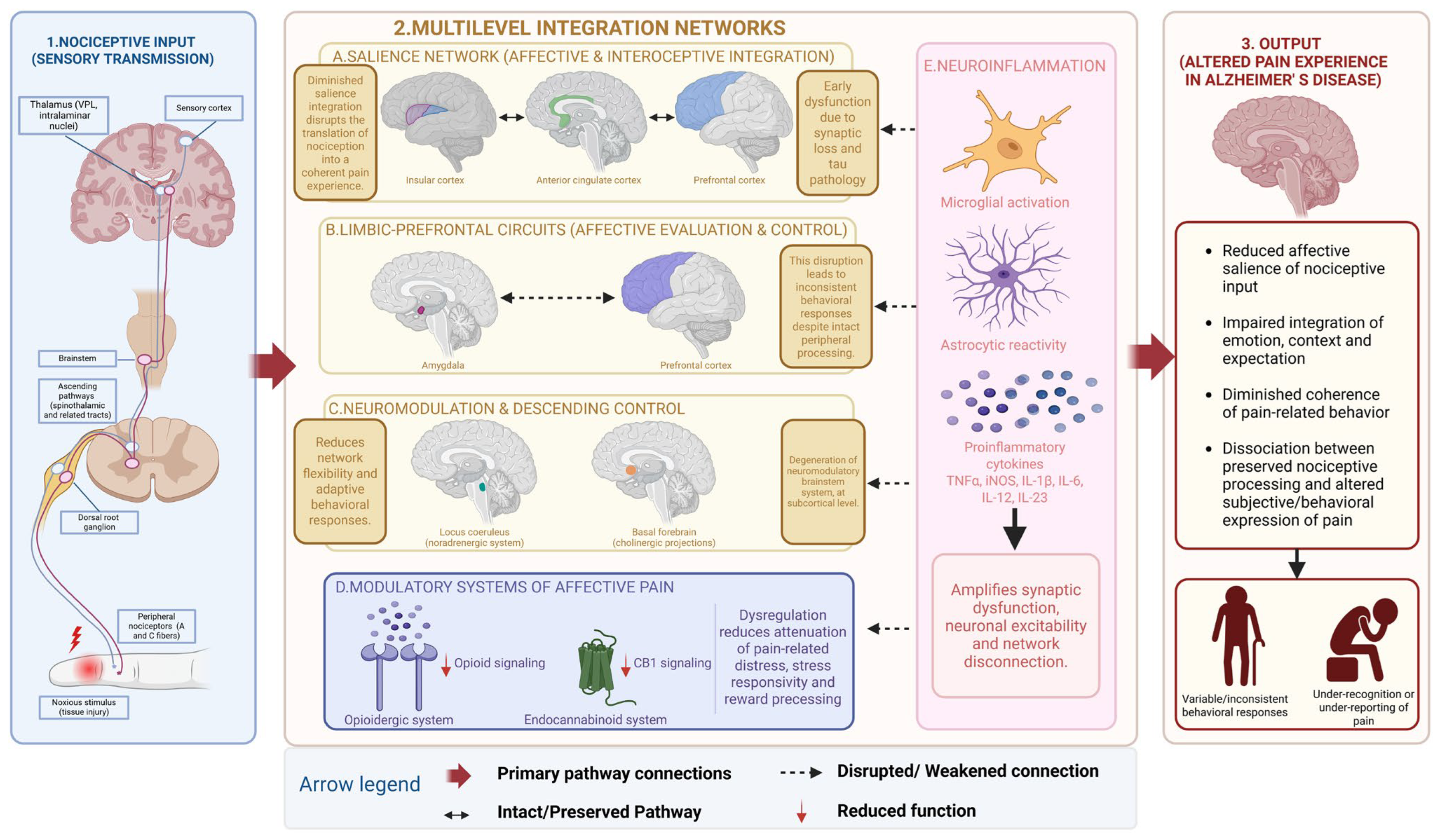
Pain in Alzheimer’s Disease: Disrupted Multilevel Integration of Nociception, Affective Processing and Clinical Expression Across Clinical and Preclinical Evidence
Abstract
1. Introduction
2. Mechanistic Substrates of Disrupted Nociceptive–Affective Integration in Alzheimer’s Disease
3. Evidence for Dissociated Pain Processing in Alzheimer’s Disease: Clinical and Preclinical Perspectives
3.1. Clinical Evidence: Dissociation Between Subjective Report and Behavioral Expression
3.2. Preclinical Evidence of Dissociated Pain Processing in Alzheimer and Chronic Pain Models
4. Reconceptualizing Pain Assessment in Alzheimer’s Disease: Limitations and Future Integrative Frameworks
Author Contributions
Funding
Institutional Review Board Statement
Informed Consent Statement
Data Availability Statement
Conflicts of Interest
Abbreviations
| AD | Alzheimer’s disease |
| Aβ | beta-amyloid |
| IASP | International Association for the Study of Pain |
| PAIN-AD | Pain Assessment in Advanced Dementia |
| PACSLAC | Pain Assessment Checklist for Seniors with Limited Ability to Communicate |
| NPI | Neuropsychiatric Inventory |
| BPSD | behaviors and psychological symptoms of dementia |
| NPS | neuropsychiatric symptoms |
| EEG | electroencephalogram |
| FACS | Facial Action Coding System |
| NFR | nociceptive flexion reflex |
| SSR | sympathetic skin response |
| 5-CSRTT | 5-choice serial reaction time task |
| SNI model | spared nerve injury |
| CBP | chronic back pain |
| CRPS | complex regional pain syndrome |
| OA | knee osteoarthritis |
| ERK signaling | extracellular signal-regulated kinase signaling |
| LTP | long-term potentiation |
| TNF-α | tumor necrosis factor-α |
| CA3–CA1 | subregion of the hippocampus |
| CSF | cerebrospinal fluid |
| mPFC | medial prefrontal cortex |
| BDNF | brain-derived neurotrophic factor |
| APS | Abbey Pain Scale |
| iNOS | inducible Nitric Oxide Synthase |
| IL-1β | Interleukin-1 beta |
| IL-6 | Interleukin-6 |
| IL-12 | Interleukin-12 |
| IL-23 | Interleukin-23 |
References
- Raja, S.N.; Carr, D.B.; Cohen, M.; Finnerup, N.B.; Flor, H.; Gibson, S.; Keefe, F.J.; Mogil, J.S.; Ringkamp, M.; Sluka, K.A.; et al. The revised International Association for the Study of Pain definition of pain: Concepts, challenges, and compromises. Pain 2020, 161, 1976–1982. [Google Scholar] [CrossRef]
- Motzkin, J.C.; Basbaum, A.I.; Crowther, A.J. Neuroanatomy of the nociceptive system: From nociceptors to brain networks. Int. Rev. Neurobiol. 2024, 179, 1–39. [Google Scholar] [CrossRef] [PubMed]
- Gonzalez-Hermosillo, D.C.; Gonzalez-Hermosillo, L.M.; Villaseñor-Almaraz, M.; Ballesteros-Herrera, D.; Moreno-Jimenez, S.; Corona-Cedillo, R.; Velasco-Campos, F.; Carrillo-Ruiz, J.D.; Roldan-Valadez, E. Current concepts of pain pathways: A brief review of anatomy, physiology, and medical imaging. Curr. Med. Imaging 2023, 20, e190523217114. [Google Scholar] [CrossRef]
- Labrakakis, C. The role of the insular cortex in pain. Int. J. Mol. Sci. 2023, 24, 5736. [Google Scholar] [CrossRef]
- Singh, A.; Patel, D.; Li, A.; Hu, L.; Zhang, Q.; Liu, Y.; Guo, X.; Robinson, E.; Martinez, E.; Doan, L.; et al. Mapping cortical integration of sensory and affective pain pathways. Curr. Biol. 2020, 30, 1703–1715.e5. [Google Scholar] [CrossRef]
- Veinante, P.; Yalcin, I.; Barrot, M. The amygdala between sensation and affect: A role in pain. J. Mol. Psychiatry 2013, 1, 9. [Google Scholar] [CrossRef] [PubMed]
- Kummer, K.; Sheets, P.L. Targeting prefrontal cortex dysfunction in pain. J. Pharmacol. Exp. Ther. 2024, 389, 268–276. [Google Scholar] [CrossRef]
- Dagnino, A.P.A.; Campos, M.M. Chronic pain in the elderly: Mechanisms and perspectives. Front. Hum. Neurosci. 2022, 16, 736688. [Google Scholar] [CrossRef]
- Satake, Y.; Izumi, M.; Aso, K.; Igarashi, Y.; Sasaki, N.; Ikeuchi, M. Comparison of predisposing factors between pain on walking and pain at rest in patients with knee osteoarthritis. J. Pain Res. 2021, 14, 1113–1118. [Google Scholar] [CrossRef] [PubMed]
- Tavares, D.R.B.; Moça Trevisani, V.F.; Frazao Okazaki, J.E.; Valéria de Andrade Santana, M.; Pereira Nunes Pinto, A.C.; Tutiya, K.K.; Gazoni, F.M.; Pinto, C.B.; Cristina Dos Santos, F.; Fregni, F. Risk factors of pain, physical function, and health-related quality of life in elderly people with knee osteoarthritis: A cross-sectional study. Heliyon 2020, 6, e05723. [Google Scholar] [CrossRef]
- Gianni, W.; Madaio, R.A.; Di Cioccio, L.; D’Amico, F.; Policicchio, D.; Postacchini, D.; Franchi, F.; Ceci, M.; Benincasa, E.; Gentili, M.; et al. Prevalence of pain in elderly hospitalized patients. Arch. Gerontol. Geriatr. 2010, 51, 273–276. [Google Scholar] [CrossRef]
- Deng, L.X.; Patel, K.; Miaskowski, C.; Maravilla, I.; Schear, S.; Garrigues, S.; Thompson, N.; Auerbach, A.D.; Ritchie, C.S. Prevalence and characteristics of moderate to severe pain among hospitalized older adults. J. Am. Geriatr. Soc. 2018, 66, 1744–1751. [Google Scholar] [CrossRef]
- Saunders, R.; Crookes, K.; Atee, M.; Bulsara, C.; Bulsara, M.K.; Etherton-Beer, C.; Ewens, B.; Gallagher, O.; Graham, R.M.; Gullick, K.; et al. Prevalence of frailty and pain in hospitalised adult patients in an acute hospital: A protocol for a point prevalence observational study. BMJ Open 2021, 11, e046138. [Google Scholar] [CrossRef]
- Jeune, V. Addressing pain in individuals with neurocognitive disorders matters: A literature review. Alzheimers Dement. 2025, 21, e107190. [Google Scholar] [CrossRef]
- Santos, K.C.; Durkee-Neuman, E.; Ong, A.; Sin, M.K. Pain Management in Cognitively Impaired Older Adults. Int. J. Nurs. Health Care Res. 2024, 7, 1528. [Google Scholar] [CrossRef]
- Mancinetti, F.; Travaglini, E.G.; Speziali, L.; Gaspari, M.; Ercolani, S.; Meccoci, P.; Boccardi, V. Pain as an underrecognized geriatric syndrome in hospitalized older adults with major neurocognitive disorder: Clinical correlates and outcomes. Eur. Geriatr. Med. 2026, 3, 10. [Google Scholar] [CrossRef] [PubMed]
- Yao, K.; Wang, S.; Xu, Z.; Fan, Z.; Chen, Z.; Jia, P.; Tu, S.; Liu, Y.; Lin, X.; Xu, Y.; et al. Mechanisms of comorbidity between Alzheimer’s disease and pain. Alzheimers Dement. 2025, 21, e14605. [Google Scholar] [CrossRef] [PubMed]
- Konovalov, R.; Aubakirova, M.; Viderman, D. Mechanisms of chronic pain in Alzheimer’s disease: A narrative review. Curr. Med. Chem. 2025, 10, 15. [Google Scholar] [CrossRef]
- Bell, T.R.; Franz, C.E.; Lerman, I.R.; Williams, M.E.; Fennema-Notestine, C.; Panizzon, M.S.; Elman, J.A.; Bennett, D.A.; Kremen, W.S. Multisite chronic pain: Association with cognitive decline and post-mortem Alzheimer’s biomarkers. Brain Commun. 2025, 7, fcaf208. [Google Scholar] [CrossRef]
- Costachescu, I.; Stanciu, G.-D.; Gogu, R.M.; Tamba, B.-I. Targeting Pain and Depression in Alzheimer’s Disease: Translational Insights and Emerging Treatments. Pharmaceuticals 2026, 19, 626. [Google Scholar] [CrossRef]
- Park, J.; Montero-Hernandez, S.; Huff, A.J.; Lee, C.; Pollonini, L.; Park, L.; Lin, L.; Telkes, I.; Galvin, J.E.; Hoang, J.; et al. Advancing pain assessment in Alzheimer’s disease and related dementias: Functional near-infrared spectroscopy for investigating brain activity. Br. J. Pain 2025, 20, 20494637251384009. [Google Scholar] [CrossRef]
- Madariaga, V.I.; Overdorp, E.; Claassen, J.A.H.R.; Brazil, I.A.; Oosterman, J.M. Association between self-reported pain, cognition, and neuropathology in older adults admitted to an outpatient memory clinic-a cross-sectional study. Brain Sci. 2021, 11, 1156. [Google Scholar] [CrossRef]
- Johnson, M.I. Reconfiguring pain interpretation within a social model of health using a simplified version of Wilber’s all quadrant all levels framework: An integral vision. Behav. Sci. 2025, 15, 703. [Google Scholar] [CrossRef]
- Habermann, M.; Büchel, C. Controllability changes pain perception by increasing the precision of expectations. Nat. Commun. 2025, 16, 10113. [Google Scholar] [CrossRef]
- Ammaturo, D.A.; Hadjistavropoulos, T.; Williams, J. Pain in dementia: Use of observational pain assessment tools by people who are not health professionals. Pain Med. 2017, 18, 1895–1907. [Google Scholar] [CrossRef]
- McLennan, A.I.G.; Winters, E.M.; Gagnon, M.M.; Hadjistavropoulos, T. Pain in dementia: A systematic review of the measurement properties of observational assessment tools. Clin. Psychol. Rev. 2026, 124, 102704. [Google Scholar] [CrossRef]
- Schellinck, H.M.; Stanford, L.; Darrah, M. Repetitive acute pain in infancy increases anxiety but does not alter spatial learning ability in juvenile mice. Behav. Brain Res. 2003, 142, 157–165. [Google Scholar] [CrossRef]
- Boyette-Davis, J.A.; Thompson, C.D.; Fuchs, P.N. Alterations in attentional mechanisms in response to acute inflammatory pain and morphine administration. Neuroscience 2008, 151, 558–563. [Google Scholar] [CrossRef]
- Gong, W.Y.; Wang, R.; Liu, Y.; Jin, H.; Zhao, Z.W.; Wang, Y.L.; Li, H.Y.; Zhang, X.; Ni, J.X. Chronic mono-arthritis pain accelerates the processes of cognitive impairment and increases the NMDAR subunits NR2B in CA3 of hippocampus from 5-month-old transgenic APP/PS1 mice. Front. Aging Neurosci. 2017, 9, 123. [Google Scholar] [CrossRef]
- Defrin, R.; Amanzio, M.; de Tommaso, M.; Dimova, V.; Filipovic, S.; Finn, D.P.; Gimenez-Llort, L.; Invitto, S.; Jensen-Dahm, C.; Lautenbacher, S.; et al. Experimental pain processing in individuals with cognitive impairment: Current state of the science. Pain 2015, 156, 1396–1408. [Google Scholar] [CrossRef]
- Kunz, M.; Mylius, V.; Schepelmann, K.; Lautenbacher, S. Loss in executive functioning best explains changes in pain responsiveness in patients with dementia-related cognitive decline. Behav. Neurol. 2015, 2015, 878157. [Google Scholar] [CrossRef]
- Achterberg, W.; Lautenbacher, S.; Husebo, B.; Erdal, A.; Herr, K. Pain in dementia. Pain Rep. 2019, 5, e803. [Google Scholar] [CrossRef]
- van Strien, W.W.J.; Hollmann, M.W. Pain perception and modulation: Fundamental neurobiology and recent advances. Eur. J. Neurosci. 2025, 62, e70275. [Google Scholar] [CrossRef]
- Cao, B.; Xu, Q.; Shi, Y.; Zhao, R.; Li, H.; Zheng, J.; Liu, F.; Wan, Y.; Wei, B. Pathology of pain and its implications for therapeutic interventions. Signal Transduct. Target. Ther. 2024, 9, 155. [Google Scholar] [CrossRef]
- Karcz, M.; Abd-Elsayed, A.; Chakravarthy, K.; Aman, M.M.; Strand, N.; Malinowski, M.N.; Latif, U.; Dickerson, D.; Suvar, T.; Lubenow, T.; et al. Pathophysiology of Pain and Mechanisms of Neuromodulation: A Narrative Review (A Neuron Project). J. Pain Res. 2024, 17, 3757–3790. [Google Scholar] [CrossRef]
- Mills, E.P.; Keay, K.A.; Henderson, L.A. Brainstem Pain-Modulation Circuitry and Its Plasticity in Neuropathic Pain: Insights From Human Brain Imaging Investigations. Front. Pain Res. 2021, 2, 705345. [Google Scholar] [CrossRef]
- De Felice, M.; Ossipov, M.H. Cortical and subcortical modulation of pain. Pain Manag. 2016, 6, 111–120. [Google Scholar] [CrossRef]
- Zharova, N.; Zharikov, Y.; Pelicer-Marques, Y.; Nikolenko, V.; Tarasenko, V.; Mikliaeva, E.; Mchenskaya, A.; Ryagin, S.; Antonyan, S.; Aniskin, D.; et al. Amygdala-centered mechanisms of pain amplification and chronification in fibromyalgia and migraine: Narrative review. Behav. Brain Res. 2026, 503, 116071. [Google Scholar] [CrossRef]
- Tracy, T.E.; Gan, L. Tau-mediated synaptic and neuronal dysfunction in neurodegenerative disease. Curr. Opin. Neurobiol. 2018, 51, 134–138. [Google Scholar] [CrossRef]
- Seoane, S.; van den Heuvel, M.; Acebes, Á.; Janssen, N. The subcortical default mode network and Alzheimer’s disease: A systematic review and meta-analysis. Brain Commun. 2024, 6, fcae128. [Google Scholar] [CrossRef]
- Sachdev, P.S. The default mode network, depression and Alzheimer’s disease. Int. Psychogeriatr. 2022, 34, 675–678. [Google Scholar] [CrossRef]
- Ababei, D.C.; Bild, V.; Macadan, I.; Vasincu, A.; Rusu, R.N.; Blaj, M.; Stanciu, G.D.; Lefter, R.M.; Bild, W. Therapeutic Implications of Renin-Angiotensin System Modulators in Alzheimer’s Dementia. Pharmaceutics 2023, 15, 2290. [Google Scholar] [CrossRef]
- Costachescu, I.; Gogu, R.M.; Stanciu, G.D.; Solcan, C.; Horodincu, L.; Szilagyi, A.; Craciun, V.C.; Ababei, D.C.; Tamba, B.I. Therapeutic relevance of an EU-GMP certified Cannabis sativa L. strain in a dual in vivo model of cognitive impairment and chronic neuropathic pain. Front. Pharmacol. 2026, 17, 1761426. [Google Scholar] [CrossRef]
- Monroe, T.B.; Gore, J.C.; Chen, L.M.; Mion, L.C.; Cowan, R.L. Pain in people with Alzheimer disease: Potential applications for psychophysical and neurophysiological research. J. Geriatr. Psychiatry Neurol. 2012, 25, 240–255. [Google Scholar] [CrossRef]
- Zhang, S.; Crossley, C.A.; Yuan, Q. Neuronal Vulnerability of the Entorhinal Cortex to Tau Pathology in Alzheimer’s Disease. Br. J. Biomed. Sci. 2024, 81, 13169. [Google Scholar] [CrossRef]
- Salzman, C.D.; Fusi, S. Emotion, cognition, and mental state representation in amygdala and prefrontal cortex. Annu. Rev. Neurosci. 2010, 33, 173–202. [Google Scholar] [CrossRef]
- Dixon, M.L.; Dweck, C.S. The amygdala and the prefrontal cortex: The co-construction of intelligent decision-making. Psychol. Rev. 2022, 129, 1414–1441. [Google Scholar] [CrossRef]
- Chen, J.; Wang, X.; Xu, Z. The Relationship Between Chronic Pain and Cognitive Impairment in the Elderly: A Review of Current Evidence. J. Pain Res. 2023, 16, 2309–2319. [Google Scholar] [CrossRef]
- Qiu, D.; Zhou, Z.B.; Li, X.Y.; Hashimoto, K.; Yang, J.J.; Wang, X.M. Chronic pain and risk of cognitive impairment: A meta-analysis of longitudinal cohort studies. Transl. Psychiatry 2026, 16, 133. [Google Scholar] [CrossRef]
- Caestecker, S.; Lescrauwaet, E.; Boon, P.; Carrette, E.; Raedt, R.; Vonck, K. The Locus Coeruleus-Noradrenergic System in the Healthy and Diseased Brain: A Narrative Review. Eur. J. Neurol. 2025, 32, e70337. [Google Scholar] [CrossRef]
- Hao, M.; Li, F.; Duan, J.-W.; Han, M.-H. Neural Circuit Connections and Functions of Locus Coeruleus–Norepinephrine System. Int. J. Mol. Sci. 2025, 26, 11163. [Google Scholar] [CrossRef]
- Scavone, J.L.; Sterling, R.C.; Van Bockstaele, E.J. Cannabinoid and opioid interactions: Implications for opiate dependence and withdrawal. Neuroscience 2013, 248, 637–654. [Google Scholar] [CrossRef]
- Woodhams, S.G.; Chapman, V.; Finn, D.P.; Hohmann, A.G.; Neugebauer, V. The cannabinoid system and pain. Neuropharmacology 2017, 124, 105–120. [Google Scholar] [CrossRef]
- García-Domínguez, M. Neuroinflammation: Mechanisms, Dual Roles, and Therapeutic Strategies in Neurological Disorders. Curr. Issues Mol. Biol. 2025, 47, 417. [Google Scholar] [CrossRef]
- Adamu, A.; Li, S.; Gao, F.; Xue, G. The role of neuroinflammation in neurodegenerative diseases: Current understanding and future therapeutic targets. Front. Aging Neurosci. 2024, 16, 1347987. [Google Scholar] [CrossRef]
- Ezzati, A.; Wang, C.; Katz, M.J.; Derby, C.A.; Zammit, A.R.; Zimmerman, M.E.; Pavlovic, J.M.; Sliwinski, M.J.; Lipton, R.B. The temporal relationship between pain intensity and pain interference and incident dementia. Curr. Alzheimer Res. 2019, 16, 109–115. [Google Scholar] [CrossRef]
- Zhang, N.K.; Zhang, S.K.; Zhang, L.I.; Tao, H.W.; Zhang, G.W. Sensory processing deficits and related cortical pathological changes in Alzheimer’s disease. Front. Aging Neurosci. 2023, 15, 1213379. [Google Scholar] [CrossRef]
- Bornier, N.; Mulliez, A.; Chenaf, C.; Elyn, A.; Teixeira, S.; Authier, N.; Bertin, C.; Kerckhove, N. Chronic pain is a risk factor for incident Alzheimer’s disease: A nationwide propensity-matched cohort using administrative data. Front. Aging Neurosci. 2023, 15, 1193108. [Google Scholar] [CrossRef]
- Blanton, H.; Reddy, P.H.; Benamar, K. Chronic pain in Alzheimer’s disease: Endocannabinoid system. Exp. Neurol. 2023, 360, 114287. [Google Scholar] [CrossRef]
- van Kooten, J.; Binnekade, T.T.; van der Wouden, J.C.; Stek, M.L.; Scherder, E.J.; Husebø, B.S.; Smalbrugge, M.; Hertogh, C.M. A Review of Pain Prevalence in Alzheimer’s, Vascular, Frontotemporal and Lewy Body Dementias. Dement. Geriatr. Cogn. Disord. 2016, 41, 220–232. [Google Scholar] [CrossRef]
- Binnekade, T.T.; Perez, R.S.; Maier, A.B.; Rhodius-Meester, H.F.; Legdeur, N.; Trappenburg, M.C.; Rhebergen, D.; Lobbezoo, F.; Scherder, E.J. White matter hyperintensities are related to pain intensity in an outpatient memory clinic population: Preliminary findings. J. Pain Res. 2019, 12, 1621–1629. [Google Scholar] [CrossRef]
- Oosterman, J.M.; Dijkerman, H.C.; Kessels, R.P.C.; Scherder, E.J.A. A unique association between cognitive inhibition and pain sensitivity in healthy participants. Eur. J. Pain 2010, 14, 1046–1050. [Google Scholar] [CrossRef]
- Bunk, S.; Emch, M.; Koch, K.; Lautenbacher, S.; Zuidema, S.; Kunz, M. Pain processing in older adults and its association with prefrontal characteristics. Brain Sci. 2020, 10, 477. [Google Scholar] [CrossRef]
- Warden, V.; Hurley, A.C.; Volicer, L. Development and psychometric evaluation of the Pain Assessment in Advanced Dementia (PAINAD) scale. J. Am. Med. Dir. Assoc. 2003, 4, 9–15. [Google Scholar] [CrossRef]
- Fuchs-Lacelle, S.; Hadjistavropoulos, T. Development and preliminary validation of the pain assessment checklist for seniors with limited ability to communicate (PACSLAC). Pain Manag. Nurs. 2004, 5, 37–49. [Google Scholar] [CrossRef]
- Kaufmann, L.; Moeller, K.; Marksteiner, J. Pain and Associated Neuropsychiatric Symptoms in Patients Suffering from Dementia: Challenges at Different Levels and Proposal of a Conceptual Framework. J. Alzheimers Dis. 2021, 83, 1003–1009. [Google Scholar] [CrossRef]
- Atee, M.; Morris, T.; Macfarlane, S.; Cunningham, C. Pain in Dementia: Prevalence and Association With Neuropsychiatric Behaviors. J. Pain Symptom Manag. 2021, 61, 1215–1226. [Google Scholar] [CrossRef]
- Chejor, P.; Atee, M.; Cain, P.; Whiting, D.; Morris, T.; Porock, D. Pain prevalence, intensity, and association with neuropsychiatric symptoms of dementia in immigrant and non-immigrant aged care residents in Australia. Sci. Rep. 2024, 14, 16948. [Google Scholar] [CrossRef]
- Cole, L.J.; Farrell, M.J.; Duff, E.P.; Barber, J.B.; Egan, G.F.; Gibson, S.J. Pain sensitivity and fMRI pain-related brain activity in Alzheimer’s disease. Brain 2006, 129, 2957–2965. [Google Scholar] [CrossRef]
- Monroe, T.B.; Beach, P.A.; Bruehl, S.P.; Dietrich, M.S.; Rogers, B.P.; Gore, J.C.; Atalla, S.W.; Cowan, R.L. The Impact of Alzheimer’s Disease on the Resting State Functional Connectivity of Brain Regions Modulating Pain: A Cross Sectional Study. J. Alzheimers Dis. 2017, 57, 71–83. [Google Scholar] [CrossRef]
- Benedetti, F.; Arduino, C.; Vighetti, S.; Asteggiano, G.; Tarenzi, L.; Rainero, I. Pain reactivity in Alzheimer patients with different degrees of cognitive impairment and brain electrical activity deterioration. Pain 2004, 111, 22–29. [Google Scholar] [CrossRef]
- Hadjistavropoulos, T.; LaChapelle, D.L.; MacLeod, F.K.; Snider, B.; Craig, K.D. Measuring movement-exacerbated pain in cognitively impaired frail elders. Clin. J. Pain 2000, 16, 54–63. [Google Scholar] [CrossRef]
- Kunz, M.; Mylius, V.; Scharmann, S.; Schepelman, K.; Lautenbacher, S. Influence of dementia on multiple components of pain. Eur. J. Pain 2009, 13, 317–325. [Google Scholar] [CrossRef]
- Lints-Martindale, A.C.; Hadjistavropoulos, T.; Barber, B.; Gibson, S.J. A psychophysical investigation of the facial action coding system as an index of pain variability among older adults with and without Alzheimer’s disease. Pain Med. 2007, 8, 678–689. [Google Scholar] [CrossRef]
- Rainero, I.; Vighetti, S.; Bergamasco, B.; Pinessi, L.; Benedetti, F. Autonomic responses and pain perception in Alzheimer’s disease. Eur. J. Pain 2000, 4, 267–274. [Google Scholar] [CrossRef]
- Beach, P.A.; Huck, J.T.; Miranda, M.M.; Bozoki, A.C. Autonomic, Behavioral, and Subjective Pain Responses in Alzheimer’s Disease. Pain Med. 2015, 16, 1930–1942. [Google Scholar] [CrossRef]
- Natavio, T.; McQuillen, E.; Dietrich, M.S.; Wells, N.; Rhoten, B.A.; Vallerand, A.H.; Monroe, T.B. A Comparison of the Pain Assessment Checklist for Seniors with Limited Ability to Communicate (PACSLAC) and Pain Assessment in Advanced Dementia Scale (PAINAD). Pain Manag. Nurs. 2020, 21, 502–509. [Google Scholar] [CrossRef]
- Millar, P.R.; Balota, D.A.; Maddox, G.B.; Duchek, J.M.; Aschenbrenner, A.J.; Fagan, A.M.; Benzinger, T.L.S.; Morris, J.C. Process dissociation analyses of memory changes in healthy aging, preclinical, and very mild Alzheimer disease: Evidence for isolated recollection deficits. Neuropsychology 2017, 31, 708–723. [Google Scholar] [CrossRef]
- Cerqueira-Nunes, M.; Monteiro, C.; Galhardo, V.; Cardoso-Cruz, H. Dysregulation of Hedonic Processing in Chronic Pain: Insights from Preclinical Data. Brain Sci. 2025, 15, 1265. [Google Scholar] [CrossRef]
- Martínez-Navarro, M.; Lara-Mayorga, I.M.; Negrete, R.; Bilecki, W.; Wawrzczak-Bargieła, A.; Gonçalves, L.; Dickenson, A.H.; Przewłocki, R.; Baños, J.E.; Maldonado, R. Influence of behavioral traits in the inter-individual variability of nociceptive, emotional and cognitive manifestations of neuropathic pain. Neuropharmacology 2019, 148, 291–304. [Google Scholar] [CrossRef]
- La Porta, C.; Lara-Mayorga, I.M.; Negrete, R.; Maldonado, R. Effects of pregabalin on the nociceptive, emotional and cognitive manifestations of neuropathic pain in mice. Eur. J. Pain 2016, 20, 1454–1466. [Google Scholar] [CrossRef]
- Pais-Vieira, M.; Lima, D.; Galhardo, V. Sustained attention deficits in rats with chronic inflammatory pain. Neurosci. Lett. 2009, 463, 98–102. [Google Scholar] [CrossRef]
- Leite-Almeida, H.; Almeida-Torres, L.; Mesquita, A.R.; Pertovaara, A.; Sousa, N.; Cerqueira, J.J.; Almeida, A. The impact of age on emotional and cognitive behaviours triggered by experimental neuropathy in rats. Pain 2009, 144, 57–65. [Google Scholar] [CrossRef]
- Mutso, A.A.; Radzicki, D.; Baliki, M.N.; Huang, L.; Banisadr, G.; Centeno, M.V.; Radulovic, J.; Martina, M.; Miller, R.J.; Apkarian, A.V. Abnormalities in hippocampal functioning with persistent pain. J. Neurosci. 2012, 32, 5747–5756. [Google Scholar] [CrossRef] [PubMed]
- Ren, W.J.; Liu, Y.; Zhou, L.J.; Li, W.; Zhong, Y.; Pang, R.P.; Xin, W.J.; Wei, X.H.; Wang, J.; Zhu, H.Q.; et al. Peripheral nerve injury leads to working memory deficits and dysfunction of the hippocampus by upregulation of TNF-α in rodents. Neuropsychopharmacology 2011, 36, 979–992. [Google Scholar] [CrossRef]
- Cardoso-Cruz, H.; Lima, D.; Galhardo, V. Impaired spatial memory performance in a rat model of neuropathic pain is associated with reduced hippocampus-prefrontal cortex connectivity. J. Neurosci. 2013, 33, 2465–2480. [Google Scholar] [CrossRef]
- Higgins, G.A.; Silenieks, L.B.; Van Niekerk, A.; Desnoyer, J.; Patrick, A.; Lau, W.; Thevarkunnel, S. Enduring attentional deficits in rats treated with a peripheral nerve injury. Behav. Brain Res. 2015, 286, 347–355. [Google Scholar] [CrossRef] [PubMed]
- Hu, Y.; Yang, J.; Hu, Y.; Wang, Y.; Li, W. Amitriptyline rather than lornoxicam ameliorates neuropathic pain-induced deficits in abilities of spatial learning and memory. Eur. J. Anaesthesiol. 2010, 27, 162–168. [Google Scholar] [CrossRef] [PubMed]
- Cui, Z.; Guo, Z.; Wei, L.; Zou, X.; Zhu, Z.; Liu, Y.; Wang, J.; Chen, L.; Wang, D.; Ke, Z. Altered pain sensitivity in 5×familial Alzheimer disease mice is associated with dendritic spine loss in anterior cingulate cortex pyramidal neurons. Pain 2022, 163, 2138–2153. [Google Scholar] [CrossRef] [PubMed]
- Aman, Y.; Pitcher, T.; Simeoli, R.; Ballard, C.; Malcangio, M. Reduced thermal sensitivity and increased opioidergic tone in the TASTPM mouse model of Alzheimer’s disease. Pain 2016, 157, 2285–2296. [Google Scholar] [CrossRef]
- Wang, W.; Zheng, W.Q.; Du, X.; Chen, S.C.; Chen, Y.H.; Ma, Q.Y.; Wang, H.; Gao, S.; Tan, R.; Zhang, H.T.; et al. Chronic pain exacerbates memory impairment and pathology of Aβ and tau by upregulating IL-1β and p-65 signaling in a mouse model of Alzheimer’s disease. Brain Res. 2024, 1832, 148843. [Google Scholar] [CrossRef]
- Cañete, T.; Giménez-Llort, L. Preserved thermal pain in 3xTg-AD mice with increased sensory-discriminative pain sensitivity in females but affective-emotional dimension in males as early sex-specific AD-phenotype biomarkers. Front. Aging Neurosci. 2021, 13, 683412. [Google Scholar] [CrossRef]
- Wang, J.; Cheng, Z.; Kim, Y.; Yu, F.; Heffner, K.L.; Quiñones-Cordero, M.M.; Li, Y. Pain and the Alzheimer’s Disease and Related Dementia Spectrum in Community-Dwelling Older Americans: A Nationally Representative Study. J. Pain Symptom Manag. 2022, 63, 654–664. [Google Scholar] [CrossRef]
- Thakur, E.R.; Amspoker, A.B.; Sansgiry, S.; Snow, A.L.; Stanley, M.; Wilson, N.; Freshour, J.; Kunik, M.E. Pain Among Community-Dwelling Older Adults with Dementia: Factors Associated with Undertreatment. Pain Med. 2017, 18, 1476–1484. [Google Scholar] [CrossRef] [PubMed]
- Hunt, L.J.; Covinsky, K.E.; Yaffe, K.; Stephens, C.E.; Miao, Y.; Boscardin, W.J.; Smith, A.K. Pain in Community-Dwelling Older Adults with Dementia: Results from the National Health and Aging Trends Study. J. Am. Geriatr. Soc. 2015, 63, 1503–1511. [Google Scholar] [CrossRef]
- Shega, J.W.; Hougham, G.W.; Stocking, C.B.; Cox-Hayley, D.; Sachs, G.A. Pain in community-dwelling persons with dementia: Frequency, intensity, and congruence between patient and caregiver report. J. Pain Symptom Manag. 2004, 28, 585–592. [Google Scholar] [CrossRef]
- Snow, A.L.; Chandler, J.F.; Kunik, M.E.; Davila, J.A.; Balasubramanyam, V.; Steele, A.B.; Morgan, R.O. Self-Reported Pain in Persons With Dementia Predicts Subsequent Decreased Psychosocial Functioning. Am. J. Geriatr. Psychiatry 2009, 17, 10. [Google Scholar] [CrossRef] [PubMed]
- Bullock, L.; Bedson, J.; Jordan, J.L.; Bartlam, B.; Chew-Graham, C.A.; Campbell, P. Pain assessment and pain treatment for community-dwelling people with dementia: A systematic review and narrative synthesis. Int. J. Geriatr. Psychiatry 2019, 34, 807–821. [Google Scholar] [CrossRef] [PubMed]
- Bullock, L.; Chew-Graham, C.A.; Bedson, J.; Bartlam, B.; Campbell, P. The challenge of pain identification, assessment, and management in people with dementia: A qualitative study. BJGP Open 2020, 4, bjgpopen20X101040. [Google Scholar] [CrossRef]
- Orgeta, V.; Orrell, M.; Edwards, R.T.; Hounsome, B.; Woods, B.; REMCARE Team. Self- and Carer-Rated Pain in People With Dementia: Influences of Pain in Carers. J. Pain Symptom Manag. 2015, 49, 1042–1049. [Google Scholar] [CrossRef]
- Regier, N.G.; Taylor, J.L.; Szanton, S.L.; Parmelee, P.A.; Perrin, N.; Liu, M.; Jenkins, E.; Hodgson, N.A.; Gitlin, L.N. Pain in persons with dementia and the direct and indirect impacts on caregiver burden. Geriatr. Nurs. 2021, 42, 366–371. [Google Scholar] [CrossRef]
- Abbey, J.; Piller, N.; De Bellis, A.; Esterman, A.; Parker, D.; Giles, L.; Lowcay, B. The Abbey pain scale: A 1-minute numerical indicator for people with end-stage dementia. Int. J. Palliat. Nurs. 2004, 10, 6–13. [Google Scholar] [CrossRef]
- Hølen, J.C.; Saltvedt, I.; Fayers, P.M.; Hjermstad, M.J.; Loge, J.H.; Kaasa, S. Doloplus-2, a valid tool for behavioural pain assessment? BMC Geriatr. 2007, 7, 29. [Google Scholar] [CrossRef]
- Smrke, U.; Milošič, A.; Mlakar, I.; Kadiš, M.; Mulej Bratec, S. Pain Cues in People With Dementia: Scoping Review. JMIR Ment. Health 2025, 12, e75671. [Google Scholar] [CrossRef] [PubMed]
- Felton, N.; Lewis, J.S.; Cockburn, S.-J.; Hodgson, M.; Dawson, S. Pain Assessment for Individuals with Advanced Dementia in Care Homes: A Systematic Review. Geriatrics 2021, 6, 101. [Google Scholar] [CrossRef]
- Smith, T.O.; Harvey, K. Psychometric properties of pain measurements for people living with dementia: A COSMIN systematic review. Eur. Geriatr. Med. 2022, 13, 1029–1045. [Google Scholar] [CrossRef]
- Lee, S.; Lo, A.X.; Hogan, T.M.; van Oppen, J.D.; Gettel, C.J.; Lapointe-Shaw, L.; Seidenfeld, J.; Hirata, K.; Aliberti, M.J.R.; Healy, H.S.; et al. Geriatric ED Guidelines Writing Group. A Systematic Review Evaluating Pain Assessment Strategies for Patients With Dementia in the Emergency Department: The Geriatric ED Guidelines 2.0. Acad. Emerg. Med. 2026, 33, e70230. [Google Scholar] [CrossRef]
- Shi, T.; Xu, Y.; Li, Q.; Zhu, L.; Jia, H.; Qian, K.; Shi, S.; Li, X.; Yin, Y.; Ding, Y. Association between pain and behavioral and psychological symptoms of dementia (BPSD) in older adults with dementia: A systematic review and meta-analysis. BMC Geriatr. 2025, 25, 100. [Google Scholar] [CrossRef] [PubMed]
- Li, X.L.; Hu, N.; Tan, M.S.; Yu, J.T.; Tan, L. Behavioral and psychological symptoms in Alzheimer’s disease. BioMed Res. Int. 2014, 2014, 927804. [Google Scholar] [CrossRef] [PubMed]
- Christidi, F.; Migliaccio, R.; Santamaría-García, H.; Santangelo, G.; Trojsi, F. Social Cognition Dysfunctions in Neurodegenerative Diseases: Neuroanatomical Correlates and Clinical Implications. Behav. Neurol. 2018, 2018, 1849794. [Google Scholar] [CrossRef]
- Pautex, S.; Michon, A.; Guedira, M.; Emond, H.; Le Lous, P.; Samaras, D.; Michel, J.P.; Herrmann, F.; Giannakopoulos, P.; Gold, G. Pain in severe dementia: Self-assessment or observational scales? J. Am. Geriatr. Soc. 2006, 54, 1040–1045. [Google Scholar] [CrossRef] [PubMed]
- Safiri, S.; Ghaffari Jolfayi, A.; Fazlollahi, A.; Morsali, S.; Sarkesh, A.; Daei Sorkhabi, A.; Golabi, B.; Aletaha, R.; Asghari, K.M.; Hamidi, S.; et al. Alzheimer’s disease: A comprehensive review of epidemiology, risk factors, symptoms diagnosis, management, caregiving, advanced treatments and associated challenges. Front. Med. 2024, 11, 1474043. [Google Scholar] [CrossRef]
- Jensen-Dahm, C.; Werner, M.U.; Jensen, T.S.; Ballegaard, M.; Andersen, B.B.; Høgh, P.; Waldemar, G. Discrepancy between stimulus response and tolerance of pain in Alzheimer disease. Neurology 2015, 84, 1575–1581. [Google Scholar] [CrossRef]
- Husebo, B.S.; Achterberg, W.; Flo, E. Identifying and Managing Pain in People with Alzheimer’s Disease and Other Types of Dementia: A Systematic Review. CNS Drugs 2016, 30, 481–497. [Google Scholar] [CrossRef] [PubMed]
- Au-Yeung, W.M.; Miller, L.; Wu, C.Y.; Beattie, Z.; Nunnerley, M.; Hanna, R.; Gothard, S.; Wild, K.; Kaye, J. Examining the Relationships Between Indoor Environmental Quality Parameters Pertaining to Light, Noise, Temperature, and Humidity and the Behavioral and Psychological Symptoms of People Living With Dementia: Scoping Review. Interact. J. Med. Res. 2024, 13, e56452. [Google Scholar] [CrossRef]
- Rice, H.; Howard, R.; Huntley, J. Professional caregivers’ knowledge, beliefs and attitudes about awareness in advanced dementia: A systematic review of qualitative studies. Int. Psychogeriatr. 2019, 31, 1599–1609. [Google Scholar] [CrossRef]
- Davidoff, H.; Van Kraaij, A.; Lutin, E.; Van den Bulcke, L.; Vandenbulcke, M.; Van Helleputte, N.; De Vos, M.; Van Hoof, C.; Van Den Bossche, M. Environmental Triggers of Specific Subtypes of Agitation in People With Dementia: Observational Study. JMIR Form. Res. 2025, 9, e60274. [Google Scholar] [CrossRef]
- Woods, D.L.; Buckwalter, K. Taking Another Look: Thoughts on Behavioral Symptoms in Dementia and Their Measurement. Healthcare 2018, 6, 126. [Google Scholar] [CrossRef]
- Anderson, A.R.; Parish, A.L.; Monroe, T. Assessment and management of pain in persons with dementia. Geriatr. Nurs. 2018, 39, 358–360. [Google Scholar] [CrossRef] [PubMed]
- Lichtner, V.; Dowding, D.; Esterhuizen, P.; Closs, S.J.; Long, A.F.; Corbett, A.; Briggs, M. Pain assessment for people with dementia: A systematic review of systematic reviews of pain assessment tools. BMC Geriatr. 2014, 14, 138. [Google Scholar] [CrossRef]
- McGaffin, L.; Mitchell, G.; Anderson, T.; Gillis, A.; Craig, S. Digital Approaches to Pain Assessment Across Older Adults: A Scoping Review. Healthcare 2026, 14, 149. [Google Scholar] [CrossRef]
- Zhang, M.; Zhu, L.; Lin, S.Y.; Herr, K.; Chi, C.L.; Demir, I.; Dunn Lopez, K.; Chi, N.C. Using artificial intelligence to improve pain assessment and pain management: A scoping review. J. Am. Med. Inform. Assoc. 2023, 30, 570–587. [Google Scholar] [CrossRef]
- Mou, F.S.; Ahmed, T.; Huda, M.N.; Nandi, A.K. Artificial neural networks fighting real neural decline: A systematic review of AI in Alzheimer’s research. Artif. Intell. Rev. 2026, 59, 124. [Google Scholar] [CrossRef] [PubMed]
- De Sario, G.D.; Haider, C.R.; Maita, K.C.; Torres-Guzman, R.A.; Emam, O.S.; Avila, F.R.; Garcia, J.P.; Borna, S.; McLeod, C.J.; Bruce, C.J.; et al. Using AI to Detect Pain through Facial Expressions: A Review. Bioengineering 2023, 10, 548. [Google Scholar] [CrossRef]
- Yoonesi, S.; Abedi Azar, R.; Arab Bafrani, M.; Yaghmayee, S.; Shahavand, H.; Mirmazloumi, M.; Moazeni Limoudehi, N.; Rahmani, M.; Hasany, S.; Idjadi, F.Z.; et al. Facial expression deep learning algorithms in the detection of neurological disorders: A systematic review and meta-analysis. Biomed. Eng. Online 2025, 24, 64. [Google Scholar] [CrossRef]
- Cross, M.P.; Acevedo, A.M.; Hunter, J.F. A Critique of Automated Approaches to Code Facial Expressions: What Do Researchers Need to Know? Affect. Sci. 2023, 4, 500–505. [Google Scholar] [CrossRef]
- Zheng, C.; Bouazizi, M.; Ohtsuki, T.; Kitazawa, M.; Horigome, T.; Kishimoto, T. Detecting Dementia from Face-Related Features with Automated Computational Methods. Bioengineering 2023, 10, 862. [Google Scholar] [CrossRef]
- Bergamasco, L.; Lorenzo, F.; Coletta, A.; Olmo, G.; Cermelli, A.; Rubino, E.; Rainero, I. Automatic Detection of Cognitive Impairment Through Facial Emotion Analysis. Appl. Sci. 2025, 15, 9103. [Google Scholar] [CrossRef]
- Liu, Y.; Wang, Z.; Yu, G. The Effectiveness of Facial Expression Recognition in Detecting Emotional Responses to Sound Interventions in Older Adults With Dementia. Front. Psychol. 2021, 12, 707809. [Google Scholar] [CrossRef] [PubMed]
- Ayena, J.C.; Bouayed, A.; Ben Arous, M.; Ouakrim, Y.; Loulou, K.; Ameyed, D.; Savard, I.; El Kamel, L.; Mezghani, N. Predicting chronic pain using wearable devices: A scoping review of sensor capabilities, data security, and standards compliance. Front. Digit. Health 2025, 7, 1581285. [Google Scholar] [CrossRef]
- Malioukis, A.; Snead, R.S.; Marczika, J.; Ambalavanan, R.; Towett, G.; Mbogori-Kairichi, M. Digital biomarkers for early agitation detection in dementia: A scoping review of emerging wearable and smart technologies for personalized care. Front. Neurol. 2026, 17, 1683517. [Google Scholar] [CrossRef]
- Ghosh, A.; Umer, S.; Dhara, B.C.; Ali, G.G.M.N. A Multimodal Pain Sentiment Analysis System Using Ensembled Deep Learning Approaches for IoT-Enabled Healthcare Framework. Sensors 2025, 25, 1223. [Google Scholar] [CrossRef]
- Cintron, D.W.; Ong, A.D.; Reid, M.C. What makes life go well? A network topic modeling analysis of well-being practices in adults with chronic pain. Pain Med. 2025, 26, 189–198. [Google Scholar] [CrossRef]
- Alsubaie, M.G.; Luo, S.; Shaukat, K. Alzheimer’s Disease Detection Using Deep Learning on Neuroimaging: A Systematic Review. Mach. Learn. Knowl. Extr. 2024, 6, 464–505. [Google Scholar] [CrossRef]
- Kargarandehkordi, A.; Li, S.; Lin, K.; Phillips, K.T.; Benzo, R.M.; Washington, P. Fusing Wearable Biosensors with Artificial Intelligence for Mental Health Monitoring: A Systematic Review. Biosensors 2025, 15, 202. [Google Scholar] [CrossRef]

| Study | Design/Population | Pain Assessment | Key Findings | Clinical Significance |
|---|---|---|---|---|
| Prospective observational cohort [16] | Hospitalized older adults with major neurocognitive disorder (n = 292; mean age 87.8 ± 6.2 years) | PAIN-AD scale | Pain-related behaviors (PAIN-AD ≥ 2) in 62.4%; only 20.3% received analgesics; PAIN-AD associated with frailty, reduced quality of life and increased 3-month mortality (HR 2.39, 95% CI 1.20–4.74) | Pain is highly prevalent, under-treated, and independently predicts adverse functional outcomes and short-term mortality |
| Cross-sectional neuropsychological study with Lasso regression [22] | Memory clinic cohort (n = 179 individuals) | Self-reported pain (occurrence, intensity, severity, frequency) | Reduced memory and executive function associated with lower pain reporting; in pain reporters, memory deficits linked to lower pain ratings, while executive dysfunction showed inverse association (higher pain scores). Associations partially mediated by medial temporal lobe atrophy, white matter hyperintensities and depressive symptoms | Distinct cognitive domains differentially modulate pain reporting, suggesting that self-reported pain reflects an interaction between memory, executive control and affective processing, rather than pure nociceptive experience |
| Quasi-experimental video-based study in dementia care context [25] | n = 130: 65 nurses, 65 laypersons without healthcare training | PACSLAC-II and PAIN-AD observational scales applied to standardized pain/non-pain video stimuli | Both groups accurately differentiated pain from no-pain and graded intensity with no significant differences between raters; PACSLAC-II and PAIN-AD showed acceptable internal consistency (α = 0.69 and 0.61), acceptable split-half reliability (0.72 and 0.65), and high interrater reliability (ICC = 0.94–0.96) | Observational pain tools demonstrate robust reliability and validity across professional and lay users, supporting their utility for early and accessible pain detection in dementia care |
| Retrospective cross-sectional study [67] | Aged care residents with dementia (n = 479; mean age 81.9 ± 8.3 years) | PainChek® combined with NPI | Pain identified in 65.6% of cases, with 48.4% moderate–severe; pain prevalence high across dementia subtypes (54.6–78.6%). Pain group showed higher neuropsychiatric symptom burden (+25.3% frequency, +33.6% severity) and caregiver distress (+31.4%); 3.8-fold increased likelihood of agitation/aggression | Pain is a major and underrecognized driver of BPSD in dementia, strongly associated with behavioral disturbance severity and caregiver burden, supporting its role as a modifiable clinical contributor to neuropsychiatric symptoms |
| Large-scale cross-sectional study [68] | Dementia referrals in residential aged care settings (immigrants n = 6340; non-immigrants n = 11,297) | PainChek® and NPI | Similar pain prevalence across groups; immigrants showed slightly higher moderate–severe pain intensity (non-English-speaking immigrants: +0.5 PainChek® points; Cohen’s d = 0.10). Pain intensity significantly associated with NPS severity across all subgroups | Pain expression and intensity in dementia are modulated by cultural background, while maintaining a consistent relationship with neuropsychiatric symptom burden, highlighting the need for culturally sensitive pain-assessment strategies |
| Experimental neuroimaging study using mechanical pressure-induced pain [69] | fMRI study in Alzheimer’s disease (n = 14 AD patients; n = 15 age-matched controls) | Pain ratings combined with functional MRI during noxious mechanical stimulation | Similar subjective pain ratings among groups; preserved activation of medial and lateral pain pathways (insula, anterior cingulate, somatosensory cortices); no reduction in pain-related brain activity in AD; in some regions, increased amplitude and duration of activation compared to controls | Pain processing is preserved at both sensory and affective neural levels in Alzheimer’s disease, challenging the assumption of reduced pain perception and highlighting risk of undertreatment |
| Combined psychophysical and resting-state fMRI study in Alzheimer’s disease [70] | n = 23 AD; n = 23 age-matched controls | Thermal perception (warmth, mild, moderate pain ratings) and RSFC across pain-related networks | AD associated with increased thermal thresholds for warmth and mild pain but preserved moderate pain unpleasantness; reduced RSFC between posterior insula and amygdala–somatosensory cortex; altered coupling between prefrontal and cingulate regions in controls only; disrupted correspondence between psychophysical responses and network connectivity | Altered integration between sensory, affective and descending modulatory pain networks in AD may underlie reduced pain reporting and contribute to underuse of analgesic treatment |
| Neurophysiological study in AD assessing cognitive status, EEG activity, sensory thresholds, and autonomic responses [71] | n = 30 non-consecutive communicative AD patients | Pain detection thresholds, pain thresholds, and heart rate responses to nociceptive stimulation and anticipation | No correlation between AD severity and sensory-discriminative measures (detection and pain thresholds); significant correlation between cognitive impairment severity and autonomic responses to pain (heart rate reactivity and anticipatory responses), associated with EEG slowing (delta/theta activity) | Strong evidence for dissociation between preserved sensory-discriminative pain processing and cognitively modulated autonomic–affective responses, suggesting progressive disruption of integrative pain networks in AD |
| Video-based observational study comparing self-report and coded nonverbal pain behaviors [72] | n = 58; 29 with cognitive impairment | Self-report pain ratings and observational coding of facial expressions, guarding behavior, and pain-related movements | Pain increased with physical activity across both groups; cognitively impaired participants showed heightened facial reactivity and more pronounced behavioral indicators (especially guarding); only modest correlations between self-report and behavioral measures, indicating partial dissociation between pain modalities | Self-report and behavioral pain measures capture complementary but non-overlapping aspects of pain in cognitively impaired elders, supporting multimodal assessment strategies for clinically relevant pain detection |
| Multimodal psychophysiological study using calibrated noxious electrical stimulation [73] | Dementia patients (n = 35) and age-matched healthy controls (n = 46) | Subjective ratings, NFR and SSR | Dementia patients showed preserved pain ratings when able to respond but reduced reporting capacity; increased facial pain responses; decreased NFR threshold indicating enhanced reflex sensitivity; and attenuated autonomic reactivity compared to controls | Dementia is associated with a dissociation across pain systems, with enhanced reflexive and expressive responses but reduced autonomic integration, supporting a multidimensional and non-uniform alteration of pain processing and underscoring the need for multimodal pain assessment |
| Quasi-experimental study [74] | Older adults with mild AD (n = 27) and healthy controls (n = 36) | Facial expression of pain (FACS) during innocuous and painful stimuli | Facial expressions varied appropriately with stimulus intensity; no significant differences between AD and control groups in facial pain reactivity | Reflexive facial pain expression is preserved in mild AD, supporting the validity of behavioral coding systems for pain assessment independent of cognitive status |
| Experimental psychophysiological study in Alzheimer’s disease patients [75] | 20 non-consecutive communicative patients (mean age 68.6 years ± 3.8 SD) with AD and 20 healthy subjects (mean age 68.8 years ± 3.2 SD) | Pain perception ratings and autonomic responses during low- and high-intensity electrical stimulation | At threshold stimulation, AD patients showed normal pain perception but blunted autonomic responses; at supra-threshold stimulation, autonomic responses became comparable to controls while pain perception was reduced; overall increased thresholds for both autonomic activation and pain tolerance in AD | AD is associated with intensity-dependent dissociation between sensory and autonomic pain processing, suggesting altered gain control and elevated thresholds for both pain perception and physiological reactivity |
| Study | Design/Population | Pain Assessment | Key Findings | Clinical Significance |
|---|---|---|---|---|
| Chronic pain models: effects on cognition and affective behavior | ||||
| Preclinical mouse study evaluating long-term effects of acute single vs. repetitive inflammatory pain during infancy [27] | CD1male and female mice; pain model with single tail clip or repetitive needle pricks | Anxiety-like behavior (elevated plus maze) and spatial learning (Morris water maze) | Repetitive neonatal pain exposure increased anxiety-like behaviors in adolescence, reflected by reduced open-arm exploration and increased risk-assessment behaviors, while spatial learning remained unaffected; single acute-pain exposure produced no significant behavioral changes. | Early repetitive pain exposure induces persistent affective vulnerability without parallel cognitive impairment, indicating that pain-related developmental plasticity selectively alters emotional circuits. |
| Preclinical rat study on acute inflammatory pain and morphine on attentional performance [28] | Sprague Dawley rats; formalin-induced pain and 5-CSRTT with graded morphine administration | Attentional performance (task omissions) under pain and pharmacological modulation | Acute inflammatory pain significantly impaired attention (increased omissions); high-dose morphine (6 mg/kg) similarly impaired performance (sedation effect), whereas an analgesic dose (3 mg/kg) improved attentional performance without major sedation. | Pain disrupts attentional processing, and its cognitive impact can be partially reversed by appropriate analgesic dosing, highlighting the need to distinguish analgesic from sedative drug effects in pain management. |
| Preclinical mouse model of neuropathic pain stratified by behavioral traits (sociality, anxiety, depressive-like behavior) [80] | Swiss albino male mice; partial sciatic nerve ligation or sham surgery to induce neuropathic pain | Mechanical hypersensitivity, emotional-like behavior, cognitive-like performance, and central amygdala activity | Spontaneous central amygdala activity correlated with sociability traits; low-sociable/high-anxious/low-depressive phenotypes showed increased nociceptive hypersensitivity, whereas high-sociable/anxious/depressive-like phenotypes exhibited stronger emotional and cognitive impairments; nociceptive, emotional, and cognitive manifestations were dissociable. | Neuropathic pain phenotypes are determined by pre-existing behavioral and molecular signatures, supporting a dissociation between sensory hypersensitivity and affective–cognitive alterations driven by amygdala-related neuroimmune and transcriptional mechanisms. |
| Preclinical mouse model of neuropathic pain with cognitive and motivational behavior assessment [81] | Swiss albino male mice; partial sciatic nerve ligation–neuropathic pain | Mechanical allodynia, thermal hyperalgesia, anxiety- and depressive-like behavior, anhedonia, object-recognition memory, and operant motivation | Neuropathic pain associated with increased anxiety- and depressive-like behaviors, anhedonia, memory impairment, and reduced motivation; pregabalin improved nociceptive, anxiety-like, anhedonic and memory deficits, but did not reverse depressive-like behavior or motivational impairments. | Emotional and cognitive dimensions of chronic pain are only partially responsive to analgesic treatment, supporting a dissociation between nociceptive relief and affective-motivational recovery and emphasizing the need for multidimensional outcome measures in pain research. |
| Longitudinal experimental study evaluating sustained attention before and after chronic pain induction [82] | Lister Hooded rats; CFA-induced monoarthritis | Mechanical sensitivity (von Frey) and 5-CSRTT | Chronic pain-induced persistent attentional deficits (increased errors and omissions); analgesic treatment (carprofen) reduced nociceptive sensitivity, but did not improve attentional performance. | Attentional impairment in chronic pain is not solely driven by ongoing nociceptive input, but reflects sustained alterations in neural systems underlying attention, highlighting dissociation between pain relief and cognitive recovery. |
| Preclinical rat study across lifespan with neuropathic pain [83] | 3-, 10-, and 22-month-old rats; SNI model | Open-field, elevated-plus-maze, forced swim test, working-memory maze, Morris water maze, spatial reversal | Neuropathic pain effects were age-dependent: increased anxiety across age groups (enhanced in young and old), depressive-like behavior and cognitive. impairment primarily in middle-aged animals; aging alone impaired cognitive performance, while pain selectively exacerbated deficits, depending on domain and age. | The impact of chronic pain on affective and cognitive domains is dynamically modulated by age, with domain-specific vulnerability, highlighting the fact that pain-related behavioral alterations depend on both neurobiological aging and network-specific susceptibility. |
| Translational study combining preclinical mouse model with human neuroimaging in chronic pain patients [84] | C57BL/6 male mice; SNI model; patients with CBP, CRPS, OA | Behavioral assays (fear extinction, anxiety), molecular markers (ERK signaling, neurogenesis), synaptic plasticity, and hippocampal volume in humans | Neuropathic pain impaired fear extinction and increased anxiety in mice, associated with reduced ERK signaling, decreased neurogenesis, and altered synaptic plasticity in the hippocampus; human patients with chronic pain (CBP, CRPS) showed reduced hippocampal volume, unlike OA patients. | Chronic pain is associated with structural and functional hippocampal alterations that link impaired cognitive–emotional processing to underlying neuroplastic changes, supporting a neurobiological substrate for pain-related affective and memory dysfunction. |
| Preclinical rodent study [85] | Sprague Dawley male rats and male C57 mice; SNI model | Behavioral memory tasks (working memory, short-term memory), hippocampal LTP, frequency facilitation, synaptic bouton density, TNF-α levels | SNI-induced working and short-term memory deficits associated with impaired CA3–CA1 synaptic plasticity, reduced presynaptic bouton density, and elevated TNF-α in hippocampus, CSF and plasma; TNF-α administration replicated, while inhibition or TNF receptor 1 deletion prevented both cognitive and synaptic deficits. | Neuroinflammatory signaling via TNF-α represents a key mechanistic link between peripheral neuropathic pain and hippocampal-dependent cognitive impairment, suggesting shared inflammatory pathways underlying pain and memory dysfunction. |
| Preclinical rat study using SNI model with chronic electrophysiological recordings [86] | Sprague Dawley rats; SNI model | Figure-eight spatial alternation task, non-sample-to-match T maze | SNI-induced chronic pain impaired working-memory performance, altered mPFC population firing during decision points, increased phase-locking to hippocampal theta rhythm and reduced information transfer within the fronto-hippocampal circuit, with oscillatory patterns predicting correct vs. incorrect trials. | Chronic pain disrupts large-scale fronto-hippocampal network dynamics underlying working memory, indicating that cognitive deficits arise from impaired inter-regional communication and altered neural synchrony, rather than isolated regional dysfunction. |
| Preclinical rat study [87] | Sprague Dawley rats; SNI model | Mechanical and thermal hypersensitivity (von Frey, acetone tests), progressive ratio responding, and 5-CSRTT performance | SNI induced persistent sensory hypersensitivity without affecting motivation for food reward; however, a delayed and progressive attentional deficit emerged (reduced accuracy, slower responses, increased omissions) during 5-CSRTT performance. | Chronic neuropathic pain selectively impairs attentional processing while sparing motivational drive, indicating domain-specific cognitive vulnerability and time-dependent emergence of pain-related executive dysfunction. |
| Preclinical rat study with chronic pain using pharmacological interventions (amitriptyline vs. lornoxicam) [88] | Sprague Dawley rats; L5 spinal nerve transection | Mechanical allodynia, depressive-like behavior, spatial-learning and memory tasks | Neuropathic pain induced mechanical allodynia, depressive-like behavior, cognitive impairment and reduced hippocampal BDNF expression; amitriptyline reversed both affective and cognitive deficits while restoring BDNF levels, whereas lornoxicam reduced pain without improving cognition or BDNF expression. | Cognitive impairment in neuropathic pain is linked to hippocampal neurotrophic dysregulation, and recovery of cognitive function depends on modulation of neuroplasticity, rather than analgesia alone. |
| A dual in vivo model of chronic neuropathic pain and cognitive impairment [43] | Naturally aged male Sprague Dawley rats combining scopolamine-induced transient cognitive impairment (AD-like features) and unilateral sciatic nerve ligation–induced neuropathic pain | Thermal nociceptive tests and mechanical sensitivity assays; behavioral and clinical monitoring. Pharmacological modulation with an EU-GMP certified Cannabis sativa L. strain | The therapy produced robust time-dependent analgesia in thermal nociceptive tests, with enhanced effects when combined with donepezil and tramadol. Mechanical sensitivity was minimally affected. | Suggests that modulation of the endocannabinoid system may exert both analgesic and neuroprotective effects in conditions combining cognitive impairment and chronic neuropathic pain. Supports the relevance of multi-targeted approaches for dementia with comorbid pain, although findings are based on an induced, non-transgenic AD-like model. |
| AD models combined with experimentally induced chronic pain | ||||
| Preclinical study investigating whether dendritic spine dysgenesis and instability in the ACC contribute to reduced pain sensitivity in inflammatory pain conditions in an AD model [89] | 5 × FAD Alzheimer’s disease mice subjected to CFA-induced inflammatory pain | Mechanical pain measurement (von Frey test); CatWalk gait analysis; hot plate test | 5 × FAD mice showed attenuated mechanical allodynia associated with reduced excitatory neuronal activity, delayed ACC responses and dendritic spine loss in ACC pyramidal neurons. | Suggests that AD-related synaptic dysfunction within ACC circuits may impair affective-motivational pain processing and contribute to altered pain expression in AD. Supports a mechanistic link between dendritic spine pathology and diminished pain responsiveness in AD models. |
| Preclinical AD mice study with chronic monoarthritis [29] | APP/PS1 mice with chronic monoarthritis induced by intra-articular CFA injections | Behavioral pain responses and cognitive testing (learning and memory models) | Chronic monoarthritis pain accelerated cognitive impairment selectively in APP/PS1 mice and was associated with increased hippocampal NR2B expression and altered NR2B/NR2A ratio. | Supports bidirectional interactions between chronic pain and AD-related neurodegeneration, suggesting that pain may exacerbate cognitive decline through higher-order neurobiological mechanisms. |
| Preclinical AD mice study with inflammatory pain using pharmacological intervention (naloxone) [90] | 4- to 7-month-old adult male and female double-mutant APPswe × PS1.M146V (TASTPM) transgenic mice, Carrageenan model of inflammatory pain | Acute noxious thermal stimulation; nociceptive threshold testing; pharmacological modulation with naloxone | Age-dependent thermal hypoalgesia associated with increased spinal inhibitory tone and central/spinal amyloid pathology, reversed by naloxone, implicating endogenous opioid mechanisms. | Provides direct evidence that AD-related pathology can alter nociceptive processing at spinal and central levels, supporting the hypothesis that reduced pain responses in AD may reflect neurobiological changes in pain pathways, rather than impaired reporting alone. |
| APP/PS1 chronic pain interaction study [91] | APP/PS1 mice subjected to partial sciatic nerve ligation (neuropathic pain) or CFA-induced inflammatory pain | Mechanical allodynia (von Frey filaments); behavioral assessment of cognition (NOR, Morris water maze, Y-maze, passive avoidance) and affective-like behavior | Both neuropathic and inflammatory pain reduced pain thresholds and significantly worsened learning, memory, and depression-like behaviors in APP/PS1 mice. Chronic pain was associated with increased hippocampal and cortical neuroinflammation and enhanced AD pathology. | Demonstrates bidirectional interaction between chronic pain and AD pathology, suggesting that persistent pain exacerbates neuroinflammation and accelerates cognitive and molecular AD-related deficits |
| 3xTg-AD thermal nociception study [92] | Sex- and age-stratified 3xTg-AD transgenic mice (2–15 months) compared with non-transgenic controls | Plantar test assessing thermal withdrawal reflexes; evaluation of sensory-discriminative and affective/emotional responses | Sensory-discriminative thermal withdrawal thresholds were largely preserved across disease stages compared to controls. However, sex-specific differences were observed: females showed increased sensitivity at premorbid stages, while males exhibited enhanced emotional reactivity to thermal nociception. | Demonstrates that AD-related pathology does not uniformly alter nociceptive thresholds, but affects sex- and stage-dependent components of pain processing, highlighting dissociation between sensory and affective dimensions of pain in AD models. |
Disclaimer/Publisher’s Note: The statements, opinions and data contained in all publications are solely those of the individual author(s) and contributor(s) and not of MDPI and/or the editor(s). MDPI and/or the editor(s) disclaim responsibility for any injury to people or property resulting from any ideas, methods, instructions or products referred to in the content. |
© 2026 by the authors. Licensee MDPI, Basel, Switzerland. This article is an open access article distributed under the terms and conditions of the Creative Commons Attribution (CC BY) license.
Share and Cite
Stanciu, G.-D.; Costachescu, I.; Gogu, R.-M.; Tamba, B.-I. Pain in Alzheimer’s Disease: Disrupted Multilevel Integration of Nociception, Affective Processing and Clinical Expression Across Clinical and Preclinical Evidence. Life 2026, 16, 860. https://doi.org/10.3390/life16050860
Stanciu G-D, Costachescu I, Gogu R-M, Tamba B-I. Pain in Alzheimer’s Disease: Disrupted Multilevel Integration of Nociception, Affective Processing and Clinical Expression Across Clinical and Preclinical Evidence. Life. 2026; 16(5):860. https://doi.org/10.3390/life16050860
Chicago/Turabian StyleStanciu, Gabriela-Dumitrita, Ivona Costachescu, Raluca-Maria Gogu, and Bogdan-Ionel Tamba. 2026. "Pain in Alzheimer’s Disease: Disrupted Multilevel Integration of Nociception, Affective Processing and Clinical Expression Across Clinical and Preclinical Evidence" Life 16, no. 5: 860. https://doi.org/10.3390/life16050860
APA StyleStanciu, G.-D., Costachescu, I., Gogu, R.-M., & Tamba, B.-I. (2026). Pain in Alzheimer’s Disease: Disrupted Multilevel Integration of Nociception, Affective Processing and Clinical Expression Across Clinical and Preclinical Evidence. Life, 16(5), 860. https://doi.org/10.3390/life16050860