Exercise-Induced Hypertension Is Associated with Cardiac Remodeling in Middle-Aged Male Long-Distance Runners: A Cross-Sectional Study
 , ,
, ,
Abstract
1. Introduction
2. Materials and Methods
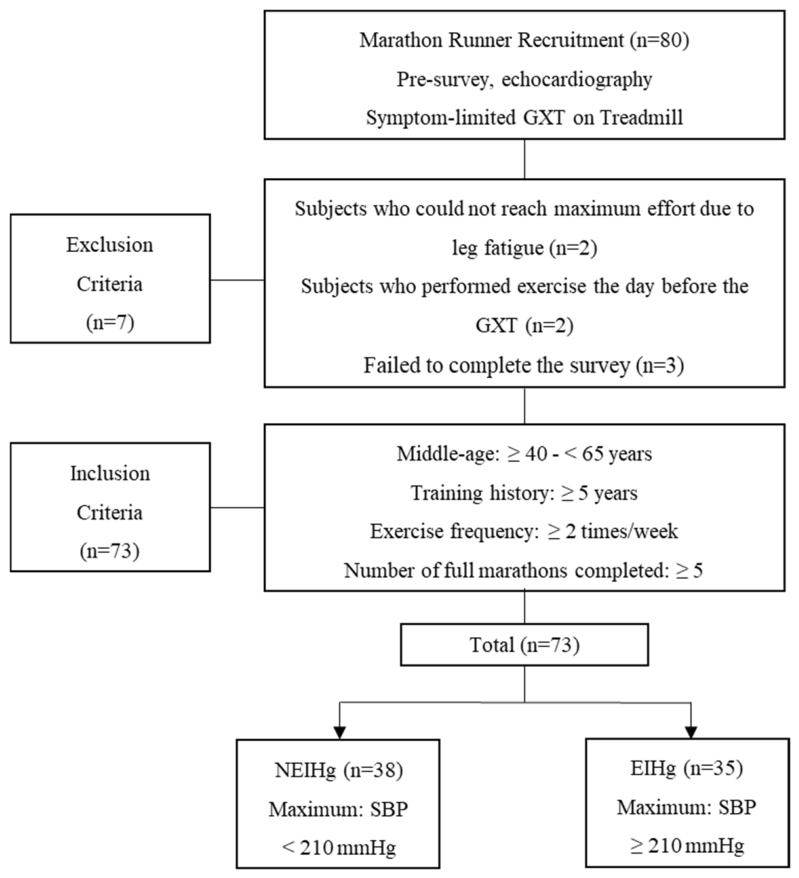
2.1. Participants and Study Protocol
2.2. Graded Exercise Test
2.3. Echocardiography Test
2.4. Statistical Analysis
3. Results
3.1. Participant Characteristics
3.2. Exercise-Related Variables
3.3. Echocardiographic Findings
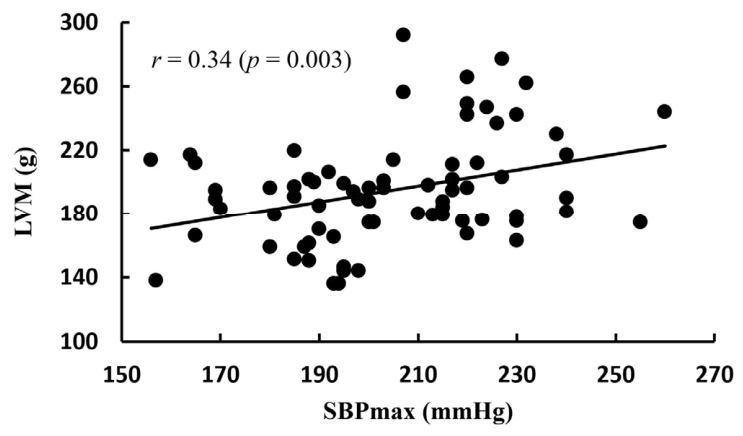
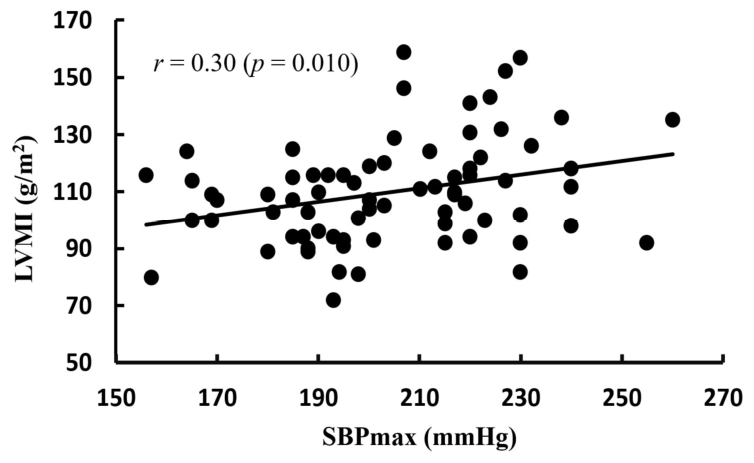
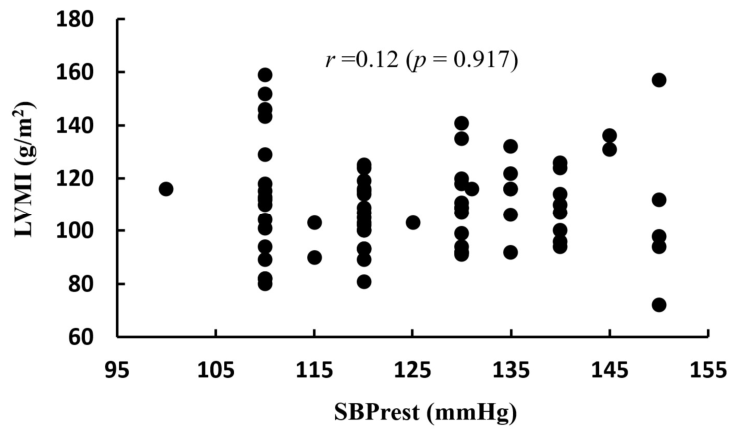
3.4. Correlation Analysis
3.5. Multivariable Regression Analysis
4. Discussion
5. Conclusions
Author Contributions
Funding
Institutional Review Board Statement
Informed Consent Statement
Data Availability Statement
Acknowledgments
Conflicts of Interest
Abbreviations
| ABPM | Ambulatory blood pressure monitoring |
| ASE | American Society of Echocardiography |
| BMI | Body mass index |
| CO | Cardiac output |
| COI | Cardiac output index |
| DBP | Diastolic blood pressure |
| DBPmax | Maximum diastolic blood pressure |
| DBPrest | Resting diastolic blood pressure |
| DT | Deceleration time |
| E | Peak velocity of early filling |
| E’ | Early diastolic annulus velocity |
| E/A | Ratio of early to late ventricular filling velocities |
| E’/A’ | Ratio of early to late diastolic annulus velocity |
| E/E’ | Ratio of early transmitral flow velocity to early diastolic annulus velocity |
| EIH | Exercise-induced hypertension |
| EIHg | Exercise-induced hypertension group |
| GXT | Graded exercise test |
| HR | Heart rate |
| HRmax | Maximum heart rate |
| HRrest | Resting heart rate |
| IVSd | Interventricular septum thickness at end-diastole |
| LA | Left atrium |
| LAD | Left atrial diameter |
| LVEDV | Left ventricular end-diastolic volume |
| LVESV | Left ventricular end-systolic volume |
| LVEF | Left ventricular ejection fraction |
| LVFS | Left ventricular fractional shortening |
| LVH | Left ventricular hypertrophy |
| LVIDd | Left ventricular internal dimension at end-diastole |
| LVIDs | Left ventricular internal dimension at end-systole |
| LVM | Left ventricular mass |
| LVMI | Left ventricular mass index |
| LVSV | Left ventricular stroke volume |
| LVSVI | Left ventricular stroke volume index |
| NEIHg | Non-exercise-induced hypertension group |
| RSBP1 | Recovery systolic blood pressure at 1 min |
| RSBP2 | Recovery systolic blood pressure at 2 min |
| RSBP3 | Recovery systolic blood pressure at 3 min |
| SBP | Systolic blood pressure |
| SBPmax | Maximum systolic blood pressure |
| SBPrest | Resting systolic blood pressure |
References
- Valenzuela, P.L.; Ruilope, L.M.; Santos-Lozano, A.; Wilhelm, M.; Krankel, N.; Fiuza-Luces, C.; Lucia, A. Exercise benefits in cardiovascular diseases: From mechanisms to clinical implementation. Eur. Heart J. 2023, 44, 1874–1889. [Google Scholar] [CrossRef]
- Scharhag, J.; George, K.; Shave, R.; Urhausen, A.; Kindermann, W. Exercise-associated increases in cardiac biomarkers. Med. Sci. Sports Exerc. 2008, 40, 1408–1415. [Google Scholar] [CrossRef]
- Shave, R.; Baggish, A.; George, K.; Wood, M.; Scharhag, J.; Whyte, G.; Gaze, D.; Thompson, P.D. Exercise-induced cardiac troponin elevation: Evidence, mechanisms, and implications. J. Am. Coll. Cardiol. 2010, 56, 169–176. [Google Scholar] [CrossRef]
- Vlachopoulos, C.; Kardara, D.; Anastasakis, A.; Baou, K.; Terentes-Printzios, D.; Tousoulis, D.; Stefanadis, C. Arterial stiffness and wave reflections in marathon runners. Am. J. Hypertens. 2010, 23, 974–979. [Google Scholar] [CrossRef]
- Merghani, A.; Maestrini, V.; Rosmini, S.; Cox, A.T.; Dhutia, H.; Bastiaenan, R.; David, S.; Yeo, T.J.; Narain, R.; Malhotra, A.; et al. Response by Merghani et al. to Letters Regarding Article, “Prevalence of Subclinical Coronary Artery Disease in Masters Endurance Athletes With a Low Atherosclerotic Risk Profile”. Circulation 2018, 137, 541–542. [Google Scholar] [CrossRef]
- Kim, Y.J.; Lee, S.E.; Park, K.M. Exercise characteristics and incidence of abnormal electrocardiogram response in long-distance runners with exercise-induced hypertension. J. Clin. Hypertens. 2021, 23, 1915–1921. [Google Scholar] [CrossRef] [PubMed]
- Kim, C.H.; Park, Y.; Chun, M.Y.; Kim, Y.J. Exercise-induced hypertension can increase the prevalence of coronary artery plaque among middle-aged male marathon runners. Medicine 2020, 99, e19911. [Google Scholar] [CrossRef] [PubMed]
- Kim, Y.J.; Kim, C.H.; Shin, K.A.; Kim, A.C.; Lee, Y.H.; Goh, C.W.; Oh, J.K.; Nam, H.S.; Park, Y. Cardiac markers of EIH athletes in ultramarathon. Int. J. Sports Med. 2012, 33, 171–176. [Google Scholar] [CrossRef] [PubMed]
- Kim, Y.J.; Shin, Y.O.; Lee, Y.H.; Jee, H.M.; Shin, K.A.; Goh, C.W.; Kim, C.H.; Min, Y.K.; Yang, H.M.; Lee, J.B. Effects of marathon running on cardiac markers and endothelin-1 in EIH athletes. Int. J. Sports Med. 2013, 34, 777–782. [Google Scholar] [CrossRef]
- Stewart, K.J.; Sung, J.; Silber, H.A.; Fleg, J.L.; Kelemen, M.D.; Turner, K.L.; Bacher, A.C.; Dobrosielski, D.A.; DeRegis, J.R.; Shapiro, E.P.; et al. Exaggerated exercise blood pressure is related to impaired endothelial vasodilator function. Am. J. Hypertens. 2004, 17, 314–320. [Google Scholar] [CrossRef]
- Schultz, M.G.; Otahal, P.; Cleland, V.J.; Blizzard, L.; Marwick, T.H.; Sharman, J.E. Exercise-induced hypertension, cardiovascular events, and mortality in patients undergoing exercise stress testing: A systematic review and meta-analysis. Am. J. Hypertens. 2013, 26, 357–366. [Google Scholar] [CrossRef] [PubMed]
- Jae, S.Y.; Kurl, S.; Kunutsor, S.K.; Franklin, B.A.; Laukkanen, J.A. Relation of maximal systolic blood pressure during exercise testing to the risk of sudden cardiac death in men with and without cardiovascular disease. Eur. J. Prev. Cardiol. 2020, 27, 2220–2222. [Google Scholar] [CrossRef] [PubMed]
- Kohl, H.W., 3rd; Nichaman, M.Z.; Frankowski, R.F.; Blair, S.N. Maximal exercise hemodynamics and risk of mortality in apparently healthy men and women. Med. Sci. Sports Exerc. 1996, 28, 601–609. [Google Scholar] [CrossRef] [PubMed]
- Kim, Y.J.; Park, K.M. Possible Mechanisms for Adverse Cardiac Events Caused by Exercise-Induced Hypertension in Long-Distance Middle-Aged Runners: A Review. J. Clin. Med. 2024, 13, 2184. [Google Scholar] [CrossRef]
- Malek, L.A.; Jankowska, A.; Greszata, L. Mild Left Ventricular Hypertrophy in Middle-Age Male Athletes as a Sign of Masked Arterial Hypertension. Int. J. Environ. Res. Public Health 2022, 19, 10038. [Google Scholar] [CrossRef]
- Sharma, S.; Drezner, J.A.; Baggish, A.; Papadakis, M.; Wilson, M.G.; Prutkin, J.M.; La Gerche, A.; Ackerman, M.J.; Borjesson, M.; Salerno, J.C.; et al. International Recommendations for Electrocardiographic Interpretation in Athletes. J. Am. Coll. Cardiol. 2017, 69, 1057–1075. [Google Scholar] [CrossRef]
- Singh, J.P.; Larson, M.G.; Manolio, T.A.; O’Donnell, C.J.; Lauer, M.; Evans, J.C.; Levy, D. Blood pressure response during treadmill testing as a risk factor for new-onset hypertension. The Framingham heart study. Circulation 1999, 99, 1831–1836. [Google Scholar] [CrossRef]
- Thompson, P.D.; Arena, R.; Riebe, D.; Pescatello, L.S. ACSM’s new preparticipation health screening recommendations from ACSM’s guidelines for exercise testing and prescription, ninth edition. Curr. Sports Med. Rep. 2013, 12, 215–217. [Google Scholar] [CrossRef]
- Schultz, M.G.; Otahal, P.; Roberts-Thomson, P.; Stanton, T.; Hamilton-Craig, C.; Wahi, S.; La Gerche, A.; Hare, J.L.; Selvanayagam, J.; Maiorana, A.; et al. Exercise blood pressure relative to fitness and cardiovascular outcomes: The EXERTION study. Eur. Heart J. 2026, 47, 1661–1671. [Google Scholar] [CrossRef]
- Mastaloudis, A.; Leonard, S.W.; Traber, M.G. Oxidative stress in athletes during extreme endurance exercise. Free Radic. Biol. Med. 2001, 31, 911–922. [Google Scholar] [CrossRef]
- Mason, S.A.; Trewin, A.J.; Parker, L.; Wadley, G.D. Antioxidant supplements and endurance exercise: Current evidence and mechanistic insights. Redox Biol. 2020, 35, 101471. [Google Scholar] [CrossRef]
- D’Andrea, A.; Riegler, L.; Cocchia, R.; Scarafile, R.; Salerno, G.; Gravino, R.; Golia, E.; Vriz, O.; Citro, R.; Limongelli, G.; et al. Left atrial volume index in highly trained athletes. Am. Heart J. 2010, 159, 1155–1161. [Google Scholar] [CrossRef] [PubMed]
- Tadic, M.; Cuspidi, C.; Radojkovic, J.; Rihor, B.; Kocijanic, V.; Celic, V. Masked Hypertension and Left Atrial Dysfunction: A Hidden Association. J. Clin. Hypertens. 2017, 19, 305–311. [Google Scholar] [CrossRef] [PubMed]
- Nagueh, S.F.; Smiseth, O.A.; Appleton, C.P.; Byrd, B.F., 3rd; Dokainish, H.; Edvardsen, T.; Flachskampf, F.A.; Gillebert, T.C.; Klein, A.L.; Lancellotti, P.; et al. Recommendations for the Evaluation of Left Ventricular Diastolic Function by Echocardiography: An Update from the American Society of Echocardiography and the European Association of Cardiovascular Imaging. Eur. Heart J. Cardiovasc. Imaging 2016, 17, 1321–1360. [Google Scholar] [CrossRef] [PubMed]
- Abdulla, J.; Nielsen, J.R. Is the risk of atrial fibrillation higher in athletes than in the general population? A systematic review and meta-analysis. Europace 2009, 11, 1156–1159. [Google Scholar] [CrossRef]
- Mont, L.; Elosua, R.; Brugada, J. Endurance sport practice as a risk factor for atrial fibrillation and atrial flutter. Europace 2009, 11, 11–17. [Google Scholar] [CrossRef]
- Waldmann, V.; Jouven, X.; Narayanan, K.; Piot, O.; Chugh, S.S.; Albert, C.M.; Marijon, E. Association Between Atrial Fibrillation and Sudden Cardiac Death: Pathophysiological and Epidemiological Insights. Circ. Res. 2020, 127, 301–309. [Google Scholar] [CrossRef]
- Koren, M.J.; Devereux, R.B.; Casale, P.N.; Savage, D.D.; Laragh, J.H. Relation of left ventricular mass and geometry to morbidity and mortality in uncomplicated essential hypertension. Ann. Intern. Med. 1991, 114, 345–352. [Google Scholar] [CrossRef]
- Lavie, C.J.; Ventura, H.O.; Messerli, F.H. Left ventricular hypertrophy. Its relationship to obesity and hypertension. Postgrad. Med. 1992, 91, 131–143. [Google Scholar] [CrossRef]
- Lavie, C.J.; Patel, D.A.; Milani, R.V.; Ventura, H.O.; Shah, S.; Gilliland, Y. Impact of echocardiographic left ventricular geometry on clinical prognosis. Prog. Cardiovasc. Dis. 2014, 57, 3–9. [Google Scholar] [CrossRef]
- Rawlins, J.; Bhan, A.; Sharma, S. Left ventricular hypertrophy in athletes. Eur. J. Echocardiogr. 2009, 10, 350–356. [Google Scholar] [CrossRef]
- Trachsel, L.D.; Carlen, F.; Brugger, N.; Seiler, C.; Wilhelm, M. Masked hypertension and cardiac remodeling in middle-aged endurance athletes. J. Hypertens. 2015, 33, 1276–1283. [Google Scholar] [CrossRef]
- Malek, L.A.; Czajkowska, A.; Mroz, A.; Witek, K.; Barczuk-Falecka, M.; Nowicki, D.; Postula, M.; Werys, K. Left ventricular hypertrophy in middle-aged endurance athletes: Is it blood pressure related? Blood Press. Monit. 2019, 24, 110–113. [Google Scholar] [CrossRef]
- Camafort, M.; Kasiakogias, A.; Agabiti-Rosei, E.; Masi, S.; Iliakis, P.; Benetos, A.; Jeong, J.O.; Lee, H.Y.; Muiesan, M.L.; Sudano, I.; et al. Hypertensive heart disease in older patients: Considerations for clinical practice. Eur. J. Intern. Med. 2025, 134, 75–88. [Google Scholar] [CrossRef] [PubMed]
- Yoon, E.S.; Jae, S.Y.; Kim, Y.J. Exercise-induced hypertension, arterial stiffness, and cardiorespiratory fitness in runners. J. Sports Med. Phys. Fit. 2022, 62, 1397–1403. [Google Scholar] [CrossRef]
- Yoon, E.S.; Kim, Y.J. Exercise-induced Hypertension and Carotid Intima-media Thickness in Male Marathon Runners. Int. J. Sports Med. 2024, 45, 519–525. [Google Scholar] [CrossRef]
- Komori, T.; Eguchi, K.; Kabutoya, T.; Ishikawa, J.; Hoshide, S.; Kario, K. Left ventricular diastolic function evaluated by the E/e’ ratio is impaired in patients with masked uncontrolled hypertension. Clin. Exp. Hypertens. 2014, 36, 538–544. [Google Scholar] [CrossRef]



| NEIHg (n = 38) | EIHg (n = 35) | |
|---|---|---|
| General characteristics | ||
| Age (years) | 57.8 ± 6.9 | 58.3 ± 6.3 |
| Height (cm) | 170.7 ± 5.9 | 171.3 ± 7.5 |
| Weight (kg) | 64.5 ± 5.7 | 66.3 ± 6.2 |
| BMI (kg/m2) | 22.1 ± 1.5 | 22.8 ± 1.8 |
| Smoking status (%) | 0 (0%) | 0 (0%) |
| Alcohol (%) | 33 (86.8%) | 32 (91.4%) |
| Hypertension (%) | 1 (2.6%) | 3 (8.6%) |
| Hyperlipidemia (%) | 1 (2.6%) | 3 (8.6%) |
| DM (%) | 3 (7.9%) | 1 (2.9%) |
| Hemodynamic characteristics | ||
| HRrest (BPM) | 54.7 ± 7.2 | 56.5 ± 9.5 |
| HRmax (BPM) | 162.7 ± 13.3 | 162.0 ± 13.3 |
| SBPrest (mmHg) | 121.7 ± 11.2 | 129.4 ± 13.2 * |
| SBPmax (mmHg) | 186.1 ± 13.0 | 224.1 ± 12.5 * |
| DBPrest (mmHg) | 78.4 ± 7.0 | 81.3 ± 8.9 |
| DBPmax (mmHg) | 88.4 ± 7.1 | 96.3 ± 8.1 * |
| RSBP1 (mmHg) | 183.5 ± 14.3 | 218.1 ± 14.4 * |
| RSBP2 (mmHg) | 174.5 ± 14.3 | 203.4 ± 15.3 * |
| RSBP3 (mmHg) | 163.6 ± 14.2 | 189.3 ± 13.7 * |
| Aerobic exercise capacity | ||
| VO2max (mL/kg/min) | 50.1 ± 6.8 | 47.8 ± 6.8 |
| NEIHg (n = 38) | EIHg (n = 35) | |
|---|---|---|
| Training history (yrs) | 17.8 ± 7.3 | 16.4 ± 5.7 |
| Exercise intensity (Borg’s RPE scale) | 13.5 ± 1.4 | 14.3 ± 1.3 * |
| Exercise time (min/day) | 88.9 ± 28.9 | 77.4 ± 27.5 |
| Exercise frequency (times per week) | 4.2 ± 1.3 | 3.9 ± 1.4 |
| Marathon time (min) | 220.6 ± 28.8 | 225.2 ± 30.4 |
| Marathons completed (number) | 86.6 ± 79.0 | 63.1 ± 70.8 |
| NEIHg (n = 38) | EIHg (n = 35) | |
|---|---|---|
| Left ventricular structure and systolic function | ||
| LAD (mm) | 3.5 ± 0.3 | 3.8 ± 0.3 * |
| LVIDd (mm) | 4.9 ± 0.4 | 5.0 ± 0.4 |
| LVIDs (mm) | 3.2 ± 0.3 | 3.2 ± 0.3 |
| LVPWd (mm) | 0.90 ± 0.09 | 0.96 ± 0.11 * |
| IVSd (mm) | 0.89 ± 0.08 | 0.99 ± 0.11 * |
| LVM (g) | 179.5 ± 24.6 | 210.9 ± 35.3 * |
| LVMI (g/m2) | 102.6 ± 13.0 | 117.9 ± 19.9 * |
| LVEDV (mL) | 114.5 ± 20.8 | 116.8 ± 28.0 |
| LVESV (mL) | 40.3 ± 9.3 | 42.7 ± 10.2 |
| LVSV (mL) | 74.0 ± 13.8 | 76.7 ± 13.6 |
| LVSVI (mL/m2) | 42.2 ± 6.8 | 42.9 ± 7.6 |
| LVEF (%) | 64.9 ± 4.0 | 64.3 ± 4.5 |
| CO (L/min) | 3.8 ± 0.7 | 4.3 ± 1.9 |
| COI (L/min/m2) | 2.1 ± 0.4 | 2.5 ± 1.0 |
| LVFS (%) | 36.5 ± 6.1 | 35.3 ± 3.3 |
| Left ventricular diastolic function | ||
| E-velocity (cm/s) | 62.0 ± 15.3 | 70.0 ± 13.5 * |
| A-velocity (cm/s) | 54.8 ± 10.8 | 63.5 ± 14.1 * |
| E’-velocity (cm/s) | 9.0 ± 1.8 | 9.0 ± 2.1 |
| A’-velocity (cm/s) | 10.7 ± 1.7 | 10.9 ± 1.4 |
| DT (m/s) | 187.7 ± 21.2 | 184.1 ± 23.7 |
| E/A | 1.18 ± 0.4 | 1.17 ± 0.4 |
| E’/A’ | 0.86 ± 0.2 | 0.83 ± 0.2 |
| E/E’ | 6.9 ± 1.8 | 8.0 ± 1.9 * |
| SBPrest (mmHg) | DBPrest (mmHg) | SBPmax (mmHg) | DBPmax (mmHg) | LVM (g) | LVMI (g/m2) | |
|---|---|---|---|---|---|---|
| LAD (mm) | r = 0.15 | r = 0.11 | r = 0.31 * | r = 0.23 * | r = 0.50 * | r = 0.49 * |
| E/E’ | r = 0.15 | r = 0.07 | r = 0.10 | r = 0.32 * | r = 0.34 * | r = 0.33 * |
| Variable | B | SE | β | 95% CI | p-Value |
|---|---|---|---|---|---|
| Left ventricular mass index | |||||
| Age | 0.489 | 0.346 | 0.177 | −0.203–1.180 | 0.163 |
| BMI | 1.753 | 1.401 | 0.160 | −1.045–4.551 | 0.215 |
| SBPrest | −0.302 | 0.193 | −0.211 | −0.688–0.085 | 0.124 |
| Exercise history | 0.378 | 0.357 | 0.136 | −0.335–1.090 | 0.294 |
| Exercise intensity | 0.460 | 1.610 | 0.036 | −2.756–3.676 | 0.776 |
| VO2max | 0.333 | 0.330 | 0.125 | −0.327–0.992 | 0.318 |
| SBPmax | 0.293 | 0.108 | 0.369 | 0.078–0.509 | 0.008 |
| Left atrial diameter | |||||
| Age | 0.010 | 0.007 | 0.178 | −0.003–0.023 | 0.136 |
| BMI | 0.089 | 0.026 | 0.405 | 0.036–0.142 | 0.001 |
| SBPrest | −0.003 | 0.004 | −0.102 | −0.010–0.004 | 0.426 |
| Exercise history | 0.003 | 0.007 | 0.061 | −0.010–0.017 | 0.616 |
| Exercise intensity | 0.006 | 0.030 | 0.024 | −0.055–0.067 | 0.841 |
| VO2max | 0.013 | 0.006 | 0.238 | 0.000–0.025 | 0.045 |
| SBPmax | 0.005 | 0.002 | 0.298 | 0.001–0.009 | 0.022 |
Disclaimer/Publisher’s Note: The statements, opinions and data contained in all publications are solely those of the individual author(s) and contributor(s) and not of MDPI and/or the editor(s). MDPI and/or the editor(s) disclaim responsibility for any injury to people or property resulting from any ideas, methods, instructions or products referred to in the content. |
© 2026 by the authors. Licensee MDPI, Basel, Switzerland. This article is an open access article distributed under the terms and conditions of the Creative Commons Attribution (CC BY) license.
Share and Cite
Kim, Y.-J.; Park, H.-S.; Nam, S.-H.; Lee, S.-E.; Lee, K.-H.; Park, Y.; Yoon, J.-H.; Ji, M.-Y. Exercise-Induced Hypertension Is Associated with Cardiac Remodeling in Middle-Aged Male Long-Distance Runners: A Cross-Sectional Study. Life 2026, 16, 853. https://doi.org/10.3390/life16050853
Kim Y-J, Park H-S, Nam S-H, Lee S-E, Lee K-H, Park Y, Yoon J-H, Ji M-Y. Exercise-Induced Hypertension Is Associated with Cardiac Remodeling in Middle-Aged Male Long-Distance Runners: A Cross-Sectional Study. Life. 2026; 16(5):853. https://doi.org/10.3390/life16050853
Chicago/Turabian StyleKim, Young-Joo, Han-Soo Park, Sang-Hyun Nam, Si-Eun Lee, Kyung-Hee Lee, Yongbum Park, Jin-Ho Yoon, and Mu-Yeop Ji. 2026. "Exercise-Induced Hypertension Is Associated with Cardiac Remodeling in Middle-Aged Male Long-Distance Runners: A Cross-Sectional Study" Life 16, no. 5: 853. https://doi.org/10.3390/life16050853
APA StyleKim, Y.-J., Park, H.-S., Nam, S.-H., Lee, S.-E., Lee, K.-H., Park, Y., Yoon, J.-H., & Ji, M.-Y. (2026). Exercise-Induced Hypertension Is Associated with Cardiac Remodeling in Middle-Aged Male Long-Distance Runners: A Cross-Sectional Study. Life, 16(5), 853. https://doi.org/10.3390/life16050853