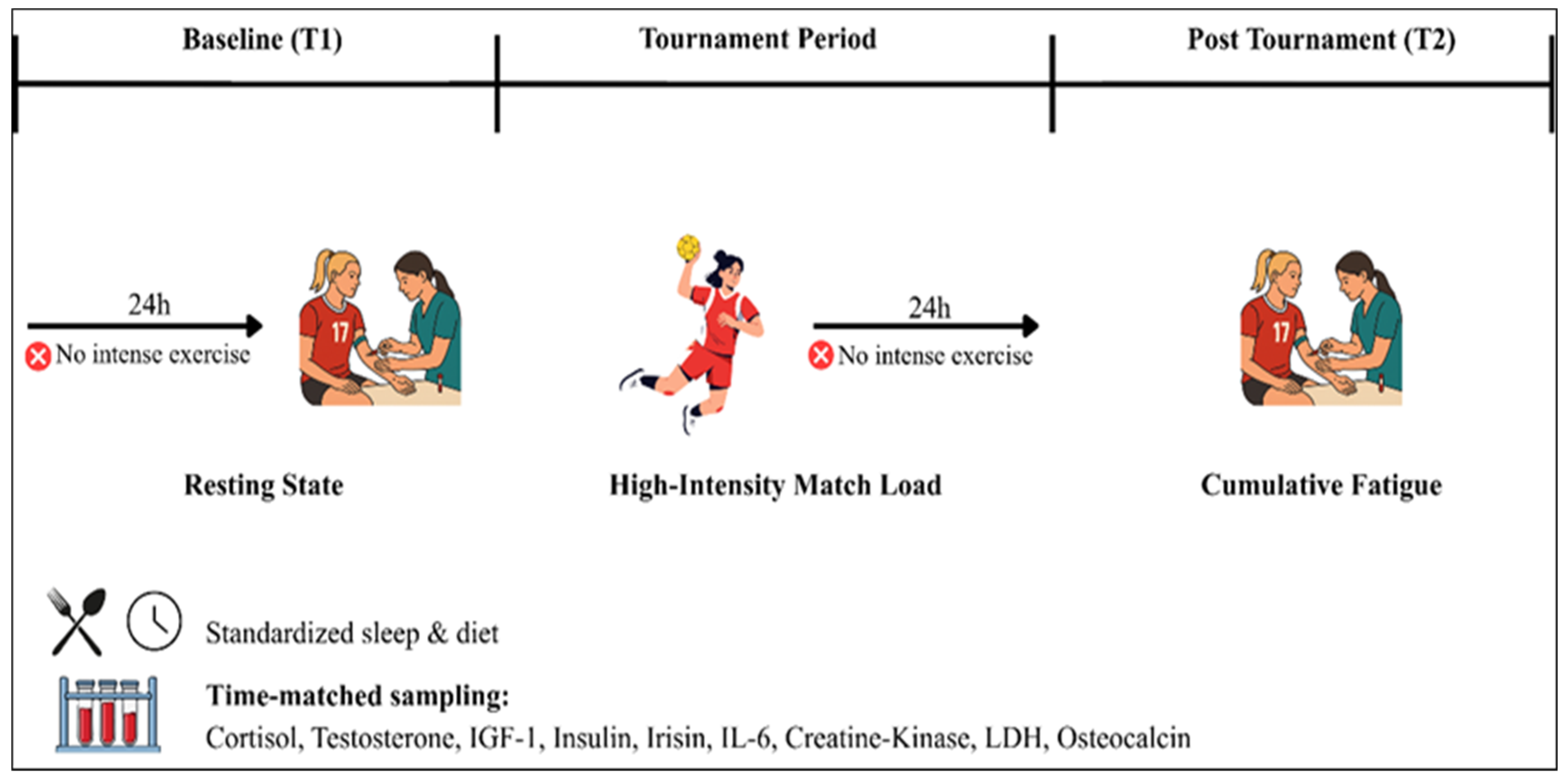
Acute Biochemical Responses to Competitive Tournament Load in Female Handball Players: Hormonal, Inflammatory and Muscle Damage Markers




Abstract
1. Introduction
2. Materials and Methods
2.1. Experimental Approach to the Study
2.2. Participants
2.3. Tournament Structure and Competitive Load
2.4. Blood Sampling and Biochemical Analyses
2.5. Statistical Analyses
3. Results
4. Discussion
5. Conclusions
Author Contributions
Funding
Institutional Review Board Statement
Informed Consent Statement
Data Availability Statement
Acknowledgments
Conflicts of Interest
References
- Michalsik, L.B.; Aagaard, P. Physical demands in elite team handball: Comparisons between male and female players. J. Sports Med. Phys. Fit. 2015, 55, 878–891. [Google Scholar] [PubMed]
- Póvoas, S.C.A.; Ascensão, A.A.M.R.; Magalhães, J.; Seabra, A.F.; Krustrup, P.; Soares, J.M.C.; Rebelo, A.N.C. Physiological demands of elite team handball with special reference to playing position. J. Strength Cond. Res. 2014, 28, 430–442. [Google Scholar] [CrossRef] [PubMed]
- Michalsik, L.B.; Madsen, K.; Aagaard, P. Match performance and physiological capacity of female elite team handball players. Int. J. Sports Med. 2014, 35, 595–607. [Google Scholar] [CrossRef] [PubMed]
- Manchado, C.; Tortosa-Martínez, J.; Vila, H.; Ferragut, C.; Platen, P. Performance factors in women’s team handball: Physical and physiological aspects—A review. J. Strength Cond. Res. 2013, 27, 1708–1719. [Google Scholar] [CrossRef]
- Cunniffe, B.; Hore, A.J.; Whitcombe, D.M.; Jones, K.P.; Baker, J.S.; Davies, B. Time course of changes in immunoendocrine markers following an international rugby game. Eur. J. Appl. Physiol. 2010, 108, 113–122. [Google Scholar] [CrossRef]
- Morgans, R.; Orme, P.; Bezuglov, E.; Di Michele, R.; Moreira, A. The immunological and hormonal responses to competitive match-play in elite soccer players. Int. J. Environ. Res. Public Health 2022, 19, 11784. [Google Scholar] [CrossRef]
- Wagner, H.; Fuchs, P.X.; von Duvillard, S.P. Specific physiological and biomechanical performance in elite, sub-elite and non-elite male team handball players. J. Sports Med. Phys. Fit. 2018, 58, 73–81. [Google Scholar] [CrossRef]
- Marin, D.P.; dos Santos, R.C.M.; Bolin, A.P.; Guerra, B.A.; Hatanaka, E.; Otton, R. Cytokines and oxidative stress status following a handball game in elite male players. Oxid. Med. Cell. Longev. 2011, 2011, 804873. [Google Scholar] [CrossRef] [PubMed]
- Wagner, H.; Finkenzeller, T.; Würth, S.; von Duvillard, S.P. Individual and team performance in team-handball: A review. J. Sports Sci. Med. 2014, 13, 808–816. [Google Scholar] [PubMed]
- Pedersen, B.K. Muscle as a secretory organ. Compr. Physiol. 2013, 3, 1337–1362. [Google Scholar] [CrossRef]
- Kirk, B.; Feehan, J.; Lombardi, G.; Duque, G. Muscle, bone, and fat crosstalk: The biological role of myokines, osteokines, and adipokines. Curr. Osteoporos. Rep. 2020, 18, 388–400. [Google Scholar] [CrossRef] [PubMed]
- Izquierdo, M.; Ibáñez, J.; Calbet, J.A.L.; Navarro-Amezqueta, I.; González-Izal, M.; Idoate, F.; Häkkinen, K.; Kraemer, W.J.; Palacios-Sarrasqueta, M.; Almar, M.; et al. Cytokine and hormone responses to resistance training. Eur. J. Appl. Physiol. 2009, 107, 397–409. [Google Scholar] [CrossRef]
- Brancaccio, P.; Maffulli, N.; Limongelli, F.M. Creatine kinase monitoring in sport medicine. Br. Med. Bull. 2007, 81–82, 209–230. [Google Scholar] [CrossRef]
- Hughes, J.D.; Denton, K.; Lloyd, R.S.; Oliver, J.L.; De Ste Croix, M. The impact of soccer match play on the muscle damage response in youth female athletes. Int. J. Sports Med. 2018, 39, 343–348. [Google Scholar] [CrossRef]
- Crewther, B.T.; Cook, C.; Cardinale, M.; Weatherby, R.P.; Lowe, T. Two emerging concepts for elite athletes: The short-term effects of testosterone and cortisol on the neuromuscular system and the dose–response training role of these endogenous hormones. Sports Med. 2011, 41, 103–123. [Google Scholar] [CrossRef]
- Hayes, L.D.; Sculthorpe, N.; Young, J.D.; Baker, J.S.; Grace, F.M. Critical difference applied to exercise-induced salivary testosterone and cortisol using enzyme-linked immunosorbent assay (ELISA): Distinguishing biological from statistical change. J. Physiol. Biochem. 2014, 70, 991–996. [Google Scholar] [CrossRef]
- Holtzman, B.; Ackerman, K.E. Recommendations and nutritional considerations for female athletes: Health and performance. Sports Med. 2021, 51, 43–57. [Google Scholar] [CrossRef] [PubMed]
- Welde, B.; Kellawan, J.M.; Larson, R.D.; Morseth, B.; Osborne, J.O.; Sandbakk, Ø. Editorial: The physiology of the female athlete—Performance, health, and recovery. Front. Sports Act. Living 2024, 6, 1433336. [Google Scholar] [CrossRef]
- Scherr, J.; Wolfarth, B.; Christle, J.W.; Pressler, A.; Wagenpfeil, S.; Halle, M. Associations between Borg’s rating of perceived exertion and physiological measures of exercise intensity. Eur. J. Appl. Physiol. 2013, 113, 147–155. [Google Scholar] [CrossRef] [PubMed]
- Kohl, T.O.; Ascoli, C.A. Direct competitive enzyme-linked immunosorbent assay (ELISA). Cold Spring Harb. Protoc. 2017, 2017, pdb.prot093740. [Google Scholar] [CrossRef]
- Cohen, J. Statistical Power Analysis for the Behavioral Sciences, 2nd ed.; Routledge Academic: New York, NY, USA, 1988. [Google Scholar]
- Ferguson, C.J. An effect size primer: A guide for clinicians and researchers. In Methodological Issues and Strategies in Clinical Research, 4th ed.; Kazdin, A.E., Ed.; American Psychological Association: Washington, DC, USA, 2016; pp. 301–310. [Google Scholar] [CrossRef]
- Ortega-Becerra, M.; Belloso-Vergara, A.; Pareja-Blanco, F. Physical and physiological demands during handball matches in male adolescent players. J. Hum. Kinet. 2020, 72, 253–263. [Google Scholar] [CrossRef]
- Michalsik, L.B.; Aagaard, P.; Madsen, K. Locomotion characteristics and match-induced impairments in physical performance in male elite team handball players. Int. J. Sports Med. 2013, 34, 590–599. [Google Scholar] [CrossRef]
- Banfi, G.; Colombini, A.; Lombardi, G.; Lubkowska, A. Metabolic markers in sports medicine. Adv. Clin. Chem. 2012, 56, 1–54. [Google Scholar] [CrossRef] [PubMed]
- Janse de Jonge, X.A.K. Effects of the menstrual cycle on exercise performance. Sports Med. 2003, 33, 833–851. [Google Scholar] [CrossRef] [PubMed]
- Loucks, A.B.; Thuma, J.R. Luteinizing hormone pulsatility is disrupted at a threshold of energy availability in regularly menstruating women. J. Clin. Endocrinol. Metab. 2003, 88, 297–311. [Google Scholar] [CrossRef]
- Khaleghi, M.M.; Ahmadi, F. Effects of Team Sports on Female Testosterone and Cortisol Hormones: A Systematic Review. Mod. Care J. 2025, 22, e158218. [Google Scholar] [CrossRef]
- Mariscal, G.; Vera, P.; Platero, J.L.; Bodi, F.; de la Rubia Orti, J.E.; Barrios, C. Changes in different salivary biomarkers related to physiologic stress in elite handball players: The case of females. Sci. Rep. 2019, 9, 19554. [Google Scholar] [CrossRef]
- Cselko, A.; Szabo, E.I.; Vaczi, M.; Koszegi, T.; Tekus, E.; Wilhelm, M. Relationship between anthropometric, physical and hormonal parameters among pre-pubertal handball players. Int. J. Environ. Res. Public Health 2021, 18, 9977. [Google Scholar] [CrossRef]
- Hackney, A.C. Hypogonadism in exercising males: Dysfunction or adaptive–regulatory adjustment? Front. Endocrinol. 2020, 11, 11. [Google Scholar] [CrossRef]
- Mountjoy, M.; Sundgot-Borgen, J.; Burke, L.M.; Ackerman, K.E.; Blauwet, C.; Constantini, N.; Lebrun, C.; Lundy, B.; Melin, A.K.; Meyer, N.L.; et al. IOC consensus statement on relative energy deficiency in sport (RED-S): 2018 update. Br. J. Sports Med. 2018, 52, 687–697. [Google Scholar] [CrossRef]
- Schlie, J.; Krassowski, V.; Schmidt, A. Effects of menstrual cycle phases on athletic performance and related physiological outcomes: A systematic review of studies using high methodological standards. J. Appl. Physiol. 2025, 139, 3. [Google Scholar] [CrossRef]
- Halson, S.L. Monitoring training load to understand fatigue in athletes. Sports Med. 2014, 44, S139–S147. [Google Scholar] [CrossRef]
- Meeusen, R.; Duclos, M.; Foster, C.; Fry, A.; Gleeson, M.; Nieman, D.; Raglin, J.; Rietjens, G.; Steinacker, J.; Urhausen, A. Prevention, diagnosis, and treatment of the overtraining syndrome: Joint consensus statement of the European College of Sport Science and the American College of Sports Medicine. Med. Sci. Sports Exerc. 2013, 45, 186–205. [Google Scholar] [CrossRef]
- Cadegiani, F.A.; Kater, C.E. Basal hormones and biochemical markers as predictors of overtraining syndrome in male athletes: The EROS-BASAL study. J. Athl. Train. 2019, 54, 906–914. [Google Scholar] [CrossRef] [PubMed]
- Rantalainen, T.; Heinonen, A.; Linnamo, V.; Komi, P.V.; Takala, T.E.S.; Kainulainen, H. Short-term bone biochemical response to a single bout of high-impact exercise. J. Sports Sci. Med. 2009, 8, 553–559. [Google Scholar] [PubMed]
- Zhang, W.; Wang, X.; Liu, Y.; He, Q.; Ding, Q.; Mei, J.; Li, X. Effects of exercise on bone mass and bone metabolism in adolescents: A systematic review and meta-analysis. Front. Physiol. 2024, 15, 1512822. [Google Scholar] [CrossRef] [PubMed]
- Karsenty, G. Osteocalcin: A Multifaceted Bone-Derived Hormone. Annu. Rev. Nutr. 2023, 43, 55–71. [Google Scholar] [CrossRef]
- Smith, C.; Lin, X.; Parker, L.; Yeap, B.B.; Hayes, A.; Levinger, I. The role of bone in energy metabolism: A focus on osteocalcin. Bone 2024, 188, 117238. [Google Scholar] [CrossRef]
- Fernández-Real, J.M.; Ricart, W. Osteocalcin: A new link between bone and energy metabolism. Some evolutionary clues. Curr. Opin. Clin. Nutr. Metab. Care 2011, 14, 360–366. [Google Scholar] [CrossRef]
- Skein, M.; Duffield, R.; Edge, J.; Short, M.J.; Mündel, T. Intermittent-Sprint Performance and Muscle Glycogen after 30 h of Sleep Deprivation. Med. Sci. Sports Exerc. 2011, 43, 1301–1311. [Google Scholar] [CrossRef]
- Ivy, J.L. Regulation of Muscle Glycogen Repletion, Muscle Protein Synthesis and Repair following Exercise. J. Sports Sci. Med. 2004, 3, 131–138. [Google Scholar] [PubMed]
- Burke, L.M.; van Loon, L.J.C.; Hawley, J.A. Postexercise Muscle Glycogen Resynthesis in Humans. J. Appl. Physiol. 2017, 122, 1055–1067. [Google Scholar] [CrossRef] [PubMed]
- Balsom, P.D.; Gaitanos, G.C.; Söderlund, K.; Ekblom, B. High-Intensity Exercise and Muscle Glycogen Availability in Humans. Acta Physiol. Scand. 1999, 165, 337–345. [Google Scholar] [CrossRef] [PubMed]
- Carmichael, M.A.; Thomson, R.L.; Moran, L.J.; Wycherley, T.P. The Impact of Menstrual Cycle Phase on Athletes’ Performance: A Narrative Review. Int. J. Environ. Res. Public Health 2021, 18, 1667. [Google Scholar] [CrossRef]



| Variable | Mean | 95% CI Lower | 95% CI Upper | SD |
|---|---|---|---|---|
| Age (years) | 21.750 | 20.589 | 22.911 | 1.389 |
| Height (m) | 1.657 | 1.611 | 1.704 | 0.056 |
| Weight (kg) | 57.250 | 52.219 | 62.281 | 6.018 |
| Training Age (years) | 7.500 | 6.405 | 8.595 | 1.309 |
| BMI (kg/m2) | 20.834 | 19.309 | 22.358 | 1.824 |
| Variable | Pre (M ± SD) | Post (M ± SD) | t | p | d | 95% CI |
|---|---|---|---|---|---|---|
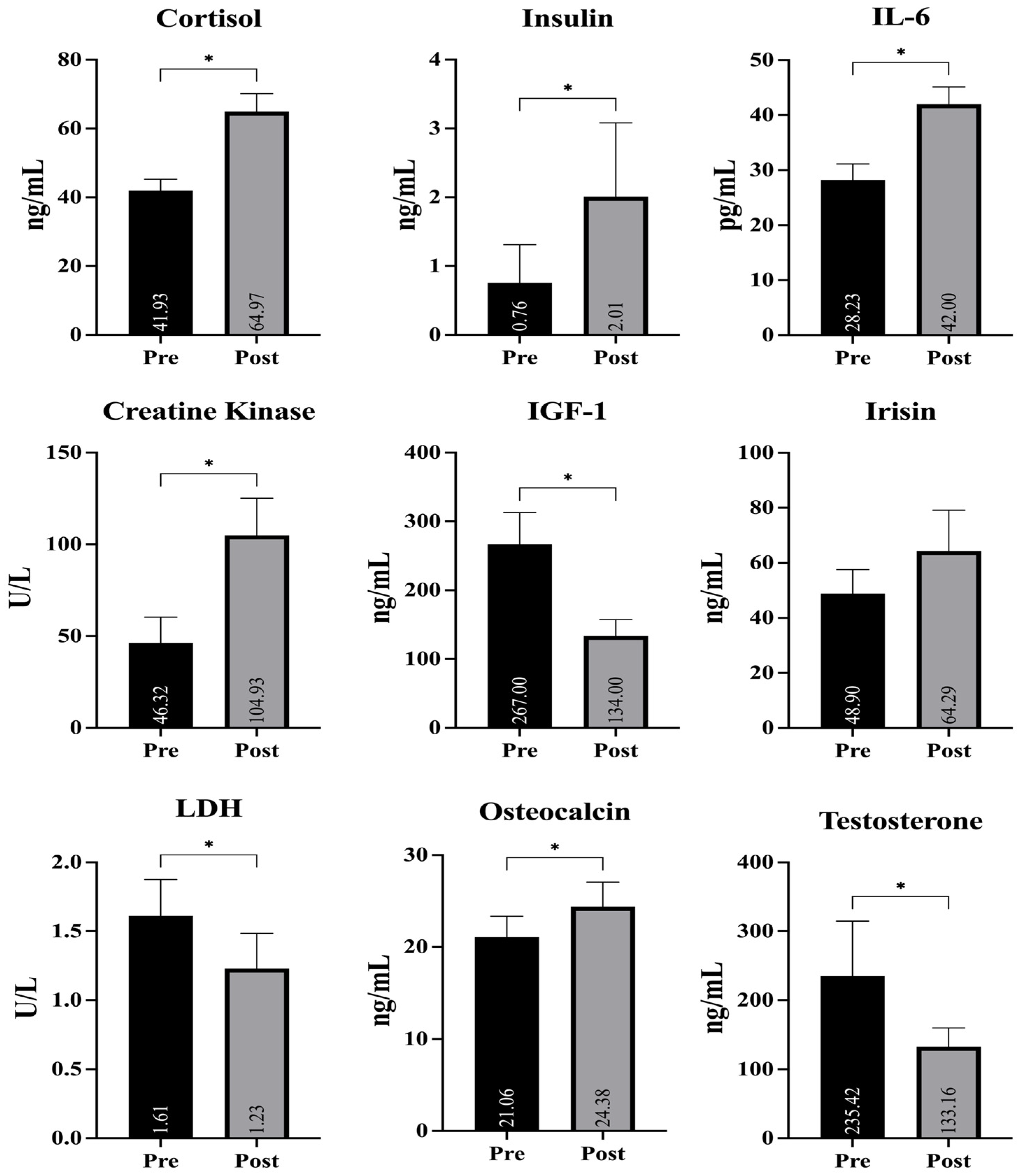
| Cortisol (ng/mL) | 41.931 ± 3.343 | 64.965 ± 5.196 | −10.462 | <0.001 | −3.699 | [−5.704, −1.676] |
| Insulin (ng/mL) | 0.757 ± 0.554 | 2.009 ± 1.072 | −2.459 | 0.044 | −0.869 | [−1.673, −0.024] |
| IL-6 (pg/mL) | 28.229 ± 2.903 | 41.995 ± 3.134 | −13.750 | <0.001 | −4.861 | [−7.436, −2.279] |
| Creatine Kinase (U/L) | 46.316 ± 14.076 | 104.931 ± 20.189 | −6.477 | <0.001 | −2.290 | [−3.634, −0.910] |
| IGF-1 (ng/mL) | 267.000 ± 46.056 | 134.000 ± 23.336 | 7.056 | <0.001 | 2.495 | [1.026, 3.931] |
| Irisin (ng/mL) | 48.901 ± 8.667 | 64.286 ± 14.870 | −2.073 | 0.077 | −0.733 | [−1.502, 0.075] |
| LDH (U/L) | 1.611 ± 0.264 | 1.230 ± 0.254 | 4.892 | 0.002 | 1.730 | [0.583, 2.834] |
| Osteocalcin (ng/mL) | 21.059 ± 2.277 | 24.377 ± 2.678 | −4.029 | 0.005 | −1.424 | [−2.409, −0.395] |
| Testosterone (ng/mL) | 235.423 ± 79.326 | 133.160 ± 27.062 | 4.200 | 0.004 | 1.485 | [0.433, 2.493] |
Disclaimer/Publisher’s Note: The statements, opinions and data contained in all publications are solely those of the individual author(s) and contributor(s) and not of MDPI and/or the editor(s). MDPI and/or the editor(s) disclaim responsibility for any injury to people or property resulting from any ideas, methods, instructions or products referred to in the content. |
© 2026 by the authors. Licensee MDPI, Basel, Switzerland. This article is an open access article distributed under the terms and conditions of the Creative Commons Attribution (CC BY) license.
Share and Cite
Pancar, Z.; Makaracı, Y.; Gençoğlu, C.; Karaca, B.; Ulusal, H. Acute Biochemical Responses to Competitive Tournament Load in Female Handball Players: Hormonal, Inflammatory and Muscle Damage Markers. Life 2026, 16, 523. https://doi.org/10.3390/life16030523
Pancar Z, Makaracı Y, Gençoğlu C, Karaca B, Ulusal H. Acute Biochemical Responses to Competitive Tournament Load in Female Handball Players: Hormonal, Inflammatory and Muscle Damage Markers. Life. 2026; 16(3):523. https://doi.org/10.3390/life16030523
Chicago/Turabian StylePancar, Zarife, Yücel Makaracı, Celal Gençoğlu, Burak Karaca, and Hasan Ulusal. 2026. "Acute Biochemical Responses to Competitive Tournament Load in Female Handball Players: Hormonal, Inflammatory and Muscle Damage Markers" Life 16, no. 3: 523. https://doi.org/10.3390/life16030523
APA StylePancar, Z., Makaracı, Y., Gençoğlu, C., Karaca, B., & Ulusal, H. (2026). Acute Biochemical Responses to Competitive Tournament Load in Female Handball Players: Hormonal, Inflammatory and Muscle Damage Markers. Life, 16(3), 523. https://doi.org/10.3390/life16030523