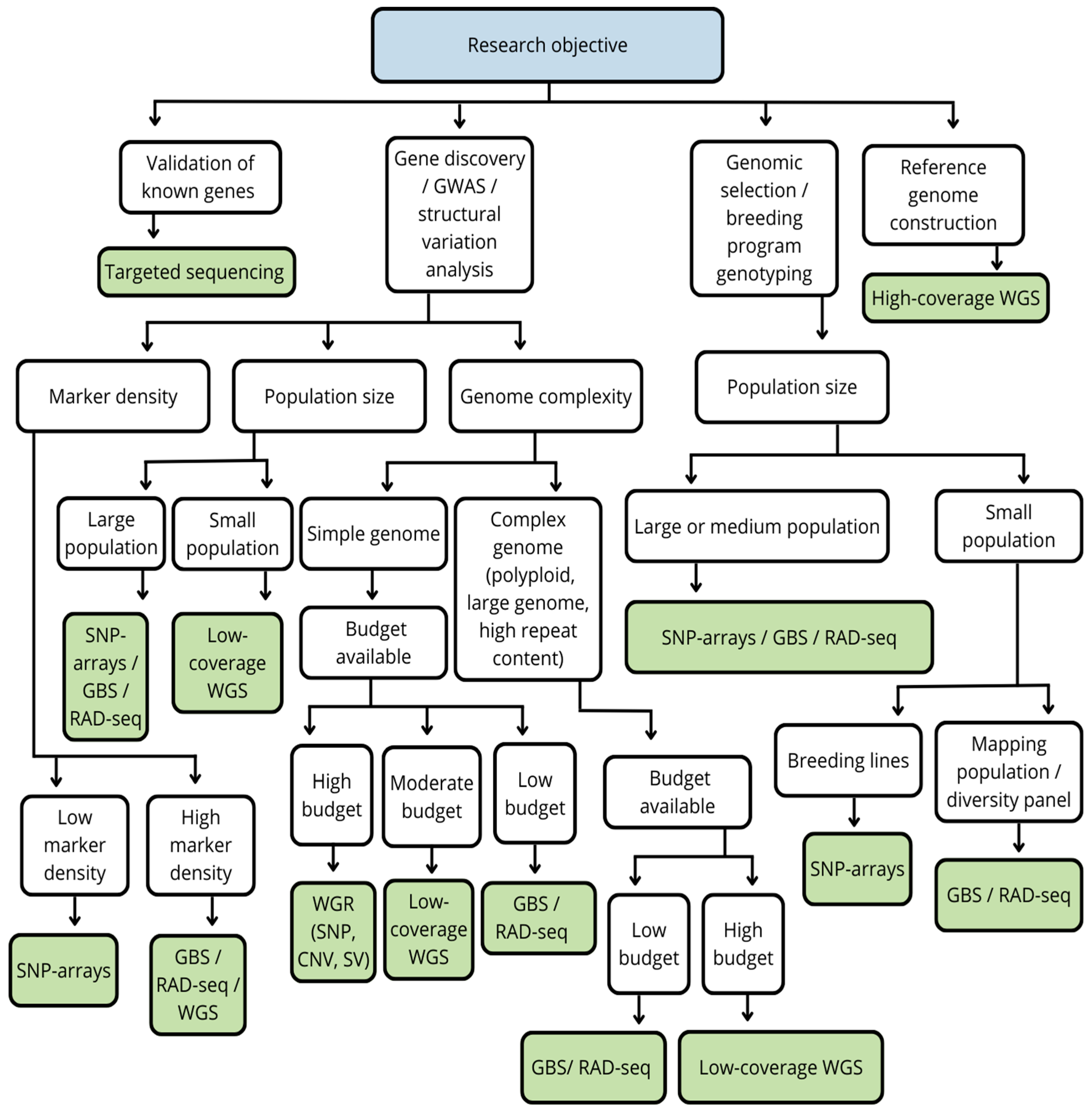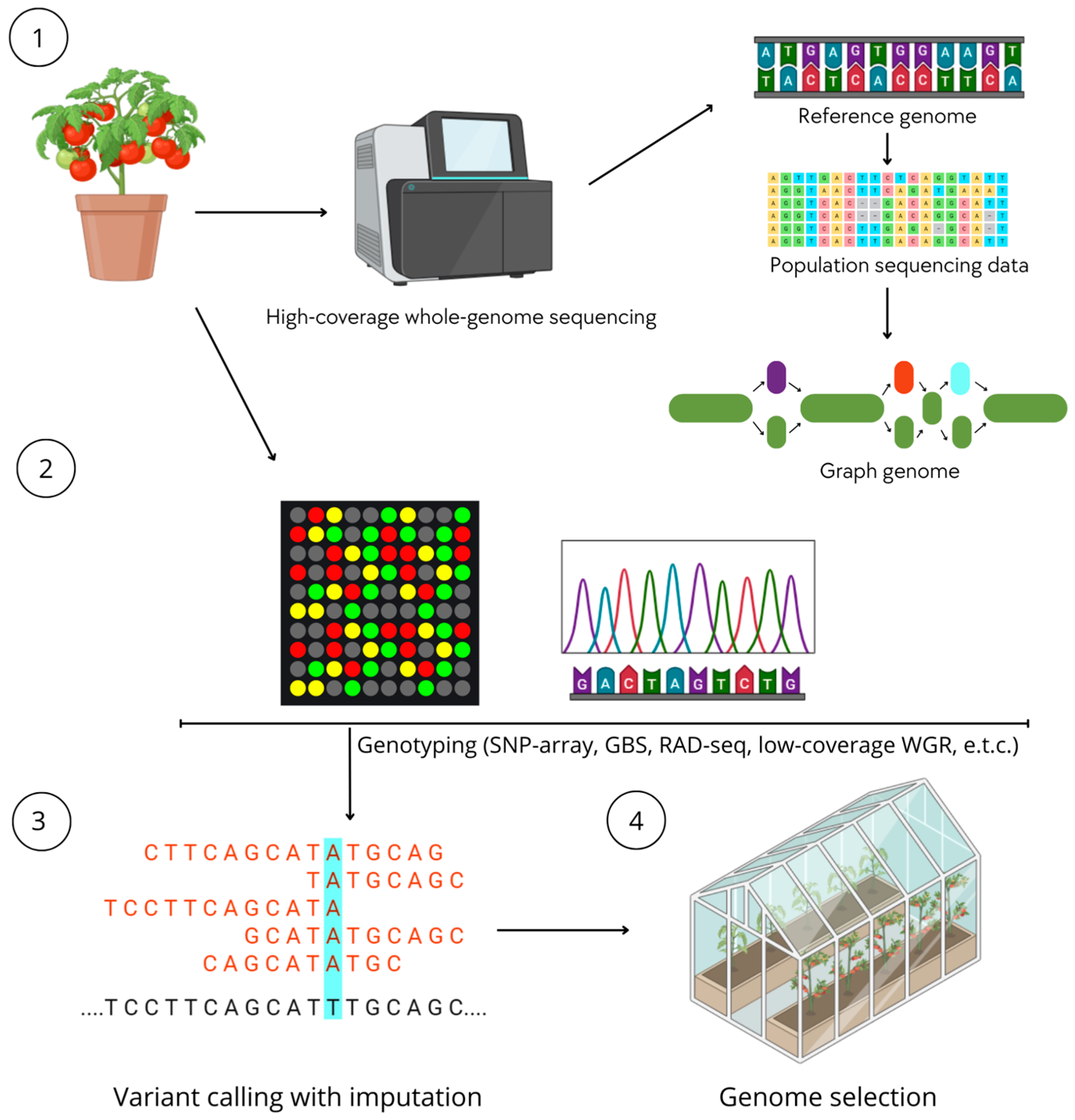
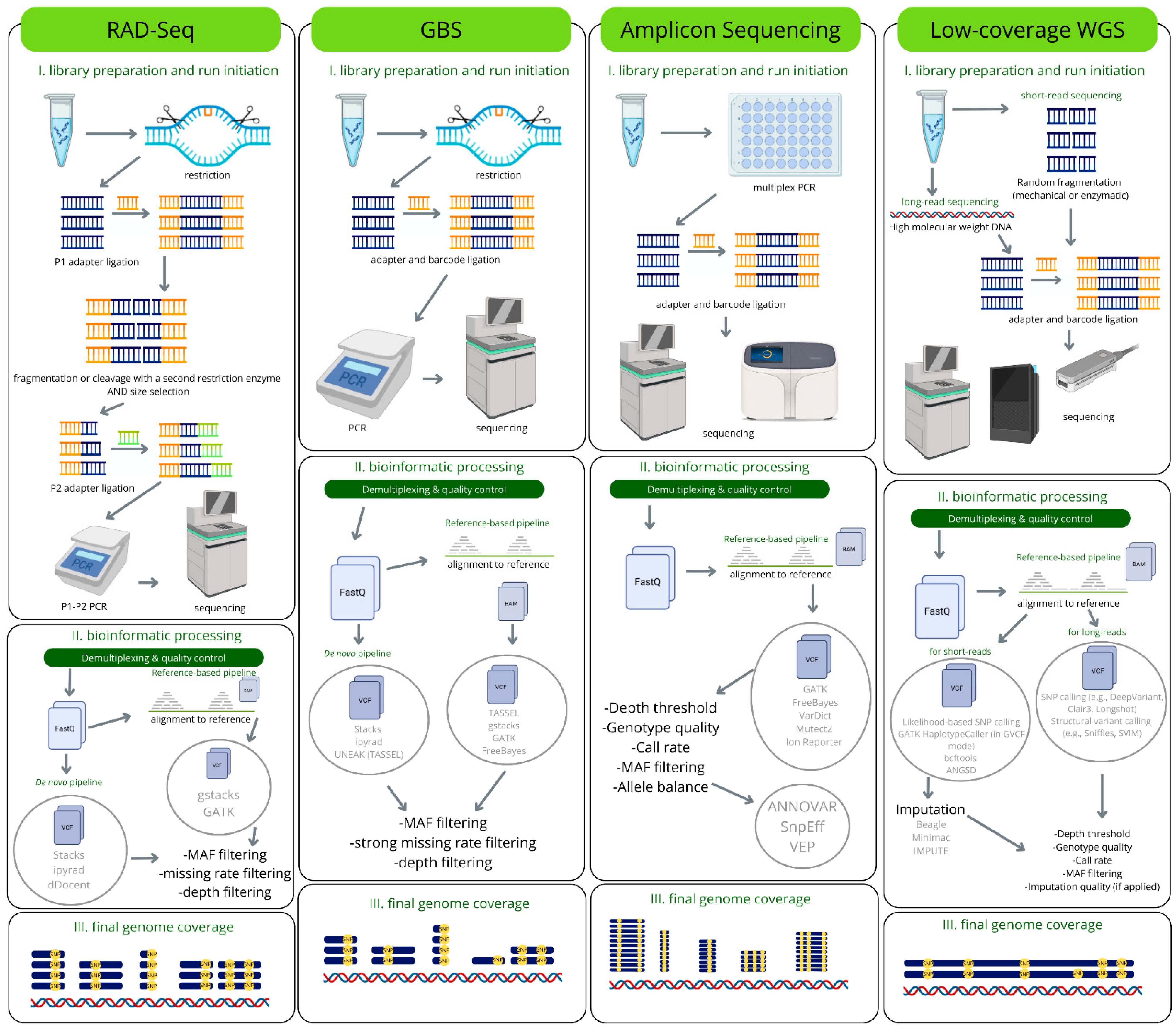
Next-Generation Genotyping: Innovations Driving Plant Genomic Improvement
 , , , ,
Abstract
1. Introduction
2. SNP Arrays as a Tool for High-Throughput Plant Genotyping and Genomic Selection
3. Reduced-Representation and Targeted Sequencing in Plant Genotyping
4. Whole-Genome Genotyping Strategies in Plant Breeding
5. Innovations in Plant Genotyping
6. Genotyping of Complex Genomes and Its Importance in GWAS and Genomic Selection
7. What Is Next?
8. Conclusions
Supplementary Materials
Author Contributions
Funding
Institutional Review Board Statement
Informed Consent Statement
Data Availability Statement
Conflicts of Interest
References
- Ćeran, M.; Miladinović, D.; Đorđević, V.; Trkulja, D.; Radanović, A.; Glogovac, S.; Kondić-Špika, A. Genomics-Assisted Speed Breeding for Crop Improvement: Present and Future. Front. Sustain. Food Syst. 2024, 8, 1383302. [Google Scholar] [CrossRef]
- Kumar, R.; Das, S.P.; Choudhury, B.U.; Kumar, A.; Prakash, N.R.; Verma, R.; Chakraborti, M.; Devi, A.G.; Bhattacharjee, B.; Das, R.; et al. Advances in Genomic Tools for Plant Breeding: Harnessing DNA Molecular Markers, Genomic Selection, and Genome Editing. Biol. Res. 2024, 57, 80. [Google Scholar] [CrossRef] [PubMed]
- Jeon, D.; Kim, C. Polyploids of Brassicaceae: Genomic Insights and Assembly Strategies. Plants 2024, 13, 2087. [Google Scholar] [CrossRef] [PubMed]
- Winfield, M.O.; Allen, A.M.; Burridge, A.J.; Barker, G.L.A.; Benbow, H.R.; Wilkinson, P.A.; Coghill, J.; Waterfall, C.; Davassi, A.; Scopes, G.; et al. High-Density SNP Genotyping Array for Hexaploid Wheat and Its Secondary and Tertiary Gene Pool. Plant Biotechnol. J. 2016, 14, 1195–1206. [Google Scholar] [CrossRef]
- Ganal, M.W.; Durstewitz, G.; Polley, A.; Bérard, A.; Buckler, E.S.; Charcosset, A.; Clarke, J.D.; Graner, E.-M.; Hansen, M.; Joets, J.; et al. A Large Maize (Zea mays L.) SNP Genotyping Array: Development and Germplasm Genotyping, and Genetic Mapping to Compare with the B73 Reference Genome. PLoS ONE 2011, 6, e28334. [Google Scholar] [CrossRef]
- Sun, C.; Dong, Z.; Zhao, L.; Ren, Y.; Zhang, N.; Chen, F. The Wheat 660K SNP Array Demonstrates Great Potential for Marker-Assisted Selection in Polyploid Wheat. Plant Biotechnol. J. 2020, 18, 1354–1360. [Google Scholar] [CrossRef]
- Doszhanova, B.; Zatybekov, A.; Didorenko, S.; Fang, C.; Abugalieva, S.; Turuspekov, Y. Genome-Wide Association Study of Seed Quality and Yield Traits in a Soybean Collection from Southeast Kazakhstan. Agronomy 2024, 14, 2746. [Google Scholar] [CrossRef]
- Lu, K.; Wei, L.; Li, X.; Wang, Y.; Wu, J.; Liu, M.; Zhang, C.; Chen, Z.; Xiao, Z.; Jian, H.; et al. Whole-Genome Resequencing Reveals Brassica Napus Origin and Genetic Loci Involved in Its Improvement. Nat. Commun. 2019, 10, 1154. [Google Scholar] [CrossRef]
- Uitdewilligen, J.G.A.M.L.; Wolters, A.-M.A.; D’hoop, B.B.; Borm, T.J.A.; Visser, R.G.F.; van Eck, H.J. A Next-Generation Sequencing Method for Genotyping-by-Sequencing of Highly Heterozygous Autotetraploid Potato. PLoS ONE 2013, 8, e62355. [Google Scholar] [CrossRef]
- Bhat, J.A.; Ali, S.; Salgotra, R.K.; Mir, Z.A.; Dutta, S.; Jadon, V.; Tyagi, A.; Mushtaq, M.; Jain, N.; Singh, P.K.; et al. Genomic Selection in the Era of Next Generation Sequencing for Complex Traits in Plant Breeding. Front. Genet. 2016, 7, 221. [Google Scholar] [CrossRef]
- Jannink, J.-L.; Lorenz, A.J.; Iwata, H. Genomic Selection in Plant Breeding: From Theory to Practice. Brief. Funct. Genom. 2010, 9, 166–177. [Google Scholar] [CrossRef] [PubMed]
- Alemu, A.; Åstrand, J.; Montesinos-López, O.A.; Isidro y Sánchez, J.; Fernández-Gónzalez, J.; Tadesse, W.; Vetukuri, R.R.; Carlsson, A.S.; Ceplitis, A.; Crossa, J.; et al. Genomic Selection in Plant Breeding: Key Factors Shaping Two Decades of Progress. Mol. Plant 2024, 17, 552–578. [Google Scholar] [CrossRef]
- Stewart-Brown, B.B.; Song, Q.; Vaughn, J.N.; Li, Z. Genomic Selection for Yield and Seed Composition Traits Within an Applied Soybean Breeding Program. G3 Genes|Genomes|Genet. 2019, 9, 2253–2265. [Google Scholar] [CrossRef]
- Yamamoto, E.; Matsunaga, H.; Onogi, A.; Ohyama, A.; Miyatake, K.; Yamaguchi, H.; Nunome, T.; Iwata, H.; Fukuoka, H. Efficiency of Genomic Selection for Breeding Population Design and Phenotype Prediction in Tomato. Heredity 2017, 118, 202–209. [Google Scholar] [CrossRef] [PubMed]
- Crossa, J.; Pérez-Rodríguez, P.; Cuevas, J.; Montesinos-López, O.; Jarquín, D.; de los Campos, G.; Burgueño, J.; González-Camacho, J.M.; Pérez-Elizalde, S.; Beyene, Y.; et al. Genomic Selection in Plant Breeding: Methods, Models, and Perspectives. Trends Plant Sci. 2017, 22, 961–975. [Google Scholar] [CrossRef]
- The 3000 Rice Genomes Project. The 3000 Rice Genomes Project. GigaSci 2014, 3, 2047-217X-3-7. [CrossRef]
- The 1001 Genomes Consortium. 1135 Genomes Reveal the Global Pattern of Polymorphism in Arabidopsis thaliana. Cell 2016, 166, 481–491. [Google Scholar] [CrossRef]
- Gunderson, K.L.; Steemers, F.J.; Lee, G.; Mendoza, L.G.; Chee, M.S. A Genome-Wide Scalable SNP Genotyping Assay Using Microarray Technology. Nat. Genet. 2005, 37, 549–554. [Google Scholar] [CrossRef] [PubMed]
- You, Q.; Yang, X.; Peng, Z.; Xu, L.; Wang, J. Development and Applications of a High Throughput Genotyping Tool for Polyploid Crops: Single Nucleotide Polymorphism (SNP) Array. Front. Plant Sci. 2018, 9, 104. [Google Scholar] [CrossRef]
- Cui, F.; Zhang, N.; Fan, X.; Zhang, W.; Zhao, C.; Yang, L.; Pan, R.; Chen, M.; Han, J.; Zhao, X.; et al. Utilization of a Wheat660K SNP Array-Derived High-Density Genetic Map for High-Resolution Mapping of a Major QTL for Kernel Number. Sci. Rep. 2017, 7, 3788. [Google Scholar] [CrossRef]
- Kim, K.-W.; Nawade, B.; Nam, J.; Chu, S.-H.; Ha, J.; Park, Y.-J. Development of an Inclusive 580K SNP Array and Its Application for Genomic Selection and Genome-Wide Association Studies in Rice. Front. Plant Sci. 2022, 13, 1036177. [Google Scholar] [CrossRef]
- Wu, X.; Li, Y.; Shi, Y.; Song, Y.; Wang, T.; Huang, Y.; Li, Y. Fine Genetic Characterization of Elite Maize Germplasm Using High-Throughput SNP Genotyping. Theor. Appl. Genet. 2014, 127, 621–631. [Google Scholar] [CrossRef] [PubMed]
- Li, Y.-F.; Li, Y.-H.; Su, S.-S.; Reif, J.C.; Qi, Z.-M.; Wang, X.-B.; Wang, X.; Tian, Y.; Li, D.-L.; Sun, R.-J.; et al. SoySNP618K Array: A High-Resolution Single Nucleotide Polymorphism Platform as a Valuable Genomic Resource for Soybean Genetics and Breeding. J. Integr. Plant Biol. 2022, 64, 632–648. [Google Scholar] [CrossRef]
- Bianco, L.; Cestaro, A.; Linsmith, G.; Muranty, H.; Denancé, C.; Théron, A.; Poncet, C.; Micheletti, D.; Kerschbamer, E.; Di Pierro, E.A.; et al. Development and Validation of the Axiom®Apple480K SNP Genotyping Array. Plant J. 2016, 86, 62–74. [Google Scholar] [CrossRef] [PubMed]
- McCouch, S.R.; Wright, M.H.; Tung, C.-W.; Maron, L.G.; McNally, K.L.; Fitzgerald, M.; Singh, N.; DeClerck, G.; Agosto-Perez, F.; Korniliev, P.; et al. Open Access Resources for Genome-Wide Association Mapping in Rice. Nat. Commun. 2016, 7, 10532. [Google Scholar] [CrossRef]
- Unterseer, S.; Bauer, E.; Haberer, G.; Seidel, M.; Knaak, C.; Ouzunova, M.; Meitinger, T.; Strom, T.M.; Fries, R.; Pausch, H.; et al. A Powerful Tool for Genome Analysis in Maize: Development and Evaluation of the High Density 600 k SNP Genotyping Array. BMC Genom. 2014, 15, 823. [Google Scholar] [CrossRef]
- Clarke, W.E.; Higgins, E.E.; Plieske, J.; Wieseke, R.; Sidebottom, C.; Khedikar, Y.; Batley, J.; Edwards, D.; Meng, J.; Li, R.; et al. A High-Density SNP Genotyping Array for Brassica Napus and Its Ancestral Diploid Species Based on Optimised Selection of Single-Locus Markers in the Allotetraploid Genome. Theor. Appl. Genet. 2016, 129, 1887–1899. [Google Scholar] [CrossRef]
- Marcotuli, I.; Gadaleta, A.; Mangini, G.; Signorile, A.M.; Zacheo, S.A.; Blanco, A.; Simeone, R.; Colasuonno, P. Development of a High-Density SNP-Based Linkage Map and Detection of QTL for β-Glucans, Protein Content, Grain Yield per Spike and Heading Time in Durum Wheat. Int. J. Mol. Sci. 2017, 18, 1329. [Google Scholar] [CrossRef]
- Seo, J.; Lee, S.-M.; Han, J.-H.; Shin, N.-H.; Lee, Y.K.; Kim, B.; Chin, J.H.; Koh, H.-J. Characterization of the Common Japonica-Originated Genomic Regions in the High-Yielding Varieties Developed from Inter-Subspecific Crosses in Temperate Rice (Oryza sativa L.). Genes 2020, 11, 562. [Google Scholar] [CrossRef] [PubMed]
- Hiraoka, Y.; Ferrante, S.P.; Wu, G.A.; Federici, C.T.; Roose, M.L. Development and Assessment of SNP Genotyping Arrays for Citrus and Its Close Relatives. Plants 2024, 13, 691. [Google Scholar] [CrossRef]
- Singh, S.; Mahato, A.K.; Jayaswal, P.K.; Singh, N.; Dheer, M.; Goel, P.; Raje, R.S.; Yasin, J.K.; Sreevathsa, R.; Rai, V.; et al. A 62K Genic-SNP Chip Array for Genetic Studies and Breeding Applications in Pigeonpea (Cajanus cajan L. Millsp.). Sci. Rep. 2020, 10, 4960. [Google Scholar] [CrossRef]
- Broccanello, C.; Chiodi, C.; Funk, A.; McGrath, J.M.; Panella, L.; Stevanato, P. Comparison of Three PCR-Based Assays for SNP Genotyping in Plants. Plant Methods 2018, 14, 28. [Google Scholar] [CrossRef]
- Negro, S.S.; Millet, E.J.; Madur, D.; Bauland, C.; Combes, V.; Welcker, C.; Tardieu, F.; Charcosset, A.; Nicolas, S.D. Genotyping-by-Sequencing and SNP-Arrays Are Complementary for Detecting Quantitative Trait Loci by Tagging Different Haplotypes in Association Studies. BMC Plant Biol. 2019, 19, 318. [Google Scholar] [CrossRef]
- Lachance, J.; Tishkoff, S.A. SNP Ascertainment Bias in Population Genetic Analyses: Why It Is Important, and How to Correct It. BioEssays 2013, 35, 780–786. [Google Scholar] [CrossRef] [PubMed]
- Geibel, J.; Reimer, C.; Weigend, S.; Weigend, A.; Pook, T.; Simianer, H. How Array Design Creates SNP Ascertainment Bias. PLoS ONE 2021, 16, e0245178. [Google Scholar] [CrossRef] [PubMed]
- Davey, J.W.; Blaxter, M.L. RADSeq: Next-Generation Population Genetics. Brief. Funct. Genom. 2010, 9, 416–423. [Google Scholar] [CrossRef]
- Wickland, D.P.; Battu, G.; Hudson, K.A.; Diers, B.W.; Hudson, M.E. A Comparison of Genotyping-by-Sequencing Analysis Methods on Low-Coverage Crop Datasets Shows Advantages of a New Workflow, GB-eaSy. BMC Bioinform. 2017, 18, 586. [Google Scholar] [CrossRef]
- Reyes, V.P.; Kitony, J.K.; Nishiuchi, S.; Makihara, D.; Doi, K. Utilization of Genotyping-by-Sequencing (GBS) for Rice Pre-Breeding and Improvement: A Review. Life 2022, 12, 1752. [Google Scholar] [CrossRef] [PubMed]
- Lowry, D.B.; Hoban, S.; Kelley, J.L.; Lotterhos, K.E.; Reed, L.K.; Antolin, M.F.; Storfer, A. Breaking RAD: An Evaluation of the Utility of Restriction Site-Associated DNA Sequencing for Genome Scans of Adaptation. Mol. Ecol. Resour. 2017, 17, 142–152. [Google Scholar] [CrossRef]
- Díaz-Arce, N.; Rodríguez-Ezpeleta, N. Selecting RAD-Seq Data Analysis Parameters for Population Genetics: The More the Better? Front. Genet. 2019, 10, 533. [Google Scholar] [CrossRef]
- Wang, S.; Meyer, E.; McKay, J.K.; Matz, M.V. 2b-RAD: A Simple and Flexible Method for Genome-Wide Genotyping. Nat. Methods 2012, 9, 808–810. [Google Scholar] [CrossRef]
- Guo, Y.; Yuan, H.; Fang, D.; Song, L.; Liu, Y.; Liu, Y.; Wu, L.; Yu, J.; Li, Z.; Xu, X.; et al. An Improved 2b-RAD Approach (I2b-RAD) Offering Genotyping Tested by a Rice (Oryza sativa L.) F2 Population. BMC Genom. 2014, 15, 956. [Google Scholar] [CrossRef][Green Version]
- Toonen, R.J.; Puritz, J.B.; Forsman, Z.H.; Whitney, J.L.; Fernandez-Silva, I.; Andrews, K.R.; Bird, C.E. ezRAD: A Simplified Method for Genomic Genotyping in Non-Model Organisms. PeerJ 2013, 1, e203. [Google Scholar] [CrossRef]
- Peterson, B.K.; Weber, J.N.; Kay, E.H.; Fisher, H.S.; Hoekstra, H.E. Double Digest RADseq: An Inexpensive Method for De Novo SNP Discovery and Genotyping in Model and Non-Model Species. PLoS ONE 2012, 7, e37135. [Google Scholar] [CrossRef] [PubMed]
- Cumer, T.; Pouchon, C.; Boyer, F.; Yannic, G.; Rioux, D.; Bonin, A.; Capblancq, T. Double-Digest RAD-Sequencing: Do Pre- and Post-Sequencing Protocol Parameters Impact Biological Results? Mol. Genet. Genom. 2021, 296, 457–471. [Google Scholar] [CrossRef] [PubMed]
- Jordon-Thaden, I.E.; Beck, J.B.; Rushworth, C.A.; Windham, M.D.; Diaz, N.; Cantley, J.T.; Martine, C.T.; Rothfels, C.J. A Basic ddRADseq Two-Enzyme Protocol Performs Well with Herbarium and Silica-Dried Tissues across Four Genera. Appl. Plant Sci. 2020, 8, e11344. [Google Scholar] [CrossRef]
- He, J.; Zhao, X.; Laroche, A.; Lu, Z.-X.; Liu, H.; Li, Z. Genotyping-by-Sequencing (GBS), an Ultimate Marker-Assisted Selection (MAS) Tool to Accelerate Plant Breeding. Front. Plant Sci. 2014, 5, 484. [Google Scholar] [CrossRef]
- Qin, B.; Hu, Y.; Huang, Y.; Liang, Y.; Guo, X.; Huang, B. Genotyping-by-Sequencing of Illicium difengpi Highlights Its Potential Genetic Diversity and Conservation Status. Sci. Rep. 2025, 15, 21015. [Google Scholar] [CrossRef]
- Elshire, R.J.; Glaubitz, J.C.; Sun, Q.; Poland, J.A.; Kawamoto, K.; Buckler, E.S.; Mitchell, S.E. A Robust, Simple Genotyping-by-Sequencing (GBS) Approach for High Diversity Species. PLoS ONE 2011, 6, e19379. [Google Scholar] [CrossRef] [PubMed]
- Heo, M.-S.; Han, K.; Kwon, J.-K.; Kang, B.-C. Development of SNP Markers Using Genotyping-by-Sequencing for Cultivar Identification in Rose (Rosa hybrida). Hortic. Environ. Biotechnol. 2017, 58, 292–302. [Google Scholar] [CrossRef]
- Romay, M.C.; Millard, M.J.; Glaubitz, J.C.; Peiffer, J.A.; Swarts, K.L.; Casstevens, T.M.; Elshire, R.J.; Acharya, C.B.; Mitchell, S.E.; Flint-Garcia, S.A.; et al. Comprehensive Genotyping of the USA National Maize Inbred Seed Bank. Genome Biol. 2013, 14, R55. [Google Scholar] [CrossRef] [PubMed]
- Zila, C.T.; Ogut, F.; Romay, M.C.; Gardner, C.A.; Buckler, E.S.; Holland, J.B. Genome-Wide Association Study of Fusarium Ear Rot Disease in the U.S.A. Maize Inbred Line Collection. BMC Plant Biol. 2014, 14, 372. [Google Scholar] [CrossRef] [PubMed]
- Peiffer, J.A.; Romay, M.C.; Gore, M.A.; Flint-Garcia, S.A.; Zhang, Z.; Millard, M.J.; Gardner, C.A.C.; McMullen, M.D.; Holland, J.B.; Bradbury, P.J.; et al. The Genetic Architecture of Maize Height. Genetics 2014, 196, 1337–1356. [Google Scholar] [CrossRef]
- Shrestha, S.; Adhikari, L.; Crain, J.; Dreisigacker, S.; Wu, S.; Singh, R.P.; Mondal, S.; Juliana, P.; Crossa, J.; Lucas, M.; et al. Genotyping Analysis of over 130,000 CIMMYT Bread Wheat Breeding Lines: A Decade-Long Effort in Optimizing Wheat Genotyping. Plant Genome 2025, 18, e70148. [Google Scholar] [CrossRef]
- Poland, J.A.; Brown, P.J.; Sorrells, M.E.; Jannink, J.-L. Development of High-Density Genetic Maps for Barley and Wheat Using a Novel Two-Enzyme Genotyping-by-Sequencing Approach. PLoS ONE 2012, 7, e32253. [Google Scholar] [CrossRef]
- Morris, G.P.; Ramu, P.; Deshpande, S.P.; Hash, C.T.; Shah, T.; Upadhyaya, H.D.; Riera-Lizarazu, O.; Brown, P.J.; Acharya, C.B.; Mitchell, S.E.; et al. Population Genomic and Genome-Wide Association Studies of Agroclimatic Traits in Sorghum. Proc. Natl. Acad. Sci. USA 2013, 110, 453–458. [Google Scholar] [CrossRef]
- Lu, F.; Romay, M.C.; Glaubitz, J.C.; Bradbury, P.J.; Elshire, R.J.; Wang, T.; Li, Y.; Li, Y.; Semagn, K.; Zhang, X.; et al. High-Resolution Genetic Mapping of Maize Pan-Genome Sequence Anchors. Nat. Commun. 2015, 6, 6914. [Google Scholar] [CrossRef]
- Sonah, H.; Bastien, M.; Iquira, E.; Tardivel, A.; Légaré, G.; Boyle, B.; Normandeau, É.; Laroche, J.; Larose, S.; Jean, M.; et al. An Improved Genotyping by Sequencing (GBS) Approach Offering Increased Versatility and Efficiency of SNP Discovery and Genotyping. PLoS ONE 2013, 8, e54603. [Google Scholar] [CrossRef]
- Jaganathan, D.; Thudi, M.; Kale, S.; Azam, S.; Roorkiwal, M.; Gaur, P.M.; Kishor, P.B.K.; Nguyen, H.; Sutton, T.; Varshney, R.K. Genotyping-by-Sequencing Based Intra-Specific Genetic Map Refines a “QTL-Hotspot” Region for Drought Tolerance in Chickpea. Mol. Genet. Genom. 2015, 290, 559–571. [Google Scholar] [CrossRef]
- Cericola, F.; Lenk, I.; Fè, D.; Byrne, S.; Jensen, C.S.; Pedersen, M.G.; Asp, T.; Jensen, J.; Janss, L. Optimized Use of Low-Depth Genotyping-by-Sequencing for Genomic Prediction Among Multi-Parental Family Pools and Single Plants in Perennial Ryegrass (Lolium perenne L.). Front. Plant Sci. 2018, 9, 369. [Google Scholar] [CrossRef] [PubMed]
- Torkamaneh, D.; Laroche, J.; Belzile, F. Genome-Wide SNP Calling from Genotyping by Sequencing (GBS) Data: A Comparison of Seven Pipelines and Two Sequencing Technologies. PLoS ONE 2016, 11, e0161333. [Google Scholar] [CrossRef]
- Brenchley, R.; Spannagl, M.; Pfeifer, M.; Barker, G.L.A.; D’Amore, R.; Allen, A.M.; McKenzie, N.; Kramer, M.; Kerhornou, A.; Bolser, D.; et al. Analysis of the Bread Wheat Genome Using Whole-Genome Shotgun Sequencing. Nature 2012, 491, 705–710. [Google Scholar] [CrossRef]
- Rimbert, H.; Darrier, B.; Navarro, J.; Kitt, J.; Choulet, F.; Leveugle, M.; Duarte, J.; Rivière, N.; Eversole, K.; on behalf of The International Wheat Genome Sequencing Consortium; et al. High Throughput SNP Discovery and Genotyping in Hexaploid Wheat. PLoS ONE 2018, 13, e0186329. [Google Scholar] [CrossRef]
- Yang, S.; Fresnedo-Ramírez, J.; Wang, M.; Cote, L.; Schweitzer, P.; Barba, P.; Takacs, E.M.; Clark, M.; Luby, J.; Manns, D.C.; et al. A Next-Generation Marker Genotyping Platform (AmpSeq) in Heterozygous Crops: A Case Study for Marker-Assisted Selection in Grapevine. Hortic. Res. 2016, 3, 16002. [Google Scholar] [CrossRef]
- Zou, C.; Karn, A.; Reisch, B.; Nguyen, A.; Sun, Y.; Bao, Y.; Campbell, M.S.; Church, D.; Williams, S.; Xu, X.; et al. Haplotyping the Vitis Collinear Core Genome with rhAmpSeq Improves Marker Transferability in a Diverse Genus. Nat. Commun. 2020, 11, 413. [Google Scholar] [CrossRef] [PubMed]
- Weitemier, K.; Straub, S.C.K.; Cronn, R.C.; Fishbein, M.; Schmickl, R.; McDonnell, A.; Liston, A. Hyb-Seq: Combining Target Enrichment and Genome Skimming for Plant Phylogenomics. Appl. Plant Sci. 2014, 2, 1400042. [Google Scholar] [CrossRef] [PubMed]
- Johnson, M.G.; Gardner, E.M.; Liu, Y.; Medina, R.; Goffinet, B.; Shaw, A.J.; Zerega, N.J.C.; Wickett, N.J. HybPiper: Extracting Coding Sequence and Introns for Phylogenetics from High-Throughput Sequencing Reads Using Target Enrichment. Appl. Plant Sci. 2016, 4, 1600016. [Google Scholar] [CrossRef] [PubMed]
- Villaverde, T.; Pokorny, L.; Olsson, S.; Rincón-Barrado, M.; Johnson, M.G.; Gardner, E.M.; Wickett, N.J.; Molero, J.; Riina, R.; Sanmartín, I. Bridging the Micro- and Macroevolutionary Levels in Phylogenomics: Hyb-Seq Solves Relationships from Populations to Species and Above. New Phytol. 2018, 220, 636–650. [Google Scholar] [CrossRef]
- Loiseau, O.; Olivares, I.; Paris, M.; de La Harpe, M.; Weigand, A.; Koubínová, D.; Rolland, J.; Bacon, C.D.; Balslev, H.; Borchsenius, F.; et al. Targeted Capture of Hundreds of Nuclear Genes Unravels Phylogenetic Relationships of the Diverse Neotropical Palm Tribe Geonomateae. Front. Plant Sci. 2019, 10, 864. [Google Scholar] [CrossRef]
- Ogutcen, E.; Christe, C.; Nishii, K.; Salamin, N.; Möller, M.; Perret, M. Phylogenomics of Gesneriaceae Using Targeted Capture of Nuclear Genes. Mol. Phylogenetics Evol. 2021, 157, 107068. [Google Scholar] [CrossRef]
- Johnson, M.G.; Pokorny, L.; Dodsworth, S.; Botigué, L.R.; Cowan, R.S.; Devault, A.; Eiserhardt, W.L.; Epitawalage, N.; Forest, F.; Kim, J.T.; et al. A Universal Probe Set for Targeted Sequencing of 353 Nuclear Genes from Any Flowering Plant Designed Using K-Medoids Clustering. Syst. Biol. 2019, 68, 594–606. [Google Scholar] [CrossRef]
- Guenay-Greunke, Y.; Bohan, D.A.; Traugott, M.; Wallinger, C. Handling of Targeted Amplicon Sequencing Data Focusing on Index Hopping and Demultiplexing Using a Nested Metabarcoding Approach in Ecology. Sci. Rep. 2021, 11, 19510. [Google Scholar] [CrossRef] [PubMed]
- Onda, Y.; Takahagi, K.; Shimizu, M.; Inoue, K.; Mochida, K. Multiplex PCR Targeted Amplicon Sequencing (MTA-Seq): Simple, Flexible, and Versatile SNP Genotyping by Highly Multiplexed PCR Amplicon Sequencing. Front. Plant Sci. 2018, 9, 201. [Google Scholar] [CrossRef]
- Nagano, S.; Hirao, T.; Takashima, Y.; Matsushita, M.; Mishima, K.; Takahashi, M.; Iki, T.; Ishiguri, F.; Hiraoka, Y. SNP Genotyping with Target Amplicon Sequencing Using a Multiplexed Primer Panel and Its Application to Genomic Prediction in Japanese Cedar, Cryptomeria japonica (L.f.) D.Don. Forests 2020, 11, 898. [Google Scholar] [CrossRef]
- Hawliczek, A.; Bolibok, L.; Tofil, K.; Borzęcka, E.; Jankowicz-Cieślak, J.; Gawroński, P.; Kral, A.; Till, B.J.; Bolibok-Brągoszewska, H. Deep Sampling and Pooled Amplicon Sequencing Reveals Hidden Genic Variation in Heterogeneous Rye Accessions. BMC Genom. 2020, 21, 845. [Google Scholar] [CrossRef] [PubMed]
- Takeshima, R.; Ogiso-Tanaka, E.; Yasui, Y.; Matsui, K. Targeted Amplicon Sequencing + Next-Generation Sequencing–Based Bulked Segregant Analysis Identified Genetic Loci Associated with Preharvest Sprouting Tolerance in Common Buckwheat (Fagopyrum esculentum). BMC Plant Biol. 2021, 21, 18. [Google Scholar] [CrossRef]
- Kutasy, B.; Farkas, Z.; Kolics, B.; Decsi, K.; Hegedűs, G.; Kovács, J.; Taller, J.; Tóth, Z.; Kálmán, N.; Kazinczi, G.; et al. Detection of Target-Site Herbicide Resistance in the Common Ragweed: Nucleotide Polymorphism Genotyping by Targeted Amplicon Sequencing. Diversity 2021, 13, 118. [Google Scholar] [CrossRef]
- Nishio, S.; Moriya, S.; Kunihisa, M.; Takeuchi, Y.; Imai, A.; Takada, N. Rapid and Easy Construction of a Simplified Amplicon Sequencing (Simplified AmpSeq) Library for Marker-Assisted Selection. Sci. Rep. 2023, 13, 10575. [Google Scholar] [CrossRef]
- Loera-Sánchez, M.; Studer, B.; Kölliker, R. A Multispecies Amplicon Sequencing Approach for Genetic Diversity Assessments in Grassland Plant Species. Mol. Ecol. Resour. 2022, 22, 1725–1745. [Google Scholar] [CrossRef]
- Ogiso-Tanaka, E.; Shimizu, T.; Hajika, M.; Kaga, A.; Ishimoto, M. Highly Multiplexed AmpliSeq Technology Identifies Novel Variation of Flowering Time-Related Genes in Soybean (Glycine max). DNA Res. 2019, 26, 243–260. [Google Scholar] [CrossRef] [PubMed]
- Bernardo, A.; Wang, S.; Amand, P.S.; Bai, G. Using Next Generation Sequencing for Multiplexed Trait-Linked Markers in Wheat. PLoS ONE 2015, 10, e0143890. [Google Scholar] [CrossRef]
- Galindo-González, L.; Pinzón-Latorre, D.; Bergen, E.A.; Jensen, D.C.; Deyholos, M.K. Ion Torrent Sequencing as a Tool for Mutation Discovery in the Flax (Linum usitatissimum L.) Genome. Plant Methods 2015, 11, 19. [Google Scholar] [CrossRef] [PubMed]
- Fonseca, L.H.M.; Carlsen, M.M.; Fine, P.V.A.; Lohmann, L.G. A Nuclear Target Sequence Capture Probe Set for Phylogeny Reconstruction of the Charismatic Plant Family Bignoniaceae. Front. Genet. 2023, 13, 1085692. [Google Scholar] [CrossRef]
- Baker, W.J.; Bailey, P.; Barber, V.; Barker, A.; Bellot, S.; Bishop, D.; Botigué, L.R.; Brewer, G.; Carruthers, T.; Clarkson, J.J.; et al. A Comprehensive Phylogenomic Platform for Exploring the Angiosperm Tree of Life. Syst. Biol. 2022, 71, 301–319. [Google Scholar] [CrossRef]
- Yoo, M.-J.; Lee, B.-Y.; Kim, S.; Lim, C.E. Phylogenomics With Hyb-Seq Unravels Korean Hosta Evolution. Front. Plant Sci. 2021, 12, 645735. [Google Scholar] [CrossRef]
- Nevill, P.G.; Zhong, X.; Tonti-Filippini, J.; Byrne, M.; Hislop, M.; Thiele, K.; van Leeuwen, S.; Boykin, L.M.; Small, I. Large Scale Genome Skimming from Herbarium Material for Accurate Plant Identification and Phylogenomics. Plant Methods 2020, 16, 1. [Google Scholar] [CrossRef]
- Bohmann, K.; Mirarab, S.; Bafna, V.; Gilbert, M.T.P. Beyond DNA Barcoding: The Unrealized Potential of Genome Skim Data in Sample Identification. Mol. Ecol. 2020, 29, 2521. [Google Scholar] [CrossRef] [PubMed]
- Cai, L.; Zhang, H.; Davis, C.C. PhyloHerb: A High-throughput Phylogenomic Pipeline for Processing Genome Skimming Data. Appl. Plant Sci. 2022, 10, e11475. [Google Scholar] [CrossRef]
- Pezzini, F.F.; Ferrari, G.; Forrest, L.L.; Hart, M.L.; Nishii, K.; Kidner, C.A. Target Capture and Genome Skimming for Plant Diversity Studies. Appl. Plant Sci. 2023, 11, e11537. [Google Scholar] [CrossRef] [PubMed]
- Campbell, E.O.; Brunet, B.M.T.; Dupuis, J.R.; Sperling, F.A.H. Would an RRS by Any Other Name Sound as RAD? Methods Ecol. Evol. 2018, 9, 1920–1927. [Google Scholar] [CrossRef]
- Zhou, Z.; Jiang, Y.; Wang, Z.; Gou, Z.; Lyu, J.; Li, W.; Yu, Y.; Shu, L.; Zhao, Y.; Ma, Y.; et al. Resequencing 302 Wild and Cultivated Accessions Identifies Genes Related to Domestication and Improvement in Soybean. Nat. Biotechnol. 2015, 33, 408–414. [Google Scholar] [CrossRef] [PubMed]
- Chia, J.-M.; Song, C.; Bradbury, P.J.; Costich, D.; de Leon, N.; Doebley, J.; Elshire, R.J.; Gaut, B.; Geller, L.; Glaubitz, J.C.; et al. Maize HapMap2 Identifies Extant Variation from a Genome in Flux. Nat. Genet. 2012, 44, 803–807. [Google Scholar] [CrossRef]
- Markkandan, K.; Yoo, S.; Cho, Y.-C.; Lee, D.W. Genome-Wide Identification of Insertion and Deletion Markers in Chinese Commercial Rice Cultivars, Based on Next-Generation Sequencing Data. Agronomy 2018, 8, 36. [Google Scholar] [CrossRef]
- Zhou, Y.; Chebotarov, D.; Kudrna, D.; Llaca, V.; Lee, S.; Rajasekar, S.; Mohammed, N.; Al-Bader, N.; Sobel-Sorenson, C.; Parakkal, P.; et al. A Platinum Standard Pan-Genome Resource That Represents the Population Structure of Asian Rice. Sci. Data 2020, 7, 113. [Google Scholar] [CrossRef]
- Muñoz-Amatriaín, M.; Eichten, S.R.; Wicker, T.; Richmond, T.A.; Mascher, M.; Steuernagel, B.; Scholz, U.; Ariyadasa, R.; Spannagl, M.; Nussbaumer, T.; et al. Distribution, Functional Impact, and Origin Mechanisms of Copy Number Variation in the Barley Genome. Genome Biol. 2013, 14, R58. [Google Scholar] [CrossRef]
- Swanson-Wagner, R.A.; Eichten, S.R.; Kumari, S.; Tiffin, P.; Stein, J.C.; Ware, D.; Springer, N.M. Pervasive Gene Content Variation and Copy Number Variation in Maize and Its Undomesticated Progenitor. Genome Res. 2010, 20, 1689–1699. [Google Scholar] [CrossRef]
- Takagi, H.; Abe, A.; Yoshida, K.; Kosugi, S.; Natsume, S.; Mitsuoka, C.; Uemura, A.; Utsushi, H.; Tamiru, M.; Takuno, S.; et al. QTL-Seq: Rapid Mapping of Quantitative Trait Loci in Rice by Whole Genome Resequencing of DNA from Two Bulked Populations. Plant J. 2013, 74, 174–183. [Google Scholar] [CrossRef] [PubMed]
- Huang, X.; Kurata, N.; Wei, X.; Wang, Z.-X.; Wang, A.; Zhao, Q.; Zhao, Y.; Liu, K.; Lu, H.; Li, W.; et al. A Map of Rice Genome Variation Reveals the Origin of Cultivated Rice. Nature 2012, 490, 497–501. [Google Scholar] [CrossRef]
- Makarevitch, I.; Waters, A.J.; West, P.T.; Stitzer, M.; Hirsch, C.N.; Ross-Ibarra, J.; Springer, N.M. Transposable Elements Contribute to Activation of Maize Genes in Response to Abiotic Stress. PLoS Genet. 2015, 11, e1004915. [Google Scholar] [CrossRef]
- Zhao, Q.; Feng, Q.; Lu, H.; Li, Y.; Wang, A.; Tian, Q.; Zhan, Q.; Lu, Y.; Zhang, L.; Huang, T.; et al. Pan-Genome Analysis Highlights the Extent of Genomic Variation in Cultivated and Wild Rice. Nat. Genet. 2018, 50, 278–284. [Google Scholar] [CrossRef]
- Geibel, J.; Reimer, C.; Pook, T.; Weigend, S.; Weigend, A.; Simianer, H. How Imputation Can Mitigate SNP Ascertainment Bias. BMC Genom. 2021, 22, 340. [Google Scholar] [CrossRef]
- Simpson, J.T.; Wong, K.; Jackman, S.D.; Schein, J.E.; Jones, S.J.M.; Birol, İ. ABySS: A Parallel Assembler for Short Read Sequence Data. Genome Res. 2009, 19, 1117–1123. [Google Scholar] [CrossRef] [PubMed]
- Ross, M.G.; Russ, C.; Costello, M.; Hollinger, A.; Lennon, N.J.; Hegarty, R.; Nusbaum, C.; Jaffe, D.B. Characterizing and Measuring Bias in Sequence Data. Genome Biol. 2013, 14, R51. [Google Scholar] [CrossRef] [PubMed]
- Huang, X.; Wei, X.; Sang, T.; Zhao, Q.; Feng, Q.; Zhao, Y.; Li, C.; Zhu, C.; Lu, T.; Zhang, Z.; et al. Genome-Wide Association Studies of 14 Agronomic Traits in Rice Landraces. Nat. Genet. 2010, 42, 961–967. [Google Scholar] [CrossRef] [PubMed]
- Watowich, M.M.; Chiou, K.L.; Graves, B.; Montague, M.J.; Brent, L.J.N.; Higham, J.P.; Horvath, J.E.; Lu, A.; Martinez, M.I.; Platt, M.L.; et al. Best Practices for Genotype Imputation from Low-Coverage Sequencing Data in Natural Populations. Mol. Ecol. Resour. 2025, 25, e13854. [Google Scholar] [CrossRef]
- Baraja-Fonseca, V.; Arrones, A.; Vilanova, S.; Plazas, M.; Prohens, J.; Bombarely, A.; Gramazio, P. Benchmarking of Low Coverage Sequencing Workflows for Precision Genotyping in Eggplant. BMC Plant Biol. 2025, 25, 1125. [Google Scholar] [CrossRef]
- Difabachew, Y.F.; Frisch, M.; Langstroff, A.L.; Stahl, A.; Wittkop, B.; Snowdon, R.J.; Koch, M.; Kirchhoff, M.; Cselényi, L.; Wolf, M.; et al. Genomic Prediction with Haplotype Blocks in Wheat. Front. Plant Sci. 2023, 14, 1168547. [Google Scholar] [CrossRef]
- Biagini, S.A.; Becelaere, S.; Aerden, M.; Jatsenko, T.; Hannes, L.; Damme, P.V.; Breckpot, J.; Devriendt, K.; Thienpont, B.; Vermeesch, J.R.; et al. Genotype Imputation from Low-Coverage Data for Medical and Population Genetic Analyses. Genome Res. 2025, 35, 1929–1941. [Google Scholar] [CrossRef]
- Kostyukova, V.; Pozharskiy, A.; Dulat, B.; Gritsenko, D. Isolation and Molecular Identification of Monilinia Fructigena in Almaty Region of Kazakhstan. Horticulturae 2025, 11, 1029. [Google Scholar] [CrossRef]
- Song, J.-M.; Guan, Z.; Hu, J.; Guo, C.; Yang, Z.; Wang, S.; Liu, D.; Wang, B.; Lu, S.; Zhou, R.; et al. Eight High-Quality Genomes Reveal Pan-Genome Architecture and Ecotype Differentiation of Brassica napus. Nat. Plants 2020, 6, 34–45. [Google Scholar] [CrossRef]
- Gao, L.; Gonda, I.; Sun, H.; Ma, Q.; Bao, K.; Tieman, D.M.; Burzynski-Chang, E.A.; Fish, T.L.; Stromberg, K.A.; Sacks, G.L.; et al. The Tomato Pan-Genome Uncovers New Genes and a Rare Allele Regulating Fruit Flavor. Nat. Genet. 2019, 51, 1044–1051. [Google Scholar] [CrossRef]
- Belser, C.; Istace, B.; Denis, E.; Dubarry, M.; Baurens, F.-C.; Falentin, C.; Genete, M.; Berrabah, W.; Chèvre, A.-M.; Delourme, R.; et al. Chromosome-Scale Assemblies of Plant Genomes Using Nanopore Long Reads and Optical Maps. Nat. Plants 2018, 4, 879–887. [Google Scholar] [CrossRef] [PubMed]
- Daccord, N.; Celton, J.-M.; Linsmith, G.; Becker, C.; Choisne, N.; Schijlen, E.; van de Geest, H.; Bianco, L.; Micheletti, D.; Velasco, R.; et al. High-Quality de Novo Assembly of the Apple Genome and Methylome Dynamics of Early Fruit Development. Nat. Genet. 2017, 49, 1099–1106. [Google Scholar] [CrossRef] [PubMed]
- Wang, L.; Wang, Z.-W.; Ma, H.-Y.; Sun, Z.-M.; Zhang, R.-G.; Qin, X.; Jia, K.-H.; Liu, D. A Near-Complete Reassembled Haplotype-Resolved Reference Genome of Acer truncatum. Sci. Data 2025, 12, 1990. [Google Scholar] [CrossRef] [PubMed]
- Simpson, J.T.; Workman, R.E.; Zuzarte, P.C.; David, M.; Dursi, L.J.; Timp, W. Detecting DNA Cytosine Methylation Using Nanopore Sequencing. Nat. Methods 2017, 14, 407–410. [Google Scholar] [CrossRef]
- Schreiber, J.; Wescoe, Z.L.; Abu-Shumays, R.; Vivian, J.T.; Baatar, B.; Karplus, K.; Akeson, M. Error Rates for Nanopore Discrimination among Cytosine, Methylcytosine, and Hydroxymethylcytosine along Individual DNA Strands. Proc. Natl. Acad. Sci. USA 2013, 110, 18910–18915. [Google Scholar] [CrossRef]
- Wenger, A.M.; Peluso, P.; Rowell, W.J.; Chang, P.-C.; Hall, R.J.; Concepcion, G.T.; Ebler, J.; Fungtammasan, A.; Kolesnikov, A.; Olson, N.D.; et al. Accurate Circular Consensus Long-Read Sequencing Improves Variant Detection and Assembly of a Human Genome. Nat. Biotechnol. 2019, 37, 1155–1162. [Google Scholar] [CrossRef]
- Travers, K.J.; Chin, C.-S.; Rank, D.R.; Eid, J.S.; Turner, S.W. A Flexible and Efficient Template Format for Circular Consensus Sequencing and SNP Detection. Nucleic Acids Res. 2010, 38, e159. [Google Scholar] [CrossRef]
- Jain, M.; Koren, S.; Miga, K.H.; Quick, J.; Rand, A.C.; Sasani, T.A.; Tyson, J.R.; Beggs, A.D.; Dilthey, A.T.; Fiddes, I.T.; et al. Nanopore Sequencing and Assembly of a Human Genome with Ultra-Long Reads. Nat. Biotechnol. 2018, 36, 338–345. [Google Scholar] [CrossRef]
- Espinosa, E.; Bautista, R.; Larrosa, R.; Plata, O. Advancements in Long-Read Genome Sequencing Technologies and Algorithms. Genomics 2024, 116, 110842. [Google Scholar] [CrossRef]
- Matthews, C.A.; Watson-Haigh, N.S.; Burton, R.A.; Sheppard, A.E. A Gentle Introduction to Pangenomics. Brief. Bioinform. 2024, 25, bbae588. [Google Scholar] [CrossRef]
- Shi, J.; Tian, Z.; Lai, J.; Huang, X. Plant Pan-Genomics and Its Applications. Mol. Plant 2023, 16, 168–186. [Google Scholar] [CrossRef]
- Wang, W.; Mauleon, R.; Hu, Z.; Chebotarov, D.; Tai, S.; Wu, Z.; Li, M.; Zheng, T.; Fuentes, R.R.; Zhang, F.; et al. Genomic Variation in 3010 Diverse Accessions of Asian Cultivated Rice. Nature 2018, 557, 43–49. [Google Scholar] [CrossRef]
- Lin, M.-J.; Iyer, S.; Chen, N.-C.; Langmead, B. Measuring, Visualizing, and Diagnosing Reference Bias with Biastools. Genome Biol. 2024, 25, 101. [Google Scholar] [CrossRef]
- Sirén, J.; Monlong, J.; Chang, X.; Novak, A.M.; Eizenga, J.M.; Markello, C.; Sibbesen, J.A.; Hickey, G.; Chang, P.-C.; Carroll, A.; et al. Pangenomics Enables Genotyping of Known Structural Variants in 5202 Diverse Genomes. Science 2021, 374, abg8871. [Google Scholar] [CrossRef]
- Garrison, E.; Sirén, J.; Novak, A.M.; Hickey, G.; Eizenga, J.M.; Dawson, E.T.; Jones, W.; Garg, S.; Markello, C.; Lin, M.F.; et al. Variation Graph Toolkit Improves Read Mapping by Representing Genetic Variation in the Reference. Nat. Biotechnol. 2018, 36, 875–879. [Google Scholar] [CrossRef]
- Ahmad, B.; Su, Y.; Hao, Y.; Razzaq, T.; Arshad, R.; Zhang, Y.; Zhang, Y.; Wang, X.; Huang, G.; Su, X.; et al. Mango Pangenome Reveals Dramatic Impacts of Reference Bias on Population Genomic Analyses. Hortic. Res. 2025, 12, uhaf166. [Google Scholar] [CrossRef] [PubMed]
- Rakocevic, G.; Semenyuk, V.; Lee, W.-P.; Spencer, J.; Browning, J.; Johnson, I.J.; Arsenijevic, V.; Nadj, J.; Ghose, K.; Suciu, M.C.; et al. Fast and Accurate Genomic Analyses Using Genome Graphs. Nat. Genet. 2019, 51, 354–362. [Google Scholar] [CrossRef] [PubMed]
- Zhu, X.; Yang, R.; Liang, Q.; Yu, Y.; Wang, T.; Meng, L.; Wang, P.; Wang, S.; Li, X.; Yang, Q.; et al. Graph-Based Pangenome Provides Insights into Structural Variations and Genetic Basis of Metabolic Traits in Potato. Mol. Plant 2025, 18, 590–602. [Google Scholar] [CrossRef]
- Qin, P.; Lu, H.; Du, H.; Wang, H.; Chen, W.; Chen, Z.; He, Q.; Ou, S.; Zhang, H.; Li, X.; et al. Pan-Genome Analysis of 33 Genetically Diverse Rice Accessions Reveals Hidden Genomic Variations. Cell 2021, 184, 3542–3558.e16. [Google Scholar] [CrossRef] [PubMed]
- Walkowiak, S.; Gao, L.; Monat, C.; Haberer, G.; Kassa, M.T.; Brinton, J.; Ramirez-Gonzalez, R.H.; Kolodziej, M.C.; Delorean, E.; Thambugala, D.; et al. Multiple Wheat Genomes Reveal Global Variation in Modern Breeding. Nature 2020, 588, 277–283. [Google Scholar] [CrossRef]
- Hirsch, C.N.; Foerster, J.M.; Johnson, J.M.; Sekhon, R.S.; Muttoni, G.; Vaillancourt, B.; Peñagaricano, F.; Lindquist, E.; Pedraza, M.A.; Barry, K.; et al. Insights into the Maize Pan-Genome and Pan-Transcriptome. Plant Cell 2014, 26, 121–135. [Google Scholar] [CrossRef]
- Bayer, P.E.; Petereit, J.; Durant, É.; Monat, C.; Rouard, M.; Hu, H.; Chapman, B.; Li, C.; Cheng, S.; Batley, J.; et al. Wheat Panache: A Pangenome Graph Database Representing Presence–Absence Variation across Sixteen Bread Wheat Genomes. Plant Genome 2022, 15, e20221. [Google Scholar] [CrossRef]
- Liang, Y.-Y.; Liu, H.; Lin, Q.-Q.; Shi, Y.; Zhou, B.-F.; Wang, J.-S.; Chen, X.-Y.; Shen, Z.; Qiao, L.-J.; Niu, J.-W.; et al. Pan-Genome Analysis Reveals Local Adaptation to Climate Driven by Introgression in Oak Species. Mol. Biol. Evol. 2025, 42, msaf088. [Google Scholar] [CrossRef]
- Ubbens, J.; Parkin, I.; Eynck, C.; Stavness, I.; Sharpe, A.G. Deep Neural Networks for Genomic Prediction Do Not Estimate Marker Effects. Plant Genome 2021, 14, e20147. [Google Scholar] [CrossRef]
- He, F.; Xu, M.; Long, R.; Zhu, K.; Du, M.; Ma, W.; Xue, H.; Peng, Y.; Chen, L.; Kang, J.; et al. Integrative Multi-Omics and Genomic Prediction Reveal Genetic Basis of Salt Tolerance in Alfalfa. J. Genet. Genom. 2025, 53, 447–457. [Google Scholar] [CrossRef] [PubMed]
- Li, J.; He, Z.; Zhou, G.; Yan, S.; Zhang, J. DeepAT: A Deep Learning Wheat Phenotype Prediction Model Based on Genotype Data. Agronomy 2024, 14, 2756. [Google Scholar] [CrossRef]
- Zhang, A.; Pérez-Rodríguez, P.; San Vicente, F.; Palacios-Rojas, N.; Dhliwayo, T.; Liu, Y.; Cui, Z.; Guan, Y.; Wang, H.; Zheng, H.; et al. Genomic Prediction of the Performance of Hybrids and the Combining Abilities for Line by Tester Trials in Maize. Crop J. 2022, 10, 109–116. [Google Scholar] [CrossRef]
- Khanna, A.; Anumalla, M.; Catolos, M.; Bhosale, S.; Jarquin, D.; Hussain, W. Optimizing Predictions in IRRI’s Rice Drought Breeding Program by Leveraging 17 Years of Historical Data and Pedigree Information. Front. Plant Sci. 2022, 13, 983818. [Google Scholar] [CrossRef]
- Lozada, D.N.; Mason, R.E.; Sarinelli, J.M.; Brown-Guedira, G. Accuracy of Genomic Selection for Grain Yield and Agronomic Traits in Soft Red Winter Wheat. BMC Genet. 2019, 20, 82. [Google Scholar] [CrossRef]
- Novielli, P.; Romano, D.; Pavan, S.; Losciale, P.; Stellacci, A.M.; Diacono, D.; Bellotti, R.; Tangaro, S. Explainable Artificial Intelligence for Genotype-to-Phenotype Prediction in Plant Breeding: A Case Study with a Dataset from an Almond Germplasm Collection. Front. Plant Sci. 2024, 15, 1434229. [Google Scholar] [CrossRef]
- Lourenço, V.M.; Ogutu, J.O.; Rodrigues, R.A.P.; Posekany, A.; Piepho, H.-P. Genomic Prediction Using Machine Learning: A Comparison of the Performance of Regularized Regression, Ensemble, Instance-Based and Deep Learning Methods on Synthetic and Empirical Data. BMC Genom. 2024, 25, 152. [Google Scholar] [CrossRef]
- MacNish, T.R.; Danilevicz, M.F.; Bayer, P.E.; Bestry, M.S.; Edwards, D. Application of Machine Learning and Genomics for Orphan Crop Improvement. Nat. Commun. 2025, 16, 982. [Google Scholar] [CrossRef]
- Meuwissen, T.H.E.; Hayes, B.J.; Goddard, M.E. Prediction of Total Genetic Value Using Genome-Wide Dense Marker Maps. Genetics 2001, 157, 1819–1829. [Google Scholar] [CrossRef]
- Pérez-Rodríguez, P.; Crossa, J.; Rutkoski, J.; Poland, J.; Singh, R.; Legarra, A.; Autrique, E.; de los Campos, G.; Burgueño, J.; Dreisigacker, S. Single-Step Genomic and Pedigree Genotype × Environment Interaction Models for Predicting Wheat Lines in International Environments. Plant Genome 2017, 10, plantgenome2016.09.0089. [Google Scholar] [CrossRef]
- Montesinos-López, O.A.; Montesinos-López, A.; Pérez-Rodríguez, P.; Barrón-López, J.A.; Martini, J.W.R.; Fajardo-Flores, S.B.; Gaytan-Lugo, L.S.; Santana-Mancilla, P.C.; Crossa, J. A Review of Deep Learning Applications for Genomic Selection. BMC Genom. 2021, 22, 19. [Google Scholar] [CrossRef] [PubMed]
- Habier, D.; Fernando, R.L.; Kizilkaya, K.; Garrick, D.J. Extension of the Bayesian Alphabet for Genomic Selection. BMC Bioinform. 2011, 12, 186. [Google Scholar] [CrossRef]
- Azodi, C.B.; Bolger, E.; McCarren, A.; Roantree, M.; de los Campos, G.; Shiu, S.-H. Benchmarking Parametric and Machine Learning Models for Genomic Prediction of Complex Traits. G3 Genes|Genomes|Genet. 2019, 9, 3691–3702. [Google Scholar] [CrossRef]
- Lundberg, S.M.; Erion, G.; Chen, H.; DeGrave, A.; Prutkin, J.M.; Nair, B.; Katz, R.; Himmelfarb, J.; Bansal, N.; Lee, S.-I. From Local Explanations to Global Understanding with Explainable AI for Trees. Nat. Mach. Intell. 2020, 2, 56–67. [Google Scholar] [CrossRef] [PubMed]
- Katiyar, S.K.; Das, R.R.; Pazhamala, L.T.; Bartholomé, J.; Chandel, G.; Bilaro, A.; Asante, M.D.; Iftekharuddaula, K.M.; Islam, M.M.; Yadaw, R.B.; et al. Accelerated Breeding Modernization: A Global Blueprint for Driving Genetic Gains, Climate Resilience, and Food Security in Rice. Theor. Appl. Genet. 2025, 138, 293. [Google Scholar] [CrossRef] [PubMed]
- Baertschi, C.; Cao, T.-V.; Bartholomé, J.; Ospina, Y.; Quintero, C.; Frouin, J.; Bouvet, J.-M.; Grenier, C. Impact of Early Genomic Prediction for Recurrent Selection in an Upland Rice Synthetic Population. G3 Genes|Genomes|Genet. 2021, 11, jkab320. [Google Scholar] [CrossRef]
- Neyhart, J.L.; Tiede, T.; Lorenz, A.J.; Smith, K.P. Evaluating Methods of Updating Training Data in Long-Term Genomewide Selection. G3 Genes|Genomes|Genet. 2017, 7, 1499–1510. [Google Scholar] [CrossRef] [PubMed]
- Juliana, P.; Montesinos-López, O.A.; Crossa, J.; Mondal, S.; González Pérez, L.; Poland, J.; Huerta-Espino, J.; Crespo-Herrera, L.; Govindan, V.; Dreisigacker, S.; et al. Integrating Genomic-Enabled Prediction and High-Throughput Phenotyping in Breeding for Climate-Resilient Bread Wheat. Theor. Appl. Genet. 2019, 132, 177–194. [Google Scholar] [CrossRef] [PubMed]
- Li, S.; Yan, B.; Li, T.K.T.; Lu, J.; Gu, Y.; Tan, Y.; Gong, F.; Lam, T.-W.; Xie, P.; Wang, Y.; et al. Ultra-Low-Coverage Genome-Wide Association Study—Insights into Gestational Age Using 17,844 Embryo Samples with Preimplantation Genetic Testing. Genome Med. 2023, 15, 10. [Google Scholar] [CrossRef]
- Sthapit, S.R.; Crain, J.; Larson, S.; Anderson, J.A.; Bajgain, P.; DeHaan, L.R.; Poland, J. A Low-coverage Skim-sequencing and Imputation Pipeline for Genomic Selection. Plant Genome 2025, 18, e70139. [Google Scholar] [CrossRef]
- Jensen, S.E.; Charles, J.R.; Muleta, K.; Bradbury, P.J.; Casstevens, T.; Deshpande, S.P.; Gore, M.A.; Gupta, R.; Ilut, D.C.; Johnson, L.; et al. A Sorghum Practical Haplotype Graph Facilitates Genome-Wide Imputation and Cost-Effective Genomic Prediction. Plant Genome 2020, 13, e20009. [Google Scholar] [CrossRef]
- Jordan, K.W.; Bradbury, P.J.; Miller, Z.R.; Nyine, M.; He, F.; Fraser, M.; Anderson, J.; Mason, E.; Katz, A.; Pearce, S.; et al. Development of the Wheat Practical Haplotype Graph Database as a Resource for Genotyping Data Storage and Genotype Imputation. G3 Genes|Genomes|Genet. 2022, 12, jkab390. [Google Scholar] [CrossRef]
- Cuperus, J.T. Single-Cell Genomics in Plants: Current State, Future Directions, and Hurdles to Overcome. Plant Physiol. 2022, 188, 749–755. [Google Scholar] [CrossRef]
- Moskal, K.; Puchta-Jasińska, M.; Bolc, P.; Motor, A.; Frankowski, R.; Pietrusińska-Radzio, A.; Rucińska, A.; Tomiczak, K.; Boczkowska, M. Why “Where” Matters as Much as “How Much”: Single-Cell and Spatial Transcriptomics in Plants. Int. J. Mol. Sci. 2025, 26, 11819. [Google Scholar] [CrossRef] [PubMed]
- Marand, A.P.; Zhang, X.; Nelson, J.; dos Reis, P.A.B.; Schmitz, R.J. Profiling Single-Cell Chromatin Accessibility in Plants. STAR Protoc. 2021, 2, 100737. [Google Scholar] [CrossRef]
- Liew, L.C.; You, Y.; Auroux, L.; Oliva, M.; Peirats-Llobet, M.; Ng, S.; Tamiru-Oli, M.; Berkowitz, O.; Hong, U.V.T.; Haslem, A.; et al. Establishment of Single-Cell Transcriptional States during Seed Germination. Nat. Plants 2024, 10, 1418–1434. [Google Scholar] [CrossRef]
- Marand, A.P.; Jiang, L.; Gomez-Cano, F.; Minow, M.A.A.; Zhang, X.; Mendieta, J.P.; Luo, Z.; Bang, S.; Yan, H.; Meyer, C.; et al. The Genetic Architecture of Cell Type–Specific Cis Regulation in Maize. Science 2025, 388, eads6601. [Google Scholar] [CrossRef]
- Engelhorn, J.; Snodgrass, S.J.; Kok, A.; Seetharam, A.S.; Schneider, M.; Kiwit, T.; Singh, A.; Banf, M.; Doan, D.T.H.; Khaipho-Burch, M.; et al. Genetic Variation at Transcription Factor Binding Sites Largely Explains Phenotypic Heritability in Maize. Nat. Genet. 2025, 57, 2313–2322. [Google Scholar] [CrossRef]
- Zhu, T.; Li, T.; Lü, P.; Li, C. Single-Cell Omics in Plant Biology: Mechanistic Insights and Applications for Crop Improvement. Adv. Biotechnol. 2025, 3, 20. [Google Scholar] [CrossRef]
- Li, H.; Feng, H.; Guo, C.; Yang, S.; Huang, W.; Xiong, X.; Liu, J.; Chen, G.; Liu, Q.; Xiong, L.; et al. High-Throughput Phenotyping Accelerates the Dissection of the Dynamic Genetic Architecture of Plant Growth and Yield Improvement in Rapeseed. Plant Biotechnol. J. 2020, 18, 2345–2353. [Google Scholar] [CrossRef] [PubMed]
- Muraya, M.M.; Chu, J.; Zhao, Y.; Junker, A.; Klukas, C.; Reif, J.C.; Altmann, T. Genetic Variation of Growth Dynamics in Maize (Zea mays L.) Revealed through Automated Non-Invasive Phenotyping. Plant J. 2017, 89, 366–380. [Google Scholar] [CrossRef] [PubMed]
- Campbell, M.T.; Du, Q.; Liu, K.; Brien, C.J.; Berger, B.; Zhang, C.; Walia, H. A Comprehensive Image-Based Phenomic Analysis Reveals the Complex Genetic Architecture of Shoot Growth Dynamics in Rice (Oryza sativa). Plant Genome 2017, 10, plantgenome2016.07.0064. [Google Scholar] [CrossRef]
- Marand, A.P.; Chen, Z.; Gallavotti, A.; Schmitz, R.J. A Cis-Regulatory Atlas in Maize at Single-Cell Resolution. Cell 2021, 184, 3041–3055.e21. [Google Scholar] [CrossRef] [PubMed]
- Zhou, S.; Kremling, K.A.; Bandillo, N.; Richter, A.; Zhang, Y.K.; Ahern, K.R.; Artyukhin, A.B.; Hui, J.X.; Younkin, G.C.; Schroeder, F.C.; et al. Metabolome-Scale Genome-Wide Association Studies Reveal Chemical Diversity and Genetic Control of Maize Specialized Metabolites. Plant Cell 2019, 31, 937–955. [Google Scholar] [CrossRef]
- Cubizolles, N.; Rey, E.; Choulet, F.; Rimbert, H.; Laugier, C.; Balfourier, F.; Bordes, J.; Poncet, C.; Jack, P.; James, C.; et al. Exploiting the Repetitive Fraction of the Wheat Genome for High-Throughput Single-Nucleotide Polymorphism Discovery and Genotyping. Plant Genome 2016, 9, plantgenome2015.09.0078. [Google Scholar] [CrossRef]
- Xiong, Z.; Pires, J.C. Karyotype and Identification of All Homoeologous Chromosomes of Allopolyploid Brassica Napus and Its Diploid Progenitors. Genetics 2011, 187, 37–49. [Google Scholar] [CrossRef]
- Hoopes, G.; Meng, X.; Hamilton, J.P.; Achakkagari, S.R.; Guesdes, F.d.A.F.; Bolger, M.E.; Coombs, J.J.; Esselink, D.; Kaiser, N.R.; Kodde, L.; et al. Phased, Chromosome-Scale Genome Assemblies of Tetraploid Potato Reveal a Complex Genome, Transcriptome, and Predicted Proteome Landscape Underpinning Genetic Diversity. Mol. Plant 2022, 15, 520–536. [Google Scholar] [CrossRef]
- Phillips, A.R. Variant Calling in Polyploids for Population and Quantitative Genetics. Appl. Plant Sci. 2024, 12, e11607. [Google Scholar] [CrossRef]
- Njuguna, J.N.; Clark, L.V.; Lipka, A.E.; Anzoua, K.G.; Bagmet, L.; Chebukin, P.; Dwiyanti, M.S.; Dzyubenko, E.; Dzyubenko, N.; Ghimire, B.K.; et al. Impact of Genotype-Calling Methodologies on Genome-Wide Association and Genomic Prediction in Polyploids. Plant Genome 2023, 16, e20401. [Google Scholar] [CrossRef] [PubMed]
- Clark, L.V.; Lipka, A.E.; Sacks, E.J. polyRAD: Genotype Calling with Uncertainty from Sequencing Data in Polyploids and Diploids. G3 Genes|Genomes|Genet. 2019, 9, 663–673. [Google Scholar] [CrossRef]
- Gerard, D.; Ferrão, L.F.V.; Garcia, A.A.F.; Stephens, M. Genotyping Polyploids from Messy Sequencing Data. Genetics 2018, 210, 789–807. [Google Scholar] [CrossRef] [PubMed]
- Voorrips, R.E.; Gort, G.; Vosman, B. Genotype Calling in Tetraploid Species from Bi-Allelic Marker Data Using Mixture Models. BMC Bioinform. 2011, 12, 172. [Google Scholar] [CrossRef]
- Serang, O.; Mollinari, M.; Garcia, A.A.F. Efficient Exact Maximum a Posteriori Computation for Bayesian SNP Genotyping in Polyploids. PLoS ONE 2012, 7, e30906. [Google Scholar] [CrossRef] [PubMed]
- Mollinari, M.; Olukolu, B.A.; Pereira, G.d.S.; Khan, A.; Gemenet, D.; Yencho, G.C.; Zeng, Z.-B. Unraveling the Hexaploid Sweetpotato Inheritance Using Ultra-Dense Multilocus Mapping. G3 Genes|Genomes|Genet. 2020, 10, 281–292. [Google Scholar] [CrossRef] [PubMed]
- de Bem Oliveira, I.; Resende, M.F.R., Jr.; Ferrão, L.F.V.; Amadeu, R.R.; Endelman, J.B.; Kirst, M.; Coelho, A.S.G.; Munoz, P.R. Genomic Prediction of Autotetraploids; Influence of Relationship Matrices, Allele Dosage, and Continuous Genotyping Calls in Phenotype Prediction. G3 Genes|Genomes|Genet. 2019, 9, 1189–1198. [Google Scholar] [CrossRef]
- Elias, M.; Chere, D.; Lule, D.; Serba, D.; Tirfessa, A.; Gelmesa, D.; Tesso, T.; Bantte, K.; Menamo, T.M. Multi-Locus Genome-Wide Association Study Reveal Genomic Regions Underlying Root System Architecture Traits in Ethiopian Sorghum Germplasm. Plant Genome 2024, 17, e20436. [Google Scholar] [CrossRef] [PubMed]
- Josephs, E.B.; Stinchcombe, J.R.; Wright, S.I. What Can Genome-Wide Association Studies Tell Us about the Evolutionary Forces Maintaining Genetic Variation for Quantitative Traits? New Phytol. 2017, 214, 21–33. [Google Scholar] [CrossRef] [PubMed]
- Lv, Y.; Dong, L.; Wang, X.; Shen, L.; Lu, W.; Si, F.; Zhao, Y.; Zhu, G.; Ding, Y.; Cao, S.; et al. Single- and Multi-Locus Genome-Wide Association Study Reveals Genomic Regions of Thirteen Yield-Related Traits in Common Wheat. BMC Plant Biol. 2024, 24, 1228. [Google Scholar] [CrossRef]
- Gahlaut, V.; Jaiswal, V.; Singh, S.; Balyan, H.S.; Gupta, P.K. Multi-Locus Genome Wide Association Mapping for Yield and Its Contributing Traits in Hexaploid Wheat under Different Water Regimes. Sci. Rep. 2019, 9, 19486. [Google Scholar] [CrossRef] [PubMed]
- Heffner, E.L.; Sorrells, M.E.; Jannink, J.-L. Genomic Selection for Crop Improvement. Crop Sci. 2009, 49, 1–12. [Google Scholar] [CrossRef]
- Wang, X.; Xu, Y.; Hu, Z.; Xu, C. Genomic Selection Methods for Crop Improvement: Current Status and Prospects. Crop J. 2018, 6, 330–340. [Google Scholar] [CrossRef]
- Rutkoski, J.; Poland, J.; Mondal, S.; Autrique, E.; Pérez, L.G.; Crossa, J.; Reynolds, M.; Singh, R. Canopy Temperature and Vegetation Indices from High-Throughput Phenotyping Improve Accuracy of Pedigree and Genomic Selection for Grain Yield in Wheat. G3 Genes|Genomes|Genet. 2016, 6, 2799–2808. [Google Scholar] [CrossRef]
- Cao, S.; Loladze, A.; Yuan, Y.; Wu, Y.; Zhang, A.; Chen, J.; Huestis, G.; Cao, J.; Chaikam, V.; Olsen, M.; et al. Genome-Wide Analysis of Tar Spot Complex Resistance in Maize Using Genotyping-by-Sequencing SNPs and Whole-Genome Prediction. Plant Genome 2017, 10, plantgenome2016.10.0099. [Google Scholar] [CrossRef]
- Wang, P.; Lehti-Shiu, M.D.; Lotreck, S.; Segura Abá, K.; Krysan, P.J.; Shiu, S.-H. Prediction of Plant Complex Traits via Integration of Multi-Omics Data. Nat. Commun. 2024, 15, 6856. [Google Scholar] [CrossRef]
- Westhues, M.; Schrag, T.A.; Heuer, C.; Thaller, G.; Utz, H.F.; Schipprack, W.; Thiemann, A.; Seifert, F.; Ehret, A.; Schlereth, A.; et al. Omics-Based Hybrid Prediction in Maize. Theor. Appl. Genet. 2017, 130, 1927–1939. [Google Scholar] [CrossRef]
- Burgueño, J.; de los Campos, G.; Weigel, K.; Crossa, J. Genomic Prediction of Breeding Values When Modeling Genotype × Environment Interaction Using Pedigree and Dense Molecular Markers. Crop Sci. 2012, 52, 707–719. [Google Scholar] [CrossRef]
- Jia, Y.; Jannink, J.-L. Multiple-Trait Genomic Selection Methods Increase Genetic Value Prediction Accuracy. Genetics 2012, 192, 1513–1522. [Google Scholar] [CrossRef]
- Montesinos-López, O.A.; Montesinos-López, A.; Crossa, J.; Gianola, D.; Hernández-Suárez, C.M.; Martín-Vallejo, J. Multi-Trait, Multi-Environment Deep Learning Modeling for Genomic-Enabled Prediction of Plant Traits. G3 Genes|Genomes|Genet. 2018, 8, 3829–3840. [Google Scholar] [CrossRef] [PubMed]
- Sandhu, K.S.; Lozada, D.N.; Zhang, Z.; Pumphrey, M.O.; Carter, A.H. Deep Learning for Predicting Complex Traits in Spring Wheat Breeding Program. Front. Plant Sci. 2021, 11, 613325. [Google Scholar] [CrossRef] [PubMed]
- Zingaretti, L.M.; Gezan, S.A.; Ferrão, L.F.V.; Osorio, L.F.; Monfort, A.; Muñoz, P.R.; Whitaker, V.M.; Pérez-Enciso, M. Exploring Deep Learning for Complex Trait Genomic Prediction in Polyploid Outcrossing Species. Front. Plant Sci. 2020, 11, 25. [Google Scholar] [CrossRef] [PubMed]



| Family | Species | Platform | SNP-Array Name | Average Number of Informative Markers | Number of Articles |
|---|---|---|---|---|---|
| Rosaceae | Apple (Malus domestica Borkh.) | Illumina | RosBREEDApple | = 2476 | 25 |
| Axiom | Axiom Apple | = 268,776 | 14 | ||
| Axiom | Axiom Apple (Axiom JKI50kMd) | 27,108 | 1 | ||
| Pear (Pyrus communis L.) | Axiom | Axiom Pear | NA | 1 | |
| Rosa (Rosa spp.) | Axiom | Axiom Rose | = 20,048 | 19 | |
| Peach (Prunus persica (L.) Batsch) | Illumina | RosBREEDPeach | = 3246 | 4 | |
| Cherry (Prunus spp.) | Illumina | RosBREEDCherry | = 1855 | 19 | |
| Strawberry (Fragaria spp.) | Axiom | Axiom Strawberry 50 K (Axiom Fana_SNP) | = 24,145 | 3 | |
| Axiom | Axiom Strawberry (i35) | = 11,769 | 22 | ||
| Axiom | Axiom Strawberry (IStraw90K) | = 10,416 | 21 | ||
| Poaceae | Maize (Zea mays L.) | Illumina | MaizeSNP50 | = 28,652 | 120 |
| Axiom | Axiom Maize6H (60 K) | = 30,979 | 7 | ||
| Axiom | Axiom Maize | = 429,498 | 19 | ||
| Wheat (T. aestivum) | Axiom | Axiom TaNG1.1 | 12,490 | 1 | |
| Axiom | Axiom Wheat HD (Bristol) | 546,299 | 2 | ||
| Illumina | 90 K iSelect | = 16,484 | 137 | ||
| Barley (Hordeum vulgare L.), Wheat (T. aestivum) | Illumina | Wheat-Barley40K | = 16,617 | 9 | |
| Rice (Oryza sativa L.) | Illumina | RiceLD | = 981 | 3 | |
| Illumina | RiceSNP50 | = 35,597 | 8 | ||
| Axiom | Axiom Rice | NA | 0 | ||
| Rye (Secale cereale L.) | Axiom | Axiom Rye | NA | 1 | |
| Barley (H. vulgare) | Illumina | Barley50K Consortium Array (barley 50 K iSelect) | = 26,869 | 41 | |
| Solanaceae | Tomato (Solanum lycopersicum L.) | Illumina | SolCAP Tomato 2013 | = 5967 | 26 |
| Axiom | Axiom Tomato | = 29,457 | 5 | ||
| Pepper (Capsicum annuum L.) | Illumina | TraitGenetics Pepper Consort. | NA | 0 | |
| Potato (Solanum tuberosum L.) | Illumina Illumina | GGP Potato-24 | = 16,737 | 4 | |
| SolCAP 8303 | = 4333 | 28 | |||
| Fabaceae | Soybean (Glycine max (L.) Merr.) | Illumina | BARCSoySNP6k | = 3003 | 56 |
| Axiom | Axiom Soybean | = 51,758 | 47 | ||
| Pea (Pisum sativum L.) | Illumina | GenoPea INRA 13.2 K | = 9480 | 7 | |
| Lentil (Lens culinaris Medik.), Pea (P. sativum), Chickpea (Cicer arietinum L.), Lupin (Lupinus L.) | Illumina | Pulses Array | = 13,216 | 3 | |
| Peanut (Arachis hypogaea L.) | Axiom | Axiom Peanut (Arachis1, Arachis2) | = 9089 | 39 | |
| Malvaceae | Cotton (Gossypium spp.) | Illumina | CottonSNP63K | = 13,273 | 33 |
| Illumina | CottonSNP80K | = 43,901 | 21 | ||
| Axiom | Axiom Cotton | NA | 0 |
| Species/Number of Markers | 1–12 K | Average Number of Informative Markers | 13 K–45 K | Average Number of Informative Markers | 46 K–95 K | Average Number of Informative Markers | 96 K+ | Average Number of Informative Markers |
|---|---|---|---|---|---|---|---|---|
| Maize (Z. mays) | 31 | = 978 | 3 | = 19,000 | 3 | 1653 | 9 | = 184,800 |
| Rice (O. sativa) | 19 | = 2051 | 3 | NA | 1 | NA | 0 | NA |
| Wheat (T. aestivum) | 2 | NA | 4 | = 16,888 | 1 | NA | 2 | 92,166 |
| Apple (M. domestica) | 2 | = 2832 | 2 | = 13,793 | 0 | NA | 0 | NA |
| Cotton (Gossypium spp.) | 0 | NA | 2 | = 21,898 | 0 | NA | 0 | NA |
| Pepper (C. annuum) | 1 | 27 | 3 | = 7313 | 0 | NA | 0 | NA |
| Pear (P. communis) | 4 | = 807 | 0 | NA | 1 | 66,616 | 2 | 166,335 |
| Peach (P. persica) | 3 | = 3015 | 0 | NA | 0 | NA | 0 | NA |
| Barley (H. vulgare) | 5 | = 1868 | 0 | NA | 0 | NA | 0 | NA |
| Tomato (S. lycopersicum) | 6 | = 2836 | 1 | NA | 0 | NA | 0 | NA |
| Soybean (G. max) | 4 | = 730 | 0 | NA | 1 | 47,337 | 1 | 128 |
| Pea (P. sativum) | 3 | = 606 | 0 | NA | 0 | NA | 0 | NA |
Disclaimer/Publisher’s Note: The statements, opinions and data contained in all publications are solely those of the individual author(s) and contributor(s) and not of MDPI and/or the editor(s). MDPI and/or the editor(s) disclaim responsibility for any injury to people or property resulting from any ideas, methods, instructions or products referred to in the content. |
© 2026 by the authors. Licensee MDPI, Basel, Switzerland. This article is an open access article distributed under the terms and conditions of the Creative Commons Attribution (CC BY) license.
Share and Cite
Kostyukova, V.; Kenzhebekova, R.; Protsenko, E.; Dulat, B.; Khusnitdinova, M.; Gritsenko, D. Next-Generation Genotyping: Innovations Driving Plant Genomic Improvement. Life 2026, 16, 521. https://doi.org/10.3390/life16030521
Kostyukova V, Kenzhebekova R, Protsenko E, Dulat B, Khusnitdinova M, Gritsenko D. Next-Generation Genotyping: Innovations Driving Plant Genomic Improvement. Life. 2026; 16(3):521. https://doi.org/10.3390/life16030521
Chicago/Turabian StyleKostyukova, Valeriya, Roza Kenzhebekova, Egor Protsenko, Bakyt Dulat, Marina Khusnitdinova, and Dilyara Gritsenko. 2026. "Next-Generation Genotyping: Innovations Driving Plant Genomic Improvement" Life 16, no. 3: 521. https://doi.org/10.3390/life16030521
APA StyleKostyukova, V., Kenzhebekova, R., Protsenko, E., Dulat, B., Khusnitdinova, M., & Gritsenko, D. (2026). Next-Generation Genotyping: Innovations Driving Plant Genomic Improvement. Life, 16(3), 521. https://doi.org/10.3390/life16030521