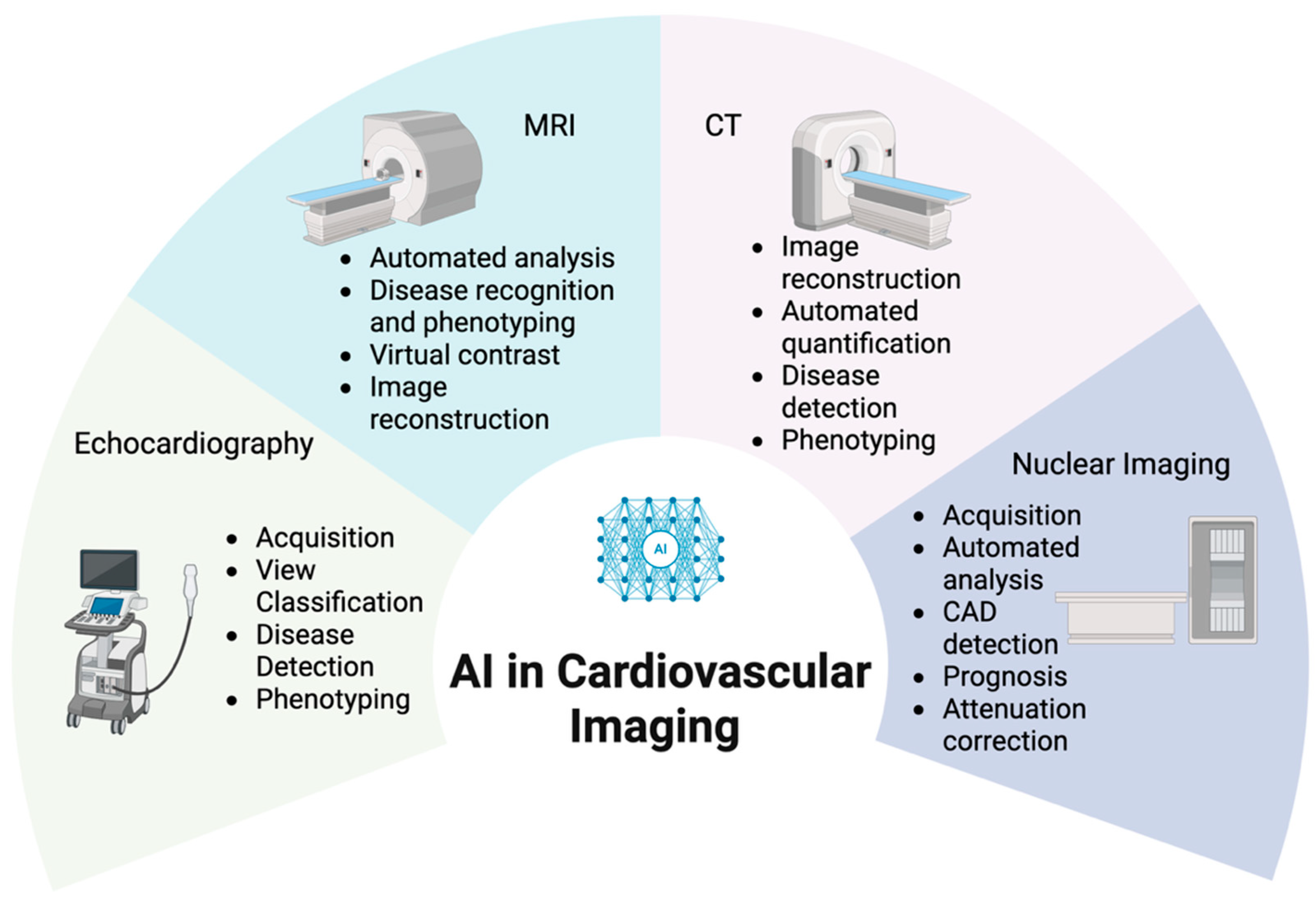
Clinical Applications of Artificial Intelligence in Cardiovascular Imaging: Where Do We Stand?

 ,
,  ,
,
Abstract
1. Introduction

2. Artificial Intelligence in Echocardiography
2.1. Current Challenges in Echocardiography
2.2. Automated View Classification
2.3. Automated Quantification: Ejection Fraction, Volumes, and Strain
2.4. Disease Detection and Phenotyping
2.4.1. Heart Failure with Preserved Ejection Fraction
2.4.2. Hypertrophic Cardiomyopathy (HCM)
2.4.3. Cardiac Amyloidosis
2.4.4. Coronary Artery Disease (CAD) and Ischaemia
2.5. AI-Guided Acquisition and Probe Assistance
2.6. Monitoring Disease Progression and Treatment Response
3. Artificial Intelligence in Computerised Tomography
3.1. Current Challenges of CT
3.2. Image Reconstruction
3.3. Coronary Artery Calcium
3.4. Disease Detection and Phenotyping
3.4.1. Plaque Quantification and Phenotype
3.4.2. Stenosis Assessment and Functional Ischaemia
3.4.3. Epicardial Adipose Tissue (EAT) and Systemic Phenotypes
3.4.4. Integrated Prognostic Models
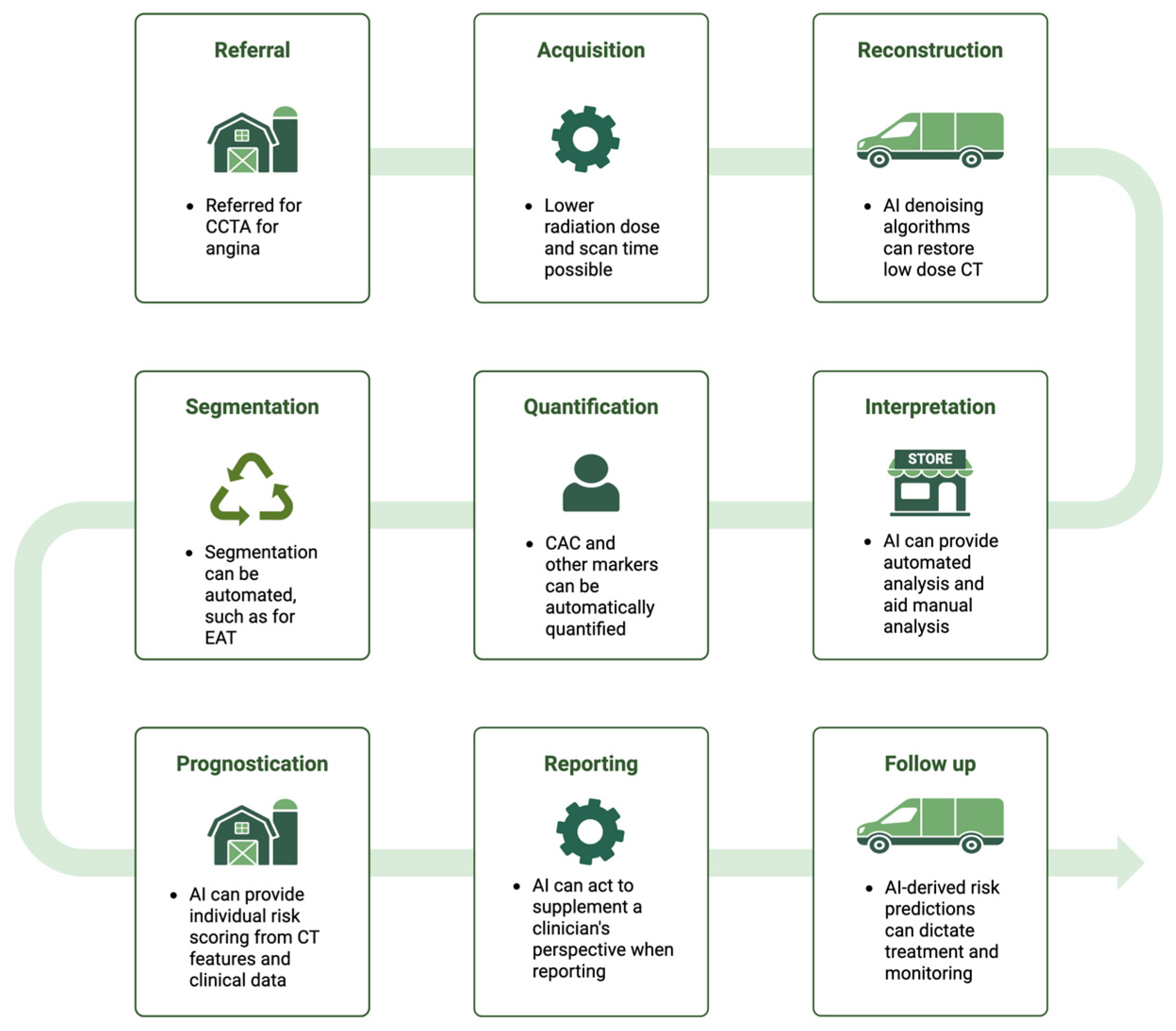
4. Artificial Intelligence in Nuclear Cardiology
4.1. Current Challenges in Nuclear Cardiology
4.2. CAD Detection from SPECT MPI
4.3. Prognosis and Management Decisions from SPECT
4.4. PET MBF/MFR: Automated Analysis and Phenotyping
4.5. FDG PET in Inflammatory Cardiomyopathies
4.6. Dose/Time Reduction and Image Quality (SPECT and PET)
4.7. Attenuation Correction When CT Is Not Available
4.8. Amyloidosis Imaging
5. Artificial Intelligence in Cardiac Magnetic Resonance Imaging
5.1. Automated Cine Analysis and Reporting
5.2. Disease-Specific Recognition on Routine CMR
5.3. Synthetic Contrast (Virtual Native Enhancement)
5.4. Scar Quantification and Risk Stratification
5.5. Acquisition and Reconstruction: Faster, Freer-Breathing, More Robust CMR
5.6. Tissue Characterisation and Quantitative Perfusion
6. Practical Considerations
7. Ethics
8. Future Work
9. Conclusions
Author Contributions
Funding
Institutional Review Board Statement
Informed Consent Statement
Data Availability Statement
Acknowledgments
Conflicts of Interest
List of Abbreviations
| 99mTc | technetium-99m |
| AC | attenuation correction |
| AI | artificial intelligence |
| AL | immunoglobulin light-chain (amyloidosis) |
| ARVC | arrhythmogenic right ventricular cardiomyopathy |
| AS | aortic stenosis |
| ASCVD | atherosclerotic cardiovascular disease |
| ASiR-V | Adaptive Statistical Iterative Reconstruction–V (iterative reconstruction algorithm) |
| ASNC | American Society of Nuclear Cardiology |
| ATTR | transthyretin (amyloidosis) |
| AUC | area under the receiver operating characteristic curve |
| AUROC | area under the receiver operating characteristic curve |
| AVR | aortic valve replacement |
| CA | cardiac amyloidosis |
| CAC | coronary artery calcium |
| CAD | coronary artery disease |
| CCTA | coronary computed tomography angiography |
| CE | Conformité Européenne (CE marking) |
| CLAIM | Checklist for Artificial Intelligence in Medical Imaging |
| CMR | cardiovascular magnetic resonance (cardiac MRI) |
| CNN | convolutional neural network |
| CT | computed tomography |
| CT-FFR | computed tomography–derived fractional flow reserve |
| CTCA | coronary computed tomography angiography (alternative abbreviation used in draft) |
| CV | cardiovascular |
| DCM | dilated cardiomyopathy |
| DECIDE-AI | reporting guideline for early-stage clinical evaluation of AI decision-support systems |
| DL | deep learning |
| DLR | deep learning reconstruction |
| EANM | European Association of Nuclear Medicine |
| EAT | epicardial adipose tissue |
| ECG | electrocardiogram |
| EF | ejection fraction |
| EHR | electronic health record |
| ESC | European Society of Cardiology |
| EU | European Union |
| FAI | fat attenuation index |
| FBP | filtered back projection |
| FDA | Food and Drug Administration (United States) |
| FDG | fluorodeoxyglucose |
| FFR | fractional flow reserve |
| GAN | generative adversarial network |
| H2FPEF | diagnostic score for HFpEF (Heavy, Hypertensive, Atrial fibrillation, Pulmonary hypertension, Elder, Filling pressure) |
| HCM | hypertrophic cardiomyopathy |
| HFA | Heart Failure Association |
| HFA-PEFF | Heart Failure Association diagnostic algorithm for HFpEF (Pre-test assessment, Echo & natriuretic Peptide score, Functional testing, Final aetiology) |
| HHD | hypertensive heart disease |
| IBSI | Image Biomarker Standardisation Initiative |
| ICA | invasive coronary angiography |
| ICC | intraclass correlation coefficient |
| ICD | implantable cardioverter-defibrillator |
| ICM | ischaemic cardiomyopathy |
| IR | iterative reconstruction |
| IVUS | intravascular ultrasound |
| LAVI | left atrial volume index |
| LGE | late gadolinium enhancement |
| LSTM | long short-term memory (network) |
| LV | left ventricle/left ventricular |
| LVEDV | left ventricular end-diastolic volume |
| LVEF | left ventricular ejection fraction |
| LVESV | left ventricular end-systolic volume |
| LVH | left ventricular hypertrophy |
| MACE | major adverse cardiovascular events |
| MBF | myocardial blood flow |
| MFR | myocardial flow reserve |
| MI | myocardial infarction |
| ML | machine learning |
| MPI | myocardial perfusion imaging |
| MPS | myocardial perfusion scintigraphy |
| MRI | magnetic resonance imaging |
| MVO | microvascular obstruction |
| NHS | National Health Service (UK) |
| NIHR | National Institute for Health and Care Research (UK) |
| PACS | Picture Archiving and Communication System |
| POCUS | point-of-care ultrasound |
| QA | quality assurance |
| QC | quality control |
| QRISK3 | cardiovascular risk score (version 3) |
| RCT | randomised controlled trial |
| RIS | Radiology Information System |
| RMWA | regional wall motion abnormality |
| RV | right ventricle/right ventricular |
| RVEDV | right ventricular end-diastolic volume |
| SCD | sudden cardiac death |
| SCORE | Systematic COronary Risk Evaluation risk score |
| SCOT-HEART | Scottish Computed Tomography of the HEART trial |
| SGLT2 | sodium–glucose cotransporter 2 (inhibitor) |
| SPECT | single-photon emission computed tomography |
| SPECT/CT | single-photon emission computed tomography with computed tomography |
| T1 | longitudinal (spin–lattice) relaxation time |
| Tc-99m | technetium-99m |
| TPD | total perfusion deficit |
| TRIPOD | Transparent Reporting of a multivariable prediction model for Individual Prognosis Or Diagnosis |
| TRIPOD-AI | TRIPOD extension for prediction models based on AI/machine learning |
| TTE | transthoracic echocardiography |
| UK | United Kingdom |
| US | United States |
| VNE | Virtual Native Enhancement (DL-generated LGE-like images without gadolinium) |
References
- Fortuni, F.; Ciliberti, G.; De Chiara, B.; Conte, E.; Franchin, L.; Musella, F.; Vitale, E.; Piroli, F.; Cangemi, S.; Cornara, S.; et al. Advancements and applications of artificial intelligence in cardiovascular imaging: A comprehensive review. Eur. Heart J. Imaging Methods Pract. 2024, 2, qyae136. [Google Scholar] [CrossRef] [PubMed]
- Sotomi, Y.; Hikoso, S.; Nakatani, D.; Okada, K.; Dohi, T.; Sunaga, A.; Kida, H.; Sato, T.; Matsuoka, Y.; Kitamura, T.; et al. Medications for specific phenotypes of heart failure with preserved ejection fraction classified by a machine learning-based clustering model. Heart 2023, 109, 1231–1240. [Google Scholar] [CrossRef]
- Mastrodicasa, D.; van Assen, M.; Huisman, M.; Leiner, T.; Williamson, E.E.; Nicol, E.D.; Allen, B.D.; Saba, L.; Vliegenthart, R.; Hanneman, K. Use of AI in Cardiac CT and MRI: A Scientific Statement from the ESCR, EuSoMII, NASCI, SCCT, SCMR, SIIM, and RSNA. Radiology 2025, 314, e240516. [Google Scholar] [CrossRef] [PubMed]
- Alsharqi, M.; Edelman, E.R. Artificial Intelligence in Cardiovascular Imaging and Interventional Cardiology: Emerging Trends and Clinical Implications. J. Soc. Cardiovasc. Angiogr. Interv. 2025, 4, 102558. [Google Scholar] [CrossRef]
- Lang, R.M.; Badano, L.P.; Mor-Avi, V.; Afilalo, J.; Armstrong, A.; Ernande, L.; Flachskampf, F.A.; Foster, E.; Goldstein, S.A.; Kuznetsova, T.; et al. Recommendations for Cardiac Chamber Quantification by Echocardiography in Adults: An Update from the American Society of Echocardiography and the European Association of Cardiovascular Imaging. J. Am. Soc. Echocardiogr. 2015, 28, 1–39.e14. [Google Scholar] [CrossRef]
- Thorstensen, A.; Dalen, H.; Amundsen, B.H.; Aase, S.A.; Stoylen, A. Reproducibility in echocardiographic assessment of the left ventricular global and regional function, the HUNT study. Eur. J. Echocardiogr. 2009, 11, 149–156. [Google Scholar] [CrossRef] [PubMed]
- Nagueh, S.F.; Abraham, T.P.; Aurigemma, G.P.; Bax, J.J.; Beladan, C.; Browning, A.; Chamsi-Pasha, M.A.; Delgado, V.; Derumeaux, G.; Dolci, G.; et al. Interobserver Variability in Applying American Society of Echocardiography/European Association of Cardiovascular Imaging 2016 Guidelines for Estimation of Left Ventricular Filling Pressure. Circ. Cardiovasc. Imaging 2019, 12, e008122. [Google Scholar] [CrossRef]
- Garcia-Elcano, L.; Bossa, M.N.; Garcia-Sineriz, I.; Giraldo Del Viejo, E.; Berto, A.; Diez-Lopez, C.; Cabrera, J.A.; Garcia-Mato, D.; Corral Acero, J. Accurate estimation of interobserver variability in echocardiography segmentation measured from 35 experts and impact on derived clinical metrics. Eur. Heart J. Cardiovasc. Imaging 2025, 26, jeae333-044. [Google Scholar] [CrossRef]
- Hwang, I.-C.; Choi, D.; Choi, Y.-J.; Ju, L.; Kim, M.; Hong, J.-E.; Lee, H.-J.; Yoon, Y.E.; Park, J.-B.; Lee, S.-P.; et al. Differential diagnosis of common etiologies of left ventricular hypertrophy using a hybrid CNN-LSTM model. Sci. Rep. 2022, 12, 20998. [Google Scholar] [CrossRef]
- Hanneman, K.; Playford, D.; Dey, D.; van Assen, M.; Mastrodicasa, D.; Cook, T.S.; Gichoya, J.W.; Williamson, E.E.; Rubin, G.D.; American Heart Association Council on Cardiovascular Radiology and Intervention; et al. Value Creation Through Artificial Intelligence and Cardiovascular Imaging: A Scientific Statement From the American Heart Association. Circulation 2024, 149, e296–e311. [Google Scholar] [CrossRef] [PubMed]
- Naser, J.A.; Lee, E.; Pislaru, S.V.; Tsaban, G.; Malins, J.G.; Jackson, J.I.; Anisuzzaman, D.M.; Rostami, B.; Lopez-Jimenez, F.; Friedman, P.A.; et al. Artificial intelligence-based classification of echocardiographic views. Eur. Heart J. Digit. Health 2024, 5, 260–269. [Google Scholar] [CrossRef]
- Zhu, Y.; Ma, J.; Zhang, Z.; Zhang, Y.; Zhu, S.; Liu, M.; Zhang, Z.; Wu, C.; Yang, X.; Cheng, J.; et al. Automatic view classification of contrast and non-contrast echocardiography. Front. Cardiovasc. Med. 2022, 9, 989091. [Google Scholar] [CrossRef]
- Madani, A.; Arnaout, R.; Mofrad, M.; Arnaout, R. Fast and accurate view classification of echocardiograms using deep learning. npj Digit. Med. 2018, 1, 6. [Google Scholar] [CrossRef]
- Zhang, J.; Gajjala, S.; Agrawal, P.; Tison, G.H.; Hallock, L.A.; Beussink-Nelson, L.; Lassen, M.H.; Fan, E.; Aras, M.A.; Jordan, C.; et al. Fully Automated Echocardiogram Interpretation in Clinical Practice. Circulation 2018, 138, 1623–1635. [Google Scholar] [CrossRef] [PubMed]
- Hu, J.; Olaisen, S.H.; Pasdeloup, D.; Van De Vyver, G.; Østvik, A.; Holte, E.; Grenne, B.; Dalen, H.; Lovstakken, L. A deep learning-based pipeline for large-scale echocardiography data curation and measurements. Eur. Heart J. Digit. Health 2025, 6, 1194–1203. [Google Scholar] [CrossRef]
- He, B.; Kwan, A.C.; Cho, J.H.; Yuan, N.; Pollick, C.; Shiota, T.; Ebinger, J.; Bello, N.A.; Wei, J.; Josan, K.; et al. Blinded, randomized trial of sonographer versus AI cardiac function assessment. Nature 2023, 616, 520–524. [Google Scholar] [CrossRef]
- Liu, X.; Fan, Y.; Li, S.; Chen, M.; Li, M.; Hau, W.K.; Zhang, H.; Xu, L.; Lee, A.P.-W. Deep learning-based automated left ventricular ejection fraction assessment using 2-D echocardiography. Am. J. Physiol. Heart Circ. Physiol. 2021, 321, H390–H399. [Google Scholar] [CrossRef] [PubMed]
- Ponikowski, P.; Voors, A.A.; Anker, S.D.; Bueno, H.; Cleland, J.G.F.; Coats, A.J.S.; Falk, V.; González-Juanatey, J.R.; Harjola, V.-P.; Jankowska, E.A.; et al. 2016 ESC Guidelines for the diagnosis and treatment of acute and chronic heart failure: The Task Force for the diagnosis and treatment of acute and chronic heart failure of the European Society of Cardiology (ESC)Developed with the special contribution of the Heart Failure Association (HFA) of the ESC. Eur. Heart J. 2016, 37, 2129–2200. [Google Scholar] [CrossRef] [PubMed]
- Yoon, M.; Oh, J.; Lee, C.J.; Kang, S.-M. Comparison of the 2021 ESC guideline with the HFA-PEFF and H2FPEF scores in diagnosing heart failure with preserved ejection fraction. Sci. Rep. 2025, 15, 22256. [Google Scholar] [CrossRef]
- Akerman, A.P.; Porumb, M.; Scott, C.G.; Beqiri, A.; Chartsias, A.; Ryu, A.J.; Hawkes, W.; Huntley, G.D.; Arystan, A.Z.; Kane, G.C.; et al. Automated Echocardiographic Detection of Heart Failure With Preserved Ejection Fraction Using Artificial Intelligence. JACC Adv. 2023, 2, 100452. [Google Scholar] [CrossRef]
- Shah, S.J.; Katz, D.H.; Selvaraj, S.; Burke, M.A.; Yancy, C.W.; Gheorghiade, M.; Bonow, R.O.; Huang, C.-C.; Deo, R.C. Phenomapping for Novel Classification of Heart Failure With Preserved Ejection Fraction. Circulation 2015, 131, 269–279. [Google Scholar] [CrossRef]
- Lancaster, M.C.; Salem Omar, A.M.; Narula, S.; Kulkarni, H.; Narula, J.; Sengupta, P.P. Phenotypic Clustering of Left Ventricular Diastolic Function Parameters: Patterns and Prognostic Relevance. JACC Cardiovasc. Imaging 2019, 12, 1149–1161. [Google Scholar] [CrossRef]
- Samad, M.D.; Ulloa, A.; Wehner, G.J.; Jing, L.; Hartzel, D.; Good, C.W.; Williams, B.A.; Haggerty, C.M.; Fornwalt, B.K. Predicting Survival From Large Echocardiography and Electronic Health Record Datasets: Optimization With Machine Learning. JACC Cardiovasc. Imaging 2019, 12, 681–689. [Google Scholar] [CrossRef] [PubMed]
- Yu, X.; Yao, X.; Wu, B.; Zhou, H.; Xia, S.; Su, W.; Wu, Y.; Zheng, X. Using deep learning method to identify left ventricular hypertrophy on echocardiography. Int. J. Cardiovasc. Imaging 2022, 38, 759–769. [Google Scholar] [CrossRef]
- Farahani, N.Z.; Aguirre, M.A.; Karlinski Vizentin, V.; Enayati, M.; Bos, J.M.; Medina, A.P.; Larson, K.F.; Pasupathy, K.S.; Scott, C.G.; Zacher, A.L.; et al. Echocardiographic Diagnosis of Hypertrophic Cardiomyopathy by Machine Learning. Mayo Clin. Proc. Digit. Health 2024, 2, 564–573. [Google Scholar] [CrossRef]
- Yu, F.; Huang, H.; Yu, Q.; Ma, Y.; Zhang, Q.; Zhang, B. Artificial intelligence-based myocardial texture analysis in etiological differentiation of left ventricular hypertrophy. Ann. Transl. Med. 2021, 9, 108. [Google Scholar] [CrossRef]
- Wu, Z.-W.; Zheng, J.-L.; Kuang, L.; Yan, H. Machine learning algorithms to automate differentiating cardiac amyloidosis from hypertrophic cardiomyopathy. Int. J. Cardiovasc. Imaging 2023, 39, 339–348. [Google Scholar] [CrossRef] [PubMed]
- Slivnick, J.A.; Hawkes, W.; Oliveira, J.; Woodward, G.; Akerman, A.; Gomez, A.; Hamza, I.; Desai, V.K.; Barrett-O’Keefe, Z.; Grogan, M.; et al. Cardiac amyloidosis detection from a single echocardiographic video clip: A novel artificial intelligence-based screening tool. Eur. Heart J. 2025, 46, 4090–4101. [Google Scholar] [CrossRef] [PubMed]
- Chang, R.S.-W.; Chiu, I.m.; Tacon, P.; Abiragi, M.; Cao, L.; Hong, G.; Le, J.; Zou, J.; Daluwatte, C.; Ricchiuto, P.; et al. Detection of cardiac amyloidosis using machine learning on routine echocardiographic measurements. Open Heart 2024, 11, e002884. [Google Scholar] [CrossRef]
- Zhang, X.; Liang, T.; Su, C.; Qin, S.; Li, J.; Zeng, D.; Cai, Y.; Huang, T.; Wu, J. Deep learn-based computer-assisted transthoracic echocardiography: Approach to the diagnosis of cardiac amyloidosis. Int. J. Cardiovasc. Imaging 2023, 39, 955–965. [Google Scholar] [CrossRef] [PubMed]
- Feng, Z.; Sivak, J.A.; Krishnamurthy, A.K. Multimodal fusion of echocardiography and electronic health records for the detection of cardiac amyloidosis. In Proceedings of the International Conference on Artificial Intelligence in Medicine; Springer: Cham, Switzerland, 2024; pp. 227–237. [Google Scholar]
- Us2.ai. Detection of Cardiac Amyloidosis with Us2.ai –Now FDA Cleared and CE Marked. Available online: https://us2.ai/detection-of-cardiac-amyloidosis-with-us2-ai-now-fda-cleared-and-ce-marked/?utm_source=chatgpt.com (accessed on 2 December 2025).
- Lin, X.; Yang, F.; Chen, Y.; Chen, X.; Wang, W.; Chen, X.; Wang, Q.; Zhang, L.; Guo, H.; Liu, B.; et al. Echocardiography-based AI detection of regional wall motion abnormalities and quantification of cardiac function in myocardial infarction. Front. Cardiovasc. Med. 2022, 9, 903660. [Google Scholar] [CrossRef]
- European Society of Cardiology. Trial Suggests AI for Heart Scans May Benefit Decision Making for Less-Experienced Clinicians. Available online: https://www.escardio.org/The-ESC/Press-Office/Press-releases/PROTEUS-Trial-suggests-AI-for-heart-scans-may-benefit-decision-making-for-less-experienced-clinicians# (accessed on 2 December 2025).
- Mahdavi, M.; Thomas, N.; Flood, C.; Stewart-Lord, A.; Baillie, L.; Grisan, E.; Callaghan, P.; Panayotova, R.; Hothi, S.S.; Griffith, V.; et al. Evaluating artificial intelligence-driven stress echocardiography analysis system (EASE study): A mixed method study. BMJ Open 2024, 14, e079617. [Google Scholar] [CrossRef]
- Narang, A.; Bae, R.; Hong, H.; Thomas, Y.; Surette, S.; Cadieu, C.; Chaudhry, A.; Martin, R.P.; McCarthy, P.M.; Rubenson, D.S.; et al. Utility of a Deep-Learning Algorithm to Guide Novices to Acquire Echocardiograms for Limited Diagnostic Use. JAMA Cardiol. 2021, 6, 624–632. [Google Scholar] [CrossRef]
- Schneider, M.; Bartko, P.; Geller, W.; Dannenberg, V.; König, A.; Binder, C.; Goliasch, G.; Hengstenberg, C.; Binder, T. A machine learning algorithm supports ultrasound-naïve novices in the acquisition of diagnostic echocardiography loops and provides accurate estimation of LVEF. Int. J. Cardiovasc. Imaging 2021, 37, 577–586. [Google Scholar] [CrossRef]
- Sabo, S.; Pettersen, H.; Bøen, G.C.; Jakobsen, E.O.; Langøy, P.K.; Nilsen, H.O.; Pasdeloup, D.; Smistad, E.; Østvik, A.; Løvstakken, L.; et al. Real-time guidance and automated measurements using deep learning to improve echocardiographic assessment of left ventricular size and function. Eur. Heart J. Imaging Methods Pract. 2025, 3, qyaf094. [Google Scholar] [CrossRef] [PubMed]
- Sengupta, P.P.; Shrestha, S.; Kagiyama, N.; Hamirani, Y.; Kulkarni, H.; Yanamala, N.; Bing, R.; Chin, C.W.L.; Pawade, T.A.; Messika-Zeitoun, D.; et al. A Machine-Learning Framework to Identify Distinct Phenotypes of Aortic Stenosis Severity. JACC Cardiovasc. Imaging 2021, 14, 1707–1720. [Google Scholar] [CrossRef]
- Sánchez-Puente, A.; Dorado-Díaz, P.I.; Sampedro-Gómez, J.; Bermejo, J.; Martinez-Legazpi, P.; Fernández-Avilés, F.; Sánchez-González, J.; Villar, C.P.d.; Vicente-Palacios, V.; Sanchez, P.L. Machine Learning to Optimize the Echocardiographic Follow-Up of Aortic Stenosis. JACC Cardiovasc. Imaging 2023, 16, 733–744. [Google Scholar] [CrossRef] [PubMed]
- Prat-Gonzalez, S.; Sanz, J.; Garcia, M.J. Cardiac CT: Indications and limitations. J. Nucl. Med. Technol. 2008, 36, 18–24. [Google Scholar] [CrossRef] [PubMed]
- Tatsugami, F.; Nakaura, T.; Yanagawa, M.; Fujita, S.; Kamagata, K.; Ito, R.; Kawamura, M.; Fushimi, Y.; Ueda, D.; Matsui, Y.; et al. Recent advances in artificial intelligence for cardiac CT: Enhancing diagnosis and prognosis prediction. Diagn. Interv. Imaging 2023, 104, 521–528. [Google Scholar] [CrossRef]
- Lin, A.; Manral, N.; McElhinney, P.; Killekar, A.; Matsumoto, H.; Kwiecinski, J.; Pieszko, K.; Razipour, A.; Grodecki, K.; Park, C.; et al. Deep learning-enabled coronary CT angiography for plaque and stenosis quantification and cardiac risk prediction: An international multicentre study. Lancet Digit Health 2022, 4, e256–e265. [Google Scholar] [CrossRef]
- Almansouri, N.E.; Awe, M.; Rajavelu, S.; Jahnavi, K.; Shastry, R.; Hasan, A.; Hasan, H.; Lakkimsetti, M.; AlAbbasi, R.K.; Gutierrez, B.C.; et al. Early Diagnosis of Cardiovascular Diseases in the Era of Artificial Intelligence: An In-Depth Review. Cureus 2024, 16, e55869. [Google Scholar] [CrossRef] [PubMed]
- Budoff, M.J.; Dowe, D.; Jollis, J.G.; Gitter, M.; Sutherland, J.; Halamert, E.; Scherer, M.; Bellinger, R.; Martin, A.; Benton, R.; et al. Diagnostic Performance of 64-Multidetector Row Coronary Computed Tomographic Angiography for Evaluation of Coronary Artery Stenosis in Individuals Without Known Coronary Artery Disease: Results From the Prospective Multicenter ACCURACY (Assessment by Coronary Computed Tomographic Angiography of Individuals Undergoing Invasive Coronary Angiography) Trial. J. Am. Coll. Cardiol. 2008, 52, 1724–1732. [Google Scholar] [CrossRef]
- Chen, H.; Zhang, Y.; Zhang, W.; Liao, P.; Li, K.; Zhou, J.; Wang, G. Low-dose CT via convolutional neural network. Biomed. Opt. Express 2017, 8, 679–694. [Google Scholar] [CrossRef]
- Tatsugami, F.; Higaki, T.; Nakamura, Y.; Yu, Z.; Zhou, J.; Lu, Y.; Fujioka, C.; Kitagawa, T.; Kihara, Y.; Iida, M.; et al. Deep learning–based image restoration algorithm for coronary CT angiography. Eur. Radiol. 2019, 29, 5322–5329. [Google Scholar] [CrossRef]
- Harder, A.M.d.; Willemink, M.J.; Budde, R.P.J.; Schilham, A.M.R.; Leiner, T.; Jong, P.A.d. Hybrid and Model-Based Iterative Reconstruction Techniques for Pediatric CT. Am. J. Roentgenol. 2015, 204, 645–653. [Google Scholar] [CrossRef]
- Otgonbaatar, C.; Ryu, J.-K.; Shin, J.; Woo, J.Y.; Seo, J.W.; Shim, H.; Hwang, D.H. Improvement in Image Quality and Visibility of Coronary Arteries, Stents, and Valve Structures on CT Angiography by Deep Learning Reconstruction. Korean J. Radiol. 2022, 23, 1044–1054. [Google Scholar] [CrossRef]
- De Santis, D.; Polidori, T.; Tremamunno, G.; Rucci, C.; Piccinni, G.; Zerunian, M.; Pugliese, L.; Del Gaudio, A.; Guido, G.; Barbato, L.; et al. Deep learning image reconstruction algorithm: Impact on image quality in coronary computed tomography angiography. Radiol. Medica 2023, 128, 434–444. [Google Scholar] [CrossRef]
- Benz, D.C.; Ersozlu, S.; Mojon, F.L.A.; Messerli, M.; Mitulla, A.K.; Ciancone, D.; Kenkel, D.; Schaab, J.A.; Gebhard, C.; Pazhenkottil, A.P.; et al. Radiation dose reduction with deep-learning image reconstruction for coronary computed tomography angiography. Eur. Radiol. 2022, 32, 2620–2628. [Google Scholar] [CrossRef] [PubMed]
- Budoff, M.J.; Young, R.; Burke, G.; Jeffrey Carr, J.; Detrano, R.C.; Folsom, A.R.; Kronmal, R.; Lima, J.A.C.; Liu, K.J.; McClelland, R.L.; et al. Ten-year association of coronary artery calcium with atherosclerotic cardiovascular disease (ASCVD) events: The multi-ethnic study of atherosclerosis (MESA). Eur. Heart J. 2018, 39, 2401–2408. [Google Scholar] [CrossRef]
- Visseren, F.L.J.; Mach, F.; Smulders, Y.M.; Carballo, D.; Koskinas, K.C.; Bäck, M.; Benetos, A.; Biffi, A.; Boavida, J.-M.; Capodanno, D.; et al. 2021 ESC Guidelines on cardiovascular disease prevention in clinical practice: Developed by the Task Force for cardiovascular disease prevention in clinical practice with representatives of the European Society of Cardiology and 12 medical societies With the special contribution of the European Association of Preventive Cardiology (EAPC). Eur. Heart J. 2021, 42, 3227–3337. [Google Scholar] [CrossRef] [PubMed]
- Kalia, N.K.; Miller, L.G.; Nasir, K.; Blumenthal, R.S.; Agrawal, N.; Budoff, M.J. Visualizing coronary calcium is associated with improvements in adherence to statin therapy. Atherosclerosis 2006, 185, 394–399. [Google Scholar] [CrossRef] [PubMed]
- Eng, D.; Chute, C.; Khandwala, N.; Rajpurkar, P.; Long, J.; Shleifer, S.; Khalaf, M.H.; Sandhu, A.T.; Rodriguez, F.; Maron, D.J.; et al. Automated coronary calcium scoring using deep learning with multicenter external validation. npj Digit. Med. 2021, 4, 88. [Google Scholar] [CrossRef] [PubMed]
- Gennari, A.G.; Rossi, A.; De Cecco, C.N.; van Assen, M.; Sartoretti, T.; Giannopoulos, A.A.; Schwyzer, M.; Huellner, M.W.; Messerli, M. Artificial intelligence in coronary artery calcium score: Rationale, different approaches, and outcomes. Int. J. Cardiovasc. Imaging 2024, 40, 951–966. [Google Scholar] [CrossRef] [PubMed]
- Society of Cardiovascular Tomography (SCCT). Agatston 2.0: The Next Generation of Calcium Scoring in the Era of AI-CAC and AI-CVD. Available online: https://www.heartlung.ai/post/heartlung-ai-webcast#:~:text=Thus%2C%20Agatston%202.0%20brings%20us,of%20plaque%20progression%20and%20stabilization (accessed on 2 February 2026).
- Abdelrahman, K.; Shiyovich, A.; Huck, D.M.; Berman, A.N.; Weber, B.; Gupta, S.; Cardoso, R.; Blankstein, R. Artificial Intelligence in Coronary Artery Calcium Scoring Detection and Quantification. Diagnostics 2024, 14, 125. [Google Scholar] [CrossRef]
- Zeleznik, R.; Foldyna, B.; Eslami, P.; Weiss, J.; Alexander, I.; Taron, J.; Parmar, C.; Alvi, R.M.; Banerji, D.; Uno, M.; et al. Deep convolutional neural networks to predict cardiovascular risk from computed tomography. Nat. Commun. 2021, 12, 715. [Google Scholar] [CrossRef]
- Hecht, H.S.; Cronin, P.; Blaha, M.J.; Budoff, M.J.; Kazerooni, E.A.; Narula, J.; Yankelevitz, D.; Abbara, S. 2016 SCCT/STR guidelines for coronary artery calcium scoring of noncontrast noncardiac chest CT scans: A report of the Society of Cardiovascular Computed Tomography and Society of Thoracic Radiology. J. Cardiovasc. Comput. Tomogr. 2017, 11, 74–84. [Google Scholar] [CrossRef]
- Shrivastava, P.; Kashikar, S.; Parihar, P.H.; Kasat, P.; Bhangale, P.; Shrivastava, P. A systematic review on deep learning-enabled coronary CT angiography for plaque and stenosis quantification and cardiac risk prediction. Eur. J. Radiol. Open 2025, 14, 100652. [Google Scholar] [CrossRef]
- Narula, J.; Stuckey, T.D.; Nakazawa, G.; Ahmadi, A.; Matsumura, M.; Petersen, K.; Mirza, S.; Ng, N.; Mullen, S.; Schaap, M.; et al. Prospective deep learning–based quantitative assessment of coronary plaque by computed tomography angiography compared with intravascular ultrasound: The REVEALPLAQUE study. Eur. Heart J. Cardiovasc. Imaging 2024, 25, 1287–1295. [Google Scholar] [CrossRef]
- Williams, M.C.; Kwiecinski, J.; Doris, M.; McElhinney, P.; D’Souza, M.S.; Cadet, S.; Adamson, P.D.; Moss, A.J.; Alam, S.; Hunter, A.; et al. Low-Attenuation Noncalcified Plaque on Coronary Computed Tomography Angiography Predicts Myocardial Infarction: Results From the Multicenter SCOT-HEART Trial (Scottish Computed Tomography of the HEART). Circulation 2020, 141, 1452–1462. [Google Scholar] [CrossRef]
- Cleerly. How Cleerly Can Help You See Coronary Artery Disease (CAD). Available online: https://cleerlyhealth.com/patient-education (accessed on 2 February 2026).
- van Noort, D.; Guo, L.; Leng, S.; Shi, L.; Tan, R.-S.; Teo, L.; Yew, M.S.; Baskaran, L.; Chai, P.; Keng, F.; et al. Evaluating machine learning accuracy in detecting significant coronary stenosis using CCTA-derived fractional flow reserve: Meta-analysis and systematic review. IJC Heart Vasc. 2024, 55, 101528. [Google Scholar] [CrossRef] [PubMed]
- Yi, D.; Zhou, F.; Liang, Q.; Liu, T.; Bao, X.; Cai, J.; Tang, C.; Zhang, L. Coronary Computed Tomography Angiography-Derived Fractional Flow Reserve: A Comprehensive Review. Rev. Cardiovasc. Med. 2025, 26, 39717. [Google Scholar] [CrossRef]
- Li, C.; Hu, Y.; Jiang, J.; Dong, L.; Sun, Y.; Tang, L.; Du, C.; Yin, D.; Jiang, W.; Leng, X.; et al. Diagnostic Performance of Fractional Flow Reserve Derived From Coronary CT Angiography: The ACCURATE-CT Study. JACC Cardiovasc. Interv. 2024, 17, 1980–1992. [Google Scholar] [CrossRef] [PubMed]
- Kasaeian, A.; Ahmadzade, M.; Hoffman, T.; Ghasemi-Rad, M.; Ayyappan, A.P. Fractional Flow Reserve from Coronary CT: Evidence, Applications, and Future Directions. J. Cardiovasc. Dev. Dis. 2025, 12, 279. [Google Scholar] [CrossRef]
- Rodriguez-Lozano, P.F.; Waheed, A.; Evangelou, S.; Kolossváry, M.; Shaikh, K.; Siddiqui, S.; Stipp, L.; Lakshmanan, S.; Wu, E.-H.; Nurmohamed, N.S.; et al. CT derived fractional flow reserve: Part 2–Critical appraisal of the literature. J. Cardiovasc. Comput. Tomogr. 2025, 19, 397–408. [Google Scholar] [CrossRef]
- West, H.W.; Siddique, M.; Williams, M.C.; Volpe, L.; Desai, R.; Lyasheva, M.; Thomas, S.; Dangas, K.; Kotanidis, C.P.; Tomlins, P.; et al. Deep-Learning for Epicardial Adipose Tissue Assessment With Computed Tomography: Implications for Cardiovascular Risk Prediction. JACC Cardiovasc. Imaging 2023, 16, 800–816. [Google Scholar] [CrossRef]
- Nalliah, C.J.; Bell, J.R.; Raaijmakers, A.J.A.; Waddell, H.M.; Wells, S.P.; Bernasochi, G.B.; Montgomery, M.K.; Binny, S.; Watts, T.; Joshi, S.B.; et al. Epicardial Adipose Tissue Accumulation Confers Atrial Conduction Abnormality. JACC 2020, 76, 1197–1211. [Google Scholar] [CrossRef]
- Channon, K.M.; Newby, D.E.; Nicol, E.D.; Deanfield, J. Cardiovascular computed tomography imaging for coronary artery disease risk: Plaque, flow and fat. Heart 2022, 108, 1510–1515. [Google Scholar] [CrossRef]
- Oikonomou, E.K.; Antonopoulos, A.S.; Schottlander, D.; Marwan, M.; Mathers, C.; Tomlins, P.; Siddique, M.; Klüner, L.V.; Shirodaria, C.; Mavrogiannis, M.C.; et al. Standardized measurement of coronary inflammation using cardiovascular computed tomography: Integration in clinical care as a prognostic medical device. Cardiovasc. Res. 2021, 117, 2677–2690. [Google Scholar] [CrossRef]
- Chan, K.; Wahome, E.; Tsiachristas, A.; Antonopoulos, A.S.; Patel, P.; Lyasheva, M.; Kingham, L.; West, H.; Oikonomou, E.K.; Volpe, L.; et al. Inflammatory risk and cardiovascular events in patients without obstructive coronary artery disease: The ORFAN multicentre, longitudinal cohort study. Lancet 2024, 403, 2606–2618. [Google Scholar] [CrossRef] [PubMed]
- Henry, J.A.; Black, S.M.; Mitchell, O.G.J.; Richardson, E.; Watson, C.; Hare, C.; Le Page, P.; Mitchell, A.R.J. Coronary inflammation and AI-Risk scores from cardiovascular computed tomography: Impact on risk prediction and clinical management in a real-world setting. Eur. Heart J. Imaging Methods Pract. 2025, 2, qyaf031. [Google Scholar] [CrossRef] [PubMed]
- Simantiris, S.; Pappa, A.; Papastamos, C.; Korkonikitas, P.; Antoniades, C.; Tsioufis, C.; Tousoulis, D. Perivascular Fat: A Novel Risk Factor for Coronary Artery Disease. Diagnostics 2024, 14, 1830. [Google Scholar] [CrossRef]
- Bourque, J.M.; Beller, G.A. Nuclear Cardiology: The Past, Present, and Future. Circ. Cardiovasc. Imaging 2024, 17, e016875. [Google Scholar] [CrossRef]
- Dorbala, S.; Ananthasubramaniam, K.; Armstrong, I.S.; Chareonthaitawee, P.; DePuey, E.G.; Einstein, A.J.; Gropler, R.J.; Holly, T.A.; Mahmarian, J.J.; Park, M.-A.; et al. Single Photon Emission Computed Tomography (SPECT) Myocardial Perfusion Imaging Guidelines: Instrumentation, Acquisition, Processing, and Interpretation. J. Nucl. Cardiol. 2018, 25, 1784–1846. [Google Scholar] [CrossRef] [PubMed]
- Underwood, S.R.; de Bondt, P.; Flotats, A.; Marcasa, C.; Pinto, F.; Schaefer, W.; Verberne, H.J. The current and future status of nuclear cardiology: A consensus report. Eur. Heart J. Cardiovasc. Imaging 2014, 15, 949–955. [Google Scholar] [CrossRef]
- Di Carli, M.F. Challenges and opportunities for nuclear cardiology. J. Nucl. Cardiol. 2019, 26, 1043–1046. [Google Scholar] [CrossRef]
- Giubbini, R.; Milan, E. Current Role of Myocardial Blood Flow Quantification with PET/CT in the Management of Coronary Artery Disease. Int. J. Cardiovasc. Sci. 2024, 37, e20240115. [Google Scholar] [CrossRef]
- Hustinx, R.; Pruim, J.; Lassmann, M.; Visvikis, D. An EANM position paper on the application of artificial intelligence in nuclear medicine. Eur. J. Nucl. Med. Mol. Imaging 2022, 50, 61–66. [Google Scholar] [CrossRef]
- Betancur, J.; Commandeur, F.; Motlagh, M.; Sharir, T.; Einstein, A.J.; Bokhari, S.; Fish, M.B.; Ruddy, T.D.; Kaufmann, P.; Sinusas, A.J.; et al. Deep Learning for Prediction of Obstructive Disease From Fast Myocardial Perfusion SPECT. JACC Cardiovasc. Imaging 2018, 11, 1654–1663. [Google Scholar] [CrossRef] [PubMed]
- Betancur, J.; Hu, L.-H.; Commandeur, F.; Sharir, T.; Einstein, A.J.; Fish, M.B.; Ruddy, T.D.; Kaufmann, P.A.; Sinusas, A.J.; Miller, E.J.; et al. Deep Learning Analysis of Upright-Supine High-Efficiency SPECT Myocardial Perfusion Imaging for Prediction of Obstructive Coronary Artery Disease: A Multicenter Study. J. Nucl. Med. 2019, 60, 664–670. [Google Scholar] [CrossRef] [PubMed]
- Miller, R.J.H.; Kuronuma, K.; Singh, A.; Otaki, Y.; Hayes, S.; Chareonthaitawee, P.; Kavanagh, P.; Parekh, T.; Tamarappoo, B.K.; Sharir, T.; et al. Explainable Deep Learning Improves Physician Interpretation of Myocardial Perfusion Imaging. J. Nucl. Med. 2022, 63, 1768–1774. [Google Scholar] [CrossRef]
- Miller, R.J.H.; Kavanagh, P.; Lemley, M.; Liang, J.X.; Sharir, T.; Einstein, A.J.; Fish, M.B.; Ruddy, T.D.; Kaufmann, P.A.; Sinusas, A.J.; et al. Artificial Intelligence–Enhanced Perfusion Scoring Improves the Diagnostic Accuracy of Myocardial Perfusion Imaging. J. Nucl. Med. 2025, 66, 648–653. [Google Scholar] [CrossRef]
- Singh, A.; Miller, R.J.H.; Otaki, Y.; Kavanagh, P.; Hauser, M.T.; Tzolos, E.; Kwiecinski, J.; Kriekinge, S.V.; Wei, C.-C.; Sharir, T.; et al. Direct Risk Assessment From Myocardial Perfusion Imaging Using Explainable Deep Learning. JACC Cardiovasc. Imaging 2023, 16, 209–220. [Google Scholar] [CrossRef]
- Hu, L.-H.; Miller, R.J.H.; Sharir, T.; Commandeur, F.; Rios, R.; Einstein, A.J.; Fish, M.B.; Ruddy, T.D.; Kaufmann, P.A.; Sinusas, A.J.; et al. Prognostically safe stress-only single-photon emission computed tomography myocardial perfusion imaging guided by machine learning: Report from REFINE SPECT. Eur. Heart J. Cardiovasc. Imaging 2020, 22, 705–714. [Google Scholar] [CrossRef]
- Mercuri, M.; Pascual, T.N.B.; Mahmarian, J.J.; Shaw, L.J.; Dondi, M.; Paez, D.; Einstein, A.J.; INCAPS Investigators Group. Estimating the Reduction in the Radiation Burden From Nuclear Cardiology Through Use of Stress-Only Imaging in the United States and Worldwide. JAMA Intern. Med. 2016, 176, 269–273. [Google Scholar] [CrossRef] [PubMed]
- Arsanjani, R.; Dey, D.; Khachatryan, T.; Shalev, A.; Hayes, S.W.; Fish, M.; Nakanishi, R.; Germano, G.; Berman, D.S.; Slomka, P. Prediction of revascularization after myocardial perfusion SPECT by machine learning in a large population. J. Nucl. Cardiol. 2015, 22, 877–884. [Google Scholar] [CrossRef]
- Berman, D.S.; Kang, X.; Slomka, P.J.; Gerlach, J.; de Yang, L.; Hayes, S.W.; Friedman, J.D.; Thomson, L.E.J.; Germano, G. Underestimation of extent of ischemia by gated SPECT myocardial perfusion imaging in patients with left main coronary artery disease. J. Nucl. Cardiol. 2007, 14, 521–528. [Google Scholar] [CrossRef] [PubMed]
- Bateman, T.M.; Heller, G.V.; Beanlands, R.; Calnon, D.A.; Case, J.; deKemp, R.; DePuey, E.G.; Di Carli, M.; Guler, E.C.; Murthy, V.L.; et al. Practical Guide for Interpreting and Reporting Cardiac PET Measurements of Myocardial Blood Flow: An Information Statement from the American Society of Nuclear Cardiology, and the Society of Nuclear Medicine and Molecular Imaging. J. Nucl. Med. 2021, 62, 1599–1615. [Google Scholar] [CrossRef] [PubMed]
- Yeung, M.W.; Benjamins, J.W.; Knol, R.J.J.; van der Zant, F.M.; Asselbergs, F.W.; van der Harst, P.; Juarez-Orozco, L.E. Multi-task Deep Learning of Myocardial Blood Flow and Cardiovascular Risk Traits from PET Myocardial Perfusion Imaging. J. Nucl. Cardiol. 2022, 29, 3300–3310. [Google Scholar] [CrossRef]
- Poitrasson-Rivière, A.; Vanderver, M.D.; Hagio, T.; Arida-Moody, L.; Moody, J.B.; Renaud, J.M.; Ficaro, E.P.; Murthy, V.L. Automated deep learning segmentation of cardiac inflammatory FDG PET. J. Nucl. Cardiol. 2024, 42, 102052. [Google Scholar] [CrossRef]
- Aghakhan Olia, N.; Kamali-Asl, A.; Hariri Tabrizi, S.; Geramifar, P.; Sheikhzadeh, P.; Farzanefar, S.; Arabi, H.; Zaidi, H. Deep learning–based denoising of low-dose SPECT myocardial perfusion images: Quantitative assessment and clinical performance. Eur. J. Nucl. Med. Mol. Imaging 2022, 49, 1508–1522. [Google Scholar] [CrossRef]
- Sun, J.; Jiang, H.; Du, Y.; Li, C.-Y.; Wu, T.-H.; Liu, Y.-H.; Yang, B.-H.; Mok, G.S.P. Deep learning-based denoising in projection-domain and reconstruction-domain for low-dose myocardial perfusion SPECT. J. Nucl. Cardiol. 2023, 30, 970–985. [Google Scholar] [CrossRef]
- Du, Y.; Sun, J.; Li, C.-Y.; Yang, B.-H.; Wu, T.-H.; Mok, G.S.P. Deep learning-based multi-frequency denoising for myocardial perfusion SPECT. EJNMMI Phys. 2024, 11, 80. [Google Scholar] [CrossRef]
- Xie, H.; Guo, L.; Velo, A.; Liu, Z.; Liu, Q.; Guo, X.; Zhou, B.; Chen, X.; Tsai, Y.-J.; Miao, T.; et al. Noise-aware dynamic image denoising and positron range correction for Rubidium-82 cardiac PET imaging via self-supervision. Med. Image Anal. 2025, 100, 103391. [Google Scholar] [CrossRef] [PubMed]
- Shanbhag, A.D.; Miller, R.J.H.; Lemley, M.; Kavanagh, P.; Liang, J.X.; Marcinkiewicz, A.M.; Builoff, V.; Van Kriekinge, S.; Ruddy, T.D.; Fish, M.B.; et al. General Purpose Deep Learning Attenuation Correction Improves Diagnostic Accuracy of SPECT MPI: A Multicenter Study. JACC Cardiovasc. Imaging 2025, 18, 1235–1246. [Google Scholar] [CrossRef] [PubMed]
- Yang, P.; Zhang, Z.; Wei, J.; Jiang, L.; Yu, L.; Cai, H.; Li, L.; Guo, Q.; Zhao, Z. Deep learning-based CT-free attenuation correction for cardiac SPECT: A new approach. BMC Med. Imaging 2025, 25, 38. [Google Scholar] [CrossRef]
- Miller, R.J.H.; Shanbhag, A.; Michalowska, A.M.; Kavanagh, P.; Liang, J.X.; Builoff, V.; Fine, N.M.; Dey, D.; Berman, D.S.; Slomka, P.J. Deep Learning–Enabled Quantification of 99mTc-Pyrophosphate SPECT/CT for Cardiac Amyloidosis. J. Nucl. Med. 2024, 65, 1144–1150. [Google Scholar] [CrossRef] [PubMed]
- Delbarre, M.-A.; Girardon, F.; Roquette, L.; Blanc-Durand, P.; Hubaut, M.-A.; Hachulla, É.; Semah, F.; Huglo, D.; Garcelon, N.; Marchal, E.; et al. Deep Learning on Bone Scintigraphy to Detect Abnormal Cardiac Uptake at Risk of Cardiac Amyloidosis. JACC Cardiovasc. Imaging 2023, 16, 1085–1095. [Google Scholar] [CrossRef]
- Mo, Q.; Cui, J.; Jia, S.; Zhang, Y.; Xiao, Y.; Liu, C.; Zhou, C.; Spielvogel, C.P.; Calabretta, R.; Zhou, W.; et al. Stacking Ensemble Learning-based Models Enabling Accurate Diagnosis of Cardiac Amyloidosis using SPECT/CT: An International and Multicentre Study. medRxiv 2025. [Google Scholar] [CrossRef]
- Leiner, T.; Rueckert, D.; Suinesiaputra, A.; Baeßler, B.; Nezafat, R.; Išgum, I.; Young, A.A. Machine learning in cardiovascular magnetic resonance: Basic concepts and applications. J. Cardiovasc. Magn. Reson. 2019, 21, 61. [Google Scholar] [CrossRef]
- Zhang, Q.; Fotaki, A.; Ghadimi, S.; Wang, Y.; Doneva, M.; Wetzl, J.; Delfino, J.G.; O’Regan, D.P.; Prieto, C.; Epstein, F.H. Improving the efficiency and accuracy of cardiovascular magnetic resonance with artificial intelligence—Review of evidence and proposition of a roadmap to clinical translation. J. Cardiovasc. Magn. Reson. 2024, 26, 101051. [Google Scholar] [CrossRef]
- Bai, W.; Sinclair, M.; Tarroni, G.; Oktay, O.; Rajchl, M.; Vaillant, G.; Lee, A.M.; Aung, N.; Lukaschuk, E.; Sanghvi, M.M.; et al. Automated cardiovascular magnetic resonance image analysis with fully convolutional networks. J. Cardiovasc. Magn. Reson. 2018, 20, 65. [Google Scholar] [CrossRef]
- Imaging Technology News. Arterys Cardio DL Cloud MRI Analytics Software Receives FDA Clearance. Available online: https://www.itnonline.com/content/arterys-cardio-dl-cloud-mri-analytics-software-receives-fda-clearance (accessed on 2 December 2025).
- Martini, N.; Aimo, A.; Barison, A.; Della Latta, D.; Vergaro, G.; Aquaro, G.D.; Ripoli, A.; Emdin, M.; Chiappino, D. Deep learning to diagnose cardiac amyloidosis from cardiovascular magnetic resonance. J. Cardiovasc. Magn. Reson. 2020, 22, 84. [Google Scholar] [CrossRef]
- Bourfiss, M.; Sander, J.; de Vos, B.D.; te Riele, A.S.J.M.; Asselbergs, F.W.; Išgum, I.; Velthuis, B.K. Towards automatic classification of cardiovascular magnetic resonance Task Force Criteria for diagnosis of arrhythmogenic right ventricular cardiomyopathy. Clin. Res. Cardiol. 2023, 112, 363–378. [Google Scholar] [CrossRef]
- Alvarez-Florez, L.; Sander, J.; Bourfiss, M.; Tjong, F.V.Y.; Velthuis, B.K.; Išgum, I. Deep Learning for Automatic Strain Quantification in Arrhythmogenic Right Ventricular Cardiomyopathy. In International Workshop on Statistical Atlases and Computational Models of the Heart; Springer: Cham, Switzerland, 2024; pp. 25–34. [Google Scholar]
- Deng, J.; Zhou, L.; Li, Y.; Yu, Y.; Zhang, J.; Liao, B.; Luo, G.; Tian, J.; Zhou, H.; Tang, H. Integration of Cine-cardiac Magnetic Resonance Radiomics and Machine Learning for Differentiating Ischemic and Dilated Cardiomyopathy. Acad. Radiol. 2024, 31, 2704–2714. [Google Scholar] [CrossRef]
- Polidori, T.; De Santis, D.; Rucci, C.; Tremamunno, G.; Piccinni, G.; Pugliese, L.; Zerunian, M.; Guido, G.; Pucciarelli, F.; Bracci, B.; et al. Radiomics applications in cardiac imaging: A comprehensive review. Radiol. Medica 2023, 128, 922–933. [Google Scholar] [CrossRef]
- Raisi-Estabragh, Z.; Izquierdo, C.; Campello, V.M.; Martin-Isla, C.; Jaggi, A.; Harvey, N.C.; Lekadir, K.; Petersen, S.E. Cardiac magnetic resonance radiomics: Basic principles and clinical perspectives. Eur. Heart J. Cardiovasc. Imaging 2020, 21, 349–356. [Google Scholar] [CrossRef]
- Pu, C.; Hu, X.; Lv, S.; Wu, Y.; Yu, F.; Zhu, W.; Zhang, L.; Fei, J.; He, C.; Ling, X.; et al. Identification of fibrosis in hypertrophic cardiomyopathy: A radiomic study on cardiac magnetic resonance cine imaging. Eur. Radiol. 2023, 33, 2301–2311. [Google Scholar] [CrossRef] [PubMed]
- Fahmy, A.S.; Rowin, E.J.; Arafati, A.; Al-Otaibi, T.; Maron, M.S.; Nezafat, R. Radiomics and deep learning for myocardial scar screening in hypertrophic cardiomyopathy. J. Cardiovasc. Magn. Reson. 2022, 24, 40. [Google Scholar] [CrossRef] [PubMed]
- Wang, J.; Bravo, L.; Zhang, J.; Liu, W.; Wan, K.; Sun, J.; Zhu, Y.; Han, Y.; Gkoutos, G.V.; Chen, Y. Radiomics Analysis Derived From LGE-MRI Predict Sudden Cardiac Death in Participants With Hypertrophic Cardiomyopathy. Front. Cardiovasc. Med. 2021, 8, 766287. [Google Scholar] [CrossRef] [PubMed]
- Fahmy, A.S.; Rowin, E.J.; Jaafar, N.; Chan, R.H.; Rodriguez, J.; Nakamori, S.; Ngo, L.H.; Pradella, S.; Zocchi, C.; Olivotto, I.; et al. Radiomics of Late Gadolinium Enhancement Reveals Prognostic Value of Myocardial Scar Heterogeneity in Hypertrophic Cardiomyopathy. JACC Cardiovasc. Imaging 2024, 17, 16–27. [Google Scholar] [CrossRef]
- Zhou, X.Y.; Tang, C.X.; Guo, Y.K.; Tao, X.W.; Chen, W.C.; Guo, J.Z.; Ren, G.S.; Li, X.; Luo, S.; Li, J.H.; et al. Diagnosis of Cardiac Amyloidosis Using a Radiomics Approach Applied to Late Gadolinium-Enhanced Cardiac Magnetic Resonance Images: A Retrospective, Multicohort, Diagnostic Study. Front. Cardiovasc. Med. 2022, 9, 818957. [Google Scholar] [CrossRef] [PubMed]
- Zhou, X.Y.; Tang, C.X.; Guo, Y.K.; Chen, W.C.; Guo, J.Z.; Ren, G.S.; Li, X.; Li, J.H.; Lu, G.M.; Huang, X.H.; et al. Late gadolinium enhanced cardiac MR derived radiomics approach for predicting all-cause mortality in cardiac amyloidosis: A multicenter study. Eur. Radiol. 2024, 34, 402–410. [Google Scholar] [CrossRef]
- Lasode, J.; Chantaksinopas, W.; Khongwirotphan, S.; Chattranukulchai, P.; Vorasettakarnkij, Y.; Sriswasdi, S.; Tumkosit, M.; Rakvongthai, Y. Radiomics for differential diagnosis of ischemic and dilated cardiomyopathy using non-contrast-enhanced cine cardiac magnetic resonance imaging. Radiol. Medica 2025, 130, 650–661. [Google Scholar] [CrossRef]
- Zhang, Q.; Burrage, M.K.; Lukaschuk, E.; Shanmuganathan, M.; Popescu, I.A.; Nikolaidou, C.; Mills, R.; Werys, K.; Hann, E.; Barutcu, A.; et al. Toward Replacing Late Gadolinium Enhancement With Artificial Intelligence Virtual Native Enhancement for Gadolinium-Free Cardiovascular Magnetic Resonance Tissue Characterization in Hypertrophic Cardiomyopathy. Circulation 2021, 144, 589–599. [Google Scholar] [CrossRef]
- Zhang, Q.; Burrage, M.K.; Shanmuganathan, M.; Gonzales, R.A.; Lukaschuk, E.; Thomas, K.E.; Mills, R.; Leal Pelado, J.; Nikolaidou, C.; Popescu, I.A.; et al. Artificial Intelligence for Contrast-Free MRI: Scar Assessment in Myocardial Infarction Using Deep Learning–Based Virtual Native Enhancement. Circulation 2022, 146, 1492–1503. [Google Scholar] [CrossRef]
- Henry, J.A.; Xavier, R.; Selvaraj, E.; Burrage, M.; Thomas, K.E.; Lukaschuk, E.; Zhang, Q.; Ferreira, V.M.; Piechnik, S.K.; Sabharwal, N.; et al. Exploring cardiovascular involvement in IgG4-related disease: A case series approach with cardiovascular magnetic resonance. Heart 2025, 111, 133–140. [Google Scholar] [CrossRef]
- Navidi, Z.; Sun, J.; Chan, R.H.; Hanneman, K.; Al-Arnawoot, A.; Munim, A.; Rakowski, H.; Maron, M.S.; Woo, A.; Wang, B.; et al. Interpretable machine learning for automated left ventricular scar quantification in hypertrophic cardiomyopathy patients. PLoS Digit. Health 2023, 2, e0000159. [Google Scholar] [CrossRef]
- Schwab, M.; Pamminger, M.; Kremser, C.; Haltmeier, M.; Mayr, A. Deep learning pipeline for fully automated myocardial infarct segmentation from clinical cardiac MR scans. Radiol. Adv. 2025, 2, umaf023. [Google Scholar] [CrossRef] [PubMed]
- Klemenz, A.-C.; Watzke, L.-M.; Deyerberg, K.K.; Böttcher, B.; Gorodezky, M.; Manzke, M.; Dalmer, A.; Lorbeer, R.; Weber, M.-A.; Meinel, F.G. Pushing the limits of cardiac MRI: Deep-learning based real-time cine imaging in free breathing vs breath hold. Eur. Radiol. 2025, 36, 1170–1183. [Google Scholar] [CrossRef] [PubMed]
- Aziz-Safaie, T.; Bischoff, L.M.; Katemann, C.; Peeters, J.M.; Kravchenko, D.; Mesropyan, N.; Beissel, L.D.; Dell, T.; Weber, O.M.; Pieper, C.C.; et al. Fast and Robust Single-Shot Cine Cardiac MRI Using Deep Learning Super-Resolution Reconstruction. Investig. Radiol. 2025, 60, 669–678. [Google Scholar] [CrossRef]
- Zucker, E.J.; Sandino, C.M.; Kino, A.; Lai, P.; Vasanawala, S.S. Free-breathing Accelerated Cardiac MRI Using Deep Learning: Validation in Children and Young Adults. Radiology 2021, 300, 539–548. [Google Scholar] [CrossRef]
- Pan, J.; Hamdi, M.; Huang, W.; Hammernik, K.; Kuestner, T.; Rueckert, D. Unrolled and rapid motion-compensated reconstruction for cardiac CINE MRI. Med. Image Anal. 2024, 91, 103017. [Google Scholar] [CrossRef] [PubMed]
- Li, X.; Huang, J.; Sun, G.; Yang, Z. Self-supervised learning for MRI reconstruction: A review and new perspective. Magn. Reson. Mater. Phys. Biol. Med. 2025, 38, 1053–1074. [Google Scholar] [CrossRef] [PubMed]
- Ferdian, E.; Suinesiaputra, A.; Dubowitz, D.J.; Zhao, D.; Wang, A.; Cowan, B.; Young, A.A. 4DFlowNet: Super-Resolution 4D Flow MRI Using Deep Learning and Computational Fluid Dynamics. Front. Phys. 2020, 8, 138. [Google Scholar] [CrossRef]
- Peper, E.S.; van Ooij, P.; Jung, B.; Huber, A.; Gräni, C.; Bastiaansen, J.A.M. Advances in machine learning applications for cardiovascular 4D flow MRI. Front. Cardiovasc. Med. 2022, 9, 1052068. [Google Scholar] [CrossRef] [PubMed]
- Oksuz, I.; Clough, J.R.; Ruijsink, B.; Anton, E.P.; Bustin, A.; Cruz, G.; Prieto, C.; King, A.P.; Schnabel, J.A. Deep learning-based detection and correction of cardiac MR motion artefacts during reconstruction for high-quality segmentation. IEEE Trans. Med. Imaging 2020, 39, 4001–4010. [Google Scholar] [CrossRef]
- Guo, R.; El-Rewaidy, H.; Assana, S.; Cai, X.; Amyar, A.; Chow, K.; Bi, X.; Yankama, T.; Cirillo, J.; Pierce, P.; et al. Accelerated cardiac T1 mapping in four heartbeats with inline MyoMapNet: A deep learning-based T1 estimation approach. J. Cardiovasc. Magn. Reson. 2022, 24, 6. [Google Scholar] [CrossRef]
- Xue, H.; Hansen, M.S.; Nielles-Vallespin, S.; Arai, A.E.; Kellman, P. Inline quantitative myocardial perfusion flow mapping. J. Cardiovasc. Magn. Reson. 2016, 18, W8. [Google Scholar] [CrossRef]
- Brown, L.A.E.; Onciul, S.C.; Broadbent, D.A.; Johnson, K.; Fent, G.J.; Foley, J.R.J.; Garg, P.; Chew, P.G.; Knott, K.; Dall’Armellina, E.; et al. Fully automated, inline quantification of myocardial blood flow with cardiovascular magnetic resonance: Repeatability of measurements in healthy subjects. J. Cardiovasc. Magn. Reson. 2018, 20, 48. [Google Scholar] [CrossRef]
- Elshibly, M.; Budgeon, C.; Shergill, S.; England, R.; Parke, K.; Moafi, A.; Xue, H.; Kellman, P.; McCann, G.P.; Arnold, J.R. Repeatability of fully automated, inline quantitative assessment of myocardial perfusion in patients with suspected coronary artery disease. Eur. Heart J. Imaging Methods Pract. 2025, 2, qyaf026. [Google Scholar] [CrossRef]
- Camaioni, C.; Knott, K.D.; Augusto, J.B.; Seraphim, A.; Rosmini, S.; Ricci, F.; Boubertakh, R.; Xue, H.; Hughes, R.; Captur, G.; et al. Inline perfusion mapping provides insights into the disease mechanism in hypertrophic cardiomyopathy. Heart 2020, 106, 824–829. [Google Scholar] [CrossRef]
- Rouzrokh, P.; Khosravi, B.; Faghani, S.; Moassefi, M.; Vera Garcia, D.V.; Singh, Y.; Zhang, K.; Conte, G.M.; Erickson, B.J. Mitigating Bias in Radiology Machine Learning: 1. Data Handling. Radiol. Artif. Intell. 2022, 4, e210290. [Google Scholar] [CrossRef]
- Wilkinson, J.; Arnold, K.F.; Murray, E.J.; van Smeden, M.; Carr, K.; Sippy, R.; de Kamps, M.; Beam, A.; Konigorski, S.; Lippert, C.; et al. Time to reality check the promises of machine learning-powered precision medicine. Lancet Digit. Health 2020, 2, e677–e680. [Google Scholar] [CrossRef]
- Norori, N.; Hu, Q.; Aellen, F.M.; Faraci, F.D.; Tzovara, A. Addressing bias in big data and AI for health care: A call for open science. Patterns 2021, 2, 100347. [Google Scholar] [CrossRef]
- Möller, F.; Botache, D.; Huseljic, D.; Heidecker, F.; Bieshaar, M.; Sick, B. Out-of-distribution Detection and Generation using Soft Brownian Offset Sampling and Autoencoders. In Proceedings of the 2021 IEEE/CVF Conference on Computer Vision and Pattern Recognition Workshops (CVPRW), Nashville, TN, USA, 19–25 June 2021; pp. 46–55. [Google Scholar]
- Tat, E.; Bhatt, D.L.; Rabbat, M.G. Addressing bias: Artificial intelligence in cardiovascular medicine. Lancet Digit. Health 2020, 2, e635–e636. [Google Scholar] [CrossRef]
- Larrazabal, A.J.; Nieto, N.; Peterson, V.; Milone, D.H.; Ferrante, E. Gender imbalance in medical imaging datasets produces biased classifiers for computer-aided diagnosis. Proc. Natl. Acad. Sci. USA 2020, 117, 12592–12594. [Google Scholar] [CrossRef]
- Han, R.; Acosta, J.N.; Shakeri, Z.; Ioannidis, J.P.A.; Topol, E.J.; Rajpurkar, P. Randomised controlled trials evaluating artificial intelligence in clinical practice: A scoping review. Lancet Digit. Health 2024, 6, e367–e373. [Google Scholar] [CrossRef] [PubMed]
- Heckel, R.; Jacob, M.; Chaudhari, A.; Perlman, O.; Shimron, E. Deep learning for accelerated and robust MRI reconstruction. Magn. Reson. Mater. Phys. Biol. Med. 2024, 37, 335–368. [Google Scholar] [CrossRef] [PubMed]
- The Royal College of Radiologists. Integrating Artificial Intelligence with the Radiology Reporting Workflows (RIS and PACS). Available online: https://www.rcr.ac.uk/our-services/all-our-publications/clinical-radiology-publications/integrating-artificial-intelligence-with-the-radiology-reporting-workflows-ris-and-pacs/?utm_source=chatgpt.com (accessed on 2 December 2025).
- Samant, S.; Bakhos, J.J.; Wu, W.; Zhao, S.; Kassab, G.S.; Khan, B.; Panagopoulos, A.; Makadia, J.; Oguz, U.M.; Banga, A.; et al. Artificial Intelligence, Computational Simulations, and Extended Reality in Cardiovascular Interventions. JACC Cardiovasc. Interv. 2023, 16, 2479–2497. [Google Scholar] [CrossRef] [PubMed]
- Mehrtabar, S.; Marey, A.; Desai, A.; Saad, A.M.; Desai, V.; Goñi, J.; Pal, B.; Umair, M. Ethical Considerations in Patient Privacy and Data Handling for AI in Cardiovascular Imaging and Radiology. J. Imaging Inform. Med. 2025. [Google Scholar] [CrossRef]
- Kohli, M.; Prevedello, L.M.; Filice, R.W.; Geis, J.R. Implementing Machine Learning in Radiology Practice and Research. Am. J. Roentgenol. 2017, 208, 754–760. [Google Scholar] [CrossRef]
- Collins, G.S.; Moons, K.G.M.; Dhiman, P.; Riley, R.D.; Beam, A.L.; Van Calster, B.; Ghassemi, M.; Liu, X.; Reitsma, J.B.; van Smeden, M.; et al. TRIPOD+AI statement: Updated guidance for reporting clinical prediction models that use regression or machine learning methods. BMJ 2024, 385, e078378. [Google Scholar] [CrossRef]
- Tejani, A.S.; Klontzas, M.E.; Gatti, A.A.; Mongan, J.T.; Moy, L.; Park, S.H.; Kahn, C.E. Checklist for Artificial Intelligence in Medical Imaging (CLAIM): 2024 Update. Radiol. Artif. Intell. 2024, 6, e240300. [Google Scholar] [CrossRef] [PubMed]
- Vasey, B.; Nagendran, M.; Campbell, B.; Clifton, D.A.; Collins, G.S.; Denaxas, S.; Denniston, A.K.; Faes, L.; Geerts, B.; Ibrahim, M.; et al. Reporting guideline for the early stage clinical evaluation of decision support systems driven by artificial intelligence: DECIDE-AI. BMJ 2022, 377, e070904. [Google Scholar] [CrossRef] [PubMed]
- Matta, S.; Lamard, M.; Zhang, P.; Le Guilcher, A.; Borderie, L.; Cochener, B.; Quellec, G. A systematic review of generalization research in medical image classification. Comput. Biol. Med. 2024, 183, 109256. [Google Scholar] [CrossRef] [PubMed]
- Zwanenburg, A.; Vallières, M.; Abdalah, M.A.; Aerts, H.J.W.L.; Andrearczyk, V.; Apte, A.; Ashrafinia, S.; Bakas, S.; Beukinga, R.J.; Boellaard, R.; et al. The Image Biomarker Standardization Initiative: Standardized Quantitative Radiomics for High-Throughput Image-based Phenotyping. Radiology 2020, 295, 328–338. [Google Scholar] [CrossRef]
- U.S. Food and Drug Administration. Marketing Submission Recommendations for a Predetermined Change Control Plan for Artificial Intelligence-Enabled Device Software Functions-Guidance for Industry and Food and Drug Administration Staff. Available online: https://www.fda.gov/media/166704/download (accessed on 2 December 2025).
- van Kolfschooten, H.; van Oirschot, J. The EU Artificial Intelligence Act (2024): Implications for healthcare. Health Policy 2024, 149, 105152. [Google Scholar] [CrossRef]

| Section | Condition/Focus | Study (ref) | Study Summary | Key Performance/Outcomes | Main Limitations |
|---|---|---|---|---|---|
| View classification | |||||
| TTE & POCUS view recognition | Naser 2024 [11] | Retrospective single-centre study using 2D and 3D CNNs to classify views from TTE and POCUS clips. | Accuracy ≈ 95–98%; AUC ≈ 0.996–0.999 for TTE and POCUS. | Single-centre, vendor-homogeneous; external generalisability uncertain. | |
| Contrast & non-contrast echo views | Zhu 2022 [12] | Retrospective study using DL to classify contrast and non-contrast echo views. | Demonstrated robust automatic view classification across contrast and non-contrast studies. | Mainly development data; limited multi-vendor, multicentre validation. | |
| Early deep learning view classification | Madani 2018 [13] | Retrospective proof-of-concept DL model for view classification and function estimation. | View/function performance comparable to board-certified echocardiographers. | Early single-centre work; limited real-world and multicentre validation described. | |
| Automated quantification | |||||
| Multi-view chamber segmentation & function | Zhang 2018 [14] | Retrospective clinical dataset with DL segmentation of chambers in 5 standard views to compute volumes, LV mass, LVEF and strain. | Demonstrated fully automated chamber quantification from routine echoes. | No prospective or broad multi-vendor external validation reported. | |
| Large-scale automated pipeline (LVEF, LAVI) | Hu 2025 [15] | Large retrospective single-vendor pipeline for automated measurement extraction and QC across >14,000 studies. | Small bias vs. manual for LVEF and LAVI; performance consistent across disease groups. | Retrospective; vendor-homogeneous; low-quality studies excluded. | |
| AI vs. sonographers—prospective trial | He 2023 [16] | Prospective blinded randomised non-inferiority clinical trial comparing AI-based chamber annotation/function with expert sonographers. | AI cardiac function assessment non-inferior to sonographers. Time saving. | Conducted in controlled trial setting; long-term workflow and outcome effects unclear. | |
| Multicentre LVEF assessment | Liu 2021 [17] | Retrospective multicentre study of DL-based 2D echo LVEF assessment. | Reliable AI LVEF across centres; reduced inter-observer variability. | Focused on LVEF only; performance in poor image quality/complex pathology less clear. | |
| Disease detection—HFpEF | |||||
| HFpEF detection from single apical-4-chamber clip | Akerman 2023 [20] | Observational study using a 3D CNN on single apical-4-chamber clips to detect HFpEF. | Sensitivity 87.8%, specificity 81.9%; reclassified indeterminate scores; AI-positive patients had ≈1.9× higher mortality. | Single-view model in specific cohorts; external multicentre validation needed. | |
| HFpEF phenotyping via clustering | Shah 2015 [21] | Prospective cohort study phenomapping using unsupervised clustering of echo and clinical variables in HFpEF. | Three phenotypes identified with distinct risk profiles and outcomes, supporting precision medicine. | Pre-DL era; depends on chosen variables and cohorts. | |
| Diastolic function phenogroups | Lancaster 2019 [22] | Retrospective phenotypic clustering of LV diastolic function parameters. | Defined diastolic phenogroups with prognostic relevance. | Variable selection and retrospective design may limit generalisability. | |
| Echo + EHR for survival prediction | Samad 2019 [23] | Large retrospective ML study (>170,000 echoes + EHR) predicting survival from echo and clinical data. | AUC ≈ 0.82 for all-cause mortality; scalable prognostic modelling. | Observational “black-box” model; prospective impact on management not shown. | |
| Disease detection—HCM/LVH | |||||
| LVH identification on echo | Yu 2022 [24] | Retrospective DL model for LVH aetiology classification. | Reported AUC ≈ 0.98 for differentiating LVH causes. | No robust external validation cohorts; risk of overfitting. | |
| HCM diagnosis from routine echo (with strain) | Farahani 2024 [25] | Retrospective multi-algorithm ML using routine echo (including strain) to detect HCM and athletic vs. pathological LVH. | AUC 0.92–0.98; 96% sensitivity distinguishing athletic vs. pathological hypertrophy with age included. | Prospective validation and real-world deployment data limited. | |
| Texture/hybrid models for LVH aetiology | Yu 2021 [26], Wu 2023 [27] | Retrospective texture-based and hybrid CNN–LSTM/ML models to separate LVH aetiologies (HCM, amyloidosis, other LVH). | Good discrimination of LVH causes from myocardial texture/sequence data. | Centre- and vendor-specific pipelines; little prospective outcome evidence. | |
| Disease detection—Cardiac amyloidosis | |||||
| Single-clip CA screening (multicentre) | Slivnick 2025 [28] | Multicentre DL model using a single apical-4-chamber clip for CA screening. | AUC 0.93; sensitivity 85%, specificity 93%; better than conventional scores. | Screening tool; requires confirmatory scintigraphy/CMR; implementation and cost-effectiveness pending. | |
| CA detection from routine echo measurements | Chang 2024 [29] | Retrospective ML using routine quantifiable echo measurements to detect CA. | AUC 0.84, sensitivity 0.82. | Dependent on complete, accurate measurements; not directly image-based. Single centre. | |
| Deep learning TTE for CA diagnosis | Zhang 2023 [30] | Retrospective DL-assisted TTE approach to diagnose CA. | Demonstrated that DL-assisted TTE can support CA diagnosis. | Single-centre; effect on diagnostic pathways and outcomes not reported. | |
| Commercial CA detection platform | Us2.ai (FDA/CE) [32] | Regulatory-cleared AI echo platform including an amyloidosis detection module. | FDA- and CE-cleared automated CA screening within routine echo workflows. | Proprietary algorithms; limited peer-reviewed performance data; real-world equity and adoption questions remain. | |
| Disease detection—CAD/ischaemia | |||||
| RMWA detection & function in MI | Lin 2022 [33] | Retrospective DL analysis of standard and bedside echoes in MI for RMWA and function. | AUC 0.91 (standard) and 0.85 (bedside) for RMWA; automated function quantification. | Focused on MI; broader CAD/pathology applicability not yet established. Retrospective design. | |
| Stress echo decision support (PROTEUS) | PROTEUS trial [34] | Stress-echo RCT comparing standard versus AI-augmented decision-making for coronary angiography. | AI was not inferior to standard decision-making. AI may support improved decision-making in less experienced clinicians. | Primarily improved reader consistency; limited hard clinical outcome data. | |
| AI-driven stress echo workflow (EASE) | Mahdavi 2024—EASE [35] | Mixed-methods real-world evaluation of EchoGo Pro AI stress echo platform. | Ongoing trial. | Ongoing trial. | |
| AI-guided acquisition | |||||
| Novice nurses guided by AI | Narang 2021 [36] | Prospective multicentre study of nurses with minimal echo experience using vendor-independent AI guidance for TTE acquisition. | Diagnostic LV size/function in 98.8% and RV size in 92.5% of patients. | Limited to specific views; small cohort; not a replacement for full sonographer studies. | |
| Medical students guided by AI | Schneider 2021 [37] | Prospective study of ultrasound-naïve medical students using ML probe guidance and AI LVEF estimation. | Novices obtained diagnostic loops; AI LVEF estimates agreed with reference. | Restricted protocols; long-term skill retention and impact on service delivery unknown. | |
| Monitoring disease progression/treatment response | |||||
| Aortic stenosis phenotyping and progression | Sengupta 2021 [39] | Retrospective ML framework using echo parameters to phenotype AS severity. | Identified distinct AS phenotypes and improved risk stratification, informing timing of valve intervention. | Observational; not yet linked to prospective management changes or outcome improvements. | |
| ML to optimise AS follow-up | Sánchez-Puente 2023 [40] | Retrospective ML models predicting AS progression and timing of valve replacement. | Improved AS risk stratification and prediction of AVR vs. conventional metrics; potential to streamline follow-up. | Requires prospective validation and health-economic evaluation across diverse populations and systems. | |
| Section | Condition/Focus | Study (ref) | Study Summary | Key Performance/Outcomes | Main Limitations |
|---|---|---|---|---|---|
| Image Reconstruction | |||||
| Noise reduction and image quality | Tatsugami et al., 2019 [47] | Retrospective study; DLR trained to suppress noise; CT from each patient reconstructed with hybrid IR and DLR | Significant reduction in image noise and superior image quality compared with hybrid iterative reconstruction | Small population; CT attenuation profiles only of selected areas; no confirmation of diagnostic accuracy | |
| Improved image quality and visibility of features | Otgonbaatar et al., 2022 [49] | Retrospective CCTA datasets (15/51 had stents); DLR, hybrid IR, FBP applied and reviewed | Improved noise reduction and enhanced spatial resolution of stents | Small population, did not evaluate blooming artefacts in stents | |
| CAD diagnosis from CCTA | De Santis et al., 2023 [50] | Prospective study; comparison of DLR with hybrid IR and FBP reconstruction | High correlation between DLR and ASiR-V in CAD diagnosis; DLR highest image quality | Vendor-specific implementation; broader validation required; no comparison with invasive coronary catheterisation; small, single-centre cohort | |
| Radiation dose reduction | Benz et al., 2022 [51] | Prospective study; patients underwent sequential normal and lower dose CT scans reconstructed with ASiR-V and DLR respectively | DLR enabled 43% radiation dose reduction; no significant impact on noise; stenosis severity and plaque characteristics preserved | No external reference standard | |
| Coronary Artery Calcium Quantification | |||||
| Automated CAC scoring | Zeleznik et al., 2021 [59] | Retrospective analysis of >20,000 individuals, prospective follow-up for cardiovascular events and death; DL model for automated CAC quantification from CT | Robust risk stratification; strong agreement with manual scoring; high test–retest reliability (ρ ≈ 0.92, ICC 0.993) | Lack of robust clinical evidence; retrospective design | |
| CAC scoring from gated & non-gated CT | Eng et al., 2021 [55] | DL-based CAC scoring of gated and non-gated CT; end-to-end models trained on robust reference standards | Excellent agreement of non-gated CAC with gated CT with reduced analysis time, good diagnostic performance, and reduced false positives | Retrospective design; gated and non-gated CTs performed at different times (<1 year) | |
| Plaque Phenotyping | |||||
| Automated plaque analysis | REVEALPLAQUE, Narula et al., 2024 [62] | Large multicentre study using DL-derived plaque metrics from CCTA | DL plaque measures correlated with IVUS segmentation | Lack of clinical outcomes; limitations of IVUS; no specific sub-analysis of each scanner | |
| MI risk prediction from plaque quantification | SCOT-HEART trial, Williams et al., 2020 [63] | Prospective trial using CCTA plaque analysis to predict MI | Low-attenuation plaque strongest predictor of myocardial infarction in stable chest pain | Not exclusively AI-driven; single technique used to analyse plaque; not all risk parameters accounted for | |
| Adipose Phenotyping | |||||
| Epicardial adipose tissue (EAT) quantification | West et al., 2023 [70] | DL segmentation of EAT from CCTA across multicentre datasets | Rapid, reproducible EAT quantification and prognostic value demonstrated | Lack of data limits conclusions about causes of noncardiac mortality and analysis of cardiac mortality | |
| Integrated Risk Modelling | |||||
| Individualised cardiovascular risk prediction from CCTA | Oikonomou et al., 2021 [73] | CaRi-Heart CCTA-derived FAI mapping with traditional risk factors to detect coronary artery inflammation | Improved prognostic performance over traditional risk factors alone, with over 30% reclassified | Clinical interpretation of FAI depends on many technical, anatomical, and biological factors | |
| ORFAN study, Chan et al., 2024 [74] | Prospective study of >40,000 patients followed up for MACE and prognostic value of FAI evaluated | AI-Risk incorporates FAI Score to provide clinically meaningful risk classification for patients undergoing CCTA | QRISK3 was a better-than-expected predictor of cardiac mortality or MACE; lack of inflammatory biomarkers | ||
| Henry et al., 2025 [75] | Prospective study of patients undergoing CCTA had clinical management decisions recorded before and after FAI and AI-Risk scores revealed | AI-Risk analysis led to reclassification and altered 33% of patient’s clinical management determined by QRISK3 and SCORE | Relatively small single-centre study; population at low risk; no outcome data | ||
| Section | Condition/Focus | Study (ref) | Study Summary | Key Performance/Outcomes | Main Limitations |
|---|---|---|---|---|---|
| Prognosis and Management Decision Support (SPECT MPI) | |||||
| Risk prediction | Singh et al., 2022 [87] | Prognostic explainable DL applied to SPECT MPI; large multi-site cohorts with external validation | Added incremental prognostic value beyond traditional quantitative approaches | Retrospective design; no CAC information, all-cause mortality assessed | |
| Stress-only SPECT imaging | Hu et al., 2020 [88] | ML model trained on >20,000 patients predicted safe cancellation of rest scans after stress SPECT | Higher prognostic safety than current clinical approaches to rest SPECT cancellation | Physician diagnosis used additional information; prospective clinical validation needed | |
| Revascularisation prediction | Arsanjani et al., 2015 [90] | Retrospectively trained ML combining clinical and quantitative SPECT features predicts revascularisation | Predicted early revascularisation with accuracy comparable to expert readers; better than standalone perfusion measures | Limitations of revascularisation; MPS protocol used high radiation; multicentre validation needed | |
| Reader decision support | Miller et al., 2022 [85] | Prospective study with readers interpreting images with and without DL decision support | Significantly improved diagnostic accuracy of MPI with DL implementation | Did not measure changes in reader confidence; variability in equipment | |
| Obstructive CAD Detection and Interpretation (SPECT MPI) | |||||
| Obstructive CAD detection | Betancur et al., 2018 [83] | DL trained on large multicentre SPECT polar maps to detect obstructive CAD | Outperformed conventional quantitative metrics (TPD) for per-patient and per-vessel CAD detection | Visual interpretation of stenosis; polar maps only from stress static images; retrospective datasets | |
| Upright + supine integration | Betancur et al., 2019 [84] | DL model combining upright and supine SPECT polar maps from large, multicentre datasets | Improved CAD detection compared with TPD; overcame single-view limitations | Visual stenosis ICA; lack of FFR measurements; limited prospective validation | |
| AI-enhanced perfusion scoring | Miller et al., 2025 [86] | DL outputs translated back into quantitative perfusion scores | Greater predictive ability for obstructive CAD than traditional analysis or DL alone | Requires further external validation; lack of FFR evaluations | |
| Quantitative PET Perfusion and Phenotyping | |||||
| MFR & phenotyping | Yeung et al., 2022 [93] | DL trained on retrospective PET polar maps to detect impaired MFR and classify risk traits | Identified impaired MFR and cardiovascular risk phenotypes | Observational design; limited interpretability of DL algorithm | |
| CT-free Attenuation Correction (SPECT) | |||||
| Attenuation correction without CT | Shanbhag et al., 2025 [99] | DL developed on multicentre cohort of >4800 patients; generating synthetic attenuation-corrected SPECT | Improved diagnostic performance for obstructive CAD | Retrospective study design | |
| Attenuation correction without CT | Yang et al., 2025 [100] | DL-based attenuation correction for SPECT developed retrospectively on >160 patients | Enhanced CT-free attenuation correction with the implementation of CT features | Preliminary testing only; single-centre study with single scanner; limited dataset | |
| Inflammatory Cardiomyopathies (FDG PET) | |||||
| Cardiac sarcoidosis | Poitrasson-Rivière et al., 2024 [94] | DL myocardial segmentation trained on 316 FDG PET studies | Improved clinical readability in >90% of cases; improved processing time | Retrospective study design on a small cohort | |
| Image Quality Optimisation: Dose Reduction, Denoising & Reconstruction (SPECT/PET) | |||||
| Dose reduction & denoising | Aghakhan Olia et al., 2021 [95] | DL denoising retrospectively applied to low-dose SPECT to predict standard projection data | Diagnostic quality preserved at half dose; 80% acceptability at quarter dose | Limited performance in higher-risk patients due to cohort | |
| Image denoising | Sun et al., 2023 [96] | Retrospective DL denoising of SPECT images | Improved image quality at reduced dose | Small cohort; lack of diagnostic information | |
| Multi-frequency denoising | Du et al., 2024 [97] | Retrospective DL denoising of 50 stress SPECT/CT scans | Multi-frequency denoising outperformed conventional methods | Limited clinical efficacy evidence | |
| PET denoising and positron range correction | Xie et al., 2025 [98] | Self-supervised DL trained on 9 healthy patients for denoising dynamic PET frames and positron range correction | DL could simultaneously denoise images and correct positron range | Only preliminary validation; lack of clinical validation | |
| Cardiac Amyloidosis Detection and Quantification (SPECT/SPECT-CT) | |||||
| Cardiac amyloidosis detection | Miller et al., 2024 [101] | Retrospective study of 299 patients (28% ATTR CA); DL developed for volumetric quantification of 99mTc-pyrophosphate uptake | Diagnostic accuracy was excellent without manual intervention; clinical outcomes established | Only one radiotracer and 3 h images used; lack of clinical follow-up data | |
| Cardiac amyloidosis detection | Mo et al., 2025 [103] | Retrospective study of 290 multicentre patients with suspected CA; ML integrating SPECT/CT radiomics for CA diagnosis | Outperformed traditional metrics; accurately classified ATTR vs. AL subtypes | Selection bias due to retrospective nature; small cohort | |
| Section | Condition/Focus | Study (ref) | Study Summary | Key Outcomes | Key Limitations |
|---|---|---|---|---|---|
| Automated Cine Analysis and Reporting | |||||
| Automated LV/RV function from cine CMR | Bai et al., 2018 [106] | Large retrospective cohort (n = 4875; UK Biobank) using fully convolutional networks for automated LV/RV segmentation across the cardiac cycle. | Small mean differences vs. manual volumes; Dice up to 0.94; LV/RV volumes, mass and EF obtained in seconds. | Trained on research, single homogeneous dataset; performance in rare disease, small datasets and across vendors needs further validation. | |
| Disease Detection—Cardiac Amyloidosis | |||||
| Cardiac amyloidosis diagnosis from LGE | Martini et al., 2020 [108] | Retrospective multi-view LGE CMR study using CNNs and handcrafted-feature ML to detect cardiac amyloidosis. | AUC ≈ 0.98; DL performance comparable to feature-based ML and expert reading. | Retrospective, single-modality; needs multicentre, multi-vendor validation and workflow impact assessment. | |
| Amyloidosis diagnosis by LGE radiomics | Zhou et al., 2022 [118] | Retrospective multicohort LGE CMR study applying radiomics features and ML to diagnose cardiac amyloidosis. | Radiomics-derived models accurately diagnosed cardiac amyloidosis across cohorts. | Retrospective; acquisition heterogeneity may limit generalisability; needs prospective, vendor-agnostic validation. | |
| Amyloidosis prognosis by LGE radiomics | Zhou et al., 2024 [119] | Multicentre retrospective LGE CMR study using radiomics features to predict all-cause mortality in cardiac amyloidosis. | Radiomics-based models better predicted mortality, adding prognostic information. | Cut-offs and feature sets not standardised; external and temporal validation required before routine use. | |
| Disease Detection—ARVC | |||||
| ARVC: CMR Task Force Criteria | Bourfiss et al., 2023 [109] | Retrospective ARVC cohort using ML on cine-derived RV metrics to approximate CMR Task Force Criteria. | Feasible automatic classification of Task Force Criteria from quantitative RV features. | Development/validation cohort; performance in borderline or screening populations not yet defined. | |
| Disease Detection—ICM vs. DCM | |||||
| ICM vs. DCM differentiation (cine radiomics) | Deng et al., 2024 [111] | Retrospective cine CMR radiomics and ML study to differentiate ischaemic from dilated cardiomyopathy. | Radiomics + ML differentiated ICM vs. DCM, addressing a common diagnostic challenge. | Pipelines require standardised acquisition; multicentre external validation still needed. | |
| Non-contrast cine radiomics: ICM vs. DCM | Lasode et al., 2025 [120] | Retrospective non-contrast cine CMR radiomics study separating ICM and DCM and detecting infarct-related scar. | Non-contrast cine radiomics differentiated ICM vs. DCM and identified infarct scar without gadolinium. | Requires harmonised protocols and prospective testing; generalisability across centres and scanners uncertain. | |
| Disease Detection—HCM | |||||
| HCM fibrosis prediction without contrast | Pu et al., 2023 [114] | Retrospective HCM cohort using cine radiomics to predict presence of LGE-detectable fibrosis. | Cine-only radiomics identified patients likely to have LGE fibrosis, potentially reducing contrast use. | Adjunct to, not replacement for, LGE; needs prospective multicentre validation. | |
| HCM scar screening (cine + DL) | Fahmy et al., 2022 [115] | Multicentre HCM study comparing radiomics vs. DL vs. DL-radiomics in detecting myocardial scar as a marker of HCM. | DL-radiomics combined outperformed other AI systems. | Clinical thresholds and integration into care pathways remain to be defined. | |
| HCM: SCD risk from LGE radiomics | Wang et al., 2021 [116] | HCM cohort with LGE CMR using radiomics of scar texture and shape to predict sudden cardiac death. | LGE radiomics predicted SCD and added prognostic value beyond conventional markers. | Feature sets and thresholds not standardised; needs validation within guideline-based risk algorithms. | |
| HCM: prognostic value of scar heterogeneity | Fahmy et al., 2024 [117] | Multicentre HCM study using LGE radiomics to quantify scar heterogeneity for outcome prediction. | Scar heterogeneity carried prognostic value and complemented traditional fibrosis metrics. | Requires harmonised radiomics pipelines and prospective demonstration of added value for ICD decisions. | |
| Synthetic Contrast (VNE) | |||||
| Gadolinium-free scar imaging in HCM | Zhang et al., 2021 [121] | HCM cohort combining native T1 and cine CMR with a DL model to synthesise LGE-like Virtual Native Enhancement images. | VNE produced scar images comparable or superior to LGE, enabling contrast-free scar assessment in HCM. | Focused on HCM; broader cardiomyopathy and multi-vendor validation still ongoing. | |
| VNE for infarct scar post-MI | Zhang et al., 2022 [122] | Post-MI cohort using DL-based VNE for contrast-free infarct size assessment. | VNE images correlated strongly with LGE for infarct size and showed better image quality. | Limited to ischaemic scar cohorts; long-term reproducibility and multicentre performance still under study. | |
| Scar Quantification and Risk Stratification | |||||
| Automated scar quantification in HCM | Navidi et al., 2023 [124] | Retrospective HCM cohort with LGE using an interpretable CNN for LV contouring and scar segmentation. | Automated scar percentage strongly correlated with expert analysis (r = 0.92). | Developed in HCM only; impact on risk stratification and ICD decisions not yet proven. | |
| Automated MI scar and MVO segmentation | Schwab et al., 2025 [125] | Retrospective MI CMR cohort using a DL pipeline for fully automated infarct and microvascular obstruction segmentation. | Generated automated infarct and MVO maps supporting post-MI risk assessment. | Requires prospective validation, robustness testing and workflow integration. | |
| Acquisition and Reconstruction | |||||
| Free-breathing DL cine vs. breath-hold | Klemenz et al., 2025 [126] | Clinical comparison of free-breathing DL-based real-time cine reconstruction vs. standard breath-hold cine. | Free-breathing DL cine achieved non-inferior image quality and LV volume accuracy, reducing breath-hold requirements. | Validated on specific sequences and scanners; tested on healthy volunteers only; performance in severe arrhythmia or extreme body habitus unclear. | |
| Fast single-shot cine with super-resolution | Aziz-Safaie et al., 2025 [127] | Clinical study using DL super-resolution reconstruction for highly undersampled single-shot cine CMR. | Enabled fast single-shot cine with preserved diagnostic quality and shorter examinations. | Protocol- and site-specific; requires broader multicentre and multi-vendor validation. | |
| Free-breathing accelerated CMR in young patients | Zucker et al., 2021 [128] | Paediatric and young adult cohort undergoing DL-accelerated free-breathing cardiac MRI. | Accelerated free-breathing scans provided diagnostic quality comparable to conventional methods. | Focused on young patients; generalisability to older, multimorbid populations and all vendors not established. | |
| Super-resolution 4D flow MRI | Ferdian et al., 2020 [131] | Methodological study (4DFlowNet) applying DL super-resolution and denoising to 4D flow CMR. | Enabled shorter 4D flow acquisitions while preserving key haemodynamic metrics. | Research-level; requires validation against invasive standards and across scanners before clinical use. | |
| Tissue characterisation and perfusion | |||||
| Accelerated T1 mapping (MyoMapNet) | Guo et al., 2022 [134] | Clinical validation of DL-based MyoMapNet for inline T1 estimation in four heartbeats. | Four-heartbeat T1 mapping showed accuracy comparable to conventional mapping with shorter breath-holds. | Requires dedicated mapping capability and software; cross-vendor validation and QA still needed. | |
| Inline quantitative perfusion mapping (development) | Xue et al., 2016 [135] | Methodological/early clinical work on inline pixel-wise myocardial perfusion (MBF) mapping at the scanner. | Demonstrated feasibility of fully automated inline quantitative perfusion mapping. | Early development; implementation and MBF standardisation depend on vendor support. | |
| Repeatability of automated MBF in healthy subjects | Brown et al., 2018 [136] | Healthy volunteer study assessing repeatability of fully automated inline MBF CMR. | Showed good repeatability of automated MBF measurements. | Limited to healthy subjects; extension to disease populations and centres required. | |
| Repeatability of automated MBF in suspected CAD | Elshibly et al., 2025 [137] | Patients with suspected CAD undergoing fully automated inline quantitative perfusion CMR. | Demonstrated repeatability of MBF in a real-world CAD cohort. | Outcome-based validation and cost-effectiveness still needed; dependent on software availability. | |
| Inline perfusion mapping in HCM | Camaioni et al., 2020 [138] | HCM cohort studied with inline perfusion mapping to assess microvascular dysfunction. | Revealed microvascular dysfunction and provided mechanistic insight into HCM. | Primarily used in specialised centres; thresholds and treatment implications continue to evolve. | |
Disclaimer/Publisher’s Note: The statements, opinions and data contained in all publications are solely those of the individual author(s) and contributor(s) and not of MDPI and/or the editor(s). MDPI and/or the editor(s) disclaim responsibility for any injury to people or property resulting from any ideas, methods, instructions or products referred to in the content. |
© 2026 by the authors. Licensee MDPI, Basel, Switzerland. This article is an open access article distributed under the terms and conditions of the Creative Commons Attribution (CC BY) license.
Share and Cite
Singhal, A.A.; Bowyer-Howell, T.; Sabharwal, N.; Lewis, A.; Mitchell, A.R.J.; Rider, O.; Henry, J.A. Clinical Applications of Artificial Intelligence in Cardiovascular Imaging: Where Do We Stand? Life 2026, 16, 507. https://doi.org/10.3390/life16030507
Singhal AA, Bowyer-Howell T, Sabharwal N, Lewis A, Mitchell ARJ, Rider O, Henry JA. Clinical Applications of Artificial Intelligence in Cardiovascular Imaging: Where Do We Stand? Life. 2026; 16(3):507. https://doi.org/10.3390/life16030507
Chicago/Turabian StyleSinghal, Archit A., Tiffany Bowyer-Howell, Nikant Sabharwal, Andrew Lewis, Andrew R. J. Mitchell, Oliver Rider, and John A. Henry. 2026. "Clinical Applications of Artificial Intelligence in Cardiovascular Imaging: Where Do We Stand?" Life 16, no. 3: 507. https://doi.org/10.3390/life16030507
APA StyleSinghal, A. A., Bowyer-Howell, T., Sabharwal, N., Lewis, A., Mitchell, A. R. J., Rider, O., & Henry, J. A. (2026). Clinical Applications of Artificial Intelligence in Cardiovascular Imaging: Where Do We Stand? Life, 16(3), 507. https://doi.org/10.3390/life16030507