Talocalcaneal Coalition: Current Concepts, Clinical Implications, and Management Strategies

 ,
,  , ,
, ,  and
and 
Abstract
1. Introduction
2. Diagnosis
2.1. Conventional Radiographs
2.2. Computed Tomography
2.3. Magnetic Resonance Imaging
2.4. Emerging and Alternative Modalities
3. Treatment
3.1. Conservative Management
3.2. Surgical Management
- •
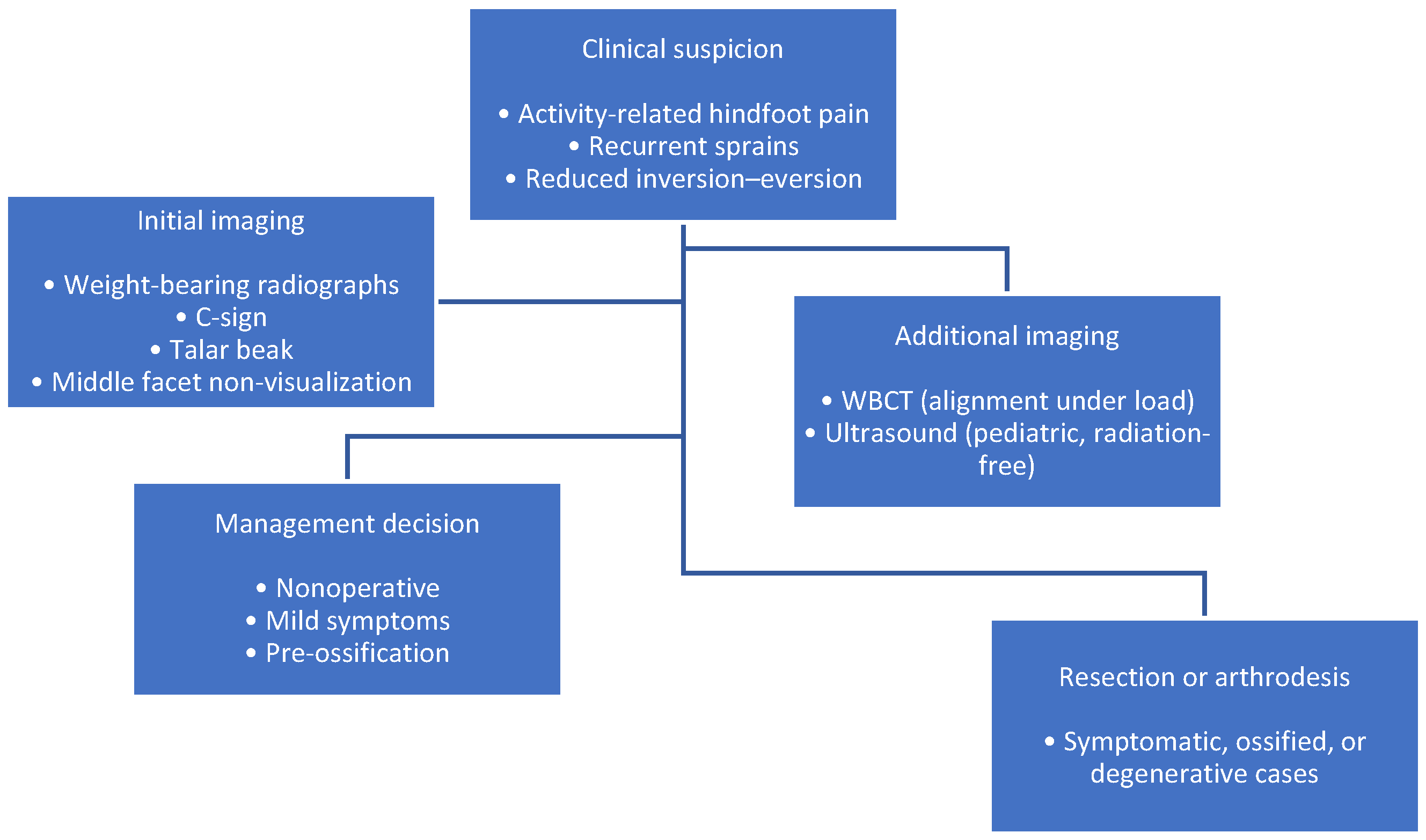
- Coalition resection: First popularized in the early 20th century and later refined by Badgley and Harris, resection aims to remove the abnormal bridge and restore subtalar mobility [5,6]. Fat, muscle, tendon, or bone wax is commonly used for interposition to reduce recurrence [32,41]. According to Wilde [40], favourable outcomes after resection of TC coalition are expected when the coalition involves no more than 50% of the posterior facet of the calcaneus on coronal CT, heel valgus is less than 16 degrees, and there are no radiographic signs of subtalar arthritis. The presence of talar beaking, although frequently observed, does not appear to compromise the clinical result. Conversely, resection is associated with poorer outcomes when the coalition occupies more than 50% of the posterior facet, when heel valgus exceeds 16 degrees, and when degenerative changes or impingement of the lateral talar process on the calcaneus are present. Mubarak and Patel (2009) highlighted that resection is most effective in patients younger than 16 years, with coalitions involving <50% of the subtalar joint and without degenerative changes [49]. Long-term follow-up studies have reported return to sports in the majority of adolescent patients, especially when the middle facet is isolated [51]. However, recurrence, incomplete pain relief, and progressive deformity remain possible, particularly in large or posterior facet coalitions. In a series of 20 non-osseous TC coalitions assessed with 3D-CT, the posterior facet and total joint surface areas were significantly larger than controls (40% and 12%, respectively), and postoperative American Orthopaedic Foot and Ankle Society (AOFAS) scores improved in all resected cases, supporting resection as a valid option for non-osseous coalitions [47]. In the largest systematic review to date on adult TC coalition (72 patients), resection proved a safe option, with superior outcomes reported for endoscopic techniques or flexor hallucis longus tendon interposition, while conservative management showed limited benefit [50]. In a prospective series of 97 tarsal coalition resections (49 TC), patients achieved high satisfaction and functional improvement, with a mean return to activity at 18.3 ± 9.6 weeks and a Roles and Maudsley score of 1.3 at final follow-up [54].
- •
- Arthrodesis: Subtalar or triple arthrodesis is reserved for severe, extensive, or degenerative coalitions, most often in older adolescents or adults [25]. This procedure reliably relieves pain and stabilizes the hindfoot, but at the expense of subtalar motion. Harris and Beath already noted in 1948 that arthrodesis provided durable symptom relief when resection was unlikely to succeed [6]. Triple arthrodesis is recommended in cases with >50% joint involvement, arthrosis, or marked hindfoot malalignment. In adolescents, the choice between resection and arthrodesis remains debated, but in adults with symptomatic coalitions unresponsive to conservative care, arthrodesis is generally required to achieve reliable pain relief and functional improvement [55]. According to Recordon et al. in pediatric and adolescent patients, most foot deformities can be managed conservatively or with joint-preserving procedures, but in severe fixed deformities triple arthrodesis remains a valuable option to relieve pain, correct alignment, and maintain a plantigrade foot [45].
3.3. Emerging Techniques
3.4. Hindfoot Alignment and Adjunctive Procedures
3.5. Post-Operative and Complications
4. Discussion
5. Conclusions
Author Contributions
Funding
Institutional Review Board Statement
Informed Consent Statement
Data Availability Statement
Conflicts of Interest
Abbreviations
| AOFAS | American Orthopaedic Foot and Ankle Society |
| AP | Antero-posterior |
| CN | Calcaneonavicular |
| CT | Computed tomography |
| FDL | Flexor digitorum longus |
| FHL | Flexor hallucis longus |
| NSAIDs | Non-steroidal anti-inflammatory drugs |
| MRI | Magnetic resonance imaging |
| PASTA | Percutaneous subtalar arthrodesis |
| TC | Talocalcaneal |
| VAS | Visual Analogue Scale |
References
- Cowell, H.R.; Elener, V. Rigid Painful Flatfoot Secondary to Tarsal Coalition. Clin. Orthop. Relat. Res. 1983, 177, 54–60. [Google Scholar] [CrossRef]
- Mosca, V.S. Subtalar Coalition in Pediatrics. Foot Ankle Clin. 2015, 20, 265–281. [Google Scholar] [CrossRef]
- Guduri, V.; Dreyer, M.A. Talocalcaneal Coalition. In StatPearls; StatPearls Publishing: Treasure Island, FL, USA, 2025. [Google Scholar]
- Slomann, H.C. On coalition calcaneo-navicularis. J. Orthop. Surg. 1921, 3, 586–602. [Google Scholar]
- Badgley, C.E. Coalition of the Calcaneus and the Navicular. Arch. Surg. 1927, 15, 75–88. [Google Scholar] [CrossRef]
- Harris, R.I.; Beath, T. Etiology of Peroneal Spastic Flat Foot. J. Bone Jt. Surg. Br. 1948, 30B, 624–634. [Google Scholar] [CrossRef]
- Leonard, M.A. The Inheritance of Tarsal Coalition and Its Relationship to Spastic Flat Foot. J. Bone Jt. Surg. Br. 1974, 56B, 520–526. [Google Scholar] [CrossRef]
- Mosier, K.M.; Asher, M. Tarsal Coalitions and Peroneal Spastic Flat Foot—A Review. J. Bone Jt. Surg. 1984, 66, 976. [Google Scholar] [CrossRef]
- Jayakumar, S.; Cowell, H.R. Rigid Flatfoot. Clin. Orthop. Relat. Res. 1977, 122, 77–84. [Google Scholar] [CrossRef]
- Taniguchi, A.; Tanaka, Y.; Kadono, K.; Takakura, Y.; Kurumatani, N. C Sign for Diagnosis of Talocalcaneal Coalition. Radiology 2003, 228, 501–505. [Google Scholar] [CrossRef] [PubMed]
- Docquier, P.-L.; Maldaque, P.; Bouchard, M. Tarsal Coalition in Paediatric Patients. Orthop. Traumatol. Surg. Res. 2019, 105, S123–S131. [Google Scholar] [CrossRef] [PubMed]
- Nalaboff, K.M.; Schweitzer, M.E. MRI of Tarsal Coalition. Bull. NYU Hosp. Jt. Dis. 2008, 66, 14. [Google Scholar]
- Rühli, F.; Solomon, L.; Henneberg, M. High Prevalence of Tarsal Coalitions and Tarsal Joint Variants in a Recent Cadaver Sample and Its Possible Significance. Clin. Anat. 2003, 16, 411–415. [Google Scholar] [CrossRef]
- Murphy, J.S.; Mubarak, S.J. Talocalcaneal Coalitions. Foot Ankle Clin. 2015, 20, 681–691. [Google Scholar] [CrossRef]
- Park, J.J.; Seok, H.G.; Woo, I.H.; Park, C.H. Racial Differences in Prevalence and Anatomical Distribution of Tarsal Coalition. Sci. Rep. 2022, 12, 21567. [Google Scholar] [CrossRef]
- Martus, J.E.; Femino, J.E.; Caird, M.S.; Kuhns, L.R.; Craig, C.L.; Farley, F.A. Accessory Anterolateral Talar Facet as an Etiology of Painful Talocalcaneal Impingement in the Rigid Flatfoot: A New Diagnosis. Iowa Orthop. J. 2008, 28, 1–8. [Google Scholar] [PubMed]
- Fernández-Rojas, E.; Monteagudo de la Rosa, M.; Martínez de Albornoz Torrente, P.; Maceira Suárez, E. Clinical Characterization of Patients with Tarsal Coalitions. 12 Years of Experience in a High Complexity Hospital. Rev. Esp. Cir. Ortop. Traumatol. 2024, 69, 260–266. [Google Scholar] [CrossRef]
- Lateur, L.M.; Van Hoe, L.R.; Van Ghillewe, K.V.; Gryspeerdt, S.S.; Baert, A.L.; Dereymaeker, G.E. Subtalar Coalition: Diagnosis with the C Sign on Lateral Radiographs of the Ankle. Radiology 1994, 193, 847–851. [Google Scholar] [CrossRef]
- Chen, K.-C.; Lan, H.H.-C.; Hwang, J.-I. Talocalcaneal Coalition: An Easily Overlooked Abnormality—A Case Report. Tungs’ Med. J. 2024, 18, 37–41. [Google Scholar] [CrossRef]
- Mascio, A.; Comisi, C.; Cinelli, V.; Pitocco, D.; Greco, T.; Maccauro, G.; Perisano, C. Radiological Assessment of Charcot Neuro-Osteoarthropathy in Diabetic Foot: A Narrative Review. Diagnostics 2025, 15, 767. [Google Scholar] [CrossRef] [PubMed]
- Mascio, A.; Greco, T.; Maccauro, G.; Perisano, C. Lisfranc Complex Injuries Management and Treatment: Current Knowledge. Int. J. Physiol. Pathophysiol. Pharmacol. 2022, 14, 161–170. [Google Scholar]
- Crim, J.R.; Kjeldsberg, K.M. Radiographic Diagnosis of Tarsal Coalition. Am. J. Roentgenol. 2004, 182, 323–328. [Google Scholar] [CrossRef]
- Sakellariou, A.; Sallomi, D.; Janzen, D.L.; Munk, P.L.; Claridge, R.J.; Kiri, V.A. Talocalcaneal Coalition. Diagnosis with the C-Sign on Lateral Radiographs of the Ankle. J. Bone Jt. Surg. Br. 2000, 82, 574–578. [Google Scholar] [CrossRef]
- Kawalec, J.S.; Mariano, A.; Thoman, S.; Osher, L.S. The C-Sign in Normal Feet: A Prospective Study and Novel Imaging Algorithm for Subtalar Joint Tarsal Coalition. Foot 2021, 46, 101752. [Google Scholar] [CrossRef] [PubMed]
- Newman, J.S.; Newberg, A.H. Congenital Tarsal Coalition: Multimodality Evaluation with Emphasis on CT and MR Imaging. Radiographics 2000, 20, 321–332; quiz 526–527, 532. [Google Scholar] [CrossRef]
- Li, X.-T.; Shen, X.-T.; Wu, X. Ultrasonography or Radiography for Suspected Pediatric Talocalcaneal Coalition. J. Pediatr. Orthop. 2025, 46, e132–e137. [Google Scholar] [CrossRef]
- Ozyurek, S.; Guler, F.; Turan, A.; Kose, O. Symptomatic Talar Beak in Talocalcaneal Coalition. BMJ Case Rep. 2013, 2013, bcr2013009309. [Google Scholar] [CrossRef] [PubMed]
- Lee, S.H.; Park, H.J.; Yeo, E.D.; Lee, Y.K. Talocalcaneal Coalition: A Focus on Radiographic Findings and Sites of Bridging. Indian J. Orthop. 2016, 50, 661–668. [Google Scholar] [CrossRef] [PubMed]
- Lintz, F.; de Cesar Netto, C.; Barg, A.; Burssens, A.; Richter, M.; Weight Bearing CT International Study Group. Weight-Bearing Cone Beam CT Scans in the Foot and Ankle. EFORT Open Rev. 2018, 3, 278–286. [Google Scholar] [CrossRef]
- Polichetti, C.; Borruto, M.I.; Lauriero, F.; Caravelli, S.; Mosca, M.; Maccauro, G.; Greco, T.; Perisano, C. Adult Acquired Flatfoot Deformity: A Narrative Review about Imaging Findings. Diagnostics 2023, 13, 225. [Google Scholar] [CrossRef]
- Wang, A.; Shi, W.; Gao, L.; Chen, L.; Xie, X.; Zhao, F.; Pi, Y.; Jiao, C.; Hu, Y.; Jiang, D.; et al. A New Classification of Talocalcaneal Coalitions Based on Computed Tomography for Operative Planning. BMC Musculoskelet. Disord. 2021, 22, 678. [Google Scholar] [CrossRef]
- Rozansky, A.; Varley, E.; Moor, M.; Wenger, D.R.; Mubarak, S.J. A Radiologic Classification of Talocalcaneal Coalitions Based on 3D Reconstruction. J. Child. Orthop. 2010, 4, 129–135. [Google Scholar] [CrossRef]
- Kumar, S.J.; Guille, J.T.; Lee, M.S.; Couto, J.C. Osseous and Non-Osseous Coalition of the Middle Facet of the Talocalcaneal Joint. J. Bone Jt. Surg. 1992, 74, 529. [Google Scholar] [CrossRef]
- Marth, A.A.; Feuerriegel, G.C.; Marcus, R.P.; Sutter, R. How Accurate Is MRI for Diagnosing Tarsal Coalitions? A Retrospective Diagnostic Accuracy Study. Eur. Radiol. 2024, 34, 3493–3502. [Google Scholar] [CrossRef] [PubMed]
- Ellsworth, B.K.; Kehoe, C.; DeFrancesco, C.J.; Bogner, E.; Mintz, D.N.; Scher, D.M. Talocalcaneal Tarsal Coalition Size: Evaluation and Reproducibility of MRI Measurements. J. Pediatr. Orthop. 2022, 42, e612–e615. [Google Scholar] [CrossRef] [PubMed]
- Masciocchi, C.; D’Archivio, C.; Barile, A.; Fascetti, E.; Zobel, B.B.; Gallucci, M.; Passariello, R. Talocalcaneal Coalition: Computed Tomography and Magnetic Resonance Imaging Diagnosis. Eur. J. Radiol. 1992, 15, 22–25. [Google Scholar] [CrossRef]
- Blockey, N.J. Peroneal Spastic Flat Foot. J. Bone Jt. Surg. Br. 1955, 37–B, 191–202. [Google Scholar] [CrossRef] [PubMed]
- Lemley, F.; Berlet, G.; Hill, K.; Philbin, T.; Isaac, B.; Lee, T. Current Concepts Review: Tarsal Coalition. Foot Ankle Int. 2006, 27, 1163–1169. [Google Scholar] [CrossRef] [PubMed]
- Vincent, K.A. Tarsal Coalition and Painful Flatfoot. J. Am. Acad. Orthop. Surg. 1998, 6, 274–281. [Google Scholar] [CrossRef]
- Wilde, P.H.; Torode, I.P.; Dickens, D.R.; Cole, W.G. Resection for Symptomatic Talocalcaneal Coalition. J. Bone Jt. Surg. Br. 1994, 76, 797–801. [Google Scholar] [CrossRef]
- Masquijo, J.; Turazza, F. Tarsal Coalition: Surgical Management in the Young Athlete. HSS J. 2024, 20, 383–389. [Google Scholar] [CrossRef]
- Ali Mousa, A.; Howaidy, A.E.F.; Mohamed, A.F.; Abd-Ella, M.M. Coalition Excision and Corrective Osteotomies versus Coalition Excision and Arthroereisis in Management of Pes Planovalgus with Talo-Calcaneal Coalition in Adolescents: A Randomized Controlled Trial. Foot Ankle Surg. 2023, 29, 466–474. [Google Scholar] [CrossRef] [PubMed]
- Zaidman, M.; Weisstub, E.; Goldman, V.; Simanovsky, N. Resection of Talocalcaneal Coalition With Calcaneal Lengthening Osteotomy: Short-to-Intermediate-Term Results. Cureus 2024, 16, e72846. [Google Scholar] [CrossRef] [PubMed]
- Jay, R.M.; Din, N. Correcting Pediatric Flatfoot with Subtalar Arthroereisis and Gastrocnemius Recession: A Retrospective Study. Foot Ankle Spec. 2013, 6, 101–107. [Google Scholar] [CrossRef]
- Recordon, J.; Muir, D. Triple Fusion in Children and Adolescents. J. Pediatr. Soc. North. Am. 2024, 5, 779. [Google Scholar] [CrossRef]
- King, A.; Parsons, S. Endoscopic Resection of Tarsal Coalitions. Foot Ankle Clin. 2020, 25, 493–503. [Google Scholar] [CrossRef]
- Yoneda, A.; Tanaka, Y.; Fujii, H.; Isomoto, S.; Sugimoto, K. Morphologic Analysis of Nonosseous Talocalcaneal Coalitions Using 3D Reconstruction. Foot Ankle Orthop. 2021, 6, 24730114211039487. [Google Scholar] [CrossRef] [PubMed]
- Masquijo, J.; Allende, V.; Torres-Gomez, A.; Dobbs, M.B. Fat Graft and Bone Wax Interposition Provides Better Functional Outcomes and Lower Reossification Rates Than Extensor Digitorum Brevis After Calcaneonavicular Coalition Resection. J. Pediatr. Orthop. 2017, 37, e427–e431. [Google Scholar] [CrossRef]
- Mubarak, S.J.; Patel, P.N.; Upasani, V.V.; Moor, M.A.; Wenger, D.R. Calcaneonavicular Coalition: Treatment by Excision and Fat Graft. J. Pediatr. Orthop. 2009, 29, 418. [Google Scholar] [CrossRef]
- Dermanis, A.A.; Elmajee, M.; Duffaydar, H.; Aljawadi, A.; Hussain, S.; Pillai, A. Talocalcaneal Coalition Resection in the Adult Population: A Systematic Review. Cureus 2022, 14, e30581. [Google Scholar] [CrossRef]
- Wang, Z.; Gou, X.; Yang, F.; Chen, Y.; Tao, X.; Zheng, G. Comparative Analysis of Clinical Outcomes of Talocalcaneal Coalition Resection: Subtalar Joint Middle and Posterior Facet Involvement versus Isolated Posterior Facet Involvement—A Retrospective Cohort Study. J. Orthop. Surg. Res. 2024, 19, 657. [Google Scholar] [CrossRef]
- Song, B.; Zhang, X.; Wang, H.; Zhang, Q.; Zhang, H.; Zhang, C. Diagnostic Value of High-Frequency Ultrasonography for Painful Talocalcaneal Coalition and Its Complications. Br. J. Radiol. 2023, 96, 20230093. [Google Scholar] [CrossRef] [PubMed]
- Moyes, S.T.; Crawfurd, E.J.; Aichroth, P.M. The Interposition of Extensor Digitorum Brevis in the Resection of Calcaneonavicular Bars. J. Pediatr. Orthop. 1994, 14, 387–388. [Google Scholar] [CrossRef]
- Saxena, A.; Allen, R.; Wright, A.; Migliorini, F.; Maffulli, N. Tarsal Coalition Resections: A Long-Term Retrospective Analysis of 97 Resections in 78 Patients. J. Orthop. Surg. Res. 2022, 17, 458. [Google Scholar] [CrossRef]
- Thorpe, S.W.; Wukich, D.K. Tarsal Coalitions in the Adult Population: Does Treatment Differ from the Adolescent? Foot Ankle Clin. 2012, 17, 195–204. [Google Scholar] [CrossRef]
- Comfort, T.K.; Johnson, L.O. Resection for Symptomatic Talocalcaneal Coalition. J. Pediatr. Orthop. 1998, 18, 283–288. [Google Scholar] [CrossRef]
- Wang, A.; Chen, L.; Pi, Y.; Zhao, F.; Xie, X.; Jiao, C.; Hu, Y.; Jiang, D.; Guo, Q. Midterm Outcomes of Talocalcaneal Coalition Arthroscopic Resection in Adults. Foot Ankle Int. 2022, 43, 1062–1069. [Google Scholar] [CrossRef]
- Saraiva, D.; Knupp, M.; Rodrigues, A.S.; Gomes, T.M.; Oliva, X.M. Outcomes of Posterior Arthroscopic Subtalar Arthrodesis for Medial Facet Talocalcaneal Coalition. Foot Ankle Int. 2021, 42, 1547–1553. [Google Scholar] [CrossRef] [PubMed]
- Sun, Y.; Cai, W.; Huang, X.; Li, J.; Li, Q. Total Arthroscopic Resection of the Talocalcaneal Coalition in Adults: Key Points of Surgical Technique. Orthop. Surg. 2024, 16, 2960–2966. [Google Scholar] [CrossRef] [PubMed]
- Gantsoudes, G.D.; Roocroft, J.H.; Mubarak, S.J. Treatment of Talocalcaneal Coalitions. J. Pediatr. Orthop. 2012, 32, 301–307. [Google Scholar] [CrossRef]
- Ortiz, C.A.; Wagner, E.; Wagner, P. Arthroereisis: What Have We Learned? Foot Ankle Clin. 2018, 23, 415–434. [Google Scholar] [CrossRef]
- Di Gennaro, G.L.; Stallone, S.; Olivotto, E.; Zarantonello, P.; Magnani, M.; Tavernini, T.; Stilli, S.; Trisolino, G. Operative versus Nonoperative Treatment in Children with Painful Rigid Flatfoot and Talocalcaneal Coalition. BMC Musculoskelet. Disord. 2020, 21, 185. [Google Scholar] [CrossRef]
- Hubert, J.; Hawellek, T.; Beil, F.T.; Saul, D.; Kling, J.H.; Viebahn, C.; Jungesblut, O.; Stücker, R.; Rupprecht, M. Resection of Medial Talocalcaneal Coalition With Interposition of a Pediculated Flap of Tibialis Posterior Tendon Sheath. Foot Ankle Int. 2018, 39, 935–941. [Google Scholar] [CrossRef] [PubMed]
- El Shazly, O.; Abou El Ela, A.A.K.H. Percutaneous Resection of Calcaneo-Navicular Coalition with Interposition of Synthetic Graft. Foot 2011, 21, 138–141. [Google Scholar] [CrossRef] [PubMed]
- Spaans, A.J.; Korbee, S.E.; Simoens, N.C.; van Bergen, C.J.A. Comparison of Different Interposition Techniques after Surgical Resection of Tarsal Coalitions in Children: A Systematic Review. J. Pediatr. Orthop. B 2025, 34, 1–8. [Google Scholar] [CrossRef]
- O’Neill, D.B.; Micheli, L.J. Tarsal Coalition. A Followup of Adolescent Athletes. Am. J. Sports Med. 1989, 17, 544–549. [Google Scholar] [CrossRef] [PubMed]
- Salomão, O.; Napoli, M.M.; de Carvalho Júnior, A.E.; Fernandes, T.D.; Marques, J.; Hernandez, A.J. Talocalcaneal Coalition: Diagnosis and Surgical Management. Foot Ankle 1992, 13, 251–256. [Google Scholar] [CrossRef]
- Luhmann, S.J.; Schoenecker, P.L. Symptomatic Talocalcaneal Coalition Resection: Indications and Results. J. Pediatr. Orthop. 1998, 18, 748–754. [Google Scholar] [CrossRef]
- Raikin, S.; Cooperman, D.R.; Thompson, G.H. Interposition of the Split Flexor Hallucis Longus Tendon after Resection of a Coalition of the Middle Facet of the Talocalcaneal Joint. J. Bone Jt. Surg. Am. 1999, 81, 11–19. [Google Scholar] [CrossRef]
- Jackson, T.J.; Larson, A.N.; Mathew, S.E.; Milbrandt, T.A. Incidence of Symptomatic Pediatric Tarsal Coalition in Olmsted County: A Population-Based Study. J. Bone Jt. Surg. Am. 2021, 103, 155–161. [Google Scholar] [CrossRef]
- Kothari, A.; Masquijo, J. Surgical Treatment of Tarsal Coalitions in Children and Adolescents. EFORT Open Rev. 2020, 5, 80–89. [Google Scholar] [CrossRef]
- Inglis, G.; Buxton, R.A.; Macnicol, M.F. Symptomatic Calcaneonavicular Bars. The Results 20 Years after Surgical Excision. J. Bone Jt. Surg. Br. 1986, 68, 128–131. [Google Scholar] [CrossRef]



| Imaging Modality | Main Advantages | Indications | Key Findings | Limitations | Clinical Role |
|---|---|---|---|---|---|
| CT | High spatial resolution; excellent bony detail; 3D reconstructions | Preoperative planning; assessment of coalition size and morphology | Osseous bridging, facet involvement, coalition extent | Limited detection of non-osseous coalitions; radiation exposure | Precise anatomical definition and preoperative planning |
| MRI | Superior soft-tissue contrast; no radiation | Suspected fibrous/cartilaginous coalition; inconclusive radiographs/CT; pediatric patients | Non-osseous coalition, bone marrow edema, cartilage damage, joint effusion, osteochondral lesions | Less precise bony detail than CT; less optimal for surgical planning | Suspected non-osseous coalition or persistent symptoms despite negative/inconclusive radiographs or CT |
| Approach | Indications | Main Techniques | Outcomes | Limitations |
|---|---|---|---|---|
| Conservative management | Children/adolescents with mild symptoms; early stages before ossification [5,7,38] |
| Temporary pain relief and functional improvement [5] | Limited long-term efficacy, poor results once coalition ossifies [38] |
| Coalition resection | Failed conservative care; patients < 16 years; coalition < 50% of posterior facet; heel valgus < 16°; no subtalar arthritis [36,37,39,40] |
|
| Poor results if >50% facet involvement, valgus > 16°, degenerative changes [39,40]. Recurrence or progressive deformity is possible [53] |
| Arthrodesis (subtalar/triple) | Severe, extensive, or degenerative coalitions; adults; failed resection candidates [25,36,54,55,56] |
|
| Loss of subtalar motion Salvage option in severe deformities |
| Emerging techniques | Selected cases requiring minimally invasive or innovative approaches [45,46,57] |
| Evidence limited to mid-term results; need further studies [45,46,57] |
Disclaimer/Publisher’s Note: The statements, opinions and data contained in all publications are solely those of the individual author(s) and contributor(s) and not of MDPI and/or the editor(s). MDPI and/or the editor(s) disclaim responsibility for any injury to people or property resulting from any ideas, methods, instructions or products referred to in the content. |
© 2026 by the authors. Licensee MDPI, Basel, Switzerland. This article is an open access article distributed under the terms and conditions of the Creative Commons Attribution (CC BY) license.
Share and Cite
Mascio, A.; Comisi, C.; Cinelli, V.; Moretti, F.; Assegbede, G.; Maccauro, G.; Greco, T.; Perisano, C. Talocalcaneal Coalition: Current Concepts, Clinical Implications, and Management Strategies. Life 2026, 16, 495. https://doi.org/10.3390/life16030495
Mascio A, Comisi C, Cinelli V, Moretti F, Assegbede G, Maccauro G, Greco T, Perisano C. Talocalcaneal Coalition: Current Concepts, Clinical Implications, and Management Strategies. Life. 2026; 16(3):495. https://doi.org/10.3390/life16030495
Chicago/Turabian StyleMascio, Antonio, Chiara Comisi, Virginia Cinelli, Federico Moretti, Gloria Assegbede, Giulio Maccauro, Tommaso Greco, and Carlo Perisano. 2026. "Talocalcaneal Coalition: Current Concepts, Clinical Implications, and Management Strategies" Life 16, no. 3: 495. https://doi.org/10.3390/life16030495
APA StyleMascio, A., Comisi, C., Cinelli, V., Moretti, F., Assegbede, G., Maccauro, G., Greco, T., & Perisano, C. (2026). Talocalcaneal Coalition: Current Concepts, Clinical Implications, and Management Strategies. Life, 16(3), 495. https://doi.org/10.3390/life16030495